Where would children’s fiction be without cannibalism? Think of Hansel and Gretel, Jack and the Beanstalk, The Robber Bridegroom, and even Snow White. Charles Perraut, called the founder of fairy tales, seems to have only had four stories that did NOT involve some sort of story about humans being eaten, by humans or at least by anthropomorphic monsters.
Yeah, wasn’t just a souvenir
What reminded me of all this was this wonderful article from The Onion, entitled:
There is a link to it in the box above this – well worth a read. Remember that The Onion is a satirical magazine…
But it inspired me to check the preview clips. They have some work to do for this movie – it’s 14 years since the original, so the kids who waited patiently for the sequel have grown up and gone on to adult pursuits like Game of Thrones (also full of cannibalism). Perhaps they have had kids, and will take them to see it.
Here’s the clip. Watch Baby Jack-Jack turn into a demonic cannibal when refused cookies.
Sometimes, parenting can be difficult.
If you like my blog, please feel free to recommend it (with discretion) to friends on social media.
If you have any questions or comments, you can use the tag or email me on cannibalstudies@gmail.com.
Rakewas a television series which first aired on the ABC (Australian Broadcasting Commission for those of you in other parts of the world) in 2010. It ran for four seasons, which is pretty impressive, although Australian series are generally much shorter than those from the US – each season was only eight episodes, making 32 episodes in total, not much longer than season 3 of Lucifer (24 episodes).
Richard Roxburgh is superb as Cleaver Greene, a brilliant Sydney barrister who is always in trouble due to his predilection for the good life. A Sydney Morning Herald reviewer said of the show “Cleaver Greene is a magnificent comic creation, but you wouldn’t want him staying in your place too long.” Incidentally, the Americans had a go at making a version of it with Greg Kinnear as the “rake” but, without the laconic Aussie humour, it only lasted one season (of 13 episodes mind you).
Season 1 Episode 1 starts with a bang – the guest star is the superb Hugo Weaving (Elrond for Tolkien fans) who is a prominent economist with a habit that gets him into trouble: he is a cannibal. Turns out that he advertised for someone who wanted to be eaten (I’m not making this up – there are enough people out there who like this idea that the psychologists have coined a word, vorarephilia, which the enthusiasts have shortened to “vore”).
Like all truly unbelievable plots, this one is based on a true story. Armin Meiwes, a German computer technician, advertised on a fetish website called The Cannibal Café (not to be confused with the popular Vancouver restaurant) for “a well-built 18 to 30-year-old to be slaughtered and then consumed”. He actually received a heap of replies, but the only one that seemed sincere was Jürgen Brandes. The two met in 2001, Brandes took a lot of sleeping pills and half a bottle of schnapps, and they collaboratively sliced off Brandes’ penis and tried, unsuccessfully, to eat it with salt, pepper, wine, and garlic (it ended up in the dog’s bowl. Hope the dog was OK – garlic can be poison for them). Brandes went off to die in the bath while Meiwes read a Star Trek novel (well, he showed some good taste there) and, when he found Brandes still alive hours later, killed him and proceeded to eat quite a lot of him over the coming weeks and months.
Meiwes and Brandes
Rake doesn’t have that sort of time to waste (or presumably any Star Trek novels) so they simplified the plot – the defendant’s meal-ticket makes a video of himself taking a lethal dose of drugs, and he is definitely dead when Hugo’s character chops him up to fridge-sized portions. Where life and art meet is that in Germany, and in New South Wales, and pretty much everywhere else in the world, there is no actual law against cannibalism. Meiwes was charged with manslaughter as he had killed Brandes (at his request – a kind of assisted suicide), and was sentenced to eight years. Due to the ensuing publicity, a retrial was ordered and he was convicted of murder, on the grounds that he had talked Brandes into letting him kill him, for his own sexual pleasure.
In Rake, there is no such complication. The dude was dead at dinner time, and the case only becomes a murder trial because there is a State election coming up and the government needs to appear tough on cannibals. However, it is clear that there is no evidence for murder – you cannot really murder dead people. Hugo looks forward to his release, but as Cleaver points out “you ate someone. You’re never going home”.
Cannibalism is seen as so abject, so vile, that there is no chance of the cannibal going home, even when he clearly is not a murderer, and is guilty at worst of defiling a corpse. Yet why is it so? Eating a cow or sheep or pig who clearly wants to live (watch any one of thousands of Youtube abattoir clips) is fine, but eating a person who wanted, longed, to be eaten is grounds for being locked up for life.
“What could be more natural than wanting to consume human flesh? It combines our two most primal instincts into one single act…. you go that one tiny step further and we’re considered vampires, monsters that should be consigned into eternal darkness. It’s the worst sort of hypocrisy.”
Incidentally, Armin Meiwes is still in jail, this time under a life sentence. He now claims to be a vegetarian, and runs the local prison chapter of the Greens Party. I guess eating someone can make you think twice about eating meat.
If you like my blog, please feel free to recommend it (with discretion) to friends on social media.
If you have any questions or comments, you can use the tag, or email me on cannibalstudies@gmail.com.
There seem to be less heroes lately. If you watch the news, the heroes – the paramedics, the nurses, the teachers, the activists – those who choose to do good things because it’s the right thing to do – are usually unrecognised. The ones in the spotlight, the ones being treated as heroes, are the rich and famous, even the ones whose only claim to fame is being famous. The news cycle concentrates not on virtue but on suffering, and on vanity, fear, guilt and greed: the tools of the marketers.
I present for your consideration a hero of mine: Ingrid Newkirk, who founded People for the Ethical Treatment of Animals(PETA) almost forty years ago, and has steered it into becoming the largest and most active animal advocacy organisation in the world, with more than 6.5 million members and supporters.
The PETA mantra is:
Animals are not ours to eat, wear, experiment on, use for entertainment, or abuse in any other way.
How does this relate to a cannibal studies blog?
Well, Ingrid Newkirk has put a number of requests in her will, one of which is:
That the “meat” of my body, or a portion thereof, be used for a human barbecue, to remind the world that the meat of a corpse is all flesh, regardless of whether it comes from a human being or another animal
Ingrid tells the press: I want it fried up with onions, because people find it hard to resist the smell of frying onions. I can imagine them coming over and saying enthusiastically, “Oooh, what’s that?’ and then, “OMG, it’s HER!”
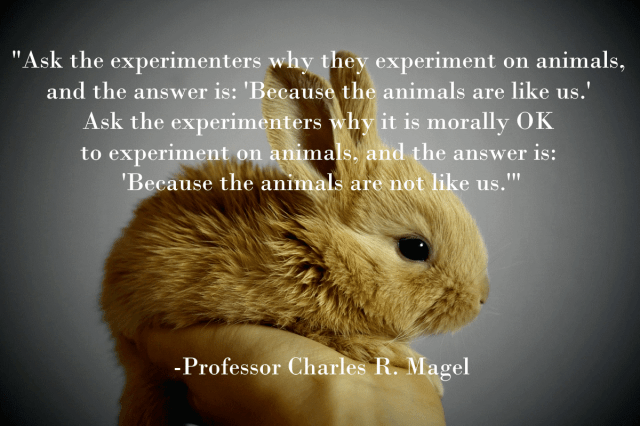
All abuse starts at the point where the proposed victim is objectified, turned from a living, breathing subject into a thing, an other, an “animal”, a piece of meat. To achieve this, we have all sorts of linguistic tricks which range from changing the names of victims (cows become “beef”, pigs become “pork”) to absurd suggestions that other animals are either mentally incapable or are automata that feel no pain. To make an animal brainless and painless, and therefore morally insignificant, is done through a nifty sleight of hand where non-humans are called “animals” and the Great Ape known as Homo sapiens somehow is not an considered an animal at all. An example: reports from medical researchers will usually distinguish “animal” trials from “human” trials.
Human cannibalism reminds us that we are animals, and that we are made of meat. It reminds us that, while we may be different to other animals (cognitively swifter than some, physically slower than others), we all suffer and die in the same ways. As Shakespeare said:
If you prick us, do we not bleed? If you tickle us, do we not laugh? If you poison us, do we not die?
One of the additional dangers of stripping moral worth from “animals” is that this can so easily be done to other humans who happen to be different colours, different genders, different faiths, different anything to us.
We need to be reminded that we are not demi-gods, that when we eat or wear or laugh at or test on “animals” we are causing massive suffering to beings not essentially different from ourselves. Even if no one eats from Ingrid’s planned barbecue (which I hope will not be held for many decades to come) they will hear the message. And if this offer of a cannibal feast makes people question why they are willing to feast on other sentient beings, then one more hole will be made in the rotten edifice that holds up the death industries, the exploitative corporations whose existence future generations will rightly condemn.
The cannibal goes out and hunts, pursues and kills another man and proceeds to cook and eat him precisely as he would any other game. There is not a single argument nor a single fact that can be offered in favor of flesh eating that cannot be offered with equal strength, in favor of cannibalism. Dr. Herbert Shelton, Superior Nutrition
If you like my blog, please feel free to recommend it (with discretion) to friends on social media. If you have any questions or comments, you can use the tag or email me on cannibalstudies@gmail.com.
The Texas chain saw massacre was named by Total Film as number one of the fifty greatest horror movies of all time. It spawned a number of sequels and prequels, but none as ground-breaking as the original, which was remastered in 2004 in 4K, making it that much more graphic. Time said that it set “a new standard for slasher films”. The concept of a vulnerable woman being terrorised by a monster was hardly new, and some critics suggested that the director, Tobe Hooper, may even have seen the Australian ‘slasher’ film Night of fear, so similar were the psychopaths. Night of fear was banned as too violent, and Texas chain saw, although less gory, was also banned in many countries, and was not available for showing in Australia for almost ten years after production. Night of fear moved from the knife or razor favoured in ‘slasher’ films to an axe; Texas chain saw escalated the weaponry even further with a large and very noisy chain saw. The chain saw is wielded by a particularly striking villain named Leatherface, so called due to his predilection for wearing a mask made of human skin.
Filmed in documentary style, on release it made a half-hearted attempt to appear to be a true story, whereas in fact it was based on the exploits of Ed Gein, a serial killer, but not a known cannibal, who was also the inspiration of Hitchcock’s Psycho (1960) as well as Buffalo Bill from The Silence of the Lambs. It was filmed on a tight budget against expectations it might never be cleared for exhibition. The respected critic Roger Ebert summed it up as “a grisly little item…I can’t imagine why anyone would want to make a movie like this, and yet it’s well-made, well-acted, and all too effective.” Such exploitative movies are profitable if made at the right price point, and Ebert grudgingly allows that the techniques and special effects are far better than the genre demands. He particularly liked the rapid montages of the survivor Sally screaming, with extreme close-ups of her bulging eyeballs, expressing all the foam flecked terror of any animal who realises she is about to be slaughtered.
Gimme a close-up!
Leatherface lives in a family of ‘others’ who terrorise, slaughter and eat passers-by. They are ‘white trash’, but made trash by the process of industrialisation of agriculture: the abattoir in which the whole family worked has automated or closed, leaving them to use their expertise on a different species. The protagonists are a group of young hipsters, driving their Kombi through Texas to check on the grave of the grandfather of Sally and Franklin, following reports (shown in graphic footage during the credits) of graves being desecrated and robbed (an Ed Gein speciality). The pseudo-documentary style introduction tells us that “an idyllic summer afternoon drive became a nightmare”, one that seems to be a thinly veiled exposition of the nightmare faced by the Woodstock generation as they moved from the summer of love into the fall of Vietnam, drugs, the Manson murders and Nixon’s Silent Majority. Hooper spoke of his inspiration coming from the “beginning of the end of the subculture”, while one critic wrote that Hooper opened the way for horror to become a “vehicle for articulating twentieth-century pessimism”. It is revealing that this film about social decline was crafted in the period between Nixon’s landslide re-election and his resignation.
Leatherface
Besides the disabled Franklin, the other four beautiful people are entirely two-dimensional, laughing at the quaint locals, reading horoscopes and heading off into unimagined horrors when looking for a non-existent swimming hole. Franklin does most of the talking, more so even than Sally, his sister, the only survivor, whose role is mostly to scream and run and scream more. Franklin reminisces about their grandfather (whose grave they are checking) and the abattoir where he used to sell his cattle. His speech is accompanied by images of cows waiting to be slaughtered or drooling, near death, as he describes the killing process – a sledgehammer: “it usually wouldn’t kill them on the first lick”. The cows queue for death as the young people drive past, on the way to their own identical slaughter. They pick up a hitchhiker who tells them his brother and grandfather work at the slaughterhouse. “My family’s always been in meat,” he tells them, an esoteric reference to their own imminent fate, which only the viewers appreciate.
The family
The family turn out to be very mentally troubled: the wild-eyed hitchhiker is the brother of Leatherface who occasionally puts down the chain saw and dons an apron to take a feminine role in the house of slaughter. Leatherface is actually humanised under his mask: grunting, sweating and showing us his deformed teeth he was as human as on-screen killers got in the days before Dexter and Hannibal. Another relative, the gas-station owner, appears normal and presents a disturbing picture of the schizophrenic nature of modern society: his station has no gas, he sells barbecued meat of a suspect origin, and he constantly offers Sally comfort as he recaptures her, gags her and beats her, all the time assuring her everything will be all right. I couldn’t help thinking of the protestations of farmers who insist that they care deeply about their animals, as they pack them onto trucks for the gruelling journey to a terrifying death.
The film’s final thirty minutes consist of Sally being chased, mostly with a chain saw, with occasional respites where she is captured and tormented before again leaping from windows. Hitchcock famously said that the chase is the “final expression” of the medium of film and ‘slasher’ movies thrive on them. Yet the film’s setting is deliberately confused: instead of the normative divide of country providing meat to the city, here the city kids are providing meat to the rural rejects. As the kids are slaughtered, we hear the sounds of pigs grunting, see a captive chicken awaiting her fate, in a room filled with the bones and skins of several species, particularly H. sapiens. The cannibals’ method of slaughter, the sledgehammer, the meat hook, the freezer, is the same as the way cattle and pigs are treated at an abattoir.
Pam learns how the professionals do it
Is the film a disguised polemic against farming and slaughtering animals? The reviewer Forrest Wickman called it “forehead-slappingly obvious” in his review “The Ultimate Pro-Vegetarian Film Is the Last Movie You’d Expect”. So much so that PETA listed it in its “top 10 movies that make you go meatless”. Hooper said in an interview that he gave up meat while making the film: “the heart of the film was about meat; it’s about the chain of life and killing sentient beings”. He also claimed that Guillermo Del Toro, no shrinking violet himself in abject film-making, gave up meat after seeing it.
Sally and friends
Nothing is as it should be in this film, nor was it in Nixon’s and Hooper’s America, circa 1974. It is filmed in bright Texan sunshine rather than horror’s normal Gothic gloom, the psychopathic Leatherface is cooking in an apron when Sally is carried in, Sally’s terror at the dinner table is accompanied with the noises of non-diegetic pigs, the normal filmic heroes (young white males) are butchered without any defence offered, and what were they all eating when they stopped the Kombi at the gas station and bought barbecue? Who among us, Hooper seems to ask, is not a cannibal?
If you like my blog, please feel free to recommend it (with discretion) to friends on social media.
If you have any questions or comments, you can use the tag or email cannibalstudies@gmail.com.
Stephen Colbert took over the Late Show from David Letterman in September 2015, but really started drawing the big crowds when Donald Trump was elected President a bit over a year later. Colbert skewers Trump nightly on the late-night show (in fairness, a lot of the material seems to write itself), so when Jodie Foster, who played Clarice Starling in Silence of the Lambs, the movie that brought Hannibal Lecter to fame in 1991, appeared as a guest on the Late Showlast December, it made sense that she would appear as a Special Agent. But instead of working for Jack Crawford, hunting serial killers, she is now working for Robert Mueller, hunting the Russian connection to the President.
Here is part the scene they are spoofing, from The Silence of the Lambs.
Go and watch it again. It’s a classic, and has been used hundreds of times in satirical pieces of all sorts. Hannibal is one of the most iconic figures of our time. Representing voracious appetite, a disavowal of the old humanist ideals of the sanctity of human life, a love of the good things of life, and a wicked sense of humour, it’s pretty clear why that might be so.
If you like my blog, please feel free to recommend it (with discretion) to friends on social media.
If you have any questions or comments, you can use the tag or email me on cannibalstudies@gmail.com.
Well, first off, it’s Anthony Hopkins as a sort-of-cannibal – a welcome return! Titus, the first filmic version of Shakespeare’s first tragedy Titus Andronicus, was made eight years after Silence of the Lambs, which had brought Hopkins fame and an Oscar for best actor. He had played other monsters in the years between Titus and Silence, including Richard Nixon and Pablo Picasso. A couple of years later (2001) he reprised the role of Hannibal Lecter in the movie Hannibal, so Titus was a handy reminder of that sudden Hannibal facial contortion. The movie Titus cost $25 million to make, and grossed less than a tenth of that, so it was, in technical language, a bomb. Shame, as it is a rollicking version of one of Shakespeare’s most difficult plays, and the cast is sublime.
Shakespeare was well aware of stories of strange foreigners known as anthropophagi, or as Columbus had named them “cannibales” (a corruption of the name of the Carib tribe whose neighbours had been telling him tall tales about them). Later references, particularly to the monstrous anagram Caliban in The Tempest, were more nuanced, probably due to his reading of the essays of Montaigne. But in Titus, although there is a POC or “Moor” who is a malevolent villain, it is not the Moor who is the cannibal, and the eating of human flesh is done neither for gustatory or psychotic reasons – it is an act of revenge.
Titus refuses power in Rome, never a good idea in tragedies, and is subsequently betrayed by the Emperor Saturninus, a role camped up mightily by Alan Cumming, and his bride Tamora, Titus’ sworn enemy, played by the splendid Jessica Lange. There is much bloodshed, even for Shakespeare, quite a lot even for a cannibal blog, but the act of cannibalism is an “innocent” one, in the sense that the person eating humans is not aware of the contents of the pie until digestion has commenced. Much like the Board of the Baltimore Philharmonic, unknowingly tucking into the second flautist around Hannibal Lecter’s dinner table.
The cannibal, the person who eats human flesh, is Tamora, and the flesh is that of her sons, who have not only raped Titus’ daughter, killed her husband and cut off her hands, but have also cut out her tongue to stop her giving evidence against them (based on another Greek myth – Philomela). Yeah, that trick was never going to work, and so we find them hanging upside down, buck naked, while Titus explains his plans for them:
Hark, villains, I will grind your bones to dust,
And with your blood and it I’ll make a paste,
And of the paste a coffin I will rear,
And make two pasties of your shameful heads,
And bid that strumpet, your unhallowed dam,
Like to the earth, swallow her own increase.
And so he does, and Mummy rather enjoys the pie, until Titus explains his little jest, and kills her. The Greeks of course were very big on revenge cannibalism – think Atreus and Thyestes – so Shakespeare had plenty of literary meat for his inspiration. Well, we’ve all been to awkward family dinners, but these guys take the cake. Or in the case of Titus, the pie.
If you like my blog, please feel free to recommend it (with discretion) to friends on social media. If you have any questions or comments, you can use the tag or email me on cannibalstudies@gmail.com.
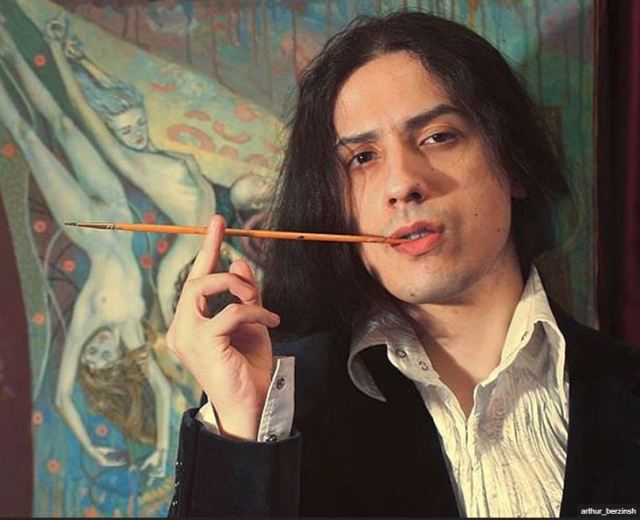
I don’t know if you’re into Facebook Live streaming, although lately people seem to be leaving Facebook rather than trying to find new ways of spending time on it. But a lot of people seem to have tuned in to a stream on 6 March 2018 of a performance named ‘Eschatology’ by artist Arturs Bērziņš at Museum LV un Grata JJ, in Riga, Latvia.
Portrait of the artist as a young autophage
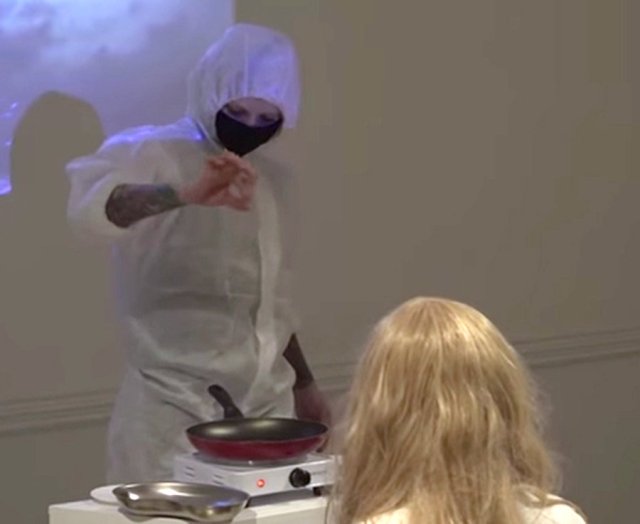
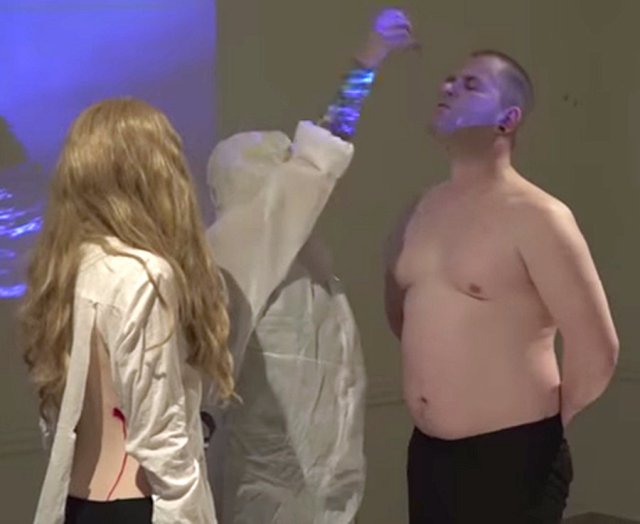
The footage showed Bērziņš’s assistant pulling on a white medical outfit, scalpel in hand, and cutting chunks of meat from the backs of two volunteers, one male and one female, apparently without anaesthetic. The assistant then fries the meat it in a large black pan.
I’ll spare you the unkindest cut, but you can, if you wish, see it on Youtube:
A small audience watches, phone cameras ready, and a couple more stand in the doorway, perhaps anticipating the need for a quick getaway. Spooky music plays as the assistant adds salt and pepper and perhaps some more exotic spices to the meagre meal and feeds the fragments to the volunteers.
The artist later said: “It’s not fake, but it also is not cannibalism. Each of them ate his or her own piece of skin after (a) scarification procedure. Otherwise fingernail gnawing also can be proclaimed as cannibalism.” Something to consider next time you can’t be bothered reaching for the nail-file.
The artist later commented “What we do daily with ourselves is much worse than any performance. The viewer has to face the genuineness. Genuine pain. Genuine action that has stepped out of abstraction into a real world. The viewer needs to be intellectually prepared for such an experience as this. Otherwise they’ll simply claim I have a screw loose and return to the infernal trance of everyday life.”
Is this the new face of competitive cooking shows?
If you like my blog, please feel free to recommend it (with discretion) to friends on social media.
If you have any questions or comments, you can use the tag or email cannibalstudies@gmail.com.
Yeah, but this movie 45 years old, so if you haven’t seen it by now, you’re either not going to, or if you are, it’s because you found out (maybe from this blog) that it’s a cannibal film! So: that IS the spoiler.
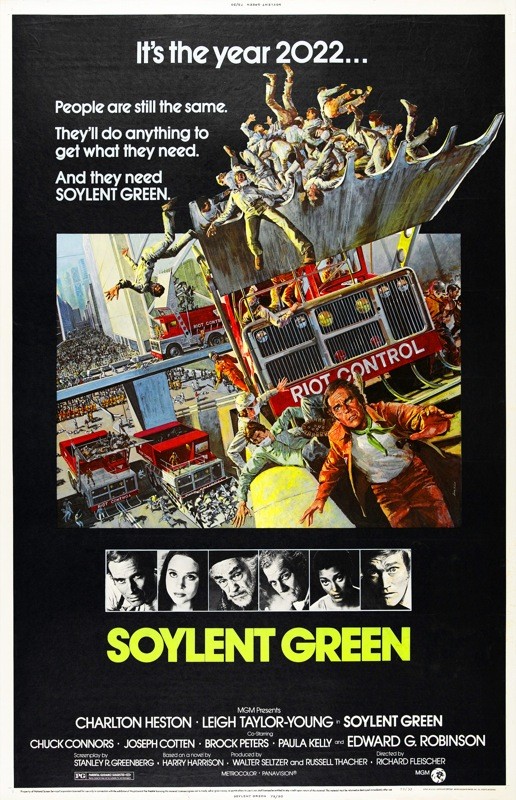
Soylent Green presents quite a different picture of survival cannibalism to Alive. Starting with idealised images of leisured gentlefolk posing before Victorian and Edwardian cameras, the opening montage rapidly records the deterioration of humanity through mass production of commodities (starting with Model T Fords) through to alienated office workers, packed freeways and trains, mountains of garbage and clouds of pollution. The montage is followed by an intertitle explaining that the year is 2022 (fifty years in the future, when the film was made) and that New York City now has a population of forty million. People are crammed everywhere – sleeping on the stairs of apartment blocks and in the abandoned cars that fill the broken roads. The protagonist, Frank Thorn (Charlton Heston), is a New York cop, sweltering in his tiny apartment. He watches an advertisement for the Soylent corporation promoting new “Soylent Green”, a miracle food said to contain ocean plankton. His room-mate Sol (Edward G Robinson) tells us of the days of his youth when food was real: the Greenhouse Effect has made everything “burn up”. The only food now is manufactured – Soylent biscuits and margarine. The rich, however, can buy fresh food from highly fortified shops; even meat is available “under the counter”.
This is class warfare – the rich can eat real food from the rural areas, which are guarded like fortresses to protect them for the privileged. The poor must queue for water and whatever artificial fare the giant corporations manufacture. Meat itself is described as “something special” by both the shopkeeper and Shirl (Leigh Taylor-Young), the woman buying it for her rich lover, Simonson (Joseph Cotten). Shirl is considered “furniture” in that she comes with the apartment (Thorn asks “personal or building?”) and is only prized for her beauty and utility. This is classic commodity fetishism: she is a commodity, while the food she buys is personalised and admired. Shirl and the other “furniture” women are given one day off a month and can be beaten indiscriminately by the owners and building manager. On the street, crowd control consists of “scoops”: bulldozers which shovel rioters up and dump them into disposal trucks.
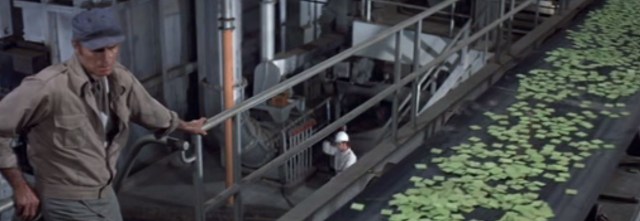
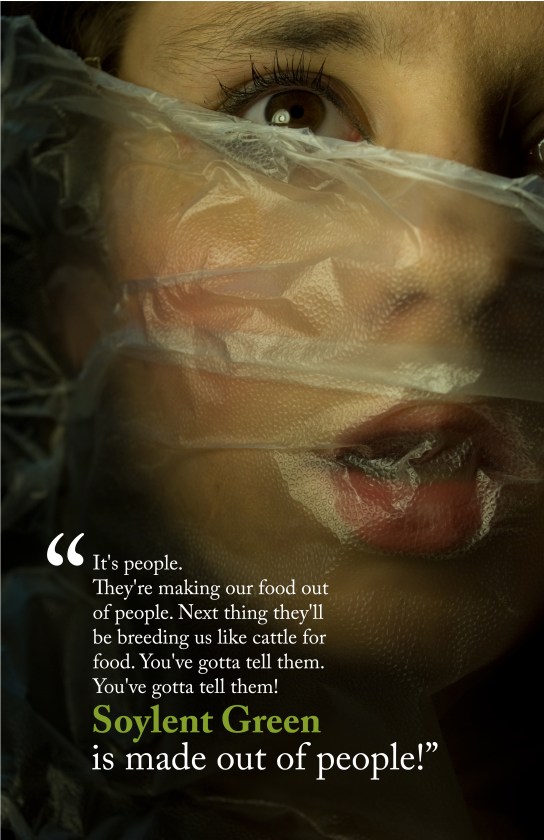
Thorn investigates the murder of Simonson, who has been slaughtered by a corporation assassin with a blow to the cranium, as happens routinely to cattle. Sol discovers from an oceanographic survey taken from the dead man’s apartment that the oceans are incapable of supplying the plankton supposedly used to make Soylent Green – it is in fact being made from the only protein still in good supply: dead humans. Sol is shattered and decides to seek euthanasia, called “going home”, at a luxurious establishment where people are, for once, treated with respect, as human, and euthanised to scenes of bucolic beauty and their choice of music. Thorn arrives in time to witness Sol’s death, and Sol begs him to expose the conspiracy. Thorn sneaks into the sanitation plant, a vast factory where people are turned into protein under high security. The bodies are dumped into a giant vat, and a conveyor belt at the other end bears Soylent Green wafers. Shocked at this objectification of human corpses, Thorn proceeds with no qualms to kill several factory workers who are trying to stop him: the sanctity of human life is not the issue, it is cannibalism of the dead that bothers him. After the required chase, he utters the famous words: “Soylent Green is people!” The final scene shows Thorn carried out on a stretcher, bloodied fingers in the air as he demands that “Everyone must be told”. But does anyone care? The credits roll over the same scene and music (Beethoven’s Pastoral Symphony) that Sol enjoyed when going “home”, the implication being that Thorn dies, while the people struggling to exist continue to demand their Soylent Green.
Soylent Green is a mixed form of cannibalism: the people who don’t hear Thorn’s message are “innocent cannibals” who continue to believe the plankton story, while those who do hear have little option but to ignore the message: like the stranded footballers in Alive, the poor can either eat dead people or starve. The abjection of processed corpses is probably of minor concern to the masses: barely eking out an existence, sleeping on stairwells or in abandoned cars, murdered at the rate of hundreds per day, herded like cattle and shifted with bulldozers when they complain. The disrespect of the dead, so shocking to Thorn who has discovered the good life in Simonson’s apartment, is mild compared to the suffering of the starving masses. Abjection is a luxury only the ruling class can afford. Class if everything for the living: a tiny minority of powerful men live in heavily guarded apartment blocks enjoying fresh food and “furniture” women, while the rest live in squalor. At death, though, all are equal: the same sanitation truck picks up (and pays for) Simonson’s corpse as anyone else’s. Rich and poor alike become crackers.
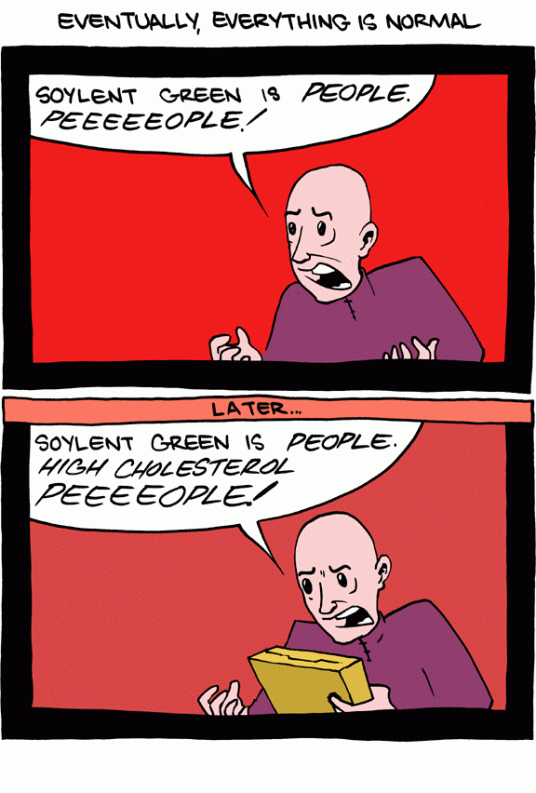
The reviewer John Puccio called Soylent Green “a movie based on an ending. And if you can’t figure out that ending ten minutes into the movie, you aren’t paying attention”. It is one of the most revealed spoilers of any film, with those who have never seen the film knowing the quote, thanks largely to a satirical version on Saturday Night Live. Despite this, I find the film still compelling; its vision of a near future dystopia caused by global warming, more relevant now than ever, offers a glimpse into the mirror: if what we fear comes to pass, would we eat the green crackers or instead choose to go “home”?
If you like my blog, please feel free to recommend it (with discretion) to friends on social media. If you have any questions or comments, you can use the tag or email cannibalstudies@gmail.com.
David Tennant, the tenth Doctor Who, has told Entertainment Weekly that he was in consideration for the role of Hannibal Lecter in the television series Hannibal that ran for three seasons from 2013-15 (and we are still hoping for a fourth?)
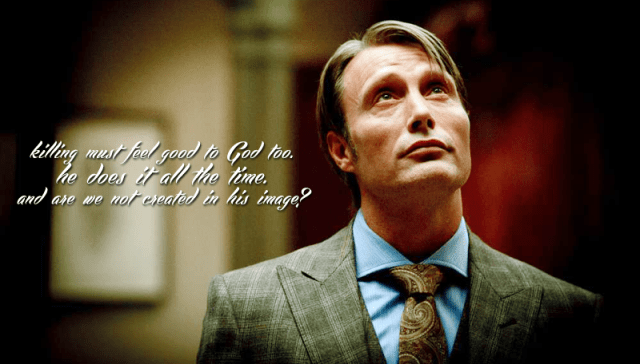
Hard to imagine anyone but Mads Mikkelsen playing the role, in hindsight, although he was, at the time the show was first announced, accused of being no Anthony Hopkins. But, as it turned out, he was perfect in the role, playing Hannibal as a fallen angel, rather than Hopkin’s trickster.
But had that deal not been done, how would Tennant have been as Hannibal? He says that he met up with Bryan Fuller (the showrunner) a couple of times, and they talked about the role, but, he adds, “Mads Mikkelsen… was a perfect choice for it”. Here he is as Kilgrave on Marvel’s Jessica Jones. A much creepier Hannibal perhaps.
If you like my blog, please feel free to recommend it (with discretion) to friends on social media.
If you have any questions or comments, you can use the tag or email cannibalstudies@gmail.com.
Ravenous– this is the 1999 Antonia Bird film, not the recent Canadian Ravenous by Robin Aubert. Aubert’s movie is about zombies, and they also tend to eat people (or bits of them), but this one is about people eating people, a more pure form of cannibalism. Except that there is still a supernatural aspect to this: the cannibalism comes from the mythical wendigo, a creature or spirit from Algonquian folklore, who possesses humans and turns them into cannibals.
The film draws inspiration from two of America’s favourite cannibalism stories: the ill-fated Donner Party and the story of Alferd Packer. At least, it involves pioneers, snow, hunger and, of course, cannibalism. Guy Pearce, as wooden an actor as we have seen for a while, plays Lieutenant Boyd of the United States Army, who plays dead in battle as his unit is massacred by the Mexicans. His body, along with the other dead are put in a cart and hauled back to the Mexican headquarters.In a moment of bravery, Boyd seizes the chance to capture the Mexican HQ. His heroism earns him a Captain’s promotion but General Slauson (the last film role of John Spencer, who went on to play Leo McGarry on The West Wing) learns of his cowardice and posts Boyd into exile at Fort Spencer, a remote military outpost high in the Sierra Nevada.
A stranger named Colqhoun (Robert Carlyle from Trainspotting, Full Monty, etc) arrives and describes how his wagon train became lost in the mountains. A Colonel named Ives had appeared and led them on a circuitous route, resulting in the party getting trapped by snow. People were reduced to cannibalism, he tells them, to avoid starvation. Before the soldiers leave for the rescue, they are warned by their Native American scout, George, of the Wendigo myth: anyone who consumes the flesh of their enemies takes their strength but becomes a demon cursed by an insatiable hunger for more human flesh. They also become almost invincible: if wounded, a bite of human flesh is – well, very invigorating.
Anthropologists love to divide their supposedly cannibalistic studies into endo- and exo-cannibals, i.e. those who eat their enemies and those who eat their friends. In both cases, they claim, the eater believes they will take on the courage, strength and virility of their meal. The wendigo has another advantage – the people he bites (as long as he doesn’t go overboard) will heal and become wendigos themselves. You’re never alone if you’re a wendigo cannibal.
The curse of cannibal studies is that eventually the audience will want to know: how did the cannibal get that way? Explaining the psychological / social / starvation causes often reduces the mystique of the act and the eater – many critics were furious when Hannibal Lecter turned out to be a traumatised survivor of WWII, for example. But the wendigo is good value: there is no particular reason he/she/it chooses anyone, in fact a simple bite from a person already bitten is sufficient – there, explanation given, let’s move on to the gore. So, we’re kind of back to the modus operandi of the zombie (and vampire) – open the mouth and spread the love. But zombies usually restrict themselves to brains, vampires to blood. Cannibalism is so much more environmentally sustainable.
The late Roger Ebert gave the film a decent review, 3 stars out of 4, and said it was “the kind of movie where you savour the texture of the film-making, even when the story strays into shapeless gore.” This is well worth seeking out, despite the presence of Guy Pearce.
If you like my blog, please feel free to recommend it (with discretion) to friends on social media. If you have any questions or comments, you can use the tag or email cannibalstudies@gmail.com.











 and his bride Tamora, Titus’ sworn enemy, played by the splendid Jessica Lange. There is much bloodshed, even for Shakespeare, quite a lot even for a cannibal blog, but the act of cannibalism is an “innocent” one, in the sense that the person eating humans is not aware of the contents of the pie until digestion has commenced. Much like the Board of the Baltimore Philharmonic, unknowingly tucking into the second flautist around Hannibal Lecter’s dinner table.






 The Cannibal Guy