Cannibalism and ‘Satanic Panic’ in Utah

Utah lawmakers are attempting to pass a bill to criminalise the ‘ritual abuse of a child,’ bringing back memories of the satanic panic of the 1980s, when other states passed similar laws.

Critics of the bill, however, say it is unnecessary and potentially harmful.

Republican state Rep. Ken Ivory is sponsoring the bill, House Bill 196. It defines ritual abuse as abuse that occurs as “part of an event or act designed to commemorate, celebrate, or solemnize a particular occasion or significance in a religious, cultural, social, institutional, or other context.” The bill lists specific actions that fall under the proposed definition: abuse against children that includes rape and sodomy, involving them in animal torture, bestiality or cannibalism, or forcing a child to ingest urine or faeces, enter a coffin or grave containing a corpse, or take drugs as part of a ritual.

A hearing of the House Judiciary Committee on February 21 heard from several adults who described themselves as survivors of ritualistic child sexual abuse. They described devil worship, animal torture, forced bondage, rape, cannibalism, child prostitution and mind control, saying that the abuse was so physically and emotionally traumatic that they had repressed memories of it.

Kimberli Raya Koen, President and Founder of The Healing Center for Complex Trauma in Salt Lake City, told the Committee that she was trafficked into a family that ritually abused her for more than two decades.

She told them:

“I see the light and I have fought to be in this chair, to be in this moment, to have a chance to say this is real and this is happening.”

Utah County Sheriff Mike Smith spoke in favour of the bill, telling the committee that he began investigating a high-profile “ritual sex abuse” case two years ago.

The investigation (covered by this blog at the time) became embroiled in politics after then-Utah County Attorney David Leavitt accused him of dredging up an old, unverified witness statement that accused Leavitt and 14 others of “cannibalizing young children” and participating in a “ritualistic” sex ring. Leavitt subsequently lost his re-election bid.

Several states passed similar laws in the 1980s and 1990s, during the height of furore over satanic ritual abuse, but few, if any, prosecutions came from them. Since then, federal law enforcement agencies, scholars and historians have pointed to the scarcity of evidence for the claims of widespread ritual abuse and warned that such legislation risks generating false allegations, wrongful imprisonments and wasting law enforcement resources.

Mary deYoung, professor emeritus of sociology at Grand Valley State University, has documented the harms of the satanic panic.

“This bill is a very good example of panic legislation, hastily cobbled together, on the basis of testimony from a couple of women recollecting childhood histories of satanic ritual abuse. It’s a bill that responds with the kind of approach where we get really angry and say, ‘There ought to be a law.’ And we don’t think about whether it can be enforced in such a way that adds any benefit to society or that ensures that justice is done.”

County Sheriff Smith acted on the reports, but his prosecutions have lagged in court for years, plagued by accusations that investigators mishandled witness statements and that the investigation was politically motivated from the start. He says:

“I was attacked, I was ridiculed, I’ve had memes made about me because of it. Without a doubt, these things do happen in Utah. I believe they’re happening, I believe they have happened.”

Utah’s proposed bill and the county sheriff’s investigation have attracted national interest from conservative media and online conspiracy theorists who believe this case will prove that the allegations in the satanic panic of the 1980s were true, and that cabals of satanists are still sexually abusing, murdering and cannibalising children. Several self-described internet investigators have, in blogs, videos and podcasts, accused hundreds of Utahns of participating in satanic ritual abuse rings.

Many of the claims in the 1980s were made in Utah, amid claims that local therapists used hypnosis and manipulative interview techniques to recover memories from alleged child victims. These were some of the earliest claims of widespread satanic ritual abuse.

Utah’s governor formed a task force in 1990 which spent $250,000 to address pervasive ritual abuse. Investigators interviewed hundreds of victims in more than 125 alleged cases, only one of which ended in prosecution. A final report from the state’s Attorney General in 1995 suggested that there was evidence of isolated instances of abuse involving rituals, but not a widespread plot to abuse children in this way.

National studies from the Department of Justice and the National Center on Child Abuse and Neglect found no evidence to support claims of widespread ritual abuse. Child sexual abuse, however, is staggeringly common; about 1 in 4 girls and 1 in 20 boys in the United States are victims, according to the Centers for Disease Control and Prevention.

In Utah, the Judiciary Committee voted 10 to 1 to advance the ritual abuse bill to the full House; if passed there, it will advance to the Senate. No one testified in opposition to the bill. Rep. Brian King, one of the two Democrats on the committee, cast a dissenting vote and questioned its necessity, noting that state law already criminalises physical and sexual child abuse. Ivory, the sponsor, conceded the offenses were already criminal, but said a specific law was necessary because the crimes are “so heinous.”

​​Rep. Kera Birkeland, a Republican, cried as she addressed the people who spoke during the hearing.

“I had no idea that this was happening in our state. We believe you.”

Do we? Are children in Utah or elsewhere being forced to eat human flesh (the focus of this blog) or other matter usually considered inedible in polite society? One of the most famous allegations is the conspiracy theory #Frazzledrip which maintains that a video is circulating showing Hillary Clinton and Huma Abedin, a former aide, ripping off a child’s face and wearing it as a mask before drinking the child’s blood in a satanic ritual sacrifice. No claims were made about making the child eat flesh though. So I guess that’s not covered by the bill.

Utah has a bit of a record here, with the ill-fated team eaten by Alferd (or Alfred) Packer leaving from the Bingham Canyon mines near Salt Lake City in November 1873 for the gold fields of Breckenridge in the Colorado Territory. They met Packer some 25 miles from their starting point, near Provo. Unrelated (I guess) is the story of a Utah man who was charged in September 2021 over the Capitol riots and later threatened to “eat the flesh” of a probation officer.

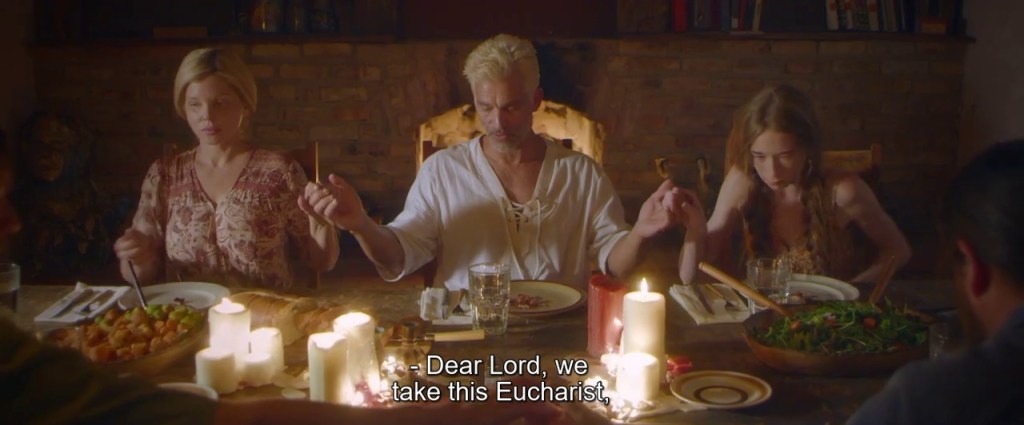
We might also wonder if these laws might be used against churches that practise the Eucharist, the eating and drinking of the wafer and wine in church, which is seen by some (particularly the Catholics) as a literal transubstantiation of wafer and wine into the flesh and blood of Christ. Children are usually expected to take communion, that is, eat the flesh and blood of Christ (in the form of wafer and wine), from the age of about seven. This does sound a lot like what the bill describes as “ingestion… of human bones, blood, or flesh”. I wonder what the churches might say about that?

Idaho is the only state to have a law against cannibalism, but it has never been used. Seems a terrible oversight, really, and perhaps the good folk of Utah can set it right.

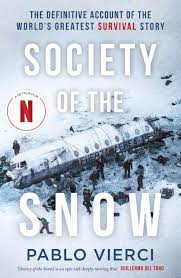
It’s just meat: SOCIETY OF THE SNOW (La sociedad de la nieve)  (J.A. Bayona, 2024)

Society of the Snow is a new account of the 1972 Andes plane crash. It is an adaptation of Pablo Vierci‘s book of the same name,which included detailed accounts of all sixteen survivors, many of whom Vierci had known from his earliest years.

The twist here (not really a spoiler as they keep presaging it) is that the narrator of the film is one of those who were not among the sixteen.

Uruguayan Air Force flight 571, chartered to transport the “Old Christians” rugby team to Santiago, Chile, crashed into a glacier in the heart of the Andes. Of the 45 passengers on board, only 16 survived for the 72 days before they were rescued. Trapped in one of the most inaccessible and hostile environments on the planet, they had to choose cannibalism to stay alive. In this blog, we are most interested in the debate that led to the decision to eat their friends and crew, but the whole story of their pursuit of survival goes beyond what they ate and is equally fascinating.

We see a group of very devout young people, laughing and joking as they organise the trip to Chile, horsing around as the plane gets most of the way over the Andes, and then their reactions as the plane just does not reach the required altitude.

After a week without food, their urine turning black from lack of protein, they start exploring their very limited options. One group believe they will be rescued, even though their plane is painted white and they are in one of the biggest snowfields in the world. But most of them start to think about the only realistic way to survive, particularly after they find a portable radio and hear that the search for them has been called off.

The film has some interesting discussions regarding the ethics of cannibalism.

“What’ll happen to us? Will God forgive us?”
“He’ll understand we’re doing everything we can to survive.”

Roberto, the medical student who has been trying to keep the injured alive, explains what happens to the body without food – it dries up, starts to absorb the organs. There is reference to the “God of the Mountains”, a different being to the one in the city. Arturo, one of the wounded, has a fascinating soliloquy about this God:

“That God tells me what to do back home, but not what to do out here…. I believe in another God. In the God that Roberto has in his head when he treats my wounds. In the God that Nando has in his legs when he keeps walking no matter what. I believe in Daniel’s hands when he cuts the meat, and Fito when he gives it to us, without saying which of our friends it belonged to. So we can eat it, without having to remember the life in their eyes.”

They discuss the legality and the practicality of cutting up bodies, the similarity to organ donation, but of course without consent. So that inspires them to make a pledge.

And so they begin to eat. There are scenes of skeletons being picked clean as the three Strauch cousins offer to cut up the bodies in an area that is hidden from the plane, “to keep the ones who eat from losing their minds”.

What the film glosses over is the Catholicism that permeates much of Latino culture. While they make the point that the bodies are now “just meat”, they do not look for the parallels of their cannibalism to the Eucharist, the eating and drinking of the wafer and wine in church which is supposed to transubstantiate into the blood and body of Christ. It is a theme explored in more detail in the earlier film, as well as in the memoirs of the survivors.

“Drawing life from the bodies of their dead friends was like drawing spiritual strength from the body of Christ when they took Communion”
(Parrado & Rause 2006. Miracle in the Andes: 72 Days on the Mountain and My Long Trek Home, p.117.)

They quote to each other Matthew 26:26: “Take and eat, this is my body.”
(Canessa & Vierci 2016. I Had to Survive: How a Plane Crash In The Andes Inspired My Calling to Save Lives,  p.27).

I suspect this might have been considered a bit too close to the bone (apologies for the pun) for the Spanish speaking audience to whom the film is mainly addressed. Or else they wanted to appeal to a wider audience than just the Catholics. Or perhaps a bit of both.

The story is best known in print for Piers Paul Read’s 1974 book Alive: The Story of the Andes Survivors, which was turned into the film Alive in 1993 by Frank Marshall. Since then, several of the survivors have written their own accounts, to set straight some of the alleged inaccuracies in Alive, but none are as well known. Outside of the Hannibal story and perhaps Soylent Green, Alive is the film most people seem to recall when they hear I have written a thesis on cannibalism.

Alive had a few problems that this film nicely avoids. For one thing, it was very Hollywood, or “Anglo” as the politically aware like to say. It starred American actors who did not look like they were starving, even when they were fondly reminiscing and lusting for the food they missed, which seemed to be mainly pizza. Society of the Snow has Uruguayan and Argentinean actors speaking in Spanish, and makeup and special effects have improved markedly in the thirty years between the films, so they look hungry, and their wounds look ghastly. It is a more authentic look at the situation in which a group of deeply religious young men could decide to eat their dead fellow passengers and friends, who conveniently lay around them, preserved in the snow.

The film closed the 80th Venice International Film Festival in an ‘Out of Competition’ slot. It was theatrically released in Uruguay on 13 December 2023, in Spain on 15 December 2023, and in the US on 22 December 2023, before streaming on Netflix in January 2024.

Society of the Snow received positive reviews. At the 96th Academy Awards, it was nominated for the Best International Feature Film, representing Spain, and Best Makeup and Hairstyling.

Society of the Snow is arguably a better movie than Alive, although at two hours forty minutes, I thought a bit more editing might have been useful. Still, sitting through that 160 minutes gave a miniscule sense of the despair of sitting in a wrecked plane in freezing conditions for 72 days, so we cannot complain!

But I was sorry to see them drop the cannibalism/communion issue, even though there is a hint in the final scene where the survivors sit around a dinner table like the Disciples at the Last Supper, their dead friends being the bread of life, transubstantiated from sacred to edible, the reverse of what is supposed to happen to the church wafer. Whether you consider this a cannibal movie or an epic of survival (and yes, there is controversy raging about that), exploring why people do or don’t eat each other is endless fascinating, and the question of cannibalising the body of Christ is, or should be, at the heart of this story.

Appalachian sin eaters: “FRANK AND PENELOPE” (Sean Patrick Flanery, 2022)

I must admit a bit of a soft spot for road movies, although they have been a little overdone in the cannibalism genre (how many Wrong Turn, Hills Have Eyes, Texas Chain Saw, etc sequels and prequels have there been so far?) But this one seems fresh, mostly due to undeniable talent of the two stars. Caylee Cowan is Penelope, a “doe-eyed femme fatale” who effortlessly channels Marilyn Monroe with a blend of innocence and raw sensuality, and chisel-jawed Billy Budinich, perhaps himself channelling James Dean, is Frank, a man who has lived his life by logic and rules and suddenly breaks out of his self-limitations to live life for himself, but only because he falls for Penelope.

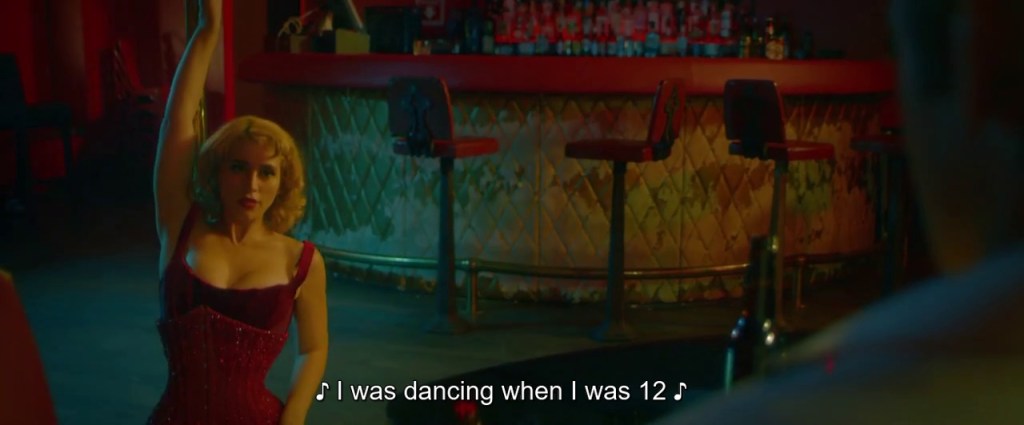
Frank’s world of law and rationality is shattered when he sees his wife having sex with her cross-training instructor, and heads out; he’s not sure where, just heading west. He stops at a strip club where he is taken in by Penelope – pole dancing to Marc Bolan’s song Cosmic Dancer hauntingly performed by Valerie June:

Is it wrong to understand
The fear that dwells inside a man?
What’s it like to be a loon?
I liken it to a balloon

Penelope gets her hands on Frank’s credit card on the pretence that she is willing to abscond with him, but then she has a row with the club owner, played by Sean Patrick Flanery, who also directed and wrote the screenplay (he’s a man of many talents!) When Frank intervenes in Penelope’s fight with the boss, she goes on the run with him, and their fate is sealed. When Frank asks Penelope if she has ever seen the classic 1991 road movie Thelma and Louise, we know this is most likely not going to end well.

There are plots and sub-plots and even a quite unnecessary Greek Chorus in the shape of a nurse (Sonya Eddy from General Hospital) reading Frank’s diary over a brain-dead body, but let’s just get to the cannibalism, because that’s what keeps this blog rolling along each week.

It’s a road movie, so there are lots of cars on roads, and cars stopped on roads, with weirdo’s peering in at the drivers.

The first face is Cleve (Brian Maillard, who’s also done a fair bit of acting, directing and writing) – Cleve is a devout follower of a cannibal cult which collects travellers off the road or in their motel. He appears at first as a whack job, but turns out to have a conscience, of sorts.

The second face at a window is the local Sheriff (Kevin Dillon from Platoon and Entourage) who tries to warn Frank and Penelope against stopping on that track of road. This warning, before the blood starts flowing, is a regular trope for cannibal films, although it’s usually a gas station dude who is dismissed as plumb crazy – e.g. the Wes Craven classic The Hills Have Eyes. In that film, the cannibals were mutants who had been too close to a nuclear bomb-testing site, in Texas Chain Saw Massacre they were unemployed slaughterhouse workers. In The Farm, they are animal liberation activists revenging the depredations humans commit on farmed animals. Every cannibal has a motive. In this film, the Sheriff tells them that:

“You’re about to hit a stretch of about thirty miles with no cell phone towers, and no gas for about forty miles after that. You may want to keep a close eye on that gauge. I mean, you can get gas in Quicksilver, about twelve miles in, but get in and get out of there. Mercury got in the water from that mine, and left them Appalachian transplants bat shit crazy.”

So what do our romantic couple do? Why, head straight for the bat shit crazy Appalachian transplants in Quicksilver, looking for a motel room in which they can practice all the sexual positions Frank has promised to perform. Of course, they could just pay attention to the Sheriff who gave them good advice (while drooling over Penelope), but then it would be a very short movie.

On the way, they run across Chisos (Johnathon Schaech, another writer and actor, you may have seen him in How to Make an American Quilt). He puts his face into the car, pretending he needs a lift, but Penelope turns him down. She can see he is up to no good, even with a name that everyone else pronounces with reverence (as in Jesus) but which she persists in saying as “Cheese Sauce”! This is actually quite a funny film, and Caylee Cowan is a comedy genius.

Chisos is the leader of the cannibal cult, and when they meet up at the motel, explains it all to them, in the standard (I’ll tell you everything Mr Bond/Batman/Spiderman since you won’t be alive to tell anyone else) method of horror movie explication. He explains that his grandfather owned the biggest mercury mine in the world, in which he was leading a prison work-release program for a whole bunch of felons – “murderers, rapists, all kinds of filth”. His grandfather survived a cave-in by “eating those sinners, organs and all.” He and his clan are now “Appalachian sin eaters at our core!”

Travellers are tested for their virtue, and eaten for their sins. He shows them his leg, which has a crucifix shaped scar. Yep, he’s been snacking on his own sins. What sin has a man like Cheese Sauce committed? Well, he’s been at it with Cleve’s wife, plus he really wants kids.

And he has decided he really wants those kids with Penelope, so he tosses Frank into a pit with unclimbable sides. There are corpses in there, people who have died in it previously, and there is plenty of water, so Frank won’t die of thirst; but he has to make a choice: he can starve or “take a bite and become one of us.”

The rest of the movie is a suspense story – will Frank die or become a cannibal? Will Penelope agree to become “a vessel” for Chisos’ progeny? What’s the story with her old boss from the strip club, who is still plenty sore at them?

The answers to all these questions you won’t hear from me, because that would be spoiler territory, and you really should see this movie. Admittedly, the critics who have reviewed it so far gave it a cumulative “rotten” score of 25% on Rotten Tomatoes, but the audience rating was a “fresh” 83%. So you’ll have to judge for yourselves. I thought the plot was good, the actors were great, the cars scintillating (if you’re interested in that sort of thing) and the soundtrack outstanding. The cannibalism is not gore based (well, just a bit) but more along the lines of abjection, watching the cult members tucking in to their sacred meal – the flesh of a woman who had admitted to abandoning her children years before.

The Eucharist, as I understand it, is the eating of the blood and body of Jesus to cleanse the sinner of their sin. Chisos has turned this on its head – cut out the middle man and just eat the sinner. Makes a lot of sense, especially if you’re a cult with a lot of mercury in your water supply.

Cannibal supermodels: THE NEON DEMON (Nicolas Winding Refn, 2016)

Marcellus (Hamlet Act I, scene iv) claimed that “something is rotten in the state of Denmark”, but it’s not their cannibal films or actors. The Neon Demon is directed by Nicolas Winding Refn (currently in trouble with PETA for killing a pig for a TV series). Refn has made several movies (Pusher, Valhalla Rising, etc) starring Mads Mikkelsen, probably known best by the readers of this blog as Hannibal Lecter, or perhaps Svend in Anders Thomas Jensen’s The Green Butchers. This film does not have Mads in it, but it does have Elle Fanning as a sixteen-year-old model who, we just know, is going to be chewed up, swallowed and spat out by the Los Angeles fashion industry.

Books about screen-writing always stress the opening image – it sets the scene, establishes the atmosphere, tells the viewer what to expect. Well, this one sure does.

Jesse (Elle Fanning from The Great) dead on a couch, blood caked onto her throat and down her arm. A grim male gaze from a photographer. The killer? Police forensics?

No, he’s an amateur photographer doing audition shots for her, and is probably the only nice guy in the story, and we all know where nice guys finish. Anyway, Jesse is befriended, as she wipes off the fake blood, by a make-up artist named Ruby (Jena Malone from The Hunger Games), who takes her to a party to meet the LA fashion scene.

The other models hate her for being young and pretty and not needing the constant plastic surgery to fix all the things the surgeon and our culture say is wrong with their bodies. In the bathroom, as you do, they discuss lipsticks, which they note are always named after either food or sex, and speculate on this new commodity, Jesse. Is she food or sex?

Either way, it’s about appetite. Think of an animal, any animal – a snail, a snake, a human. What is the animal thinking about? It’s almost certainly food or sex. This film combines the two. The men have the power – the celebrity photographer, the fashion designer, even the sleazy motel manager (played with black humour by Keanu Reeves) – Jesse is their fresh meat.

The young, hopeful girls have their looks, and a useful booster of narcissism, a taste for the neon demon of fame, which fuels their journey through the fashion jungle.

When they get “old” (over twenty apparently), they inject various toxins and go under the plastic surgeon’s knife to fix what they are convinced are their failings. But it’s never enough. Jesse sees visions which confirm her own beauty in her eyes:

Women would kill to look like this. They carve and stuff and inject themselves. They starve to death, hoping, praying that one day they’ll look like a second-rate version of me.

But once used up, the women and girls are rejected, discarded, left to fight among themselves – to the death. Jesse is edible to them too, but not in the male way, more in the way that Elizabeth Báthoryis alleged to have bathed in the blood of virgins to keep her youth.

That’s a small taste of the real cannibalism in the film, which infiltrates the metaphoric cannibalism of the meat markets of advertising and fashion. There is an ancient tradition, from the earliest days of tribal ceremonies and the Wendigo to Richard Chase and Armin Meiwes, that eating the flesh or drinking the blood of a victim (preferably a young fit one) will transfer their strength and attractiveness to the eater. If you can keep them down of course.

An even older tradition talks of killing and eating the gods of the harvest, in order that they may be reborn and bring with them next year’s prosperity. The tradition survives in the transubstantiation of the Eucharist service. Jesse is a young and beautiful. She is, or thinks she is, a goddess. How can she not be eaten, in this film both metaphorically and literally?

There is no point in going on with the plot, it’s filled with rape, paedophilia, murder, masturbation, necrophilia, and of course cannibalism, but you really need to see it yourself, and anyway, the plot is not the point. Brian Tellerico, the reviewer from Rogerebert.com, summed this up:

It is a sensory experience, driven by the passion of its fearless filmmaker and a stunning central performance by Elle Fanning.

The director called the film an “adult fairy tale”:

“I woke up one morning a couple of years ago and was like, ‘Well, I was never born beautiful, but my wife is,’ and I wondered what it had been like going through life with that reality. I came up with the idea to do a horror film about beauty, not to criticize it or to attack it, but because beauty is a very complex subject. Everyone has an opinion about it.”

Everyone had an opinion about The Neon Demon too, with some of the audience at Cannes booing it and the rest giving it a standing ovation. You can make up your own mind – it’s an Amazon original, so you should be able to find it quite easily wherever you are in the world. It is a beautiful film, the acting is superb, the direction is assured and precise. The horror is not so much from the gore, as the scenes of young girls being treated as meat. But that is exactly the point.

The French philosopher Jacques Derrida spoke of what he called “carnivorous sacrifice”:

“The establishment of man’s privileged position requires the sacrifice and devouring of animals.”

The animals we sacrifice and devour are little more than infants – chickens for example are slaughtered at seven weeks of age. Pigs are killed at six months (less if they run into Refn, apparently). We no more eat old animals than photographers seek out old models. Remember Curtis’ line in Snow Piercer:

“I know what people taste like. I know that babies taste best.”

Or the words of John Jacques Rousseau:

The animals you eat are not those who devour others; you do not eat the carnivorous beasts, you take them as your pattern. You only hunger after sweet and gentle creatures who harm no one, which follow you, serve you, and are devoured by you as the reward of their service.

Cannibalism is no more or less than the sacrifice and devouring of animals – in this case, the Great Ape known as Homo sapiens. As voracious consumerism and greed extends its reach, to plunder the entire planet, the distinction between us and the other animals seems increasingly to evaporate.

“From the perspective of the virus, the human being is irrelevant” – ANTIVIRAL (Brandon Cronenberg, 2012)

I have in my (admittedly odd) library a title called The In Vitro Meat Cookbook. It has a series of recipes, none of which you can cook yet, because they require as their main ingredient meat grown in the laboratory rather than cut from the quivering corpse of an animal who probably lived her whole life in horrendous conditions. When this lab meat becomes commercially available, it will doubtlessly be great news for the billions of animals who die in terror for our plates each year, but these recipes go beyond the meats you might see at a butcher shop, to such suggested dishes as Dodo Nuggets and Dinosaur Leg and, yes, Celebrity Cubes:

“Forget autographs and posters. Prove that you’re the ultimate fan of a celebrity by eating him or her.”

Pop stars in whiskey glaze. If that isn’t intimate enough, how about “IN VITRO ME”? Yep, it’s grown from your own stem cells, and it’s “best shared with a lover as the ultimate expression of unity”.

I digress, but it is relevant to this week’s movie. Antiviral is a film even more relevant now than when it was released a decade ago. For a start, the daily news speaks of little else than viruses and antivirals, and when they do turn to other issues, these usually involve celebrities. This film covers both. It is set in an alternative present, where the obsession with celebrities has moved past adulation and stalking (and occasional cannibalism) to a lucrative business – selling their diseases. For a lot of money, you can suffer the same symptoms and weeping, bleeding pustules as your favourite star!

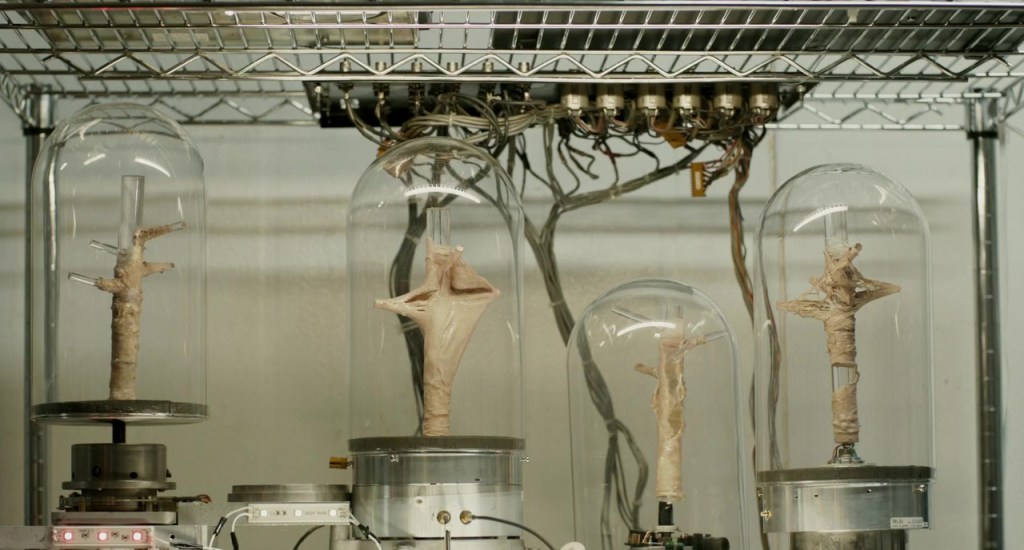
The movie is the first work by Brandon Cronenberg, the son of body-horror pioneer David Cronenberg (The Fly, The Dead Zone, A History of Violence, etc), sometimes known as “the King of Venereal Horror” or “the Baron of Blood”. Quite a legacy to live up to, but Brandon Cronenberg does it brilliantly in this work, which features cannibalism among its panoply of abjection. The imagery is stunning – bleak scenes in monochromes, then a flash of crimson – blood or lipstick. Needles sticking in arms and gums, lumps of meat grown from celebrities and sold to customers desperate for a touch and a taste of their favourite star.

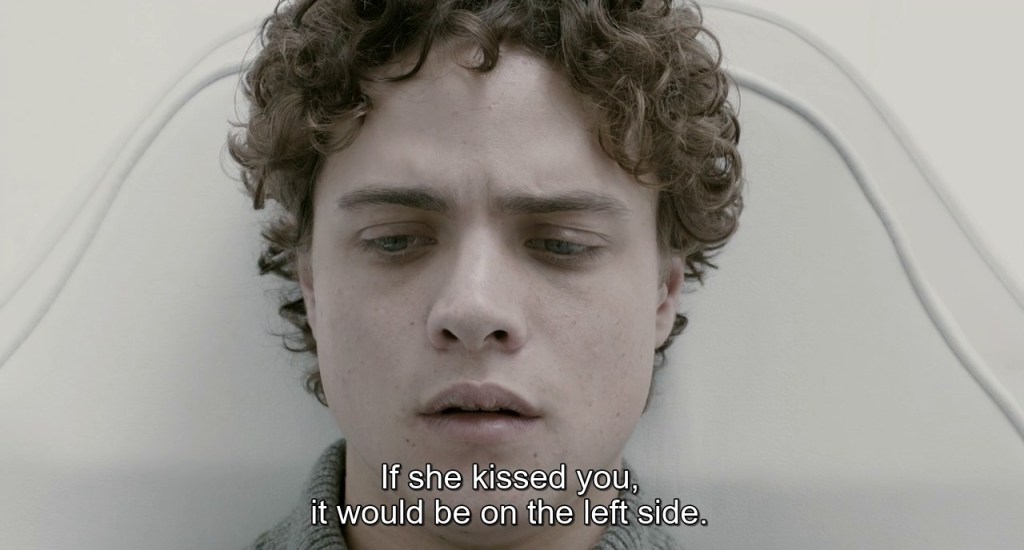
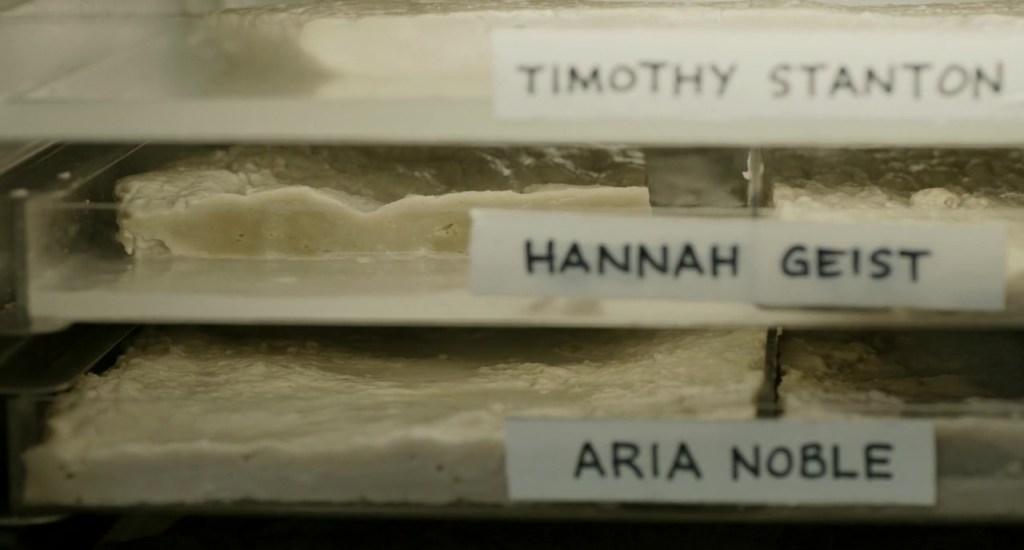
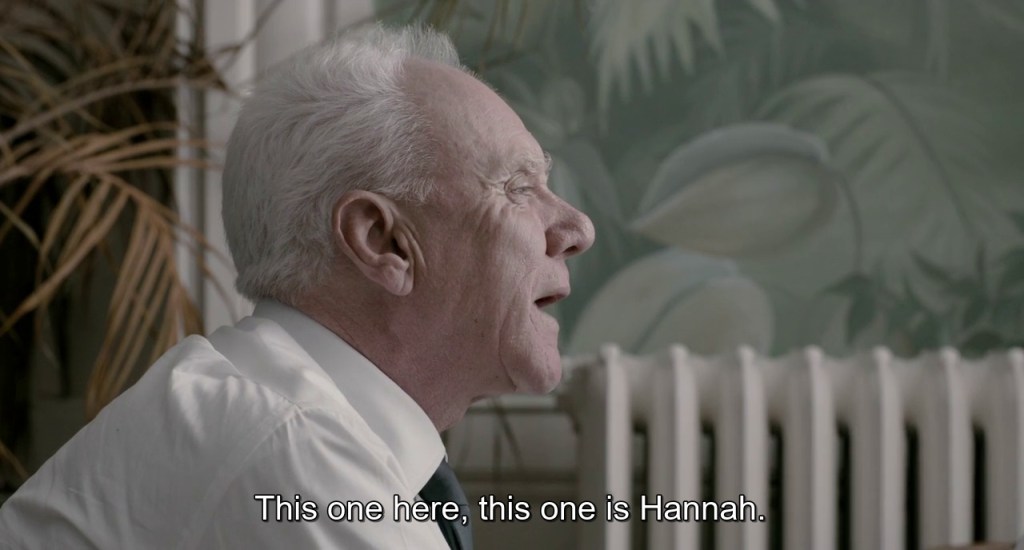
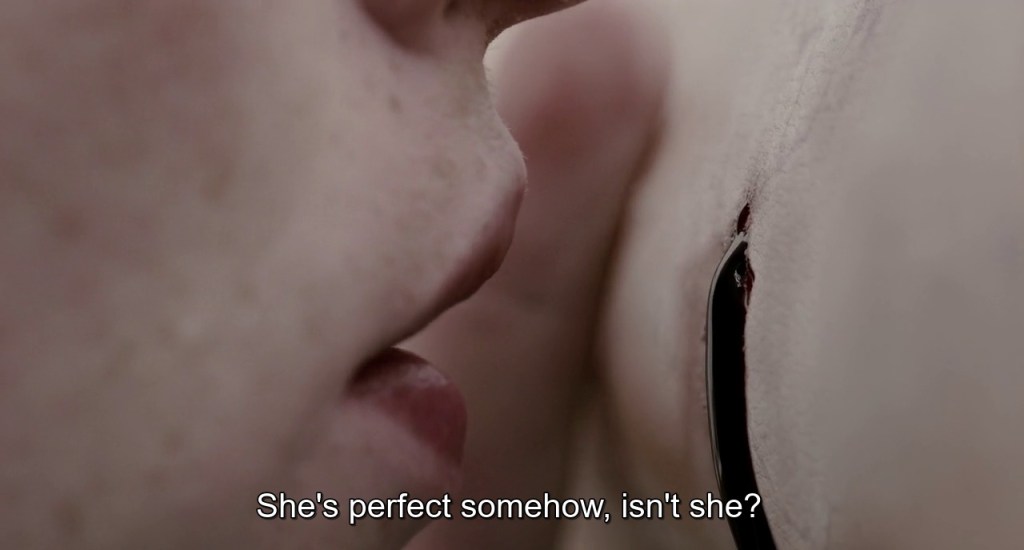
The protagonist of the film is Syd (Caleb Landry Jones from Get Out, Nitram etc), an employee of the Lucas Clinic. Syd sells customers the dream of being close to their favourite celebrity. What does the avid fan do after already seeing all the movies, reading the magazines, collecting the images? In this world, they pay to get the same diseases as the celeb. Syd knows how to sell, he talks a fan into a dose of herpes simplex, collected by his employer from the superstar Hannah Geist, whom he describes as “more than human”. She had the pus-filled blisters on the right of her mouth, so you really want to be infected on the left, because

Syd is a trusted employee of Lucas (where the archivist is played by Lara Jean Chorostecki, who played Freddie Lounds in Hannibal!), but he is ambitious, hoping to sell the virus that is killing Hannah on the black market. He takes some of her blood (Lucas Clinic has exclusive rights to Hannah’s diseases) and infects himself, then waits, taking his temperature, doing things with cotton probes that we all now understand.

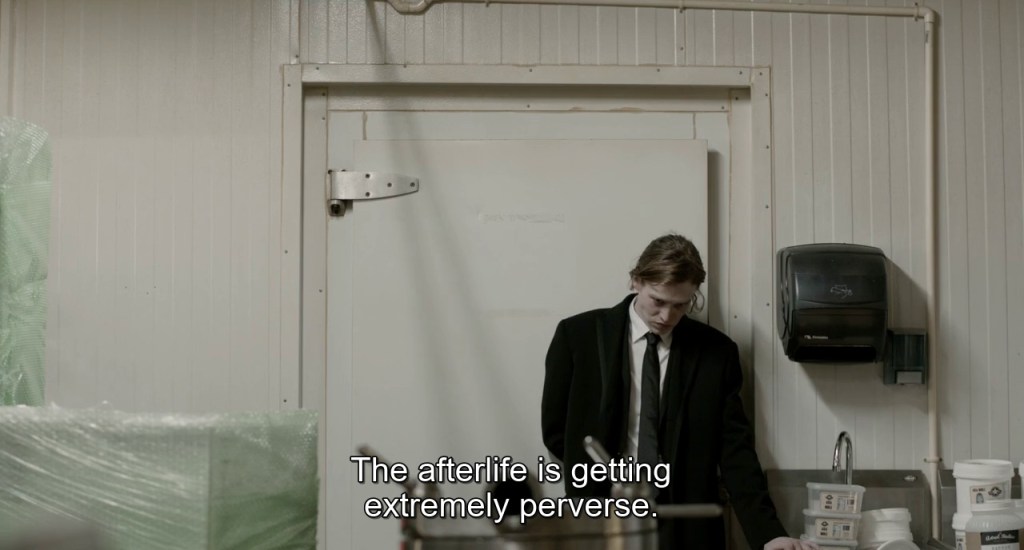
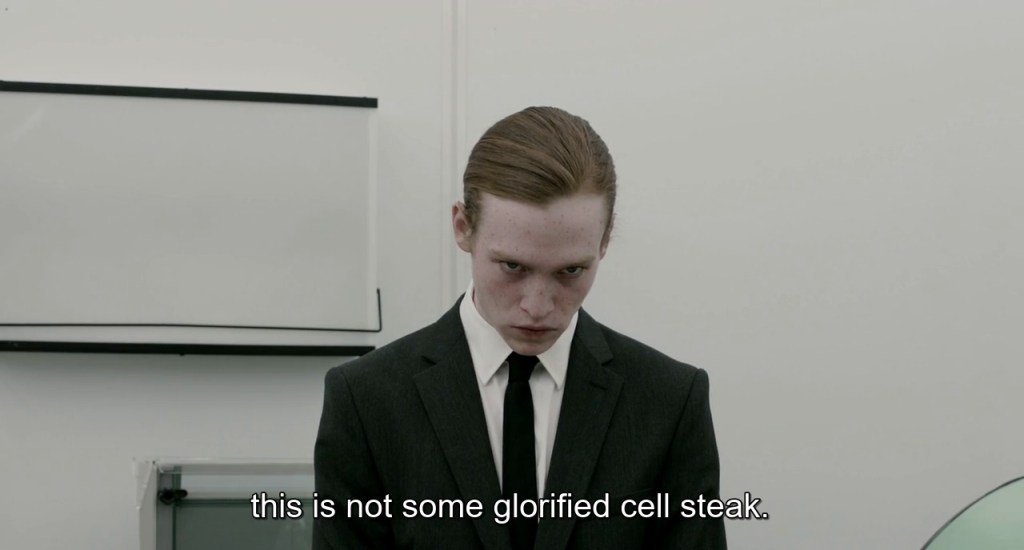
He is hoping to sell the new virus through the specialist butcher Arvid (Joe Pingue), whose business Astral Bodies does a thriving trade in celebrity cell steaks – edible flesh grown from the cells of celebrities.

Syd tells Arvid “I don’t understand how this is not considered cannibalism”. Arvid is more philosophical. What does it mean to be human, he asks – is the human “found in its materials” or is it something more religious, as the law currently tends to assume – a soul perhaps?

“But we’ll see what happens when we go from growing celebrity cell steaks to growing complete celebrity bodies.”

When Hannah’s death is announced, Syd’s diseased blood is suddenly in demand – those who have already eaten Hannah now want to either watch him die the way she did, or buy the virus and die along with her. Syd has to escape the virus coursing through his body, and the various business types who want it.

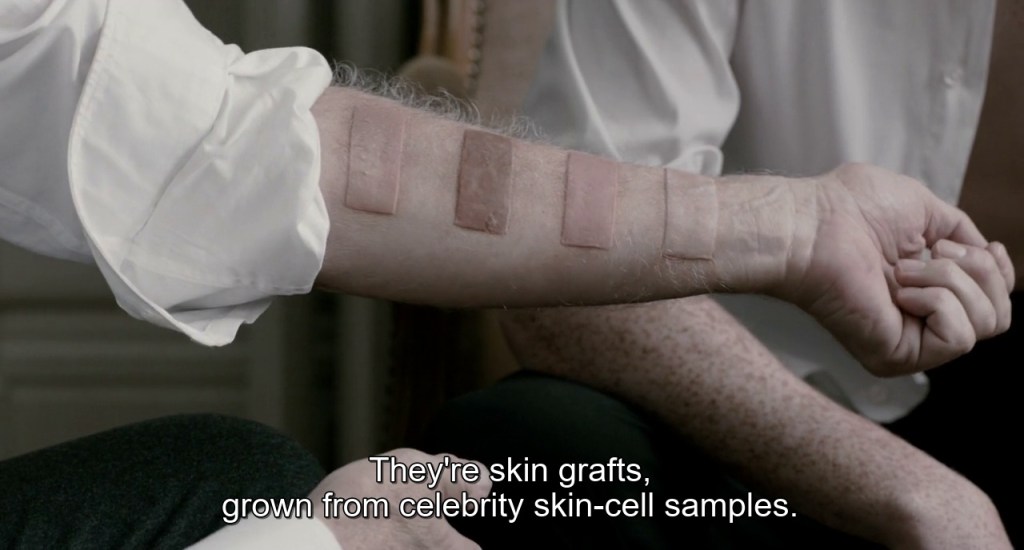
Anything related to a celeb is valuable. Lucas Clinic is even planning to sell ringworms from Hannah’s dog. Or if you don’t want a disease, you can get a skin graft from your favourite celebs, as Hannah’s doctor, Dr Abendroth (played by the magnificent Malcolm McDowell) shows Syd.

What does it mean to “go viral”? This humble blog has gone viral (a very mild, non-toxic one) in that it is viewed thousands of times a month, presumably because wonderful readers like you share it (please?) on social media, or perhaps (socially distanced) word of mouth. But a celebrity who goes viral has his or her impact measured not in the thousands of views but in the millions. Celebrity becomes the message in itself; as the head of Lucas Clinic says, when asked if the current crop of celebs deserve to have the levels of mania surrounding them,

“Anyone who’s famous deserves to be famous. It’s more like a collaboration that we choose to take part in. Celebrities are not people. They’re group hallucinations.”

Hannah’s doctor Abendroth is more metaphysical, musing that

“there is a power, something in the thrall of the collective eye, that can be consumed and appropriated.”

Certainly we devour our celebrities, with the paparazzi as the hunters and the rest of us sitting with a magazine or a tablet and consuming them – think of Marilyn Monroe, Princess Diana, Amy Winehouse, Michael Jackson and many, many more. Unlike most of us mere mortals, the celeb who has gone viral remains consumable after death, perhaps more so. So it is with Hannah.

The marketing of Hannah’s “afterlife” expresses the vulnerability of humans, the paragon of animals, to a virus, a type of genetic code so tiny that we are not even agreed on calling them “alive”.

“From the perspective of the virus, the human being is irrelevant. What matters is the system that allows it to function. Skin cells, nerve cells, the right home for the right disease.”

But no spoilers – go get this one out and watch it (if you’re not the squeamish type) – it is well worth it.

We long for connection. Cronenberg mentioned a moment of inspiration:

“A friend of mine said he was watching Jimmy Kimmell one night and Sarah Michelle Gellar was on the show. She said she was sick and if she sneezed she’d infect the whole audience, and everyone just started cheering.” 

The philosopher Blaise Pascal said that there was, in every human, an “infinite abyss [which] can be filled only with an infinite and immutable object”. He suggested that this infinite and immutable object should be God. Humans are big on eating gods – Dionysus was torn apart and reborn by means of his mother eating his heart, which made her pregnant. Christians eat the Eucharist – the body and blood of Jesus, according to John 6:55-66

“For my flesh is meat indeed, and my blood is drink indeed. He that eateth my flesh, and drinketh my blood, dwelleth in me, and I in him.”

We live vicariously, by eating our gods. But in our culture, the celebrity is god. The viral, consumable, more-than-human celebrity.

“This thirst is consuming me”: CRONOS (Guillermo del Toro, 1993)

Cronos is the first feature film of Guillermo del Toro, better known for his later mind-bending fantasies Pan’s Labyrinth and The Shape of Water. Del Toro was originally chosen by Peter Jackson to direct The Hobbit trilogy, but couldn’t do it, due to extended delays. So he’s a top tier director, an auteur, as the French say. He was only 29 when he made Cronos, yet it has been hailed as one of the greatest horror films and one of the best Spanish language films, and has a rating of 91% “fresh” on Rotten Tomatoes. Empire Magazine called it a “unique, terrifying mini-masterpiece.”

At this point I need to admit that it is less a cannibal film than a vampire one. Now I have nothing against vampires, some of my best friends are vampires (probably), but a cannibal should really be alive rather than undead, IMHO. This one is so good, though, that I’m giving it a run on the cannibal blog. Apologies to the cannibal purists.

There is also a link to #cannibalism, because the undertaker (yes, even immortals sometimes need undertakers) is Tito (Daniel Giménez Cacho), in a prequel role for the great cannibal movie We Are What We Are, in which he was the coroner who found a finger in the dad’s stomach. You’d have to watch it – it’s worth it.

Anyway. Gothic movies usually start off a few centuries in the past, because old magic is just – better. This one has a 14th century alchemist inventing a device which looks like a Faberge egg with claws. The device sticks its claws into whomever happens to pick it up and an insect inside (species yet to be determined) injects something (IDK – vitamin C? Testosterone?) which makes the person immortal. Centuries later – in the present – an earthquake reveals the dead alchemist. Well, he was immortal, but the earthquake caused a stake to pierce his heart, which is not ideal if you’re a vampire (or anyone else really). The egg is in a statue of an archangel, which is the first of a string of religious symbols (hey, it’s Spanish, OK?)

The statue ends up with antique dealer, Jesús Gris (played by the wonderful Federico Luppi who was one of Guillermo del Toro ‘s favourite actors and was also in The Devil’s Backbone and Pan’s Labyrinth). Gris and his granddaughter Aurora (Tamara Shanath) extract the egg, wind it up and it plunges its stingers into him.

There’s some blood and pain, sure, but he finds he is getting younger, and heals much faster. You laugh a little, you cry a little, but then there’s another problem – he develops a longing for human blood.

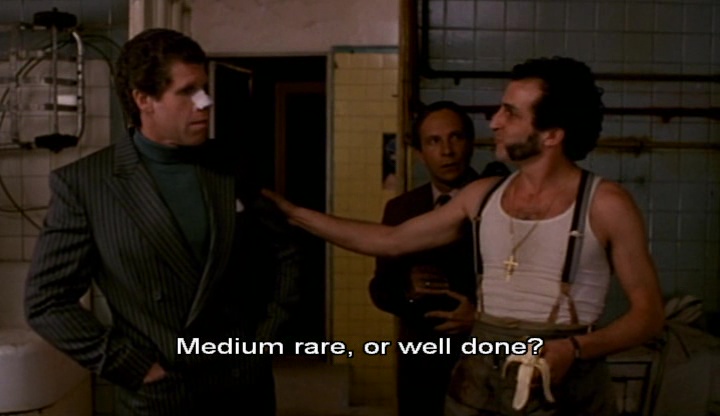
There’s also a dying businessman (Claudio Brook, The Exterminating Angel and several other films of Luis Bunuel) who really wants the Cronos Device. His American nephew (Ron Perlman, Hellboy and Sons of Anarchy) is brought in to seek out the device by any means necessary (some of which are quite nasty). He puts up with his uncle, because he is named in the will, but wait, if uncle is immortal…

What would you do to defeat death, to live forever?

As Roger Ebert observed, there are some real religious issues explored here – the battle of good and evil, love (for Gris’ wife and granddaughter) being more powerful than greed, and particularly the unshakeable belief in divine afterlife. What happens to that hope if you never die? And what if that extended life requires eating flesh and drinking blood? Would you risk hell to avoid going to heaven? When little Aurora cuts her hand, Jesus has to decide if his thirst is really worth drinking his granddaughter’s blood.

Of course, that assumes that drinking blood is somehow essentially evil. Tell that to a mosquito.

Jesus Gris is, like any good vampire, likely to start smoking ominously if he finds himself in the sunshine. But can his goodness overcome the vamp issues? Well he dies and comes back to life, reborn in a glowing white skin, he takes many savage beatings, saying that he can handle the pain, then he smashes the egg, declaring

Jesus Gris – translates to English as “the Grey Jesus”. He is the suffering servant, who died and came back to life. There is a lot of that in Spanish films, but this one has an added twist:

Yes, he wants blood. Could that be a backhander to the Church? Religion can motivate good deeds, or suck the blood of the devotees. The Eucharist is all about transubstantiation – the wine and wafer are believed (by some) to be literally the blood and body of Christ. Hannibal is full of it, particularly the resurrection of Mason Verger and his attempt to eat Hannibal. It’s the eternal paradox.

Cronos won the grand prize in the Critics’ Week at the 1993 Cannes Film Festival, and nine Mexican Academy Awards, including best picture and director. It has an enviable 91% “fresh” on the Rotten Tomatoes website. The Criterion Blu-ray edition is available at Amazon. The soundtrack is superb, by the acclaimed Mexican composer Javier Álvarez. Highly recommended.

NEXT WEEK: One of the most controversial cannibal films of all time: Joe D’Amato’s Antropophagus.