Facebook cannibalism: “Eschatology” 2018

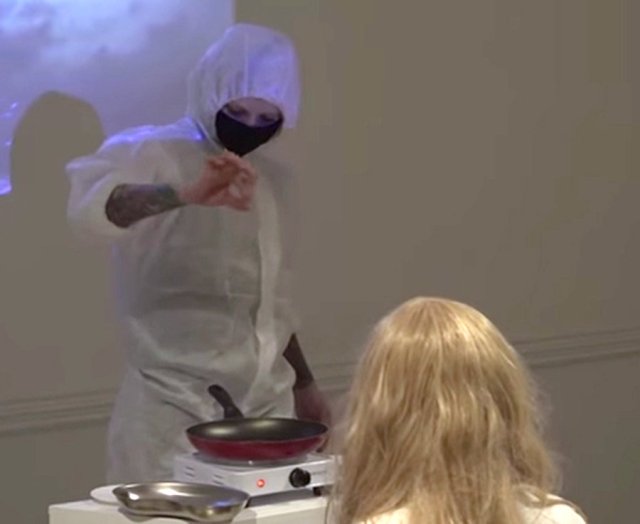
I don’t know if you’re into Facebook Live streaming, although lately people seem to be leaving Facebook rather than trying to find new ways of spending time on it. But a lot of people seem to have tuned in to a stream on 6 March 2018 of a performance named ‘Eschatology’ by artist Arturs Bērziņš at Museum LV un Grata JJ, in Riga, Latvia.

1 Artist
Portrait of the artist as a young autophage

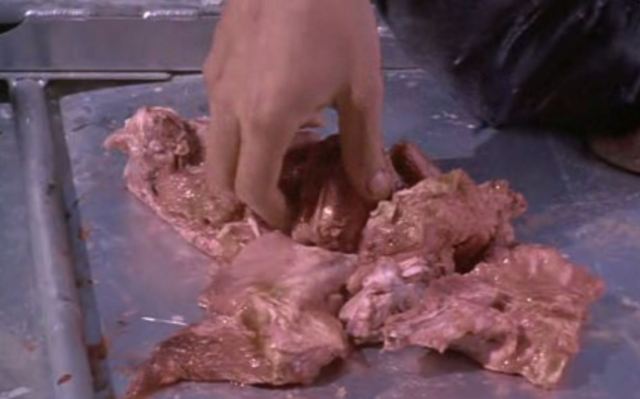
The footage showed Bērziņš’s assistant pulling on a white medical outfit, scalpel in hand, and cutting chunks of meat from the backs of two volunteers, one male and one female, apparently without anaesthetic. The assistant then fries the meat it in a large black pan.

I’ll spare you the unkindest cut, but you can, if you wish, see it on Youtube:

A small audience watches, phone cameras ready, and a couple more stand in the doorway, perhaps anticipating the need for a quick getaway. Spooky music plays as the assistant adds salt and pepper and perhaps some more exotic spices to the meagre meal and feeds the fragments to the volunteers.

1306534

The artist later said: “It’s not fake, but it also is not cannibalism. Each of them ate his or her own piece of skin after (a) scarification procedure. Otherwise fingernail gnawing also can be proclaimed as cannibalism.” Something to consider next time you can’t be bothered reaching for the nail-file.

1306541

The artist later commented “What we do daily with ourselves is much worse than any performance. The viewer has to face the genuineness. Genuine pain. Genuine action that has stepped out of abstraction into a real world. The viewer needs to be intellectually prepared for such an experience as this. Otherwise they’ll simply claim I have a screw loose and return to the infernal trance of everyday life.”

Is this the new face of competitive cooking shows?

If you like my blog, please feel free to recommend it (with discretion) to friends on social media.
If you have any questions or comments, you can use the tag or email  cannibalstudies@gmail.com.

Waste not, want not: “Soylent Green” (Fleischer 1973)

SPOILER ALERT!!

Yeah, but this movie 45 years old, so if you haven’t seen it by now, you’re either not going to, or if you are, it’s because you found out (maybe from this blog) that it’s a cannibal film! So: that IS the spoiler.

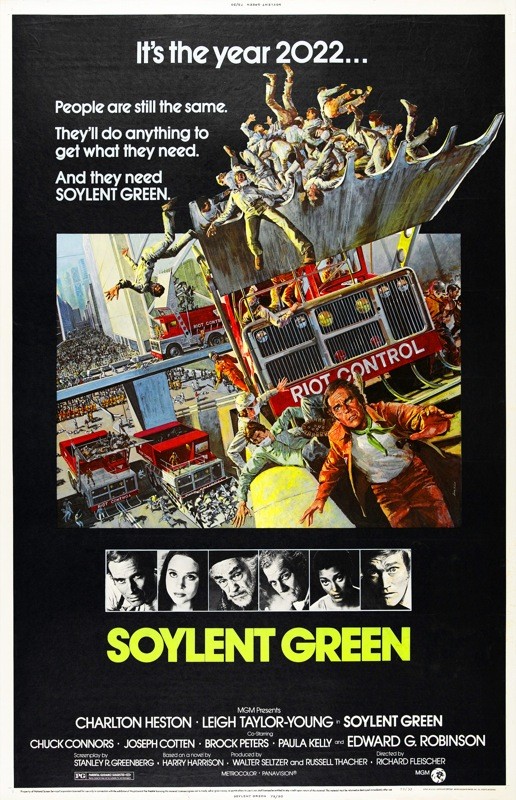
Soylent Green presents quite a different picture of survival cannibalism to Alive. Starting with idealised images of leisured gentlefolk posing before Victorian and Edwardian cameras, the opening montage rapidly records the deterioration of humanity through mass production of commodities (starting with Model T Fords) through to alienated office workers, packed freeways and trains, mountains of garbage and clouds of pollution. The montage is followed by an intertitle explaining that the year is 2022 (fifty years in the future, when the film was made) and that New York City now has a population of forty million. People are crammed everywhere – sleeping on the stairs of apartment blocks and in the abandoned cars that fill the broken roads. The protagonist, Frank Thorn (Charlton Heston), is a New York cop, sweltering in his tiny apartment. He watches an advertisement for the Soylent corporation promoting new “Soylent Green”, a miracle food said to contain ocean plankton. His room-mate Sol (Edward G Robinson) tells us of the days of his youth when food was real: the Greenhouse Effect has made everything “burn up”. The only food now is manufactured – Soylent biscuits and margarine. The rich, however, can buy fresh food from highly fortified shops; even meat is available “under the counter”.

soylent_green_poster

This is class warfare – the rich can eat real food from the rural areas, which are guarded like fortresses to protect them for the privileged. The poor must queue for water and whatever artificial fare the giant corporations manufacture. Meat itself is described as “something special” by both the shopkeeper and Shirl (Leigh Taylor-Young), the woman buying it for her rich lover, Simonson (Joseph Cotten). Shirl is considered “furniture” in that she comes with the apartment (Thorn asks “personal or building?”) and is only prized for her beauty and utility. This is classic commodity fetishism: she is a commodity, while the food she buys is personalised and admired. Shirl and the other “furniture” women are given one day off a month and can be beaten indiscriminately by the owners and building manager. On the street, crowd control consists of “scoops”: bulldozers which shovel rioters up and dump them into disposal trucks.

soylent_green_by_constanttraveller-d4ezp2r

Thorn investigates the murder of Simonson, who has been slaughtered by a corporation assassin with a blow to the cranium, as happens routinely to cattle. Sol discovers from an oceanographic survey taken from the dead man’s apartment that the oceans are incapable of supplying the plankton supposedly used to make Soylent Green – it is in fact being made from the only protein still in good supply: dead humans. Sol is shattered and decides to seek euthanasia, called “going home”, at a luxurious establishment where people are, for once, treated with respect, as human, and euthanised to scenes of bucolic beauty and their choice of music. Thorn arrives in time to witness Sol’s death, and Sol begs him to expose the conspiracy. Thorn sneaks into the sanitation plant, a vast factory where people are turned into protein under high security. The bodies are dumped into a giant vat, and a conveyor belt at the other end bears Soylent Green wafers. Shocked at this objectification of human corpses, Thorn proceeds with no qualms to kill several factory workers who are trying to stop him: the sanctity of human life is not the issue, it is cannibalism of the dead that bothers him. After the required chase, he utters the famous words: “Soylent Green is people!” The final scene shows Thorn carried out on a stretcher, bloodied fingers in the air as he demands that “Everyone must be told”. But does anyone care? The credits roll over the same scene and music (Beethoven’s Pastoral Symphony) that Sol enjoyed when going “home”, the implication being that Thorn dies, while the people struggling to exist continue to demand their Soylent Green.

Soylent Green1200

Soylent Green is a mixed form of cannibalism: the people who don’t hear Thorn’s message are “innocent cannibals” who continue to believe the plankton story, while those who do hear have little option but to ignore the message: like the stranded footballers in Alive, the poor can either eat dead people or starve. The abjection of processed corpses is probably of minor concern to the masses: barely eking out an existence, sleeping on stairwells or in abandoned cars, murdered at the rate of hundreds per day, herded like cattle and shifted with bulldozers when they complain. The disrespect of the dead, so shocking to Thorn who has discovered the good life in Simonson’s apartment, is mild compared to the suffering of the starving masses. Abjection is a luxury only the ruling class can afford. Class if everything for the living: a tiny minority of powerful men live in heavily guarded apartment blocks enjoying fresh food and “furniture” women, while the rest live in squalor. At death, though, all are equal: the same sanitation truck picks up (and pays for) Simonson’s corpse as anyone else’s. Rich and poor alike become crackers.

soylent-green

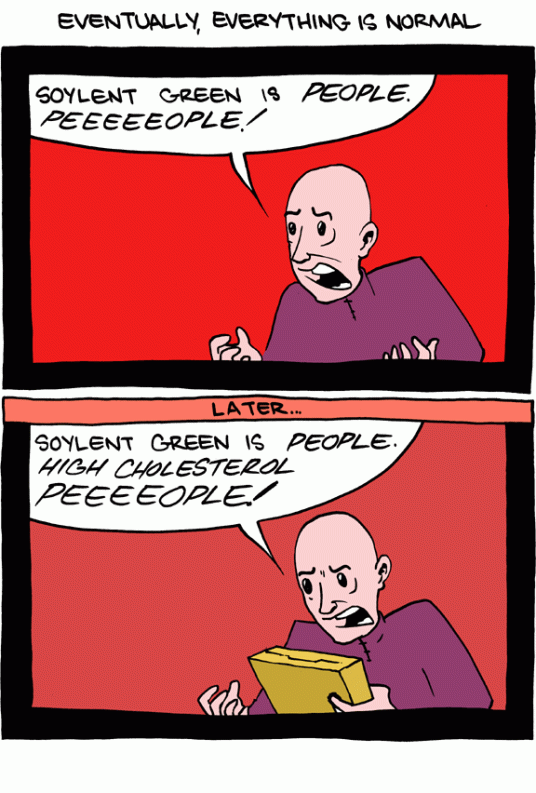
The reviewer John Puccio called Soylent Green “a movie based on an ending. And if you can’t figure out that ending ten minutes into the movie, you aren’t paying attention”. It is one of the most revealed spoilers of any film, with those who have never seen the film knowing the quote, thanks largely to a satirical version on Saturday Night Live. Despite this, I find the film still compelling; its vision of a near future dystopia caused by global warming, more relevant now than ever, offers a glimpse into the mirror: if what we fear comes to pass, would we eat the green crackers or instead choose to go “home”?

soylent green is high cholesterol people

If you like my blog, please feel free to recommend it (with discretion) to friends on social media. If you have any questions or comments, you can use the tag or email cannibalstudies@gmail.com.

Doctor Lecter! Doctor Who?

David Tennant, the tenth Doctor Who, has told Entertainment Weekly that he was in consideration for the role of Hannibal Lecter in the television series Hannibal that ran for three seasons from 2013-15 (and we are still hoping for a fourth?)

Hannibal looks at Annabelle

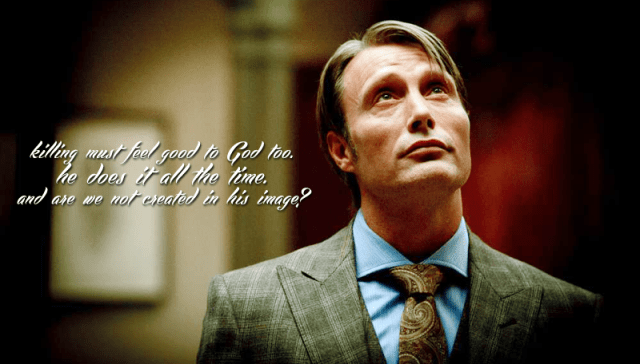
Hard to imagine anyone but Mads Mikkelsen playing the role, in hindsight, although he was, at the time the show was first announced, accused of being no Anthony Hopkins. But, as it turned out, he was perfect in the role, playing Hannibal as a fallen angel, rather than Hopkin’s trickster.

hannibalOPa_zps444cb958

But had that deal not been done, how would Tennant have been as Hannibal? He says that he met up with Bryan Fuller (the showrunner) a couple of times, and they talked about the role, but, he adds, “Mads Mikkelsen… was a perfect choice for it”. Here he is as Kilgrave on Marvel’s Jessica Jones. A much creepier Hannibal perhaps.

David Tennant's Kilgrave to return for Marvel's Jessica Jones ...

If you like my blog, please feel free to recommend it (with discretion) to friends on social media.
If you have any questions or comments, you can use the tag or email  cannibalstudies@gmail.com.

Contagious cannibalism: “Ravenous” (Bird, 1999)

Ravenous – this is the 1999 Antonia Bird film, not the recent Canadian Ravenous by Robin Aubert. Aubert’s movie is about zombies, and they also tend to eat people (or bits of them), but this one is about people eating people, a more pure form of cannibalism. Except that there is still a supernatural aspect to this: the cannibalism comes from the mythical wendigo, a creature or spirit from Algonquian folklore, who possesses humans and turns them into cannibals.

ravenous1999

The film draws inspiration from two of America’s favourite cannibalism stories: the ill-fated Donner Party and the story of Alferd Packer. At least, it involves pioneers, snow, hunger and, of course, cannibalism. Guy Pearce, as wooden an actor as we have seen for a while, plays Lieutenant Boyd of the United States Army, who plays dead in battle as his unit is massacred by the Mexicans. His body, along with the other dead are put in a cart and hauled back to the Mexican headquarters.In a moment of bravery, Boyd seizes the chance to capture the Mexican HQ. His heroism earns him a Captain’s promotion but General Slauson (the last film role of John Spencer, who went on to play Leo McGarry on The West Wing) learns of his cowardice and posts Boyd into exile at Fort Spencer, a remote military outpost high in the Sierra Nevada.

Screen-Shot-2017-09-21-at-8.25.26-AM

A stranger named Colqhoun (Robert Carlyle from Trainspotting, Full Monty, etc) arrives and describes how his wagon train became lost in the mountains. A Colonel named Ives had appeared and led them on a circuitous route, resulting in the party getting trapped by snow. People were reduced to cannibalism, he tells them, to avoid starvation. Before the soldiers leave for the rescue, they are warned by their Native American scout, George, of the Wendigo myth: anyone who consumes the flesh of their enemies takes their strength but becomes a demon cursed by an insatiable hunger for more human flesh. They also become almost invincible: if wounded, a bite of human flesh is – well, very invigorating.

ravenous-1999-3

Anthropologists love to divide their supposedly cannibalistic studies into endo- and exo-cannibals, i.e. those who eat their enemies and those who eat their friends. In both cases, they claim, the eater believes they will take on the courage, strength and virility of their meal. The wendigo has another advantage – the people he bites (as long as he doesn’t go overboard) will heal and become wendigos themselves. You’re never alone if you’re a wendigo cannibal.

Ravenous-1999-movie-3

The curse of cannibal studies is that eventually the audience will want to know: how did the cannibal get that way? Explaining the psychological / social / starvation causes often reduces the mystique of the act and the eater – many critics were furious when Hannibal Lecter turned out to be a traumatised survivor of WWII, for example. But the wendigo is good value: there is no particular reason he/she/it chooses anyone, in fact a simple bite from a person already bitten is sufficient – there, explanation given, let’s move on to the gore. So, we’re kind of back to the modus operandi of the zombie (and vampire) – open the mouth and spread the love. But zombies usually restrict themselves to brains, vampires to blood. Cannibalism is so much more environmentally sustainable.

The late Roger Ebert gave the film a decent review, 3 stars out of 4, and said it was “the kind of movie where you savour the texture of the film-making, even when the story strays into shapeless gore.” This is well worth seeking out, despite the presence of Guy Pearce.

If you like my blog, please feel free to recommend it (with discretion) to friends on social media. If you have any questions or comments, you can use the tag or email  cannibalstudies@gmail.com.

“Cannibalism is not a crime” – S.African expert

The trial is about to start of five men in KwaZulu Natal in relation to alleged cannibalism. In July 2017, a man appeared at Estcourt police station and claimed he was “tired of eating human flesh”. This led to his and the others’ arrests, after body parts were discovered in their possession.

When the men first appeared in court, police fired rubber bullets and stun grenades to break up crowds hurling insults at them.

The suspects were back in the dock at the Estcourt Magistrate’s Court, KwaZulu-Natal, last week, Estcourt News reports, but the trial was postponed as the state reported that the mental assessment of accused number one, Nino Mbatha, is incomplete. He was admitted into Fort Napier Hospital during the second week of March, after he was found mentally and emotionally unstable.

Image result for Accused number one, Nino Mbatha
Accused number one, Nino Mbatha is still undergoing a mental assessment.

The Ladysmith Gazette reported that hundreds of people in the Amangwe area confessed to cannibalism – being given human flesh to eat as traditional medicine. But former police profiler and forensic psychologist Professor Gérard Labuschagne says that cannibalism in South African was “a very rare thing”. “It’s not occurring frequently and is not associated with multi murder… Remember there is no crime for cannibalism like there is no crime for taking drugs. You are charged with dealing in drugs. And for cannibalism, you will be charged with the possession of human body parts,” he said. “If you cut the parts of a dead body you will also be charged with desecration of a corpse. So you have to be cautious, and, remember, police often arrest people and then withdraw the charges. We can’t assume all were eating the body parts.”

The case resumes on April 16.

Frozen dinners: “Alive” (Marshall, 1993)

Alive is not “just” a cannibal movie – it actually delves into the ethical issues involved in eating other people. Most cannibal films assume that it is grotesque and taboo and generally yucky, and go on to treat the cannibal in the plot as simply a freak of nature, best destroyed ASAP. Except for Hannibal Lecter of course, who can see nothing much wrong with the idea.

Alive is the semi-fictional retelling of an actual event: the crash of a Uruguayan Air Force plane chartered by a football team in the Andes in 1972. The subject of cannibalism is not hidden: in case viewers missed the synopsis, reviews or word-of-mouth titillation, the film starts with Carlitos, a survivor of the crash (played by a chain-smoking John Malkovich), reflecting on his ordeal some twenty years earlier, and sharing the moral conclusions he drew from it. So many people, he complains, have told him they would have rather died than done that which he coyly does not name, but “until you’re in a situation like that, you have no idea how you’ll behave”. Wreathed in smoke, he explores the metaphysical lesson which we will hopefully glean from the tale, that the God he learnt about at school was not the God he met on the mountain: “the God that’s hidden by what surrounds us in this civilisation”. He caught a glimpse, it appears, of that savage and indifferent world of eat or be eaten, the inhuman universe that shocks those who have ever experienced the fury of nature.

The metaphorical nature of this tale is established at the beginning of the narrative. Two women play female stereotypical roles, one enthusing about, the other terrified of the mountains over and into which the plane bounces. They are the mother and sister of Nando (Ethan Hawke), who is to become the lead character when he finally awakens from his coma. The sister, Susana, thinks the mountains are beautiful, the mother replies that they look like “big teeth”. So the metaphor of incorporation is established, and so the plane and the mountain meet, in a feat of special effects impressive for 1993.

Nevertheless, we are 44 minutes into the film before the subject of cannibalism arises: Nando plans to walk over the mountains for help, but cannot do it on a piece of chocolate and a sip of wine (their only apparent food stores). “Then I’ll cut some meat off the pilots. After all they got us into this mess” he says. The others think he’s joking and go on reciting their rosaries, but by day nine, when his sister dies and they hear on the radio that the search has been called off, Nando calls them together and announces “We’re going to save ourselves”. His meaning is clear: they will have to eat the dead.

Alive cutting
Piece of broken glass, dead team mate, lunch

A crucial debate follows between those who “won’t do it” because it’s “disgusting” and those arguing in favour. These arguments boil down to the common themes of cannibal films. Revulsion: we sometimes have to do things that are disgusting, for example “if I had a wound that was rotting and needed washing out, wouldn’t you do it, even though it was disgusting?” The sanctity of life: “if the soul leaves the body when we die, then the body is just a carcass… What’s there in the snow is just meat, Antonio. Food.” Then of course the main theme: survival. Our families (and perhaps God too) would rather see us alive than morally pure. As they prepare to cut the first pieces of human flesh, one of them comments: “It’s like communion. From their deaths, we’ll live.” Nando, the instigator, hangs back from feeding until he is reassured they are not eating his sister’s body. Immediate family is hard to redefine as “just meat”.

Alive - meat on the wing
This was probably some innocent chicken, but for the audience, it was the other passengers

It’s unusual, even in survival films, to see women cannibals (excepting comedies). Although the survival arguments have been fought and won, the last woman alive in the plane, Liliana, is still holding out, but decides that she wants another baby, will need nourishment, and accordingly agrees that tomorrow she will eat. That night an avalanche engulfs the wreckage and she is one of the victims, saved from abjection by death. Note: in the book upon which the film was based, she eats the flesh. Then gets killed.

In the bitter cold of the High Andes, the survivors are packed together in the wrecked interior of the plane, sharing their hopes and despairs, discussing ethics and strategies. We, the audience, are sitting among them, considering the same life and death questions, asking ourselves what we would do in their position. By contrast, the scenes outside in the dirty snow or struggling across the mountains to safety are remote: we are just observers, our distance confirmed by syrupy music.

Alive

Little attempt is made to show the physical effects of seventy days without (non-human) food: the men look ready for their next football match when rescue finally arrives. Roger Ebert admitted that he does not know what it would be like to huddle in a wrecked plane for ten weeks eating human flesh, but complains “I cannot imagine, and frankly this film doesn’t much help me”. It seems a minor quibble: the film was clearly a vehicle for Ethan Hawke, Vincent Spano and other Hollywood “young guns”: Newsweek stated that Hawke has “a face for which close-ups were invented”, suggesting that not everyone in the audience may have been there to struggle with ethical dilemmas.

Part of the attraction of the movies, particularly thrillers or horror movies, is the safety of recognising that we are anchored in a cinema watching actors on a set, and that realisation is never far away in watching Alive. Comfortable, warm and well-fed, we can watch our proxy desperadoes wrestle with fascinating questions of body and soul while ourselves munching thoughtfully on a choc-top. We may conclude that they would have been better to die in the crash, or that they made the heroic choice, but either way the genius of this iteration of the cannibal film is that we have watched the dehumanising of the human body, while allowing ethical ambiguity.

Is cannibalism sexy? “Cannibal Women in the Avocado Jungle of Death” (Lawton, 1989)

Cannibal Women in the Avocado Jungle of Death is a 1989 film which was the directorial debut of J. F. Lawton, who also authored Pretty Woman and Under Siege. He released this one under a pseudonym, J. D. Athens, and at first glance you have to agree with his decision.

The film drips with a sometimes forced irony, inspiring one reviewer on Rotten Tomatoes to call it “One of the best bad movies I’ve ever seen”. Here is some typical dialogue:

Margo Hunt: “They’re an ancient commune of feminists, so radical, so militant, so left of center they… they eat their men.”
Bunny: “Oh, that. Well, if I like a guy, I usually start at…”
Margo Hunt: “They don’t eat their men like that, Bunny.”

Or this one:

There aren’t any modern feminists who advocate cannibalism- at least not since the sixties.

The “jungle of death” is southern California, where a group of radical feminists have occupied the avocado plantations and kill and eat their men, as well as several companies of US troops who try to eliminate them. The film is rich in intertextual references: the protagonists enter the jungle in pursuit of Dr Kurtz, a professor of feminist studies who has become emperor of the cannibal women, a reference to Conrad’s Heart of Darkness (set in the Congo) and the movie version of it Apocalypse Now (set in Vietnam), in which Brando plays the deranged Colonel Kurtz, who famously dies with the words “the horror, the horror!” on his lips. The Dr Kurtz in this film similarly meets her end, but her “horror” refers to having had to defend feminism on the David Letterman Late Show.

Intertextual humour depends on the reader being familiar with the sometimes cryptic references. Apocalypse Now is pretty well known, but some of the other references are either too obvious to be funny or else too obscure to score a laugh. The film opens with the kind of “male gaze” scene expected in an exploitation pic: semi-naked warrior women bathing in a stream while a couple of randy male explorers look on, but the scene concludes with both the men tracked down and slaughtered for the cannibals’ next meal. The main character, Margo Hunt, is played by Shannon Tweed, a former Playboy model, who does not drop her clothes at any point; her ditzy assistant, who wants to change her major from Home Economics to Feminist Studies, is named “Bunny”, another reference to the Playboy world. The bumbling comic relief and token male chauvinist is played by Bill Maher of the television show Real Time, a show which goes out of its way to skewer such prehistoric thinking.  He dresses like Indiana Jones and even wields a bull whip, rather less expertly. Topics from Margaret Mead to Disneyland all get a brief reference, and there is little time to wonder what they are about before the next gag is upon us. Some of the references are double barrelled: when Bunny is told that the women eat their men, she asks “boiled or roasted”, a reference both to the many Home Economics jokes, but also to Levi-Strauss’s musings on the different ways cannibals would cook their relatives or their enemies.

This image has an empty alt attribute; its file name is cannibal-women-3-1.png

 Bill Maher as Jim. That isn’t a spa.

Cannibal Women in the Avocado Jungle of Death is neither as stupid as it sounds or as funny as it intends. But it is diverting and it’s fun to tease out the cultural references, and the lead actors are really very good at delivering their sometimes painful lines. Its commentary on cannibalism is actually quite perceptive: the cannibal women are all gorgeous and young and scantily clad, presentations which are usually intended for the consumption of a male audience. This binary is reversed as they seize their knives and proceed to butcher and consume the male gazers (not on screen – the film is careful not to lose its PG13 rating, although it got an R18 in New Zealand). There is usually a male hero and a female in need of saving; in this, the roles are totally reversed. Cannibalism is not presented as evil or deranged by definition, but rather as another variety of power struggle. To quote Dr Kurtz:

This is a war between men and women. Anything short of cannibalism is
just beating around the bush.

Image result for cannibal women in the avocado jungle of death

When your family are cannibals: “Parents” (Balaban, 1989)

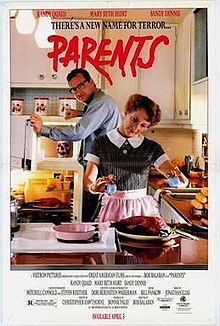
220px-Parents

Parents is a real cannibal film. None of these feeble excuses about starvation or uncontrollably psychotic – here are people who enjoy eating tasty animals, and their chosen tasty animals are humans.

Parents is a Canadian/American production, the first feature film directed by Bob Balaban, who you will recognise from the Christopher Guest movies like Best in Show if you can be bothered to search for a picture of him. He’s a funny guy, and Randy Quaid leads a terrific cast, but the movie never quite got off the ground, scoring a measly 50% on Rotten Tomatoes, with Roger Ebert writing that the movie couldn’t really decide if it was satire, comedy, or horror.

parents

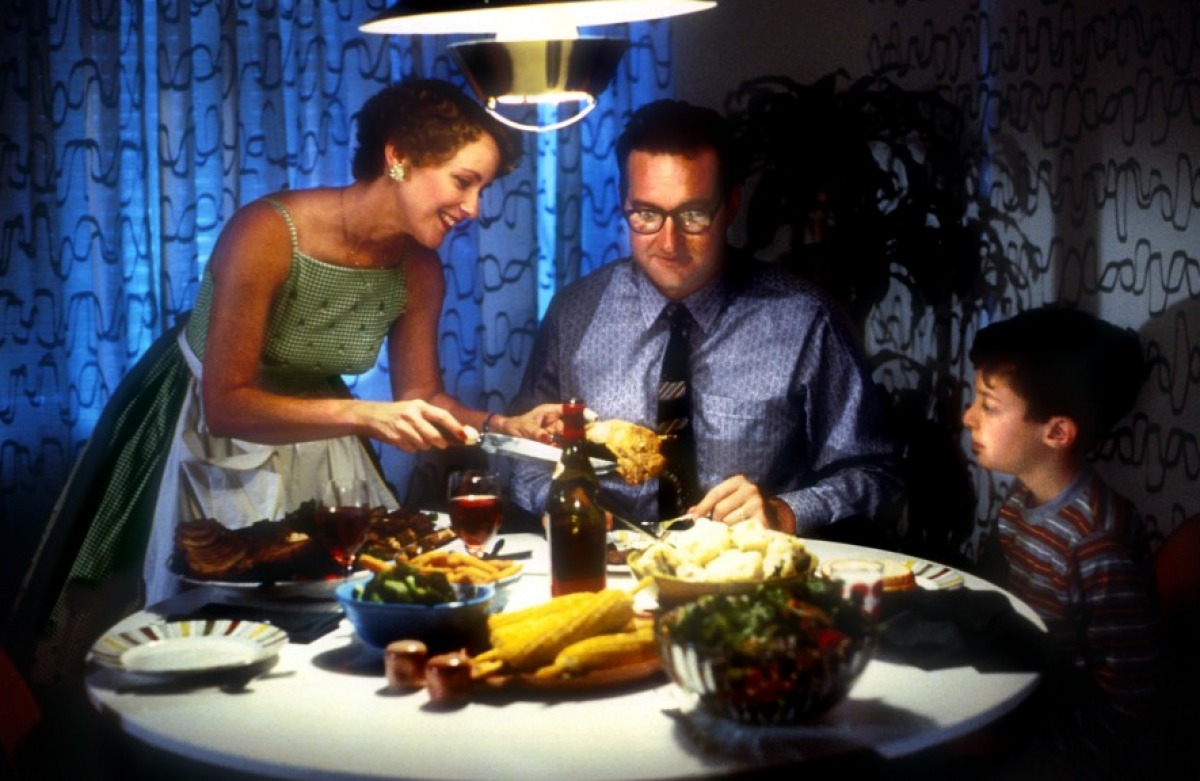
The satire is of the complacent fifties family, Mom at home, Dad at work, kid at school. The kid is Michael, played by a child actor who later made a fine career in Canada as an accountant, another commentary on the film, perhaps. He is traumatised by his family’s move to suburbia, by his increasingly gory dreams, and by seeing his parents having sex (he thinks they are biting each other – if only Freud had hung around long enough to make a cameo).

Michael’s Dad works at Toxico, a fine American corporation making toxic substances to defoliate jungles, and his particular job is working with human corpses, those who have donated their bodies for the good of science. Well, a man has to bring home the bacon, and Dad surely does, straight from the long pigs. Michael begins to suspect that their meals are what Nietzsche called Human, All Too Human after he sneaks into Toxico and sees Dad cutting up corpses. But he can’t get a straight answer out of his parents:

“What are we eating?”
“Leftovers.”
“Leftovers from what?”
“From the refrigerator.”

Parents_1

So it’s comedy. But when Michael’s sceptical social worker takes him home and finds a body in the cellar, shit gets real. There is much death and bondage. Dad tells Michael he is an “outsider” like them, and that if he can get people to believe him, they will all burn. “Is that what you want?” He tells Michael “I’m sure you’ll acquire a taste for it. Your mother did.” She flashes a pretty fifties advertising smile: “I learnt to love it.”

Michael demurs and ends up bound up by his father like Isaac on the mountain with Abraham. Talk about sacrificial discourses! He manages to turn the tables, without the aid of angels and/or rams, and well, the fire happens.

bound by sacrificial discourses of old testament

Michael ends up living with his (also archetypal fifties) grandparents who tuck him into bed and leave him a rather suspicious sandwich, in case he gets peckish during the night. Like all of us, he has moved on from his parents, but not from the patriarchal and carnist violence that helped to form him, us, and our polite, blood-soaked culture.

Mallet

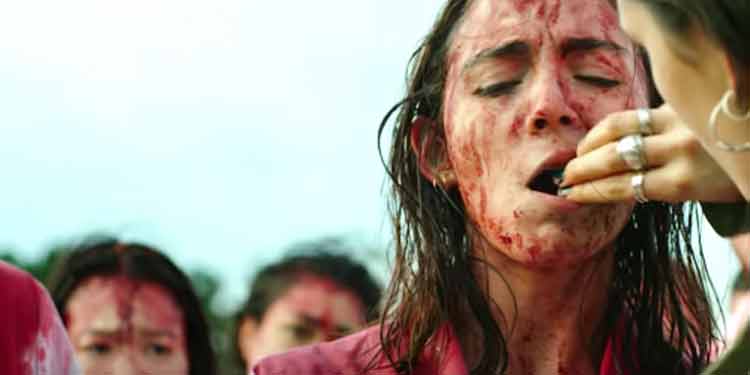
School for cannibals: “Raw” (Ducournau, 2016)

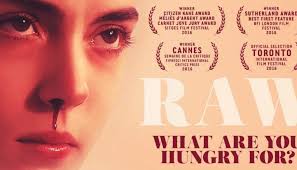
Poster

Raw is a French Bildungsroman or coming-of-age story, where education and character development is a crucial part of the narrative. A Bildungsroman is about transition to adulthood, whatever that term may mean for the protagonist. Think American Graffiti or Harry Potter, but with cannibalism. It’s about what Hannibal Lecter would call “becoming”, and relates closely to his preferred version of it, because Justine, a life-long vegetarian, “grows up” to become a cannibal.

The story is set in a veterinary school where Justine has just enrolled and the presence of animals, alive and dead, remind us of our materiality – we too get sick, bleed, die, just like the patients and specimens around her. Justine’s sister, who has been attending for some years, bullies her into accepting the hazing ritual – eating a rabbit’s kidney.

Kidney_Layer 1

This introduction to meat (as well as a shower of blood during the orientation festivities) brings out first an itchy rash, and then the hunger, and it’s all teeth and blood from there (it’s called Raw for a reason). But it’s not just a slasher movie – Justine finds her identity, which is what these movies are all about. She discovers what excites and pleases her, while being abused and humiliated. We sit in the cinema thinking: that’s exactly what growing up was like!

Raw-Julia-Ducournau-1

Fortunately for this blog, the number of cannibal movies, books and news stories is growing all the time. Julie Ducournau was astonished that hers was not the only cannibal film at Cannes – there was also Neon Demon and Bad Batch. She commented:

The cannibalism in my movie is political. So the fact other movies are talking about it, it means something about society. We’re not talking about sci-fi; it’s about monsters that actually exist and are humans.

The movie starts with a car crash, deliberately caused, and resulting in some apparently quite yummy corpses. Our reliance on motor vehicles and acceptance of the carnage they create is built into the plot of a few cannibal narratives – e.g. Godard’s Weekend and Balaban’s Parents.  We find out more about Justine, about her sister, about her parents, before the final unravelling of the plot. No spoilers here, though.

Raw became famous, or infamous, when the news media heard that, during the 2016 Toronto International Film Festival, some viewers received emergency medical treatment after allegedly fainting as a result of the film’s graphic scenes. The director, Julie, claimed to be shocked when she heard about this, but, as Oscar Wilde is supposed to have said, “there is no such thing as bad publicity”, and Raw quickly became famous, or infamous. Some cinemas in the US apparently handed out bags to patrons – the kind you find in the seat pocket of your plane.

But it would be a shame for Raw to be considered just a gore-fest. It is an intelligent and compassionate study of growing up in a rough world, and the pain of having the ethics that supported your childhood questioned and demolished. I thought the explanation of why it all happened at the end was disappointing and unnecessary, but take a look at Raw (I don’t think you will need a sick bag or an ambulance), and judge for yourself.

arm biting

Frank is in the sauce: “Fried Green Tomatoes” (Avnet, 1991)

Come on, this is a blog about cannibal films, innit? We’re talking comedy/weepy here, not Hannibal Lecter. The big issue is not cannibalism but, decades before the age of #metoo, domestic abuse. Jon Avnet’s directorial debut tells the story of Ruth and Idgie who form a special relationship (not as explicitly special as it was in the book on which it was based, but still special) when Ruth rescues Idgie from chronic depression after the death of her brother, while Idgie later rescues Ruth and her child from her abusive husband. They move to the town of Whistle Stop and start a café serving – yeah, you got it. Tomatoes. Green ones. And barbecued meat.

DVD box

When the abusive husband turns up, things get nasty, until he disappears, and then of course the cops turn up. But the abusive Frank has vanished, and it remains a mystery. The investigator is baffled, but he does enjoy the barbecue served at the Whistle Stop Café.

Investigator: “why this about the best barbecue I ever ate!”

Sipsey (the cook): “The secret’s in the sauce”.

Secret in the sauce

So it is. And so is Frank. Apologies if you were planning to watch this, but the statute of limitations on spoilers is only 25 years. Still a classic though, with one of the best casts you could hope for. And – it is definitely a cannibal movie.