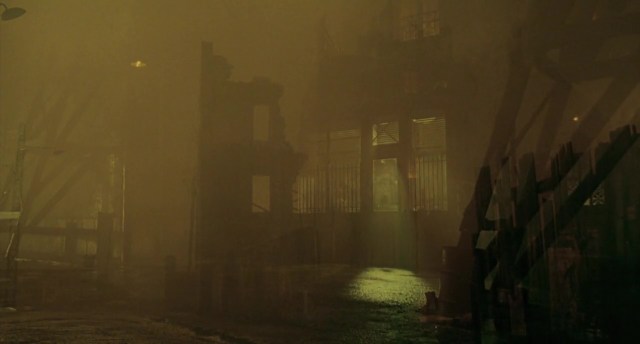
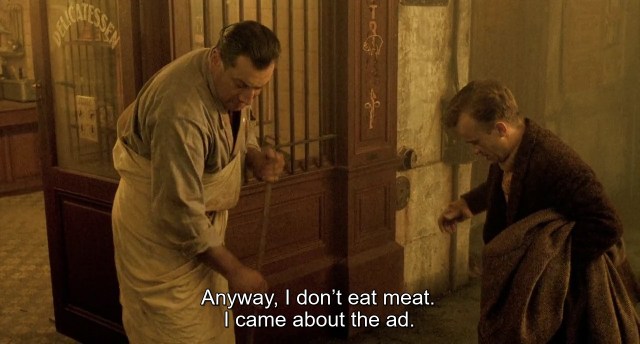
Delicatessen is a classic French black comedy set in a post-apocalyptic village where seeds and grains are the exchange currency. The butcher advertises for handy-men in a journal called Hard Times and then slaughters the applicants and sells their meat to his weird tenants, who have surrealistic activities: a man who lives in a flooded room full of frogs and snails, a woman who constantly fails at suicide attempts so involved they would be worthy of Wile E Coyote, and two brothers who manufacture mooing machines for no apparent reason.
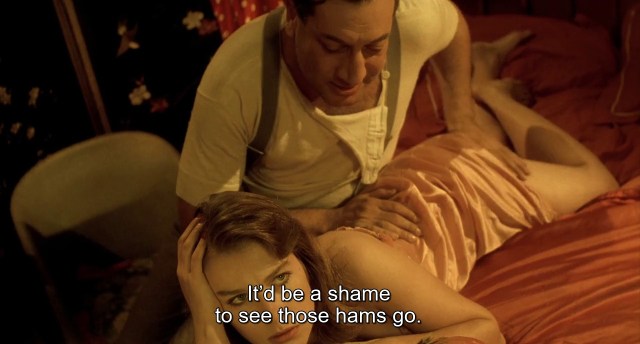
The trailer for Delicatessen is a scene from the early part of the film, where the butcher, Clapet (Jean-Claude Dreyfus) is having sex with a woman (Karin Viard) who seems to be as much captive as partner.
As his lustful tempo, played out on the squeaky bedsprings, increases in speed, so do the activities of all the tenants: the butcher sets the pace in this world (and by implication in our world too).
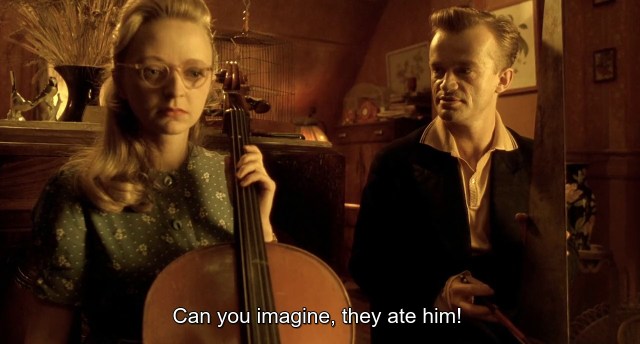
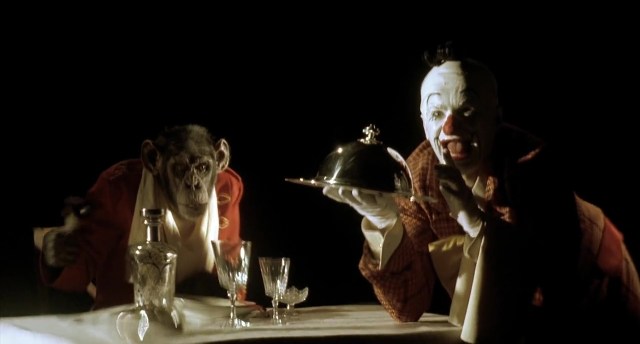
Into this house of horrors comes a gentle (vegetarian) clown, Louison (Dominique Pinon), who has left the circus after his partner, Doctor Livingstone, was eaten.
Livingstone, it turns out, was a chimp, but his sorrow is no less real for that.
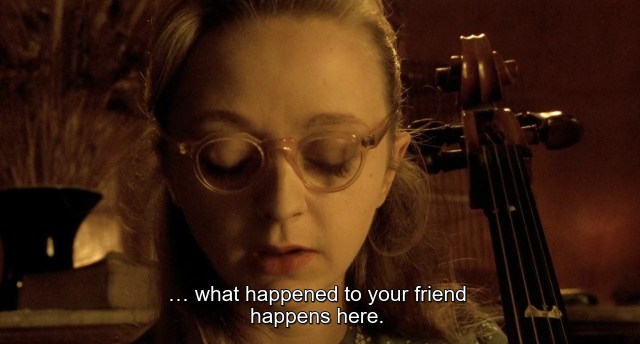
The butcher’s daughter, Julie (Marie-Laure Dougnac) falls in love with him and tries to warn him of his likely fate.
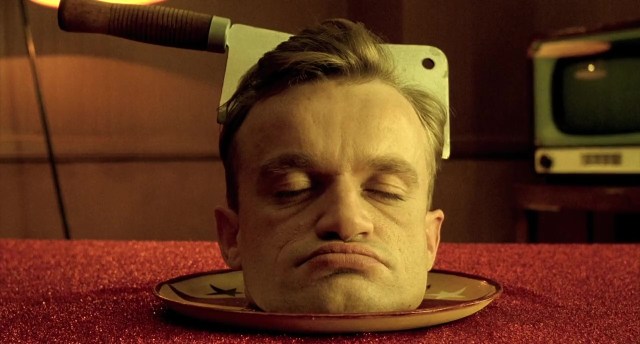
Julie dreams about the upcoming butchery of Louison, and decides to save him. To do this, she has to seek the help of the Troglodistes, an underground group who are vegetarian and hate the “surfacers”, who hunt them. Their motivation is the 30 bags of corn in her father’s house. Her motivation: love. Her father’s: meat. Can there be a more French theme? She returns to find:
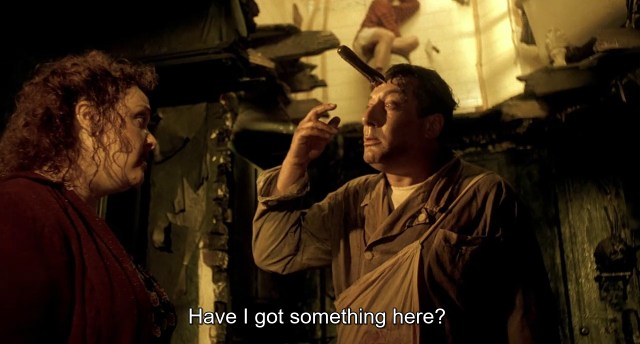
But he’s a clown – this is a new act he is rehearsing.
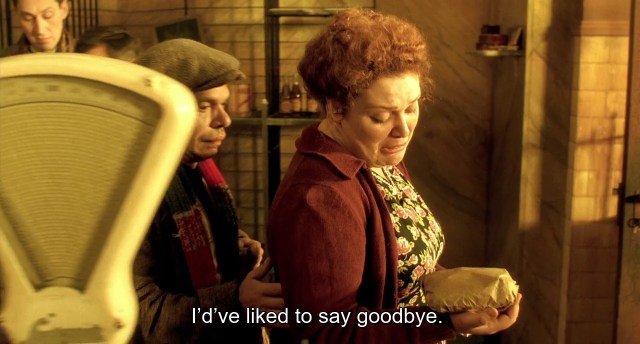
Since Louison did not appear on the steps last night, where the killings are done, the butcher is instead selling bits of the mother of one of the tenants. As the tenant leaves the butcher, a neat packet of her mother’s flesh under her arm, she says:
“We’ll do that now” her husband assures her.
Look, none of it makes any sense, but that’s to be expected. All we can conclude is that voracious appetite (of which cannibalism is the highest form) doesn’t pay.
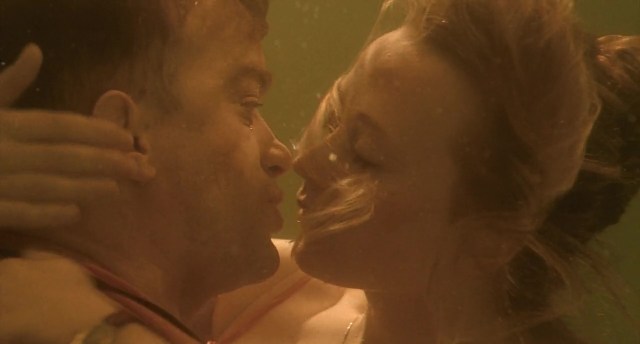
And love always triumphs…
… even if it’s underwater.
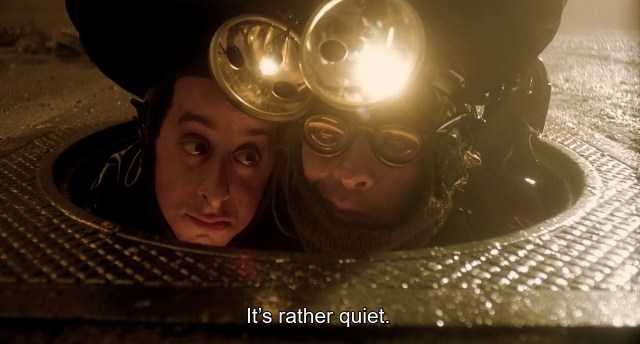
The director Marc Caro’s cameo (in goggles).
Rotten Tomatoes currently gives Delicatessen an impressive 89% “fresh”. The Washington Post called Delicatessen “a tasteless variation on Sweeney Todd set geographically near the border of Terry Gilliam’s Brazil” while Unsung Films said it was “reminiscent of Amélie – and …much braver”. Amélie was the director Jean-Pierre Jeunet’s 2001 masterpiece.
Empire summed up Delicatessen as “simply essential viewing for vegetarians”.
Cannibalism films often have that effect.
IF YOU LIKE MY BLOG, PLEASE FEEL FREE TO RECOMMEND IT (WITH DISCRETION) TO FRIENDS ON SOCIAL MEDIA.
IF YOU HAVE ANY QUESTIONS OR COMMENTS, YOU CAN USE THE TAG, OR EMAIL ME ON CANNIBALSTUDIES@GMAIL.COM.
First off, if you don’t like gore (hey, it’s a blog about cannibal films, not necessarily slashers), then you may want to avoid this little French number. If graphic scenes don’t bother you (or if you like them) then this one is quite intriguing and very well made. But –– you’ve been warned.
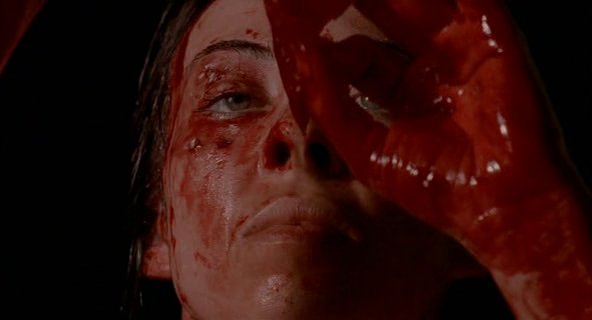
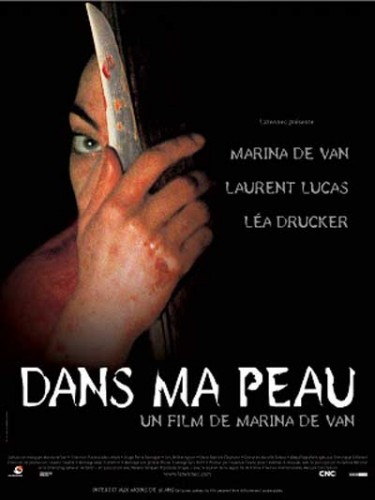
Marina de Van both directed and starred in this film, one in a genre of French movies which became known as New French Extremity films. There’s not a great deal of plot, but there’s a lot to the film in terms of the concepts and questions it raises. The film starts with a series of scenes: traffic, buildings, doors, etc, split screen into the image on one side, and a negative version on the other. So we’re already exploring dualism. The lead character, Esther (played by the director, Marina de Van), is a picture of privilege: she is white, well paid, well off, has a loving boyfriend – she’s on top of her world. Then she has a fall. A real fall, onto some rubbish, and actually injures her leg. But it doesn’t hurt. She doesn’t even notice the abrasions for some time.
Her doctor (played by her real-life brother, Adrian de Van) and her boyfriend (Laurent Lucas) are both concerned about her feeling no pain, but she brushes them off. Then she starts poking her wound, then the cutting starts, then the stabbing, then later the chewing (which qualifies it for my cannibal blog). That’s all I’m saying – no spoilers.
In the director’s words, the movie asks “does this body really belong to me?” In an interview, she revealed that the story is based on an childhood accident, when she was hit by a car and had her leg broken, and she saw her leg not as part of her, but as a “fascinating, deformed object.”
Here’s the point: we look at each other with love or lust or hatred or fear, but it’s always only skin deep. What is beneath that surface? Derrida tells us that the binary opposition of inside to outside is the “matrix” of all oppositions. We consume the insides (muscle, fat, blood) of other animals but are horrified at our own internals – think of the warning given on the news when showing an accident or terrorist event, often quickly followed by an advert or a kitchen show involving bits of a dead lamb.
Why are we so repelled by what’s under our skin? Judith Halberstam tells us that skin is a “metonym for the human”, and any breach of it reveals a “semiotic of monstrosity” – the uncanniness within the body. Or as Angela Carter put it, “if flesh plus skin equals sensuality, then flesh minus skin equals meat”.
This film, and cannibal films generally, remind us that we are not gods or angelic beings – we are animals, and are made of meat, just like the animals we torment and slaughter. When Esther looks into her own being, she feels the same appetite others feel when walking past a roast.
In My Skin received 65% on Rotten Tomatoes, with one reviewer saying “A spellbinding, forceful film that refuses to be ignored” and another slamming it as “a bloody mess, in more ways than one.” The film received the Best International Film award at the Fantasia Film Festival in 2003. Make up your own mind.
This episode is called “Relevés”, an obscure term in the French menu – it comes sort of after the main course, but is not the Rôti (roasts) of episode 11; this one is joints – big butcher joints, served with heavy accompaniments and garnish. Appropriate for a meaty episode, in which Hannibal takes steps not just to cover his own tracks, but to lay a path of suspicion to Will, who has been behaving very strangely lately, thanks to his encephalitis (which Hannibal has also covered up). The real meat of this episode, though, is its treatment of mental illness – where it starts (physical and/or psychological) and how it develops, and the paucity and inadequacy of treatments.
At the start of the episode, everyone is starting to recover. Georgia Madchen, who killed her friend and witnessed Hannibal killing the doctor who knew about Will’s condition, is in an oxygen tank, awaiting shock treatment which may restore her memory.
But she doesn’t want to remember.
Hannibal has brought Will one of his gourmet concoctions: “Silkie chicken in a broth: a black boned bird prized in China for its medicinal value since the seventh century. Wolfberries, ginseng, ginger, red dates and star anise. Will’s bemused response, as though Hannibal was his Jewish mother, making chicken soup to treat a psychic crisis that just seems to get worse:
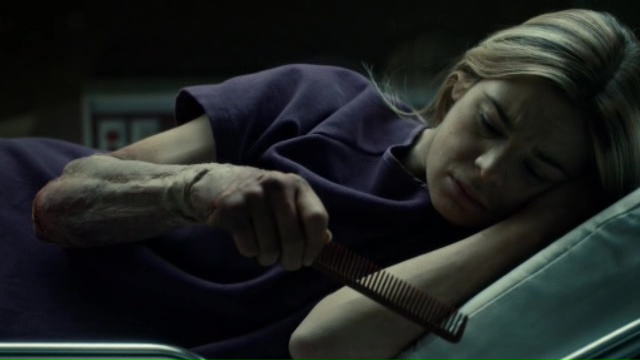
Hannibal also does not want Georgia to recover her memory, because he is vulnerable, even if she was unable to see his face. She wakes up in her oxygen tent and finds a plastic comb, naturally, she starts to comb her hair, and naturally the static creates a spark that ignites the oxygen.
So that leaves Abigail as apparently the only one who could spill the fava beans on Hannibal. She is busy writing her book with Freddie Lounds, who tells her she knows what killers look like
She looks for a specific brand of hostility. She sees it in Will Graham, every time she looks at him. Very convenient for Hannibal. But Will has released himself from hospital, and is starting to realise that the spate of copycat deaths are all the same, but slightly different, to the murders they copied – the copycat killed all of them, including Georgia, who saw his face. Will is furious that Georgia was misdiagnosed and misunderstood her whole life, and doesn’t want the same thing to happen with her death, which Jack is treating as suicide.
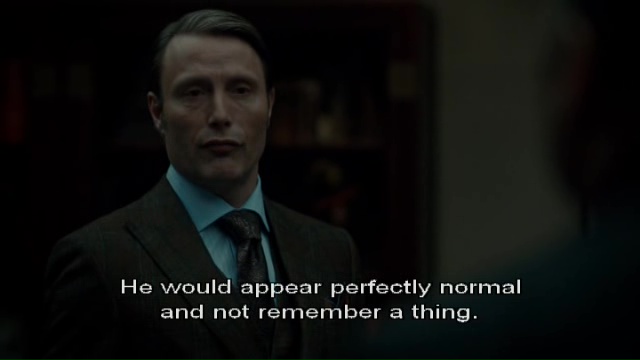
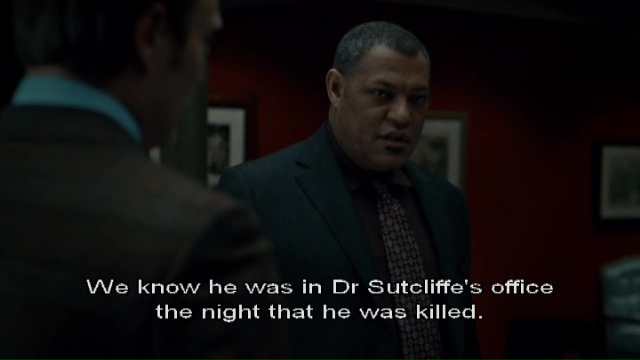
Will’s vehement reaction worries Jack, who consults Hannibal, allowing Hannibal to plant the seed of suspicion: does Will suffer from a mental illness that would allow him to do things he doesn’t normally do?
That’s true for Will, but even more true for Hannibal, who sees himself as a species apart from the common herd, an Übermensch, who has cast off normative humanism for his own ends, which we are yet to understand.
Will is visiting Abigail in hospital. They discuss the nature of killing. Will admits killing her dad was terrifying, but then made him feel powerful. She replies that
She wanted to escape, but Will is doubtful
Her dad is still out there, in the form of the copycat. Will thinks he can catch him,
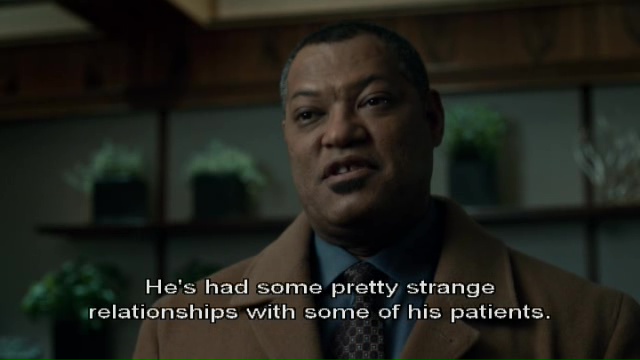
Jack has been visiting Bedelia, who has covered for Hannibal (as any professional psychiatrist would) and has been asking about a case in which a patient, referred to her by Hannibal, tried to kill her, but luckily died by swallowing his own tongue ( a reference to Multiple Miggs in Silence of the Lambs). Hannibal, Jack points out,
30
Hannibal asks what she told Jack?
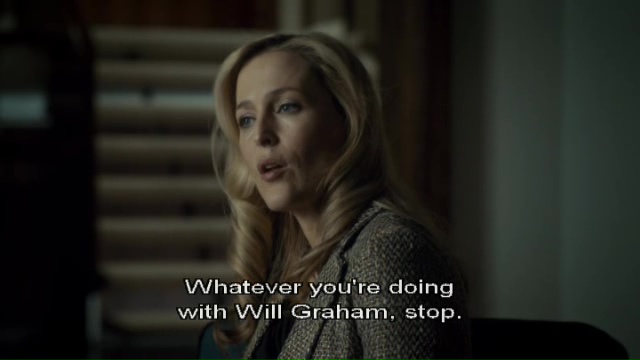
She doesn’t know quite what Hannibal is trying to do with Will (it seems to us, the omniscient spectators, that he wants to turn Will into a clone of his own powerful self)
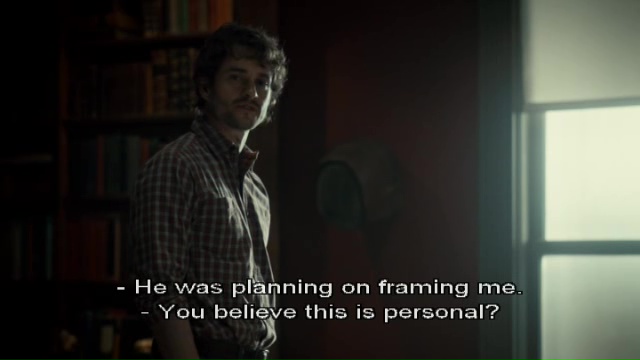
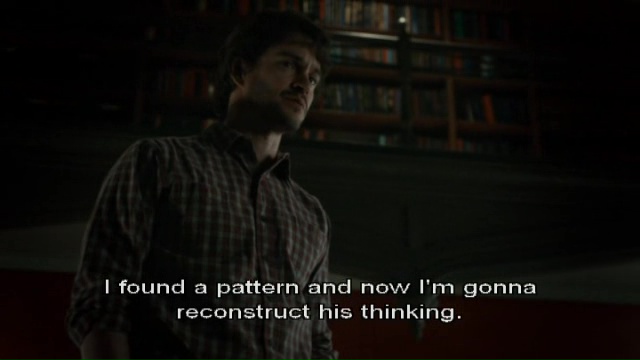
Will is thinking clearly again, he tells Hannibal, and starting to understand the copycat killer that so baffles the FBI. Georgia was killed for seeing the killer, who ended up framing her for it, but
Now it’s personal. Will realises it could be someone at the FBI or the police. He doesn’t, however, realise what we realise, that he is in the same room with the killer. Like a pantomime, we feel like shouting at the screen: look behind you! But we don’t, because we don’t have interactive TVs (yet), and also because we like Hannibal, and don’t really want to see him unmasked (yet). But Will’s clarity, and Abigail’s book, are both threats to Hannibal. And he has only one episode of Season 1 to neutralise them.
Fortunately for Hannibal, everyone is on the wrong scent. Jack is still convinced Abigail is the killer, while Freddie is still convinced it is Will, and tells Jack so.
Will takes Abigail out of the hospital, back to the crime scene – her home in Minnesota. Jack is furious and goes to see Hannibal, who admits to Will’s confused mental states, where he loses time and doesn’t know what he has done. He plays Jack a selected section of the recording of his discussion with Will about the murder of Melissa Schurr.
Together with Hannibal’s revelations about Will’s mental state, Jack is starting to suspect Will.
Will had told Hannibal, who hadn’t told Jack, that he was getting so close to Hobbs that
Now he has Hobb’s daughter, who Hobbs intended to kill. Jack fears the worst. As for Hannibal:
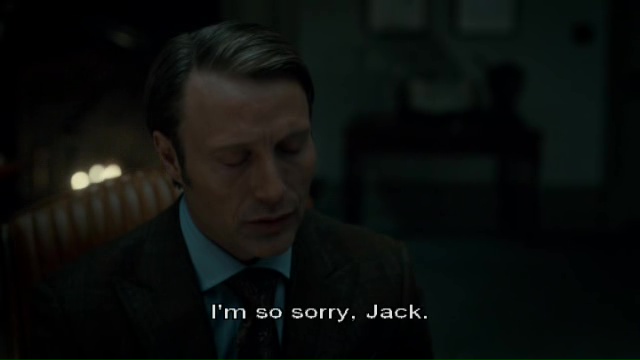
Hannibal is sorry, but not, as Jack thinks, for hiding the “truth” about Will’s mental state. He is truly sad and sorry, for losing his friend, his only friend, feeding him into the jaws of the justice system.
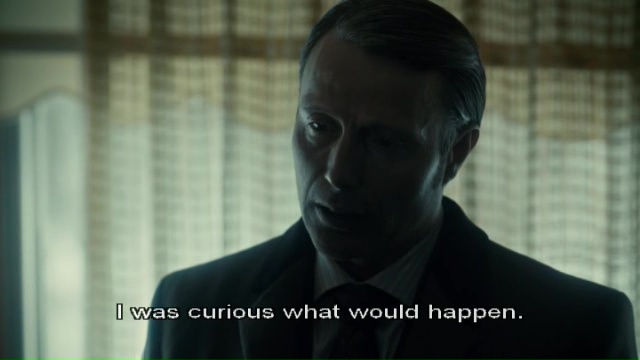
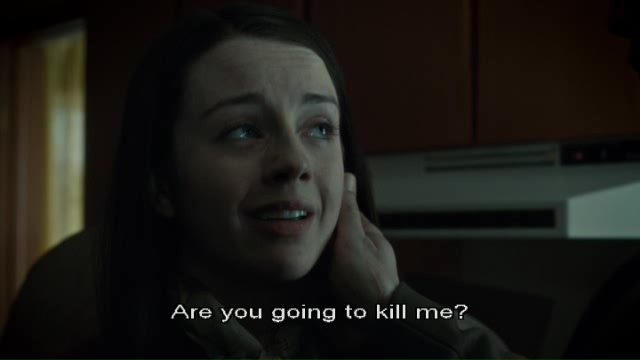
Why does Hannibal do these things? Abigail asks him, and he tells her the truth, at last. He called the house to warn Hobbs they were on their way. Why? she demands. And this is crucial to an understanding of Hannibal:
He killed Marissa, hoping that Abigail would kill the victim’s brother. Abigail is another of his projects
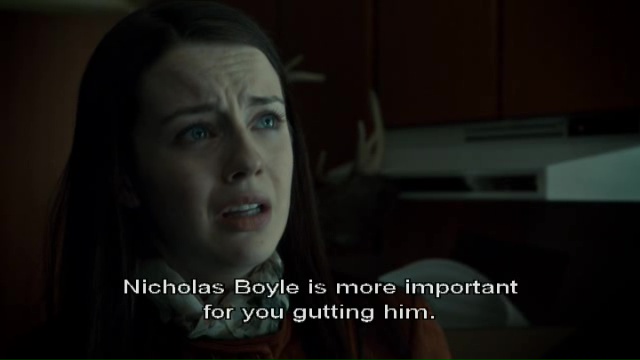
Hannibal believes, as Dolarhyde says in Manhunter, that the people who are killed in these becomings are not real: “You alone know the people I use to help me in these things are only elements undergoing change to fuel the radiance of what I am Becoming. Just as the source of light is burning.” Abigail’s Becoming is far more important than Nick Boyle. But Abigail is scared of Hannibal now: he tells her that he has killed far more people than her father.
Will he or won’t he?
Next episode – the season finale.
IF YOU LIKE MY BLOG, PLEASE FEEL FREE TO RECOMMEND IT (WITH DISCRETION) TO FRIENDS ON SOCIAL MEDIA.
IF YOU HAVE ANY QUESTIONS OR COMMENTS, YOU CAN USE THE TAG, OR EMAIL ME ON CANNIBALSTUDIES@GMAIL.COM.
Joe D’Amato (real name Aristide Massaccesi) was nothing if not prolific, directing some 200 films from 1972-99. These covered a multitude of genres from westerns to war, comedy to fantasy, but he is best known for his horror, erotic and adult films. His first softcore movie was Emanuelle’s Revenge in 1975, followed by his work on five of the six “Black Emanuelle” movies starring Laura Gemser as a globe-trotting journalist who gets into all sorts of merry scrapes, usually involving violence, horror and rape. They were based around the French Emmanuelle movies, with one “m” removed from the title to avoid copyright problems.
D’Amato’s first Emanuelle movie, Emanuelle’s Revenge (1975), was with German actress Rosemarie Lindt as Emanuelle and George Eastman as Carlo, whose role as a murderous monster with a machete prefigured his later role in D’Amato’s Antropophagus (1980). Both these movies deserve a mention in this blog, since the first has Carlo fantasising about cannibalism while under the influence of LSD, while the second has a demented cannibal who actually eats his own intestines (all right, don’t believe me). We’ll get to them – maybe.
Emanuelle and the Cannibals was the fifth of the Black Emanuelle films; the fourth that D’Amato directed. The porn level is a great deal lower than the others in the series (Emanuelle in America for example had a naked woman masturbating a horse), but this had something better: cannibalism! Who needs horses?
The film starts with a claim to be a true story, which was the thing in those days.
Emanuelle is in an asylum in New York, in which women do crazy things (just like they do in Suddenly Last Summer, so it must be true). Mostly they just talk to themselves and carry dolls, and Emanuelle is “embedded” as they say – an investigative journalist from the Evening Post, cleverly disguised as a doll-carrying crazy. The boss doctor (a cameo by the Director) tells her she will cause a scandal if discovered, and his price if she wants to come back and do it all again will be double.
Meanwhile, one particular crazy is busy biting off and eating a nurse’s breast, which Emanuelle finds fascinating. The staff say she is a “complete savage” and she snarls and snaps at them, but is quickly tamed by Emanuelle, who introduces herself with some hand gestures (between the girl’s legs).
Emanuelle’s editor is fascinated by the story of the cannibal and even asks how the nurse is. Emanuelle answers “she asked for it. She’s well known for her homosexual inclinations.” Well, that’s OK then. Emanuelle has taken photos of the girl with her gown hoisted up, and after studying them extensively, they raise their eyes high enough to notice a huge tattoo “above her pubic region” (I’m not sure if the dialogue really is this bad or if it is the poor translation used for the dubbing). It’s an Aztec symbol – from the Tupinambas according to the newspaper’s resident nerd (do you remember when newspapers could afford to employ nerds?). The Tupinamba were everyone’s favourite Brazilian cannibals since Hans Staden was captured by them and claimed to have witnessed their cannibalistic rituals in the sixteenth century. Fortunately, the Portuguese came to save them from their sins, and through enslavement, assimilation, extermination and the introduction of Smallpox, managed to wipe them out completely.
But not in this movie. Emanuelle goes to the Natural History Museum to meet up with the “famous anthropologist” Mark Lester (Gabriele Tinti, who was Gemser’s real-life husband). He takes her to lunch, to his house to look at films of Tanzanian ritual cannibals cutting off heads, penises and what have you from a pair of adulterers, and then to bed. She takes him to the Amazon. Fair exchange.
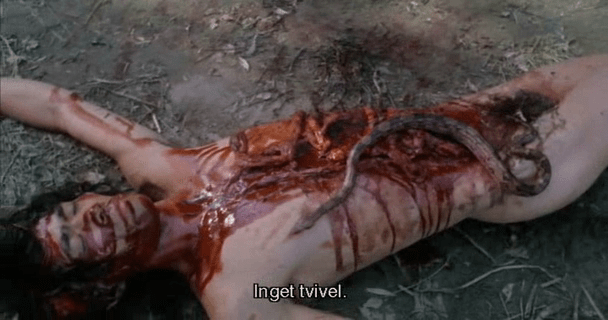
now you know how to say “it’s about cannibalism” and “you’re crazy” in Swedish
Before leaving, the movie treats us to scenes of New York traffic and several gratuitous sex scenes including one with Emanuelle’s steady boyfriend, who seems to be able to make sweet sweet love while still wearing skin-tight jeans. And lots of close-ups of Gemser.
On the plane, they smoke (!) and discuss anthropology and history, appropriate since it’s a Pan Am flight.
Why are there still cannibals? asks Emanuelle. He tells her about political cannibalism like Idi Amin, or “tolerated” cannibalism like the Andes plane crash survivors. But in the Amazon, they live by their own rules, and may eat human flesh for ritual purposes, or because they are peckish. Lucky she brought along an anthropologist.
They interview the dude who found the cannibal girl, and he says he has lived among the Amazonian tribes for 25 years and only come across two cases of cannibalism, which were quickly hushed up by the government. He has a daughter, Isabelle (Mónica Zanchi) who has grown up since she last saw Lester and lusts after him, and she spies on Lester and Emanuelle as they go through the same motions, and the same soundtrack, as the New York sex scenes, while Isabelle masturbates outside. Now that’s the sort of thing that you’d expect to cause a lot more problems than extinct cannibals.
Isabelle is taking supplies to a Missionary down the river who knows all there is to know about the “savages” as they call them, and a Nun and two Indians are going with them (definitely redshirts). The Nun tells them that superstition is still strong in the jungle, and there are still witch-doctors curing people with herbs! Oh, the horror. She does admit that the herbs work, so much so that the mission has appropriated (sorry, adopted) many of the concoctions.
There is a totally superfluous scene where Emanuelle and Isabelle are in the river washing each other (mostly concentrating on each other’s breasts, which I guess must get grimy on the river) and being watched by a chimp, who smokes their cigarettes and tries on their sunglasses. Of the three actors in the scene, the chimp seems to be portrayed as the most intelligent. They meet up with some adventurers, Donald and Maggie, who tell them that the Mission was attacked by savages and everyone massacred. Donald saves Emanuelle from a snake, and she asks him what he is doing in the jungle.
“Hunting. Hunting is my life. I’ve sacrificed a lot to satisfy my craving for – hunting…. The satisfaction of catching it. And to kill! … you have to share risks with the animals. Man too can be hunted.”
And what’s Maggie doing there? Well, she’s doing the African cook, Salvador. And no one seems to wonder what the hell he’s doing there in the middle of the Amazon basin. Donald catches them hard at it in the jungle, but it doesn’t become much of a thing, because they have their own agenda – searching for a crashed plane full of diamonds. When the others decide to go back, they find one of the redshirts cut up, cannibal style, and their boats missing.
They try to head back down the river on foot, but on the way find a Bible, and Father Morales from the Mission to which they had been heading.
So, we all know what happens next. This is a cannibal film after all. The Nun disappears and – well, we know from the very start of the movie which part of the body is the favourite of these particular cannibals. They also like intestines. And we get to see it all happen.
The expeditionaries find the Nun (or some of her), and it just gets worse from there. Donald and Maggie find the plane and the diamonds, pause for a celebratory quickie, and are attacked by the cannibals. Donald forgets to duck and the savages take Maggie, and the diamonds. Our few remaining heroes find the village and the villagers, who are about to sacrifice Maggie to the Goddess of Fertility. We know this because we have an anthropologist along. After that, they put a wire around Donald’s midriff, and have a tug of war.
Donald’s quick weight-loss diet
Isabelle is drugged and naked, but they want to sacrifice a pregnant girl to the river gods, and she’s not pregnant – yet. Cue a rather morose gang rape, led by the Shaman, where the rapists all seem bashful – doing it in front of a crowd I guess?
When everybody has had a turn at poor Isabelle, Emanuelle comes up with an idea – she paints the tattoo found on the crazy girl onto her stomach and appears to the superstitious locals as their Goddess of the river. They hand over Isabelle and the two women dive into the river hand in hand, much to the rage of the hoodwinked cannibals, who pursue them in canoes. Luckily, Emanuelle is willing to do anything for a story, even shoot people, but she’s a bit sorry about the white people (and servants) they lost on the way, even remembering the names of the redshirts. But Mark sums it up, with typical anthropological moral relativity:
“Don’t take it badly, Emanuelle. It’s nobody’s fault.”
And nor, apparently, is cannibalism. Or colonialism. Or killing natives for following their rituals. Or making really bad movies.
Rottentomatoes.com has not bothered to gather the reviews of critics, but the viewers’ score is a miserable 26%, with a “Super Reviewer” pointing out that “The acting may be appalling, but it’s difficult to tell for sure because this is dubbed — badly.”
The Allmovie site summed it up:
“excruciating tedium punctuated by occasional kinky sex in the first half of the film and cheap, gag-inducing special effects in the second…
Too gory for softcore fans and too dull for gorehounds, this is basically a film with no target audience whatsoever.”
Mike Bracken, AKA “The Horror Geek”, calls it a “Trash Cinema Classic”. His review is comprehensive as well as hilarious.
Perhaps the Director was making a subtle point with this scene where they are planning to eat some innocent creature from the jungle:
IF YOU LIKE MY BLOG, PLEASE FEEL FREE TO RECOMMEND IT (WITH DISCRETION) TO FRIENDS ON SOCIAL MEDIA.
IF YOU HAVE ANY QUESTIONS OR COMMENTS, YOU CAN USE THE TAG, OR EMAIL ME ON CANNIBALSTUDIES@GMAIL.COM.
This episode is named “TROU NORMAND”, which is a shot of liquor, usually Calvados, a potent apple liqueur from Normandy, served between courses of a particularly heavy meal. And yes, the first eight episodes of Season 1 were heavy going, and we know that the main course is yet to be served.
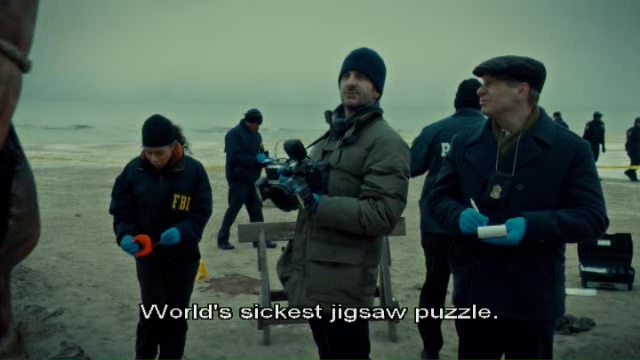
In this one, the FBI team are investigating a totem pole made of dead people in West Virginia. The bodies are carefully coiled together, making a puzzle for the investigators.
Will does his reenactment, then blinks and suddenly he is in Hannibal’s waiting room. He knows then that he is in trouble – the sleepwalking, the hallucinations and now he’s disassociating, and losing time. He has just driven 3 ½ hours from the crime scene to Hannibal’s office with no memory of it at all. Oh yes, he’s a sick puppy. Hannibal’s diagnosis is interesting:
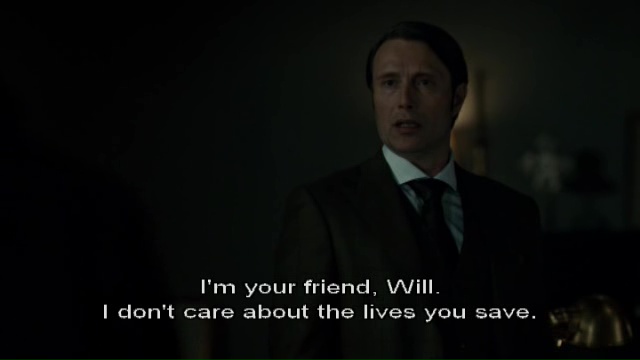
Hannibal also summarises why we care about people we know and usually don’t give a damn about anyone else:
“What if you lose time and hurt yourself? Or someone else?” Hannibal is planting the seed. Will may be capable of – anything.
Will apologises to Jack for disappearing from the crime scene, but Jack hasn’t noticed anything wrong. Is there something wrong? No, Will grins, everything’s fine. No problems.
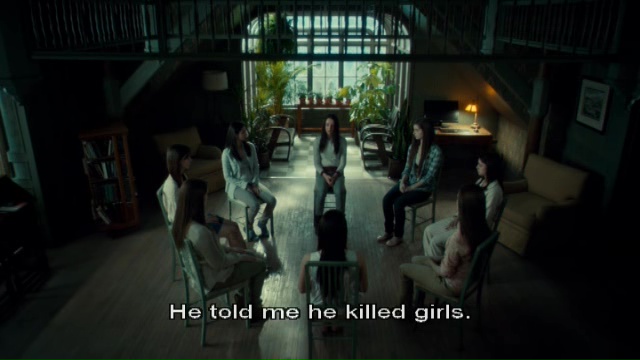
Abigail Hobbes is also in trouble. She is having nightmares where her father tells her he killed all those girls (in the first episode) so he wouldn’t have to kill her. But her support group morphs into those very girls, all saying “he should have killed you, so he wouldn’t have killed me”.
Then Freddie Lounds tells her that she is broke – the families of those girls are suing her father’s estate, and she won’t inherit a thing. She needs to write a book, with Freddie’s help of course. Will and Hannibal try to talk her out of it, but she wants to prove her innocence.
Will is getting more and more unstable. He is lecturing on the totem pole murders, but it turns out he is addressing an empty lecture theatre. Alana finds him there, tells him she can’t get involved with him:
Meanwhile, the FBI have found the body of the boy Abigail gutted and Hannibal helped her hide in episode 3. Jack wants to put her in the room to identify the corpse because he still suspects Abigail of the murder/s. Alana and Will are dead against causing her more trauma. Hannibal? Well, he is into growth and becoming, and for this he puts people in difficult positions:
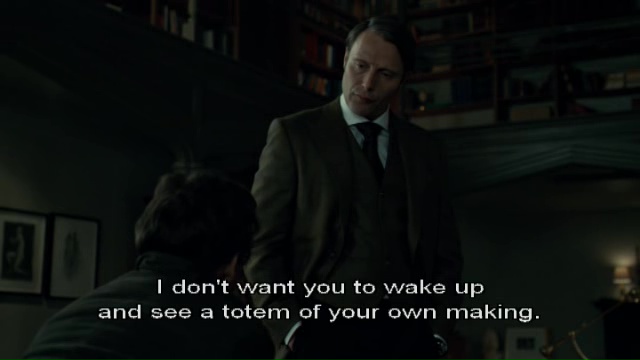
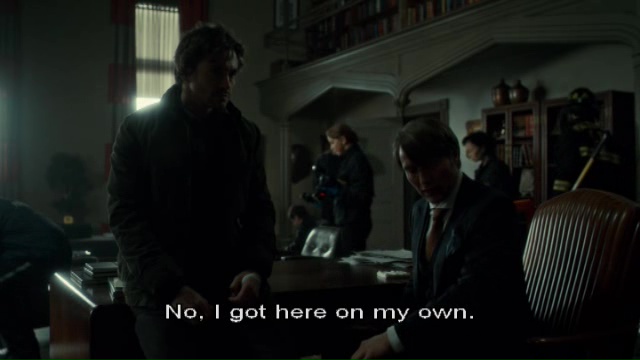
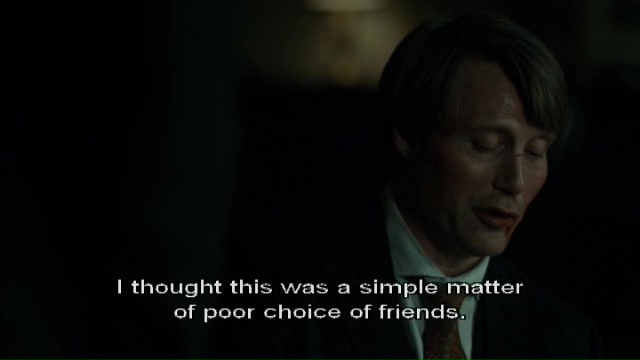
But Hannibal is putting his own pressure on Abigail. He tells her that he is concerned that her book, and her digging up the body, all put him in danger. He insists that he must be able to trust her. Will realises that she killed the boy, and Hannibal admits he knew, because he helped her hide the body. Is Will going to report them to Jack? Well, no, because Hannibal talks him out of it:
Now Hannibal has Will where he wants him – legally compromised, lying to Jack, and a partner – at least in co-parenting.
Hannibal is putting on one of his fine feasts for – yes – Freddie Lounds, with Will and Abigail eating various bloody concoctions. But Freddie has thrown him, by announcing she is a vegetarian! Hannibal rises to the occasion and prepares the finest salad she has ever tasted. Despite Will’s aggressive sarcasm and Abigail’s defiance, Hannibal manages to get them to agree: we’re all doing this to protect Abigail.
This slideshow requires JavaScript.
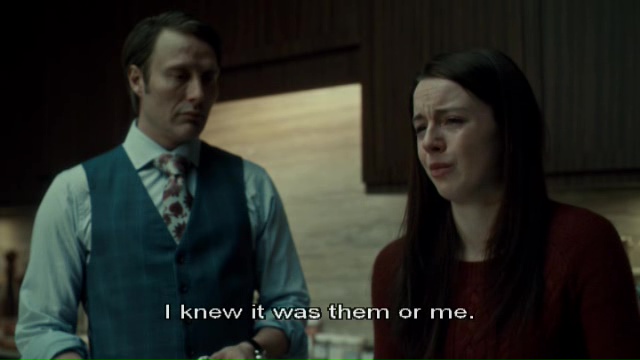
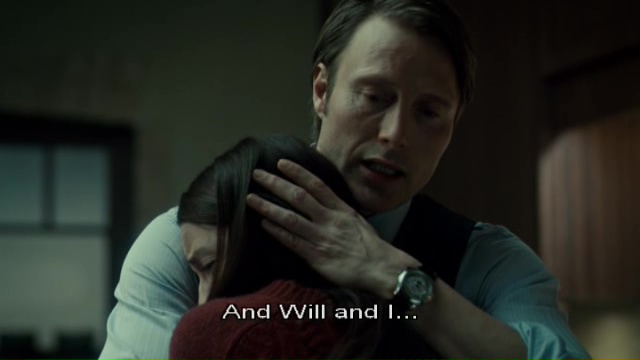
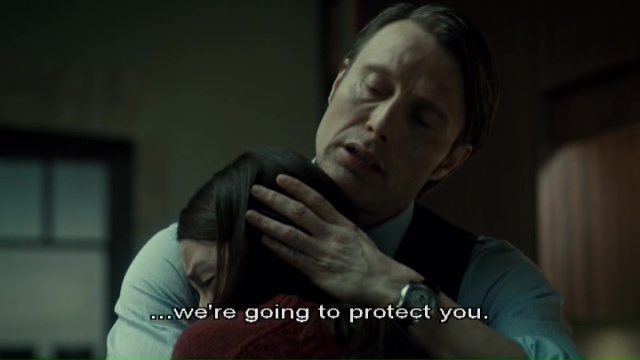
After dinner, Hannibal washes and Abigail dries, and she finally confesses that she did help her father – she would befriend girls that looked like her and find out where they lived, so that he would kill them, instead of her.
Hannibal comforts her:
Now she is totally in his hegemonic care, Will is a co-conspirator and co-parent, and Hannibal has a friend, and a family.
This is his design.
IF YOU LIKE MY BLOG, PLEASE FEEL FREE TO RECOMMEND IT (WITH DISCRETION) TO FRIENDS ON SOCIAL MEDIA.
IF YOU HAVE ANY QUESTIONS OR COMMENTS, YOU CAN USE THE TAG, OR EMAIL ME ON CANNIBALSTUDIES@GMAIL.COM.
So we’re over the half-way point of Season 1, and Hannibal’s fascination with Will has gone from amused manipulation to a possibility of friendship, based on their similarities, made piquant by their differences. This episode is all about friends – lovable, edible or just annoying.
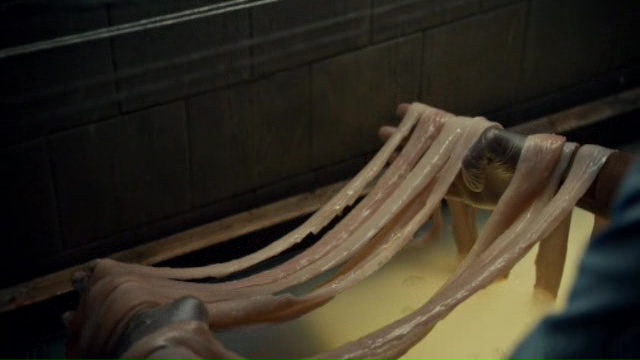
Last episode we met Tobias (Demore Barnes), a friend of Hannibal’s (probably) most annoying patient, Franklyn (Dan Fogler, from Fantastic Beasts). Tobias is teaching a kid violin and talking about superior strings. “Are they made of cat guts?” the kid wants to know. “Not always” answers Tobias, and we then see him making new strings for the orchestra. They are guts, but not from cats.
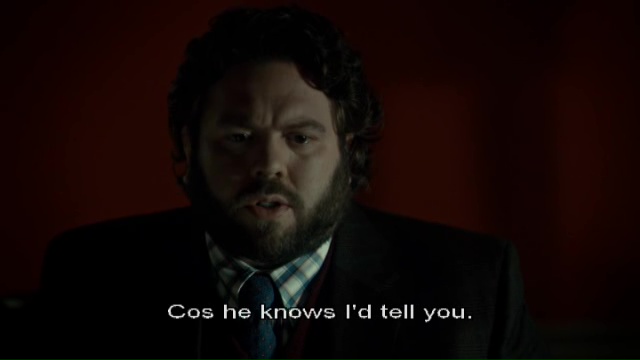
Franklyn is trying to “be” Hannibal – he has googled “psychopaths” and wants to discuss whether Tobias is crazy. Whether he is a “psychopath”. Whether Franklyn himself is a psychopath. Hannibal tells Franklyn he is not a psychopath, although “you may be attracted to them.” He certainly likes Hannibal a lot. And Tobias. He wants them to be his friends.
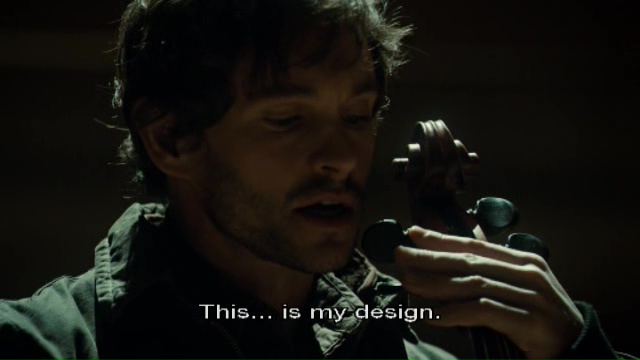
The murder victim in this episode (Baltimore is such a dangerous place!) is the trombonist from the Baltimore Metropolitan Orchestra. The killer has jammed a cello down his throat and played him – created a sound – “my sound”.
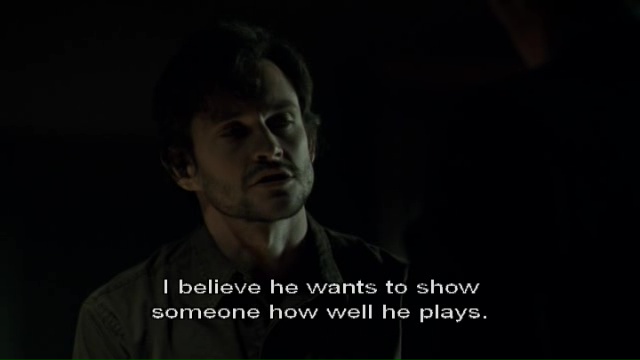
But why go to all that trouble? Franklyn tells Hannibal that Tobias had been talking about cutting someone’s throat and playing them like a violin – exactly what the FBI found. Will has a theory:
Why would he tell Franklyn about it though?
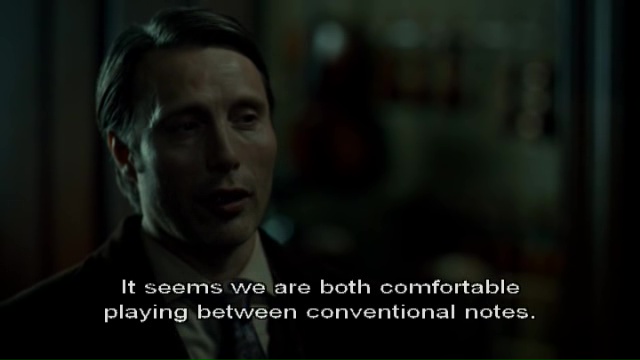
Hannibal goes to visit Tobias, talks about strings, composing or discovering music on his preferred instrument: the Theremin. With a little coded chat, they soon determine that they have a lot in common.
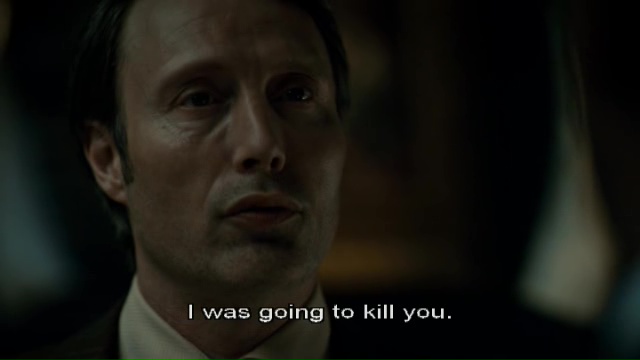
Will wants to be (more than) friends with Alana – he kisses her, but she bolts. Tobias comes to dinner at Hannibal’s home, at which he admits he was going to kill Hannibal.
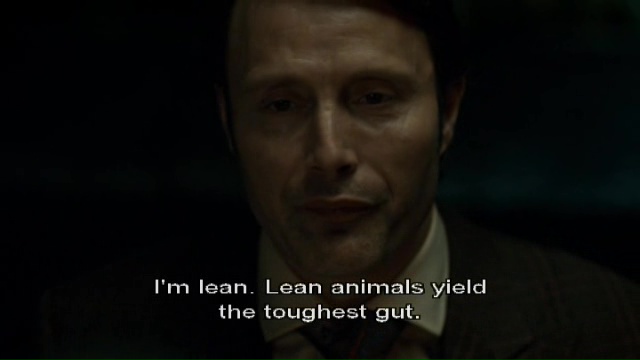
“Of course you were. I’m lean. Lean animals yield the toughest gut.”
Tobias says he changed his mind after following Hannibal to a bus depot, presumably the one referenced last episode (where the victim was cut in two and left sitting across the bus aisle from himself). He knows that Hannibal is the Ripper. Hannibal is not pleased. Tobias doesn’t care about being investigated by the FBI – he will just kill whoever they send to investigate him. Hannibal considers this reckless, and that’s not a term of praise, particularly when that might lead them back to Hannibal. But Tobias, of course, wants to be Hannibal’s friend. He wants a friend who understands him (and isn’t too fussed at the use of human body parts).
But Hannibal is not putting up with reckless friends, even if they have common hobbies.
Tobias asks why, then, did Hannibal invite him for dinner?
Now that is a great line.
They are on the verge of sorting it out with extreme prejudice when Will arrives seeking lonely hearts advice: “I kissed Alana!” Tobias beats it out of the window, and Will gets to eat the dessert he missed. He also gets to tell Hannibal about his latest symptoms – on top of sleepwalking and getting headaches, he is now hearing the cries of wounded animals – the latest was, he thought, in his chimney, which led to some drastic and unnecessary renovations. He admits to being “unstable.” Hannibal clearly decides he needs a challenge, and leaks the information about Tobias and his strings, and suggests Will should go investigate him. He knows Tobias will try to kill any investigators. But Will needs a challenge if he is to grow and become a true protégé. He needs to grow, and “to become”. That is the central theme of all Lecter texts.
Hannibal discusses all this with Bedelia, his psychiatrist, in one of the most fascinating exchanges of the show:
H: I met a man much like myself [Tobias of course]. Same hobbies. Same worldview. But I’m not interested in being his friend. I’m curious about him. And that got me curious about friendship.
B: Whose friendship are you considering?
H: [Now he’s talking about Will Graham] He’s nothing like me. We see the world in different ways, yet he can assume my point of view.
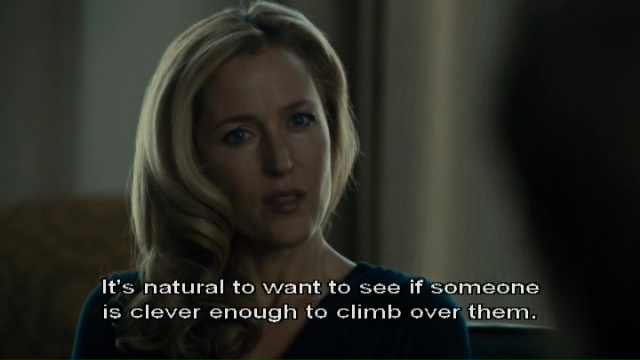
B: It’s nice when someone sees us, Hannibal. Or has the ability to see us. It requires trust. Trust is difficult for you.
H: You’ve helped me to better understand what I want in a friendship and what I don’t.
Will and a couple of cops turn up to interview Tobias about the strings made from the unfortunate trombonist’s vocal chords, but Will is distracted by one of his imaginary distressed animal sounds. By the time he gets back inside, the cops are dead (they are clearly redshirts) and Will follows Tobias down the basement steps, much as Clarice followed Jame Gumb in Silence of the Lambs. There is an underground shoot out, just like – yep. Except Clarice appears to be a much better shot than Will.
Then there’s the whole Franklyn/Tobias/Hannibal thing that has to be resolved, and Hannibal is just the man for that sort of thing. Followed, of course, by the Goldberg Variations.
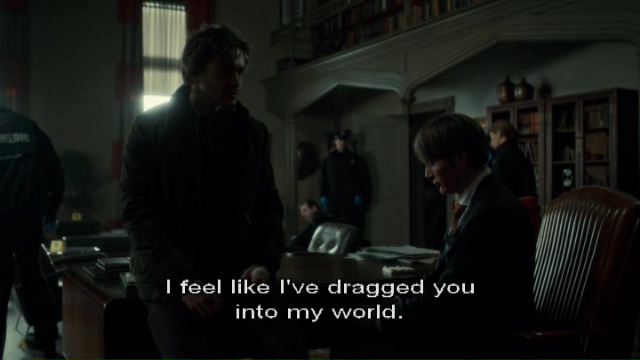
The Baltimore PD come to tidy up afterwards, with Jack and Will. There is a tender moment of blossoming friendship:
Then Hannibal is back at Bedelia’s place, talking about responsibility. Does he feel responsible for Franklyn? Did Bedelia feel responsibility when she was attacked by her patient [and yes, we’ll hear a lot more about that in the future]? Yes, she says.
Was Tobias a cannibal? We didn’t see him eat anyone, but there were a lot of body parts about his basement, and abuse and exploitation don’t always have to be about eating, do they? He and Hannibal actually did have a lot in common. But he was too rash, too reckless. He could never be a protégé nor a friend. A friend would need to be a lot more vulnerable.
IF YOU LIKE MY BLOG, PLEASE FEEL FREE TO RECOMMEND IT (WITH DISCRETION) TO FRIENDS ON SOCIAL MEDIA.
IF YOU HAVE ANY QUESTIONS OR COMMENTS, YOU CAN USE THE TAG, OR EMAIL ME ON CANNIBALSTUDIES@GMAIL.COM.
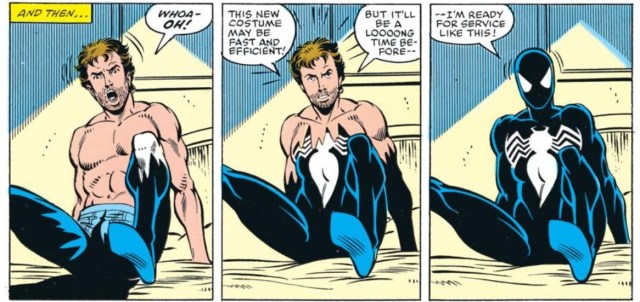
Venom is a character from the Marvel Universe, originally seen in Spider-man #252 (May 1984) as a living costume (honest!) then becoming a symbiote which took over Spidey (remember the black spider-man outfit?). So, if you’ll pardon the arachnid pun, this movie is a spin-off.
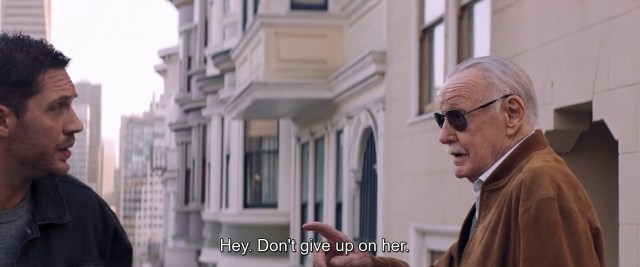
The genius behind Marvel – Stan Lee – in the last cameo released before his death
OK, so I’ll try to keep this short, because you’re reading this on the web (sorry, I just can’t help myself).
There’s a billionaire (Riz Ahmed from Nightcrawler) who wants to send us into space (not naming names, but there are about three such billionaires in the news at the moment). He sees the future of the species as more important than the lives of the marginalised people on whom he tests his drugs, and whom he “merges” with his aliens.
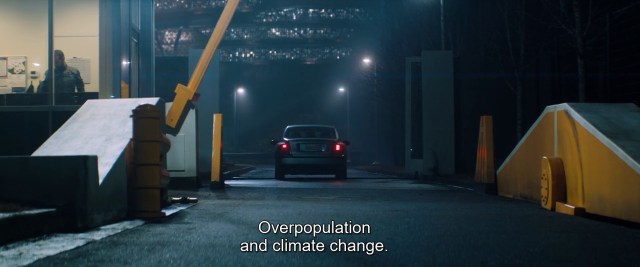
He has (had) a spaceship, which picked up some symbiotic forms from a meteor; one of those aliens caused the ship to crash on re-entry to earth.
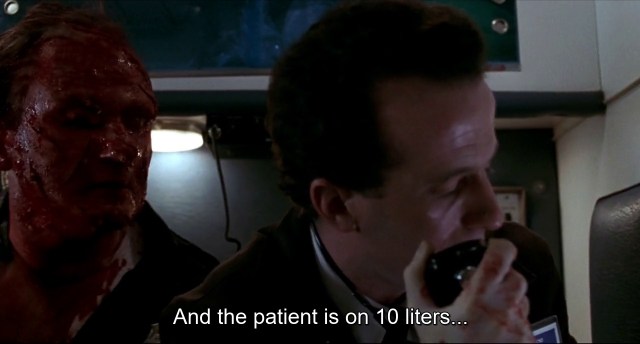
We get the definite impression these things are not too human-friendly, as one of them kills the crew of an ambulance, in a scene that is highly reminiscent of Hannibal’s escape in Silence of the Lambs.
That’s Hannibal Lecter of course, wearing an Officer Pembry mask
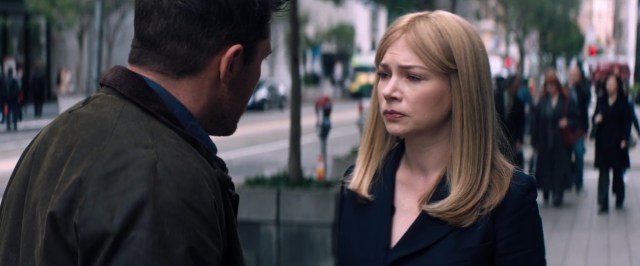
The main character is Eddie Brock (Tom Hardy, an extremely versatile English actor who was playing a Russian in a recent movie review, and is here playing an American). Eddie is an investigative journalist, which apparently requires a lot of chutzpah and some very fast motorcycle stunts. His fiancée is a lawyer named Anne Weying (Michelle Williams from lots of great movies, including Brokeback Mountain). Anne is working for a law firm that is defending the billionaire, but Eddy knows the password on her computer and finds out stuff he isn’t supposed to know about wrongful deaths caused by the company (didn’t we see that plot point on Billions?)
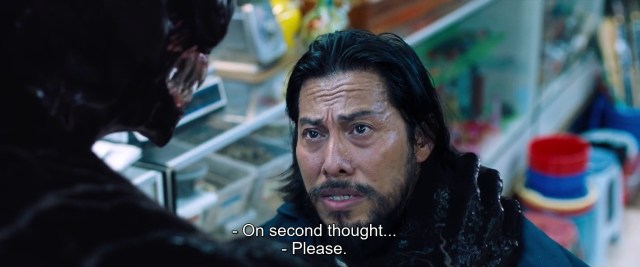
Anyway, he asks the billionaire difficult questions and he and Anne both get fired, because he clearly got the scoop from her. She breaks off the engagement, Eddie ends up down and out, and helpless – he can’t even defend his local convenience store manager from a dude with a gun who comes in for “protection” money on a regular basis.
But hey, there are symbiotes out there, looking for some human interaction, and they have teeth that would make the dental association wet themselves. The one that winds up inside Eddie is named Venom, one of the ones from the billionaire’s lab, and he has been through several hosts, most of which have died because they are not compatible. Then there’s the other one that killed the ambulance crew, and has since killed a lot more people, and he is mad, bad and dangerous to host.
Eddie being a nice guy leads to Venom becoming nice (ish) too and agreeing to oppose the plot to bring the other symbiotes to earth, where they intend to feast on humans – they’ve figured out there are plenty of us to go around.
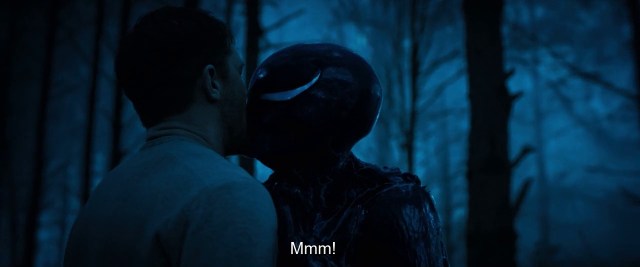
Venom takes over a cute doggie and then moves into Anne, who comes to save Eddie from the bad guys, leading to an awkward kiss between him and the symbiotic version of Anne, now in slinky black alien shape.
Of course, to save Eddie, Anne has to take some fairly drastic action, in her Venom persona.
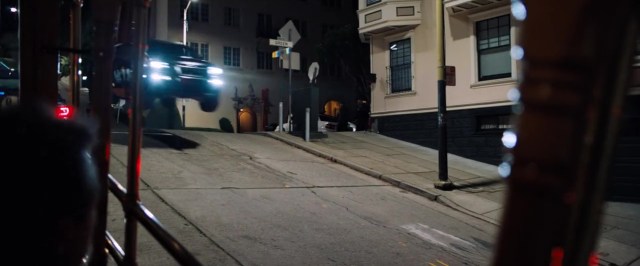
There are some great action sequences involving bikes and drones and cars (leaping off the ground in standard San Fran car chase mode) and a pretty awesome battle between Venom and the nasty alien.
Everyone thinks the aliens have gone, but in fact Venom is still inside Eddie and they are now true sybiotes: two beings in one body. He can turn back into Venom when required, and Venom is almost always hungry, and he doesn’t like dead meat.
So we come to the point of having this movie in a cannibalism blog. They come to an understanding: they won’t eat any nice humans, but very, very bad ones – that’s fine.
A succinct statement of the ethics of cannibalism. Hannibal would have amended it to “rude people”, but philosophers get to make their own ethical maxims. And so it is that he, or they, eat the rude, violent dude in the convenience store.
Look, it’s not a great movie, and the critics were quite rude, with a pretty ordinary score of 28% on Rotten Tomatoes. The movie-going public felt differently, and the box office so far is over $850 million, which is an almost mind-boggling figure, even for a movie in which the hero bites off people’s heads. I guess people love to see (other) humans being eaten. Is this a cannibal movie? Well, half the main character is human, so I guess it’s half a cannibal film.
So what’s next for a nice guy who occasionally becomes an alien cannibal and eats rude people? Hannibal would approve of Venom’s answer:
“The way I see it, we can do whatever we want”.
IF YOU LIKE MY BLOG, PLEASE FEEL FREE TO RECOMMEND IT (WITH DISCRETION) TO FRIENDS ON SOCIAL MEDIA.
IF YOU HAVE ANY QUESTIONS OR COMMENTS, YOU CAN USE THE TAG, OR EMAIL ME ON CANNIBALSTUDIES@GMAIL.COM.
This episode is called “Sorbet” which, in a French menu, is the break, the refreshing fruit frappe served between courses to clear the palate. It’s all about preparing: not just the kitchen and the ingredients, but also the guests. It’s about content, and timing.
In this episode, we find out much about Hannibal, particularly the way he chooses and prepares his meat, but also some important psychological facts. We meet his psychiatrist, Bedelia Du Maurier (Gillian Anderson – Dana Scully from X-Files). She knows a lot about Hannibal – not everything, but a lot more than Jack and Will and the entire FBI. But, like one of Hannibal’s feasts, she is going to serve us each dish when it, and we, are ready.
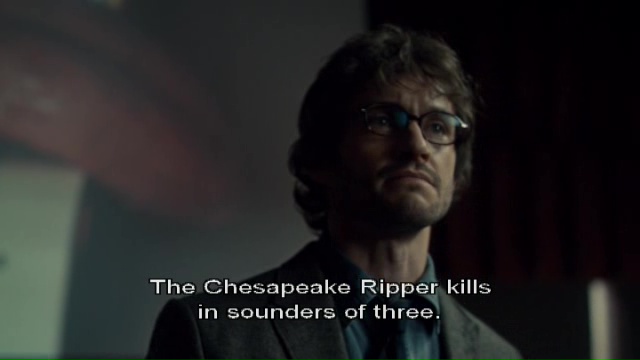
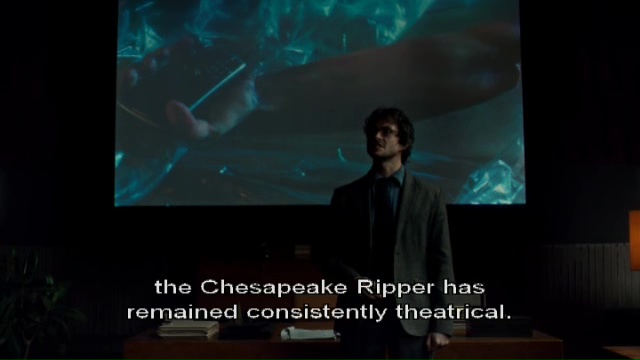
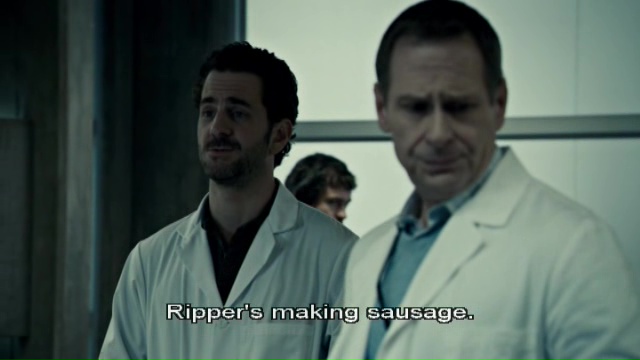
The episode starts with Will lecturing at the FBI Academy about the Chesapeake Ripper, who we (but no one else) know is really Hannibal. We learn a lot about how Will believes the Ripper views his victims, and about his methods.
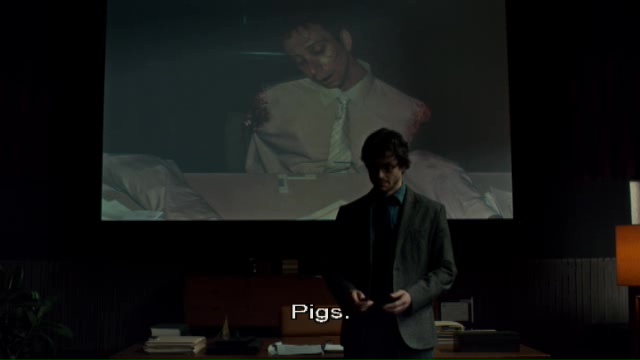
A “sounder” is a collective term for pigs, and that is how Hannibal sees his victims – as pigs. Just as humans confine and slaughter pigs with barely a twinge of conscience, so Hannibal collects human organs for his freezer.
Organs are carefully removed. Like an earlier Ripper named Jack, the conclusion is that the killer has anatomical or surgical training (although Jack the Ripper may have been a butcher rather than a surgeon). Another important fact that Will tells the kids and us:
And so to the theatre we go, the concert hall in fact, where we hear a magnificent opera recital from the brilliant pen of Brian Reitzell, who went on, after Hannibal, to write the music for American Gods. Of course, we can’t just sit and enjoy it as Hannibal and his annoying patient Franklyn (and his friend Tobias) do, decked out in black tie and tux. No, we start with some lessons in anatomy and acoustics – the scene starts in the larynx of the singer and we then get to follow the music up her throat and into Hannibal’s ear.
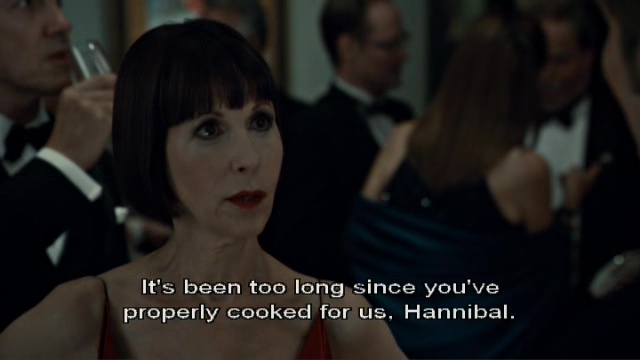
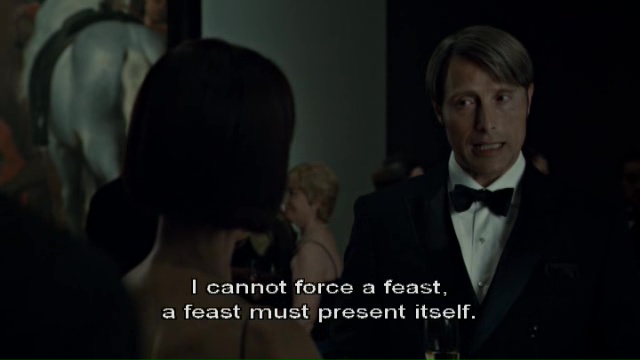
After the recital, the Chairperson of the Baltimore Philharmonic gently chides Hannibal for not putting on one of his sumptuous feasts – she misses not just the food but the spectacle.
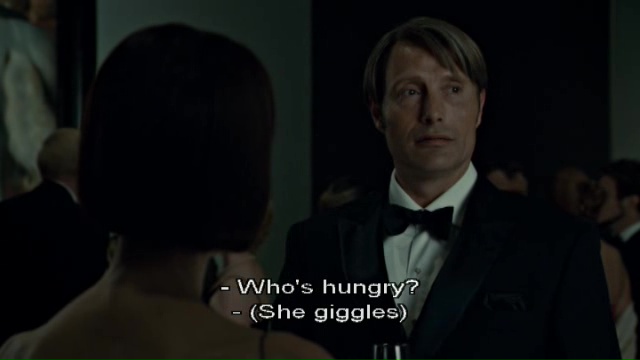
Hannibal replies that he is waiting for inspiration. Perhaps Franklyn provides it: as Hannibal rather testily dismisses him, he asks:
Hannibal is also busy torturing Jack with supposed calls from his missing student Miriam Lass. As Will puts it:
“The reason he left you Miriam Lass’s arm is so he could poke you with it.”
Meanwhile, Jack and Will are busy with a new killer, who the CSI gang are convinced is the Ripper (organs have been removed, if a bit sloppily). Will says no – this dude is collecting organs for sale, and trying to save the “donor” afterwards (without a great deal of success). This is not the MO of the Ripper:
So, asks Jack, how do you see the Ripper? Will considers, and then comes up with an analysis taken from Will’s analysis of Hannibal in Red Dragon (the book):
“… one of those pitiful things sometimes born in hospitals. They feed it. Keep it warm. But they don’t put it on the machines. They let it die. But he doesn’t die.”
We finally meet Bedelia Du Maurier, Hannibal’s psychiatrist. It is perhaps not widely known that psychiatrists go to psychiatrists, but in view of the psychic storms they deal with daily, it makes sense. Hannibal later tells Will he started seeing a psychiatrist when he chose to become one.
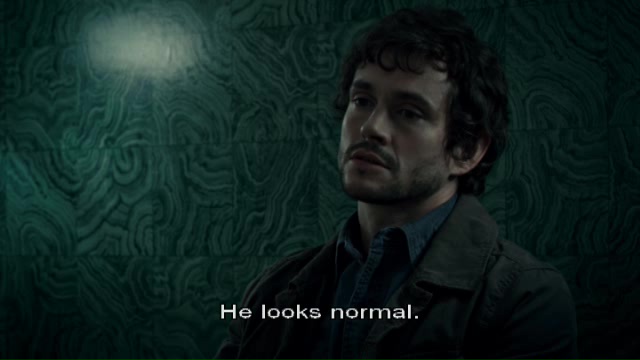
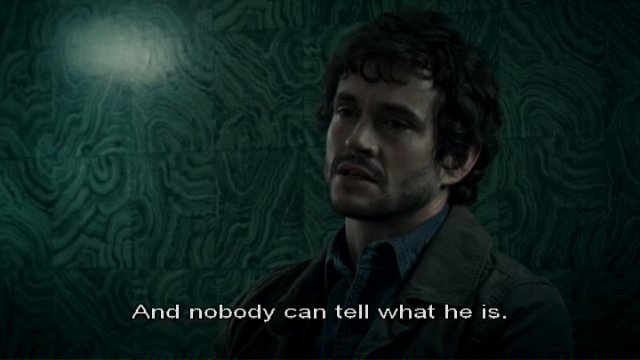
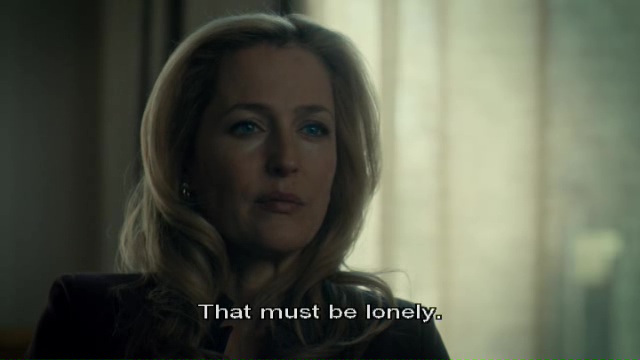
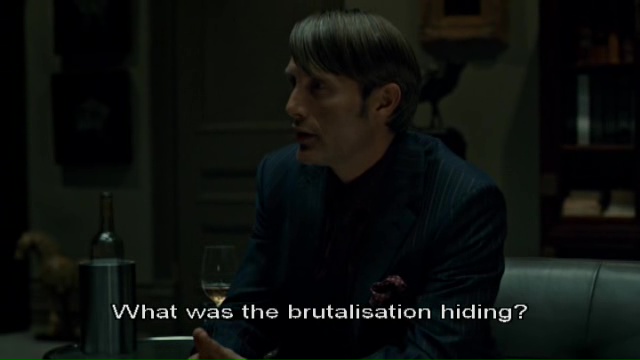
Bedelia does not mince words. She is no longer practising, and stays available for Hannibal because she likes him. Turns out there are other reasons too, but we’ll save them for later episodes. She and Hannibal discuss honesty, and she shows that she can indeed be brutally honest:
She also tells him that she is his therapist, not his friend, something he recently told the distraught Franklyn, who is a version of Benjamin Raspail from the books, one of the Silence of the Lambs characters whose names were not released by MGM for the television production. Caught in his own trap, Hannibal must look for company or even friendship elsewhere. Could it be Will?
Hannibal and Will have a lot in common, particularly a fascination with the motivation of the Ripper.
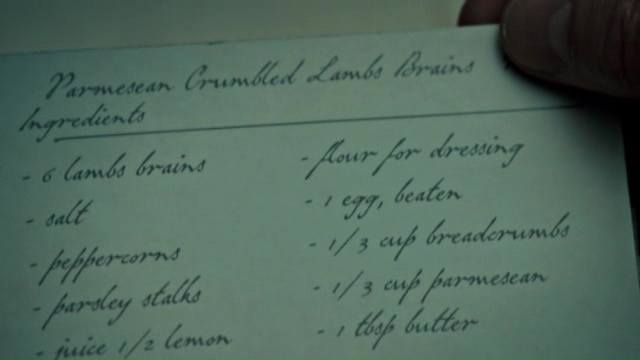
We find out a lot more about Hannibal’s motivations in a series of montages showing how he chooses his victims (from their business cards) and the meal they will supply (from a set of menu cards in perfect copperplate handwriting).
He starts with a medical examiner who rudely accuses Hannibal of lying. Hannibal asks for his business card, and then appears when the man’s car mysteriously breaks down on a rainy road.
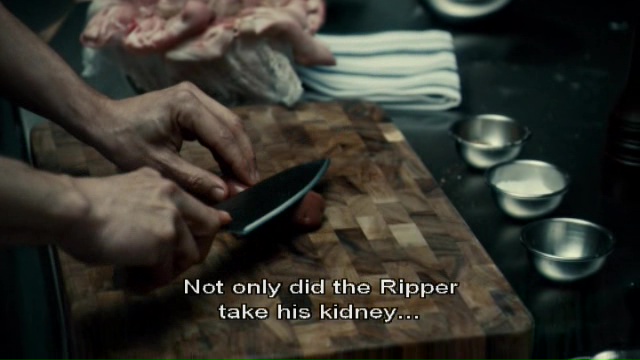
The rude medical examiner is found in a school bus, his top half sitting across the aisle from his bottom half. He is missing a kidney and his heart.
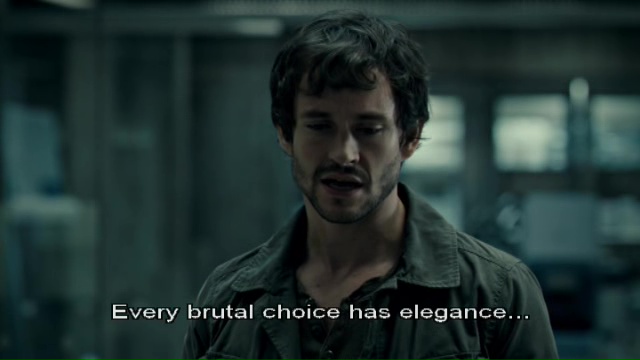
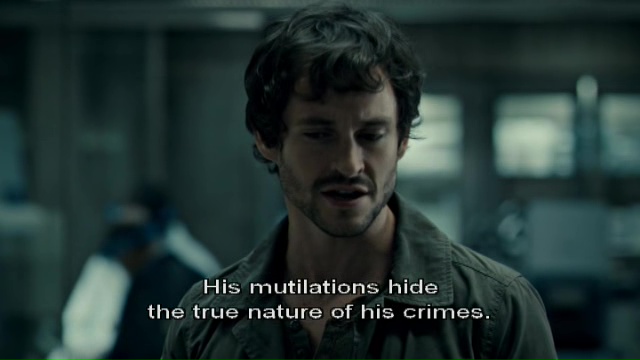
Will realises, though, that the mutilations are just theatre.
Hannibal and Alana prepare these organs for dinner (she presumably believes them to be from a different mammal) and duel flirtatiously as he tries to draw out what she knows about Will. Hannibal’s interest in Will is growing in each scene. He suspects Will can become a friend, perhaps even become an Übermensch like himself.
In the meantime, Hannibal is preparing his banquet for the Philharmonic. There is the montage of business cards and recipes involving liver pate, brisket, lungs and brains, and various business owners, who presumably have offended Hannibal’s intense dislike of discourtesy. This montage is accompanied by the rollicking “Golden Calf” aria sung by Mephistopheles in Gounod’s Faust.
This spate of mutilations leaves the investigation team baffled. No longer are they seeking an organ harvester – one of the victims is missing a spleen. Who on earth is waiting for a spleen transplant? There is only one explanation:
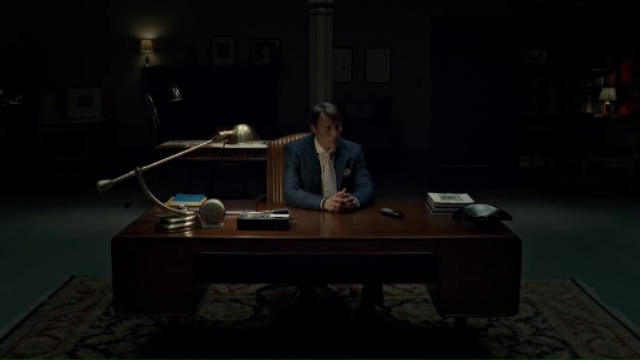
But despite the excitement of hunting and cooking, Hannibal is unhappy. There is a poignant scene of Hannibal sitting, forlorn, at his desk, checking his appointment book (last appointment Will Graham) as we hear, what else, the Mozart Requiem, the musical quintessence of melancholy.
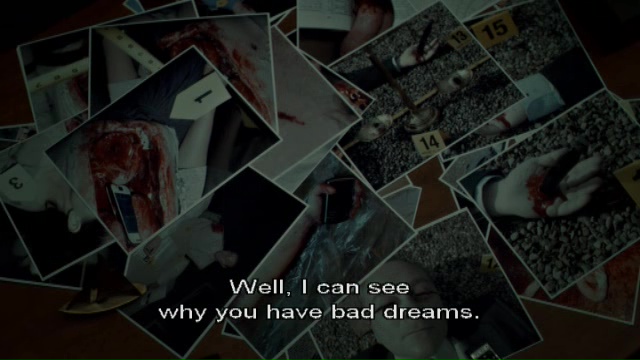
He goes looking for Will, who is day-nightmaring about Abigail (who is calling him “Dad”) and girls mounted on antlers. Hannibal interrupts his bad dreams and sees the range of atrocity photographs will has been studying.
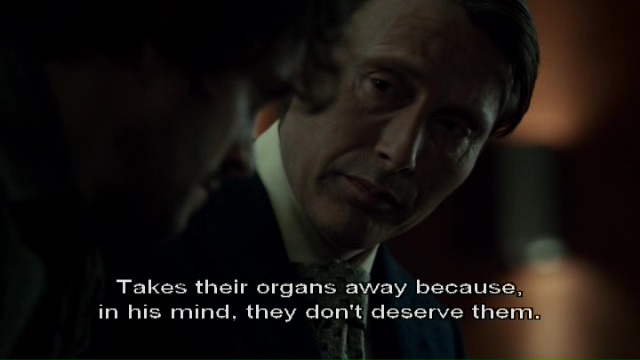
There follows a discussion of the possible motivations of the Ripper, in which Will is starting to get close to the truth. Hannibal suggests that perhaps the Ripper is displaying his enemies after death, as happens in many cultures. Will disagrees – “These aren’t the Ripper’s enemies. These are pests he’s swatted.” They are just being punished for undignified behaviour. Disgraced.
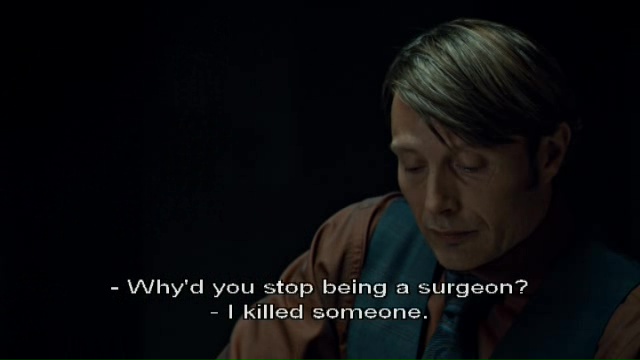
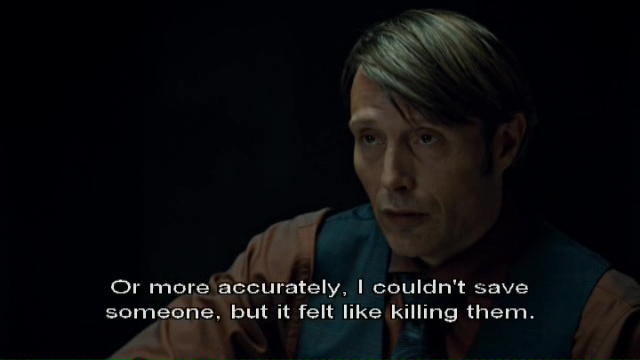
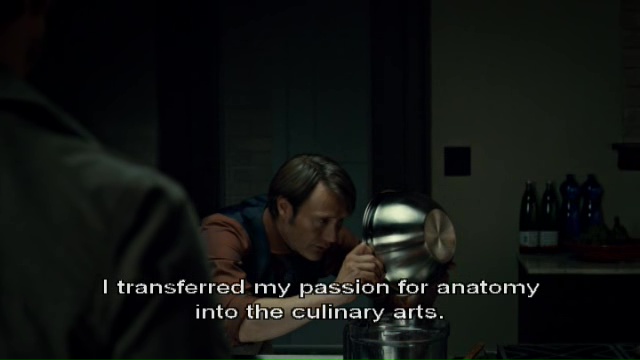
As he prepares his banquet, Hannibal tells Will why he gave up surgery:
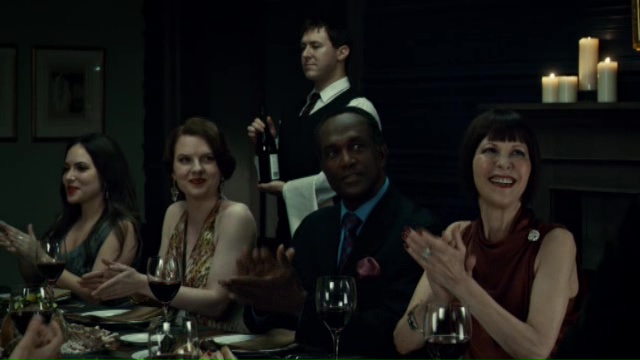
This is news to us, although we know that, as a child, he was unable to save his sister Mischa – could this be an indirect reference? Anyway. There follows a wonderful montage of Hannibal’s banquet plates, followed by a round of applause from his guests, who are all about to become unaware cannibals.
This slideshow requires JavaScript.
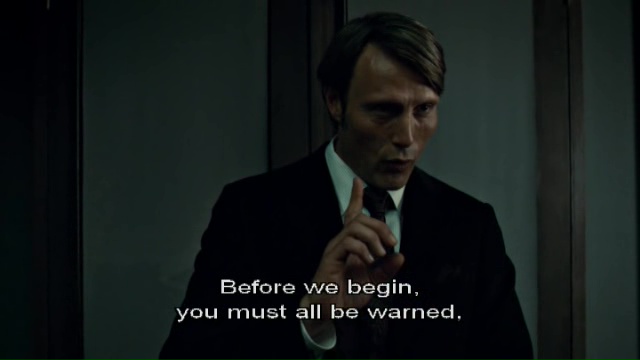
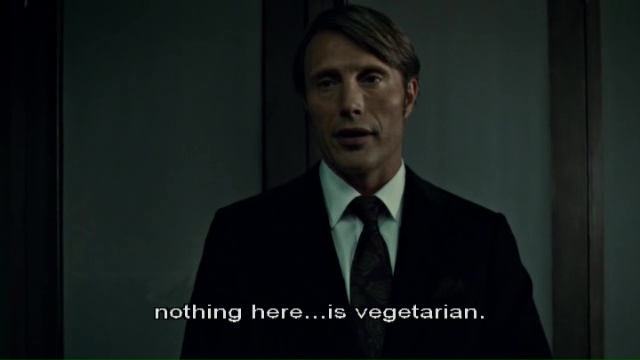
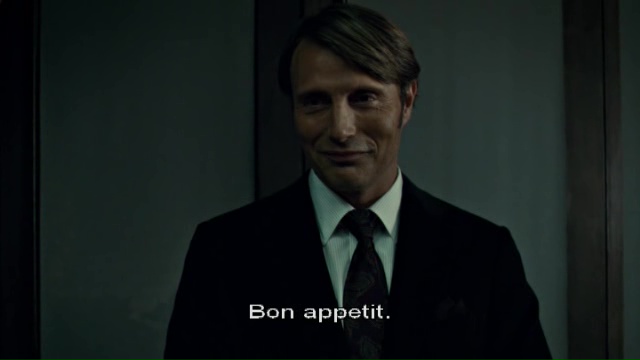
But before they can eat, Hannibal has a warning:
What they applaud now, they will later consider appalling, abject, psychologically shattering. The gross hypocrisy of their logic is impossible for even the brilliant Doctor Lecter to comprehend.
IF YOU LIKE MY BLOG, PLEASE FEEL FREE TO RECOMMEND IT (WITH DISCRETION) TO FRIENDS ON SOCIAL MEDIA.
IF YOU HAVE ANY QUESTIONS OR COMMENTS, YOU CAN USE THE TAG, OR EMAIL ME ON CANNIBALSTUDIES@GMAIL.COM.
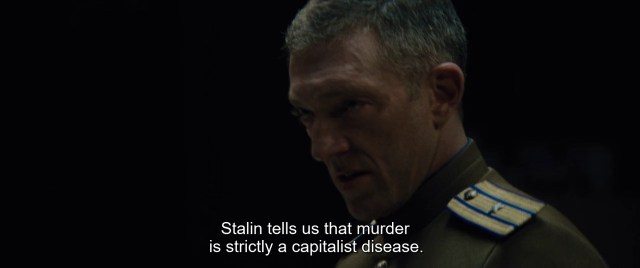
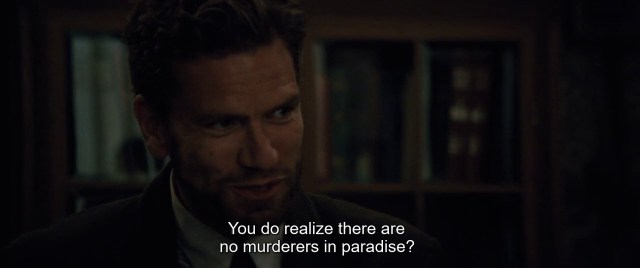
Most cannibal movies are about the cannibal, but Child 44 is almost entirely about the cannibal-hunter. He is a member of Stalin’s secret police, the MGB, the predecessor of the KGB, and the movie is set in the last days of the Stalinist terror. The perp is torturing and killing children and surgically removing their organs, so our hero wants to, like, stop him. There is an administrative problem though: in the Socialist Paradise of the USSR, there is no such thing as murder; it is a capitalist crime. So the first case is put down as a train accident. Then there are 43 more – thus the title.
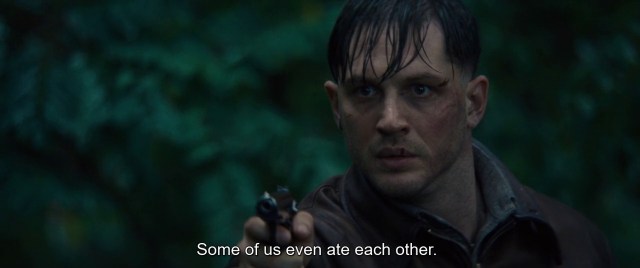
The film is based on the bestselling book by Tom Rob Smith, the first of a trilogy featuring former MGB Agent Leo Demidov. In the film, Leo is played by the English actor Tom Hardy, with a convincing mix of power and vulnerability that carries an otherwise rather overlong production. Leo is a war hero who planted the red flag on the Reichstag after the conquest of Berlin, and is now a senior investigator.
One of his friends from the Berlin days, Alexei (Fares Fares), also a MGB officer, finds that his little boy has been brutally murdered, but Leo has to persuade him to accept the official explanation that he was hit by a train.
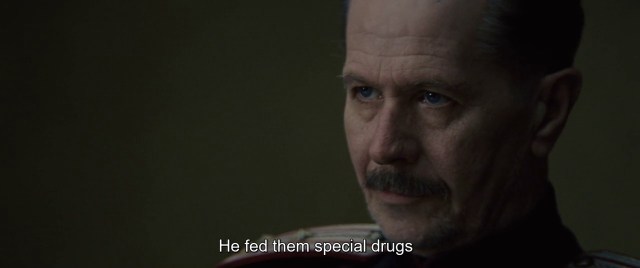
The antagonist (not the killer, we barely see more than his legs or arms until half way through the film) is another veteran of Berlin named Vasili (Joel Kinnaman, who played the clean-cut Republican candidate running against Frank Underwood in House of Cards). He is a coward, liar, etc and manages to derail Leo’s career by accusing Leo’s wife, Raisa (Noomi Rapace from The Girl with the Dragon Tattoo) of being a spy. Stripped of his rank for refusing to denounce his (maybe) pregnant wife, Leo must start his investigation as a mere militiaman in a remote town. He is under the command of a General played by the brilliant Gary Oldman, who has portrayed everyone from Dracula to Beethoven, Sirius Black to George Smiley, Winston Churchill to Mason Verger (in Hannibal the movie).
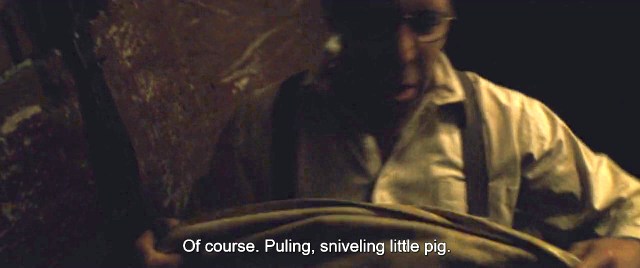
The General has two boys and is not pleased when another dead boy, with organs surgically removed, is found nearby. He arrests the man who found the body, not because he thinks he is the killer but because he is gay, and he assumes that a gay man must be responsible (also because homosexuality was a crime in the Soviet Union). But rounding up all the gay men in town doesn’t stop the killings. The killer is seen picking up a boy in a station, later making sweets (where would archetypal paedophiles be without bags of sweets) and still later abusing himself for being weak and prone to remorse.
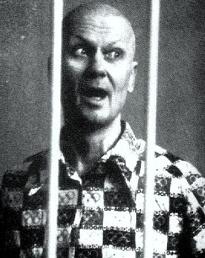
The film, as I said, is based on a book, which is based on the true story of Andrei Chikatilo, the “Rostov Ripper”, who was eventually convicted of 52 murders, although he confessed to more. Chikatilo was able to continue his killing spree from 1978 to 1995, due to a combination of general ineptitude, official denial of the concept of a Soviet serial killer, and luck (apparently his semen had a different grouping to his blood). He claimed that he had been told by his mother that his older brother had been kidnapped and cannibalised by starving neighbours when he was little. This may have been her way of trying to scare him into behaving, but he was born in Ukraine at the time of the Holodomor, when Stalin was busy starving millions of people to death as part of the process of Collectivisation, so could well have been true. Chikatilo was a self-confessed cannibal, stating that he gained sexual satisfaction from torturing his victims, and would sometimes drink their blood and eat their nipples and tongues. The real Chikatilo was far more depraved than depicted in this movie. There is a list of his crimes at the criminal minds website.
Andrei Chikatilo
This film has a lot going for it, particularly a first-rate cast, some good action scenes, and a lot of sets which capture the oppressive darkness of Stalinist Russia. But it has a lot of problems too. It’s over two hours and gets a bit tedious in parts, and the decision to have a bunch of English, Swedish, Lebanese, Polish and even Australian actors speak in English with heavy Russian accents to make it seem “authentic” was widely derided by critics. The Guardian critic called the film “an Iron Curtain version of ‘Allo ‘Allo”.
With a Rotten Tomato rating of only 26%, the film bombed at the box office, grossing just $13 million against its $50 million budget. It was banned in Russia, with the Minister of Culture accusing the film of making the Soviet Union look like Mordor. Outrageous of course. Stalin was far worse than Sauron.
And perhaps the worst thing? Just as the Soviets would not admit that there was a serial killer in their paradise, this film does not approach the fact that he was also a cannibal (although it refers briefly to the widespread cannibalism of the Ukrainian famine). It asks some important questions about social ethics and who is actually responsible for people like Chikatilo, the individual or the state and its terrorist organisations. But without people getting eaten, it’s just another very long murder mystery.
IF YOU LIKE MY BLOG, PLEASE FEEL FREE TO RECOMMEND IT (WITH DISCRETION) TO FRIENDS ON SOCIAL MEDIA.
IF YOU HAVE ANY QUESTIONS OR COMMENTS, YOU CAN USE THE TAG, OR EMAIL ME ON CANNIBALSTUDIES@GMAIL.COM.
The movie starts at St. John’s Orphanage in Washington in 1882. A young Albert Fish and other children are being beaten, to drive out their sins.
Fast forward to Albert Fish (Patrick Bauchau) as an adult. He remembers, in a voiceover, a horse that some older boys at the orphanage set on fire; how the horse galloped off, trying to get away from the fire, but of course taking the fire with him. Fish compares himself to that horse.
“The fire chases you, and catches you, and then it’s in your blood. After that, it’s the fire that has control, not the man. Blame the fire of passion for what Albert H. Fish has done.”
Scott Flynn’s debut film is not just a very well made and pretty creepy thriller / horror movie, it is an accurate retelling of the story of Albert H. Fish, who killed several children in the 1920s, and ate parts of their bodies.
Albert Fish (Patrick Bauchau) with his grand-daughter. He hands her back to his daughter saying “I’m no good with little ones”. Truer words were never spoken.
Fish never got over the beatings at the orphanage, and is seen in the film whipping himself with a belt, interspersed with images of himself in the orphanage, watched by a pale boy – his younger self. That’s not the least of it: an X-ray found dozens of needles he had inserted into his groin for further punishment. In a sense, he punished himself in advance for sins he felt he was driven to commit.
The film is structured around a film noir-style narration by Detective Will King (Jack Conley), of the NY Missing Persons Bureau.
Fish kills a boy scout, who is found by the other scouts hanging from a tree, his calf removed.
Then comes the famous case: Fish sees a newspaper ad from a young man, Edward Budd (Eric Parker), who is looking for work, but when he visits the Budd family home, he is smitten by young Grace (Lexi Ainsworth), Edward’s ten year old sister, whom he stares at throughout the interview. No one seems to find this creepy, and when Fish comes back to pick up Edward and his friend, he suggests that Grace accompany him to his niece’s birthday party at Columbus and 135th – when he returns her, he says, he’ll pick up the boys. The mother (Jillian Armenante) has qualms, as well she might, but the father urges her to let Grace go. So, they have lunch. The father says “Let’s eat – I’m starved.” Fish replies: “Me too.” But it’s not for what the Budd’s are putting on their table.
Of course, there is no party, no niece, no such street as 135th Street, and no return for Grace. When they get off the train, Grace dives back into the carriage to retrieve a package Fish has forgotten. She thinks it’s a present for the niece; it’s actually a bone saw that he bought earlier. Grace is picking flowers when Fish calls her into the creepy old house, purportedly to hide for the surprise party; the door slams shut. Fade to next scene. Fish is eating raw meat.
Detective King searches for Grace Budd for six years, despite the department closing the case and the public forgetting about young Grace. Fish hasn’t forgotten though, and when he finds a stationery package in his room while chasing a cockroach, he writes to Grace’s mother, a break which finally allows Will to track down and arrest Fish. In the letter, Fish describes the crime in graphic detail, but modestly added that Grace had died a virgin – I guess he thought Mrs Budd would find that comforting. The movie gradually has Fish read the parts of the letter regarding the killing, chopping up and eating of Grace, although it omits the earlier section which told of his friend who returned from China in 1894, where:
“all children under 12 were sold to the Butchers to be cut up and sold for food… A boy or girls behind which is the sweetest part of the body and sold as veal cutlet brought the highest price”
The letter is quoted in full, with its dodgy grammar, in Wikipedia.
Fish said that this story had given him the idea:
“He told me so often how good human flesh was I made up my mind to taste it.”
In the trial, a psychiatrist with a suitably Germanic accent testifies that Fish told him that:
“What I did must have been right, or an angel would have stopped me, just as the angel stopped Abraham in the Bible.”
Genesis 22 has a lot to answer for.
Fish is found guilty, despite the psychiatrist’s evidence of his insanity, and put to death in the electric chair. The pale boy follows him down the corridor to the execution room.
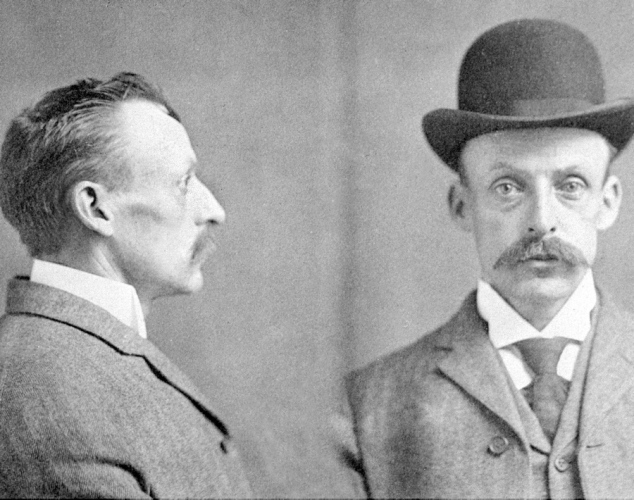
The real Albert Fish
The real Grace Budd
The true number of Fish’s victims will never be known. He claimed to have “had children in every state” but whether he was referring to rape, murder or cannibalism, or just bragging, cannot be established. Fish was finally caught because he killed and ate Grace Budd, a white girl: he admitted that he mostly chose children who were mentally handicapped or African-American as his victims, explaining that he assumed the police would not look too hard for them. The fact that it took six years to catch him, and that this film does not even mention them, would seem to prove him right.
The DVD cover shows Albert and Grace heading for the deserted house where she will be killed and eaten. The tag line is interesting: “a real life Hannibal Lecter”. Pretty sure Hannibal would eat alive anyone who compared him to Albert Fish.
The full movie is not easy to find. There is a copy on Youtube when I last checked, with subtitles in Spanish.
IF YOU LIKE MY BLOG, PLEASE FEEL FREE TO RECOMMEND IT (WITH DISCRETION) TO FRIENDS ON SOCIAL MEDIA.
IF YOU HAVE ANY QUESTIONS OR COMMENTS, YOU CAN USE THE TAG, OR EMAIL ME ON CANNIBALSTUDIES@GMAIL.COM.










 30
30






























































 The Cannibal Guy