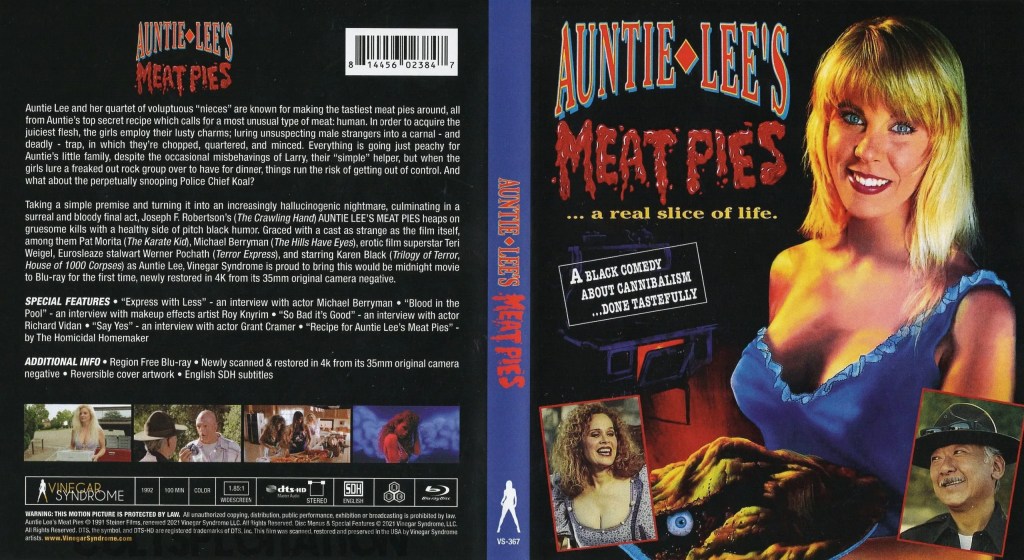
What’s in your pie? AUNTIE LEE’S MEAT PIES (Joseph F. Robertson, 1992)

This is described on the cover of the Bluray disc as:

“A black comedy about cannibalism… done tastefully”

The particular genre of this little known 1992 film is “innocent cannibalism” – humans slaughtered and made into meat dishes for sale to unwitting customers; those customers thereby becoming the cannibals. It’s eternally fascinating, because everyone at one time has pulled something a bit lumpy or fibrous from their pie, hot dog or burger and wondered what (or who) that came from.

The plot is simple, even simplistic. Auntie Lee (the wonderful Karen Black) is a Satan-worshipper who sends her nubile nieces out to lure men back to the house/bakery (often by shooting out their tyres and then offering them a lift) where they are slaughtered in various grisly ways and then chopped up and made into pies, which are irresistibly delicious and widely sought after in the nearby restaurants.

This trope started with Sweeney Todd, the “Demon Barber of Fleet Street”, a crucial figure to modern cannibalism. There are those who argue that Sweeney really existed and was hanged outside Tyburn Prison in London in 1802. At any rate, his story was popularised in the 1846 “penny dreadful” A String of Pearls: a Romance (Prest, 2010) and remains enduringly popular. Sweeney in his early nineteenth century incarnation insouciantly slaughters his clients, dropping them through a trap-door and supplying their corpses to his partner, Mrs Lovett, to use in her popular meat pies, unwittingly setting a precedent for the industrial slaughter facilities that would proliferate in following years. The first movie version was a silent film in 1928, in which the whole narrative turned out to be a nightmare. A 1936 version showed Sweeney as a true hedonist, a man who just enjoyed killing and robbing his customers. Several remakes have happened since, most recently a musical by Tim Burton. A Danish adaptation called The Green Butchers with Mads Mikkelsen, who later played Hannibal in the eponymous  television series, depicted unsuccessful butchers suddenly becoming wildly popular when they start serving human flesh. The 2021 French film Barbaque [Some Like it Rare] depicts French butchers hunting vegans whose flesh, unpolluted by animal products, turns out to be hugely popular with their customers.

Most recently, the Sweeney story has been reborn as a fictional “true-crime” podcast becoming a Broadway play, which in turn becomes a television series: the wonderful Horror of Dolores Roach, which I finished reviewing last week. Like Dolores Roach, Auntie Lee reverses the usual order of carnivorous virility—instead of the psychopathic male murderer (there is one, but he is dispatched quickly after raping one of the women), the killing is done by young, nubile women who lure men into traps which are increasingly intricate and gory. This is the monstrous-feminine – the male fear of what may happen when lust overcomes caution and the female reverses the birthing role and instead reabsorbs her victim.

The female killers are Playboy models, and were clearly chosen for talents other than their acting. However, other main characters are really good—Karen Black who has appeared in several horror B-movies is Auntie Lee, sending the girls out to bring home “the makings”, Pat Morita (Happy Days, Karate Kid) as the witless sheriff, and the inimitable Michael Berryman (One Flew Over the Cuckoo’s Nest (1975), The Hills Have Eyes), whose hypohidrotic ectodermal dysplasia gave him such an unusual appearance that he made a career from portraying everything from idiots to monsters.

Except for the wooden acting by the “nieces”, this is a well-acted, light-hearted if gory comedy, and many of the images are very striking.

At the end, after every man who enters the house is dead and being cooked, Auntie Lee and the nieces speculate about moving out of the town to New York City, where “we’ll never run out of beef”. In popular parlance, the brawny male is often called “beefsteak”, while sex is offered as a transaction, becoming almost indistinguishable from any other form of commodity, including feeding. As Coral says to the man she is leading to his death (using one of the most popular double entendres in Cannibal Studies):

“I can’t wait to have you inside me”

Such is the nature of modern capitalist cannibalism – the human is just another species, a resource like any other, potentially exploitable, vulnerable, even edible. Auntie Lee won’t cook Mormons or Californians, but New Yorkers are fair game, just as some people won’t eat pigs or dogs but will eat sheep or chickens. As Isaac Bashevis Singer said:

“As long as human beings will go on shedding the blood of animals, there will never be any peace.”
At the time of writing, the full movie is available on YouTube.
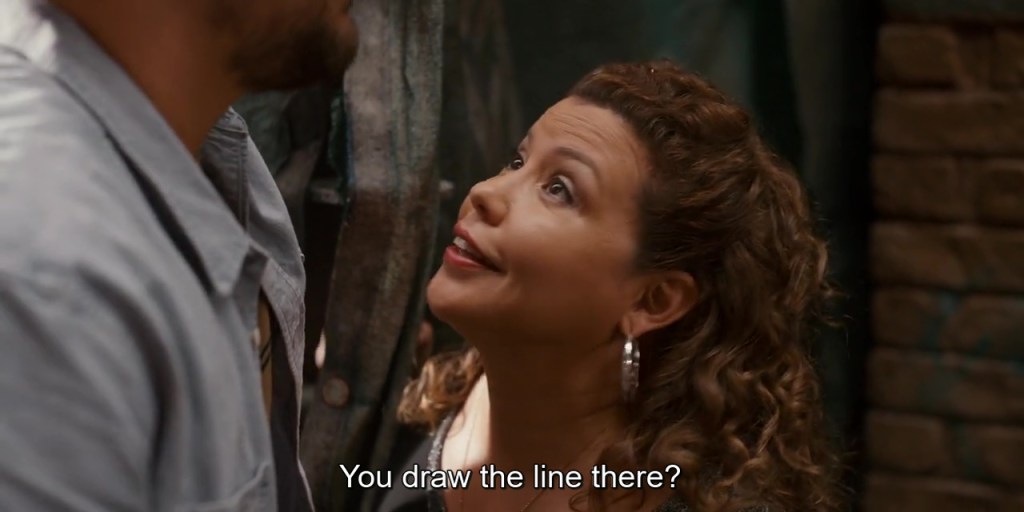
“You draw the line there?”: DOLORES ROACH episodes 7 & 8

The climax. The denouement. The final two episodes of this quite brilliant podcast that became a Broadway show that became a television series about an untrue true crime, and includes podcasts and Broadway shows. If you need to catch up on the earlier episodes, I would suggest watching them, but if you can’t wait, here are my earlier blogs.

Episode 1

Episode 2 & 3

Episode 4

Episode 5

Episode 6

And here is the very brief synopsis.

  • In episode 1, Dolores has just been released from prison after 16 years – she took the fall for her boyfriend, who has since disappeared. She heads back to Washington Heights New York. but it’s all gentrified now, except for Empanada Loca, the shop of her old friend Luis, who offers her a room and sets her up as a masseuse, a skill she learnt in jail.
  • In episodes 2 and 3, Dolores kills the landlord who has been harassing Luis for his overdue rent, which he can’t afford because the neighbourhood is now fancy, and people don’t buy empanadas much. Luis creates a new empanada, MUY LOCO. It is hugely successful, because it contains, yep, human flesh, in this case, the landlord, Mr Pearlman, whose son, Jonah, appears in the shop at the end of episode 3, with two cops behind him.
  • In episode 4, Dolores is shocked to find what Luis has done with the body of the landlord she murdered, and disgusted by the secret contents of the muy loco empanadas—Mr Pearlman. She is particularly horrified when Luis offers Jonah an empanada to try, a muy loco, which she knows is a “mouthful of daddy”. Meanwhile, the local drug dealer, Marcie, has pissed off Dolores, and now she is also in Luis’ fridge, and bits of her are now in the empanadas.
  • In episode 5, Dolores hires a private eye called Ruthie, played by Cyndi Lauper, to trace her ex, who cheated on her and let her take the fall in a drug bust. Ruthie’s motto (or perhaps mission statement) is I NEVER DON’T FIND THEM. But the last thing Dolores wants is for Ruthie to find Mr Pearlman.
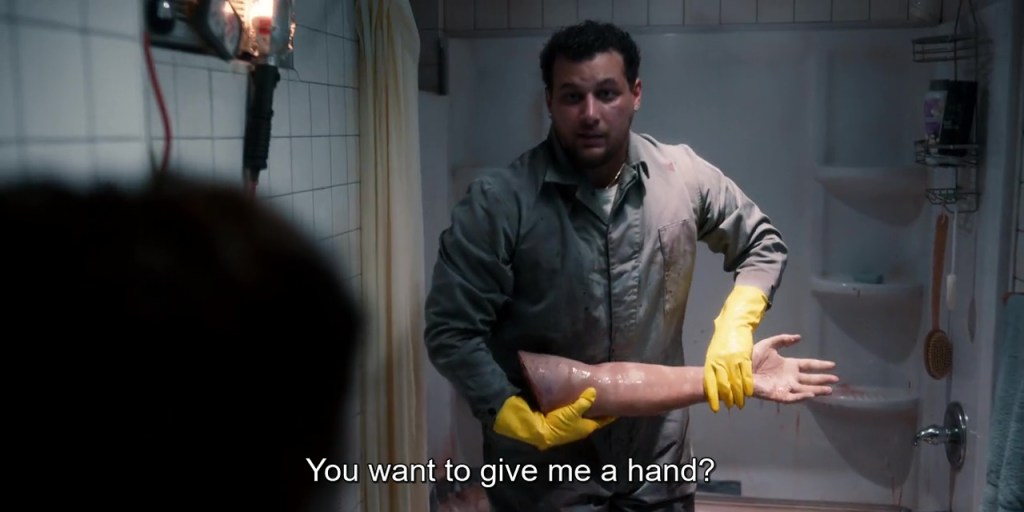
  • In episode 6, we see cannibalism as a business. Luis has been clear-eyed about this all along – he gets rid of the annoying landlord, he thoroughly destroys the evidence (in customers’ stomachs) and he makes money from the meat, which is apparently delicious and hugely popular, while saving money by not buying the flesh of other animals from the food-services man, Jeremiah, the only sympathetic character in the story so far.

Not a lot of human flesh being eaten in these final two episodes, because everything is turning to shit, largely due to the impulsive plans of Luis, and the tendency of Dolores to snap the neck of anyone who annoys her. Police are looking for the drug dealer Dolores killed back in episode 4, and threatening to call in the DEA. Luis is still chopping up the bodies of Dolores’ victims to fill his empanadas, but he doesn’t want anyone to find the marijuana he is growing. THAT would be incriminating. Dolores points out that his fridge and apartment are full of chopped up bodies, and asks him the question that defines all ethical discussions.

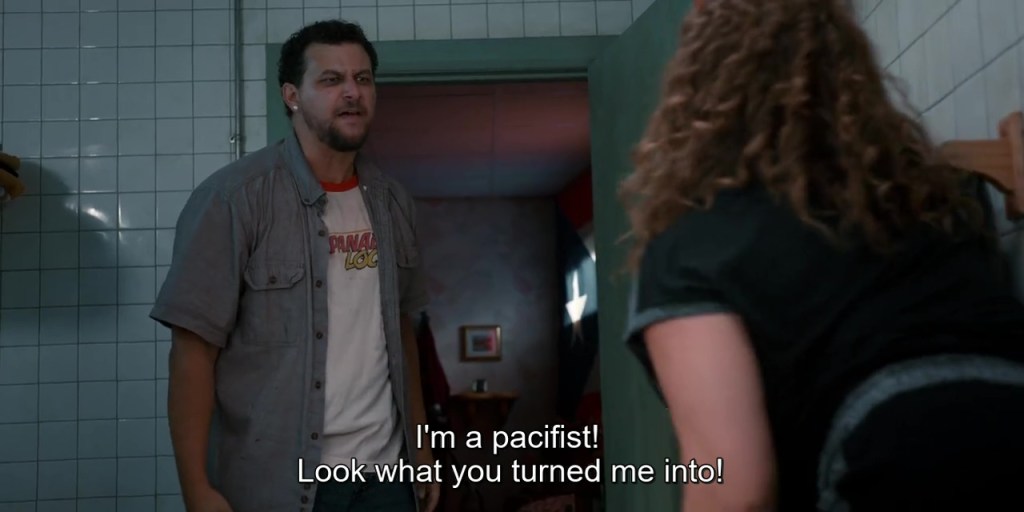
 She’s much more upset about the cannibalism than the increasing number of corpses she is leaving all over the shop. Odd that. Luis sees meat as his business, and Dolores’ steady body count as his (very reasonably priced) supplier. He’s not too fussed about all the killing, as long as he doesn’t have to do it – like customers in a butcher shop. When he finally kills a man, he is upset: “Look what you made me do!”

Luis cracks some of the best jokes in this show, in the middle of the street (much to Dolores’ fury) about the “fat fuck” she killed last episode, and how he is going to use the body fat in his pastry.

And some of the worst.

Lots of interesting Freudian things going on here – in earlier episodes, they discussed the difference between edible and Oedipal, and then there’s the whole thing with Luis only wanting to give Dolores cunnilingus, not penetrative sex, even though she has her period. She considers that eating her menstrual blood makes him a cannibal, even though he has been snacking on human empanadas all through the show, so it shouldn’t really be a surprise.

And his pet name is Mami. It’s apparently the Spanish equivalent of “baby” or “darling”, but is also used for, yep, mother. Freud said the two primary taboos are incest and cannibalism, and Luis definitely has an edible complex.

We find out why Luis doesn’t want sex – he fell in love with his father’s girlfriend when he was 12, had sex with her (so now we have another taboo covered) and then tried to castrate himself in punishment. He couldn’t cut through his penis (Meiwes and Brandes found it was much harder than you might think) and poured hot oil on the wound, leaving him horribly disfigured. Yes, Dr Freud, the threat of castration can be as big a motivation for mental illness as you thought.

Dolores just thinks she is a monster. But one of the fascinating things about cannibalism is that unlike other horror movie tropes, they are not supernatural or even particularly superhuman. And they really exist.

“I’m a monster. Worse, I’m real.”

Luis ends up “deep fried, like everybody else” in one of the most dramatic scenes, and Dolores escapes:

She goes looking for the showrunner of the play, a nice piece of postmodern complication as he clearly represents the creator of the show we are watching, Aaron Mark.

He is accused of humanising a serial killer, but hey, Dolores is very human, just like Macbeth and Oedipus and every tragic protagonist in literature. She’s not even a cannibal; in the whole eight episodes, we have not even seen her eat a human empanada! She’s just a misunderstood serial killer.

As she says, you have to draw a line somewhere.

She forces the showrunner to take her to a house where, he says, someone knows the whereabouts of the man who betrayed her and left her to rot in jail. When the door opens, she roars with laughter, and then pounces, but at whom? All we know is that, like Georgina in The Cook, The Thief, she is directing her invective at us, the audience! We may not know where her ex is living. But we do know that cannibalism starts at home.

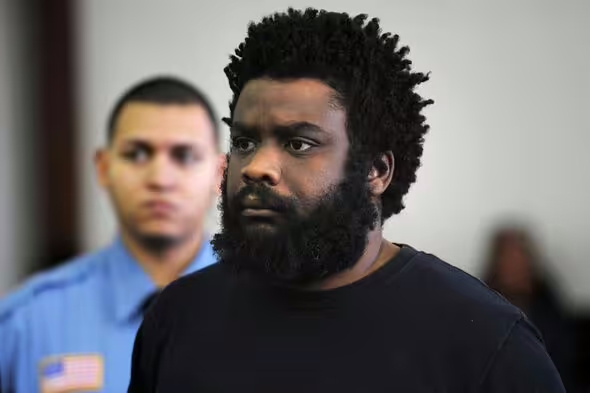
Brain-eating cannibal released in Connecticut

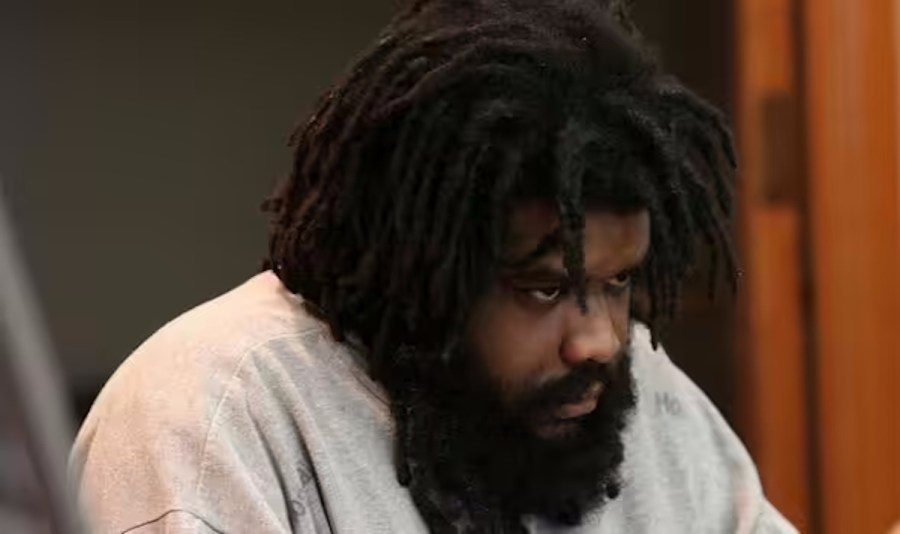
Tyree Smith, from Bridgeport Connecticut, killed a homeless man on December 15, 2011, and ate his brain and eyeballs. He has just been released into the community, ten years after being committed to a state psychiatric hospital, the Whiting Forensic Hospital, supposedly for sixty years.

Smith apologised for the murder at the trial, and the three-judge panel decided he was not guilty of murder by reason of insanity, during his sentencing in July 2013.

In lieu of prison, Smith was committed to a state psychiatric hospital for sixty years. After just ten years, the state Psychiatric Security Review Board said Smith was ready to be transitioned back into the community and he has been released from the facility, Connecticut’s most secure.

He will be living in a Waterbury group home, under orders not to associate with anyone involved in criminal activity. The board stated in its report:

Tyree Smith is an individual with a psychiatric illness requiring care, custody and treatment. Since his last hearing, Tyree Smith has continued to demonstrate clinical stability. Mr. Smith is medication compliant, actively engaged in all recommended forms of treatment, and has been symptom-free for many years.

During the trial, Smith’s cousin Nicole Rabb claimed he arrived at her Connecticut home in December 2011, ranting about Greek gods and talking about needing to go out and get blood.

Police described in the arrest warrant what they believed happened.

Smith curled up outside the abandoned, boarded-up Brooks Street apartment building where he used to live. He was awakened by Angel “Tun Tun” Gonzalez, a homeless drunk who invited him in from the cold. Gonzalez was popular in the neighbourhood. Like Smith, he had also once lived in the Brooks Street building before it was boarded up.
Once inside the apartment, Smith heard a voice saying, “This is your blood.”
Police said Smith hacked Gonzalez to death with his axe and cannibalised the body.

When Smith’s cousin saw him the next evening, she noticed what appeared to be specks of blood on his pants, and found that he was carrying chopsticks and a bloody axe. Smith allegedly told Rabb he killed a man and ate his brains in the Lakeview Cemetery while drinking sake, and warned her he intended to eat more people. Smith said the rush he felt while hacking Gonzalez and consuming pieces of his body was unlike anything he had ever experienced before, according to the arrest warrant. He told Rabb he has a sexual lust for blood.

A month later, police found Angel Gonzalez’s mutilated body in the vacant apartment on Brooks Street in Bridgeport where Smith had lived as a child. Police later recovered the bloody axe and an empty bottle of sake in a streambed near the Boston Avenue cemetery.

In a videotaped statement to police, Smith said he used a hatchet to kill Gonzalez, then took out the man’s eyes and part of his brain and ate them, washed down with sake (rice wine).

Smith’s defence team relied on the testimony of Yale University psychiatrist Dr. Reena Kapoor, who indicated that Smith had retained his lust for human flesh after his arrest, even offering to eat her. Kapoor claimed Smith suffered from psychotic incidents since childhood, and heard voices.

The voices ordered Smith to eat the victim’s brain so they would get a better understanding of human behaviour, and the eyes so that they could see into the ‘spirit realm’

Kapoor added that Smith went to Subway after eating the man’s body parts.

The report on Smith’s release said there was no evidence of “internal preoccupation or paranoia” and that “he denied experiencing cravings but stated that if they were to arise, he would reach out to his hospital and community supports and providers.”

A year before the murder, Smith wrote on Facebook,

Devouring your flesh. Smelling your bodies burn in a heap. I hate the day they created you filthy humans. There. Thats whats been on my mind since a child. Happy?

Of course, spouting abuse on Facebook doesn’t mean that the writer will eat people’s brains. Well, not always.

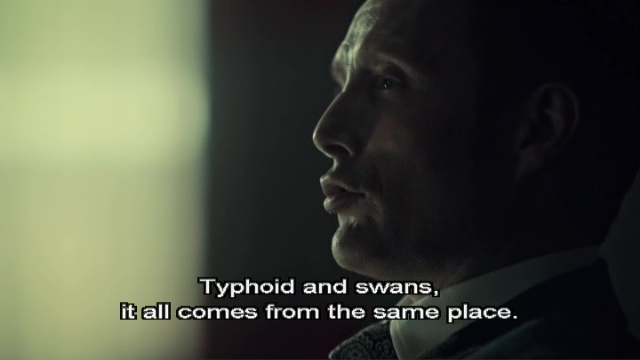
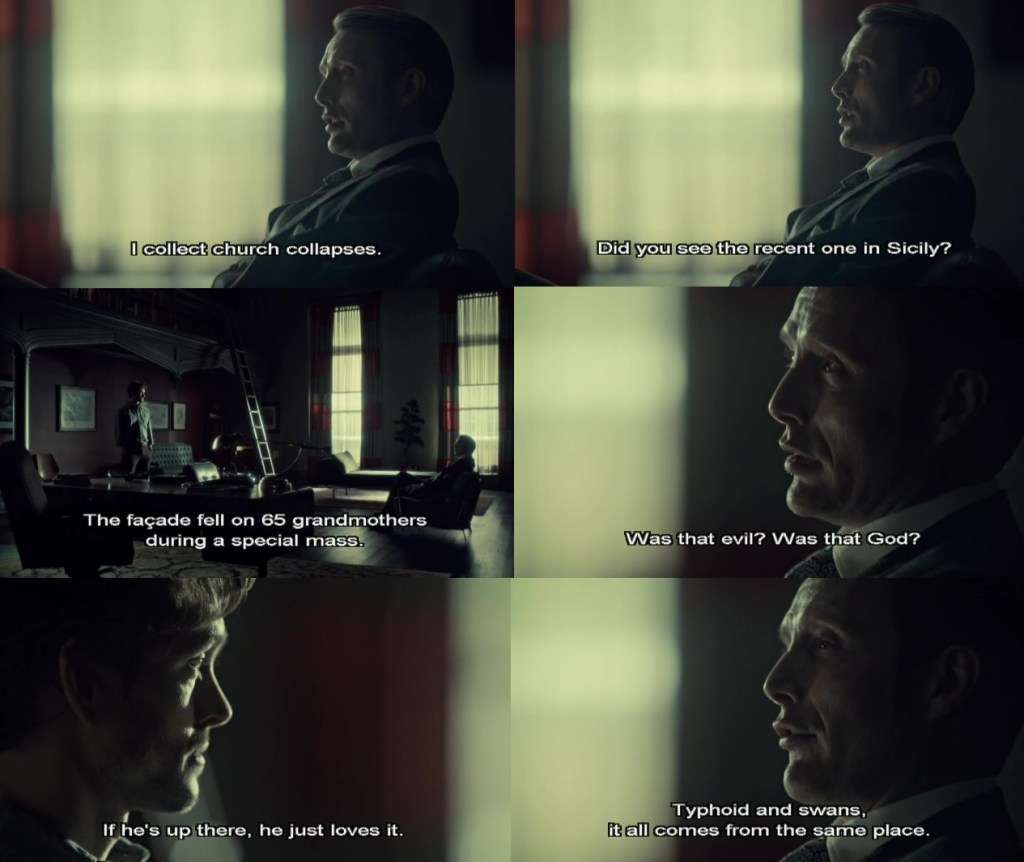
Hannibal’s scrapbook: “I collect church collapses”

Last week’s doomscrolling offered a story about a church roof collapsing during Sunday Mass in a northern Mexican city, killing at least nine people and injuring 40.

I know, it’s awful, but it immediately reminded me of Hannibal, Season 2, Episode 9, “Shiizakana”.

Hannibal and Will are talking about God, as you do when discussing the art of killing people with your psychiatrist.

Will: what do you think about when you think about killing?
Hannibal: I think about God.
Will: Good and evil?
Hannibal: Good and evil has nothing to do with God.

As Hannibal says, God kills lots of people, and are we not made in his image?

In the movie Red Dragon, the dialog is similar:

Why shouldn’t it feel good. It does to God. Why, only last week in Texas he dropped a whole church roof on the heads of 34 of his worshippers just as they were grovelling through a hymn. He wouldn’t begrudge you one journalist.

Or consider what Hannibal Lecktor (they spelled it differently) played by Brian Cox said about the joys of murder in the movie Manhunter:

It feels good Will because God has power. And if one does what God does enough times, one will become as God is.

More (lots more) Hannibal at thecannibalguy.com/2020/07/08/hannibal-film-and-tv-blogs/

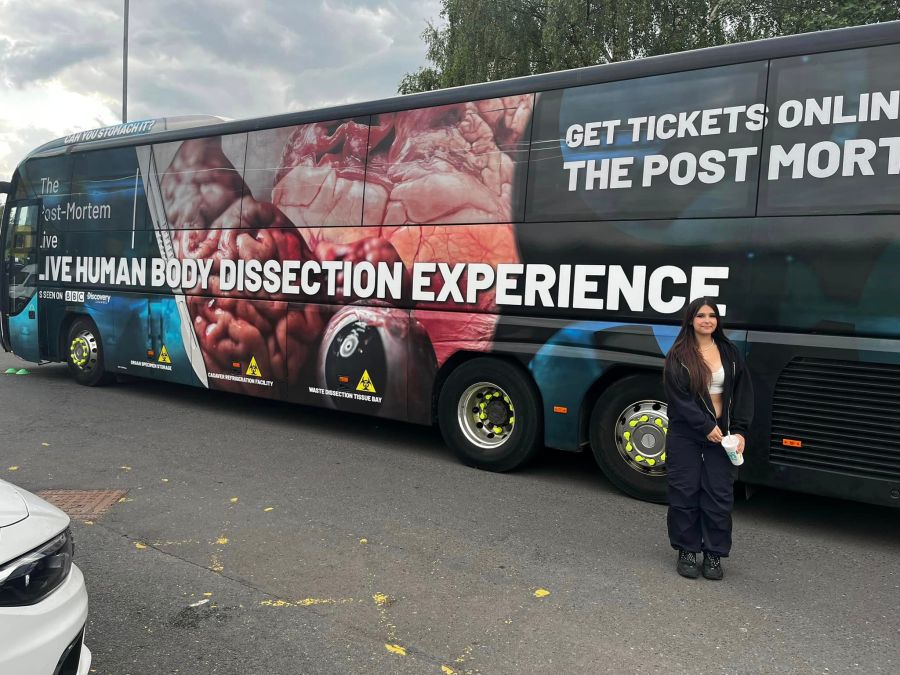
LIVE CANNIBALISM SHOWS: Post Mortem Live

What’s your idea of a great night out? How about attending a post mortem examination of a cannibal serial killer’s victims? That is the theme of “Post Mortem Live” which is touring various parts of the UK, purporting to show the workings of a crime lab, with some extras for the paying audience – they supposedly get to taste parts of the corpses! The press release asks:

“Ever wanted to try a real organ? Well now’s your chance. What does it taste like? Tender, fatty, juicy? Will introducing the pallet to organ meat leave you wanting more, and what lengths will you go to in order to satisfy your hunger?”

This press release is not on their website or Facebook page as far as I could see. If it ever existed (it is reported on several outraged social media sites) then it must have been a joke, and has now been removed.

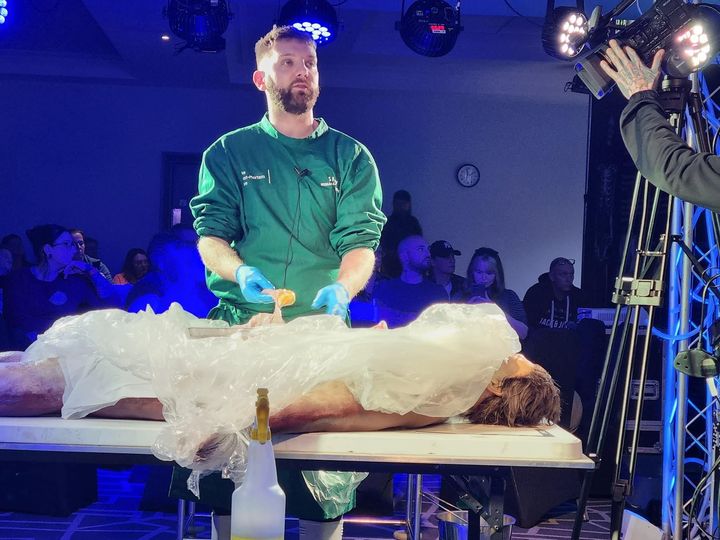
The show is based on the real murders committed by Dennis Nilsen in the UK and Jeffrey Dahmer in the USA, and gives the audience a hands-on experience of the post-mortem and forensic processes used to gather evidence of cause of death and identity of the victims, as well as piece together the actions of the serial killer, including tracing evidence of cooking and eating body parts.

​​

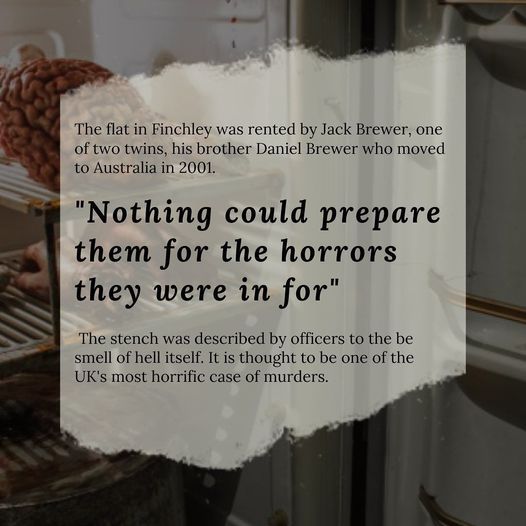
The storyline involves the (fictional) killings of 23 people, brutally murdered and dismembered by an equally fictional serial killer called Jack Brewer, who is said to have had a “feast”. Audience members will investigate the crimes in an “immersive and one-of-a-kind experience” through forensic tests similar to those used to catch and prosecute Nilsen and Dahmer. 

Jeffrey Dahmer killed at least seventeen young men and boys between 1978 and 1991, and ate parts of some of them. Dahmer did not look monstrous, just a lonely young gay man befriending marginalised others and offering them money to pose for photographs or friendship and sex, then drugging them. In some cases, he injected acid into their brains in a desperate but vain attempt to turn them into sex zombies, before killing and eating them, often preserving their skulls so that they would always remain with him.

Dennis Nilsen was a Scottish serial killer who murdered at least twelve young men and boys between 1978 and 1983. Following each murder, Nilsen would bathe and dress the victim’s body, which he retained for extended periods of time, before dissecting and disposing of the remains by burning them or flushing them down the toilet. Nilsen expressed surprise at the public revulsion towards his disposal of his victims’ corpses, which included cooking the flesh to render it down, and perhaps to consume it. Nilsen was trained as a butcher and chef, and we know that a number of serial killers worked as butchers, one of many occupations conferring a professional detachment from the carcasses of non-human animals, which are not very different from human ones.

The audience at this show are offered the opportunity to dissect organs, a method used in crime labs to determine whether a suspect had tried to dismember, degrade, cook or consume the victims. Is it possible, they ask, to deceive the science and conspire to carry out the perfect murder?

The FAQ states that the show is aimed at students and healthcare professionals, but anyone can attend as long as they’re over 14, and buy a ticket. The ticket price includes “basic PPE, gloves, specimens and clinical consumables.”

What happens at the show?

“The Post Mortem Live offers the chance to get hands on with real anatomical specimens of porcine origin contextualised into a simulated human body dissection.”

There is some eating. For a bit extra, you can book a “Dinner & Dissection”. The offer asks “Are you ready for main-corpse? or Dead-ssert?” Ah, no cannibalism story is complete without a few puns, and the organisers aggravate the crime by calling this a “cutting edge insight” into dark world of homicide detection, forensics and pathology.

The website blog features a number of particularly gruesome images of diseased and injured body parts, nothing to do with the fictional case, but maybe a warning of what to expect. Many of them are on their Facebook page too, some with graphic content warnings, others (possibly worse ones) without. Go figure. I can safely predict you will either love or hate these pages. If you think you will hate them, maybe don’t open them.

I’m not using the images of smashed limbs and spiked eyeballs on this site – all images here are from the show. Which is not real humans.

But… it is is bodily material from real pigs – that’s what they mean by “real anatomical specimens of porcine origin.” I wonder if this is supposed to be reassuring? No dead humans were harmed in the making of this show, but a whole lot of live pigs were killed so that they could be cut up for human amusement. That is sicker than the atrocity pics.