Hell is in Hello: “MOTEL HELL” (Connor, 1980)

Lee Marvin “sang” these words in the musical Paint Your Wagon:

Do I know where Hell is? Hell is in hello…

Don’t know whether Director Kevin Connor got the idea from Lee Marvin, but he certainly borrowed from Texas Chain Saw Massacre, with an actual chainsaw duel between two brothers featuring at the climax of the film. Texas, in its own low budget way, revolutionised the horror genre, introduced slashers, and let us in on the world of the neglected, socially isolated “flyover zone” cannibal.

It’s also a spoof on Psycho – the killer in the motel, the unsuspecting travellers. You might also call it a precursor of the film Delicatessen that was considered on this blog last week: once again there are rooms for rent, human meat for sale.
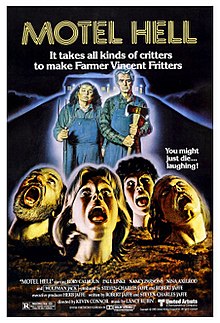
220px-POSTER_-_MOTEL_HELL.jpg

The motel is actually called MOTEL HELLO but the “O” keeps flickering off, thus giving the sinister name, and the title of the film.

vlcsnap-00007.jpg

vlcsnap-00002.jpg

Vincent (Rory Calhoun) is a neo-lib dream: an entrepreneur who relishes his freedom to do whatever he likes in the name of business. The hidden hand of the market is his, and that hand carries a shotgun, or sometimes a chainsaw. Vincent runs the motel, but in his spare time (of which he has plenty) he ambushes motorists and stores them until he slaughters them and sells their flesh in his butcher shop as FARMER VINCENT’S SMOKED MEATS.

Simpsons fans will know Rory Calhoun of course!

Farmer Vincent’s is a family business, and Vincent’s sister Ida (Nancy Parsons) is involved in the process, which involves burying the victims up to their necks in the garden and cutting their vocal chords so they can’t make a fuss, then feeding them up like hogs until they are fat and edible. But Vincent fancies one of the victims, Terry (Nina Axelrod) and asks Ida to help her heal from the accident he caused. His kid brother Bruce (Paul Linke) is the local sheriff, and is as clueless as we expect local sheriffs to be, but he soon develops a crush on Terry. But she develops a crush on Vincent, so we know that (murder and cannibalism aside) there’s going to be trouble.

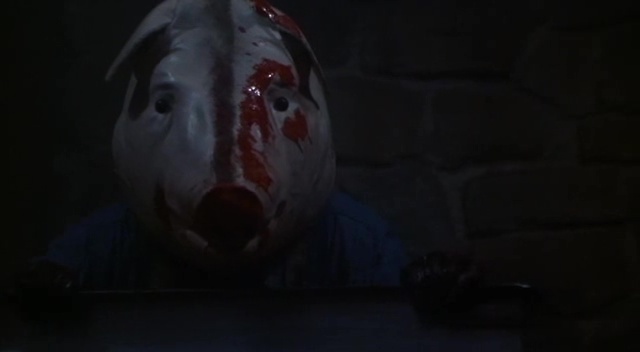
In a scene that perfectly parodies slasher movies, two little girls sneak into the smoking room, and with the requisite spooky backing track, are terrified by the scenes of carnage they see there – a lot of dead pigs. Only pigs, we might chuckle but, for Vincent, pigs and people are just the same: dumb animals good for nothing except slaughter and smoking for profit.
vlcsnap-00013.jpg

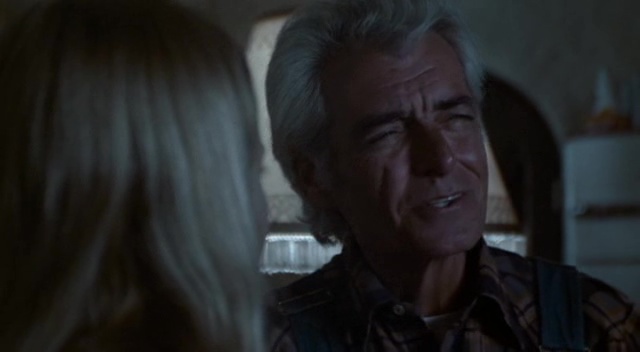
Terry is pretty upset about losing her boyfriend (to whom she was not married, the religious Vincent notes), but he convinces her that being with them is “preordained”
vlcsnap-00014.jpg
“Ah, the ways of the Lord are mysterious!”

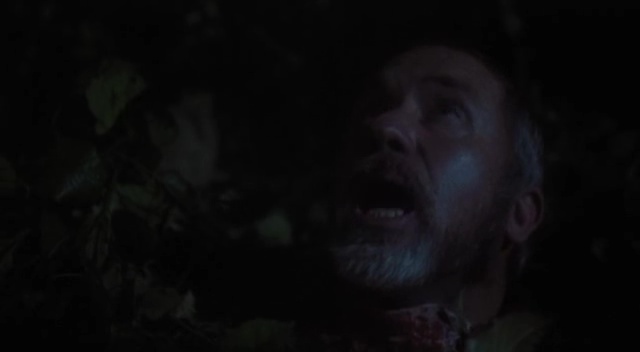
Vincent’s methods of harvesting meat animals are not too particular: the local meat inspector who gets too nosy, a bus full of hippie musicians, even a pair of swingers whom he has lured with an ad – all get buried up their necks in the garden, unable to make any intelligible sound.
vlcsnap-00016.jpg

He explains to Ida how important his various traps are, because “they give me a chance to be a free agent” and his work will remain special and important. Yep, Vincent is a classic neo-lib. As Ida pulls the latest victims out of the truck toward the holes he has dug, he tells her “plant ‘em!”. As they reflect on the strangeness of the hippies, they chant their motto:

It takes all kinds of critters
To make Farmer Vincent’s fritters!

As Vincent and Ida settle down to “plant” their critters and pull out the scalpels to cut their vocal chords, are they really behaving differently to the farmer who ties down a bull or hog to castrate him or to burn off his horns, or a sheep farmer who cuts hunks of skin off the backside of a lamb because it’s an easy way to avoid fly-strike (and saves money on insecticides)? They cleverly portray the hard work and care of farmers who really can see nothing wrong in the suffering they inflict for the sake of profit. He checks out one victim, smiling “not quite – tomorrow he’ll be ready to become famous.”

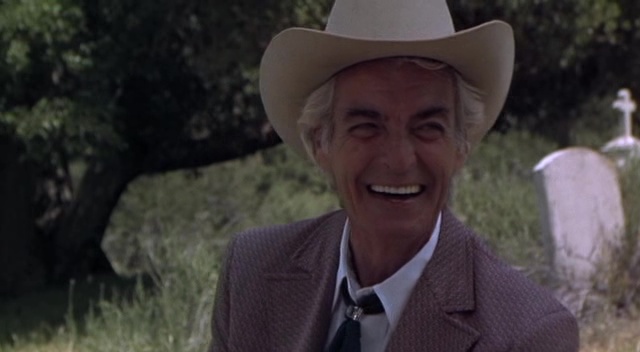
Terry asks how Vincent got started in the meat business and he tells her of the days when they couldn’t afford an icebox, and Granny would smoke anything she could catch – chickens, rabbits, frogs. One day, she asked Vincent to do something about an annoying dog who was barking, and that dog ended up smoked too. Did Granny know she was eating a dog, asks Terry, now repulsed, although she has just been enjoying Vincent’s smoked “ham”. Vincent replies:

Why Granny never put any distinctions on any of God’s creatures. She always used to say [Ida and Bruce join in the chant] MEAT’S MEAT, AND A MAN’S GOTTA EAT!
vlcsnap-00018.jpg

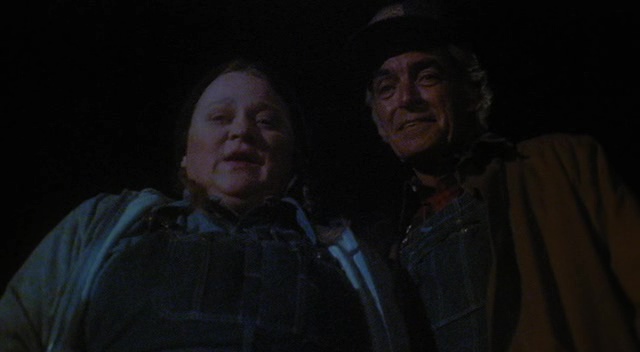
Ida doesn’t like the wheezing and hissing noises the captives make as they try to talk without vocal chords. Vincent replies “They’re good animals! Not like taking care of chickens, or hogs.” Ida asks: “Vincent, do you think in the years to come people will appreciate us for what we’re doing here?” She goes on “Somebody’s gotta take a little responsibility for the planet!” Vincent and Ida are also ecologists, performing a valuable service by combating the scourge of human overpopulation.

The action is interspersed with the seemingly continuous telecast of a televangelist on the TV. Also with cannibal puns: as the swingers get ready for what they expect will be a wild evening (it will, but not quite as they hoped), Ida tells them “you look good enough to eat”. And the final credits roll to the Kregg Nance song “You’re eating out my heart and soul”.
vlcsnap-00019.jpg

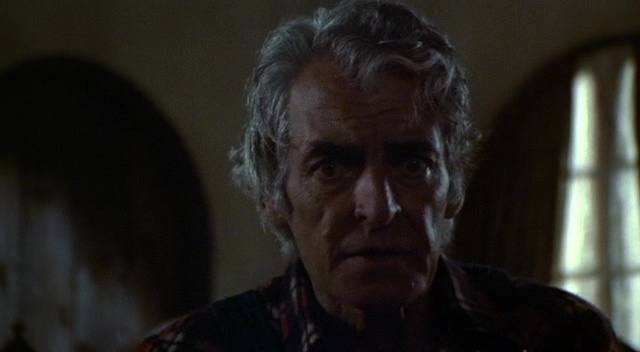
People certainly don’t like the idea of cannibalism, but they usually find it hard to articulate what is wrong with it, compared to eating other “critters”. For most, it is enough to say it is taboo, but that really begs the question. The genius of this film is that Vincent is not the usual psychotic serial killer type of cannibal. He is good humoured, kind, and has a strong sense of morality, seen in his choice of religious programs, as well as his shock when Terry comes on to him – he recoils, saying “we should be married first”.
vlcsnap-00009.jpg

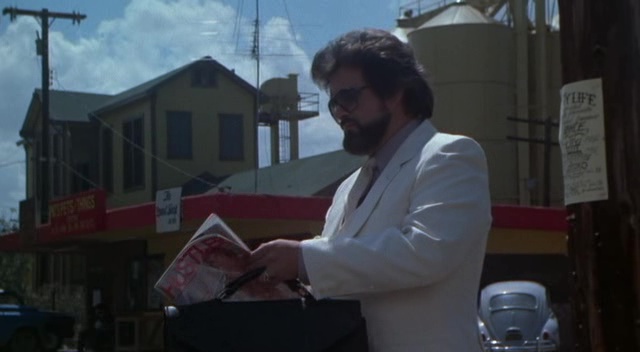
Well, they are going to get married, by none other than the local pastor, played by the legendary Wolfman Jack, a gravelly voiced DJ of the golden age of Rock.
vlcsnap-00020.jpg

Ida drugs Terry, so that she and Vincent can go prepare the meat for the wedding feast. Vincent insists on offering his victims a humane death – he believes that “no animal should ever suffer any unnecessary pain”. Well, we nearly all believe that! Just a question of semantics – define ‘animal’. Define ‘pain’. And define ‘unnecessary’.

Anyway, Bruce is royally pissed off and starts looking for evidence against Vincent, and the “animals” start digging themselves out and staggering about in a scene reminiscent of just about every zombie movie.

vlcsnap-00022.jpg

Terry finds out the truth, but it’s her version (what else could it be?) As far as Vincent is concerned, he is just preparing the wedding feast. He says:

Haven’t you ever cleaned a fish? There’s nothing cruel in what I’m doing here. I treat most of my stock better than farmers treat their animals. I don’t feed them chemicals or hormones. When you consider the way the world is today, there’s no question I’m doing a lot of them a big favour.

Terry ask him what right he has to play God. Vincent denies that is what he is doing.

I’m just helping out. There’s too many people in the world and not enough food. This takes care of both problems at the same time.

And that’s Vincent’s truth. And there is some truth in it.

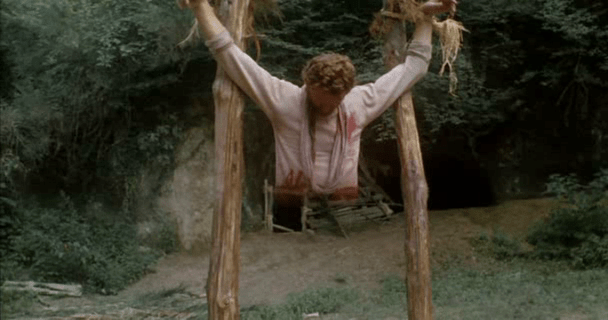
The climax is the two brothers battling it out with chainsaws (a Texas Chain Saw reference) while Vincent wears a pig’s head on his head, which would not help his visual acuity much, but takes us to all sorts of interesting tropes, such as Animal Farm. The shock ending: as Vincent dies, he admits to his whole life being a lie, to being the biggest hypocrite of them all. Why?

My meat. I used – preservatives!

The film received a respectable 70% fresh on Rotten Tomatoes. The reviews range from “a rather well-executed dark comedy” to “tasteless, gruesomely awkward and moronic.” I liked it because it ticked all the boxes in my quest to understand cannibalism’s undermining of anthropocentrism. And Rory Calhoun is terrific – or as Montgomery Burns would say:

Excellent.jpg

Meating the future: “DELICATESSEN” (Caro & Jeunet, 1991)

vlcsnap-00003.jpg

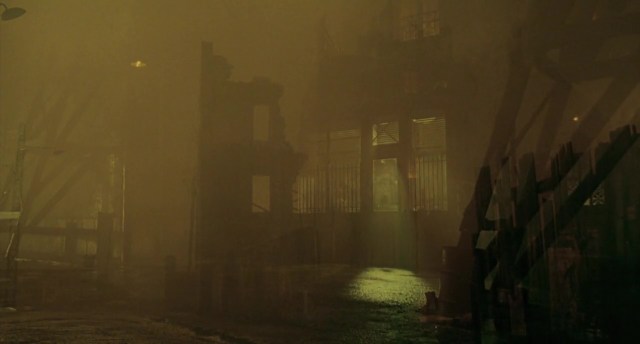
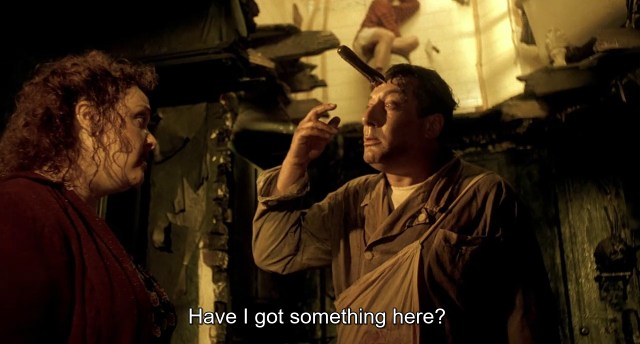
Delicatessen is a classic French black comedy set in a post-apocalyptic village where seeds and grains are the exchange currency. The butcher advertises for handy-men in a journal called Hard Times and then slaughters the applicants and sells their meat to his weird tenants, who have surrealistic activities: a man who lives in a flooded room full of frogs and snails, a woman who constantly fails at suicide attempts so involved they would be worthy of Wile E Coyote, and two brothers who manufacture mooing machines for no apparent reason.

vlcsnap-00001.jpg

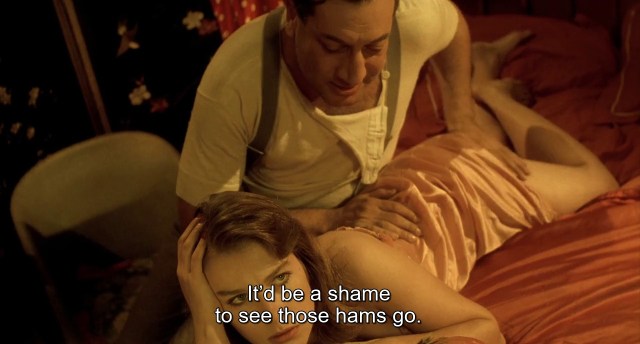
The trailer for Delicatessen is a scene from the early part of the film, where the butcher, Clapet (Jean-Claude Dreyfus) is having sex with a woman (Karin Viard) who seems to be as much captive as partner.

vlcsnap-00008.jpg

As his lustful tempo, played out on the squeaky bedsprings, increases in speed, so do the activities of all the tenants: the butcher sets the pace in this world (and by implication in our world too).

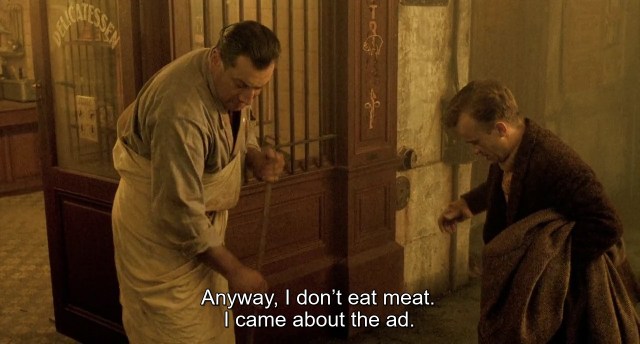
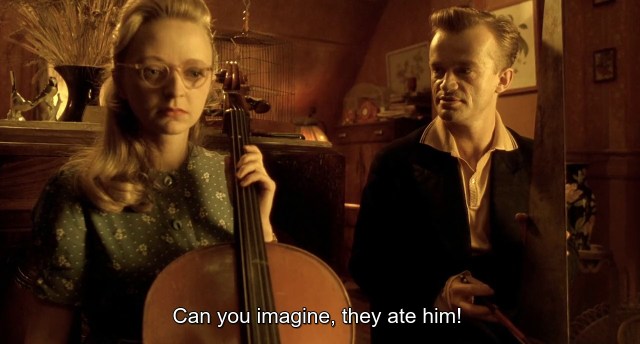
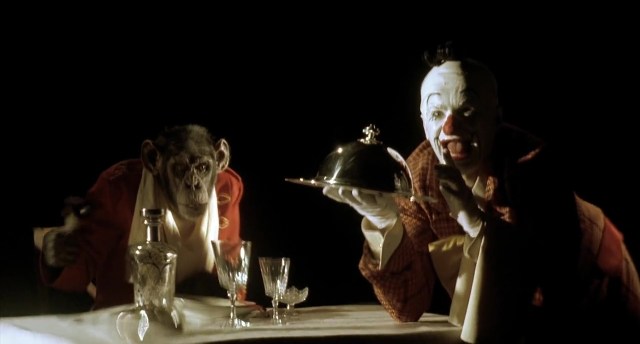
Into this house of horrors comes a gentle (vegetarian) clown, Louison (Dominique Pinon), who has left the circus after his partner, Doctor Livingstone, was eaten.

vlcsnap-00006.jpg

vlcsnap-00007.jpg

Livingstone, it turns out, was a chimp, but his sorrow is no less real for that.

vlcsnap-00014.jpg

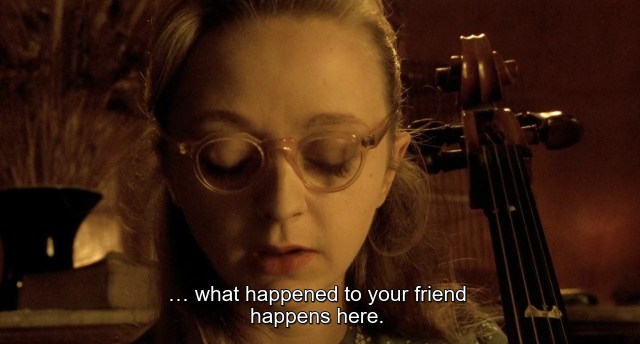
The butcher’s daughter, Julie (Marie-Laure Dougnac) falls in love with him and tries to warn him of his likely fate.

vlcsnap-00009.jpg

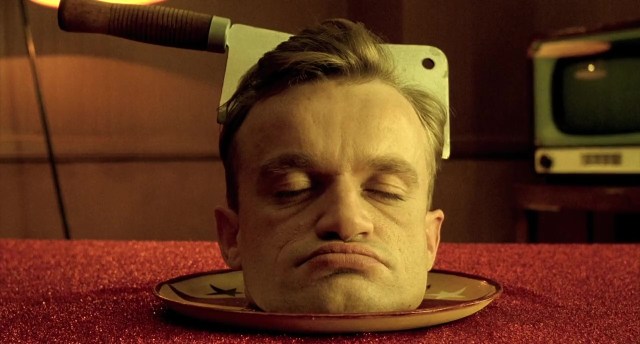
Julie dreams about the upcoming butchery of Louison, and decides to save him. To do this, she has to seek the help of the Troglodistes, an underground group who are vegetarian and hate the “surfacers”, who hunt them. Their motivation is the 30 bags of corn in her father’s house. Her motivation: love. Her father’s: meat. Can there be a more French theme? She returns to find:

vlcsnap-00017.jpg

But he’s a clown – this is a new act he is rehearsing.

vlcsnap-00018.jpg

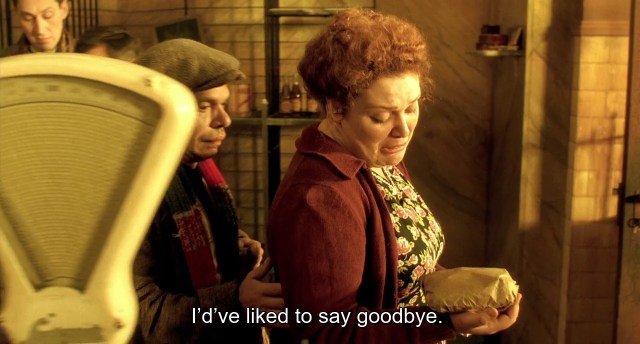
Since Louison did not appear on the steps last night, where the killings are done, the butcher is instead selling bits of the mother of one of the tenants. As the tenant leaves the butcher, a neat packet of her mother’s flesh under her arm, she says:

vlcsnap-00019.jpg

“We’ll do that now” her husband assures her.

Look, none of it makes any sense, but that’s to be expected. All we can conclude is that voracious appetite (of which cannibalism is the highest form) doesn’t pay.

vlcsnap-00030.jpg

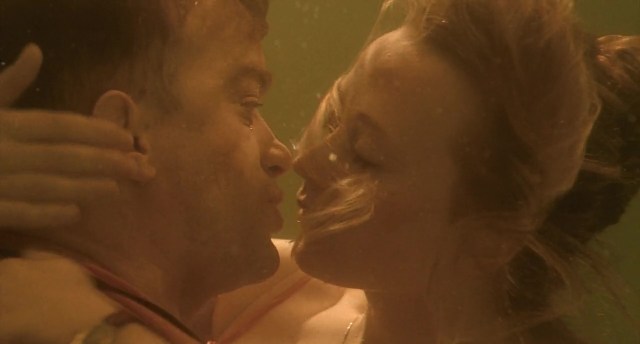
And love always triumphs…

vlcsnap-00028.jpg

… even if it’s underwater.

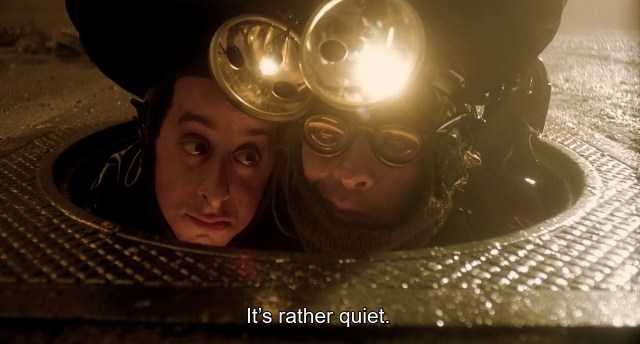
The director Marc Caro’s cameo (in goggles).

vlcsnap-00024.jpg

Rotten Tomatoes currently gives Delicatessen an impressive 89% “fresh”. The Washington Post called Delicatessen “a tasteless variation on Sweeney Todd set geographically near the border of Terry Gilliam’s Brazil” while Unsung Films said it was “reminiscent of Amélie – and …much braver”. Amélie was the director Jean-Pierre Jeunet’s 2001 masterpiece.

Empire summed up Delicatessen as “simply essential viewing for vegetarians”.

Cannibalism films often have that effect.


IF YOU LIKE MY BLOG, PLEASE FEEL FREE TO RECOMMEND IT (WITH DISCRETION) TO FRIENDS ON SOCIAL MEDIA.
IF YOU HAVE ANY QUESTIONS OR COMMENTS, YOU CAN USE THE TAG, OR EMAIL ME ON CANNIBALSTUDIES@GMAIL.COM.

Auto-cannibalism: “In My Skin” (de Van, 2002)

First off, if you don’t like gore (hey, it’s a blog about cannibal films, not necessarily slashers), then you may want to avoid this little French number. If graphic scenes don’t bother you (or if you like them) then this one is quite intriguing and very well made. But –– you’ve been warned.vlcsnap-2019-02-16-15h47m58s843.png

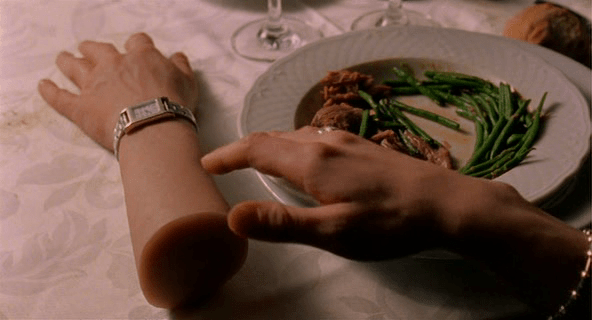
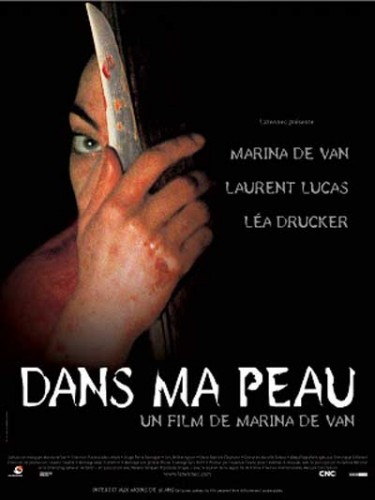
Marina de Van both directed and starred in this film, one in a genre of French movies which became known as New French Extremity films. There’s not a great deal of plot, but there’s a lot to the film in terms of the concepts and questions it raises. The film starts with a series of scenes: traffic, buildings, doors, etc, split screen into the image on one side, and a negative version on the other. So we’re already exploring dualism. The lead character, Esther (played by the director, Marina de Van), is a picture of privilege: she is white, well paid, well off, has a loving boyfriend – she’s on top of her world. Then she has a fall. A real fall, onto some rubbish, and actually injures her leg. But it doesn’t hurt. She doesn’t even notice the abrasions for some time.

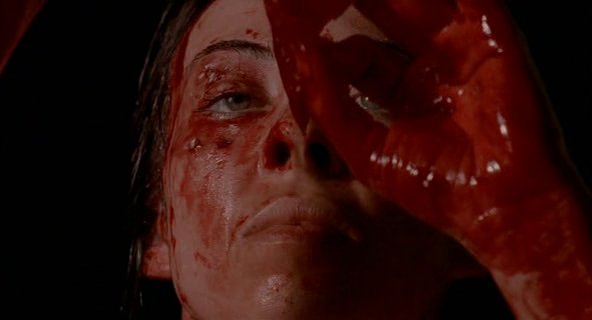
Her doctor (played by her real-life brother, Adrian de Van) and her boyfriend (Laurent Lucas) are both concerned about her feeling no pain, but she brushes them off. Then she starts poking her wound, then the cutting starts, then the stabbing, then later the chewing (which qualifies it for my cannibal blog). That’s all I’m saying – no spoilers.

In-My-Skin-e1549986752157.jpg

In the director’s words, the movie asks “does this body really belong to me?” In an interview, she revealed that the story is based on an childhood accident, when she was hit by a car and had her leg broken, and she saw her leg not as part of her, but as a “fascinating, deformed object.”

vlcsnap-2019-02-16-17h17m23s509.png

Here’s the point: we look at each other with love or lust or hatred or fear, but it’s always only skin deep. What is beneath that surface? Derrida tells us that the binary opposition of inside to outside is the “matrix” of all oppositions. We consume the insides (muscle, fat, blood) of other animals but are horrified at our own internals – think of the warning given on the news when showing an accident or terrorist event, often quickly followed by an advert or a kitchen show involving bits of a dead lamb.

vlcsnap-2019-02-16-17h03m14s707.png

Why are we so repelled by what’s under our skin? Judith Halberstam tells us that skin is a “metonym for the human”, and any breach of it reveals a “semiotic of monstrosity” – the uncanniness within the body. Or as Angela Carter put it, “if flesh plus skin equals sensuality, then flesh minus skin equals meat”.

DpUdQUrU0AIX2hr.jpg

This film, and cannibal films generally, remind us that we are not gods or angelic beings – we are animals, and are made of meat, just like the animals we torment and slaughter. When Esther looks into her own being, she feels the same appetite others feel when walking past a roast.

vlcsnap-2019-02-16-17h02m45s986.png

In My Skin received 65% on Rotten Tomatoes, with one reviewer saying “A spellbinding, forceful film that refuses to be ignored” and another slamming it as “a bloody mess, in more ways than one.” The film received the Best International Film award at the Fantasia Film Festival in 2003. Make up your own mind.

Dans-ma-peau_Marina-De-Van-s-In-My-Skin-2002-movie-6-375x500.jpg

Innocent cannibalism: “SWEENEY TODD: THE DEMON BARBER OF FLEET STREET” (King, 1936)

One of the earliest films in the range of cannibal stories I have chosen to cover is George King’s 1936 version of Sweeney Todd. Sweeney is a modern myth, but is a descendant of the shadow archetype, those who destroy themselves in trying to destroy others, including Homer’s Cyclops, whose behaviour, Lacan would say, is governed by “unregulated libidinism”. This Todd is certainly so governed.

vlcsnap-00001.jpg
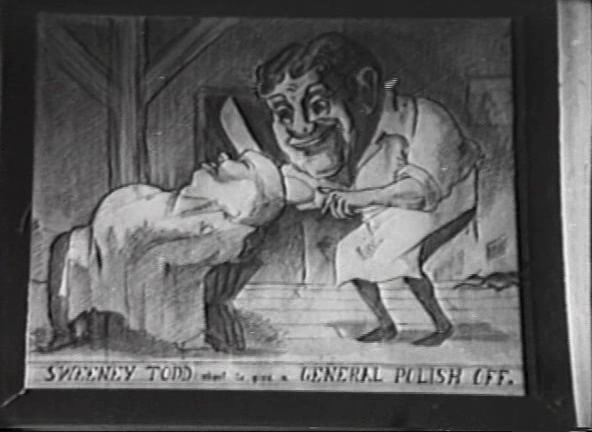
The poster on the wall of the barber shop, where the story is told

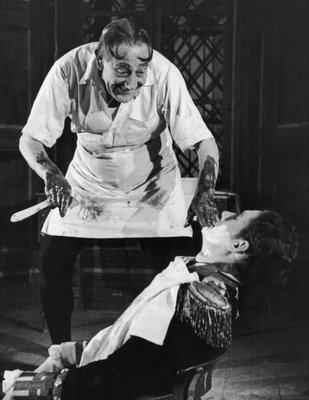
The title role is played by the wonderfully named Tod Slaughter, who presents Todd as pure evil: socially respectable, yet greedy for money and lusting after the young heroine, Johanna. This is a far more straight forward explanation of cannibalism than the 21st century version where Depp is motivated by revenge at injustice (and insists on singing as well).

The plot is straightforward: Todd has a barber shop near the docks where he lures passers-by in for a shave, kills them and steals their valuables, the kind of simple but effective business plan that any bank would find beguiling.

vlcsnap-00004.jpg

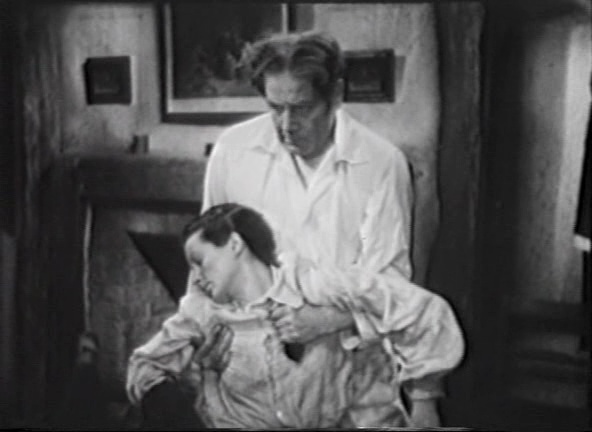
Todd’s partner in crime, Mrs Lovett, has a pie shop and profitably disposes of the bodies. Johanna is the daughter of a local merchant and Todd offers to go into partnership with him, planning to ruin him and blackmail him into approving marriage with his daughter. When the girl’s true love, Mark, returns with riches from the African colonies, (he also bravely fights off a tribe of savages, who are probably cannibals in terms of the colonial trope) he is robbed by Todd but saved from death by Mrs Lovett, who is jealous of Todd’s attention to Johanna. In an interesting instance of early (pre-‘slasher’) gender displacement, Johanna decides to save Mark by dressing as a boy, but is captured by Todd and, setting the gender roles back to basics, has to be rescued from the resulting fire (which consumes Todd) by Mark.

vlcsnap-00012.jpg

Neither Todd nor Lovett are ever seen eating human flesh – all cannibalism is performed by the unwitting customers, alluded to when Mark’s comic relief friend and shipmate, Pearley, munches through a pie while speculating on what Todd does with the bodies. The word ‘cannibal’ is never uttered, and the only whiff of abjection is when the narrator, a modern day barber in Todd’s old shop recounting the story to a customer, reveals there is a pie shop next door, and watches in amazement as the man flees. This is textbook abjection: the smell of meat from some non-human mammal cooking next door has made the customer in contemporary London realise his own mortality.

Sweeney Todd 1936.jpg

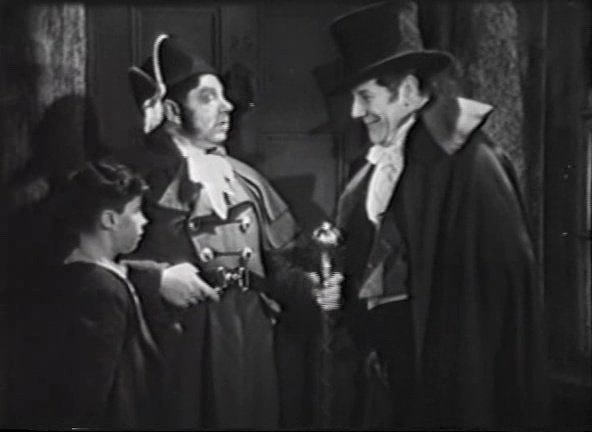
The class nature of nineteenth century England is illustrated by young Tobias, who is brought to Todd as an apprentice: Todd gets one guinea for each boy he takes from the parish. The Beadle warns Todd that this is the last boy he is getting: presumably he has killed, and Mrs Lovett has cooked, the previous seven.

vlcsnap-00002.jpg
“You’ve brought me another apprentice. And a nice little boy, too!”

The boy prepares the victims by applying shaving cream, and is then sent off for a walk with a penny pie from next door, making the innocent lad the chief innocent cannibal. In fact, all the cannibalism is innocent and is carried out by the lower classes, represented by Pearley and Tobias, an apparent metaphor for the exploitation with which the working class was struggling in the 1930s when the film was made. Todd’s unconscionable slaughter of men (never women, except, almost, the disguised Johanna) for profit is pure objectification: he treats his fellow humans as commodities. No explanation is given, nor needed: Todd’s maniacal laughter is necessary and sufficient to make clear that he is a psychopath; in this, he is a mythic figure: the stuff of nightmares.

Sweeney Todd 1936 poster.jpg

Full movie (with some audio issues) is available at https://www.youtube.com/watch?v=6W0YoxQkTjs

IF YOU LIKE MY BLOG, PLEASE FEEL FREE TO RECOMMEND IT (WITH DISCRETION) TO FRIENDS ON SOCIAL MEDIA.

IF YOU HAVE ANY QUESTIONS OR COMMENTS, YOU CAN USE THE TAG, OR EMAIL ME ON CANNIBALSTUDIES@GMAIL.COM.

Cannibal Cheesecake: “Emanuelle and the Last Cannibals”, (D’Amato, 1977)

Joe D’Amato (real name Aristide Massaccesi) was nothing if not prolific, directing some 200 films from 1972-99. These covered a multitude of genres from westerns to war, comedy to fantasy, but he is best known for his horror, erotic and adult films. His first softcore movie was Emanuelle’s Revenge in 1975, followed by his work on five of the six “Black Emanuelle” movies starring Laura Gemser as a globe-trotting journalist who gets into all sorts of merry scrapes, usually involving violence, horror and rape. They were based around the French Emmanuelle movies, with one “m” removed from the title to avoid copyright problems.

D’Amato’s first Emanuelle movie, Emanuelle’s Revenge (1975), was with German actress Rosemarie Lindt as Emanuelle and George Eastman as Carlo, whose role as a murderous monster with a machete prefigured his later role in D’Amato’s Antropophagus (1980). Both these movies deserve a mention in this blog, since the first has Carlo fantasising about cannibalism while under the influence of LSD, while the second has a demented cannibal who actually eats his own intestines (all right, don’t believe me). We’ll get to them – maybe.

Emanuelle and the Cannibals was the fifth of the Black Emanuelle films; the fourth that D’Amato directed. The porn level is a great deal lower than the others in the series (Emanuelle in America for example had a naked woman masturbating a horse), but this had something better: cannibalism! Who needs horses?

The film starts with a claim to be a true story, which was the thing in those days.

vlcsnap-00001.jpg

Emanuelle is in an asylum in New York, in which women do crazy things (just like they do in Suddenly Last Summer, so it must be true). Mostly they just talk to themselves and carry dolls, and Emanuelle is “embedded” as they say – an investigative journalist from the Evening Post, cleverly disguised as a doll-carrying crazy. The boss doctor (a cameo by the Director) tells her she will cause a scandal if discovered, and his price if she wants to come back and do it all again will be double.

Meanwhile, one particular crazy is busy biting off and eating a nurse’s breast, which Emanuelle finds fascinating. The staff say she is a “complete savage” and she snarls and snaps at them, but is quickly tamed by Emanuelle, who introduces herself with some hand gestures (between the girl’s legs).

Emanuelle’s editor is fascinated by the story of the cannibal and even asks how the nurse is. Emanuelle answers “she asked for it. She’s well known for her homosexual inclinations.” Well, that’s OK then. Emanuelle has taken photos of the girl with her gown hoisted up, and after studying them extensively, they raise their eyes high enough to notice a huge tattoo “above her pubic region” (I’m not sure if the dialogue really is this bad or if it is the poor translation used for the dubbing). It’s an Aztec symbol – from the Tupinambas according to the newspaper’s resident nerd (do you remember when newspapers could afford to employ nerds?). The Tupinamba were everyone’s favourite Brazilian cannibals since Hans Staden was captured by them and claimed to have witnessed their cannibalistic rituals in the sixteenth century. Fortunately, the Portuguese came to save them from their sins, and through enslavement, assimilation, extermination and the introduction of Smallpox, managed to wipe them out completely.

But not in this movie. Emanuelle goes to the Natural History Museum to meet up with the “famous anthropologist” Mark Lester (Gabriele Tinti, who was Gemser’s real-life husband). He takes her to lunch, to his house to look at films of Tanzanian ritual cannibals cutting off heads, penises and what have you from a pair of adulterers, and then to bed. She takes him to the Amazon. Fair exchange.

vlcsnap-00002 (2).jpg
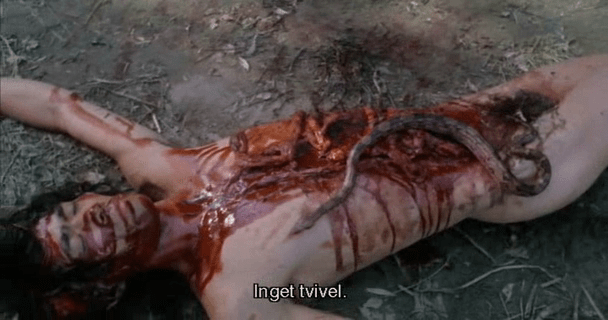
now you know how to say “it’s about cannibalism” and “you’re crazy” in Swedish

Before leaving, the movie treats us to scenes of New York traffic and several gratuitous sex scenes including one with Emanuelle’s steady boyfriend, who seems to be able to make sweet sweet love while still wearing skin-tight jeans. And lots of close-ups of Gemser.

vlcsnap-00004 (2).jpg

On the plane, they smoke (!) and discuss anthropology and history, appropriate since it’s a Pan Am flight.

Why are there still cannibals? asks Emanuelle. He tells her about political cannibalism like Idi Amin, or “tolerated” cannibalism like the Andes plane crash survivors. But in the Amazon, they live by their own rules, and may eat human flesh for ritual purposes, or because they are peckish. Lucky she brought along an anthropologist.

They interview the dude who found the cannibal girl, and he says he has lived among the Amazonian tribes for 25 years and only come across two cases of cannibalism, which were quickly hushed up by the government. He has a daughter, Isabelle (Mónica Zanchi) who has grown up since she last saw Lester and lusts after him, and she spies on Lester and Emanuelle as they go through the same motions, and the same soundtrack, as the New York sex scenes, while Isabelle masturbates outside. Now that’s the sort of thing that you’d expect to cause a lot more problems than extinct cannibals.

Isabelle is taking supplies to a Missionary down the river who knows all there is to know about the “savages” as they call them, and a Nun and two Indians are going with them (definitely redshirts). The Nun tells them that superstition is still strong in the jungle, and there are still witch-doctors curing people with herbs! Oh, the horror. She does admit that the herbs work, so much so that the mission has appropriated (sorry, adopted) many of the concoctions.

There is a totally superfluous scene where Emanuelle and Isabelle are in the river washing each other (mostly concentrating on each other’s breasts, which I guess must get grimy on the river) and being watched by a chimp, who smokes their cigarettes and tries on their sunglasses. Of the three actors in the scene, the chimp seems to be portrayed as the most intelligent. They meet up with some adventurers, Donald and Maggie, who tell them that the Mission was attacked by savages and everyone massacred. Donald saves Emanuelle from a snake, and she asks him what he is doing in the jungle.

“Hunting. Hunting is my life. I’ve sacrificed a lot to satisfy my craving for – hunting…. The satisfaction of catching it. And to kill! … you have to share risks with the animals. Man too can be hunted.”

And what’s Maggie doing there? Well, she’s doing the African cook, Salvador. And no one seems to wonder what the hell he’s doing there in the middle of the Amazon basin. Donald catches them hard at it in the jungle, but it doesn’t become much of a thing, because they have their own agenda – searching for a crashed plane full of diamonds. When the others decide to go back, they find one of the redshirts cut up, cannibal style, and their boats missing.

vlcsnap-2018-12-22-14h15m19s240.png

They try to head back down the river on foot, but on the way find a Bible, and Father Morales from the Mission to which they had been heading.

vlcsnap-2018-12-22-14h19m58s078.png

So, we all know what happens next. This is a cannibal film after all. The Nun disappears and – well, we know from the very start of the movie which part of the body is the favourite of these particular cannibals. They also like intestines. And we get to see it all happen.

vlcsnap-2018-12-22-14h41m41s313.png

The expeditionaries find the Nun (or some of her), and it just gets worse from there. Donald and Maggie find the plane and the diamonds, pause for a celebratory quickie, and are attacked by the cannibals. Donald forgets to duck and the savages take Maggie, and the diamonds. Our few remaining heroes find the village and the villagers, who are about to sacrifice Maggie to the Goddess of Fertility. We know this because we have an anthropologist along. After that, they put a wire around Donald’s midriff, and have a tug of war.

vlcsnap-2018-12-22-15h01m09s557.png
Donald’s quick weight-loss diet

Isabelle is drugged and naked, but they want to sacrifice a pregnant girl to the river gods, and she’s not pregnant – yet. Cue a rather morose gang rape, led by the Shaman, where the rapists all seem bashful – doing it in front of a crowd I guess?

When everybody has had a turn at poor Isabelle, Emanuelle comes up with an idea – she paints the tattoo found on the crazy girl onto her stomach and appears to the superstitious locals as their Goddess of the river. They hand over Isabelle and the two women dive into the river hand in hand, much to the rage of the hoodwinked cannibals, who pursue them in canoes. Luckily, Emanuelle is willing to do anything for a story, even shoot people, but she’s a bit sorry about the white people (and servants) they lost on the way, even remembering the names of the redshirts. But Mark sums it up, with typical anthropological moral relativity:

“Don’t take it badly, Emanuelle. It’s nobody’s fault.”

And nor, apparently, is cannibalism. Or colonialism. Or killing natives for following their rituals. Or making really bad movies.

Rottentomatoes.com has not bothered to gather the reviews of critics, but the viewers’ score is a miserable 26%, with a “Super Reviewer” pointing out that “The acting may be appalling, but it’s difficult to tell for sure because this is dubbed — badly.”

The Allmovie site summed it up:
“excruciating tedium punctuated by occasional kinky sex in the first half of the film and cheap, gag-inducing special effects in the second…
Too gory for softcore fans and too dull for gorehounds, this is basically a film with no target audience whatsoever.”

Mike Bracken, AKA “The Horror Geek”, calls it a “Trash Cinema Classic”. His review is comprehensive as well as hilarious.

Perhaps the Director was making a subtle point with this scene where they are planning to eat some innocent creature from the jungle:

The full movie is available at https://www.youtube.com/watch?v=2oPfifnhGNo (dubbed into English, with Spanish subtitles!).

IF YOU LIKE MY BLOG, PLEASE FEEL FREE TO RECOMMEND IT (WITH DISCRETION) TO FRIENDS ON SOCIAL MEDIA.
IF YOU HAVE ANY QUESTIONS OR COMMENTS, YOU CAN USE THE TAG, OR EMAIL ME  ON CANNIBALSTUDIES@GMAIL.COM.

So many snacks; so little time: “VENOM” (Fleischer, 2018)

vlcsnap-00040.jpg

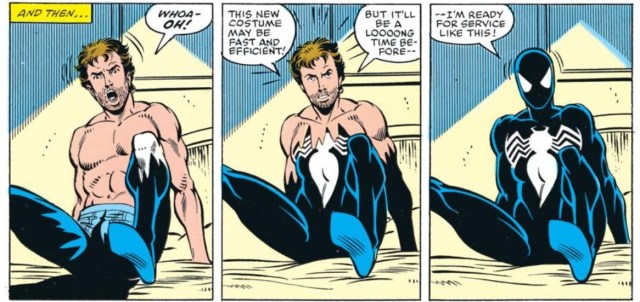
Venom is a character from the Marvel Universe, originally seen in Spider-man #252 (May 1984) as a living costume (honest!) then becoming a symbiote which took over Spidey (remember the black spider-man outfit?). So, if you’ll pardon the arachnid pun, this movie is a spin-off.

vlcsnap-00090.jpg
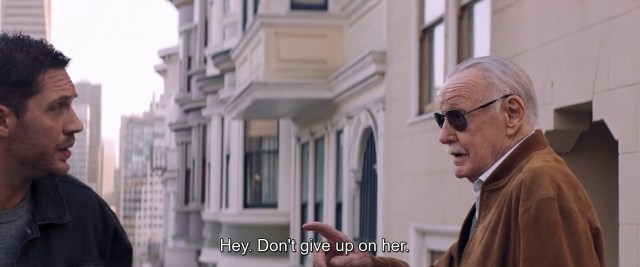
The genius behind Marvel – Stan Lee – in the last cameo released before his death

Amazing-Spiderman-252-Venom-Brooklyn-Comic-Shop-1.jpg

OK, so I’ll try to keep this short, because you’re reading this on the web (sorry, I just can’t help myself).

ASM-252-04.jpg

There’s a billionaire (Riz Ahmed from Nightcrawler) who wants to send us into space (not naming names, but there are about three such billionaires in the news at the moment). He sees the future of the species as more important than the lives of the marginalised people on whom he tests his drugs, and whom he “merges” with his aliens.

vlcsnap-00014.jpg

vlcsnap-00016.jpg

He has (had) a spaceship, which picked up some symbiotic forms from a meteor; one of those aliens caused the ship to crash on re-entry to earth.

We get the definite impression these things are not too human-friendly, as one of them kills the crew of an ambulance, in a scene that is highly reminiscent of Hannibal’s escape in Silence of the Lambs.

vlcsnap-00001.jpg

vlcsnap-00002.jpg
That’s Hannibal Lecter of course, wearing an Officer Pembry mask

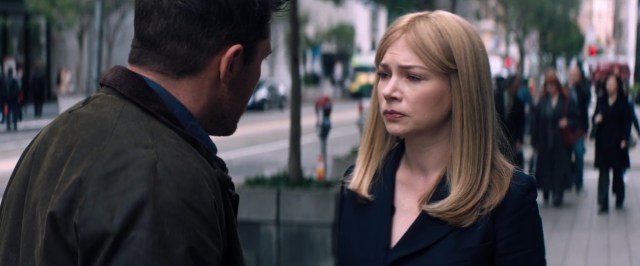
The main character is Eddie Brock (Tom Hardy, an extremely versatile English actor who was playing a Russian in a recent movie review, and is here playing an American). Eddie is an investigative journalist, which apparently requires a lot of chutzpah and some very fast motorcycle stunts. His fiancée is a lawyer named Anne Weying (Michelle Williams from lots of great movies, including Brokeback Mountain). Anne is working for a law firm that is defending the billionaire, but Eddy knows the password on her computer and finds out stuff he isn’t supposed to know about wrongful deaths caused by the company (didn’t we see that plot point on Billions?)

Anyway, he asks the billionaire difficult questions and he and Anne both get fired, because he clearly got the scoop from her. She breaks off the engagement, Eddie ends up down and out, and helpless – he can’t even defend his local convenience store manager from a dude with a gun who comes in for “protection” money on a regular basis.

vlcsnap-00010.jpg

But hey, there are symbiotes out there, looking for some human interaction, and they have teeth that would make the dental association wet themselves. The one that winds up inside Eddie is named Venom, one of the ones from the billionaire’s lab, and he has been through several hosts, most of which have died because they are not compatible. Then there’s the other one that killed the ambulance crew, and has since killed a lot more people, and he is mad, bad and dangerous to host.vlcsnap-00038.jpg

Eddie being a nice guy leads to Venom becoming nice (ish) too and agreeing to oppose the plot to bring the other symbiotes to earth, where they intend to feast on humans – they’ve figured out there are plenty of us to go around.

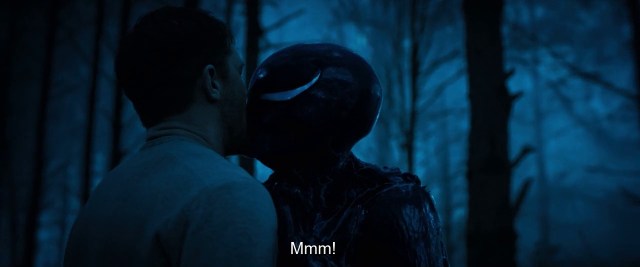
Venom takes over a cute doggie and then moves into Anne, who comes to save Eddie from the bad guys, leading to an awkward kiss between him and the symbiotic version of Anne, now in slinky black alien shape.

vlcsnap-00085.jpg

Of course, to save Eddie, Anne has to take some fairly drastic action, in her Venom persona.

vlcsnap-00086.jpg

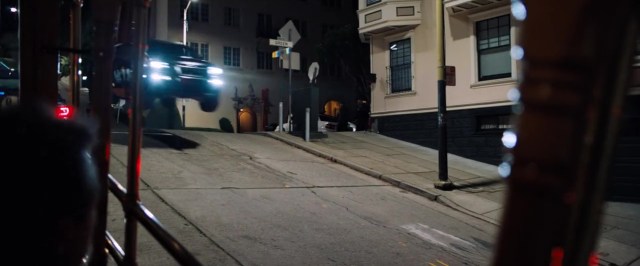
There are some great action sequences involving bikes and drones and cars (leaping off the ground in standard San Fran car chase mode) and a pretty awesome battle between Venom and the nasty alien.

vlcsnap-00037.jpg

Everyone thinks  the aliens have gone, but in fact Venom is still inside Eddie and they are now true sybiotes: two beings in one body. He can turn back into Venom when required, and Venom is almost always hungry, and he doesn’t like dead meat.

vlcsnap-00025.jpg

So we come to the point of having this movie in a cannibalism blog. They come to an understanding: they won’t eat any nice humans, but very, very bad ones – that’s fine.

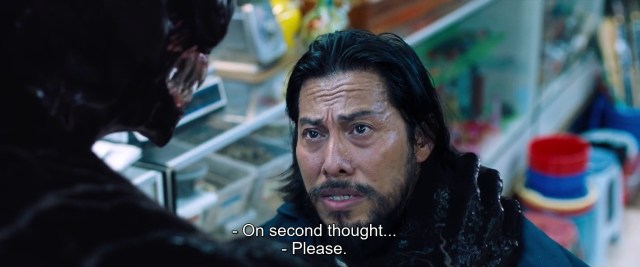
A succinct statement of the ethics of cannibalism. Hannibal would have amended it to “rude people”, but philosophers get to make their own ethical maxims. And so it is that he, or they, eat the rude, violent dude in the convenience store.

vlcsnap-00111vlcsnap-00108

Look, it’s not a great movie, and the critics were quite rude, with a pretty ordinary score of 28% on Rotten Tomatoes. The movie-going public felt differently, and the box office so far is over $850 million, which is an almost mind-boggling figure, even for a movie in which the hero bites off people’s heads. I guess people love to see (other) humans being eaten. Is this a cannibal movie? Well, half the main character is human, so I guess it’s half a cannibal film.

So what’s next for a nice guy who occasionally becomes an alien cannibal and eats rude people? Hannibal would approve of Venom’s answer:

“The way I see it, we can do whatever we want”.

vlcsnap-00039.jpg

vlcsnap-00107.jpg

IF YOU LIKE MY BLOG, PLEASE FEEL FREE TO RECOMMEND IT (WITH DISCRETION) TO FRIENDS ON SOCIAL MEDIA.
IF YOU HAVE ANY QUESTIONS OR COMMENTS, YOU CAN USE THE TAG, OR EMAIL ME  ON CANNIBALSTUDIES@GMAIL.COM.

Cannibal hunter: “CHILD 44” (Espinosa, 2015)

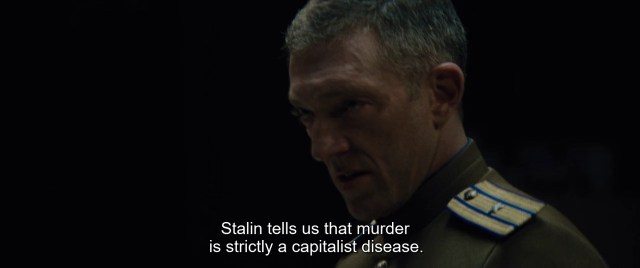
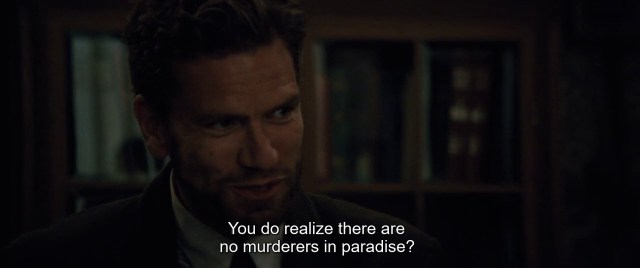
Most cannibal movies are about the cannibal, but Child 44 is almost entirely about the cannibal-hunter. He is a member of Stalin’s secret police, the MGB, the predecessor of the KGB, and the movie is set in the last days of the Stalinist terror. The perp is torturing and killing children and surgically removing their organs, so our hero wants to, like, stop him. There is an administrative problem though: in the Socialist Paradise of the USSR, there is no such thing as murder; it is a capitalist crime. So the first case is put down as a train accident. Then there are 43 more – thus the title.

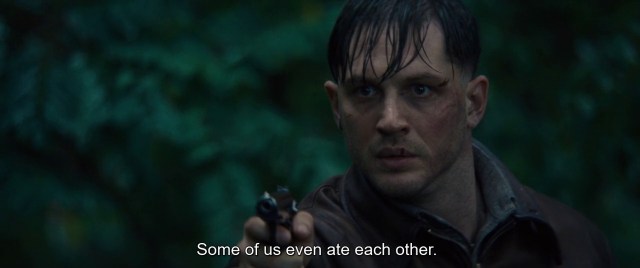
vlcsnap-2018-11-30-12h07m44s774.jpg

The film is based on the bestselling book by Tom Rob Smith, the first of a trilogy featuring former MGB Agent Leo Demidov. In the film, Leo is played by the English actor Tom Hardy, with a convincing mix of power and vulnerability that carries an otherwise rather overlong production. Leo is a war hero who planted the red flag on the Reichstag after the conquest of Berlin, and is now a senior investigator.

vlcsnap-2018-11-30-16h36m36s863.jpg

One of his friends from the Berlin days, Alexei (Fares Fares), also a MGB officer, finds that his little boy has been brutally murdered, but Leo has to persuade him to accept the official explanation that he was hit by a train.

vlcsnap-2018-11-30-18h29m20s092.jpg

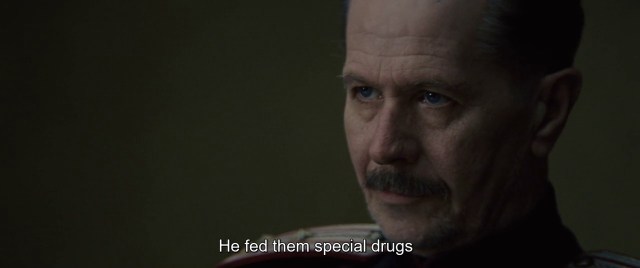
The antagonist (not the killer, we barely see more than his legs or arms until half way through the film) is another veteran of Berlin named Vasili (Joel Kinnaman, who played the clean-cut Republican candidate running against Frank Underwood in House of Cards). He is a coward, liar, etc and manages to derail Leo’s career by accusing Leo’s wife, Raisa (Noomi Rapace from The Girl with the Dragon Tattoo) of being a spy. Stripped of his rank for refusing to denounce his (maybe) pregnant wife, Leo must start his investigation as a mere militiaman in a remote town. He is under the command of a General played by the brilliant Gary Oldman, who has portrayed everyone from Dracula to Beethoven, Sirius Black to George Smiley, Winston Churchill to Mason Verger (in Hannibal the movie).

vlcsnap-2018-11-30-18h26m01s802.jpg

The General has two boys and is not pleased when another dead boy, with organs surgically removed, is found nearby. He arrests the man who found the body, not because he thinks he is the killer but because he is gay, and he assumes that a gay man must be responsible (also because homosexuality was a crime in the Soviet Union). But rounding up all the gay men in town doesn’t stop the killings. The killer is seen picking up a boy in a station, later making sweets (where would archetypal paedophiles be without bags of sweets) and still later abusing himself for being weak and prone to remorse.

vlcsnap-2018-11-30-18h15m16s015.jpg

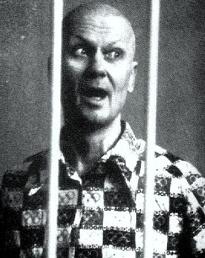
The film, as I said, is based on a book, which is based on the true story of Andrei Chikatilo, the “Rostov Ripper”, who was eventually convicted of 52 murders, although he confessed to more. Chikatilo was able to continue his killing spree from 1978 to 1995, due to a combination of general ineptitude, official denial of the concept of a Soviet serial killer, and luck (apparently his semen had a different grouping to his blood). He claimed that he had been told by his mother that his older brother had been kidnapped and cannibalised by starving neighbours when he was little. This may have been her way of trying to scare him into behaving, but he was born in Ukraine at the time of the Holodomor, when Stalin was busy starving millions of people to death as part of the process of Collectivisation, so could well have been true.  Chikatilo was a self-confessed cannibal, stating that he gained sexual satisfaction from torturing his victims, and would sometimes drink their blood and eat their nipples and tongues. The real Chikatilo was far more depraved than depicted in this movie. There is a list of his crimes at the criminal minds website.

Andrei_Romanovich_Chikatilo_Trial_1992.jpg
Andrei Chikatilo

This film has a lot going for it, particularly a first-rate cast, some good action scenes, and a lot of sets which capture the oppressive darkness of Stalinist Russia. But it has a lot of problems too. It’s over two hours and gets a bit tedious in parts, and the decision to have a bunch of English, Swedish, Lebanese, Polish and even Australian actors speak in English with heavy Russian accents to make it seem “authentic” was widely derided by critics. The Guardian critic called the film “an Iron Curtain version of ‘Allo ‘Allo”.

With a Rotten Tomato rating of only 26%, the film bombed at the box office, grossing just $13 million against its $50 million budget. It was banned in Russia, with the Minister of Culture accusing the film of making the Soviet Union look like Mordor. Outrageous of course. Stalin was far worse than Sauron.

And perhaps the worst thing? Just as the Soviets would not admit that there was a serial killer in their paradise, this film does not approach the fact that he was also a cannibal (although it refers briefly to the widespread cannibalism of the Ukrainian famine). It asks some important questions about social ethics and who is actually responsible for people like Chikatilo, the individual or the state and its terrorist organisations. But without people getting eaten, it’s just another very long murder mystery.vlcsnap-2018-11-30-18h59m44s130.jpg

IF YOU LIKE MY BLOG, PLEASE FEEL FREE TO RECOMMEND IT (WITH DISCRETION) TO FRIENDS ON SOCIAL MEDIA.
IF YOU HAVE ANY QUESTIONS OR COMMENTS, YOU CAN USE THE TAG, OR EMAIL ME  ON CANNIBALSTUDIES@GMAIL.COM.

Creepy old cannibal dude – THE GRAY MAN (Flynn, 2007)

The movie starts at St. John’s Orphanage in Washington in 1882. A young Albert Fish and other children are being beaten, to drive out their sins.

01 orhanage beatings.JPG

Fast forward to Albert Fish (Patrick Bauchau) as an adult. He remembers, in a voiceover, a horse that some older boys at the orphanage set on fire; how the horse galloped off, trying to get away from the fire, but of course taking the fire with him. Fish compares himself to that horse.

“The fire chases you, and catches you, and then it’s in your blood. After that, it’s the fire that has control, not the man.
Blame the fire of passion for what Albert H. Fish has done.”

Scott Flynn’s debut film is not just a very well made and pretty creepy thriller / horror movie, it is an accurate retelling of the story of Albert H. Fish, who killed several children in the 1920s, and ate parts of their bodies.

03 grandaughter - I'm no good with little ones
Albert Fish (Patrick Bauchau) with his grand-daughter. He hands her back to his daughter saying “I’m no good with little ones”. Truer words were never spoken.

Fish never got over the beatings at the orphanage, and is seen in the film whipping himself with a belt, interspersed with images of himself in the orphanage, watched by a pale boy – his younger self. That’s not the least of it: an X-ray found dozens of needles he had inserted into his groin for further punishment. In a sense, he punished himself in advance for sins he felt he was driven to commit.

02 self flag.JPG

The film is structured around a film noir-style narration by Detective Will King (Jack Conley), of the NY Missing Persons Bureau.

Fish kills a boy scout, who is found by the other scouts hanging from a tree, his calf removed.

04 Scouts find Francis.JPG

Then comes the famous case: Fish sees a newspaper ad from a young man, Edward Budd (Eric Parker), who is looking for work, but when he visits the Budd family home, he is smitten by young Grace (Lexi Ainsworth), Edward’s ten year old sister, whom he stares at throughout the interview. No one seems to find this creepy, and when Fish comes back to pick up Edward and his friend, he suggests that Grace accompany him to his niece’s birthday party at Columbus and 135th – when he returns her, he says, he’ll pick up the boys. The mother (Jillian Armenante) has qualms, as well she might, but the father urges her to let Grace go. So, they have lunch. The father says “Let’s eat – I’m starved.” Fish replies: “Me too.” But it’s not for what the Budd’s are putting on their table.

05 smitten with Grace.JPG

Of course, there is no party, no niece, no such street as 135th Street, and no return for Grace. When they get off the train, Grace dives back into the carriage to retrieve a package Fish has forgotten. She thinks it’s a present for the niece; it’s actually a bone saw that he bought earlier. Grace is picking flowers when Fish calls her into the creepy old house, purportedly to hide for the surprise party; the door slams shut. Fade to next scene. Fish is eating raw meat.

06 so pleased to see you grace.JPG

Detective King searches for Grace Budd for six years, despite the department closing the case and the public forgetting about young Grace. Fish hasn’t forgotten though, and when he finds a stationery package in his room while chasing a cockroach, he writes to Grace’s mother, a break which finally allows Will to track down and arrest Fish. In the letter, Fish describes the crime in graphic detail, but modestly added that Grace had died a virgin – I guess he thought Mrs Budd would find that comforting. The movie gradually has Fish read the parts of the letter regarding the killing, chopping up and eating of Grace, although it omits the earlier section which told of his friend who returned from China in 1894, where:

“all children under 12 were sold to the Butchers to be cut up and sold for food… A boy or girls behind which is the sweetest part of the body and sold as veal cutlet brought the highest price”

The letter is quoted in full, with its dodgy grammar, in Wikipedia.

Fish said that this story had given him the idea:

“He told me so often how good human flesh was I made up my mind to taste it.”

In the trial, a psychiatrist with a suitably Germanic accent testifies that Fish told him that:

“What I did must have been right, or an angel would have stopped me, just as the angel stopped Abraham in the Bible.”

Genesis 22 has a lot to answer for.

Fish is found guilty, despite the psychiatrist’s evidence of his insanity, and put to death in the electric chair. The pale boy follows him down the corridor to the execution room.

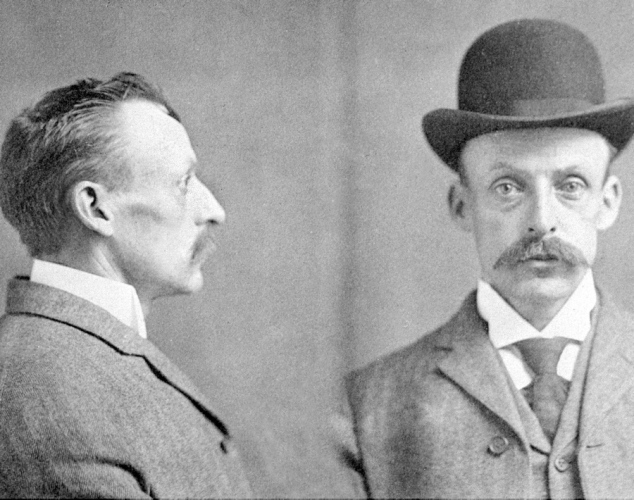
99 Albert_Fish_1903.JPG
The real Albert Fish
150px-Grace_budd.gif
The real Grace Budd

The true number of Fish’s victims will never be known. He claimed to have “had children in every state” but whether he was referring to rape, murder or cannibalism, or just bragging, cannot be established. Fish was finally caught because he killed and ate Grace Budd, a white girl: he admitted that he mostly chose children who were mentally handicapped or African-American as his victims, explaining that he assumed the police would not look too hard for them. The fact that it took six years to catch him, and that this film does not even mention them, would seem to prove him right.

DVD.jpg

The DVD cover shows Albert and Grace heading for the deserted house where she will be killed and eaten. The tag line is interesting: “a real life Hannibal Lecter”. Pretty sure Hannibal would eat alive anyone who compared him to Albert Fish.

The full movie is not easy to find. There is a copy on Youtube when I last checked, with subtitles in Spanish.

IF YOU LIKE MY BLOG, PLEASE FEEL FREE TO RECOMMEND IT (WITH DISCRETION) TO FRIENDS ON SOCIAL MEDIA.
IF YOU HAVE ANY QUESTIONS OR COMMENTS, YOU CAN USE THE TAG, OR EMAIL ME  ON CANNIBALSTUDIES@GMAIL.COM.

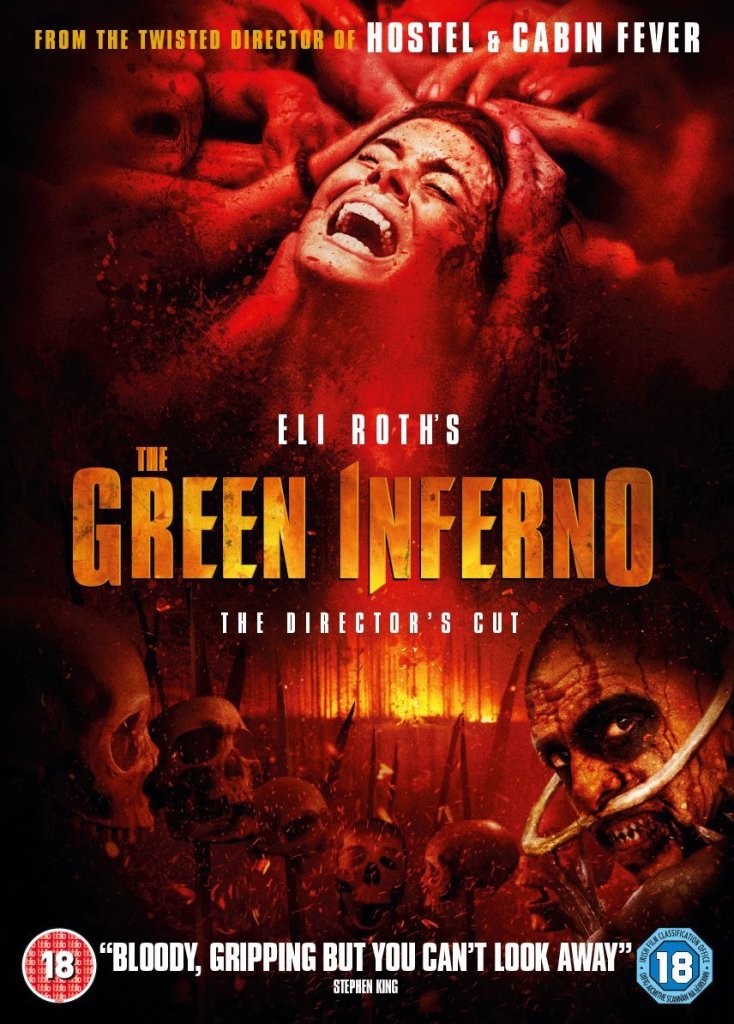
Not easy being green (or lunch): THE GREEN INFERNO (Roth, 2013)

Green Inferno (Eli Roth) is a homage to Italian cannibal films of the late 1970s and early ’80s “cannibal boom”, particularly Cannibal Holocaust (1980), which featured a film-within-a-film called, you guessed it, The Green Inferno. The film follows a group of activists who are forced to fight for survival when they are captured by a cannibal tribe. This is a standard trope of the Italian cannibal films, although Roth tries to inject a few twists to bring it up to the 21st century (they are trying to save the tribe).

dvd the-green-inferno.jpg

The film was made in 2013 but only released on September 25, 2015.

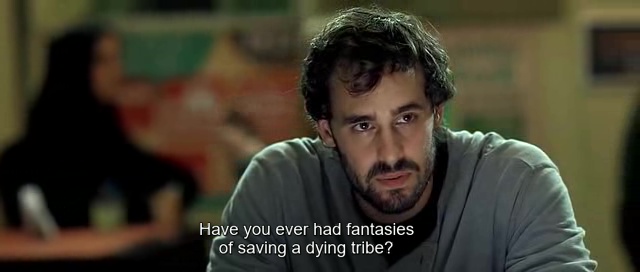
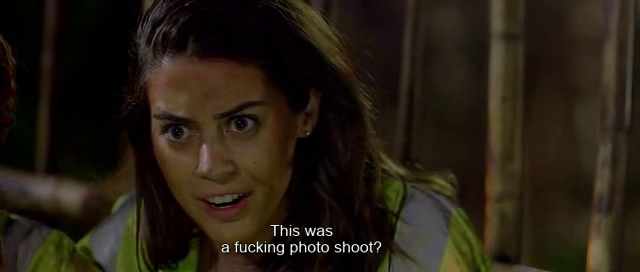
The protagonist is Justine (Chilean actress Lorenza Izzo, at that time soon to be, and since then divorced, wife of Eli Roth). She plays a college freshman, who is a rebel without a cause. As the film opens, she is involved in a hunger strike to win health insurance for campus janitors. She escalates to outrage over female genital mutilation when she attends a lecture on the practice, and rushes off to lobby her father, who is a UN lawyer.

vlcsnap-2018-10-09-17h22m47s079.jpg

The trouble starts when Jonah (Aaron Burns) invites her to a meeting of an activist group led by Alejandro (Ariel Levy). The group plans a trip to the Amazon rainforest to stop a big corporation from illegally logging the forest and exterminating the ancient native tribes who live there; their goal is to film the logging crews with cell phones and stream footage, to raise public awareness.

vlcsnap-2018-10-09-17h30m07s473.jpg

The operation is funded by a drug dealer named Carlos, who flies them into Peru in a small plane. They arrive in the Amazon and head to a logging site where they begin their protest, chaining themselves to bulldozers while filming the loggers cutting down trees. A private militia arrives, and the protest receives viral attention on the internet when Justine is nearly shot by one of the militia officers. The group is arrested, but Carlos pays the police to let them go.

vlcsnap-2018-10-17-10h00m04s950.jpg

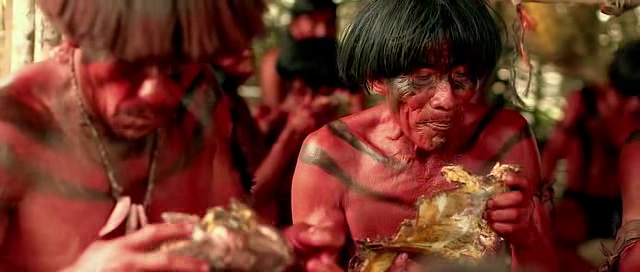
In a scene reminiscent of Alive!, the plane crashes into the forest; OK, they are bouncing through trees instead of snow, but like Alive! wings are falling off, people are falling out of the back of the plane, etc. The survivors search for a GPS phone to call for help, but then the cannibals arrive, painted blood red. The group are shot with tranquiliser darts and taken to a small village where they are imprisoned in a bamboo cage.

the_green_inferno.jpg

The female elder of the cannibal tribe dismembers and decapitates Jonah, in graphic detail, starting with his eyeballs and tongue.

download.jpg

Tongues traditionally get a beating in cannibal movies, maybe because they represent the human ability to communicate with language, and so are ideal targets for those whose prime directive is not the survival of civilisation. Man From Deep River had a similar scene. Hannibal serves tongue to his friends in episode six of the first season of the television series, and Cordell promises to do the same to Hannibal in Season 3 episode seven:

I’ll boil it, slice it very thin, marinate it in olive oil, garlic, parsley and vinegar.

And of course, Clarice is warned about the time Hannibal ate a nurse’s tongue in Silence of the Lambs.

Here’s the twist: Alejandro had cynically staged the protest to benefit a rival company, and the eventual deforestation of the area is inevitable. If they can survive until the next lot of bulldozers arrive they might be saved – and because they cooked Jonah first, the village may not need to eat any more of them for a while (he’s a big lad).

vlcsnap-2018-10-26-23h21m20s086.png

vlcsnap-2018-10-26-23h22m17s731.png

OK, no more spoilers – if you like gratuitous gore, go watch the movie. Suffice it to say that female genital mutilation manages to get back into the plot, and people get eaten – one alive, another by ants. Not sure which is worse.

Green Inferno was filmed on location in Chile, the Peruvian Amazon and New York City.

vlcsnap-2018-10-26-23h17m55s292.png

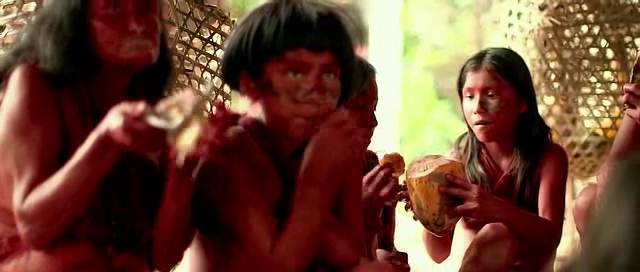
But to make it feel really authentic, Roth decided to cast the Callanayacu tribe from Peru as the main “stars”. Nearly every person (except the Americans) in the movie is an actual member of the tribe that Roth discovered in the Amazon. A remote, self-sustaining farming (definitely not cannibal) community with no electricity or running water, the Callanayacu had little contact with the outside world beyond the occasional supply boat.

vlcsnap-2018-10-26-23h17m51s710.png

While Roth had found the perfect cast, he soon found that most of the tribe had no concept of what a movie was, and had never seen one. So Roth brought a generator and a TV and made them watch the 1980 grindhouse film, Cannibal Holocaust.

“We had to explain to them conceptually what a movie was, and showed them Cannibal Holocaust — and they thought it was the funniest thing that they had ever seen” Roth said in an interview.

Roth says the decision to film in the Peruvian jungle paid off.

“The footage looks so spectacular. It’s something you couldn’t get anywhere else in the world. We went farther than any cameras had ever gone before. They call the river gorge ‘Pongo de Aguirre’ because Werner Herzog’s Aguirre, The Wrath of God was the last film to shoot there. But we went deeper, to a point where there was nothing but river and jungle. It was an incredible experience.”

Roth’s movies are all tributes to the great horror classics. Green Inferno does not try to say much new – it puts a bunch of (mostly) white people in a jungle full of primitive irrational cannibals, out of their depth, and makes them face their worst fears – the key trope of cannibal films. Probably the majority of cannibal movies do that, including Road to Zanzibar. The twist here is that the cannibals are not the bad guys – they are doing what Roth imagines primitive people did all the time (he is certainly wrong there).

vlcsnap-2018-10-26-23h16m26s877.png

The people he is condemning are of course the venal corporations, but also the sanctimonious “social justice warriors” as he calls them:

“the film is really about people getting caught up in causes they don’t know anything about and doing it for vanity reasons more than for the cause itself.”

But Roth is not doing much for the locals either, showing them as brutal and merciless killers, and Survivor International said the group was “disturbed” by the depiction of the tribe, explaining, “These stories have created a racist view of uncontacted and isolated groups.” Amazon Watch and AIDESEP voiced similar concerns.

inferno2.jpg

The film took a hammering by the critics. Variety said:

“A project that boasts all the appeal (and aroma) of a carcass rotting in the rainforest.”

Rotten Tomatoes critics gave it a measly 36%, with the audience rating below even that.

Stephen King, on the other hand, who knows a bit about horror, tweeted that the film is:

“like a glorious throwback to the drive-in movies of my youth: bloody, gripping, hard to watch, but you can’t look away.”


Incidentally, this is not the only Green Inferno movie. As well as the film within a film in Cannibal Holocaust, the cannibal film genre was supposed to have died with Antonio Climati’s 1988 film  Natura Contro (English: Against Nature), also known in English as The Green Inferno and Cannibal Holocaust II.

Cannibal_Holocaust_2_DVD.jpg

Climati had no intention of making a sequel to Deodato’s Cannibal Holocaust, and the title was used by distributors of the film to cash in on the success and notoriety of the earlier film. In 2002, British distributor VIPCO released Natura Contro on VHS and DVD as Cannibal Holocaust II, the film’s best known name. Not much cannibalism in it though.

Next week: more Hannibal episodes!


IF YOU LIKE MY BLOG, PLEASE FEEL FREE TO RECOMMEND IT (WITH DISCRETION) TO FRIENDS ON SOCIAL MEDIA.
IF YOU HAVE ANY QUESTIONS OR COMMENTS, YOU CAN USE THE TAG, OR EMAIL ME  ON CANNIBALSTUDIES@GMAIL.COM.


From the sublime to the ridiculous: LOVE BOAT Season 3 episode 13 (Duchowny & Rafkin, 1979)

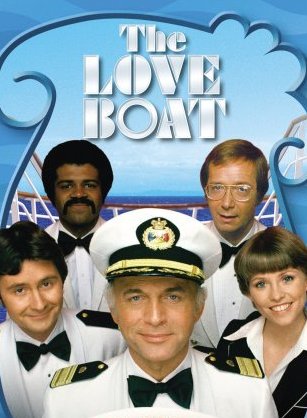
Crew.jpg

Tom Paine said it is only a small step from the sublime to the ridiculous, so it seems fitting to move from last week’s blog, HANNIBAL, one of the most concise studies of the cannibal psychosis of postmodern society, to a glimpse of the bourgeoisie at play, or at least their aspirations of what that might look like. I refer, of course, to LOVE BOAT, a series that ran for an absurdly long nine years and 250 episodes. Aaron Spelling was the producer – he also made Charlie’s Angels, Dynasty, Beverley Hills 90210, Charmed and a string of other shows, which always seemed to capture the zeitgeist of the time.

Aaron_Spelling_TWA_ad_photo.JPG

Why are we watching Love Boat you ask (or wail, while pathetically covering your ears)? Well, there is an interesting cannibal reference in episode 13 of season 3, which went to air on November 24, 1979. The episode has the catchy title of “Not Now, I’m Dying / Eleanor’s Return / Too Young to Love” – there were always a few threads going on at the same time.

Warning: the following theme song is a mind worm and will be running through your head relentlessly during your worst hangovers.

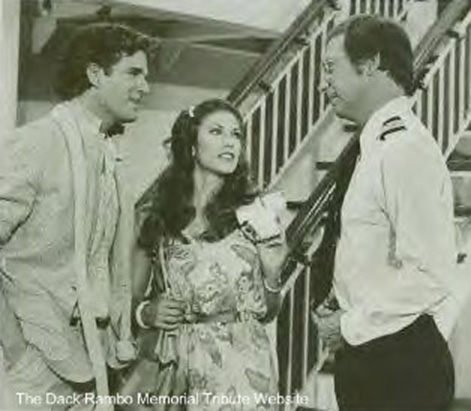
Anyway, getting to the point. One of the main characters on the ship is the Doc (Dr Adam Bricker) played by Bernie Kopell, who also played the KAOS agent Siegfried in Get Smart. On this particular cruise, Lucy, a friend of Doc’s (Barbi Benton), comes on board with her boyfriend Peter (Dack Rambo). She wants a romantic conclusion, a proposal, but Peter keeps on making excuses.

DR05c.jpg

Eventually, Peter “admits” to having a terminal illness, saying he has Kuru, a disease he spotted on the front of a magazine. Doc calls his bluff, pointing out that Kuru is only contracted by “eating people”. But then Peter drops a pen, can’t hold a book, and Doc realises that he really does have a disease – ALS (Lou Gehrig’s Disease). A sad irony in that Dack Rambo was to die of complications from AIDS only five years after this episode went to air. Barbi Benton, who started off as a Playboy model, is still going strong, as is Bernie Kopell at the time of writing.

dackloveboatpic.jpg

This is interesting not so much for the longevity of the stars but the mention of Kuru. This is a prion disease, a rare, incurable neurodegenerative disorder that was found in the Fore people of Papua New Guinea. Kuru is a form of transmissible spongiform encephalopathy, related to the “mad cow” disease that cured people from eating beef for many years and is still tested for when you go to donate blood.

Kuru was first suspected to be related to funerary cannibalism (eating your relatives rather than burying them, to return their life force to the village) after extensive studies by the Australian anthropologist Shirley Lindenbaum starting in 1961. Kuru was found to be eight to nine times more prevalent in women and children than in men. Fore men reported that they considered that consuming human flesh would weaken them in times of conflict or battle, while the women and children were allowed to eat the bodies of the deceased, including the brain, where the prion particles were particularly concentrated. Daniel Carleton Gajdusek, a virologist, was later awarded a Nobel prize for mapping the transmission of the disease to chimpanzees by transferring into them parts of the brain of an 11-year-old Fore girl who had died of Kuru.

FavorableGregariousCowbird-size_restricted
From a 2010 documentary of Kuru

Kuru is rare and hard to catch (even the Fore people have a high rate of immunity to the disease). It is, however, very popular among people who write about cannibalism on social media, as they think it proves that human cannibalism is a ‘bad thing’ because it can make you ill (although they don’t mention the bovine version, in case that ruins their dinner). The Nobel prize was the cherry on top of the brain tissue theory of cannibalism.

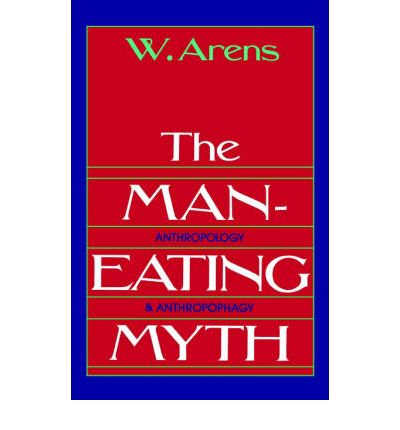
In 1979, the same year this episode of Love Boat was aired, an American anthropologist, William Arens of Stony Brook University, New York, published his book The Man-Eating Myth, in which he challenged the automatic assumption of cannibalism among those dubbed “savages” by the colonial powers of the West. In fact, Arens caused a major uproar in anthropological circles by saying he could find no adequate documentation of cannibalism as custom in any form for any society – it may have happened, but not as a socially sanctioned system. He was more interested in why people are so fascinated by the depiction or suspicion of it (and so am I, hence this blog). As for the Fore, Arens said “the evidence is circumstantial, since Fore cannibalism has never been observed by an outsider”.

Arens.jpg

So, did the Fore get Kuru by eating their dead? We’ll never know for sure, but we can be confident, with Doc, that Peter didn’t.

NEXT WEEK: HANNIBAL Season 1 Episode 2

If you like my blog, please feel free to recommend it (with discretion) to friends on social media.
If you have any questions or comments, you can use the tag, or email me on cannibalstudies@gmail.com.