Autocannibalism – you Reddit here first

This is not a movie review – they come out on Sundays.

So this is from Reddit, which is a social news aggregation, web content rating and discussion website. People post under pseudonyms, and then win points for how many people like the post. This means that stuff sometimes is, let us say, exaggerated. Reddit has over 200 million users. Which still doesn’t mean the stories are true.

However, nothing is guaranteed true in this world, not even promises to denuclearise, which you might think everyone would want to happen. Therefore: I’m giving this story the benefit of the doubt, and if it isn’t true, the dude went to a lot of trouble, so he deserves an up vote just for all the hard work.

Come on. If this was on a cooking blog, you wouldn’t even blink.

This guy, who calls himself Incrediblyshinyshart, served his friends tacos, made from his own amputated leg. He reported to Vice that he was involved in an accident a couple of years ago – a car hit his bike, and his foot was shattered to the point that he would never walk on it again. When the doctor asked if he wanted to amputate, his one question was, “Can I keep it?”

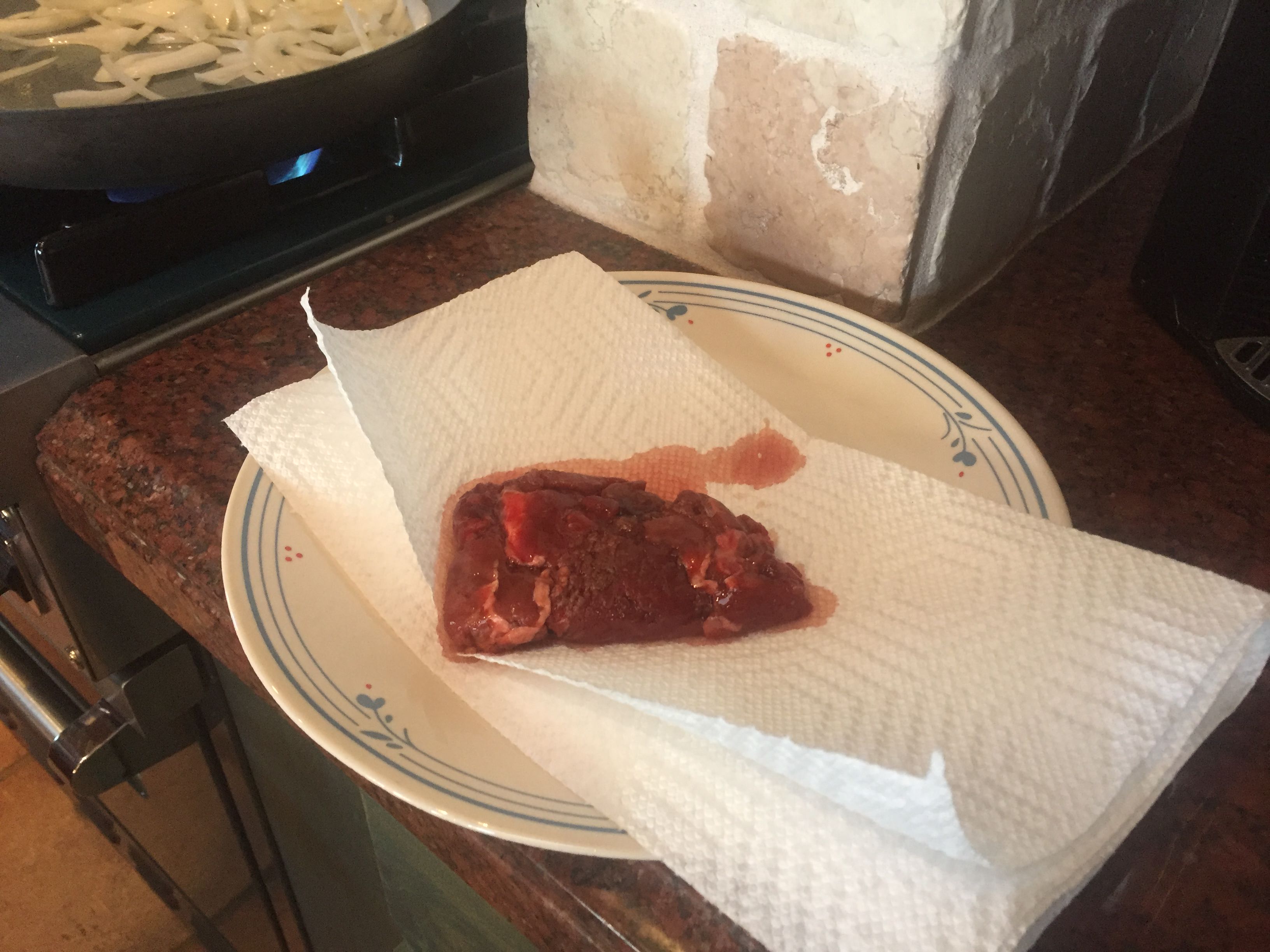
To make a long leg story short, he invited ten of his most closest friends to a special brunch. They ate apple strudel, they drank gin lemonade punches and mimosas. And then he served fajita tacos made from Shiny’s severed human limb.

The foot was not going to be fixed.

The full process is described in the June 12 on-line edition of Vice, and I don’t intend to repeat it all here. There were a number of pictures, some quite grizzly, which were not included in the article, but they did conveniently put in a link if you really want to go there. I don’t recommend it, but then I also avoid the meat section at the supermarket.

The article emphasised that what he did was in no sense illegal. Cannibalism can often be linked to murder (thank you Dr Lecter) or at least interference with a corpse, both of which are legally frowned upon. But this was his own body part, and did not involve a corpse – he is very much alive and kicking. [Sorry – Reddit is full of much worse puns]. The Legal Information Institute at Cornell makes it clear that, in the USA, there are no laws against cannibalism per se.

Why am I not surprised at the t-shirt caption?

The bit I was most interested in was: what did he taste like? His answer is quite comprehensive:

“People think it tastes like pork because in movies we hear it called “long pig.” But that term originated in places like Papua New Guinea, where they eat wild boar. They’re not eating our big, fat, domesticated pigs that have white meat. Boars don’t have white meat. They just don’t…. I think it’s more akin to that. This particular cut was super beefy. It had a very pronounced, beefy flavor to it. The muscle I cut was tough and chewy. It tasted good, but the experience wasn’t the best.”

The Reddit entry by Shiny is here.

Enjoy.

The cannibal in the will: (Ingrid Newkirk, PETA)

There seem to be less heroes lately. If you watch the news, the heroes – the paramedics, the nurses, the teachers, the activists – those who choose to do good things because it’s the right thing to do – are usually unrecognised. The ones in the spotlight, the ones being treated as heroes, are the rich and famous, even the ones whose only claim to fame is being famous. The news cycle concentrates not on virtue but on suffering, and on vanity, fear, guilt and greed: the tools of the marketers.

I present for your consideration a hero of mine: Ingrid Newkirk, who founded People for the Ethical Treatment of Animals (PETA) almost forty years ago, and has steered it into becoming the largest and most active animal advocacy organisation in the world, with more than 6.5 million members and supporters.

The PETA mantra is:

Animals are not ours to eat, wear, experiment on, use for entertainment, or abuse in any other way.

How does this relate to a cannibal studies blog?

Well, Ingrid Newkirk has put a number of requests in her will, one of which is:

That the “meat” of my body, or a portion thereof, be used for a human barbecue, to remind the world that the meat of a corpse is all flesh, regardless of whether it comes from a human being or another animal

Ingrid tells the press: I want it fried up with onions, because people find it hard to resist the smell of frying onions.  I can imagine them coming over and saying enthusiastically,  “Oooh, what’s that?’ and then, “OMG, it’s HER!” 

All abuse starts at the point where the proposed victim is objectified, turned from a living, breathing subject into a thing, an other, an “animal”, a piece of meat. To achieve this, we have all sorts of linguistic tricks which range from changing the names of victims (cows become “beef”, pigs become “pork”) to absurd suggestions that other animals are either mentally incapable or are automata that feel no pain. To make an animal brainless and painless, and therefore morally insignificant, is done through a nifty sleight of hand where non-humans are called “animals” and the Great Ape known as Homo sapiens somehow is not an considered an animal at all.  An example: reports from medical researchers will usually distinguish “animal” trials from “human” trials.
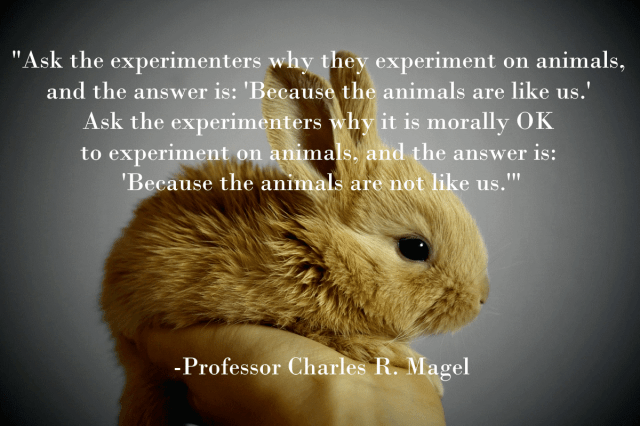
Animal testing - like us

Human cannibalism reminds us that we are animals, and that we are made of meat. It reminds us that, while we may be different to other animals (cognitively swifter than some, physically slower than others), we all suffer and die in the same ways. As Shakespeare said:

If you prick us, do we not bleed? If you tickle us, do we not laugh? If you poison us, do we not die?

One of the additional dangers of stripping moral worth from “animals” is that this can so easily be done to other humans who happen to be different colours, different genders, different faiths, different anything to us.

DSC_0886

We need to be reminded that we are not demi-gods, that when we eat or wear or laugh at or test on “animals” we are causing massive suffering to beings not essentially different from ourselves. Even if no one eats from Ingrid’s planned barbecue (which I hope will not be held for many decades to come) they will hear the message. And if this offer of a cannibal feast makes people question why they are willing to feast on other sentient beings, then one more hole will be made in the rotten edifice that holds up the death industries, the exploitative corporations whose existence future generations will rightly condemn.

The cannibal goes out and hunts, pursues and kills another man and proceeds to cook and eat him precisely as he would any other game. There is not a single argument nor a single fact that can be offered in favor of flesh eating that cannot be offered with equal strength, in favor of cannibalism.
             Dr. Herbert Shelton, Superior Nutrition

If you like my blog, please feel free to recommend it (with discretion) to friends on social media. If you have any questions or comments, you can use the tag or email me on cannibalstudies@gmail.com.

“Cannibalism is not a crime” – S.African expert

The trial is about to start of five men in KwaZulu Natal in relation to alleged cannibalism. In July 2017, a man appeared at Estcourt police station and claimed he was “tired of eating human flesh”. This led to his and the others’ arrests, after body parts were discovered in their possession.

When the men first appeared in court, police fired rubber bullets and stun grenades to break up crowds hurling insults at them.

The suspects were back in the dock at the Estcourt Magistrate’s Court, KwaZulu-Natal, last week, Estcourt News reports, but the trial was postponed as the state reported that the mental assessment of accused number one, Nino Mbatha, is incomplete. He was admitted into Fort Napier Hospital during the second week of March, after he was found mentally and emotionally unstable.

Image result for Accused number one, Nino Mbatha
Accused number one, Nino Mbatha is still undergoing a mental assessment.

The Ladysmith Gazette reported that hundreds of people in the Amangwe area confessed to cannibalism – being given human flesh to eat as traditional medicine. But former police profiler and forensic psychologist Professor Gérard Labuschagne says that cannibalism in South African was “a very rare thing”. “It’s not occurring frequently and is not associated with multi murder… Remember there is no crime for cannibalism like there is no crime for taking drugs. You are charged with dealing in drugs. And for cannibalism, you will be charged with the possession of human body parts,” he said. “If you cut the parts of a dead body you will also be charged with desecration of a corpse. So you have to be cautious, and, remember, police often arrest people and then withdraw the charges. We can’t assume all were eating the body parts.”

The case resumes on April 16.