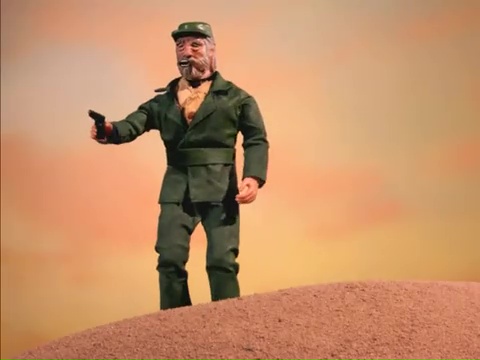
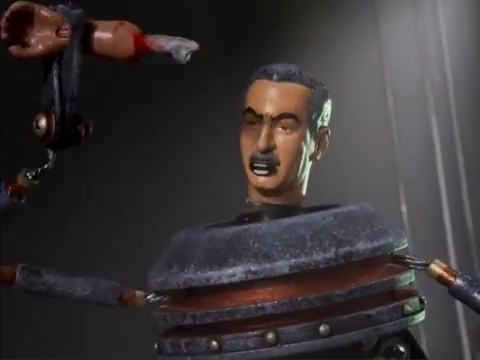
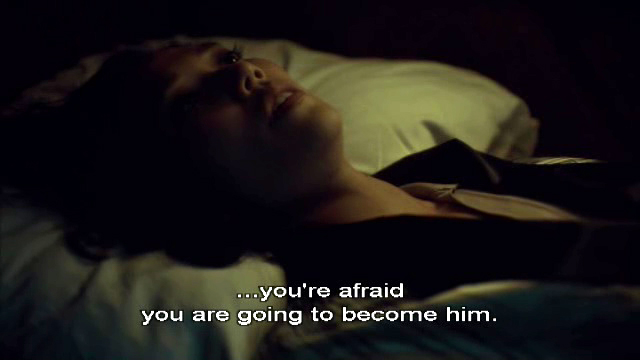
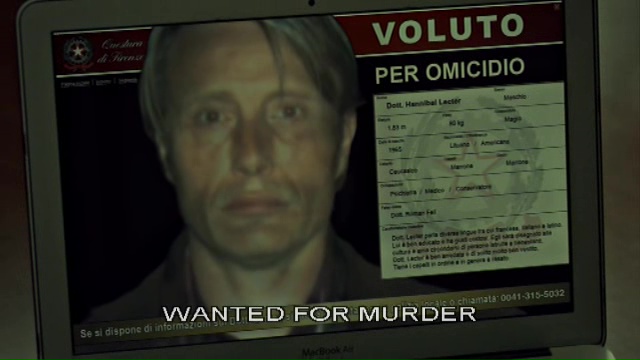
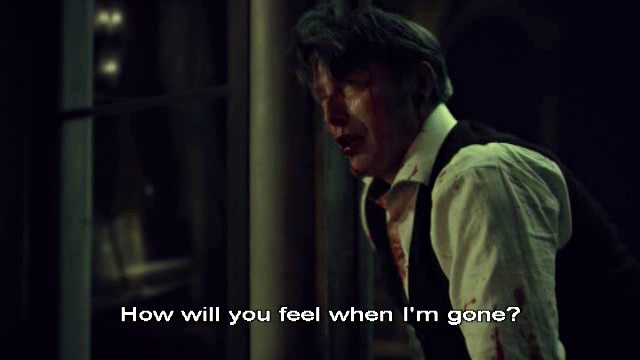
The last CANNIBAL on Earth — (“Last Man on Earth” Season 4, episodes 9-11, Will Forte)

https://www.youtube.com/watch?v=5HspqJ9ef5Q

The Last Man on Earth was a four-season American post-apocalyptic comedy series that showed on Fox from 2015-17. The protagonist (Will Forte, who also created the series) is Phil (or Tandy as everyone calls him – long story). Phil believes he is the only survivor of a mysterious virus (not coronavirus, but hard not to think about it while watching) that has killed off humanity and most other animals. He travels around the USA leaving signs on billboards asking other survivors to contact him in Tucson, but gradually goes crazy from loneliness.

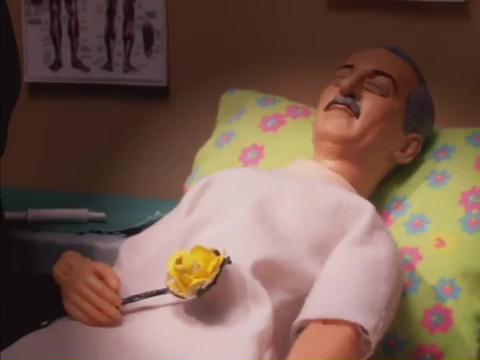
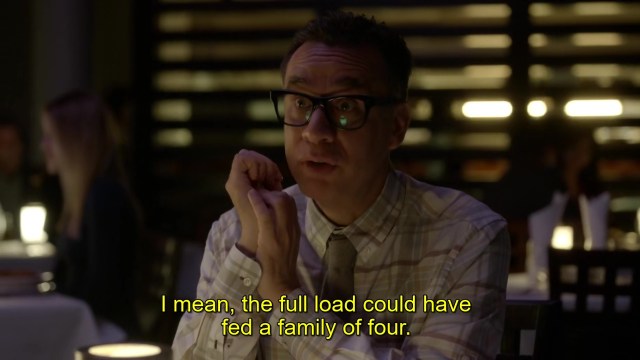
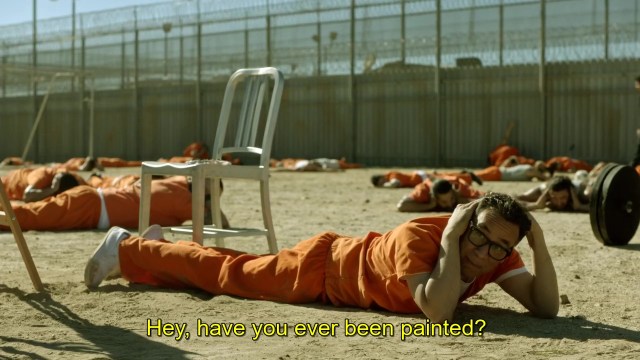
Then he starts meeting other humans. As it’s a comedy, they are (nearly) all nice, friendly, peaceable people, who bicker but generally don’t bite. Until season 4, when he meets Karl (Fred Armisen), a serial-killer cannibal. In a flashback to before the virus, Karl is being socially inept, disgusting his dinner date with recollections of a boil he had just had lanced.

vlcsnap-00005.jpg

vlcsnap-00008.jpg

The art of cannibalism stories is to disgust the viewer. Otherwise, where’s the conflict?

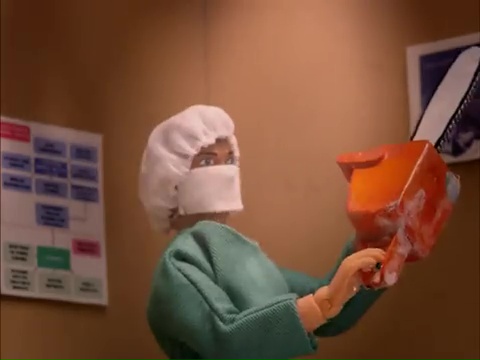
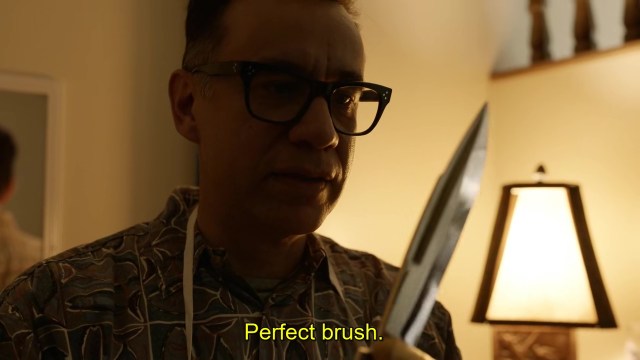
Karl’s modus operandi is to invite his prospective victim in for a sitting where he paints their portrait (a skill in which he is almost as deficient as his romantic conversation), then reach for his

vlcsnap-00024.jpg

When his model goes looking for a refreshing drink in the fridge, Karl has to run.

vlcsnap-00025.jpg

He flees to Mexico and sets up the same artistic practice, but is soon arrested and sent to a maximum-security prison, where he starts painting the other inmates, with designs to convert them into his next meal.

vlcsnap-00026.jpg

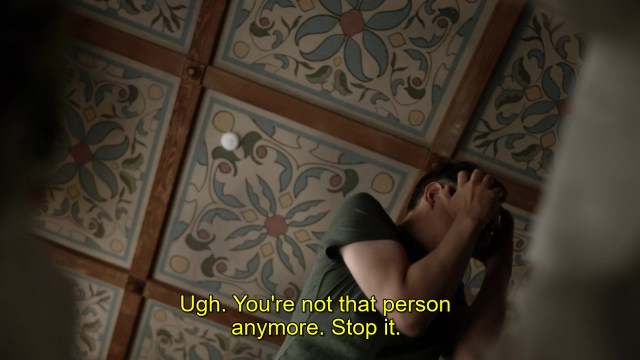
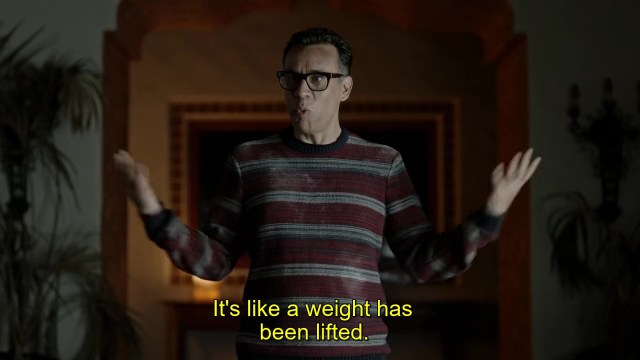
Karl is also somehow immune to the virus, but has been unable to escape the prison in which he was confined for the four years after everyone else died. Karl has killed the only other virus survivor, a guard, and is wearing his uniform, to hide his status as prisoner/cannibal. Karl is nice too. Except for being a serial killer cannibal.

vlcsnap-00033.jpg

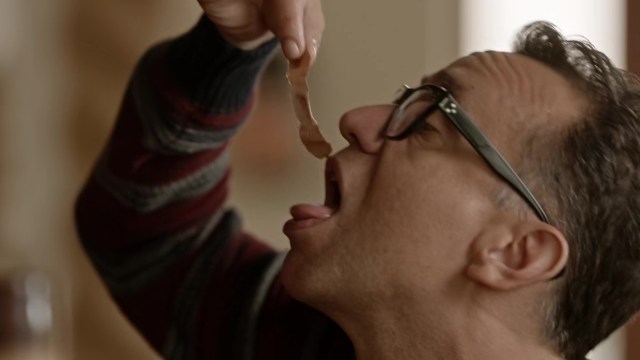
Karl has an unexplained compulsion to eat human flesh, and is powerless to defy it, despite his desperate efforts to do so.

vlcsnap-00027.jpg

He is obsessively drawn to a used Band-Aid, which is stained with the flesh of a burnt finger.

vlcsnap-00032.jpg

He is unmasked when he is followed to a cemetery, where he hopes to satiate his longings with some well-rotted corpse-flesh, much to the disgust of the observers.

vlcsnap-00049.jpg

vlcsnap-00051.jpg

What makes a cannibal? We have looked in this blog at several motivations such as savageism, starvation, revenge, psychopathy and entrepreneurship, and particularly at the figure of the wendigo, the mythical Algonquin spirit that inhabits the lost and drives them to an ever-escalating hunger for human flesh. Bryan Fuller implies in Hannibal that the good doctor Lecter is such a spirit, appearing as a figure with antlers, often disturbingly dressed in suit and tie. Traditionally, the cannibal required no explanation. In Classical stories, he (and cannibals were usually male) was a super-human or else hybrid figure, monstrous in appearance and easily identified as an ‘other’. In colonial times, they were tribes of savages, whose ignorance of the morals of Europe required the intervention of the conquistadors to ensure they were re-educated, which would usually involve the appropriation of their lands and the enslavement or extermination of the ‘cannibals’.

The contemporary cannibal is often typified by his inconspicuousness – acquaintances of cannibals like Jeffrey Dahmer, Albert Fish or Armin Meiwes often spoke of how normal and prosaic they seemed. Karl fits exactly into this model of the contemporary cannibal – the others like him, and can hardly believe it, even when he admits to his addiction, as if it was an AA meeting.

vlcsnap-00024.jpg

vlcsnap-00025.jpg

There are many ethical issues raised in this apparently light-hearted comedy. Everything in the world before the virus was about voracious appetite and power, and things have not changed that much. Now of course there is no money, and the stores are full of whatever you could want, but it’s all starting to go bad, even the tins. The few animals they have found alive have usually come to a sticky end – the cow whose milk they took died, her calf was left behind when they left for Mexico, the bull was killed and eaten. They found crickets and ate them. They catch a fish with a hook, much to their surprise. Phil threatens to eat a little dog’s butt at one point. Anthropocentrism, sometimes called speciesism or human narcissism, is now the supreme ideology, even though it has apparently led to the extermination of almost all life on Earth.

The main question of this brave new world, then, is: are there any ethical constants? The survivors are mostly besotted with the idea of having babies and repopulating the world with humans: is that a great idea? And while they are satisfied to smash down shop doors and take whatever they need, they are shocked at the cannibal doing the same. To Karl, to all of us, morality is simply relative to his immediate needs. Certainly not a view confined to cannibals.

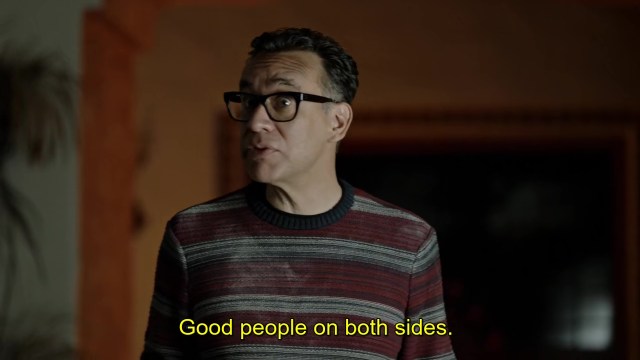
Karl suggests they all go to bed, and discuss the problem in the morning. They will have questions for him. He will have questions for them too! His morality is straight out of Trump at Charlottesville:vlcsnap-00031.jpg

vlcsnap-00032.jpg

As Dostoevsky said in the Brothers Karamazov:

“…there was no law of nature that man should love mankind, and that, if there had been any love on earth hitherto, it was not owing to a natural law, but simply because men have believed in immortality…. if you were to destroy in mankind the belief in immortality, not only love but every living force maintaining the life of the world would at once be dried up. Moreover, nothing then would be immoral, everything would be lawful. even cannibalism.”

Karl exemplifies what Aristotle called the “rational principle”.

“What’s for dinner?” HANNIBAL Season 3 Episode 6, “Dolce” (Fuller, 2015)

“Some are born cannibals, some achieve cannibalism, and some have cannibalism thrust upon ’em. Thy Fates open their hands. Let thy blood and spirit embrace them.”
[With apologies to Shakespeare’s Twelfth Night]

This episode is, at last, a thorough exploration of cannibal theory. At this point, almost half way through the final season of Hannibal (unless our appeals and supplications are answered) we need to ask – who is a cannibal now, and did they achieve it or have it thrust upon ‘em?

Hannibal was almost born into it, apparently, fed, while quite young, some casserole made out of his sister Mischa; by Nazi collaborators in the books and films; by person or person as yet unknown (until Season 4?) in this television series. Jack, some members of the Baltimore Philharmonic who so enjoyed Hannibal’s hospitality, and quite a few others had cannibalism thrust upon them – they were “innocent” cannibals – fed human flesh while assuming it was, perhaps, a mature veal. Will Graham, on the other hand, seems to have achieved cannibalism, as a form of bonding with Hannibal. He killed the “cave bear” dude and probably took some of his flesh to Hannibal`s dinner party, pretending it was the journalist, Freddie Lounds. Yes, he was trying to fool Hannibal (always a foolish thing to do), but they ate it, and it bound them together.
vlcsnap-00092.jpg

And let’s not forget the wendigo mythology, which says that once you eat human flesh, you are destined to crave it forever more. Now, when Jack asks “Will you slip away with him?” Will replies,
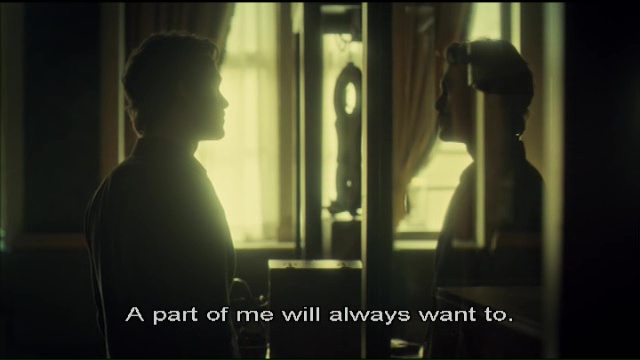
vlcsnap-00006.jpg

Hannibal is pretty upset about leaving Florence, and especially missing his planned feast – Bedelia. He tells her
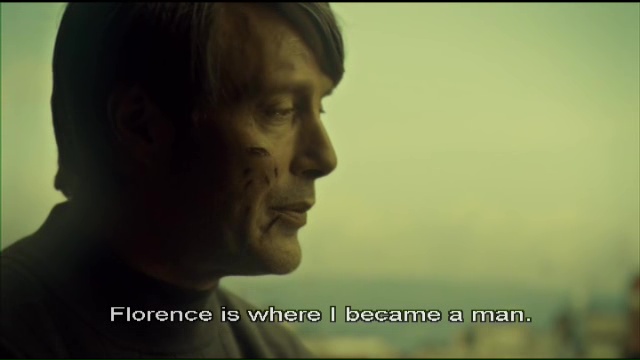
vlcsnap-00013.jpg

This refers to Il Mostro, the “Monster of Florence”, a real character who terrorised the city from 1974-85, killing couples as they had sex in their cars, and often cutting out the woman’s sexual organs, possibly for later consumption. He says he “sees my end in my beginning”, and Bedelia, who is becoming quite a Nietzschean herself, discusses the eternal recurrence:
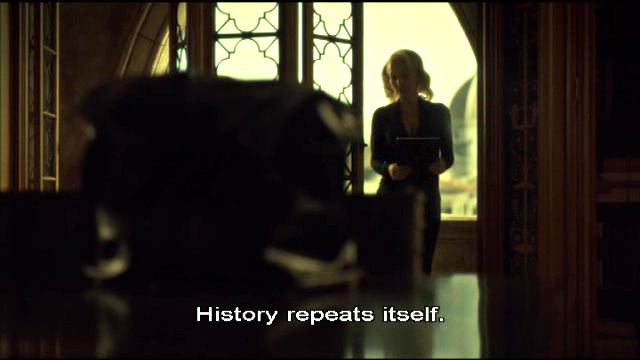
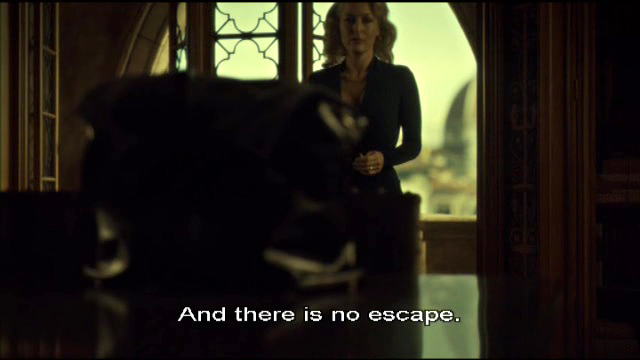
vlcsnap-00016.jpg

vlcsnap-00017.jpg

Bedelia has packed for a quick escape, but only for him. It’s not how Hannibal imagined their goodbye. She has outmanoeuvred him – probably the only character in the show who can.
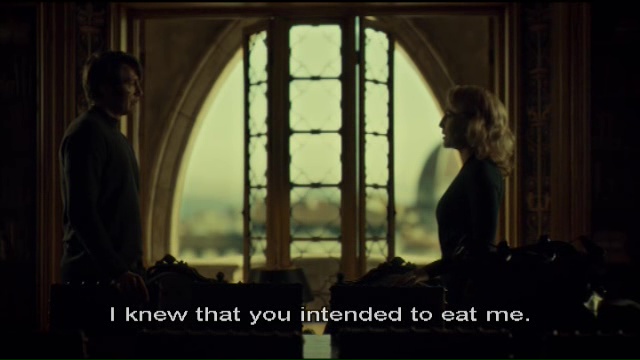
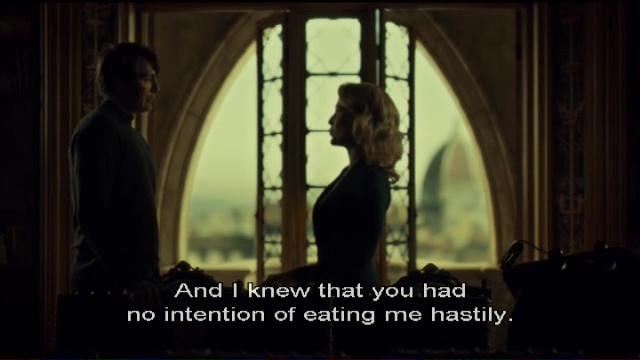
vlcsnap-00022.jpg

vlcsnap-00023.jpg

They exchange a rather chaste kiss; a taste, shall we say, of meals to come.
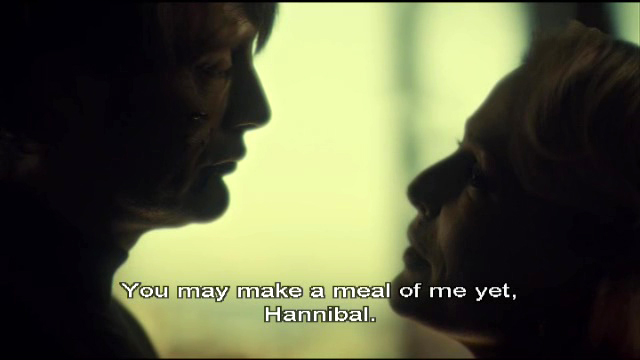
vlcsnap-00059.jpg

vlcsnap-00060.jpg

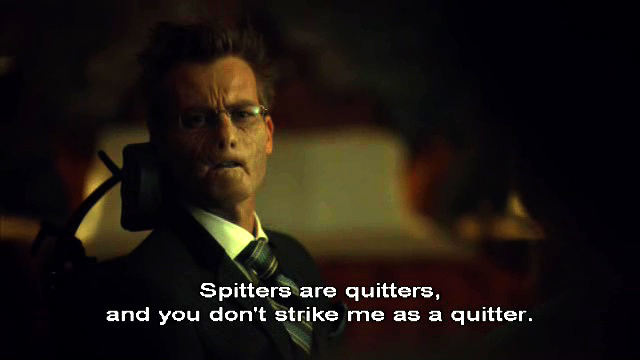
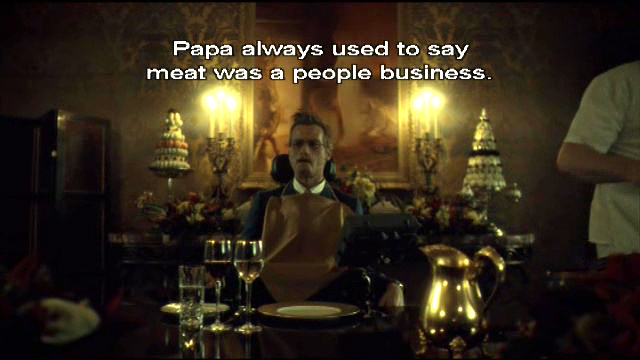
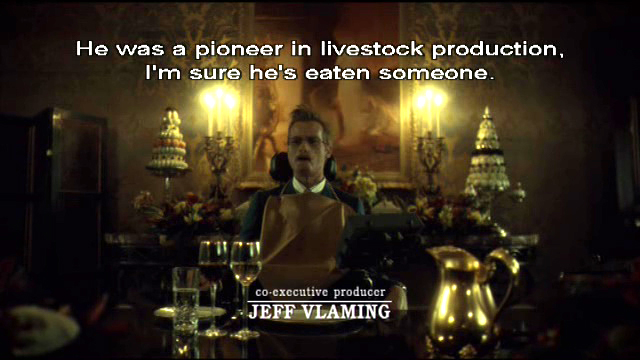
Meanwhile, back at Mason Verger’s estate, Muskrat Farm, Cordell is serving pig tails, cut to appear like human finger joints. They are planning to cook and eat Hannibal but, even for Mason, this is not an appealing prospect. Cordell has also made marrow in a similar shape, which Mason spits out into a Buddhist singing bowl, pointing out that Buddhists don’t eat meat (sic). Cordell replies:

“This isn’t meat. This is man.”

Not totally clear what the difference is (aren’t we made of meat?) but it’s bothering the hell out of poor Mason.
vlcsnap-00040.jpg

vlcsnap-00041.jpg

vlcsnap-00042.jpg

Mason is so old fashioned, so normative in his ethics! He is happy to molest children (even if the broken spine Hannibal gave him limits him to mental abuse). But Cordell tries to reassure him; eating Dr Lecter will make Mason

“the apex predator. We could Peking Duck him. You have to torture a duck to prepare it. Pump its skin up with air then glaze it with a hot honey and hang it by its neck until it dries.”

Mason dreams he is ambulant again, he dreams about Hannibal, who is pumped, glazed, hanged, and roasted until crispy.

vlcsnap-00052.jpg

vlcsnap-00054.jpg

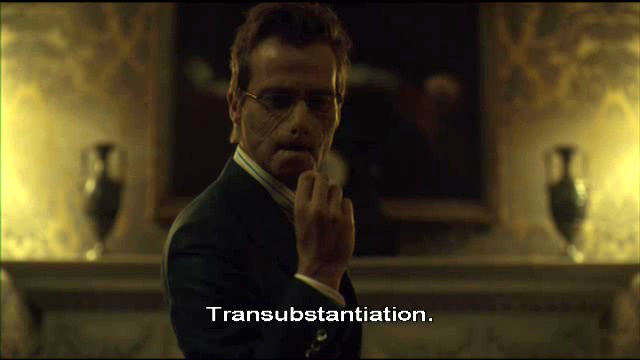
Yes, like Jesus turning the church wafers and wine into his body and blood, so Mason dreams of turning Hannibal into a Peking Duck. But he wakes to find Hannibal has killed his bounty hunter and escaped.

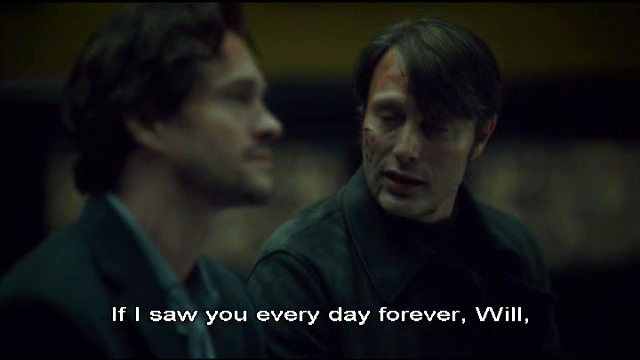
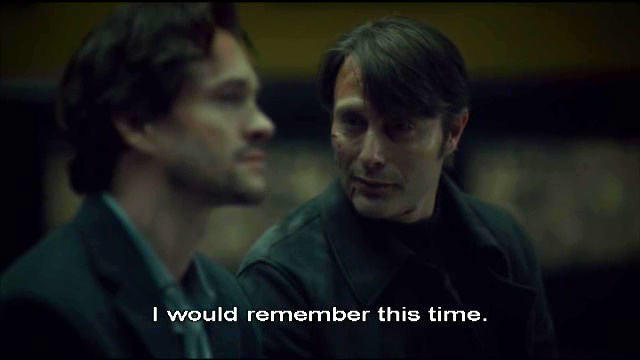
Hannibal, meanwhile, is in the Uffizi Gallery, sketching Botticelli’s Primavera, but substituting Will and Bedelia into the drawing. Will comes in from behind. It’s a touching reunion, almost a love scene, of two battered but unbowed warriors.
vlcsnap-00069.jpg

vlcsnap-00070.jpg

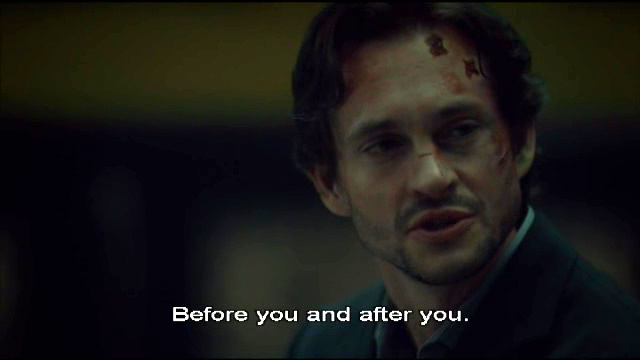
Hannibal asks Will where the dividing line is, for him, between past and future.
vlcsnap-00080.jpg

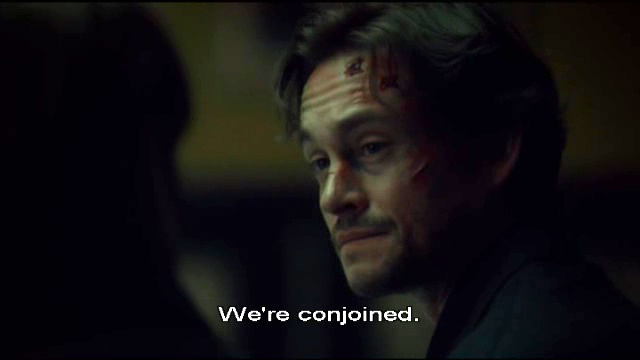
“Every crime of yours feels like one I am guilty of. We’re conjoined. I’m curious whether we can survive separation.”

It’s so tender! But it’s not totally a love scene. As they leave the gallery and cross the street, Will pulls a knife, prepares to kill Hannibal, but Chiyoh shoots him from the roof.

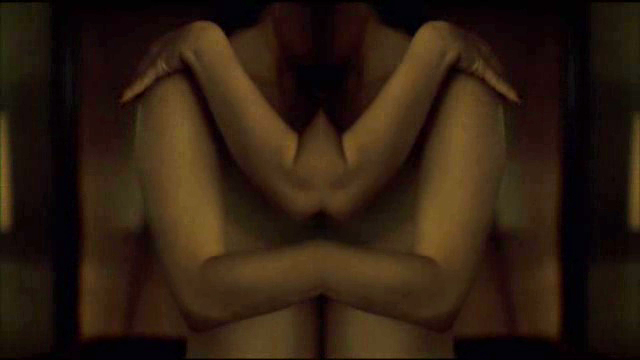
Margo and Alana are having a less complicated relationship, if somewhat more artistic.
vlcsnap-00099.jpg

vlcsnap-00100.jpg

vlcsnap-00104.jpg

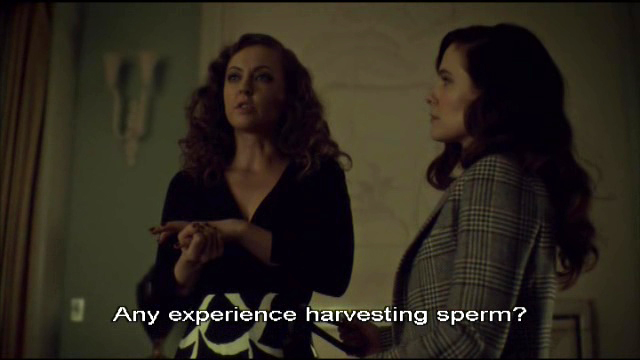
We are treated to a kaleidoscope of lesbian sex. But nothing is free. Margo wants to have a Verger baby, which will inherit the family fortune, but it’s tricky, since her brother had her uterus removed.
vlcsnap-00110.jpg

Hannibal removes the bullet from Will’s shoulder. The anaesthetic puts Will into a trance, during which we are treated to some more Nietzschean philosophy from both of them.

“Taste and smell are the oldest senses, and closest to the centre of the mind.”

“Parts that precede pity and morality.”

Will asks, “What’s for dinner?” Once again, we are treated to a kaleidoscope, but this time it’s Hannibal and Will.

vlcsnap-00130.jpg

Will wakes up strapped to his chair, at a long dining table. Hannibal is in a reflective, almost sentimental mood. He talks about all the things he is sorry to be missing by leaving Florence.

vlcsnap-00134.jpg

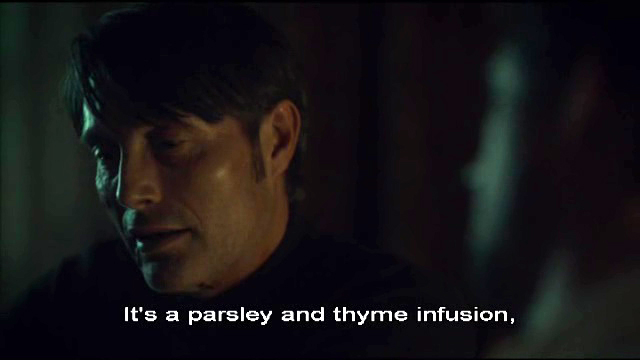
While they talk, he feeds Will from a soup tureen. Will is not impressed by the taste.
vlcsnap-00136.jpg

vlcsnap-00165.jpg

Yes, Will is getting ready for dinner – but as the main course.

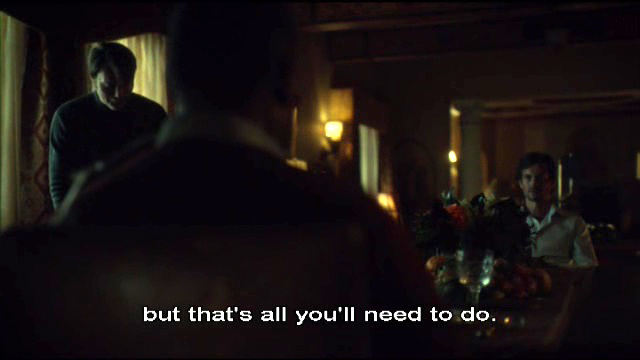
Jack appears with a gun, but Hannibal is under the table and cuts his Achilles tendons, disables him, drugs him and ties him to the chair to watch Bryan Fuller’s reimagining of the final scene of the book and movie Hannibal. You may remember Hannibal, in those days almost unimaginable as anyone but Anthony Hopkins, sawing off the cranium of Paul Krendler, a very rude person who had ruined Clarice Starling’s career, and cooking his frontal lobes. Well, this time, it’s Will. Jack is invited to dinner too. Hannibal tells him

“I’ve taken the liberty of giving you something to help you relax. You won’t be able to do much more than chew.”
vlcsnap-00144.jpg

Hannibal unpacks an electric surgical saw, telling Will,

“Jack was the first to suggest getting inside your head. Now we both have the opportunity to chew quite literally what we’ve only chewed figuratively.”

Hannibal starts sawing off the top of Will’s skull. Blood runs down, turning Will into a figure reminiscent of Jesus with the crown of thorns.

vlcsnap-00158.jpg

But even the best laid plans of mice and cannibals gang aft a-gley. We see pig carcasses hanging from hooks. We see Will and Hannibal, also hanging upside-down. Mason rolls in.

“Gentlemen. Welcome to Muskrat Farm.”

Yet another dinner is in preparation. This time, Hannibal is to be the main course.

Dexter is delicious: “What’s Eating Dexter Morgan?” DEXTER Season 8 Episode 3

00 title.jpg

Dexter is a television series that ran for 96 episodes from 2006-13. This episode is from the final season, and is the only one to feature a cannibal, which seems like a pretty shocking oversight really.

Dexter Morgan (Michael C. Hall, who played David Fisher in Six Feet Under) is a serial killer who also works as a blood spatter technician for the Miami metro police. There’s a lot of analysis of how he got that way (didn’t help that he saw his mother chopped up with a chainsaw when he was little) but, as he is not the cannibal in this tale, we don’t have to concern ourselves too much about that. Interesting to note, though, that although he is presented as a psychopath, he is often shown to have emotions and feelings that might not result in that diagnosis. In fact, Dexter only kills very bad people (just as Hannibal Lecter mostly only kills very rude ones) so he is really more a vigilante than a psychopath, and is motivated by a sense of justice that the Nietzschean Dr Lecter might find laughably absurd. We would have to conclude that both, however, are trying to improve the world by removing objectionable characters from its surface.

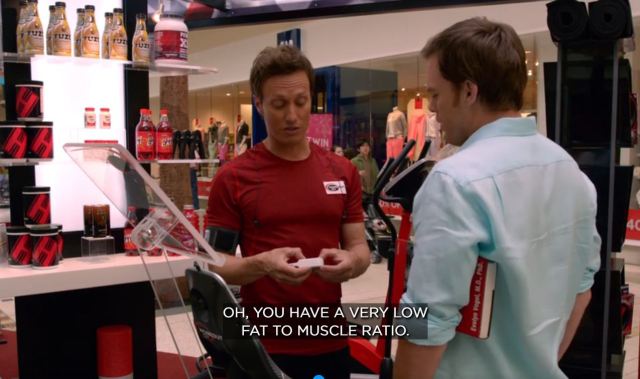
Dexter follows a suspect, Ron Galuzzo (Andrew Elvis Miller), to the mall where he sells exercise equipment. Galuzzo measures Dexter’s body/fat ratio, a wink to what we are about to find out about the dude and his culinary interests.

02 very low fat to muscle.JPG
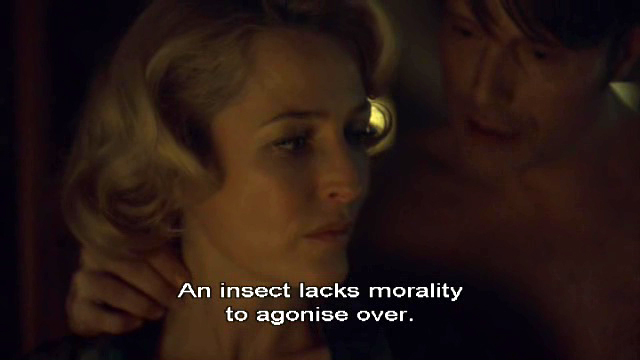
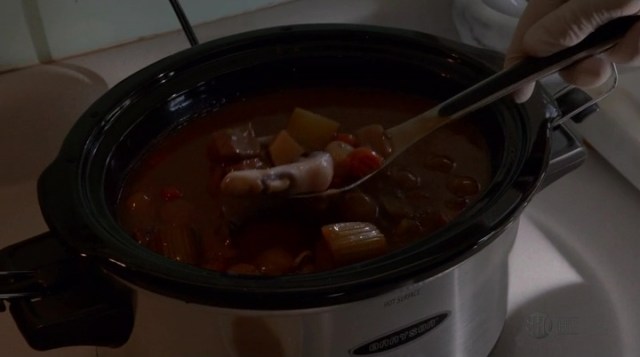
Dexter breaks into Galuzzo’s house and it’s a mess, except for the kitchen, which is clean and spotless. Dexter opens a crock pot and finds a finger in the stew. Dexter is horrified, because I guess serial killers are not used to seeing body parts. Or perhaps Dexter is secretly a vegan.

vlcsnap-00005.jpg

vlcsnap-00004.jpg

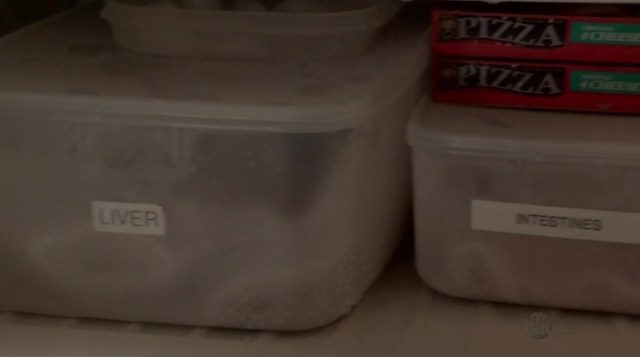
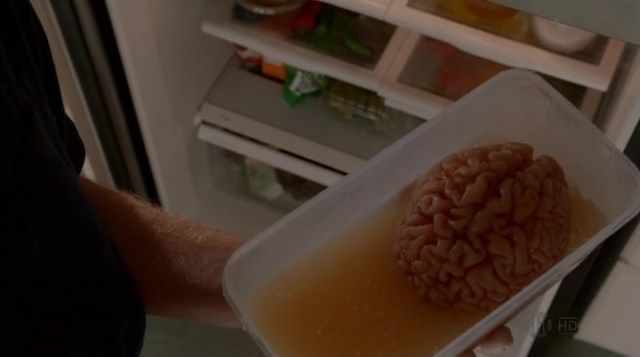
In the fridge, Dexter finds plastic containers containing various body parts. One of them holds a whole brain marinating in a garlic sauce.

vlcsnap-00007.jpg

vlcsnap-00009.jpg

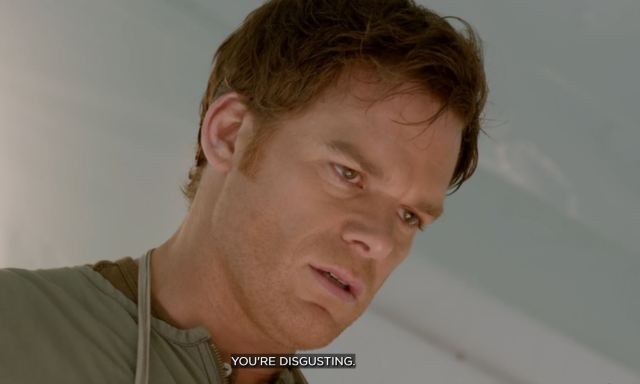
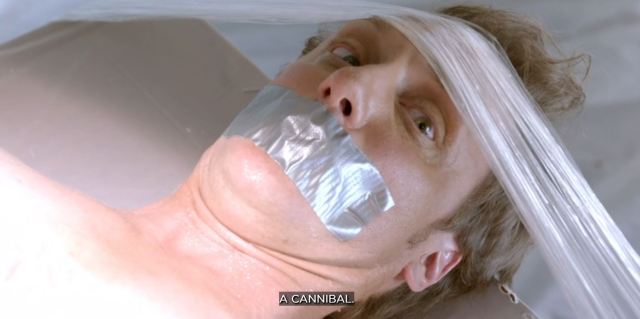
Dexter has a killing ritual, in which the victim is bound and gagged; in this case, it takes place in Galuzzo’s kitchen.

11 Disgusting.JPG

12 cannibal.JPG

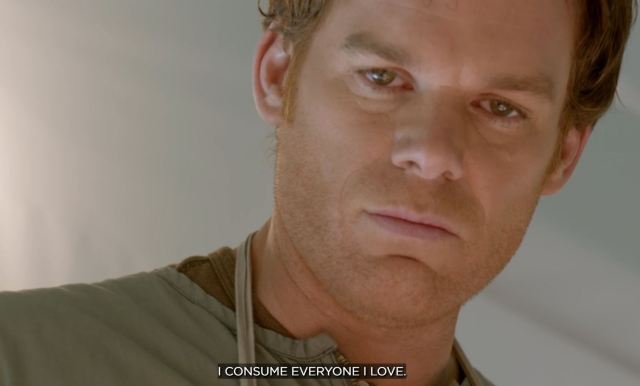
He first lectures Galuzzo on the evils of cannibalism (bit of a nerve from someone whose hobby is slicing people up) then admits that he thinks that he and Galuzzo are alike, because

15 consume everyone I love.JPG

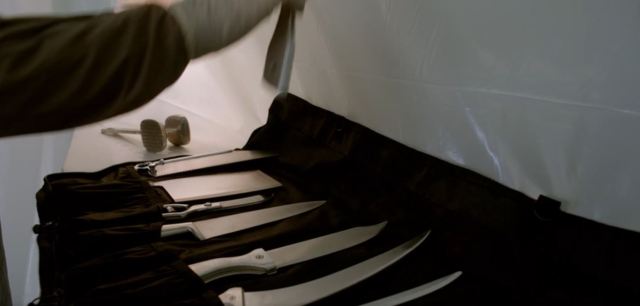
Of course, Dexter has a rather better set of knives than most cannibals.

16 knives.JPG

Galuzzo is the only cannibal featured in the TV series, which is all based around the first book of an entertaining and highly amusing series of eight novels by Jeff Lindsay. A quite different case of cannibalism is featured in the fifth novel, Dexter is Delicious (2010). In the book, Dexter faces a coven of cannibals who eat (sometimes willing) victims in a Dionysian romp.

Image result for dexter is delicious

The story revolves around Dexter and his sister, Deb, trying to save a young girl who doesn’t want to be saved; she wants to be eaten. I shall leave the cannibal unnamed in this extract, so as not to be accused of spoilers.

“Some of them do. They want to be eaten – just as much as I want to eat them…. Almost makes you believe in a benevolent God, doesn’t it?”

The book (IMHO) offers a much better cannibal story than the one in this episode, and we can only wish that the television gods had adapted it instead of this rather insipid character who presents no real challenge to Dexter, beyond offending his delicate sensibilities. Maybe Legal forbade it. Fine to tie a cannibal up, abuse him and slaughter him, but to eat someone who wants to be eaten? Now there’s an ethical dilemma for our times.

vlcsnap-00001.jpg

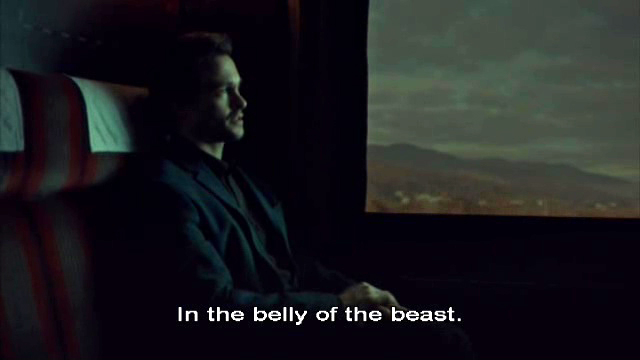
“In the Belly of the Beast” HANNIBAL Season 3 Episode 5 “Contorno”

Cannibalism is at its heart all about food, food from a particular species of animal. This episode, Contorno (Italian for side dishes) is also about food – our choices, our enjoyment, how food affects us and how it identifies us.

We start with Chiyoh and Will on a train to Italy. Chiyoh fills in a little bit of what we don’t know about the early Hannibal. Chiyoh was sent to be attendant to Hannibal’s aunt, Lady Murasaki. The young Hannibal was there, an orphan. He was meant to be with his sister, but he was alone. We don’t know why, although we will be told (episode 7) that Hannibal ate, but didn’t kill, his sister, Mischa.

They get talking about snails, a side dish of which we know Hannibal is inordinately fond, particularly when they have been snacking on human flesh. Chiyoh observes:

“Birds eat thousands of snails every day. Some of those snails survive digestion and emerge to find they’ve travelled the world.”

vlcsnap-00010.jpg

Then we see Hannibal feeding snails to Bedelia – he explains that, as a young man, he kept sea-snails to attract fireflies.

“Their larvae devour many times their own bodyweight. Fuel, to power a transformation into a delicate creature of such beauty.”

Snails, Hannibal tells Bedelia, follow their nature. She dismisses his metaphor: fireflies live such brief lives. A bit more evidence follows that Hannibal is a Nietzschean:

vlcsnap-00016.jpg

In a scene in which Hannibal is clearly checking whether Bedelia is ready for dinner yet (his), they move on from snails and fireflies, a story about transformation, to a discussion on Hannibal’s other main interest: Will Graham. In particular, Will’s fascinating struggle to retain his ethical certainty in the face of Nietzsche’s amor fati – the love of fate, and his true nature as a hunter.

vlcsnap-00017.jpg

vlcsnap-00018.jpg

Bedelia protests: “Almost anything can be trained to resist its instincts. A shepherd dog doesn’t savage the sheep.”

vlcsnap-00021.jpg

Still on the food theme, Alana has laid out Hannibal’s table setting for Mason Verger – she has worked out that he can be traced through his exquisite purchases, just the way Clarice did in the book Hannibal. She has tracked him to Florence through receipts for Bâtard-Montrachet (Chardonnay) and tartufi bianchi (white truffles). Mason, never one for social niceties, observes that Hannibal must have liked the taste of her too, and perhaps she enjoyed her own taste of him. He offers a double-entendre that the Guardian critic described as

“actually the most disgusting part of the episode. That’s pretty impressive given the extreme close-ups on snails and Pazzi’s bowels flopping to the ground as he is hanged from a window”.

vlcsnap-00037.jpg

Chiyoh is not really getting Will. She cannot seem to see the attraction between the men, just the shared aptitude for violence: “If you don’t kill him”,

vlcsnap-00056.jpg

He agrees. So she pushes him off the train. As you do.

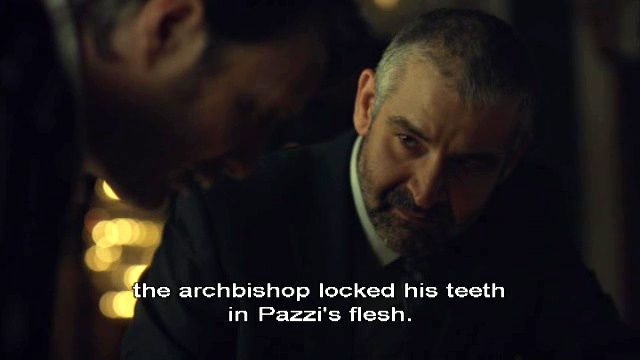
No humans were eaten in the making of this episode; snails are the man-eaters. But we do get the gory killing of police inspector Pazzi, who goes as his ancestor went – hanged with his bowels out as punishment for treachery. His ancestor tried to kill Lorenzo the Magnificent in 1478; this Pazzi recognised Hannibal and tried to sell him to Mason Verger rather than turn him over to the FBI.

vlcsnap-00062.jpg

Hannibal shows Pazzi a woodcarving of his ancestor’s death, and mentions that the Archbishop bit Francesco.

vlcsnap-00085.jpg

Running out of time, Hannibal just tells Pazzi “I’ve been giving very serious thought to doing the same” (although in the book and film Hannibal, this line was “I’ve been giving very serious thought to eating your wife”).

No one actually gets eaten, but Hannibal gets a solid beating from Jack Crawford, who has just dumped his wife’s ashes in the Arno and is fighting mad, particularly after spending the afternoon with Pazzi’s soon-to-be widow. Some readers interpret this scene as Hannibal finally discovering he is not as smart and invulnerable as he thinks, but I hold to the oft-stated theme that Hannibal is always way ahead of the plot. The beating that Hannibal takes is almost without resistance; as if he somehow feels that he owes Jack a chance at revenge for betraying his friendship, a chance to grow into a predator.

vlcsnap-00115.jpg

vlcsnap-00116.jpg

So Jack pushes Hannibal out the window, but he catches himself on Pazzi’s corpse and limps off. The inspector is without his bowels, but not without his uses.

vlcsnap-00093.jpg


Rage and appetite: SKIN AND BONES S1E08 of “Fear Itself” (Larry Fessenden, 2008)

Fear Itself was an American horror/suspense anthology television series shot in Canada. It began airing on June 5, 2008.

vlcsnap-00002.jpg

Look, it’s a TV video nasty, but the cast is great, and it features a Wendigo, a figure made famous in Hannibal and the movie Ravenous.

The Wendigo (sometimes called Wetigo) is a figure from North American Algonquin folklore. He is a mythical figure – giant, fierce and cannibalistic. He gathers strength from feeding on human flesh, but the flesh makes him grow larger, and so his appetite can never be satisfied. He is sometimes protective, and sometimes a figure of revenge (Cartman may have been taken over by a Wendigo in last week’s blog!) In this story, the Wendigo is “the spirit of the lonely places” and is all about revenge. The Wendigo gets inside people who are weak, hungry, and filled with rage.

We know what’s going to happen. So does the token wise old Native American, Eddie Bear (Gordon Tootoosis) who knows all about Wendigos, as did Joseph Runningfox in Ravenous. Of course, no one is interested in metaphysical explanations from those who might understand the land, so it just escalates from there.

vlcsnap-00006.jpg

“Don’t matter what you call it. It’s a madness, it’s fierce, it’s a hunger that can’t be satisfied. It’s an anger that can’t be settled. It’s the Wendigo!”

Grady (Doug Jones from Pan’s Labyrinth, Hellboy II and Star Trek Discovery) has a ranch but knows nothing about living off the land. His brother Rowdy (John Pyper-Ferguson) is running the ranch, and is clearly making out with his wife Elena (Molly Hagan). There are two children (Cole Heppell and Brett Dier, who you might recognise as Michael from Jane the Virgin).

vlcsnap-00003.jpg

The kids challenge Rowdy with the usual line “You’re not our father!” so of course we know he must be. The Wendigo has taken over Grady while he was on a hunting trip (with Chuck and Billy who have, you know, disappeared: down the hatch) and when Grady stumbles back to the ranch, he is skinny, covered in frostbite, and remarkably creepy. And hungry. So hungry, he could eat a horse (and does).

vlcsnap-00001.jpg

But he certainly doesn’t want Elena’s soup. When she feels his forehead, he licks her arm, and mutters, “tastes good!” Soon he is feeling fine. And still hungry. Soon it’s Rowdy’s turn to be the family meal. He makes Elena cut up and cook and then eat his brother. OK, he’s possessed by a Wendigo, but it’s still cannibalism in my book.

vlcsnap-00009.jpg

CUT IT UP AND COOK IT! …it’s just meat.

Director Larry Fessenden had made an earlier Wendigo movie called, well, Wendigo, which got a respectable 60% on Rotten Tomatoes.

If you want to know what happens in this one (and you can really sort of guess), you can watch the whole episode on Youtube.

It’s worth watching, if only for Doug Jones’ performance as the Wendigo.

vlcsnap-00011.jpg

“I could feel a rage growing up inside me. A rage that would not let me die!”

Sounds like an allegory of twenty-first century politics.

vlcsnap-00008.jpg

Cartman’s Cannibalism: SOUTH PARK S5E4 “Scott Tenorman Must Die” (Parker & Stone, 2001)

“Scott Tenorman Must Die” was the 69th episode of South Park, and first aired on July 11, 2001. It contains nods to a number of classic cannibal narratives.

Eric Cartman’s cousin, 8th-grader Scott Tenorman, tricks Cartman out of $16.12 in return for some pubic hairs, the possession of which, he tells Cartman, means that he has reached puberty. Realizing that he has been tricked, Cartman swears revenge.

vlcsnap-00004.jpg

“Did you see that movie Hannibal? Where the deformed guy trained his pigs to eat his enemy alive? Well, if we find a pony, we can train it… to bite off Scott Tenorman’s wiener.”

vlcsnap-00007.jpg

The pony misunderstands the training.

vlcsnap-00008.jpg

Cartman’s schemes become more convoluted, involving a letter to the band Radiohead asking them to visit South Park, where Scott will be humiliated as his favourite group get to watch the pony mutilate his member.

Cartman arranges for Scott’s parents to be killed.

vlcsnap-00010.jpg

He steals the bodies and cooks them up for his “chili con-carnival.”

After Scott eats the chili, Cartman asks him:

“Do you like it, Scott? I call it Mr and Mrs Tenorman chili.
Nyah nyah nyah nyah nyah – I made you eat your parents”.

vlcsnap-00014.jpg

Cartman enjoys licking up Scott’s tears.

vlcsnap-00018.jpg

We have here a passing reference to Hannibal again, in which Mason Verger collects the tears of orphans to make into his favourite cocktail.

But the main reference is to all revenge cannibalism narratives, from the Greek legend of Atreus and Thyestes to Titus Andronicus, to Liver-eating Johnson, John R. Weber and Omaima Nelson, and of course the Tim Burton version of Sweeney Todd.

vlcsnap-00012.jpg

Cartman is not a cannibal in this episode, but he facilitates an act of cannibalism as revenge, just as Sweeney Todd did. Eating a relative, as Scott Tenorman (and Thyestes) unwittingly did, is horrific not because of the flavour – they find the fare delicious. It’s because a life you cared about was snuffed out, not just extinguished, but totally annihilated by digestion, just as we do to those we eat every day, whose lives may have been just as precarious and precious – to someone.


Remembrance of Things Past: HANNIBAL Season 3 Episode 4: “Aperitivo”.

There was a “Hannibal” in Proust: Comte Hannibal de Bréauté-Consalvi in The Guermantes Way. Now there is some Proust in Hannibal – everything in this episode is à la recherche du temps perdu – “Remembrance of Things Past” or, more accurately, “In Search of Lost Time”.

Hannibal, let’s be clear, gets into people’s heads (including those of his loyal Fannibals). That of course is his job as a psychiatrist, but he takes it well beyond work hours, getting into the heads of everyone with whom he deals, including Miriam Lass, who was his captive for a long time, and shot Frederick Chilton, because Hannibal was in her head.

vlcsnap-00012.jpg

It’s episode 4, and we are finally finding out what happened to all the people knifed, shot and pushed out of windows (or made to eat their own faces) in the previous season. Those still alive have it in for him, are hunting him in their own ways. Mason Verger, whose fortune is based on breeding and killing pigs, wants to catch Hannibal and feed him to those pigs. He has offered a reward of one million dollars for his capture. Chilton, less one eye and half his teeth from Miriam’s bullet, just says “Happy hunting!” Verger’s words about Hannibal are taken from the Bible, the Book of Job, where Satan tells God he has been “going to and fro on the earth, and from walking back and forth on it”. He is relating Hannibal to a supernatural being: Satan. But also to an edible being: a pig. This can’t end well.

vlcsnap-00021.jpg

We know Will was cut up good in his last dance with Hannibal, but we get a new perspective in the next scene after the credits – we are inside Will’s body cavity, in the coil of guts, looking at the stomach skin as it is punctured by Hannibal’s linoleum knife. Waking up in the hospital, he is visited not by Abigail, as he had hoped and imagined in episode 2, but Chilton, who wants help catching Hannibal, who would be a prize specimen for his “hospital” for the criminally insane.

Will spurns Chilton’s offer of compassion and friendship, which leads to one of Chilton’s best lines of the show:

The optimist believes we live in the best of all possible worlds;

vlcsnap-00024.jpg

Will is still imagining scenarios – in the next scene, he and Hannibal are plunging knives into Jack Crawford in a scene that could only have been inspired by Julius Caesar.

Et Tu Brute.JPG

vlcsnap-00025.jpg

But Will finally didn’t go with Hannibal, and Jack’s not dead – he’s tracking to Will’s boatshed to seek Will’s help, just as he did at the beginning of Red Dragon, where the whole saga started. Will admits that he warned Hannibal, wanted him to run, because “he was my friend”,

vlcsnap-00029.jpg

Alana is still alive too, despite being pushed out of a first storey window. She wakes up full of rods that hold her together. The doctors have told her that a lot of marrow got into her bloodstream from her multiple broken bones, so she should expect to think differently. And she does.

vlcsnap-00031.jpg

She goes to see Mason Verger, who tells her he has found religion, been saved by the risen Jesus or, as he familiarly calls him “the Riz”. As a believer, he says he has forgiven Hannibal. Alana is not so convinced.

vlcsnap-00043.jpg

Jack remembers his apparent death at Hannibal’s hands, but has somehow recovered. His health, not his career – he has been forced to retire from the FBI. The culture has found a new nightmare to slap its clammy flab and ruin its sleep.

vlcsnap-00044.jpg

He also remembers waking up in hospital, lying next to Bella, his wife, who is continuing to die without him as it turns out. He takes her home, sits with her, holds her while her heart stops and her brain dies. He dresses for church and visualises their wedding, but it’s a funeral, she is in a casket, and there is a splendid bouquet from – who else – Hannibal. The card contains a John Donne poem and finishes “I’m so sorry about Bella, Jack”. Fighting to the death does not, apparently, reduce the respect or affection Hannibal feels for his opponents.

Everyone, everyone alive that is, wants to find Hannibal, and most of them want to kill him. What does Will want, as he embarks on a sustainable sailing voyage to Europe to find Hannibal? We don’t know. Mason Verger is talking transubstantiation – his face has been (somewhat) restored by extensive surgery, now he wants to transubstantiate Hannibal. In most ceremonies

vlcsnap-00052.jpg

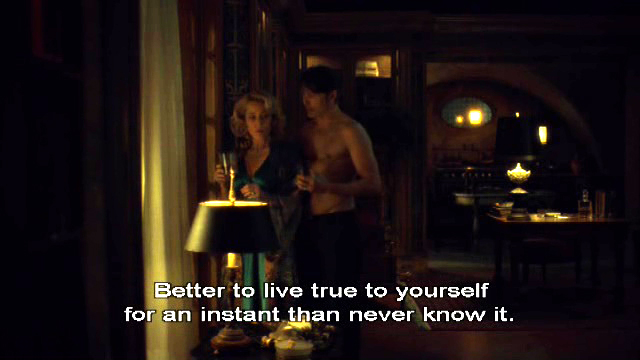
He is planning a more elaborate ceremony. He tells his major-domo nurse Cordell

vlcsnap-00055.jpg

Alana is helping, telling Verger that Hannibal will be traceable because, wherever he goes, he will be ordering the very best wine, truffles, etc. She tells him “You’re preparing the theatre of Hannibal’s death. I’m just doing my part to get him to the stage.”

It sounds like they are all conspiring against poor Hannibal. But remember what Alana told Jack when they thought they were outsmarting him – Hannibal is always in charge of the narrative. Whatever the others are doing, he wants them to be doing. Or as Bedelia said, he is drawing them to him. Nietzsche wrote:

“In your friend, you should possess your best enemy. Your heart should feel closest to him when you oppose him.”

While everyone else is remembering things past, or searching for lost time, Hannibal is making friends.

“How did your sister taste?” HANNIBAL Season 3 Episode 3, “Secondo”

vlcsnap-00002.jpg

Season 3, and particularly this episode, is presented as Gothic horror. There are dark churches, gloomy castles, even Hannibal’s shadowy kitchen, where he is removing a hand from the Sunday roast.

vlcsnap-00036.jpg

This episode is all about identity. All our protagonists (if still alive) have gone through trauma, Will and Jack were clinically dead for a while, and such trauma usually leads to questioning – who am I, what am I doing, and what is this on my plate?

It’s the third episode of the final season (looking forward to being proved wrong here), and we still don’t know what happened to many of the victims of the last series. Hannibal of course is doing nicely in Florence under the name of Dr Fell, Curator at the Palazzo Capponi. Bedelia is living with him, a somewhat nervous room-mate, pretending to be Mrs Fell, but there is no sign of intimacy, and some definite portents of doom. Last episode, she witnessed the murder of Anthony Dimmond. Dimmond knew Hannibal was not Fell, and was duly killed with a bust of Aristotle (was it really Aristotle?) Hannibal, who believes Bedelia betrayed him, explained to her that she was not just observing the murder, she was participating. She knows, Dimmond knew, we know, that she is slated to be one of his next courses.

They speak, somewhat obsessively, about betrayal (not just Bedelia’s, but Will’s) and forgiveness. Hannibal forgave Will last season. Will forgave Hannibal last episode. Bedelia points out that betrayal and forgiveness are

vlcsnap-00006.jpg

vlcsnap-00007.jpg

Hannibal is looking wistful. It is possible that he has not experienced love before, or at least not since the happy time before he ate his sister, Mischa. This is his search for identity – Hannibal as lover.

Will has two searches. He is of course searching for Hannibal, for love of for revenge is not clear to us, or to him. He is also searching for his own identity – is he a lawman or an acolyte of Hannibal? Where will he look?

vlcsnap-00013.jpg

vlcsnap-00014.jpg

Will is in Aukštaitija, Lithuania. It’s the Lecter castle, which we last saw in the movie Hannibal Rising. Bryan Fuller, in his incomparable way, has brought to life a character who had a minor role in the book and no part in the movie – Hannibal’s aunt’s protégé, Chiyoh.

vlcsnap-00033.jpg

Will walks past the grave of Mischa. He treads Hannibal’s sacred ground.

vlcsnap-00019.jpg

He imagines a conversation with Hannibal, who tells him

“It’s not healing to see your childhood home – but it helps you measure whether you are broken, how and why, assuming you want to know…  Its door is at the centre of my mind, and here you are feeling for the latch.”

Hannibal’s identity is all tied up with the tiny girl who someone killed, and Hannibal ate.

We see Chiyoh shoot a bird and cut off the bird’s feet. The scene switches to Hannibal cutting off a human hand, presumably Dimmond’s. Then he is making cocktails for Professor Sogliato, the epitome of rudeness and intellectual pretension. The cocktail is Punch Romaine, a drink, he tells Sogliato, served to first class guests on the Titanic during their last dinner. Not a good omen. Sogliato has bad timing, and makes his one snide comment too many just as Hannibal is wielding the cocktail ice-pick.

vlcsnap-00057.jpg

vlcsnap-00042.jpg

Sogliato, his frontal lobe partly destroyed, can only stutter and giggle. Bedelia, even though she is a trained doctor, pulls the ice pick out, and Sogliato immediately collapses on the table.

vlcsnap-00047.jpg

Witty as ever. Bedelia asks if Hannibal is longer interested in “preserving the peace you found here?” Hannibal understands physics as well as medicine.

vlcsnap-00049.jpg

Hannibal grows through conflict and engagement; it’s all a giant game of life and death to the evolving Übermensch. But it was far from impulsive. Bedelia sees what he is doing: the Titanic cocktail was a giveaway.

vlcsnap-00050.jpg

He is drawing Will, who is of course in Lithuania, when Jack arrives in Italy. Jack is seeking not Hannibal, but Will. He has broken Will, perhaps turned him into Hannibal’s disciple, and while he would like the Italian police to find Hannibal, his main concern is Will.

Chiyoh is guarding a man, a wild, Robinson Crusoe type figure who, she says, is the one who ate Mischa. Fed her to Hannibal we suppose (that’s how it went in the movie). Hannibal is serving dinner to another couple from the Studiolo, who are lamenting the absence of Sogliato (who is probably at, or on, the table, unbeknownst to them).

vlcsnap-00088.jpg

vlcsnap-00097.jpg

vlcsnap-00099.jpg

Hannibal wanted to kill the dude in the cage, but Chiyoh wouldn’t let him, so he left her to guard the man, for years and years. Will sets the man free, but he returns to his cage and tries to kill Chiyoh, and she then kills him. She accuses Will of doing it for the same reasons as Hannibal would – to see if she would kill. But he says he just wanted to set her free.

But here’s the thing. Our motivations for our actions come from our stories. As Will says:

“We construct fairy tales and we accept them. Our minds concoct all sorts of fantasies when we don’t want to believe something.”

vlcsnap-00166.jpg

Chiyoh believes Hannibal’s story about the man in the cage. She believes that his cannibalism is simply a re-enactment of what he saw happen to his sister. Will has doubts.

vlcsnap-00106.jpg

vlcsnap-00107.jpg

vlcsnap-00108.jpg

What makes Dr Lecter into “Hannibal the Cannibal”? Was it watching his sister slaughtered and eaten? Will argues this does not “quantify” him. Remember an earlier Hannibal who objected to being “quantified” by a census-taker? Remember also that thousands of people have watched appalling brutality being visited on their families and not reacted as Hannibal does.

We have not finished considering that question. Hannibal is washing Bedelia’s hair as she luxuriates in the free-standing bath tub. She asks him “What were you like as a young man?” His answer reminds us that Mads is playing the role as a demonic force.

vlcsnap-00136.jpg

So, Bedelia asks the same question that Will and Chiyoh are covering. “Why can’t you go home, Hannibal? What happened to you there?”

vlcsnap-00141.jpg

vlcsnap-00142.jpg

In Silence of the Lambs, this was followed up with

“You can’t reduce me to a set of influences. You’ve given up good and evil for behaviourism… Look at me, Officer Starling. Can you stand to say I’m evil?”

Will took on that speech, back in Season 2, during their cannibal feast. But here, Bedelia is winning the debate. She has already told him that she knows he is drawing Will and Jack to him with his murders, and warned him that he will get caught. Diving under the water, she cheekily asks

vlcsnap-00143.jpg

Bedelia is once again Hannibal`s therapist; her fee is staying alive. She tells him that

“What your sister made you feel was beyond your conscious ability to control or predict. I would suggest what Will Graham makes you feel is not dissimilar. A force of mind and circumstance.”

vlcsnap-00178.jpg

vlcsnap-00179.jpg

“Same with forgiveness. And I would argue, the same with betrayal” comments Bedelia.

vlcsnap-00185.jpg

vlcsnap-00186.jpg

Bedelia plays her trump card.

“If past behaviour is an indicator of future behaviour, there is only one way you will forgive Will Graham.”

vlcsnap-00189.jpg


“He knew exactly how to cut me”: HANNIBAL Season 3 Episode 2 “Primavera” (Fuller, 2015)

Season 2 ended with pretty much all the main characters lying dead or dying in pools of blood, except for Hannibal, who was sitting on a plane with a glass of champagne and his former psychiatrist Bedelia next to him.

The first episode of Season 3 saw Hannibal very happily ensconced in Florence with a new name, a new job, and a chance to show off his expertise in Dante’s sonnets, of course delivered in perfect Italian. So happy, he had hardly killed anyone, although that had changed by the end of the episode.

vlcsnap-00001.jpg

But what of the gore-splattered rest of the cast? Did any of them live to see Season 3? Well, some did of course although, in some cases, only just. The episode starts with a long reprise of what happened to Will and Abigail, but it’s all in Will’s fevered dreams as he lies in hospital, and he sees it as the killing of his higher self:  blood pours out of a dying stag and fills the room – he is sinking, in an ocean of blood.

vlcsnap-00032.jpg

This is a love story, but of star-crossed lovers. In this case, double-crossed lovers.

Time did reverse. The teacup that I shattered dared to come together. A place was made for Abigail in your world. That place was made for all of us. Together. I wanted to surprise you.
And you… you wanted to surprise me. I let you know me. See me. I gave you a rare gift.

vlcsnap-00014.jpg

The teacup is a crucial symbol to Hannibal. It represents two important discourses that inform his somewhat unorthodox life choices: Nietzsche’s concept of amor fati – the love of fate, the acceptance that what has happened could not have happened any other way, and will happen again, and again. It is not fatalism though, in which we can sit and wait for the inevitable – Nietzsche and Hannibal want to be out there making it happen as it should, as it will, as it must.

vlcsnap-00037.jpg

vlcsnap-00040.jpg

Hannibal wants to speed up the cycle of eternal recurrence, reverse time and repair all that has been lost, particularly his sister, Mischa, who was eaten. He is obsessed with Stephen Hawking’s description of entropy as proof of the “arrow of time” – we “know” that time only flows one way because a shattered teacup does not gather itself back together. Hannibal really likes Hawking’s early theory that, when the universe stops expanding and starts contracting, time will reverse and entropy mend itself; the teacup will mend, Mischa will be whole again, Abigail will be returned to Will. Undoing all the bad things that happened. He just wants to speed things up.

vlcsnap-00023.jpg

Has the teacup re-formed after all? Abigail wanders into Will’s hospital room as he wakes up.

vlcsnap-00044.jpg

Will is hallucinating, but it gives him a chance to state his own metaphysical opinions. Will is more a follower of Leibniz; he thinks there are an infinite number of universes and everything that can happen will, does, did happen in one of the multiverses. Just, not in this one, which makes him sad.

vlcsnap-00062.jpg

It has to end well. And it has to end badly. It has to end every way it can.

OK, but Abigail wants them to find Hannibal, or rather believes the Hannibal wants them to find him. Even after all that happens, she wants to go to him. And so, of course, does Will, although he won’t admit it. He remembers Hannibal taking about his “memory palace”, a place where memories can be stored and restored, and brought out and relived even, or especially, in bad times. Hannibal’s palace is “vast, even by mediaeval standards” and

vlcsnap-00078.jpg

Off to Palermo goes Will and, maybe, Abigail, and meets Inspector Pazzi, who has been chasing Hannibal for twenty years. As a young man, Hannibal was “Il Mostro”, the monster of Florence, and would kill people to make them into art works, particularly based on Botticelli’s Primavera. A real case, which remains unsolved.

vlcsnap-00111.jpg

We hear more philosophy – Will has taken on Hannibal`s theology; as far as God is concerned

vlcsnap-00092.jpg

Elegance is more important than suffering. That’s his design.

Then he gives us his views on Hannibal`s motivations: it’s all about fun. This is basic Hannibal philosophy, going all the way back to his letter to Will Graham in the book Red Dragon.

Hannibal’s not God. Wouldn’t have any fun being God. Defying God – that’s his idea of a good time. Nothing would thrill Hannibal more than to see this roof collapse, mid-Mass, packed pews, choirs singing, he would just love it. And he thinks God would love it too.

And of course, the roof starts to drop a fine powder on Will’s outstretched hand.

Inspector Pazzi points out that Hannibal never leaves evidence.

vlcsnap-00113.jpg

Which raises the big question – what exactly is cannibalism? Was Jame Gumb a cannibal when he used women’s skin to make a “suit with tits” (which he will hopefully be doing again in Season 4)? Was Francis Dolarhyde a cannibal for killing whole families to fuel his radiance (as he will do again later in Season 3)? Hannibal eats people when he can, and when he wants to, but didn’t Jack Crawford enjoy his elegant dinners at Hannibal`s house, pretending to be a friend, knowing what was probably being served? When Will brought the long pig, pretending it flesh of Freddie Lounds, was it really Randall Tier they were eating? Hannibal sure as hell knew it wasn’t pork. Will happily ate it.

Now Hannibal has found a new, non-gustatory use for human bodies: art. He has taken the body of the annoying art student he killed last episode, and made it into a heart, his heart, broken by Will’s betrayal and the loss of the space he made for them. Will uses his powerful forensic imagination to read Hannibal`s design:

I splintered every bone. Fractured them. Dynamically. Made you malleable. I skinned you. Bent you. Twisted you. And trimmed you. Head hands, arms and legs. A topiary. This is my design. A valentine written on a broken man.

vlcsnap-00131.jpg

Hannibal is – complicated. Will explains to Abigail that “he follows several trains of thought at once without distraction from any – and one of the trains is always for his own amusement.”

He gave you back to me, then he took you away. It’s Lucy and the football; he just keeps pulling you away. What if no one died? What if – what if we all left together? Like we were supposed to. After he served the lamb. Where would we have gone? …A place was made for you Abigail, in this world. It was the only place I could make for you.

Charlie Brown.gif

Will finally realises that Abigail is dead, and he is talking to his delusion, to his own subconscious thoughts (which are dominated by finding and rejoining Hannibal). He heads through the arch into the catacombs; he knows Hannibal is waiting in there. Pazzi is behind him, despite Will’s warnings that Hannibal will kill him. Pazzi wants to know what Will might do when/if he finds your Il Mostro?

vlcsnap-00161.jpg

In an atmospheric scene somewhere between Phantom of the Opera and The Name of the Rose, Will and Hannibal wander the winding tunnels, Will calling Hannibal’s name, Hannibal silent. Waiting for Will to say it. At the end of the last season, Hannibal had said to Will as he cut him up “I forgive you, Will. Do you forgive me?”

We finally get the answer.

vlcsnap-00163.jpg


Next week: a new cannibal movie from Brazil: THE CANNIBAL CLUB

“The eating of the heart is a powerful image” HANNIBAL Season 3, Episode 1 “Antipasto” (Fuller, 2015)

https://www.youtube.com/watch?v=JYpNz7StTEQ

Look, I know from the Fannibals sites that some people didn’t like Season 3, or at least not as much as one and two. I humbly beg to disagree. This season sees Hannibal exposed and ferocious, no longer wearing his “person suit” in which he was pretending to be the respectable psychiatrist, trying to help the FBI catch – well, himself. At the end of Season 2, he left most of the cast writhing in pools of their own blood, and we saw him drinking champagne on a plane to France. His psychiatrist, Bedelia, was by his side, wedded to him, it seems, by their shared responsibility for the death of her patient, whom Hannibal had referred to her. Obligated to him by his helping her cover up her killing.

vlcsnap-00042.jpg

Hannibal’s fairy tale is set in Florence, Italy. You may remember a Hannibal of a different generation, in Silence of the Lambs, telling Clarice Starling that memory is what he had instead of a window, as she admired his drawings of the Duomo. Hannibal, it turns out, is an expert on pre-Renaissance Italian literature, particularly Dante, and wants the job of Curator and Translator at the Palazzo Capponi, which of course he gets, by killing the previous Curator and then consuming the man chosen to replace him: Dr Fell, who he meets and eats in Paris. Also by being able to recite Dante from heart at a moment’s notice:

Joyous appeared he in his hand to keep
my very heart, and, lying on his breast,
my lady, veil-enwrapped and full asleep.

But he awakened her, and of my heart,
aflame, he humbly made her, fearful, taste
I saw him, finally, in tears depart.

vlcsnap-00010.jpg

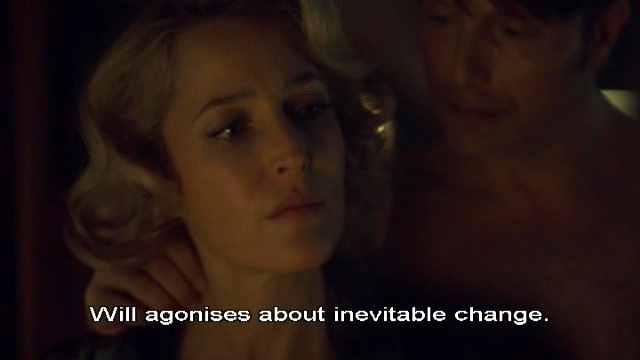
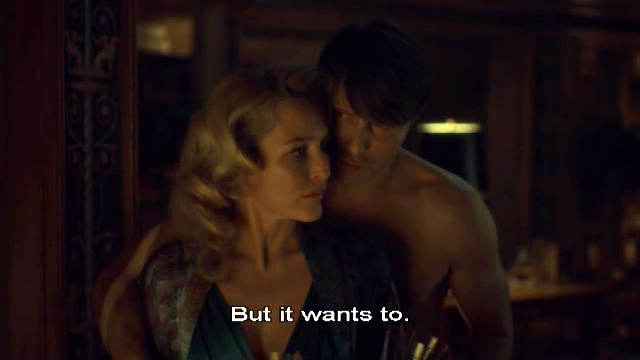
Bedelia is no longer pretending not to know what Hannibal does, or of what he is capable. She has an insight into his Nietzschean ethos

vlcsnap-00070.jpg

vlcsnap-00071.jpg

vlcsnap-00072.jpg

And Hannibal is loving Florence.

“I’ve found a peace here that I would preserve. I’ve killed hardly anybody during our residence”.

Well, the old Curator. And Dr Fell. And Mrs Fell. But the rude Professor Sogliato, who is a natural for dinner because he has been opposing Hannibal’s appointment and being, well, rude about his Italian – will he kill and eat him? No, that would not serve to preserve the peace.

vlcsnap-00076.jpg

vlcsnap-00077.jpg

Bedelia has a flashback to her apartment, just after the bloodbath of the Season 2 Finale, where Hannibal is showering, washing off the blood. She asked him then what he had done.

vlcsnap-00092.jpg

Bedelia is terrified of him, but still, they are living the high life.

vlcsnap-00110.jpg

There’s a complication, of course, as can happen when you kill people (maybe eat them) and take their identity. This complication is a young scholar from England, Anthony Dimmond (Tom Wisdom from The Boat That Rocked and Avengers: Endgame) who worked for Dr Fell, cordially detested him, and won’t be too upset when he finds out that Hannibal is taking his place. Hannibal appears to show friendship, in one of those double entendres that Hannibal does so well

vlcsnap-00120.jpg

We have another flashback to Hannibal’s extended feast on Abel Gideon, at which the only guest of honour was Abel himself.

vlcsnap-00125.jpg

“you wish me to be eating oysters, drinking sweet wines and snacking on acorns.
All to make me tastier?”

Abel’s arm is hanging up in the basement being consumed by snails, to make them tastier. And Abel’s tasty flesh is being eaten by Hannibal

vlcsnap-00131.jpg

vlcsnap-00132.jpg

At the dinner, Dimmond asks Bedelia (AKA Mrs Fell) if she is avoiding meat. She replies with one of the great vegan ripostes

vlcsnap-00143.jpg

But what is she eating instead? Ah yes

vlcsnap-00144.jpg

Dimmond, being a scholar, tells her

vlcsnap-00145.jpg

Yes, Bedelia is being fattened up for a future feast. And she knows it.

vlcsnap-00146.jpg

vlcsnap-00147.jpg

Dimmond gets his hopes up: “Is it that kind of party?” “It is not that kind of party” replies Hannibal. To Bedelia’s amazement, Dimmond gets up and leaves at the end of dinner. Alive.

But not for long. Hannibal is giving a lecture to prove his qualifications for the Curatorship. He lectures on mediaeval art, particularly drawing the comparison between Judas, who betrayed Jesus, and Pietro della Vigna, whose alleged treachery and suicide earned him a place in Dante’s Hell. Disappearing in the glow of his slideshow, Hannibal is soon replaced by the One whom Mads seems to be using as inspiration for his portrayal of Hannibal

vlcsnap-00174.jpg

The theme of his talk is

vlcsnap-00178.jpg

Lo fe gibetto a me de la mie case: I make my own home be my gallows”.

Realising that he is looking at her, and that he considers that she betrayed him (by resigning as his therapist), Bedelia gets up and rushes home to pack. Dimmond comes to the lecture, realises immediately that Hannibal has replaced Dr Fell, and they stroll through an exhibition of instruments of torture. Why do people love such exhibitions? In fact, why do we love stories about zombies, vampires, cannibals? Hannibal explains

vlcsnap-00183.jpg

vlcsnap-00184.jpg

Or as Dimmond puts it

“What still slaps the clammy flab of our submissive consciousness hard enough to get our attention?”

Dimmond offers a sort of partnership with Hannibal. Big mistake. Since Will, Hannibal is not looking to take on new partners. Hannibal takes him home for dinner, just as Bedelia is about to leave, her bag packed and ready.

Wasting no time, Hannibal wallops Dimmond with a bust of Aristotle (appropriate on so many levels) and has a fascinating exchange with Bedelia as she wipes blood off her face, and Dimmond crawls painfully toward the door. He asks her, and us:

vlcsnap-00202.jpg

She knew what he would do. She was curious about what would happen. She anticipated their thoughts, counter-thoughts, rationalisations. Is this (the bloody mess) what she expected? Yes, it was.

vlcsnap-00211.jpg

He helps her off with her coat. She’s not going anywhere.

And nor is Dimmond, whose corpse Hannibal folds up into the shape of a heart and leaves in a distant cathedral – but more of that next episode.

And nor are we. We are also curious about what will happen. We also anticipate thoughts, counter-thoughts and rationalisations. We also expect things to happen, whether it be in this show, or in our own lives, filled with appetite and consumption and instruments of torture.

That’s participation.

As usual, Hannibal has the final word, in a line that sums up pretty much everything I have been trying to say about cannibalism, and the link to carnivorous virility, and our assumption that it’s OK  to eat anyone whom we classify as less than us.

vlcsnap-00026

As Claude Levi-Strauss said:

“We are all cannibals”.
Next week: Beneath the Planet of the Apes