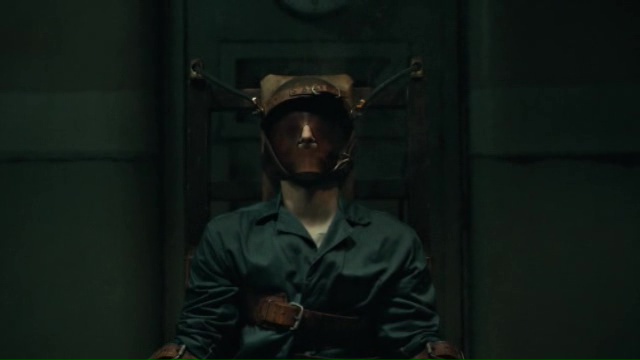
Will is awaiting trial, and the FBI has offered a plea deal – but if he fights the case and loses, he’ll face the death penalty. The electric chair. We see him in that chair, smoke rising from his corpse, as the clock ticks – backwards. Like Vertov’s bull in Kino-Eye, he comes back to life. Then we see the executioner – it is Will himself, looking serious, and quite spiffy, in a suit.
He’s clearly anxious about the trial.
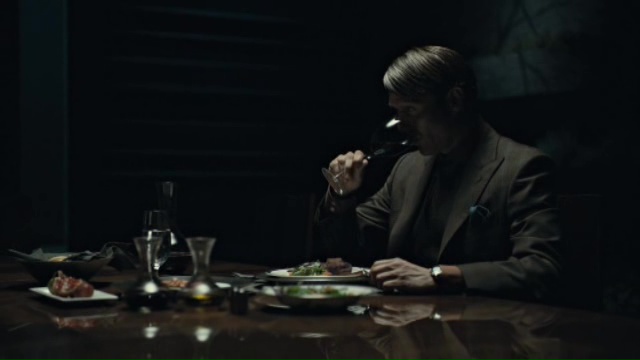
He buttons himself into a suit; so does Hannibal. They dress to the dalla sua pace aria from Don Giovanni. It is a song of anxiety – Donna Anna has asked her fiancé, Don Ottavio, to kill Don Giovanni in revenge. But all Ottavio can do is worry about her state of mind. Hannibal is feeling a bit guilty too perhaps, or is this his design? Anyway, he is creating a protégé from young Will, and doesn’t want electric chairs getting in his way.
Hannibal puts on cuff-links, while Will has hand-cuffs. Easy to confuse the two words.
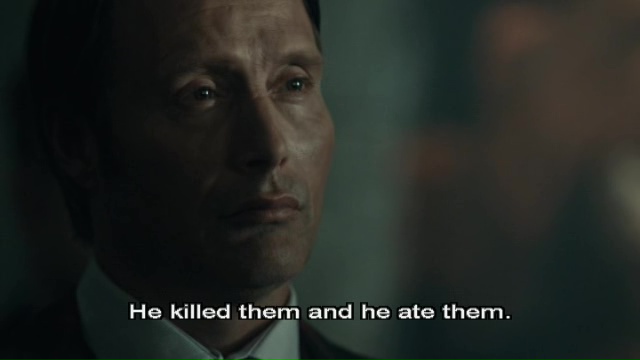
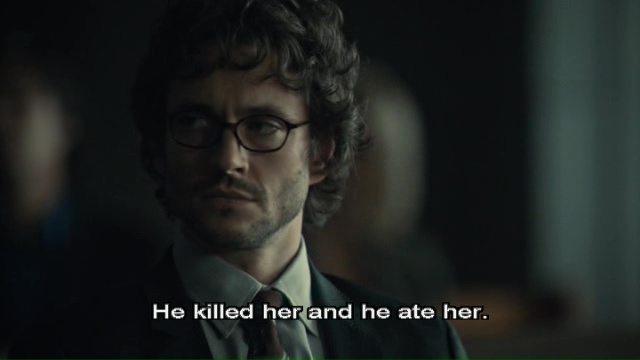
The Prosecution argues that Will killed and ate Abigail as her father had planned to do. Her father killed girls and ate them, so then did Will. The crime, although it’s a murder trial, is clearly cannibalism.
Jack is called as a witness and dumps on the FBI case, taking the blame for pushing Will too hard, and pleading the Hannah Arendt defence: Will had objected to the name “museum of evil minds” because
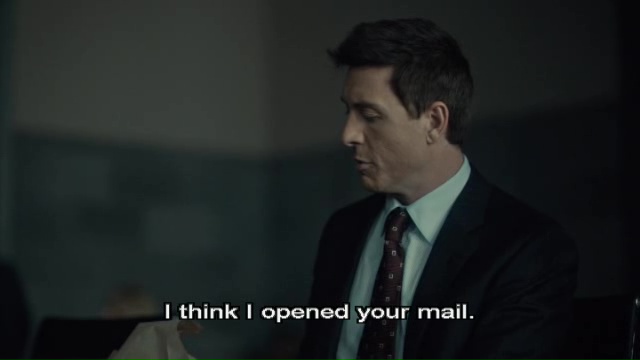
Will’s Defence lawyer opens an envelope and another ear falls out.
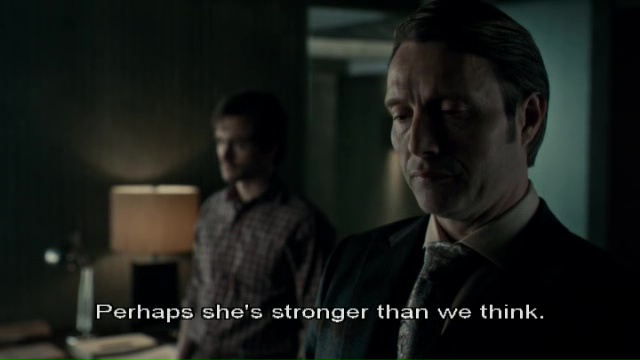
Hannibal’s diagnosis: there may be another killer. He has sent this ear to help you prove you are not guilty. He is an admirer. Will is incredulous – an admirer?
Hannibal speculates that the killer wants to be seen. Why?
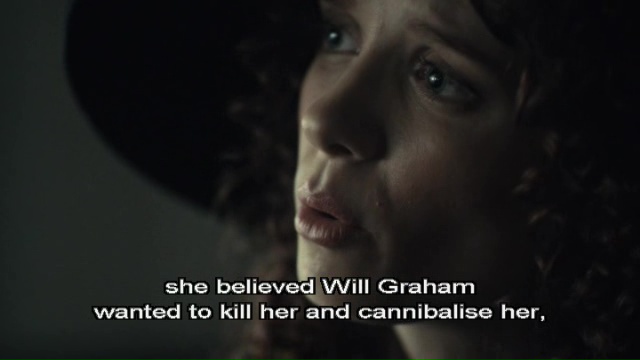
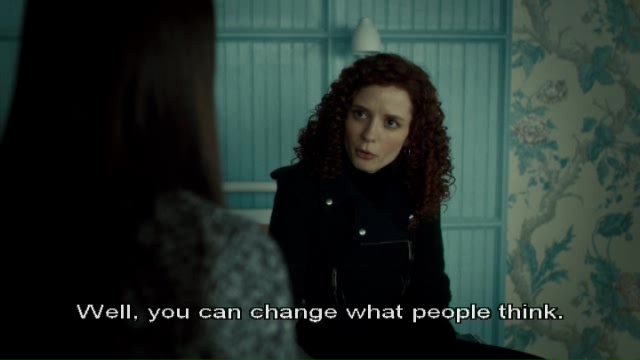
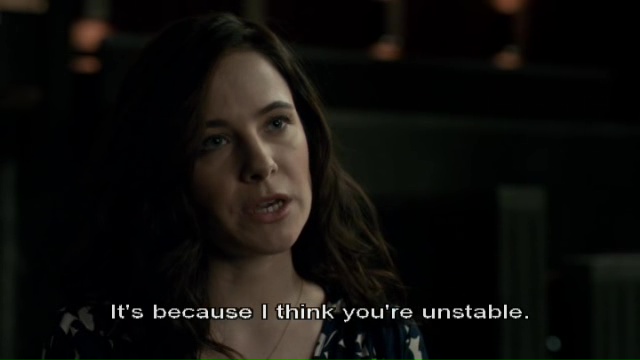
In court, it’s not getting better though. Freddie tells how Abigail believed that, like her father
Chilton gives damning evidence, and uses Clarice’s line about Hannibal from Silence of the Lambs:
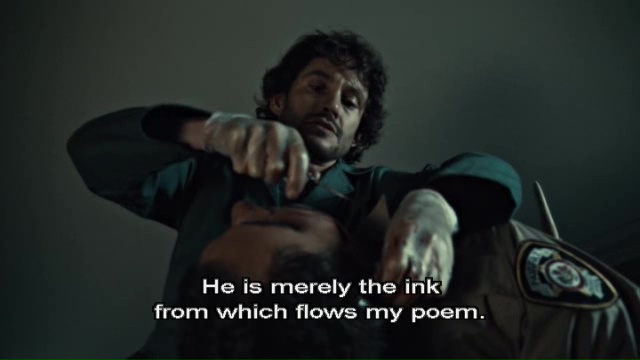
Hannibal takes Will a folder of crime scene photos from the latest murder – the court bailiff who was killed: found burned, mounted on stag’s head, Glasgow smile and ear lopped off. The team are calling it “Will Graham’s greatest hits”. Will does his pendulum thing (obviously feeling much better) and sees himself kill the dude, but without it being, you know, personal:
But Will sees that this is a different killer:
“Cassie’s lungs were removed while she was still breathing. Georgia was burned alive. What I found of Abigail was cut off while her heart was beating.”
Hannibal admits he knew that, but wants Will to use this as a defence, even though it’s a lie.
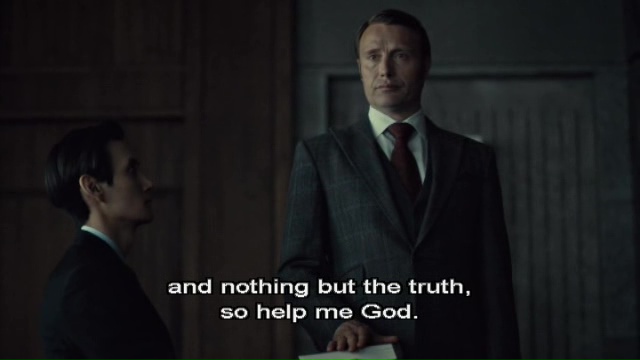
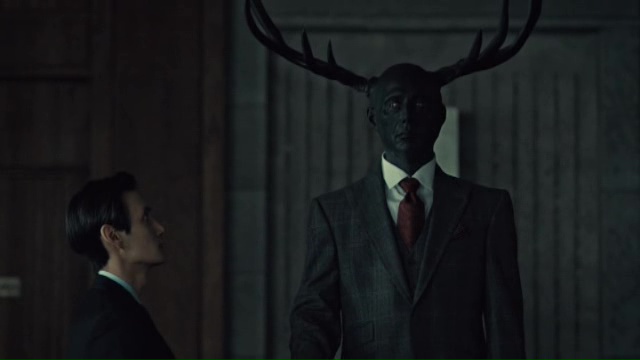
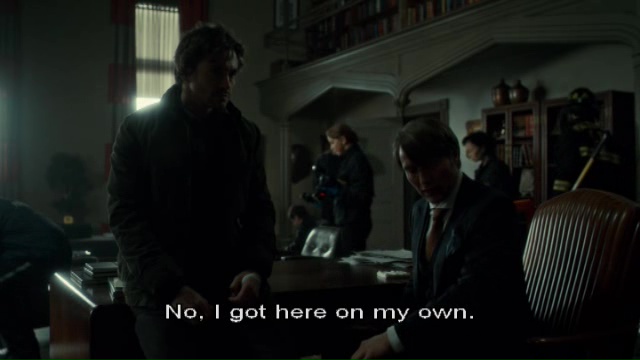
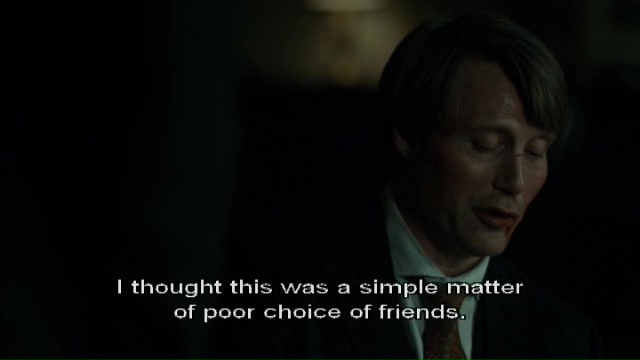
Hannibal gets on the stand, and takes the oath, but Will sees through him.
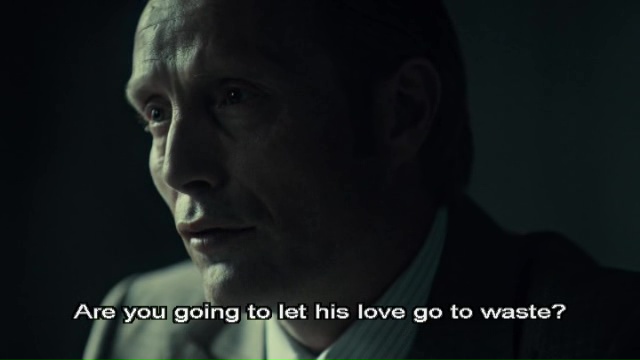
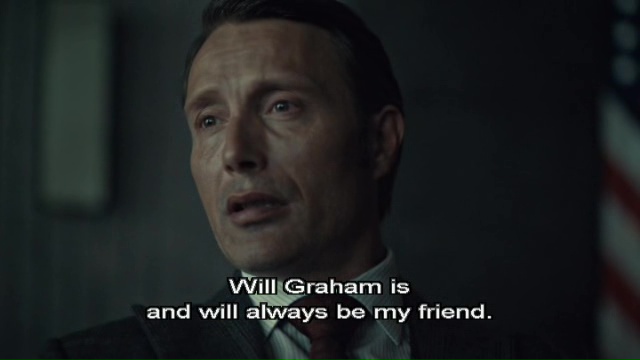
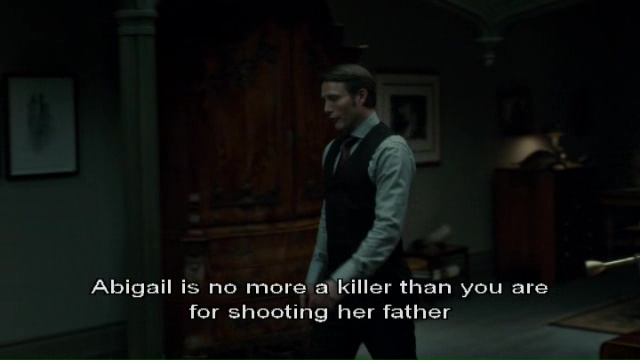
Hannibal lies for Will, saying it’s the same killer. It’s love, or as the prosecutor says, “his personal beliefs and biases are driving his conclusions.”
The judge tosses out the defence. Hannibal is pissed. Not in control.
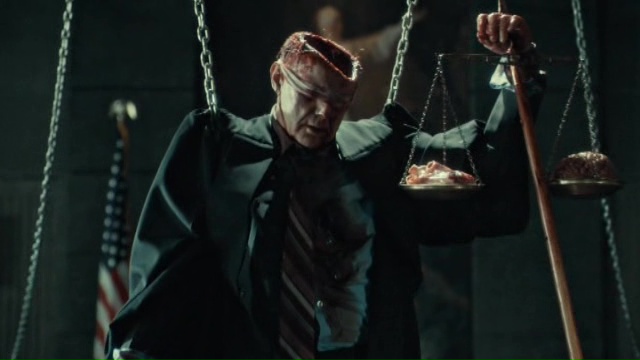
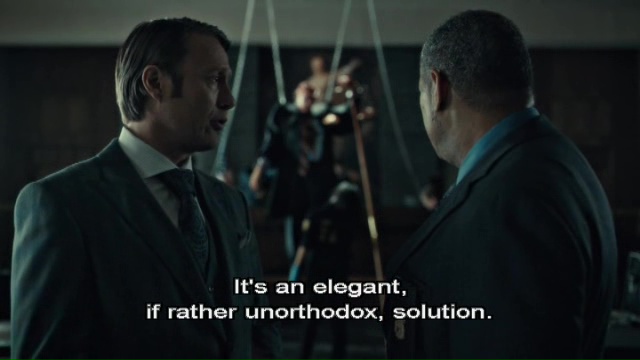
Bad idea, judge. He is found holding the scales of justice. His brain on one side of the scales, his heart on the other.
But there will be a mistrial. Will has a reprieve. For now.
IF YOU LIKE MY BLOG, PLEASE FEEL FREE TO RECOMMEND IT (WITH DISCRETION) TO FRIENDS ON SOCIAL MEDIA.
IF YOU HAVE ANY QUESTIONS OR COMMENTS, YOU CAN USE THE TAG, OR EMAIL ME ON CANNIBALSTUDIES@GMAIL.COM.
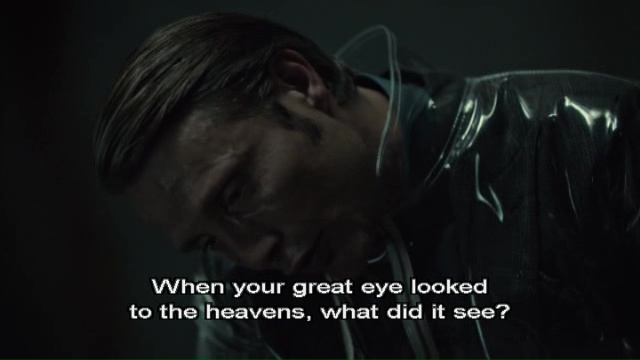
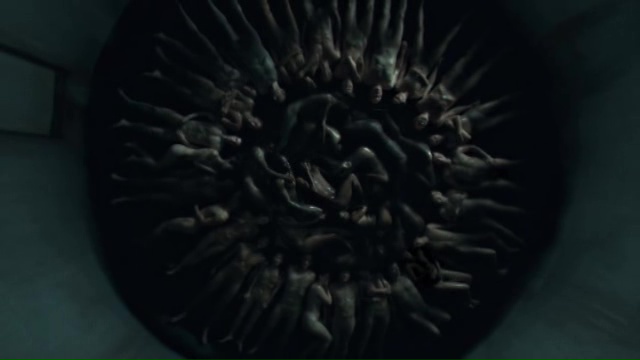
Last episode we spoke briefly about the dude (played by Patrick Garrow) who is building an art work out of human bodies – he kidnaps them, kills them (usually) with a heroin overdose, and coats them in resin, and sews them together to form a giant eye, looking back, he hopes, at God. Let’s redefine “cannibalism”, for the purpose of this blog entry, to let this dude in – he is using human bodies for his appetites, in this case metaphysical ones. He may not be eating the victims (although who knows?) but he is certainly using them up, in large numbers.
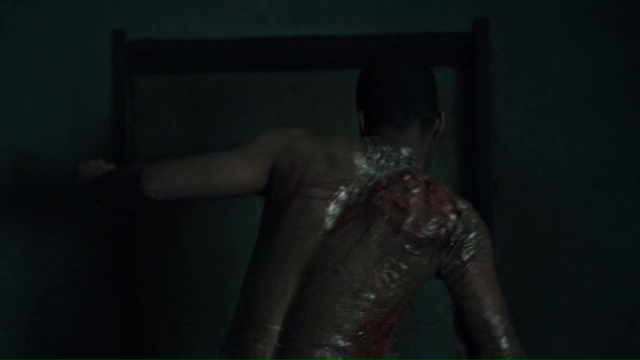
He gets a bit sloppy, and one of the victims (Ryan Field), who has a high tolerance for opiates (the murder weapon of choice), escapes, first tearing off bits of his flesh that have been sewn to other bodies. This is what cannibalism texts do at their heart – they show the insides of the human body. They offend our sense of the clean, proper symbolic order by showing that inside, we are just animals, able to be treated like any other species, and torn apart to assuage appetite for food, visual arts, worship, or anything, really.
Will is in the asylum, where he tearfully begs Alana and Hannibal for help.
Has he begun to doubt Hannibal’s guilt, or is this a ploy? Hannibal’s plots are not always seamless – Bedelia has certainly seen through them. She comes to Hannibal’s office to terminate his psychiatric sessions. She has begun to question his actions – particularly with regard to her attack. Yes, we’ll hear more about that attack.
A toxic masculinity dance commences, where he advances on her and she steps back – he ends up in her face, where she tells him her conclusion, “based on what I glimpsed through the stitching of the person suit that you wear”:
“Exactly, I cannot say. I’ve had to draw a conclusion based on what I glimpsed through the stitching of the person suit that you wear.”
The FBI is still baffled by these dozens of missing people, although Beverley has visited Will with pictures, and he told her that the killer is choosing them for their skin colour – he is making a colour palette. He’s an artist! Hannibal can dig that:
We’re supposed to see colour, Jack. That may be all this killer has ever seen in his fellow man.
Hannibal understands that – he finds killing easy too. In his fellow man, he sees dinner.
He also has the nose of a bloodhound, and can tell, from sniffing the latest body, that the victim ran through a cornfield. He discusses the case with Will in the asylum for the criminally insane, and Will confirms the artwork
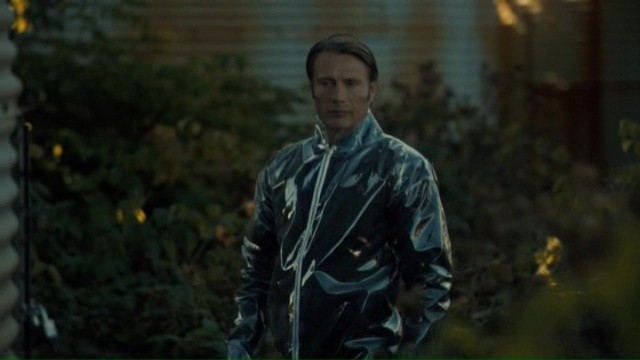
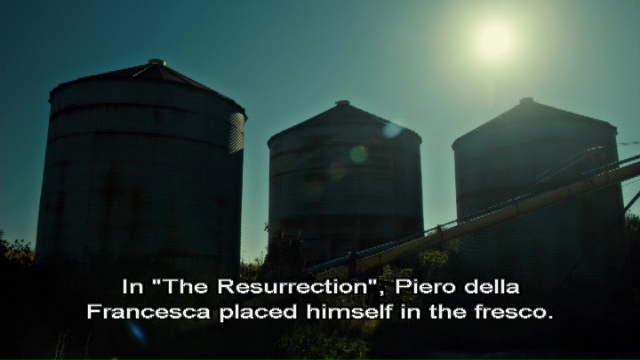
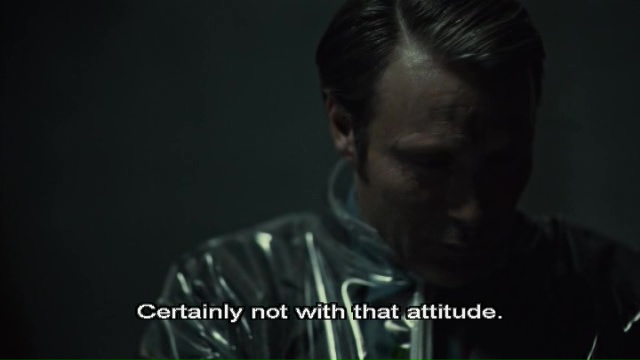
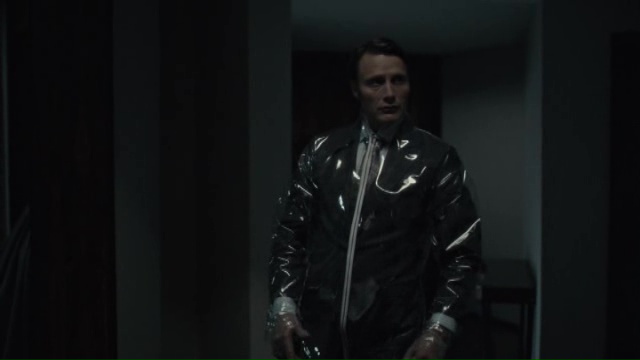
Hannibal figures out where there is a suitably private abandoned silo, near a cornfield, and near the river where the bodies were dumped. We see him surveying the area, wearing his killing suit (because dry cleaning is so expensive)
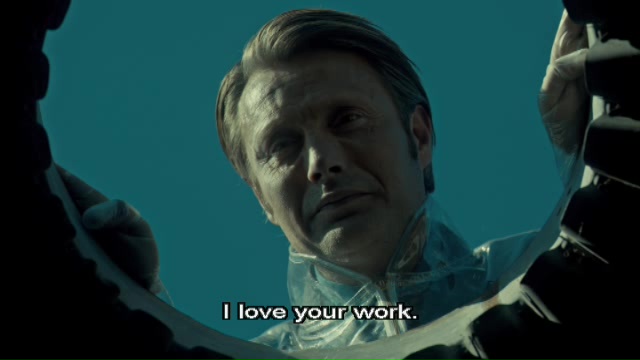
He climbs on the roof, where there is a small opening, through which the “eye” can look up at God. When the killer appears, Hannibal greets him.
The FBI find the crime scene, thanks to Will’s advice, but now the killer is stitched into it. In the silo full of bodies, Jack and Hannibal engage in some philosophical speculation:
Jack: How does a human being go so bad.
Hannibal: when it comes to nature versus nurture I choose neither. We are built from a DNA blueprint and born into a world of scenario and circumstance we don’t control.
Jack: Praise the mutilated world, huh? [This is a reference to a New Yorker poem after 9/11].
Jack: Ritual human sacrifice.
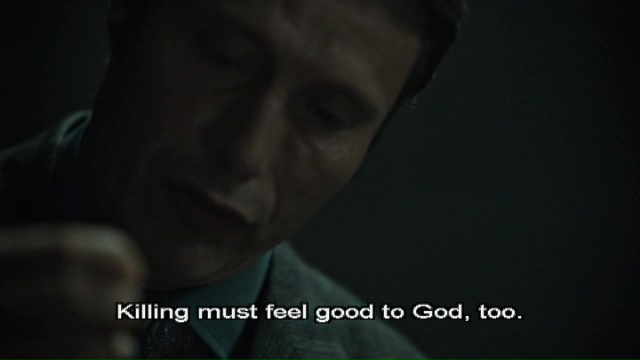
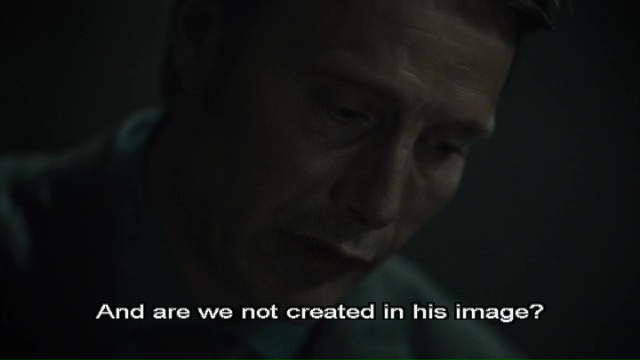
Hannibal: I’m not sure if it’s an offering but it’s a gesture. The eye looks beyond this world into the next and sees the reflection of man himself. Is the killer looking at God?
Jack: Maybe it’s some sick existential crisis.
Hannibal: If it were an existential crisis I would argue there wouldn’t be any reflection in the eye at all.
Jack: you say he doesn’t see people. He sees material.
Hannibal: Those in the world around him are a means to an end. He uses them to do what he’s driven to do.
Jack immediately sees his own reflection – he was using Will to do what he was driven to do [saving lives, which is not really the worst possible sin, but he’s still beating himself up about it].
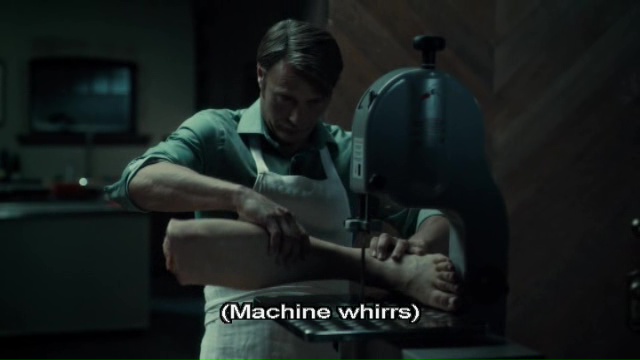
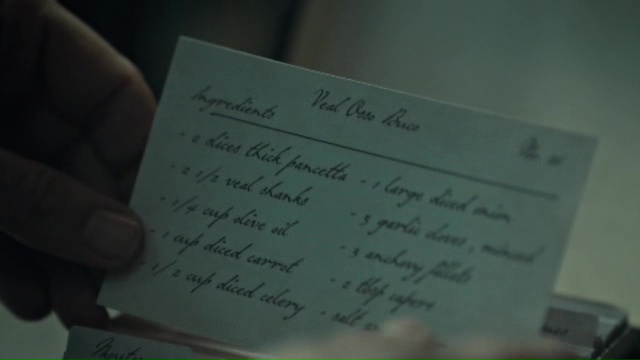
They haven’t really figured out that the last victim is the killer, but they do manage to notice that he is missing a leg. Only Hannibal knows where that leg is. We see him cutting off the foot with an electric meat saw, to Beethoven’s 9th, and converting the shank into a nice Osso Buco.
Will does his visionary thing for Beverley and realises that the killer’s body doesn’t belong.
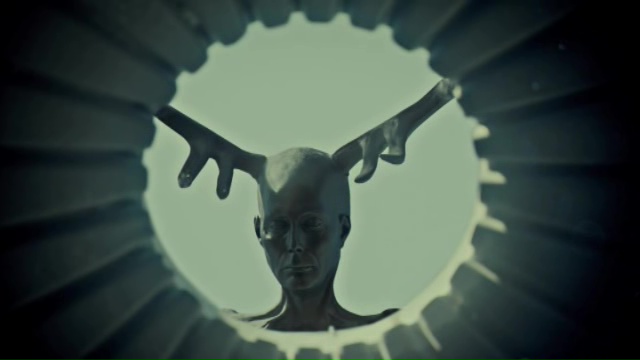
He sees stag-man looking through hole in the roof, but the eye remains fixed and unseeing, unless someone else sees him. That someone will be Hannibal.
Will sees himself being sewn onto the eye by Hannibal. He remember Hannibal’s words from Season 1, episode 2:
We see what really happened: Hannibal is cooking up heroin, reassuring the killer with classical references (because it’s comforting to know there is a Renaissance painting allusion available when someone is sewing your skin to some corpses).
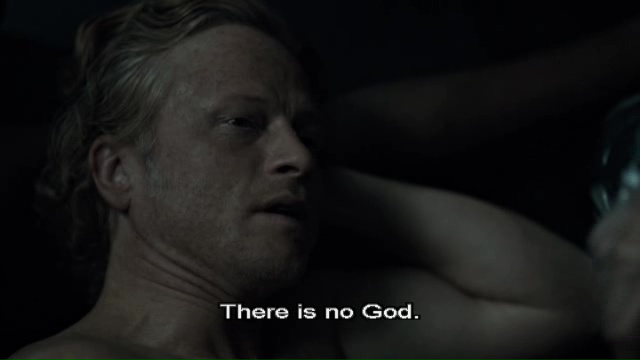
Why is the killer lying there letting Hannibal get on with his needlepoint? Well, it involves a religious crisis.
Hannibal tells him:
“God gave you purpose – not only to create art but to become it…. Your eye will now see God reflected back. It will see you.”
Hannibal is well aware of Nietzsche’s concept that “God is dead” and that we, humanity, killed him, and therefore need to replace him. Hannibal is now looking down at the dying killer:
Hannibal has done what he believes is best – finished the killer’s artwork, made him a part of it, given it a sacred content. Bedelia visits Will and tells him the same thing:
It may be small comfort, but I am convinced that Hannibal has done what he honestly believes is best for you.
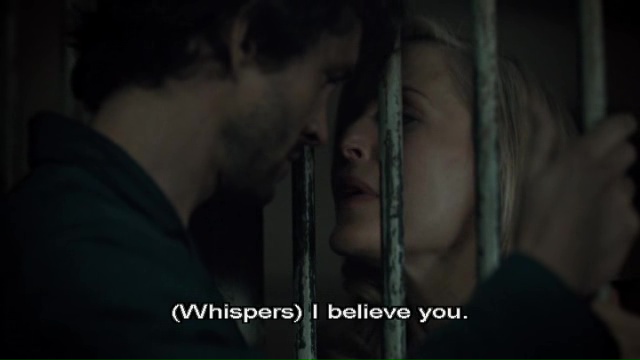
She whispers to Will:
Will’s doubts about Hannibal have been dissolved. Now there will be a reckoning.
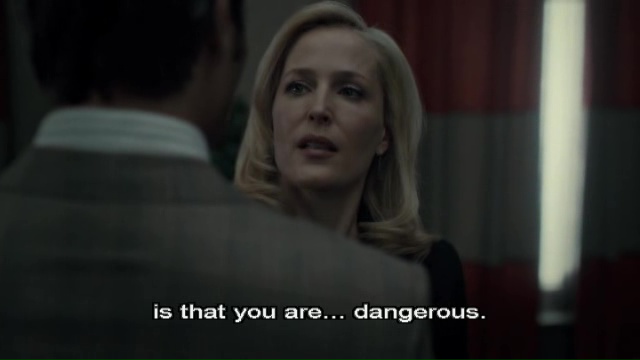
Speaking of reckonings, Hannibal is back in his killing suit in Bedelia’s house – but the furniture is covered – she is gone. She’s left him a bottle of scent and he hears her words “you are dangerous”.
No shit, Bedelia?
IF YOU LIKE MY BLOG, PLEASE FEEL FREE TO RECOMMEND IT (WITH DISCRETION) TO FRIENDS ON SOCIAL MEDIA.
IF YOU HAVE ANY QUESTIONS OR COMMENTS, YOU CAN USE THE TAG, OR EMAIL ME ON CANNIBALSTUDIES@GMAIL.COM.
The season finale of a show usually ends (or certainly should end) with a gut punch that leaves us reeling and also wanting more, counting the moments until the next season. Certainly happened at the end of Season 1, with Will suffering severe encephalitis, causing him to lose large tracts of time, framed for murder, shot by Jack Crawford, and confined in the Baltimore Asylum for the Very Very Nervous. Hannibal has put Will through the wringer, hoping that this will purify him, enable him to become an Übermensch, like Hannibal.
The becomings are not the only Nietzschean aspects of this episode. Amor fati is love of fate – the acceptance that everything that has happened will happen repeatedly. Or perhaps Hannibal’s interpretation is more along the lines of the space-time continuum – we know he likes watching Stephen Hawking’s videos – everything that has happened and will happen is fixed as it was and as it will be.
In any case, the episode begins where the series will end; an epic battle between Jack and Hannibal, and then goes back in time:
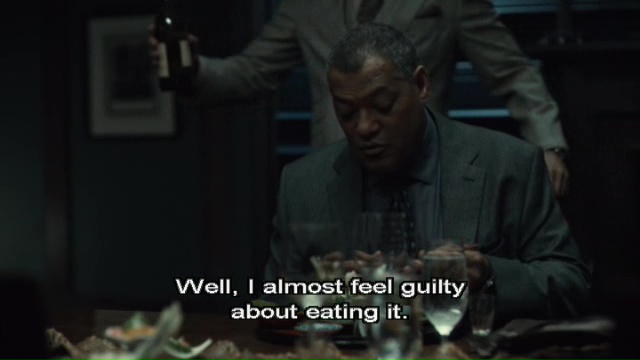
It’s just after Will’s arrest, and Jack is feeling guilty about all sorts of things. Breaking Will, which resulted, he thinks, in the murder of at least five people. And also guilty about eating the exquisite Japanese meal Hannibal has lovingly prepared: Mukozuke – seasonal sashimi, sea urchin, water clam and squid. The presentation is Kaiseki – a Japanese art form that honours the taste and aesthetic of what we eat (and is the name of this episode). It is the last meal Hannibal prepared for his aunt, Murasaki (lots more about her when we get to the final Hannibal movie, real soon now – Hannibal Rising and, who knows? Maybe Hannibal Season 4?)
Hannibal, of course, never feels guilty about eating anything. Why should he? Other humans are just “elements undergoing change to fuel his radiance” (Red Dragon p.121). We are only prawns in his game.
Will has accused Hannibal of being the Chesapeake Ripper (not without justification, since, well, he is) but Jack is feeling guilty about that too. Hannibal, totally confident, eases his mind:
Will can project himself into his happy place – fishing in the river. But even in this vision, there is Hannibal, in the shape of the hybrid human/stag.
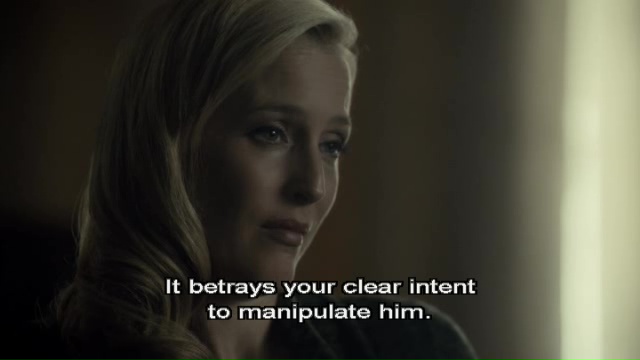
Meanwhile (as Stephen Colbert would say) Bedelia is still analysing Hannibal, which is like a mouse chasing a cat. She believes that Will is trying to manipulate Hannibal. If Hannibal agrees to visit Will, though:
Hannibal admires Will’s insight into himself: “he sees his own mentality as grotesque but useful. Like a chair of antlers. He can’t repress who he is.”
The answer? Just one of those Hannibal Mona Lisa smiles.
Will tells Hannibal he used to hear his thoughts in his own voice, but now
Hannibal just wants Will to use that voice to find himself, and what he can become. Will wants to find what thoughts Hannibal planted in his head
Hannibal gives his DNA sample, wonders when his suits will be cleared from the evidence room. Beverley tells him
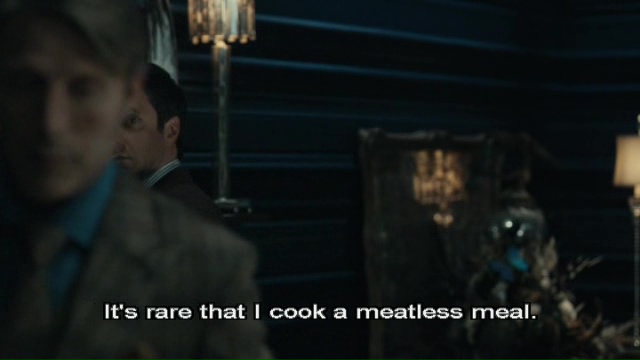
Alana tries to hypnotise Will to get his memories back, but he has a vision: he is sitting at a table covered with Hannibal’s meals. Stag-man is sitting at other end. On Will’s plate – Abigail’s ear. Hannibal finds out from Chilton, who has been secretly recording the sessions (as he did to Clarice in Silence of the Lambs). Hannibal has, to his own surprise, cooked a gourmet vegetarian meal for Chilton, who is missing a kidney from last season.
Meat is expensive. Hannibal has a very affordable source though.
Chilton tells Hannibal that he is the sole topic of Will’s conversations:
Oh, there’s also a dude who is busy killing people and sewing them together, because we always need a bigger monster – makes our own monsters seem much nicer somehow. We’ll get to him next episode (although he’s not really a cannibal, so we’re not going to give him much time).
Will remembers Hannibal stuffing Abigail’s ear down his oesophagus. Now he’s sure he didn’t kill and eat her. Jack comes to visit, but refuses to listen to Will’s certainty about Hannibal.
A bit more guilt for Jack. A bit more fun for Hannibal.
IF YOU LIKE MY BLOG, PLEASE FEEL FREE TO RECOMMEND IT (WITH DISCRETION) TO FRIENDS ON SOCIAL MEDIA.
IF YOU HAVE ANY QUESTIONS OR COMMENTS, YOU CAN USE THE TAG, OR EMAIL ME ON CANNIBALSTUDIES@GMAIL.COM.
It is quite extraordinarily, in retrospect, to realise that this 2001 film was the first Hannibal Lecter film to be about Hannibal Lecter. He was very much a bit player in both Manhunter and Red Dragon (both based on the book Red Dragon) – he was in an asylum and visited occasionally by Will Graham, desperate for a clue as to the identity of the serial killer the FBI was hunting. The movie that made him a household name, The Silence of the Lambs, saw him still in that Baltimore Asylum for the Criminally Insane, but now he was a major figure, even though only on screen for a bit under 16 minutes. But very good minutes they were (he won the Oscar for it, and the film won five in total) and, importantly, we saw him escape, to rejoin us, the viewers, in the breathing world, as we crept, with wide eyes, back to the dark parking lot of the cinema after the credits had rolled.
“I need to come out of retirement and return to public life.”
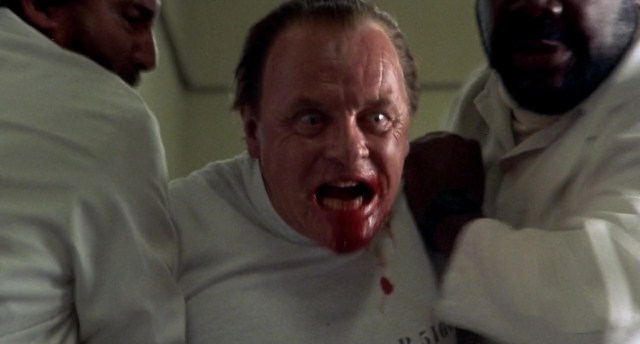
In Hannibal, he is free, and doing what he loves best – being an expert on Renaissance art and poetry in Florence, drinking fine wines, and occasionally eating people. But, as in the previous movies, and in the TV series, Hannibal takes his sweet time before he actually appears on screen. His image appears at 24 minutes: an archive video of him attacking a nurse who was careless with his ECG (any comments on why he attacks the nurse would be appreciated. It seems out of character for Hannibal: discourteous even).
His voice appears at 28 minutes, and his person at 30. Hannibal never rushes things. Instead, the film starts with Hannibal’s nemeses: Mason Verger, intent on revenge and plotting to capture Hannibal and feed him to his pigs, and of course Clarice Starling, her career in tatters due to a combination of law enforcement ineptitude and toxic masculinity working to bring her down. She is caught on the news shooting a woman with a baby, even though that woman was a drug dealer who was shooting at her.
Her only possible way to reinstate her career will be to work with Verger to capture Hannibal.
This wasn’t an easy film to make – sequels rarely are, particularly when they are following a film that did a lot better than anyone expected. And this film was made ten years after Silence, so there was a huge, pent up demand. There was also the brilliant book from Thomas Harris on which this was based; it had come out two years previously, and many, including the director of Silence, Jonathan Demme, the screenwriter, Ted Tally, and the star, Jodie Foster, considered the plot a bridge too far. All three declined to be involved in the new film. Lucklily, Anthony Hopkins was ready to get back in the saddle, so the film proceeded – without him, it would seem to have been unlikely.
So, sad not to get Demme back to direct, but hey, Dino di Laurentiis found a substitute: the brilliant Ridley Scott (Alien, Blade Runner, Thelma and Louise), who had just finished Gladiator and at first declined the script, as he thought it was another ancient history epic, and didn’t want to have to direct elephants crossing the Alps. Oh, it’s about a cannibal in Florence? OK then. The screenplay was first drafted by Pulitzer Prize winner David Mamet and then written by Steven Zaillian (Schindler’s List). And instead of the incomparable Jodie Foster, he chose, from a list of the greatest actors of the time, Julianne Moore, apparently the recommendation of Hopkins. di Laurentiis said of Jodie Foster’s refusal to take part: “when the Pope dies, they get a new Pope”. So it was off to a rollicking start.
Then there’s the supervillain. In Hannibal movies, there is always a much worse monster for us to hate, giving us licence to like Hannibal that much more. In this case, it is Mason Verger (Gary Oldman), heir to a huge fortune built on the cruel pork trade, a sadist and child molester in his youth.
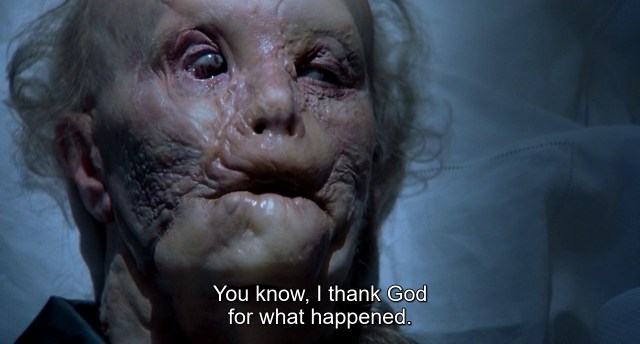
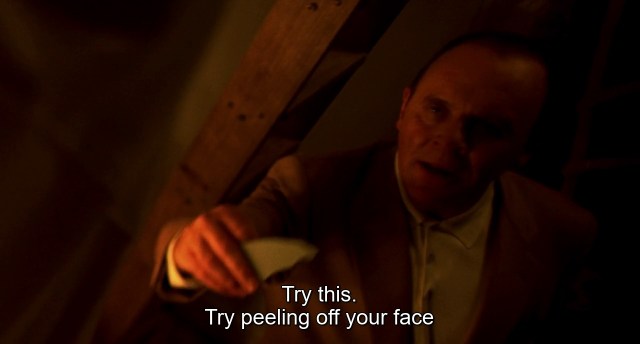
He is the only surviving victim of Hannibal: instead of killing him, Hannibal got him whacked on psychotropic drugs and suggested that he slice his own face off and feed it to the dogs. In the book, this is explained: Mason had adopted two dogs who were good friends, and put them in a cage with no food, to see if they would turn to cannibalism. Gratuitous cruelty and cannibalism – not what Hannibal is about at all. Hannibal’s cannibalism contains a nugget of justice. As the Asylum orderly Barney tells Clarice:
He told me that whenever feasible, he prefers to eat the rude. Free range rude, he called them.
Incidentally, Barney is portrayed by Frankie Faison (The Wire) who is the only actor to appear in all four Hannibal films up to this one.
Hannibal manages to communicate with Clarice throughout the film, usually by letter or phone call, explaining his point of view and questioning why she continues to serve her corrupt and venal masters.
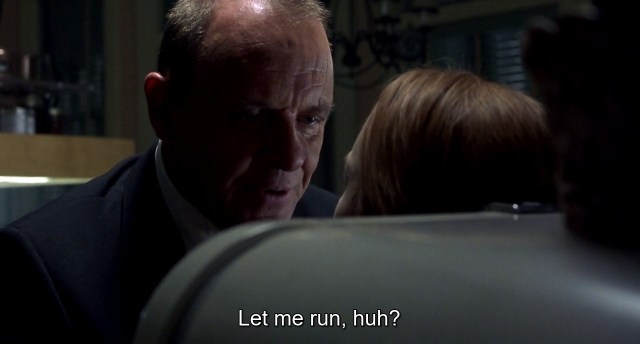
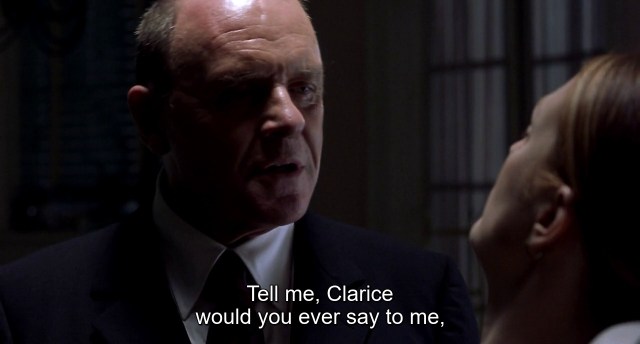
Tell me Clarice, would you want to harm those who have forced you to consider it though? It’s perfectly OK to feel this. It’s perfectly au naturel to want to taste the enemy. It just feels so good.
The camera lingers lovingly on Mason’s disfigurements: according to the DVD, Oldman spent six hours each day in makeup to make him so lovable. Hopkins, on the other hand, did not bother with makeup for this movie, allowing his advancing years and natural pallor to tell the story of the years since his escape.
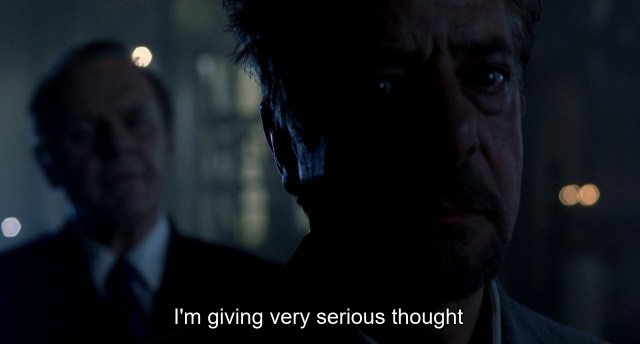
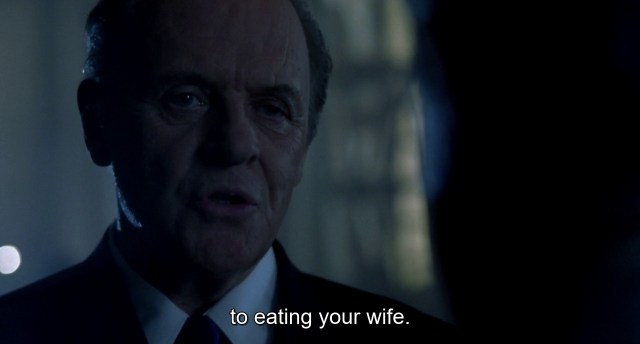
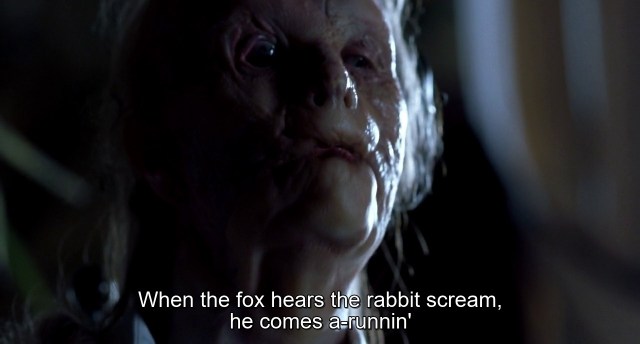
With Hannibal, there is always the question of who is the cannibal. In Red Dragon, was it Hannibal in his cell or Dolarhyde collecting movies of women he had killed and raped? In Silence, was it the same Hannibal in the same cell, or Jame Gumb, killing and skinning women to make a vest with tits? In this one, is it the Renaissance scholar Hannibal seeking a job as curator of the Capponi library or Inspector Pazzi (Giancarlo Giannini), threatening a local pickpocket into ambushing Hannibal, hoping to sell Hannibal to Verger to be fed to his pigs? The pickpocket loses his femoral artery to a small knife that Hannibal keeps in his sleeve. He dies, but Pazzi gets the fingerprint he needs for the deal to go ahead and in a scene full of Catholic symbolism, washes his bloody hands in the fountain of Il Porcellino, a porcine reference to the greed of Judas and the cowardice of Pontius Pilate, as well as a foretaste of the pigs who have been bred to eat Hannibal. Verger and his thugs get the pigs flown to the US and primed to eat humans (pigs usually prefer not to). Pazzi later gets from Hannibal the same treatment his treasonous ancestor received in Florence 500 years earlier – hanging from the window with his bowels protruding. But not until Hannibal has offered the line of the movie:
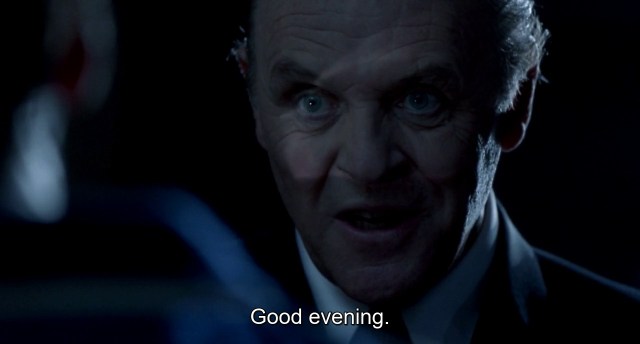
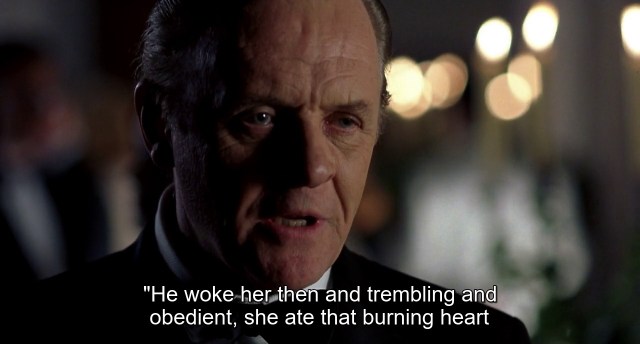
Hannibal has met Pazzi’s wife, Allegra (Francesca Neri), at the sublime opera of Dante’s sonnet A ciascun’alma presa from Vita Nuova, which Hannibal and Allegra recite to each other meaningfully, all about Beatrice eating Dante’s heart, and clearly referencing Hannibal’s growing obsession with Clarice.
In a scene that reveals both Pazzi’s desperation to make Allegra happy, including risking his career and life to capture Hannibal, and Hannibal’s own burning love for Clarice, she asks him:
Allegra: Dr Fell, do you believe a man could become so obsessed with a woman from a single encounter? Hannibal: Could he daily feel a stab of hunger for her and find nourishment in the very sight of her? I think so. But would she then see through the bars of his plight and ache for him?
Dante and Beatrice were nine years old when his obsession with her started. Hannibal’s obsession with Clarice started at a more mature age, but burns just as brightly.
The music, Vide Cor Meum, is by Hans Zimmer (Lion King, Gladiator, the Dark Knight trilogy and heaps more) and is so beautiful that it is used again in the TV series Hannibal, in the season finales of both the first two seasons. As she leaves with Pazzi, another couple brush past saying “let’s get something to eat!” Hannibal mutters to himself, and to us, “why not?”
Verger understands that the way to trap Hannibal is by threatening Clarice, and pays Paul Krendler (Ray Liotto), the man who has conspired to destroy Clarice’s career since she first rebuffed his advances, to fabricate evidence of collusion with Hannibal.
“But not to help…”
She is suspended from the FBI. Hannibal goes shopping for fine furniture, and burglaring for medical equipment. He breaks into Clarice’s apartment in DC, where she has drunk herself to sleep, and leaves a collage of her face on a fashion shoot in a magazine. The game is afoot. He leads her to Union Station where he engages her in a discussion of her life, her future, and why the forces of the law, the law she loves and respects, have totally betrayed her.
Why are you so resented? You serve the idea of order, Clarice. They don’t. You believe in the oath you took. They don’t. You feel it is your duty to protect the sheep. They don’t.
As he leaves, Verger’s Sardinian hit-men hit him with a tranquiliser dart and drive him off. Now who will save whom?
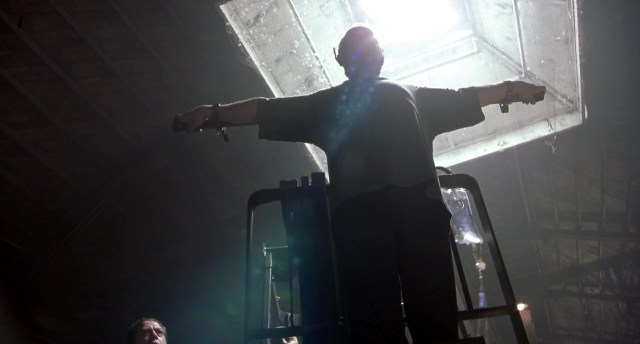
Hannibal is strapped to a forklift in a crucifixion position, his feet are to be fed to the pigs, then he is to be kept alive for several hours until the rest of him is given to them. She cuts him loose, leading to one of the funniest exchanges in the film.
Clarice can deal with most of these thugs, but is shot while rescuing Hannibal, who picks her up and walks through the hogs. They leave him alone – since they cannot smell fear on him. He arranges for Verger’s helper to push the furious billionaire into the pig pen. Dinner is served.
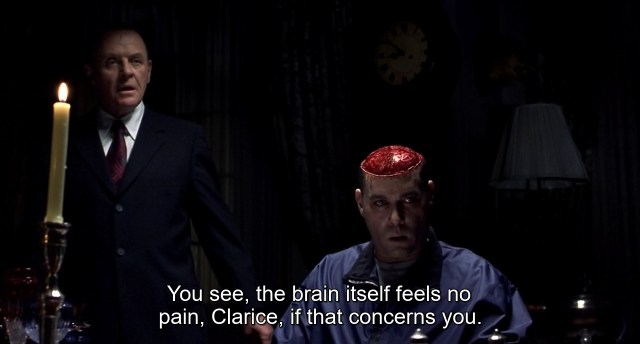
Krendler returns to his lakehouse, but Hannibal is already there. So is Clarice; Hannibal has removed the bullet and she is sedated. She wakes dressed in full evening gown and high heels and staggers downstairs where, in the most famous scene of the film, Hannibal has sawn Krendler’s cranium off, and is preparing to serve his brain. Of course, the brain has no pain receptors on its surface, so Krendler is awake and joins the meal.
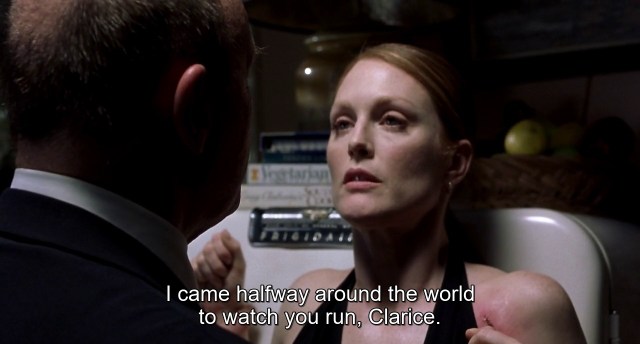
Most of this is fairly true to the book. Only the ending was changed, apparently to appeal to those whose morality could stand seeing a man eat his own brains, but not to seeing Starling, so long an honest cop, go over to Lecter’s side – the side of cynicism about authority and enjoyment of the finer things of life. Instead, she rebuffs him and with her remaining strength tries to stop the dinner, and then the escape. She hancuffs the two of them together, Hannibal goes to bite her, then to cut off her hand, but it is he that leaves minus one. That’s love.
But then, there is the single tear – does she regret the opportunity to dance with the devil?
I admit to preferring the story the way the author wrote it in the book. I think Hannibal would have too. Read the book and you will see that is the perfect denouement to the Hannibal saga. I think they compromised on the end to avoid controversy (although they did get away with feeding Krendler his own brain, so they weren’t totally devoid of courage).
I suspect that the idea of amputation of his hand came from Sir Anthony Hopkins, who had starred in Shakespeare’s Titus only two years earlier, in which he cuts off his hand, and his daughter suffers a worse fate involving both hands and her tongue. [I nearly said Hopkins had a hand in the decision, but I restrained myself].
Titus is also a cannibal movie, by the way. You can read my blog about it at Titus.
Why does Hannibal eat people? Clarice speculates on this earlier in the film, while she is still on the case, as Krendler asks her what she’s doing sitting in the dark.
Thinking about cannibalism. Aren’t you curious why he dines on his victims? To show his contempt for those who exasperate him. Or sometimes to perform a public service. In the case of the flutist, Benjamin Raspail, he did it to improve the sound of the Baltimore Philharmonic Orchestra, serving the not so talented flute player’s sweetbreads to the Board with a nice Montrachet at $700 per bottle.
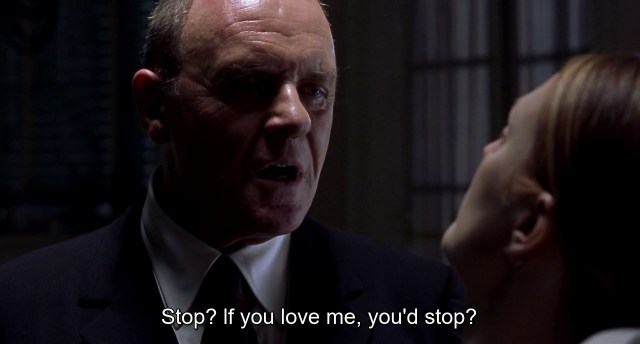
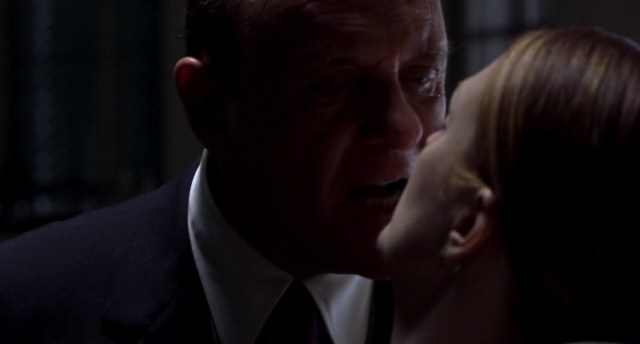
Yes, Clarice, quite right. But also, like any cuisine, it’s a habit, or a preference. Hannibal simply cannot see any reason not to eat people, particularly rude ones. In the final scene, he offers to give it all up for her:
BTW: note the books on Krendler’s fridge: Southern Cooking and Vegetarian Times. Our ethical choices: what we consider right, or what we consider delicious. Hannibal, unlike everyone else, makes his choices without hesitating. He considers them the same thing.
IF YOU LIKE MY BLOG, PLEASE FEEL FREE TO RECOMMEND IT (WITH DISCRETION) TO FRIENDS ON SOCIAL MEDIA.
IF YOU HAVE ANY QUESTIONS OR COMMENTS, YOU CAN USE THE TAG, OR EMAIL ME ON CANNIBALSTUDIES@GMAIL.COM.
The finale of season one is named after what is usually the last course on a French menu – no, it’s not sweet, it’s ‘savoureux’ meaning savoury, and is defined as “a dish of pungent taste, such as anchovies on toast or pickled fruit”. If you didn’t know that (I didn’t), we can be confident that Hannibal did.
This is a final course, and with ratings being king in the TV industry, it was never certain that the show would be renewed (it was, tragically, cancelled after season 3) so this is a final of sorts, and not a sweet one.
It starts with Will trying to shoot a stag, chasing the bleeding animal through the undergrowth in thick night, only to come face to face with the stag-man, who we (but not yet Will) know represents Hannibal. He wakes up covered in sweat and panting (which seems, from all evidence, to be the only way Will ever wakes up), and finds his feet covered in mud. Will’s fevered imagination is starting to control his reality. Reality doesn’t get any better though, as Will throws up in the sink and finds, not last night’s beer and prawns, but a human ear.
He calls the only person he can trust, the only person he shouldn’t – Hannibal Lecter. Jack arrives and arrests him. It’s all downhill from here, Will. The ear is Abigail’s, and so is the blood under his fingernails. Will even believes it himself; according to the evidence:
Alana is furious at Jack for leaving Will out there when everyone could see he was breaking, but Jack replies that every decision he made about Will:
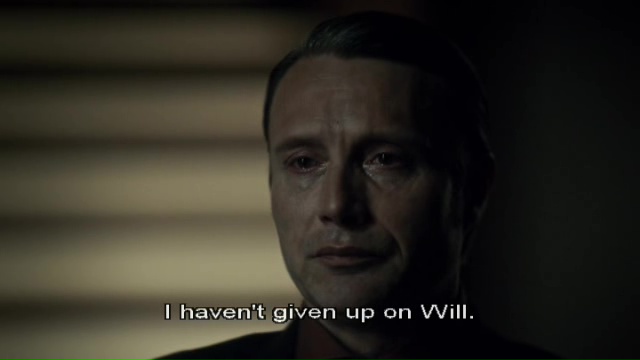
That would be Hannibal. Whom Alana recommended. Well played. But Hannibal is torn up about Abigail and Will, or at least he tearfully tells his psychiatrist that he is. Hannibal wants a family, with Abigail as the child, replacing the sister who was eaten at a tender age. In framing Will for the murder of Abigail, he has seemingly lost that chance.
Of course, with Hannibal, nothing is ever that simple. Like a good chess player, he is always several steps ahead of his opponents, but his game is not chess but becoming – he wants his protégés to become like him, or as much like him as possible. But he has real tears in his eyes. To become, they must go through challenges that may kill them. And as a Nietzschean, he knows the theory of amor fati – literally the love of fate. The death that so scarred him as a child, his little sister, will recur, again and again. Hey, no one said being an Übermensch is easy. He really was hoping this family thing would turn out. Maybe he still is.
He tells Bedelia his philosophy – and a very Nietzschean, anti-metaphysical one it is.
But Will has been arrested, and escapes (surprisingly easily) from the ambulance taking him to the asylum for the criminally insane. Who would have thought such a vehicle would need better security than a pair of handcuffs? He runs to – of course – Hannibal, telling him that he would have believed he might have killed Abigail, but no, not all the others. Hannibal plants the seed of doubt back into Will’s head, but Will wants to go to see where Abigail died.
They go back to the scene where Hobbs first tried to kill Abigail, and Hannibal points out that they haven’t found the body – except for the ear. He tells Will that if he was acting as Hobbs, they may never find the body – Hobbs used to eat his victims.
But Will has taken one of his intuitive leaps that made him so sought after in the FBI. He knows he could have killed Abigail, but
He knows it was Hannibal. And Hannibal knows Will is on the precipice of becoming.
Will pulls a gun on Hannibal. His greatest anger is not due to his realisation that Hannibal is the murderer, or that Hannibal has framed him. It’s that he realises Hannibal’s motives
Jack arrives and shoots Will, in the very same corner of the very same kitchen where Will shot Hobbs. And Will mutters the same words Hobbs said to him, with the stag-man looking on.
Hannibal sums up, as usual in a way that no one will fully understand.
We are all becoming. He visits Bedelia, but not empty handed
It’s a veal dish, and Bedelia makes the usual comment that veal draws among those whom Hannibal would consider less than enlightened
But Bedelia sees more than she lets on.
But right now, as Hannibal goes to visit Will in the Baltimore Asylum for the Criminally Insane, he has everything just the way he wants it. The background music is the opera from Hannibal (the movie). Will now knows who Hannibal is, and is using his title respectfully.
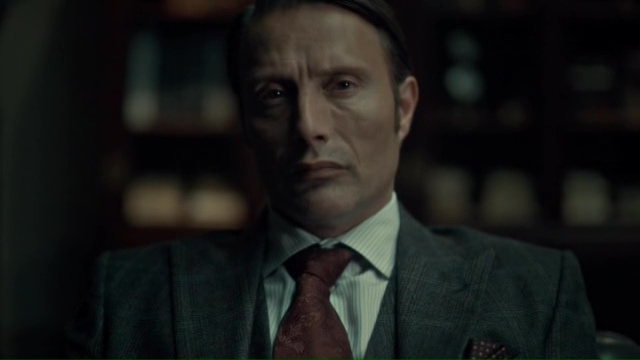
Hannibal’s face at the end of the season is ‘savoureux’.
IF YOU LIKE MY BLOG, PLEASE FEEL FREE TO RECOMMEND IT (WITH DISCRETION) TO FRIENDS ON SOCIAL MEDIA.
IF YOU HAVE ANY QUESTIONS OR COMMENTS, YOU CAN USE THE TAG, OR EMAIL ME ON CANNIBALSTUDIES@GMAIL.COM.
This episode is called “Relevés”, an obscure term in the French menu – it comes sort of after the main course, but is not the Rôti (roasts) of episode 11; this one is joints – big butcher joints, served with heavy accompaniments and garnish. Appropriate for a meaty episode, in which Hannibal takes steps not just to cover his own tracks, but to lay a path of suspicion to Will, who has been behaving very strangely lately, thanks to his encephalitis (which Hannibal has also covered up). The real meat of this episode, though, is its treatment of mental illness – where it starts (physical and/or psychological) and how it develops, and the paucity and inadequacy of treatments.
At the start of the episode, everyone is starting to recover. Georgia Madchen, who killed her friend and witnessed Hannibal killing the doctor who knew about Will’s condition, is in an oxygen tank, awaiting shock treatment which may restore her memory.
But she doesn’t want to remember.
Hannibal has brought Will one of his gourmet concoctions: “Silkie chicken in a broth: a black boned bird prized in China for its medicinal value since the seventh century. Wolfberries, ginseng, ginger, red dates and star anise. Will’s bemused response, as though Hannibal was his Jewish mother, making chicken soup to treat a psychic crisis that just seems to get worse:
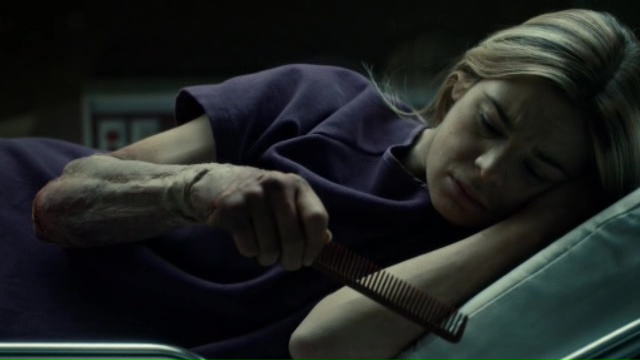
Hannibal also does not want Georgia to recover her memory, because he is vulnerable, even if she was unable to see his face. She wakes up in her oxygen tent and finds a plastic comb, naturally, she starts to comb her hair, and naturally the static creates a spark that ignites the oxygen.
So that leaves Abigail as apparently the only one who could spill the fava beans on Hannibal. She is busy writing her book with Freddie Lounds, who tells her she knows what killers look like
She looks for a specific brand of hostility. She sees it in Will Graham, every time she looks at him. Very convenient for Hannibal. But Will has released himself from hospital, and is starting to realise that the spate of copycat deaths are all the same, but slightly different, to the murders they copied – the copycat killed all of them, including Georgia, who saw his face. Will is furious that Georgia was misdiagnosed and misunderstood her whole life, and doesn’t want the same thing to happen with her death, which Jack is treating as suicide.
Will’s vehement reaction worries Jack, who consults Hannibal, allowing Hannibal to plant the seed of suspicion: does Will suffer from a mental illness that would allow him to do things he doesn’t normally do?
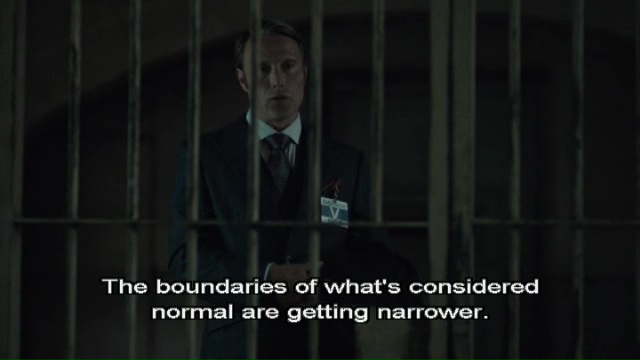
That’s true for Will, but even more true for Hannibal, who sees himself as a species apart from the common herd, an Übermensch, who has cast off normative humanism for his own ends, which we are yet to understand.
Will is visiting Abigail in hospital. They discuss the nature of killing. Will admits killing her dad was terrifying, but then made him feel powerful. She replies that
She wanted to escape, but Will is doubtful
Her dad is still out there, in the form of the copycat. Will thinks he can catch him,
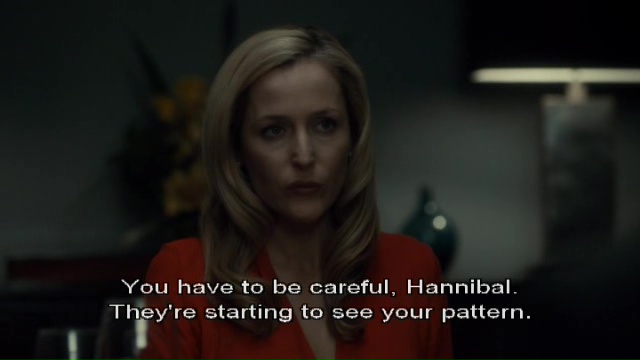
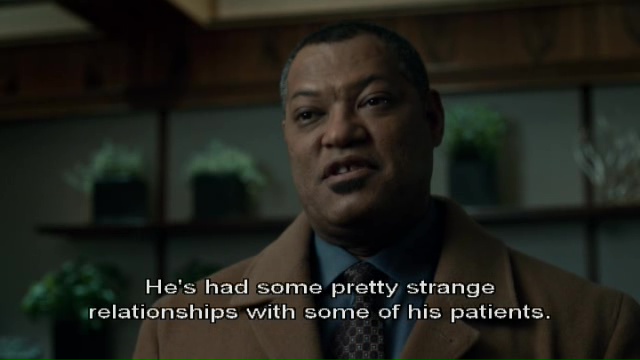
Jack has been visiting Bedelia, who has covered for Hannibal (as any professional psychiatrist would) and has been asking about a case in which a patient, referred to her by Hannibal, tried to kill her, but luckily died by swallowing his own tongue ( a reference to Multiple Miggs in Silence of the Lambs). Hannibal, Jack points out,
30
Hannibal asks what she told Jack?
She doesn’t know quite what Hannibal is trying to do with Will (it seems to us, the omniscient spectators, that he wants to turn Will into a clone of his own powerful self)
Will is thinking clearly again, he tells Hannibal, and starting to understand the copycat killer that so baffles the FBI. Georgia was killed for seeing the killer, who ended up framing her for it, but
Now it’s personal. Will realises it could be someone at the FBI or the police. He doesn’t, however, realise what we realise, that he is in the same room with the killer. Like a pantomime, we feel like shouting at the screen: look behind you! But we don’t, because we don’t have interactive TVs (yet), and also because we like Hannibal, and don’t really want to see him unmasked (yet). But Will’s clarity, and Abigail’s book, are both threats to Hannibal. And he has only one episode of Season 1 to neutralise them.
Fortunately for Hannibal, everyone is on the wrong scent. Jack is still convinced Abigail is the killer, while Freddie is still convinced it is Will, and tells Jack so.
Will takes Abigail out of the hospital, back to the crime scene – her home in Minnesota. Jack is furious and goes to see Hannibal, who admits to Will’s confused mental states, where he loses time and doesn’t know what he has done. He plays Jack a selected section of the recording of his discussion with Will about the murder of Melissa Schurr.
Together with Hannibal’s revelations about Will’s mental state, Jack is starting to suspect Will.
Will had told Hannibal, who hadn’t told Jack, that he was getting so close to Hobbs that
Now he has Hobb’s daughter, who Hobbs intended to kill. Jack fears the worst. As for Hannibal:
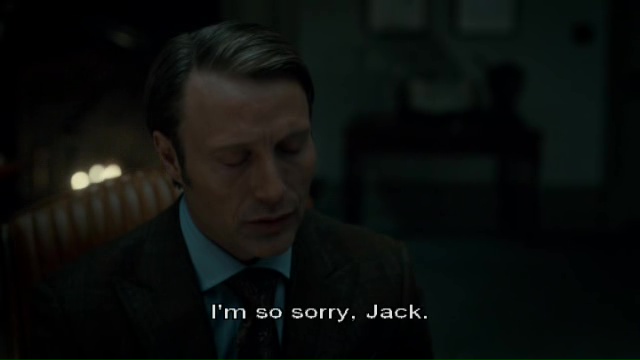
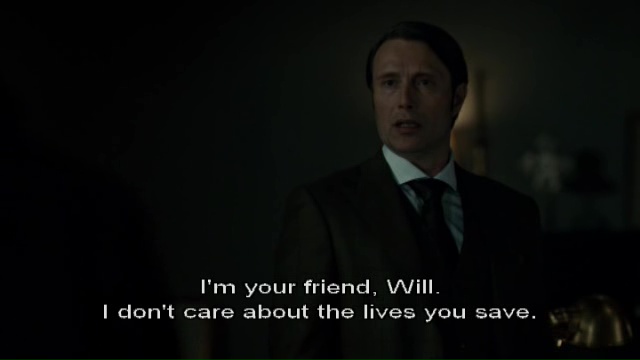
Hannibal is sorry, but not, as Jack thinks, for hiding the “truth” about Will’s mental state. He is truly sad and sorry, for losing his friend, his only friend, feeding him into the jaws of the justice system.
Why does Hannibal do these things? Abigail asks him, and he tells her the truth, at last. He called the house to warn Hobbs they were on their way. Why? she demands. And this is crucial to an understanding of Hannibal:
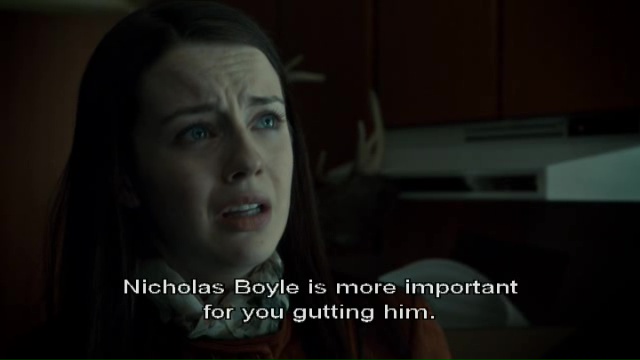
He killed Marissa, hoping that Abigail would kill the victim’s brother. Abigail is another of his projects
Hannibal believes, as Dolarhyde says in Manhunter, that the people who are killed in these becomings are not real: “You alone know the people I use to help me in these things are only elements undergoing change to fuel the radiance of what I am Becoming. Just as the source of light is burning.” Abigail’s Becoming is far more important than Nick Boyle. But Abigail is scared of Hannibal now: he tells her that he has killed far more people than her father.
Will he or won’t he?
Next episode – the season finale.
IF YOU LIKE MY BLOG, PLEASE FEEL FREE TO RECOMMEND IT (WITH DISCRETION) TO FRIENDS ON SOCIAL MEDIA.
IF YOU HAVE ANY QUESTIONS OR COMMENTS, YOU CAN USE THE TAG, OR EMAIL ME ON CANNIBALSTUDIES@GMAIL.COM.
We’re finally at the main course of this extended French banquet that makes up the episodes of Season 1. This episode is called Rôti, which means roast. The dead animals are coming out of hot, dark ovens, cooked, carved, and being eaten. And the accompanying sauce is a healthy dose of Existentialism, Hannibal Lecter style.
This episode is all about identity, and identity is all about existence: what is real, what exists and how can we be sure? Here is Sartre’s view of existence from the novel Nausea: the character who sees himself usually as a man named Roquentin, sitting under what seems to be a chestnut tree:
…the diversity of things, their individuality, were only an appearance, a veneer. This veneer had melted, leaving soft, monstrous lumps, in disorder — naked, with a frightful and obscene nakedness.
Roquentin concludes “My existence was beginning to cause me some concern. Was I a mere figment of the imagination?”
Most of the characters are losing their footing in this episode, and some are losing all touch with reality.
Abel Gideon has lost touch with his identity. Thanks to Dr Chilton’s “psychic driving”, Gideon came to believe he was the Chesapeake Ripper. Of course he isn’t – that’s Hannibal, and Hannibal is none too pleased to have someone else take credit for his ‘work’. Hannibal discusses the situation with Chilton over dinner: Kudal, a sheep gut curry. Lots of useful metaphors in this dish – guts because we are getting inside all the characters at last, and sheep? Well, sheep are used (rather unfairly IMHO) as allegories of blind obedience – going where the leader goes, following without question. Chilton thinks psychic driving is something of this sort – lead the patient to the conclusion you have already drawn.
Hannibal points out that Gideon was an ideal patient to be manipulated:
Chilton suggests Gideon is a psychopath, but Hannibal squashes this idea:
So, if Gideon is not really a psychopath, he is just a common killer, a domestic violence offender who went over the edge into serial killer. Chilton told him he was the Ripper. Alana then told him he was not in a state of mind to know who he was.
Chilton feels like his is going to be blamed (especially since Gideon is planning to sue him). Gideon escapes, as he is hoping to attract the real Ripper, who, he hopes, will tell him who he really is, but Will understands that the Ripper will kill Gideon, for taking credit for his ‘work’.
Realising Gideon is not the Ripper, Chilton just wishes he had been more curious about how common minds work. Hannibal replies:
Thus, the sheep’s gut curry.
The psychic driving didn’t work as hoped, Hannibal tells Chilton, because, once a patient is exposed to the methods of manipulation, he will push back.
Will Graham is not aware of Hannibal’s manipulation, or of his now chronic encephalitis. He is having nightmares about water: tsunamis of water at crime scenes, melting clocks à la Dali, hallucinations of water pouring down the walls in the BAU. He imagines Jack is accusing him, Will, of being the killer they seek.
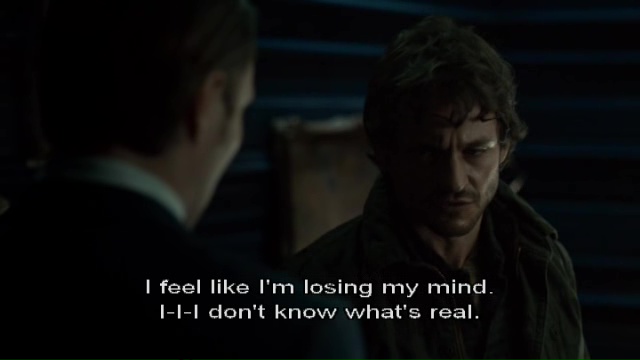
Will is lost. He feels crazy. Is that your worst fear, asks Hannibal?
Gideon’s battle with identity is brought into focus when he kidnaps Freddie Lounds, so that she can document his vengeance on Chilton, and draw the Ripper, who he knows is an “avid fan” of Freddie’s journalism (the term “avid fan” is from the book and movies of Red Dragon).
Gideon describes his existential crisis to Freddie.
He then proceeds to open up Chilton and remove an amazing number of his organs, without actually killing him:
When the FBI bursts in, Freddie is keeping Chilton alive, and Gideon has gone. Will is waiting in Gideon’s car, and takes him, not to the FBI, but to Hannibal’s home. Why? He is convinced that this is not Gideon he has captured, but his dead nemesis, Garret Jacob Hobbs. Hannibal helpfully tells him that there is no one there at all, which tips Will right over the deep end of his identity/existential crisis:
Will has what Hannibal describes as a “mild seizure” and questions Gideon about whether he is the man who claimed to be the Ripper. Why “claimed”?
He sends Gideon off to hunt Alana. He then tricks Will into going after Gideon. They meet up, two lost souls seeking identity.
This slideshow requires JavaScript.
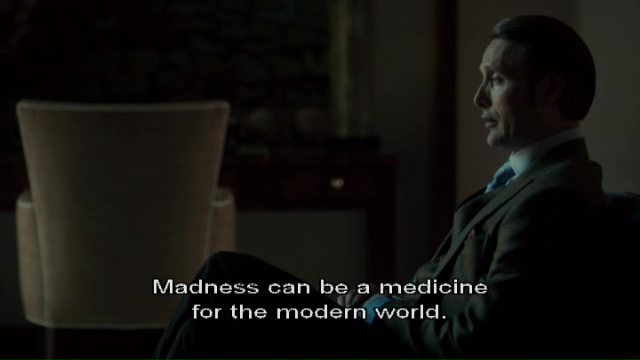
At the end, we have the fascinating session of Hannibal with his psychiatrist, Bedelia. He tells her that Will is troubled, that Hannibal sees his madness and wants to contain it, like an oil spill. Oil, she tells him, is valuable, what is the value to Hannibal of Will’s madness?
And finally we come to the crux of Hannibal’s own identity crisis. He is not the loner that he likes to affect.
Bedelia asks “Do you see yourself in his madness?”
They discuss side-effects, that they can be temporary, or can be beneficial:
Will does not present Hannibal with problems from normal life. What does he present?
Now we’re talking abandoned identities!
IF YOU LIKE MY BLOG, PLEASE FEEL FREE TO RECOMMEND IT (WITH DISCRETION) TO FRIENDS ON SOCIAL MEDIA.
IF YOU HAVE ANY QUESTIONS OR COMMENTS, YOU CAN USE THE TAG, OR EMAIL ME ON CANNIBALSTUDIES@GMAIL.COM.
Be honest: do you still wonder, perhaps late at night, if there is someone/something under your bed? This episode is called “Buffet Froid” (cold buffet) and starts with a young woman returning to her home on a cold, dark night, wisely ignoring rattling noises in her shed and heading inside, but we know from the statue outside that things aren’t going to go well.
She tucks herself into bed but then hears water dripping through her ceiling. She heads up the dark, musty stairs to the attic to investigate – a big lump of her roof is missing. She staples plastic over the hole, but we’re outside, and we can see footprints. When she gets back to her room, she sees puddles, perhaps footprints, and as she reaches her bed, she is dragged underneath it and killed.
Meanwhile, Will is getting more and more unstable. He draws a clock for Hannibal (a simple test for neurological problems). It looks fine to him. But to Hannibal:
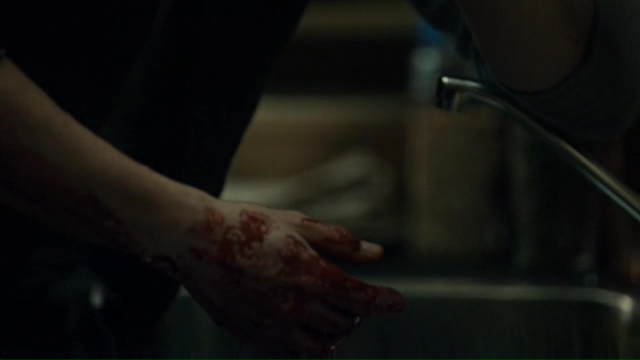
He goes fishing and cuts up the fish which bleeds profusely, like a human, and suddenly he is at the crime scene where the woman was killed, and he seems to be the killer. He rushes from the room, covered in blood, having contaminated the crime scene.
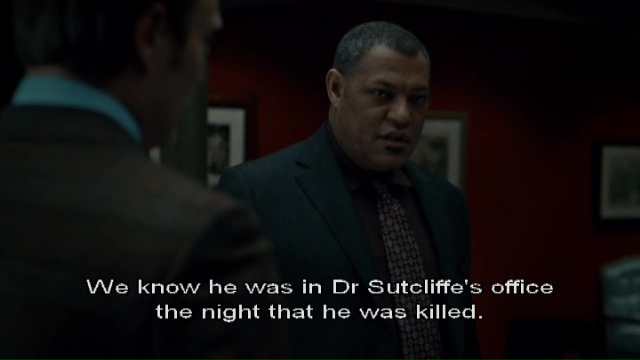
Now even Jack is concerned. Officially. Hannibal offers to refer Will to a Neurologist, but says if there is no physiological cause found, he will have to accept a diagnosis of mental illness. Which is precisely where Hannibal is steering him. Hannibal accompanies Will to the Neurologist, Dr Sutcliffe (John Benjamin Hickey), but while Will is having a brain scan, Hannibal tells Sutcliffe that Will has encephalitis. How does he know? He says he smelt it.
The scan shows massive inflammation on Will’s brain, but Hannibal persuades Sutcliffe to say there is nothing wrong, so that they can study Will’s response. For the good of science, of course.
But Hannibal’s plans don’t only require Will to think he is going insane – Jack needs persuading too. Hannibal tells him about the Neurological examination over a post-dinner brandy, then has a fascinating exchange about how Will’s empathy – his “mirror neurons” – make him vulnerable.
Hannibal and Sutcliffe (they were at Hopkins together – presumably Johns rather than Anthony) meet for dinner and discuss a rare and expensive form of pork – jamon iberico. We learn that Hannibal loves his treats: the more expensive and difficult to obtain they are, the better. They decide that, if the eater decides the meat is superior, then belief determines value. “A case of psychology overriding neurology” points out Hannibal. This banter of course is really about Will Graham. What makes Will rare enough for Hannibal to care about?
So they have set his mind on fire, but when will they put it out? “Will is my friend” says Hannibal. He’ll put it out when it’s necessary.
But Sutcliffe is running more tests on Will, which is not part of Hannibal’s plan. As Will comes out of the scanner, he finds the room deserted. Sutcliffe is very dead: he has had his face peeled back, like the woman at the start of the episode, and of course everyone assumes it is the same killer, the one under the bed, Georgia Madchen (Ellen Muth).
That night, as Will sleeps fitfully, his multiple stray dogs start to bark and growl. He realises Madchen is back – under his bed.
He persuades her that she is alive, and not alone. She comes in for treatment. How much, Jack wants to know, will she remember?
Although she has a disease in which she cannot see faces, she has witnessed Hannibal kill Sutcliffe and then hand her the scissors.
Remembering would be dangerous.
IF YOU LIKE MY BLOG, PLEASE FEEL FREE TO RECOMMEND IT (WITH DISCRETION) TO FRIENDS ON SOCIAL MEDIA.
IF YOU HAVE ANY QUESTIONS OR COMMENTS, YOU CAN USE THE TAG, OR EMAIL ME ON CANNIBALSTUDIES@GMAIL.COM.
This episode is named “TROU NORMAND”, which is a shot of liquor, usually Calvados, a potent apple liqueur from Normandy, served between courses of a particularly heavy meal. And yes, the first eight episodes of Season 1 were heavy going, and we know that the main course is yet to be served.
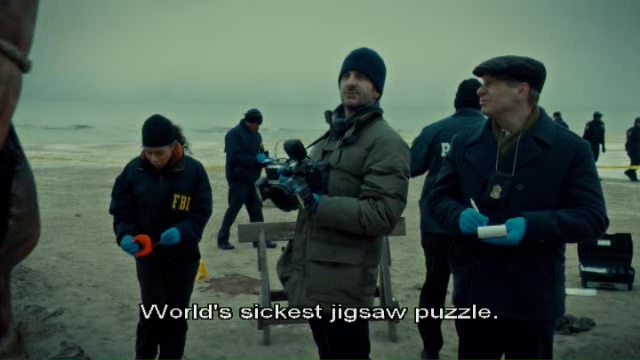
In this one, the FBI team are investigating a totem pole made of dead people in West Virginia. The bodies are carefully coiled together, making a puzzle for the investigators.
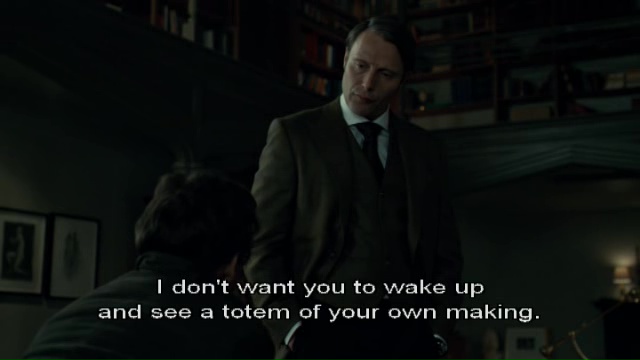
Will does his reenactment, then blinks and suddenly he is in Hannibal’s waiting room. He knows then that he is in trouble – the sleepwalking, the hallucinations and now he’s disassociating, and losing time. He has just driven 3 ½ hours from the crime scene to Hannibal’s office with no memory of it at all. Oh yes, he’s a sick puppy. Hannibal’s diagnosis is interesting:
Hannibal also summarises why we care about people we know and usually don’t give a damn about anyone else:
“What if you lose time and hurt yourself? Or someone else?” Hannibal is planting the seed. Will may be capable of – anything.
Will apologises to Jack for disappearing from the crime scene, but Jack hasn’t noticed anything wrong. Is there something wrong? No, Will grins, everything’s fine. No problems.
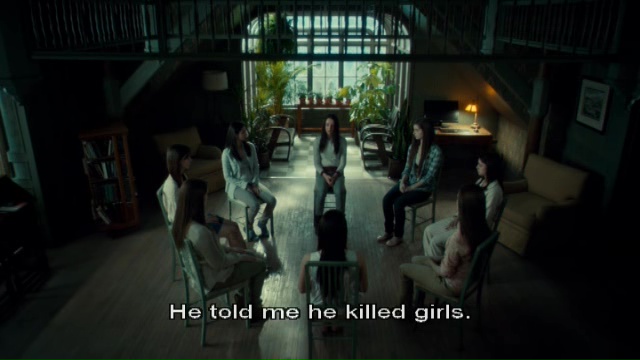
Abigail Hobbes is also in trouble. She is having nightmares where her father tells her he killed all those girls (in the first episode) so he wouldn’t have to kill her. But her support group morphs into those very girls, all saying “he should have killed you, so he wouldn’t have killed me”.
Then Freddie Lounds tells her that she is broke – the families of those girls are suing her father’s estate, and she won’t inherit a thing. She needs to write a book, with Freddie’s help of course. Will and Hannibal try to talk her out of it, but she wants to prove her innocence.
Will is getting more and more unstable. He is lecturing on the totem pole murders, but it turns out he is addressing an empty lecture theatre. Alana finds him there, tells him she can’t get involved with him:
Meanwhile, the FBI have found the body of the boy Abigail gutted and Hannibal helped her hide in episode 3. Jack wants to put her in the room to identify the corpse because he still suspects Abigail of the murder/s. Alana and Will are dead against causing her more trauma. Hannibal? Well, he is into growth and becoming, and for this he puts people in difficult positions:
But Hannibal is putting his own pressure on Abigail. He tells her that he is concerned that her book, and her digging up the body, all put him in danger. He insists that he must be able to trust her. Will realises that she killed the boy, and Hannibal admits he knew, because he helped her hide the body. Is Will going to report them to Jack? Well, no, because Hannibal talks him out of it:
Now Hannibal has Will where he wants him – legally compromised, lying to Jack, and a partner – at least in co-parenting.
Hannibal is putting on one of his fine feasts for – yes – Freddie Lounds, with Will and Abigail eating various bloody concoctions. But Freddie has thrown him, by announcing she is a vegetarian! Hannibal rises to the occasion and prepares the finest salad she has ever tasted. Despite Will’s aggressive sarcasm and Abigail’s defiance, Hannibal manages to get them to agree: we’re all doing this to protect Abigail.
This slideshow requires JavaScript.
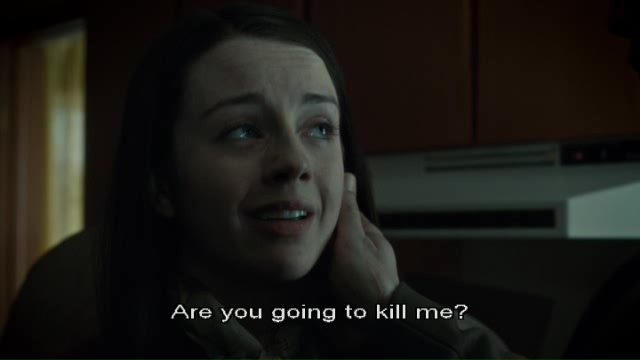
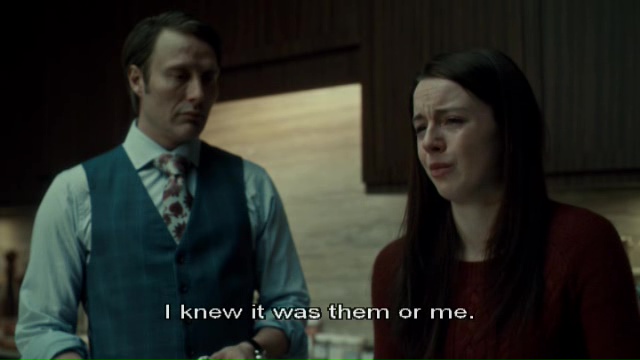
After dinner, Hannibal washes and Abigail dries, and she finally confesses that she did help her father – she would befriend girls that looked like her and find out where they lived, so that he would kill them, instead of her.
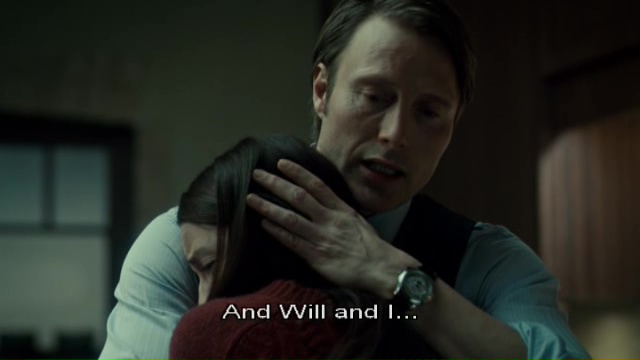
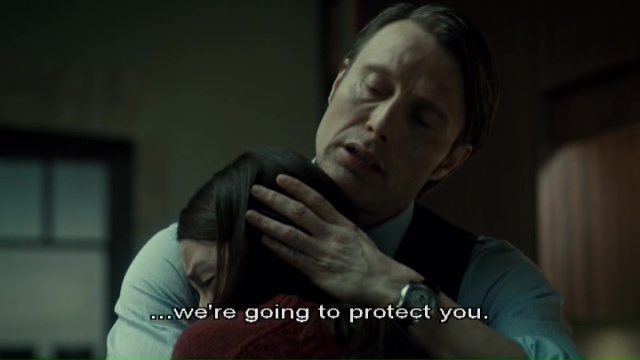
Hannibal comforts her:
Now she is totally in his hegemonic care, Will is a co-conspirator and co-parent, and Hannibal has a friend, and a family.
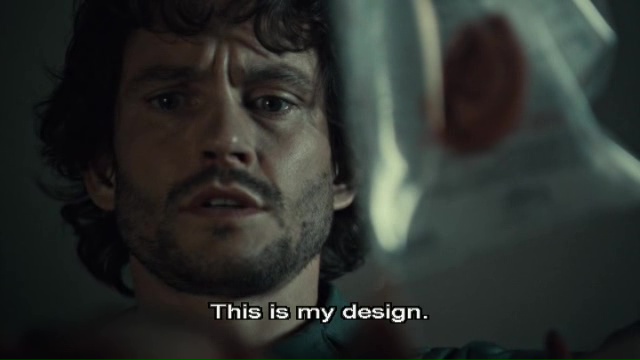
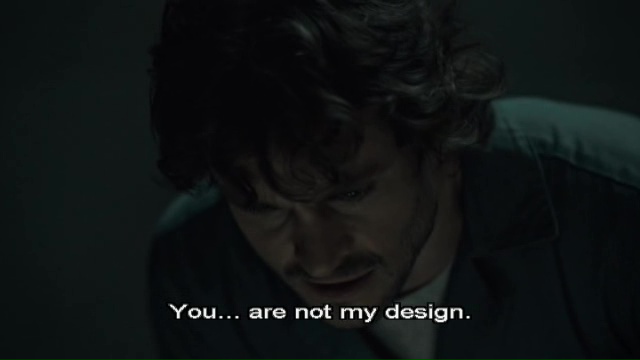
This is his design.
IF YOU LIKE MY BLOG, PLEASE FEEL FREE TO RECOMMEND IT (WITH DISCRETION) TO FRIENDS ON SOCIAL MEDIA.
IF YOU HAVE ANY QUESTIONS OR COMMENTS, YOU CAN USE THE TAG, OR EMAIL ME ON CANNIBALSTUDIES@GMAIL.COM.
So we’re over the half-way point of Season 1, and Hannibal’s fascination with Will has gone from amused manipulation to a possibility of friendship, based on their similarities, made piquant by their differences. This episode is all about friends – lovable, edible or just annoying.
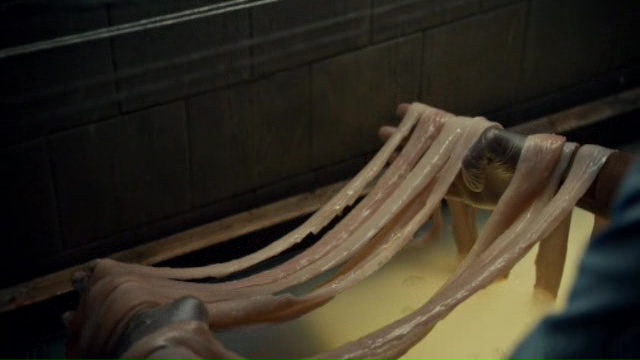
Last episode we met Tobias (Demore Barnes), a friend of Hannibal’s (probably) most annoying patient, Franklyn (Dan Fogler, from Fantastic Beasts). Tobias is teaching a kid violin and talking about superior strings. “Are they made of cat guts?” the kid wants to know. “Not always” answers Tobias, and we then see him making new strings for the orchestra. They are guts, but not from cats.
Franklyn is trying to “be” Hannibal – he has googled “psychopaths” and wants to discuss whether Tobias is crazy. Whether he is a “psychopath”. Whether Franklyn himself is a psychopath. Hannibal tells Franklyn he is not a psychopath, although “you may be attracted to them.” He certainly likes Hannibal a lot. And Tobias. He wants them to be his friends.
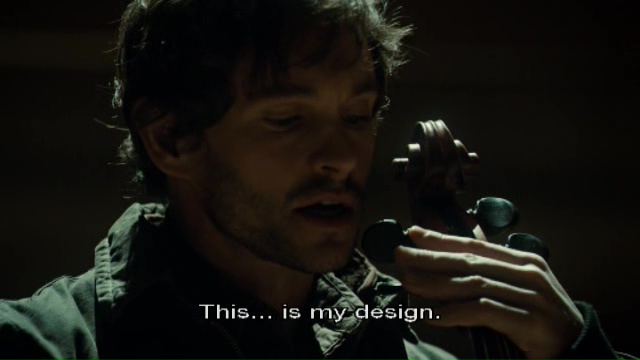
The murder victim in this episode (Baltimore is such a dangerous place!) is the trombonist from the Baltimore Metropolitan Orchestra. The killer has jammed a cello down his throat and played him – created a sound – “my sound”.
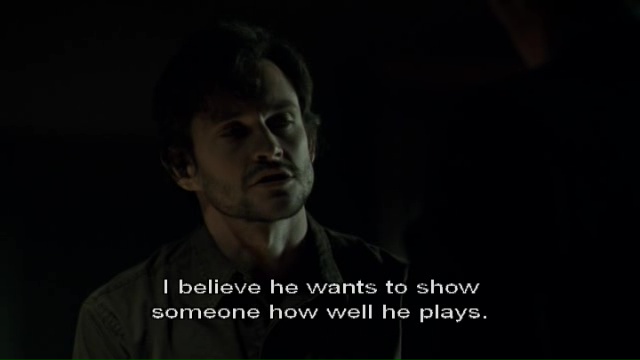
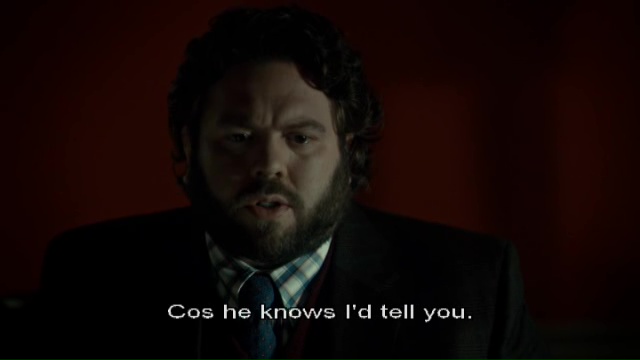
But why go to all that trouble? Franklyn tells Hannibal that Tobias had been talking about cutting someone’s throat and playing them like a violin – exactly what the FBI found. Will has a theory:
Why would he tell Franklyn about it though?
Hannibal goes to visit Tobias, talks about strings, composing or discovering music on his preferred instrument: the Theremin. With a little coded chat, they soon determine that they have a lot in common.
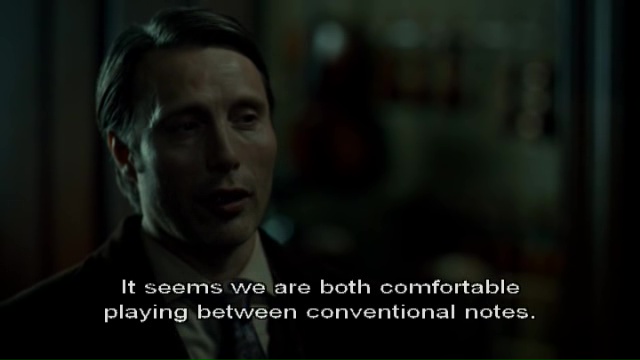
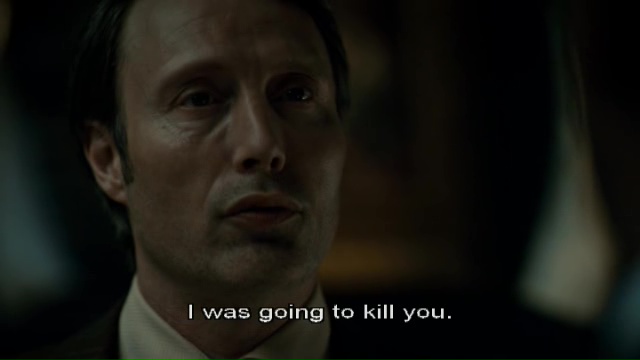
Will wants to be (more than) friends with Alana – he kisses her, but she bolts. Tobias comes to dinner at Hannibal’s home, at which he admits he was going to kill Hannibal.
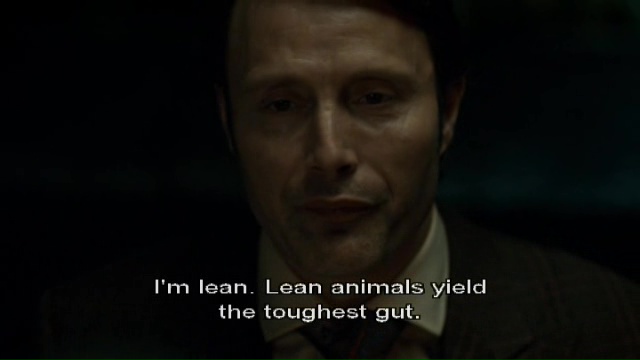
“Of course you were. I’m lean. Lean animals yield the toughest gut.”
Tobias says he changed his mind after following Hannibal to a bus depot, presumably the one referenced last episode (where the victim was cut in two and left sitting across the bus aisle from himself). He knows that Hannibal is the Ripper. Hannibal is not pleased. Tobias doesn’t care about being investigated by the FBI – he will just kill whoever they send to investigate him. Hannibal considers this reckless, and that’s not a term of praise, particularly when that might lead them back to Hannibal. But Tobias, of course, wants to be Hannibal’s friend. He wants a friend who understands him (and isn’t too fussed at the use of human body parts).
But Hannibal is not putting up with reckless friends, even if they have common hobbies.
Tobias asks why, then, did Hannibal invite him for dinner?
Now that is a great line.
They are on the verge of sorting it out with extreme prejudice when Will arrives seeking lonely hearts advice: “I kissed Alana!” Tobias beats it out of the window, and Will gets to eat the dessert he missed. He also gets to tell Hannibal about his latest symptoms – on top of sleepwalking and getting headaches, he is now hearing the cries of wounded animals – the latest was, he thought, in his chimney, which led to some drastic and unnecessary renovations. He admits to being “unstable.” Hannibal clearly decides he needs a challenge, and leaks the information about Tobias and his strings, and suggests Will should go investigate him. He knows Tobias will try to kill any investigators. But Will needs a challenge if he is to grow and become a true protégé. He needs to grow, and “to become”. That is the central theme of all Lecter texts.
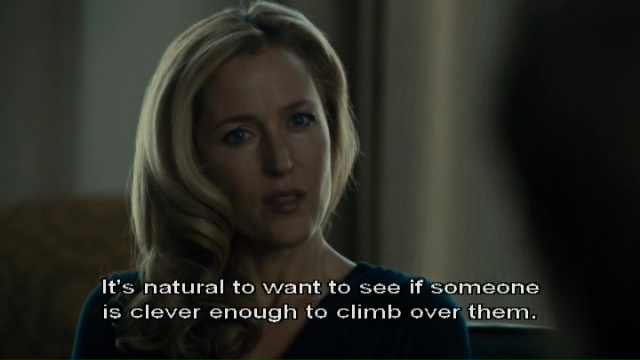
Hannibal discusses all this with Bedelia, his psychiatrist, in one of the most fascinating exchanges of the show:
H: I met a man much like myself [Tobias of course]. Same hobbies. Same worldview. But I’m not interested in being his friend. I’m curious about him. And that got me curious about friendship.
B: Whose friendship are you considering?
H: [Now he’s talking about Will Graham] He’s nothing like me. We see the world in different ways, yet he can assume my point of view.
B: It’s nice when someone sees us, Hannibal. Or has the ability to see us. It requires trust. Trust is difficult for you.
H: You’ve helped me to better understand what I want in a friendship and what I don’t.
Will and a couple of cops turn up to interview Tobias about the strings made from the unfortunate trombonist’s vocal chords, but Will is distracted by one of his imaginary distressed animal sounds. By the time he gets back inside, the cops are dead (they are clearly redshirts) and Will follows Tobias down the basement steps, much as Clarice followed Jame Gumb in Silence of the Lambs. There is an underground shoot out, just like – yep. Except Clarice appears to be a much better shot than Will.
Then there’s the whole Franklyn/Tobias/Hannibal thing that has to be resolved, and Hannibal is just the man for that sort of thing. Followed, of course, by the Goldberg Variations.
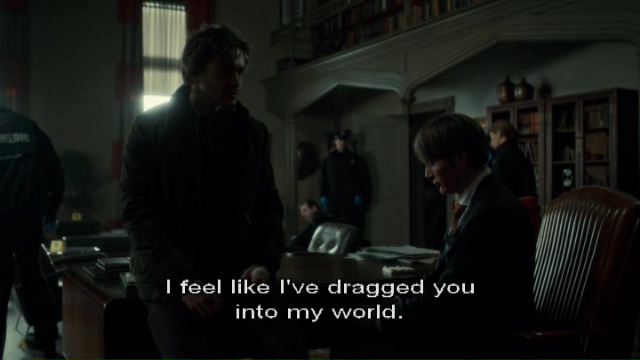
The Baltimore PD come to tidy up afterwards, with Jack and Will. There is a tender moment of blossoming friendship:
Then Hannibal is back at Bedelia’s place, talking about responsibility. Does he feel responsible for Franklyn? Did Bedelia feel responsibility when she was attacked by her patient [and yes, we’ll hear a lot more about that in the future]? Yes, she says.
Was Tobias a cannibal? We didn’t see him eat anyone, but there were a lot of body parts about his basement, and abuse and exploitation don’t always have to be about eating, do they? He and Hannibal actually did have a lot in common. But he was too rash, too reckless. He could never be a protégé nor a friend. A friend would need to be a lot more vulnerable.
IF YOU LIKE MY BLOG, PLEASE FEEL FREE TO RECOMMEND IT (WITH DISCRETION) TO FRIENDS ON SOCIAL MEDIA.
IF YOU HAVE ANY QUESTIONS OR COMMENTS, YOU CAN USE THE TAG, OR EMAIL ME ON CANNIBALSTUDIES@GMAIL.COM.









































 30
30

































 The Cannibal Guy