“You draw the line there?”: DOLORES ROACH episodes 7 & 8

The climax. The denouement. The final two episodes of this quite brilliant podcast that became a Broadway show that became a television series about an untrue true crime, and includes podcasts and Broadway shows. If you need to catch up on the earlier episodes, I would suggest watching them, but if you can’t wait, here are my earlier blogs.

Episode 1

Episode 2 & 3

Episode 4

Episode 5

Episode 6

And here is the very brief synopsis.

  • In episode 1, Dolores has just been released from prison after 16 years – she took the fall for her boyfriend, who has since disappeared. She heads back to Washington Heights New York. but it’s all gentrified now, except for Empanada Loca, the shop of her old friend Luis, who offers her a room and sets her up as a masseuse, a skill she learnt in jail.
  • In episodes 2 and 3, Dolores kills the landlord who has been harassing Luis for his overdue rent, which he can’t afford because the neighbourhood is now fancy, and people don’t buy empanadas much. Luis creates a new empanada, MUY LOCO. It is hugely successful, because it contains, yep, human flesh, in this case, the landlord, Mr Pearlman, whose son, Jonah, appears in the shop at the end of episode 3, with two cops behind him.
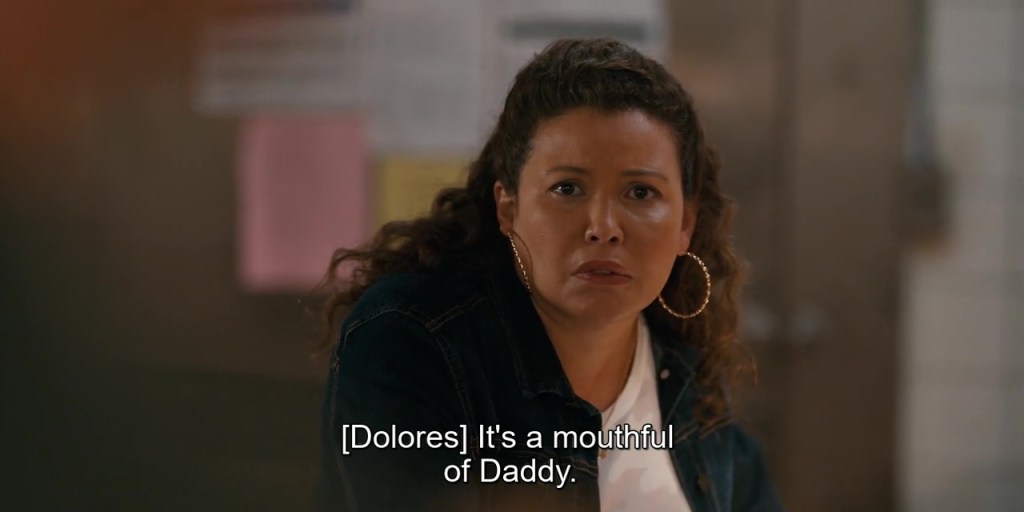
  • In episode 4, Dolores is shocked to find what Luis has done with the body of the landlord she murdered, and disgusted by the secret contents of the muy loco empanadas—Mr Pearlman. She is particularly horrified when Luis offers Jonah an empanada to try, a muy loco, which she knows is a “mouthful of daddy”. Meanwhile, the local drug dealer, Marcie, has pissed off Dolores, and now she is also in Luis’ fridge, and bits of her are now in the empanadas.
  • In episode 5, Dolores hires a private eye called Ruthie, played by Cyndi Lauper, to trace her ex, who cheated on her and let her take the fall in a drug bust. Ruthie’s motto (or perhaps mission statement) is I NEVER DON’T FIND THEM. But the last thing Dolores wants is for Ruthie to find Mr Pearlman.
  • In episode 6, we see cannibalism as a business. Luis has been clear-eyed about this all along – he gets rid of the annoying landlord, he thoroughly destroys the evidence (in customers’ stomachs) and he makes money from the meat, which is apparently delicious and hugely popular, while saving money by not buying the flesh of other animals from the food-services man, Jeremiah, the only sympathetic character in the story so far.

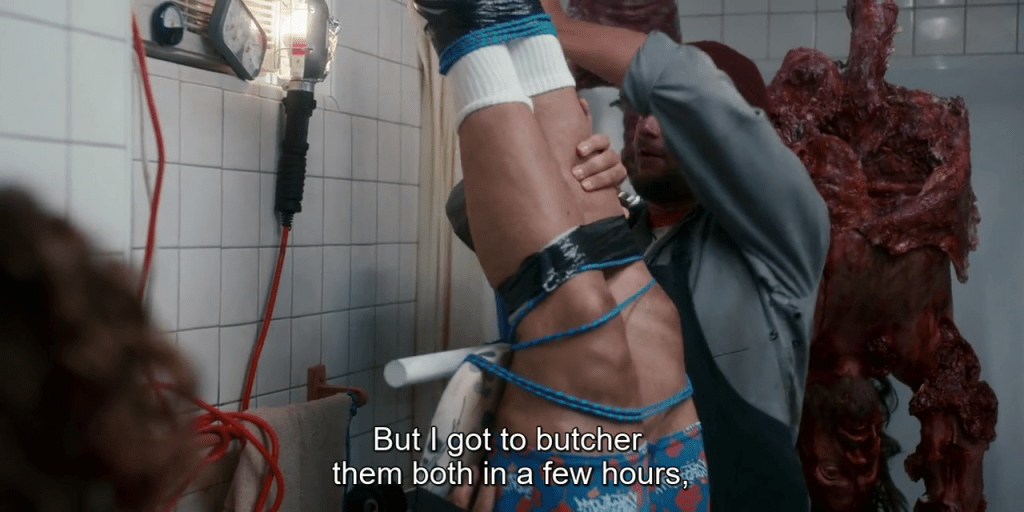
Not a lot of human flesh being eaten in these final two episodes, because everything is turning to shit, largely due to the impulsive plans of Luis, and the tendency of Dolores to snap the neck of anyone who annoys her. Police are looking for the drug dealer Dolores killed back in episode 4, and threatening to call in the DEA. Luis is still chopping up the bodies of Dolores’ victims to fill his empanadas, but he doesn’t want anyone to find the marijuana he is growing. THAT would be incriminating. Dolores points out that his fridge and apartment are full of chopped up bodies, and asks him the question that defines all ethical discussions.
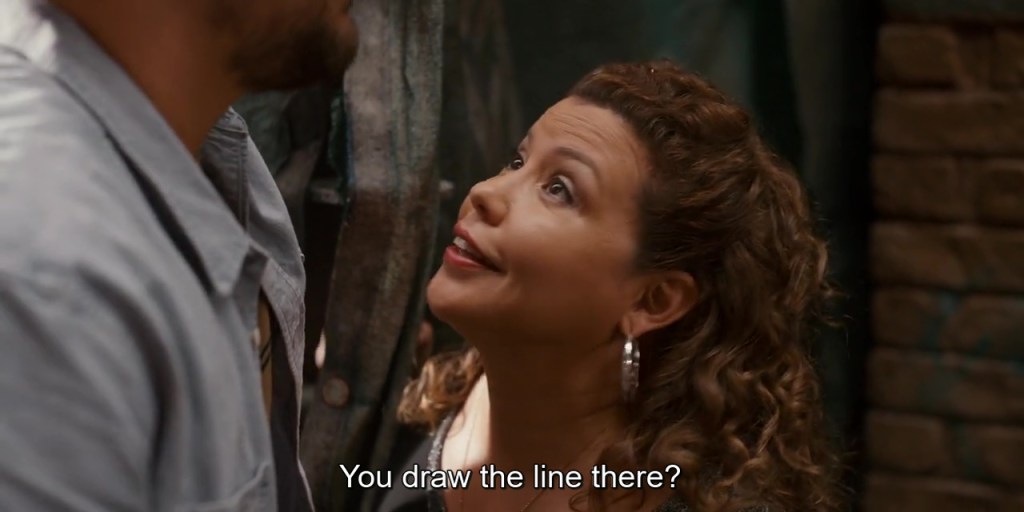
 She’s much more upset about the cannibalism than the increasing number of corpses she is leaving all over the shop. Odd that. Luis sees meat as his business, and Dolores’ steady body count as his (very reasonably priced) supplier. He’s not too fussed about all the killing, as long as he doesn’t have to do it – like customers in a butcher shop. When he finally kills a man, he is upset: “Look what you made me do!”
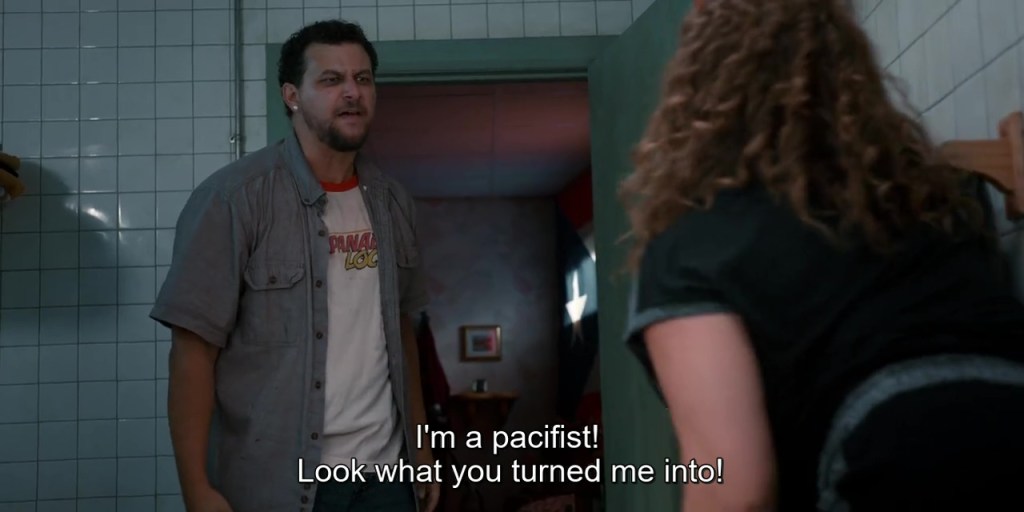
Luis cracks some of the best jokes in this show, in the middle of the street (much to Dolores’ fury) about the “fat fuck” she killed last episode, and how he is going to use the body fat in his pastry.

And some of the worst.
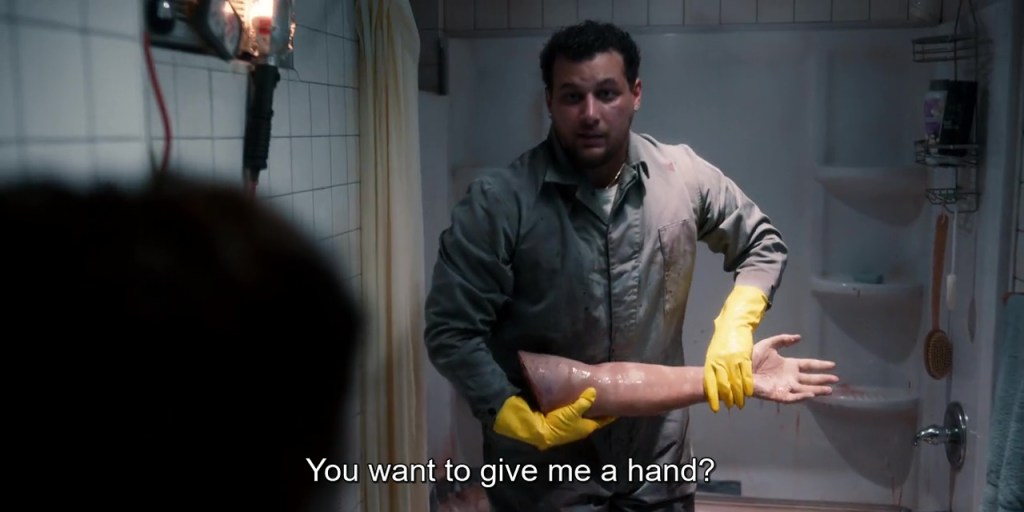
Lots of interesting Freudian things going on here – in earlier episodes, they discussed the difference between edible and Oedipal, and then there’s the whole thing with Luis only wanting to give Dolores cunnilingus, not penetrative sex, even though she has her period. She considers that eating her menstrual blood makes him a cannibal, even though he has been snacking on human empanadas all through the show, so it shouldn’t really be a surprise.

And his pet name is Mami. It’s apparently the Spanish equivalent of “baby” or “darling”, but is also used for, yep, mother. Freud said the two primary taboos are incest and cannibalism, and Luis definitely has an edible complex.

We find out why Luis doesn’t want sex – he fell in love with his father’s girlfriend when he was 12, had sex with her (so now we have another taboo covered) and then tried to castrate himself in punishment. He couldn’t cut through his penis (Meiwes and Brandes found it was much harder than you might think) and poured hot oil on the wound, leaving him horribly disfigured. Yes, Dr Freud, the threat of castration can be as big a motivation for mental illness as you thought.

Dolores just thinks she is a monster. But one of the fascinating things about cannibalism is that unlike other horror movie tropes, they are not supernatural or even particularly superhuman. And they really exist.

“I’m a monster. Worse, I’m real.”

Luis ends up “deep fried, like everybody else” in one of the most dramatic scenes, and Dolores escapes:

She goes looking for the showrunner of the play, a nice piece of postmodern complication as he clearly represents the creator of the show we are watching, Aaron Mark.

He is accused of humanising a serial killer, but hey, Dolores is very human, just like Macbeth and Oedipus and every tragic protagonist in literature. She’s not even a cannibal; in the whole eight episodes, we have not even seen her eat a human empanada! She’s just a misunderstood serial killer.

As she says, you have to draw a line somewhere.

She forces the showrunner to take her to a house where, he says, someone knows the whereabouts of the man who betrayed her and left her to rot in jail. When the door opens, she roars with laughter, and then pounces, but at whom? All we know is that, like Georgina in The Cook, The Thief, she is directing her invective at us, the audience! We may not know where her ex is living. But we do know that cannibalism starts at home.


Brain-eating cannibal released in Connecticut

Tyree Smith, from Bridgeport Connecticut, killed a homeless man on December 15, 2011, and ate his brain and eyeballs. He has just been released into the community, ten years after being committed to a state psychiatric hospital, the Whiting Forensic Hospital, supposedly for sixty years.

Smith apologised for the murder at the trial, and the three-judge panel decided he was not guilty of murder by reason of insanity, during his sentencing in July 2013.

In lieu of prison, Smith was committed to a state psychiatric hospital for sixty years. After just ten years, the state Psychiatric Security Review Board said Smith was ready to be transitioned back into the community and he has been released from the facility, Connecticut’s most secure.

He will be living in a Waterbury group home, under orders not to associate with anyone involved in criminal activity. The board stated in its report:

Tyree Smith is an individual with a psychiatric illness requiring care, custody and treatment. Since his last hearing, Tyree Smith has continued to demonstrate clinical stability. Mr. Smith is medication compliant, actively engaged in all recommended forms of treatment, and has been symptom-free for many years.

During the trial, Smith’s cousin Nicole Rabb claimed he arrived at her Connecticut home in December 2011, ranting about Greek gods and talking about needing to go out and get blood.

Police described in the arrest warrant what they believed happened.

Smith curled up outside the abandoned, boarded-up Brooks Street apartment building where he used to live. He was awakened by Angel “Tun Tun” Gonzalez, a homeless drunk who invited him in from the cold. Gonzalez was popular in the neighbourhood. Like Smith, he had also once lived in the Brooks Street building before it was boarded up.
Once inside the apartment, Smith heard a voice saying, “This is your blood.”
Police said Smith hacked Gonzalez to death with his axe and cannibalised the body.

When Smith’s cousin saw him the next evening, she noticed what appeared to be specks of blood on his pants, and found that he was carrying chopsticks and a bloody axe. Smith allegedly told Rabb he killed a man and ate his brains in the Lakeview Cemetery while drinking sake, and warned her he intended to eat more people. Smith said the rush he felt while hacking Gonzalez and consuming pieces of his body was unlike anything he had ever experienced before, according to the arrest warrant. He told Rabb he has a sexual lust for blood.

A month later, police found Angel Gonzalez’s mutilated body in the vacant apartment on Brooks Street in Bridgeport where Smith had lived as a child. Police later recovered the bloody axe and an empty bottle of sake in a streambed near the Boston Avenue cemetery.

In a videotaped statement to police, Smith said he used a hatchet to kill Gonzalez, then took out the man’s eyes and part of his brain and ate them, washed down with sake (rice wine).

Smith’s defence team relied on the testimony of Yale University psychiatrist Dr. Reena Kapoor, who indicated that Smith had retained his lust for human flesh after his arrest, even offering to eat her. Kapoor claimed Smith suffered from psychotic incidents since childhood, and heard voices.

The voices ordered Smith to eat the victim’s brain so they would get a better understanding of human behaviour, and the eyes so that they could see into the ‘spirit realm’

Kapoor added that Smith went to Subway after eating the man’s body parts.

The report on Smith’s release said there was no evidence of “internal preoccupation or paranoia” and that “he denied experiencing cravings but stated that if they were to arise, he would reach out to his hospital and community supports and providers.”

A year before the murder, Smith wrote on Facebook,

Devouring your flesh. Smelling your bodies burn in a heap. I hate the day they created you filthy humans. There. Thats whats been on my mind since a child. Happy?

Of course, spouting abuse on Facebook doesn’t mean that the writer will eat people’s brains. Well, not always.

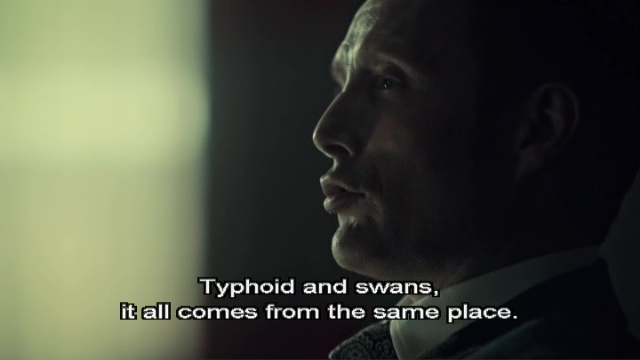
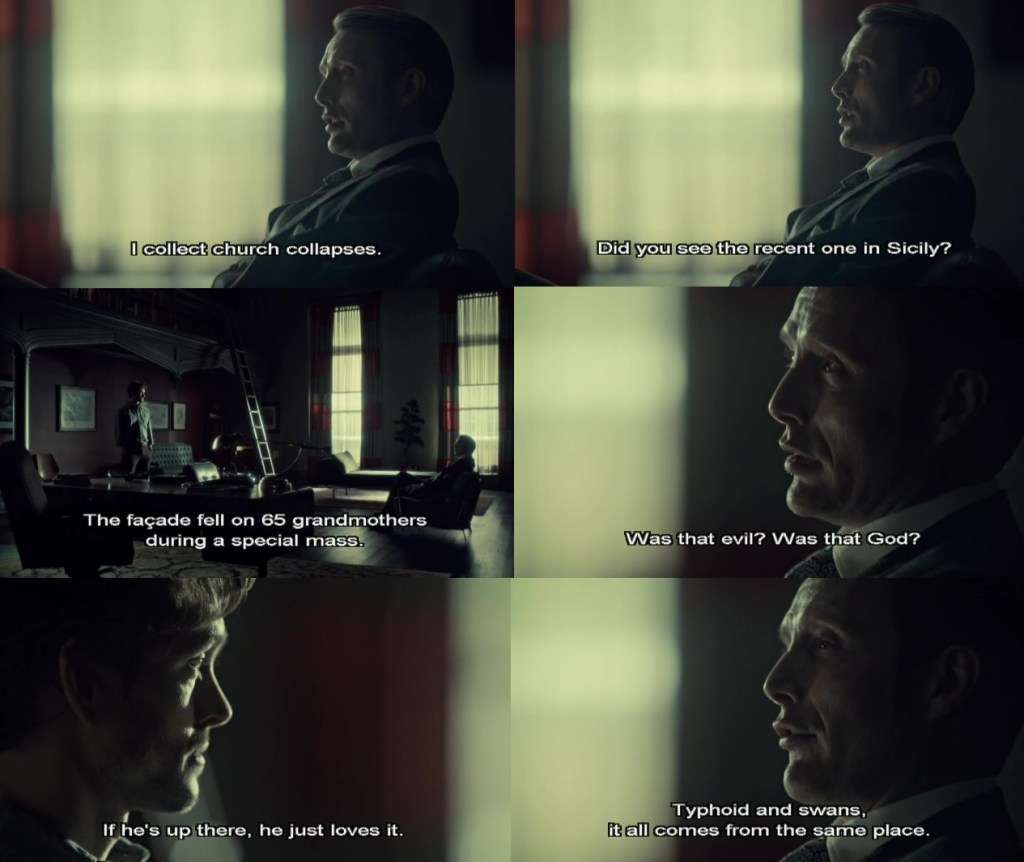
Hannibal’s scrapbook: “I collect church collapses”

Last week’s doomscrolling offered a story about a church roof collapsing during Sunday Mass in a northern Mexican city, killing at least nine people and injuring 40.

I know, it’s awful, but it immediately reminded me of Hannibal, Season 2, Episode 9, “Shiizakana”.

Hannibal and Will are talking about God, as you do when discussing the art of killing people with your psychiatrist.

Will: what do you think about when you think about killing?
Hannibal: I think about God.
Will: Good and evil?
Hannibal: Good and evil has nothing to do with God.

As Hannibal says, God kills lots of people, and are we not made in his image?

In the movie Red Dragon, the dialog is similar:

Why shouldn’t it feel good. It does to God. Why, only last week in Texas he dropped a whole church roof on the heads of 34 of his worshippers just as they were grovelling through a hymn. He wouldn’t begrudge you one journalist.

Or consider what Hannibal Lecktor (they spelled it differently) played by Brian Cox said about the joys of murder in the movie Manhunter:

It feels good Will because God has power. And if one does what God does enough times, one will become as God is.

More (lots more) Hannibal at thecannibalguy.com/2020/07/08/hannibal-film-and-tv-blogs/

LIVE CANNIBALISM SHOWS: Post Mortem Live

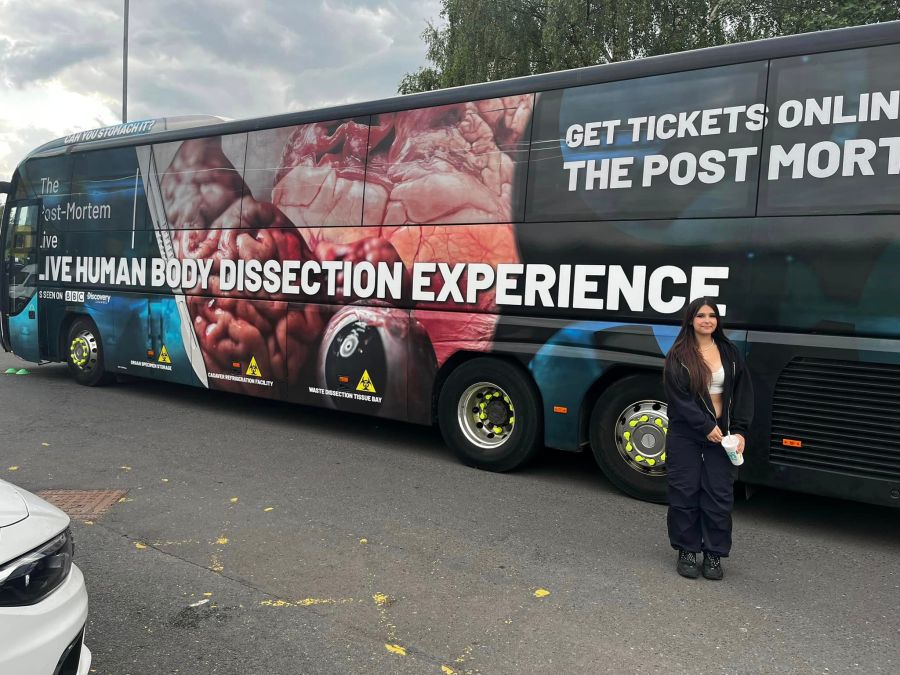
What’s your idea of a great night out? How about attending a post mortem examination of a cannibal serial killer’s victims? That is the theme of “Post Mortem Live” which is touring various parts of the UK, purporting to show the workings of a crime lab, with some extras for the paying audience – they supposedly get to taste parts of the corpses! The press release asks:

“Ever wanted to try a real organ? Well now’s your chance. What does it taste like? Tender, fatty, juicy? Will introducing the pallet to organ meat leave you wanting more, and what lengths will you go to in order to satisfy your hunger?”

This press release is not on their website or Facebook page as far as I could see. If it ever existed (it is reported on several outraged social media sites) then it must have been a joke, and has now been removed.

The show is based on the real murders committed by Dennis Nilsen in the UK and Jeffrey Dahmer in the USA, and gives the audience a hands-on experience of the post-mortem and forensic processes used to gather evidence of cause of death and identity of the victims, as well as piece together the actions of the serial killer, including tracing evidence of cooking and eating body parts.

​​

The storyline involves the (fictional) killings of 23 people, brutally murdered and dismembered by an equally fictional serial killer called Jack Brewer, who is said to have had a “feast”. Audience members will investigate the crimes in an “immersive and one-of-a-kind experience” through forensic tests similar to those used to catch and prosecute Nilsen and Dahmer. 

Jeffrey Dahmer killed at least seventeen young men and boys between 1978 and 1991, and ate parts of some of them. Dahmer did not look monstrous, just a lonely young gay man befriending marginalised others and offering them money to pose for photographs or friendship and sex, then drugging them. In some cases, he injected acid into their brains in a desperate but vain attempt to turn them into sex zombies, before killing and eating them, often preserving their skulls so that they would always remain with him.

Dennis Nilsen was a Scottish serial killer who murdered at least twelve young men and boys between 1978 and 1983. Following each murder, Nilsen would bathe and dress the victim’s body, which he retained for extended periods of time, before dissecting and disposing of the remains by burning them or flushing them down the toilet. Nilsen expressed surprise at the public revulsion towards his disposal of his victims’ corpses, which included cooking the flesh to render it down, and perhaps to consume it. Nilsen was trained as a butcher and chef, and we know that a number of serial killers worked as butchers, one of many occupations conferring a professional detachment from the carcasses of non-human animals, which are not very different from human ones.

The audience at this show are offered the opportunity to dissect organs, a method used in crime labs to determine whether a suspect had tried to dismember, degrade, cook or consume the victims. Is it possible, they ask, to deceive the science and conspire to carry out the perfect murder?

The FAQ states that the show is aimed at students and healthcare professionals, but anyone can attend as long as they’re over 14, and buy a ticket. The ticket price includes “basic PPE, gloves, specimens and clinical consumables.”

What happens at the show?

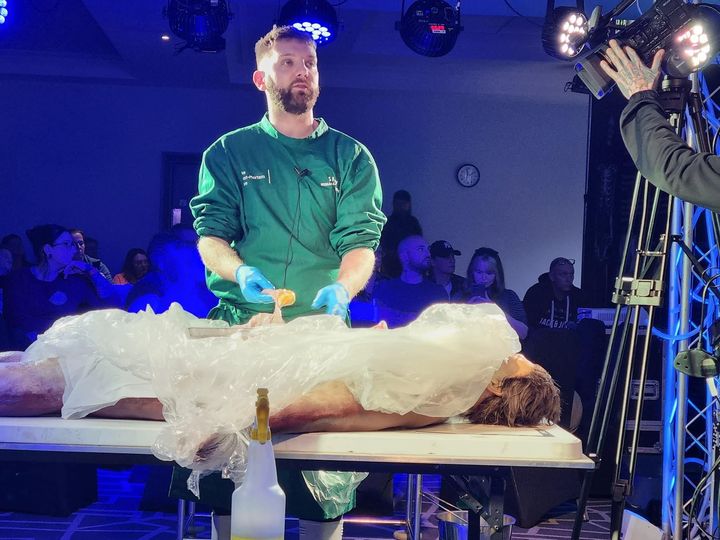
“The Post Mortem Live offers the chance to get hands on with real anatomical specimens of porcine origin contextualised into a simulated human body dissection.”

There is some eating. For a bit extra, you can book a “Dinner & Dissection”. The offer asks “Are you ready for main-corpse? or Dead-ssert?” Ah, no cannibalism story is complete without a few puns, and the organisers aggravate the crime by calling this a “cutting edge insight” into dark world of homicide detection, forensics and pathology.

The website blog features a number of particularly gruesome images of diseased and injured body parts, nothing to do with the fictional case, but maybe a warning of what to expect. Many of them are on their Facebook page too, some with graphic content warnings, others (possibly worse ones) without. Go figure. I can safely predict you will either love or hate these pages. If you think you will hate them, maybe don’t open them.

I’m not using the images of smashed limbs and spiked eyeballs on this site – all images here are from the show. Which is not real humans.

But… it is is bodily material from real pigs – that’s what they mean by “real anatomical specimens of porcine origin.” I wonder if this is supposed to be reassuring? No dead humans were harmed in the making of this show, but a whole lot of live pigs were killed so that they could be cut up for human amusement. That is sicker than the atrocity pics.

What the Fox? “My Son Jeffrey: The Dahmer Family Tapes”

A new streaming series promises “never-before-heard” conversations between serial killer Jeffrey Dahmer, “The Milwaukee Cannibal”, and his father, Lionel.

My Son Jeffrey: The Dahmer Family Tapes is streaming from Sept. 18 on Fox Nation, Fox News Channel’s subscription-based streaming service.

The four-part documentary series replays conversations recorded with Dahmer while he was in Columbia Correctional Institution in Portage, Wisconsin, serving 15 life sentences after confessing in 1991 to a string of crimes including murder, necrophilia and cannibalism. The recordings, made by Lionel Dahmer, have not been heard publicly before, according to Fox Nation.

The series also includes Dahmer family home movies, and interviews with a variety of others, including Mike Kukral, a high school friends from Ohio; Michael Prochaska, Dahmer’s college roommate; Ronald Flowers, the man who escaped after Dahmer had drugged, sexually abused and imprisoned him at Dahmer’s grandmother’s house in West Allis; and retired Milwaukee Police lieutenants Kenneth Mueller and Michael Dubis, who were on the scene the night of Dahmer’s arrest.

Dahmer was beaten to death in prison in 1994, but you wouldn’t know from watching streaming services. In 2022, Netflix went full Dahmer-mania, with Ian Brennan and Ryan Murphy’s dramatisation of the life and crimes called DAHMER: MONSTER – The Jeffrey Dahmer Story.   

“Monster” won a Golden Globe for best actor in a miniseries or TV movie for Evan Peters for his portrayal of Dahmer. The series received 13 nominations at the Primetime Emmy Awards, which drew some ire from Thomas M. Jacobson, the attorney who represented eight of the families of Jeffrey Dahmer’s victims. He told entertainment industry news site The Wrap that nominations for shows like that contributed “to glamorizing or desensitizing violence and crime in society.”

Netflix quickly followed up their re-enactment with Conversations with a Killer: THE JEFFREY DAHMER TAPES, a set of tapes made by his defence attorneys in which he made all sorts of fascinating admissions. At this point, there wasn’t much the keen true-crime aficionado didn’t know about Dahmer.

Actually, most of this information had long been out there. Plenty of evidence had been removed and studied after his arrest, including the fridge full of human body parts, several skeletons and the barrel of acid he used to dissolve unwanted flesh. Dahmer had spoken freely to his interrogators about the murders he had done, in graphic detail, all of which was revealed at trial. After his sentencing, and before he was killed (obviously), he gave interviews to news programs who could not believe their luck, and treated him like a celebrity.

Jeremy Renner had portrayed Dahmer when Netflix was still sending movies in the post, in a movie called Dahmer.

So what does this new Fox program hope to add (besides some sorely needed ratings)? FOX Nation President Jason Klarman said in a press release:

“The Jeffrey Dahmer case has captivated the public for over three decades and now with these exclusive tapes released for the very first time, viewers will hear from Dahmer in his own words and get insight into his relationship with his father”

Fox is featuring in the promos the fact that Dahmer was killing and pickling men back in the 1980s when he was living with his dear old grandma in Wisconsin. He had lured three men back to granny’s place and killed them, and kept mummified souvenirs in his room and in the basement.

The recording does not make clear to which victims the mummified remains belonged; Jamie Doxtator, Richard Guerrero and Anthony Sears were all killed at the location. Another victim, Steven Tuomi, was murdered by Dahmer in a nearby hotel but he kept those mummified remains in her basement as well. He told his father:

“Remember when you visited grandma? Remember that small, one-by-one square foot box? You know what was in it, don’t you? The mummified head and genitals of the last victim at the West Allis location”

Dahmer’s dad was presumably relieved to hear that it only had mummified body parts, because he was worried it was something naughty:

“It was wooden, but it had a metal covering, and you were very insistent that I opened that up because you thought I had pornography magazines”.

The show also plays up the fact that the dad, Lionel, admits to his son that he also had strange and disturbing thoughts in his youth, and perhaps actions too, since he expressed surprise that he had never been caught. He tells his son, “You’re just like me, Jeff”.

Showing audio on television is pretty dull so, like the Netflix tapes, it’s illustrated with lots of archive pictures. There are skulls, and meat from Dahmer’s fridge,

And his mug shot, which is actually a lot less terrifying than some we’ve seen recently.

It’s hard to imagine that the relatives of Dahmer’s victims, who objected to the Emmy nominations for the Netflix series, are going to be too thrilled at Fox Nation digging up the corpses again. But then, it’s Fox, and they love being on the edge.

“Do not contaminate my meat!”: DELORES ROACH episode 6

Delores is still killing people, Luis is still chopping them up to fill his empanadas. It’s becoming an industry, but Delores still gets queasy, and not real happy about the killings, but she’s much more upset about the cannibalism. Odd that.

If you haven’t read my blogs on the earlier episodes, here is a brief summary. In episode 1, Delores has just been released from prison after 16 years – she took the fall for her boyfriend, who has since disappeared. She heads back to Washington Heights New York. but it’s all gentrified now, except for Empanada Loca, the shop of her old friend Luis, who offers her a room and sets her up as a masseuse, a skill she learnt in jail. In episodes 2 and 3, Delores kills the landlord who has been harassing Luis for his overdue rent, which he can’t afford because the neighbourhood is now fancy, and people don’t buy empanadas much. Luis creates a new empanada, MUY LOCO. It is hugely successful, because it contains, yep, human flesh, in this case, the landlord, Mr Pearlman, whose son, Jonah, appears in the shop at the end of episode 3, with two cops behind him. In episode 4, Delores is shocked to find what Luis has done with the body of the landlord she murdered, and disgusted by the secret contents of the muy loco empanadas—Mr Pearlman. She is particularly horrified when Luis offers Jonah an empanada to try, a muy loco, which she knows is a “mouthful of daddy”. Meanwhile, the local drug dealer, Marcie, has pissed off Delores, and now she is also in Luis’ fridge, and bits of her are now in the empanadas.

In episode 5, Delores hires a private eye called Ruthie, played by the wonderful Cyndi Lauper, to trace her ex, who cheated on her and let her take the fall in a drug bust. Ruthie’s motto (or perhaps mission statement) is I NEVER DON’T FIND THEM. But the last thing Delores wants is for Ruthie to find Mr Pearlman.

In this episode, number 6, we see cannibalism as a business. Luis has been clear-eyed about this all along – he gets rid of the annoying landlord, he thoroughly destroys the evidence (in customers’ stomachs) and he makes money from the meat, which is apparently delicious and hugely popular, while saving money by not buying the flesh of other animals from the food-services man, Jeremiah, the only sympathetic character in the story so far. It’s a win-win-win for Luis.

But now Delores has two more victims for him – the drug dealer, Hector, who has an allergic reaction to her massage oil, and Ruthie, who sees what is going on. Delores has “doubled the body count”.

Luis is pretty happy about the situation. “Mami’s been busy” he says, as he finds the bodies.

We finally get to see Luis’ artistry. He needs to butcher both bodies before they start to decompose, reproaching Delores:

“You could have spread these two out. Cause this is going to be, like, a challenge, even for me!”

We see him slit Hector’s throat in graphic detail, exactly as happens millions of times a week to other animals in abattoirs, fisheries and farms. But Delores, who was OK killing them, gets pretty nauseous at the sight of blood; apparently there are eight quarts (7.6 litres) in a body the size of Hector, Luis tells her, and we see it gurgling down the drain.

He orders Delores to leave, because he’s a conscientious butcher, telling her,

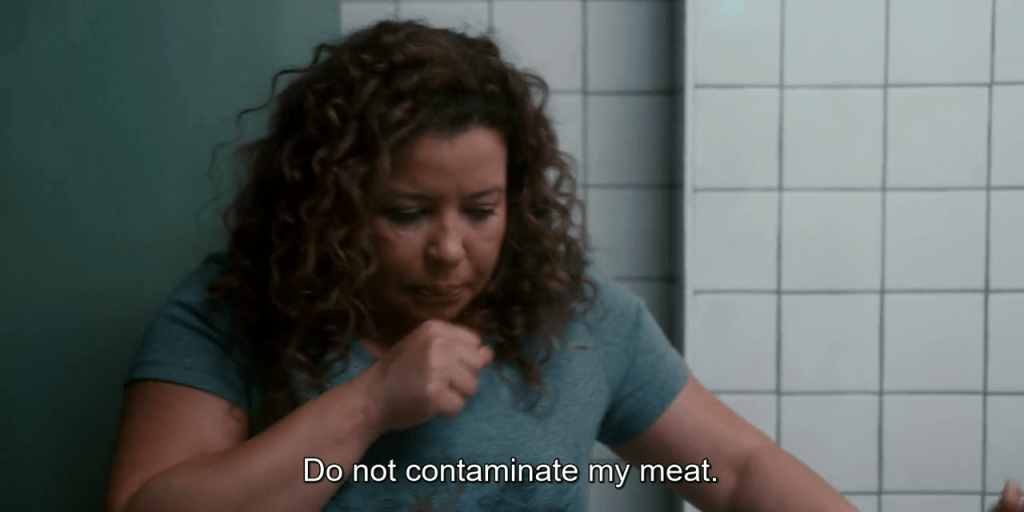
“This is a food prep space, OK? Do not contaminate my meat!”

She runs into Jeremiah (actually, her runs into her), the nice, normal food services delivery man, who tells her he knows what’s going on.

“You’re not back here a week, before the landlord goes missing. Food services like mine are getting squeezed out.”

Jeremiah isn’t interested in her conscience or her legal position, he has people to whom he owes money, and he’d like them disappeared too, please.

This is modern commodity capitalism. Everything, everyone, is assessed by monetary value, everything, everyone, is a commodity. To Luis, the victims are just meat to be butchered and sold in empanadas, to Jeremiah, they are creditors who are making his life difficult. For both, they are just ‘livestock’.

The basic precept of capitalism, as film critic Robin Wood warns in his paper “Return of the Repressed” is that “people have the right to live off other people”. In Washington Heights, thanks to the ready temper of Delores Roach, that is exactly what they are doing.

“He bit my thigh!”: THE HORROR OF DELORES ROACH, episode 5

Intertextuality is a term used to explain the way that similar or related texts influence, reflect, or differ from each other. In the start of this series, we heard the Stanley Holloway song “Sweeney Todd the Barber”, which this series clearly relates to, in that Sweeney would kill his hairdressing clients and send them down a trapdoor to the basement where his partner, Mrs Lovett, would fillet them into meat pies. The 2007 version of Sweeney differed from earlier versions by being a musical (!) and also giving Sweeney a motive—revenge—rather than just being, you know, batshit crazy. Intertexually, Delores turned a lot of this upside down: she was downstairs killing people; Luis was upstairs turning them into empanadas. The serial killer was female instead of male, the pastry cook male instead of female. The victims were not random people who needed a shave, but people who had pissed Delores off.

If you haven’t read my blogs on the first episodes, you might want to do that first. In a nutshell, in episode 1, Delores has just been released from prison after 16 years. She heads back to Washington Heights NY but it’s all gentrified now, except for the Empanada Loca shop of her old friend Luis, who offers her a room and sets her up as a masseuse, a skill she learnt in jail. In episodes 2 and 3, Delores kills the landlord who has been harassing Luis for his overdue rent, which he can’t afford because the neighbourhood is now fancy, and people don’t buy empanadas much. Luis creates a new empanada, MUY LOCO. It is hugely successful, like the chocolates in a recent blog, because it contains, yep, human flesh, in this case, the landlord, Pearlman. Whose son, Jonah, appears in the shop at the end of episode 3, with two cops behind him.

But in episode 4, it turned out Jonah didn’t know his dad is missing, and the cops are just waiting for their empanadas. But Delores is horrified by the idea of cannibalism (although, funnily, not so much the fact that the meat came from the body of the landlord she murdered) and disgusted by the secret contents of the muy loco empanadas—Mr Pearlman. She is particularly horrified when Luis offers Jonah an empanada to try, a muy loco, which she knows is a “mouthful of daddy”. Meanwhile, the local drug dealer, Marcie, has pissed off Delores, and now she is also in Luis’ fridge, and bits of her are in the empanadas.

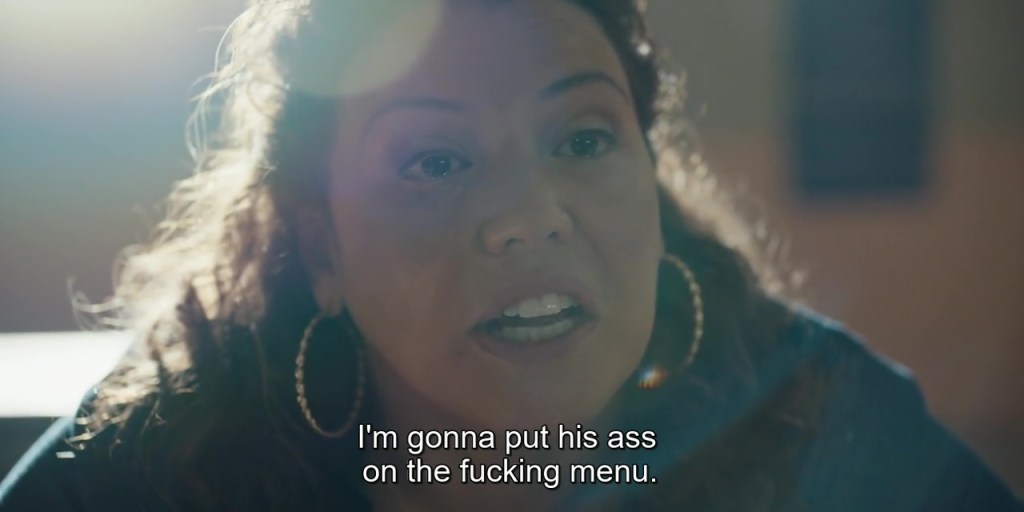
So the link in the first half of the series was to Sweeney Todd, killing people and putting them in pies. But this story goes back well beyond Sweeney, to a new intertextual link, and the common thread now (besides pies) is revenge! Delores is intent on finding her ex who, she has discovered, set her up to take the fall when the drug police moved in, and who had been cheating on her all around town, including with Marcie. She is determined to put him in an empanada.

For this purpose, she goes looking for a friend of a friend, a Private Investigator called Ruthie, played by the wonderful Cyndi Lauper. Ruthie’s motto (or perhaps mission statement) is the title of this week’s episode:

I NEVER DON’T FIND THEM

Ruthie doesn’t like getting involved in drug issues (too dangerous), and warns Delores not to get her tangled in any such wars.

Ruthie also has a passion for the theatre, and is currently an usher in the Broadway production of Shakespeare’s Titus Andronicus, starring Jamie Lee Curtis. The production was invented for this series, which is a shame, as I would have flown to New York to see that!

Now, this link to Titus merits some unpacking…

Ruthie gives Delores tickets to see Titus Andronicus, which is all about a Roman general, Titus, who kills and cooks his enemy’s sons into a pie, which he then serves to the unwitting mother.

Shakespeare would have been well aware of the many Greek legends of revenge, particularly that of Thyestes, as told in Seneca’s play of the same name. Thyestes unknowingly ate the flesh of his sons, served by his brother, Atreus. Shakespeare used the trope in this, his first tragedy, which was filmed in 1999 as Titus, with Anthony Hopkins in the title role, again serving human flesh to his unsuspecting guests, eight years after winning his Oscar for doing just that as “Hannibal the Cannibal” in The Silence of the Lambs.

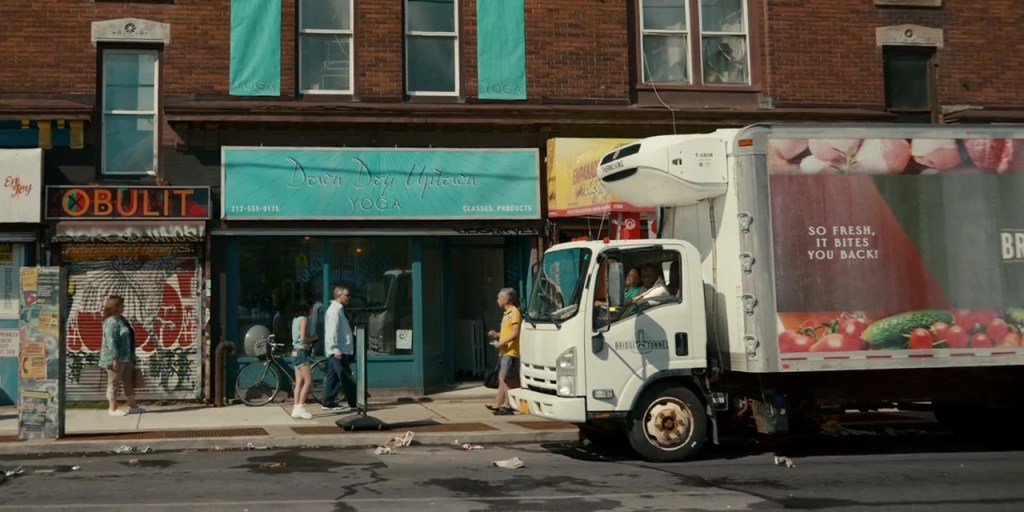
There are lots of other nice little touches, like the delivery guy, Jeremiah (named after the Old Testament Prophet of doom) asking why Luis doesn’t buy meat off him any more. “Doesn’t need to”, is what Delores doesn’t dare reply. Jeremiah’s truck has the slogan “SO FRESH, IT BITES YOU BACK”:

Then there’s the drug pusher who works (or worked) for Marcie, or as Delores calls her “cunt face”. Marcie is currently supplying filling for the latest batches of Muy Loco empanadas, but this dude doesn’t know that yet and is enjoying a Marcie empanada.

There’s problems ahead though. Jonah is now actively looking for his dad, who was Delores’ first murder victim. And he has run into Ruthie, who has promised him:

But Delores doesn’t want anyone to find him. She knows where Mr Perlman (and Marcie) are, and when she stumbles into Luis’ bathroom, she certainly finds them!

Delores is painfully aware that she can hardly be judgemental at what Luis has done to her victims.

“Maybe I didn’t chop these people up, but I did this.”

She makes up with Luis, who throws Jonah off the scent by sending a fake message from his father’s phone, and pledging that he will look after her, take the full blame if their crimes ever come out. They finally (five episodes in) head for the bedroom, where Luis performs cunnilingus, about as close as most humans come to cannibalism, and even crosses that line a little when he gets excited and bites her thigh.

Gynophagia, the fetish involving killing, cooking and eating women, is described by psychobiologist Clarence Herrick as a “morbid expression” of the universal desire to hug, often too violently, the object of our affection or desire, an extreme form of the grandmother painfully pinching a grandchild’s cheek or the child hugging to death a favourite kitten. So biting or in extreme cases eating women is perhaps rough love, an extended form of cunnilingus.

The thin red line between eating humans and eating other species has well and truly been crossed by the time Luis finally mounts Delores at the end of this episode.

“It’s a mouthful of daddy”: DELORES ROACH episode 4

This is such a great show. I was going to blog a couple of episodes at a time, but there is so much content in the short episodes that I had to do this one, the fourth, in splendid isolation. Also, I’m uploading it on father’s day (in Australia and probably some other places), and having a character eat some of his father just seems so pertinent!

If you haven’t read my blogs on the first episodes, you might want to do that first. In a nutshell, in episode 1, Delores has just been released from prison after 16 years. She heads back to Washington Heights NY but it’s all gentrified now, except for the Empanada Loca shop of her old friend Luis, who offers her a room and sets her up as a masseuse, a skill she learnt in jail.

In episodes 2 and 3, Delores kills the landlord who has been harassing Luis for his overdue rent, which he can’t afford because the neighbourhood is now fancy, and people don’t buy empanadas much. Luis creates a new empanada, MUY LOCO. It is hugely successful, like the chocolates in last week’s blog, because it contains, yep, human flesh, in this case, the landlord. Whose son, Jonah, appears in the shop at the end of episode 3, with two cops behind him.

All caught up, and now we’re at episode 4. It turns out Jonah does not know his dad is missing, and the cops are just waiting for their empanadas. But Delores does not want to go back to jail, having just got out after sixteen years, so you might think that finding Luis destroying (or actually cooking and selling) the evidence should be good news, but (call her old fashioned) she is horrified by the idea of cannibalism (although, funnily, not so much the murder she committed) and disgusted by the secret contents of the muy loco empanadas.

This dissonance between getting rid of the evidence of her rather serious crime and disgust at the fact that the evidence is being fed to an enthusiastic clientele is aggravated when Luis offers Jonah an empanada to try, a muy loco, reminding us of the lyrics of the old Stanley Holloway song about Sweeney Todd, on whom this story is based:

“For many a poor orphan lad
The first square meal he ever had
Was a hot meat pie made out of his dad
From Sweeney Todd the Barber”

Luis tells Jonah “the meat’s locally sourced” which is particularly true for him. Jonah loves the taste, asks if the meat is duck.

No, it’s no duck. We hear Delores’ thoughts:

Furious at Luis for feeding the landlord to his son, Delores takes the rest of the meat and sets fire to it, putting the muy loco off the menu. Luis is furious, and cannot see what the problem is, and then comes one of the great double entendres of the cannibal genre –

Luis barks at her:

“Hey, it’s edible! Like the Greek myth.”

Now we’re getting to the meat of the cannibalism debate!

Quick refresher: Oedipus was a mythological figure depicted in the play Oedipus Rex written by Sophocles some 2500 years ago. Oedipus became king of Thebes after unwittingly fulfilling a prophecy that he would kill his father, Laius (the previous king), and marry his mother, Jocasta (whom Oedipus took as his queen). It was more a case of mistaken identity and road rage than some deep psychosexual drive, but Sigmund Freud used it as the basis of what he called the Oedipus complex. This referred to a child’s sexual desire for the opposite-sex parent and hatred for the same-sex parent which, if not reconciled, leads to neurosis. Freud wrote that,

“It is the fate of all of us, perhaps, to direct our first sexual impulse towards our mother and our first hatred and our first murderous wish against our father. Our dreams convince us that this is so.”

Oedipus didn’t eat his father, but Freud believed that cannibalism is a foundation of the human unconscious. He asserted that cannibalism is one of the two original prohibitions of humankind, the other being incest. Freud’s conception was that the origin of human civilisation was an act of incestuous patricide and cannibalism by a group of pre-sapien savages, which became the origin of cooperative civilisation. In Totem and Taboo, he speculated that a prehuman group of brothers in a “primal horde” had come to resent their father’s monopolisation of the tribe’s females (common among primates) and conspired to kill the father and take their mothers and sisters for themselves. “Cannibal savages as they were, it goes without saying that they devoured their victim as well”. A later wave of remorse led these conspirators to create “out of their filial sense of guilt the two fundamental taboos of totemism”, the proscription of cannibalism and incest. This father/son guilt, he argued, corresponds with the Oedipus complex, which he called “the nuclear complex of the neuroses”.

So Jonah, like Oedipus has unwittingly eaten human flesh, the flesh of his father, not knowing what it was. If Luis had said it was duck, he would have believed him, and accepted that contentedly, because social conventions say we can eat ducks, but not dads. Yet the taste is so close that he couldn’t tell the difference. And since his dad was already dead, was this worse than deliberately killing a living, sentient duck?

Meanwhile, the local drug dealer, Marcie, accuses Delores of selling drugs and stealing her customers, because of the long queues of people waiting for muy loco empanadas. Delores tries to persuade her she is running a massage business and takes her downstairs for a massage, where Marcie starts to vandalise her room looking for drugs, and mocks her for protecting her old boyfriend, revealing that he cheated on her and eventually turned her in to the DEA to save his own hide. They fight, and Marcie becomes the new supply for the next batch of muy locos.

Delores is determined to find the cheating boyfriend. When she does, she promises,

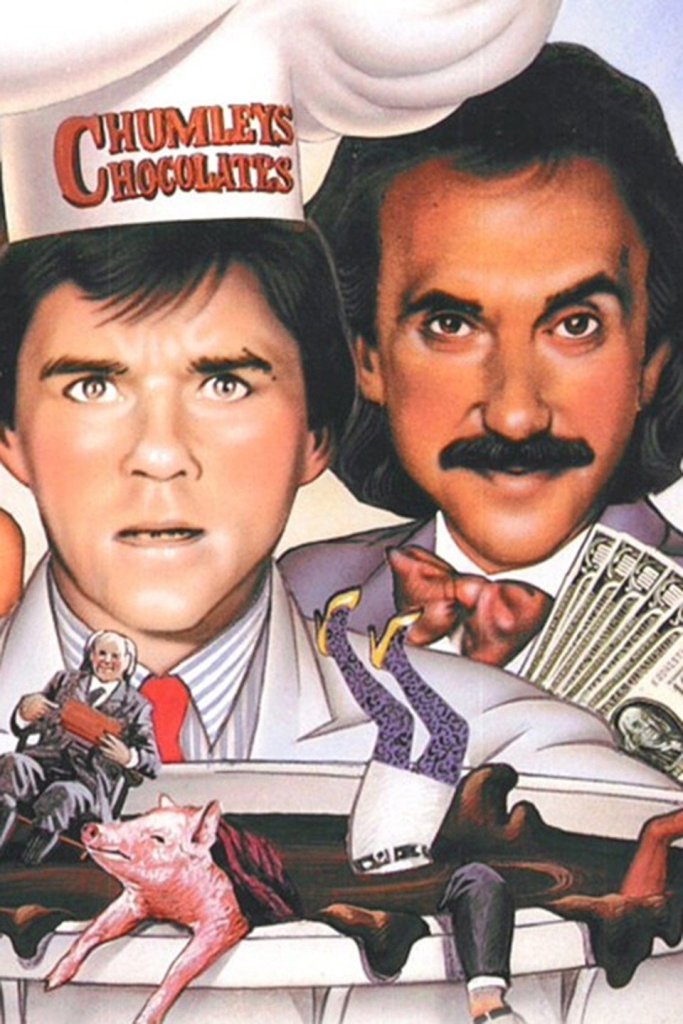
“Cannibal chocolates”: CONSUMING PASSIONS (Giles Foster, 1988)

Consuming Passions is a black-comedy film directed by Giles Foster (Hotel du Lac). The film is based on the stage play Secrets by two of the Monty Python greats, Michael Palin and Terry Jones, which was filmed and shown on the BBC in 1973.

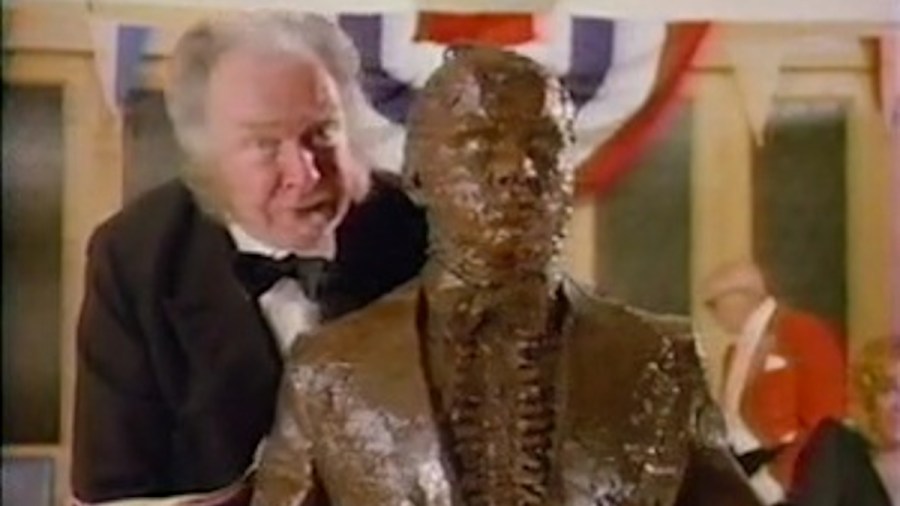
This is what I call entrepreneurial cannibalism, with a subgroup of accidental or fortuitous circumstances. A chocolate factory is preparing to launch a new luxury range, Passionelles. However, during production, the new management trainee causes three of the workers to fall into the giant vat of chocolate, where their flesh is mixed into the first batch.

The horrified boss tries to recall the chocolates, but they have already gone on sale. They prove a huge hit with the public. Market feedback says:

“Pleasantly nutty
subtle and delicious
addictive, compulsive
tasted full of goodness…”

They try to replicate the taste with meat from other animals, including a horrific scene where the guileless protagonist, Ian, orders a mountain of meat from the local butcher, including:

“three young porkers, with heads, ears and trotters”

But this bombs – only human flesh will give the chocolate that something special. As the secretary of the company (played by the wonderful Prunella Scales) says:

“People don’t want to eat chocolates with cows and pigs in them. People want to eat chocolates with people in them.”

They contemplate various ways to obtain dead bodies to use in their chocolate, including murder and/or chucking unemployed people in the vat. The new boss, played by the wonderful actor Jonathan Pryce (Brazil, The Two Popes, and many more) states the ultimate in neolib rationalisation:

“Think of all those millions and millions of unemployed school-leavers, yeah? A tragic, tragic situation. But we can give them a chance to do their bit for society yeah… think how it will shorten the dole queues.”

This seems to be based on Jonathan Swift’s 1729 pamphlet A Modest Proposal, in which he satirically suggested that the Irish, who were already being devoured economically by the landlords, should now sell the oppressors their children to make “a most delicious, nourishing, and wholesome Food; whether Stewed, Roasted, Baked or Boiled.”

In fact, the whole film is a commentary on the neoliberal ideologies that were dominating political policy at the time under Reagan and Thatcher. This toxic reasoning, which is still rampant, aspired to free up corporations while crippling any resistance from workers. Profit became the only determinant of policy – here the new owner of the company rejects the idea of putting real chocolate in the product, preferring artificial flavours and colours. When the market demands human bodies, that’s what they must have. Ian has to trawl morgues, hospitals, funeral parlours and medical schools. When his girlfriend, the quality control chemist, discovers there is human flesh in the chocolates, he assumes she will leave him, but she tells him,

“doesn’t hurt them if they’re dead. They’d probably be glad to know they’re being useful, like!”

By the end of the film, Ian is chocolate man of the year, knighted by the Queen, and made chairman of the company. He is no longer disgusted by cannibalism, but in fact is appraising everyone he meets, including his fiancée, for their weight, fat content and likely edibility. In an extreme example of what Marx called commodity fetishism, we have all become comestible commodities. Nancy Fraser writes and speaks convincingly about the way Cannibal Capitalism systematically destroys and consumes the sectors of society on which its own survival depends. In order to sell more commodities to the public, corporations will consume any resource, including the air we breathe, and our bodies too.

The Danes used a similar plot device later with The Green Butchers, starring Mads Mikkelsen (yep, it’s Hannibal, but not as we know him) as a butcher who accidentally locks the electrician in the freezer overnight and finds his customers love the resulting offcuts. The French tried it more recently with Some Like it Rare, in which a couple who own a butcher store accidentally run over and kill a vegan who has been protesting against their store for selling the flesh of animals. They too find their customers love human flesh, but only if it is uncontaminated by eating the meat of other animals – they only kill and cook vegans, a consummation (or consumption) of which Annie Potts and Jovian Parry have found, on social media, many carnists dream.

Talking about human body parts in chocolates, do you remember choc fingers? I used to scoff them down as a child. I was somewhat surprised to see they were still available, and were subject of a scandal in the UK in 2015 – Cadbury had reduced the size of the packet by two biscuits!

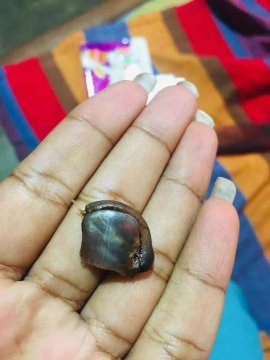
The headline is somewhat unfortunate, and that’s not what this movie is about. But I’d forgotten their very existence, until a recent ‘news’ report that a Sri Lankan woman bit into a chocolate and found the inside rather hard. Thinking it was a ‘fruit and nut’ variety, she persevered, but when the nut still did not crack she decided to check it out by holding the piece of chocolate under tap water. 

In case her tweet has been removed, here is the photo:

It was a bit of a finger, and it reminded me of this long-forgotten (perhaps deservedly) movie. That news, story, like the film, reminds us that, like the ouroboros, our society is busy eating its own tail, it’s workers.

For me, the only really repulsive bit was the dead piglets being dropped into the vat. I’m going to assume they were very realistic models, perhaps made of marzipan, but I’m aware that in a world that kills 1.3 billion pigs a year, buying real corpses would be a lot cheaper for a low-budget movie.

Consuming Passions received a 20% rotten rating on Rotten Tomatoes. It’s a nice idea, but they play it as farce, hanging the comedy on the assumption that we will all be so disgusted by the thought of eating human flesh that we will ignore the often silly dialogue and the occasionally appalling acting, particularly Vanessa Redgrave who, totally unnecessarily, flounces through the film proclaiming herself a “loose woman” and butchering a Maltese accent.

But there are some interesting ideas about masculinist theories of meat-eating, with one woman saying she was going to buy those chocs for her husband to “put the lead back in his pencil”. The idea that men somehow need meat for virility is a basic plank of meat marketing, despite the clear links to heart disease, colon cancer, environmental crises, and of course appalling animal cruelty. And the film’s basic principle, that we are all edible in our consumerist culture, is apposite and well argued, as more and more bodies are sucked into that vat of delicious brown ooze.

“Just Darwin and shit”: THE HORROR OF DELORES ROACH episodes 2&3

I’m spreading this out, one or two episodes at a time rather than binge-watching the whole eight, because I want to savour them, also because that would be like watching a four-hour movie, which I usually only do if Peter Jackson is involved. And I’m trying to finish my thesis, so no four-hour movies for this old student!

If you haven’t read my blog on the first episode, you might want to do that first, as it makes more sense if you know that Delores has just been released from prison after 16 years. Just click here.

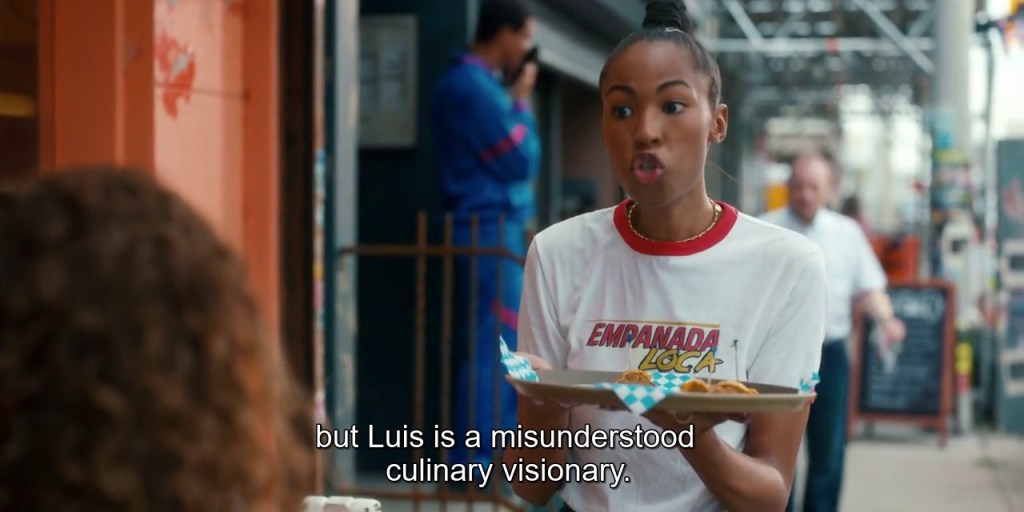
Delores is living in the basement of an empanada shop run by Luis, but he is a dreamer, and is quickly going broke. The whole neighbourhood has been gentrified, and people don’t buy empanadas like they used to. Luis keeps inventing new flavours, but none have caught on.

Episode 2 is the setup for the cannibalism to come in episode 3. We know it’s coming, but Delores doesn’t.

Luis is feuding with his landlord, Gideon Pearlman, played by the wonderful comedian Marc Maron (the cranky entrepreneur from the TV show GLOW). Delores plays peacemaker, takes him downstairs and gives him all her money, which turns out to be negligible amount, due to the massive gentrification that has happened in Washington Heights in the last sixteen years while she was in the pokey. He sees her massage table and she offers him her “magic hands”, which of course he misinterprets as an offer of a hand-job. But Delores has learnt self-defence in jail.

“Got to break the C2 or C1 to kill somebody”

Which she does. Not knowing what to do with the body, she runs to the shop and buys spades, saws, gaffer tape and, to be inconspicuous, a whole load of birthday balloons. It really is a dark comedy!

When she comes back, she finds Nellie, who works in the empanada shop, giving away samples of the new taste sensation, MUY LOCO. What’s in it?

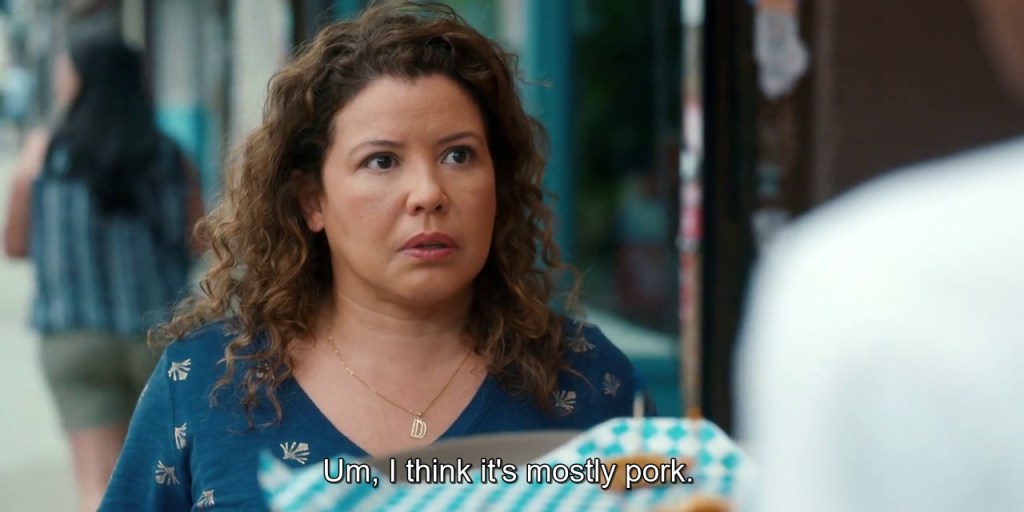
Yeah, it’s not pork, it’s long pig, and when she confronts Luis, he tells her he “took care of it”.

Luis is suddenly a huge business success. Everyone loves Muy Loco, including the local cops. And he wants to give Delores the credit, whereas all she wants to do is barf.

But you, my Delores, you just changed the game for me. You have led me to a pantheon that very few of us who are called to this art are ever privileged enough to touch.
So now, that greedy son of a bitch will get chewed up, shat out and flushed down the toilet.”

The other reason I didn’t want to go past episode three is that Luis and Delores engage in a fundamental philosophical discussion that is key to Cannibal Studies, which we might summarise as “meat is meat”. When Delores refuses to taste Muy Loco because “it’s human fucking flesh in an empanada!”, Luis responds:

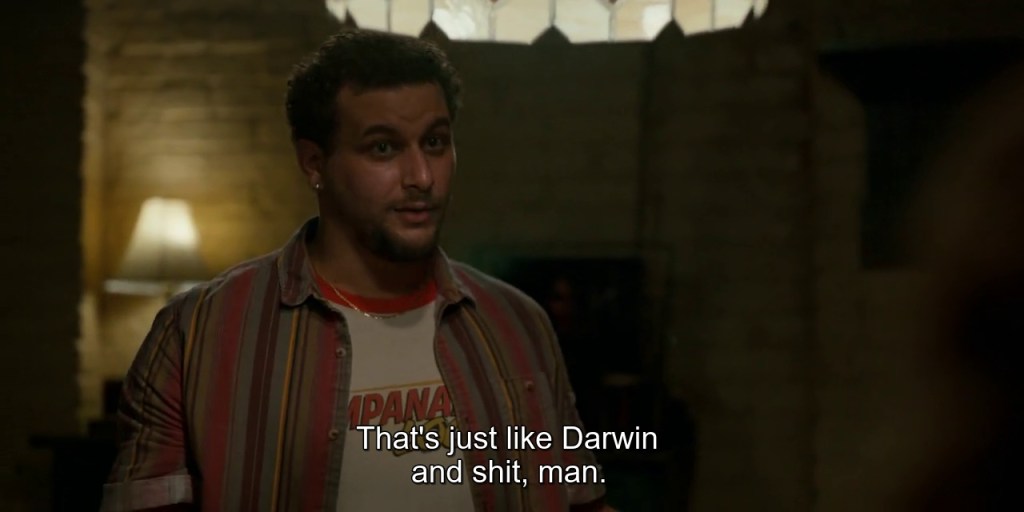
“Delores. Meat is meat. Flesh is flesh. The only reason that we eat a pig, or a cow or a lamb, like whatever, is because we are more powerful than them. So we get to feed off them. That’s how we survive, because we are carnivores. That’s just like Darwin and shit, man”

We’re actually not carnivores – that name is reserved for the true predators – tigers, sharks, that sort of animal. We are scavengers, like anchovies, or pigs.

We’re treated to lots of close-ups of meat being chopped, meat being cooked, meat being gobbled up. Viewers may at this point be consoling themselves by saying “it’s not human”, but it’s red meat, it’s from some mammal, and what difference does it make which species?

Luis has taken care of the body, removed the evidence, and become a successful business owner, all with one radical idea. The only problem is,