A Brazilian murder suspect and Dutch resident who police believe may have participated in “cannibal practices” was arrested at an airport in Portugal with a suitcase containing “suspicious meat” and bloodstained clothing.
Begoleã Mendes Fernandes, 26, was taken into custody at Lisbon Airport on Monday February 27, 2023, after getting off a flight from Amsterdam, where he was suspected of killing 21-year-old Alan Lopes a day earlier. Both the victim and suspect are of Brazilian descent. Fernandes was at first arrested on suspicion of travelling on falsified documents.
Portuguese media reported that pieces of meat were found inside a plastic bag packed into Fernandes’ luggage, and that the meat could be human flesh. The meat is still to be analysed in a laboratory, to determine its origin. The Portuguese Immigration and Border Services (Servico De Estrangereiros E Fronteiras or SEF) issued a statement:
“After contacting the authorities in the Netherlands, the country where he resided, it was confirmed that he was wanted on suspicion of committing a crime of murder that occurred on February 26, in Amsterdam, which led the judicial authorities of that country to issue, yesterday afternoon, a European Arrest Warrant for extradition purposes. By indication of the Dutch authorities and the Lisbon DIAP, in addition to the documents that the suspect had in his possession, a bandage and clothes with traces of blood, a plastic package containing several pieces of meat and a mobile phone were seized, with the foreign citizen taken to the PJ’s Scientific Police Laboratory.”
Fernandes drew border officers’ attention because he had a bandage on his right hand and bloodstains on his clothing. He was scheduled to board a flight to Belo Horizonte in Brazil.
The police found the body of Lopes in his home on Vegastraat in Amsterdam at around 9:20 p.m. that Sunday after calls from his concerned friends. “It was clear that he died in a violent crime,” the police said in an initial statement. Specialists were deployed to the scene to do a forensic investigation.
The Portuguese daily newspaper Jornal de Notícias noted that
“The suspect claimed that he killed the victim because the latter forced him into cannibalistic practices.”
Lopes’ friends told Dutch daily paper Parool that they called the police after Fernandes messaged them to say that he had killed the young man. Several of Lopes’ friends received the voice notes at around 7:30 p.m. on Sunday. Marco Cunha (23) told Parool:
“He said that he tried to defend himself against Alan because he had pretended to be a cannibal. Other friends received the same vague message.”
The 26-year-old Fernandes, who described himself on Facebook as “2% genius, 98% crazy” made his initial court appearance in Lisbon and was placed in custody pending his extradition to the Netherlands.
Lopes was found dead Sunday night at a house in Amsterdam that he shared with his mother and sister, who were away at the time. According to Lopes’ friends, the young man was trying to help Fernandes, who worked as a delivery boy and had descended into drug-taking in recent months.
“He went crazy in a short time. He was on drugs, and it drove him crazy. His brain just stopped working.”
“Alan tried to help him. He had a big heart, even for the one who killed him,” Lopes’ mother, Antonia Lima (45), said to Parool. Her partner, Freek Posthumus (60), said that the young man was building a life in the Netherlands. “He was busy with his driver’s license and worked hard. I am convinced he had a bright future ahead of him.”
Kamila Lopes, the victim’s sister, told the news site Notícias ao Minuto that Fernandes was homeless and would stay with the family whenever he had nowhere to reside.
However, in an interview with the Portuguese television channel SIC, Fernandes’ mother, Carla Pimentel, suggested that her son may have killed Lopes in self-defence, according to the Portuguese-language news outlet RFI.
According to Pimentel, Fernandes was having dinner with the victim when Lopes offered him human flesh, and also showed him videos about cannibalism. The 21-year-old then allegedly tried to kill Fernandes.
The mom claimed that the meat found in her son’s possession in Lisbon was the same that was offered to him by Lopes, and that her son had kept it as evidence that he planned to hand to the authorities. Some reports are claiming that forensics have shown the meat is not from the body of the victim, Lopes, suggesting that the claims about cannibalism of a third person may be accurate.
Fernandes is expected to be extradited to the Netherlands sometime “this week” (i.e. week commencing 20 March). In the meantime, he has been locked in a jail cell in Lisbon airport for 22 hours every day for his own safety. According to tabloidCorreio da Manhã, due to the media frenzy, he is now known as “the cannibal”, and authorities hope to “contain any untoward reactions with other inmates”.
The modern cannibal is usually hard to identify. Jeffrey Dahmer was the all-American boy next door. Armin Meiwes used to mow his neighbours’ lawns to be helpful. Issei Sagawa was so small and helpless that he seemed vulnerable rather than threatening. Albert Fish was a sweet old man, so charming that the Budd’s let him take their little girl to a party.
They were normal, everyday people, a bit weird, but not monsters.
At least, not in appearance. This is a recent phenomenon – the original cannibals were called anthropophagi (Greek for man-eaters) and were humanoid in shape, but were usually some sort of hybrid – a mix of humans and gods or other animals – strong, ferocious, and clearly not quite human. From the 15th century, the alleged cannibals found by Columbus and other explorers were different in culture and skin colouring, so were easily distinguished, defamed and exterminated. It is only recently, since Jack the Ripper in 1888, that the cannibal walked among us, undetected until the victims were found (or what was left of them).
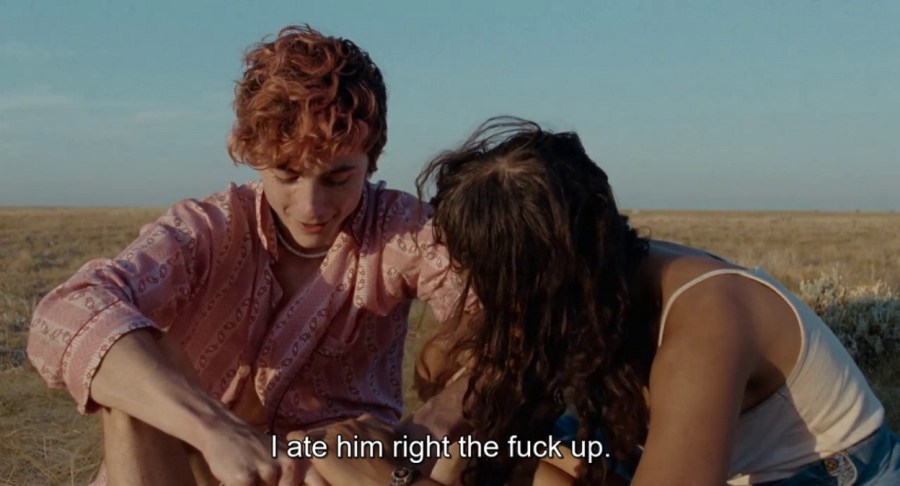
Bones and All presents as a coming of age cannibal romance, taking a sharp turn back into cannibal history for its themes. Maren (Taylor Russell from Lost in Space) is finishing high school, a spectacular end of term in which she is invited to her friend’s sleepover and bites a girl’s finger off, instead of, you know, just admiring the nail polish, as she had been invited to do.
She then goes on the run with her father, who has been keeping her ahead of the law as she grew up (her first human meat was her babysitter when she was three) but now ditches her, with a few hundred dollars and a birth certificate.
It then becomes a road movie, as she travels through the American Mid-West trying to find her mother, attracting suspicion not because of her eating habits but just because she looks too young to be on the road. She comes across another cannibal (they are called “eaters”) in the shape of a weird old man named Sully (Mark Rylance, Bridge of Spies) before meeting up with Lee, played by the love interest of seemingly everyone nowadays, Timothée Chalamet. Chalamet appeared in the third instalment of Guadagnino’s “Desire Trilogy”, Call Me by Your Name), in which he was the love interest of Oliver, played by Armie Hammer, who has recently been generating his own cannibalism headlines.
As a road movie it’s Thelma and Louise mixed with Romeo and Juliet, if they had been cannibals. In other words outsiders, star-crossed lovers, and lots of flesh being torn off dead (and sometimes living) bodies. Road movies rely on meeting new and weird people, and learning about the protagonists (and ourselves) from their stories.
Sully is a lonely old man who teaches Maren about being an eater, and how an eater has a super-power – like a vampire, they have a nose that can smell other eaters at great distances, and can also smell dying people, which allows him to feast on them fairly inculpably, although Maren rather wonders if they should be calling 911 rather than letting them gasp their last breaths. So they are anthropophagi, they smell different, have a strong sense of smell, and so are not quite human. We subsequently discover that the cannibal gene is passed on – Lee’s dad and Maren’s mother were also eaters. They are a breed apart, hybrid humans, who can mate with non-eaters.
They are also presented as ‘savages’ – related to the colonised peoples who were declared cannibal by the imperial powers. Maren is biracial, and Sully (although played by a classical British Shakespearean actor) seems to be presented as a Native American, with a long ponytail and a feather in his hat. The marginalised and disenfranchised are regularly presented as dangerous, thieves, murders, cannibals, regardless of any evidence.
An interesting character from colonial times is the wendigo, a figure from Algonquin mythology who eats his fellow humans and draws on their strength to grow huge and powerful, which only makes him hungrier and deadlier. Sully tells Maren that her fate is to need more and more flesh as she gets older.
Just like the wendigo, who is an indigenous version of the anthropophagus, and one that was used by the victims to characterise the European invaders and their voracious appetite for land and gold. The phrase “bones and all” reminds us of the colonial greed that denied the humanity of those invaded and insisted on taking everything, leaving nothing and nowhere to go but a few reservations or missions in remote, unprofitable areas. Eating bones and all is also a perfect way of getting rid of the evidence.
The title Bones and All is taken from the book of the same name by Camille DeAngelis, but the phrase was not used in the book – it just meant that Maren and the other eaters would automatically eat the whole person, bones and all. Except for her first, the babysitter, because she was too small to swallow bones – she left a pile of them, a pool of blood, and the hammer from an eardrum. In a movie, though, it can be harder for the viewer to maintain a willing suspension of disbelief, so eating the victim bones and all becomes a rite of passage – the next level of being an eater. Maren and Lee don’t know how to eat a person bones and all, so they are not yet postgrad eaters. Maren puts it succinctly – “that’s impossible.” But what about eating the flesh? Armin Meiwes took ten months to eat 20 kilograms (44 lb) of Brandes, but we are asked to accept that Maren and Lee can eat a whole body in a night.
But then, everything is ambiguous in this story, which has been widely described as a metaphor for otherness and queerness. The story is set in 1981, as Ronald Reagan is entering the White House. Being different, queer, compassionate, seeking social justice were all considered laughable or dangerous. Greed was good, and so eating a victim bones and all might have seemed laudable. Drug addiction was escalating, and some have seen the cannibalism in this film as a metaphor for this as well – Maren and Lee can’t go too long without their feed, and will do whatever they need to in order to get it.
Some of the ambiguities are more subtle: Maren looks young, which bothers various people she deals with, although she is 18 and technically an adult in most places. Lee falls in love with her, but is also capable of appearing to be cruising for gay sex.
He chooses a carnival worker who has been mean to a child, leads him into the bushes and masturbates him, slitting the man’s throat as he orgasms. It was not until twenty years later that gay sex was legalised in the US, and this man’s secret desire for same sex petite mort becomes his real mort. They then discover that the man had a wife and family, and are stricken with guilt, because apparently eating some people is OK, but not family people.
Then we have the eaters – Maren is naïve and caring, horrified by her need to feed. Lee is a puny dude who kills seemingly effortlessly, but like Hannibal Lecter, Lee prefers to eat rude people – when we first meet him, he challenges a rude person in a supermarket and leads him to a deserted shed where he kills and eats him. Sully is an senior eater, so has to eat regularly, but says he tries not to kill people – sniffs out those who are dying, but later he gets violent when Maren rejects his advances.
Jake (Michael Stuhlbarg) is an eater who has graduated to eating bones and all, but he is accompanied by a friend named Brad (David Gordon Green), a cop (!), who is not a natural eater, but just likes doing it. Maren accepts that she and Lee have to eat people, but is revolted by Jake’s wish to do the same. We’re back to the old debate of nature versus nurture. Are people born queer? Or with addictive personalities? Or psychopathic? Or cannibalistic?
The Director, Luca Guadagnino, has made a number of changes from the book, which are examined elsewhere. The most obvious one, though, is that Maren is brought up and then eventually abandoned by her mother in the book, but her father in the film. This changes the dynamic considerably, because we now have two eaters in the family, both female. The eater parent in both versions is locked up in an asylum, having eaten their own hands, but in the movie it’s her mother, (a short but superb appearance by Chloë Sevigny). We arrive at last at the modern horror archetype, the “monstrous-feminine”, the figure that confronts the male viewer with his fears of being castrated (Freud’s favourite explanation), as well as “the monstrous womb” – a terrifying image of a “black hole which threatens to reabsorb what it once birthed” (Creed, The Monstrous-Feminine, p. 27). The female cannibal is quintessentially monstrous-feminine, terrifying men with the antithesis of popular female stereotypes of giving life and nurturing. In the book, Maren only eats boys or men (after the initial babysitter) – she is drawn to eat those who seek to be close to her. In both versions of the story, the ambiguity is clear to us and the female cannibals – they have a compulsion to eat, but don’t want to hurt others.
Maren’s solution is to try to act normal, fall in love, get a job, get “clean” of the eating. Her mother’s was to lock herself away, and even then she chewed off her own hands.
To me, the most fascinating ambiguity in this film and in our societies generally is the question “who can you eat?” Eating some animals is considered just “normal” – Lee is chewing on bacon (pig flesh) served to him in a very respectable café, and has been working in an abattoir. When they need money, he and Maren rob the abattoir at night, later sitting on the overhead walkway watching the cows who are to be killed for legal, non-controversial eating, when Maren observes
“every one of them has a mom and a dad, sisters, brothers, cousins, kids. Friends even.”
The real question, Derrida says, is not what to eat but how to eat well. Perhaps, as Chalamet has said, it is impossible to live ethically – every act of consumption or energy usage wrecks the environment a little bit more. For some carnivores, this is seen as a ‘bones and all’ issue, they call it “nose to tail” – killing is OK, but wasting any part of the animal is the real crime. But as Maren says, cows also feel terror, pain, bereavement when their babies are taken from them. The author of the book, Camille DeAngelis, went vegan before writing it, indicating that the problem of who to eat, the rude or dying, the human or the cow, weighed on her, and the scene filmed in the slaughterhouse indicates that Guadagnino may have felt the same. Cat Woods’ review in Salon reminds us that Brad, the off duty policeman, chooses to be a cannibal:
“Why would he hunt, slaughter, and feast upon human flesh if he doesn’t need to? And, if we the audience can be repulsed by that – and his evident choice to slaughter and eat flesh when there is abundant satiety that doesn’t cause violence, pain and loss – then perhaps we need to venture a little deeper into our own psyches and ask: Why would we feast upon flesh if we don’t need to?”
This is a seriously good film, with a great cast and, in the midst of all this carnage, we are treated to magnificent scenery beautifully captured by cinematographer Arseni Khachaturan. I have not revealed the ending, and hope I have not revealed too many other plot points. I recommend you go see it.
Oxygen True Crime is a program brand within the NBCUniversal stable, and is rather oddly described as:
“a multi-platform high quality crime destination brand for women”
I guess because most of the murderers reported by the show are men?
Anyway, the show we are reviewing here is part of the 2022 second season of an Oxygen series called Living with a Serial Killer, the first season of which aired in 2021. The program has covered a number of British and North American killers, including Steve Wright (the Suffolk Strangler), Peter Tobin, Timothy Boczkowski and a couple of women: Elizabeth Wettlaufer, a Canadian nurse who murdered several of her patients and Joanne Dennehy, who stabbed three men to death in 2013.
Living with a Serial Killer concentrates not so much on the killer, as do most true crime shows, but on the partners or friends or even children who lived with them, the people who thought they knew them, and it tells how they lived either in fear or else were oblivious to the exploits of the murderers. Most, but not all, of these unwilling companions were women.
Most of the killers were not cannibals, disappointingly for this blog, but one was, or says he was, despite there not being enough left of his victims to confirm or deny his claim. This was Stephen Griffiths, who stood up in court for his arraignment for murder and, when asked his name, identified himself as THE CROSSBOW CANNIBAL.
Griffiths killed three women in the city of Bradford, West Yorkshire, England in 2009 and 2010; 43-year-old Susan Rushworth disappeared on 22 June 2009, followed by 31-year-old Shelley Armitage on 26 April 2010 and 36-year-old Suzanne Blamires on 21 May that year.
The women were all Bradford sex workers. Parts of Blamires’s body, including her severed head still containing a crossbow bolt, were found in the River Aire in Shipley, near Bradford, on 25 May. Other human tissue found in the same river was later established to belong to Armitage. No remains of Rushworth were ever found. Griffiths was arrested after CCTV security footage caught him in the act of killing Suzanne Blamires. He not only committed the execution on camera but, after dragging her body inside his apartment, returned carrying his crossbow and gave a middle finger to the camera, knowing he had been seen.
Griffiths was a postgraduate research student studying criminology and specialising in British murderers, so he knew a great deal about killing and disposing of bodies. He also knew what sort of activities led to sensationalist press coverage, and he seems to have been determined to become more famous than one of his pin-ups, the Yorkshire Ripper, Peter Sutcliffe. Sutcliffe had murdered thirteen women in the same area between 1975 and 1980, and was at the time rotting in prison with several life sentences to serve, and judicial instructions that he was never to be released. Sutcliffe died in November 2020 after refusing treatment for COVID-19.
After his arrest, which happened a few days later when the caretaker checked the CCTV tapes, Griffiths readily admitted the murders to the police, telling them he had eaten some of his victims’ flesh, and adding, “That’s part of the magic.”
The program focuses on Kathy Hancock, who lived with Griffiths for a considerable time. A tough woman, a prison officer when they met, she was physically abused by him, poisoned, and perhaps worst of all psychologically tortured (particularly when he stole her dogs) to the extent that she was unable to escape his influence. She did not know that he was a serial killer, but was not very surprised when she found out. Despite the occasional escape, she was with him or under his influence for much of the decade from 2001 until his arrest in 2010.
When interviewed by West Yorkshire Police (extract at the top of this blog), Griffiths was asked why he killed the three sex-workers. His reply:
“I don’t know. Well, I’m misanthropic. I don’t have much time for the human race.”
Police divers found 159 pieces of human tissue when they searched the River Aire; almost all were from the final victim, Suzanne Blamires. There were only two parts of Shelley Armitage found – a part of her spine and a section of flesh revealing knife marks. Susan Rushworth’s family had no definite confirmation of her death or disposal, and no remains over which to mourn. He told the police:
“… it was just meat in the bath that was chopped up and churned, some of it eaten raw and I don’t know after that. I don’t know where she is.”
Griffiths claimed to be possessed by an alter ego named Ven Pariah who took over his social media accounts and boasted of his exploits. Psychiatrists found him fit to be tried, but it is still possible that his psychotic episodes (he was diagnosed as a sadistic schizoid psychopath) accompanied the murders and he really does not know what happened subsequently. It does sound a bit convenient though, like Hans Beckert in Fritz Lang’s M – EINE STADT SUCHT EINEN MÖRDER, who claimed he could not remember murdering and consuming his child victims, particularly as Griffiths seems to have clear recall of the actual murders and dismemberments.
Or he could be making it all up, since we know that Griffiths was desperate to be (in)famous and, as a student of criminology, would have been aware that cannibalism would make far bigger headlines than murder.
But here’s another explanation. Griffiths told police that he did not particularly despise sex workers, but that they were easy targets – they worked on dark, run-down streets and, due to their propensity for addiction, the police were unlikely to worry too much if they disappeared – there were plenty of other possible explanations besides murder. This is reminiscent of Albert Fish, who killed and ate African-American and Latino children, not because he was a racist, but because he knew the police would not look too hard for them.
Griffiths’ hatred was not aimed at sex workers but at women in general. He was insecure, vain, and had a desperate need to dominate. This is indicated in his relationship with Kathy Hancock, whom he abused and tormented despite the fact that she was voluntarily cohabiting with him. When she finally left he stalked and threatened her, to the extent that she finally moved overseas to get as far away from him as possible.
The ultimate form of control is to kill and consume the ‘other’. Humans do it all the time to other animals to establish an ideological superiority and supremacy – we eat meat (some of us) not because it is necessary for our health but because sacrificing the animal demonstrates human exceptionalism. It elevates the human, or those privileged to be considered human, to a higher plane than other animals and ‘lesser’ or sub-humans (untermenschen), whom we feel free to exploit in a wide variety of ways such as slavery, sweatshops and, in the extreme, cannibal feasting. Griffiths’ profound misogyny could find its deepest expression not in paying for the use of their bodies, or even ‘just’ killing them, but in utterly destroying them, and at the same time absorbing them into his own body, thereby destroying their independent subjectivity and making them exist only as part of him. Cannibalism offers ultimate power and control over the victims.
David Wilson, Professor of Criminology and Criminal Justice at Birmingham City University, said that
“We want to see serial killers as real aberrations, as different from dominant beings in our culture, but often they are just extreme versions of other beings of their time.”
Was Stephen Griffiths a cannibal or a braggart? We’ll never know for certain. Claims of cannibalism are hard to confirm, as the perpetrator is often undiscovered, unreliable, or dead. Except for cases where cannibals recorded their acts on video tape (such as Armin Meiwes), we only have the verification of missing flesh or slashed bones, evidence over which everyone from archaeologists to forensic scientists can argue forever, or the confessions of the cannibal, which can be easily retracted before trial or may prove to be just boasting and narcissistic grandstanding. Griffiths told the police:
“It was just a slaughterhouse in the bath tub.”
The cannibal, whether literal or metaphorical, is essentially enacting an extreme form of carnivorous virility, and thereby questioning the conventional view of humans as above nature, as not animals, not meat. The cannibal makes us look at ourselves as edible, and thereby question our place in, and exploitation of, the natural world. The bath tub, our symbol of cleanliness and separation from the dirt and smell of nature, becomes a slaughterhouse. The slaughterhouse, normally hidden in remote towns behind high walls, comes home.
Cannibalism seems to be everywhere lately – movies, TV, books, and music. It represents a radical “othering” that appeals both to our desire to isolate ourselves into our tribe and deny the humanity of others, and our suspicion that we ourselves are the “other” that our society is seeking to jettison. This is particularly so for anyone who counts as marginalised.
No wonder then that cannibalism has repeatedly entered music, here in the shape of cyber-punk and rap.
Comethazine (real name Frank Childress) is a 24-year-old rapper and songwriter who is best known for his platinum-selling singles “Walk” and “Bands“. Both were on his 2018 debut mixtape, Bawskee. He is now up to Bawskee 5, released on November 18th 2022, the twelfth song on which is called Cannibal (link above).
Rap is not known for its gentle melodies or tranquil lyrics, so you can judge these for yourself.
(Comethazine in this bitch, nigga, I’m piped the fuck up) Come and get your man ’cause he buggin’ (Add1ct) Chop that nigga up, throw his body in the oven (Uh, mm, mm, mm)
Come and get your man ’cause he buggin’ (Bitch, buggin’) I’m about to chop that nigga up, throw his body in the oven (Bitch, bitch, bitch, bitch) Cannibal, yes, bitch, I’m a real deal animal (Yeah) I be on the block screaming, “Kill, kill, Hannibal” (Alright) Fuck a snitch, bitch, this chop’ got a handle, uh (Boom) Light a nigga top like a candle Mop made a nigga flip, flop like a sandal Got his thot tryna hump like a camel Caught him at the light, and let it dump out the rental (Boom) Bitch boy, like bitch ’cause he sentimental (Hallow) Unload the clip, full clip to the temple Hollow tip hit, left a dent like a dimple If he a opp, he get popped like pimple Bitch, I don’t wanna fuck, give me top, I’m simple Bitch, you a thot so you get treated like a rental Put a fuckboy on ABC like Jimmy Kimmel
Come and get your man ’cause he buggin’ (Bitch, buggin’) I’m about to chop that nigga up, throw his body in the oven (Bitch, bitch, bitch, bitch) Cannibal, yes, bitch, I’m a real deal animal (Yeah) I be on the block screaming, “Kill, kill, Hannibal” Come and get your man ’cause he buggin’ (Now) I’m about to chop that nigga up, throw his body in the oven (Bitch, bitch, bitch, bitch) Cannibal, yes, bitch, I’m a real deal animal (Yeah) I be on the block screaming, “Kill, kill, Hannibal”
Not too sure what it all means, or maybe that doesn’t matter. Not sure Hannibal Lecter would be playing this in his car, despite the mention of his name. Although Hannibal does like artists who are driven to complete their work, regardless of the cost in human life – remember the guy who makes murals out of corpses?
Comethazine is clearly driven, and if that requires chopping up and throwing his fellow man into an oven, who are we to argue?
So, the buzz for this movie is ‘Ted Lasso goes cannibal’. By that, they don’t imply we will need to sit through any football matches, but that there is going to be a lot of American “can-do” ardour, conflicting with British reticence and melancholy. Also some dark humour, and a whole lot of gore, which some may find objectionable. Consider yourselves warned.
Feed Me is directed by Adam Leader and Richard Oakes (Hosts). XYZ Films released the horror-comedy on October 27 2022 on digital and on demand platforms. Feed Me follows Jed (Christopher Mulvin) whose life is shattered when his wife Olivia (Samantha Loxley) suddenly dies, leaving him feeling guilty. The blurb says:
“Spiralling into an abyss of depression, he finds himself in a bar with a deranged cannibal, Lionel Flack (Neal Ward) who convinces him he can redeem himself through the glorious act of allowing himself to be slowly eaten to death.”
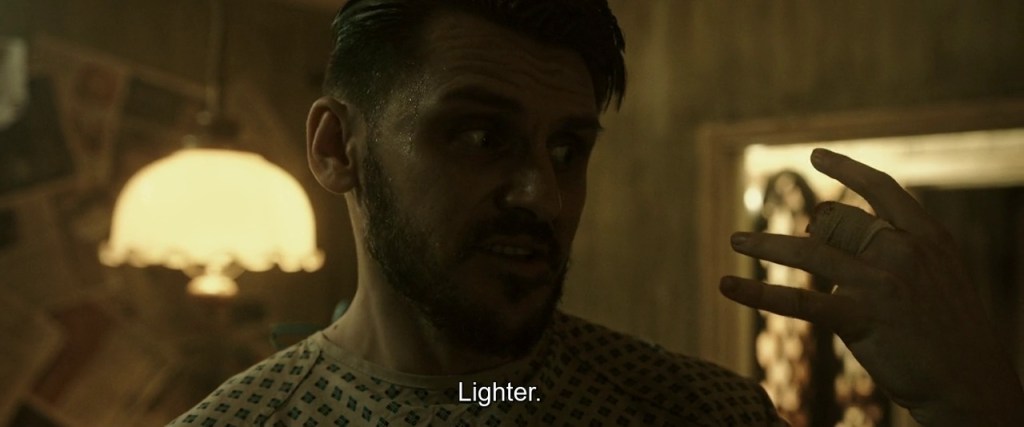
Suicide, usually unassisted, is sadly common in modern society, and besides making the relatives wretched, it is also an enormous inconvenience to the police, medics and trauma-cleaners who have to deal with it. So why not benefit someone – the local cannibal who promises a painless death that will not require housekeeping, because he will eat the resulting mess? Jed moves in with Lionel, whose tiny house is filthy and full of body parts. But Jed is ready, eager to die, and Lionel is tremblingly eager to eat him.
Cannibalism, particularly vorarephilia (the erotic desire to consume or be consumed by another) can be seen as a type of eating disorder, particularly in cases where there are other foods readily available, but if that is the case, so can any form of carnivory. The film starts and finishes with such reflections – Jed’s wife is a beautiful young woman who is convinced she is fat and ugly, and eventually dies from the effects of bulimia – she starves herself and vomits out whatever nourishment she does eat, until her body closes down.
As Jed explains it, her mental illness meant that she “was eaten from the inside out.” Lionel’s solution is that, if Jed is determined to kill himself, he should do it from the outside in.
Lionel quotes some fake anthropology – a tribe called the Yiurkun who, he says, live in perpetual happiness,
His offer (and there is a written contract involved) is to eat Jed, quickly and painlessly, so he can join his beloved. Why not, Jed thinks, since Olivia has effectively (in his dreams) eaten his heart?
Lionel starts small – local anaesthetic, one finger chopped off with secateurs and carefully cooked, the wound cauterised with a hot clothes iron. “How do you feel?” Lionel asks.
But of course you can’t eat a whole person one finger at a time, and it’s not long before Lionel is removing limbs, but now without anaesthetic, because he gets mad at Jed.
Lionel says he has heard that
“some cultures believe that torturing the animal alive improves the taste and quality of the meat.”
This is not an invention of the director – it’s well known that dogs and cats and other animals are often beaten or burnt or at least made to watch the death of other animals, to make the terror and agony generate adrenalin, which is supposed to add flavour. Astonishingly, Hillary Clinton was accused of doing the same to small children. Other politicians have had the same accusations hurled at them. While these are almost certainly nonsense, it is true that almost every one of the seventy billion land animals humans eat each year will go through extremely painful ordeals, and all of the trillions of sea creatures. Jed is just one more animal in agony.
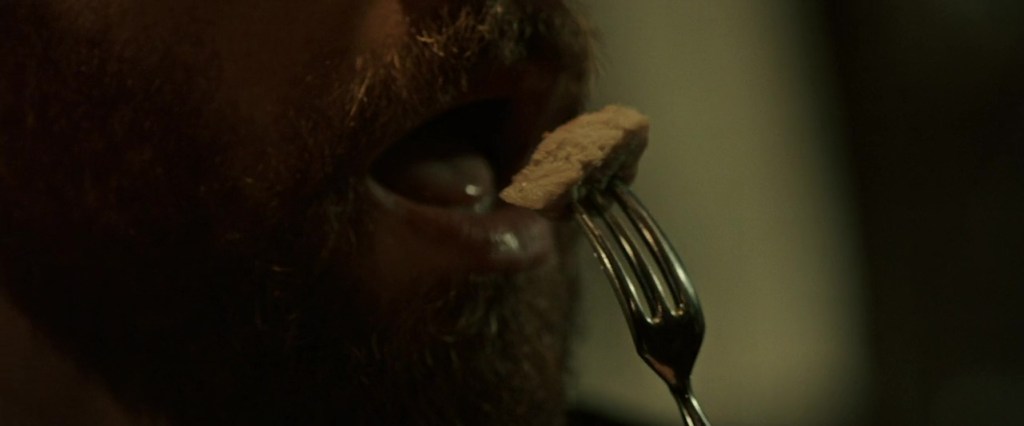
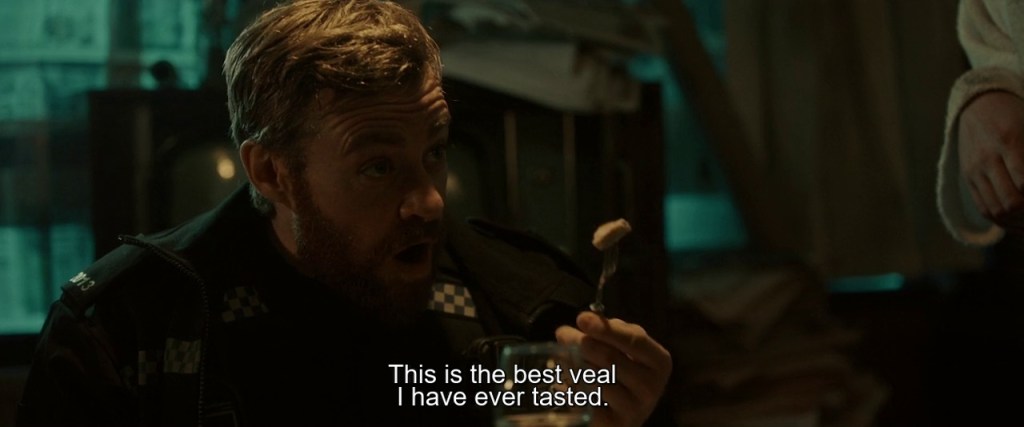
When the neighbour calls police about all the screaming going on, Lionel invites them in and feeds them some of his “mild veal”.
The enjoyment of food depends largely on what we believe about it. The actor playing the cop is probably in fact eating a piece of veal. His character, the cop, believes he is indeed eating veal. The audience, us, suspends disbelief so we can imagine that he is actually eating part of Jed’s leg. This turns the meal from gourmet to horror – a simple change of species, entirely within our imagination. The title, FEED ME, challenges the assumption that food will be prepared and served with our preconceptions catered for – it will be tasty and uncontroversial. In this society, eating a baby cow who wanted to live is praiseworthy; eating a man who wants to die is horrific.
The title reminded me of a foodie show called “Somebody Feed Phil” which sees writer and producer Phil Rosenthal (Everybody Loves Raymond) travelling around the world eating huge dishes of food while adding no weight to his irritatingly slim frame. In a recent episode, Phil lands in Madrid and apologises to a suckling (newborn) pig –
“you’re very cute, but I’m going to eat you.”
Most cannibals, like carnivores everywhere, do not usually have their victim’s permission, and usually do not apologise either, although they may feel some cognitive dissonance, knowing that their meal required the suffering and slaughter of the animal whose flesh is involved. Phil didn’t kill the new-born baby pig, but did apologise for eating him. Jeffrey Dahmer killed seventeen men and boys and also didn’t apologise (until it was far too late). The closest parallel to the plot of this film (the trailer above states it was “inspired by true events”) is the true case of Armin Meiwes, who advertised for a man who wished to be killed and eaten, had dinner and sex with the only genuine respondent, and then killed and ate him. He felt there was no apology needed, since Jorgen Brandes had wanted, indeed demanded, to be eaten. So it is with Lionel, who offers to kill and eat Jed, and then slowly and gradually makes good on his promise.
Neal Ward plays Lionel as an over the top, twitchy, verbose American con-man, the kind of man we like to think serial killers and cannibals look like, because that would make them easy to spot. Yet the essence of the real modern cannibal is his (or sometimes her) completely normal and unremarkable appearance – they walk among their peers, unknown and unidentified until their arrest (if they are ever found). Neighbours, for example, praised Meiwes as a nice young man who would mow the lawn for them. Issei Sagawa was so small and apparently innocuous that the young woman he killed and ate had been happy to come to his apartment to read poetry together.
The tagline for this movie is
“You are who you eat…”
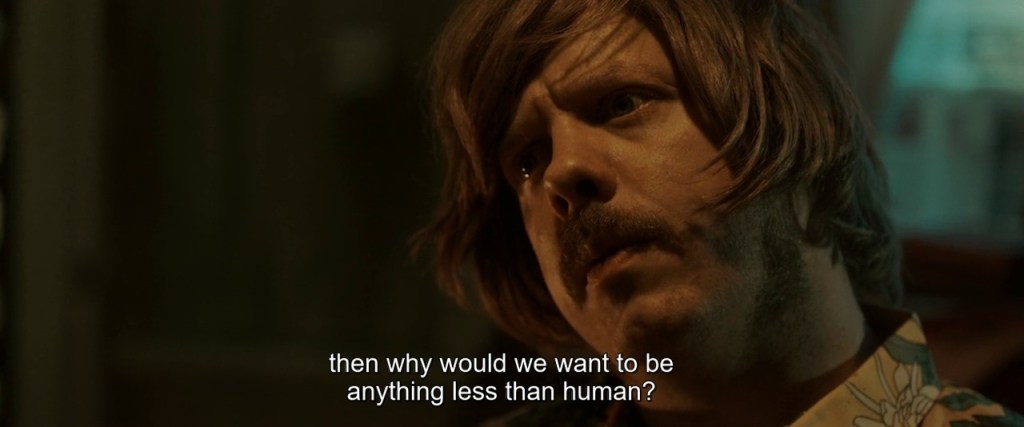
The concept is interesting – if you are who/what you eat, do you want to eat pigs or chickens or sheep, all of whom are used, quite unjustly, as common insults (for gluttons, cowards or mindless followers). If you are what you eat, Lionel tells us, you should eat humans.
The anthropologist Marvin Harris wrote in his book Good to Eat: Riddles of Food and Culture that, while humans are clearly not obligate carnivores, “our species-given physiology and digestive processes predispose us to learn to prefer animal foods”. This presents a problem for him, since “strictly speaking, human flesh itself contains the highest-quality protein that one can eat”. Lionel’s pathology stems from his calculating, impeccable logic.
The film is a fascinating study of love, loss, despair, friendship, loneliness and appetite. The gore is perhaps a bit over the top, but no longer unusual in modern films. The acting, despite what other reviewers have said, is great and the story compelling. Neal Ward plays Lionel as both a monster and a clown, a hard role to portray, but he is, in the end, seeking the same as all of us – self-acceptance, love, a validation of his humanity, and a good meal.
Last week we reviewed a fan-fiction prequel of the cannibalism classic The Texas Chain Saw Massacre. Fan-fiction allows anyone with a keyboard or, in these cases, a camera, to tell alternative versions, or fill in story elements that seem to be missing from their favourite narratives. Future targets of horror remakes include The Grinch and Winnie the Pooh!
This week’s short fan-fiction fills in the back-story of Princess Fiona from the Shrek movies.
Fans of the SHREK films will remember from the first movie in 2001 that Princess Fiona who had been imprisoned in a tower and with whom Shrek the ogre had fallen in love, turned out also to be an ogre. Fiona was voiced by Cameron Diaz who became one of Hollywood’s highest-paid actresses due to her role in the Shrek franchise, earning three million dollars for the first film and around ten million for each sequel.
Ogres are usually presented as cannibals, often eaters of babies and children as their first choice (see Marina Warner’s study of the ogre as the symbol of “monstrous paternity”). Shrek himself doesn’t really do that, although he does mention in the 2007 third movie, Shrek The Third, that he does not want to be a parent because his own father “tried to eat me”. Nonetheless, Fiona and Shrek end up with little ogre triplets at the end of the third movie.
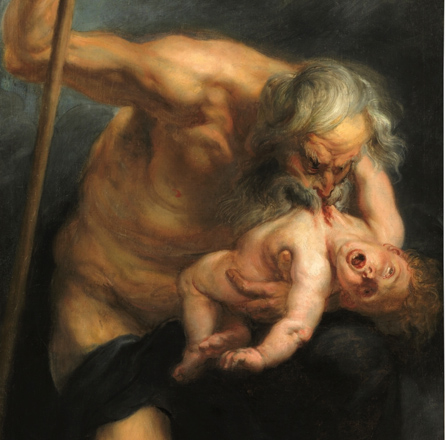
“Ogre” comes from the Italian word OGRO meaning monster, which in turn came from the Latin word ORCUS (fans of Tolkien will recognise this etymological hint). Ogres have been eating children, sometimes their own, since the tale of Kronos, the king of the Greek gods, who was told that he would be overthrown by his own child, and proceeded to eat each baby as it was born (much like Shrek’s dad). Rubens painted a ferocious image of Kronos (identified as Saturn) eating his child in 1636.
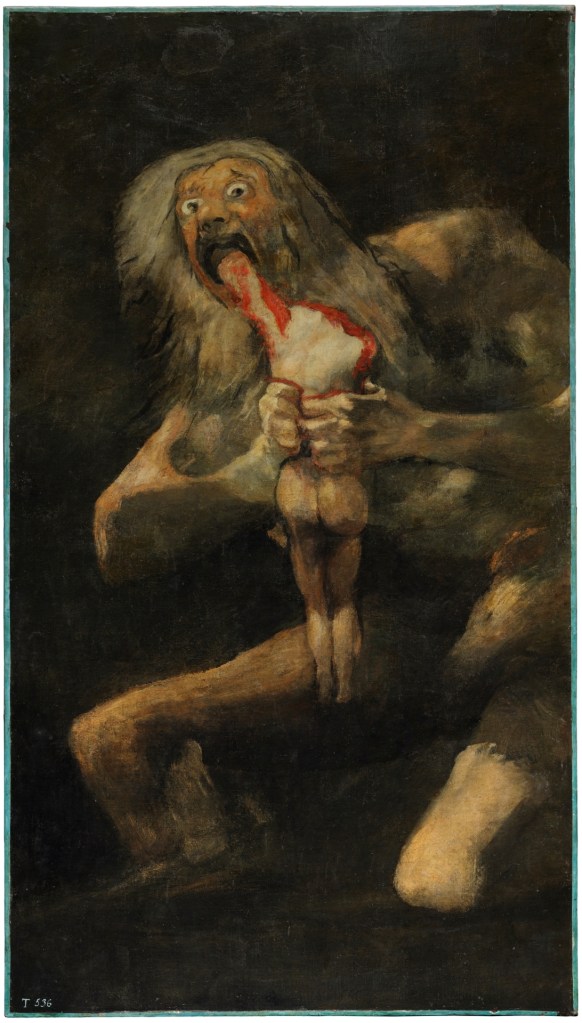
Goya created a dark, even more desperate late painting, around 1821-3.
Kronos’ wife, Rhea, saved the last child, Zeus, by wrapping up a stone which Kronos ate, leaving Zeus to kill his father and become supreme deity. Such are the role models of Western civilisation.
Charles Perrault wrote a series of fairy stories that were published in French in 1697, and included such perennials as Puss in Boots, Cinderella and Sleeping Beauty (later adaptations have taken a lot of the violence and gore out of the narratives). In one called Hop O’My Thumb (Le Petit Poucet), the hero is lost in the forest with his brothers and sisters and takes shelter in the house of an ogre, who is fond of eating small children. In the English version of the story, the ogre growl:
Fee, fau, fum, I smell the blood of an English man, Be he alive or be he dead, I’ll grind his bones to make my bread.
Hop notices that the baby ogres wear crowns on their heads, which he puts on his own brothers, so when the ogre wakes up and fancies a snack, he slits the throats of his own daughters instead of the boys.
But what happens when ogres grow up (assuming no unintentional paternal consumption)? We rarely see female ogres, and the Shrek story seems to imply that perhaps female ogres are as violent and dangerous as their male counterparts, or even more so. Fiona has been put under a spell, which we are led to believe turns her into an ogre at night, necessitating her imprisonment in a tower. This spell is broken when Shrek kisses her, returning her to her proper self, but it turns out that her real self is ogre, and the only reason she appeared human during the day was the magic spell. She would become her true self, presumably a violent ogre, at night.
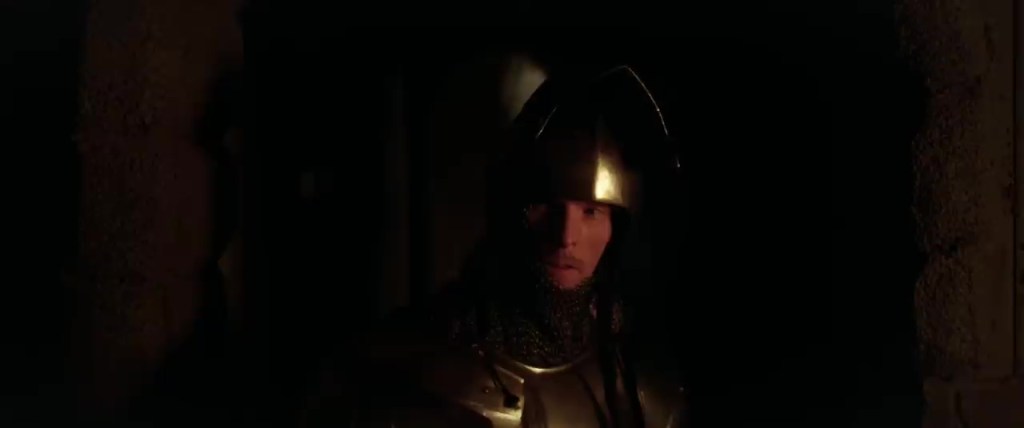
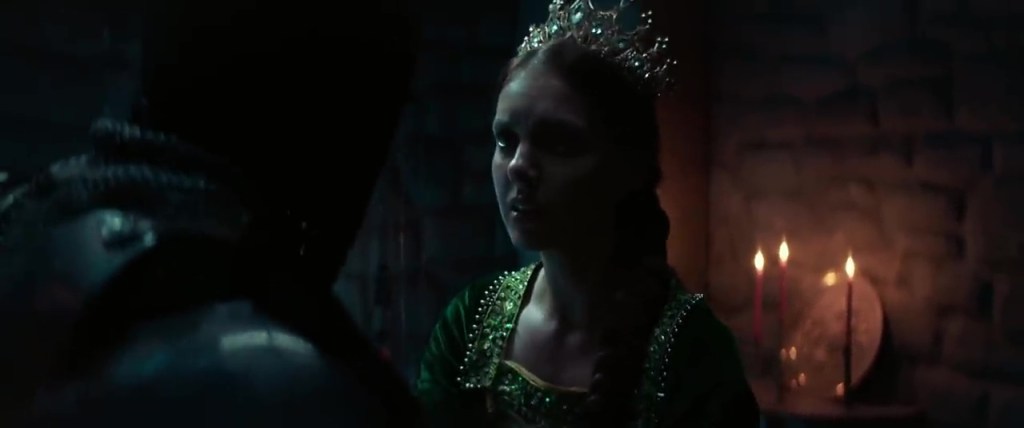
So we come to our short fan-fiction film made in Los Angeles by director and writer Andy Chen. A brave knight in armour explores a castle, eventually finding the beautiful princess, Fiona.
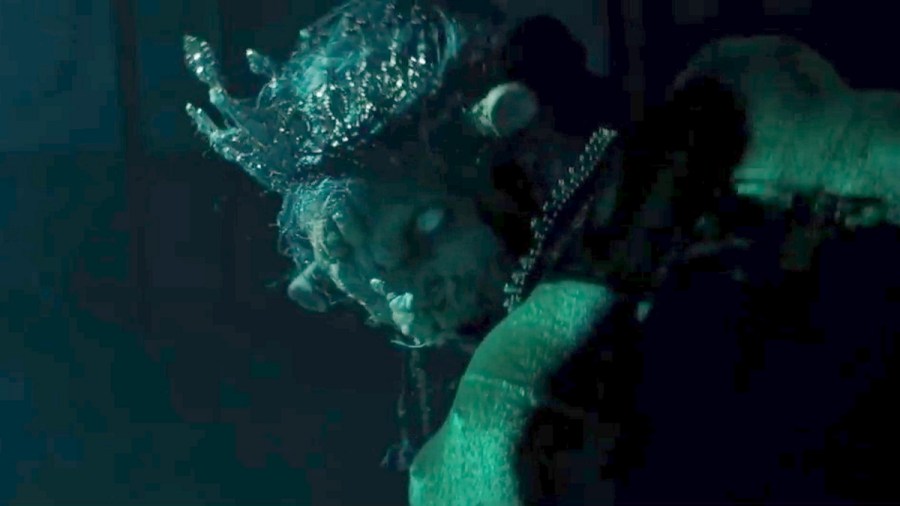
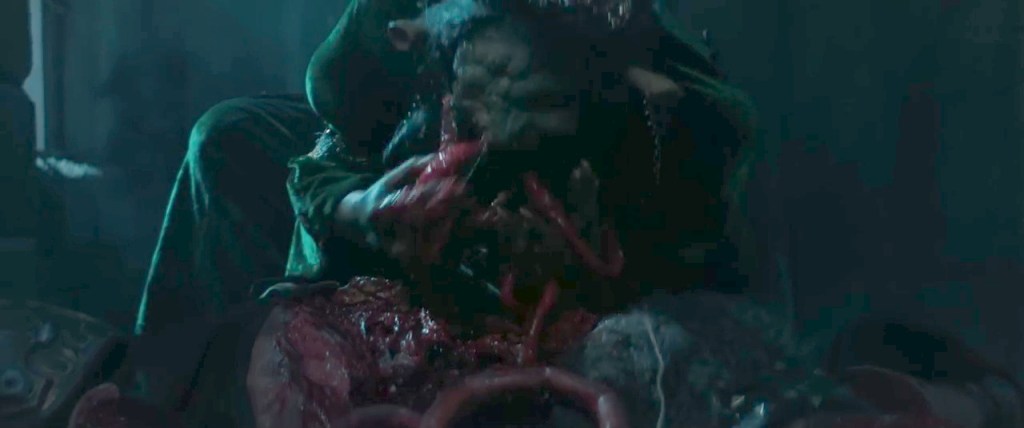
But when he offers to rescue her, night is falling, and she tells him it’s too late, and she turns into an ogre (wearing a crown still, like the ogrelings in Perrault’s story). Well, you can guess the rest. Fiona has been kept locked away at night for good reason. Everyone has a dark side, a hidden cannibal, even a beautiful princess. Perhaps especially a beautiful princess.
The film is quite splendidly put together, with plenty of dark, gothic imagery. The full film (it’s only four minutes, unfortunately) is on the locustgardenYouTube site, below.
This case wasn’t in my summary of 2020 cannibalism incidents because it just missed out – it happened on Christmas Eve, 2019. So I thought I’d wait until it went to trial, and that took until OCTOBER 2022!
Anyway, Mark David Latunski and Kevin Bacon (not that one) have finally found their place on this blog. Mark Latunski has just entered a plea of guilty as charged to open murder and mutilation of a body. Open murder can cover both first- and second-degree murder. His lawyers had been working on an insanity defence, but just as his trial was due to start on October 18, Latunski changed his plea to guilty.
Lutunski, 53, from the Shiawassee County — a man with an extensive history of psychiatric diagnoses — confessed to inviting Bacon, 25, to his Bennington Township home — about 90 miles northwest of Detroit — after meeting him on Grindr, a dating app catering to the LGBTQ+ community. Bacon left his Swartz Creek home for Latunski’s house some 20 miles away on Christmas Eve 2019 and was reported missing by his parents when he failed to show up for the family’s Christmas breakfast.
Latunski told police he had met Bacon on December 24 in a parking lot in Clayton Township, the same place Bacon’s vehicle was later discovered. At Latunski’s house, Bacon stripped naked and put on a blindfold, earmuffs, ankle restraints and wrist restraints, Latunski said.
He admitted to the court that he had stabbed Bacon in the back of his neck, just below the hairline. When he realized Bacon was not dead, police said Latunski told them he didn’t want Bacon to suffer, so he slit his throat as well. He then hung his body from the ceiling of his basement, to let the blood drain out, police said. It dripped onto the dirt under an open trap door, which had been set up so Bacon’s blood could fertilise the plants outside the house.
He described how he then cut off Bacon’s testicles before frying and eating them. According to some sources, other body parts may also have been eaten.
Latunski told police their agreement was that he would end Bacon’s life and utilise his body. He would use bone meal to plant tulips, his intestines to grow chestnuts or peach pits and his muscles to make jerky, he said. After the murder, the U.S. Postal Service intercepted a package for Latunski containing a dehydrator.
Police found Bacon’s car at a Family Dollar store parking lot, about five miles from his home. Inside was a cell phone, which contained messages between Bacon and Latunski, leading authorities to Latunski’s home. There, investigators found Bacon’s naked body hanging upside down from the basement rafters, the victim stabbed and his throat slit. Latunski confessed to the murder, as well as removing Bacon’s testicles for consumption, but claimed he was only carrying out a sexual fantasy with Bacon’s permission.
Latunski claimed Bacon was a willing participant and that the homicide was merely a matter of granting Bacon’s alleged wish to die. In 2020, a judge had denied Latunksi’s motion to have assisted suicide charges added to his existing criminal charges because, according to state law, defendants cannot add on charges.
Latunski previously told investigators the pair had even discussed how they could get rid of Bacon’s body before Latunski killed him, according to the Lansing State Journal.
The charges against Latunski on 30 December 2019 were “murder and mutilation of a corpse”. He was not charged with cannibalism, because cannibalism is not a crime in 49 of the 50 US states.
At a special hearing on 18 October, the judge found Latunski guilty of first-degree murder after finding he had acted with “cold calculation” in the murder. He was sentenced to life imprisonment. Latunski’s house was sold at auction in February 2020 for $101,000.
If Latunski is telling the truth (although the court seems to think otherwise), the situation is similar to the 2001 case in Germany in which Armin Meiwes met Bernd Jürgen Brandes, whose greatest desire was to be eaten. After they had sex, Meiwes cut off the victim’s penis, which they cooked and attempted to eat together (unsuccessfully – it was overdone and too tough). He left Brandes to bleed out in a bath, but when he found he was still alive hours later, cut his throat, and then dismembered his body and consumed his flesh over several months. Another German case in 2022 saw a young man known only as Stefan R. convicted of murder after killing a man he met on a gay/bi/trans dating website called Planet Romeo. Mr R. was found to have cut off the victim’s penis, which was never found.
Sigmund Freud would have loved a chat with these guys.
The war in the Ukraine has been one of the dominant news stories of 2022. At the time of the invasion in February 2022, Russia, a supposed military superpower, was expected to crush the much smaller Ukrainian military and swallow up the country in a matter of days. Cannibalise it, one might say.
However, the reality, after months of fighting, was that Russia did not achieve a quick victory, and might not even keep the territory it has taken. In the meantime, both sides have suffered significant losses of fighters, equipment and infrastructure. The Ukrainians estimated in mid-September that over 50,000 Russian soldiers have been killed so far.
The news this month (September 2022) is that Russia has mobilised around 300,000 “reservists” – civilians who have completed their mandatory military service, but will now be dragged back into uniform. There are two million reservists in Russia, so this is only a partial mobilisation, but it shows a level of desperation in Putin’s war machine.
But it turns out that Russia has been boosting the number of soldiers for some time, by recruiting within its worst maximum-security prisons.
A mercenary army called The Wagner Group deployed to the Ukraine back in 2014 to help pro-Russian separatists fight Ukrainian forces. British military intelligence reports that there are 1,000 mercenaries fighting there. The group has also been active in Syria and Africa, and has repeatedly been accused of war crimes and human rights abuses. They are now fighting alongside Russian regular troops in the Donbas region.
A BBC investigation identified Yevgeny Prigozhin, an oligarch known as “Putin’s chef” – so-called because he rose from being a restaurateur and caterer for the Kremlin – as a key figure in the Wagner Group. Many of Mr Prigozhin’s companies are currently under US sanctions for what it calls his “malign political and economic influence around the globe”. He has denied any connection with the Wagner Group.
Now a leading expert in Russia’s prison system, Olga Romanova, in the media group “Vazhnye istorii” (Важные истории or Important Stories) has reported that prisoners from the jails around St. Petersburg are being recruited to go to war in Ukraine as part of the “Wagner” army. Romanova states that Prigozhin has been visiting Russian prison camps in order to enlist convicted criminals to fight in Ukraine, according to accounts from military analysts and videos that have emerged on Telegram from Russian prisons. Romanova told The Daily Beast website:
“Putin’s plan is to recruit at least 50,000 convicts and Prigozhin, who is an ex-convict himself, has already sent more than 3,000 [including] serial murderers, robbers and at least one cannibal.”
Relatives of the prisoners report that the inmates are being promised that if the “volunteer” dies, they will pay the family 5 million roubles. If they live for six months of “service”, they will receive a payment of 200,000 roubles and a full pardon. A chilling thought for the victims (and their relatives) of the crimes which caused them to be in the prison camps!
“In 1/2 a year you go home with a pardon… there’s no way you end up back in prison. Those who arrive on the first day and don’t like where they’ve ended up are considered deserters and get shot.”
In Ukraine, Prigozin’s army is often referred to as an “army of orcs and goblins,” a reference to Lord of the Rings. “They take everyone, no matter what they are in prison for,” said Romanova in a video on the “Popular Politics” YouTube channel, as translated by The New Voice of Ukraine.
“They took a maniac who, so to speak, has cannibalism in his portfolio. He was also sent to war.”
Now authoritative sources (Twitter) tells us that the cannibal who has been recruited by the Wagner Group for the war in Ukraine is none other than Yegor Komarov, about whom this blog reported in December 2021. Komarov had been arrested in the town of Sortavala (near the Finnish border) after running from his crashed car, from the boot of which had tumbled a headless corpse. Komarov admitted to being a cannibal and stated that he ‘likes killing people’. He confessed to stabbing and killing another man in a park in St Petersburg the previous year for the sole purpose of tasting human flesh, and said he had sliced off the tongue and fried it in butter.
He sounds like a perfect guest at a dinner party for Putin, catered of course by Prigozhin, “Putin’s chef”.
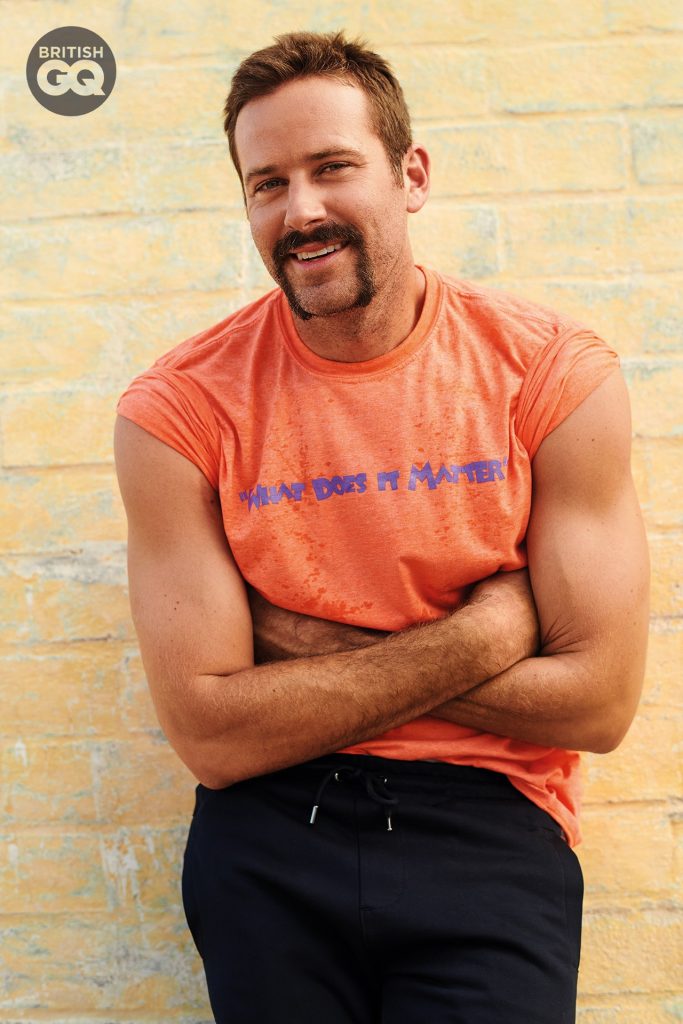
Hammer is a young American actor (in his thirties) who found fame with his 2008 portrayal of the evangelist Billy Graham in Billy, the Early Years for which he won a “Faith and Values Award” from Mediaguide, a Christian review organisation. Don’t you love irony?
Now, a new three-part documentary on Discovery+ has gone through the history of the Hammer family, and the way the Hammers seem to treat everyone as, well, nails. Narrated in part by Armie’s aunt, Casey Hammer, the documentary makes clear that the family tree is rotten with toxic masculinity, abuse and exploitation. If we were wondering how Armie got that way, this sheds plenty of light on the question.
Hammer’s family was, shall we say, a colourful one. His aunt Casey declared,
“I know my grandfather had a dark side, but I saw my father’s dark side first hand, and I’ve seen my brother’s dark side, and I’ve just heard about Armie’s dark side. But I believe it.”
The documentary goes through the dark deeds of these generations: the patriarch and oil tycoon Armand Hammer, his son Julian, his son (and Casey’s brother) Michael, and his son, Armie. Casey said of her brother Michael (Armie’s dad):
“That’s the sign of a true monster. You can look in the mirror and not see any fault or that you’re doing anything wrong. And that’s how deep it goes with my brother. And that’s why he’s so scary, because he has no conscience.”
The first episode is about Armie’s allegedly violent relationships with young women who were often so star-struck that they would often let him get away with tying them up and biting them, among other things. He made his appetite seem like love.
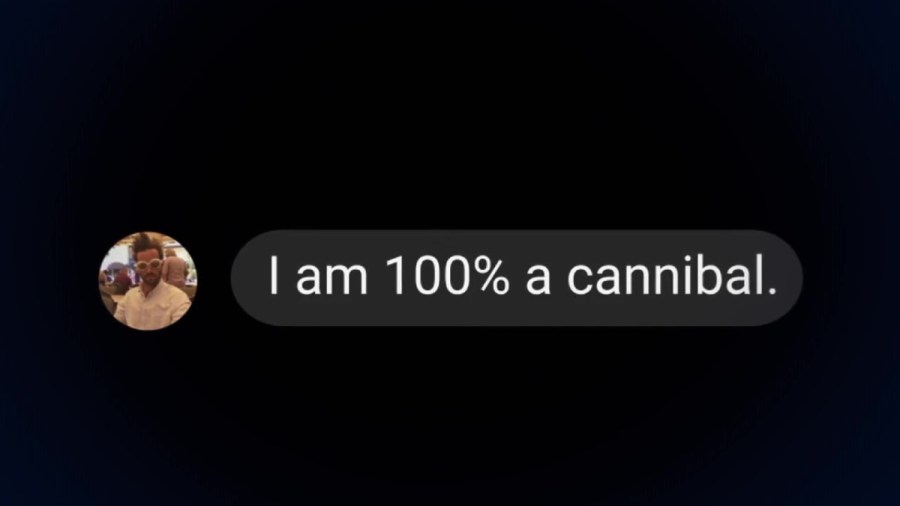
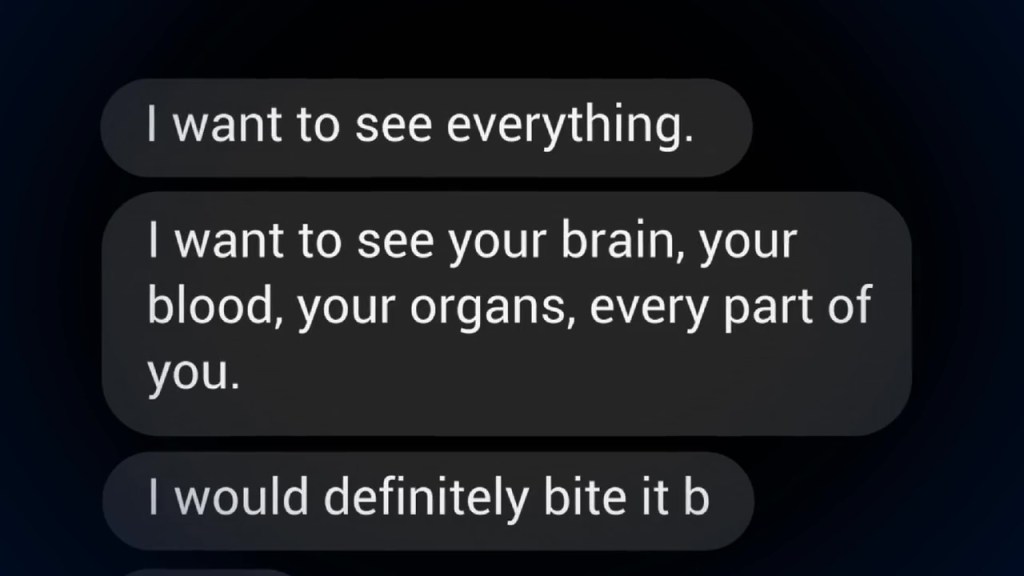
In early 2021, several of Armie’s girlfriends took to social media to describe Hammer as abusive, manipulative and violent. Screenshots of his text messages appeared to show him describing fantasies (or real events) of rape and cannibalism.
“I am 100% a cannibal…. Fuck. That’s scary to admit. I’ve never admitted that before. I’ve cut the heart out of a living animal before and eaten it while still warm. Totally raw. Still warm. ‘d eat your heart if i wasn’t stuck without you after.”
“I want to see your brain, your blood, your organs, every part of you. I would definitely bite it. 100%. Or try to fuck it. Not sure which. Probably both.”
“If I fucked you into a vegetative state id keep you, feed you, watch you, and keep fucking you…Till you are so sore and broken…. I can’t stop thinking of [fucking] your actual brain.”
“…cut a piece of your skin off and make you cook it for me…. Who’s slave/master relationship is the strongest? We’d win. When I tell you to slit your wrists and use the blood for anal.”
The documentary shows a clearly nervous Courtney Vucevovich describing Armie taking her to Sedona, tying her up, and doing whatever he wanted to her.
She shows texts on her phone, but also a note that he left at her home after he stalked her and found her address.
“Armie wanted total control of me, and absolute compliance, destroying any sense of bodily autonomy.”
Then he took her to meet his Mom! But, she said, “it was like a band-aid on a bullet wound.”
In early March, Armie’s ex-girlfriend Paige Lorenze, 24, said in an explosive interview with Vanity Fair that during their time together she felt “really unsafe and sick to her stomach.” The interview claimed that the celebrity’s ex-partners have “compared him to Ted Bundy” and said he was obsessed with shibari – a Japanese bondage art form where people are tied up in intricate patterns.
Lorenze was horrified to see the accusations of cannibalism,
“Because he would say things to me…weird stuff…like, ‘I want to eat your ribs’.”
She also claimed that Hammer had carved his initial into her pubic area and licked the wound, later bragging about it to friends, and that Hammer was fixated on biting her body, saying,
”If you did not tell me to stop I would eat a piece out of you.” And he was serious too. It was like he actually wanted to eat my flesh away.
The “A” that Armie allegedly carved into Paige
On their first night together, Lorenze said Hammer insisted: ‘You can either call me daddy or sir.’ She tells us in the documentary that
“He’s obsessed with meat. I brushed it off, but I do believe that he was serious.”
Another woman named Effie whom he dated for about five months in 2020 said that he had raped her for over four hours in Los Angeles. He told her he wanted to eat her flesh, and would suck or lick her wounds if she had “a little cut on my hand.”
Most of the documentary details allegations of non-consensual sex, AKA rape, for which Armie is being investigated by detectives from the Los Angeles sex crime division.
One such text read:
“I’m not going to lie… you cryin and crawling away while I stalked you down your halway was so exhilarating”
But on the subject of cannibalism (which is what this blog is about) let’s remember that Hammer has not been charged with acting on his cannibalistic fantasies — and in fact he has denied sending those texts. Courtney Vucevovich claims that her shoulder bears evidence of his cannibalistic ways, a wound that he suggested should be tattooed into her skin to make it permanent:
But texting and sex play, even bondage and sado-masochism (if consensual), are not illegal, and Hammer clearly enjoyed both.
But if he said these things and sent these texts, and if they were just fantasies, he picked the very worst time, the apex of the #MeToo movement, to send them. Hammer subsequently lost leading roles for which he had been preparing, including in the Jennifer Lopez film Shotgun Wedding, and his agency dropped him.
In March 2021, Effie, the woman who initially came forward with abuse allegations on Instagram, identified herself and accused Hammer of violently raping her in April 2017. The Los Angeles Police Department subsequently confirmed that he was the subject of a sexual assault investigation, which had been set in motion a month prior. Hammer has vehemently denied any wrongdoing via his lawyer, who stated that “all of his interactions with [Effie] – and every other sexual partner of his for that matter – have been completely consensual, discussed and agreed upon in advance, and mutually participatory.”
Hammer was unable to see his family during the pandemic lockdown, and his marriage fell apart. In June 2021, Hammer checked into a Florida treatment centre for drug, alcohol and sex issues.
The documentary outlines Armie’s fantasies and alleged assaults, and also goes into details of the corruption and violent activities of his forebears. So that raises the question, the one that Clarice asked Hannibal, “what happened to you?” Nothing happened, Hannibal answered. “I happened… Look at me, Officer Starling. Can you stand to say I’m evil?”
WTF? Is there a curse of the Hammer family? An evil gene? An epigenetic generational trauma that makes each new generation a bit more abusive than the last? Of course, Hannibal has some philosophy about this as well:
“when it comes to nature versus nurture I choose neither. We are built from a DNA blueprint and born into a world of scenario and circumstance we don’t control.“
The Hammer family have for some generations been enormously wealthy, and with wealth comes privilege. That does not necessarily lead to cannibalism (although movies like The Cannibal Club suggest otherwise), and certainly poor people can also be cannibals, but it may make the wealthy feel insulated against consequences – that is one important theme of shows like Succession. Wealth, privilege and entitlement does lead to cannibalism (not clear whether real or imagined) in American Psycho, at least in the book, (the film lingered on the murders but wimped out a bit on the actual eating of body parts).
Cannibalism is an act of domination – there can be no greater conquest of another than converting them into a meal and eventually into excrement. Hammer revealed this need to dominate in wanting to be called ‘daddy or sir’. In wanting to tie these women up so they are helplessly compliant with his every desire. In the power of watching them cry and beg. In ownership of their bodies.
The massive wealth of the Hammers demonstrates Bataille’s concept of “the accursed share”. Excess energy – in this case, wealth from the exploitation of energy in the form of oil – is spent on luxury without any public benefit, in non-procreative sexuality, in pageants and grand buildings, or else in catastrophic ways like war or sacrifice. In other words, in social terms, it must be used, or wasted. Armie Hammer used his excess energy on finding ways to control women, ultimately tying them up for the purposes of eroticism. Whether this was consensual or forced, which is what most of the women allege, is up to the Los Angeles sex crime detectives to determine. But it seems clear that privilege, particularly multiplied over several generations,
“must necessarily be lost without profit; it must be spent, willingly or not, gloriously or catastrophically.”
Georges Bataille, The Accursed Share Vol 1, p.21.
Excess energy can be donated – billionaires such as Warren Buffett and Bill Gates have pledged to give away at least half of their wealth during their lifetimes or at their deaths. Or they can expend their excess energy (wealth) on fancy homes and cars and bending others to their will. Although they usually do this less publicly than Armie Hammer did, this is still metaphoric cannibalism.
Fun fact: Rotten Tomatoes critics gave the documentary a 67% “fresh” rating, but the “audience” rating is only 5%. Most reviews, and thousands of other social media posts, doubted the veracity of the women’s claims, saying that Hammer had suffered the loss of his career because he openly expressed his fantasies. Vucekovich, on the other hand, says that after the news came out about her relationship with Hammer, she received death threats and harassing messages from Armie’s “die-hard fans.” Out of fear, she relocated from an apartment to a house where she installed cameras. “The ‘Charmies’ made my life hell,” she says. At the same time, she fielded “thousands” of messages from women who had been through something similar.
Is Armie Hammer a cannibal? He is a rich and handsome movie star from a wealthy and privileged family, who built his career on playing men who can get away with anything. He is certainly a persuasive abuser of (often much) younger women, a form of exploitative consumption that is uncomfortably close to cannibalistic ingestion.
But is he a cannibal? Technically, almost certainly not. But in his mind, in the deep, dark fissures of his unconscious, he certainly is. According to Freud, we all are.
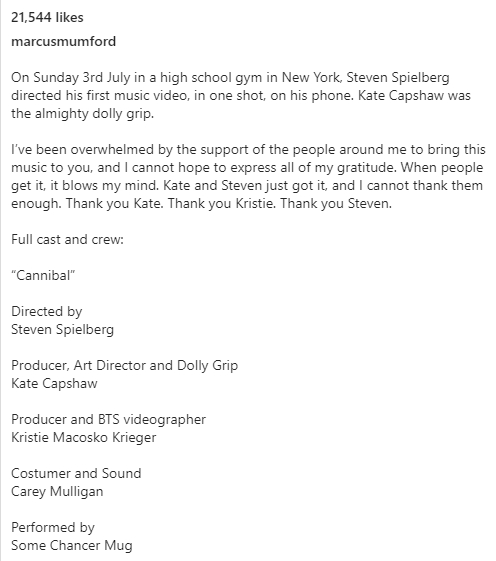
Does Steven Spielberg make music videos? Well, not usually. But he whipped out his phone for this recording of a new single from Marcus Mumford (of Mumford & Sons) – his first solo venture, and the first song from his soon to be released (September 16) album called (Self-Titled). The album is produced by Blake Mills and featuring Brandie Carlile, Phoebe Bridgers, Clairo and Monica Martin.
Fans of Mumford & Sons have been perturbed to hear about Marcus’ solo album, wondering if it denotes the end of a great band, particularly considering that founding member Winston Marshall left the band in 2021 after calling controversial journalist Andy Ngo’s book Unmasked: Inside Antifa’s Radical Plan to Destroy Democracy “brave”. But Marcus has confirmed that the band will not be disbanding and he will not be leaving, saying his solo album has the “full blessing and permission of the band”, who wrote on Instagram that:
“We are excited about the next chapter of Mumford & Sons, we’re working on what that looks like, but for now we hope you can enjoy this person, our friend, being a human being.”
Anyhow, the first song we have seen from the album is called CANNIBAL (the clip is at the top of this blog) which is lucky, as otherwise I would have had no excuse to crap on about it on this cannibalism blog. Marcus stated on his Instagram account that he had faced and danced with “demons” for a long time during COVID-19 isolation, and wrote “Cannibal” in January 21.
Rolling Stone wrote that the video was shot on July 3 in a high school gym in New York. Steven Spielberg “directed his first music video, in one shot, on his phone”.
Abby Jones on the Consequence website describes the song:
“Cannibal is a somber, rootsy tune that feels a bit like a pared-down version of Mumford & Sons’ arena-sized folk rock — that is, until around the three-minute mark, when the song transforms from an acoustic ballad into a rousing barnburner.”
The song is about the cannibalistic nature of relationships. The one described in the song appears to be complicated and toxic, arousing love and hate. For example,
I can still taste you and it kills me That there’s still some sick part of it that thrills me That my own body keeps betraying me There is such power that it may destroy me, but it compels me
Camille Paglia in her controversial book Sexual Personae: Art and Decadence from Nefertiti to Emily Dickinsondescribes the sparagmos rite of the Dionysian cult in which the body of a god, or the animal (human or other) representing it, was torn apart and eaten raw, otherwise known as omophagy. Rending the body of the god and spreading the parts acted to inseminate the earth, so was an act of love, and Paglia suggests that oral sex retains a suggestion of omophagy – raw cannibalism.
“farmers who hand-raise lambs can love them and still send them to slaughter.”
Metaphoric cannibalism, particularly in terms of affectionate or sexual imagery, is a vast topic that cannot be adequately covered here. Suffice it to quote Italo Calvino in his book Under the Jaguar Sun perfectly summed up what he called “universal cannibalism”:
“…our teeth began to move slowly, with equal rhythm, and our eyes stared into each other’s with the intensity of serpents’ — serpents concentrated in the ecstasy of swallowing each other in turn, as we were aware, in our turn, of being swallowed by the serpent that digests us all, assimilated ceaselessly in the process of ingestion and digestion, in the universal cannibalism that leaves its imprint on every amorous relationship.”
“CANNIBAL” could be about the challenge of living and continuing to love someone during interminable COVID isolation. But at least one review suggests it is about childhood trauma and abuse, and posts a trigger warning. If that is one of your triggers, approach with caution. Such truths are hard, sometimes impossible to talk about: “when I began to tell, it became thе hardest thing I ever said out loud. Thе words got locked in my throat.”
I can still taste you, and I hate it That wasn’t a choice in the mind of a child and you knew it You took the first slice of me and you ate it raw Ripped it in with your teeth and your lips like a cannibal You fucking animal!
Sigmund Freud wrote that the two original prohibitions of humankind are incest and cannibalism, and it sounds a lot like Marcus Mumford has definitively linked them in this piece. The song finishes with a cry of pain: “Help me know how to begin again!”