The recent tour of Australia by British anti-trans campaigner Kellie-Jay Keen-Minshull— who also goes by the name of Posie Parker — added cannibalism to the culture wars already raging over transsexual rights.
Keen-Minshull organised a “Let Women Speak” tour of Australia and New Zealand, holding rallies in several cities to claim the push for transgender rights is “silencing”, endangering and discriminating against women.
There has been a lot said about Keen-Minshull, mostly debating her claim to be a warrior for women’s rights and accusing her of being an extremist, expressing views that are designed to be harmful to the transgender community. The rhetoric she uses is far more extreme than usually expressed in Australian politics, although it has become common in other countries, particularly the USA. She suggests, among other claims, that trans women are sexual predators who pose a safety threat to girls in female bathrooms. She describes gender affirmation healthcare as mutilation, and being transgender as a “fetish” — positions totally at odds with the views of experts who work with people who are transitioning.
Keen-Minshull’s rally in Melbourne was attended by far-right extremists who performed Nazi salutes. Although organisers claimed the masked thugs had “gate-crashed” the event, a trans rights activist and TikTok star known online as LilahRPG said “everyone was just furious, seeing Nazis doing salutes uninterrupted and interacting with the TERFs.” TERF is an acronym for “trans-exclusionary radical feminist“.
This is one of the clearest indications that far-right social media is using the “gender-critical” movement to promote membership of their groups.
Keen-Minshull has made a series of videos (see Twitter message above) about “Grooming Gangs” – repeating unproven claims that a young girl in England was killed and eaten as kebab meat. These claims are then used as racist conspiracy theories, saying that the botched police investigation was in fact a cover-up of paedophile elites who, they say, control everything. Keen-Minshull says:
“What we know is that there’s grooming gangs in Telford. A young woman that never actually really made it to mainstream news, wasn’t a big story, was cut up and I think she was put into meat that was sold for human consumption. We know that there are vast numbers of men involved in these grooming gangs, and we know that there’s weird cover-up stuff going on, that only makes sense if the other people in power are also raping children.”
The case she is referring to seems to be the disappearance of 14-year-old Charlene Downes, who disappeared in Blackpool in north-west England in November 2003. Accusations were made of a child-grooming ring, which induced young girls into having sex in return for cigarettes, food and alcohol. At least one newspaper was quick to claim that investigations had been “hampered by political correctness”, because the girls were white and the perpetrators non-white.
Two men, Ilyad Albattikh and Mohammed Reveshi, were tried in May 2007—the first for Downes’ murder, the other for helping dispose of the body—but the jury failed to reach a verdict. A re-trial was scheduled, but in April 2008 the accused were released because of concerns about serious errors in the evidence compiled by Lancashire Constabulary, who were chastised for their inept handling of the case.
The prosecution had claimed Charlene’s body had been cut up and minced into kebabs in a Blackpool takeaway called “Funny Boys”.
At the time of the trial, the court was told the fast food shop owner had “joked” that Charlene Downes had been chopped up and put into kebabs that were sold to the public.
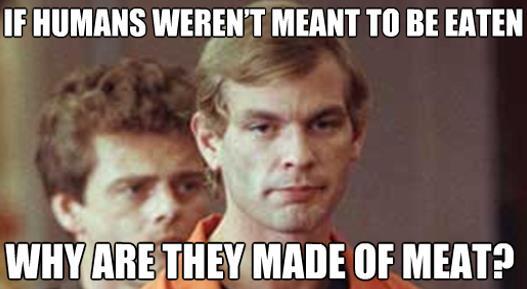
There is a lot of racism involved in this story. White children being raped by men of colour is stated or implied in many of the reports, although there is little evidence to show that white offenders were not also involved. Many actual cases of the cannibalism of children indicate the opposite – that white men like Jeffrey Dahmer and Albert Fish prey on children of colour, because such missing children are less likely to be investigated by white detectives. Meanwhile, the Indian current affairs website OpIndia did not mince its words about the alleged mincing of the victim:
Groomed by Muslim gangs, minced into pieces, fed as kebabs
Of course, Ms Keen-Minshull did not invent the idea of using cannibalism as a weapon of dehumanisation (Christopher Columbus did that very successfully) or even as a part of the culture wars – recall the hate and scorn aimed at the New York Times when it suggested the “cannibalism has a time and a place… and others suggest that that time is now”.
Classical mythologies told of savage gods who ate their own children, and paranormal entities such as witches, who used body parts for their rituals. Such usages were not exclusively supernatural, with “blood libel” accusations that Jews were killing Christian children to use their blood for religious rituals and cannibalism dating back to the twelfth century, and being revived with nauseating regularity up to the present day.
QAnon has been very successful recruiting members in the US, partly based on accusing everyone from Hillary Clinton to a pizza shop owner of killing and eating children. The accusations are meant to dehumanise the alleged perpetrators, but usually end up doing the same to the victim. Poor little Charlene is now almost unknown, except as the “kebab meat girl”.
Lots more details of her case are available on YouTube investigations such as the one below, some of them are quite lurid.
Winnie-the-Pooh is a much-loved (but sometimes intensely disliked) fictional bear who evolved from the childhood stories told to his son (Christopher Robin) by A. A. Milne, the author of a series of books first published almost a century ago. The original Pooh was an actual toy bear bought in Harrods in 1921. Other toys belonging to the little boy, Piglet, Eeyore, Kanga, Roo, and Tigger, were incorporated into Milne’s stories as friends of Pooh, who was presented as “a bear of very little brain”. Pooh and his friends lived in the 100 Acre Wood, where they got into all sorts of scrapes.
The anthropomorphic bear, his name now without hyphens, was licensed by the Disney company in 1961 for a very successful series of features that became one of their most popular franchises. I loved the books as a child, and hated what the cartoons had done to him, but maybe that’s just me.
Anyway, Milne’s U.S. copyright in Winnie-the-Pooh expired at the end of 2021, 95 years since publication of the first story. The character therefore entered the public domain in the United States, with Disney no longer holding exclusive rights. Independent filmmaker Rhys Frake-Wakefield seized on this opportunity to create a horror film titled Winnie-the-Pooh: Blood and Honey.
The premise, told through a cartoon opening, is that Winnie and Piglet feel betrayed and abandoned by Christopher, who has grown up and moved on to big-boy things like college and sex. (For a wonderful discussion of the difference between being “lost” and being “abandoned”, I recommend Hayley Singer’s new book, Abandon Every Hope). They have gone feral.
During a particularly cold winter, they are starving, and decide to kill and eat their old friend Eeyore the donkey, which drives them to detest humanity. They make a pact:
“they renounced their humanity and returned to their animalistic roots, swearing never to talk again.”
When Christopher comes to the 100 Acre Woods with his fiancée Mary five years later, he looks for his old friends, telling her “It’s going to be OK, alright, I promise.” Only of course it isn’t. Pooh and Piglet kill her and capture him, and chain him up in their old house, where he can see his (late) fiancée hanging defleshed (eaten?) from a meat-hook, while Pooh flogs him with the late Eeyore’s tail.
Pooh and Piglet then proceed to hunt and kill a group of women students who have come to a holiday house in the woods to help one of them recover from a stalking incident (clever poetic irony) and then Pooh kills some men who try to help them. There is a lot of extreme violence involved including strangling, crushing with cars, mauling (by piglet of all people), insertion into a wood-chipper, and bludgeoning with a sledge-hammer.
At this point, I need to come clean and admit that I am having trouble classifying this as a cannibal film. Lots of people get killed (it’s definitely a slasher), and toys eat another toy at the beginning, which is a sort of cannibalism (but only in the way that Woodstock from Peanuts is a cannibal for eating turkey on Thanksgiving). I don’t know that toys are a discrete “species”, but if not then even a real pig and bear eating a donkey is nowhere near cannibalism. But the introduction says they “renounced their humanity”, so I’m taking that as a licence to include this in a cannibalism blog; they were anthropomorphically human when they ate the human donkey, right? Hey, even Princess Fiona from Shrek wasn’t really human (she was a secret ogre) but we wrote up her exploits, eating brave knights who came to save her. So we have some fun ontological challenges like “what is cannibalism?” what is “eating?” and “what is human?” Apparently they believe that not talking is the way to renounce humanity, which both bolsters anthropocentric arguments about human superiority (we are often described as the only species with a language, to the annoyance of the whales), but also raises some interesting questions for the voiceless, or those who choose not to talk. Does a vow of silence mean a renunciation of humanity? A question for another time and, hopefully, a different blog.
But from a Cannibal Studies point of view, there are some other interesting ideas in the back-story. It starts with starvation cannibalism (if we allow that name) in that, like survivors of plane crashes, shipwrecks, or ill-considered trips across the Sierra Nevada, Pooh and Piglet are driven to eat their friend Eeyore through extreme deprivation. But then we move to a new motivation – social degeneration, where the formerly very civilised, polite toys become psychotic murderers, much like the feral humans in Texas Chain Saw Massacre, The Hills Have Eyes or Death Line. Look, we don’t really see them eat humans, although we see a skull and jars of blood, and hear reports of mutilated bodies being found in the woods, so there is a certain implication. But they are not human, so that’s OK. They’re not even officially animate, although you wouldn’t say that if they were swinging a sledge-hammer toward your head. And just when did they learn to drive cars?
The film has had almost universally awful reviews, collecting a woeful 4% “fresh” on Rotten Tomatoes, with The Times critic saying:
“Rhys Frake-Waterfield cloddishly desecrates your childhood, and AA Milne’s beloved classic, with a dimly written, shoddily realised, sub-standard slasher whose artistic aspirations never reach beyond making a fast buck.”
The Guardian was even less impressed, describing the film as:
“…a terrifying combination of not-scary and not-funny, and a cast of Love Island types on Xanax apparently reading the dialogue off an optician’s chart held up behind the camera.”
Look, it’s not that bad – the woods look nice but also somewhat ominous, and while some of the acting is wooden, they all have great death scenes, and the violence is enough to attract any gorehound. Anyway, the film was a big success on its release in January (in Mexico) and February (US, UK). As of 23 February 2023, Winnie-The-Pooh: Blood and Honey had grossed $1.8 million in the United States and Canada, and $2.4 million in other territories, including over $1 million in Mexico, for a worldwide total of $4.2 million. The budget was apparently less than $100,000, making it proportionally one of the most profitable films ever made, surprising even the film-maker.
Is it surprising though? Fan fiction has been rewriting classic stories for a while now (have you seen what sexual gymnastics some Fannibals have created for Hannibal and Will?), while stories of the perils of civilisation being brought down by thoughtless dedication to progress and neo-liberalism are the zeitgeist. Winnie-The-Pooh is our abandoned childhood, coming back to haunt us.
Francis Wolke, 30, was found guilty on March 2, 2023 of first-degree murder for killing 62-year-old Kathleen Anderson in her Menlo Park bedroom in December of 2018, and sentenced on April 5 to a term of 26 years to life in prison.
San Mateo County prosecutors stated that a friend of Anderson found her body while the killer was still inside the house. The friend called the Menlo Park Police Department and detained Wolke at knifepoint until police arrived.
When the trial opened on Tuesday, February 14, Wolke’s attorney, Connie O’Brien, had declared, in a rather unusual opening statement, that her client was driven to murder by a desire to engage in cannibalism. She stated that Volke believed that, if he committed cannibalism, he would “stay young forever” and join the “1%” of people who eat human protein to become rich.
Anderson had never met Wolke, 30, before the murder. “There was no known relationship or contact between defendant and victim, nor a known motive for the crime,” prosecutors said. Wolke lived in Cincinnati, Ohio and had arrived in the San Francisco Bay Area just days before the murder. He was also wanted in Santa Clara County for prowling and drug possession. According to the Palo Alto Daily Post, Anderson worked as the City of Atherton’s arborist for two decades.
In 2020, Wolke had pleaded not guilty due to insanity. The trial jury deliberated for three days before finding him guilty, and then reconvened to consider the insanity issue, which could have seen Wolke sentenced to state hospitals, instead of state prison. The jury handed down its ruling on March 8 2023 in San Mateo County Court in Redwood City, finding that Wolke was sane at the time of the murder.
Defence lawyers had argued the insanity defence based on Volke’s belief that he had to commit cannibalism in order to join “the 1%” and stay young forever. They testified that Wolke said he wanted to join an elite group of wealthy people whom he believed killed humans and ate their flesh to become “protein harvesters” and that he, too, would enjoy wealth and eternal youth after consuming human stem cells.
Deputy District Attorney Tricia Povah argued the case for Wolke’s intent to murder. Povah laid out in graphic details the injuries that Wolke inflicted during multiple attempts to take the life of Anderson, including attempted strangulation.
Wolke was accused of stabbing Anderson in the eye with a pencil, hitting her brain. The allegation that Wolke used a deadly and dangerous weapon in this act was also accepted by the jury.
Wolke also attempted to behead Anderson, which his defence lawyers alleged was due to his intention to engage in cannibalism. Wolke reportedly told investigators he:
“wasn’t very good at (it) because (he’d) never done it before.”
Wolke, according to court testimony, had a history of heavy methamphetamine use, but did not test positive for any drugs at the time of the murder. According to defence attorney Connie O’Brien, he was experiencing psychosis in the form of auditory hallucinations while on the bus ride from his family’s home in Cincinnati to the Bay Area, with voices telling him that he had to commit sins to join the 1%.
Despite Wolke’s hallucinations, the prosecution argued that Wolke had an understanding of the morals surrounding murder and that he was aware of his actions as he committed the killing. Dr George Wilkinson, a forensic psychiatrist and expert witness for the prosecution, testified that Wolke understood his actions.
“He was well aware of what he was doing, in fact, it would have been necessary to fulfil the delusions.”
Povah argued that he showed awareness of his situation. When police officers went to enter the house to investigate, Wolke told them where to find Anderson, saying:
“The body’s in the basement. I have a mental problem. I very seriously killed that woman.”
Lots of interesting Cannibal Studies issues are raised by this case. Cannibals are almost routinely labelled as psychotic, on the anthropocentric assumption that human flesh is sacred and inviolable. But to be found insane, as Wolke discovered, a murderer has to prove that he (or she) did not know what he was doing, or that it was wrong. Hannibal Lecter, in the books, movies and TV series, was not executed for his crimes because the jury found him insane. He strongly denied this.
An intention to achieve social status through the ingestion of human flesh seems to show a clear understanding of (some rather dubious) causality. That is, he knew what he was doing, even though he was doing something that would seem to most people irrational.
Or is it? The mythology of the Wendigo tells of cannibals who gain strength, size and often healing powers or long life through eating the flesh of other humans, but also develop an insatiable appetite for ever more of the stuff. What appetites distinguish and define the so-called “1%”, that tiny group of uber-rich who absorb around a quarter of the nation’s income and own 40% of the wealth? Psychiatrists will happily tell you that those who achieve huge fortunes or high office are often psychopaths, immune to fear of failure, or empathy for those they exploit. The accumulation of capital, whether by imperialists or corporate raiders, is metaphorically a form of cannibalism, feeding on the flesh of others in a zero-sum game, that is supposed to gain them enormous wealth and eternal life (or a botox version of it).
A part of Wolke’s mind must have worked out that he was not made of such stern stuff, and told him that, to get there, he would need to cultivate his inner cannibal.
We’re heading back into the early days of Cannibal Studies with this one! The TV anthology Alfred Hitchcock Presents aired on CBS and NBC between 1955 and 1965. Produced and presented by the great auteur himself with a humorous introduction and postscript, the stories covered mysteries, thrillers and dramas. It remains timeless; in 2021, Rolling Stone ranked it 18th on its list of “30 Best Horror TV Shows of All Time”. Hitchcock was called “The Master of Suspense” and is considered one of the most important figures in cinema history. His films garnered 46 Academy Award nominations, including six wins.
The production team he put together for the TV series was a lot cheaper than a film crew, and he used them often to make his movies. A year after Specialty of the House, Hitchcock used his TV crew to make the film Psycho, a seminal film in the horror genre and in Cannibal Studies. Psycho’s story was itself adapted from the case of the so-called “Butcher of Plainfield”, Ed Gein, who would dig up bodies and use the bones and skin to make masks, accessories and furniture. Gein would make women suits out of human skin (which inspired Jame Gumb – “Buffalo Bill” – in Silence of the Lambs) so he could dress up as his mother (which inspired Psycho). His facemasks, made out of human faces, inspired the character Leatherface in The Texas Chain Saw Massacre and its many sequels.
This week’s 1959 TV show was also an adaptation, from Stanley Ellin’s short story “The Speciality of the House” about gourmet chef Sbirro, whose exclusive restaurant offers a “warm haven in a coldly insane world”. Sbirro serves a specialty called “lamb Amirstan, which turns out to be the flesh of patrons who had enquired too deeply into the mysteries of his kitchen. Ellin’s story was first published in Ellery Queen’s Mystery Magazine in 1948.
This production is fairly true to the short story. The wonderful Robert Morley is Laffler, a well-heeled import-export businessman, who has invited his protégé, Costain, to the very exclusive club/restaurant. They meet some of the other diners, including a rich Singaporean businessman (as if to show us that American elitism is not entirely white, but ironically played by Japanese actor Tetsu Komai) and another very cantankerous diner whose regular eating-partner has apparently resigned, immediately after becoming a life member. Laffler is astonished, because his three obsessions are lamb Amirstan, which all the members crave, a longing to become a life-member of the club, and a yearning to “see the kitchen where these miracles are performed”.
On their first two visits, lamb Amirstan is not served, much to Laffler’s disappointment. The dishes that are served are always superb, but there is no menu, no choices offered.
“My dear boy, when you’ve studied the art of fine eating as long and as vigorously as I have, you won’t trouble with menus…. Here at Spirro’s we have no doubts, we ask no questions, we only know that there is a genius in the kitchen!”
Spirro (the spelling in the story changed, for reasons not explained) makes an appearance while Laffler is complaining about not being allowed into the kitchen. Unlike the short story, in which women were not welcomed into the club, in the Hitchcock show Spirro is a woman (played by Spivy), very much in the style of the “monstrous-feminine” who, we are all subconsciously afraid, will reabsorb us into the feminine form from which we emerged. She puts a hand of Laffler’s meaty shoulder and announces, “I think we will be having the speciality of the house very soon, my friend.” She is looking at Costain; we realise by now that Laffler has become a nuisance to her and is likely soon to become lamb Amirstan. The next night, when lamb Amirstan is finally to be served, Laffler is very rude, refusing to sit with Costain, demanding to be served first, and insisting on more food on his plate.
Unlike Laffler, Spirro says of Costain, “He has very nice manners, your friend.” Manners, the rule of laws and language referred to by Michel Foucault as “the symbolic” are the basis for civilised, patriarchal societies. Rudeness is appalling, and you will perhaps recall Hannibal Lecter, decades later, saying “discourtesy is unspeakably ugly to me.” Laffler has been discourteous, intrusive, and so is destined to become a “life member”. When he makes a fuss about no more lamb Amirstan on the following night, he is delighted to find Spirro inviting him into the kitchen, to “meet the chef”. Chef is clearly ready for the meeting.
Cannibalism here is presented as addictive. All the members crave not the superb cuisine served every night but specifically the “specialty of the house” which turns out to be the latest life-member. It is a myth that cannibals only want human flesh once they have tasted it; in fact, all the evidence seems to indicate that we don’t taste that much different to pigs. But the myth is enduring – think of the many stories of the Wendigo, a figure from Algonquin stories who becomes addicted to human flesh which makes him grow larger and therefore inevitably hungrier. Or the recent movie Bones and All, where the two Romeo and Juliet lovers are united not only in their affection for each other but their recurring fascination with human flesh. Or Cannibal Apocalypse, where Vietnam vets are infected with the wendigo bug.
Like many cannibal stories, the victim’s life is envisaged as being absorbed by the eaters. “Life member” is, therefore, an apt description for one whose life has been taken and now lives only in metabolisation into the body of the cannibal. These members are what are sometimes described as “innocent cannibals” – they love to eat meat, but are not aware from what animal it has been carved. Think of the appreciative consumers of the meat pies in Sweeney Todd.
But are any of us really innocent, if we know that some sentient animal has died to be on our plate? It might be a rare breed of lambs from the Ugandan border, or it could be a rude businessman. Ethics, as Hannibal once told us, become aesthetics. If it tastes great, if a person of authority and good taste places it before us, it is at least aesthetically, if not ethically, proper. As the new life member, soon to be lamb Amirstan, told us earlier in the show:
“My mother used to say – we eat what’s set before us, and we like it.”
The episode is available on line, the link is at the top of this blog.
A Brazilian murder suspect and Dutch resident who police believe may have participated in “cannibal practices” was arrested at an airport in Portugal with a suitcase containing “suspicious meat” and bloodstained clothing.
Begoleã Mendes Fernandes, 26, was taken into custody at Lisbon Airport on Monday February 27, 2023, after getting off a flight from Amsterdam, where he was suspected of killing 21-year-old Alan Lopes a day earlier. Both the victim and suspect are of Brazilian descent. Fernandes was at first arrested on suspicion of travelling on falsified documents.
Portuguese media reported that pieces of meat were found inside a plastic bag packed into Fernandes’ luggage, and that the meat could be human flesh. The meat is still to be analysed in a laboratory, to determine its origin. The Portuguese Immigration and Border Services (Servico De Estrangereiros E Fronteiras or SEF) issued a statement:
“After contacting the authorities in the Netherlands, the country where he resided, it was confirmed that he was wanted on suspicion of committing a crime of murder that occurred on February 26, in Amsterdam, which led the judicial authorities of that country to issue, yesterday afternoon, a European Arrest Warrant for extradition purposes. By indication of the Dutch authorities and the Lisbon DIAP, in addition to the documents that the suspect had in his possession, a bandage and clothes with traces of blood, a plastic package containing several pieces of meat and a mobile phone were seized, with the foreign citizen taken to the PJ’s Scientific Police Laboratory.”
Fernandes drew border officers’ attention because he had a bandage on his right hand and bloodstains on his clothing. He was scheduled to board a flight to Belo Horizonte in Brazil.
The police found the body of Lopes in his home on Vegastraat in Amsterdam at around 9:20 p.m. that Sunday after calls from his concerned friends. “It was clear that he died in a violent crime,” the police said in an initial statement. Specialists were deployed to the scene to do a forensic investigation.
The Portuguese daily newspaper Jornal de Notícias noted that
“The suspect claimed that he killed the victim because the latter forced him into cannibalistic practices.”
Lopes’ friends told Dutch daily paper Parool that they called the police after Fernandes messaged them to say that he had killed the young man. Several of Lopes’ friends received the voice notes at around 7:30 p.m. on Sunday. Marco Cunha (23) told Parool:
“He said that he tried to defend himself against Alan because he had pretended to be a cannibal. Other friends received the same vague message.”
The 26-year-old Fernandes, who described himself on Facebook as “2% genius, 98% crazy” made his initial court appearance in Lisbon and was placed in custody pending his extradition to the Netherlands.
Lopes was found dead Sunday night at a house in Amsterdam that he shared with his mother and sister, who were away at the time. According to Lopes’ friends, the young man was trying to help Fernandes, who worked as a delivery boy and had descended into drug-taking in recent months.
“He went crazy in a short time. He was on drugs, and it drove him crazy. His brain just stopped working.”
“Alan tried to help him. He had a big heart, even for the one who killed him,” Lopes’ mother, Antonia Lima (45), said to Parool. Her partner, Freek Posthumus (60), said that the young man was building a life in the Netherlands. “He was busy with his driver’s license and worked hard. I am convinced he had a bright future ahead of him.”
Kamila Lopes, the victim’s sister, told the news site Notícias ao Minuto that Fernandes was homeless and would stay with the family whenever he had nowhere to reside.
However, in an interview with the Portuguese television channel SIC, Fernandes’ mother, Carla Pimentel, suggested that her son may have killed Lopes in self-defence, according to the Portuguese-language news outlet RFI.
According to Pimentel, Fernandes was having dinner with the victim when Lopes offered him human flesh, and also showed him videos about cannibalism. The 21-year-old then allegedly tried to kill Fernandes.
The mom claimed that the meat found in her son’s possession in Lisbon was the same that was offered to him by Lopes, and that her son had kept it as evidence that he planned to hand to the authorities. Some reports are claiming that forensics have shown the meat is not from the body of the victim, Lopes, suggesting that the claims about cannibalism of a third person may be accurate.
Fernandes is expected to be extradited to the Netherlands sometime “this week” (i.e. week commencing 20 March). In the meantime, he has been locked in a jail cell in Lisbon airport for 22 hours every day for his own safety. According to tabloidCorreio da Manhã, due to the media frenzy, he is now known as “the cannibal”, and authorities hope to “contain any untoward reactions with other inmates”.
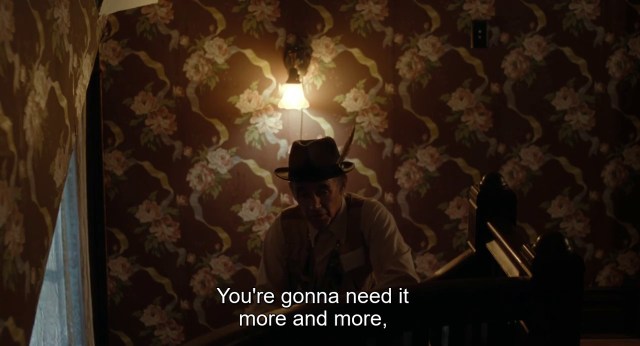
The Last of Us is an HBO original TV series which was released to streaming on January 15, 2023. It was adapted by Neil Druckmann, the writer and creative director of the video game of the same name, and Craig Mazin, the showrunner of the highly acclaimed miniseries Chernobyl.
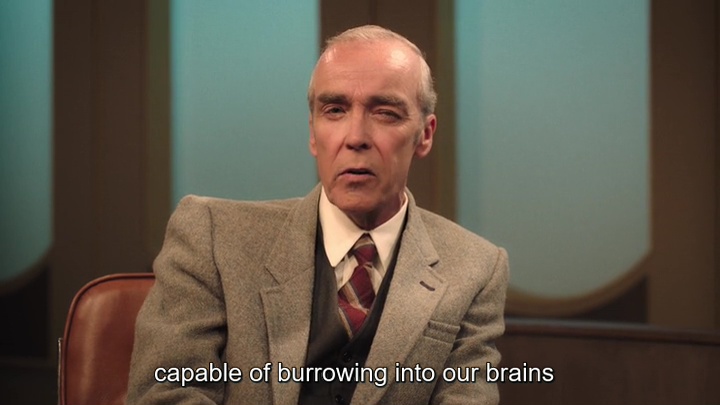
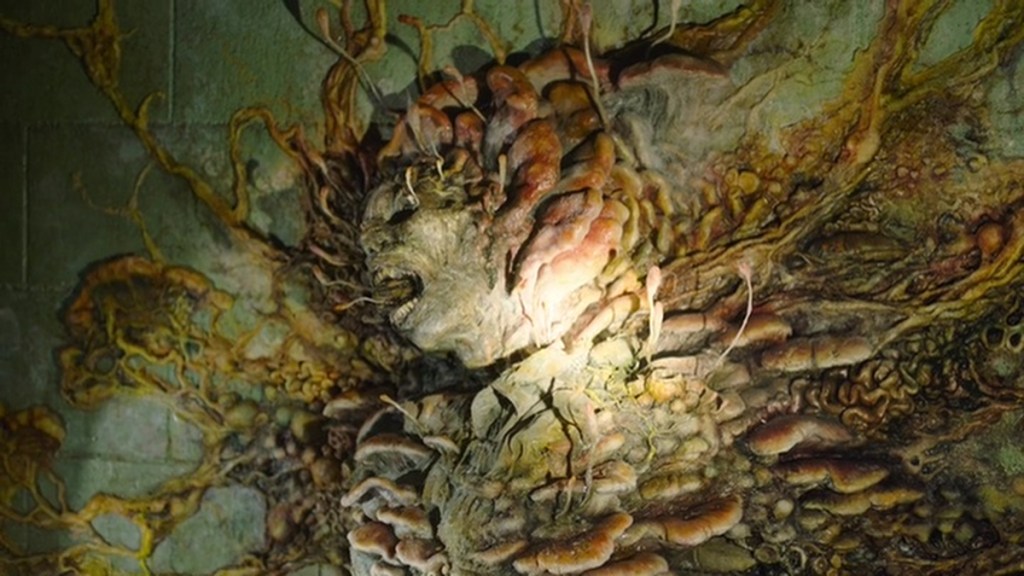
The show opens with a panel discussion; a couple of epidemiologists arguing about what sort of organism will wipe out humanity. Turns out bacteria and viruses can be terrible, but we always beat them. But fungi – one of them, cordyceps, can take over the brain, make you a slave, dedicated to one thing – spreading its spores to everyone else. Apparently, part of this fungal strategy is to kill other people and eat bits of their bodies, a lot like, y’know, zombies!
Some of this is factual – the fungus quoted, Ophiocordyceps unilateralis, is sometimes called the “zombie ant fungus” because it takes over the bodies of ants and forces them to climb to a high place and wait for spores to sprout from their heads, to be spread by the wind.
That’s one smart fungus but, as the epidemiologist says, fungus cannot live at human body temperature. Unless of course they are forced to evolve heat-tolerant forms – if, for example, hypothetically, the planet started warming. Yes, we’re talking yet another side-effect of the global warming caused by our voracious consumption of the resources of the planet. Human cannibalism of Mother Earth.
The good news is that Scientific American says there is zero chance of Ophiocordyceps surviving in our warm bodies and taking over our brains. The bad news is that there are plenty of other new strains developing, including Candida auris, which has spread to fifty countries so far and there are no drugs that treat it effectively. It won’t turn us into flesh-eating zombies, but it can do lots of other bad stuff.
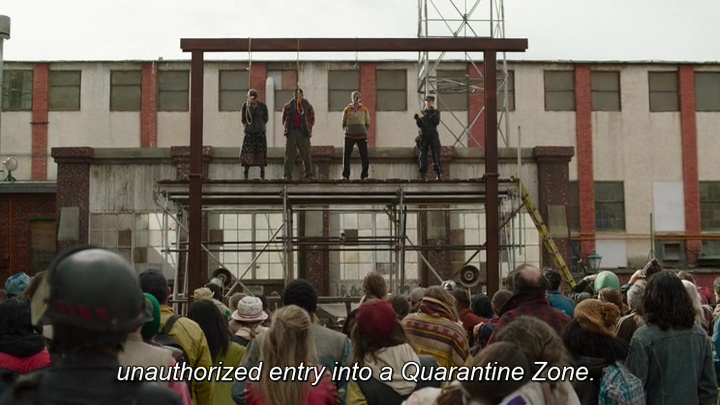
From the cranky 1960s epidemiologists we jump forward to 2003, when the fungus suddenly takes hold. The nice, senile old lady next door starts eating her family, and our protagonist, Joel (Pedro Pascal from Game of Thrones and Mandalorian) tries to escape the city with his brother and daughter, as civilisation collapses around their ears. I won’t tell you how that turns out, in case you are planning to watch it (or play the game), but the plot then jumps twenty years to 2023, a terrible year, in which people live in quarantine zones under martial law, which provides the gallows for anyone who tries to escape, or to break in.
The authoritarian government is at war with the infected, but also with a rebel group called Fireflies. The gallows, the walls, the restrictions seem perhaps a comment on the COVID lockdowns that took place only a little before this series was made, but whether in favour or against is not clear. In a pandemic, no one knows what to do, but everyone has an opinion, and whatever course is chosen will likely be seen as either ineptitude or oppression. The fungus is not COVID, which is a virus but, like COVID and other pandemics, it has the effect of causing everyone to be at the throats of everyone else. In this case, literally.
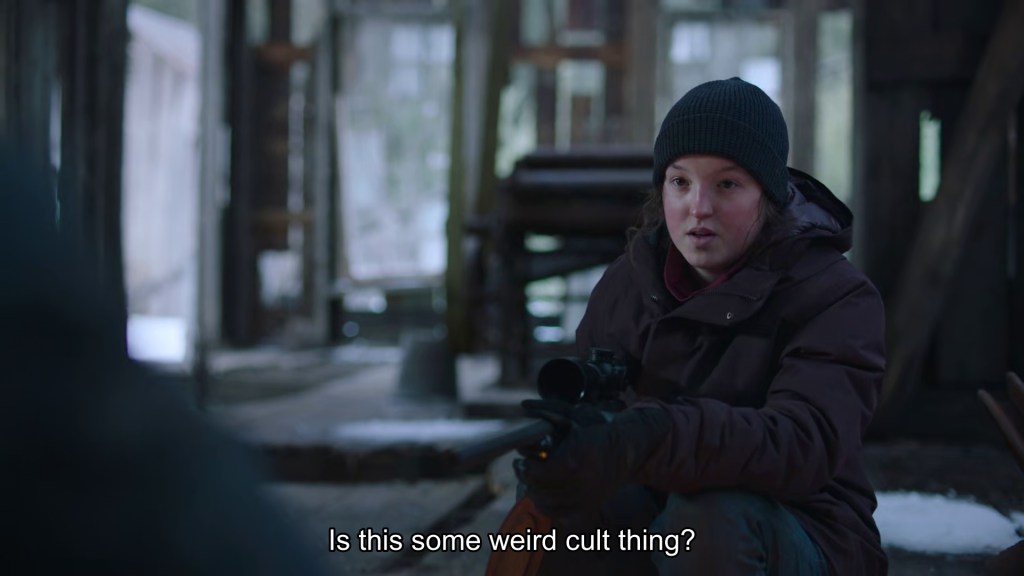
So in 2023, Joel, has a nice steady job (gig economy, but still earning a bit, and trading drugs as a side-hustle), burning corpses and cleaning sewers, neither of which tasks seem likely to become obsolete any time soon. But he’s a professional smuggler, and finds himself transporting a young girl, Ellie (Bella Ramsey, also from Game of Thrones) across the country. Ellie is valuable cargo – she is apparently immune from the fungus, and lots of people would love to cut her up and find out why and how. Heading cross-country does not (just) mean finding affordable gas (or solar chargers?), food and weapons (the basis for most games), but also has problems since the areas outside the quarantine zones are full of “the infected” (what the show calls the zombies) as well as raiders and slavers. Well, it’s based on a computer game, so there are sure to be obstacles.
The question of nomenclature keeps coming up in reviews. Assuming “zombie” can be defined clearly, many reviews argue that these dudes are not zombies because they are not ‘undead’, which seems to be a prerequisite for graduating to zombiehood. In fact, Eben Bolter, the cinematographer who shot four episodes of the first season, said that the term “zombie” (AKA the “Z-word”) was strictly forbidden on set. To me, it seems to be splitting hairs – the “infected” twitch like zombies, kill like zombies, eat (other people) like zombies. If it walks like a zombie, attacks like a zombie, and eats like a zombie, to me it’s a zombie, even if it doesn’t smell like one. What never became clear to me was why these particular zombies, their minds controlled by the fungus, insisted on killing and eating people (there is a good discussion of this on Reddit). Most parasitic organisms keep their hosts alive, because when the body dies, so do they. But I guess with billions of people alive (or not undead) in the twenty years of the fungus, eating a few can be understood. Even a zombie (infected) has to eat.
There are plenty of films and TV shows about people turning into cannibal zombies through some external threat. 28 Days Later showed a virus that was developed in a laboratory (London, not Wuhan) that turned people into rage-filled consumers. Doghouse showed all the women of a small English village turning into mindless zombies through a virus that was being tested by the military for germ warfare. Drive In from American Horror Stories suggested that just seeing a movie with the right subliminal suggestions could do it.
Then there’s The Girl with All the Gifts, in which a fungus (cordyceps, the same one as Last of Us) takes over infected humans, turns them into mindless zombies called “hungries”, and makes their bodies feeding stations for its spores. And yes, there is a young girl who is the main character, who ends up having to face off with the bad guy. Well worth watching if you get a chance. There has been some reasonably polite (for the Internet) debate over which came first, and if either stole the idea from the other. The Girl with All the Gifts was released in 2016, obviously well before the TV series of TLOA. But the game came out in 2013. But the book TGWATG was based on a short story by M.R.Carey called Iphigenia in Aulis, which was published in 2012 as part of a short-story collection called An Apple for the Creature.
Maybe it was just coincidence – the zeitgeist of the time. Innovations like 3D printing of body parts and cloning of stem cells were shaking faith in the anthropocentric division of the world into nature/culture and animal/human. Out of this fog of indistinction came two stories of cultural collapse and redemption through nature, their central characters young girls (Ellie and Melanie) who were both vulnerable but strong, warriors, hunters and protectors like Artemis, the Greek goddess at the centre of the myth of Iphigenia in Aulis. With nature fighting back in the form of climate change, perhaps our cultural consciousness recalled Artemis to lead us out of the mess. In the shape of Ellie and Melanie.
The word “zombie”, like the word “cannibal”, comes from the invasion, genocide and cultural obliteration of the nations colonised by the Europeans. Roger Luckhurst’s excellent review of the zombie trope points out that the slave labourers in the cane fields of Haiti were called zombies, but were definitely living humans who were certainly not undead but rather exhausted by endless toil, and perhaps shackled so they walked in a shuffling pace. They, like the “infected” of Last of Us, were slaves of an alien master.
Look, the show’s well made, and the reviews keep emphasising that it’s the best adaptation ever made of a computer game, which I think may be damning it with faint praise. The acting is very good, the photography superb and the graphics are terrific, as you would expect in a big-budget show. It is currently scoring 96% fresh on Rotten Tomatoes, with most critics praising the suspense, the narrative and the relationships of the main characters, Joel and Ellie. Rebecca Nicholson, the critic from The Guardian, called it
“…one of the finest TV shows you will see this year”
Of course, it is being watched by many gamers who are dedicated to Joel’s story, having lived and died with, or as him, in their hours spent playing the game. They may not be aware of the many, many zombie apocalypse movies and shows that have graced the screen since George Romero introduced us to characters lurching around the graveyard and smashing open windows hoping to find fresh brains in Night of the Living Dead in 1968 (he called them “ghouls” rather than zombies, but that never caught on). The zombie film goes back even further, to The White Zombie (1932), in which Bela Lugosi turned Madge Bellamy into a mindless love object – returned to life, but as a slave with no will of her own, precisely what Jeffrey Dahmer was hoping to achieve by pouring muriatic acid into the brains of his hoped-for sex slaves.
Storytelling in games is a very different beast to a film or TV show. In games, we have a goal and many obstacles to overcome, crash through or kill. On screen, we have (hopefully) realistic, sympathetic characters who interact, clash, and begin to love. The premise of a game is action, of a film or show, interaction. For a good summary of all the things a gamer might hate about the adaptation to screen, check out Ian Bogost’s review in The Atlantic. He sums up,
“It’s just not interesting to watch an angry man escort an irritable girl across the country amid a cartoonish zombie apocalypse cosplaying a credible global pandemic.”
But most critics felt that the writers had overcome this minefield and turned the characters, particularly Joel and Ellie, into real, sympathetic people.
Like games, a series of discrete episodes, some barely involving Joel and Ellie, take place during their journey across a devastated America. This is how games and TV shows have to be – gamers and bingers have to stop and sleep sometimes (well, maybe not gamers).
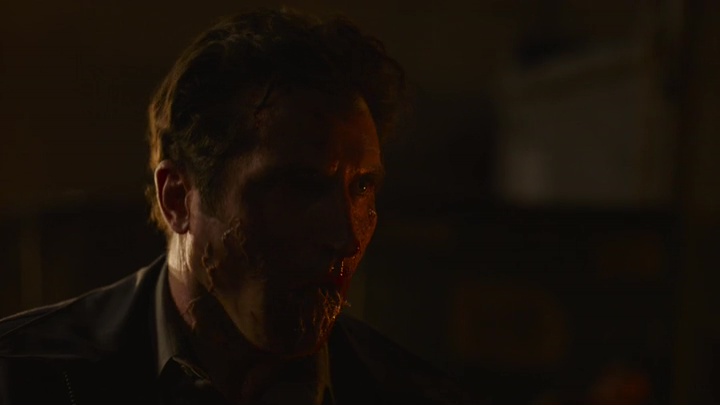
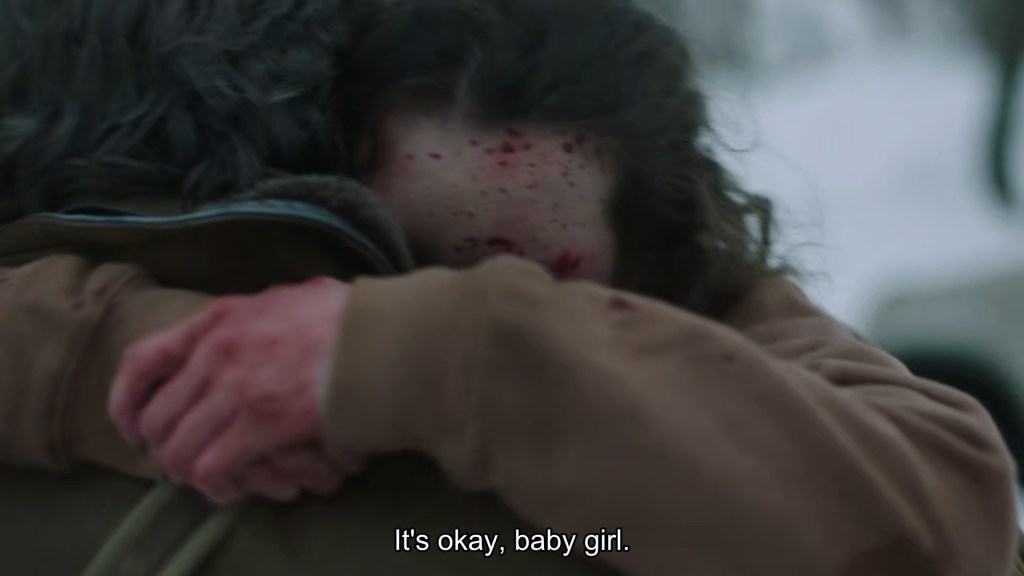
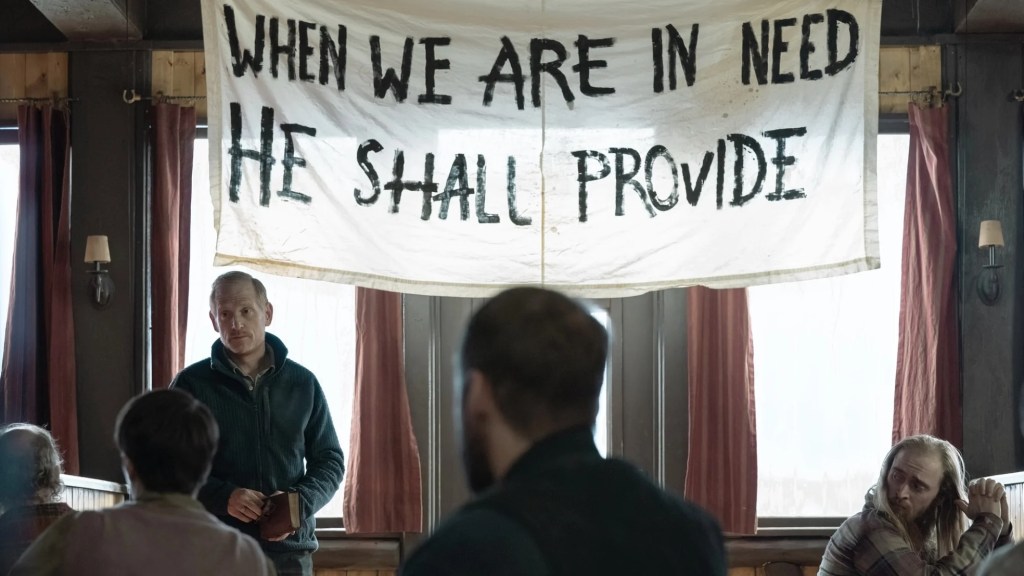
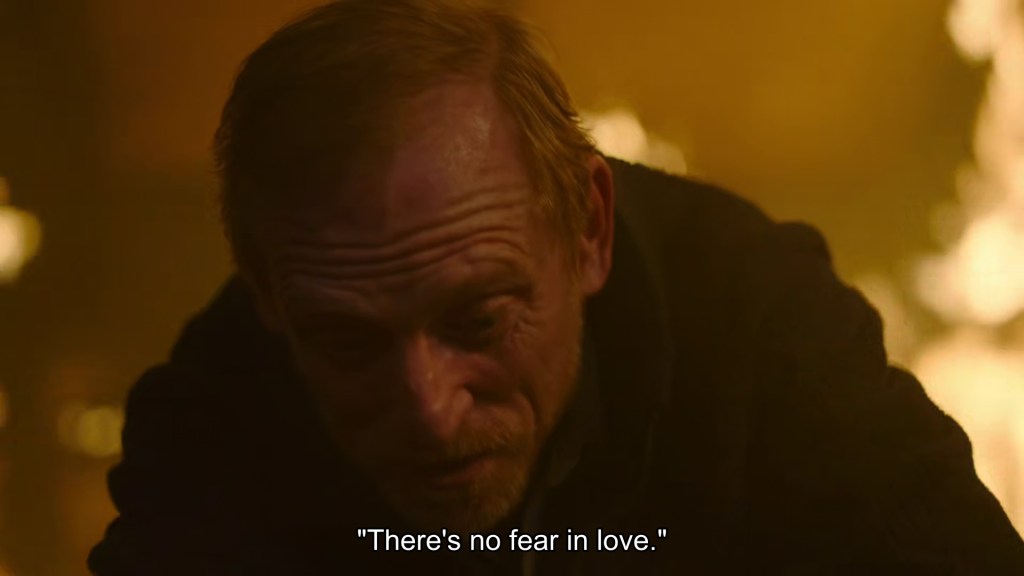
Then we get to episode eight, titled “When We Are in Need”, which Belen Edwards of Mashable predicted would “mess you up”. Joel and Ellie meet a cannibal (yes, you are on the right blog, sorry it took us a while to get here). Ellie is seeking penicillin for a wounded Joel, and finds it through a preacher named David (Scott Shepherd) and his off-sider James (Troy Baker, who played Joel in the video game!) who are trying to carry off the carcass of a deer that Ellie wounded. David the cannibal is a preacher; these cannibals are Christian devotees. In the game, they were ‘just’ psychopaths, but the show has added some backstory.
The episode starts with David reading from Revelation 21:1-4, which talks about “a new heaven and a new earth”, in which there will be no more death, mourning, crying or pain. Quite a promise for an apocalyptic series. Ellie is not impressed.
The advantage of being religious is that almost anything can be justified with a quote, out of context, from the holy books. David rationalises his attempted rape of Ellie with John 4:18 – “There is no fear in love”. Nice try. The context, trying to rape a young girl in a burning building, is definitely Satanic imagery. David is presented as the devil, because he feeds his flock the only meat available to him. Also because he is a murderer and a rapist, but that doesn’t seem so unusual in post-fungus world.
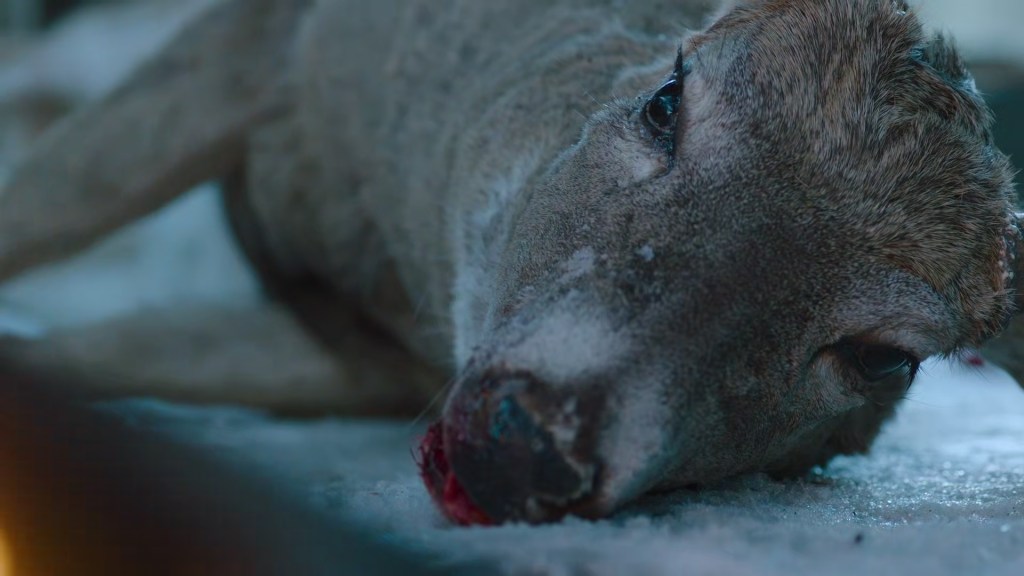
There’s a lot written about the moral twists and turns in this episode, mostly people being horrified by the cannibalism (although it is the standard operating procedure of the “infected”), and pointing out that only a preacher adept at using (twisting?) the teachings of the Bible could justify the eating of human flesh by his flock. But let’s not forget that Catholic Communion insists that it involves eating the actual body and drinking the actual blood of Christ. The Old Testament also has incidents of cannibalism during the siege of Jerusalem. Yet there is a strange consensus that shooting a living deer, wounding him so he dies later in agony, then eating him, is perfectly acceptable, while eating dead humans, who have probably died from lack of food, is somehow the work of the devil. One website says:
“David and the others are engaging in an unspeakably disgusting practice, and the fact that he’s okay with it demonstrates his moral rot.”
David tells Ellie he does not hate the fungus cordyceps, because it fights and kills for its own preservation. He feels he must do the same, be a strong, even violent leader, to protect his “flock”.
“What does cordyceps do? Is it evil? No. It’s fruitful, it multiplies. It feeds and protects its children, and it secures its future with violence if it must. It loves.”
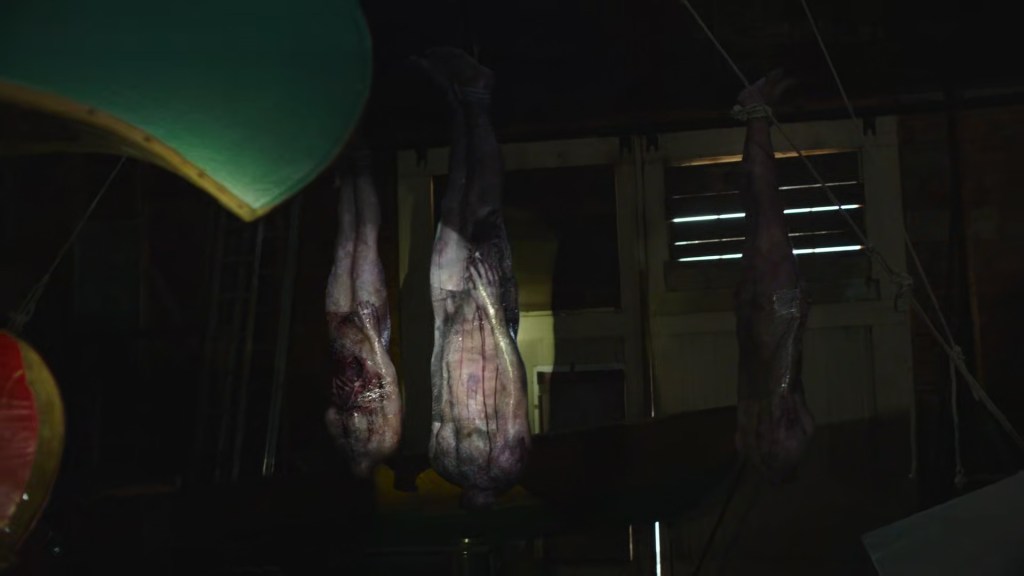
Do David’s followers know they are eating people? The cold room is full of corpses hung and ready, as Joel discovers when he stumbles in hoping to save Ellie, so it seems probable.
David tells Ellie that he keeps the cannibalism secret, because the followers (or “sheep” as he calls them) are too weak to accept what is necessary. Or perhaps David’s followers didn’t a) know or b) care that the flesh they are eating is from one mammal rather than another. There’s a scene where they all solemnly chow down on plates of what seems obviously to be the meat of the guy Joel killed last episode. Here’s a summary from the Digital Mafia website, which believes that they knew but pretended not to:
“People had turned into animals, but they still wanted to reassure themselves that they had strict regard for what was morally right.”
Killing of deer or rabbits is presented as totally uncontroversial in the show. Yet Ellie shouts at David:
“You’re an animal!”
He replies:
“Well yes, we all are. That’s sorta the point. But what was I supposed to do? Let them starve? These people who put their lives in my hands. Who expect me to keep them safe. Who love me!”
I found the killing of the stag, which I hope was sophisticated computer graphics, far more shocking than the images of hungry people eating a human corpse, which after all is a dead animal who can no longer feel any harm.
Joel and Ellie also kill to survive. Joel killed a member of David’s community in the previous episode, the one who was that night’s main course at David’s diner, and he gratuitously kills two of David’s men after he has tortured them to find out where Ellie had been taken, beats them to death as they beg for their lives. But Joel doesn’t eat the resultant corpses; human life is not sacred in this ruined earth, nor was it ever, only human flesh is sacrosanct. David sees that we are animals, “That’s sorta the point”, and so would consider Joel’s casual disposal of the corpses a shocking waste of good food. If we are happy to eat animals, and humans are animals, I guess he has a point.
The “infected” lost their humanity when they were taken over by the fungus. Joel maintains a thin red line between killing people and eating them. David’s followers have tried to retain their obsolete humanism even though threatened with starvation. David, the teacher turned preacher, sees the hypocrisy of such arbitrary distinctions. When civilisation goes up in smoke, so does its normative ethics. And when you’re in the middle of a zombie apocalypse and hungry, maybe caring is an anthropocentric luxury that most people cannot afford?
On February 24 2023, Hong Kong model Abby Choi was found dead in a rental unit in Hong Kong’s northern Tai Po district. Or at least, some of her; Choi’s corpse was not complete. Her head was missing, to be found by the police, after some analysis, in a cooking pot. The police described the crime scene as a “slaughterhouse”, and they found other parts of her body in the refrigerator.
An electric saw and a meat-grinder that had been used to mince human flesh were found at the crime scene, as well as soup pots containing human tissue.
Police have taken into custody her ex-husband Alex Kwong, his father Kwong Kau and his brother Anthony Kwong. All were charged with murdering model Abby Choi a day earlier. Alex Kwong’s mother, Jenny Li, faces one count of perverting the course of justice. None of the four were granted bail.
The former husband, one of the main suspects in the murder, was arrested the next day at a pier in Tung Chung, on one of the city’s outlying islands, Lantau, while trying to flee with just the clothes on his back, and half a million HK dollars and four million $HK worth of fancy watches.
On Sunday, authorities confirmed that a young woman’s skull believed to be Choi’s had been found in a cooking pot that was seized from the house. Officials believe that a hole on the right rear of the skull is where the fatal blow was struck.
Ms Choi lived at Kadoorie Hill in Ho Man Tin and had been missing since Tuesday (Feb 21). Police discovered two legs in the apartment’s refrigerator, as well as the victim’s ID card, credit cards, and other belongings, according to Police Superintendent Alan Chung. Human tissue was found in pots of soup, while the victim’s torso and hands were not at the scene. Chung said:
“Police also have found that the flat was arranged by cold-blooded killers meticulously. Tools that are used to dismember human bodies were found in the flat, including meat grinders, chainsaws, long raincoats, gloves, and masks.”
According to China Underground, Choi’s former father-in-law had rented the flat, which was almost bare of furniture, as were the two bedrooms. Police found two types of choppers, a hammer, face shields, black raincoats, and a purple handbag that belonged to Choi. The suspects reportedly covered the walls with a sail and wore face shields and raincoats to prevent being bloodstained while dismembering the body. This was clearly not a spur of the moment crime.
More than 100 police personnel were sent to search the Tseung Kwan O Chinese Permanent Cemetery on Saturday, including a diving team who were deployed to the nearby catchwater.
The motive of the murder has yet to be determined, but it is believed to be a financial dispute between Choi, who was only 28 years old, and her ex-husband’s family, involving around 100 million Hong Kong dollars.
As a model, Choi enjoyed international exposure and was photographed at the Elie Saab Spring Summer 2023 Haute Couture show in Paris, France, as recently as January. She also appeared as the digital cover model for the luxury magazine L’Officiel Monaco and attended this year’s Paris Fashion Week.
Choi, who was also known as a social media influencer, has nearly 100,000 followers on her Instagram account, which features photographs of her posing with various luxury brands in locations from London to Paris and Shanghai and aboard yachts in Hong Kong. In her bio she writes that she’s “embracing every moment in life.”
Choi’s friend Bernard Cheng said she had four children: two sons ages 10 and 3, and two daughters ages 8 and 6; a son and a daughter from her ex-husband, who have been placed in the care of the model’s mother, and two children with her present partner.
The murder case has been adjourned to May.
The news has been greeted with horror in Hong Kong. But social media is already making tasteless comments about cannibalism and cunnilingus.
The comment in the social media posts about HK people “always” cooking their murder victims seems a little hard to swallow (sorry). No one has yet accused the alleged perps of eating the human flesh soup found in the pots, and there is some speculation that they were cooking the flesh just to render it down for disposal, or to stop it decomposing. But if you find pots of soup on a stove, you’d imagine that the most likely explanation would be that they were there for degustation. Everything else about the case uses metaphors of carnivorous virility and factory farming – the flat being a “slaughterhouse”, the grinders and protective equipment, and the motivation for the killing – lots of money.
Except in times of chronic famine, or during the Cultural Revolution, China is not known for many cases of cannibalism, unlike some other countries we could (and often do) name. But the Chinese do make some great cannibal movies, including Herman Yau’s Human Pork Buns and Ebola Syndrome (伊波拉病毒), and Fruit Chan’s Dumplings. Check them out, and then ask yourself, what exactly was planned for those pots?
A forensic psychiatrist has told Newsweek that the man charged in connection with the slayings of four University of Idaho students in November 2022 had battled with “cannibalistic urges“.
Bryan Kohberger, a 28-year-old Ph.D. student and teaching assistant in the Department of Criminal Justice and Criminology at Washington State University, was arrested at his parents’ home in Albrightsville, Pennsylvania.
Kohberger is accused of breaking into a rental house in Moscow, Idaho, and fatally stabbing Kaylee Goncalves, Madison Mogen, Xana Kernodle and Ethan Chapin in the early morning hours on November 13.
Reports have surfaced divulging that Kohberger follows a strict vegan diet and has reportedly struggled with heroin addiction in the past.
Forensic psychiatrist Carole Lieberman told Newsweek that Kohberger’s “obsessive-compulsive eating habits” indicate he was afraid he would become addicted to meat if he ate it.
“He was not only vegan, he refused to eat off of pots or plates that had had meat on them. Psychologically, this represents his struggle against his cannibalistic urges. He was afraid that if he let himself go to taste meat once, he would become addicted to it—like he had become to heroin—and start killing and eating people.”
A relative told the New York Post last week that Kohberger’s dietary restrictions were “very, very weird” and that he seemed “very OCD,” referring to obsessive-compulsive disorder.
The woman, who asked not to be named, but said she was previously married into Kohberger’s family, said:
“It was above and beyond being vegan. His aunt and uncle had to buy new pots and pans because he would not eat from anything that had ever had meat cooked in them.”
Casey Arntz, who was friends with Kohberger in middle and high school, said in a video posted on TikTok that he had been “a heavy heroin user” in high school. Kohberger’s struggles with drug addiction continued into his college years, a friend from Northampton Community College told Fox News. Criminal profiler John Kelly told Fox News,
“This kind of person has this volcanic rage inside that’s going to explode on is victim of choice.”
Lieberman told Newsweek that Kohberger had probably studied criminology both to “calm the demons inside him that were telling him to kill” but also to “learn how to commit the perfect crime.”
Kohlberger may have corresponded with Rader (a lot of criminology students do) but we don’t know that yet. We have to wonder if Rader would have told him about working in the meat department of a Wichita IGA a few years before his murder spree began.
Kohberger has been held without bond in Pennsylvania since his arrest. He will be tried in Idaho, the state in which the crimes took place, the only state in the US with a law against cannibalism, although no such charges have been laid against Kohberger.
Kohlberger’s obsession with meat reflects a lot of issues considered in Cannibal Studies. Firstly, the question of human meat: there really is no significant difference between the meat of humans and other large mammals such as cows, pigs or sheep. Hannibal Lecter takes delight in feeding human meat to his guests, such as the flesh of the flautist of the Baltimore Philharmonic, whose Board members subsequently enjoy the meal immensely in the book and film Red Dragon, thus becoming innocent cannibals. Incidentally, being the Baltimore flautist seems to be a rocky road – their principal flautist Emily Skala, was fired in 2021 for spreading misinformation about the safety of coronavirus vaccines, the efficacy of face masks and the outcome of the 2020 presidential election, relieved of her post, but not eaten.
But the point is that once meat is prepared (cooked, seasoned, presented) it is very hard to tell its provenance. Cannibals who have been asked have mostly compared it to pork or veal, with Armin Meiwes telling an interviewer
“It would have made no difference in somebody else had tasted it; he wouldn’t have questioned the meat…. During preparation, it is not as dark, but bright and fresh as pork, and tastes so very close to pork.”
Kohlberger’s belief that he might like human flesh if he tried any meat at all therefore has some logic to it. Since Charles Darwin’s writings overthrew the special status of humans as closer to angels than animals, anthropocentrism has been amended to offer a story of humans as the culmination of evolution and thereby continues, rather less successfully, to obscure human animality. Should such beliefs falter, as happens repeatedly in many cases of contemporary cannibalism, it becomes a very short step from eating other animals to eating the human one.
But why should he become addicted to any meat? Well, we know Kohlberger has an addictive personality, shown by his very heavy usage of heroin. But we’re not talking drugs of addiction but lumps of protein, aren’t we? Well, there are plenty of studies about that. Marta Zaraska, for example, wrote in her book Meathooked that meat is highly addictive on several fronts – genetic, cultural, historic and commercial, and coined the term “meathooked” for the incongruous compulsion to eat meat despite the pangs of cognitive dissonance – the repressed feeling of guilt when considering oneself an animal-lover while also paying big corporations to kill them. Then there is the mythology of the Wendigo, a creature from Algonquin legend who starts off as a human but becomes a being who can only live on human flesh, which makes him grow bigger and at the same time hungrier. If you believe in Wendigos, then the slippery slope from carnivore to cannibal seems reasonably clear.
This leads us to the issue of Kohlberger’s apparently very strict veganism. Most people seem to believe (or want to believe) that vegans are fanatics, obsessed with animal welfare (or environment or their own health) who therefore compulsively avoid meat. But in fact most vegans I know would wash a pot well after a relative had cooked meat, but are unlikely to throw it out as irretrievably ruined, as Kohlberger purportedly did. Veganism is an ethical system that attempts to minimise harm to sentient animals, which includes humans (yes, Virginia, we are animals). If there is a slippery slope from the flesh of other animals to the flesh of Homo sapiens, then the vegan is furthest from the edge of that slope. If Kohlberger did kill those students (and at this stage it’s only alleged), then he is no vegan, even if he didn’t sample them on the way out.
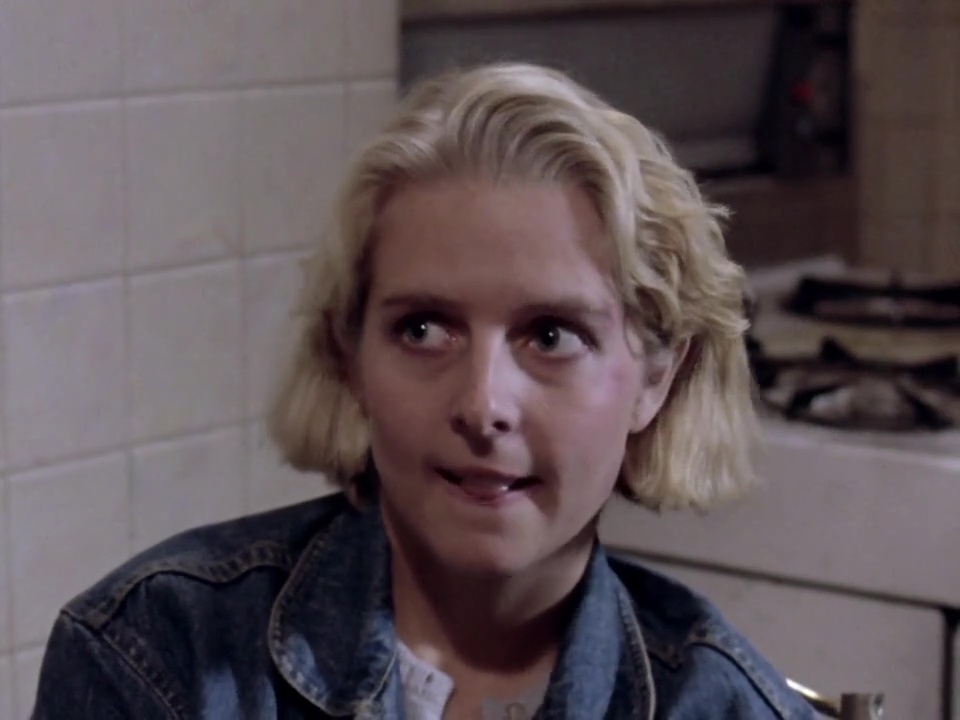
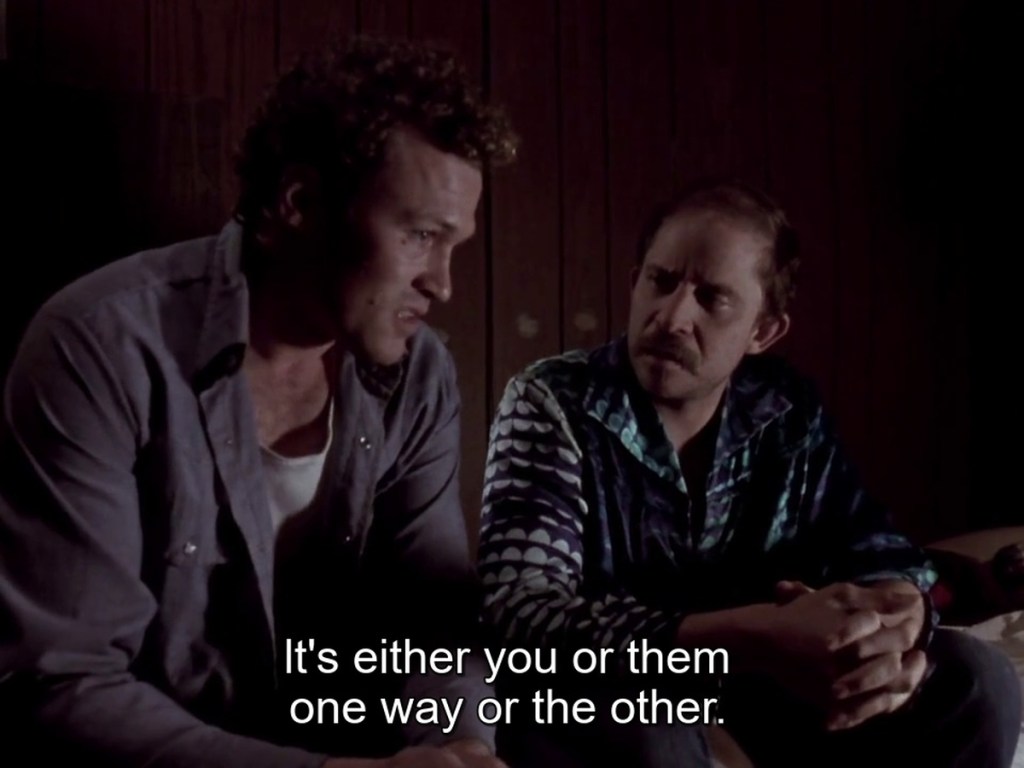
Henry: Portrait of a Serial Killer is an American psychological crime film directed and co-written by John McNaughton that depicts a random crime spree by Henry and his protégé Otis, who torture and kill with impunity. Michael Rooker in his debut film plays the nomadic killer Henry, Tom Towles plays Otis, a prison ‘friend’ who lives with Henry, and Tracy Arnold is Becky, Otis’s sister.
The characters of Henry and Otis are loosely based on convicted real life serial killers Henry Lee Lucas and Ottis Toole, who was famous for his claims to have cannibalised many of their victims, claiming that they also supplied women and children for human sacrifice to a cult called “The Hand of Death”.
Henry confessed to over 600 murders, which supposedly were committed between his release from prison in 1975 to his arrest in 1983, a pace that would have required a murder every week. A detailed investigation by the Texas attorney general’s office ruled out Lucas as a suspect in most of his confessions by comparing his known whereabouts to the dates of the murders to which he had confessed. It appears that the police would bring any cold case to his attention, feed him information about it, and then let him take responsibility. He had nothing to lose, and global fame and notoriety to gain. He was convicted of 11 murders and sentenced to death for the murder of an unidentified female victim known only as “Orange Socks.” His death sentence was commuted to life in prison by Texas Governor George W. Bush in 1998 due to evidence that Lucas was in Florida at the time “Orange Socks” was killed in Texas. Lucas later recanted all his confessions except for the murder of his mother, and died in prison of heart failure on March 13, 2001.
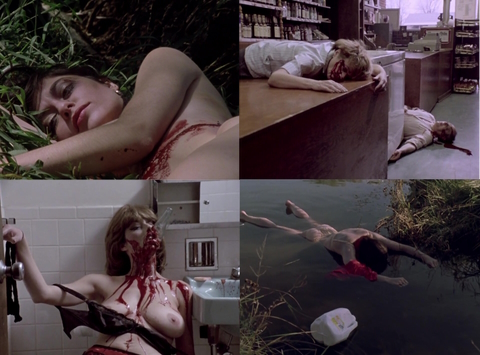
The film involves a lot of scenes of Henry driving his battered old Chevy Impala around the grey streets of Chicago, finding people to kill. Images of bloody mayhem are offered for their shock value and become repetitive, and rather fake, but then the film was made on a tiny budget.
Some narratives in the film run parallel to what we know of the real serial killers. Henry did meet Ottis, but in a soup kitchen in Jacksonville, Florida, not in prison. Henry’s father really did lose both of his legs after being struck by a freight train, leaving Henry at his mother’s mercy. But the film largely omits the long-term homosexual relationship between them (shyly hinting at it when they share the last can of beer) and, sadly, totally omits Ottis’ predilection for cannibalism.
Henry did sexually abuse Ottis’ 12-year-old niece Frieda Powell, who lived with them for many years. As in the film, Powell preferred to be addressed as Becky rather than Frieda. However, in the film Becky is Otis’s younger sister, and is presented as a considerably older single mother, not the real 12-year-old Powell.
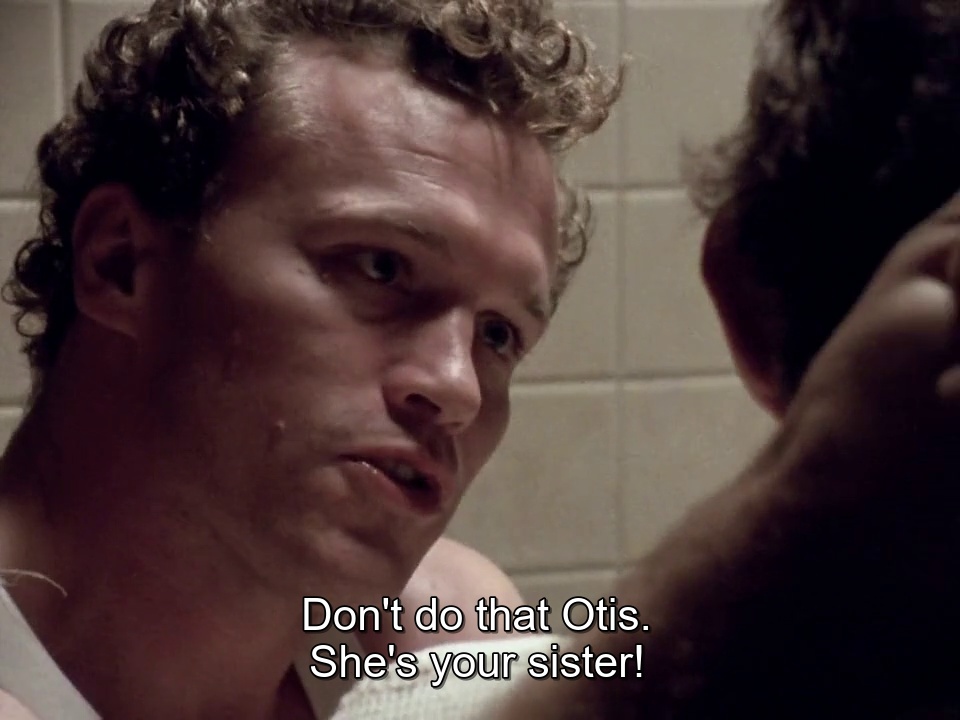
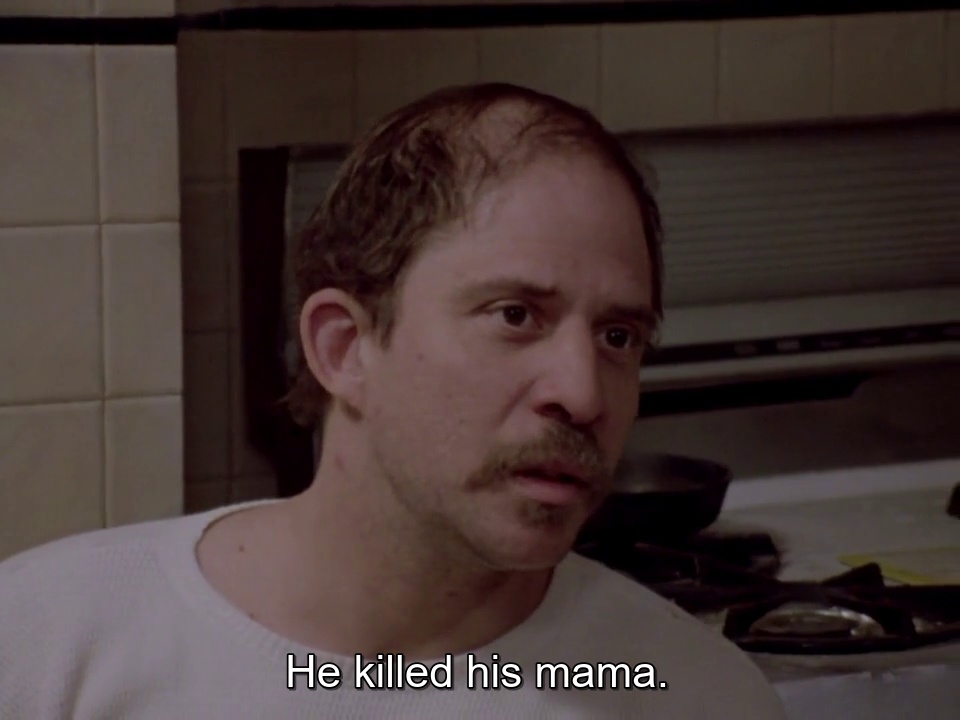
Sexual neurosis is presented as the root cause of the violent tendencies of both men. Otis, who is shown attempting to sexually abuse his sister, tells her that Henry killed his own mother, and when Becky asks Henry about it, he tells her his mother was a sadist and a “whore”, who forced him to watch her having sex with clients, sometimes making him wear girls’ clothing for further humiliation.
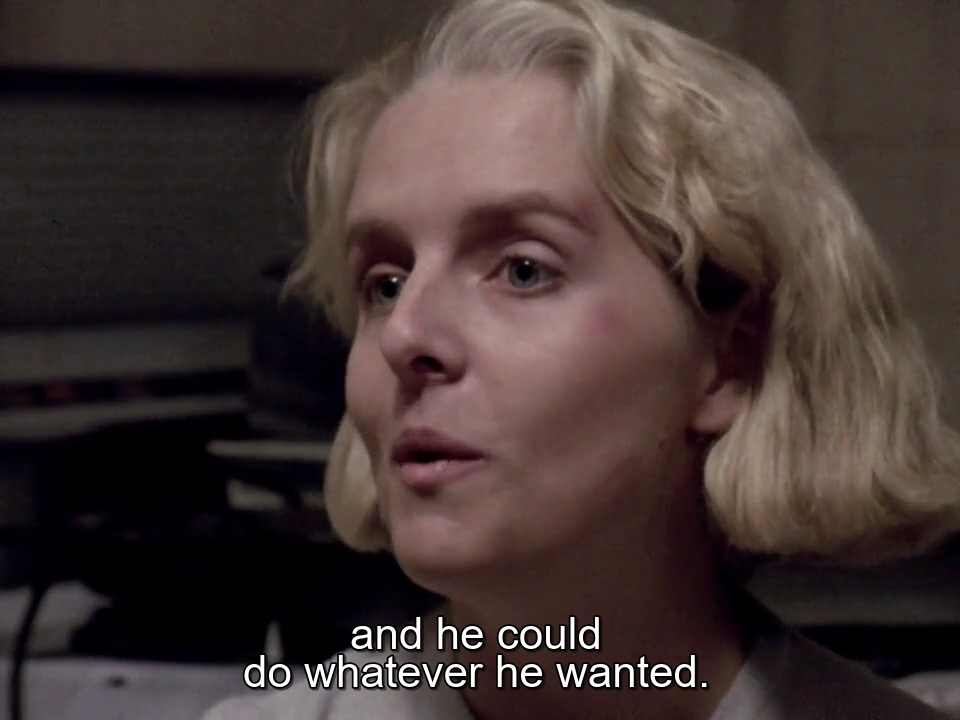
Becky in response tells Henry of her childhood, in which she was regularly raped by her father, with her mother claiming not to believe her.
“He told me he had a right, because he was my daddy and I was his daughter, and he fed me and let me live in his house, and he could do whatever he wanted. And he did… I didn’t fight him, because when I did he just hit me.”
Henry introduces Otis to his world of serial killing when they pick up two sex workers and Henry snaps their necks during sex, suggesting that he is revenging his mother’s abuse. To Henry, the world is against him, and murder is “always the same, and it’s always different.”
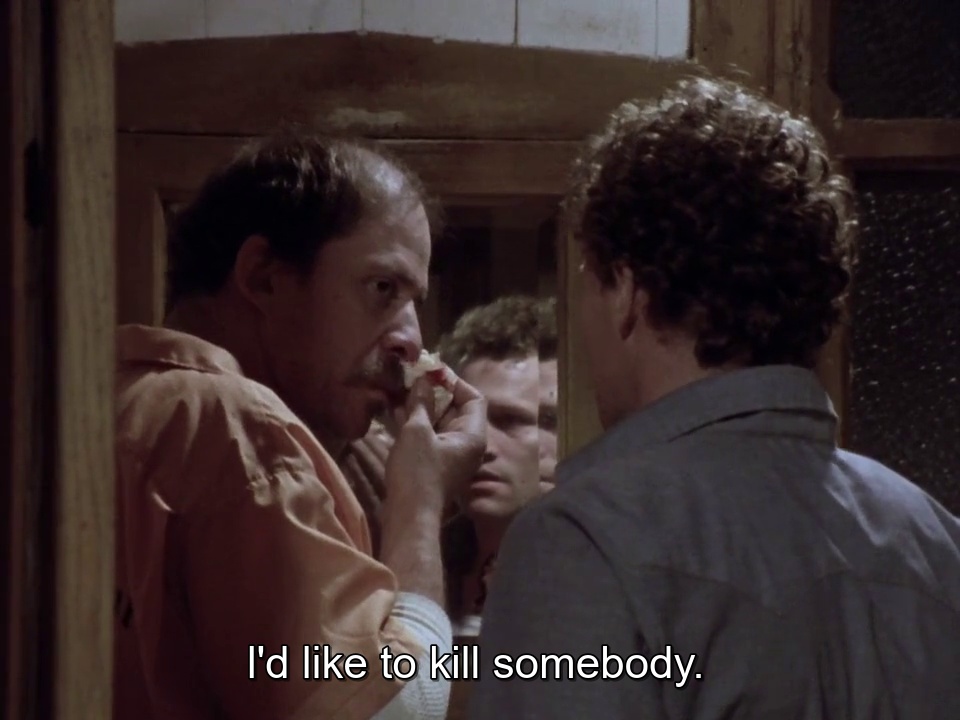
Otis gets a taste for murder when they kill a fence who mocks them when they try to buy a television from him, and then actively seeks out opportunities when a high school boy he comes on to punches him in the mouth. Henry says it would be a mistake to kill the boy, since they’ve been seen together, but Henry wants to kill someone. It’s the world being against them, again.
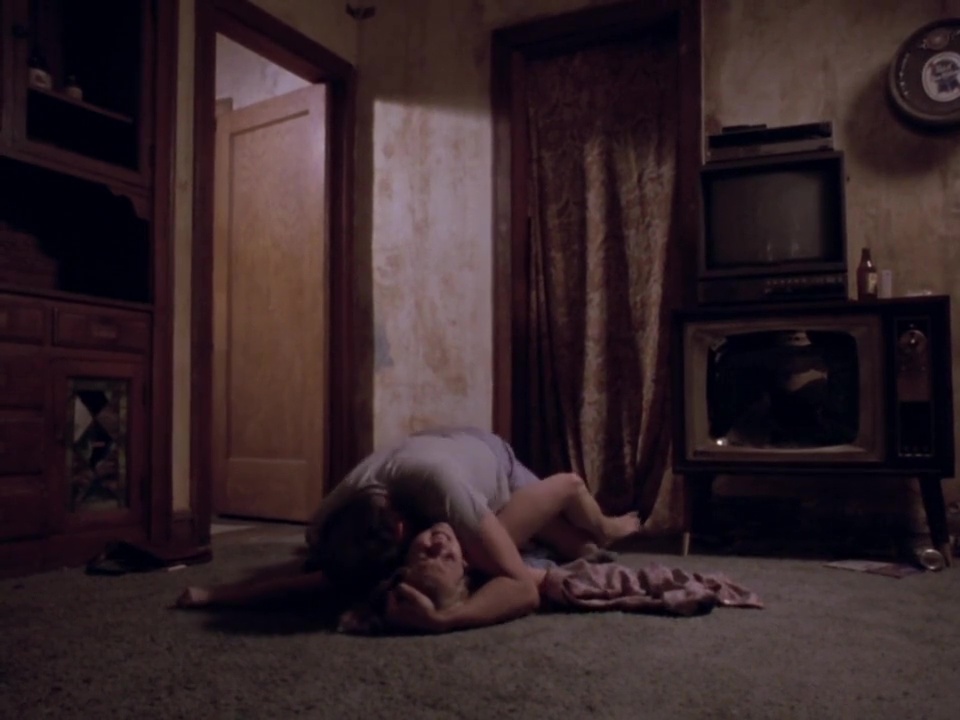
Henry schools Otis to make sure every murder is different – that way there can be no M.O. for the police to follow. A particularly brutal scene of the murder of a family is videotaped by the pair (on a camera stolen from the dead fence) and Otis enjoys re-watching himself molesting the screaming woman, breaking her neck and then attempting necrophilia, until Henry orders him to stop, just as he forced him to desist from molesting Becky when she arrived. When Henry finds Otis raping his own sister, he fights him and with Becky’s help, kills him.
Henry has his own moral code, in which murder is fine, but incest, family violence and necrophilia are forbidden. The real Henry’s paedophilic involvement with twelve-year-old Becky, and the real Ottis’ interest in eating people, are never mentioned.
Incest, murder and cannibalism are the three great taboos of our civilisation according to Freud, the driving forces behind the creation of laws and morals, which stop us destroying our communities by doing those things. The movie sadly concentrates on the murders and has references to incest, but totally ignores the cannibalism.
Unlike the film, the real Henry did not kill Ottis – both men died in separate prisons, Ottis in Florida State Prison in 1996 and Henry in Ellis Unit, Huntsville, Texas in 2001.
Due to the violent imagery, the film was censored in many markets and the original poster (above) was banned. The controversy brought it some very valuable publicity. The reviews were also mostly positive – it has an 89% “Fresh” rating on Rotten Tomatoes, with Roger Ebert observing that the film does not “sugar-coat” or trivialise violence as most slashers tend to do, and calling it:
“a very good film, a low-budget tour de force that provides an unforgettable portrait of the pathology of a man for whom killing is not a crime but simply a way of passing time and relieving boredom.”
It’s well made (considering the miniscule budget), the cast are terrific (in both senses of the word) and the plot, if somewhat out of step with the reality of the case, is well presented and never dull. But why should it stick to the “facts” of the case, when clearly neither Henry nor Ottis were too sure what was real and what simply bravado?
Gannibalis a new seven-episode television series set in present day, rural Japan. The show is based on a Manga series (comic or graphic novel) which appears to be available on-line.
In the first episode, we see a policeman raging outside a house, accusing the occupants of cannibalism. He soon comes to a sticky end.
Police officer Daigo Agawa becomes Chuzai (residential police officer) at the Kuge village, accompanied by his wife Yuki and daughter Mashiro, after the previous Chuzai mysteriously went missing (the same officer seen being killed in the opening). Daigo has caused some incident in his previous posting, which has led to his transfer to this remote and eerie (but very beautiful) village.
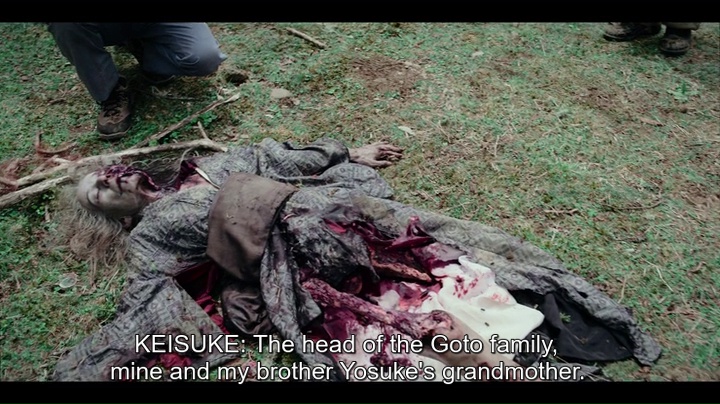
The daughter, Mashiro, seems to have no fear, but also refuses to speak, which Daigo believes is his fault. On his first day, Daigo is summoned by the Goto family, who seem to run the small forestry village, like a local crime family.
They have found the body of their grandmother, Gin Goto, the head of the family. They insist she was attacked by a bear, and pull out firearms when Daigo points out that the tooth marks on her arm are human.
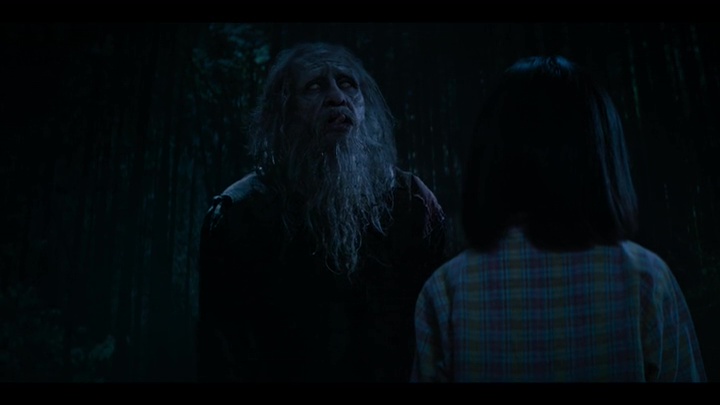
Meanwhile the little girl Mashiro wanders away from home, and meets up with a large blind guy who seems only able to snarl.
Showing no fear, she offers him a sugar candy, and in turn comes home with a human finger.
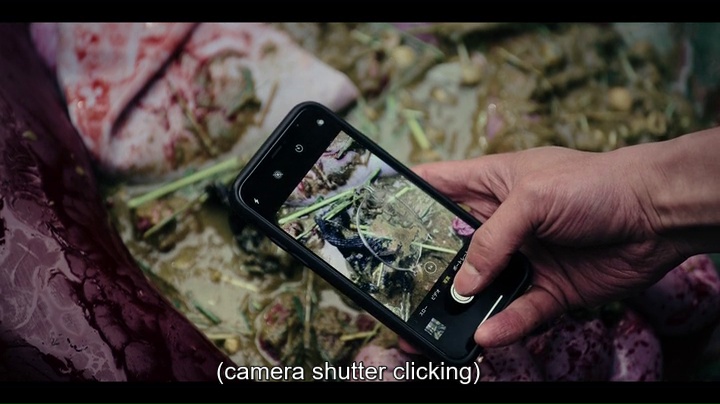
Problem: the finger is not from Gin Goto. Lots of people are, apparently, getting dismembered.
Daigo accompanies the Goto family on a hunt to find the bear that they claim ate Grandma, and is then attacked by a bear, who turns out to have granny’s specs in his stomach.
In a scene that could almost define carnivorous virility, the men gather around the bear and eat his flesh, a ritual that is supposed to keep Grandma within them.
This is what we call, in Cannibal Studies, “essentialism”, the idea that the spirit or strength of a person lives on by eating them, even if only via the bear that ate her (even though that’s clearly not what happened).
In the following episodes, Daigo slowly unravels the truth about cannibalism in the village.
Gannibal is directed by Shinzô Katayama, the director of the horror-thriller Missing. Reviews have been glowing, stressing how ‘gross’ and unsettling the show is. One tweet said:
Except for the opening, which is over the top in Japanese anime style, the acting is great, the suspense interesting without jump scares, the music eerie, and the photography beautiful. If you like a good suspense show and don’t mind subtitles, this one is highly recommended.
Gannibal started streaming December 28 on Hulu. Also available on Disney+.





































 The Cannibal Guy