According to Hollywood, everyone eagerly anticipates Christmas, which must be why incidents of violence flare over the festive season (largely driven by festive booze). Christmas goes for twelve days (they tell me), which covers the New Year mayhem as well, and reportedly involves a lot of odd things like lords leaping and pear trees containing medium sized birds. This film covers the twelve days, but omits French hens and turtle doves, etc, in favour of lots of blood and gore. I reviewed it many years ago, but it seems worth a fresh “bah humbug” as I recover over my keyboard after battling greedy retailers and stressed-out motorists.
“Bah! Humbug” always seems like a pretty good response to the confected cheer of Christmas, particularly to those who do not, for various reasons, celebrate the event or conform to the voracious consumerism that accompanies it. If you are one of the many who is over the Christmas rom-coms and tear-jerkers, you may have already come across the German Christmas demon Krampus, who appeared in a 2015 movie from Michael Dougherty, involving goblins, killer toys, malicious snowmen and a jack-in-the-box that eats a child whole, although he has been punishing naughty children for a lot longer than that, and may date back to pre-Christian folklore.
The cannibal movie reviewed today, though, was originally called The 12 Deaths of Christmas and features a different villain – a Christmas witch named Frau Perchtawho, according to legend, steals a child each of the twelve nights of Christmas. The witch is also said to slit open the bellies of disobedient children (not dissimilar to the threats of cannibalism which Andre Chikatilo’s mother used to keep him in line). The film’s name was changed to Mother Krampus for the American audience, many of whom have adopted Krampus as a sort of anti-Santa. Frau Perchta does not have nearly the same fan base.
The Santa Claus dogma is of course about socialisation – children are told that a large stranger will sneak into their houses at night and reward them if they are “good”. What if they are not good? Who will sneak into their house then, and what mayhem will ensue? Krampus was one answer, Frau Perchta another. Then there was Santa’s assistant, Père Fouettard who, in a nod to the suffering energy corporations, hands out lumps of coal to children who are not deemed to have been good, and sometimes whips them too (the name Père Fouettard translates as “Father Whipper”. Following Santa around appears to have been his punishment for engaging in a bit of entrepreneurial cannibalism, in which he and his wife drugged three children, slit their throats, cut them into pieces, and stewed them in a barrel, to be sold as Christmas hams. The taste, allegedly, is almost identical.
But today’s film is not just about stealing the bad children, and perhaps killing them, no, it’s all about the punishment of the wicked being extended to the following generations – a popular theme in the Bible (check out Deuteronomy 5:9 for some unfair shit). Perchta is coming for the children of adults who wronged her.
One of these children, and the protagonist of what passes for the plot, is Amy (Faye Goodwin – Mandy the Doll). Her mum is Vanessa (Claire-Maria Fox of Suicide Club and Bride of Scarecrow), and Vanessa’s dad – Amy’s grandpa – (Tony Manders, from The Young Cannibals) lives outside the village, near a scary forest in Belgrave (the UK one), and asks her to drive him, on Christmas no less (no Ubers I guess) to the Church, where a bunch of locals want to discuss the focal local issue – lots of village children are disappearing. There we finally get to hear the legend of the witch:
“Frau Perchta was a witch, who over Christmas stole the souls of children.”
Dad admits to Vanessa that the peaceful villagers got together to kill an old woman 25 years ago. We, the audience, know the background, through an endless voiceover accompanied by cards at the start of the movie. 12 kids disappeared over the 12 days of Christmas in 1921, and none were found, except for one girl whose mind was gone, and she could only scream “the witch! The witch!”
Then, in 1992, five more kids disappeared, their bodies were found in the forest, and the villagers believed, for reasons far from clear, that a nice old lady was the killer and was in fact Frau Perchta the witch, so they stabbed her and lynched her, as you do if the local constable is on leave, in a backward and primitive town like Belgrave, which apparently hosts the National Space Centre!
But as she died, she shouted a curse – that Frau Perchta would be back to wreak revenge on them, and their children. So, maybe she wasn’t quite so nice. Yeah, that’s about it for plot – we see (several times) the stringing up of the old woman, we see the risen witch. The witch kills lots of people in creative ways, including one who is cut up and made into a Christmas light show, another whose flesh is pressed into a cookie cutter to make Christmas peoplebread men, while another is trussed up like a Christmas turkey with an apple in her mouth and carved up, and her flesh cooked and fed to her boyfriend, who is Amy’s absentee dad. Then dad has his heart pulled out and eaten (not uncommon in cannibal stories – think Fresh Meat or even Hannibal).
The climax of a horror film (or any action movie) is usually the last ten minutes, in which the story is resolved and the bad guy defeated (until the sequel). This one goes on (and on and on) for about half an hour, presumably to ensure the film is considered a full-length feature, and it resolves nothing much, with a twist at the end that makes no sense at all. But lots of people get killed, and several have parts of them eaten, which is enough to get a mention in this blog, I guess. The plot is thin, the acting is often appalling, the continuity director in some parts seems to have been taken into the forest and eaten. But it’s presented as a low-budget slasher, and that’s what they are often like – they are not dramatic masterworks, but gruesome pantomimes. The idea of one child’s aunt walking him home through the dark forest at night when bodies are turning up everywhere is narratively absurd but, in a panto, we want to anticipate the villain, we want to guess what is going to happen, and yell at the actors to “look behind you!” And the gore, and the fright factors, are quite well done.
The moral of the story, if there is such a thing, is pronounced by a mysterious woman who turns out to be Amy’s grandma, not that it does her much good.
“Taking it into our own hands, playing God. That’s why all this is happening.”
Isn’t that exactly what humans do – play God? Nietzsche told us that God is dead, we killed him, so we have to become God. We play God in so many ways – the Christmas story in essence is about a Jewish family trying to escape one of the many psychopaths who have played God over the centuries. We play God when we nominate ourselves as above nature, more angel than animal, and proceed to destroy our own ecosystem. Who bears the suffering from such follies? The children. Like Frau Perchta, our vicious brutality usually comes back to haunt us, through the generations.
At the time of writing, the full movie (should you wish to bother) is available on YouTube.
In the year 2000, 44-year-old slaughterhouse worker Katherine Knight had a night of passion with her partner, John Price, then stabbed him 37 times, professionally skinned him, hung his hide on a meat hook over the lounge room door, decapitated him, butchered his corpse and cooked parts of him. She served up his meat with baked potato, carrot, pumpkin, beetroot, zucchini, cabbage, squash and gravy in neat settings at the dinner table, putting beside each plate place-names for Price’s children. Another meal was tossed into the backyard; it appears she intended to eat it but couldn’t do so. The police arrived before Price’s children so, as far as we know, none of him was consumed (by humans anyway).
Knight pleaded guilty to murder and the judge ordered that her papers be marked “never to be released.” An appeal was quickly denied, and she is still serving her life sentence at Silverwater Women’s Correctional Centre in Sydney.
Shoreline Entertainment planned to make a film of the incident based on Peter Lalor’s book Blood Stain, but so far it has not surfaced.
It appears that Knight was NOT a cannibal, despite one of the favourite media labels about her being “Kathy the Cannibal”. Other reports called her “The Woman Hannibal Lecter”, a comparison that makes no sense at all, since Hannibal did not use 37 strokes to kill people, definitely did eat parts of them, and did not (as Knight did) take a cocktail of sleeping tablets afterwards while lying in bed with the mutilated corpse.
Darren O’Sullivan, whose documentary is linked at the top of this blog, commented,
“this is possibly the most horrific thing I have ever discovered”.
Although the series is called “Real Twisted Tales”, I suspect O’Sullivan must have led a sheltered life. Knight was a slaughterhouse worker, recognised for her skills in knife work. She grew up in the NSW town of Aberdeen, where everyone in her family and most of the town were employed in the abattoir. Her job, from a young age, was to kill and cut up animals. She did to John Price what she was trained to do to other animals – slaughter them, cut them up, cook them. She did try to feed bits to his children, which is what farmers did in the UK (feeding cattle bone-meal to cattle), an act of cannibalism which led to Mad Cow Disease. But there is little evidence that she herself ate any of him.
The documentary above states that Katherine Knight is “one of the most evil people in the world”, because she was found sane enough to stand trial. But really, what she did was what she was paid to do every day, just to a different species than those who usually suffered and died under her hand.
Superstitious anthropocentric beliefs put humans on a tier somewhere between angels and animals, but really we are a species of Great Ape, closely related to the chimpanzee. Rationally speaking, there really is only a thin red line between killing and eating any species of animal.
‘There will be cannibalism, and rumours of cannibalism”
Yes, I paraphrased the Book of Matthew. Although not all that many people got eaten, the media was full of cannibal stories, and here are a few of them, sorted by their places of occurrence.
Australia
One of the men imprisoned for the so-called Snowtown murders (which mostly did not take place in the little town of Snowtown) was released. Mark Haydon was charged with assisting the men who did the actual killing and who ate part of one victim’s leg some 25 years earlier.
Brazil
Influencer Israel dos Santos Assis, better known online as Pinguim (Penguin) was arrested for desecrating graves in the cemetery of San Francisco the Count in the Salvador Metropolitan Region, stealing human bones, and using human flesh from the corpses to cook his most popular dish: feijoada, a bean stew usually involved simmering beans with beef or pork. Seems rotting human is a good substitute for pork.
Canada
Robert Pickton, the pig farmer convicted of six counts of second-degree murder (although he was charged with at least twenty others), was attacked by another inmate in prison and died a few weeks later. Pickton allegedly “processed” the meat of his rape and murder victims by feeding them to his pigs and, police said, possibly mixing them up with pork products he sold to his neighbours for their personal consumption.
China
Netflix released a new version of the classic science fiction book 3 Body Problem and ran into a storm of criticism from China for its depictions of the extreme violence of the Cultural Revolution. Although most of the victims of the purges were killed by shooting, live burial, drowning, boiling alive, and disembowelling, there is evidence that several hundred had been cannibalised, as the ultimate in humiliation.
The General who presided over a Cultural Revolution massacre that included cannibalism of those deemed “enemies of the people”, Wei Guoqing, was reburied (or at least his ashes were) with full honours in Beijing’s Babaoshan Revolutionary Cemetery – the resting place of China’s high-ranking leaders and revolutionary heroes. Wei’s name is most strongly linked in the public mind with cannibalism during the massacre period in Guangxi’s Wuxuan and Wuming counties and Nanning city. Researchers have found that at least 137 people were eaten, with thousands participating. “Paying tribute to a legendary gourmet,” wrote one wag on social media.
Cuba
Stories began circulating this year that the extreme food shortages in Cuba were leading to the danger, or actual occurrence, of cannibalism. This was bolstered by reports from 2022 of two hospital workers who had been stealing hearts and fat from human bodies and selling them as mince.
Haiti
Rumours circulated that the natural disasters and gang violence in Haiti was leading to starvation cannibalism. Jimmy Cherizier, a gang leader called Barbecue (“Babekyou” in the local parlance) was known for his penchant for burning people alive, and there was at least one video on Twitter/X of one gang member supposedly “tearing flesh from the leg of a burning corpse and eating it.” Such stories cannot be selfishly maintained by one little country, so of course it was not long before Bill and Hillary Clinton were accused of joining the cannibal feast. To add to the hilarity, Elon Musk posted on his own site, X, that a picture of a man near a fire was evidence of cannibalism, only to have the post removed by his own team for violating community standards. The fact-checking website Snopes pointed out that videos of bodies in Haiti being roasted on spits had previously appeared as accusations against a Nigerian restaurant, and were in fact from a Halloween prank in China in 2018. Still, you know, voodoo and all. Meanwhile, Trump ally Laura Loomer supplied conclusive proof that Haitians were cannibals: apparently, if you Google it, you will see a lot of results. The Prosecution rests its case.
India
India’s top court put a temporary stay on the execution of a man convicted of killing his mother and eating her remains in what is being deemed as the “rarest of rare” cases of cannibalism. Sunil Rama Kuchkoravi of western Maharashtra state’s Kolhapur district was handed a death penalty by a lower court in 2021 for killing his 63-year-old mother in 2017. The High Court in October this year upheld the death sentence against Kuchkoravi, stating that the convict possibly has a “syndrome of pathological cannibalism”. The execution has been delayed until the case is reheard in April 2025.
Israel (and around there)
Francesca Albanese, the U.N. special rapporteur for Palestinian rights, has been condemned for antisemitic rhetoric by the governments of the U.S., France and Germany among others. Albanese, known for accusing Israel of genocide (an odd charge seeing that the population of Gaza has increased in the last twelve months), wrote that the Israeli army was “rotten to the core”. A follower immediately introduced the classic blood libel: “Jews are capable of eating human flesh”, to which Albanese replied along the lines of “not all Jews”. Reassuring to note that a person paid by the taxpayers of the West, who finance the UN, can admit that some Jews are not cannibals!
A Yazidi woman was rescued from Gaza by Israeli troops. She revealed that, after being captured by ISIS in 2014 and forced to be sex slaves, the women were starved and finally fed meat which, they later told her, was from the bodies of a beheaded Yazidi baby, the child of one of the women. They told her:
‘We cooked your one-year-old son that we took from you, and this is what you just ate’.
Indonesia
Police investigated a suspected cannibalism case in West Java Province. The Head of the Criminal Investigation Unit confirmed that a video on social media showed the alleged perpetrator consuming a small portion of the victim’s flesh. He said that police had found 12 body parts of the victim at the crime scene.
Italy
An inmate in the notorious Poggioreale Prison in Naples tore the finger off another inmate and ate it. The Campania Guarantor, Samuele Ciambriello, observed that “it is now clear that the Poggioreale prison needs a structure suitable for hosting inmates suffering from mental disorders.” Seems like a good idea.
Mexico
A podcast called Mexico Unexplained revisited this year the story of Gabriela Rico Jiménez, a 21-year-old model from Mexico who disappeared some 15 years ago, after raging against the machine outside a fancy hotel in Monterrey Nuevo Leon. Ranting about the elites, including oddly the Queens of England and Germany (which is a Republic), she had shouted that “They ate humans! Disgusting!… They smell like human flesh!”
Nigeria
A man accused of being a sorcerer was blamed by villagers of the small town of Kirikiri for the disappearance of several children and elderly people. He was supposed to be “feeding on the flesh of the innocent.” Several claimed to have located the individual on the edge of a forest, wearing clothes “stained with blood” and mumbling mysterious incantations. A group of villagers beat the man and left him for dead.
Russia
Erkinzhon Abdurakhmanov, 47, intended to cure his own heart problems ‘after making a pact with the devil’, he told police. He killed a 65-year-old male pensioner in the Kuyurgazinsky district of Russian region Bashkortostan by striking him three times with an axe, according to reports. He then then cut out the heart and ‘ate the meal’ as he waited at a bus stop. He gave the uneaten remains to a woman also waiting for a bus ‘and asked her to bury it’. He was not arrested, however, until he headed into a liquor store and tried to steal some drinks. Cannibalism is not against the law in Russia, but murder and stealing alcohol is.
Vladimar Putin’s policy of giving pardons to criminals who agreed to fight in Ukraine in lieu of serving their sentences, was honoured in a pardon to a charmer named Denis Gorin, who had been convicted of at least four murders, and had eaten the flesh of his victims.
Another pardon involved Dmitri Malyshev. Malyshev was sentenced to 25 years in prison in 2015 for multiple criminal offences. Ten years ago, he murdered an acquaintance, a Tajik native, and then filmed himself cutting the heart out of the victim and roasting it in a frying pan and eating it. Neighbours seemed uneasy about his imminent return home.
South Africa
On December 26, 2024, eight illegal miners known as zama zamas emerged from Shaft 10 of a mine near Stilfontein, located in Northwest South Africa. They were taken by police, who confirmed that twelve bodies remained trapped beneath the ground, with miners reportedly resorting to eating human flesh due to severe food shortages.
[GRAPHIC CONTENT] Illegal miners have started eating human flesh. That's according to SANCO North West Spokesperson, Mzukisi Jam. The claims were made in Christmas Eve letters sent to the surface claiming that more miners have died. #DStv403#eNCApic.twitter.com/vqDodTXgmZ
Novosibirsk Archpriest Alexander Novopashin became notorious for claiming that Ukrainians are “cannibals”. Although conspiracy theories about cannibals are becoming more common, this particular Archpriest is taken seriously in Russia, and regularly lectures Russian security forces and soldiers.
UK
Marius Gustavson, who called himself “the eunuch maker”, offered a service where he charged men to destroy or remove their testicles, and then charged subscribers to his website to see him perform the operations. The court heard that that there was “clear evidence” of cannibalism and that Gustavson had “cooked testicles for lunch in an artfully arranged salad platter”.
Meanwhile, a candidate from a party called Reform UK was suspended for saying that meat-eaters should “eat other humans” and said humanity should be “obliterated”. Just saying what many are thinking, perhaps.
USA
The cannibal story of the year was the President, Joe Biden, claiming that his uncle had been eaten by cannibals in New Guinea. The leaders of PNG took exception to the stereotyping of their people as cannibals. Apparently, only some of them had been.
Speaking of Presidents, Donald Trump embellished his rhetoric on immigration by pointing out that some of the undocumented people pouring over the border were from insane asylums, and called that “Silence of the Lambs stuff”. Trump had previously claimed that Hannibal Lecter had endorsed his candidacy, which is a bit odd since Hannibal is a fictional character, but by far not the oddest claim in the 2024 election.
In March, a homeless man in Kern County was arrested for picking up the leg of a person who had been killed in a train accident and chowing down on it. California has no laws against cannibalism, but he was charged with “mutilating the body” which is a bit odd, since the train had already done that.
In Utah, which also has no law against cannibalism (Idaho is the only state that does), a law was passed to criminalise the ‘ritual abuse of a child’, which apparently regularly includes making the little ones eat “organic substance or material” (i.e. bits of people) before they are allowed to have their desserts. This in addition to claims that such rituals would sometimes involve eating the children instead.
A keen-eyed traveller pointed out that the road once taken by the Donner Party, which ended up in them getting lost and eating each other, was now signposted with a sign indicating dining was available. Much hilarity ensued on social media.
Conservative political commentator Candace Owens managed to link transexuals, Native Americans and cannibals, all in one sentence. No wonder she is so widely admired.
Much to the relief of the good people of Idaho (the only State in the Union with laws against cannibalism), the law was amended to ensure that giving someone else human flesh to eat was also prohibited. This led, on its long road to farce, to the accusation that bodies were being turned into compost which could be used to grow food for humans to consume. Rather than DNA test all compost, the law confined itself to banning the act of deliberately giving human flesh to another person. The legislator who introduced the bill cited a disturbing case on the show TruTV, which she admitted might have been a prank (it was) in which diners were told they had been eating human flesh, just to whet their appetites perhaps.
Ariana Grande raised some eyebrows when she was asked on a podcast whom she would most like to dine, and named Jeffrey Dahmer. Not sure Dahmer would have agreed – he was more into man-flesh, and there’s not much meat on Ariana anyway.
In April, a man was arrested in Las Vegas for eating a victim’s eyeballs and ears. The victim was pronounced dead. What happens in Vegas stays – internal.
Talking of ears, Mike Tyson, famous for biting the ear of Evander Holyfield in a fight in (where else) las Vegas in 1997, released a line of marijuana gummies shaped like nibbled ears.
Allegations were raised that Gilgo Beach ‘serial killer’ Rex Heuermann’s family was involved in the murders, which took place near the remote beach town of Gilgo in Suffolk County, New York from the 1990s to 2011. His daughter, who likes to paint the odd Satanic scene including body parts and cannibal feasts, was accused of being involved in his depredations. Homicide experts said that was insane, a word that gets tossed around a lot in cannibal stories. Heuermann was charged with a seventh murder last week.
On October 9, a woman in Kentucky, Torilena May Fields, was arrested after a dismembered body was found behind a home in Northern Kentucky and cooked human body parts were found in the oven. The body, and its parts, turned out to have been her mother. She was also charged with cruelty in that she “intentionally tortured and killed a domestic dog.”. A contractor found the dismembered body of the mother, and told police the perp had been “casting spells.” Her bail was set at $1.5 million. Her next court appearance is set for March 10, 2025 in Robertson County. Some people just give cannibalism a bad name.
Another Kentucky woman, a former youth counsellor, was arrested for allegedly discussing cannibalism and other hobbies with a convicted murderer.
In Oklahoma, Kevin Ray Underwood was executed by lethal injection in December (on his 45th birthday, the press gleefully informed us) for killing a ten-year-old girl in a “cannibalistic fantasy.” The man admitted to luring the girl into his apartment and beating her over the head with a cutting board before suffocating and sexually assaulting her. He told investigators that he nearly beheaded her in his bathtub before abandoning his plans to eat her. So not really a cannibalism story, but near enough.
International
Citizen of the world, Donald Duck, appeared on the interview show Hot Ones on the Internet (which is global), where guests eat chicken wings with hot sauce. Turns out Donald is a vegan though, preferring cauliflower, and since ducks aren’t chickens, the controversy that ensued over whether he was (or would have been) a cannibal by partaking of chicken was just silly.
HAPPY NEW YEAR, and may your worst problems be mild gastro-oesophageal reflux.
December 1, the date on which I am writing this blog, is the birthday of perhaps the most famous living cannibal, the German named Armin Meiwes. He became famous around the globe when he was arrested in December 2002 for killing and eating a willing volunteer he had met on the Internet in 2001, a man named Bernd-Jürgen Brandes, who had helped sever and cook his own penis before being finished off and filleted by Meiwes. Movies have been made based on the events, from reenactments like Dora’s Cannibal to fantasies like Weisz’s Grimm Love. Songs have been written about him and sensationalised retellings haunt our documentaries, often inexplicably comparing him to Hannibal Lecter.
Meiwes was born in Essen in 1961, and was raised by his stern and controlling mother after his father and half-brother moved out, not unlike the story of Ed Gein, who tried to resurrect his severe and hard-hearted mother by killing and eating the genitals of local women in Plainfield Wisconsin. Armin Meiwes, hopelessly devoted to his late mother as he brooded in his thirty-room house, sometimes dressing in her clothes and impersonating her voice, was not dissimilar to Norman Bates in Hitchcock’s film Psycho, which was based on the Gein murders. Many have tried to pin his later conduct on his childhood feelings of abandonment and helplessness although, if that were the case, we would expect millions of similar cases around the world. Maybe there are, but they don’t get caught?
At any rate, young Meiwes developed a taste for cannibalism (sometimes called vorarephilia) from reading fairy tales, particularly the Grimm Brothers’ Hansel and Gretel, in which abandoned children almost get eaten by a witch. The witch, we might note, was the only adult to show them any affection, even though her ulterior motives were clear, at least to the children who were reading the story. The Grimms wrote their fairy tales near Rotenburg, where Meiwes killed and butchered his friend. You may also remember (at least, Fannibals will) that Hannibal Lecter referred to this fairy-tale when he was serving up dinner to Abel Gideon; Gideon’s own leg, smoked in candy apples and thyme, glazed, and served on a sugar cane quill.
Meiwes fantasy of eating and incorporating a brother culminated in 2001 in him advertising on a fetish website called The Cannibal Café for “a well-built 18 to 30-year-old to be slaughtered and then consumed”. The only reply that seemed sincere, indeed eager, was from Brandes, who was not really well-built or 18-30, but fitted the bill because he was determined to be eaten.
They got together and, after getting to know each other (which included slicing off Brandes’ penis and cooking it), Meiwes left his friend to bleed out in the bath, and then proceeded to butcher his carcass and eat the meat, in a variety of cuts, over several months.
In case there are still a few psychologists and journalists who haven’t yet pontificated on Meiwes and Brandes, this week we consider a 2023 UK Channel 5 documentary called The Cannibal Next Door, directed by Calum Farmer. This is quite a good reenactment of the events, although like many others, it relies too heavily on brooding, portentous music and opinions from experts, all of whom are universally repulsed by the cannibalism, a repulsion that Meiwes and many of his correspondents clearly did not share.
“It had broken humanity’s last great taboo.”
Trigger warning: the real Meiwes (seeing it’s his birthday): This website claims it has actual leaked stills from Meiwes’ video. If you don’t like pictures of chopped up humans, maybe skip the link. They look fake to me, but this Reddit reader swears they are real.
Meiwes is still in jail in Germany, not for cannibalism, which is still not a crime, but for murder, which is absurd since Brandes wanted to die, and was in fact obsessed with being slaughtered and eaten. If anything, Meiwes is guilty of assisting a suicide. There was no law in Germany against eating a human.
We know so much about the case because Meiwes was very open in describing what happened, even videotaping the whole process of slaughtering and butchering. The jury in his case watched this video, and reportedly turned quite green, but it seems likely that they would have also done so had they been made to watch some of the horror clips of cruelty and killing in abattoirs that are abundant on YouTube. His lawyer argued:
“We say it is neither murder or manslaughter, but killing on demand. My client is not a monster.”
As it was clearly not murder and there was no law against eating a corpse, Meiwes was sentenced for manslaughter and given an 8½ year sentence. Public outrage resulted in a retrial which then found him guilty of murder, on the devious premise that Brandes had been mentally incapacitated by depression, and therefore open for manipulation by his killer. He was sentenced to life, which in Germany requires a minimum of fifteen years imprisonment. Meiwes has already served more than that.
Meiwes believed that he did nothing wrong. It seems that the only thing he can see as a moral failing is not the fact that he ate human meat, but that he ate any meat; he subsequently became an environmentalist and a vegetarian, both of which would obviate eating any flesh, including human. His simple claim in his defence was that, unlike pigs, sheep, cows, chickens and other animals, here was a willing victim who consented to, indeed demanded, his own slaughter and consumption. Is it not clearly more ethical to eat an animal who wants to be eaten, whatever the species, than one who does not?
As a general rule, I am not a big fan of “mockumentaries” – if you’re making stuff up, then why not just describe it as fiction? And if you are a channel like Animal Planet which makes factual documentaries about (real) fauna and flora for its seventy million viewers, it seems at least deceptive if not actively fraudulent to start showing made up stuff as if it is a “documentary”. This is not the first time they’ve done it; they had previously tried to make us believe they had found evidence of dragons and mermaids. So an untrue ‘true-crime’ documentary about a fake cannibal locked up for supposed cannibalism which was actually carried out by an extinct species of hobbits seemed pretty tame to the Ethics Department of Animal Planet I guess.
I should concede that some of the classics of cannibal texts are mockumentaries or “found footage” inventions. Many of the Italian ‘cannibal boom” films attempted to appear as factual records, particularly the classic Cannibal Holocaust, for which the director, Ruggero Deodata, secreted away the actors to make it appear they had been killed, then had to produce them in court to avoid facing homicide charges. More recently, District Nine, Ghoul and Long Pigs have all made somewhat desultory attempts to persuade us that we were watching the actual killing and eating of humans by humans.
In this week’s offering, The Cannibal in The Jungle, the director Simon George presents a feature-length ‘true-crime’ special about an American scientist accused of murdering and consuming the remains of his fellow explorers while on an expedition in 1970s Indonesia. The murder/cannibalism case is told through interviews with an Australian anthropologist Richard Hoernboeck (played by Scottish actor Jim Sturgeon with a broad Australian accent), who says he found evidence of a tribe of very small hominids which he calls hobbits, and subsequently chose to investigate the murder/cannibalism case, 25 years after it happened. He tells us that in 1977, an American ornithologist was convicted of killing and cannibalising two colleagues in the jungles of Indonesia while on a quest to study eagles, as well as hoping to find a supposedly extinct owl. Instead, Dr Timothy Darrow, branded ‘The American Cannibal’ by the press during his trial for murder and cannibalism, claimed in his (unsuccessful) defence that they had been attacked by a lost species of early humans. These hobbits, he said, were responsible for the murder and consumption of his friends. Nobody believed him. Cannibalism is easier to believe than hobbits.
In fact, the remains of a species matching Darrow’s description were found in those jungles of Indonesia in 2003 by an anthropologist from Wollongong University, although his name was Mike Morwood (a hobbit name if ever I heard one). In what is now regarded as one of the most important anthropological finds ever, a team of scientists discovered the bones of an entirely new species of human, one that stood only 43 inches or 110cm tall. Homo floresiensis (popularly called Flores Man or more popularly Hobbits) lived on the island for perhaps over a million years before going extinct. Some recent research suggests that a tribe of the hominins known as Homo erectus became isolated on this remote Indonesian island, perhaps a million years ago, and evolved a dramatically smaller body size.
But did they really go extinct? An indigenous tribe on the Indonesian island of Flores, where the remains of the ‘hobbits’ were discovered, have their own accounts of little wild men that climb trees and walk on two legs. They also describe them as cannibals. And according to their legends, they may never have died out at all. This story claims to follow Hoernboeck’s expedition into the jungle of Flores, Indonesia, seeking to discover if hobbits still exist, whether Timothy Darrow’s ill-fated expedition really encountered the supposedly extinct creatures, and if the ‘American Cannibal’ was therefore innocent of the crimes for which he was convicted more than three decades previously.
The local people of the island, the Lio, claim that the hobbits were around until very recently, and may still be hiding out in the forest. In the fake doco, they are shown suggesting that they would kidnap and eat children, although being a different species to Homo sapiens, I suppose this would not technically be cannibalism.
The program is ingeniously done. Hoernboeck, the modern-day anthropologist, shows purportedly real video of his interviews with the imprisoned Darrow (played by Richard Brake, who was in Game of Thrones and Hannibal Rising, so there’s a giveaway for the alert horror fan), and his expedition to trace the journey on which Darrow supposedly found the hobbits. Interspersed with this, we are shown what we are told is a reenactment of the original expedition by Darrow and his friends/victims. The implication is that we can believe the rest is real, because they told us what was staged. We move to the present to see the anthropologist tracking down Darrow’s tape recorder which contains the taped call of the hobbits, then eventually the actual film taken by Darrow that proved his innocence but, alas, not until after he died in the brutal Kerobokan prison.
With a modicum of willing suspension of disbelief, it’s actually pretty convincing, and quite sad, unless we keep reminding ourselves that the whole thing is a fake. Those who watched it when it first came out, unless they recognised the Night King or the war criminal who ate Hannibal’s sister, did not discover that it was all fictional until the very end, when there is a (very) short statement. Most viewers probably wouldn’t even have noticed it.
What I found interesting is the depiction of the totally credible outrage of the Indonesian authorities, furious that an American would eat the Indonesian guide. Yet when the Flores locals are shown talking about the hobbits capturing and eating their children, there is inaction. Nature is red in tooth and claw! Animals eat each other, and eat people if they can, so if some unidentified ape ate your child, well, that’s unfortunate. But anthropocentric ideology denies our animality, so for a human to eat a human still manages to shock. The false binary of human/animal has led science to tie knots in the language, with some calling the hobbits “ape-men” and one learned anthropologist, Gregory Forth, calling his book about them Between Ape and Human. Like this documentary, the idea of a lacuna between apes and humans is fictional. We are a species of great ape, and our DNA is 98.8% identical to chimps.
Dr. Darrow’s supposed cannibalism was more horrific than nature’s mundane bloodbaths, not because he was genetically similar to the victim, but because he was a post-doctoral scientist, a ‘civilised’ man. If either party to slaughter, the one wielding or the one enduring the blade, can be defined as ‘animal’, all bets are off. The cannibals we consider in this blog are simply better than most people at dehumanising, objectifying the other.
The full movie is available, at the time of writing, at Daily Motion.
Even the poster didn’t try to persuade people that it was true.
“crying, why are ppl actually believing this … y’all believe anything”
That is certainly true. You may recall an almost identical campaign a few years back which claimed that Anne Hathaway had left evidence of cannibalism in a house she sold in 2013. This turned out to have been a “sociological study.”
Oprah has a history of media interviews in which she discusses food. Recently, she extolled the idea of using medications for losing weight, revealing that she has been using such drugs. Who can say that a high protein, low carb diet based on the cuisine of Dr Hannibal Lecter might not prove effective? Have you ever met a fat cannibal?
In 2008, Oprah went on a three week “vegan cleanse”. At the end of that brief period, she wrote
“At the end of the 21 days, I could not declare myself vegan or even vegetarian. But I am, for sure, more mindful of my choices. I’m eating a far more plant-based diet.”
Maybe giving up meat for health, environmental or ethical reasons could go beyond just avoiding human flesh, for everyone’s health?
People who automatically flinch at the idea of cannibal movies (or cannibalism generally) give a little mental shrug when the subject turns to starvation. What would you do if you had no food, nothing containing any life-giving nourishment except other human bodies? The honest answer to that is, usually, ‘I don’t know, and I hope never to find out’.
Several films considered in this blog have looked into what we might call “survival cannibalism”, a sub-group of the wider “castaway” genre—films like Hitchcock’s Lifeboat—which derive from the narrative of Robinson Crusoe. The most famous in Cannibal Studies is still Alive, which retold the story of the young footballers who survived a plane crash in the Andes, only to discover that the search had been called off and there was literally no food in the snow, except the bodies of their fellow passengers (most of whom were their friends). It was recently rebooted in Spanish in Bayona’s La sociedad de la nieve. Such stories are contemporary versions of the old shipwreck stories which motivated much of the cannibalism narratives of early modern Europe, horrifying the Europeans, when they weren’t accusing the colonialised of the same thing. A classic story is the whaling ship Essex, the wreck of which inspired Moby Dick. The film In the Heart of the Sea follows that story – what happened to them after the ship sunk? Well, weeks in a lifeboat with nothing but each other for company and no food…
Then we have the many, many post-apocalyptic stories, starting with Soylent Green, in which overpopulation and climate change have led to the recycling of dead people into delicious crackers. Other classics of this genre include Delicatessen, We Are The Flesh, Cadaver, and of course the bleak glimpse of the future, The Road. Such disasters can be intentionally created, such as Stalin’s famine in the Ukraine, during which the starving ate their own relatives. In the USA, the classic case of starvation cannibalism is the Donner Party.
This week’s film, Hunger, explores the same question: what would you do? If you were starving, what, or who, would you eat? An apocalypse is not the fault of the victims, and surviving any way you can, feeding yourself and your family, is difficult to criticise. It may still be gross to some (or most) people, but it is nevertheless, in some ways, understandable.
But this film complicates it by taking away the excuses of an indifferent nature or a catastrophic global event. In Hunger, there is no apocalypse. The characters are just five people who wake to find themselves in a dark dungeon, with no idea how they got there. It’s a cistern, a larger version of the abandoned well in which Catherine Martin found herself trapped in Silence of the Lambs. And, of course, like Catherine, there is no food being catered. Science hates anecdotal evidence, so in this film we have a scientist who has gathered ‘ordinary’ people in extraordinary circumstances, just to see what would happen. You may remember Mason Verger boasting of a similar experiment in Hannibal:
“I adopted some dogs from the shelter. Two dogs that were friends. I had them in a cage together with no food and fresh water. One of them died hungry. The other had a warm meal.”
They have access to four barrels of water, a toilet (of sorts, but only four toilet rolls) and a day-clock that marks off 30 days, the length of time the human body can survive without food.
On the second day, they find on their water barrels a scalpel, an instrument that Jordan, the doctor played by Lori Heuring (Mulholland Drive), calls “a human carving knife”. It soon becomes clear what that is for, and it ends up (after much discussion) being used for just that purpose – to kill and butcher each other.
We find out as they talk that they seem to have been chosen because they have all taken a life – one killed her abusive partner, another in a hold-up gone wrong, another through euthanasia. Doctors like Jordan handle life and death every day. But the scientist wants to know, are they willing to kill out of hunger alone?
Then there is that scientist who kidnapped them; we find that he had been a young boy who survived a car crash: we later discover he cannibalised his mother’s corpse to stay alive. Now he watches his captives, and takes careful notes.
He shares their predilection for taking life: when a couple come to have sex in the quiet country area and hear the pleas for help from their oubliette, he shoots them with tranquiliser darts and pushes their car into the river, but not until they wake up. He thereby reveals a sadistic streak, a psychopathy, or at least a disavowal of empathy, common in scientists who experiment on mice, rats, dogs, monkeys and other animals. Most of us react to seeing other sentient beings in pain by initiating an empathetic response called resonance in the inferior frontal gyrus and the inferior parietal lobule of our brains. Recent research in which rats were given electric shocks and responded similarly both to pain and to watching other rats in pain showed that this ability is not restricted to humans, and in fact may be better developed in rats than in some scientists. Like Descartes torturing dogs or Josef Mengele experimenting on camp inmates, a psychopathic scientist can justify any cruelty for the sake of research.
Cannibalism, the act of killing and eating another, is sometimes considered transcendent (by the cannibal), with one character making reference to cannibalism as a spiritual pursuit:
“Human flesh is essence. It captures a person’s soul!”
The scientist likes this idea, because he ate his mother, so it’s comforting to think that he now contains her soul. But the main theme of the film remains starvation cannibalism, in this case forced on the victims, as it was in the Ukrainian famines or the Nazi death camps. The counterpart of this cannibalism is happening in their bodies. As Dr Jordan tells us, the process of starvation progresses as “your body basically cannibalises itself.” The alternative is what the scientist hopes to witness, the choice to “become a savage”.
Jordan, the doctor, is the only character who refuses to consider cannibalism. Like “the Man” in The Road, she wants to “carry the fire”, and that anthropocentric ideal does not include eating humans. The others spurn such naïve ideology:
“You can hold on to your precious humanity. We’re doing what we have to do to survive. And your boyfriend? He tasted surprisingly delicious.”
Cannibalism is usually depicted by society as a form of madness or monstrosity involving a devolution from civilised to savage, from enlightened to barbaric. Unless we pay someone else to do it for us—then it’s called animal husbandry.
The film was produced for a tiny $625,000, so the special effects and production time are limited (except for the buckets of gore), but it is still extremely effective. Hunger was released on Fangoria’s Frightfest DVD line, the same distributor as the (reworked) Armin Meiwes story Grimm Love. It does not seem to have received wide distribution, which is a shame, as it is well made, well acted (particularly Lori Heuring, who is quite incandescent) and is well worth your while chasing down. Moreover, it covers a crucial question that becomes more urgent as the world goes to hell in a handbasket – what would you do?
Way back in 2015, when first campaigning for the presidency, Donald Trump announced he would build a wall on the border with Mexico to keep out:
“…people that have lots of problems. They’re bringing drugs. They’re bringing crime. They’re rapists. And some, I assume, are good people.”
That seems quite tame now, doesn’t it? Warning about rapists have lost their power, especially given Trump’s own personal legal struggles regarding sexual assault.
So he has turned, dear reader, to our fave subject. Speaking on Right Side Broadcasting Network from Mar-a-Lago, a resort that relies heavily on immigrant labour, he upped the ante on border crossers by calling them cannibals released from mental institutions.
“They’re rough people, in many cases from jails, prisons, from mental institutions, insane asylums. You know insane asylums. That’s ‘Silence of the Lambs’ stuff. Hannibal Lecter, anybody know Hannibal Lecter?”
This is not the first time that Trump has quoted Hannibal. At a rally in Iowa in October 3023, he also spoke of people from insane asylums sneaking into the country, and again quoted Hannibal. He added a rather strange endorsement.
Trump on Hannibal Lecter: You know why I like him? Because he said on television “I love Donald Trump” so I love him pic.twitter.com/1jYyXKFkjI
“Hannibal Lecter, how great an actor was he? You know why I like him? Because he said on television on one of the – ‘I love Donald Trump.’ So I love him. I love him. I love him. He said that a long time ago and once he said that he was in my camp, I was in his camp. I don’t care if he was the worst actor, I’d say he was great to me.”
Hannibal Lecter is, of course, not in a position to comment on politics as he is a fictional character born in the mind and the novels of Thomas Harris and born again, we might say, in the films of those books in which Hannibal was played by Brian Cox and then by Anthony Hopkins. Then, in a third coming, Hannibal was rebooted as a Gen-X queer icon in the TV series Hannibal, played by Mads Mikkelsen.
Which of these Hannibals loves, or loved, Donald Trump?
Mads Mikkelsen told CBS News in 2016 that though he could “definitely laugh at some of the stuff [Trump] says, he can also go, ‘Oh my God, did he say that?’ I think he’s a fresh wind for some people.”
Hopkins, who was born in Wales and became a U.S. citizen in 2000, told The Guardian that he doesn’t care for Trump and explained that he doesn’t vote anyway, because he doesn’t “trust anyone.”
“We’ve never got it right, human beings. We are all a mess, and we’re very early in our evolution.”
Nietzsche wrote of an Übermensch, a super-man who was as superior to ordinary people as they feel themselves to be to pigs. Hannibal clearly sees himself in this role. The mantra of the Übermensch is “Adapt, evolve, become”. But, as Charles Darwin would tell you (if he had not himself become extinct), evolution does not describe a ‘great chain of being’, an evolutionary ladder toward perfection. It is simply about best fitting a niche, surviving a hostile environment while competitors become extinct. The art of evolution is to out-run, out-fight, out-eat the other – to be the last one standing. And the only one eating. Perhaps eating the loser. As Frederick Chilton tells us, “Cannibalism is an act of dominance.”
Early humans seem to have practised cannibalism (according to some palaeontologists), although it may have been more for ritual purposes than for the protein. But in the modern age, protein is king, or at least those who eat the most protein consider themselves therefore superior to nature, and to other humans. Meat is a fetish, an addiction, a way of declaring human, particularly male, supremacy. We confine, torment and slaughter around 80 billion land animals each year (that’s 80,000,000,000) to feed this fetish.
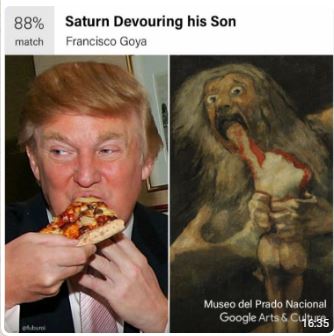
But supremacism does not depend on species – those of another race, another origin, another gender, another age-group may all be dehumanised, objectified like farmed animals, and cannibalism is famously the accusation used to dehumanise colonised people, giving invaders the excuse to enslave or exterminate them. Trump dehumanises immigrants by accusations of cannibalism, just as his political opponents dehumanise him. When American comedian Jon Stewart was asked in 2017 by Late Show host Stephen Colbert to say something nice about then President Donald Trump, he hesitated and eventually blurted, “He’s not a cannibal”. Colbert followed this up a year later suggesting Trump eats human flesh, but only “it’s very well done with some ketchup”.
Consuming the appropriated assets of those considered foreign or inferior is standard operating procedure in human history. In the absence of now largely abandoned concepts of (some) humans being semi-divine creatures, created in the “image of God”, what is to stop the actual consumption of those on the next rung down? As the huge population of humanity consumes the environment, leading to climate change and famine, could cannibalism be the next phase of human evolution?
As anthropologist Harold Monroe asks in Cannibal Holocaust, “I wonder who the real cannibals are?”
Some months ago, I reviewed a film called Auntie Lee’s Meat Pies, in which I asked readers “What’s in your pie?” This film, The Mad Butcher (Lo strangolatore di Vienna), asks a far more profound question: “What’s in your sausage?” In each case, a better pronoun might have been “who”.
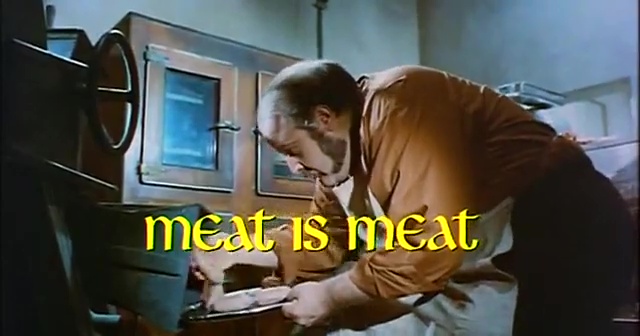
Guido Zurli was an Italian director but this film was made in English, set in Vienna and starred the wonderful, larger-than-life Hollywood actor Victor Buono, who plays the “Mad Butcher” of the title. In the USA, it was released as Meat is Meat, a better title IMHO – describing cannibals as “mad” is such a lazy approach, an intellectual shrug of avoidance. And to the butcher of this film, meat really is… just meat.
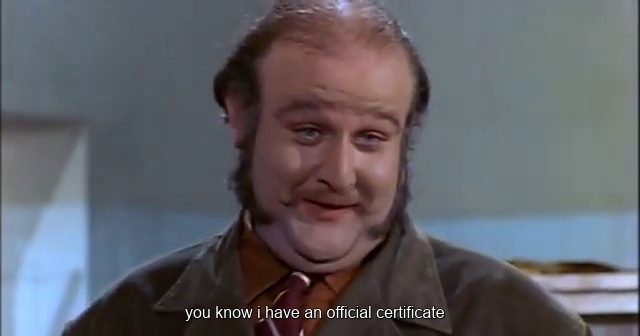
Otto (Buono) is dedicated to his calling – cutting up and selling animal flesh, and to him, the women he kills and minces are just that – meat. Otto has anger issues, which caused him to be confined to an asylum for three years, after slapping a customer with a piece of liver. But now he is being released, with an official certificate allowing him to say, “I’m not crazy now.”
His wife, who had had him committed (to save him going to jail, she claims) wants him to come home with her, worried about what the neighbours will say, but he wants to move into his butcher store where, he tells anyone who will listen, he is “the best butcher in Vienna”.
While throwing from his window the rubbish left by his wife’s brother who was running the store in his absence, Otto sees a neighbour as she showers, in silhouette. She looks, well, edible to him.
His wife catches him staring at the neighbour and, during the resulting row, he strangles her. At first horrified, he realises that there is only one way to get rid of the evidence. After that, he has to dispose of a sex worker brought home by the brother-in-law, and then the brother-in-law, who he has spent much of the film calling a “pig”. Well, he is a very popular butcher, the best in Vienna, and after all, as he opines, “I need this meat.”
But then, when he manages to abduct the neighbour (she of the long showers with the lights on and the blinds open), he has to deal with the American protagonist – a journalist who inexplicably is allowed to hang out with the police and investigate their cases. Otto rips off her clothes (there’s a lot of that sort of thing) and promises her
“I’m not just the best BUTCHER in Vienna!”
As the logline says, in one of those double-entendres that haunt cannibal movies, “His sausage was a cut above the others!“
This is more black comedy than traditional horror – Otto relishes turning his customers into innocent cannibals. They, in turn, rave about his sausages, lining up to buy them from his push-cart in the park.
When his activities are disclosed, the police chief, who has been happily eating other animals all movie, is suddenly smitten by a serious bout of nausea.
“Those sausages that I ate! They were made of human flesh!”
The innocent cannibal theme has been popular since Sweeney Todd, who first appeared on film in 1928. Forty years earlier, Jack the Ripper had terrified the citizens of the heaving metropolis of London, brimming with workers drawn to the dark Satanic mills, driven into town by the centralisation of agriculture and the promise of gainful employment. Social cohesion seemed to be failing (isn’t it always?) and the cannibal was the figure who best represented the city as voracious beast. Henry James described London as “an ogress who devours human flesh to keep herself alive to do her tremendous work”. The “savage” of foreign climes who had so thrillingly filled the imaginative accounts of the colonial explorers had come home personfied as their own city, and the unknown faces dwelling within it were chief suspects. This was reflected in H.G. Wells’ first novel, The Time Machine, in which the proletariat, thousands of years in the future, have evolved into a highly technological cannibalistic tribe who feed off the soft, effete gentle people who are all that remain of the bourgeoisie.
Sweeney Todd took this to a new level, showing that even a “gentleman”, an apparently respectable member of society, could kill people. But Sweeney is never shown eating anyone; it is his customers, or the customers of his girlfriend who owns a pie-shop, who enjoy (immensely) the flesh of his victims. This could be done for revenge, as in the later, Tim Burton version of Sweeney, or for profit, particularly in times of shortage, such as Ulli Lomel’s Tenderness of Wolves concerning the German serial killer and cannibal Fritz Haarmann, who supplied meat of many species, particularly human, to his unwitting and grateful neighbours.
The outer limits of the world were still full of cannibalistic savages, but now they were in the same country – Texas Chain Saw Massacre featured a bunch of rednecks who captured tourists and fed them to other tourists (as well as catering to the extended family of course). But we were more worried about the cannibal in our midst, driven by the spectre of Ed Gein, an unassuming if eccentric man who dug up graves and used the bodies for ornaments, graduating into killing people and possibly feeding their flesh to neighbours as venison, an accurate term for animals hunted down for food and fun. A later version was Farmer Vincent in Motel Hell who collected tourists to serve in his motel, quoting his motto “meat’s meat and a man’s gotta eat!). Another slightly less light-hearted group of entrepreneurial cannibals like Vincent were the merry animal liberationists who farmed, milked, slaughtered and sold the flesh of those observed eating animals (to others who pay to eat animals) in The Farm.
Other films from all around the world feature butchers profitably selling human flesh for human consumption: The Butchers, Ebola Syndrome (from Hong Kong), Delicatessen from France, The Green Butchers from Denmark, and Barbaque (Some Like it Rare), also from France. In most of these films, the flesh of humans is found to be irresistibly delicious, until its provenance is discovered (although in Barbaque, only flesh from vegans has that special something). This is also the theme of Sweeney Todd even in the latest personification, The Horror of Delores Roach, in which New Yorkers line up around the block to buy the most delicious empanadas, unaware they are made of the chef’s landlord. Hitchcock had explored the same territory in 1959 with his episode called Specialty of the House, in which members of an exclusive men’s club crave the specialty “lamb Armistran”, which turns out to be the flesh of patrons who had enquired too deeply into the methods of the chef. Just so in this film, The Mad Butcher, which was the subject of this blog before I embarked on one of my legendary tangents.
Hannibal Lecter, untypically, did not eat humans because they were irresistibly delicious, but because they were another species of edible mammals, inferior to Hannibal the Übermensch and those few he considered his equals, no more or less acceptable morally and gustatorily than any other meat animal. Hannibal found amusement watching his guests enjoy his cooking, not because of the type of the meat, but because of his gastronomical skills. Hannibal’s meals were just as delicious whether filled with human, cow, pig, sheep, or anyone else. It’s the preparation, what Claude Lévi-Strauss called “the cultural transformation of the raw”. Hannibal refined the rude into delicious concoctions. Otto feels the same way about refining annoying people through the artistry of his butchery.
“Let me explain. Animals tear meat. Butchers carve.”
Rotten Tomatoes gives this film a solid 42%, based on the wordless review of one critic. I think as cannibal films go it would be forgettable, except for the amazing performance of the great Victor Buono, who turns it into a melodrama, or even a pantomime. It is, whatever its critical failings, very watchable and a lot of fun, and for those who are interested in such things, there is no gore but lots of meat, and lots of dresses being ripped from female bodies. To the protagonist, Otto, sex is one more appetite, like hunger, easily satisfied by violence, and not to be denied by the stultifying conventions of society.
In the year 2000, 44-year-old slaughterhouse worker Katherine Knight had a night of passion with her partner, John Price, then stabbed him 37 times, professionally skinned him, hung his hide on a meat hook over the lounge room door, decapitated him, butchered his corpse and cooked parts of him. She served up his meat with baked potato, carrot, pumpkin, beetroot, zucchini, cabbage, squash and gravy in neat settings at the dinner table, putting beside each plate place-names for Price’s children. Another meal was tossed into the backyard; it appears she intended to eat it but couldn’t do so. The police arrived before Price’s children so, as far as we know, none of him was consumed (by humans anyway).
Knight pleaded guilty to murder and the judge ordered that her papers be marked “never to be released.” An appeal was quickly denied, and she is still serving her life sentence at Silverwater Women’s Correctional Centre in Sydney.
Shoreline Entertainment planned to make a film of the incident based on Peter Lalor’s book Blood Stain, but so far it has not surfaced.
It appears that Knight was NOT a cannibal, despite one of the favourite media labels about her being “Kathy the Cannibal”. Other reports called her “The Woman Hannibal Lecter”, a comparison that makes no sense at all, since Hannibal did not use 37 strokes to kill people, definitely did eat parts of them, and did not (as Knight did) take a cocktail of sleeping tablets afterwards while lying in bed with the mutilated corpse.
Darren O’Sullivan, whose documentary is linked at the top of this blog, commented,
“this is possibly the most horrific thing I have ever discovered”.
Although the series is called “Real Twisted Tales”, I suspect O’Sullivan must have led a sheltered life. Knight was a slaughterhouse worker, recognised for her skills in knife work. She grew up in the NSW town of Aberdeen, where everyone in her family and most of the town were employed in the abattoir. Her job, from a young age, was to kill and cut up animals. She did to John Price what she was trained to do to other animals – slaughter them, cut them up, cook them. She did try to feed bits to his children, which is what farmers did in the UK (feeding cattle bone-meal to cattle), an act of cannibalism which led to Mad Cow Disease. But there is little evidence that she herself ate any of him.
The documentary above states that Katherine Knight is “one of the most evil people in the world”, because she was found sane enough to stand trial. But really, what she did was what she was paid to do every day, just to a different species than those who usually suffered and died under her hand.
Superstitious anthropocentric beliefs put humans on a tier somewhere between angels and animals, but really we are a species of Great Ape, closely related to the chimpanzee. Rationally speaking, there really is only a thin red line between killing and eating any species of animal.






























 The Cannibal Guy