Idaho killer avoids death sentence

Family members of one of the victims of a gruesome murder of four college students in Idaho are furious that Bryan Kohberger has been offered and accepted a plea deal.

Kohberger was accused of stabbing Xana Kernodle, Madison Mogen, Kaylee Goncalves, and Ethan Chapin to death in November 2022 in Moscow, Idaho. The students were found with fatal stab wounds in an off-campus rental home in the early morning hours. Investigators believe the four students, thought to be sleeping at the time, were fatally stabbed between 3 a.m. and 5 a.m. According to the coroner, there was no sign of sexual assault.

A little over a month after the killings, Kohberger, a 28-year-old Ph.D. student and teaching assistant in the Department of Criminal Justice and Criminology at Washington State University, was arrested at his parents’ home in Pennsylvania on Dec. 30, 2022, and extradited to Idaho.

Kohberger was facing a possible death sentence if convicted in a trial that was scheduled to begin Aug. 18, 2025.

A letter sent to families of the victims to inform them of the deal said Kohberger will appear in court Wednesday to enter his guilty plea and be sentenced in late July to life in prison, according to the Idaho Statesman. Kohberger will forfeit his right to appeal as part of the deal. The letter from Moscow Prosecuting Attorney Bill Thompson said:

“We cannot fathom the toll that this case has taken on your family. This resolution is our sincere attempt to seek justice for your family. This agreement ensures that the defendant will be convicted, will spend the rest of his life in prison, and will not be able to put you and the other families through the uncertainty of decades of post-conviction appeals.”

Goncalves’s family had an angry reply on their Facebook page.

“We are beyond furious at the State of Idaho. They have failed us. Please give us some time. This was very unexpected. We appreciate all your love and support.”

The family issued a later post explaining what had been taking place.

“I would like to clarify a couple of things…we DID talk to the prosecution on Friday about the POSSIBILITY of a plea deal and it was a HARD NO from our family. It was very nonchalant and barely discussed as the majority of the conversation was surrounding the upcoming trial. NOTHING in our conversation prepared us for the next steps.”

A family member of one victim told NewsNation that upon hearing of the plea deal, she felt like “all the power had been given back to Kohberger.”

Why is this case featured in a blog about cannibalism? Well, A forensic psychiatrist told  Newsweek after the arrest that Kohberger had battled with “cannibalistic urges.

Reports then surfaced that Kohberger had followed a strict vegan diet, and had reportedly struggled with heroin addiction in the past.

Forensic psychiatrist Carole Lieberman told Newsweek that Kohberger’s “obsessive-compulsive eating habits” indicate he was afraid he would become addicted to meat if he ate it.

“He was not only vegan, he refused to eat off of pots or plates that had had meat on them. Psychologically, this represents his struggle against his cannibalistic urges. He was afraid that if he let himself go to taste meat once, he would become addicted to it—like he had become to heroin—and start killing and eating people.”

A relative told the New York Post that Kohberger’s dietary restrictions were “very, very weird” and that he seemed “very OCD,” referring to obsessive-compulsive disorder.

The woman, who asked not to be named, but said she was previously married into Kohberger’s family, said:

“It was above and beyond being vegan. His aunt and uncle had to buy new pots and pans because he would not eat from anything that had ever had meat cooked in them.”

Casey Arntz, who was friends with Kohberger in middle and high school, said in a video posted on TikTok that he had been “a heavy heroin user” in high school. Kohberger’s struggles with drug addiction continued into his college years, a friend from Northampton Community College told Fox News. Criminal profiler John Kelly told Fox News,

“This kind of person has this volcanic rage inside that’s going to explode on its victim of choice.”

Lieberman told Newsweek that Kohberger had probably studied criminology both to “calm the demons inside him that were telling him to kill” but also to “learn how to commit the perfect crime.”

It is possible that he had been in touch with the so-called BTK killer, Dennis Rader, whose serial killings in Wichita were the subject of a book by his supervisor, Katherine Ramsland.

Kohlberger may have corresponded with Rader (a lot of criminology students do) but we don’t know that for sure. We have to wonder if Rader would have told him about working in the meat department of a Wichita IGA a few years before his murder spree began.  

Kohlberger’s obsession with meat reflects a lot of issues considered in Cannibal Studies. Firstly, the question of human meat: there really is no significant difference between the meat of humans and other large mammals such as cows, pigs or sheep. Hannibal Lecter takes delight in feeding human meat to his guests, such as the flesh of the flautist of the Baltimore Philharmonic, whose Board members subsequently enjoy the meal immensely in the book and film Red Dragon, thus becoming “innocent cannibals”.
But the point is that once meat is prepared (cooked, seasoned, presented) it is very hard to tell its provenance. Cannibals who have been asked have mostly compared it to pork or veal, with Armin Meiwes telling an interviewer

“It would have made no difference in somebody else had tasted it; he wouldn’t have questioned the meat…. During preparation, it is not as dark, but bright and fresh as pork, and tastes so very close to pork.”

Kohlberger’s belief that he might like human flesh if he tried any meat at all therefore has some logic to it. Since Charles Darwin’s writings overthrew the special status of humans as closer to angels than other animals, anthropocentrism has been amended to offer a story of humans as the culmination of evolution and thereby continues, rather less successfully, to obscure human animality. Should such beliefs falter, as happens repeatedly in many cases of contemporary cannibalism, it becomes a very short step from eating other animals to eating the human one.

But why should he become addicted to any meat? Well, we know Kohlberger has an addictive personality, shown by his very heavy usage of heroin. But we’re not talking drugs of addiction but lumps of protein, aren’t we? Well, there are plenty of studies about that. Marta Zaraska, for example, wrote in her book Meathooked that meat is highly addictive on several fronts – genetic, cultural, historic and commercial, and coined the term “meathooked” for the incongruous compulsion to eat meat despite the pangs of cognitive dissonance – the repressed feeling of guilt when considering oneself an animal-lover while also paying big corporations to kill them. Then there is the mythology of the Wendigo, a creature from Algonquin legend who starts off as a human but becomes a being who can only live on human flesh, which makes him grow bigger and at the same time hungrier. If you believe in Wendigos, then the slippery slope from carnivore to cannibal seems reasonably clear.

This leads us to the issue of Kohlberger’s apparently very strict veganism. Most people seem to believe (or want to believe) that vegans are fanatics, obsessed with animal welfare (or the environment, or their own health) who therefore compulsively avoid meat. But in fact most vegans would certainly wash a pot thoroughly after a relative had cooked meat, but are unlikely to throw it out as irretrievably ruined, as Kohlberger purportedly did. Veganism is an ethical system that attempts to minimise harm to sentient animals, which includes humans (yes, Virginia, humans are animals). If there is a slippery slope from the flesh of other animals to the flesh of Homo sapiens, then the vegan is furthest from the edge of that slope. When Kohlberger killed those students, he was not following any known vegan code of ethics, even if he didn’t sample their flesh on the way out.

I did it Meiwes – “THE CANNIBAL NEXT DOOR”

December 1, the date on which I am writing this blog, is the birthday of perhaps the most famous living cannibal, the German named Armin Meiwes. He became famous around the globe when he was arrested in December 2002 for killing and eating a willing volunteer he had met on the Internet in 2001, a man named Bernd-Jürgen Brandes, who had helped sever and cook his own penis before being finished off and filleted by Meiwes. Movies have been made based on the events, from reenactments like Dora’s Cannibal to fantasies like Weisz’s Grimm Love. Songs have been written about him and sensationalised retellings haunt our documentaries, often inexplicably comparing him to Hannibal Lecter.

Meiwes was born in Essen in 1961, and was raised by his stern and controlling mother after his father and half-brother moved out, not unlike the story of Ed Gein, who tried to resurrect his severe and hard-hearted mother by killing and eating the genitals of local women in Plainfield Wisconsin. Armin Meiwes, hopelessly devoted to his late mother as he brooded in his thirty-room house, sometimes dressing in her clothes and impersonating her voice, was not dissimilar to Norman Bates in Hitchcock’s film Psycho, which was based on the Gein murders. Many have tried to pin his later conduct on his childhood feelings of abandonment and helplessness although, if that were the case, we would expect millions of similar cases around the world. Maybe there are, but they don’t get caught?

At any rate, young Meiwes developed a taste for cannibalism (sometimes called vorarephilia) from reading fairy tales, particularly the Grimm Brothers’ Hansel and Gretel, in which abandoned children almost get eaten by a witch. The witch, we might note, was the only adult to show them any affection, even though her ulterior motives were clear, at least to the children who were reading the story. The Grimms wrote their fairy tales near Rotenburg, where Meiwes killed and butchered his friend. You may also remember (at least, Fannibals will) that Hannibal Lecter referred to this fairy-tale when he was serving up dinner to Abel Gideon; Gideon’s own leg, smoked in candy apples and thyme, glazed, and served on a sugar cane quill.

Meiwes fantasy of eating and incorporating a brother culminated in 2001 in him advertising on a fetish website called The Cannibal Café for “a well-built 18 to 30-year-old to be slaughtered and then consumed”. The only reply that seemed sincere, indeed eager, was from Brandes, who was not really well-built or 18-30, but fitted the bill because he was determined to be eaten.

They got together and, after getting to know each other (which included slicing off Brandes’ penis and cooking it), Meiwes left his friend to bleed out in the bath, and then proceeded to butcher his carcass and eat the meat, in a variety of cuts, over several months.

In case there are still a few psychologists and journalists who haven’t yet pontificated on Meiwes and Brandes, this week we consider a 2023 UK Channel 5 documentary called The Cannibal Next Door, directed by Calum Farmer. This is quite a good reenactment of the events, although like many others, it relies too heavily on brooding, portentous music and opinions from experts, all of whom are universally repulsed by the cannibalism, a repulsion that Meiwes and many of his correspondents clearly did not share.  

“It had broken humanity’s last great taboo.”

Trigger warning: the real Meiwes (seeing it’s his birthday): This website claims it has actual leaked stills from Meiwes’ video. If you don’t like pictures of chopped up humans, maybe skip the link. They look fake to me, but this Reddit reader swears they are real.

Meiwes is still in jail in Germany, not for cannibalism, which is still not a crime, but for murder, which is absurd since Brandes wanted to die, and was in fact obsessed with being slaughtered and eaten. If anything, Meiwes is guilty of assisting a suicide. There was no law in Germany against eating a human.

We know so much about the case because Meiwes was very open in describing what happened, even videotaping the whole process of slaughtering and butchering. The jury in his case watched this video, and reportedly turned quite green, but it seems likely that they would have also done so had they been made to watch some of the horror clips of cruelty and killing in abattoirs that are abundant on YouTube. His lawyer argued:

“We say it is neither murder or manslaughter, but killing on demand. My client is not a monster.”

As it was clearly not murder and there was no law against eating a corpse, Meiwes was sentenced for manslaughter and given an 8½ year sentence. Public outrage resulted in a retrial which then found him guilty of murder, on the devious premise that Brandes had been mentally incapacitated by depression, and therefore open for manipulation by his killer. He was sentenced to life, which in Germany requires a minimum of fifteen years imprisonment. Meiwes has already served more than that.

Meiwes believed that he did nothing wrong. It seems that the only thing he can see as a moral failing is not the fact that he ate human meat, but that he ate any meat; he subsequently became an environmentalist and a vegetarian, both of which would obviate eating any flesh, including human. His simple claim in his defence was that, unlike pigs, sheep, cows, chickens and other animals, here was a willing victim who consented to, indeed demanded, his own slaughter and consumption. Is it not clearly more ethical to eat an animal who wants to be eaten, whatever the species, than one who does not?

The revenge of nature: WENDIGO (Larry Fessenden, 2001)

Wendigo is a film written, directed and edited by Larry Fessenden, who would, a few years later, make an episode of the TV horror series Fear Itself called SKIN AND BONES, which was about a guy who disappears on a hunting trip with friends and returns cold, thin and desperately hungry. He has, we quickly discover, become a Wendigo! In this, the earlier film, there are also crazy hunters led by Otis (John Speredakos), who are mad with our protagonists for driving into a stag (the traditional symbol of the Wendigo) who they have been tracking and, worst of all, breaking his antlers, which are apparently very valuable. The Wendigo is already there in their cabin as a “dark presence”, so we just need to be introduced.

First, the really good cast – George (the Dad) is played by Jake Weber, from the 2004 remake of Dawn of the Dead and Meet Joe Black. He is a super-stressed New York photographer, and the last thing he needs is a run-in with a bunch of redneck hunters. Kim, the Mom, is played by the wonderful Patricia Clarkson (most recently starring in Gray) and the kid, Miles, is played by Erik Per Sullivan, who was Dewey in Malcolm in the Middle.

George is more disturbed by the rednecks than he is willing to let on, telling Kim, who is a psychologist, that he is distressed by the “abyss” between him and them, with no possibility of communication. She tells him that:

“It’s very archetypical for the civilised man to feel threatened by the man of the country.”

George is utterly divorced from nature, seeing it as alien and menacing. So, the other last thing he needs to meet is a Wendigo, a figure on the front line of the human war on nature.

They head into town to buy curry (as you do in small towns) and Miles meets in the store a Native American Elder who tells him about the Wendigo, a small carving of which Miles is drawn to.

“The Wendigo is a mighty powerful spirit… it can take on many forms, part wind, part tree, part man, part beast. Shape shifting between them… It can fly at you, like a sudden storm, without warning, and consume you with its ferocious appetite. The Wendigo is hungry, always hungry. The more it eats, the bigger it gets, and the bigger it gets, the hungrier it gets, and we are hopeless in the face of it. We are consumed, devoured…. There are spirits that are angry. Nobody believes in spirits anymore. Doesn’t mean they’re not there.”

The Wendigo is a figure from the mythology of the Algonquin people of North America. They lived in a land of long winters where the competition for food would have been intense and cannibalism of the dead probably not unusual. Myths help to spell out behaviours that societies need to discourage – cannibalism could decimate small, isolated communities. That myth, of the voracious monster whose hunger only grows with feeding, was later applied to the invaders, the colonists who took their land, their produce and often their lives. In such a struggle, the Wendigo, as an original figure of their culture, could take almost a vengeful role, eating the technologically superior invaders. George inadvertently confirms this, telling Miles “the Wendigo only goes after bad guys.”

The Elder tells Miles he can keep the figure, but there is no sign of him when Kim is subsequently asked to pay for it. He is presumably one of those spirits, not angry but advisory.  He warns Miles about the “cry of the Wendigo”. The Wendigo is clearly (to the audience) imbued into that carving.

Then the Wendigo strikes. Or is it the rednecks? Did the Wendigo knock George off his sled, or did it carry him home after Otis shot him? Was it the revenge of nature, or society? When the Wendigo later demands of Otis “Give me my liver!” it voices the cry of revenge of every animal, human and otherwise, killed for fun or profit. When Otis meets justice, Miles awakes with his Wendigo figure in his hand.

It’s a great cast, with an absorbing plot, although it gets a bit lost at the end. But the questions it asks are compelling.  The New York Times critic wrote:

“Mr. Fessenden carefully blurs the line between psychology and the supernatural, suggesting that each is strongly implicated in the other. The rampaging Wendigo may be a manifestation of Miles’s incipient Oedipal rage, but at the same time it is a force embedded in nature and history.”

The Wendigo carries so much symbolism, besides the horror trope in which he seems so regularly to find himself, such as in Fear Itself or the classic Wendigo film, Ravenous, which was made a couple of years before this film. He expresses the anger that rages within George, the father who cannot show interest in his son’s curiosity because of his own issues brought with him from the city, frustration and fear of failure. And we can infer (as the NYT does) that Miles himself feels an Oedipal rage toward his father who, Freud tells us, is the child’s rival for sexual possession of the mother throughout childhood. The voracious hunger comes from an even earlier stage, what Freud called the “cannibalistic stage” of babyhood, where the infant wants to own the breast, consume it so it will always remain in his possession. George’s playacting the cannibal, attacking and pretending to eat Miles, is a common parent/child game, but is also deeply revealing of these forces hidden deep in the unconscious.

At yet another level, the Wendigo represents the revenge of nature on the civilised, those whose insatiable hunger for growth decimates the land and finds sport in killing its inhabitants, be they human, deer or any ‘other’. The antler is a weapon used by the stag, a normally shy and timorous animal who becomes a formidable fighter in the mating season, and the size and strength of its antlers represents both its sexual and fighting prowess. In the hybrid shape of a human and a stag, the Wendigo recasts humans from hunters to hunted, from predator to prey. This is precisely why Hannibal Lecter is shown in Wendigo form throughout much of the three seasons of the television series Hannibal. Hannibal is the civilised, rational, erudite man of science, a psychiatrist who knows of the dark forces inside the human psyche, and has determined that the human is just another animal, no more deserving of respect or inedibility than any other species, and even less if he happens to be rude. Who judges that – the supernatural force, the inhuman, the less-than-human or, in Hannibal’s opinion, the more-than-human? Whichever you choose, it appears as the Wendigo.

Criminals, rapists and cannibals: Donald Trump and the immigrants

Way back in 2015, when first campaigning for the presidency, Donald Trump announced he would build a wall on the border with Mexico to keep out:

“…people that have lots of problems. They’re bringing drugs. They’re bringing crime. They’re rapists. And some, I assume, are good people.”

That seems quite tame now, doesn’t it? Warning about rapists have lost their power, especially given Trump’s own personal legal struggles regarding sexual assault. 

So he has turned, dear reader, to our fave subject. Speaking on Right Side Broadcasting Network from Mar-a-Lago, a resort that relies heavily on immigrant labour, he upped the ante on border crossers by calling them cannibals released from mental institutions.

“They’re rough people, in many cases from jails, prisons, from mental institutions, insane asylums. You know insane asylums. That’s ‘Silence of the Lambs’ stuff. Hannibal Lecter, anybody know Hannibal Lecter?”  

This is not the first time that Trump has quoted Hannibal. At a rally in Iowa in October 3023, he also spoke of people from insane asylums sneaking into the country, and again quoted Hannibal. He added a rather strange endorsement.

“Hannibal Lecter, how great an actor was he? You know why I like him? Because he said on television on one of the – ‘I love Donald Trump.’ So I love him. I love him. I love him. He said that a long time ago and once he said that he was in my camp, I was in his camp. I don’t care if he was the worst actor, I’d say he was great to me.”

Hannibal Lecter is, of course, not in a position to comment on politics as he is a fictional character born in the mind and the novels of Thomas Harris and born again, we might say, in the films of those books in which Hannibal was played by Brian Cox and then by Anthony Hopkins. Then, in a third coming, Hannibal was rebooted as a Gen-X queer icon in the TV series Hannibal, played by Mads Mikkelsen.

Which of these Hannibals loves, or loved, Donald Trump?

Mads Mikkelsen told CBS News in 2016 that though he could “definitely laugh at some of the stuff [Trump] says, he can also go, ‘Oh my God, did he say that?’ I think he’s a fresh wind for some people.”

Brian Cox called Trump “such a fucking asshole” and “so full of shit.” So Trump is probably not quoting him.

Hopkins, who was born in Wales and became a U.S. citizen in 2000, told The Guardian that he doesn’t care for Trump and explained that he doesn’t vote anyway, because he doesn’t “trust anyone.”

“We’ve never got it right, human beings. We are all a mess, and we’re very early in our evolution.”

Nietzsche wrote of an Übermensch, a super-man who was as superior to ordinary people as they feel themselves to be to pigs. Hannibal clearly sees himself in this role. The mantra of the Übermensch is “Adapt, evolve, become”. But, as Charles Darwin would tell you (if he had not himself become extinct), evolution does not describe a ‘great chain of being’, an evolutionary ladder toward perfection. It is simply about best fitting a niche, surviving a hostile environment while competitors become extinct. The art of evolution is to out-run, out-fight, out-eat the other – to be the last one standing. And the only one eating. Perhaps eating the loser. As Frederick Chilton tells us, “Cannibalism is an act of dominance.”

Early humans seem to have practised cannibalism (according to some palaeontologists), although it may have been more for ritual purposes than for the protein. But in the modern age, protein is king, or at least those who eat the most protein consider themselves therefore superior to nature, and to other humans. Meat is a fetish, an addiction, a way of declaring human, particularly male, supremacy. We confine, torment and slaughter around 80 billion land animals each year (that’s 80,000,000,000) to feed this fetish.

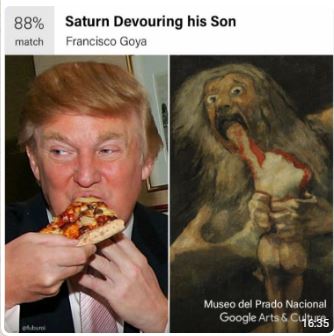
But supremacism does not depend on species – those of another race, another origin, another gender, another age-group may all be dehumanised, objectified like farmed animals, and cannibalism is famously the accusation used to dehumanise colonised people, giving invaders the excuse to enslave or exterminate them. Trump dehumanises immigrants by accusations of cannibalism, just as his political opponents dehumanise him. When American comedian Jon Stewart was asked in 2017 by Late Show host Stephen Colbert to say something nice about then President Donald Trump, he hesitated and eventually blurted, “He’s not a cannibal”. Colbert followed this up a year later suggesting Trump eats human flesh, but only “it’s very well done with some ketchup”.

Consuming the appropriated assets of those considered foreign or inferior is standard operating procedure in human history. In the absence of now largely abandoned concepts of (some) humans being semi-divine creatures, created in the “image of God”, what is to stop the actual consumption of those on the next rung down? As the huge population of humanity consumes the environment, leading to climate change and famine, could cannibalism be the next phase of human evolution?

As anthropologist Harold Monroe asks in Cannibal Holocaust, “I wonder who the real cannibals are?”  

And as Hannibal said,

“It’s only cannibalism if we’re equals.”

“Every cannibal wants to be a director”: LONG PIGS (Nathan Hynes, Chris Power)

Long Pigs is a 2007 “found footage” movie, in which two desperate filmmakers come across a cannibal, ask him if they can document his eating habits, and then are shocked when he starts killing people and eating them. It is presented as a documentary, with all the usual warnings about graphic scenes etc.

Bit silly, and found footage has rather been done to death, but it has some interesting ideas, particularly the sympathetic approach to the main character, even as he commits his crimes. Look, it seems to say, everyone needs a hobby and, to this cannibal, killing and eating people is no more ethically questionable than hunting or fishing. Stalk, catch, kill (as quickly and painlessly as possible) and then enjoy. He does his best to keep the movie interesting, with a patter of jokes, historical facts and philosophical observations as he slices and dices.

The cannibal is played by Anthony Alviano (Headcase, A Matter of Justice), and he presents the cannibal, also called Anthony, as a boy-next-door persona, one who kills and guts people. Like a farmer of animals, he starts the film explaining that it’s bad to frighten the victims, not for ethical reasons, but because the adrenaline ruins the taste of the meat. The filming starts as he drives around looking for a “certain kind of woman”, because he wants to make “long pig stew”. “Long pig” is a term supposedly used in the Pacific region before colonisation to designate human meat, although that definition is widely contested. Anyway, Anthony is looking for “marbled meat”, so he searches for a sex worker (traditionally victims who are not exhaustively looked for by police) who is, let’s say, of a heavy build.

“People who eat stew make perfect stew. It sounds obvious. Yeah, she looks like she eats well.”

As she smiles at the camera, he sneaks up behind with a sledgehammer and cracks her skull, resulting in the cameraman vomiting (which is actually rather more gross than the murder). They ask Anthony if gets a sexual thrill from killing women, but he dismisses this, in the same way a slaughterhouse worker might deny any pleasure in killing a different species of mammal.

“I’m not a freak or anything like that. This is all culinary, this is hard work!”

“Any hunter would recognise this position. We got the corpse hanging by the ankles. The first thing I’m gonna do here is make a little incision and tie off the anus. That’s to stop contamination from the feces. You would do that whether it was a deer carcass or a cow or a person… Absolutely necessary for health reasons.”

He cooks a stew from a portion of her thigh, then after dinner goes off to brawl in an ice-hockey game, an arena that seems the very essence of carnivorous virility.

Afterwards, he cooks ribs on a barbecue, assuring the viewers that there are “no animal by-products” used – just soymilk. And a woman’s ribs, of course, thus reinforcing the anthropocentric mythology of the human as not really animal, even though he has just butchered one in the same way as any other animal prepared for human consumption. He quotes the Arawak word barbaca, the grill on which human meat was supposedly cooked, according to explorers like Hans Staden and Jean de Léry, which became the Spanish word barbacoa, and eventually morphed into English as barbecue. Staden’s narratives were later illustrated by Theodor de Bry in his 1592 book Americae Tertia Pars, and the film sneaks in a quick peek at that glimpse of sixteenth century sensationalism.

There’s a lot of moral philosophy interwoven in the scenes of murder and gastronomy. Anthony the cannibal and his friend try to persuade the filmmakers to try some of the ribs, saying, it’s dead, and therefore cannot suffer, whereas we eat live vegetables, and “broccoli feels pain! Did you know that?” This is precisely the argument tossed at vegans by carnists, but in this case, it demonstrates the contention of the nutritionist Herbert M. Shelton:

The cannibal goes out and hunts, pursues and kills another man and proceeds to cook and eat him precisely as he would any other game. There is not a single argument nor a single fact that can be offered in favor of flesh eating that cannot be offered with equal strength, in favor of cannibalism.

Anthony works as a valet in a fancy restaurant, parking cars for rude people, and if you follow the lore of Hannibal Lecter, you will know that rude people are prime targets of cannibals. They park the car of a particularly rude man, take down his address from his licence and, next day, shoot him and load him in their car trunk. Unfortunately, they have a flat tyre and have to head to a pig farm for help, where they witness pigs being slaughtered and prepared for sale, in identical ways to Anthony’s own processes, but with rather better technology, and, oh yes, totally legally.

Most of the film is a spoof on cooking shows, which regularly have smiling chefs, or hopeful chefs, preparing lumps of animal flesh, hoping to win prizes. Anthony shows, in high-speed motion accompanied by the music of the Sugarplum Fairy, exactly how he prepares a body, stripping it and dismembering it until all that is left is two feet (still in socks) and the long femurs. He demonstrates how to get rid of the bones, cutting them up and putting them in a kiln at 2600 degrees – he even uses the line “these are some we prepared earlier.” This is a cooking show for cannibals.

Anthony is a typical modern cognate cannibal; as he says, people expect Hannibal Lecter, so “no one is going to suspect the valet”. This gives him the invisibility that we saw in cases like Jeffrey Dahmer. He loves his old mother who is in a nursing home, and is bewildered by a doctor’s request to do a post mortem analysis brain when she dies, a sophisticated update of cannibalism. He sadly tells the filmmakers that she has Alzheimer’s, but we eventually find that she died of Creutzfeldt-Jakob spongiform encephalopathy, a human version of mad-cow disease, probably from eating human meat that he fed her. He also admits to eating a five-year-old girl called Ashley, because people prefer meat from young animals, but was subsequently perturbed by the extensive police searches, and now avoids playgrounds and schools: “It’s like a supermarket, man.” As New Year celebrations explode outside, he comes to realise the filmmakers are going to release the movie, which will detail all his criminal history, and goes to get his sledgehammer. The rest, as Shakespeare says, is silence.

Anthony has a philosophy that rejects anthropocentrism and sees nothing wrong with cannibalism, or at least nothing that does not apply to any other meat. It’s a cannibalistic rejection of what Richard Ryder and later Peter Singer called “speciesism”.

“It’s only human beings that are so arrogant that they believe they are better than every other kind of animal out there. Worms don’t think about, you know, oh my god, why did mama worm get eaten by a fish; fish eats the worm and that’s that, it’s completely accepted by the worm, and the fish, and small fish gets eaten by the big fish, and if it was so wrong to eat it, then why would it taste so good?”

At the end, he is in jail, but he has published a cookbook. His cooking show has finally paid off.

This is a low-budget film, but is a lot better than might be expected. The creators were lucky enough to secure the services of Chris Bridges, the special effects artist whose credits include the Dawn of the Dead remake, Saw III & IV, 300 and Star Trek Discovery. Unless they actually killed and dismembered people, the result is spectacularly authentic. Anthony Alviano is brilliant in the role, which was written with him in mind.

The full movie (although slashed drastically from 81 minutes to 56 minutes) can, at the time of writing, be seen at https://youtube.com/watch?v=vnGXBRkxXuo.

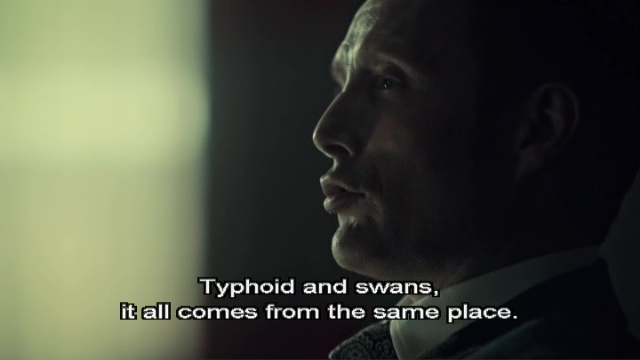
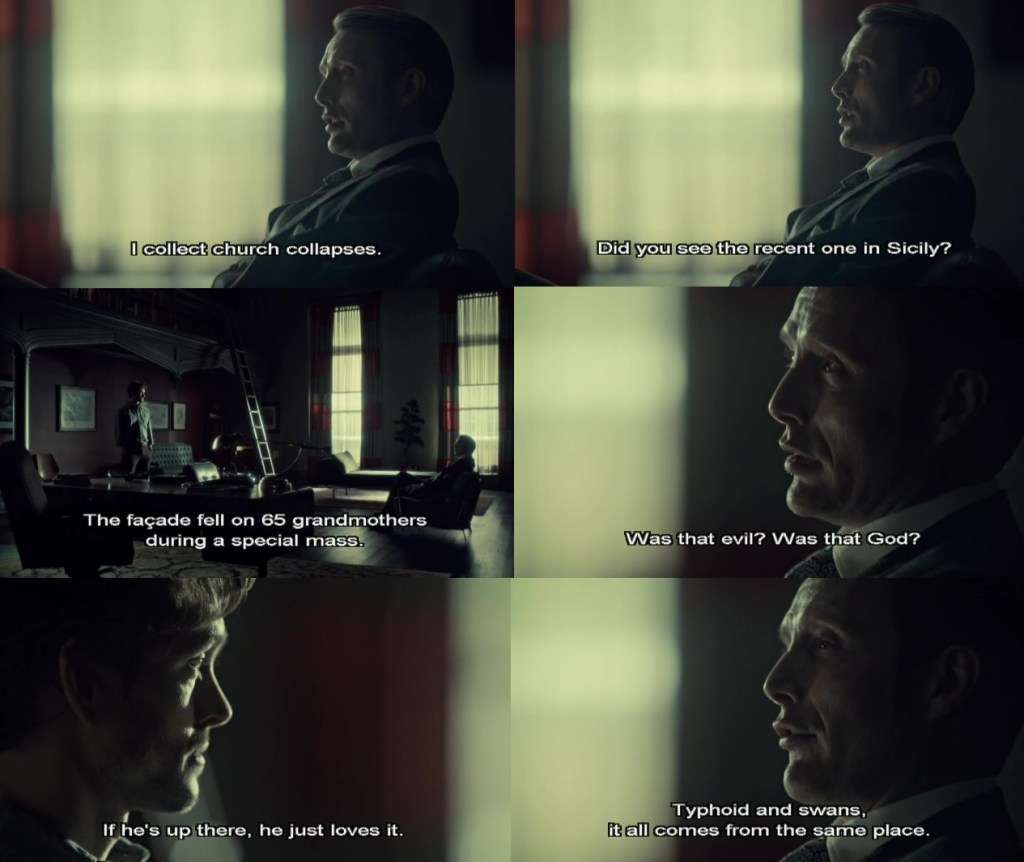
Hannibal’s scrapbook: “I collect church collapses”

Last week’s doomscrolling offered a story about a church roof collapsing during Sunday Mass in a northern Mexican city, killing at least nine people and injuring 40.

I know, it’s awful, but it immediately reminded me of Hannibal, Season 2, Episode 9, “Shiizakana”.

Hannibal and Will are talking about God, as you do when discussing the art of killing people with your psychiatrist.

Will: what do you think about when you think about killing?
Hannibal: I think about God.
Will: Good and evil?
Hannibal: Good and evil has nothing to do with God.

As Hannibal says, God kills lots of people, and are we not made in his image?

In the movie Red Dragon, the dialog is similar:

Why shouldn’t it feel good. It does to God. Why, only last week in Texas he dropped a whole church roof on the heads of 34 of his worshippers just as they were grovelling through a hymn. He wouldn’t begrudge you one journalist.

Or consider what Hannibal Lecktor (they spelled it differently) played by Brian Cox said about the joys of murder in the movie Manhunter:

It feels good Will because God has power. And if one does what God does enough times, one will become as God is.

More (lots more) Hannibal at thecannibalguy.com/2020/07/08/hannibal-film-and-tv-blogs/

Ohio man sentenced to 26 years to life for killing Menlo Park woman in order to stay young through cannibalism

Francis Wolke, 30, was found guilty on March 2, 2023 of first-degree murder for killing 62-year-old Kathleen Anderson in her Menlo Park bedroom in December of 2018, and sentenced on April 5 to a term of 26 years to life in prison.

San Mateo County prosecutors stated that a friend of Anderson found her body while the killer was still inside the house. The friend called the Menlo Park Police Department and detained Wolke at knifepoint until police arrived.

When the trial opened on Tuesday, February 14, Wolke’s attorney, Connie O’Brien, had declared, in a rather unusual opening statement, that her client was driven to murder by a desire to engage in cannibalism. She stated that Volke believed that, if he committed cannibalism, he would “stay young forever” and join the “1%” of people who eat human protein to become rich.

Anderson had never met Wolke, 30, before the murder. “There was no known relationship or contact between defendant and victim, nor a known motive for the crime,” prosecutors said. Wolke lived in Cincinnati, Ohio and had arrived in the San Francisco Bay Area just days before the murder. He was also wanted in Santa Clara County for prowling and drug possession. According to the Palo Alto Daily Post, Anderson worked as the City of Atherton’s arborist for two decades.

In 2020, Wolke had pleaded not guilty due to insanity. The trial jury deliberated for three days before finding him guilty, and then reconvened to consider the insanity issue, which could have seen Wolke sentenced to state hospitals, instead of state prison. The jury handed down its ruling on March 8 2023 in San Mateo County Court in Redwood City, finding that Wolke was sane at the time of the murder.

Defence lawyers had argued the insanity defence based on Volke’s belief that he had to commit cannibalism in order to join “the 1%” and stay young forever. They testified that Wolke said he wanted to join an elite group of wealthy people whom he believed killed humans and ate their flesh to become “protein harvesters” and that he, too, would enjoy wealth and eternal youth after consuming human stem cells.

Deputy District Attorney Tricia Povah argued the case for Wolke’s intent to murder. Povah laid out in graphic details the injuries that Wolke inflicted during multiple attempts to take the life of Anderson, including attempted strangulation.

Wolke was accused of stabbing Anderson in the eye with a pencil, hitting her brain. The allegation that Wolke used a deadly and dangerous weapon in this act was also accepted by the jury.

Wolke also attempted to behead Anderson, which his defence lawyers alleged was due  to his intention to engage in cannibalism. Wolke reportedly told investigators he:

“wasn’t very good at (it) because (he’d) never done it before.”

Wolke, according to court testimony, had a history of heavy methamphetamine use, but did not test positive for any drugs at the time of the murder. According to defence attorney Connie O’Brien, he was experiencing psychosis in the form of auditory hallucinations while on the bus ride from his family’s home in Cincinnati to the Bay Area, with voices telling him that he had to commit sins to join the 1%.

Despite Wolke’s hallucinations, the prosecution argued that Wolke had an understanding of the morals surrounding murder and that he was aware of his actions as he committed the killing. Dr George Wilkinson, a forensic psychiatrist and expert witness for the prosecution, testified that Wolke understood his actions.

“He was well aware of what he was doing, in fact, it would have been necessary to fulfil the delusions.”

Povah argued that he showed awareness of his situation. When police officers went to enter the house to investigate, Wolke told them where to find Anderson, saying:

“The body’s in the basement. I have a mental problem. I very seriously killed that woman.”

Lots of interesting Cannibal Studies issues are raised by this case. Cannibals are almost routinely labelled as psychotic, on the anthropocentric assumption that human flesh is sacred and inviolable. But to be found insane, as Wolke discovered, a murderer has to prove that he (or she) did not know what he was doing, or that it was wrong. Hannibal Lecter, in the books, movies and TV series, was not executed for his crimes because the jury found him insane. He strongly denied this.

An intention to achieve social status through the ingestion of human flesh seems to show a clear understanding of (some rather dubious) causality. That is, he knew what he was doing, even though he was doing something that would seem to most people irrational.

Or is it? The mythology of the Wendigo tells of cannibals who gain strength, size and often healing powers or long life through eating the flesh of other humans, but also develop an insatiable appetite for ever more of the stuff. What appetites distinguish and define the so-called “1%”, that tiny group of uber-rich who absorb around a quarter of the nation’s income and own 40% of the wealth? Psychiatrists will happily tell you that those who achieve huge fortunes or high office are often psychopaths, immune to fear of failure, or empathy for those they exploit. The accumulation of capital, whether by imperialists or corporate raiders, is metaphorically a form of cannibalism, feeding on the flesh of others in a zero-sum game, that is supposed to gain them enormous wealth and eternal life (or a botox version of it).

A part of Wolke’s mind must have worked out that he was not made of such stern stuff, and told him that, to get there, he would need to cultivate his inner cannibal.

“…CANNIBALISTIC URGES” – Man on trial for brutal murder of four Idaho University students

A forensic psychiatrist has told Newsweek that the man charged in connection with the slayings of four University of Idaho students in November 2022 had battled with “cannibalistic urges.

Bryan Kohberger, a 28-year-old Ph.D. student and teaching assistant in the Department of Criminal Justice and Criminology at Washington State University, was arrested at his parents’ home in Albrightsville, Pennsylvania.

Kohberger is accused of breaking into a rental house in Moscow, Idaho, and fatally stabbing Kaylee Goncalves, Madison Mogen, Xana Kernodle and Ethan Chapin in the early morning hours on November 13.

Reports have surfaced divulging that Kohberger follows a strict vegan diet and has reportedly struggled with heroin addiction in the past.

Forensic psychiatrist Carole Lieberman told Newsweek that Kohberger’s “obsessive-compulsive eating habits” indicate he was afraid he would become addicted to meat if he ate it.

“He was not only vegan, he refused to eat off of pots or plates that had had meat on them. Psychologically, this represents his struggle against his cannibalistic urges. He was afraid that if he let himself go to taste meat once, he would become addicted to it—like he had become to heroin—and start killing and eating people.”

A relative told the New York Post last week that Kohberger’s dietary restrictions were “very, very weird” and that he seemed “very OCD,” referring to obsessive-compulsive disorder.

The woman, who asked not to be named, but said she was previously married into Kohberger’s family, said:

“It was above and beyond being vegan. His aunt and uncle had to buy new pots and pans because he would not eat from anything that had ever had meat cooked in them.”

Casey Arntz, who was friends with Kohberger in middle and high school, said in a video posted on TikTok that he had been “a heavy heroin user” in high school. Kohberger’s struggles with drug addiction continued into his college years, a friend from Northampton Community College told Fox News. Criminal profiler John Kelly told Fox News,

“This kind of person has this volcanic rage inside that’s going to explode on is victim of choice.”

Lieberman told Newsweek that Kohberger had probably studied criminology both to “calm the demons inside him that were telling him to kill” but also to “learn how to commit the perfect crime.”

It is possible that he had been in touch with the so-called BTK killer, Dennis Rader, whose serial killings in Wichita were the subject of a book by his supervisor, Katherine Ramsland.

Kohlberger may have corresponded with Rader (a lot of criminology students do) but we don’t know that yet. We have to wonder if Rader would have told him about working in the meat department of a Wichita IGA a few years before his murder spree began.  

Kohberger has been held without bond in Pennsylvania since his arrest. He will be tried in Idaho, the state in which the crimes took place, the only state in the US with a law against cannibalism, although no such charges have been laid against Kohberger.

His next court appearance will be June 26.

Kohlberger’s obsession with meat reflects a lot of issues considered in Cannibal Studies. Firstly, the question of human meat: there really is no significant difference between the meat of humans and other large mammals such as cows, pigs or sheep. Hannibal Lecter takes delight in feeding human meat to his guests, such as the flesh of the flautist of the Baltimore Philharmonic, whose Board members subsequently enjoy the meal immensely in the book and film Red Dragon, thus becoming innocent cannibals. Incidentally, being the Baltimore flautist seems to be a rocky road – their principal flautist Emily Skala, was fired in 2021 for spreading misinformation about the safety of coronavirus vaccines, the efficacy of face masks and the outcome of the 2020 presidential election, relieved of her post, but not eaten.

But the point is that once meat is prepared (cooked, seasoned, presented) it is very hard to tell its provenance. Cannibals who have been asked have mostly compared it to pork or veal, with Armin Meiwes telling an interviewer

“It would have made no difference in somebody else had tasted it; he wouldn’t have questioned the meat…. During preparation, it is not as dark, but bright and fresh as pork, and tastes so very close to pork.”

Kohlberger’s belief that he might like human flesh if he tried any meat at all therefore has some logic to it. Since Charles Darwin’s writings overthrew the special status of humans as closer to angels than animals, anthropocentrism has been amended to offer a story of humans as the culmination of evolution and thereby continues, rather less successfully, to obscure human animality. Should such beliefs falter, as happens repeatedly in many cases of contemporary cannibalism, it becomes a very short step from eating other animals to eating the human one.

But why should he become addicted to any meat? Well, we know Kohlberger has an addictive personality, shown by his very heavy usage of heroin. But we’re not talking drugs of addiction but lumps of protein, aren’t we? Well, there are plenty of studies about that. Marta Zaraska, for example, wrote in her book Meathooked that meat is highly addictive on several fronts – genetic, cultural, historic and commercial, and coined the term “meathooked” for the incongruous compulsion to eat meat despite the pangs of cognitive dissonance – the repressed feeling of guilt when considering oneself an animal-lover while also paying big corporations to kill them. Then there is the mythology of the Wendigo, a creature from Algonquin legend who starts off as a human but becomes a being who can only live on human flesh, which makes him grow bigger and at the same time hungrier. If you believe in Wendigos, then the slippery slope from carnivore to cannibal seems reasonably clear.

This leads us to the issue of Kohlberger’s apparently very strict veganism. Most people seem to believe (or want to believe) that vegans are fanatics, obsessed with animal welfare (or environment or their own health) who therefore compulsively avoid meat. But in fact most vegans I know would wash a pot well after a relative had cooked meat, but are unlikely to throw it out as irretrievably ruined, as Kohlberger purportedly did. Veganism is an ethical system that attempts to minimise harm to sentient animals, which includes humans (yes, Virginia, we are animals). If there is a slippery slope from the flesh of other animals to the flesh of Homo sapiens, then the vegan is furthest from the edge of that slope. If Kohlberger did kill those students (and at this stage it’s only alleged), then he is no vegan, even if he didn’t sample them on the way out.

Love and cannibalism: BONES AND ALL (Luca Guadagnino, 2022)

The modern cannibal is usually hard to identify. Jeffrey Dahmer was the all-American boy next door. Armin Meiwes used to mow his neighbours’ lawns to be helpful. Issei Sagawa was so small and helpless that he seemed vulnerable rather than threatening. Albert Fish was a sweet old man, so charming that the Budd’s let him take their little girl to a party.

They were normal, everyday people, a bit weird, but not monsters.

At least, not in appearance. This is a recent phenomenon – the original cannibals were called anthropophagi (Greek for man-eaters) and were humanoid in shape, but were usually some sort of hybrid – a mix of humans and gods or other animals – strong, ferocious, and clearly not quite human. From the 15th century, the alleged cannibals found by Columbus and other explorers were different in culture and skin colouring, so were easily distinguished, defamed and exterminated. It is only recently, since Jack the Ripper in 1888, that the cannibal walked among us, undetected until the victims were found (or what was left of them).

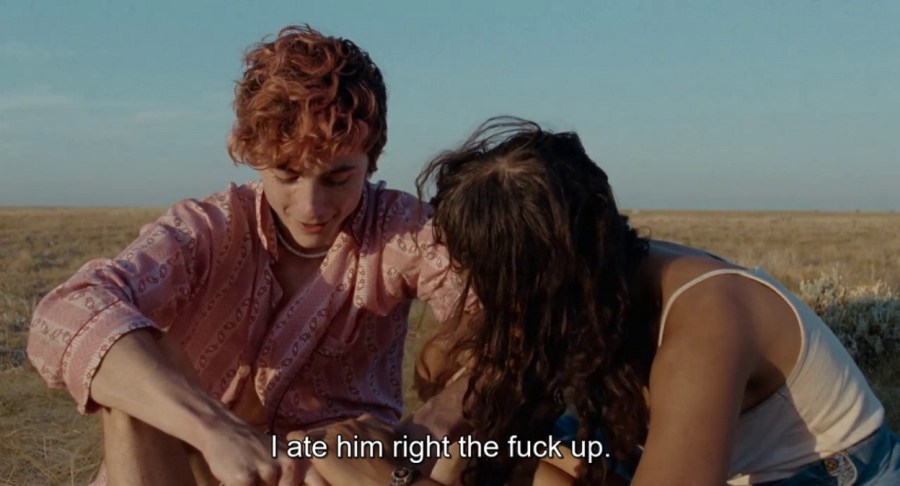
Bones and All presents as a coming of age cannibal romance, taking a sharp turn back into cannibal history for its themes. Maren (Taylor Russell from Lost in Space) is finishing high school, a spectacular end of term in which she is invited to her friend’s sleepover and bites a girl’s finger off, instead of, you know, just admiring the nail polish, as she had been invited to do.

She then goes on the run with her father, who has been keeping her ahead of the law as she grew up (her first human meat was her babysitter when she was three) but now ditches her, with a few hundred dollars and a birth certificate.

It then becomes a road movie, as she travels through the American Mid-West trying to find her mother, attracting suspicion not because of her eating habits but just because she looks too young to be on the road. She comes across another cannibal (they are called “eaters”) in the shape of a weird old man named Sully (Mark Rylance, Bridge of Spies) before meeting up with Lee, played by the love interest of seemingly everyone nowadays, Timothée Chalamet. Chalamet appeared in the third instalment of Guadagnino’s “Desire Trilogy”, Call Me by Your Name), in which he was the love interest of Oliver, played by Armie Hammer, who has recently been generating his own cannibalism headlines.

As a road movie it’s Thelma and Louise mixed with Romeo and Juliet, if they had been cannibals. In other words outsiders, star-crossed lovers, and lots of flesh being torn off dead (and sometimes living) bodies. Road movies rely on meeting new and weird people, and learning about the protagonists (and ourselves) from their stories.

Sully is a lonely old man who teaches Maren about being an eater, and how an eater has a super-power – like a vampire, they have a nose that can smell other eaters at great distances, and can also smell dying people, which allows him to feast on them fairly inculpably, although Maren rather wonders if they should be calling 911 rather than letting them gasp their last breaths. So they are anthropophagi, they smell different, have a strong sense of smell, and so are not quite human. We subsequently discover that the cannibal gene is passed on – Lee’s dad and Maren’s mother were also eaters. They are a breed apart, hybrid humans, who can mate with non-eaters.

They are also presented as ‘savages’ – related to the colonised peoples who were declared cannibal by the imperial powers. Maren is biracial, and Sully (although played by a classical British Shakespearean actor) seems to be presented as a Native American, with a long ponytail and a feather in his hat. The marginalised and disenfranchised are regularly presented as dangerous, thieves, murders, cannibals, regardless of any evidence.

An interesting character from colonial times is the wendigo, a figure from Algonquin mythology who eats his fellow humans and draws on their strength to grow huge and powerful, which only makes him hungrier and deadlier. Sully tells Maren that her fate is to need more and more flesh as she gets older.

Just like the wendigo, who is an indigenous version of the anthropophagus, and one that was used by the victims to characterise the European invaders and their voracious appetite for land and gold. The phrase “bones and all” reminds us of the colonial greed that denied the humanity of those invaded and insisted on taking everything, leaving nothing and nowhere to go but a few reservations or missions in remote, unprofitable areas. Eating bones and all is also a perfect way of getting rid of the evidence.

The title Bones and All is taken from the book of the same name by Camille DeAngelis, but the phrase was not used in the book – it just meant that Maren and the other eaters would automatically eat the whole person, bones and all. Except for her first, the babysitter, because she was too small to swallow bones – she left a pile of them, a pool of blood, and the hammer from an eardrum. In a movie, though, it can be harder for the viewer to maintain a willing suspension of disbelief, so eating the victim bones and all becomes a rite of passage – the next level of being an eater. Maren and Lee don’t know how to eat a person bones and all, so they are not yet postgrad eaters. Maren puts it succinctly – “that’s impossible.” But what about eating the flesh? Armin Meiwes took ten months to eat 20 kilograms (44 lb) of Brandes, but we are asked to accept that Maren and Lee can eat a whole body in a night.

But then, everything is ambiguous in this story, which has been widely described as a metaphor for otherness and queerness. The story is set in 1981, as Ronald Reagan is entering the White House. Being different, queer, compassionate, seeking social justice were all considered laughable or dangerous. Greed was good, and so eating a victim bones and all might have seemed laudable. Drug addiction was escalating, and some have seen the cannibalism in this film as a metaphor for this as well – Maren and Lee can’t go too long without their feed, and will do whatever they need to in order to get it.

Some of the ambiguities are more subtle: Maren looks young, which bothers various people she deals with, although she is 18 and technically an adult in most places. Lee falls in love with her, but is also capable of appearing to be cruising for gay sex.

He chooses a carnival worker who has been mean to a child, leads him into the bushes and masturbates him, slitting the man’s throat as he orgasms. It was not until twenty years later that gay sex was legalised in the US, and this man’s secret desire for same sex petite mort becomes his real mort. They then discover that the man had a wife and family, and are stricken with guilt, because apparently eating some people is OK, but not family people.

Then we have the eaters – Maren is naïve and caring, horrified by her need to feed. Lee is a puny dude who kills seemingly effortlessly, but like Hannibal Lecter, Lee prefers to eat rude people – when we first meet him, he challenges a rude person in a supermarket and leads him to a deserted shed where he kills and eats him. Sully is an senior eater, so has to eat regularly, but says he tries not to kill people – sniffs out those who are dying, but later he gets violent when Maren rejects his advances.

Jake (Michael Stuhlbarg) is an eater who has graduated to eating bones and all, but he is accompanied by a friend named Brad (David Gordon Green), a cop (!), who is not a natural eater, but just likes doing it. Maren accepts that she and Lee have to eat people, but is revolted by Jake’s wish to do the same. We’re back to the old debate of nature versus nurture. Are people born queer? Or with addictive personalities? Or psychopathic? Or cannibalistic?

The Director, Luca Guadagnino, has made a number of changes from the book, which are examined elsewhere. The most obvious one, though, is that Maren is brought up and then eventually abandoned by her mother in the book, but her father in the film. This changes the dynamic considerably, because we now have two eaters in the family, both female. The eater parent in both versions is locked up in an asylum, having eaten their own hands, but in the movie it’s her mother, (a short but superb appearance by Chloë Sevigny). We arrive at last at the modern horror archetype, the “monstrous-feminine”, the figure that confronts the male viewer with his fears of being castrated (Freud’s favourite explanation), as well as “the monstrous womb” – a terrifying image of a “black hole which threatens to reabsorb what it once birthed” (Creed, The Monstrous-Feminine, p. 27). The female cannibal is quintessentially monstrous-feminine, terrifying men with the antithesis of popular female stereotypes of giving life and nurturing. In the book, Maren only eats boys or men (after the initial babysitter) – she is drawn to eat those who seek to be close to her. In both versions of the story, the ambiguity is clear to us and the female cannibals – they have a compulsion to eat, but don’t want to hurt others.

Maren’s solution is to try to act normal, fall in love, get a job, get “clean” of the eating. Her mother’s was to lock herself away, and even then she chewed off her own hands.

To me, the most fascinating ambiguity in this film and in our societies generally is the question “who can you eat?” Eating some animals is considered just “normal” – Lee is chewing on bacon (pig flesh) served to him in a very respectable café, and has been working in an abattoir. When they need money, he and Maren rob the abattoir at night, later sitting on the overhead walkway watching the cows who are to be killed for legal, non-controversial eating, when Maren observes

“every one of them has a mom and a dad, sisters, brothers, cousins, kids. Friends even.”

The real question, Derrida says, is not what to eat but how to eat well. Perhaps, as Chalamet has said, it is impossible to live ethically – every act of consumption or energy usage wrecks the environment a little bit more. For some carnivores, this is seen as a ‘bones and all’ issue, they call it “nose to tail” – killing is OK, but wasting any part of the animal is the real crime. But as Maren says, cows also feel terror, pain, bereavement when their babies are taken from them. The author of the book, Camille DeAngelis, went vegan before writing it, indicating that the problem of who to eat, the rude or dying, the human or the cow, weighed on her, and the scene filmed in the slaughterhouse indicates that Guadagnino may have felt the same. Cat Woods’ review in Salon reminds us that Brad, the off duty policeman, chooses to be a cannibal:

“Why would he hunt, slaughter, and feast upon human flesh if he doesn’t need to?
And, if we the audience can be repulsed by that – and his evident choice to slaughter and eat flesh when there is abundant satiety that doesn’t cause violence, pain and loss – then perhaps we need to venture a little deeper into our own psyches and ask: Why would we feast upon flesh if we don’t need to?”

This is a seriously good film, with a great cast and, in the midst of all this carnage, we are treated to magnificent scenery beautifully captured by cinematographer Arseni Khachaturan. I have not revealed the ending, and hope I have not revealed too many other plot points. I recommend you go see it.

“I’m just gonna make you my zombie”: DAHMER: MONSTER – The Jeffrey Dahmer Story (Murphy and Brennan, Netflix, 2022)

This new docudrama (I can’t believe that’s a word) is quite a big deal in the highly respected academic discipline of Cannibal Studies. While many people think of Hannibal Lecter when the subject of cannibalism arises, in terms of contemporary culture (and therefore putting aside the Donner Party for now), Jeffrey Dahmer, known as the “Milwaukee Cannibal”, is a crucial figure, not least because he really existed, we know a lot about him, and we have a good understanding of what he did. Dahmer typifies the modern cannibal in that he seems so unremarkable; we have seen, and perhaps remarked at, his cool demeanour and the fact that he seemed like just an ordinary, everyday boy next door.

There have been a few Dahmer movies and documentaries, including some interesting interviews with the man himself, arranged in jail, before a fellow prisoner caved his head in with a metal bar. This new one has a pedigree though. First of all because it is presented by Ian Brennan (Glee, Scream Queens, The Politician) and  Ryan Murphy, who signed a $300 million deal with Netflix in 2018 and who brought us such enormous and terrifying hits as Glee, Nip/Tuck, American Horror Story and American Horror Stories.

Monster – the Jeffrey Dahmer Story runs over ten episodes, released concurrently on September 21, 2022. The length alone (almost nine hours) makes it more comprehensive and immersive than the other treatments. It is also different to most serial killer / cannibal documentaries and films in that it is presented not from Dahmer’s point of view, but from that of those around him – the victims, but also the family and the neighbours (who had to put up with the appalling stench of death that always emanated from his rooms or apartments).

“We had one rule going into this from Ryan, that it would never be told from Dahmer’s point of view.”

The first episode drops us into the main event – Dahmer in his Milwaukee apartment, trolling gay bars and offering young men and boys money to come home with him for a photo session, where he drugs them and attempts to turn them into love zombies by drilling holes in their skulls and pouring acid into their brains. When this doesn’t work, he has sex with their corpses, and harvests their meat.

One man escapes and flags down the police, who arrest Dahmer. The series then turns back to his childhood, his parents’ messy divorce, and the isolation which left him free to hatch his murderous plots. Later, we meet some of his victims, and his neighbour Glenda Cleveland who repeatedly tried to notify the police and FBI of what she heard, saw and smelled, but was comprehensively ignored and even threatened for her interventions.

“What do you do in there? The smell, power tools going all hours of the night, I hear screaming coming from your apartment.”

Dahmer, threatened with eviction due to her complaints, offers her a sandwich, saying “I used to be a butcher. I made that just for you.” Glenda refuses to eat it, and we know why – it looks like a chicken sandwich (and probably is).

But our willing suspension of disbelief declares it human meat, which is not kosher in any religious tradition. He tells Glenda to “eat it!”

Most of this documentary is very true to the facts as we know them, but in any re-enactment, there will be gaps to fill in or characters that need to be heard, without filling the cast list with an unmanageable number of people to remember. So the sandwich was apparently a fact, but was not given to Glenda but to another neighbour, Pamela Bass, who thought he was a generous if shy young man, and admitted that she ended up eating it.

Glenda, played superbly by Niecy Nash (from Scream Queens and Claws), is a strong woman caught in one of those nightmares where you know there is horror, but no one will believe you.

She demands to know what is in the sandwich.

“It’s just meat… It’s like a, uh, pulled pork.”

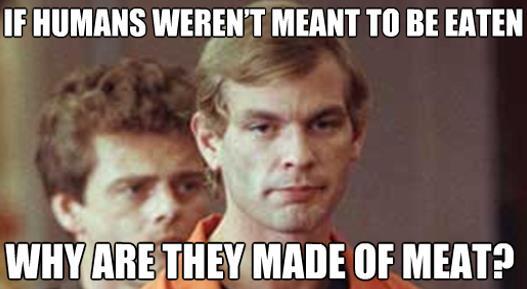
This is a regular theme of cannibal texts: they remind us that humans are animals, and our flesh and organs are made of meat. It’s a popular meme on animal rights social media sites. This one shows the real Dahmer, in case you’ve forgotten what he looked like.

Dahmer was looking for love, but he was not willing to risk losing it, so he tried to conscript his victims as undead zombies or as corpses, skeletons, or just happy meals. He showed affection – he is seen lying with his corpses, holding their hands, preserving their body parts. He loved them in much the same way that farmers often claim to love their cattle, sheep, pigs, etc, just before putting them on the abattoir trucks.

Dahmer is played brilliantly by Evan Peters (American Horror Story, X-Men, Mare of Easttown), who looks a lot like Dahmer, but with a touch of the young Malcolm McDowell – imagine Clockwork Orange but with cannibalism. If you want to know what Dahmer might have looked like forty years after his arrest, check out McDowell in Antiviral.

Jeffrey Dahmer murdered and dismembered seventeen men and boys between 1978 and 1991, thirteen years during which the police had no clue about his serial murder spree and, some might say, didn’t care much, since most of the victims were people of colour. And this is the heart of this rendition of Dahmer’s story – he was protected by the racism and incompetence of the American justice system. Here was a clean-cut white man, and people of colour disappear without trace all the time, apparently, so the police did not bother him, while the judges treated him as just a naughty boy.  Glenda’s frantic calls were met with apathy or rudeness.

He kept getting away with everything – one of the most extraordinary moments is shown in flashback in episode 2. On May 27, 1991, Glenda Cleveland called the police to Dahmer’s apartment after her daughter, Sandra Smith, and her niece, Nicole Childress, found a bleeding, naked and incoherent boy on the street who was running from Dahmer. Dahmer appeared, white and polite, and told the police that the boy was his 19 years old boyfriend.

He said the boy was drunk and they had been in an argument, and so the cops helped him take the boy back to his apartment, had a quick look around, made homophobic remarks about AIDS, and left the boy there.

The boy was bleeding from a hole drilled in his skull. After the police left, he was dead within the hour. It was later discovered that the boy was 14-year-old Konerak Sinthasomphone, Dahmer’s 13th victim. Incredibly, Dahmer was actually on parole for an earlier arrest for the molestation of another child, who was one of Konerak’s older brothers.

When Cleveland spotted Konerak’s photo in a missing person alert in the newspaper days later, she realised he was the young boy Dahmer had claimed was his boyfriend. She contacted the police and the FBI yet again, but they didn’t even return her call. Five of Dahmer’s seventeen murders, including that of Konerak, were carried out after Cleveland began contacting police. All but three of Dahmer’s victims were non-white.

The Reverend Jesse Jackson, a leader in the Civil Rights movement since the time of MLK, got involved in the case despite the urgings of some of his supporters, who didn’t think the movement should be linked to “a gay serial killer who eats people”. But as he says:

“I realised it was not just a gruesome horror show. It’s a metaphor for all the social ills that plague our nation. Bad policing, underserved communities, the low value we assign to our young Black and brown men, especially if they happen to be gay.”

The old profiling stereotypes no longer work, in fact never did. Dahmer was a serial killer who was ignored by the law for thirteen years, because he was white and male. In the Soviet Union at the same time, Andrei Chikatilo was killing and eating parts of over fifty women and children, ignored by the police force, because serial killing was considered impossible in the “workers’ paradise”. But those profiles still endure: a Black man on the street is instantly suspected of criminal intent, a white man, even Jeffrey Dahmer, is largely untouchable. In that sense, society dehumanises the poor, the coloured, the disabled, just as effectively as Dahmer did to his prey.

As the philosopher Michel Foucault observed, the world outside was a scary place filled with monsters up to the seventeeth century, and those monsters were thought to be probably criminals. But in modern times, the criminal is considered likely to be a monster. Ancient monsters were recognisable – usually grotesque and often hybrids of humans and other animals. But the contemporary monster looks, speaks and eats pretty much like the rest of us. Like Jeffrey Dahmer – the boy next door.