Weaker than man: “The Odyssey” (Nolan, 2026)

More words have been written about The Odyssey than most movies, because it has the attraction of being both a grandiose blockbuster told with the complexity and brilliance that is the signature of Christopher Nolan (Dark Knight trilogy, Oppenheimer, and many more), as well as a reinterpretation of one of the most important classics of Western civilisation. Most critics seem to love it, some hate it, and others nitpick over issues like the use of modern slang and obscenities, while ignoring the fact that the characters are speaking modern English instead of ancient Greek. Or the fact that the Wooden Horse was not mentioned in Homer’s telling of the Trojan war (The Iliad) and mentioned only briefly in The Odyssey; most of the detail came from Vergil’s The Aeneid, which was written some 700 years after Homer.

Luckily, writing a blog on cannibalism means never having to worry about stuff like that – all that matters is who gets eaten, by whom, and what it means, which is pretty subjective (like everything else in literature). Mythology is full of cannibals, and the Greeks had more than their fair share, for example the revenge cannibalism of Thyestes unknowingly eating the flesh of his sons served to him by his brother Atreus. Cannibalism is an unmatched method of revenge because not only is the victim killed, but is then reborn as excrement, the ultimate degradation. Shakespeare used revenge cannibalism with gusto in his play Titus Andronicus.

In the case of The Odyssey, there are two narratives of cannibalism, only one of which Nolan bothers to show us.

Odysseus, the King of Ithica, is trying to get home from the destruction of the great city of Troy, an orgy of destruction, rape and slaughter that has left him racked with guilt. Not so easy in a sailboat travelling through largely uncharted seas. He and his army land on an island populated by the cyclopes, literally “round eyes”, shepherd giants with one large eye in the middle of their foreheads. The cave the Greeks blunder into seeking provisions is the home of the cyclops Polyphemus, who is a son of the sea god Poseidon and Thoösa, the sea nymph daughter of the primordial sea god Phorcys, neither of whom are gods you want to upset if you’re trying to sail home without a good GPS. Polyphemus likes the Greeks a lot; he eats them with gusto, as Homer puts it:

He dashed their heads against the floor as though they had been puppies. Their brains ran out on the ground and soaked the earth. Limb by limb he tore them to pieces to make his meal, which he devoured like a mountain lion, never pausing till entrails and flesh, marrow and bones, were all consumed.

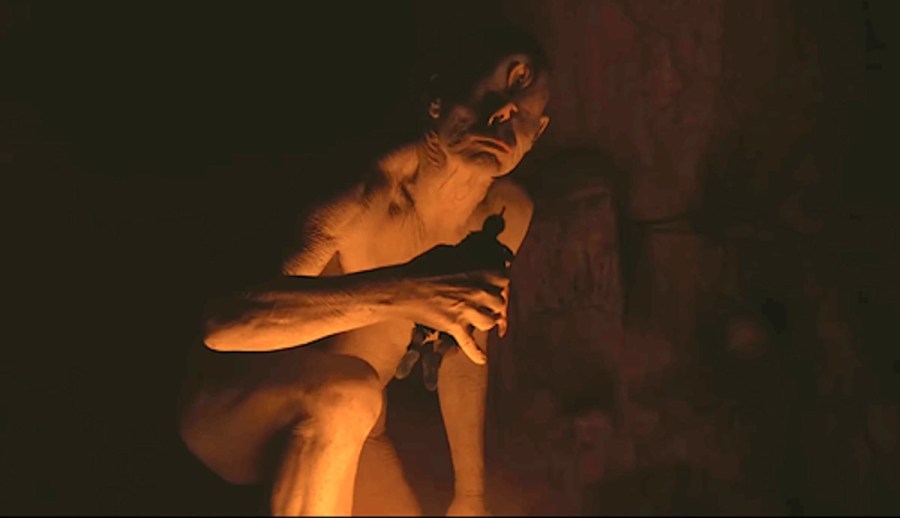
Nolan, who seems to avoid computer graphics, used a 60-foot animatronic puppet, forced-perspective framing, and full-body performance capture to show Polyphemus and, IMHO, it’s one of the highlights of the film. Odysseus and his men blind the cyclops (which admittedly is half as hard as blinding a giant with two eyes) and the distraught Polyphemus, after hurling rocks at the departing boats, prays to his father Poseidon to avenge him, meaning that this voyage is going to be much more difficult and take a lot longer than even the three-hour film makes it seem.
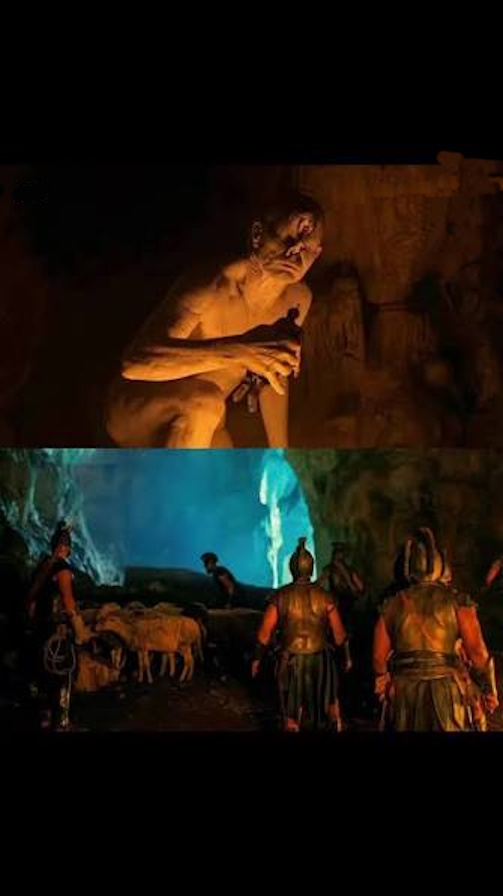
The Greeks land on another island; this time inhabited not by solitary sheepherders like Polyphemus but a race of giants called the Laestrygonians, who are not nearly so pleased to see them. In Homer’s original version, Odysseus sends three scouts, one of whom is rapidly digested before the giants head to the hills where they keep a handy supply of boulders, which they hurl down until they have destroyed all the Greek ships except that of Odysseus, proceeding to spear the Greek soldiers like fish before having a beach barbecue.
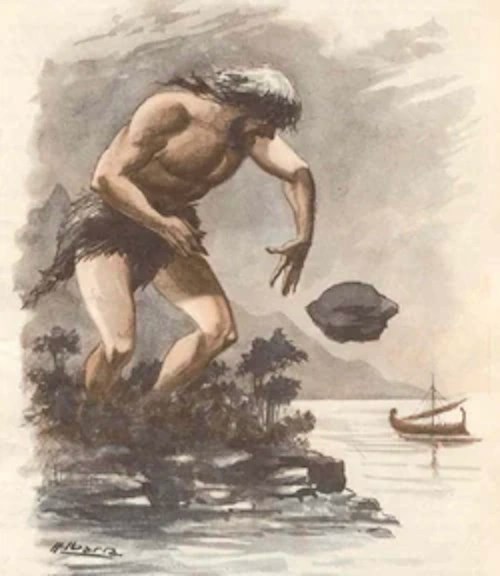
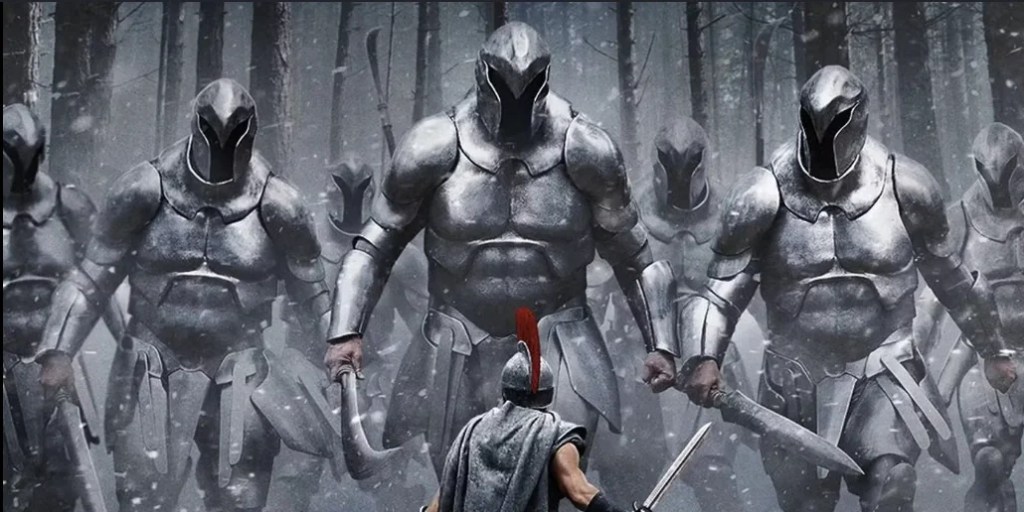
In the film, the Laestrygonians are presented as giants (but not as big as Polyphemus apparently) and mysteriously clad in mediaeval armour. Alas, Nolan does not show us the fate of the slaughtered Greeks, but those of us who read Homer or glance at the internet know that they are certainly on the menu.
Various other sea monsters eat crew members as the voyage continues interminably, but we’ll concentrate on the incidents above, as the cannibals depicted are at least humanoid, if somewhat larger than life. What the cyclopes and Laestrygonians have in common is their size. Very few depictions of cannibals show small, meek perps, although in reality many cannibals have been quite diminutive, making up in ruthlessness for their meagre size. Think of Ottis Toole or Issei Sagawa. It is perhaps difficult to persuade people to be scared of pint-sized villains, especially in the relatively short time allowed a movie, so monsters are almost always large and intimidating. One of the main precepts of Greek civilisation, as we are told several times in the film, is hospitality to the stranger (xenia or Zeus’s Law), and both Polyphemus and the shiny knights are entirely lacking in that virtue. I guess the men and boys who sought comfort in the home of Jeffrey Dahmer might agree that lack of hospitality seems basic to cannibalism.

The differences between Homer’s cannibals are more interesting though. The cyclopes are isolated outsiders, pastoralists who herd sheep and eat them (and any people that wander by), and do not seem to engage in poetry or philosophy or young boys the way the ancient Greeks did, and therefore, from the point of view of the Greeks, they are uncivilised. In fact, it is debateable whether the cyclops is technically a cannibal (defined as a human who eats other humans), as he appeared to be some other species (a giant with a single eye), but he speaks good Greek (at least in Homer’s version) and so at very least seems to possess what Aristotle called the “rational principle”, as well as a powerful appreciation of carnivorous virility – domination through consumption. Like most cannibals, they are depicted as outsiders who threaten the assumed boundaries of social and symbolic orders. The classical “anthropophagus” (the word “cannibal” had to wait for the Spanish to adapt it from the Antilles in the sixteenth century) was, like Polyphemus, a hybrid human/animal monster—a warning against the dangers of straying from the sovereign and the church. The cyclops has one eye because he has no perspective – social, cultural or ethical.

The Laestrygonians, on the other hand, are a highly organised community, able to buckle on their armour at a moment’s notice (unless perhaps they sit around in it, waiting for scrumptious strangers to appear). In their anonymity and well-drilled efficiency, they are the picture of totalitarian society – identical, disciplined, totally intolerant of outsiders (except for dinner). They appear to be a fascist league, armed and violent.
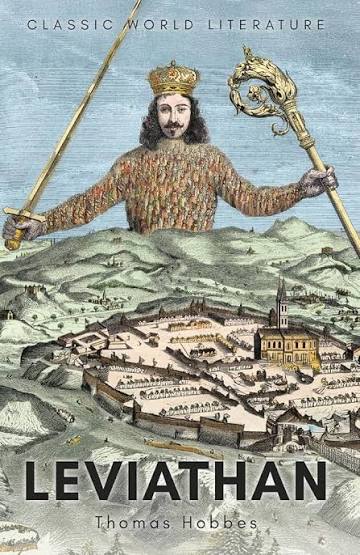
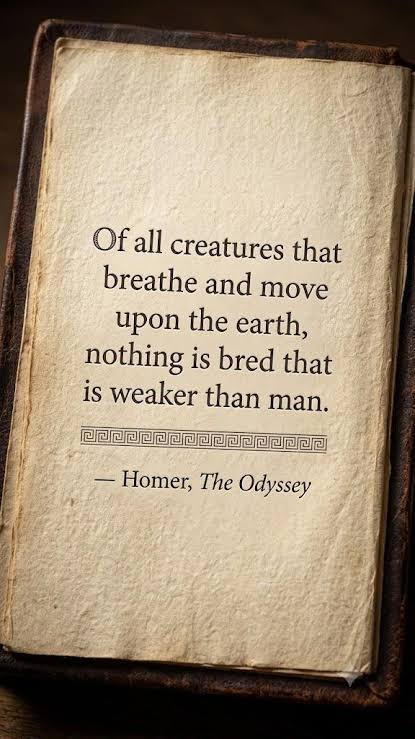
Thomas Hobbes in his famous work Leviathan warned against rejection of the social order. Without civilisation and a strong central authority, a sovereign, we would live in what he called a “state of nature”, which he described as a “war of all against all”. The human response is to declare war on nature and try to dominate it, overcoming our biological weakness and vulnerability by banding together like Laestrygonians. As Odysseus warns the freeloading suitors in his house, foretelling their sudden change of fortune and mortal existence,
In Hobbes’ state of nature, there would be no culture, no industry, no buildings, no science, no arts, and:

“which is worst of all, continual fear, and danger of violent death; and the life of man, solitary, poor, nasty, brutish, and short.”

This is an accurate portrait of the cyclops, lonely, violent and brutish, in his cave reeking of death. But the Laestrygonians go to the opposite extreme, where there is no room for difference or dissent. They, like us trying to control the environment, use technology and strategic cooperation to enforce their wills. They do not ask who the Greeks are, what they need, or whether they come as a threat – they slaughter them and eat them just for the crime of being on their land, the way the Nazis killed Jews and Roma for daring to exist. The absolute sovereignty of Hobbes’ Leviathan may be no more civilised than that of the ant colony that attacks any prey within its reach. Their cannibalism is simply the resolution of difference.

Cannibal stories from Homer onward reveal as much about the victims as the perpetrators. They demonstrate that we are all flesh, at our most physical and animalistic at the time of death and consumption, be that consumption by worms, cyclopes, Laestrygonians or the seemingly innocuous cannibal next door. We can be slaughtered like puppies, consumed as if by a lion, and our integrity and transcendence is contradicted by being split and ruptured—our brains gush, our entrails, flesh and bones and marrow are revealed as common comestibles. Like all animals, we eat and try to avoid being eaten. But unlike nature, which as Tennyson said is “red in tooth and claw”, we can elect to make ethical choices.
Rat Man – Tsutomu Miyazaki, the Otaku Killer

Nerd. Rapist. Cannibal.

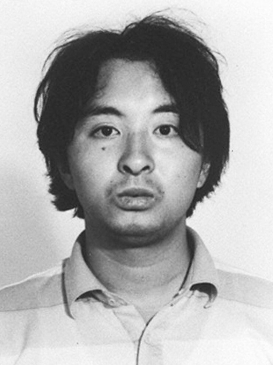
This is the range of identities that the Japanese serial killer Tsutomu Miyazaki moved through in his short life, going from a loner who spent his time alone in his room to a man who murdered young girls in Tokyo and Saitama Prefecture between August 1988 and June 1989. All four little girls were murdered and then raped; the last one was also cannibalised. He kept body parts as souvenirs, and liked to send clues to the girls’ parents to taunt them.

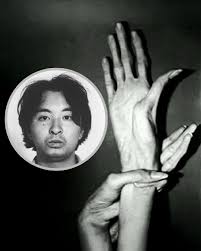
Miyazaki was born in 1962 to a well-off family in Itsukaichi, a town in the Nishitama district of Tokyo. He was born premature with a rare birth defect, radioulnar synostosis, that caused his hand joints to be fused together, making him unable to bend his wrists upwards. Many sensationalist reports about his case show the image below, which is a different condition and is taken from a medical textbook. There was apparently nothing obviously wrong with his hands, but his disability led to him being bullied at school, which some say led to his mental decline, and eventually isolated him in his room watching endless video tapes, some of which he made himself.

Of course, many people get bullied at school, but most of them do not end up killing and eating tender-age children. He was also ignored by his parents, who led busy lives, and his sisters, with the only person interested in him being his grandfather, the only person who showed him kindness. In May 1988, his grandfather died, greatly increasing his depression and isolation. He reportedly ate some of his grandfather’s ashes, to “retain something from him.” He was later caught watching his sisters in the shower and attacked them and then his mother when told to leave.

Between August 1988 and June 1989, Miyazaki murdered and mutilated four girls between the ages of 4 and 7 and sexually molested their corpses. He drank the blood of one victim and ate a part of her hand. 

These crimes—which prior to his apprehension were named the “Little Girl Murders” and later the Tokyo/Saitama Serial Kidnapping Murders of Little Girls (東京・埼玉連続幼女誘拐殺人事件) were particularly shocking in the Saitama Prefecture, which rarely saw crimes against children.

On 22 August 1988, one day after Miyazaki’s 26th birthday, Miyazaki saw Mari Konno, aged 4, who had gone to play at a friend’s house. Miyazaki led Konno to his black car, then drove west of Tokyo and parked under a bridge in a wooded area. He sat alongside Konno for half an hour before murdering her and molesting her corpse. He dumped her body in the hills near his home, departing with her clothes, then allowed the body to decompose before returning to remove her hands and feet, which he kept in his closet. Miyazaki burned Konno’s remaining bones in his furnace, ground them into powder, and sent them to her family in a box along with several of her teeth, photos of her clothes, and a postcard which read, 

「真理さん、骨、火葬、調査して、証明して」 
(“Mari. Bones. Cremated. Investigate. Prove.”) 

Konno’s hands and feet were found in Miyazaki’s closet after his arrest almost a year later.

On 3 October 1988, Miyazaki abducted Masami Yoshizawa, aged 7, walking along a rural road. He drove her to the same place he had killed Konno and killed her, raped her corpse, and left with her clothes. Two months later, on 12 December 1988, he abducted Erika Namba, aged 4, as she was returning home from a friend’s house. Miyazaki drove to a parking lot in Naguri, where he forced her to remove her clothes in the back seat and began to take pictures of her. He killed her, covered her with a bedsheet, and placed her body in his car’s trunk. He disposed of her clothes in a wooded area and left her body in the adjoining parking lot, where it was discovered three days later. On 20 December, Namba’s family received a postcard sent by Miyazaki with a message assembled using words cut out of magazines: 

「絵梨香、かぜ、せき、のど、楽、死 」 
(“Erika. Cold. Cough. Throat. Rest. Death.”)

On 6 June 1989, Miyazaki convinced Ayako Nomoto, aged 5, to allow him to take pictures of her. He then led Nomoto into his car and murdered her. Miyazaki took the corpse into his apartment and spent the next two days engaging in sexual acts with her body and masturbating, taking photos and videos of the remains in various positions. When Nomoto’s corpse began to decompose, Miyazaki dismembered it, scattering body parts around Tokyo, including in a cemetery, a public toilet and nearby woods and leaving her head in the nearby hills. He kept her hands, drinking blood from them and chewing on them. Fearing that the police would find Nomoto’s body parts, Miyazaki returned to the cemetery and the hills two weeks later and carried the remains back to his apartment, where he hid them in his closet.

On 23 July 1989, Miyazaki saw two sisters playing in a park in Hachiōji and managed to separate them. He was taking photographs of the younger one, whom he had convinced to strip nude, when he was caught by their father, who attacked Miyazaki but was unable to restrain him. Miyazaki later returned to the park to retrieve his car but was arrested by police who were responding to a call by the child’s father. A search of his two-room bungalow produced 5,763 videotapes, some containing anime and slasher films (later used as rationale for his crimes). Interspersed among them was video footage and photos of his victims. Miyazaki, who maintained a calm and demeanour during his trial, appeared indifferent to his capture.

The trial began in March 1990 and took seven years. It focused on Miyazaki’s mental state at the time of the murders. Under Japanese law, people of unsound minds are not subject to punishment, and people having cognitive disability are entitled to reduced sentences. Three teams of court-appointed expert psychiatrists came to differing conclusions about Miyazaki’s ability to tell right from wrong: one team determined Miyazaki to have a cognitive disability, another team thought him either schizophrenic or as having dissociative personality disorder, and the third team found that although Miyazaki definitely had at least one personality disorder, he was still capable of taking responsibility for his actions. He was sentenced to death, a verdict that was upheld by the High Court in 2001 and the Supreme Court in 2006. He was hanged on 17 June 2008, almost twenty years after he had started his murderous rampage.

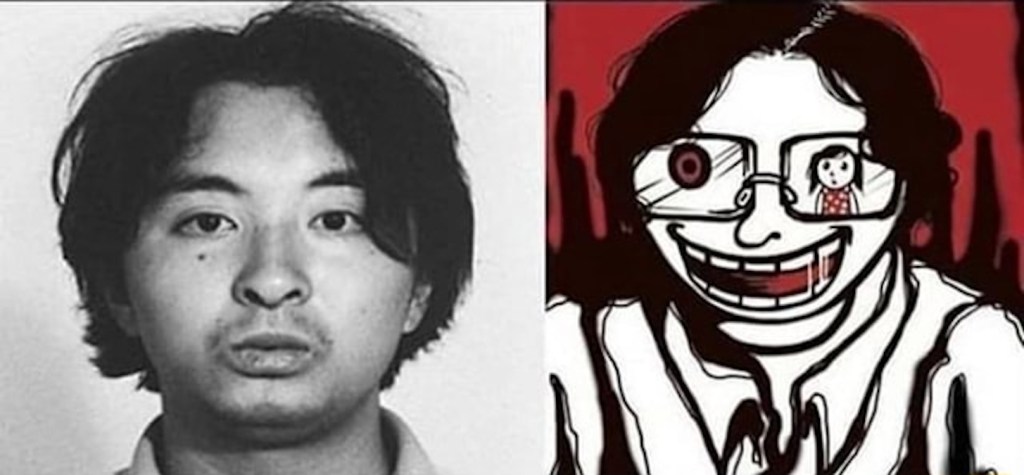
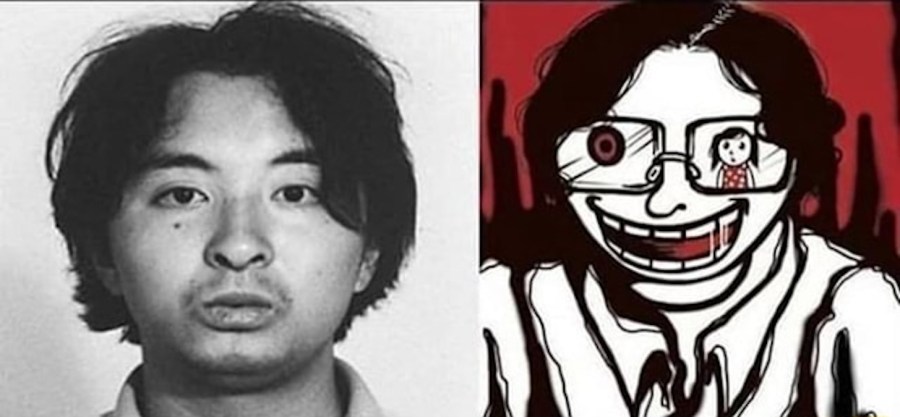
Miyazaki claimed that he was not responsible for the murders but was compelled by an alternative personality called “Rat Man”. He sketched Rat Man while sitting in court awaiting sentence.

Throughout the trial, Miyazaki refused to apologise to the parents of the girls and described his serial murders as an “act of benevolence”. The press called him “Dracula” (because he had drank the blood of Ayako Nomoto) and “Little Girl Murderer”. He was the first serial killer to be linked to the “Otaku“, or nerd, cult in Japan.

Although the nerd cult is mainly associated with relatively harmless manga, Japanese cartoons and films, the public fear of the Otaku cult has never abated since Miyazaki’s crimes, and was reignited when Tomohiro Kato, a 25-year-old loner, went on a knife rampage in Tokyo’s Otaku district of Akihabara in 2008, killing seven people and injuring 10 others.

Does manga, graphic art which often shows depictions of violence and rape, encourage actual acts like murder, rape and cannibalism? Enthusiasts reject the claim, pointing out that its parallel argument about video games promoting gun violence have never been proven. A better question is why manga and other incendiary art forms have become so central to social outcasts, men like Miyazaki and the earlier Japanese cannibal Issei Sagawa (who drew his own manga), men (usually) whose identity is so steeped in anger, isolation, inferiority and inability to form relationships that they see other humans, especially vulnerable little ones, as just prey animals, a way to bolster their damaged egos, to make them feel powerful. And doesn’t this mentality exactly replicate human treatment of other animals, killing and eating them to make us feel like gods?

Issei Sagawa: “This Is A Manga Written By A Cannibalistic Murderer”

 “I just open the page, and the first thing I see is – a half-eaten head.”

If you’re not familiar with the term, “anime” is animation, which can be hand drawn or computer generated. It usually refers to Japanese creations, but in Japan it can apply to any animated work. Usually, anime is used to refer to TV shows or movies, while “manga” usually means graphic novels (comics). There is children’s anime and a whole range of adult material, which regularly wanders into the world of sex and violence.

The manga reviewed in this short YouTube clip (above) embraces both sex and violence, as well as combining those in the form of necrophilia and cannibalism, and does so in graphic detail. It is the autobiographical record of Issei Sagawa, a Japanese man who murdered and cannibalised a young Dutch student named Renée Hartevelt, whom he had befriended at the Sorbonne in Paris in 1981. Sagawa never served time for the act.

Sagawa’s story has been told in many formats, including several documentaries, including The Cannibal Who Walked Free in 2007 and CANIBA in 2017.

Sagawa died in 2022, but he left behind a record of his activities in the form of manga, a comic book, although it was far from comical. In fact, this review on YouTube is on the site “Anime Dork”, described as “a team of passionate anime otakus” (obsessive fans), formed in August 2022, whose reviews are usually fairly light-hearted and humorous.

Not this one. The reviewer, Sydney Poniewaz, who writes under the name sydsnap, is an actress and YouTube star (pushing toward a million subscribers, so very successful), and a True Crime aficionado, particularly fascinated by the often very weird crimes committed in Japan, where she sometimes resides. But she is clearly horrified by the content of the booklet she is holding which, she tells us, is drawn by “an awful human being”, and extracts of which she eventually begins showing us.

She gives a brief synopsis of the case, such as:

“He began to sexually assault her corpse, and then partake in cannibalisation of her body.”

In the manga, she tells us,

“He talked about everything he did to her body: every scent he smelled, every texture he felt, every disgusting brief or prolonged thought throughout any sort of disgusting act he did, which – he does a lot!”

She seems most shocked by the fact that he escaped justice and led the rest of his life a free man, making films including porn, writing books, and even doing restaurant reviews.

“I’m trying to show one image where he’s not being disgusting, but honestly, he always is… he’s talking about how good it felt to murder her, how he wants to do it again.”

So, Sydney did not like the book, which she bought for (no doubt) a lot of money, and then she had to pay lots more to have the Japanese text translated, which she truly seems to regret.

“I do not recommend it. I really, really, really do not recommend it for the faint of heart. I am a pretty hard person to shake in terms of content, but this is probably the most disgusting thing I have ever read.”

There are a lot of comments on the YouTube site, mostly shocked and horrified, and a few are below. I particularly like the one that emphasises that these stories almost always focus on the killer, this one being told by him from his point of view, and rarely the victim. Renée Hartevelt, like Charlene Downes whom we discussed last week, deserves to be remembered for more than just being eaten by another member of her species.

There are more extracts of the manga, if you are interested, in the Caniba documentary, and I captured a few for my review of it. Or if you really want to get into the whole story (and I suppose some readers will), the manga itself is available on eBay, for a hefty price tag.

Why did he do it? The manga makes that pretty clear. He ate Renée for the same reason any of us eat anything – because he wanted to. The outrage that followed is based on the deeply held but mostly unexamined idea, largely based in religion, that humans are somehow separate and above other animals, kind of demi-gods. Issei Sagawa, obviously, did not believe that.

Love and cannibalism: BONES AND ALL (Luca Guadagnino, 2022)

The modern cannibal is usually hard to identify. Jeffrey Dahmer was the all-American boy next door. Armin Meiwes used to mow his neighbours’ lawns to be helpful. Issei Sagawa was so small and helpless that he seemed vulnerable rather than threatening. Albert Fish was a sweet old man, so charming that the Budd’s let him take their little girl to a party.

They were normal, everyday people, a bit weird, but not monsters.

At least, not in appearance. This is a recent phenomenon – the original cannibals were called anthropophagi (Greek for man-eaters) and were humanoid in shape, but were usually some sort of hybrid – a mix of humans and gods or other animals – strong, ferocious, and clearly not quite human. From the 15th century, the alleged cannibals found by Columbus and other explorers were different in culture and skin colouring, so were easily distinguished, defamed and exterminated. It is only recently, since Jack the Ripper in 1888, that the cannibal walked among us, undetected until the victims were found (or what was left of them).

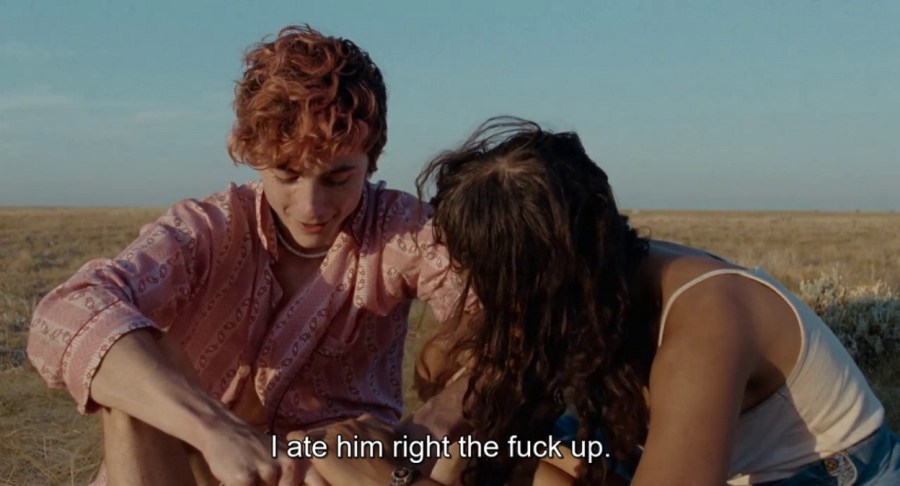
Bones and All presents as a coming of age cannibal romance, taking a sharp turn back into cannibal history for its themes. Maren (Taylor Russell from Lost in Space) is finishing high school, a spectacular end of term in which she is invited to her friend’s sleepover and bites a girl’s finger off, instead of, you know, just admiring the nail polish, as she had been invited to do.

She then goes on the run with her father, who has been keeping her ahead of the law as she grew up (her first human meat was her babysitter when she was three) but now ditches her, with a few hundred dollars and a birth certificate.

It then becomes a road movie, as she travels through the American Mid-West trying to find her mother, attracting suspicion not because of her eating habits but just because she looks too young to be on the road. She comes across another cannibal (they are called “eaters”) in the shape of a weird old man named Sully (Mark Rylance, Bridge of Spies) before meeting up with Lee, played by the love interest of seemingly everyone nowadays, Timothée Chalamet. Chalamet appeared in the third instalment of Guadagnino’s “Desire Trilogy”, Call Me by Your Name), in which he was the love interest of Oliver, played by Armie Hammer, who has recently been generating his own cannibalism headlines.

As a road movie it’s Thelma and Louise mixed with Romeo and Juliet, if they had been cannibals. In other words outsiders, star-crossed lovers, and lots of flesh being torn off dead (and sometimes living) bodies. Road movies rely on meeting new and weird people, and learning about the protagonists (and ourselves) from their stories.

Sully is a lonely old man who teaches Maren about being an eater, and how an eater has a super-power – like a vampire, they have a nose that can smell other eaters at great distances, and can also smell dying people, which allows him to feast on them fairly inculpably, although Maren rather wonders if they should be calling 911 rather than letting them gasp their last breaths. So they are anthropophagi, they smell different, have a strong sense of smell, and so are not quite human. We subsequently discover that the cannibal gene is passed on – Lee’s dad and Maren’s mother were also eaters. They are a breed apart, hybrid humans, who can mate with non-eaters.

They are also presented as ‘savages’ – related to the colonised peoples who were declared cannibal by the imperial powers. Maren is biracial, and Sully (although played by a classical British Shakespearean actor) seems to be presented as a Native American, with a long ponytail and a feather in his hat. The marginalised and disenfranchised are regularly presented as dangerous, thieves, murders, cannibals, regardless of any evidence.

An interesting character from colonial times is the wendigo, a figure from Algonquin mythology who eats his fellow humans and draws on their strength to grow huge and powerful, which only makes him hungrier and deadlier. Sully tells Maren that her fate is to need more and more flesh as she gets older.

Just like the wendigo, who is an indigenous version of the anthropophagus, and one that was used by the victims to characterise the European invaders and their voracious appetite for land and gold. The phrase “bones and all” reminds us of the colonial greed that denied the humanity of those invaded and insisted on taking everything, leaving nothing and nowhere to go but a few reservations or missions in remote, unprofitable areas. Eating bones and all is also a perfect way of getting rid of the evidence.

The title Bones and All is taken from the book of the same name by Camille DeAngelis, but the phrase was not used in the book – it just meant that Maren and the other eaters would automatically eat the whole person, bones and all. Except for her first, the babysitter, because she was too small to swallow bones – she left a pile of them, a pool of blood, and the hammer from an eardrum. In a movie, though, it can be harder for the viewer to maintain a willing suspension of disbelief, so eating the victim bones and all becomes a rite of passage – the next level of being an eater. Maren and Lee don’t know how to eat a person bones and all, so they are not yet postgrad eaters. Maren puts it succinctly – “that’s impossible.” But what about eating the flesh? Armin Meiwes took ten months to eat 20 kilograms (44 lb) of Brandes, but we are asked to accept that Maren and Lee can eat a whole body in a night.

But then, everything is ambiguous in this story, which has been widely described as a metaphor for otherness and queerness. The story is set in 1981, as Ronald Reagan is entering the White House. Being different, queer, compassionate, seeking social justice were all considered laughable or dangerous. Greed was good, and so eating a victim bones and all might have seemed laudable. Drug addiction was escalating, and some have seen the cannibalism in this film as a metaphor for this as well – Maren and Lee can’t go too long without their feed, and will do whatever they need to in order to get it.

Some of the ambiguities are more subtle: Maren looks young, which bothers various people she deals with, although she is 18 and technically an adult in most places. Lee falls in love with her, but is also capable of appearing to be cruising for gay sex.

He chooses a carnival worker who has been mean to a child, leads him into the bushes and masturbates him, slitting the man’s throat as he orgasms. It was not until twenty years later that gay sex was legalised in the US, and this man’s secret desire for same sex petite mort becomes his real mort. They then discover that the man had a wife and family, and are stricken with guilt, because apparently eating some people is OK, but not family people.

Then we have the eaters – Maren is naïve and caring, horrified by her need to feed. Lee is a puny dude who kills seemingly effortlessly, but like Hannibal Lecter, Lee prefers to eat rude people – when we first meet him, he challenges a rude person in a supermarket and leads him to a deserted shed where he kills and eats him. Sully is an senior eater, so has to eat regularly, but says he tries not to kill people – sniffs out those who are dying, but later he gets violent when Maren rejects his advances.

Jake (Michael Stuhlbarg) is an eater who has graduated to eating bones and all, but he is accompanied by a friend named Brad (David Gordon Green), a cop (!), who is not a natural eater, but just likes doing it. Maren accepts that she and Lee have to eat people, but is revolted by Jake’s wish to do the same. We’re back to the old debate of nature versus nurture. Are people born queer? Or with addictive personalities? Or psychopathic? Or cannibalistic?

The Director, Luca Guadagnino, has made a number of changes from the book, which are examined elsewhere. The most obvious one, though, is that Maren is brought up and then eventually abandoned by her mother in the book, but her father in the film. This changes the dynamic considerably, because we now have two eaters in the family, both female. The eater parent in both versions is locked up in an asylum, having eaten their own hands, but in the movie it’s her mother, (a short but superb appearance by Chloë Sevigny). We arrive at last at the modern horror archetype, the “monstrous-feminine”, the figure that confronts the male viewer with his fears of being castrated (Freud’s favourite explanation), as well as “the monstrous womb” – a terrifying image of a “black hole which threatens to reabsorb what it once birthed” (Creed, The Monstrous-Feminine, p. 27). The female cannibal is quintessentially monstrous-feminine, terrifying men with the antithesis of popular female stereotypes of giving life and nurturing. In the book, Maren only eats boys or men (after the initial babysitter) – she is drawn to eat those who seek to be close to her. In both versions of the story, the ambiguity is clear to us and the female cannibals – they have a compulsion to eat, but don’t want to hurt others.
Maren’s solution is to try to act normal, fall in love, get a job, get “clean” of the eating. Her mother’s was to lock herself away, and even then she chewed off her own hands.

To me, the most fascinating ambiguity in this film and in our societies generally is the question “who can you eat?” Eating some animals is considered just “normal” – Lee is chewing on bacon (pig flesh) served to him in a very respectable café, and has been working in an abattoir. When they need money, he and Maren rob the abattoir at night, later sitting on the overhead walkway watching the cows who are to be killed for legal, non-controversial eating, when Maren observes

“every one of them has a mom and a dad, sisters, brothers, cousins, kids. Friends even.”

The real question, Derrida says, is not what to eat but how to eat well. Perhaps, as Chalamet has said, it is impossible to live ethically – every act of consumption or energy usage wrecks the environment a little bit more. For some carnivores, this is seen as a ‘bones and all’ issue, they call it “nose to tail” – killing is OK, but wasting any part of the animal is the real crime. But as Maren says, cows also feel terror, pain, bereavement when their babies are taken from them. The author of the book, Camille DeAngelis, went vegan before writing it, indicating that the problem of who to eat, the rude or dying, the human or the cow, weighed on her, and the scene filmed in the slaughterhouse indicates that Guadagnino may have felt the same. Cat Woods’ review in Salon reminds us that Brad, the off duty policeman, chooses to be a cannibal:

“Why would he hunt, slaughter, and feast upon human flesh if he doesn’t need to?
And, if we the audience can be repulsed by that – and his evident choice to slaughter and eat flesh when there is abundant satiety that doesn’t cause violence, pain and loss – then perhaps we need to venture a little deeper into our own psyches and ask: Why would we feast upon flesh if we don’t need to?”

This is a seriously good film, with a great cast and, in the midst of all this carnage, we are treated to magnificent scenery beautifully captured by cinematographer Arseni Khachaturan. I have not revealed the ending, and hope I have not revealed too many other plot points. I recommend you go see it.

2022 CANNIBAL NEWS and VIEWS

What a year! These are some of the cannibalism stories, films and songs that arrived in 2022, with links back to the original reports, so that you can look up the ones that catch your interest, and so that this blog does not take all of 2023 to read.

January

  • A German man dubbed by the press the ‘cannibal teacher’ was convicted of murder and sentenced to life in prison. Stefan R., a 41-year-old maths and chemistry teacher, had apparently searched on the dark web for terms such as “long pig” and “fatten and slaughter people”. The man claimed his victim died of natural causes after a (presumably vigorous) sexual tryst, and he had removed the man’s penis “since my DNA could still have possibly been present due to the oral sex I performed”. In other words, he didn’t mind a bit of mutilation and perhaps cannibalism, but was concerned not to be “outed” as gay.
  • Djalma Campos Figueiredo, 46, was arrested in Brazil. He had been sentenced by the Court of Justice of Rondonia in the city of Porto Velho to 42 years in prison for several counts of aggravated murder but had escaped custody. The Civil Police alleged he would eat his victims’ eyes and ears and drink their blood.
  • Meanwhile, the Zamfara (NW Nigeria) State Police Command arrested a 57-year-old man, Aminu Baba, for allegedly eating and selling human body parts. Baba and three others were arrested after the murder of a nine-year-old boy. The Police Commissioner reported that Baba had “confessed that he usually ate the body parts and identified the throat as the most delicious part. He also sold some of the human parts to his customers.”

February

  • In Afghanistan, we discovered that the Taliban were rounding up drug addicts and putting them in rehabilitation centres to detox, which is a nice thought, except that they gave them little or no food (“cold turkey” does not count), so they apparently resorted to cannibalism.

April

We have been following the case of an Idaho man, James David Russell, who was accused of killing and eating a neighbour in September 2021. This was a big deal for us in Cannibal Studies, because Idaho is still the only state in the Union to have a law against cannibalism, a statute that hit the books in 1990, but has never been used. In April, Russell was deemed fit to stand trial.

  • In the Indian state of Assam, a man who had had perhaps more than a few drinks smelt cooking meat in a crematorium in a Hindu cremation ground. He helped himself to a few portions of the body, but was caught by villagers and handed over to police; but not before he had eaten about half of his purloined flesh.

May

  • A man calling himself The Chinese Zodiac Killer was arrested by the FBI in Jefferson County, New York for sending letters to media outlets, government offices including the White House, and other organisations, claiming he killed people and ate their flesh, and that he plans to kill more. He seems to have based his story on the Zodiac killer who terrorised California in the late 1960s. The original Zodiac Killer (who was not accused of cannibalism) was never caught, but this one was easily found, posting his threatening letters (what century is this again?) at the same letterbox he had previously used.

June

  • The case against James David Russell (see above in April) went to preliminary trial. Sadly, the judge threw out the charge of cannibalism, saying there was insufficient evidence to pursue it, and went with the rather more mundane offence of first-degree murder. Since this has a life sentence attached, the practical effect of dropping the cannibalism charge is negligible, but as the first cannibalism case in the USA, it would have been fascinating.
  • A rumour swept the Internet that the actress Anne Hathaway was a cannibal, based on a cryptic Tweet saying “police didn’t find human remains and evidence of cannibalism in her LA home that she sold in 2013.” We were all later astonished to discover the whole thing was a hoax.
  • The effects of the war in The Ukraine were starting to be felt in Europe and the UK (whose people often do not think it’s part of Europe). The Russians fell gladly on a statement from one Jeremy Clarkson (a car enthusiast) that “Hunger makes people eat their neighbours” to predict that the British will soon be a nation of cavemen feeding off each other. Of course, if you’ve ever been to a soccer match…
  • industrial/electronic music duo SKYND released their tenth song, called ARMIN MEIWES, about the German man who killed and ate a willing volunteer.
  • Back in the USA, the Utah County Attorney felt he had to go public to deny accusations that he and his wife are cannibals. Honest. I wouldn’t/couldn’t make this stuff up.

July

  • The New York Times raised the temperature of the culture wars with its review of several books, movies and TV shows about cannibalism, culminating in the (somewhat tongue in cheek) statement that “Cannibalism has a time and place… that time is now.” The right-wing press predictably jumped on the story accusing the NYT of everything from irresponsibility to Satanism.
  • Also in New York, Steven Spielberg whipped out his cell phone to record Marcus Mumford singing his new work, a haunting song called “CANNIBAL“. The song might be about love and lockdown, or it could involve child abuse.

August

September

  • DISCOVERY+ launched a three-part series called HOUSE OF HAMMER. The series explored allegations from various girlfriends of the actor Armie Hammer that he was a cannibal, or had at least threatened them with cannibalism. It also examined his relatives, many of whom seemed to be presented as even worse specimens than Armie.
  • Russia discovered the war was not going well in Ukraine, and started recruiting murderers and rapists to be sent to the front as reinforcements. Also – one cannibal, Yegor Komarov, whose man-eating exploits we learned about in December 2021.

October

  • In the Indian state of Kerala, there were allegations that a couple who ran a massage centre were bringing women home not so much for massages, but for human sacrifice and ritual cannibalism.
  • In the US state of Michigan, Mark David Latunski, who had been arrested in 2019 for killing and eating his Grindr date, finally came to trial and entered a plea of guilty.

November

  • Issei Sagawa, the “Kobe Cannibal”, died of pneumonia at the age of 73. Sagawa had killed and eaten a young Dutch fellow-student in Paris in 1981. He was found insane and sent back to Japan, where he was released and lived free ever since, making movies, writing books, and even becoming a restaurant reviewer.
  • Rapper Comethazine released Bawskee 5, the 12th song on which was called “CANNIBAL“.
  • Back in Brazil again! A patient in the Municipal Hospital of Nuovo Hamburgo in the state of Rio Grande do Sul attacked other patients, screamed and spat at people, and eventually chewed off his own fingers and toes. A witness said “while he was chewing his own meat, you could hear the crackling of bones in his mouth”.

December

  • Mark Latunski, 52, was sentenced to life in prison without the possibility of parole on December 15 for the murder of his Grindr date three years previously. Kevin Bacon, 25, had been killed and mutilated by Latunski on December 24, 2019 at Latunski’s Bennington home. Latunski pleaded guilty in September to killing Bacon and eating one of his testicles, after stabbing him in the back and slitting his throat. In a victims’ impact statement, the victim’s father said “Evil does exist, and it touched us.”

On the screen

The big news on streaming television this year was Jeffrey Dahmer, the “Milwaukee Cannibal”, who took Netflix by storm with not one but two titles, despite having been killed by a fellow prisoner in 1994.

  • Ryan Murphy and Ian Brennan’s docudrama called “MONSTER: THE JEFFREY DAHMER STORY“, which logged nearly two hundred million hours of watching in its first week of release
  • Joe Berlinger’s third series of CONVERSATIONS WITH A KILLER, featuring previously unheard defence attorney tapes of interviews with Dahmer.

Lots of new cannibalism feature films in 2022, some of which I will catch up with next year:

  • Luca Guadagnino’s BONES AND ALL, featuring Timothée Chalamet and Taylor Russell as teenage cannibals in a tender and gory road movie, has been getting heaps of publicity.
  • Mimi Cave’s FRESH is a charming romcom, until the knives come out. A fascinating insight into ultimate consumerism.
  • Leatherface came back (again!), this time older but no wiser. This is the ninth (!) instalment of the TEXAS CHAINSAW MASSACRE franchise, and went straight to Netflix.
  • John Ainslie’s DO NOT DISTURB depicts a couple renewing their romance by taking peyote, but finding that this particular variant of the drug awakens a taste for human flesh.
  • Leatherface came out to play again, this time as a fan-film prequel called THE SAWYER MASSACRE. Made on a shoestring but arguably superior to the other sequels and prequels.
  • Liam Regan’s EATING MISS CAMPBELL, in which a vegan, goth student falls in love with her new English teacher and develops a taste for human flesh.
  • Sean Patrick Flanery’s enjoyable road movie FRANK AND PENELOPE, in which a couple take on a cannibal cult in the wilds of Texas.
  • Timo Vuorensola’s JEEPERS CREEPERS REBORN, the umpteenth take on a supernatural tale of the demon who eats people and incorporates their bodies, but only every 23 years.
  • Fred Olen Ray’s PIRANHA WOMEN offers a totally believable story of women who turn into man-eaters because of an anti-cancer treatment.
  • THE MENU has Ralph Fiennes as a demented chef and Anya Taylor-Joy as the fly, as it were, in his menu plan. There is no obvious cannibalism involved in the movie, but there is some speculation on-line about the final cheeseburger.
  • Ted Lasso goes cannibal’ in Adam Leader & Richard Oakes’ FEED ME, a jolly rant in which a grieving man wants to die, and a nearby cannibal wants to help him, but by instalment.

And now for something completely different

From out of the future, we have some new AI software of which Shital Shah, a senior research engineer at Microsoft, said:

ChatGPT is “a large language model that has been trained to generate human-like responses to text input.” In other words, you can ask it questions and receive (often) intelligent answers, rather than a series of links, like Google. You can try it for free (at the moment) here.

Naturally, I asked it questions such as “is meat murder” and it replied:

Ultimately, whether or not eating meat is considered murder is a matter of personal belief and moral judgement.”

So, I barked back, like a prosector out for a conviction, “Where does that leave the cannibal?”

“Whether or not eating other humans is considered murder would also be a matter of personal belief and moral judgement. Most people would consider cannibalism to be morally reprehensible, as it involves the killing and consuming of another human being. However, there may be some individuals who do not see it that way, and their personal beliefs and moral judgement would dictate their view on the matter.”

The Internet has spoken, at last.

ISSEI SAGAWA – “the Kobe Cannibal” – DEAD at 73

Issei Sagawa, a Japanese murderer known as the “Kobe Cannibal”, died of pneumonia on November 24 2022 at the age of 73. His funeral was attended only by relatives, with no public ceremony planned, according to a statement from his younger brother and the publisher of the brother’s 2019 memoir.

In 1981, 32 year old Sagawa, then a Japanese exchange student, murdered a young Dutch woman, Renée Hartevelt, a fellow student at the Paris Sorbonne, then raped, mutilated, and cannibalised her corpse over two days.

After that, he cut up her remains and packed them into two large suitcases, called a taxi and tried to drop the cases off in a park in the middle of Paris. He fell asleep in the park (eating too much meat can have that affect) and someone opened one of the cases. Sagawa walked calmly away, but within four days, the police tracked Sagawa through the taxi driver, and he confessed immediately. In his refrigerator and on his dining table, they found a large quantity of human flesh.

Sagawa was declared insane, but his father employed an influential French lawyer to argue, successfully, that it was unfair for the French taxpayer to pay for indefinite confinement in a mental hospital, and that he should be sent back to Japan to be cured. Accordingly, less than three years after his confession, Sagawa was put on a plane and sent back to Japan, the only condition being that he could never come back to France. He could not be prosecuted in Japan because the French had sealed the case files after the murder charge had been dropped. He spent 18 months in a Japanese mental hospital but then checked himself out, and has been free ever since.

There is a comprehensive study of the case in the documentary THE CANNIBAL WHO WALKED FREE, which I reviewed in this blog in February – you can read it here. It contains a link to the documentary on YouTube.

Another fascinating documentary which looks more closely into the psyche of both Sagawa and his brother through interviews (sometimes disturbingly close-up ones) is CANIBA, made by two artists/anthropologists in 2017. I reviewed that in May, and you can read it here. It has a link to the production site where you can buy the DVD should you be so inclined.

The French philosopher Georges Bataille is widely quoted on the Internet as saying

“A kiss is the beginning of cannibalism.”

I hate to be a party pooper, but there is no evidence of Bataille ever saying this. Nonetheless, the concept makes sense. Sex is a very oral experience – from passionate kissing to cunnilingus and fellatio, much of foreplay consists of licking, tasting and biting. Even non-sexual love often involves phrases such as “I could just eat you up.” Cannibals like Armin Meiwes and Jeffrey Dahmer ate their victims to keep them close. Sagawa did the same, claiming he loved Renée.

Sagawa, with a massive inferiority complex based around his conviction that he was small and ugly, saw a bullet in the neck as his only way he would ever have sexual experiences with a live partner, particularly a beautiful young woman who seemed totally out of his league. Murder in such a belief system must have seemed like a form of courtship, and cannibalism a way to keep her with him forever. For forty years, he has done just that, living off his notoriety, making films, appearing in torture porn, writing books and comics (from which the drawings in this blog are taken), and even reviewing restaurants for foodie magazines.

Sagawa appears in the documentaries mentioned above (and several others I have not yet reviewed) as a repulsive, sick individual, but never as repulsive and sick as he firmly believed himself to be.

Cannibalism as eating disorder: FEED ME (2022)

So, the buzz for this movie is ‘Ted Lasso goes cannibal’. By that, they don’t imply we will need to sit through any football matches, but that there is going to be a lot of American “can-do” ardour, conflicting with British reticence and melancholy. Also some dark humour, and a whole lot of gore, which some may find objectionable. Consider yourselves warned.

Feed Me is directed by Adam Leader and Richard Oakes (Hosts). XYZ Films released the horror-comedy on October 27 2022 on digital and on demand platforms. Feed Me follows Jed (Christopher Mulvin) whose life is shattered when his wife Olivia (Samantha Loxley) suddenly dies, leaving him feeling guilty. The blurb says:

“Spiralling into an abyss of depression, he finds himself in a bar with a deranged cannibal, Lionel Flack (Neal Ward) who convinces him he can redeem himself through the glorious act of allowing himself to be slowly eaten to death.”

Suicide, usually unassisted, is sadly common in modern society, and besides making the relatives wretched, it is also an enormous inconvenience to the police, medics and trauma-cleaners who have to deal with it. So why not benefit someone – the local cannibal who promises a painless death that will not require housekeeping, because he will eat the resulting mess? Jed moves in with Lionel, whose tiny house is filthy and full of body parts. But Jed is ready, eager to die, and Lionel is tremblingly eager to eat him.

Cannibalism, particularly vorarephilia (the erotic desire to consume or be consumed by another) can be seen as a type of eating disorder, particularly in cases where there are other foods readily available, but if that is the case, so can any form of carnivory. The film starts and finishes with such reflections – Jed’s wife is a beautiful young woman who is convinced she is fat and ugly, and eventually dies from the effects of bulimia – she starves herself and vomits out whatever nourishment she does eat, until her body closes down.

As Jed explains it, her mental illness meant that she “was eaten from the inside out.” Lionel’s solution is that, if Jed is determined to kill himself, he should do it from the outside in.

Lionel quotes some fake anthropology – a tribe called the Yiurkun who, he says, live in perpetual happiness,

His offer (and there is a written contract involved) is to eat Jed, quickly and painlessly, so he can join his beloved. Why not, Jed thinks, since Olivia has effectively (in his dreams) eaten his heart?

Lionel starts small – local anaesthetic, one finger chopped off with secateurs and carefully cooked, the wound cauterised with a hot clothes iron. “How do you feel?” Lionel asks.

But of course you can’t eat a whole person one finger at a time, and it’s not long before Lionel is removing limbs, but now without anaesthetic, because he gets mad at Jed.

Lionel says he has heard that

“some cultures believe that torturing the animal alive improves the taste and quality of the meat.”

This is not an invention of the director – it’s well known that dogs and cats and other animals are often beaten or burnt or at least made to watch the death of other animals, to make the terror and agony generate adrenalin, which is supposed to add flavour. Astonishingly, Hillary Clinton was accused of doing the same to small children. Other politicians have had the same accusations hurled at them. While these are almost certainly nonsense, it is true that almost every one of the seventy billion land animals humans eat each year will go through extremely painful ordeals, and all of the trillions of sea creatures. Jed is just one more animal in agony.

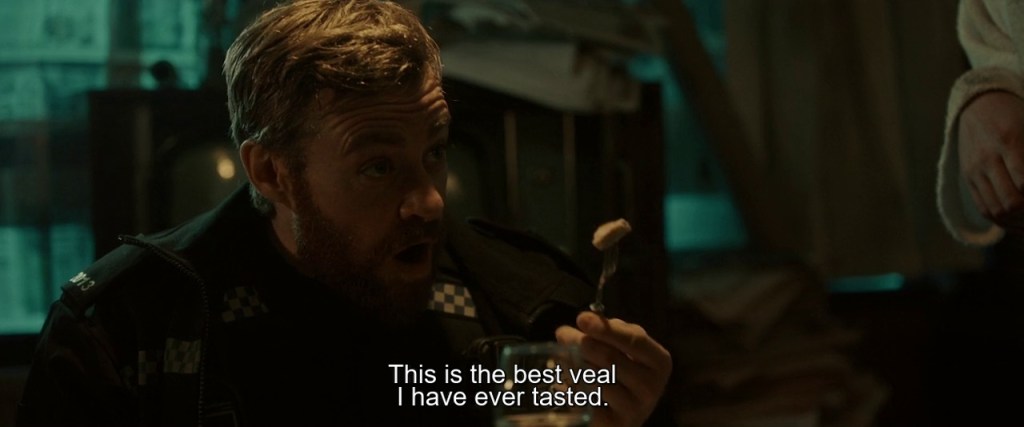
When the neighbour calls police about all the screaming going on, Lionel invites them in and feeds them some of his “mild veal”.

The enjoyment of food depends largely on what we believe about it. The actor playing the cop is probably in fact eating a piece of veal. His character, the cop, believes he is indeed eating veal. The audience, us, suspends disbelief so we can imagine that he is actually eating part of Jed’s leg. This turns the meal from gourmet to horror – a simple change of species, entirely within our imagination. The title, FEED ME, challenges the assumption that food will be prepared and served with our preconceptions catered for – it will be tasty and uncontroversial. In this society, eating a baby cow who wanted to live is praiseworthy; eating a man who wants to die is horrific.

The title reminded me of a foodie show called “Somebody Feed Phil” which sees writer and producer Phil Rosenthal (Everybody Loves Raymond) travelling around the world eating huge dishes of food while adding no weight to his irritatingly slim frame. In a recent episode, Phil lands in Madrid and apologises to a suckling (newborn) pig –

“you’re very cute, but I’m going to eat you.”

Most cannibals, like carnivores everywhere, do not usually have their victim’s permission, and usually do not apologise either, although they may feel some cognitive dissonance, knowing that their meal required the suffering and slaughter of the animal whose flesh is involved. Phil didn’t kill the new-born baby pig, but did apologise for eating him. Jeffrey Dahmer killed seventeen men and boys and also didn’t apologise (until it was far too late). The closest parallel to the plot of this film (the trailer above states it was “inspired by true events”) is the true case of Armin Meiwes, who advertised for a man who wished to be killed and eaten, had dinner and sex with the only genuine respondent, and then killed and ate him. He felt there was no apology needed, since Jorgen Brandes had wanted, indeed demanded, to be eaten. So it is with Lionel, who offers to kill and eat Jed, and then slowly and gradually makes good on his promise.

Neal Ward plays Lionel as an over the top, twitchy, verbose American con-man, the kind of man we like to think serial killers and cannibals look like, because that would make them easy to spot. Yet the essence of the real modern cannibal is his (or sometimes her) completely normal and unremarkable appearance – they walk among their peers, unknown and unidentified until their arrest (if they are ever found). Neighbours, for example, praised Meiwes as a nice young man who would mow the lawn for them. Issei Sagawa was so small and apparently innocuous that the young woman he killed and ate had been happy to come to his apartment to read poetry together.

The tagline for this movie is

“You are who you eat…”

The concept is interesting – if you are who/what you eat, do you want to eat pigs or chickens or sheep, all of whom are used, quite unjustly, as common insults (for gluttons, cowards or mindless followers). If you are what you eat, Lionel tells us, you should eat humans.

The anthropologist Marvin Harris wrote in his book Good to Eat: Riddles of Food and Culture that, while humans are clearly not obligate carnivores, “our species-given physiology and digestive processes predispose us to learn to prefer animal foods”. This presents a problem for him, since “strictly speaking, human flesh itself contains the highest-quality protein that one can eat”. Lionel’s pathology stems from his calculating, impeccable logic.

The film is a fascinating study of love, loss, despair, friendship, loneliness and appetite. The gore is perhaps a bit over the top, but no longer unusual in modern films. The acting, despite what other reviewers have said, is great and the story compelling. Neal Ward plays Lionel as both a monster and a clown, a hard role to portray, but he is, in the end, seeking the same as all of us – self-acceptance, love, a validation of his humanity, and a good meal.

Issei Sagawa, in your face: CANIBA (2017)

In 1987, Japanese student Issei Sagawa murdered a young Dutch woman, Renée Hartevelt, a fellow student at the Paris Sorbonne, then mutilated, cannibalised, and performed necrophilia on her corpse over a period of two days.

Sagawa was declared insane in France and returned to Japan, where he could not be tried for murder as no evidence had been sent by the French. A free man, he became something of a celebrity, making torture porn movies, selling paintings (many of them nudes), writing books and manga showing his crime, and even becoming a food critic. The fascination so many people feel with the life and crimes of Issei Sagawa is shown by the number of documentaries made about him:

  • Cannibal Superstar (Viasat Explore, Sweden, 1986, 47 minutes)
  • Excuse Me for Living (Channel 4, UK, 1993, 60 minutes)
  • The Cannibal That Walked Free (Channel 5, UK, 2007, 46 minutes)
  • Interview with a Cannibal (Vice, US, 2011, 34 minutes)

And, most recently, this one: Canniba, made by two artists/anthropologists, Véréna Paravel and Lucien Castaing-Taylor from Harvard’s Sensory Ethnography Lab. Unlike the more standard documentaries which deal in psychoanalytic speculations and dramatic narration, this one is an extreme close-up of the cannibal himself, in his declining years. The only characters shown are Sagawa himself, his brother Jun and a young woman carer, who is inappropriately dressed in a maid’s uniform and happily tells him zombie stories as she prepares him for bed. Sagawa was hospitalized in 2013 from a cerebral infarction, which permanently damaged his nervous system, and due to this and severe diabetes is largely unresponsive through most of the filming, becoming animated only when discussing his murder of Renée. Jun sums his brother up:

“Cannibalism is really very much nourished by fetishistic desire. The desire to lick the lips of your lover, and things like that, are based on primal urges. Cannibalism is just an extension of that. Both extremes exist within him. Cannibalism is a totally different world for him.”

The film seems to ask us to consider our own fetishes (you don’t have any? That would make you unique) and asks whether we are repulsed by Sagawa’s acts, or by the abjection in ourselves which he forces us to confront.

The first thirty minutes are a gruelling close-up of the two men – Issei and Jun and their desultory interactions, with the camera so close you can see every pore, except when it (blessedly) goes out of focus. Issei is largely catatonic, staring sightlessly as we, in turn, stare in extreme close-up at his face, which looks almost like a death mask. The only signs of animation are when he is offered chocolate, of which he seems inordinately fond, perhaps as a substitute for the human flesh he so craved. Probably not great for his diabetes, but we’re not really hoping for a happy ending to this story.

Unable to see a future, Issei dwells on the past. He remembers his mother telling him in graphic detail about falling down some stairs in a department store and miscarrying.

From this glimpse of the behavioural background to his subsequent actions, we are suddenly catapulted to a clip of a much younger Issei in a porn film, biting a woman’s buttocks, as he did to the dead victim, then being urinated on and finally masturbated by her.

The horror of his ruined visage is contrasted to the prudish pixilation of the debauchery.

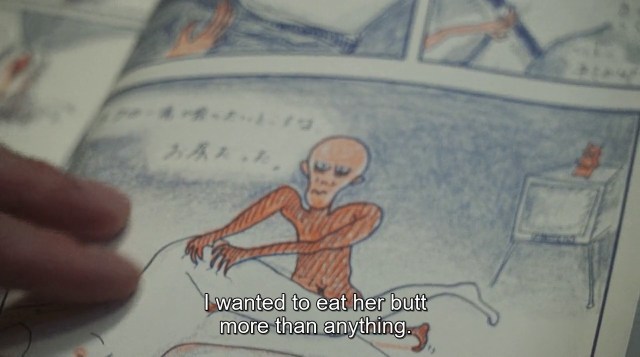
If we haven’t walked out by now, as many of the audience did at the early screenings in the Toronto and Venice film festivals, we are then treated to his commentary, now quite animated, on his manga – a comic-book format showing his murder, rape and cannibalisation of the young woman. His brother tut-tuts throughout, saying he doesn’t want to see such things, while Issei explains what he did, and what it meant to him.

“For a hideous person like me, she was out of reach.”

A bullet in the back of her neck was the only way he could think of to bring her into his reach.

“Finally the thing I was craving to eat was right in front of me! The stench doesn’t matter. I started with the richest part of her right buttock.”

The murder and cannibalism turned a shy, diminutive man-child into a fierce Samurai, in his own mind.

He describes the eating the flesh (the harvesting of which is shown in detail in the manga) as “an historical moment!” For that brief time, the woman was entirely his, and what Derrida called carnivorous virility gave him an absurd sense of masculine power as he “dominated” the woman’s corpse for his sexual and gastronomic pleasure.

There’s heaps more, but you’ll have to watch the film or get the manga – my blog has its limits.

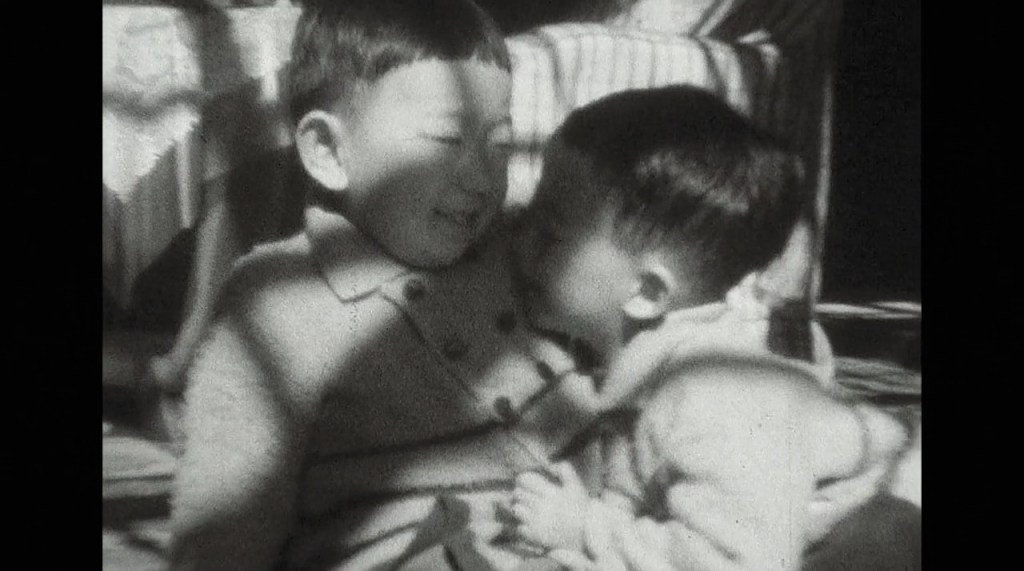
The film then disconcertingly lurches into home movies of the two men when they were cute little boys.

We are not given a commentary, but we know from other accounts that their uncle would dress up as a cannibal and capture them for his cooking pot. The psychoanalysts would eat that up, but we should consider that many of us are chased by various demented relatives in our childhood games without going on to become monsters in their likeness.

Issei’s brother Jun, now his carer, appears as the sane one in the family, but we are quickly disabused of that as we see his own self-abuse – he likes to wrap his arms in barbed wire, and cut his arms with knives. Everyone needs a hobby I guess. Issei is not impressed – compared to shooting a woman from behind and then having sex with the body and eating parts of it, a bit of cutting would seem fairly tame to him.

Finally we meet the carer, a young, attractive women dressed as a maid. This is actually Satomi Yôko, an actress playing a maid playing a carer, a further jolt to our fragile sense of reality. She giggles over Issei, telling him, as he stares into her breasts (a particular fetish of his):

She asks him if he wants to cosplay a zombie, and tells him a convoluted story about a zombie woman who eats the old man who keeps her in chains, a reversal of his history, and another fetish of Issei’s, who early in the film says “I want to be eaten by Renée.” She tells him:

“For the zombie to survive, I have to keep eating live humans… I’m alive, but I can’t be with normal humans.”

It’s a perfect summation for the fate of Issei Sagawa.

The only soundtrack is at the very end, The Stranglers’ 1981 song “La Folie” (“madness”) which concerned Sagawa’s crime.

It’s in French, but the partial translation is:

He was once a student
Who strongly wanted, like in literature,
His girlfriend, she was so sweet
That he could almost eat her
Rejecting all vices
Warding off all evils
Destroying all beauty

The film managed 53% fresh on Rotten Tomatoes, while the New York Times called the movie “an exercise in intellectualized scab-picking.” IndieWire summed up:

“Caniba” ranks among the most unpleasant movies ever made, but that doesn’t mean you shouldn’t see it.

There is another review of an earlier Sagawa documentary, The Cannibal That Walked Free on my blog. The film Caniba is available, if you are so inclined, from https://grasshopperfilm.com/film/caniba/

Serving your crew: DREAD HUNGER (eight-player cannibalism game)

Imagine you are trapped on a ship surrounded by ice in the Arctic, and some of your friends might actually not be whom they seem. Dread Hunger, a New Zealand computer game in which players can cannibalise their friends, has become a huge success, mainly in China.

I usually blog about cannibal movies here, or news stories about cannibalism when they break. This is the first game I have covered, although I am waiting to see the game “Borneo: A Jungle Nightmare” which is due for release this year – it is scripted and directed by Ruggero Deodato, who brought us one of the seminal cannibal movies in 1980: CANNIBAL HOLOCAUST. This game was originally going to have the same title, but is not a remake (in game form) of the original, but more like fourth in Deodato’s cannibal saga. Due out sometime in 2022.

Anyway, back to DREAD HUNGER! When the Christchurch company, Digital Confectioners, released the game earlier this year, they were hoping they might reach 10,000 players in the US. To their surprise, they found that more than 260,000 people in China play the game every day. Due to time zones, says Director Sam Evans, the demand is mostly between the hours of 12.30am and 5am New Zealand time (which for computer nerds is a fairly normal operating time).

Dread Hunger is a survival game set during an Arctic exploration in 1847-48. Players can build fires, fight off wolves, and hunt for food, including, sometimes, human flesh from their shipmates.

There are various weapons, and the players can also “pick up severed heads and limbs and use them to kill.”

One of the strategies is:

Betray Your Friends
Feed them tainted food, lure animals to attack them, hex them with blood magic, or if all else fails… just shoot them in the back.”

The game has become a target of hackers, including DDOS attacks and “cheats” where hackers find a loophole in the game code they can exploit to give players an unfair advantage.

Dread Hunger has just passed 1 million copies sold, a figure Evans called “insane”. The graphics are splendid and, well, graphic.

This has led to some new, if profitable, challenges.

“The American market largely treats games like a product. They buy the game, they play the game on average 10-15 hours over a few weeks, then they move on. But in China when they find a game they like, they play it for hundreds of hours, for years and years. This forced us to treat the game like a service. We now have to focus on continual development and regularly updating the game to add more cool features over time.”

The game is mainly based on the 1845 expedition of 129 men led by explorer Sir John Franklin, which left Britain for the Canadian Arctic in search of the elusive Northwest Passage. Their ships, the H.M.S. Erebus and the H.M.S. Terror never returned.

Rumours that the crew resorted to cannibalism have swirled around the doomed expedition since the nineteenth century. Evidence suggests that Franklin’s crew may have not only consumed the flesh of deceased compatriots, but also cracked their bones, to eat the marrow inside. In 1854, interviews with local Inuits described piles of human bones, cracked in half.

In 1864, Sir Edwin Landseer‘s painting Man Proposes, God Disposes caused a stir at the Royal Academy exhibition for its depiction of two polar bears, one chewing on a tattered ship’s ensign, the other gnawing on a human ribcage. Cannibalism did not get a mention – yet. 

More recently, in the 1980s and 1990s, researchers recovered remains of the crew on King William Island. Knife marks on the bones backed up early accounts of human cannibalism. A newer analysis of 35 bones by anthropologists Simon Mays and Owen Beattie suggests that the men did indeed eat each other. The bones showed signs of breakage and heating—indicating that the crew members probably cooked them to extract the marrow. Mays and Beattie published their results in 2015 in the International Journal of Osteology.

Horror writer Dan Simmons‘s 2007 book The Terror was developed as a 2018 AMC television series also called The Terror. The expedition has, over the years, taken on the mythic value to the British that the Donner Party holds in the USA.

One of the lines from the launch trailer (above):

“I have heard it said that this land can change a man. Turn him into a beast. Well, to that I would say—men were always beasts. Some you see, well, they’re just better at hiding it than others.”

Dread Hunger is what is called in games parlance a “social deduction game”. This is a category of game in which players attempt to uncover each other’s hidden role or team allegiance. It’s an ideal formula for a population who never know quite who the agents of their government might be. And also an ideal cannibalism game for the recent history of man-eating, in which the cannibals like Albert Fish, Jeffrey Dahmer, Issei Sagawa and Armin Meiwes all appeared as very ordinary, normal neighbours.

We all need to do some social deductions, it seems.

Issei Sagawa: THE CANNIBAL THAT WALKED FREE (Toby Dye, 2007)

The Cannibal that Walked Free (AKA Cannibal Superstar) is a British documentary produced by Visual Voodoo for Channel Five which explores the case of Japanese cannibal Issei Sagawa. It uses dialogues with police and psychiatrists and, most intriguingly, extensive interviews with the cannibal himself.

Sagawa murdered a young Dutch woman, Renée Hartevelt, a fellow student at the Paris Sorbonne, then mutilated, cannibalised, and performed necrophilia on her corpse over two days.

The mellow voice of the narrator, Struan Rodger (Chariots of Fire), announces:

“This man murdered and ate a woman in Paris… he has never stood trial. Today he walks the Tokyo streets a free man, a free man with an ongoing appetite for human flesh.”

Around midnight on June 13 1981, 32 year old the Japanese exchange student, Issei Sagawa, emerged from his apartment at 10 Rue Erlanger in the 16th arrondissement of Paris with two large suitcases, hailed a taxi and travelled the short distance to the Bois de Boulogne. His hopes that the park would be empty at night were in vain, and several witnesses saw this 4’9” (145cm) smartly dressed Asian man trying to drag two large suitcases to the lake. Worn out (and probably full of meat), Sagawa fell asleep on a bench and woke to find an old man opening one of the cases. When the old man began to scream, Sagawa walked calmly away.

The police found that someone had removed flesh from parts of the body. During the autopsy, they discovered there had been post mortem sexual intercourse – necrophilia.

Within four days, the police tracked Sagawa through the taxi driver, and he confessed immediately. In his refrigerator, they found a large quantity of human flesh.

On the table was a plate with pieces of cooked human flesh, condiments and mustard.

The case was reported globally with the press expressing horror and disbelief. Patrick Duval, Author Le Japonais Cannibal interviewed Sagawa for several hours.

Sagawa said that the feelings began when he was very young: “I was very weak, very ugly, like a small monkey.” He described as an important memory from his childhood a game in which his uncle would play a ravenous cannibal, out to gobble up Issei and his brother.

As he grew up, he felt unable to attract the kind of women that he desired:

“Object of my desire is definitely the white girl, beautiful blonde hair, blue eyes.”

Jean-Pierre Van Geirt – a journalist from Paris Match, said “Sagawa was deeply in love with Renée, and his love was so mad that he thought the most he could love her was to eat her.”

Sagawa had invited the young student to his apartment to discuss literature. He said he asked Renée to read a German language poem he had chosen, a poem about cannibalism, and that she was unaware that he was standing behind her, holding a rifle. He shot her in the back of the neck.

“I had decided before that the first bite would be the buttocks. I was able to cut through the skin, I’m a fool so I didn’t have a clue about human body structure. I thought that red flesh would appear straight away but it wasn’t like that, and this layer that was like sweet corn just carried on for ages, however deep I cut through. I couldn’t reach with my knife so I ripped out the flesh with my fingers and put it in my mouth. After I had sex with her, I tried to kiss her I said out loud I love you, in French. And I felt a huge shiver.

He had a tape recording of the murder and a camera with which had recorded the stages of what he did to Renée after her death; police found both in his apartment after his arrest. He had also saved a good deal of her flesh in his fridge, before packing up her remains in two suitcases.

Just 34 months after his confession, Sagawa would be a free man.  Found to be insane and unfit to stand trial in France, his father employed an influential French lawyer who argued successfully that it was unfair for the French taxpayer to pay for indefinite confinement in a mental hospital, and that he should be sent back to Japan to be cured. Accordingly, less than three years after his confession, Sagawa was put on a plane and sent back to Japan. The only condition was that he could never come back to France. He spent 18 months in a Japanese mental hospital but then checked himself out, and has been free ever since.

The interviewers tracked down his psychiatric report: it said

“He was hung up by his height, not self-assured, over-sensitive and most of all emotionally cold and self-satisfied when he talked about the murder. Someone who is capable of feeling guilty wouldn’t commit such an act. You have to be completely devoid of some human emotions. Among which is the sharing of the universal taboo of cannibalism.”

The interviewer visited Sagawa’s Tokyo apartment where he lives under a false name and found him enjoying Beethoven’s 9th Symphony – the second movement, popularised in the film Clockwork Orange. He claims that he wept for the victim’s family and for his family, who were devastated – his father lost his high-powered job, his mother attempted suicide.

Despite his alleged distress, in the mid-1980s he wrote a book “In the Fog”, against the express wishes of both his and Renée’s family. It is the story of his crime, written from his perspective. It sold out. He wrote a further 19 books about his crime, became a columnist in magazines, joined a symposium at a Japanese university and appeared in two stage shows, finally appearing in torture porn, including recreations of his crime, using tall, Western actresses.

Under his false name, he told the interviewer, he meets up with Western sex workers.

“My final desire is just the same – when I see all the beautiful girls’ legs, I want to eat. So I’m not cured at all.
But now, I’m not interested in at all the white women. I hate them. I found that Japanese women are the most beautiful in the world.”

Sagawa now feels the urge to cannibalise young Japanese women.

At the programme’s request, Sagawa agreed to attend his first psychiatric assessment in over ten years. In the documentary, he tells the Criminal Psychiatrist, Dr Susumu Oda:

“My libido and appetite are connected. This is very important. For instance, you see the beautiful girls on the train in summer, and you see their legs, don’t you. I think they look delicious.”

He says that he masturbates to make his feelings disappear.

Oda reported:

“A child suckles on his mother’s breast. A child survives eating breasts. So it is not that strange that a child would want to eat something he loves.”

Sagawa was small, weak and spoiled, so he never learnt to suppress those desires.

“Deep down, he doesn’t regret what he has done. He has a tendency to slowly turn the other person into an object. I think this is very dangerous.”  

The doctor’s conclusion:

Freud maintained that there are two “pregenital” forms of sexual organisation in very young children not yet predominantly motivated by their genital zones. The first of these he called “oral-sadistic” or “cannibalistic”, in which sexual activity is not separated from ingestion (the second was “sadistic-anal”), and he suggested that these were “harking back to early animal forms of life”. In this “cannibalistic” stage, “the object that we long for and prize is assimilated by eating and is in that way annihilated as such.” It is not surprising, therefore, that Sagawa wanted to eat his ideal woman, and he made a particular point of eating her breasts.

“Too Much Blood”, a song on the Rolling Stones‘ 1983 album Undercover, is about Sagawa and violence in the media. His crime also inspired the Stranglers‘ 1981 song “La Folie”. The Noise Black Metal band Gnaw Their Tongues released an EP titled Issei Sagawa in 2006.

The documentary is available in full on Youtube at the time of writing. The link is at the top of this blog.

A more recent look at Sagawa is the 2017 documentary Caniba.