


What a year! These are some of the cannibalism stories, films and songs that arrived in 2022, with links back to the original reports, so that you can look up the ones that catch your interest, and so that this blog does not take all of 2023 to read.
January
- A German man dubbed by the press the ‘cannibal teacher’ was convicted of murder and sentenced to life in prison. Stefan R., a 41-year-old maths and chemistry teacher, had apparently searched on the dark web for terms such as “long pig” and “fatten and slaughter people”. The man claimed his victim died of natural causes after a (presumably vigorous) sexual tryst, and he had removed the man’s penis “since my DNA could still have possibly been present due to the oral sex I performed”. In other words, he didn’t mind a bit of mutilation and perhaps cannibalism, but was concerned not to be “outed” as gay.

- Djalma Campos Figueiredo, 46, was arrested in Brazil. He had been sentenced by the Court of Justice of Rondonia in the city of Porto Velho to 42 years in prison for several counts of aggravated murder but had escaped custody. The Civil Police alleged he would eat his victims’ eyes and ears and drink their blood.
- Meanwhile, the Zamfara (NW Nigeria) State Police Command arrested a 57-year-old man, Aminu Baba, for allegedly eating and selling human body parts. Baba and three others were arrested after the murder of a nine-year-old boy. The Police Commissioner reported that Baba had “confessed that he usually ate the body parts and identified the throat as the most delicious part. He also sold some of the human parts to his customers.”
February
- A war between rival cartels in the Mexican state of Zacatecas graduated from the normal torture and beheadings to systematic cannibalism, with new sicarios (cartel assassins) being required to eat parts of their rivals before being allowed to graduate (or remain alive).

- In Afghanistan, we discovered that the Taliban were rounding up drug addicts and putting them in rehabilitation centres to detox, which is a nice thought, except that they gave them little or no food (“cold turkey” does not count), so they apparently resorted to cannibalism.
- In the Brazilian state of Tocantins, three men were arrested for murder. One of them, Rafael Araújo, claimed that the three had ripped out the victim’s heart and eaten pieces of it.
April
We have been following the case of an Idaho man, James David Russell, who was accused of killing and eating a neighbour in September 2021. This was a big deal for us in Cannibal Studies, because Idaho is still the only state in the Union to have a law against cannibalism, a statute that hit the books in 1990, but has never been used. In April, Russell was deemed fit to stand trial.

- In the Indian state of Assam, a man who had had perhaps more than a few drinks smelt cooking meat in a crematorium in a Hindu cremation ground. He helped himself to a few portions of the body, but was caught by villagers and handed over to police; but not before he had eaten about half of his purloined flesh.
May
- A man calling himself The Chinese Zodiac Killer was arrested by the FBI in Jefferson County, New York for sending letters to media outlets, government offices including the White House, and other organisations, claiming he killed people and ate their flesh, and that he plans to kill more. He seems to have based his story on the Zodiac killer who terrorised California in the late 1960s. The original Zodiac Killer (who was not accused of cannibalism) was never caught, but this one was easily found, posting his threatening letters (what century is this again?) at the same letterbox he had previously used.
June
- The case against James David Russell (see above in April) went to preliminary trial. Sadly, the judge threw out the charge of cannibalism, saying there was insufficient evidence to pursue it, and went with the rather more mundane offence of first-degree murder. Since this has a life sentence attached, the practical effect of dropping the cannibalism charge is negligible, but as the first cannibalism case in the USA, it would have been fascinating.
- A rumour swept the Internet that the actress Anne Hathaway was a cannibal, based on a cryptic Tweet saying “police didn’t find human remains and evidence of cannibalism in her LA home that she sold in 2013.” We were all later astonished to discover the whole thing was a hoax.

- The effects of the war in The Ukraine were starting to be felt in Europe and the UK (whose people often do not think it’s part of Europe). The Russians fell gladly on a statement from one Jeremy Clarkson (a car enthusiast) that “Hunger makes people eat their neighbours” to predict that the British will soon be a nation of cavemen feeding off each other. Of course, if you’ve ever been to a soccer match…

- industrial/electronic music duo SKYND released their tenth song, called ARMIN MEIWES, about the German man who killed and ate a willing volunteer.
- Back in the USA, the Utah County Attorney felt he had to go public to deny accusations that he and his wife are cannibals. Honest. I wouldn’t/couldn’t make this stuff up.
July
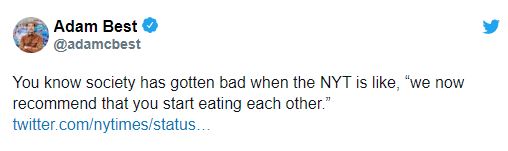
- The New York Times raised the temperature of the culture wars with its review of several books, movies and TV shows about cannibalism, culminating in the (somewhat tongue in cheek) statement that “Cannibalism has a time and place… that time is now.” The right-wing press predictably jumped on the story accusing the NYT of everything from irresponsibility to Satanism.
- Also in New York, Steven Spielberg whipped out his cell phone to record Marcus Mumford singing his new work, a haunting song called “CANNIBAL“. The song might be about love and lockdown, or it could involve child abuse.

August
- In Oju, Nigeria, a 45-year-old man was seen beheading his aunt and eating her head.
September
- DISCOVERY+ launched a three-part series called HOUSE OF HAMMER. The series explored allegations from various girlfriends of the actor Armie Hammer that he was a cannibal, or had at least threatened them with cannibalism. It also examined his relatives, many of whom seemed to be presented as even worse specimens than Armie.

- Russia discovered the war was not going well in Ukraine, and started recruiting murderers and rapists to be sent to the front as reinforcements. Also – one cannibal, Yegor Komarov, whose man-eating exploits we learned about in December 2021.
October
- In the Indian state of Kerala, there were allegations that a couple who ran a massage centre were bringing women home not so much for massages, but for human sacrifice and ritual cannibalism.
- In the US state of Michigan, Mark David Latunski, who had been arrested in 2019 for killing and eating his Grindr date, finally came to trial and entered a plea of guilty.

November
- Issei Sagawa, the “Kobe Cannibal”, died of pneumonia at the age of 73. Sagawa had killed and eaten a young Dutch fellow-student in Paris in 1981. He was found insane and sent back to Japan, where he was released and lived free ever since, making movies, writing books, and even becoming a restaurant reviewer.

- Rapper Comethazine released Bawskee 5, the 12th song on which was called “CANNIBAL“.
- Back in Brazil again! A patient in the Municipal Hospital of Nuovo Hamburgo in the state of Rio Grande do Sul attacked other patients, screamed and spat at people, and eventually chewed off his own fingers and toes. A witness said “while he was chewing his own meat, you could hear the crackling of bones in his mouth”.
December
- Mark Latunski, 52, was sentenced to life in prison without the possibility of parole on December 15 for the murder of his Grindr date three years previously. Kevin Bacon, 25, had been killed and mutilated by Latunski on December 24, 2019 at Latunski’s Bennington home. Latunski pleaded guilty in September to killing Bacon and eating one of his testicles, after stabbing him in the back and slitting his throat. In a victims’ impact statement, the victim’s father said “Evil does exist, and it touched us.”
On the screen
The big news on streaming television this year was Jeffrey Dahmer, the “Milwaukee Cannibal”, who took Netflix by storm with not one but two titles, despite having been killed by a fellow prisoner in 1994.

- Ryan Murphy and Ian Brennan’s docudrama called “MONSTER: THE JEFFREY DAHMER STORY“, which logged nearly two hundred million hours of watching in its first week of release
- Joe Berlinger’s third series of CONVERSATIONS WITH A KILLER, featuring previously unheard defence attorney tapes of interviews with Dahmer.
Lots of new cannibalism feature films in 2022, some of which I will catch up with next year:
- Luca Guadagnino’s BONES AND ALL, featuring Timothée Chalamet and Taylor Russell as teenage cannibals in a tender and gory road movie, has been getting heaps of publicity.
- Mimi Cave’s FRESH is a charming romcom, until the knives come out. A fascinating insight into ultimate consumerism.
- Leatherface came back (again!), this time older but no wiser. This is the ninth (!) instalment of the TEXAS CHAINSAW MASSACRE franchise, and went straight to Netflix.
- John Ainslie’s DO NOT DISTURB depicts a couple renewing their romance by taking peyote, but finding that this particular variant of the drug awakens a taste for human flesh.
- Leatherface came out to play again, this time as a fan-film prequel called THE SAWYER MASSACRE. Made on a shoestring but arguably superior to the other sequels and prequels.
- Liam Regan’s EATING MISS CAMPBELL, in which a vegan, goth student falls in love with her new English teacher and develops a taste for human flesh.
- Sean Patrick Flanery’s enjoyable road movie FRANK AND PENELOPE, in which a couple take on a cannibal cult in the wilds of Texas.
- Timo Vuorensola’s JEEPERS CREEPERS REBORN, the umpteenth take on a supernatural tale of the demon who eats people and incorporates their bodies, but only every 23 years.
- Fred Olen Ray’s PIRANHA WOMEN offers a totally believable story of women who turn into man-eaters because of an anti-cancer treatment.
- THE MENU has Ralph Fiennes as a demented chef and Anya Taylor-Joy as the fly, as it were, in his menu plan. There is no obvious cannibalism involved in the movie, but there is some speculation on-line about the final cheeseburger.
- ‘Ted Lasso goes cannibal’ in Adam Leader & Richard Oakes’ FEED ME, a jolly rant in which a grieving man wants to die, and a nearby cannibal wants to help him, but by instalment.

And now for something completely different
From out of the future, we have some new AI software of which Shital Shah, a senior research engineer at Microsoft, said:
ChatGPT is “a large language model that has been trained to generate human-like responses to text input.” In other words, you can ask it questions and receive (often) intelligent answers, rather than a series of links, like Google. You can try it for free (at the moment) here.
Naturally, I asked it questions such as “is meat murder” and it replied:
“Ultimately, whether or not eating meat is considered murder is a matter of personal belief and moral judgement.”
So, I barked back, like a prosector out for a conviction, “Where does that leave the cannibal?”
“Whether or not eating other humans is considered murder would also be a matter of personal belief and moral judgement. Most people would consider cannibalism to be morally reprehensible, as it involves the killing and consuming of another human being. However, there may be some individuals who do not see it that way, and their personal beliefs and moral judgement would dictate their view on the matter.”
The Internet has spoken, at last.





 The Cannibal Guy