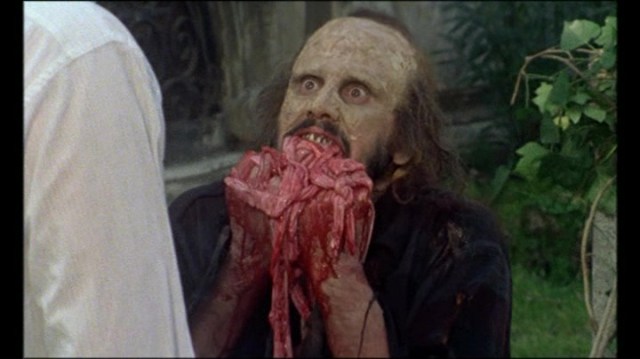
Meat is meat: THE MAD BUTCHER (Guido Zurli,1971)

Some months ago, I reviewed a film called Auntie Lee’s Meat Pies, in which I asked readers “What’s in your pie?” This film, The Mad Butcher (Lo strangolatore di Vienna), asks a far more profound question: “What’s in your sausage?” In each case, a better pronoun might have been “who”.

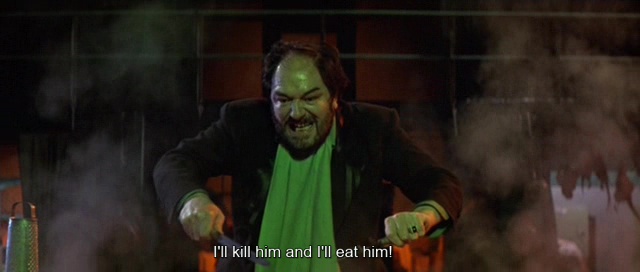
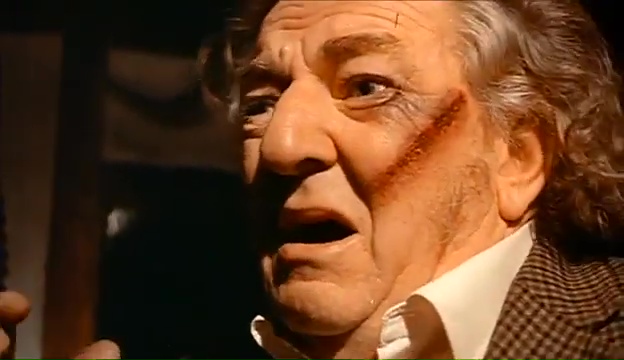
Guido Zurli was an Italian director but this film was made in English, set in Vienna and starred the wonderful, larger-than-life Hollywood actor Victor Buono, who plays the “Mad Butcher” of the title. In the USA, it was released as Meat is Meat, a better title IMHO – describing cannibals as “mad” is such a lazy approach, an intellectual shrug of avoidance. And to the butcher of this film, meat really is… just meat.
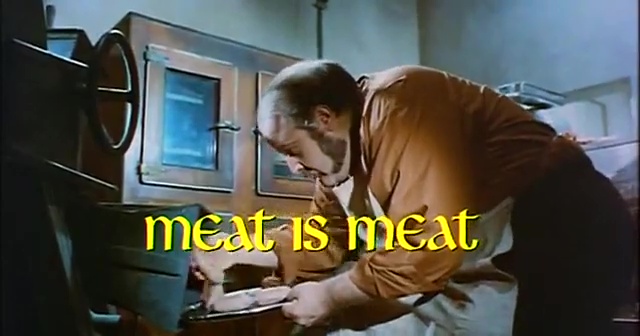
Otto (Buono) is dedicated to his calling – cutting up and selling animal flesh, and to him, the women he kills and minces are just that – meat. Otto has anger issues, which caused him to be confined to an asylum for three years, after slapping a customer with a piece of liver. But now he is being released, with an official certificate allowing him to say, “I’m not crazy now.”
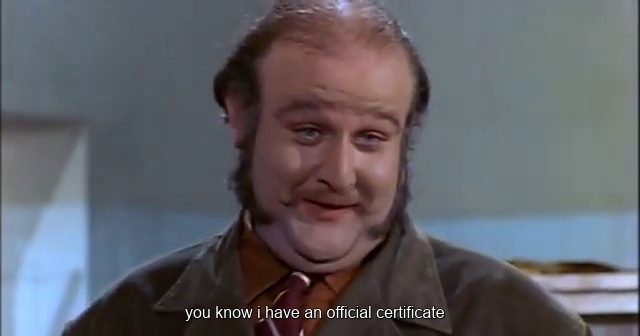
His wife, who had had him committed (to save him going to jail, she claims) wants him to come home with her, worried about what the neighbours will say, but he wants to move into his butcher store where, he tells anyone who will listen, he is “the best butcher in Vienna”.

While throwing from his window the rubbish left by his wife’s brother who was running the store in his absence, Otto sees a neighbour as she showers, in silhouette. She looks, well, edible to him.

His wife catches him staring at the neighbour and, during the resulting row, he strangles her. At first horrified, he realises that there is only one way to get rid of the evidence. After that, he has to dispose of a sex worker brought home by the brother-in-law, and then the brother-in-law, who he has spent much of the film calling a “pig”. Well, he is a very popular butcher, the best in Vienna, and after all, as he opines, “I need this meat.”

But then, when he manages to abduct the neighbour (she of the long showers with the lights on and the blinds open), he has to deal with the American protagonist – a journalist who inexplicably is allowed to hang out with the police and investigate their cases. Otto rips off her clothes (there’s a lot of that sort of thing) and promises her

“I’m not just the best BUTCHER in Vienna!”

As the logline says, in one of those double-entendres that haunt cannibal movies, “His sausage was a cut above the others!

This is more black comedy than traditional horror – Otto relishes turning his customers into innocent cannibals. They, in turn, rave about his sausages, lining up to buy them from his push-cart in the park.
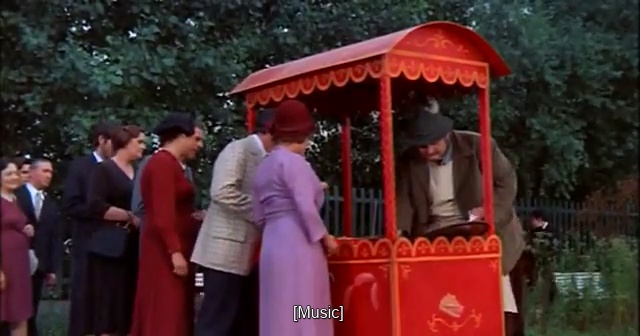
When his activities are disclosed, the police chief, who has been happily eating other animals all movie, is suddenly smitten by a serious bout of nausea.

“Those sausages that I ate! They were made of human flesh!”

The innocent cannibal theme has been popular since Sweeney Todd, who first appeared on film in 1928. Forty years earlier, Jack the Ripper had terrified the citizens of the heaving metropolis of London, brimming with workers drawn to the dark Satanic mills, driven into town by the centralisation of agriculture and the promise of gainful employment. Social cohesion seemed to be failing (isn’t it always?) and the cannibal was the figure who best represented the city as voracious beast. Henry James described London as “an ogress who devours human flesh to keep herself alive to do her tremendous work”. The “savage” of foreign climes who had so thrillingly filled the imaginative accounts of the colonial explorers had come home personfied as their own city, and the unknown faces dwelling within it were chief suspects. This was reflected in H.G. Wells’ first novel, The Time Machine, in which the proletariat, thousands of years in the future, have evolved into a highly technological cannibalistic tribe who feed off the soft, effete gentle people who are all that remain of the bourgeoisie.

Sweeney Todd took this to a new level, showing that even a “gentleman”, an apparently respectable member of society, could kill people. But Sweeney is never shown eating anyone; it is his customers, or the customers of his girlfriend who owns a pie-shop, who enjoy (immensely) the flesh of his victims. This could be done for revenge, as in the later, Tim Burton version of Sweeney, or for profit, particularly in times of shortage, such as Ulli Lomel’s Tenderness of Wolves concerning the German serial killer and cannibal Fritz Haarmann, who supplied meat of many species, particularly human, to his unwitting and grateful neighbours.

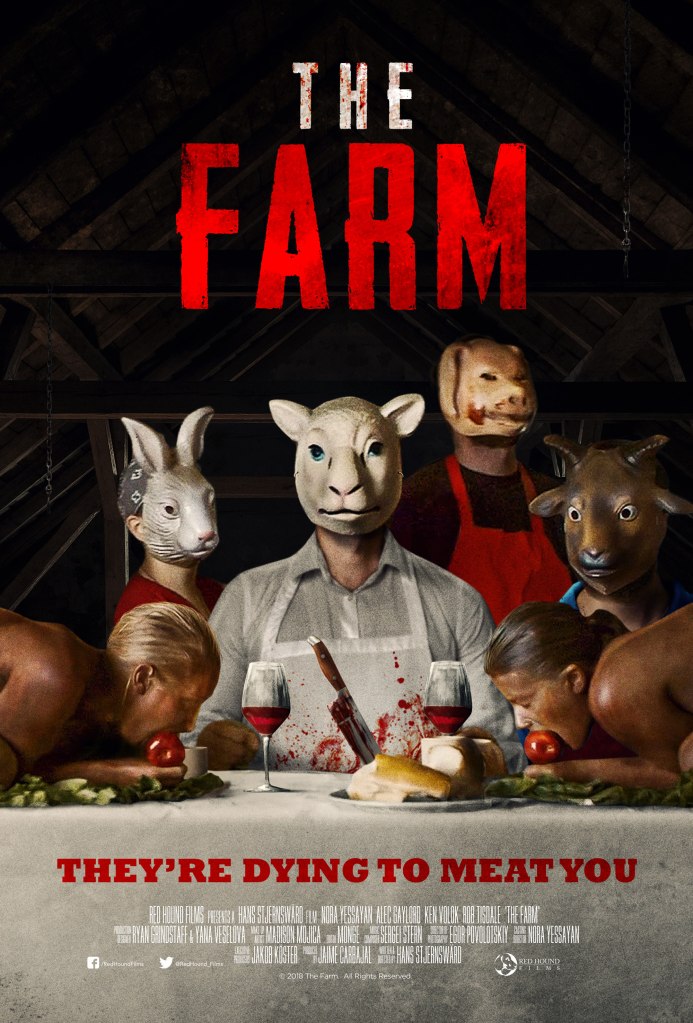
The outer limits of the world were still full of cannibalistic savages, but now they were in the same country – Texas Chain Saw Massacre featured a bunch of rednecks who captured tourists and fed them to other tourists (as well as catering to the extended family of course). But we were more worried about the cannibal in our midst, driven by the spectre of Ed Gein, an unassuming if eccentric man who dug up graves and used the bodies for ornaments, graduating into killing people and possibly feeding their flesh to neighbours as venison, an accurate term for animals hunted down for food and fun. A later version was Farmer Vincent in Motel Hell who collected tourists to serve in his motel, quoting his motto “meat’s meat and a man’s gotta eat!). Another slightly less light-hearted group of entrepreneurial cannibals like Vincent were the merry animal liberationists who farmed, milked, slaughtered and sold the flesh of those observed eating animals (to others who pay to eat animals) in The Farm.

Other films from all around the world feature butchers profitably selling human flesh for human consumption: The Butchers, Ebola Syndrome (from Hong Kong), Delicatessen from France, The Green Butchers from Denmark, and Barbaque (Some Like it Rare), also from France. In most of these films, the flesh of humans is found to be irresistibly delicious, until its provenance is discovered (although in Barbaque, only flesh from vegans has that special something). This is also the theme of Sweeney Todd even in the latest personification, The Horror of Delores Roach, in which New Yorkers line up around the block to buy the most delicious empanadas, unaware they are made of the chef’s landlord. Hitchcock had explored the same territory in 1959 with his episode called Specialty of the House, in which members of an exclusive men’s club crave the specialty “lamb Armistran”, which turns out to be the flesh of patrons who had enquired too deeply into the methods of the chef. Just so in this film, The Mad Butcher, which was the subject of this blog before I embarked on one of my legendary tangents.

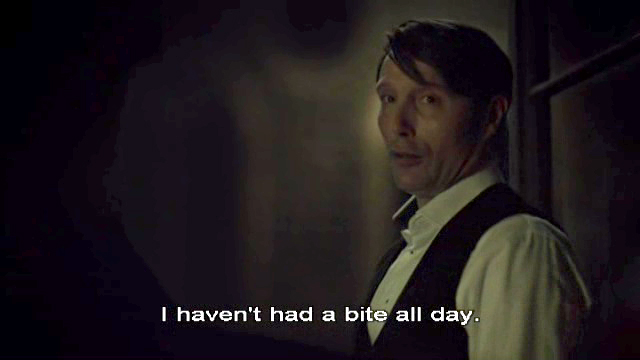
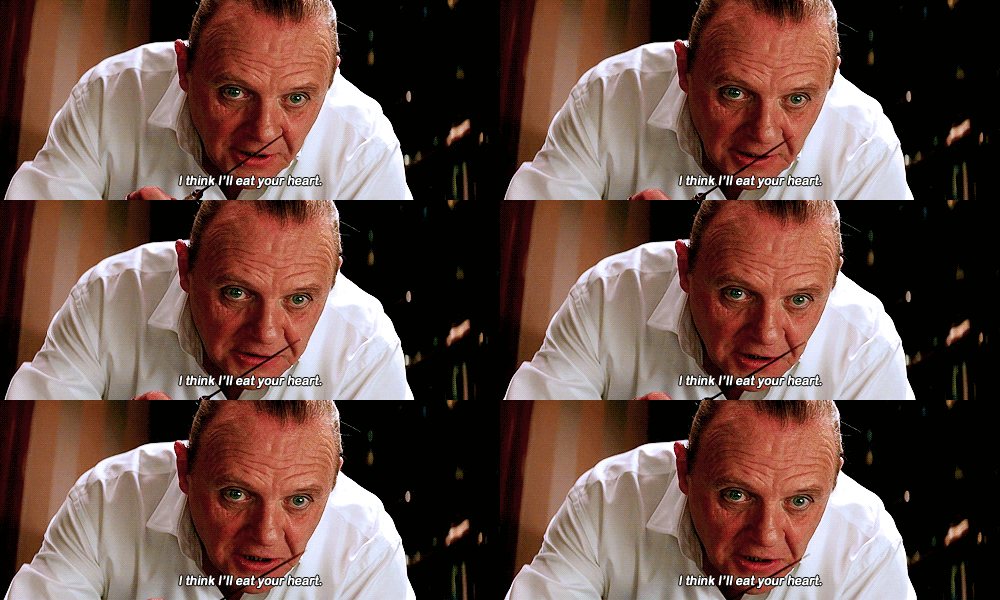
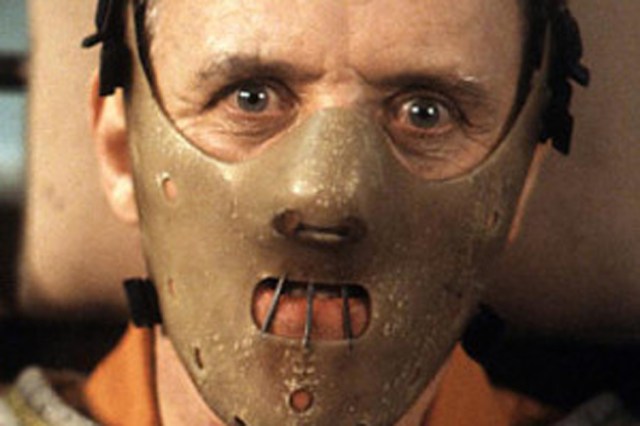
Hannibal Lecter, untypically, did not eat humans because they were irresistibly delicious, but because they were another species of edible mammals, inferior to Hannibal the Übermensch and those few he considered his equals, no more or less acceptable morally and gustatorily than any other meat animal. Hannibal found amusement watching his guests enjoy his cooking, not because of the type of the meat, but because of his gastronomical skills. Hannibal’s meals were just as delicious whether filled with human, cow, pig, sheep, or anyone else. It’s the preparation, what Claude Lévi-Strauss called “the cultural transformation of the raw”. Hannibal refined the rude into delicious concoctions. Otto feels the same way about refining annoying people through the artistry of his butchery.

“Let me explain. Animals tear meat. Butchers carve.”

Rotten Tomatoes gives this film a solid 42%, based on the wordless review of one critic. I think as cannibal films go it would be forgettable, except for the amazing performance of the great Victor Buono, who turns it into a melodrama, or even a pantomime. It is, whatever its critical failings, very watchable and a lot of fun, and for those who are interested in such things, there is no gore but lots of meat, and lots of dresses being ripped from female bodies. To the protagonist, Otto, sex is one more appetite, like hunger, easily satisfied by violence, and not to be denied by the stultifying conventions of society.

If you speak Italian, the full movie can, at the time of writing, be seen at: https://ok.ru/video/1511628212842

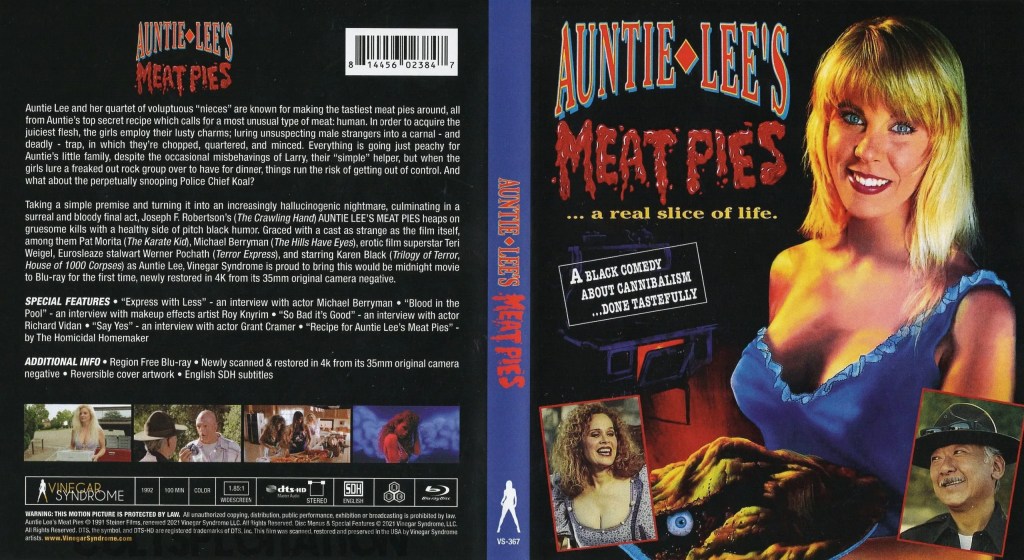
What’s in your pie? AUNTIE LEE’S MEAT PIES (Joseph F. Robertson, 1992)

This is described on the cover of the Bluray disc as:

“A black comedy about cannibalism… done tastefully”

The particular genre of this little known 1992 film is “innocent cannibalism” – humans slaughtered and made into meat dishes for sale to unwitting customers; those customers thereby becoming the cannibals. It’s eternally fascinating, because everyone at one time has pulled something a bit lumpy or fibrous from their pie, hot dog or burger and wondered what (or who) that came from.

The plot is simple, even simplistic. Auntie Lee (the wonderful Karen Black) is a Satan-worshipper who sends her nubile nieces out to lure men back to the house/bakery (often by shooting out their tyres and then offering them a lift) where they are slaughtered in various grisly ways and then chopped up and made into pies, which are irresistibly delicious and widely sought after in the nearby restaurants.

This trope started with Sweeney Todd, the “Demon Barber of Fleet Street”, a crucial figure to modern cannibalism. There are those who argue that Sweeney really existed and was hanged outside Tyburn Prison in London in 1802. At any rate, his story was popularised in the 1846 “penny dreadful” A String of Pearls: a Romance (Prest, 2010) and remains enduringly popular. Sweeney in his early nineteenth century incarnation insouciantly slaughters his clients, dropping them through a trap-door and supplying their corpses to his partner, Mrs Lovett, to use in her popular meat pies, unwittingly setting a precedent for the industrial slaughter facilities that would proliferate in following years. The first movie version was a silent film in 1928, in which the whole narrative turned out to be a nightmare. A 1936 version showed Sweeney as a true hedonist, a man who just enjoyed killing and robbing his customers. Several remakes have happened since, most recently a musical by Tim Burton. A Danish adaptation called The Green Butchers with Mads Mikkelsen, who later played Hannibal in the eponymous  television series, depicted unsuccessful butchers suddenly becoming wildly popular when they start serving human flesh. The 2021 French film Barbaque [Some Like it Rare] depicts French butchers hunting vegans whose flesh, unpolluted by animal products, turns out to be hugely popular with their customers.

Most recently, the Sweeney story has been reborn as a fictional “true-crime” podcast becoming a Broadway play, which in turn becomes a television series: the wonderful Horror of Dolores Roach, which I finished reviewing last week. Like Dolores Roach, Auntie Lee reverses the usual order of carnivorous virility—instead of the psychopathic male murderer (there is one, but he is dispatched quickly after raping one of the women), the killing is done by young, nubile women who lure men into traps which are increasingly intricate and gory. This is the monstrous-feminine – the male fear of what may happen when lust overcomes caution and the female reverses the birthing role and instead reabsorbs her victim.

The female killers are Playboy models, and were clearly chosen for talents other than their acting. However, other main characters are really good—Karen Black who has appeared in several horror B-movies is Auntie Lee, sending the girls out to bring home “the makings”, Pat Morita (Happy Days, Karate Kid) as the witless sheriff, and the inimitable Michael Berryman (One Flew Over the Cuckoo’s Nest (1975), The Hills Have Eyes), whose hypohidrotic ectodermal dysplasia gave him such an unusual appearance that he made a career from portraying everything from idiots to monsters.

Except for the wooden acting by the “nieces”, this is a well-acted, light-hearted if gory comedy, and many of the images are very striking.

At the end, after every man who enters the house is dead and being cooked, Auntie Lee and the nieces speculate about moving out of the town to New York City, where “we’ll never run out of beef”. In popular parlance, the brawny male is often called “beefsteak”, while sex is offered as a transaction, becoming almost indistinguishable from any other form of commodity, including feeding. As Coral says to the man she is leading to his death (using one of the most popular double entendres in Cannibal Studies):

“I can’t wait to have you inside me”

Such is the nature of modern capitalist cannibalism – the human is just another species, a resource like any other, potentially exploitable, vulnerable, even edible. Auntie Lee won’t cook Mormons or Californians, but New Yorkers are fair game, just as some people won’t eat pigs or dogs but will eat sheep or chickens. As Isaac Bashevis Singer said:

“As long as human beings will go on shedding the blood of animals, there will never be any peace.”

At the time of writing, the full movie is available on YouTube.

“He bit my thigh!”: THE HORROR OF DELORES ROACH, episode 5

Intertextuality is a term used to explain the way that similar or related texts influence, reflect, or differ from each other. In the start of this series, we heard the Stanley Holloway song “Sweeney Todd the Barber”, which this series clearly relates to, in that Sweeney would kill his hairdressing clients and send them down a trapdoor to the basement where his partner, Mrs Lovett, would fillet them into meat pies. The 2007 version of Sweeney differed from earlier versions by being a musical (!) and also giving Sweeney a motive—revenge—rather than just being, you know, batshit crazy. Intertexually, Delores turned a lot of this upside down: she was downstairs killing people; Luis was upstairs turning them into empanadas. The serial killer was female instead of male, the pastry cook male instead of female. The victims were not random people who needed a shave, but people who had pissed Delores off.

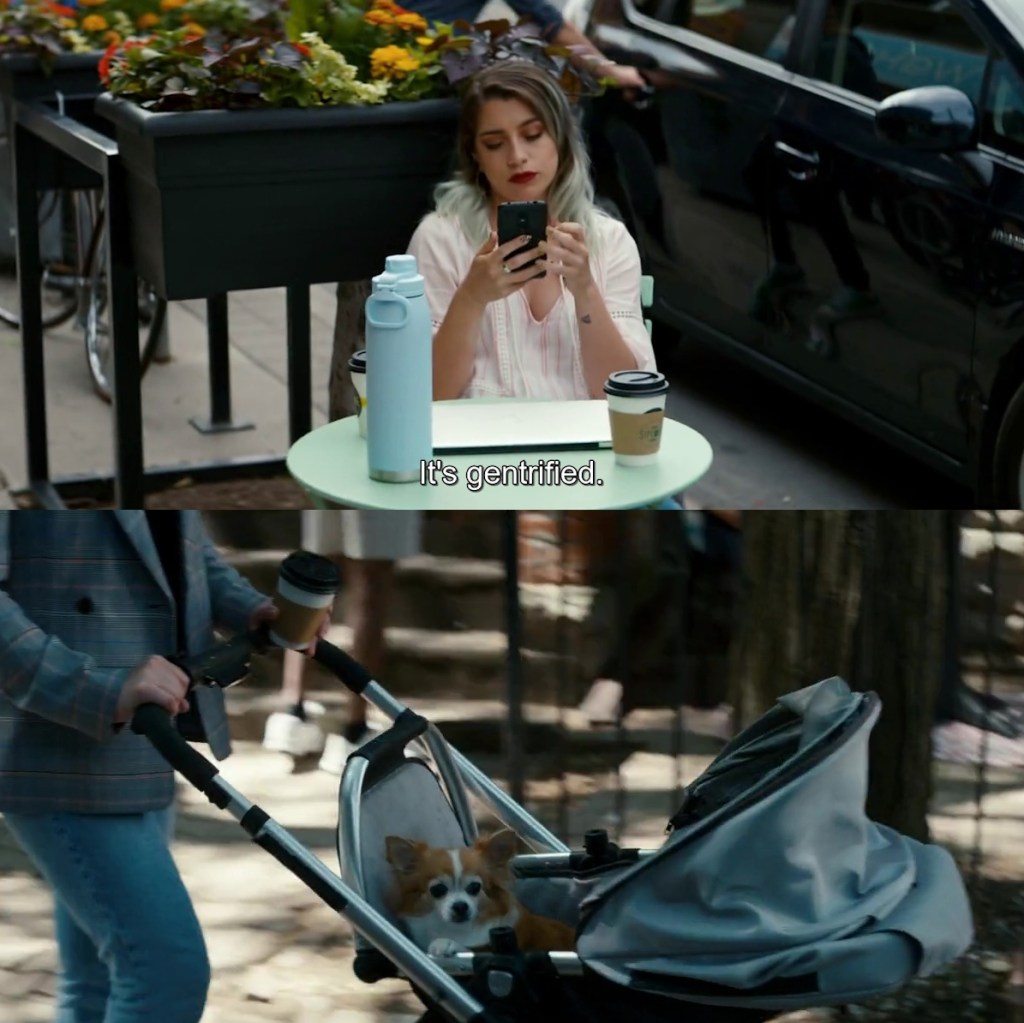
If you haven’t read my blogs on the first episodes, you might want to do that first. In a nutshell, in episode 1, Delores has just been released from prison after 16 years. She heads back to Washington Heights NY but it’s all gentrified now, except for the Empanada Loca shop of her old friend Luis, who offers her a room and sets her up as a masseuse, a skill she learnt in jail. In episodes 2 and 3, Delores kills the landlord who has been harassing Luis for his overdue rent, which he can’t afford because the neighbourhood is now fancy, and people don’t buy empanadas much. Luis creates a new empanada, MUY LOCO. It is hugely successful, like the chocolates in a recent blog, because it contains, yep, human flesh, in this case, the landlord, Pearlman. Whose son, Jonah, appears in the shop at the end of episode 3, with two cops behind him.
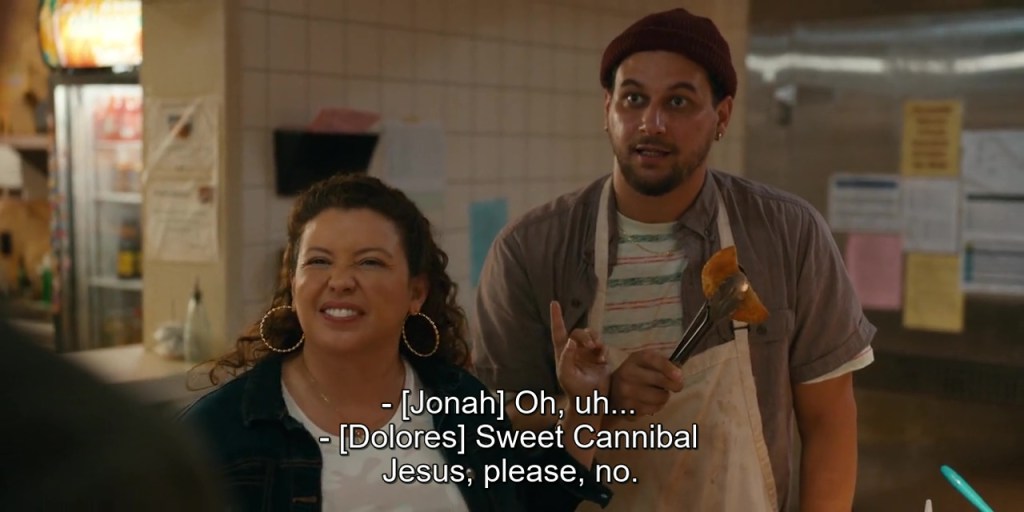
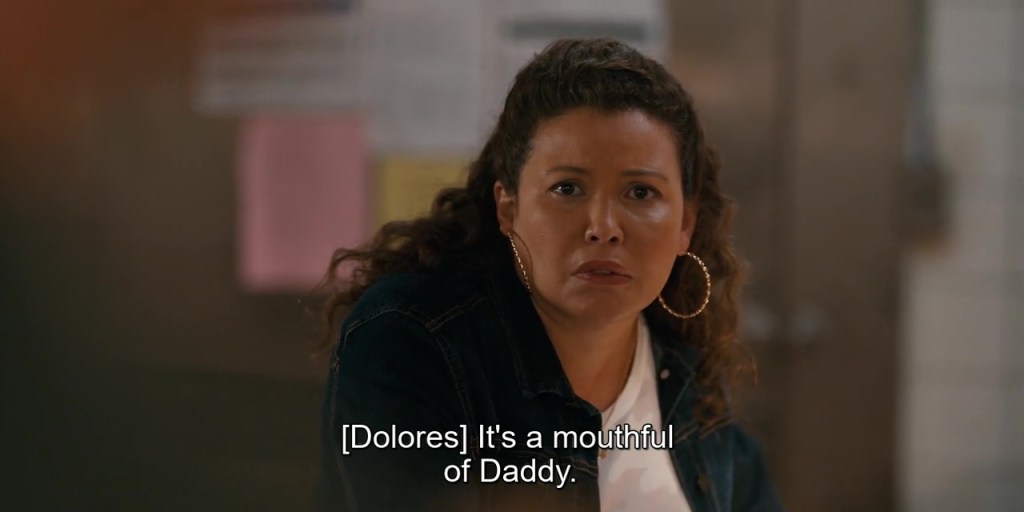
But in episode 4, it turned out Jonah didn’t know his dad is missing, and the cops are just waiting for their empanadas. But Delores is horrified by the idea of cannibalism (although, funnily, not so much the fact that the meat came from the body of the landlord she murdered) and disgusted by the secret contents of the muy loco empanadas—Mr Pearlman. She is particularly horrified when Luis offers Jonah an empanada to try, a muy loco, which she knows is a “mouthful of daddy”. Meanwhile, the local drug dealer, Marcie, has pissed off Delores, and now she is also in Luis’ fridge, and bits of her are in the empanadas.

So the link in the first half of the series was to Sweeney Todd, killing people and putting them in pies. But this story goes back well beyond Sweeney, to a new intertextual link, and the common thread now (besides pies) is revenge! Delores is intent on finding her ex who, she has discovered, set her up to take the fall when the drug police moved in, and who had been cheating on her all around town, including with Marcie. She is determined to put him in an empanada.

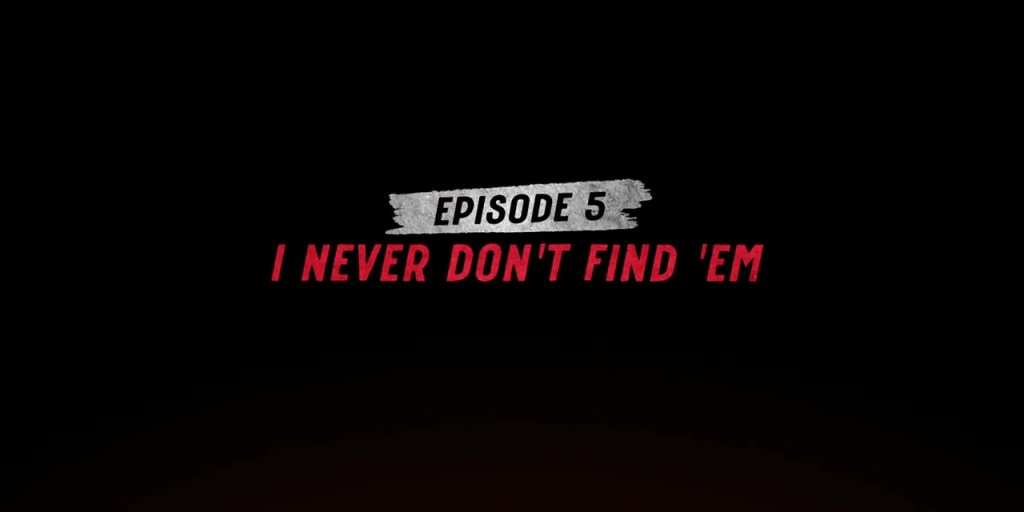
For this purpose, she goes looking for a friend of a friend, a Private Investigator called Ruthie, played by the wonderful Cyndi Lauper. Ruthie’s motto (or perhaps mission statement) is the title of this week’s episode:

I NEVER DON’T FIND THEM

Ruthie doesn’t like getting involved in drug issues (too dangerous), and warns Delores not to get her tangled in any such wars.

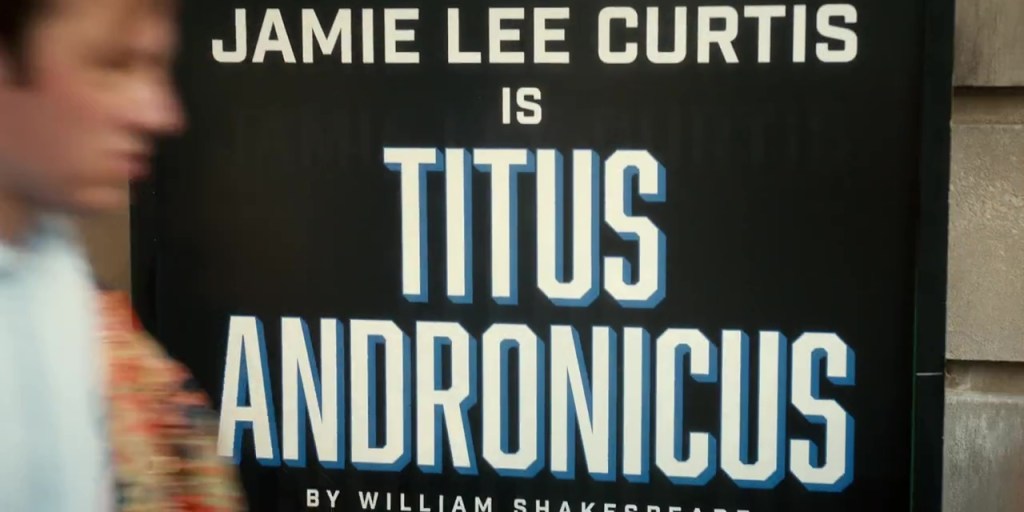
Ruthie also has a passion for the theatre, and is currently an usher in the Broadway production of Shakespeare’s Titus Andronicus, starring Jamie Lee Curtis. The production was invented for this series, which is a shame, as I would have flown to New York to see that!

Now, this link to Titus merits some unpacking…

Ruthie gives Delores tickets to see Titus Andronicus, which is all about a Roman general, Titus, who kills and cooks his enemy’s sons into a pie, which he then serves to the unwitting mother.

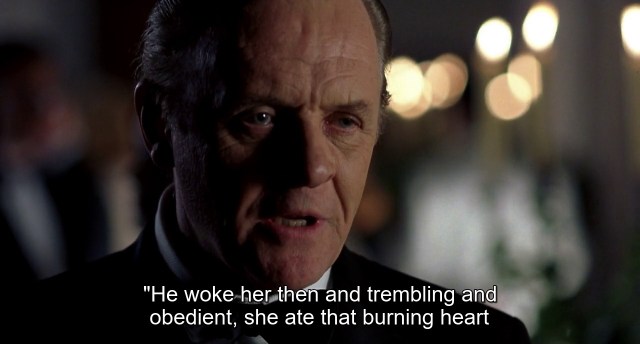
Shakespeare would have been well aware of the many Greek legends of revenge, particularly that of Thyestes, as told in Seneca’s play of the same name. Thyestes unknowingly ate the flesh of his sons, served by his brother, Atreus. Shakespeare used the trope in this, his first tragedy, which was filmed in 1999 as Titus, with Anthony Hopkins in the title role, again serving human flesh to his unsuspecting guests, eight years after winning his Oscar for doing just that as “Hannibal the Cannibal” in The Silence of the Lambs.

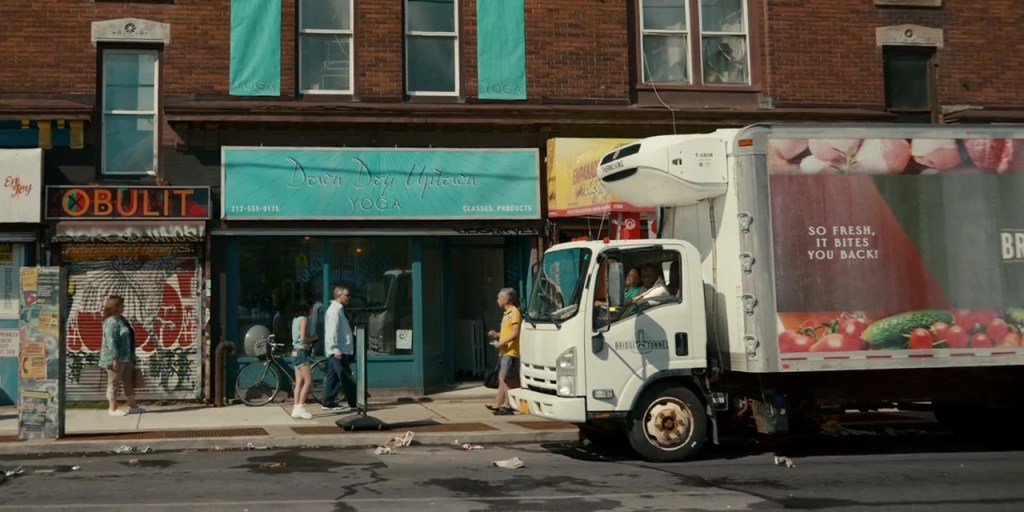
There are lots of other nice little touches, like the delivery guy, Jeremiah (named after the Old Testament Prophet of doom) asking why Luis doesn’t buy meat off him any more. “Doesn’t need to”, is what Delores doesn’t dare reply. Jeremiah’s truck has the slogan “SO FRESH, IT BITES YOU BACK”:

Then there’s the drug pusher who works (or worked) for Marcie, or as Delores calls her “cunt face”. Marcie is currently supplying filling for the latest batches of Muy Loco empanadas, but this dude doesn’t know that yet and is enjoying a Marcie empanada.

There’s problems ahead though. Jonah is now actively looking for his dad, who was Delores’ first murder victim. And he has run into Ruthie, who has promised him:

But Delores doesn’t want anyone to find him. She knows where Mr Perlman (and Marcie) are, and when she stumbles into Luis’ bathroom, she certainly finds them!

Delores is painfully aware that she can hardly be judgemental at what Luis has done to her victims.

“Maybe I didn’t chop these people up, but I did this.”

She makes up with Luis, who throws Jonah off the scent by sending a fake message from his father’s phone, and pledging that he will look after her, take the full blame if their crimes ever come out. They finally (five episodes in) head for the bedroom, where Luis performs cunnilingus, about as close as most humans come to cannibalism, and even crosses that line a little when he gets excited and bites her thigh.

Gynophagia, the fetish involving killing, cooking and eating women, is described by psychobiologist Clarence Herrick as a “morbid expression” of the universal desire to hug, often too violently, the object of our affection or desire, an extreme form of the grandmother painfully pinching a grandchild’s cheek or the child hugging to death a favourite kitten. So biting or in extreme cases eating women is perhaps rough love, an extended form of cunnilingus.

The thin red line between eating humans and eating other species has well and truly been crossed by the time Luis finally mounts Delores at the end of this episode.

“It’s a mouthful of daddy”: DELORES ROACH episode 4

This is such a great show. I was going to blog a couple of episodes at a time, but there is so much content in the short episodes that I had to do this one, the fourth, in splendid isolation. Also, I’m uploading it on father’s day (in Australia and probably some other places), and having a character eat some of his father just seems so pertinent!

If you haven’t read my blogs on the first episodes, you might want to do that first. In a nutshell, in episode 1, Delores has just been released from prison after 16 years. She heads back to Washington Heights NY but it’s all gentrified now, except for the Empanada Loca shop of her old friend Luis, who offers her a room and sets her up as a masseuse, a skill she learnt in jail.

In episodes 2 and 3, Delores kills the landlord who has been harassing Luis for his overdue rent, which he can’t afford because the neighbourhood is now fancy, and people don’t buy empanadas much. Luis creates a new empanada, MUY LOCO. It is hugely successful, like the chocolates in last week’s blog, because it contains, yep, human flesh, in this case, the landlord. Whose son, Jonah, appears in the shop at the end of episode 3, with two cops behind him.

All caught up, and now we’re at episode 4. It turns out Jonah does not know his dad is missing, and the cops are just waiting for their empanadas. But Delores does not want to go back to jail, having just got out after sixteen years, so you might think that finding Luis destroying (or actually cooking and selling) the evidence should be good news, but (call her old fashioned) she is horrified by the idea of cannibalism (although, funnily, not so much the murder she committed) and disgusted by the secret contents of the muy loco empanadas.

This dissonance between getting rid of the evidence of her rather serious crime and disgust at the fact that the evidence is being fed to an enthusiastic clientele is aggravated when Luis offers Jonah an empanada to try, a muy loco, reminding us of the lyrics of the old Stanley Holloway song about Sweeney Todd, on whom this story is based:

“For many a poor orphan lad
The first square meal he ever had
Was a hot meat pie made out of his dad
From Sweeney Todd the Barber”

Luis tells Jonah “the meat’s locally sourced” which is particularly true for him. Jonah loves the taste, asks if the meat is duck.

No, it’s no duck. We hear Delores’ thoughts:

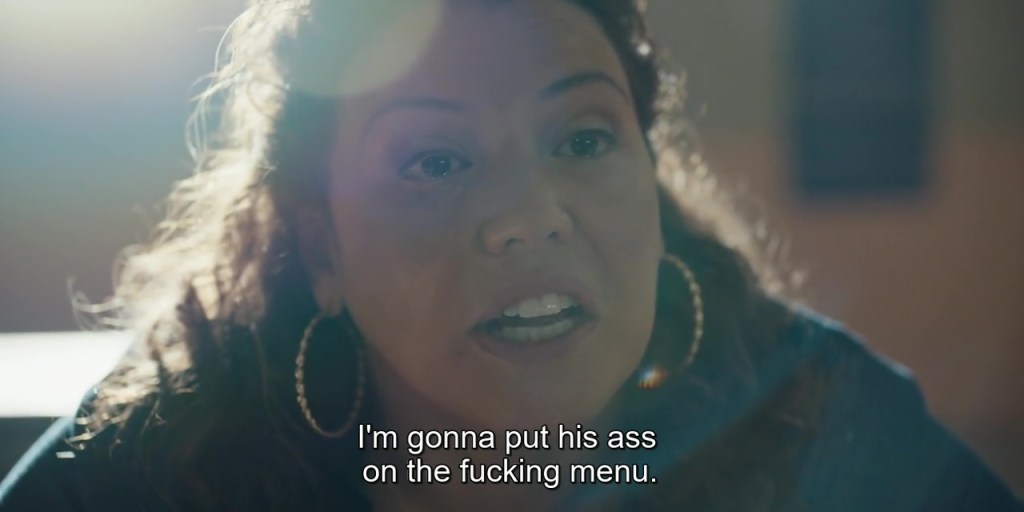
Furious at Luis for feeding the landlord to his son, Delores takes the rest of the meat and sets fire to it, putting the muy loco off the menu. Luis is furious, and cannot see what the problem is, and then comes one of the great double entendres of the cannibal genre –

Luis barks at her:

“Hey, it’s edible! Like the Greek myth.”

Now we’re getting to the meat of the cannibalism debate!

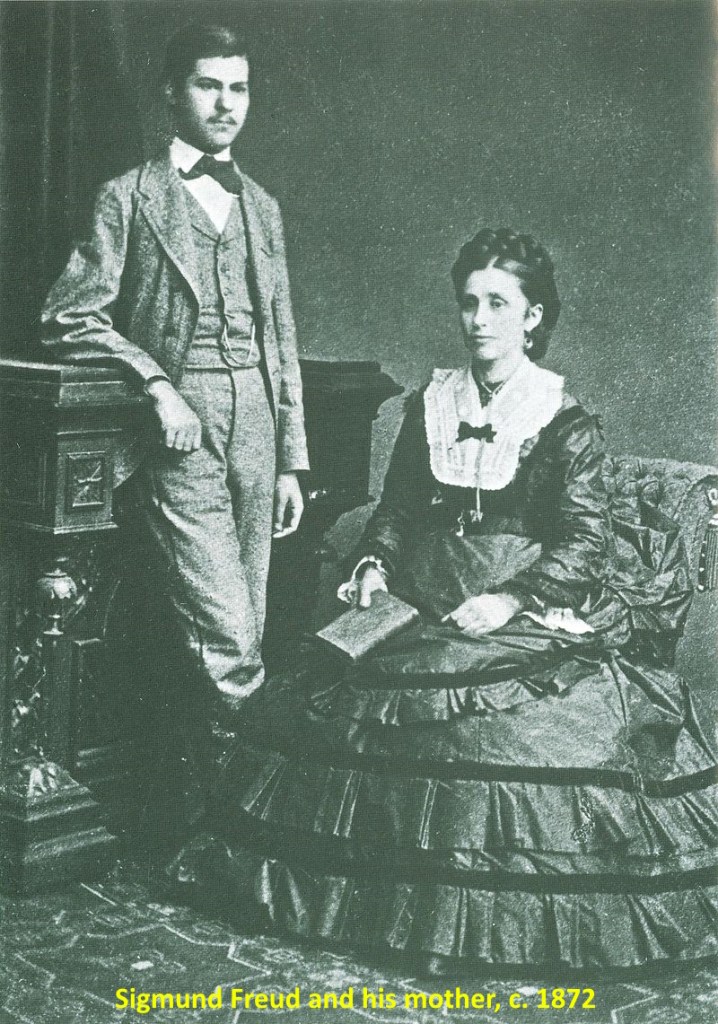
Quick refresher: Oedipus was a mythological figure depicted in the play Oedipus Rex written by Sophocles some 2500 years ago. Oedipus became king of Thebes after unwittingly fulfilling a prophecy that he would kill his father, Laius (the previous king), and marry his mother, Jocasta (whom Oedipus took as his queen). It was more a case of mistaken identity and road rage than some deep psychosexual drive, but Sigmund Freud used it as the basis of what he called the Oedipus complex. This referred to a child’s sexual desire for the opposite-sex parent and hatred for the same-sex parent which, if not reconciled, leads to neurosis. Freud wrote that,

“It is the fate of all of us, perhaps, to direct our first sexual impulse towards our mother and our first hatred and our first murderous wish against our father. Our dreams convince us that this is so.”

Oedipus didn’t eat his father, but Freud believed that cannibalism is a foundation of the human unconscious. He asserted that cannibalism is one of the two original prohibitions of humankind, the other being incest. Freud’s conception was that the origin of human civilisation was an act of incestuous patricide and cannibalism by a group of pre-sapien savages, which became the origin of cooperative civilisation. In Totem and Taboo, he speculated that a prehuman group of brothers in a “primal horde” had come to resent their father’s monopolisation of the tribe’s females (common among primates) and conspired to kill the father and take their mothers and sisters for themselves. “Cannibal savages as they were, it goes without saying that they devoured their victim as well”. A later wave of remorse led these conspirators to create “out of their filial sense of guilt the two fundamental taboos of totemism”, the proscription of cannibalism and incest. This father/son guilt, he argued, corresponds with the Oedipus complex, which he called “the nuclear complex of the neuroses”.

So Jonah, like Oedipus has unwittingly eaten human flesh, the flesh of his father, not knowing what it was. If Luis had said it was duck, he would have believed him, and accepted that contentedly, because social conventions say we can eat ducks, but not dads. Yet the taste is so close that he couldn’t tell the difference. And since his dad was already dead, was this worse than deliberately killing a living, sentient duck?

Meanwhile, the local drug dealer, Marcie, accuses Delores of selling drugs and stealing her customers, because of the long queues of people waiting for muy loco empanadas. Delores tries to persuade her she is running a massage business and takes her downstairs for a massage, where Marcie starts to vandalise her room looking for drugs, and mocks her for protecting her old boyfriend, revealing that he cheated on her and eventually turned her in to the DEA to save his own hide. They fight, and Marcie becomes the new supply for the next batch of muy locos.

Delores is determined to find the cheating boyfriend. When she does, she promises,

Deep tissue cannibalism: THE HORROR OF DELORES ROACH Episode 1 (Aaron Mark, 2023)

This is not only a fabulous story, but possesses a proud heritage in the field of Cannibal Studies, and is not afraid to flaunt it. Delores Roach is a young woman in a basement in Washington Heights Manhattan, who gives massages for a living, occasionally killing her clients and delivering their bodies to Luis, who runs the struggling empanada store above, to use as meat. Yes, it is unapologetically the offspring of the legend of Sweeney Todd, the “Demon Barber of Fleet Street”, who killed his customers instead of shaving them and then dropped them through a trapdoor to his colleague and perhaps lover, Mrs Lovett, who turned them into delicious meat pies. There is some controversy over whether or not Sweeney was a real person who was publicly hanged outside Newgate Prison in 1802 or just an urban legend of early capitalism. In any case, Sweeney appeared in a number of movies; in 1936 he was just plumb crazy, while in 2007 Tim Burton made him an honest man wronged by a corrupt power establishment. Burton’s film is based on a Sondheim musical that played interminably on Broadway and around the world.

In this version, Delores (Justina Machado) turns everything upside down; it’s Sweeney through the looking glass. We’re in New York instead of London, with a female serial killer instead of a male, and a male pastry chef instead of a female. Delores is downstairs killing people for Luis who is upstairs cooking them, again turning the Sweeney legend upside down. Like Sweeney, at least in the Tim Burton musical version of the story, Delores has returned from a long and unjust term of incarceration.

She finds her shabby neighbourhood, Washington Heights, gentrified after 16 years in the slammer, to the extent that she doesn’t even recognize any of the shops. A lot of the reviews seem to focus on gentrification as the main crime in this story.

Except for her favourite fast food store, Empanada Loca, run by Luis (Alejandro Hernandez), the son of the man who used to make the empanadas. He has a soft spot for Delores, who used to pay him in cash and spliffs when he delivered her lunches. Luis offers her accommodation, for old time’s sake, and maybe the odd massage.

There are plenty of stories based on butchers serving human meat to unwitting customers, turning them into innocent cannibals. Among them are Hitchcock’s Speciality of the House, Mielche’s The Butchers, Yau’s The Untold Story, Jensen’s The Green Butchers, Stjernswärd’s The Farm and Eboué’s Some Like it Rare. And of course our old friend Hannibal, who tells his guests “Nothing here is vegetarian”.

Burton’s Sweeney Todd was based on a Broadway musical, but Delores is a generation later, and so now her Broadway show is based on a more contemporary form of popular culture, the TRUE CRIME podcast.

Of course, it’s not true, but in the postmodern age, a true crime podcast needs a true crime, which is also confected for our narrative pleasure.

The podcast becomes a Broadway play, with the actor Jessica Pimentel (Orange is the New Black) playing Flora who is playing Delores in the play (stay with me here). Her performance is a triumph; in her final soliloquy she is covered in blood and holding a human heart.

The performance of the play, and the episode we are watching, both end with a song: Stanley Holloway’s “Sweeney Todd the Barber”:

“Sweeney Todd the barber,
by gob he were better than the play
Sweeney Todd the barber,

I’ll polish them off he used to say
and many’s  the poor young orphan lad
had the first square meal he ever had
a hot meat pie made out of his dad
from Sweeney Todd the barber”

For those of us who have been waiting for this series, or those who just saw the advance publicity, we are now in the omniscient position of knowing what is going to happen. We have seen the newspaper headline of the “real” murder and the review of the “real” true crime podcast, and seen the full house audience cheering the performance. In case we aren’t sure, a couple of friends pour drinks in Flora’s dressing room, chatting about the play and its reflection in the “real” world.

“…the café in Taipei serving human flesh dumplings?”
“Yes, yes, yes, yes and the human bone marrow in that bistro in Paris!”

Then the “real” Delores appears in the dressing room after the friends leave. No, not to murder Flora for impersonating her, but to tell her the true story.

“I’m gonna tell you shit you could never un-know.”

So now, we have a dramatisation of a fake true crime podcast about an actual crime that doesn’t exist, and the dramatisation is being applauded for creating a wave of actual cannibalism events (that also didn’t happen). They concern a female serial killer who is based on a male serial killer who also probably didn’t exist. An actor playing the (unreal) serial killer is telling her story to the actor playing the actor who is playing that serial killer. It plays (sorry) with the mind.

So does cannibalism. Except for a few rare cases where the cannibal is prepared to admit all his or her activities, such as Albert Fish, Jeffrey Dahmer and Issei Sagawa (who laid out the whole project in a manga), cannibalism narratives are very difficult to nail down. Some like Ottis Toole over-confess, leading to speculation that they are making it all up, helped by police who want to clear the cold case log. Others deny everything. And some just disappear and are never found, like Jack the Ripper. Cases of cannibalism are so sensationalised that the reports of the popular press are dubious in their accuracy.

But what we do know is that cannibalism is real, and is one of the primal drives among every type of animal from comb jellies to humans. Freud and Abrahams called the first six months of an infant’s life “the cannibalistic stage”. We all have a cannibal inside; it just comes out more readily for some people than others.

The series is a Blumhouse production on Prime Video and is so good that I am spreading this blog over all the episodes. Among the many great names to appear in future will be Cyndi Lauper as a detective.

Cannibals just wanna have fun.

Human pastries: Os Canibais de Garanhuns (The Cannibals of Garanhuns, Brazil)

In 2012, police in Garanhuns, Brazil, arrested for murder Jorge Beltrao Negromonte da Silveira, his wife, Isabel Pires, and his mistress, Bruna Cristina Oliveira, who all lived together in a group they called “The Cartel”. Residing with the Cartel was a small child named Vitória, who had been the daughter of their first victim. In 2018, all three adults were found guilty and sentenced to decades in prison.

However, the worldwide public interest in the crimes did not stem from their murder of three young mothers, but from the fact that the Cartel stripped the flesh from the victims and baked them into salgados, salty, deep-fried pastries, which were then sold to the unsuspecting public. To the disappointment of the media, the pictures of the perpetrators showed them as three ordinary Brazilian people, not the monsters the public had expected.

Isabel Pires, left, Jorge Beltrao Negromonte da Silveira, and Bruna Cristina Oliveira

This case, one of about one hundred reported incidents involving cannibalism since the year 2000, is of particular interest because it incorporates many of the issues considered in this blog.

  1. Reports of cannibals from earliest times almost invariably labelled them ‘monsters’, the same term the media used in this case to describe the members of the Cartel. Silveira muddied this even further by accusing his mistress Oliveira of being a witch, who had tortured him and Pires into taking parts in “purification” rituals.
  2. Cannibalism has been a useful accusation against colonised peoples since the time of Columbus, and Brazil has been particularly singled out in the literature as offering indisputable examples of “savage” cannibalism. Gananath Obeyesekere, one of the foremost scholars of cannibalism, writes that he omitted a chapter on the Tupinamba of Brazil from his book Cannibal Talk, which casts significant doubt on the existence of systemic savage cannibalism, partly because of the passionate commitment of Brazilian scholars to the “empirical reality of conspicuous anthropophagy”.
  3. Contemporary narratives of cannibalism, particularly since Jack the Ripper, assume that there are psychogenic bases for the act; de Silveira was found to have written a book called Revelações de um Esquizofrênico (Revelations of a Schizophrenic).
  4. Unknowing cannibals are often described as “innocent” in that they are offered meat without recognising its provenance. The enduringly popular Sweeney Todd, the ‘demon barber of Fleet Street’, is supposed to have, in the late eighteenth century, murdered his customers and furnished their flesh to his accomplice, Margery Lovett, who turned them into meat pies for her unknowing but enthusiastic customers, just as the Cartel did with their salgados. In neither case were there any misgivings because, according to da Silveira, human meat tastes almost the same as beef.
  5. Reports of cannibalism usually leave readers hungry for explanations – the motivation of the act. The Cartel chose its victims partly on the basis that they were tackling overpopulation by killing off single mothers who were unable to care for their children. The Cartel had its own methods of selecting victims, involving not just their unmarried maternity but a set of rules provided by “spiritual entities” which determined which women were evil and should be killed, based on the numbers on their identity cards adding up to 666.
  6. At the heart of this case lies an ethical question: is there a fundamental difference between a salgado (salty) snack full of beef and one filled with human meat? The premise of arguments for such a difference is the concept of anthropocentrism, the belief that (some) humans can transcend their disowned yet undeniable animality, and attain a higher moral status than other animals, such that intentionally killing a human is ‘murder’ while killing other animals is considered commercial harvesting. This sometimes called “speciesism”, except that there has never existed a culture where humans honestly considered all other humans their equals, or sometimes just human narcissism.

Silveira was sentenced to 71 years in prison, while his wife received 68 years and his mistress 71 years and 10 months. This is on top of another conviction in 2014, where the trio were found guilty of killing Jéssica Camila da Silva Pereira. Silveira was sentenced to 23 years in prison for that murder, while his wife and mistress were each sentenced to 20 years.


References

Araújo, E. L. V. M. d. (2018). Estudo do Caso dos Canibais de Garanhuns. (Law thesis), Centro Universitário Tabosa De Almeida, Caruaru, Brazil. Retrieved from http://repositorio.asces.edu.br/handle/123456789/1548 

Haining, P. (2007). Sweeney Todd: The True Story of The Demon Barber of Fleet Street. London, Robson Books.

Hunter, B. (2018). “Cannibal killers served flesh-filled pastries to neighbours” Toronto Sun, (December 18). Retrieved from https://torontosun.com/news/world/cannibal-killers-served-flesh-filled-pastries-to-neighbours

Lam, K. (2018) “Cannibal trio sentenced for killing women, stuffing flesh into pastries”, New York Post, (December 17). Retrieved from https://nypost.com/2018/12/17/cannibal-trio-sentenced-for-killing-women-stuffing-flesh-into-pastries/

Obeyesekere, G. (2005). Cannibal talk : The Man-eating Myth and Human Sacrifice in The South Seas. Berkeley: University of California Press.

Other fun cannibalism facts can be found at: thecannibalguy.com/category/cannibal-news/ and thecannibalguy.com/category/on-cannibals/

What’s your favourite cannibal movie?

Of all the (sometimes) wonderful cannibal movies and shows I have reviewed in this blog, my personal favourite is still The Silence of the Lambs with Anthony Hopkins as Hannibal the Cannibal. It was the first film I reviewed on this blog (does that mean I liked the others less each time? Not at all), and interestingly, it does not actually feature any cannibalism, although we hear a lot about it.

Fun fact!

So I was pretty chuffed to find that The Silence of the Lambs is the favourite horror movie of the State of Utah, according to the Horrornews.net website. They used information from Rotten Tomatoes and Google Trends, and partnered with Mindnet Analytics, to analyse how interest in horror movies varied in each US state and the District of Columbia (DC). The results are presented on their website:

Best Horror Movies: Which Does Each US State Love Most?

This survey covers all horror, whereas in this blog we concentrate on the cannibal, so please let us know your favourite cannibal film (or TV show, but if it’s a series, your favourite episode) either in the comments at the bottom of the page (after a few suggestions) or at cannibalstudies@gmail.com. I’ll let you know the results.

Family feeding frenzy: FRIGHTMARE (Pete Walker, 1974)

The British Daily Telegraph called this movie a “moral obscenity”, or perhaps that was their mission statement. The trailer (above) is a hoot, offering the warning

Of course, these ‘small segments’ which are the only ones they dare show are the most gruesome parts of the movie. If you’re coming for the gore, just watch the trailer. But Frightmare has a lot more to offer than just slasher-fare. It is a British film, which is pretty refreshing in itself, as the British tend not to make a lot of cannibal films, sadly. Among the best are Revenge of Frankenstein, and Death Line. The Brits like to analyse their cannibals, find behaviourist explanations of their eating preferences. This film is in that tradition, but with some nice variations.

The film was variously titled Frightmare, Cover Up and Once Upon a Frightmare. Released in 1974, it was directed by Pete Walker, who spent the 1970s battling the censors with a string of gory movies, which didn’t set the box offices alight, but eventually became cult classics, particularly this little cannibal thriller.

 The story starts with a shy young man (Andrew Sachs, best known as Manuel from Fawlty Towers!) asking to be allowed into a trailer-home, from whence we know he will not be departing.

He’s not from Barcelona…

Then we see a very cranky judge sentencing Edmund and Dorothy Yates to a mental institution; he had hoped to send them to the gallows, but unfortunately there was this medical report…

Seventeen years later, Dorothy (Sheila Keith from Ballet Shoes) and Edmund (Rupert Davies from The Spy Who Came in from The Cold) have been deemed officially cured, and live in an isolated farmhouse. Dorothy ate at least six people in 1957, while her husband was convicted as well, having faked insanity in order to remain with his wife, although in reality he had not been involved in her murders. But that’s all in the past, says Dorothy, who now is just a harmless old pensioner. Dorothy has taken up hobbies, including needlepoint, and the use of power tools.

In the current day (well, 1974) Dorothy is back to her old tricks. She lures lonely and friendless young people to her home, promising tea and tarot card reading, at which she is deadly accurate, as the session always finishes with the same tarot card.

Then there’s the kids – Jackie (Deborah Fairfax), Edmund’s daughter from a previous marriage, who seems relatively normal, and Debbie (Kim Butcher), Dorothy’s actual daughter, conceived shortly before Dorothy was committed to the asylum; Debbie has never met her parents. Debbie is only fifteen but rides with a violent bikie gang and has apparently inherited her mother’s appetite for human flesh. She initiates a fight in which her boyfriend and his gang beat to death a barman, who had refused to serve her because she was under-age. The bikie gang flees when witnesses arrive, but Debbie stays, and carries off the body. Jackie meanwhile is delivering packages every week to her step-mother. They bleed, and they turn out to be the brains of some unfortunate sentient animal. She buys them at the butcher (oh the horror!), pretending she has been hunting humans, as a good step-daughter would, but Mum is not fooled – she wants human brains. Probably likes the way they come pre-scrambled.

Edmund tells his daughter that Dorothy has started up her old gustatory habits, and shows her a corpse in the back of his boss’ Rolls Royce to prove the point. If you have a chauffeur, you might want to dash outside now and check the boot (trunk) of your Roller. We’ll wait for you.

Jackie’s boyfriend is, conveniently, a psychiatrist, who searches out Dorothy’s case history. As a girl, the chief boffin says, she had a pet rabbit who, during the Great Depression, her family decided to kill for food. Traumatised by the consumption of her beloved family member (of the furry variety) she “twisted the horror of the situation into something pleasurable.” She started catching small animals and eating their brains, then started on larger ones, of the sapiens variety.

“It was the only case of cannibanthropy on record in this country. Pathological cannibalism. There were a couple of cases in the United States, almost unheard of anywhere else.”

Now we’re just getting silly, in a way that would embarrass Manuel and Basil. For a start, there is no such word, and if there were, it would just mean someone who cannibalises humans, which is somewhat redundant. Pathological cannibalism didn’t exist in 1974? In the country that birthed Jack the Ripper less than one hundred years earlier? Only fifteen years earlier, Tom Burns had killed, molested and eaten (more or less in that order) two little girls in the town of Barrow in Lancashire. But it’s an interesting observation that in less than fifty years ‘pathological cannibalism’ has gone from almost unknown to a regular headline for the yellow press.

Jackie confronts Debbie about her wild, wild ways, then tells the cops where to find the (partially chewed) body of the barman. Debbie and her boyfriend head to the country home to, you know, meet mum and dad. Find out a bit about the old folks.

It’s a touching reconciliation of mum and daughter, even when mum takes a pitchfork to the boyfriend.

Look, it might have been horrifying and gruesome in 1974, but maybe we’ve all become hardened by watching cannibal movies or the TV evening news. Rotten Tomatoes gave it a measly 55% but, to be fair, it is highly watchable and, being a British production, the character actors are superb, particularly Rupert Davies and Sheila Keith.

The daughters are also more than just the gorgeous young teens that seem to swarm in slasher films. There is conflict between the older Jackie who feels responsible for everyone, and the younger Debbie, who lives for kicks (and a bit of flesh). Jackie represents the delusional nature of modern social customs, which see humans as defined by being other-than-animal, and so she is happy to buy the brains of cows or sheep (socially acceptable) in order to fool her step-mother (socially awkward), but horrified to find the older woman preferring the real thing (socially unacceptable). I’m sure most cannibals (and zombies) would think she is delusional: a brain is a brain.

The fascinating part of the movie for me is the main antagonist, Dorothy, the (unfortunately rare) female cannibal. Cannibalism remains an extreme form of carnivorous virility, and women have not yet won equality in number of perps or number of victims, and they probably even earn less flesh than men. I liked that Debbie, who had never met her cannibalistic mother, was already eating bartenders, disproving the expert psychiatrists who had blundered in releasing Dorothy, and before that misinterpreted her cannibalism as an unfortunate response to the eating of her pet rabbit. Debbie adds nature into the mix, offering support for a kind of genetic cannibalism, almost a wendigo syndrome, something that runs in families, like the Finnish family in Bloody Hell, or the Parker family in the Catskills. Frightmare was released a year before The Texas Chainsaw Massacre, which of course became the quintessential family-cannibal movie.

Anyway, Dorothy is a superb villain, a mixture of Arsenic and Old Lace and Leonarda Cianciulli, who murdered three women to make soap and teacakes in wartime Italy. Sheila Keith portrays at one moment a frail old woman, broken by years in an asylum, and the next a cackling serial killer with an electric drill and a flaming poker, both of which she plunges into various victims. Her husband has the role of the weak, supportive spouse, he is Mrs Lovett to Dorothy’s Sweeney Todd. Simon Flynn on the Peter Cushing tribute website called her “the most memorable woman the horror genre has ever seen.” Amen to that.

You can get the movie at Amazon or you might find it on Youtube – currently the full movie is showing at https://www.youtube.com/watch?v=aJj_ir8vi2I

Humans as livestock: THE FARM (Hans Stjernswärd, 2018)

What does it mean to be “treated like an animal”? We humans are, after all, animals, one species of the family Hominid, or great apes. So why should we not be treated like animals, or, if we are averse to abuse, why then do we treat non-human animals “like animals”? The ultimate act of treating humans “like animals” is the killing and eating or the human body, which of course is made of meat, and various other edible parts.

One of the classics of cannibal studies is the film The Texas Chain Saw Massacre, made on a tight budget by Tobe Hooper in 1974, and remade and turned into multiple sequels since then. In these films, cannibals capture and slaughter tourists for their flesh. The Farm attempts to push the slaughter metaphor a whole lot further.

The cannibal who dwells among us has been a popular trope since Sweeney Todd the Barber starting cutting the throats of his customers over 200 years ago, carting their bodies to the pie shop of Mrs Lovett, who turned them into very popular pies. There have been multiple versions of this story, the latest being a musical with Johnny Depp and Helena Bonham Carter. Variations on this theme included Motel Hell and the Danish comedy Green Butcher, starring Mads Mikkelsen (21st century Hannibal Lecter) as you have never seen him before.

vlcsnap-2018-08-15-15h07m49s449
It’s Mads, Captain, but not as we know it.

Early cannibal stories concentrated on ‘savages’ who ate us just because that’s what the imperialists told us that was what primitive peoples did. Sweeney and his ilk looked a lot like us, but happened to be less discriminating when it came to sourcing their meat. Slasher cannibals were a hybrid – a fusion of the foreign savage and the domestic entrepreneur – they were modern, civilised people who had sunk back into voracious savagery. Texas Chain Saw was a progenitor of the slasher films in which a bunch of urban trendies come up against a whole family of degenerate cannibals – people who have dropped (or been thrown) out of civil society and reverted to savagery and cannibalism. Stories about semi-human, savage cannibals waylaying travellers date back to at least Sawney Bean and his incestuous cannibal family in 16th century Scotland, or even further back to Homer’s Cyclops or the various monsters reported by Herodotus.

What slasher and savage cannibal movies had in common was that the cannibals were more of the hunter-gatherer type, setting traps or chasing potential prey, as our ancestors did for a couple of hundred thousand years before the agricultural revolution started, some ten thousand years ago. At that time, we started selectively breeding animals, confining them, controlling their lifecycles, harvesting their bodily secretions, and slaughtering them for meat at our convenience. This movie, The Farm, takes that social evolution into the world of cannibals. What if our backroad cannibals didn’t just chase down tourists, but farmed humans for their meat and their milk?

It’s an intriguing premise, which starts with the traditional horror preamble, a young couple, Nora (Nora Yessayan, who also did the casting) and Alec (Alec Gaylord) stopping for the night somewhere they should know better than to stop, much like Brad and Janet in Rocky Horror Show.

These films have a formula – the sassy, city folk, some of them in an unmarried relationship (and being judged and often punished for it).

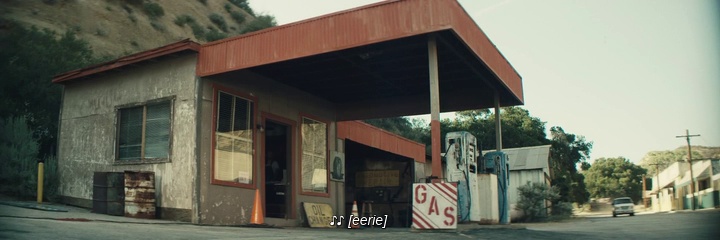
The diner with food of an indeterminable origin, the gas station with the weird attendant.

The house or motel with some nasty surprises (e.g. bloodstained sheets), and (yes) the monster under the bed.

But The Farm goes off in another direction after that. The young couple are captured and put in cages.

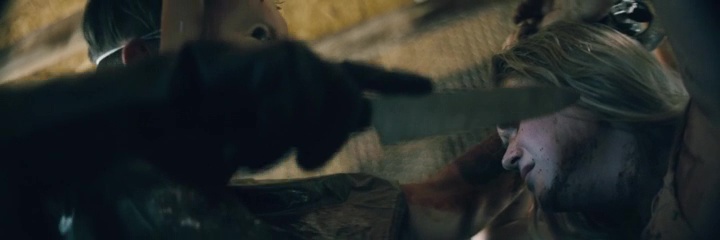
They are gagged, and so they are voiceless, the way we consider farm animals to be, and treated ruthlessly by the farmers, who are mostly wearing animal masks.

Nora is tied with her legs apart and artificially inseminated, as happens to millions of cows every year.

Alec is confined, knocked on the head and taken off to where human meat is harvested. Somehow, he survives that and comes looking for Nora.

The farm is a catering company, cooking and selling the meat for festive events.

The captured human men are killed whenever fresh meat is needed, the women are fitted to suction machines and their milk is collected.

When they can no longer become pregnant, they are added to the butchery.

I guess we are (most of us) aware that cows, like all mammals, have to give birth before they produce milk. On this farm, as on dairy farms world-wide, the babies are waste products of milk production and are killed soon after they are born. That indifferent killing of the innocent is the most disturbing scene of the film.

Look, it’s BUSINESS. Just as billions of male chicks are minced alive at hatcheries because they can’t lay eggs, so dairy calves are killed if they can’t produce milk, and human babies dashed against the concrete floor in the milking sheds of The Farm. Of course, businesses of all sorts have production and quality problems, and have to deal with unhappy customers.

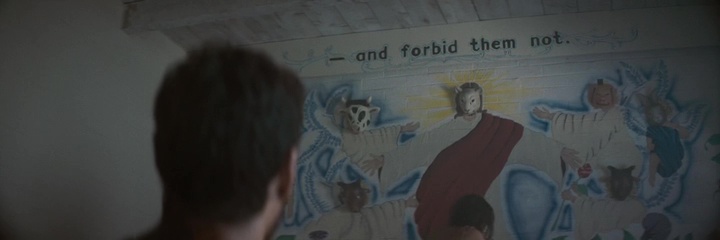
Nora and Alec escape and seek refuge in a church. How much sympathy would an escaped cow or sheep or pig get in a church? It does give us an understanding of the ideology of the Farm though, with it’s mural based on Matthew 19:14:

Suffer little children, and forbid them not, to come unto me: for of such is the kingdom of heaven.

Farmed animals are often compared to children in that they are vulnerable, selectively bred to be dependent and of course are mostly slaughtered when still infant or barely adult. The Dean of St Paul’s, William Ralph Inge, wrote in “The Idea of Progress”,

“We have enslaved the rest of the animal creation, and have treated our distant cousins in fur and feathers so badly that beyond doubt, if they were able to formulate a religion, they would depict the Devil in human form.”

Nora and Alec, at the start of the film, stopped at a café near the Farm, where they were watched as they uncaringly ate beef and bacon burgers. They were, without their knowledge, judged guilty of eating flesh, of cannibalism of their fellow mammals, and the “animals” are now harvesting their bodies in return.

Eric from scariesthings.com summarised:

“this is a tough watch for most audiences and is even a little rough for hardened horror fans”

The reviewers either loved or hated The Farm. Very few thought it was just OK; it was either slammed as stupid and badly made or lauded as a brilliant expose of modern animal agriculture, told in a looking-glass world where we are the animals. I tend to the second view, but I hope you will get the chance to decide for yourself. The film seems to be on Amazon Prime.

I won’t tell you the ending, but the poster kinda gives it away…

Innocent cannibalism: “SWEENEY TODD: THE DEMON BARBER OF FLEET STREET” (King, 1936)

One of the earliest films in the range of cannibal stories I have chosen to cover is George King’s 1936 version of Sweeney Todd. Sweeney is a modern myth, but is a descendant of the shadow archetype, those who destroy themselves in trying to destroy others, including Homer’s Cyclops, whose behaviour, Lacan would say, is governed by “unregulated libidinism”. This Todd is certainly so governed.

vlcsnap-00001.jpg
The poster on the wall of the barber shop, where the story is told

The title role is played by the wonderfully named Tod Slaughter, who presents Todd as pure evil: socially respectable, yet greedy for money and lusting after the young heroine, Johanna. This is a far more straight forward explanation of cannibalism than the 21st century version where Depp is motivated by revenge at injustice (and insists on singing as well).

The plot is straightforward: Todd has a barber shop near the docks where he lures passers-by in for a shave, kills them and steals their valuables, the kind of simple but effective business plan that any bank would find beguiling.

vlcsnap-00004.jpg

Todd’s partner in crime, Mrs Lovett, has a pie shop and profitably disposes of the bodies. Johanna is the daughter of a local merchant and Todd offers to go into partnership with him, planning to ruin him and blackmail him into approving marriage with his daughter. When the girl’s true love, Mark, returns with riches from the African colonies, (he also bravely fights off a tribe of savages, who are probably cannibals in terms of the colonial trope) he is robbed by Todd but saved from death by Mrs Lovett, who is jealous of Todd’s attention to Johanna. In an interesting instance of early (pre-‘slasher’) gender displacement, Johanna decides to save Mark by dressing as a boy, but is captured by Todd and, setting the gender roles back to basics, has to be rescued from the resulting fire (which consumes Todd) by Mark.

vlcsnap-00012.jpg

Neither Todd nor Lovett are ever seen eating human flesh – all cannibalism is performed by the unwitting customers, alluded to when Mark’s comic relief friend and shipmate, Pearley, munches through a pie while speculating on what Todd does with the bodies. The word ‘cannibal’ is never uttered, and the only whiff of abjection is when the narrator, a modern day barber in Todd’s old shop recounting the story to a customer, reveals there is a pie shop next door, and watches in amazement as the man flees. This is textbook abjection: the smell of meat from some non-human mammal cooking next door has made the customer in contemporary London realise his own mortality.

Sweeney Todd 1936.jpg

The class nature of nineteenth century England is illustrated by young Tobias, who is brought to Todd as an apprentice: Todd gets one guinea for each boy he takes from the parish. The Beadle warns Todd that this is the last boy he is getting: presumably he has killed, and Mrs Lovett has cooked, the previous seven.

vlcsnap-00002.jpg
“You’ve brought me another apprentice. And a nice little boy, too!”

The boy prepares the victims by applying shaving cream, and is then sent off for a walk with a penny pie from next door, making the innocent lad the chief innocent cannibal. In fact, all the cannibalism is innocent and is carried out by the lower classes, represented by Pearley and Tobias, an apparent metaphor for the exploitation with which the working class was struggling in the 1930s when the film was made. Todd’s unconscionable slaughter of men (never women, except, almost, the disguised Johanna) for profit is pure objectification: he treats his fellow humans as commodities. No explanation is given, nor needed: Todd’s maniacal laughter is necessary and sufficient to make clear that he is a psychopath; in this, he is a mythic figure: the stuff of nightmares.

Sweeney Todd 1936 poster.jpg

Full movie (with some audio issues) is available at https://www.youtube.com/watch?v=6W0YoxQkTjs

IF YOU LIKE MY BLOG, PLEASE FEEL FREE TO RECOMMEND IT (WITH DISCRETION) TO FRIENDS ON SOCIAL MEDIA.

IF YOU HAVE ANY QUESTIONS OR COMMENTS, YOU CAN USE THE TAG, OR EMAIL ME ON CANNIBALSTUDIES@GMAIL.COM.