Idaho killer avoids death sentence

Family members of one of the victims of a gruesome murder of four college students in Idaho are furious that Bryan Kohberger has been offered and accepted a plea deal.

Kohberger was accused of stabbing Xana Kernodle, Madison Mogen, Kaylee Goncalves, and Ethan Chapin to death in November 2022 in Moscow, Idaho. The students were found with fatal stab wounds in an off-campus rental home in the early morning hours. Investigators believe the four students, thought to be sleeping at the time, were fatally stabbed between 3 a.m. and 5 a.m. According to the coroner, there was no sign of sexual assault.

A little over a month after the killings, Kohberger, a 28-year-old Ph.D. student and teaching assistant in the Department of Criminal Justice and Criminology at Washington State University, was arrested at his parents’ home in Pennsylvania on Dec. 30, 2022, and extradited to Idaho.

Kohberger was facing a possible death sentence if convicted in a trial that was scheduled to begin Aug. 18, 2025.

A letter sent to families of the victims to inform them of the deal said Kohberger will appear in court Wednesday to enter his guilty plea and be sentenced in late July to life in prison, according to the Idaho Statesman. Kohberger will forfeit his right to appeal as part of the deal. The letter from Moscow Prosecuting Attorney Bill Thompson said:

“We cannot fathom the toll that this case has taken on your family. This resolution is our sincere attempt to seek justice for your family. This agreement ensures that the defendant will be convicted, will spend the rest of his life in prison, and will not be able to put you and the other families through the uncertainty of decades of post-conviction appeals.”

Goncalves’s family had an angry reply on their Facebook page.

“We are beyond furious at the State of Idaho. They have failed us. Please give us some time. This was very unexpected. We appreciate all your love and support.”

The family issued a later post explaining what had been taking place.

“I would like to clarify a couple of things…we DID talk to the prosecution on Friday about the POSSIBILITY of a plea deal and it was a HARD NO from our family. It was very nonchalant and barely discussed as the majority of the conversation was surrounding the upcoming trial. NOTHING in our conversation prepared us for the next steps.”

A family member of one victim told NewsNation that upon hearing of the plea deal, she felt like “all the power had been given back to Kohberger.”

Why is this case featured in a blog about cannibalism? Well, A forensic psychiatrist told  Newsweek after the arrest that Kohberger had battled with “cannibalistic urges.

Reports then surfaced that Kohberger had followed a strict vegan diet, and had reportedly struggled with heroin addiction in the past.

Forensic psychiatrist Carole Lieberman told Newsweek that Kohberger’s “obsessive-compulsive eating habits” indicate he was afraid he would become addicted to meat if he ate it.

“He was not only vegan, he refused to eat off of pots or plates that had had meat on them. Psychologically, this represents his struggle against his cannibalistic urges. He was afraid that if he let himself go to taste meat once, he would become addicted to it—like he had become to heroin—and start killing and eating people.”

A relative told the New York Post that Kohberger’s dietary restrictions were “very, very weird” and that he seemed “very OCD,” referring to obsessive-compulsive disorder.

The woman, who asked not to be named, but said she was previously married into Kohberger’s family, said:

“It was above and beyond being vegan. His aunt and uncle had to buy new pots and pans because he would not eat from anything that had ever had meat cooked in them.”

Casey Arntz, who was friends with Kohberger in middle and high school, said in a video posted on TikTok that he had been “a heavy heroin user” in high school. Kohberger’s struggles with drug addiction continued into his college years, a friend from Northampton Community College told Fox News. Criminal profiler John Kelly told Fox News,

“This kind of person has this volcanic rage inside that’s going to explode on its victim of choice.”

Lieberman told Newsweek that Kohberger had probably studied criminology both to “calm the demons inside him that were telling him to kill” but also to “learn how to commit the perfect crime.”

It is possible that he had been in touch with the so-called BTK killer, Dennis Rader, whose serial killings in Wichita were the subject of a book by his supervisor, Katherine Ramsland.

Kohlberger may have corresponded with Rader (a lot of criminology students do) but we don’t know that for sure. We have to wonder if Rader would have told him about working in the meat department of a Wichita IGA a few years before his murder spree began.  

Kohlberger’s obsession with meat reflects a lot of issues considered in Cannibal Studies. Firstly, the question of human meat: there really is no significant difference between the meat of humans and other large mammals such as cows, pigs or sheep. Hannibal Lecter takes delight in feeding human meat to his guests, such as the flesh of the flautist of the Baltimore Philharmonic, whose Board members subsequently enjoy the meal immensely in the book and film Red Dragon, thus becoming “innocent cannibals”.
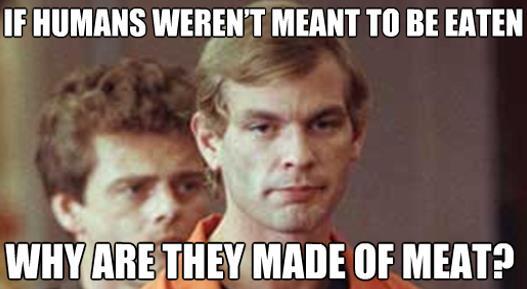
But the point is that once meat is prepared (cooked, seasoned, presented) it is very hard to tell its provenance. Cannibals who have been asked have mostly compared it to pork or veal, with Armin Meiwes telling an interviewer

“It would have made no difference in somebody else had tasted it; he wouldn’t have questioned the meat…. During preparation, it is not as dark, but bright and fresh as pork, and tastes so very close to pork.”

Kohlberger’s belief that he might like human flesh if he tried any meat at all therefore has some logic to it. Since Charles Darwin’s writings overthrew the special status of humans as closer to angels than other animals, anthropocentrism has been amended to offer a story of humans as the culmination of evolution and thereby continues, rather less successfully, to obscure human animality. Should such beliefs falter, as happens repeatedly in many cases of contemporary cannibalism, it becomes a very short step from eating other animals to eating the human one.

But why should he become addicted to any meat? Well, we know Kohlberger has an addictive personality, shown by his very heavy usage of heroin. But we’re not talking drugs of addiction but lumps of protein, aren’t we? Well, there are plenty of studies about that. Marta Zaraska, for example, wrote in her book Meathooked that meat is highly addictive on several fronts – genetic, cultural, historic and commercial, and coined the term “meathooked” for the incongruous compulsion to eat meat despite the pangs of cognitive dissonance – the repressed feeling of guilt when considering oneself an animal-lover while also paying big corporations to kill them. Then there is the mythology of the Wendigo, a creature from Algonquin legend who starts off as a human but becomes a being who can only live on human flesh, which makes him grow bigger and at the same time hungrier. If you believe in Wendigos, then the slippery slope from carnivore to cannibal seems reasonably clear.

This leads us to the issue of Kohlberger’s apparently very strict veganism. Most people seem to believe (or want to believe) that vegans are fanatics, obsessed with animal welfare (or the environment, or their own health) who therefore compulsively avoid meat. But in fact most vegans would certainly wash a pot thoroughly after a relative had cooked meat, but are unlikely to throw it out as irretrievably ruined, as Kohlberger purportedly did. Veganism is an ethical system that attempts to minimise harm to sentient animals, which includes humans (yes, Virginia, humans are animals). If there is a slippery slope from the flesh of other animals to the flesh of Homo sapiens, then the vegan is furthest from the edge of that slope. When Kohlberger killed those students, he was not following any known vegan code of ethics, even if he didn’t sample their flesh on the way out.
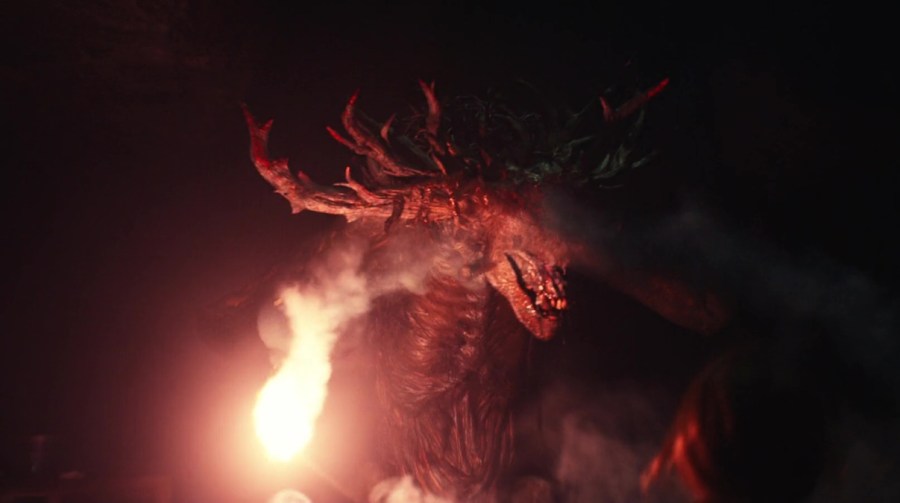
Cannibalism as contagion: ANTLERS (Scott Cooper, 2021)

If you read this blog, and I hope you do, you might remember a movie we reviewed recently called Wendigo. It was about the mythical creature from Algonquin legends, the spirit who takes over humans and turns them into voracious cannibals whose feeding frenzy makes them grow larger and, consequently, hungrier. The Wendigo is usually represented by the stag or at least the antlers of a stag; thus the title of this week’s film, Antlers, which fronts another Wendigo, although this time a rather less complex creature.

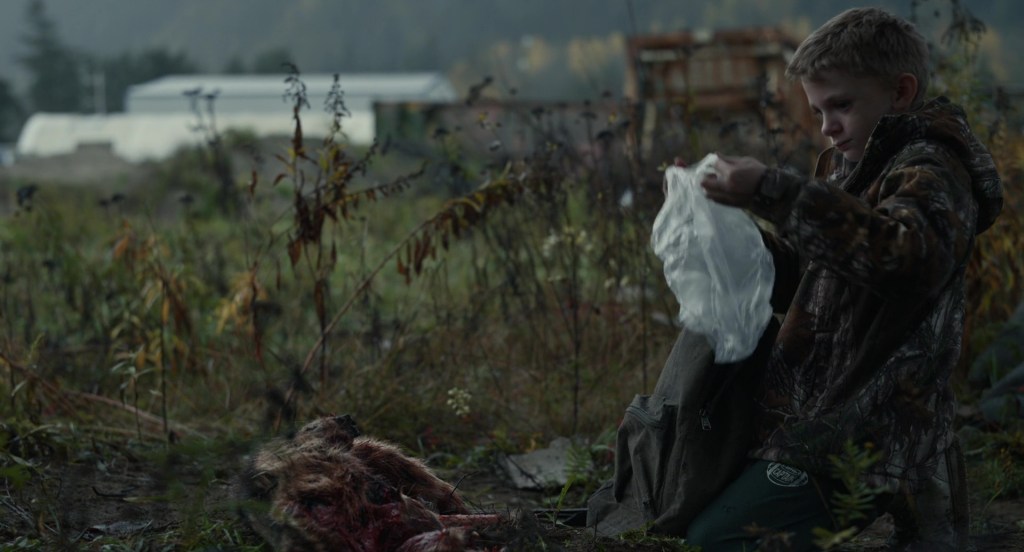
Directed and co-written by Scott Cooper (Crazy Heart, Black Mass) the film is produced by Guillermo del Toro, who has already won three Academy Awards for his imaginative grotesqueries. Del Toro’s films exhibit his fascination with fairy tales and mythology and the monstrous, in which he finds poetic beauty. The cast is outstanding, led by Keri Russell (Grimm Love, The Americans) as Julia, a teacher in rural Oregon who wants to help a young boy in her class named Lucas (Jeremy T. Thomas) who, she suspects, is suffering parental abuse. She thinks this because he is drawing gruesome pictures of creatures with huge antlers, and collecting roadkill.

Jeffrey Dahmer’s dad used to take him out on road trips to find roadkill to dissect, but there was nothing wrong with him, was there? Well, OK, but anyway, he wasn’t being abused, and nor is Lucas (except by the usual school bully).

Lucas’ dad was using an abandoned mine to cook methamphetamine, disturbing the quiet of the place, releasing who knows what has been hiding in there? Yep, but it’s not a balrog (also usually shown with horns), it’s a wendigo. And it has infected both the dad and the little brother. Dad is now very loud, very violent creature with a lack of hair (bit like Gollum, but more excitable) who need to be fed raw meat every day. No smart cracks about Oregonians, please. But Julia is an outsider herself – she fled to California as a young woman to escape her abusive father, and is wracked with guilt about leaving her brother Paul (Jesse Plemons – Friday Night Lights and Breaking Bad) behind. He is now sheriff of the town, where he does exciting things like evict poor people from their humble homes. She thinks he resents her, and we think so too – why wouldn’t he? He tells her he spent his entire life praying she’d come back. But now, whenever he comes near her, she flinches as she flashes back to her father abusing her as a child.

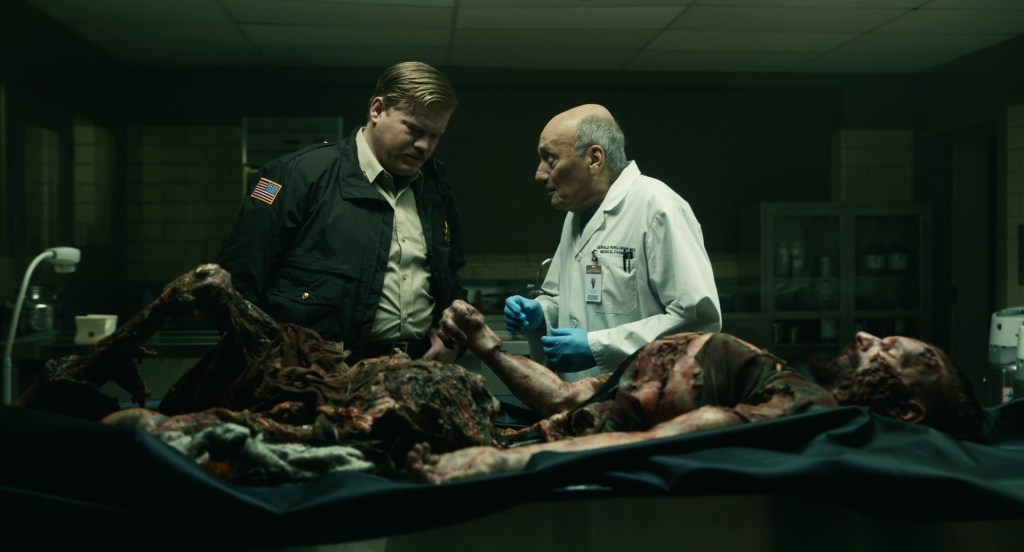
Paul goes into the woods to retrieve half a human body that someone has reported, and takes it to the coroner, who tells him the mutilation shows teeth marks – and they are human teeth. Almost halfway into the movie, and we finally have some cannibalism going on! Paul finds the other half of the dude (the dad’s former business partner) in the mine where they were cooking the meth. Also some mysterious antlers!

From there on, people start getting eaten – the stern school principal, the school bully who has been picking on Lucas (monsters can also be instruments of justice). It doesn’t work well for dad either; after he is finished enjoying the school principal, the real monster, now in the shape of a skeletal beast looking similar to the creature fought in the Alien films (but with antlers), sacrifices his body (the reference to the crucifixion is clear), then bursts out of his mouth, leaving him a charred, flayed wreck.

Lucas is carried off to the hospital, where he is diagnosed as dehydrated, malnourished, and deeply psychotic. Well, no wonder!

Warren, the previous Sheriff, is a local Native American, and explains to them that Lucas’ drawings, as well as the antler found in the mine, depicts the Wendigo,

“…a diabolical wickedness that devours mankind… known to be eternally starving but feasting makes them hungrier, and weaker. Those who are unfortunate enough to encounter one can only kill it when it’s in its weakened state. And only by extinguishing its beating heart, forcing it to search for another host. But it makes sense you see – our ancestral spirits never died. They were here long before we were here, and they’ll be here long after we’re gone. But now they’re angry.”

They find the missing school bully, who has been “eaten in half”, but Paul tells Julia he still cannot believe in a mythical nature spirit. He requires a conversion experience – maybe his deputy getting pin-cushioned and eaten, and then him getting comprehensively monstered? That leaves it up to Julia to take on the Wendigo. Being a teacher, she remembers the bit about it being weakened when eating, and the bit about extinguishing its beating heart. Using some impressive combat techniques that she probably learnt in The Americans, Julia rather easily beats the big beast, but then has a new problem – the Wendigo spirit is now in Aiden, Lucas’ little brother. Does Julia have the heart to kill and tear the beating heart out of an eight-year-old boy who looks like he just needs a meal and a bath? And do it while she is being watched by his big brother, Lucas?

Spoiler alert: you bet she does!

But as we watch the happy ending, Lucas now living with Julia and Paul, we see Paul begin to cough and spit out black foam – the first symptom of becoming a Wendigo (or this version of it.) As Jeffrey Jerome Cohen told us in his “Seven Theses” on monster culture, the monster never really dies or goes away; it just comes back in different clothes, or different skin. No matter how many times Ripley killed the Alien, it kept coming back, sometimes in the shape of its progeny (a reversal of the Beowulf story, where killing the monster arouses his mother’s wrath).

There are several versions of the Wendigo story. In Supernatural, the Wendigo only ate people every 23 years, an extreme version of the paleo diet. In Fear Itself, the Wendigo takes over anyone who is weak and hungry and fills them with rage, while in Lone Ranger, it appeared an outlaw in the Old West, who could only be killed with a silver bullet for some reason. The common thread is insatiable and voracious appetite, a hunger that destroys without thought for sustainability. In Bones and All, that hunger begins young and gets stronger as they grow older. Perhaps the classic of Wendigo literature is the film Ravenous, in which becoming a Wendigo gives not just superhuman strength but close to invulnerability, or at least the ability to heal any wounds by eating more people. And, of course, a voracious hunger.

The film starts with a warning. This is read in Ojibwe, one of the Indigenous languages of the Algonquin people, whose lands stretch from present-day Ontario in eastern Canada all the way into Montana. This is the language in which the mythology of the Wendigo was developed. The English translation scrolls up the screen:

The film is brilliantly acted, beautifully filmed and directed, but could have made more of a point of the environmental message with which it started, rather than just hurtling into the special effects and gore. The Wendigo is well presented, if a little sparse (we hardly see those antlers), but the connection between the greed of humans and the monstrous revenge of nature is left hanging. There have been five great extinction events found in fossil records. The SIXTH MASS EXTINCTION is happening as we speak. Extinctions have occurred at over 1,000 times the background extinction rate since 1900, and the rate is increasing, a result of human activity (or ecocide), driven by population growth and overconsumption of the earth’s natural resources. In late 2021, WWF Germany suggested that over a million species could go extinct within a decade in the “largest mass extinction event since the end of the dinosaur age.”

Humanity has waged war on nature since we came down from the proverbial trees, but particularly since the agricultural revolution some 12,000 years ago, when we decided nature could be dominated rather than placated. Fossil fuel combustion, the selective breeding of billions of other animals for food or clothing, the capture of wild animals for entertainment – these are all manifestations of the war on nature, motivated by a Wendigo-like hunger which can never be satiated. It’s a war that we cannot win, without destroying ourselves in the process – nature never goes away, but, like the Wendigo, comes back in another (angrier) skin – floods, droughts, climate change, etc. We have, as the Ojibwe warning says, pillaged the land and awakened a Malevolent Spirit. Like any organism evolving by natural selection, we can adapt or die. Our only advantage over other species is that we could, if we had the sense, decide which to choose.

The revenge of nature: WENDIGO (Larry Fessenden, 2001)

Wendigo is a film written, directed and edited by Larry Fessenden, who would, a few years later, make an episode of the TV horror series Fear Itself called SKIN AND BONES, which was about a guy who disappears on a hunting trip with friends and returns cold, thin and desperately hungry. He has, we quickly discover, become a Wendigo! In this, the earlier film, there are also crazy hunters led by Otis (John Speredakos), who are mad with our protagonists for driving into a stag (the traditional symbol of the Wendigo) who they have been tracking and, worst of all, breaking his antlers, which are apparently very valuable. The Wendigo is already there in their cabin as a “dark presence”, so we just need to be introduced.

First, the really good cast – George (the Dad) is played by Jake Weber, from the 2004 remake of Dawn of the Dead and Meet Joe Black. He is a super-stressed New York photographer, and the last thing he needs is a run-in with a bunch of redneck hunters. Kim, the Mom, is played by the wonderful Patricia Clarkson (most recently starring in Gray) and the kid, Miles, is played by Erik Per Sullivan, who was Dewey in Malcolm in the Middle.

George is more disturbed by the rednecks than he is willing to let on, telling Kim, who is a psychologist, that he is distressed by the “abyss” between him and them, with no possibility of communication. She tells him that:

“It’s very archetypical for the civilised man to feel threatened by the man of the country.”

George is utterly divorced from nature, seeing it as alien and menacing. So, the other last thing he needs to meet is a Wendigo, a figure on the front line of the human war on nature.

They head into town to buy curry (as you do in small towns) and Miles meets in the store a Native American Elder who tells him about the Wendigo, a small carving of which Miles is drawn to.

“The Wendigo is a mighty powerful spirit… it can take on many forms, part wind, part tree, part man, part beast. Shape shifting between them… It can fly at you, like a sudden storm, without warning, and consume you with its ferocious appetite. The Wendigo is hungry, always hungry. The more it eats, the bigger it gets, and the bigger it gets, the hungrier it gets, and we are hopeless in the face of it. We are consumed, devoured…. There are spirits that are angry. Nobody believes in spirits anymore. Doesn’t mean they’re not there.”

The Wendigo is a figure from the mythology of the Algonquin people of North America. They lived in a land of long winters where the competition for food would have been intense and cannibalism of the dead probably not unusual. Myths help to spell out behaviours that societies need to discourage – cannibalism could decimate small, isolated communities. That myth, of the voracious monster whose hunger only grows with feeding, was later applied to the invaders, the colonists who took their land, their produce and often their lives. In such a struggle, the Wendigo, as an original figure of their culture, could take almost a vengeful role, eating the technologically superior invaders. George inadvertently confirms this, telling Miles “the Wendigo only goes after bad guys.”

The Elder tells Miles he can keep the figure, but there is no sign of him when Kim is subsequently asked to pay for it. He is presumably one of those spirits, not angry but advisory.  He warns Miles about the “cry of the Wendigo”. The Wendigo is clearly (to the audience) imbued into that carving.

Then the Wendigo strikes. Or is it the rednecks? Did the Wendigo knock George off his sled, or did it carry him home after Otis shot him? Was it the revenge of nature, or society? When the Wendigo later demands of Otis “Give me my liver!” it voices the cry of revenge of every animal, human and otherwise, killed for fun or profit. When Otis meets justice, Miles awakes with his Wendigo figure in his hand.

It’s a great cast, with an absorbing plot, although it gets a bit lost at the end. But the questions it asks are compelling.  The New York Times critic wrote:

“Mr. Fessenden carefully blurs the line between psychology and the supernatural, suggesting that each is strongly implicated in the other. The rampaging Wendigo may be a manifestation of Miles’s incipient Oedipal rage, but at the same time it is a force embedded in nature and history.”

The Wendigo carries so much symbolism, besides the horror trope in which he seems so regularly to find himself, such as in Fear Itself or the classic Wendigo film, Ravenous, which was made a couple of years before this film. He expresses the anger that rages within George, the father who cannot show interest in his son’s curiosity because of his own issues brought with him from the city, frustration and fear of failure. And we can infer (as the NYT does) that Miles himself feels an Oedipal rage toward his father who, Freud tells us, is the child’s rival for sexual possession of the mother throughout childhood. The voracious hunger comes from an even earlier stage, what Freud called the “cannibalistic stage” of babyhood, where the infant wants to own the breast, consume it so it will always remain in his possession. George’s playacting the cannibal, attacking and pretending to eat Miles, is a common parent/child game, but is also deeply revealing of these forces hidden deep in the unconscious.

At yet another level, the Wendigo represents the revenge of nature on the civilised, those whose insatiable hunger for growth decimates the land and finds sport in killing its inhabitants, be they human, deer or any ‘other’. The antler is a weapon used by the stag, a normally shy and timorous animal who becomes a formidable fighter in the mating season, and the size and strength of its antlers represents both its sexual and fighting prowess. In the hybrid shape of a human and a stag, the Wendigo recasts humans from hunters to hunted, from predator to prey. This is precisely why Hannibal Lecter is shown in Wendigo form throughout much of the three seasons of the television series Hannibal. Hannibal is the civilised, rational, erudite man of science, a psychiatrist who knows of the dark forces inside the human psyche, and has determined that the human is just another animal, no more deserving of respect or inedibility than any other species, and even less if he happens to be rude. Who judges that – the supernatural force, the inhuman, the less-than-human or, in Hannibal’s opinion, the more-than-human? Whichever you choose, it appears as the Wendigo.

THE LONE RANGER (Verbinski, 2013)

This film had a lot of publicity due to the cast – Armie Hammer (since mired in cannibalism scandals as detailed elsewhere) plays the Lone Ranger and, wait for it, Johnny Depp (mired in different scandals altogether) plays his Native American off-sider Tonto. Depp claims he has Native American ancestry, perhaps a great-grandmother, so I guess that’s fine. Helena Bonham-Carter is in there somewhere too, as a brothel madam with an ivory leg – she has certainly graced this blog before, and with Johnny Depp! The director, Gore Verbinski, directed The Ring and the first three Pirates of the Caribbean movies, at least one of which I recall walking out of, but so forgettable were they that I can’t remember which one.

Set in the Wild West in 1869, the Lone Ranger starts off as a lawyer named John Reid, coming to Texas as DA to impose law on a savage land, like Jimmy Stewart in High Noon. His “bible” (he tells the Presbyterians on the train) is John Locke’s Treatises, which insist that

“Whenever men unite into society, they must quit the laws of nature and assume the laws of men, so that society as a whole may prosper.”

Good luck with that.

Reid’s brother, a Texas Ranger, deputises him to help catch an escaped outlaw named Butch Cavendish (William Fichtner from Armageddon, Black Hawk Down and many more). All the deputies are killed by Butch’s gang, except the old drunk, who is working with the outlaws and leads them into an ambush. That could easily (and perhaps mercifully) have been the end of the movie, but Reid is awakened by a “Spirit Horse” and Tonto explains he cannot be killed in battle. He also tells Reid that Butch, the outlaw, is a Wendigo, a figure from Algonquin legend – the tribes from the north of America, and nothing to do with Comanche mythology, but hey, maybe Tonto read this blog.

A Wendigo eats people and gets bigger and stronger as a result, but also hungrier. According to Tonto, he can only be killed with a silver bullet (I think that’s actually vampires, kemosabe). Incidentally, Tonto in the original radio series was not a Comanche but from the Potawatomi nation (who might have referenced Wendigos), but let’s not bother too much with, you know, facts. After all, a spirit horse may have edited the script.

So Reid is still alive and puts on his mask (about an hour into the film), Butch captures his dead brother’s wife and child, a whole tribe of Comanches are massacred by the US Cavalry (that has a ring of truth to it at least), but why on earth is this nonsense being reviewed in a blog about cannibalism?

Well, Butch may or may not be a Wendigo, and may or may not require a silver bullet to kill him (he doesn’t), but he is a cannibal. He is pretty keen on eating people’s hearts, or eyes, or maybe his own foot, according to rumour.

The problem with the movie is that it really can’t decide if it’s a Western drama or a comedy. The bad guys are the essence of evil, but the good guys are clowns. Then in the middle they put a gratuitous massacre of Comanches which at least adds a touch of historical realism.

The special effects are pretty great, with people on horses chasing trains, jumping on trains from horses, jumping on horses from trains, and trains getting derailed and crashing spectacularly. The scenery is gorgeous (Monument Valley of course, even though the film is purportedly set in Texas).

But it flopped at the box office, grossing $260 million against the $650 million that it was estimated to need to break even. Rotten Tomatoes gives it a miserable 31% ‘rotten’ rating, with those 31% mainly loving it, and the rest totally trashing it. The New York Post called it a

“bloated, misshapen mess, a stillborn franchise loaded with metaphors for its feeble attempts to amuse, excite and entertain.”

Then again, the San Jose Mercury News was more forgiving, describing it as a “one hot mess”, but an entertaining one.

If you have two and a half hours to waste, I guess it will keep you amused or shocked or sickened or whatever you take from it. I reviewed it here because it has a bit of cannibalism (Butch eats the Lone Ranger’s brother’s heart) and because Tonto calls him a Wendigo. And there’s not much that’s better than a Wendigo movie.

“…CANNIBALISTIC URGES” – Man on trial for brutal murder of four Idaho University students

A forensic psychiatrist has told Newsweek that the man charged in connection with the slayings of four University of Idaho students in November 2022 had battled with “cannibalistic urges.

Bryan Kohberger, a 28-year-old Ph.D. student and teaching assistant in the Department of Criminal Justice and Criminology at Washington State University, was arrested at his parents’ home in Albrightsville, Pennsylvania.

Kohberger is accused of breaking into a rental house in Moscow, Idaho, and fatally stabbing Kaylee Goncalves, Madison Mogen, Xana Kernodle and Ethan Chapin in the early morning hours on November 13.

Reports have surfaced divulging that Kohberger follows a strict vegan diet and has reportedly struggled with heroin addiction in the past.

Forensic psychiatrist Carole Lieberman told Newsweek that Kohberger’s “obsessive-compulsive eating habits” indicate he was afraid he would become addicted to meat if he ate it.

“He was not only vegan, he refused to eat off of pots or plates that had had meat on them. Psychologically, this represents his struggle against his cannibalistic urges. He was afraid that if he let himself go to taste meat once, he would become addicted to it—like he had become to heroin—and start killing and eating people.”

A relative told the New York Post last week that Kohberger’s dietary restrictions were “very, very weird” and that he seemed “very OCD,” referring to obsessive-compulsive disorder.

The woman, who asked not to be named, but said she was previously married into Kohberger’s family, said:

“It was above and beyond being vegan. His aunt and uncle had to buy new pots and pans because he would not eat from anything that had ever had meat cooked in them.”

Casey Arntz, who was friends with Kohberger in middle and high school, said in a video posted on TikTok that he had been “a heavy heroin user” in high school. Kohberger’s struggles with drug addiction continued into his college years, a friend from Northampton Community College told Fox News. Criminal profiler John Kelly told Fox News,

“This kind of person has this volcanic rage inside that’s going to explode on is victim of choice.”

Lieberman told Newsweek that Kohberger had probably studied criminology both to “calm the demons inside him that were telling him to kill” but also to “learn how to commit the perfect crime.”

It is possible that he had been in touch with the so-called BTK killer, Dennis Rader, whose serial killings in Wichita were the subject of a book by his supervisor, Katherine Ramsland.

Kohlberger may have corresponded with Rader (a lot of criminology students do) but we don’t know that yet. We have to wonder if Rader would have told him about working in the meat department of a Wichita IGA a few years before his murder spree began.  

Kohberger has been held without bond in Pennsylvania since his arrest. He will be tried in Idaho, the state in which the crimes took place, the only state in the US with a law against cannibalism, although no such charges have been laid against Kohberger.

His next court appearance will be June 26.

Kohlberger’s obsession with meat reflects a lot of issues considered in Cannibal Studies. Firstly, the question of human meat: there really is no significant difference between the meat of humans and other large mammals such as cows, pigs or sheep. Hannibal Lecter takes delight in feeding human meat to his guests, such as the flesh of the flautist of the Baltimore Philharmonic, whose Board members subsequently enjoy the meal immensely in the book and film Red Dragon, thus becoming innocent cannibals. Incidentally, being the Baltimore flautist seems to be a rocky road – their principal flautist Emily Skala, was fired in 2021 for spreading misinformation about the safety of coronavirus vaccines, the efficacy of face masks and the outcome of the 2020 presidential election, relieved of her post, but not eaten.

But the point is that once meat is prepared (cooked, seasoned, presented) it is very hard to tell its provenance. Cannibals who have been asked have mostly compared it to pork or veal, with Armin Meiwes telling an interviewer

“It would have made no difference in somebody else had tasted it; he wouldn’t have questioned the meat…. During preparation, it is not as dark, but bright and fresh as pork, and tastes so very close to pork.”

Kohlberger’s belief that he might like human flesh if he tried any meat at all therefore has some logic to it. Since Charles Darwin’s writings overthrew the special status of humans as closer to angels than animals, anthropocentrism has been amended to offer a story of humans as the culmination of evolution and thereby continues, rather less successfully, to obscure human animality. Should such beliefs falter, as happens repeatedly in many cases of contemporary cannibalism, it becomes a very short step from eating other animals to eating the human one.

But why should he become addicted to any meat? Well, we know Kohlberger has an addictive personality, shown by his very heavy usage of heroin. But we’re not talking drugs of addiction but lumps of protein, aren’t we? Well, there are plenty of studies about that. Marta Zaraska, for example, wrote in her book Meathooked that meat is highly addictive on several fronts – genetic, cultural, historic and commercial, and coined the term “meathooked” for the incongruous compulsion to eat meat despite the pangs of cognitive dissonance – the repressed feeling of guilt when considering oneself an animal-lover while also paying big corporations to kill them. Then there is the mythology of the Wendigo, a creature from Algonquin legend who starts off as a human but becomes a being who can only live on human flesh, which makes him grow bigger and at the same time hungrier. If you believe in Wendigos, then the slippery slope from carnivore to cannibal seems reasonably clear.

This leads us to the issue of Kohlberger’s apparently very strict veganism. Most people seem to believe (or want to believe) that vegans are fanatics, obsessed with animal welfare (or environment or their own health) who therefore compulsively avoid meat. But in fact most vegans I know would wash a pot well after a relative had cooked meat, but are unlikely to throw it out as irretrievably ruined, as Kohlberger purportedly did. Veganism is an ethical system that attempts to minimise harm to sentient animals, which includes humans (yes, Virginia, we are animals). If there is a slippery slope from the flesh of other animals to the flesh of Homo sapiens, then the vegan is furthest from the edge of that slope. If Kohlberger did kill those students (and at this stage it’s only alleged), then he is no vegan, even if he didn’t sample them on the way out.

Love and cannibalism: BONES AND ALL (Luca Guadagnino, 2022)

The modern cannibal is usually hard to identify. Jeffrey Dahmer was the all-American boy next door. Armin Meiwes used to mow his neighbours’ lawns to be helpful. Issei Sagawa was so small and helpless that he seemed vulnerable rather than threatening. Albert Fish was a sweet old man, so charming that the Budd’s let him take their little girl to a party.

They were normal, everyday people, a bit weird, but not monsters.

At least, not in appearance. This is a recent phenomenon – the original cannibals were called anthropophagi (Greek for man-eaters) and were humanoid in shape, but were usually some sort of hybrid – a mix of humans and gods or other animals – strong, ferocious, and clearly not quite human. From the 15th century, the alleged cannibals found by Columbus and other explorers were different in culture and skin colouring, so were easily distinguished, defamed and exterminated. It is only recently, since Jack the Ripper in 1888, that the cannibal walked among us, undetected until the victims were found (or what was left of them).

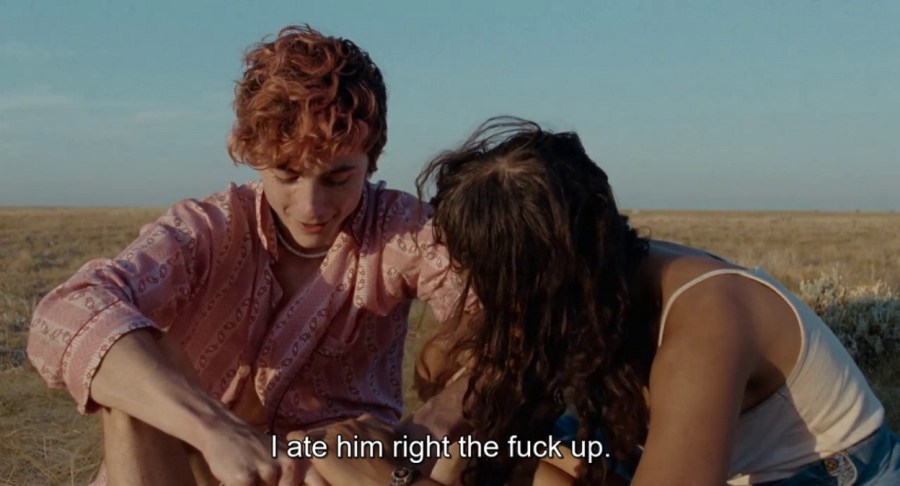
Bones and All presents as a coming of age cannibal romance, taking a sharp turn back into cannibal history for its themes. Maren (Taylor Russell from Lost in Space) is finishing high school, a spectacular end of term in which she is invited to her friend’s sleepover and bites a girl’s finger off, instead of, you know, just admiring the nail polish, as she had been invited to do.

She then goes on the run with her father, who has been keeping her ahead of the law as she grew up (her first human meat was her babysitter when she was three) but now ditches her, with a few hundred dollars and a birth certificate.

It then becomes a road movie, as she travels through the American Mid-West trying to find her mother, attracting suspicion not because of her eating habits but just because she looks too young to be on the road. She comes across another cannibal (they are called “eaters”) in the shape of a weird old man named Sully (Mark Rylance, Bridge of Spies) before meeting up with Lee, played by the love interest of seemingly everyone nowadays, Timothée Chalamet. Chalamet appeared in the third instalment of Guadagnino’s “Desire Trilogy”, Call Me by Your Name), in which he was the love interest of Oliver, played by Armie Hammer, who has recently been generating his own cannibalism headlines.

As a road movie it’s Thelma and Louise mixed with Romeo and Juliet, if they had been cannibals. In other words outsiders, star-crossed lovers, and lots of flesh being torn off dead (and sometimes living) bodies. Road movies rely on meeting new and weird people, and learning about the protagonists (and ourselves) from their stories.

Sully is a lonely old man who teaches Maren about being an eater, and how an eater has a super-power – like a vampire, they have a nose that can smell other eaters at great distances, and can also smell dying people, which allows him to feast on them fairly inculpably, although Maren rather wonders if they should be calling 911 rather than letting them gasp their last breaths. So they are anthropophagi, they smell different, have a strong sense of smell, and so are not quite human. We subsequently discover that the cannibal gene is passed on – Lee’s dad and Maren’s mother were also eaters. They are a breed apart, hybrid humans, who can mate with non-eaters.

They are also presented as ‘savages’ – related to the colonised peoples who were declared cannibal by the imperial powers. Maren is biracial, and Sully (although played by a classical British Shakespearean actor) seems to be presented as a Native American, with a long ponytail and a feather in his hat. The marginalised and disenfranchised are regularly presented as dangerous, thieves, murders, cannibals, regardless of any evidence.

An interesting character from colonial times is the wendigo, a figure from Algonquin mythology who eats his fellow humans and draws on their strength to grow huge and powerful, which only makes him hungrier and deadlier. Sully tells Maren that her fate is to need more and more flesh as she gets older.

Just like the wendigo, who is an indigenous version of the anthropophagus, and one that was used by the victims to characterise the European invaders and their voracious appetite for land and gold. The phrase “bones and all” reminds us of the colonial greed that denied the humanity of those invaded and insisted on taking everything, leaving nothing and nowhere to go but a few reservations or missions in remote, unprofitable areas. Eating bones and all is also a perfect way of getting rid of the evidence.

The title Bones and All is taken from the book of the same name by Camille DeAngelis, but the phrase was not used in the book – it just meant that Maren and the other eaters would automatically eat the whole person, bones and all. Except for her first, the babysitter, because she was too small to swallow bones – she left a pile of them, a pool of blood, and the hammer from an eardrum. In a movie, though, it can be harder for the viewer to maintain a willing suspension of disbelief, so eating the victim bones and all becomes a rite of passage – the next level of being an eater. Maren and Lee don’t know how to eat a person bones and all, so they are not yet postgrad eaters. Maren puts it succinctly – “that’s impossible.” But what about eating the flesh? Armin Meiwes took ten months to eat 20 kilograms (44 lb) of Brandes, but we are asked to accept that Maren and Lee can eat a whole body in a night.

But then, everything is ambiguous in this story, which has been widely described as a metaphor for otherness and queerness. The story is set in 1981, as Ronald Reagan is entering the White House. Being different, queer, compassionate, seeking social justice were all considered laughable or dangerous. Greed was good, and so eating a victim bones and all might have seemed laudable. Drug addiction was escalating, and some have seen the cannibalism in this film as a metaphor for this as well – Maren and Lee can’t go too long without their feed, and will do whatever they need to in order to get it.

Some of the ambiguities are more subtle: Maren looks young, which bothers various people she deals with, although she is 18 and technically an adult in most places. Lee falls in love with her, but is also capable of appearing to be cruising for gay sex.

He chooses a carnival worker who has been mean to a child, leads him into the bushes and masturbates him, slitting the man’s throat as he orgasms. It was not until twenty years later that gay sex was legalised in the US, and this man’s secret desire for same sex petite mort becomes his real mort. They then discover that the man had a wife and family, and are stricken with guilt, because apparently eating some people is OK, but not family people.

Then we have the eaters – Maren is naïve and caring, horrified by her need to feed. Lee is a puny dude who kills seemingly effortlessly, but like Hannibal Lecter, Lee prefers to eat rude people – when we first meet him, he challenges a rude person in a supermarket and leads him to a deserted shed where he kills and eats him. Sully is an senior eater, so has to eat regularly, but says he tries not to kill people – sniffs out those who are dying, but later he gets violent when Maren rejects his advances.

Jake (Michael Stuhlbarg) is an eater who has graduated to eating bones and all, but he is accompanied by a friend named Brad (David Gordon Green), a cop (!), who is not a natural eater, but just likes doing it. Maren accepts that she and Lee have to eat people, but is revolted by Jake’s wish to do the same. We’re back to the old debate of nature versus nurture. Are people born queer? Or with addictive personalities? Or psychopathic? Or cannibalistic?

The Director, Luca Guadagnino, has made a number of changes from the book, which are examined elsewhere. The most obvious one, though, is that Maren is brought up and then eventually abandoned by her mother in the book, but her father in the film. This changes the dynamic considerably, because we now have two eaters in the family, both female. The eater parent in both versions is locked up in an asylum, having eaten their own hands, but in the movie it’s her mother, (a short but superb appearance by Chloë Sevigny). We arrive at last at the modern horror archetype, the “monstrous-feminine”, the figure that confronts the male viewer with his fears of being castrated (Freud’s favourite explanation), as well as “the monstrous womb” – a terrifying image of a “black hole which threatens to reabsorb what it once birthed” (Creed, The Monstrous-Feminine, p. 27). The female cannibal is quintessentially monstrous-feminine, terrifying men with the antithesis of popular female stereotypes of giving life and nurturing. In the book, Maren only eats boys or men (after the initial babysitter) – she is drawn to eat those who seek to be close to her. In both versions of the story, the ambiguity is clear to us and the female cannibals – they have a compulsion to eat, but don’t want to hurt others.

Maren’s solution is to try to act normal, fall in love, get a job, get “clean” of the eating. Her mother’s was to lock herself away, and even then she chewed off her own hands.

To me, the most fascinating ambiguity in this film and in our societies generally is the question “who can you eat?” Eating some animals is considered just “normal” – Lee is chewing on bacon (pig flesh) served to him in a very respectable café, and has been working in an abattoir. When they need money, he and Maren rob the abattoir at night, later sitting on the overhead walkway watching the cows who are to be killed for legal, non-controversial eating, when Maren observes

“every one of them has a mom and a dad, sisters, brothers, cousins, kids. Friends even.”

The real question, Derrida says, is not what to eat but how to eat well. Perhaps, as Chalamet has said, it is impossible to live ethically – every act of consumption or energy usage wrecks the environment a little bit more. For some carnivores, this is seen as a ‘bones and all’ issue, they call it “nose to tail” – killing is OK, but wasting any part of the animal is the real crime. But as Maren says, cows also feel terror, pain, bereavement when their babies are taken from them. The author of the book, Camille DeAngelis, went vegan before writing it, indicating that the problem of who to eat, the rude or dying, the human or the cow, weighed on her, and the scene filmed in the slaughterhouse indicates that Guadagnino may have felt the same. Cat Woods’ review in Salon reminds us that Brad, the off duty policeman, chooses to be a cannibal:

“Why would he hunt, slaughter, and feast upon human flesh if he doesn’t need to?
And, if we the audience can be repulsed by that – and his evident choice to slaughter and eat flesh when there is abundant satiety that doesn’t cause violence, pain and loss – then perhaps we need to venture a little deeper into our own psyches and ask: Why would we feast upon flesh if we don’t need to?”

This is a seriously good film, with a great cast and, in the midst of all this carnage, we are treated to magnificent scenery beautifully captured by cinematographer Arseni Khachaturan. I have not revealed the ending, and hope I have not revealed too many other plot points. I recommend you go see it.

Cannibal supermodels: THE NEON DEMON (Nicolas Winding Refn, 2016)

Marcellus (Hamlet Act I, scene iv) claimed that “something is rotten in the state of Denmark”, but it’s not their cannibal films or actors. The Neon Demon is directed by Nicolas Winding Refn (currently in trouble with PETA for killing a pig for a TV series). Refn has made several movies (Pusher, Valhalla Rising, etc) starring Mads Mikkelsen, probably known best by the readers of this blog as Hannibal Lecter, or perhaps Svend in Anders Thomas Jensen’s The Green Butchers. This film does not have Mads in it, but it does have Elle Fanning as a sixteen-year-old model who, we just know, is going to be chewed up, swallowed and spat out by the Los Angeles fashion industry.

Books about screen-writing always stress the opening image – it sets the scene, establishes the atmosphere, tells the viewer what to expect. Well, this one sure does.

Jesse (Elle Fanning from The Great) dead on a couch, blood caked onto her throat and down her arm. A grim male gaze from a photographer. The killer? Police forensics?

No, he’s an amateur photographer doing audition shots for her, and is probably the only nice guy in the story, and we all know where nice guys finish. Anyway, Jesse is befriended, as she wipes off the fake blood, by a make-up artist named Ruby (Jena Malone from The Hunger Games), who takes her to a party to meet the LA fashion scene.

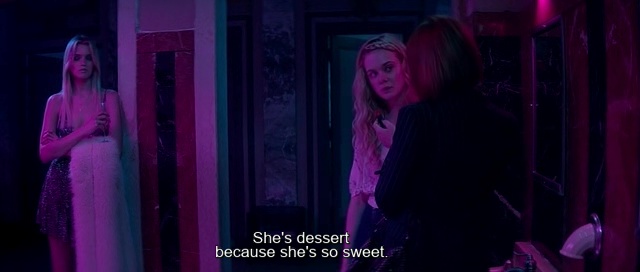
The other models hate her for being young and pretty and not needing the constant plastic surgery to fix all the things the surgeon and our culture say is wrong with their bodies. In the bathroom, as you do, they discuss lipsticks, which they note are always named after either food or sex, and speculate on this new commodity, Jesse. Is she food or sex?

Either way, it’s about appetite. Think of an animal, any animal – a snail, a snake, a human. What is the animal thinking about? It’s almost certainly food or sex. This film combines the two. The men have the power – the celebrity photographer, the fashion designer, even the sleazy motel manager (played with black humour by Keanu Reeves) – Jesse is their fresh meat.

The young, hopeful girls have their looks, and a useful booster of narcissism, a taste for the neon demon of fame, which fuels their journey through the fashion jungle.

When they get “old” (over twenty apparently), they inject various toxins and go under the plastic surgeon’s knife to fix what they are convinced are their failings. But it’s never enough. Jesse sees visions which confirm her own beauty in her eyes:

Women would kill to look like this. They carve and stuff and inject themselves. They starve to death, hoping, praying that one day they’ll look like a second-rate version of me.

But once used up, the women and girls are rejected, discarded, left to fight among themselves – to the death. Jesse is edible to them too, but not in the male way, more in the way that Elizabeth Báthoryis alleged to have bathed in the blood of virgins to keep her youth.

That’s a small taste of the real cannibalism in the film, which infiltrates the metaphoric cannibalism of the meat markets of advertising and fashion. There is an ancient tradition, from the earliest days of tribal ceremonies and the Wendigo to Richard Chase and Armin Meiwes, that eating the flesh or drinking the blood of a victim (preferably a young fit one) will transfer their strength and attractiveness to the eater. If you can keep them down of course.

An even older tradition talks of killing and eating the gods of the harvest, in order that they may be reborn and bring with them next year’s prosperity. The tradition survives in the transubstantiation of the Eucharist service. Jesse is a young and beautiful. She is, or thinks she is, a goddess. How can she not be eaten, in this film both metaphorically and literally?

There is no point in going on with the plot, it’s filled with rape, paedophilia, murder, masturbation, necrophilia, and of course cannibalism, but you really need to see it yourself, and anyway, the plot is not the point. Brian Tellerico, the reviewer from Rogerebert.com, summed this up:

It is a sensory experience, driven by the passion of its fearless filmmaker and a stunning central performance by Elle Fanning.

The director called the film an “adult fairy tale”:

“I woke up one morning a couple of years ago and was like, ‘Well, I was never born beautiful, but my wife is,’ and I wondered what it had been like going through life with that reality. I came up with the idea to do a horror film about beauty, not to criticize it or to attack it, but because beauty is a very complex subject. Everyone has an opinion about it.”

Everyone had an opinion about The Neon Demon too, with some of the audience at Cannes booing it and the rest giving it a standing ovation. You can make up your own mind – it’s an Amazon original, so you should be able to find it quite easily wherever you are in the world. It is a beautiful film, the acting is superb, the direction is assured and precise. The horror is not so much from the gore, as the scenes of young girls being treated as meat. But that is exactly the point.

The French philosopher Jacques Derrida spoke of what he called “carnivorous sacrifice”:

“The establishment of man’s privileged position requires the sacrifice and devouring of animals.”

The animals we sacrifice and devour are little more than infants – chickens for example are slaughtered at seven weeks of age. Pigs are killed at six months (less if they run into Refn, apparently). We no more eat old animals than photographers seek out old models. Remember Curtis’ line in Snow Piercer:

“I know what people taste like. I know that babies taste best.”

Or the words of John Jacques Rousseau:

The animals you eat are not those who devour others; you do not eat the carnivorous beasts, you take them as your pattern. You only hunger after sweet and gentle creatures who harm no one, which follow you, serve you, and are devoured by you as the reward of their service.

Cannibalism is no more or less than the sacrifice and devouring of animals – in this case, the Great Ape known as Homo sapiens. As voracious consumerism and greed extends its reach, to plunder the entire planet, the distinction between us and the other animals seems increasingly to evaporate.

Having old friends for dinner – YELLOWJACKETS (episode 1, 2021)

This new Showtime series (this first episode aired November 14 2021) crosses many genres. There’s the whole Mean Girls range of stories about the angst of going through puberty and surviving high school, where everyone else seems desperate to drag you down in order to lift themselves up. There’s the Lost genre of survival stories that started with Robinson Crusoe (first published in 1719) and its bastard child, Gilligan’s Island. There’s psychological thrillers and murder mysteries with a twist like Psycho. And, of course, there is cannibalism, the subject of this humble blog. Yellowjackets is all the above, with an ensemble cast.

Yellowjackets jumps between eras, with the main characters portrayed by teenage (or close) actors in 1996, and adult actors as them 25 years later – now. The pilot episode shows a terrified girl running barefoot through the snow before she plunges into a bear pit. Then we’re back in grungy 1996, surrounded by teenage angst and jealousy, following the girls in a champion New Jersey soccer team called the “Yellowjackets” as they prepare to fly from New Jersey to Seattle for a championship match. A yellowjacket is a predatory wasp who attends picnics and can get very antisocial very quickly. It’s a nice metaphor.

The plane crashes in a frozen Canadian wilderness; it’s one of those stories where our pretensions of human supremacy are stripped away by the fragility of our technology and the awesome and indifferent might of nature. Right away, we are thinking Alive, the story of the Uruguayan footballers who crashed in the Andes in 1972 and survived on the flesh of their dead teammates. The action moves back and forth from the pre-crash period to the present, as the survivors interact and relive their guilt and PTSD, which have been festering for 25 years. There is a deep, dark secret which is not fully revealed in the first episode (although it’s mentioned prominently in every review). We see that girl falling into the trap and being impaled on stakes, her bloody body being dragged through the snow then strung from a tree and sliced open.

We see her meat being cooked and served to a group of girls in animal furs and full savage garb, including the horned headdress that is the symbol of primitive cannibals in so many movies.

Later episodes will show that the girls didn’t sit about and discuss divinity like the Uruguayan footballers in Alive. We viewers are in on the secret – they split into warring, cannibalistic tribes and survived on human flesh, but not necessarily already dead bodies like Alive. These girls go hunting girls. And like many cannibal narratives, including most of the “evidence” presented by missionaries and explorers to demonstrate the savage nature of the people they were invading, the evidence is often more to do with the detritus left from the feast than the feast itself.

This is Alive meets Lord of the Flies, but with girls. Although the movies of Lord of the Flies did not offer any explicit cannibalism, Golding’s book made it pretty clear that the other boys intended to do to Ralph what they did to the pig they captured, i.e. a barbecue. This post-war (well justified) pessimism about the way our thin veneer of civilisation can so easily be stripped from us was the origin of both the misanthropic 1960s view of society and, later, reality TV; and the two are profoundly related.

Lord of the Flies showed us that boys will be boys (AKA vicious cannibals). Mean Girls showed us the hidden savagery in teenage girls. Yellowjackets puts these together and shows girls as cannibals, which makes it that much more sensational. We’ve seen cannibal girls in films like, well, Cannibal Girls, where the cannibalism derives from supernatural sources, and The Lure, which shows us the dangers of hooking up with human/fish hybrids, but this may be different, unless the producers decide to introduce some sort of entities driving the cannibal mayhem (please don’t). So far, Yellowjackets seems to be much more interesting than just another Wendigo story; it’s what Freud (in The Future of an Illusion) warned about when he spoke of the “instinctual wishes” for cannibalism, incest and murder that live in each of us, and are “born afresh with every child.” We are barely capable of civilised interactions in high school, so how are we going to relate to each other in a disaster? We are animals who deny our animality, and we normally consume each other in such polite, socially acceptable ways. Until we don’t.

The series was created by Ashley Lyle and Bart Nickerson (Narcos and Dispatches from Elsewhere), who were inspired to do the show when they saw the scorn social media keyboard warriors poured on the idea of a female Lord of the Flies. In a New York Times interview, Lyle recalls an on-line comment she read that inspired her to conceive Yellowjackets:

One man’s comment read, “What are they going to do? Collaborate to death?”
Lyle recalled what she immediately thought in response: “You were never a teenage girl, sir.”

The first episode is directed by Karyn Kusama, who seems to specialise in movies about female rage, including the wonderful Jennifer’s Body.

With 100% fresh rating on Rotten Tomatoes, this is one to watch, and maybe keep watching.

Vietnam vets and cannibals: CANNIBAL APOCALYPSE (Antonio Margheriti, 1980)

This is one of those horror flicks that’s a bit hard to categorise. It’s an Italian “cannibal boom” film in the tradition of Ruggero Deodato’s classic Cannibal Holocaust which came out the same year, as well as earlier efforts such as Deodato’s Last Cannibal World, Joe D’Amato’s Black Emanuelle films, and the one that started the Italian cannibal boom, Umberto Lenzi’s The Man from Deep River. But Antonio Margheriti, using his alias Anthony M. Dawson, turned the genre on its head. The cannibal boom movies were usually set in the jungle, where tribes of primitive savages killed and ate Western interlopers, who richly deserved their fate. In other words, the archetypal colonialist cannibal story with a post-colonial twist (revenge!)

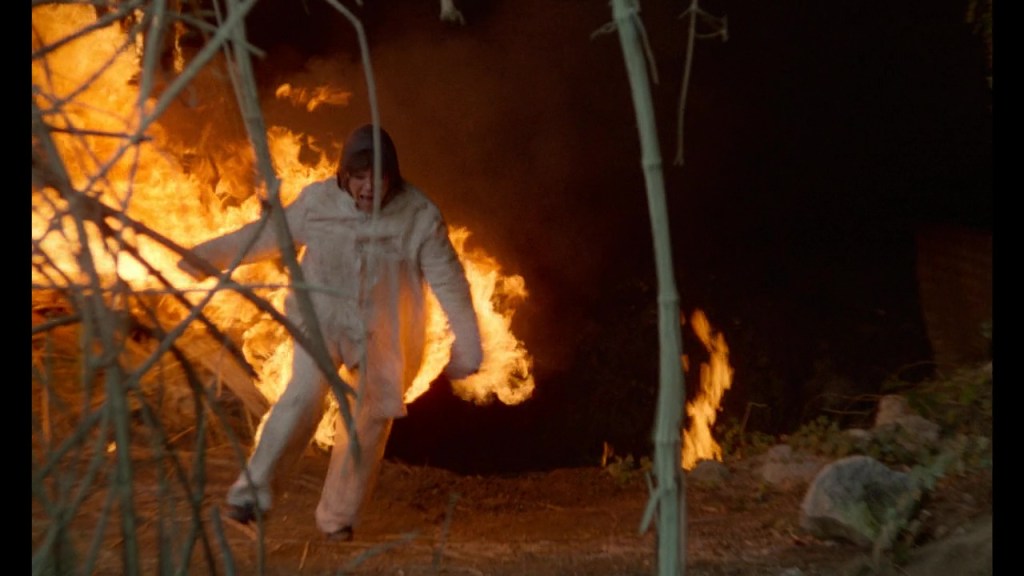
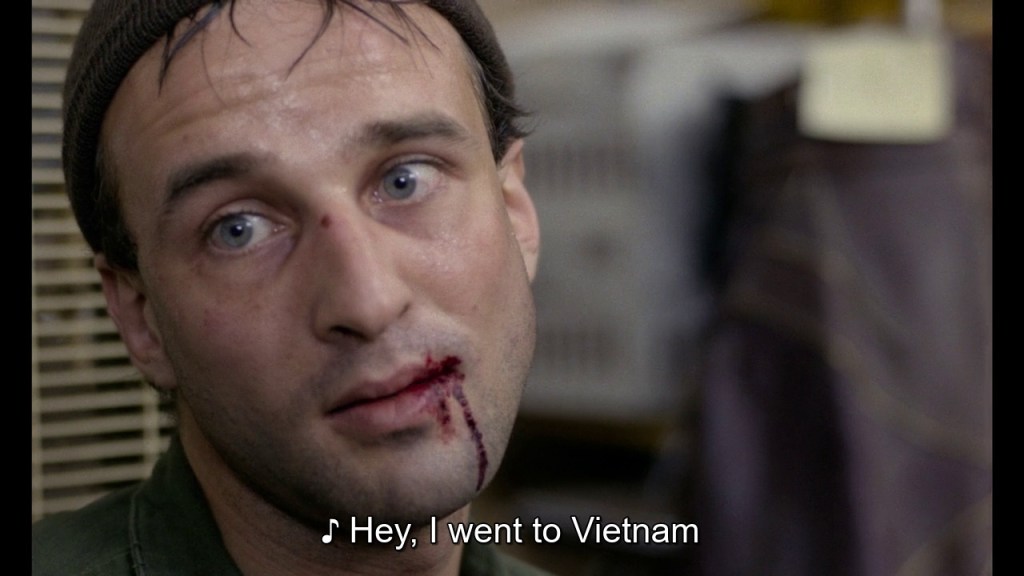
This one starts in the jungle too, but it’s a jungle in Vietnam, and the Western interlopers are American soldiers prosecuting the disastrous and eventually futile Vietnam War. A squad led by super-macho Norman Hopper (John Saxon from Nightmare on Elm Street) lands in a village and torches the place, after getting blown up by a dog (yeah, it gets worse). They find some POWs captured from their squad, Tommy Thompson (Tony King, who is now head of security for the hip-hop group Public Enemy) and Charlie Bukowski – a intertextual reference to the poet Charles Bukowski I guess, although the link seems tenuous. Bukowski (the soldier, not the poet) is played by John Morghen from Cannibal Ferox, an actor who pretty much always dies horribly in every movie he’s been in, and this is no exception.

They have somehow caught a virus (?) which makes them crave human flesh. That makes it sound more like a zombie movie than a cannibal one (think 28 Days Later), but let’s give it a cannibal pass by referencing the Wendigo films like Ravenous or Eater. Or you could claim, as the doctor says to Norman, it’s a “form of rabies.”

No, it isn’t. He really should have gone with Wendigo, a mythical figure – giant, fierce and cannibalistic, who gathers strength from feeding on human flesh, but the flesh makes him grow larger, and so his appetite can never be satisfied. He is sometimes protective (like Norman), and sometimes a figure of revenge (like Charlie and Tommy). The Wendigo gets inside people who are weak, hungry, or filled with rage.

Anyway, the squad is using flamethrowers to fight the Vietcong (and their women and small children) and one burning woman falls into the pit where the POWs are confined, making for a cooked meal. No home delivery jokes please.

Back in the States, Norman is having nightmares of being bitten by the POWs as he rescued them from their meaty pit. He realises something is wrong with him (the virus from getting bitten maybe?) and stares in horror and fascination at a bleeding lump of flesh in the fridge. Why is there flesh left to bleed in the fridge – isn’t that a health hazard?

One of the rescued POWs, Bukowski, suddenly phones him – he’s on day release from the “Hospital for Nervous Disorders”, or what the cops call a “loony bin”. Norman can’t meet him because the teenage neighbour is lasciviously pointing a hairdryer at him, and he is drawn to her lower regions, but for someone infected with the cannibal virus, ‘eating her out’ means something different to what she expects. She drops by later to tell him that she enjoyed being bitten. What do you know.

Meanwhile, Charlie has gone to see a war movie, as you do when you’re been treated for months for severe PTSD. It’s Umberto Lenzi’s From Hell to Victory, a lovely in-joke among amici, with lots of explosions and deaths. But no one is watching the war.

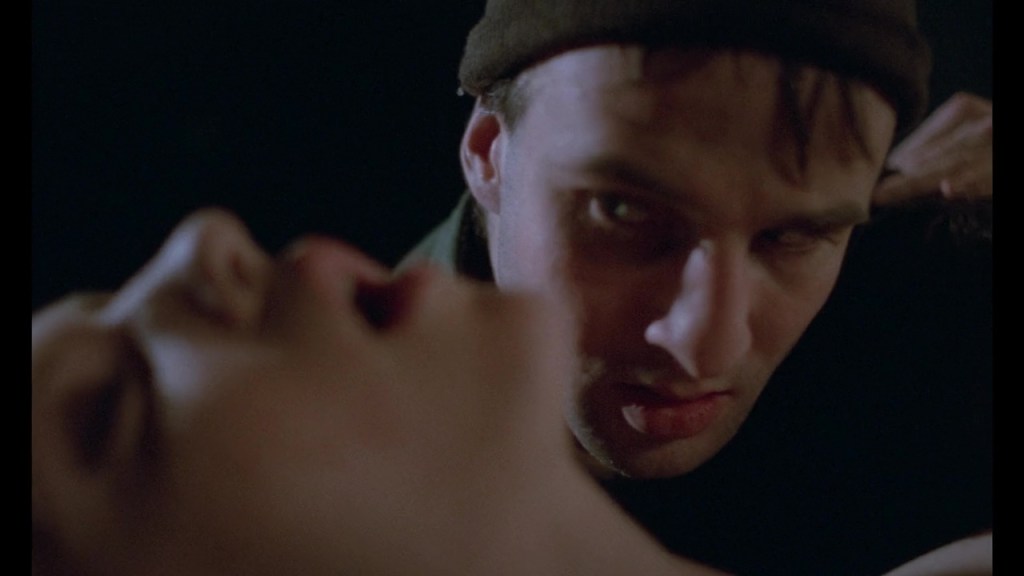
In front of him, a couple are doing oral things – exchanging saliva and sucking on boobs, erotic cannibalism, but Charlie joins in by taking a healthy bite of the girl’s neck as she leans back in her seat. He runs, there’s a shootout, he kills and eats a bikie and a security guard – it’s all downhill from here. The Atlanta police chief wants to know about him, not his name (despite it’s fascinating intertextuality):

Is he a subversive, a queer, a black, a commie, or a Moslim fanatic?

No, he’s a clean cut all-American (Italian) Vietnam vet, who wants to eat people.

Lots of people get bitten or scratched – a cop, a nurse, who then bites off the doctor’s tongue, and of course there’s that wanton teenager from next door (what horror film would be complete without promiscuous teenagers?), who was infected by Norman’s bite, even though he thought he could overcome the craving for meat.

Point is, they all have the cannibal virus, and the cannibals end up in the sewers (apparently hoping to hoof it to the airport and hop on a flight back to Vietnam), where they are chased by men with guns and flamethrowers; it’s really just like Nam, but now they have become the enemy.

The movie was one of 39 films to be prosecuted in Britain during the 80s as a ‘video nasty’. The acting sometimes leaves a little to be desired, but the main characters, Saxon and Morghen, are great. The special effects are by the legendary Giannetto De Rossi and are, like most of his work, spectacularly abject. The music is a mix of elevator and disco, creating what TV Tropes calls “soundtrack dissonance” – it’s either disturbing or just annoying, I’ll leave that up to you to decide.

In his commentary on the film, the director Antonio Margheriti proudly states that this film was Quentin Tarantino’s favourite of his movies. Tarantino referenced the film a couple of times: in Inglourious Basterds, Donnie Donowitz uses an alias “Antonio Margheriti”, while in Once Upon a Time in Hollywood, Leonardo DiCaprio character goes to Italy in 1969 to star in Spaghetti Westerns and also one Bond-type spy thriller supposedly directed by Margheriti titled Operazione Dyn-o-mite.

But video nasty or not, Cannibal Apocalypse has some interesting things to say about the fallacies and phalluses of war and cannibalism. The cannibal virus comes back to the USA with Vietnam veterans, a group who were sent to fight a vicious and often brutal war, often against civilians, and returned to abuse or neglect, with far more veterans dying from suicide than died in that war. They also brought back with them, on top of their trauma, exotic diseases, drug habits, and acute psychological damage. Many went as conscripts, and came back as severely damaged killing machines, metaphorically lusting for human flesh and spreading the anger and violence to all those near to them. It’s happened over and over in every war – a culture of killing leads to a spiral of violence. Even when you think the nightmare is over and all the cannibals dead, there’s still the teenager and her little brother to consider (hey, it’s been over forty years – where is the sequel this seems to promise?)

Probably not.

The drive to kill and to eat flesh are closely linked in human history. Consider the words of Isaac Bashevis Singer in the forward to the book Vegetarianism, a Way of Life, by Dudley Giehl:

As long as human beings will go on shedding the blood of animals, there will never be any peace…

If you think Cannibal Apocalypse sounds interesting but you’re short of time, most of the good (gory) bits are covered fully in the review by Mike Bracken, AKA The Horror Geek (@horrorgeek). Mike’s vodcasts are always very entertaining, but this review had me guffawing out loud, which is a bit weird when you’re watching with headphones, in apparent silence, and pretending to be writing an academic thesis. In fact, Mike’s review is much better than the film, IMHO.

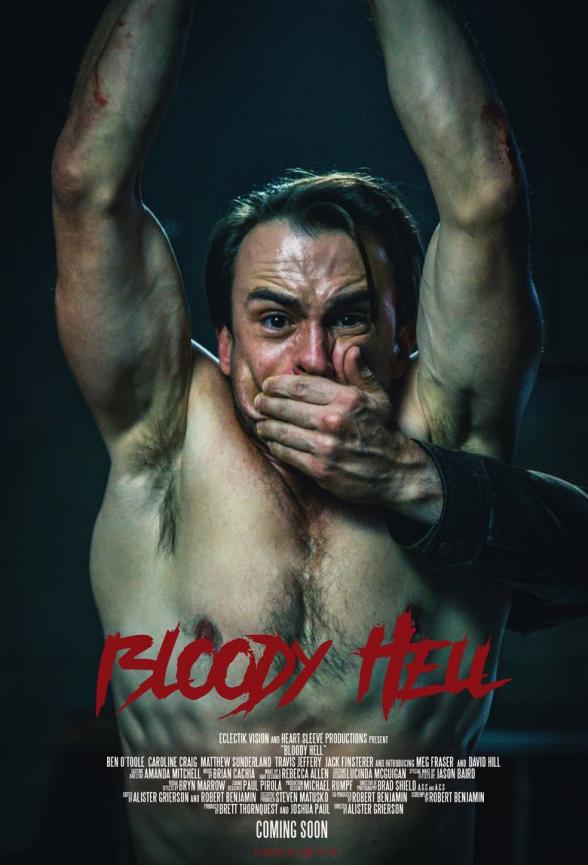
BLOODY HELL (Alister Grierson, 2020)

This is a ripsnorter of a thriller, and full of surprises. Defiantly internationalist, the film is an Australian-British action/horror film directed by Alister Grierson (Kokoda, Sanctum, Tiger) and written by Robert Benjamin. It is set in a basement in Helsinki Finland with scenes in Boise, Idaho, and features mostly Australian and New Zealand actors, with American or Finnish accents and dialogue as necessary. It was made on the Gold Coast in Queensland (as many blockbusters have been recently).

The main characters are both personas of Rex (Ben O’Toole – Hacksaw Ridge, Detroit, The Water Diviner).  O’Toole is superb (imagine a combination of Bruce Willis and Robert Downey Jr) in two roles: both the physical Rex and his inner voice, the part of him (and all of us) which commentates his life and ordeals, screams abuse, even when pretending to be calm and collected or even unconscious, and debates the best responses, rational or emotional, to every aspect of what is going on around him. O’Toole called this Rex his character’s “conscience”, but it’s not a Freudian split between an ego and a superego (or id) – it is more nuanced, and the invisible Rex (invisible to other characters – the audience and physical Rex can see and hear him) argues about practical and ethical issues all the time, sometimes compassionate, sometimes sneering and violent. That inner voice, as we all know, is exhausting.

Rex and his inner voice are off to Finland. Why? Well, Rex was in a bank, chatting to a teller he fancied, when a gang of heavily armed men came storming in and violently robbed both the bank and the customers. Rex, ex-military, was able to take on the gang and kill them all, but the last one was ready to surrender when invisible Rex screamed:

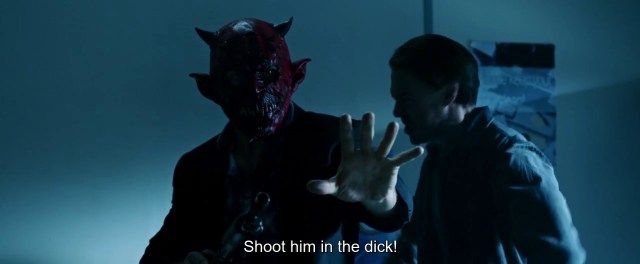
As the last robber collapsed, dickless, his gun went off, killing an innocent teller who had been hiding in a cupboard. Rex became a media sensation, with half the population calling him a hero, and the rest a “psycho twat”, and a plea bargain saw him in jail for eight years for causing the teller’s death, leading to his decision to emigrate, on his release. In a flashback to his court case, Rex is asked why he shot the bank robber in that particular spot.

“I wanted him down… and I didn’t want him to reproduce… win – win!”

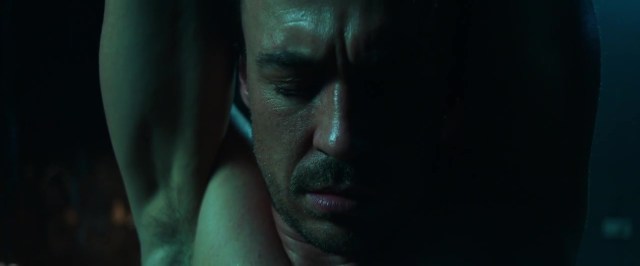
Why Finland? Well, he shot spitballs at a world map in his jail cell, and fate led him to that country. Where, unfortunately, a family of cannibals awaited him, and he wakes up, barely twenty minutes into the film, hanging by his wrists from a water pipe in a dark basement.

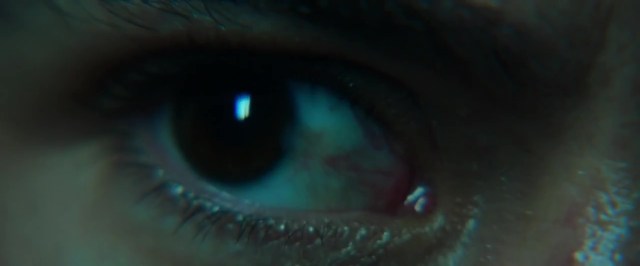
With the classic trope of cannibal films, used so well in Texas Chain Saw Massacre – the extreme close-up.

He is missing a leg, blood dripping from the stump, but his inner Rex is still fine and walking around, and furious at their precarious situation. Our imaginary self, after all, is as threatened by our mortality as we are.

It is clear to us, the audience, that Rex’s body parts are a living larder, although it takes the Rexs a bit longer to figure out why his leg is missing.

“Black market limb trade… is that a thing? I’m pretty sure there’s a niche there.”

It’s actually a very funny film – the dialogue between the two Rexs and even some of the murderous Finns is often hilarious. Rex pulls himself up to the huge knot to try to free himself with his teeth, observing that, short of one leg,

Rex’s love interest is Alia (Meg Fraser – Leech) the daughter, who has spent her life trying to escape her family.

Rex offers to “rescue” her (which considering his position is ambitious), and tells her,

“If we get out of here, I’ll tell you the whole story over dinner. I’ll even pay, huh?”

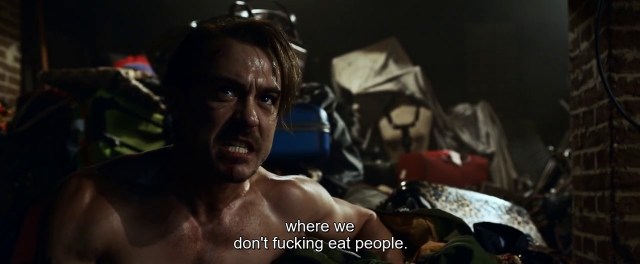
Now Rex has to dump on vegans to the girl whose family is upstairs eating the meat of his right leg; the family are definitely not vegans, nor can they see anything much wrong in giving their oldest son his preferred meat species. Alia explains that her older brother Pati is “the oldest and the hungriest”. Like Rex, he certainly does like a bit of meat, but, like the Wendigo, there is only one source that will satisfy him. Many omnivores will eat any meat except human. Pati will eat any meat as long as it’s human. As omnis like to say “it’s a personal choice.”

“He’s the reason you’re here. And very soon, there will be nothing left of you.”

Cannibal Studies is usually concerned with the anthropological or metaphorical aspects of the act – exposing the outsider as uncivilised, or else dripping irony about our own rapacious appetites. This film manages to do both, as Rex rants about the Finnish family, and how he wants to be back in the good ol’ USA,

Which is ironic, because if you check the “Cannibal News” category on this blog, you will see that a goodly proportion of modern cases of cannibalism occur in the good ol’ USA (and none in Finland*). The USA is the apotheosis of consumer societies where, just like Alia’s brother,

The rest of the film concerns Rex’s attempts to escape – not easy when one leg is gone and one of the family members has just tried to saw off the second one. You’ll have to see it to find out how that goes. It’s well worth it. Film critic Rob Hunter sums it up nicely:

“It’s a serious tale of survival encased in blackly comic humor, maliciously creepy twins, and the most sweetly sensual stump-washing scene you’ve ever had the pleasure of witnessing.”

The movie premiered in Australia on October 8, 2020, and in the United States a day later at the Nightstream Film Festival. It has a 91% fresh on Rotten Tomatoes, with comments like “blissfully, absurdly over-the-top, but in a twistedly charming way”.

This is a blackly humorous horror-thriller, and is quite brilliantly executed by Alister Grierson, particularly as the hero, normally the action figure of such stories, is tied to the ceiling and missing a leg for most of the film. You might think that would slow down the pace, but director Grierson keeps it tearing along. I usually stop and start when reviewing a movie, but this one I gulped down in one sitting, then came back for details.

As for the lead actor, Ben O’Toole, he seems to have got a taste for the cannibal stories. He said in an interview that he’d like to play Titus Andronicus, who was William Shakespeare’s favourite cannibal.

Let’s not forget, too, how much cannibalistic symbolism is involved in sex, such as “I could eat you up” as well as various foodie words for cunnilingus and felatio. And of course the French (or Finnish) kiss, when Rex and Alia finally escape.

And just to prove other people like puns too, here is the last frame of the film.

* Actually, there is a case of Finnish cannibalism – Jarno Elg, a supposed Satanist, who was sentenced to life imprisonment in 1998 for murdering a 23-year-old man, eating some of the body parts and inciting some friends to participate in a ritual that included torturing the victim while listening to songs from The Cainian Chronicle album by the Norwegian black metal band Ancient. Elg was granted parole in 2014.

The movie is available at Amazon.