Meat is meat! THE BUTCHERS (Paulmichel Mielche, 1973)

Since at least the time of Sweeney Todd, the barber who killed his customers and turned them into pies in the early 19th century, enterprising business people have been selling human meat to their customers. In Soylent Green, the US government does a roaring trade in it, and demonstrates sustainable recycling, well before it became fashionable. It’s a trope that is enduringly popular, because it offers metaphors for the fears people hold about their own society. Who among us has not suspected we have been exploited, chewed up and spat out at some time? Except for those doing the chewing up of course. 

The movie was originally called Maxie, but that must have been a bit subtle, as it was renamed for marketing purposes to The Butchers or sometimes Murderer’s Keep. The lead character is a young girl named Maxie (K.T. Baumann) – a difficult role as Maxie is a deaf mute who witnesses the local butcher chopping up dead people for his shop, and is kidnapped by his assistant to ensure her “silence”. They’re afraid she is going to learn to talk. It’s complicated (not really). Baumann expresses what most actors get to say by using her face, movements and sounds, and she is very impressive.

The butchers are Smedke (Vic Tayback from Bullitt as well as bit parts in almost every TV show ever made) and his half-witted assistant Finn, played with gusto by Robert Walden (Lou Grant and lots of other shows). The problem is that, as horror movie villains, they are neither scary nor villainous. Except for their business practices, they are quite sympathetic characters. The gore we usually associate (expect?) with cannibal movies is mainly the result of Finn, the apprentice butcher, screwing up the slaughter of some unfortunate hens. We see that in gory detail, as if the director wants us to question whether it’s worse to eat a living, breathing animal fighting for her life, or a dead body who can feel nothing. The scene reminded me of the gratuitous animal cruelty in Cannibal Holocaust and other Italian cannibal movies, which were supposedly added to make the audience think the violence and cannibalism were real. No such pretence here – they just kill chickens. Life is cheap.

Smedke is buying human corpses, wrapped in brown paper, from a shipping yard (no further explanation is offered) and happily chopping them up for customers who don’t want to pay the prices he charges for the regular cuts. His refrain is:

“Meat is meat! And a man has to make a living.”

A refrain that is lost in this film, but was used to great effect a few years later (“meat is meat and a man’s gotta eat!”) by the ever-cheerful Rory Calhoun in Motel Hell. Smedke is an entrepreneur in Nixon’s America, which is careering toward neo-liberalism, Reagan and “greed is good”. Although he doesn’t get to expand on his philosophy, it seems clear that a dead body is worthless buried, so it might as well be bought and sold.

The interesting aspect of the ‘plot’ is that Maxie cannot tell anyone what she has seen (basically a human foot sticking out of the brown paper) and has no social skills since her father has kept her at home rather than risk her humiliation at school. Yet she can take an ethical position – she tosses out all the meat in her father’s fridge, choosing vegetarianism.

This barely ranks as a B movie, and while I have reviewed a few films on this blog that got a fat zero on Rotten Tomatoes, this might be the first that did not even get onto the site at all. Check this less than glowing review:

“Miekhe… ends up creating the cinematic equivalent of a staph infection, an oblique mess that just spreads and oozes across the screen like fissures on an untreated leg gash. By the end, you aren’t hoping for closure so much as a conclusion – ANY conclusion – just to get us out of this asylum as anti-horror film… And yet, for all its baffling movie machinations, its lack of gory goodness and substantially less than successful storytelling, The Butchers is still a fascinating film experience.”

Indeed, it has a certain fascination if you can navigate through the paper-thin plot – it is a glimpse of small-town America in 1970 as it moves from the optimism of the sixties to the rapacity of the seventies. The cast are mostly great, particularly Baumann and Walden. Talia Coppola, (aka Talia Shire, the sister of Francis Ford Coppola) is shown as a star on the credits, although she has a minor role in the film. She played Connie Corleone in the Godfather series, and Adrian Pennino in the Rocky films, and was nominated for an Oscar in both roles. She is a bit wasted here.

The music is quirky, sometimes totally inappropriate and never boring or obvious like so many horror films. And sometimes it’s just fun to watch a film that no one has heard of, and probably no one ever will. And it asks the key question of cannibal studies: why do people find the killing and eating of some animals unremarkable and others repulsive?

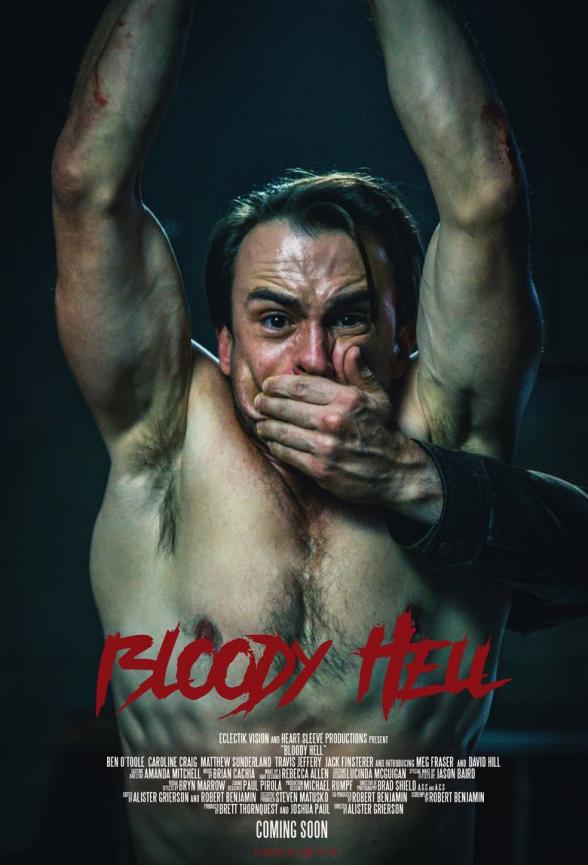
BLOODY HELL (Alister Grierson, 2020)

This is a ripsnorter of a thriller, and full of surprises. Defiantly internationalist, the film is an Australian-British action/horror film directed by Alister Grierson (Kokoda, Sanctum, Tiger) and written by Robert Benjamin. It is set in a basement in Helsinki Finland with scenes in Boise, Idaho, and features mostly Australian and New Zealand actors, with American or Finnish accents and dialogue as necessary. It was made on the Gold Coast in Queensland (as many blockbusters have been recently).

The main characters are both personas of Rex (Ben O’Toole – Hacksaw Ridge, Detroit, The Water Diviner).  O’Toole is superb (imagine a combination of Bruce Willis and Robert Downey Jr) in two roles: both the physical Rex and his inner voice, the part of him (and all of us) which commentates his life and ordeals, screams abuse, even when pretending to be calm and collected or even unconscious, and debates the best responses, rational or emotional, to every aspect of what is going on around him. O’Toole called this Rex his character’s “conscience”, but it’s not a Freudian split between an ego and a superego (or id) – it is more nuanced, and the invisible Rex (invisible to other characters – the audience and physical Rex can see and hear him) argues about practical and ethical issues all the time, sometimes compassionate, sometimes sneering and violent. That inner voice, as we all know, is exhausting.

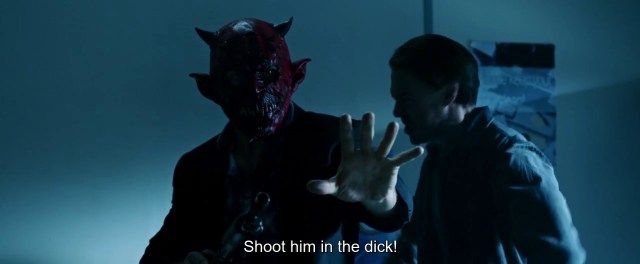
Rex and his inner voice are off to Finland. Why? Well, Rex was in a bank, chatting to a teller he fancied, when a gang of heavily armed men came storming in and violently robbed both the bank and the customers. Rex, ex-military, was able to take on the gang and kill them all, but the last one was ready to surrender when invisible Rex screamed:

As the last robber collapsed, dickless, his gun went off, killing an innocent teller who had been hiding in a cupboard. Rex became a media sensation, with half the population calling him a hero, and the rest a “psycho twat”, and a plea bargain saw him in jail for eight years for causing the teller’s death, leading to his decision to emigrate, on his release. In a flashback to his court case, Rex is asked why he shot the bank robber in that particular spot.

“I wanted him down… and I didn’t want him to reproduce… win – win!”

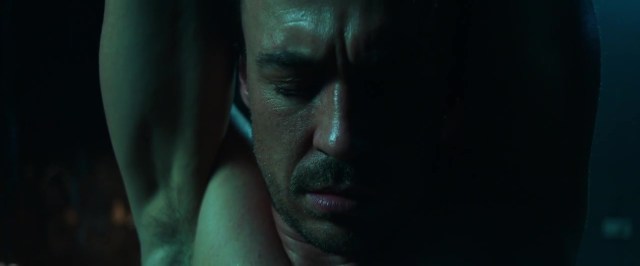
Why Finland? Well, he shot spitballs at a world map in his jail cell, and fate led him to that country. Where, unfortunately, a family of cannibals awaited him, and he wakes up, barely twenty minutes into the film, hanging by his wrists from a water pipe in a dark basement.

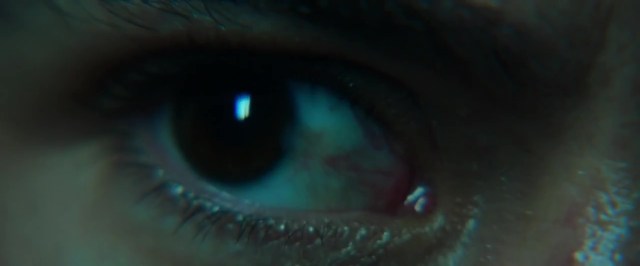
With the classic trope of cannibal films, used so well in Texas Chain Saw Massacre – the extreme close-up.

He is missing a leg, blood dripping from the stump, but his inner Rex is still fine and walking around, and furious at their precarious situation. Our imaginary self, after all, is as threatened by our mortality as we are.

It is clear to us, the audience, that Rex’s body parts are a living larder, although it takes the Rexs a bit longer to figure out why his leg is missing.

“Black market limb trade… is that a thing? I’m pretty sure there’s a niche there.”

It’s actually a very funny film – the dialogue between the two Rexs and even some of the murderous Finns is often hilarious. Rex pulls himself up to the huge knot to try to free himself with his teeth, observing that, short of one leg,

Rex’s love interest is Alia (Meg Fraser – Leech) the daughter, who has spent her life trying to escape her family.

Rex offers to “rescue” her (which considering his position is ambitious), and tells her,

“If we get out of here, I’ll tell you the whole story over dinner. I’ll even pay, huh?”

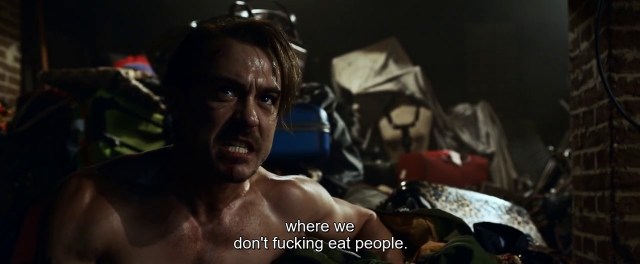
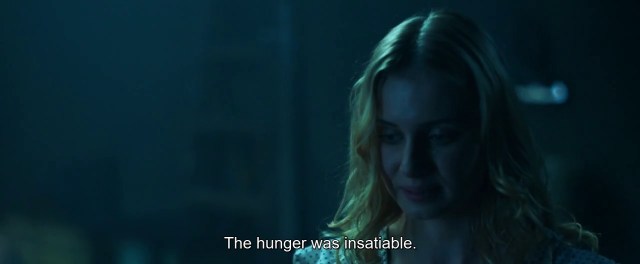
Now Rex has to dump on vegans to the girl whose family is upstairs eating the meat of his right leg; the family are definitely not vegans, nor can they see anything much wrong in giving their oldest son his preferred meat species. Alia explains that her older brother Pati is “the oldest and the hungriest”. Like Rex, he certainly does like a bit of meat, but, like the Wendigo, there is only one source that will satisfy him. Many omnivores will eat any meat except human. Pati will eat any meat as long as it’s human. As omnis like to say “it’s a personal choice.”

“He’s the reason you’re here. And very soon, there will be nothing left of you.”

Cannibal Studies is usually concerned with the anthropological or metaphorical aspects of the act – exposing the outsider as uncivilised, or else dripping irony about our own rapacious appetites. This film manages to do both, as Rex rants about the Finnish family, and how he wants to be back in the good ol’ USA,

Which is ironic, because if you check the “Cannibal News” category on this blog, you will see that a goodly proportion of modern cases of cannibalism occur in the good ol’ USA (and none in Finland*). The USA is the apotheosis of consumer societies where, just like Alia’s brother,

The rest of the film concerns Rex’s attempts to escape – not easy when one leg is gone and one of the family members has just tried to saw off the second one. You’ll have to see it to find out how that goes. It’s well worth it. Film critic Rob Hunter sums it up nicely:

“It’s a serious tale of survival encased in blackly comic humor, maliciously creepy twins, and the most sweetly sensual stump-washing scene you’ve ever had the pleasure of witnessing.”

The movie premiered in Australia on October 8, 2020, and in the United States a day later at the Nightstream Film Festival. It has a 91% fresh on Rotten Tomatoes, with comments like “blissfully, absurdly over-the-top, but in a twistedly charming way”.

This is a blackly humorous horror-thriller, and is quite brilliantly executed by Alister Grierson, particularly as the hero, normally the action figure of such stories, is tied to the ceiling and missing a leg for most of the film. You might think that would slow down the pace, but director Grierson keeps it tearing along. I usually stop and start when reviewing a movie, but this one I gulped down in one sitting, then came back for details.

As for the lead actor, Ben O’Toole, he seems to have got a taste for the cannibal stories. He said in an interview that he’d like to play Titus Andronicus, who was William Shakespeare’s favourite cannibal.

Let’s not forget, too, how much cannibalistic symbolism is involved in sex, such as “I could eat you up” as well as various foodie words for cunnilingus and felatio. And of course the French (or Finnish) kiss, when Rex and Alia finally escape.

And just to prove other people like puns too, here is the last frame of the film.

* Actually, there is a case of Finnish cannibalism – Jarno Elg, a supposed Satanist, who was sentenced to life imprisonment in 1998 for murdering a 23-year-old man, eating some of the body parts and inciting some friends to participate in a ritual that included torturing the victim while listening to songs from The Cainian Chronicle album by the Norwegian black metal band Ancient. Elg was granted parole in 2014.

The movie is available at Amazon.


Cannibal News: THE OKLAHOMA CANNIBAL 2021 – Lawrence Anderson

Lawrence Paul Anderson was arrested in February for the murder of his neighbour Andrea Lynn Blankenship, 41, as well as his uncle Leon Pye, 67, and his four-year-old niece Kaeos Yates. Police allege that Anderson, 42, cut out his neighbour’s heart and cooked it with potatoes for his family, then proceeded to kill them too.

Lawrence Anderson

On February 9 2021, Chickasha (Oklahoma) police responded to a 911 call from a woman pleading for help. They found Leon Pye already dead and his granddaughter Kaeos critically injured. She died in the back of the ambulance. Delsie Pye, Leon ‘s wife, was alive, but had knife wounds to both eyes.

Leon Pye and Kaeos Yates

Two days later Anderson confessed to the Oklahoma State Bureau of Investigation that before slaughtering his family, he had broken into the home of a neighbour and butchered the woman (Blankenship) who lived there.

“He confessed to going to 227 West Minnesota Avenue, Chickasha,” an agent reported. “He used his shoulder to knock in the back door. There were two German Shepherd dogs in the house. Anderson advised he killed the female resident and cut her heart out.”

Andrea Lynn Blankenship

“He took the heart back to 214 West Minnesota, Chickasha. He cooked the heart with potatoes to feed to his family, to release the demons.”

The SBI is seeking a warrant to collect from the home “pots, pans and any utensils for cooking.”

The triple murder sparked additional public outrage after it emerged that Anderson had been released from prison early, in January, as reported by the Oklahoman. He had been sentenced to twenty years behind bars for gun and drug offenses in 2017 before Governor Kevin Stitt commuted the sentence to nine years at the recommendation of the Oklahoma Pardon and Parole Board. He was released on parole in January after serving just over three years, and had been staying with his aunt and uncle since his release.

Grady County District Attorney Jason Hicks charged Anderson with three counts of first-degree murder and two felony charges of assault and battery with a deadly weapon and maiming on Tuesday. He was not charged with cannibalism. With the exception of Idaho, there are no laws against cannibalism in the United States.

Anderson sobbed in court during his initial appearance Tuesday, telling the judge: ‘I don’t want no bail, your honor. I don’t want no bail.’ Anderson does not look, at first glance, like a monster. Rather, he seems to offer support to Arendt’s theory of the banality of evil.

Anderson is being held without bond, and the prosecution says that the death penalty ‘is on the table’. 

Once again, we see that acts of cannibalism will dominate news stories, while murders are considered barely more than mundane. Yet paradoxically, while penalties for murder are usually substantial, cannibalism is not against the law in most jurisdictions, even in the USA (excluding Idaho), the country where a large proportion of cases of contemporary cannibalism occur.

Legislators, it seems, would prefer to pretend it just doesn’t happen. Until it does.

For more cannibal news, choose that category in the box on the right of the screen.

Whales and cannibals: IN THE HEART OF THE SEA (Ron Howard, 2015)

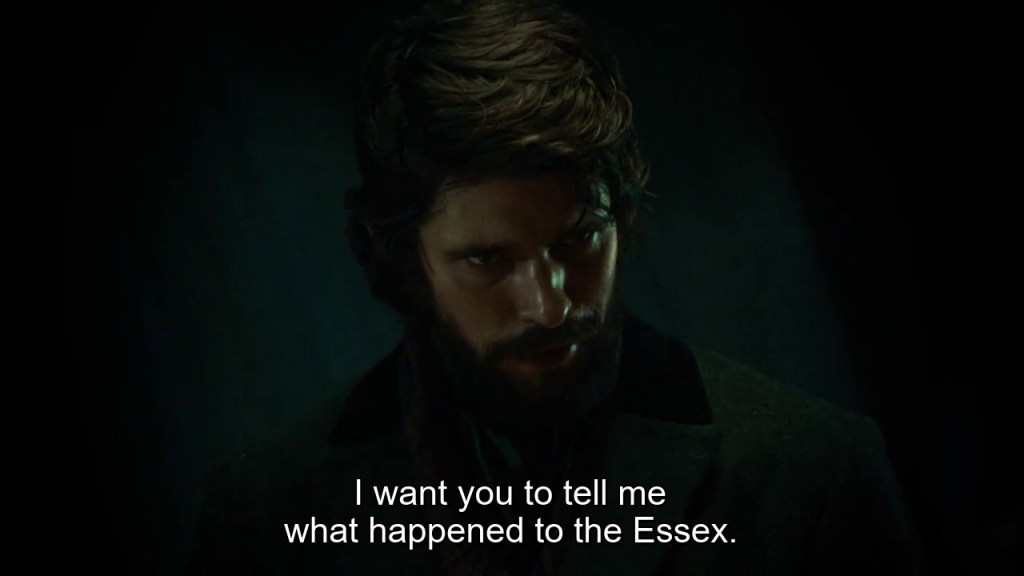
Herman Melville’s Moby Dick, the original ‘Great American Novel’, was based on the story of the Essex, a whaling ship that was destroyed by a bull sperm whale in 1820. The story of the wreck, and particularly the subsequent cannibalism that some of the survivors employed to survive, has largely faded from public knowledge (Moby Dick finished with the whale sinking the ship), but in the nineteenth century, every American child would have learnt about it at school, and this film starts with a young Melville (Ben Wishaw, who played a very different role in Perfume) seeking out the last survivor some decades later, hoping to get the full story to use in his novel.

This film is based on a meticulously researched 2000 book of the same name on the Essex disaster by Nathaniel Philbrick, which won him the National Book Award for Nonfiction in that year. Whaling was no more controversial in the early nineteenth century than crude oil in the early twentieth – it was used to power the factories and light up the cities of the world, and was worth a fortune. As the fleets decimated the whales near shore, the boats had to head further into, well, the heart of the sea, to find their victims. Whaling was, and remains, an incredibly brutal business, with small boats harpooning the giant mammals then drawing near and stabbing them to death. A successful kill was signalled by a plume of blood spurting out of the whale’s blowhole.

Whaling was a class-based system, with the captains drawn from the powerful old families in Nantucket, the tiny American island that was the centre of the industry. The main protagonist of the film is Owen Chase (Chris Hemsworth – the mighty Thor) as the first mate, who was refused the captaincy because he is socially inferior, an “off-islander”.

His best friend is the second mate Matthew Joy (Cillian Murphy from 28 Days Later). The Captain, George Pollard (Benjamin Walker from Abraham Lincoln: Vampire Hunter) is ineffectual but is from one of the original Nantucket families, and so has been promoted over Chase. In fact, the ships were run on strict class and race lines: the African-Americans and off-islanders lived in the Foc’s’le or front of the ship, where the food was inferior, and did the dirty work. The Nantucketers lived aft, and were fed and treated better. They were, in general, the ones that survived sinkings. Six African-Americans made it into the whaling boats – none survived. True Nantucketers were also mostly devout Quakers, pacifists who, however, saw no problem in killing magnificent whales and “raising bloody havoc at sea” as Philbrick put it. Class conflict is the basis of the story for the first half, before the angry whale comes along.

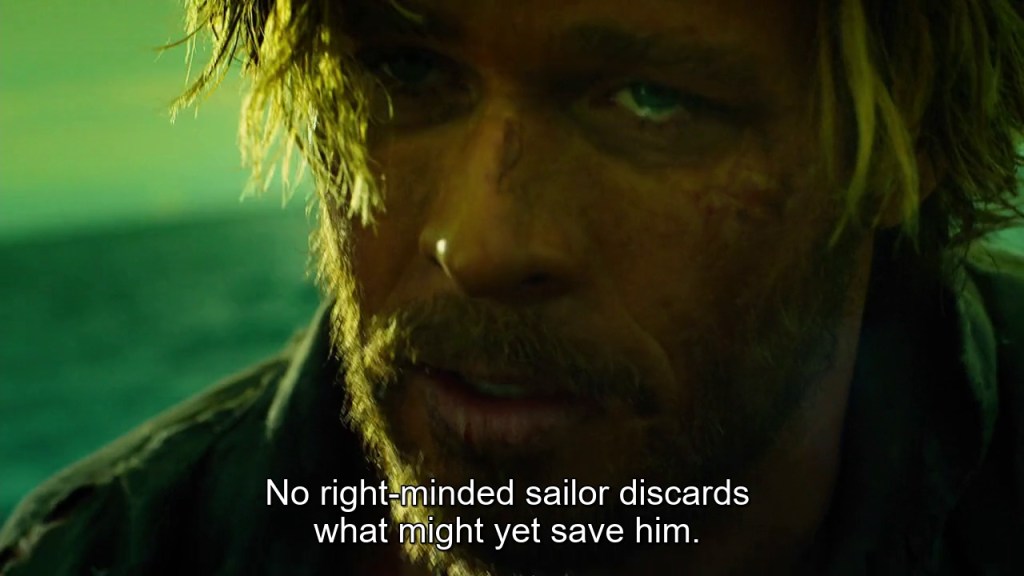
The story of the Essex is told to Melville by a decrepit old drunk who is the last remaining survivor, Thomas Nickerson (Brendan Gleeson, who was also in 28 Days Later). Nickerson had been a cabin boy (played by Tom Holland – Spiderman) when the boat sank. Nickerson did write an account of the events, but it was not discovered until 1980, so Melville did not in fact use his words. Chase’s brief account would have been the one known to Melville, who embroidered the conflict, as authors do, to make the whale white and almost supernatural, and avoided the controversy, not mentioning the cannibalism that resulted from the wrecking of the boat.

This does shed some light on the different reception of cannibalism over time. When the Essex set sail, cannibalism at sea after shipwrecks was not uncommon, and was generally considered embarrassing but necessary. The Monty Python team did a skit based on a version of this incident.

In the Heart of the Sea suggests a conspiracy by the whaling company to ignore the cannibalism as the presence at sea of a giant, angry whale would discourage further exploration, but Chase and Pollard refuse to cooperate. By Melville’s time, cannibalism was too graphic for his potential audience (he wanted to sell books after all). In our time, the great white whale is still of interest, in that he represents nature fighting back against human rapaciousness, but the real point of this film is now the cannibalism. Would anyone go to see a movie about a shipwreck if Thor didn’t eat anyone?

Or even if he did. The film’s tagline was “Based on the incredible true story that inspired Moby-Dick”, which did not inspire enough people to see it – it grossed $93 million, which sounds great until you see that it’s budget was $100 million. It scored a paltry 42% on Rotten Tomatoes, with the Seattle Times critic summarising it as:

“Thor and Spider-Man fight a whale.”

Despite some critics seeing the movie as over-long and dull, the scenes at sea are full of action (if not exactly Pirates of the Caribbean) and very well done, and the special effects are spectacular, especially the whales and the sails, and the whales demolishing the sails (you can guess which side I was on).

But as Philbrick wrote in his book,

The Essex disaster is not a tale of adventure. It is a tragedy that happens to be one of the greatest true stories ever told. (p.236)

The halfway point of a movie is usually the turning point in some form, and it certainly is here – in the middle of the film, in the middle of the Pacific, they finally find an abundance of whales, including the great white whale that they were warned about on a stop in Ecuador. He charges the ship, staves in the side, the whale oil they had collected goes up in flames, and they have to abandon ship and fit as much food as they can (which isn’t much) into their little whaling boats.

The rest of the movie is all about how some (a few) of them survived the long voyage of 4,500 nautical miles back to South America. They reach a small but uninhabitable island, and the white whale makes them welcome by tipping over their boats as they head for the beach. Chase and the Captain abandon their class struggle to engage in dialogue about anthropocentric carnivorous virility instead.

Pollard answers with presupposed anthropocentric arrogance.

“We are supreme creatures, made in God’s own likeness. Earthly kings, whose business it is to circumnavigate the planet bestowed to us…”

The island cannot sustain them – they find the skeletons of a previous party that took shelter there, so repair the boats and head off again for another agonising trip across the endless ocean. After 48 days stranded, with almost no food or water, one of the sailors on Chase’s boat dies. The others prepare to toss him overboard, but Chase stops them. It’s all handled quite delicately, but it’s definitely become a cannibal movie.

“We prepared the body. We removed the organs. Separated his limbs from his body and cut all the flesh from the bones.”

In the other boat, no one dies so conveniently, so they draw straws for a victim. The captain gets the short straw, but his cousin cannot shoot him and shoots himself instead, keeping the catering in the family.

The whale comes back, but he and Chase exchange a look, and Chase cannot bring himself to kill the magnificent bull.

After ninety days at sea, the survivors reached South America. According to the book, a boat that drew up alongside saw two men sucking the marrow from the bones of the dead, refusing to give them up. Unlike some survivor cannibal stories such as Alive, where the actors looked pretty much the same weight at the end of the ordeal, Hemsworth reported that the cast were put on a strict ration of 500–600 calories a day, and he lost 40 pounds (18kg), giving him a reasonable idea of what the sailors had gone through.

What the film doesn’t mention is that the survivors could have had a much easier time of it if they had headed not for South America but west toward the Marquesas Islands, only 1,200 miles away. They chose not to do so, because of earlier reports that the natives were, yep, cannibals. One mariner, Georg von Langsdorff, had written in 1804 that the natives so loved human flesh that “those who have once eaten it can with difficulty abstain from it.” Of course, it was all nonsense.

Instead, they headed east, and ended up eating each other.

The Silence of Hannibal: CLARICE episode 1 (CBS 2021)

So first the bad news – due to contractual arrangements, Hannibal Lecter does not make an appearance in the new TV series called Clarice. He can’t – the DeLaurentiis company (which produced Bryan Fuller’s Hannibal as well as the movies Manhunter, Hannibal, Red Dragon and Hannibal Rising) has exclusive rights to the characters originating in the novels Red Dragon, Hannibal and Hannibal Rising, and MGM have exclusive rights to The Silence of the Lambs, and own the movie too. Clarice Starling first appeared in Silence of the Lambs, so can be revisited in this series, while Hannibal and Will Graham originated in Red Dragon, so can come to life in Fuller’s brilliant series, but the three of them cannot ever meet. With intellectual property as hot as the characters that came from the Promethean mind of Thomas Harris, sharing it around among production companies is about as likely as two dogs with one bone.

The good news is that Clarice is a damn good show, and Rebecca Breeds, the Aussie actor with the West Virginia accent (it sounded good to me, although I’ve never been to WV) is just right in the role. In the pilot, she manages to convey a complex picture of a young woman who is smart, resourceful and tough, fighting for her place in a man’s world, while still haunted by untreated PTSD from her run-in with Buffalo Bill in the movie.

This is a sequel to Silence of the Lambs, and while there is no appearance from Hannibal (who, after all, was on the run after his gory escape in the movie), there are plenty of references to the film, particularly Buffalo Bill (Jame Gumb), the serial killer whom Clarice killed at the climax of the film.

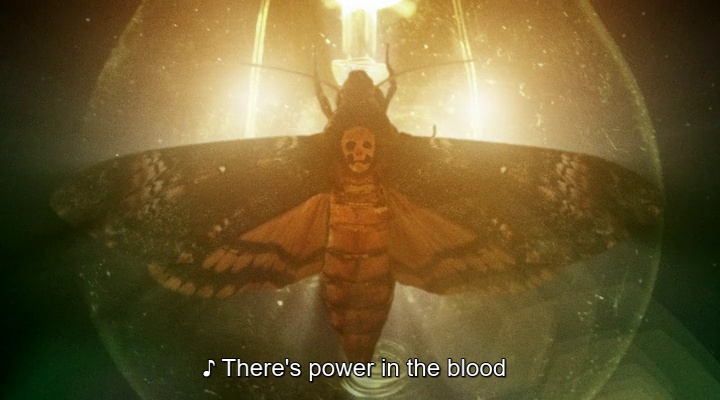
A year after the events of the film, Clarice is waking up at night from nightmares full of violence and deaths-head moths.

She is attending mandatory psychiatric sessions, which she is not happy about, and tries to joke, argue and obfuscate her way out. The therapist says that is

“understandable, given that your last therapist was an inmate in the Baltimore Hospital for the Criminally Insane,”

If you remember Silence of the Lambs, you will recall that the serial killer, Jame Gumb, had captured Catherine Martin, whose mother was a US Senator, and was about to skin her to make a “vest with tits” as Hannibal so elegantly put it. The mother, Ruth Martin (Jayne Atkinson), is now Attorney General of the US, and determined that a new serial killer will not be running wild on her watch.

Ruth Martin drags Clarice out of the Quantico FBI HQ where she has been hiding and doing data entry, and attaches her to the new ViCAP (Violent Crime Apprehension Program) task force. She tells Clarice,

“You saved my little girl. You are a woman with a very public reputation for hunting monsters, Clarice.”

The pilot episode is largely procedural, as was Hannibal when Season one started. Someone is killing women and mutilating them. Is it a crazed serial killer? Well, he is biting them, so that qualifies him for this cannibalism blog, but Clarice notices something odd about the wounds. There’s no intimacy. No frenzy.

 “A true psychopath? We’d still be looking. But a true sociopath – they wouldn’t have left their faces.”

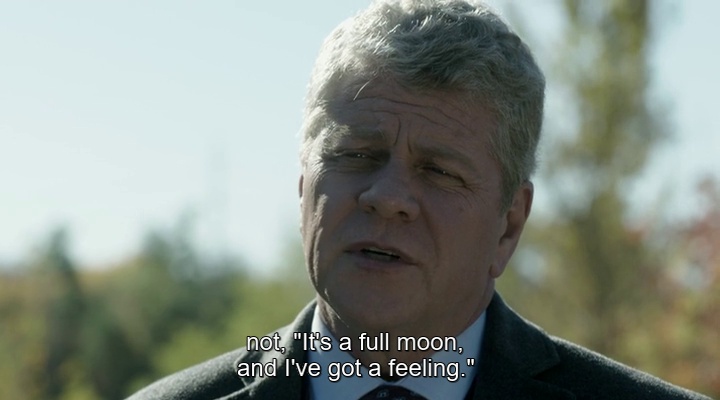
The ongoing antagonist in this is Paul Krendler (Michael Cudlitz from Walking Dead) who barely appeared in the film Silence of the Lambs, although he was an important opponent in the book, and became more important as he destroyed her career in the book and film Hannibal in revenge for her unwillingness to indulge his sexual appetites. In this series, he is a cranky old man, dubious of her talents (he thinks she just got lucky in pursuit of Buffalo Bill) and not willing to let her play hunches.

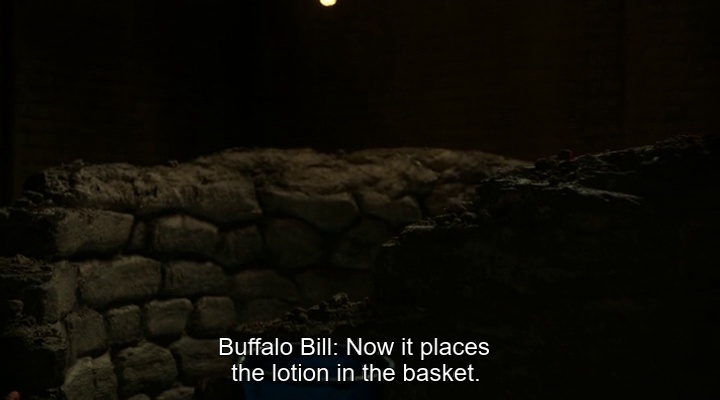
The FBI grunts play tricks on her, putting lotion on the handles of her desk drawers and telling her

Which of course were Gumb’s instructions to Catherine, using the impersonal pronoun ‘it’ to dehumanise her.

Clarice remembers what Hannibal taught her about the Emperor Marcus Aurelius, with a little prompting from her friend Ardelia (Devyn A. Tyler).

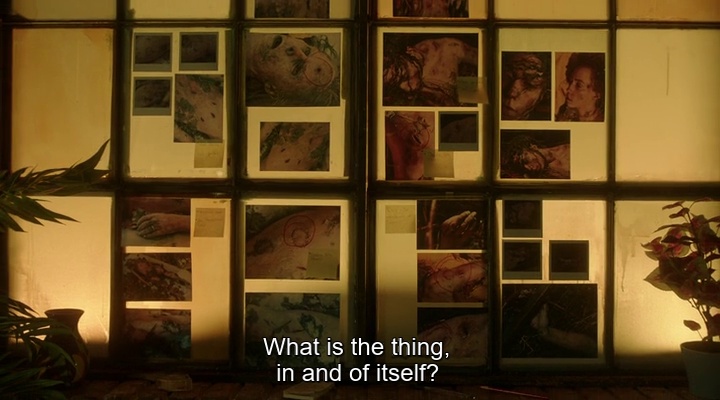
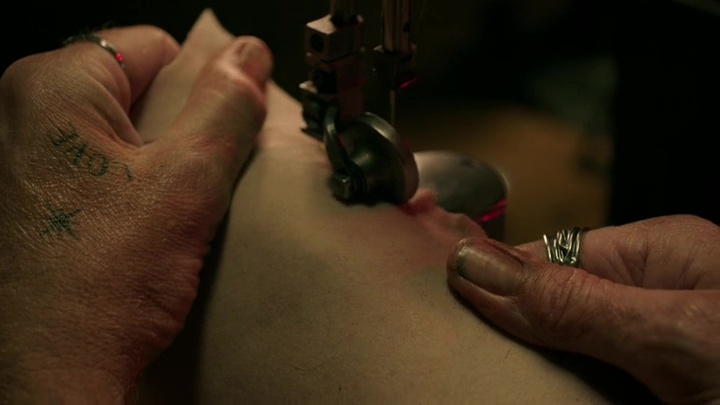
She works out that the wounds are “desperately random”, which is what Hannibal told her about the apparently random dumping of the bodies by Jame Gumb. She realises that the murderer is not a crazy serial killer but is cold, calculating and has a set of targets. The rest of the episode is about her tracking him down, while still haunted by her past. Meanwhile, Catherine Martin is frantic to talk to her; Catherine is now an anorexic recluse, because Gumb only took big girls, whose skin would fit on his frame (but at least she has Gumb’s dog Precious, who I always thought was a nod to Tolkein). Clarice suffers flashbacks and nightmares: Catherine in the oubliette, Jame Gumb sewing a garment of human hide.

The press are obsessed with Clarice, the National Tattler calling her (as in the movie), the “Bride of Frankenstein”.

Krendler wants her to toe the official line and tell the press that this is a crazy guy. But this is Clarice. She’s going to tell it like it is.

Now, I know a lot of Fannibals would have preferred a fourth season of Hannibal to a new series about Clarice (and have said so quite vociferously). But let us not forget what Clarice meant to Hannibal, or at least Hannibal in his twentieth century persona. She was one of the first to interview him successfully in his solitary cell. He found her fascinating and was, let us admit it, somewhat smitten with her, in the books and the films. Remember Hannibal’s words:

“I think it would be quite something to know you in private life.”

So let’s not disparage our opportunity to know her. In the movie Hannibal, he points out that he has travelled half way around the world to watch her run, and wonders why she won’t now let him run, then chops off his own hand rather than harm her.

vlcsnap-00135

Unlike many male authors, Thomas Harris can write female protagonists as real, complex people, and he does it so well; not just Clarice Starling, but also the central characters of his first and most recent novels (both non-Hannibal stories) – Dahlia Iyad in Black Sunday (1975) and the eponymous protagonist of Cari Mora (2019).

Hollywood was not willing to countenance a romance between a law officer and (as they saw it) a psychopathic serial killer. But in the novel, the relationships are far more complex: Hannibal hopes Clarice might provide a position in the world for Mischa, his sister, who was eaten by Nazi collaborators during the war. Clarice suggests an alternative: Mischa can live through him, Hannibal, instead, and “she” and Clarice can be like sisters. Remembering Hannibal’s question to Senator Martin (in Silence of the Lambs), she asks if he was breastfed, and if he ever felt that Mischa had made him give up the breast when she was born. Well, he won’t have to give up this one: she offers him her breast, with a warm drop of Chateau d’Yquem suspended from the nipple. He sucks it, but not as a cannibal; as a child, or as a lover. Freud of course would wonder if there is actually a difference.

Unlike the film, in the book Hannibal and Clarice are presumed live happily ever after; the asylum guard Barney sees them at the Teatro Colon, the opera house in Buenos Aires. They are watching Tamerlane, an opera that starts with an Emperor in chains, and ends with a love duet.

This new series, Clarice, is what happens between Hannibal`s escape at the end of Silence of the Lambs and their renewed encounters in Hannibal. It’s important history, one which those of us who loved the books and movies need to explore, even if we loved the Hannibal TV series too.

Clarice is on CBS (where you can watch the first episode if you are in the USA or have a VPN) and streaming on Stan in Australia.

A complete listing of my Hannibal film and TV blogs is at https://thecannibalguy.com/2020/07/08/hannibal-film-and-tv-blogs/

Cannibal News – THE ARKHANGELSK CANNIBAL sentenced to life imprisonment

The Russian Supreme Court has just confirmed the sentence of life imprisonment on Eduard Seleznev, known as the “Arkhangelsk Cannibal”, who killed and ate the flesh of three men.

Seleznev killed three of his friends aged 59, 43 and 34 between March 2016 and March 2017, getting them drunk and then stabbing them to death. He admitted the murders, and added that he had then sliced their bodies up, kept the meat in plastic bags, and disposed of the bodies in the Volokhnitsa river. He subsequently boiled and ate the flesh.

Psychiatrists advised the court that they had found him to be sane and responsible for his actions, and he was sentenced to life imprisonment, but appealed to the Supreme Court, which has just this week confirmed the earlier sentence and advised that he should never be paroled. He was ordered to pay over one million roubles (roughly $14,000 USD) in compensation to the victims’ families.

The parents of one of the victims had gone looking for their son but found Seleznev living in the man’s flat. After murdering and eating the man’s flesh, Seleznev had decided to stay in the flat and started working at a local meat processing plant. Seleznev told the parents that the man had moved to St. Petersburg, but the family members found odd-looking unpackaged meat lying on the floor. Understandably suspicious, they went to the police.

Seleznev apparently had been convicted for a double murder previously but been released after thirteen years in jail in 2000, and had lived in basements, where he caught and cooked local cats, dogs, birds and other small animals found on the streets. Murder of humans is very often preceded by slaughter of other animals. It is not surprising that Seleznev killed dogs, cats and birds or chose to work in a slaughterhouse.

The sociopathic personality usually develops in early childhood or adolescence and is classified under the diagnosis of “conduct disorder,” which then develops into “anti-social personality disorder” (both of these are listed in the DSM). One of the early signs of a conduct disorder is often cruelty to animals.

Like most jurisdictions, cannibalism is not listed in the Russian criminal code, so Seleznev was charged with murder and misusing the victims’ body parts. To the cannibal, of course, burying good meat is misuse, while eating could be considered – sustainable harvesting?

For more cannibal news, check out https://thecannibalguy.com/category/on-cannibals/

Trey Parker and Matt Stone’s CANNIBAL THE MUSICAL (Trey Parker, 1993)

Ever wondered what Trey Parker and Matt Stone did before South Park? Here’s a surprise – they went to college, where they wrote, directed, produced, co-scored and acted in a musical about cannibalism. This is it.

How’s your American history? It’s certainly never dull – full of wars, insurrections, and also a good deal of cannibalism – historical and contemporary. Probably the most famous incident is the Donner Party, a group of families who became snowbound in the Sierra Nevada over winter 1846-47, and famously turned to cannibalism to survive. Also up there in the mythology is the story of the famous typo, Alferd Packer, a prospector and self-proclaimed wilderness guide, who confessed to cannibalism during the harsh winter of 1874. Packer and five other men had attempted to travel across the San Juan Mountains of Colorado through the bitter winter snow, and Packer was the only one to arrive, some two months later, at the Los Pinós Indian Agency, near Saguache, Colorado. He first claimed the other men had abandoned him, then changed his story to tell of shared cannibalism of the men who had died of the cold, but was eventually charged with murder.

The real Alferd (Alfred) Packer

Incidentally, in case you’re wondering, his name was probably Alfred, but according to some sources, he changed it to Alferd after a mix up with a tattoo. Don’t know if that’s true, but just think of Jame Gumb in Silence of the Lambs, who refused to correct his birth certificate by adding an S to his first name. The author of that book, the meticulous researcher Thomas Harris, may have been having a wink at Alferd with that one.

According to a book on Packer, the judge at his trial sentenced him to death, saying:

Stand up yah voracious man-eatin’ sonofabitch and receive yir sintince. When yah came to Hinsdale County, there was siven Dimmycrats. But you, yah et five of ’em, goddam yah. I sintince yah t’ be hanged by th’ neck ontil yer dead, dead, dead, as a warnin’ ag’in reducin’ th’ Dimmycratic populayshun of this county. Packer, you Republican cannibal, I would sintince ya ta hell but the statutes forbid it.

Packer was not hanged, due to a legal technicality – he was sentenced under state law, but Colorado was not a state at the time of the cannibalism. Antonia Bird’s film Ravenous was also partly based on Packer.

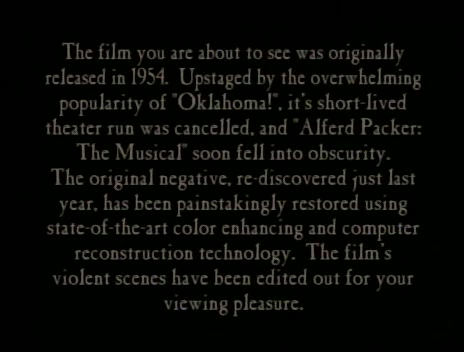
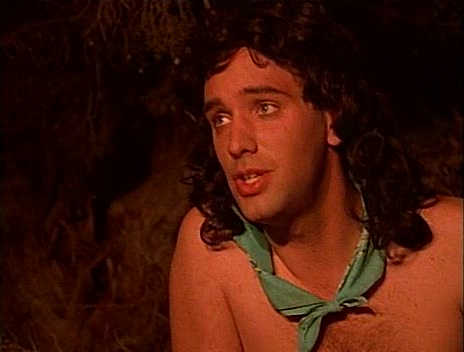
That is pretty much the story that Trey Parker tells, using the names, dates and versions of the events that happened, and even in musical form, he tells it rather more accurately than an earlier biopic called The Legend of Alfred Packer (1980); also a lot more accurately than a later film called Devoured: The Legend of Alferd Packer (2005), which offered audiences the ghost of Alferd eating people in the modern day. Parker and Stone add lots of humour and gore and some very impressive and catchy songs, all written by, and mostly sung by, Trey Parker. Parker and Stone are masters of irony, and it is laid on thick, starting with the card at the beginning saying that the film was originally released in 1954 (some 15 years before Parker and Stone were born) but was eclipsed by the release of Oklahoma. The card goes on to claim that the violence has been edited out, and they follow this with a scene showing Packer killing the other members of his group by biting their necks and tearing off their arms.

The film moves between Packer’s trial (the bloody scene at the start is the prosecution lawyer re-enacting the alleged crime) and Packer’s description of the actual events, complete with dance routines and love songs to his horse, Liane.

The group who persuade Packer to be their guide are totally unprepared for the march from Utah to the Colorado gold fields over the snowbound Rockies, and are warned not to proceed into a big storm by a tribe of Indians, played by Japanese foreign exchange students, who speak Japanese, and even carry Samurai swords.

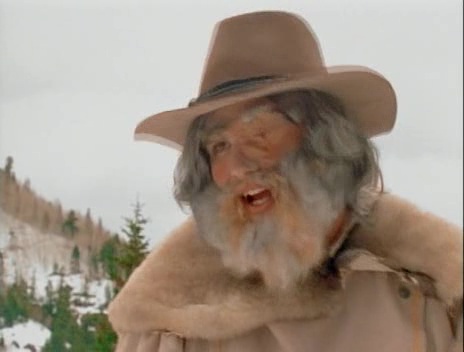
In a nice bit of cannibal intertextuality (Homer’s Odyssey), they try to kill a sheep belonging to a one-eyed cyclops (actually a Confederate soldier who lost his eye in the civil war). Early shades of South Park, as the cyclops squirts pus from his missing eye.

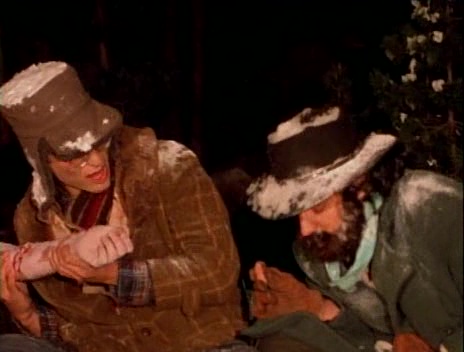
Sitting around the campfire, starving, they recall the story of the Donner party, and that gives them an idea. Yeah, they eat the guy who was an incurable optimist, who they shot for wanting to build a snowman. Look, it makes sense at the time. They even discuss not exactly the ethics of cannibalism, but at least the aesthetics – they won’t eat the dead guy’s butt, and Packer (Parker) is sick at what part Humphrey (Stone) chooses to eat.

There’s a ballet dream with Alfred dreaming of a reunion with Lianne (the horse), who has run away with a gang of trappers. Yeah, you’ll have to see it.

But the snow has them trapped, and they run out of food, and now the discussion is not which parts of a corpse to eat, but which member of the team should be sacrificed for the next meal. There is a hugely extravagant massacre, following which Packer waits out the winter, but now with plenty of meat, and then heads into town with his story of losing the rest of his party. That doesn’t wash, particularly when the well chewed bodies are found.

There’s a bar fight, pretty much de rigueur in Westerns, and Packer escapes to Wyoming, which he says is worse than being torn apart by the furious townspeople. Eventually he is arrested and brought back to Colorado. During his trial, there is a love interest, Polly (Toddy Walters), who interviews Packer through the bars of his cell in a scene that kept reminding me of Clarice Starling interviewing Hannibal Lecter in Silence of the Lambs, which had swept the Oscars in 1992, the year before this was made. She becomes convinced of his innocence and – well, it’s complicated. But the film is well worth your 100 minutes, just to see what Parker and Stone could do with real people instead of simulated cut-outs.

The film had mixed reviews, with some of the reviewers not knowing what to make of it. The critic score on Rotten Tomatoes is only 65%, but the audience score is 82%. The critic from Empire said: “there’s an air of genial enthusiasm, tempered by sick humour, that is surprisingly engaging”.

The tagline for the film is:

“In the tradition of Friday the 13th Part 2… and Oklahoma… comes the first intelligent movie about cannibalism!”

Parker and Stone are not shy about their fascination with cannibalism, for example, check out the South Park episode “Scott Tenorman Must Die”, in which Cartman takes revenge on a boy by killing the boy’s parents, and cooking and feeding them to him.

vlcsnap-00012.jpg

For a movie made by a couple of students at the University of Colorado, this is very impressive. It’s well made, the cast is great and the music is hard to get out of your head afterwards. I guess not so surprising, when we consider that four years later, in 1997, Parker and Stone launched South Park, which has been running ever since with over 300 episodes shown so far, and more seasons booked until at least 2022.

Modern geniuses.

The Vampire of Hanover: THE TENDERNESS OF WOLVES (Ulli Lomel, 1973)

The Tenderness of Wolves (Die Zärtlichkeit der Wölfe) is about the German serial killer and cannibal Fritz Haarmann. It’s not a documentary though, it’s an artistic interpretation of the story, and it’s a classic of the cannibal genre.

Fritz Haarmann, a.k.a. “the Butcher of Hanover” or “the Vampire of Hanover”, was a German serial killer who sexually assaulted, murdered and mutilated at least 24 boys and young men between 1918 and 1924 in Hanover, Germany. His case was the partial inspiration for Fritz Lang’s film M, the antagonist of which was a composite of Haarmann and at least three other interwar cannibals.

The most recent film to be directly based upon Haarmann’s murder spree, Der Totmacher (The Deathmaker), was released in 1995 and focused on the written records of the psychiatric examinations of Haarmann.

The real Fritz Haarmann

Haarmann was a petty thief, conman, and homosexual (which was against the law at that time) and served several prison sentences. Germany was in dire social and financial distress after the war, and crime was rampant. The police knew of Haarmann’s minor criminalities, but preferred to use him as an informant, and even tolerated him patrolling the railway stations demanding to see travellers’ documents and making arrests.

The film transfers the action to the late 1940s after the second world war; it was too expensive to recreate the streets of 1924, although the final scene reveals that Haarmann was executed in 1925. But the story is timeless, so the time shift is incongruous, but not disturbing.

Everything else about the film is disturbing though. The streets of Germany were full of homeless youths, and Haarmann would offer them shelter, take them home, feed them and make love to them, and then bite through their adam’s apples to kill them. He called this his “love bite”. He was never actually charged with cannibalism (it was not a criminal offence, and still isn’t in most jurisdictions) but he actively traded in black-market ground meat, and neighbours reported seeing him carrying large amounts out of his apartment, although he was never seen to bring in any carcasses.

The film makes it clear that the meat he supplies his delighted neighbours is human. The “innocent” cannibals around the table accept Haarmann’s story that the meat comes from a butcher named Karl, are pleased to be able to get meat, and do not ask questions.

Tenderness of the Wolves was produced by Rainer Werner Fassbinder, the prolific if short-lived German film maker. Fassbinder also appears in a minor role as Haarmann’s criminal accomplice, Hugo Wittkowski.

The director, Ulli Lommel – later responsible for the infamous video nasty The Boogeyman – was a regular actor in Fassbinder films, but this was only his second directorial effort and shows an exquisite artistry.

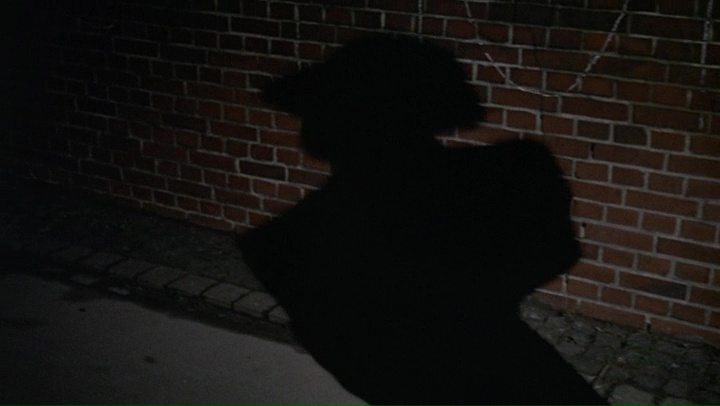
Kurt Raab wrote the screenplay as well as delivering an astonishing performance as Haarmann. At once vulnerable and yet able to play the tough cop, Raab’s Haarmann is drawn from Peter Lorre’s performance in M but also F.W. Murnau’s 1922 Expressionist vampire classic Nosferatu. The symbolism of the monstrous killer is clear at the beginning as we watch Haarmann’s shadow moving over the street, just as we saw, in the earlier movie, the nosferatu climbing the stairs.

But is he the vampire Nosferatu or the snivelling child molester from M?

Well, both, and that gives him a complexity that makes the film so fascinating. Haarmann is not the only criminal in the story – he is just worst among equals. Everyone is grifting and looking for an edge. The homeless kids are looking for food and shelter and affection, and Haarmann is only too willing to give them all that, but there is a price – their lives and their flesh. He is looking for love too, but from all the wrong people, in particular his tempestuous relationship with Hans Grans, who sees him purely as a meal ticket.

Roger Ebert summed up the film:

“the movie has a haunting banality. It’s about insignificant creeps, and it invests them with a depressing universality.”

Haarmann in this film is both tender and wolf, and in that he encapsulates Hannah Arendt’s summation of Adolf Eichmann in her study of his war crimes trial. Eichmann was a leading figure in the Holocaust, the destruction of European Jewry during the second world war. Arendt found that, while it would have been comforting to find that Eichmann was a monster, in fact he was “terribly and terrifyingly normal”. Eichmann maintained that he was just following orders, doing his job, and Arendt called this “the banality of evil”.

Just so, Haarmann would have argued that he was just doing his job, doing what he needed to do to survive a broken society, make a little money and feed his appetite for food, for sex and for flesh. And for love, the one thing he never achieved.

At the end, Haarmann is led off to the police car, his neighbours and followers who ate his meat gladly watching on. His last words are:

“Take my little life. I am not afraid of death through the axe or the hangman. It is my salvation. I am happy to give my death and my blood for atonement into God’s arms and justice. It could have been thirty, but also forty – I don’t know. There are victims that you don’t know about. But they are not the ones you’re thinking of. They were the most beautiful ones I had.”

The full movie is currently available on YouTube.

The Beautiful Child: GRETEL AND HANSEL (Osgood Perkins, 2020)

Here’s Horror royalty: the classic “fairy tale” from the Brothers Grimm, directed by Oz Perkins, son of the one and only Anthony Perkins (Norman Bates in Hitchcock’s Psycho). Oz is also an actor – he appeared as the young Norman Bates in Psycho II.

The witch, bloodthirsty and cannibalistic, is in many ways the exemplar of what Barbara Creed calls the monstrous feminine – and her victims are most often children, which is perhaps why children love stories about witches. Some adults dismiss children’s stories as light-weight and simplistic. But kids interpret the world through what they see, and the stories they hear. What kids understand is their own powerlessness – parents and teachers have control, and their youthful grasp of justice can make that seem uncomfortable or even intolerable. The bildungsroman, the coming of age story, is all about finding their power, in the face of seemingly inexorable oppression.

The usual title of this story is Hansel and Gretel, the 1812 Grimm story of the children who are abandoned in the forest and find an enchanted gingerbread house in which lives a cannibalistic witch, who fattens up Hansel for her dinner. The story is an important one in cannibal studies – even Hannibal quotes it from time to time.

Perkins has reversed the title deliberately to make Gretel (Sophia Lillis from It) the older child, a girl on the verge of womanhood, who must unwillingly take responsibility for her little brother Hansel (Sam Leakey in his debut role), see through the deceptions and dangers of adults, and make decisions that can be literally life and death, eater or eaten.

There is a fairy story within the story:

“The beautiful child in her little pink cap”

It tells of a little girl who was saved from a fatal illness by an enchantress, but,

The child was granted second sight. People came to hear what she saw, but did not like what she said.

She had other powers, and could deliver death to anyone, even her own father.

Fairy stories have morals, and the moral of the beautiful child, and Hansel and Gretel, is

Their mother sends them out to offer her services to a local lecher, who takes advantage of a “terrible pestilence” (sounds familiar) and asks the young girl

Furious at Gretel’s refusal to sell her body to help with the finances, the mother chases them out with an axe. Their world, once they are alone, is one of mystery, magic and terror. “The big, bad world opened up in front of us…”

There is plenty of intertextual humour to keep us guessing: Gretel is a sassy American, with strong views on the feudal class system.

Hansel is a cheeky English boy. They are rescued from an ogre by a huntsman, who tells them if they stray from their path, they can expect to meet wolves (a reference to a different cannibal story called “Little Red Riding Hood”.)

They find the gingerbread house, well, at least it smells of cake (and bacon, says Hansel). Inside is a table groaning with an abundance of food. Gifts!

There’s a witch of course, named Holda (Alice Krige, the Borg Queen from Star Trek: First Contact) who is charming and courteous. She plucks a strand of Hansel’s hair as he hoes into dinner, and sniffs it, like Hannibal sniffing Will Graham.

What can I say – she loves children!

But there is much more to this story (both stories). Is she “the beautiful child” of the internal fairy story? She senses that Gretel has second sight and magical powers. In the house, in dreams or in second sight, Gretel sees several children who appear out of mirrors.

Gretel is vegetarian, while Hansel likes his meat; at eight he is already imbued with carnivorous virility.

The witch, Holda, is not impressed, pointing out that “the ox, with his vegetable-made bones pulls the cart and the fat man who sits atop it!” She is dismissive of his carnivorous virility. Of course, we have to wonder, as Gretel does, where all the meat and milk come from, considering there are no animals on the property. Except for human ones. Are our cities any different?

Gretel starts to appreciate her powers, and the abundance they will offer her.

“This is your power. To see what is hidden and to take it. A small mind believes only what it can see. But we know that we are our fate’s own masters, don’t we?”

Hansel remembers Gretel’s lessons:

“You always say there aren’t any gifts in this world. That nothing is given without something taken away.”

To take on her full powers, Gretel realises that she’ll need to lose Hansel, who is a burden. The witch warns that

“he’ll soon come to fear you, as all men should if they’re smart.”

We only see Holda eat once, and when she finishes, she pulls out of her mouth a long lock of blonde hair with a little bow on the end. Well, we guessed what she ate, especially if we ever quaked through a Brothers Grimm story or two.

The witch in psychoanalytic terms is the oral-sadistic mother, and Creed calls her an “implacable enemy of the symbolic order”, because she demonstrates its frailty. Holda at first seems maternal – she offers the lost children food and shelter, but the fact that they can so quickly end up in that food warns us of that frailty – she reminds us that we, too, are edible animals.

Gretel soon finds out where all the food is coming from.

The witch tells her the real story of the beautiful child and of her power. Gretel has achoice – will she take the gift and pay the price? But hey, no spoilers. See the movie to find out what Gretel decides. It’s worth it.

The reviewer on RogerEbert.com called it:

“the kind of low-key gem that horror fans are always looking for but so rarely find—one that is smartly conceived, visually stylish and genuinely creepy at times.”

The story is even more relevant than it was when the movie was made (or the Grimms wrote it down) because of the weird conspiracy theories circulating in the USA about politicians torturing and killing children in the basements of pizza restaurants in order to harness their youthful energies. But leaving aside the magic and the second sight, isn’t the cynical utilisation of the young the basis of advertising, wars and agriculture? Society is built on the exploitation and sometimes the slaughter and consumption of the innocent.

The cinematography of this film is splendid, and the actors are sensational, particularly G&H despite, or perhaps because of, their youth. Overall, a very satisfying reboot of a classic cannibalism story.

Commodity cannibalism: NEVER LET ME GO (Mark Romanek, 2010)

NEVER LET ME GO is based quite faithfully on the beautifully written and quite disturbing 2005 novel of the same name by British author Kazuo Ishiguro, which was shortlisted for the Booker prize (which he had previously won with Remains of the Day) and was named by Time Magazine as the best novel of 2005, as well as being listed as fourth on their list of the 100 Best English-language novels published since 1923 (when they started publishing).

This gave the film a high bar, but it does not disappoint, due to the superb cast, the direction of Mark Romanek (One Hour Photo), and the script by Alex Garland (28 Days Later), a friend of Ishiguro, who asked the author for film rights before he even finishing reading the manuscript. Yep, it’s that good.

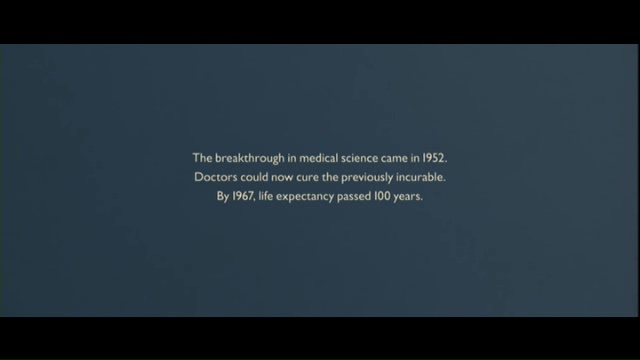
OK. This is a spoiler alert, particularly if you are going to read the book, although any review will soon tell you what it’s about, and the “secret” is revealed quite early in the film. Here goes. The film is set in an alternative present, where incurable diseases have been conquered.

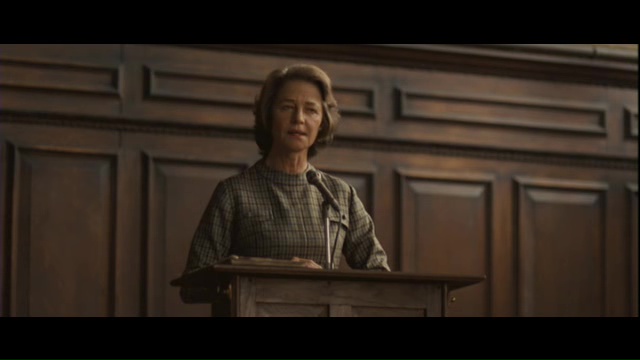
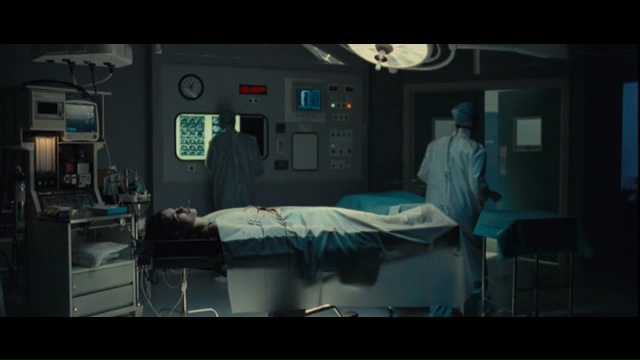
The protagonists are clones, bred to supply their organs to “real” humans, who can now live well into their hundreds, thanks in part to these donations, and the new medical technologies. The kids are brought up to live healthy lives. Smoking? Right out. A healthy replacement part in a healthy body. The stern principal, Miss Emily (the wonderful Charlotte Rampling) tells them not to spoil the merchandise:

“Students of Hailsham are special. Keeping yourselves well, keeping yourselves healthy inside, is of paramount importance.”

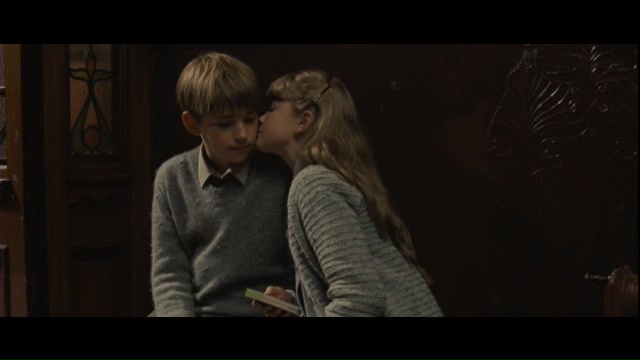
We see the childhood of the protagonists mainly through the eyes of 11-year-old Kathy (Isobel Meikle-Small) who has a preteen crush on Tommy (Charlie Rowe).

Her best friend is Ruth (Ella Purnell). Ruth’s confidence and precocity wins over the shy and vulnerable Tommy, who is barely able to cope with the inevitable challenges and failures of growing up. Tommy represents so many of us – filled with rage at the injustices and humiliations of the world, but unwilling to stand up and take what he wants. Kathy accepts the loss of her first love to her first friend.

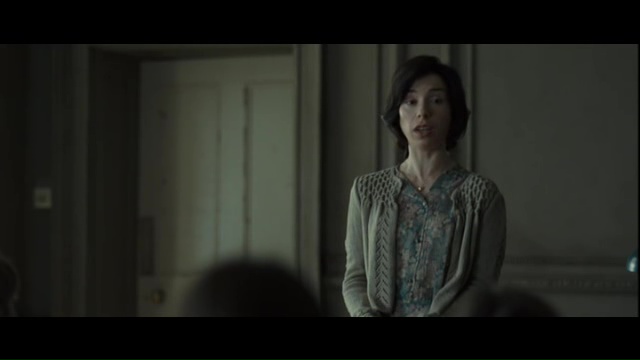
The children are encouraged to create pictures, poetry and sculpture, which may be chosen for display in a mysterious place called “The Gallery”. They are told that Hailsham children are special. They are told of dangers that befall children who leave the school grounds – the boy who was found tied to a tree with his hands and feet cut off, the girl who starved outside the gates. They are not told the truth. One teacher, Miss Lucy (Sally Hawkins from The Shape of Water) dares to tell them what will happen when they grow up, which gets her fired. She tells them,

“You will become adults, but only briefly. Before you are old, before you are even middle-aged, you will start to donate your vital organs. That’s what you’re created to do. And sometime around your third or fourth donation, your short life will be complete.

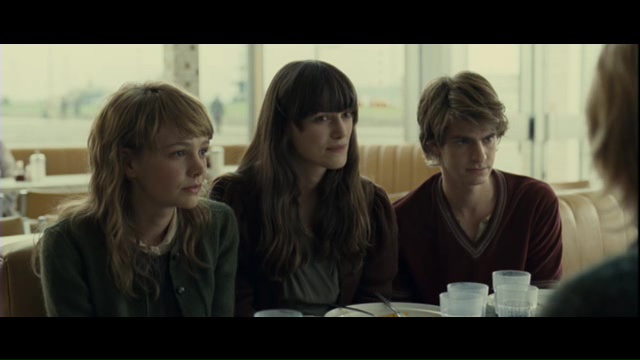
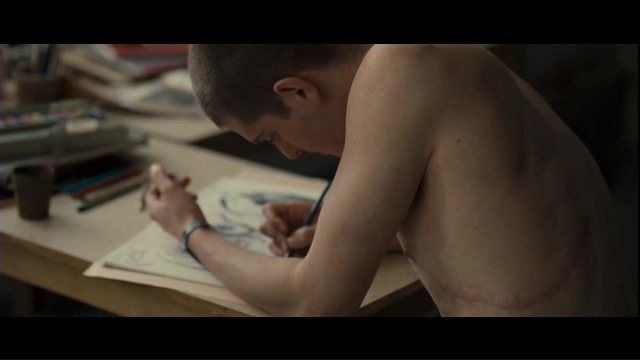
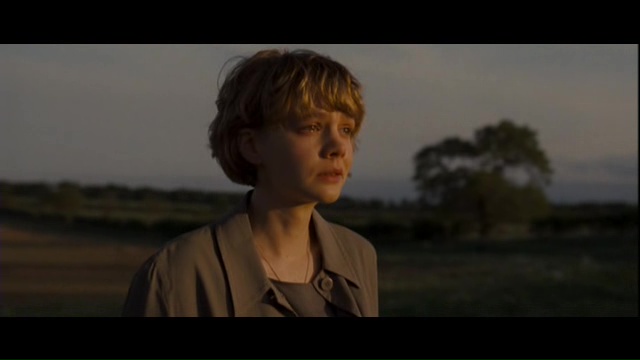
The film moves to their adulthood – at 18, they are moved out of Hailsham and sent to a collection of farm buildings called the cottages, to wait until they are old enough to move to “completion centres” where they will begin to donate their organs. Tommy (Andrew Garfield) is now in a sexual relationship with Ruth (Keira Knightley) which shatters the friendship of Ruth and Kathy (Carey Mulligan).

The people from the outside, the delivery men and others, are reticent, unable to make eye contact with the kids; they exhibit the kind of cognitive dissonance you might see from people on a petting farm, admiring a piglet that they know will soon be bacon.

These kids are not considered human, even though they are genetically identical to some “original” whom they desperately want to meet – the ‘real’ human from whom they were replicated. Ruth is convinced they must be less than fully human, that they are cloned only from

“trash – junkies, prostitutes, winos, tramps, convicts, as long as they aren’t psychos. If you want to look for originals… look in the gutter.”

Tommy finds Kathy looking through porn magazines, flipping through quickly, looking only at the faces. She is looking for the “trash”, the less-than-humans from whom they may have been cloned.

The other young people tell them of a rumour about the possibility of Hailsham students getting a “deferral”—a temporary reprieve from organ donation if they can prove they are in love. Tommy decides that The Gallery at Hailsham was part of a study to see if clones have souls, can fall in love, and are therefore worthy of deferral. He becomes obsessed with finding the Gallery, and seeing if love, verifiable love, makes them human.

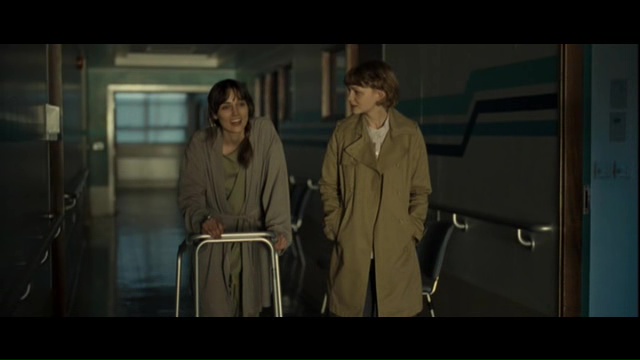
They are also able to volunteer to become carers for the others, and Kathy decides to do this, delaying thereby her own donations. She finds Ruth at a completion centre – Ruth has endured two donations and is ready, willing to complete on the next.

They visit Tommy at another centre, who tells them that Hailsham has closed, and donors are now raised in schools that are like “battery farms”. The donation centre is full of “donors” with missing parts – and they often die (or complete) after two or more donations.

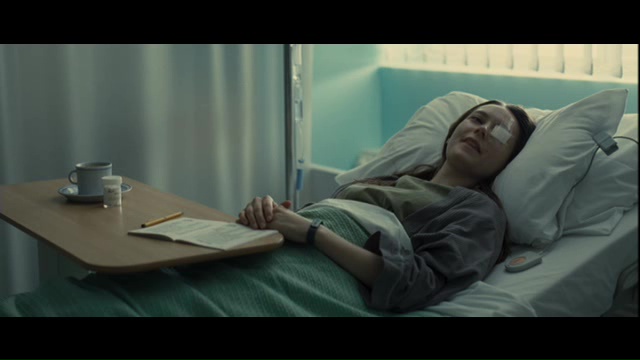
Ruth has heard that after the fourth donation, there are no more carers, no more recovery centres, just harvesting of parts until they switch you off. Kathy cares for Ruth, who dies (completes) after her third donation, and Kathy then takes Tommy, still reasonably well after two donations, to see the mysterious gallery owner.

They’re in love, they tell her. They want a deferral. But the gallery was just part of an ethical argument – Hailsham was the last place where the ethics of the donor system were questioned, and the art was supposed to show what they were capable of. But they were exploring an answer to a question no one was asking.

“Would you ask people to return to darkness – the days of lung cancer, breast cancer, motor-neurone disease? They’ll simply say no…. We didn’t have the gallery to look into your souls. We had the gallery to see if you had souls at all.”

Films on www.thecannibalguy.com tend to centre around violence and gore. That is what people expect from horror and from cannibal movies. But this is not a horror movie, or at least not a monster movie in the traditional sense of the grotesque, frightening and uncanny. But is it a cannibal movie?

I believe it is. Definitions of cannibalism vary according to who is accusing whom. At what point does exploitation of the human body or mind turn to abuse or consumption? Organ transplants, where a living organ is incorporated into the body of a recipient, is sometimes called cannibalism, particularly due to speculation that some part of the ‘donor’ remains imbued – consider James Whale’s classic 1931 film Frankenstein, where the monster is given a brain stolen from the cranium of a criminal, which makes him homicidal. In any case, if an organ is taken without the consent of the ‘donor’, such as the alleged cases of political prisoners being executed according to the demand for their tissue-type, how is this different to Hannibal’s feasts?

The horror in this film is in the human struggle with questions of mortality, what it even means to be human. These kids seem to be normal people – they laugh, they sing, they tease each other, they fall in love. But they are aware of their own deaths, something that most of us repress more or less successfully, assuming that we will always have another tomorrow. They know better; they are destined to be cut up and emptied of organs until their bodies give out. They are not fully human, despite looking just like any other bunch of kids, because they are cloned, and so are classified as beneath the human line in the anthropocentric scorecard. They are at best “all but human” through their art. But the ‘real’ humans don’t care. Redefine someone as less than human, objectify them, be they a different race, gender or species, and the range of abuses is unlimited. Nothing matters but our delusion that we will live forever, necessitating the sacrifice of the other.

The critic Roger Ebert wrote:

“Essentially it asks, how do you live with the knowledge that you are not considered a human being but simply a consumer resource? Many hourly workers at big box stores must sometimes ponder this question.”

There is no option for resistance. They have been brought up all their young lives to obey, to believe that it is necessary to be cut up, to complete, for the benefit of unknown others, because that’s what they were bred for, just as we justify cutting up cows and pigs and chickens and lambs because that’s we bred them for. Only Tommy rebels, but it’s an inchoate howl of rage, the same scream at the butchering world that he aimed at the kids who didn’t pick him for their game when he was 11. Powerless, all he can do is bellow like a steer in an abattoir. It may be that defiance of death that verifies his humanity, because, as Dylan Thomas said, we ought to “rage against the dying of the light”.

Or as another Dylan said (Bob), “He not busy being born is busy dying.”

Kathy sums this up at the end:

“What I’m not sure about is if our lives have been so different from the people we save. We all complete. Maybe none of us really understand what we’ve lived through. Or feel we’ve had enough time.”