Dreams (夢, Yume) is a 1990 magical realist anthology of eight stories, written and directed by Akira Kurosawa, inspired by his recurring dreams. An international co-production of Japan and the United States, Dreams was made with assistance from George Lucas and Steven Spielberg.
Akira Kurosawa (Japanese: 黒澤 明, March 23, 1910 – September 6, 1998) was a Japanese filmmaker and painter who directed thirty films in a career over fifty years. Kurosawa directed around one film per year throughout the 1950s and early 1960s, including a number of classics which were often adapted by other directors. These included Rashomon (1950), Ikiru (1952), Seven Samurai (1954) – which was remade in 1960 by John Sturges as The Magnificent Seven, Throne of Blood (1957), Yojimbo (1961) and High and Low (1963). He is widely considered one of the most important and influential filmmakers in the history of cinema.
Kurosawa’s bold, dynamic style was strongly influenced by Western cinema, yet distinct. In 1990, the year Dreams was released, he accepted the Academy Award for Lifetime Achievement.
Dreams is his most personal work, taken from his own life and unconscious mind. He addresses themes such as childhood, spirituality, art, death, and the mistakes and transgressions made by humans against nature. The episodes within Dreams do not have a single narrative, but are the fragmentary adventures of a “surrogate Kurosawa” (often recognizable by the character wearing Kurosawa’s trademark hat) through eight different segments, or “dreams”, each one with a title. Each is more a fairy tale than a dream in the filmic sense.
A child sees a forbidden fox wedding ceremony and is told he must suicide, another weeps as he witnesses the spirits of a peach orchard that has been cut down by his family, reflecting the human war on nature.
The fear of nature fighting back is a bleak dream of men struggling through a mountain blizzard. The horror of war is demonstrated as a Japanese officer is confronted by the ghosts of his annihilated platoon.
Our understanding of nature is questioned in “Crows”, the only dream not made in Japanese, where Vincent van Gogh is portrayed by American filmmaker Martin Scorsese, with a broad New York accent, and the protagonist travels through the images that fill van Gogh’s tortured imagination.
Our abuse of nature comes to its logical conclusion as we see nuclear power points explode behind Mount Fuji, human ingenuity able to create but not control these forces; in the end, all they can do is colour the toxic pollution so people know what is killing them.
“The Weeping Demon” is the seventh dream, and of particular interest in Cannibal Studies. It shows the aftermath of nuclear devastation, a fear that has haunted us all for eighty years, particularly the Japanese, who were the first and only people to experience nuclear weapon attacks.
A man is wandering around a misty, bleak mountainous terrain. He meets an oni(demon or ogre), who is a mutated human with a single horn on his head. Oni are known for indulging in murder and cannibalism when they get the chance. They are typically portrayed as hulking figures with one or more horns growing out of their heads, massive teeth, and occasionally a third eye in the centre of the forehead.
The demon tells him that there was a nuclear conflagration, which resulted in the destruction of nature and animals, the growth of dandelions taller than humans, and horns sprouting on the heads of those humans left. The horns cause them to feel excruciating pain each evening; but they cannot die, so they howl in agony all night. Many of these demons were formerly millionaires and government officials, who are now suffering through a hell befitting their sins.
Even in this apocalyptic post-war world, the social hierarchies continue to oppress – the demons with two or three horns eat those with only one.
“There’s no food! We feed on ourselves. The weak ones go first. It’s about my turn now. Even here we have grades. One-horn demons like myself always get eaten by those who have two or three horns. Before they were powerful and pretentious. And now they still throw their weight around as demons.”
The demon that the man meets is waiting to be eaten, seeing this as an escape from his agony and nagging hunger, but also as a punishment – before the wars, he was a farmer who poured milk into the river and buried vegetables to maintain market prices. He warns the man to flee, but when the man asks where he should go, the demon just asks if he too wants to become a demon. The terrified man runs away with the demon in pursuit.
The film finishes with a meditation on death, the final and irrevocable return to nature. Laying down our technology, our appetites and our bodies is celebrated – peace at last.
Condemned as disjointed by some critics, the film has a logic to it, a dream logic, in which things are out of place yet seem quite natural. It starts with a little boy witnessing the wedding procession of the foxes, a slow funereal procession that is forbidden for human viewing, and finishes in a village that has spurned technology and progress in favour of clean air and water and long, peaceful lives, where we witness a funeral procession that is pure colourful celebration.
Dreams is a sumptuous, thoughtful, dramatic, film from which I found it hard to look away. Although it is one of Kurosawa’s last films, it shows him at the height of his power and creativity, and offers a glimpse into his mind, just as he glimpses the mind of van Gogh.
Dreams is now a classic, as are all Kurosawa’s works, but it currently has only 66% fresh rating on Rotten Tomatoes, proving that a lot of people can’t be bothered listening to (or even watching) other people’s dreams. The New York Times critic called it:
“…a collection of short, sometimes fragmentary films that are less like dreams than fairy tales of past, present and future”
But dreams, like the evening news, are always fragmentary – narratives jump from tragedy to kitsch to humour. Dreams often reflect and amplify our repressed emotions and fears, and fairy tales are mythic versions of dreams. Many, perhaps most, fairy tales include cannibalistic giants, wicked step-parents, witches and ogres, such as Little Red Riding Hood, Hansel and Gretel or The Juniper Tree. Children wander, lost and hungry, through brooding forests and come across strange and fantastic creatures. Dreams reveal our repressed fears about the human attacks on nature and each other, the struggles and conflicts that lead to monsters or demons.
In dreams, we lose our rational sense of causality – anything can happen. We get lost, like in fairy tales, in forests or snowstorms or in the mind of Vincent van Gogh, seeing the world the way he had to, consuming it and reimagining it before he could paint it. We meet ghosts of people who don’t know they are dead. Nuclear power plants explode, a fear on everyone’s mind in 1990, four years after The Chernobyl disaster. In dreams, ethics become aesthetics, to quote from Hannibal. Dreams, like fairy tales, are episodic and disjointed, and the film captures this brilliantly.
Although fairy tales date back centuries, they remain ever popular, with new versions or completely new stories released to reflect the fears of each historical period. In our modern period, the growing and changing presence of media makes us all aware of the bloodshed on the battlefields and in the death camps and slaughterhouses of modern industrial societies, images that we desperately try to forget or repress. It is no wonder that dreams are full of cannibals.
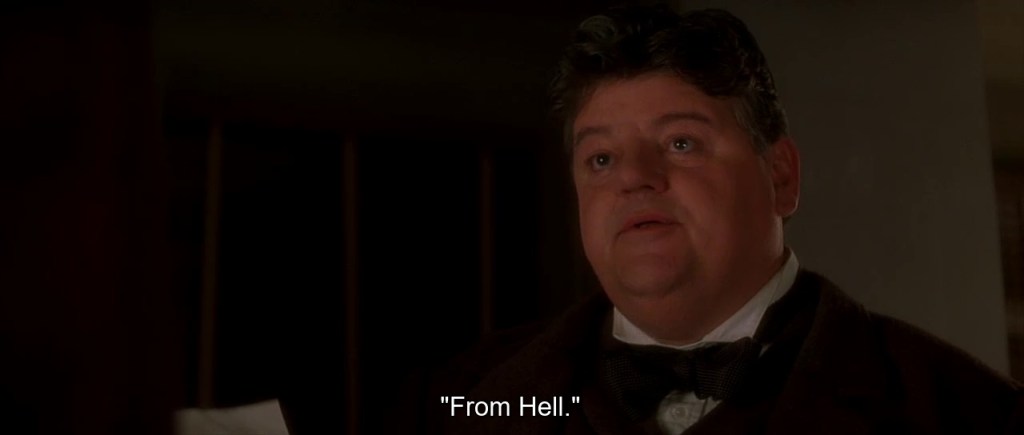
Even those who are not True Crime aficionados know of Jack the Ripper, a mysterious serial killer who slaughtered women in the Whitechapel district of London in 1888, took body parts for trophies, and on one occasion wrote to the authorities boasting of having eaten a victim’s kidney. Well, half a kidney – the other half was enclosed in the letter, and was positively identified as human tissue. The letter was entitled “FROM HELL”.
In my thesis, I date modern, domestic cannibalism from 1888, when Jack the Ripper murdered five or more women in the summer and autumn of that year.
The From Hell letter was sent to the Chairman of the Whitechapel Vigilance Committee in October with a box containing half a kidney. The letter stated that the writer had taken the kidney from a woman, and half of it was enclosed as proof. “tother piece I fried and ate it very nise” (sic).
This letter, and the half-kidney, are featured in this week’s movie.
A huge literature has developed on the history and likely identity of Jack, but none of it is conclusive; the crime writer Patricia Cornwell argued that the Ripper was the famous artist Walter Sickert. Others have written credible accounts of other suspects, including Prince Edward Albert Victor, second in line to the British throne. The enduring mythology of Jack the Ripper, though, depends on the fact that he remains unknown, a figure hidden by his presumed uniformity with those of his milieu. Jack was the domestic cannibal – murderous, voracious, and indistinguishable from any other citizen, just another face in the street, as demonstrated by the fact that he was never apprehended, or even conclusively identified.
Jack rapidly became an international phenomenon. A Chicago doctor wrote in the Medical Standard that,
… the Whitechapel murderer is a cannibal pure and simple. The Whitechapel murders are clearly the work of a lunatic of the so-called “sexual pervert” type, fortunately rare in Anglo-Saxon lands but not infrequently met with in Russia, Germany, Bohemia and France. In these lunatics there is a return to the animal passions of the lowest cannibalistic savage races. Cannibalism is shown in a thirst for blood, and these animal passions come to the surface when the checks imposed by centuries of civilization are removed either by disease or by the defects inherited from degenerate parents.
So critical to the creation of the domestic monster was The Ripper that almost a century and a half later, books and films are still investigating and theorising on his acts and identity.
Jack went “viral” long before the internet was around to invent the term. Jack conventions are held around the world offering attendees the opportunity to view and buy merch and listen to “experts” tell them who Jack (maybe) was. Many books have offered definitive proof of Jack’s secret identity, only to have other experts contradict them. One writer actually bought at auction a shawl belonging to one of the victims, Catherine Eddowes, and had it forensically examined, finding, through links to the DNA of descendants, that it contained her blood, and the semen of a long-suspected Polish immigrant named Aaron Kosminski. Seems conclusive, doesn’t it, but other Jack-fans were sceptical; DNA can be contaminated. Richard Cobb, who organizes Jack the Ripper conventions, told the Guardian that the shawl had been “openly handled by loads of people and been touched, breathed on, spat upon.”
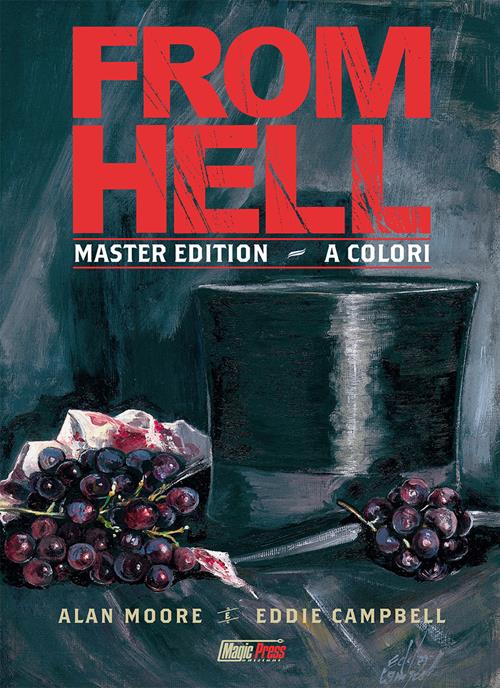
This film, From Hell, has a somewhat more circuitous lineage, being based on a graphic novel (formerly called comic book series) by Alan Moore and Eddie Campbell which was published from 1989-1998 and then collected into book form. That novel is based on a 1976 non-fiction book by Stephen Knight with the rather unfortunate title of Jack the Ripper: The Final Solution.Knight’s theory proposes a conspiracy by the Freemasons, in which high-ranking Freemason Sir William Gull, royal surgeon to Queen Victoria, is told to cover up the marriage of a shopgirl, Annie Crook to Prince Albert Victor, the heir to the throne, which had resulted in a baby who would be in line for the crown, particularly as the Prince was dying of syphilis. The murders themselves were not the crimes of passion common in impoverished London, particularly from the pimps that the women feared most, but involved the careful dissection of the bodies and removal of organs and often vulvas. The basis of many theories was that these were clearly the work of an educated man with medical or at least anatomical training.
“Martha Tabram was raped, tortured and killed. This is methodical. The butchery is irrational, yet meticulous and deliberate. Altogether a different breed of killer.”
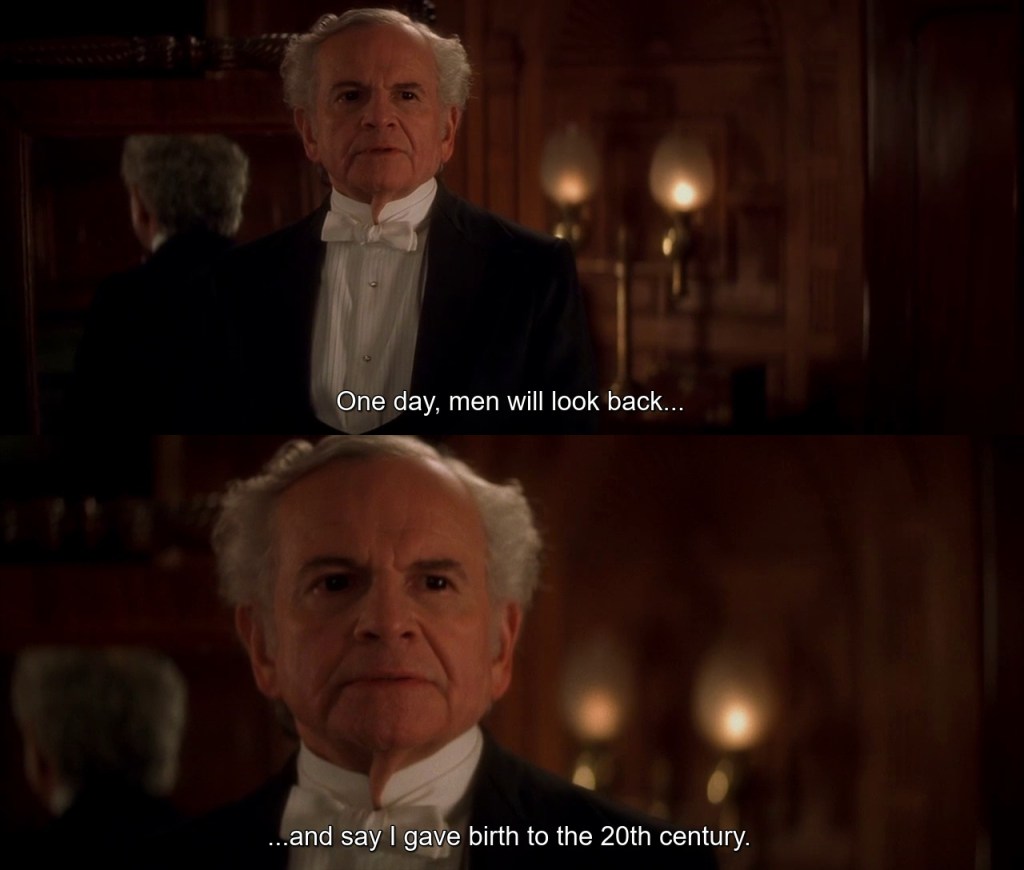
The film had mixed reviews, getting a 57% “fresh” rating on Rotten Tomatoes, but I found it an easy to watch, interesting tale told with some gusto, by a stellar cast: Sir William Gull, physician to His Maj and presumed serial killer, is played by the late lamented Ian Holm, who was playing a sweet, doddery, 111 year old Bilbo Baggins in The Lord of the Rings: The Fellowship of the Ring the same year he played Jack.
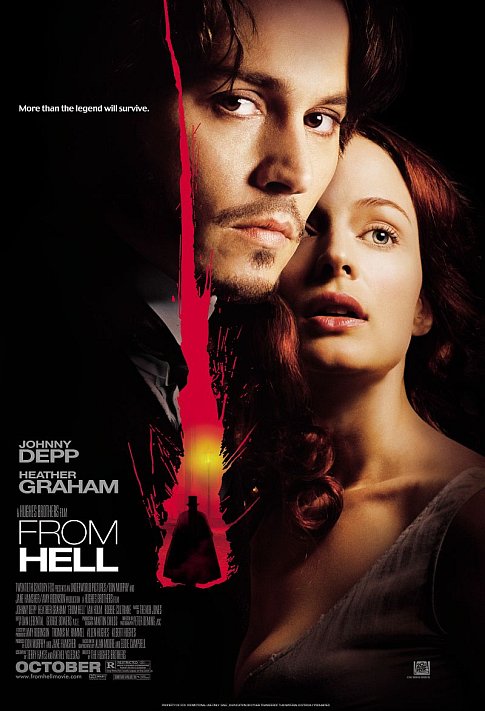
Johnny Depp plays Inspector Abberline, the cop searching for Jack, with his usual brooding sensual close-ups, while Heather Graham (Boogie Nights) is quite luminous as the sex worker Mary Kelly, who becomes his love interest as well as a target of Jack. Then there’s a delightful performance by Robbie Coltrane (Hagrid from the Harry Potter films) as Abberline’s sergeant, who quotes Shakespeare as he tries to revive Abberline from his opium den dreams, where he imbibes absinthe laced with laudanum and “sees” the murders as they happen.
Ian McNeice (Bert Large from Doc Martin) pops up as the coroner, and there are a host of other familiar faces. If you like a boisterous story and some great performances, you might enjoy this. But if you are serious Jack groupie, you will wince at the anachronism that puts the receipt of the kidney some time before the murder of Catherine Eddowes, from whom that kidney is likely to have been taken.
Like any fictional recreation of history, there is inevitably exaggeration and speculation. The film depicts an all-powerful Freemason movement infiltrating the police and medical establishment and threatening or killing anyone in their way. There is an evocative depiction of the life of late nineteenth century sex workers (called “whores” by the police, and often themselves, and “unfortunates” in official language). There is also some cursory mention of the classism and racism that English society exhibited in the age of Empire (and still does), seeking to blame the American natives in “Buffalo Bill’s Wild West Show” (perhaps a wink to the serial killer in The Silence of the Lambs?), foreigners, Orientals, Jews, Socialists – anyone other than the rich and powerful. Several scenes feature the hatred of Jews that saw the police and the populace open to antisemitic provocation when looking for a scapegoat. The chasm between the respectable killer and the honest but disreputable poor is made by means of an (otherwise gratuitous) appearance by the Elephant Man, Joseph Merrick who, like Jack, was a famous denizen of Whitechapel. He stands surrounded by respectable white men, wondering at his ugliness, but having no inkling of his humanity.
Foreigners, the disfigured, the “unfortunates” and Jews were outsiders in English society, and outsiders are denied the protection that other citizens expect, and so are easily accused, attacked, killed and sometimes even eaten. The “unfortunate” mother of the royal baby is kidnapped and given a frontal lobotomy, a new scientific technique which was instantly turned to the advantage of the elite.
In Victorian England, the poor were blamed for any and all of society’s ills, with the idea of suspecting a rich, educated man excluded from consideration. Of course, the Indigenous people in Queen Victoria’s empire were similarly objectified, enslaved or slaughtered, also using the benefits of modern technology such as the gunboat and machine-gun.
The movie opens with a quote, Jack, saying “One day men will look back and say I gave birth to the twentieth century.”
I can see no other reference to such a quote in any source other than this movie, but it has a certain ring to it, it makes sense of this modern drama between the rich, who only ever want more, and the poor, who scrabble just to stay alive. At a time when the environment has been appropriated and cannibalised by the ruling class, has Jack’s comment in 1888 proved prophetic?
Jack the Ripper was less “a return to the animal passions of the lowest cannibalistic savage races” and more a manifestation of the voracious appetite and greed of modern capitalist industrial society, where the value of everything, including the life of humans and other animals, is counted only in monetary terms, and the marginalised and objectified are cast out and consumed.
“I just open the page, and the first thing I see is – a half-eaten head.”
If you’re not familiar with the term, “anime” is animation, which can be hand drawn or computer generated. It usually refers to Japanese creations, but in Japan it can apply to any animated work. Usually, anime is used to refer to TV shows or movies, while “manga” usually means graphic novels (comics). There is children’s anime and a whole range of adult material, which regularly wanders into the world of sex and violence.
The manga reviewed in this short YouTube clip (above) embraces both sex and violence, as well as combining those in the form of necrophilia and cannibalism, and does so in graphic detail. It is the autobiographical record of Issei Sagawa, a Japanese man who murdered and cannibalised a young Dutch student named Renée Hartevelt, whom he had befriended at the Sorbonne in Paris in 1981. Sagawa never served time for the act.
Sagawa’s story has been told in many formats, including several documentaries, including The Cannibal Who Walked Free in 2007 and CANIBA in 2017.
Sagawa died in 2022, but he left behind a record of his activities in the form of manga, a comic book, although it was far from comical. In fact, this review on YouTube is on the site “Anime Dork”, described as “a team of passionate anime otakus” (obsessive fans), formed in August 2022, whose reviews are usually fairly light-hearted and humorous.
Not this one. The reviewer, Sydney Poniewaz, who writes under the name sydsnap, is an actress and YouTube star (pushing toward a million subscribers, so very successful), and a True Crime aficionado, particularly fascinated by the often very weird crimes committed in Japan, where she sometimes resides. But she is clearly horrified by the content of the booklet she is holding which, she tells us, is drawn by “an awful human being”, and extracts of which she eventually begins showing us.
She gives a brief synopsis of the case, such as:
“He began to sexually assault her corpse, and then partake in cannibalisation of her body.”
In the manga, she tells us,
“He talked about everything he did to her body: every scent he smelled, every texture he felt, every disgusting brief or prolonged thought throughout any sort of disgusting act he did, which – he does a lot!”
She seems most shocked by the fact that he escaped justice and led the rest of his life a free man, making films including porn, writing books, and even doing restaurant reviews.
“I’m trying to show one image where he’s not being disgusting, but honestly, he always is… he’s talking about how good it felt to murder her, how he wants to do it again.”
So, Sydney did not like the book, which she bought for (no doubt) a lot of money, and then she had to pay lots more to have the Japanese text translated, which she truly seems to regret.
“I do not recommend it. I really, really, really do not recommend it for the faint of heart. I am a pretty hard person to shake in terms of content, but this is probably the most disgusting thing I have ever read.”
There are a lot of comments on the YouTube site, mostly shocked and horrified, and a few are below. I particularly like the one that emphasises that these stories almost always focus on the killer, this one being told by him from his point of view, and rarely the victim. Renée Hartevelt, like Charlene Downes whom we discussed last week, deserves to be remembered for more than just being eaten by another member of her species.
There are more extracts of the manga, if you are interested, in the Caniba documentary, and I captured a few for my review of it. Or if you really want to get into the whole story (and I suppose some readers will), the manga itself is available on eBay, for a hefty price tag.
Why did he do it? The manga makes that pretty clear. He ate Renée for the same reason any of us eat anything – because he wanted to. The outrage that followed is based on the deeply held but mostly unexamined idea, largely based in religion, that humans are somehow separate and above other animals, kind of demi-gods. Issei Sagawa, obviously, did not believe that.
The recent tour of Australia by British anti-trans campaigner Kellie-Jay Keen-Minshull— who also goes by the name of Posie Parker — added cannibalism to the culture wars already raging over transsexual rights.
Keen-Minshull organised a “Let Women Speak” tour of Australia and New Zealand, holding rallies in several cities to claim the push for transgender rights is “silencing”, endangering and discriminating against women.
There has been a lot said about Keen-Minshull, mostly debating her claim to be a warrior for women’s rights and accusing her of being an extremist, expressing views that are designed to be harmful to the transgender community. The rhetoric she uses is far more extreme than usually expressed in Australian politics, although it has become common in other countries, particularly the USA. She suggests, among other claims, that trans women are sexual predators who pose a safety threat to girls in female bathrooms. She describes gender affirmation healthcare as mutilation, and being transgender as a “fetish” — positions totally at odds with the views of experts who work with people who are transitioning.
Keen-Minshull’s rally in Melbourne was attended by far-right extremists who performed Nazi salutes. Although organisers claimed the masked thugs had “gate-crashed” the event, a trans rights activist and TikTok star known online as LilahRPG said “everyone was just furious, seeing Nazis doing salutes uninterrupted and interacting with the TERFs.” TERF is an acronym for “trans-exclusionary radical feminist“.
This is one of the clearest indications that far-right social media is using the “gender-critical” movement to promote membership of their groups.
Keen-Minshull has made a series of videos (see Twitter message above) about “Grooming Gangs” – repeating unproven claims that a young girl in England was killed and eaten as kebab meat. These claims are then used as racist conspiracy theories, saying that the botched police investigation was in fact a cover-up of paedophile elites who, they say, control everything. Keen-Minshull says:
“What we know is that there’s grooming gangs in Telford. A young woman that never actually really made it to mainstream news, wasn’t a big story, was cut up and I think she was put into meat that was sold for human consumption. We know that there are vast numbers of men involved in these grooming gangs, and we know that there’s weird cover-up stuff going on, that only makes sense if the other people in power are also raping children.”
The case she is referring to seems to be the disappearance of 14-year-old Charlene Downes, who disappeared in Blackpool in north-west England in November 2003. Accusations were made of a child-grooming ring, which induced young girls into having sex in return for cigarettes, food and alcohol. At least one newspaper was quick to claim that investigations had been “hampered by political correctness”, because the girls were white and the perpetrators non-white.
Two men, Ilyad Albattikh and Mohammed Reveshi, were tried in May 2007—the first for Downes’ murder, the other for helping dispose of the body—but the jury failed to reach a verdict. A re-trial was scheduled, but in April 2008 the accused were released because of concerns about serious errors in the evidence compiled by Lancashire Constabulary, who were chastised for their inept handling of the case.
The prosecution had claimed Charlene’s body had been cut up and minced into kebabs in a Blackpool takeaway called “Funny Boys”.
At the time of the trial, the court was told the fast food shop owner had “joked” that Charlene Downes had been chopped up and put into kebabs that were sold to the public.
There is a lot of racism involved in this story. White children being raped by men of colour is stated or implied in many of the reports, although there is little evidence to show that white offenders were not also involved. Many actual cases of the cannibalism of children indicate the opposite – that white men like Jeffrey Dahmer and Albert Fish prey on children of colour, because such missing children are less likely to be investigated by white detectives. Meanwhile, the Indian current affairs website OpIndia did not mince its words about the alleged mincing of the victim:
Groomed by Muslim gangs, minced into pieces, fed as kebabs
Of course, Ms Keen-Minshull did not invent the idea of using cannibalism as a weapon of dehumanisation (Christopher Columbus did that very successfully) or even as a part of the culture wars – recall the hate and scorn aimed at the New York Times when it suggested the “cannibalism has a time and a place… and others suggest that that time is now”.
Classical mythologies told of savage gods who ate their own children, and paranormal entities such as witches, who used body parts for their rituals. Such usages were not exclusively supernatural, with “blood libel” accusations that Jews were killing Christian children to use their blood for religious rituals and cannibalism dating back to the twelfth century, and being revived with nauseating regularity up to the present day.
QAnon has been very successful recruiting members in the US, partly based on accusing everyone from Hillary Clinton to a pizza shop owner of killing and eating children. The accusations are meant to dehumanise the alleged perpetrators, but usually end up doing the same to the victim. Poor little Charlene is now almost unknown, except as the “kebab meat girl”.
Lots more details of her case are available on YouTube investigations such as the one below, some of them are quite lurid.
Winnie-the-Pooh is a much-loved (but sometimes intensely disliked) fictional bear who evolved from the childhood stories told to his son (Christopher Robin) by A. A. Milne, the author of a series of books first published almost a century ago. The original Pooh was an actual toy bear bought in Harrods in 1921. Other toys belonging to the little boy, Piglet, Eeyore, Kanga, Roo, and Tigger, were incorporated into Milne’s stories as friends of Pooh, who was presented as “a bear of very little brain”. Pooh and his friends lived in the 100 Acre Wood, where they got into all sorts of scrapes.
The anthropomorphic bear, his name now without hyphens, was licensed by the Disney company in 1961 for a very successful series of features that became one of their most popular franchises. I loved the books as a child, and hated what the cartoons had done to him, but maybe that’s just me.
Anyway, Milne’s U.S. copyright in Winnie-the-Pooh expired at the end of 2021, 95 years since publication of the first story. The character therefore entered the public domain in the United States, with Disney no longer holding exclusive rights. Independent filmmaker Rhys Frake-Wakefield seized on this opportunity to create a horror film titled Winnie-the-Pooh: Blood and Honey.
The premise, told through a cartoon opening, is that Winnie and Piglet feel betrayed and abandoned by Christopher, who has grown up and moved on to big-boy things like college and sex. (For a wonderful discussion of the difference between being “lost” and being “abandoned”, I recommend Hayley Singer’s new book, Abandon Every Hope). They have gone feral.
During a particularly cold winter, they are starving, and decide to kill and eat their old friend Eeyore the donkey, which drives them to detest humanity. They make a pact:
“they renounced their humanity and returned to their animalistic roots, swearing never to talk again.”
When Christopher comes to the 100 Acre Woods with his fiancée Mary five years later, he looks for his old friends, telling her “It’s going to be OK, alright, I promise.” Only of course it isn’t. Pooh and Piglet kill her and capture him, and chain him up in their old house, where he can see his (late) fiancée hanging defleshed (eaten?) from a meat-hook, while Pooh flogs him with the late Eeyore’s tail.
Pooh and Piglet then proceed to hunt and kill a group of women students who have come to a holiday house in the woods to help one of them recover from a stalking incident (clever poetic irony) and then Pooh kills some men who try to help them. There is a lot of extreme violence involved including strangling, crushing with cars, mauling (by piglet of all people), insertion into a wood-chipper, and bludgeoning with a sledge-hammer.
At this point, I need to come clean and admit that I am having trouble classifying this as a cannibal film. Lots of people get killed (it’s definitely a slasher), and toys eat another toy at the beginning, which is a sort of cannibalism (but only in the way that Woodstock from Peanuts is a cannibal for eating turkey on Thanksgiving). I don’t know that toys are a discrete “species”, but if not then even a real pig and bear eating a donkey is nowhere near cannibalism. But the introduction says they “renounced their humanity”, so I’m taking that as a licence to include this in a cannibalism blog; they were anthropomorphically human when they ate the human donkey, right? Hey, even Princess Fiona from Shrek wasn’t really human (she was a secret ogre) but we wrote up her exploits, eating brave knights who came to save her. So we have some fun ontological challenges like “what is cannibalism?” what is “eating?” and “what is human?” Apparently they believe that not talking is the way to renounce humanity, which both bolsters anthropocentric arguments about human superiority (we are often described as the only species with a language, to the annoyance of the whales), but also raises some interesting questions for the voiceless, or those who choose not to talk. Does a vow of silence mean a renunciation of humanity? A question for another time and, hopefully, a different blog.
But from a Cannibal Studies point of view, there are some other interesting ideas in the back-story. It starts with starvation cannibalism (if we allow that name) in that, like survivors of plane crashes, shipwrecks, or ill-considered trips across the Sierra Nevada, Pooh and Piglet are driven to eat their friend Eeyore through extreme deprivation. But then we move to a new motivation – social degeneration, where the formerly very civilised, polite toys become psychotic murderers, much like the feral humans in Texas Chain Saw Massacre, The Hills Have Eyes or Death Line. Look, we don’t really see them eat humans, although we see a skull and jars of blood, and hear reports of mutilated bodies being found in the woods, so there is a certain implication. But they are not human, so that’s OK. They’re not even officially animate, although you wouldn’t say that if they were swinging a sledge-hammer toward your head. And just when did they learn to drive cars?
The film has had almost universally awful reviews, collecting a woeful 4% “fresh” on Rotten Tomatoes, with The Times critic saying:
“Rhys Frake-Waterfield cloddishly desecrates your childhood, and AA Milne’s beloved classic, with a dimly written, shoddily realised, sub-standard slasher whose artistic aspirations never reach beyond making a fast buck.”
The Guardian was even less impressed, describing the film as:
“…a terrifying combination of not-scary and not-funny, and a cast of Love Island types on Xanax apparently reading the dialogue off an optician’s chart held up behind the camera.”
Look, it’s not that bad – the woods look nice but also somewhat ominous, and while some of the acting is wooden, they all have great death scenes, and the violence is enough to attract any gorehound. Anyway, the film was a big success on its release in January (in Mexico) and February (US, UK). As of 23 February 2023, Winnie-The-Pooh: Blood and Honey had grossed $1.8 million in the United States and Canada, and $2.4 million in other territories, including over $1 million in Mexico, for a worldwide total of $4.2 million. The budget was apparently less than $100,000, making it proportionally one of the most profitable films ever made, surprising even the film-maker.
Is it surprising though? Fan fiction has been rewriting classic stories for a while now (have you seen what sexual gymnastics some Fannibals have created for Hannibal and Will?), while stories of the perils of civilisation being brought down by thoughtless dedication to progress and neo-liberalism are the zeitgeist. Winnie-The-Pooh is our abandoned childhood, coming back to haunt us.
Francis Wolke, 30, was found guilty on March 2, 2023 of first-degree murder for killing 62-year-old Kathleen Anderson in her Menlo Park bedroom in December of 2018, and sentenced on April 5 to a term of 26 years to life in prison.
San Mateo County prosecutors stated that a friend of Anderson found her body while the killer was still inside the house. The friend called the Menlo Park Police Department and detained Wolke at knifepoint until police arrived.
When the trial opened on Tuesday, February 14, Wolke’s attorney, Connie O’Brien, had declared, in a rather unusual opening statement, that her client was driven to murder by a desire to engage in cannibalism. She stated that Volke believed that, if he committed cannibalism, he would “stay young forever” and join the “1%” of people who eat human protein to become rich.
Anderson had never met Wolke, 30, before the murder. “There was no known relationship or contact between defendant and victim, nor a known motive for the crime,” prosecutors said. Wolke lived in Cincinnati, Ohio and had arrived in the San Francisco Bay Area just days before the murder. He was also wanted in Santa Clara County for prowling and drug possession. According to the Palo Alto Daily Post, Anderson worked as the City of Atherton’s arborist for two decades.
In 2020, Wolke had pleaded not guilty due to insanity. The trial jury deliberated for three days before finding him guilty, and then reconvened to consider the insanity issue, which could have seen Wolke sentenced to state hospitals, instead of state prison. The jury handed down its ruling on March 8 2023 in San Mateo County Court in Redwood City, finding that Wolke was sane at the time of the murder.
Defence lawyers had argued the insanity defence based on Volke’s belief that he had to commit cannibalism in order to join “the 1%” and stay young forever. They testified that Wolke said he wanted to join an elite group of wealthy people whom he believed killed humans and ate their flesh to become “protein harvesters” and that he, too, would enjoy wealth and eternal youth after consuming human stem cells.
Deputy District Attorney Tricia Povah argued the case for Wolke’s intent to murder. Povah laid out in graphic details the injuries that Wolke inflicted during multiple attempts to take the life of Anderson, including attempted strangulation.
Wolke was accused of stabbing Anderson in the eye with a pencil, hitting her brain. The allegation that Wolke used a deadly and dangerous weapon in this act was also accepted by the jury.
Wolke also attempted to behead Anderson, which his defence lawyers alleged was due to his intention to engage in cannibalism. Wolke reportedly told investigators he:
“wasn’t very good at (it) because (he’d) never done it before.”
Wolke, according to court testimony, had a history of heavy methamphetamine use, but did not test positive for any drugs at the time of the murder. According to defence attorney Connie O’Brien, he was experiencing psychosis in the form of auditory hallucinations while on the bus ride from his family’s home in Cincinnati to the Bay Area, with voices telling him that he had to commit sins to join the 1%.
Despite Wolke’s hallucinations, the prosecution argued that Wolke had an understanding of the morals surrounding murder and that he was aware of his actions as he committed the killing. Dr George Wilkinson, a forensic psychiatrist and expert witness for the prosecution, testified that Wolke understood his actions.
“He was well aware of what he was doing, in fact, it would have been necessary to fulfil the delusions.”
Povah argued that he showed awareness of his situation. When police officers went to enter the house to investigate, Wolke told them where to find Anderson, saying:
“The body’s in the basement. I have a mental problem. I very seriously killed that woman.”
Lots of interesting Cannibal Studies issues are raised by this case. Cannibals are almost routinely labelled as psychotic, on the anthropocentric assumption that human flesh is sacred and inviolable. But to be found insane, as Wolke discovered, a murderer has to prove that he (or she) did not know what he was doing, or that it was wrong. Hannibal Lecter, in the books, movies and TV series, was not executed for his crimes because the jury found him insane. He strongly denied this.
An intention to achieve social status through the ingestion of human flesh seems to show a clear understanding of (some rather dubious) causality. That is, he knew what he was doing, even though he was doing something that would seem to most people irrational.
Or is it? The mythology of the Wendigo tells of cannibals who gain strength, size and often healing powers or long life through eating the flesh of other humans, but also develop an insatiable appetite for ever more of the stuff. What appetites distinguish and define the so-called “1%”, that tiny group of uber-rich who absorb around a quarter of the nation’s income and own 40% of the wealth? Psychiatrists will happily tell you that those who achieve huge fortunes or high office are often psychopaths, immune to fear of failure, or empathy for those they exploit. The accumulation of capital, whether by imperialists or corporate raiders, is metaphorically a form of cannibalism, feeding on the flesh of others in a zero-sum game, that is supposed to gain them enormous wealth and eternal life (or a botox version of it).
A part of Wolke’s mind must have worked out that he was not made of such stern stuff, and told him that, to get there, he would need to cultivate his inner cannibal.
A man calling himself The Chinese Zodiac Killer has been sentenced to 16 months in prison for sending threatening letters to various establishments for over a year.
46-year-old Jesse Bartlett of LaFargeville in Jefferson County was arrested in Jefferson County on May 19 2022 for sending letters to media outlets, government offices including the White House, and other organisations in New York, New Jersey, Connecticut, Pennsylvania, New Hampshire, Vermont, and Washington D.C. In the letters, he claimed that he killed people, ate their flesh and plans to kill more, including an unidentified bus driver. Bartlett was arrested by the FBI and charged with Mailing Threatening Letters.
Bartlett, a school bus driver who, according to prosecutors, owned multiple firearms, was arrested after he was allegedly caught on surveillance cameras placing brown envelopes into U.S. Postal Service collection boxes. On May 12, the FBI filmed Bartlett dropping 21 envelopes into U.S. Postal Service boxes in Watertown and Clayton, and another 21 in the same Watertown bin on May 15.
Further investigation found that the letters were consistent with those written by the so-called “Chinese Zodiac Killer.” Authorities said the letters were signed “Aleister Crowley,” a name that was also referenced in earlier Chinese Zodiac Killer letters, and presumably refers to the late English occultist and artist.
The letters said in part:
EVERY MONTH SINCE NOVEMBER I HAVE KILLED BOTH MALE AND FEMALES. IT IS POSSIBLE THAT I AM KILLING INDIVIDUALS WHOSE IDENTITIES ARE IMPOSSIBLE TO TRACK (I.E., HOMELESS, RUNAWAYS, ILLEGAL IMMIGRANTS), AND DESTROYING ALL EVIDENCE SO EFFICIENTLY.
In August 2021, a letter was received by a retail company in Syracuse. In the letter, Bartlett allegedly stated:
“EACH MONTHLY LETTER CONTAINS MY CURRENT KILL COUNT – AND WHETHER OR NOT I FEASTED ON THE FLESH OF MY VICTIMS.”
Another letter sent to The Day newsroom pledged to enslave people in a “macabre paradice”, using the same misspellings as the original Zodiac. The case was investigated by the FBI’s Joint Terrorism Task Force, along with New York State Police, and the United States Postal Inspection Service.
The original Zodiac Killer stabbed or shot to death five people in Northern California in 1968 and 1969. He had sent taunting letters and cryptograms to police and newspapers that included astrological symbols. As far as we know, he did not eat anyone (human).
That original Zodiac Killer was never caught. Bartlett copied the original Zodiac by inserting cryptic codes into his letters, which have not been interpreted (if, in fact, they are not simply gibberish.)
Bartlett pleaded guilty to mailing a threatening communication in December 2022. District Judge Brenda Sannes also imposed a three-year term of supervised release once Bartlett completes his sentence. He also faces local counts of third- and fourth-degree criminal possession of a weapon brought on March 21 by state police. He was allegedly found to be in possession of two illegally owned long guns and expandable magazines, in violation of the state’s Secure Ammunition and Firearms Enforcement Act of 2013, or “SAFE Act”. According to troopers, the charges are a result of the investigation and execution of a search warrant in May 2022 at Mr. Bartlett’s residence in the town of Alexandria.
Bartlett is clearly not Chinese, the Zodiac Killer or, it seems, a cannibal killer, but simply a copycat who added cannibalism to his modus operandi because it’s so fashionable. According to Assistant U.S. Attorney Michael Barnett, there’s no evidence that Bartlett ever tried to carry out any of the things he described in his letters. Bartlett was not charged with any homicide offences, although he was acquitted of killing a friend in 2010 after pleading self-defence. His main motivation seems to be recognition and celebrity, warning “I WILL MAKE AN EXAMPLE OF ANYONE WHO REFUSES TO EDUCATE THE PUBLIC OF MY EXISTENCE”:
I HAVE ALREADY KILLED SOMEONE IN THE NEW YORK AREA. HEAR MY PROPHECY: I WILL KILL AGAIN. HELL WANTS MORE SOULS. I AM A SEXUAL PREDATOR AND A KILLER AMONG THE LIVING. I AM NOT HIDING. I AM VERY EASY TO FIND …BECAUSE I NEED TO BE FOUND. BUT I MUST TEST YOU.
Prosecutors also said that Bartlett had stated that he is “a sexual predator” and is “on the hunt for your women at all times.” Although prosecutors have not pursued any leads to do with murder or cannibalism, we may never know for sure what Jesse Bartlett got up to. Could it be the case, as he wrote, that he is killing people whose identities are impossible to track (i.e. homeless, runaways, illegal immigrants), “AND DESTROYING ALL EVIDENCE SO EFFICIENTLY”?
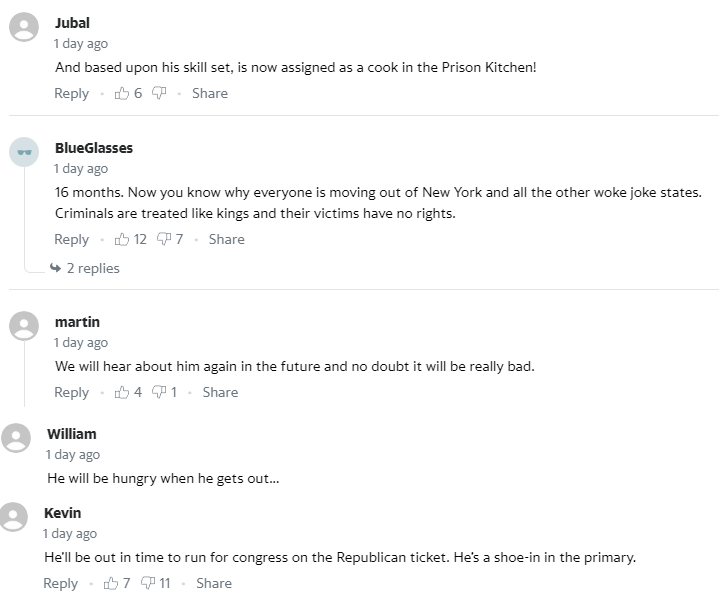
Assistant U.S. Attorney Barnett said that Bartlett’s sentence includes the time he has already served behind bars. So, he’ll be out pretty soon. There are a range of hilarious comments on social media already, many of them ingeniously weaving partisan politics into the story.
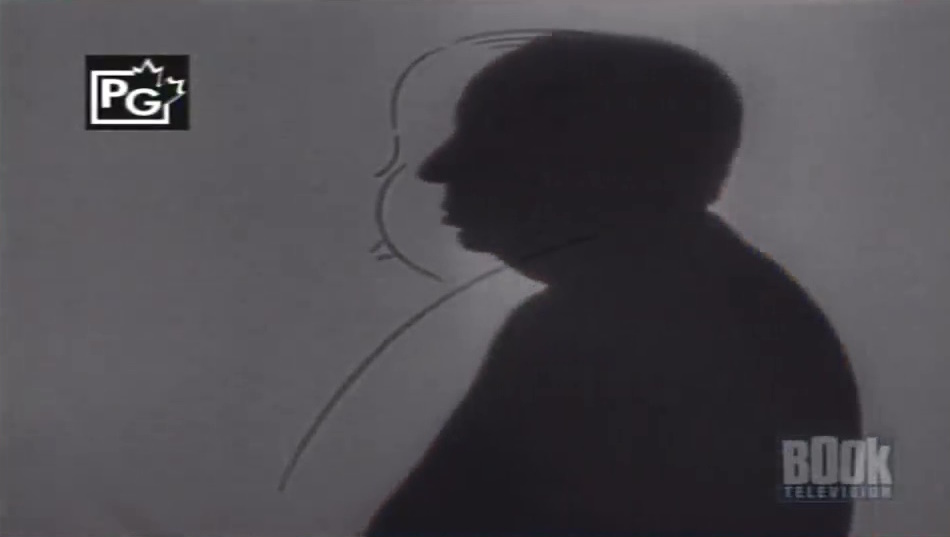
We’re heading back into the early days of Cannibal Studies with this one! The TV anthology Alfred Hitchcock Presents aired on CBS and NBC between 1955 and 1965. Produced and presented by the great auteur himself with a humorous introduction and postscript, the stories covered mysteries, thrillers and dramas. It remains timeless; in 2021, Rolling Stone ranked it 18th on its list of “30 Best Horror TV Shows of All Time”. Hitchcock was called “The Master of Suspense” and is considered one of the most important figures in cinema history. His films garnered 46 Academy Award nominations, including six wins.
The production team he put together for the TV series was a lot cheaper than a film crew, and he used them often to make his movies. A year after Specialty of the House, Hitchcock used his TV crew to make the film Psycho, a seminal film in the horror genre and in Cannibal Studies. Psycho’s story was itself adapted from the case of the so-called “Butcher of Plainfield”, Ed Gein, who would dig up bodies and use the bones and skin to make masks, accessories and furniture. Gein would make women suits out of human skin (which inspired Jame Gumb – “Buffalo Bill” – in Silence of the Lambs) so he could dress up as his mother (which inspired Psycho). His facemasks, made out of human faces, inspired the character Leatherface in The Texas Chain Saw Massacre and its many sequels.
This week’s 1959 TV show was also an adaptation, from Stanley Ellin’s short story “The Speciality of the House” about gourmet chef Sbirro, whose exclusive restaurant offers a “warm haven in a coldly insane world”. Sbirro serves a specialty called “lamb Amirstan, which turns out to be the flesh of patrons who had enquired too deeply into the mysteries of his kitchen. Ellin’s story was first published in Ellery Queen’s Mystery Magazine in 1948.
This production is fairly true to the short story. The wonderful Robert Morley is Laffler, a well-heeled import-export businessman, who has invited his protégé, Costain, to the very exclusive club/restaurant. They meet some of the other diners, including a rich Singaporean businessman (as if to show us that American elitism is not entirely white, but ironically played by Japanese actor Tetsu Komai) and another very cantankerous diner whose regular eating-partner has apparently resigned, immediately after becoming a life member. Laffler is astonished, because his three obsessions are lamb Amirstan, which all the members crave, a longing to become a life-member of the club, and a yearning to “see the kitchen where these miracles are performed”.
On their first two visits, lamb Amirstan is not served, much to Laffler’s disappointment. The dishes that are served are always superb, but there is no menu, no choices offered.
“My dear boy, when you’ve studied the art of fine eating as long and as vigorously as I have, you won’t trouble with menus…. Here at Spirro’s we have no doubts, we ask no questions, we only know that there is a genius in the kitchen!”
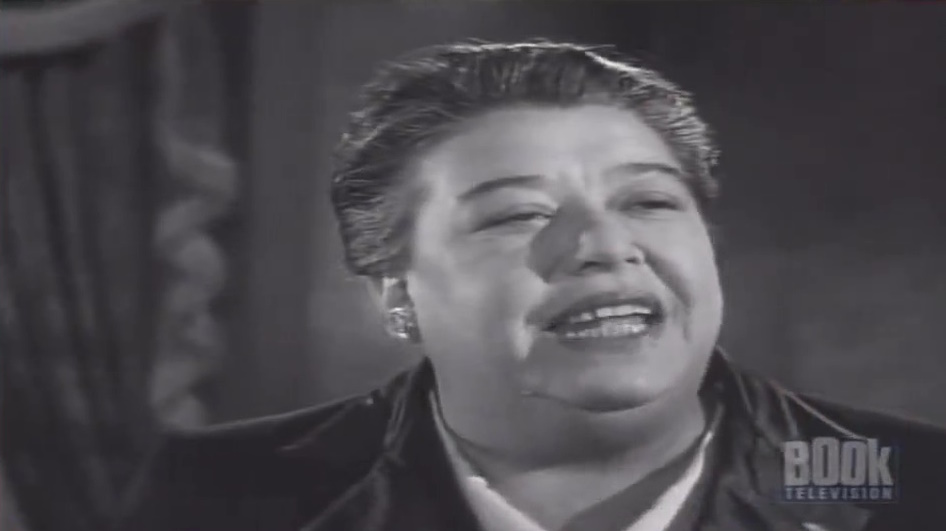
Spirro (the spelling in the story changed, for reasons not explained) makes an appearance while Laffler is complaining about not being allowed into the kitchen. Unlike the short story, in which women were not welcomed into the club, in the Hitchcock show Spirro is a woman (played by Spivy), very much in the style of the “monstrous-feminine” who, we are all subconsciously afraid, will reabsorb us into the feminine form from which we emerged. She puts a hand of Laffler’s meaty shoulder and announces, “I think we will be having the speciality of the house very soon, my friend.” She is looking at Costain; we realise by now that Laffler has become a nuisance to her and is likely soon to become lamb Amirstan. The next night, when lamb Amirstan is finally to be served, Laffler is very rude, refusing to sit with Costain, demanding to be served first, and insisting on more food on his plate.
Unlike Laffler, Spirro says of Costain, “He has very nice manners, your friend.” Manners, the rule of laws and language referred to by Michel Foucault as “the symbolic” are the basis for civilised, patriarchal societies. Rudeness is appalling, and you will perhaps recall Hannibal Lecter, decades later, saying “discourtesy is unspeakably ugly to me.” Laffler has been discourteous, intrusive, and so is destined to become a “life member”. When he makes a fuss about no more lamb Amirstan on the following night, he is delighted to find Spirro inviting him into the kitchen, to “meet the chef”. Chef is clearly ready for the meeting.
Cannibalism here is presented as addictive. All the members crave not the superb cuisine served every night but specifically the “specialty of the house” which turns out to be the latest life-member. It is a myth that cannibals only want human flesh once they have tasted it; in fact, all the evidence seems to indicate that we don’t taste that much different to pigs. But the myth is enduring – think of the many stories of the Wendigo, a figure from Algonquin stories who becomes addicted to human flesh which makes him grow larger and therefore inevitably hungrier. Or the recent movie Bones and All, where the two Romeo and Juliet lovers are united not only in their affection for each other but their recurring fascination with human flesh. Or Cannibal Apocalypse, where Vietnam vets are infected with the wendigo bug.
Like many cannibal stories, the victim’s life is envisaged as being absorbed by the eaters. “Life member” is, therefore, an apt description for one whose life has been taken and now lives only in metabolisation into the body of the cannibal. These members are what are sometimes described as “innocent cannibals” – they love to eat meat, but are not aware from what animal it has been carved. Think of the appreciative consumers of the meat pies in Sweeney Todd.
But are any of us really innocent, if we know that some sentient animal has died to be on our plate? It might be a rare breed of lambs from the Ugandan border, or it could be a rude businessman. Ethics, as Hannibal once told us, become aesthetics. If it tastes great, if a person of authority and good taste places it before us, it is at least aesthetically, if not ethically, proper. As the new life member, soon to be lamb Amirstan, told us earlier in the show:
“My mother used to say – we eat what’s set before us, and we like it.”
The episode is available on line, the link is at the top of this blog.
A Brazilian murder suspect and Dutch resident who police believe may have participated in “cannibal practices” was arrested at an airport in Portugal with a suitcase containing “suspicious meat” and bloodstained clothing.
Begoleã Mendes Fernandes, 26, was taken into custody at Lisbon Airport on Monday February 27, 2023, after getting off a flight from Amsterdam, where he was suspected of killing 21-year-old Alan Lopes a day earlier. Both the victim and suspect are of Brazilian descent. Fernandes was at first arrested on suspicion of travelling on falsified documents.
Portuguese media reported that pieces of meat were found inside a plastic bag packed into Fernandes’ luggage, and that the meat could be human flesh. The meat is still to be analysed in a laboratory, to determine its origin. The Portuguese Immigration and Border Services (Servico De Estrangereiros E Fronteiras or SEF) issued a statement:
“After contacting the authorities in the Netherlands, the country where he resided, it was confirmed that he was wanted on suspicion of committing a crime of murder that occurred on February 26, in Amsterdam, which led the judicial authorities of that country to issue, yesterday afternoon, a European Arrest Warrant for extradition purposes. By indication of the Dutch authorities and the Lisbon DIAP, in addition to the documents that the suspect had in his possession, a bandage and clothes with traces of blood, a plastic package containing several pieces of meat and a mobile phone were seized, with the foreign citizen taken to the PJ’s Scientific Police Laboratory.”
Fernandes drew border officers’ attention because he had a bandage on his right hand and bloodstains on his clothing. He was scheduled to board a flight to Belo Horizonte in Brazil.
The police found the body of Lopes in his home on Vegastraat in Amsterdam at around 9:20 p.m. that Sunday after calls from his concerned friends. “It was clear that he died in a violent crime,” the police said in an initial statement. Specialists were deployed to the scene to do a forensic investigation.
The Portuguese daily newspaper Jornal de Notícias noted that
“The suspect claimed that he killed the victim because the latter forced him into cannibalistic practices.”
Lopes’ friends told Dutch daily paper Parool that they called the police after Fernandes messaged them to say that he had killed the young man. Several of Lopes’ friends received the voice notes at around 7:30 p.m. on Sunday. Marco Cunha (23) told Parool:
“He said that he tried to defend himself against Alan because he had pretended to be a cannibal. Other friends received the same vague message.”
The 26-year-old Fernandes, who described himself on Facebook as “2% genius, 98% crazy” made his initial court appearance in Lisbon and was placed in custody pending his extradition to the Netherlands.
Lopes was found dead Sunday night at a house in Amsterdam that he shared with his mother and sister, who were away at the time. According to Lopes’ friends, the young man was trying to help Fernandes, who worked as a delivery boy and had descended into drug-taking in recent months.
“He went crazy in a short time. He was on drugs, and it drove him crazy. His brain just stopped working.”
“Alan tried to help him. He had a big heart, even for the one who killed him,” Lopes’ mother, Antonia Lima (45), said to Parool. Her partner, Freek Posthumus (60), said that the young man was building a life in the Netherlands. “He was busy with his driver’s license and worked hard. I am convinced he had a bright future ahead of him.”
Kamila Lopes, the victim’s sister, told the news site Notícias ao Minuto that Fernandes was homeless and would stay with the family whenever he had nowhere to reside.
However, in an interview with the Portuguese television channel SIC, Fernandes’ mother, Carla Pimentel, suggested that her son may have killed Lopes in self-defence, according to the Portuguese-language news outlet RFI.
According to Pimentel, Fernandes was having dinner with the victim when Lopes offered him human flesh, and also showed him videos about cannibalism. The 21-year-old then allegedly tried to kill Fernandes.
The mom claimed that the meat found in her son’s possession in Lisbon was the same that was offered to him by Lopes, and that her son had kept it as evidence that he planned to hand to the authorities. Some reports are claiming that forensics have shown the meat is not from the body of the victim, Lopes, suggesting that the claims about cannibalism of a third person may be accurate.
Fernandes is expected to be extradited to the Netherlands sometime “this week” (i.e. week commencing 20 March). In the meantime, he has been locked in a jail cell in Lisbon airport for 22 hours every day for his own safety. According to tabloidCorreio da Manhã, due to the media frenzy, he is now known as “the cannibal”, and authorities hope to “contain any untoward reactions with other inmates”.
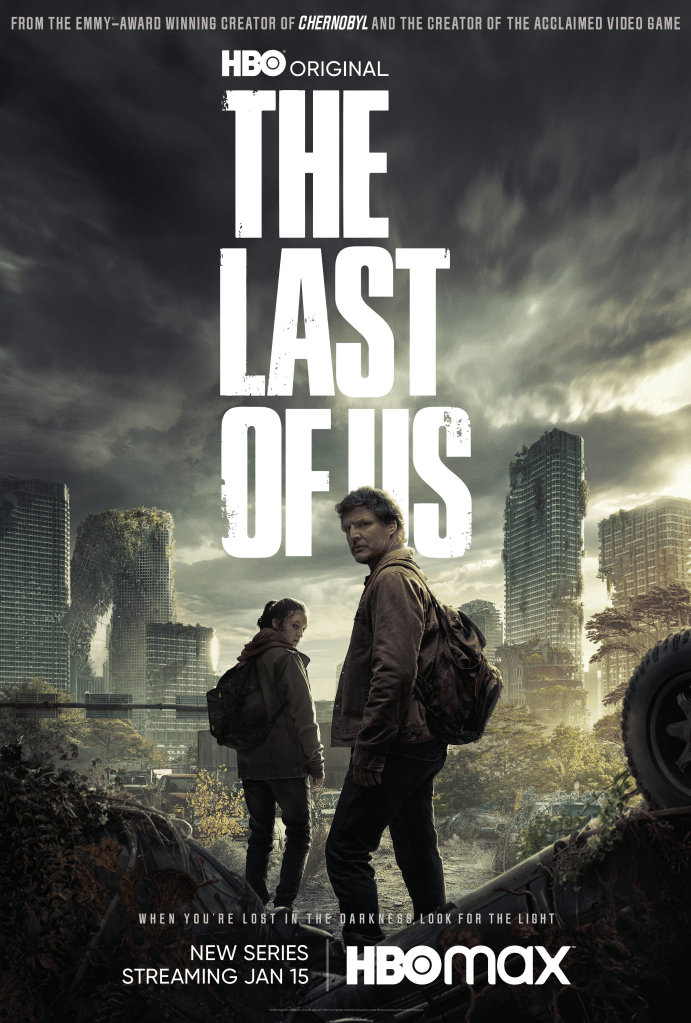
The Last of Us is an HBO original TV series which was released to streaming on January 15, 2023. It was adapted by Neil Druckmann, the writer and creative director of the video game of the same name, and Craig Mazin, the showrunner of the highly acclaimed miniseries Chernobyl.
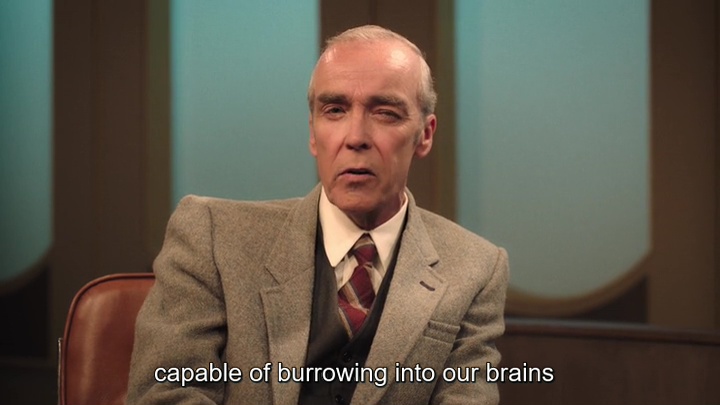
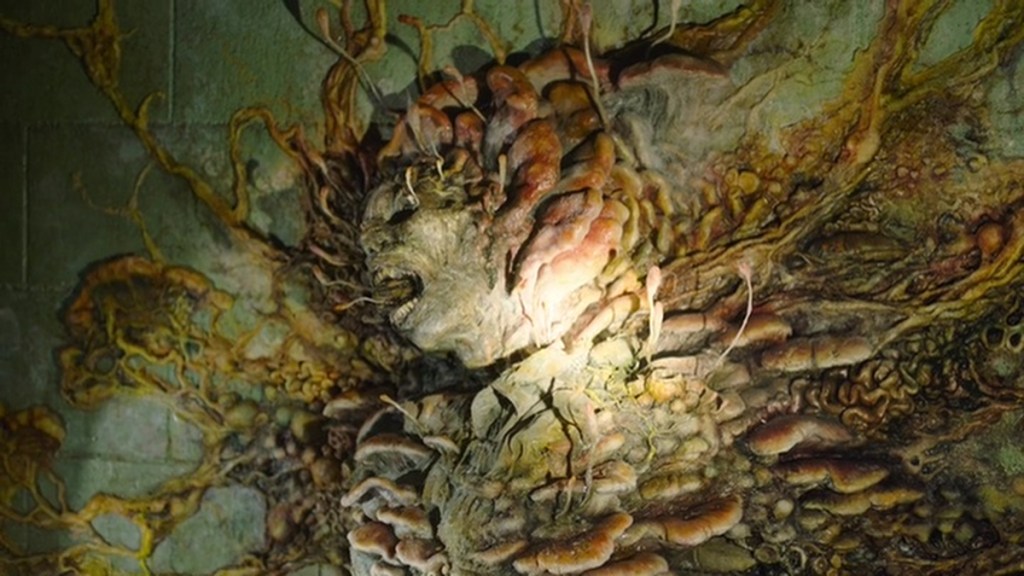
The show opens with a panel discussion; a couple of epidemiologists arguing about what sort of organism will wipe out humanity. Turns out bacteria and viruses can be terrible, but we always beat them. But fungi – one of them, cordyceps, can take over the brain, make you a slave, dedicated to one thing – spreading its spores to everyone else. Apparently, part of this fungal strategy is to kill other people and eat bits of their bodies, a lot like, y’know, zombies!
Some of this is factual – the fungus quoted, Ophiocordyceps unilateralis, is sometimes called the “zombie ant fungus” because it takes over the bodies of ants and forces them to climb to a high place and wait for spores to sprout from their heads, to be spread by the wind.
That’s one smart fungus but, as the epidemiologist says, fungus cannot live at human body temperature. Unless of course they are forced to evolve heat-tolerant forms – if, for example, hypothetically, the planet started warming. Yes, we’re talking yet another side-effect of the global warming caused by our voracious consumption of the resources of the planet. Human cannibalism of Mother Earth.
The good news is that Scientific American says there is zero chance of Ophiocordyceps surviving in our warm bodies and taking over our brains. The bad news is that there are plenty of other new strains developing, including Candida auris, which has spread to fifty countries so far and there are no drugs that treat it effectively. It won’t turn us into flesh-eating zombies, but it can do lots of other bad stuff.
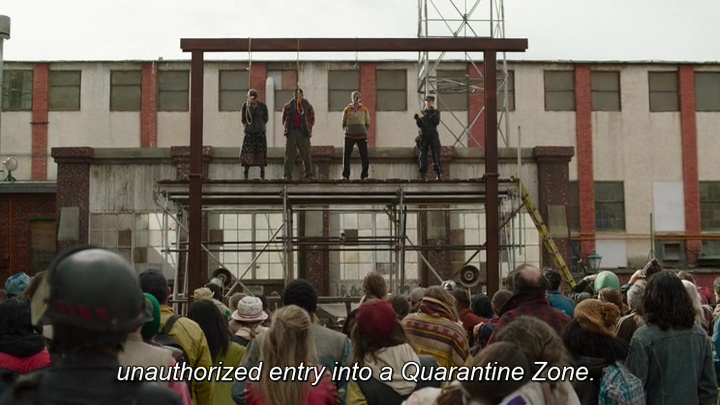
From the cranky 1960s epidemiologists we jump forward to 2003, when the fungus suddenly takes hold. The nice, senile old lady next door starts eating her family, and our protagonist, Joel (Pedro Pascal from Game of Thrones and Mandalorian) tries to escape the city with his brother and daughter, as civilisation collapses around their ears. I won’t tell you how that turns out, in case you are planning to watch it (or play the game), but the plot then jumps twenty years to 2023, a terrible year, in which people live in quarantine zones under martial law, which provides the gallows for anyone who tries to escape, or to break in.
The authoritarian government is at war with the infected, but also with a rebel group called Fireflies. The gallows, the walls, the restrictions seem perhaps a comment on the COVID lockdowns that took place only a little before this series was made, but whether in favour or against is not clear. In a pandemic, no one knows what to do, but everyone has an opinion, and whatever course is chosen will likely be seen as either ineptitude or oppression. The fungus is not COVID, which is a virus but, like COVID and other pandemics, it has the effect of causing everyone to be at the throats of everyone else. In this case, literally.
So in 2023, Joel, has a nice steady job (gig economy, but still earning a bit, and trading drugs as a side-hustle), burning corpses and cleaning sewers, neither of which tasks seem likely to become obsolete any time soon. But he’s a professional smuggler, and finds himself transporting a young girl, Ellie (Bella Ramsey, also from Game of Thrones) across the country. Ellie is valuable cargo – she is apparently immune from the fungus, and lots of people would love to cut her up and find out why and how. Heading cross-country does not (just) mean finding affordable gas (or solar chargers?), food and weapons (the basis for most games), but also has problems since the areas outside the quarantine zones are full of “the infected” (what the show calls the zombies) as well as raiders and slavers. Well, it’s based on a computer game, so there are sure to be obstacles.
The question of nomenclature keeps coming up in reviews. Assuming “zombie” can be defined clearly, many reviews argue that these dudes are not zombies because they are not ‘undead’, which seems to be a prerequisite for graduating to zombiehood. In fact, Eben Bolter, the cinematographer who shot four episodes of the first season, said that the term “zombie” (AKA the “Z-word”) was strictly forbidden on set. To me, it seems to be splitting hairs – the “infected” twitch like zombies, kill like zombies, eat (other people) like zombies. If it walks like a zombie, attacks like a zombie, and eats like a zombie, to me it’s a zombie, even if it doesn’t smell like one. What never became clear to me was why these particular zombies, their minds controlled by the fungus, insisted on killing and eating people (there is a good discussion of this on Reddit). Most parasitic organisms keep their hosts alive, because when the body dies, so do they. But I guess with billions of people alive (or not undead) in the twenty years of the fungus, eating a few can be understood. Even a zombie (infected) has to eat.
There are plenty of films and TV shows about people turning into cannibal zombies through some external threat. 28 Days Later showed a virus that was developed in a laboratory (London, not Wuhan) that turned people into rage-filled consumers. Doghouse showed all the women of a small English village turning into mindless zombies through a virus that was being tested by the military for germ warfare. Drive In from American Horror Stories suggested that just seeing a movie with the right subliminal suggestions could do it.
Then there’s The Girl with All the Gifts, in which a fungus (cordyceps, the same one as Last of Us) takes over infected humans, turns them into mindless zombies called “hungries”, and makes their bodies feeding stations for its spores. And yes, there is a young girl who is the main character, who ends up having to face off with the bad guy. Well worth watching if you get a chance. There has been some reasonably polite (for the Internet) debate over which came first, and if either stole the idea from the other. The Girl with All the Gifts was released in 2016, obviously well before the TV series of TLOA. But the game came out in 2013. But the book TGWATG was based on a short story by M.R.Carey called Iphigenia in Aulis, which was published in 2012 as part of a short-story collection called An Apple for the Creature.
Maybe it was just coincidence – the zeitgeist of the time. Innovations like 3D printing of body parts and cloning of stem cells were shaking faith in the anthropocentric division of the world into nature/culture and animal/human. Out of this fog of indistinction came two stories of cultural collapse and redemption through nature, their central characters young girls (Ellie and Melanie) who were both vulnerable but strong, warriors, hunters and protectors like Artemis, the Greek goddess at the centre of the myth of Iphigenia in Aulis. With nature fighting back in the form of climate change, perhaps our cultural consciousness recalled Artemis to lead us out of the mess. In the shape of Ellie and Melanie.
The word “zombie”, like the word “cannibal”, comes from the invasion, genocide and cultural obliteration of the nations colonised by the Europeans. Roger Luckhurst’s excellent review of the zombie trope points out that the slave labourers in the cane fields of Haiti were called zombies, but were definitely living humans who were certainly not undead but rather exhausted by endless toil, and perhaps shackled so they walked in a shuffling pace. They, like the “infected” of Last of Us, were slaves of an alien master.
Look, the show’s well made, and the reviews keep emphasising that it’s the best adaptation ever made of a computer game, which I think may be damning it with faint praise. The acting is very good, the photography superb and the graphics are terrific, as you would expect in a big-budget show. It is currently scoring 96% fresh on Rotten Tomatoes, with most critics praising the suspense, the narrative and the relationships of the main characters, Joel and Ellie. Rebecca Nicholson, the critic from The Guardian, called it
“…one of the finest TV shows you will see this year”
Of course, it is being watched by many gamers who are dedicated to Joel’s story, having lived and died with, or as him, in their hours spent playing the game. They may not be aware of the many, many zombie apocalypse movies and shows that have graced the screen since George Romero introduced us to characters lurching around the graveyard and smashing open windows hoping to find fresh brains in Night of the Living Dead in 1968 (he called them “ghouls” rather than zombies, but that never caught on). The zombie film goes back even further, to The White Zombie (1932), in which Bela Lugosi turned Madge Bellamy into a mindless love object – returned to life, but as a slave with no will of her own, precisely what Jeffrey Dahmer was hoping to achieve by pouring muriatic acid into the brains of his hoped-for sex slaves.
Storytelling in games is a very different beast to a film or TV show. In games, we have a goal and many obstacles to overcome, crash through or kill. On screen, we have (hopefully) realistic, sympathetic characters who interact, clash, and begin to love. The premise of a game is action, of a film or show, interaction. For a good summary of all the things a gamer might hate about the adaptation to screen, check out Ian Bogost’s review in The Atlantic. He sums up,
“It’s just not interesting to watch an angry man escort an irritable girl across the country amid a cartoonish zombie apocalypse cosplaying a credible global pandemic.”
But most critics felt that the writers had overcome this minefield and turned the characters, particularly Joel and Ellie, into real, sympathetic people.
Like games, a series of discrete episodes, some barely involving Joel and Ellie, take place during their journey across a devastated America. This is how games and TV shows have to be – gamers and bingers have to stop and sleep sometimes (well, maybe not gamers).
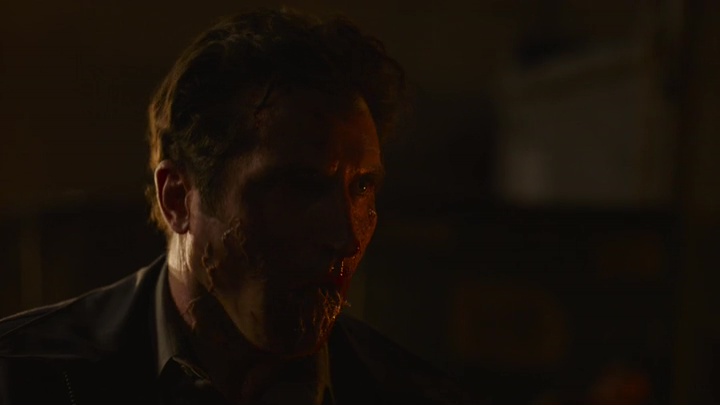
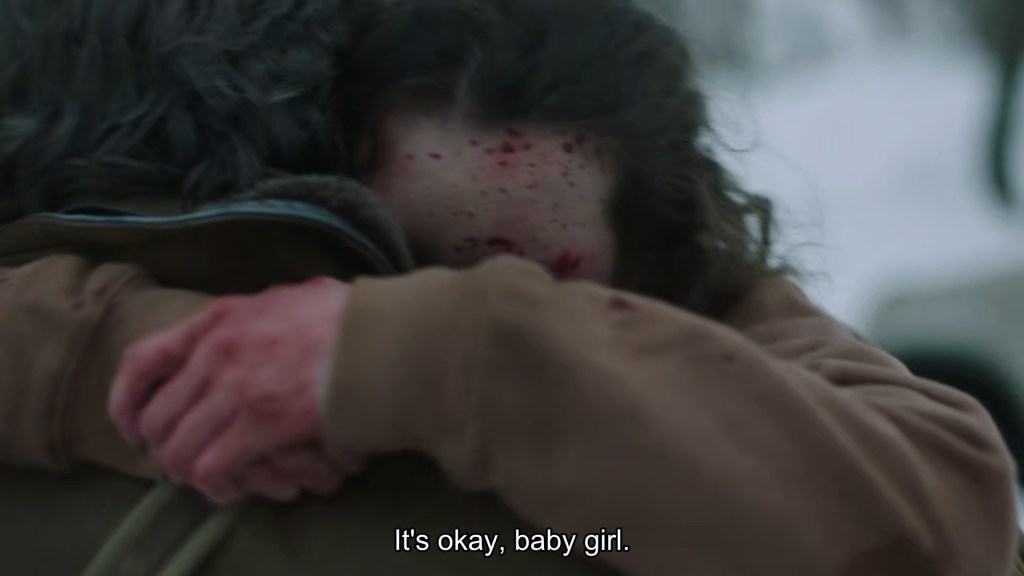
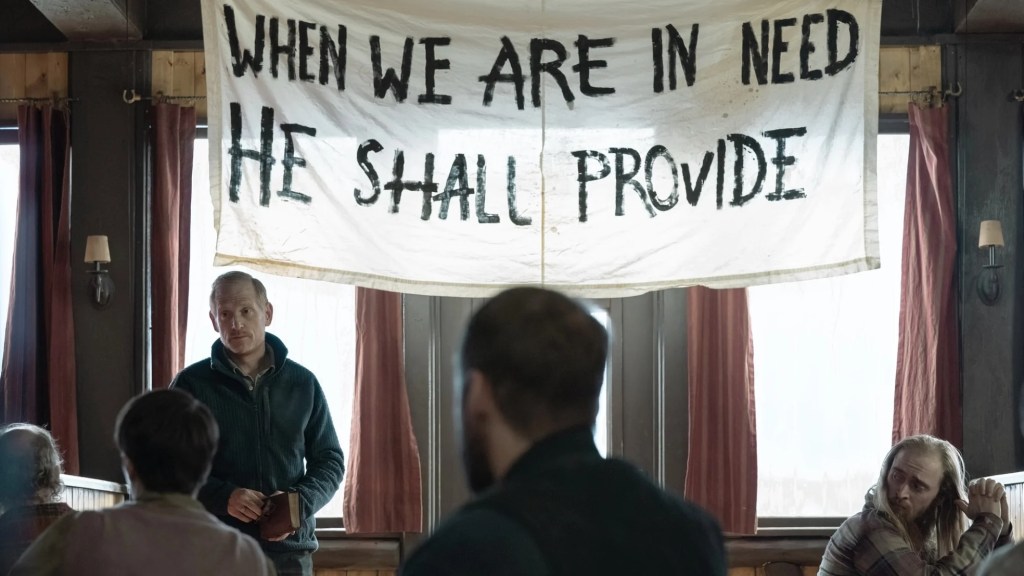
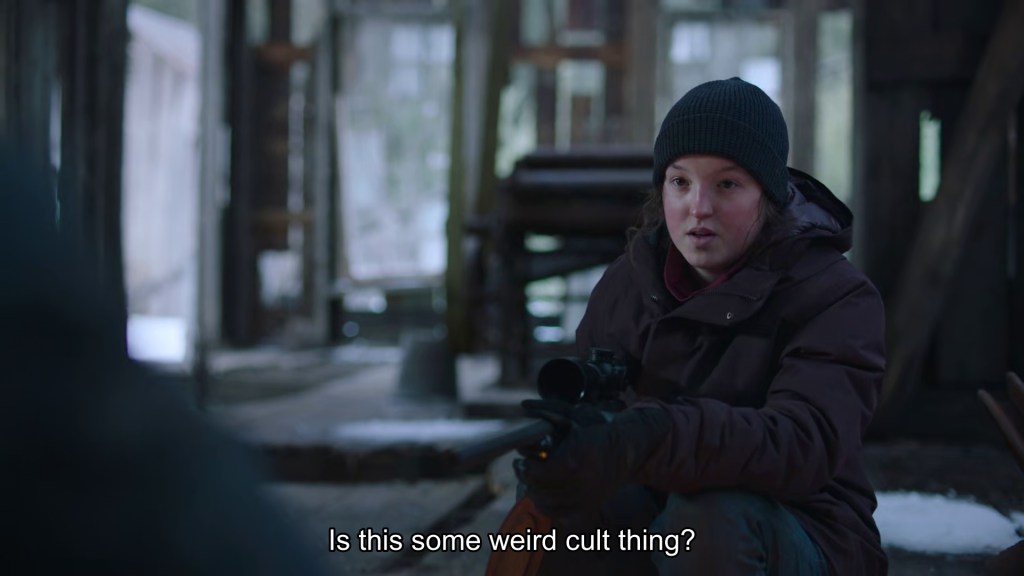
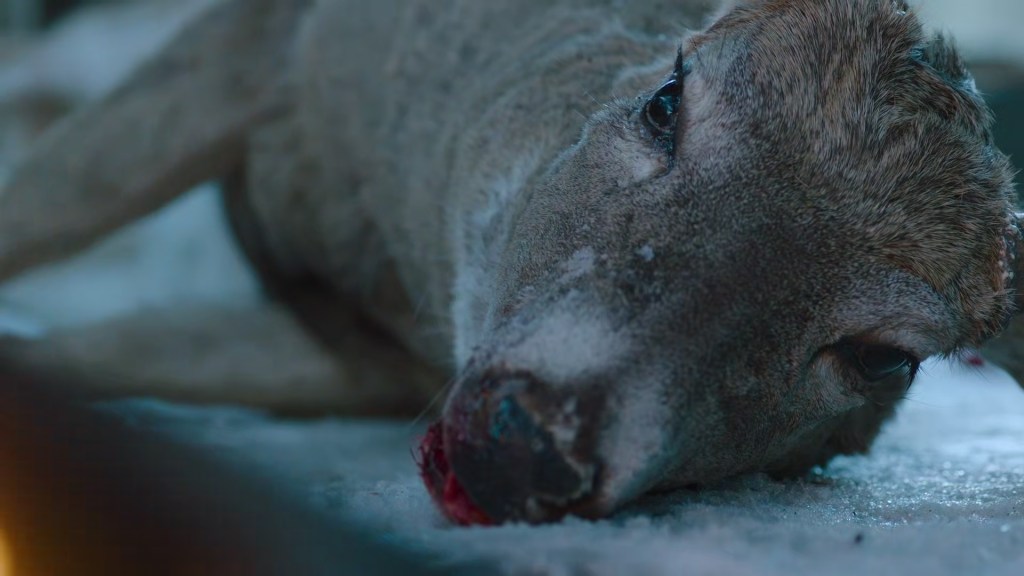
Then we get to episode eight, titled “When We Are in Need”, which Belen Edwards of Mashable predicted would “mess you up”. Joel and Ellie meet a cannibal (yes, you are on the right blog, sorry it took us a while to get here). Ellie is seeking penicillin for a wounded Joel, and finds it through a preacher named David (Scott Shepherd) and his off-sider James (Troy Baker, who played Joel in the video game!) who are trying to carry off the carcass of a deer that Ellie wounded. David the cannibal is a preacher; these cannibals are Christian devotees. In the game, they were ‘just’ psychopaths, but the show has added some backstory.
The episode starts with David reading from Revelation 21:1-4, which talks about “a new heaven and a new earth”, in which there will be no more death, mourning, crying or pain. Quite a promise for an apocalyptic series. Ellie is not impressed.
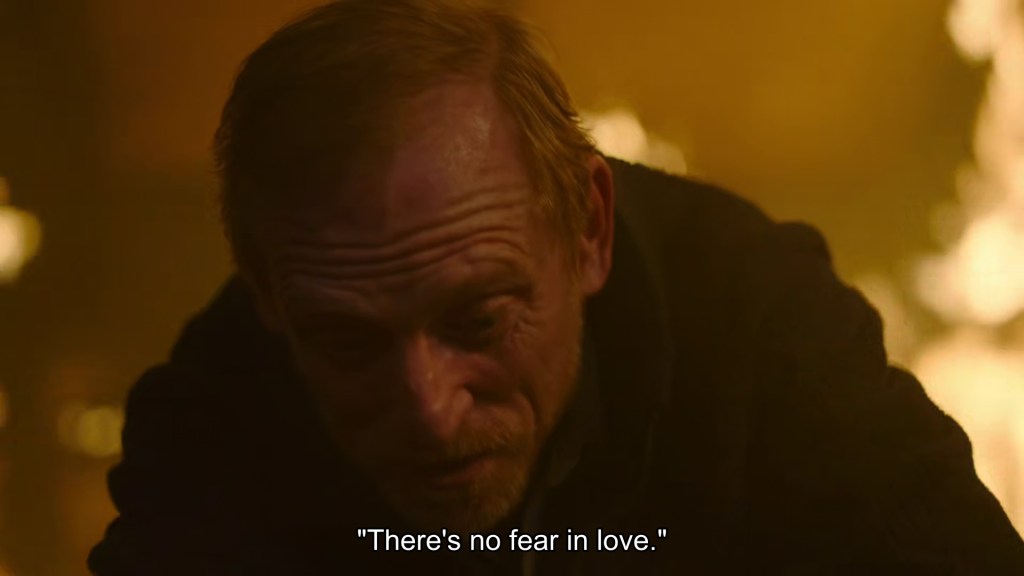
The advantage of being religious is that almost anything can be justified with a quote, out of context, from the holy books. David rationalises his attempted rape of Ellie with John 4:18 – “There is no fear in love”. Nice try. The context, trying to rape a young girl in a burning building, is definitely Satanic imagery. David is presented as the devil, because he feeds his flock the only meat available to him. Also because he is a murderer and a rapist, but that doesn’t seem so unusual in post-fungus world.
There’s a lot written about the moral twists and turns in this episode, mostly people being horrified by the cannibalism (although it is the standard operating procedure of the “infected”), and pointing out that only a preacher adept at using (twisting?) the teachings of the Bible could justify the eating of human flesh by his flock. But let’s not forget that Catholic Communion insists that it involves eating the actual body and drinking the actual blood of Christ. The Old Testament also has incidents of cannibalism during the siege of Jerusalem. Yet there is a strange consensus that shooting a living deer, wounding him so he dies later in agony, then eating him, is perfectly acceptable, while eating dead humans, who have probably died from lack of food, is somehow the work of the devil. One website says:
“David and the others are engaging in an unspeakably disgusting practice, and the fact that he’s okay with it demonstrates his moral rot.”
David tells Ellie he does not hate the fungus cordyceps, because it fights and kills for its own preservation. He feels he must do the same, be a strong, even violent leader, to protect his “flock”.
“What does cordyceps do? Is it evil? No. It’s fruitful, it multiplies. It feeds and protects its children, and it secures its future with violence if it must. It loves.”
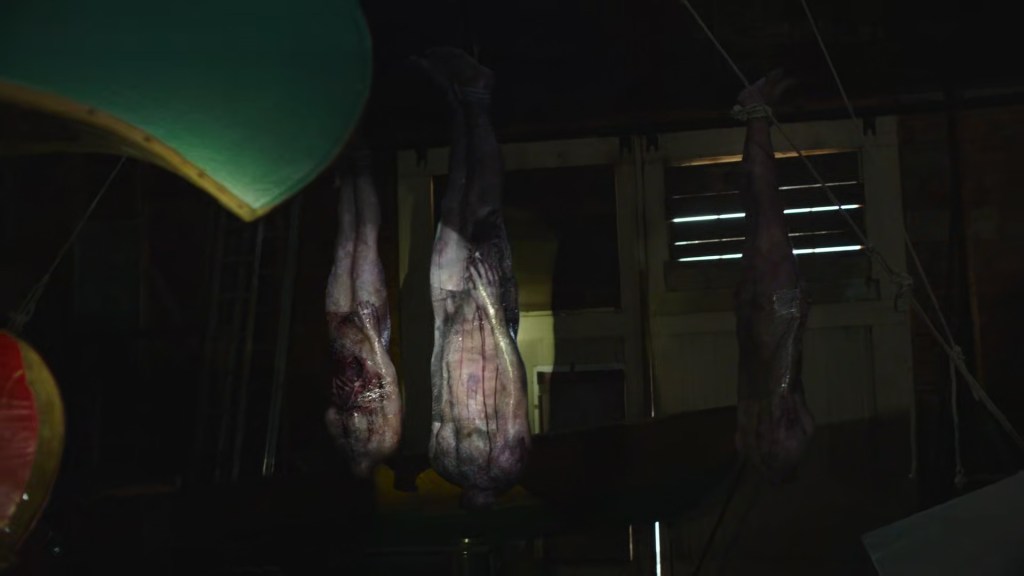
Do David’s followers know they are eating people? The cold room is full of corpses hung and ready, as Joel discovers when he stumbles in hoping to save Ellie, so it seems probable.
David tells Ellie that he keeps the cannibalism secret, because the followers (or “sheep” as he calls them) are too weak to accept what is necessary. Or perhaps David’s followers didn’t a) know or b) care that the flesh they are eating is from one mammal rather than another. There’s a scene where they all solemnly chow down on plates of what seems obviously to be the meat of the guy Joel killed last episode. Here’s a summary from the Digital Mafia website, which believes that they knew but pretended not to:
“People had turned into animals, but they still wanted to reassure themselves that they had strict regard for what was morally right.”
Killing of deer or rabbits is presented as totally uncontroversial in the show. Yet Ellie shouts at David:
“You’re an animal!”
He replies:
“Well yes, we all are. That’s sorta the point. But what was I supposed to do? Let them starve? These people who put their lives in my hands. Who expect me to keep them safe. Who love me!”
I found the killing of the stag, which I hope was sophisticated computer graphics, far more shocking than the images of hungry people eating a human corpse, which after all is a dead animal who can no longer feel any harm.
Joel and Ellie also kill to survive. Joel killed a member of David’s community in the previous episode, the one who was that night’s main course at David’s diner, and he gratuitously kills two of David’s men after he has tortured them to find out where Ellie had been taken, beats them to death as they beg for their lives. But Joel doesn’t eat the resultant corpses; human life is not sacred in this ruined earth, nor was it ever, only human flesh is sacrosanct. David sees that we are animals, “That’s sorta the point”, and so would consider Joel’s casual disposal of the corpses a shocking waste of good food. If we are happy to eat animals, and humans are animals, I guess he has a point.
The “infected” lost their humanity when they were taken over by the fungus. Joel maintains a thin red line between killing people and eating them. David’s followers have tried to retain their obsolete humanism even though threatened with starvation. David, the teacher turned preacher, sees the hypocrisy of such arbitrary distinctions. When civilisation goes up in smoke, so does its normative ethics. And when you’re in the middle of a zombie apocalypse and hungry, maybe caring is an anthropocentric luxury that most people cannot afford?





























 The Cannibal Guy