December 1, the date on which I am writing this blog, is the birthday of perhaps the most famous living cannibal, the German named Armin Meiwes. He became famous around the globe when he was arrested in December 2002 for killing and eating a willing volunteer he had met on the Internet in 2001, a man named Bernd-Jürgen Brandes, who had helped sever and cook his own penis before being finished off and filleted by Meiwes. Movies have been made based on the events, from reenactments like Dora’s Cannibal to fantasies like Weisz’s Grimm Love. Songs have been written about him and sensationalised retellings haunt our documentaries, often inexplicably comparing him to Hannibal Lecter.
Meiwes was born in Essen in 1961, and was raised by his stern and controlling mother after his father and half-brother moved out, not unlike the story of Ed Gein, who tried to resurrect his severe and hard-hearted mother by killing and eating the genitals of local women in Plainfield Wisconsin. Armin Meiwes, hopelessly devoted to his late mother as he brooded in his thirty-room house, sometimes dressing in her clothes and impersonating her voice, was not dissimilar to Norman Bates in Hitchcock’s film Psycho, which was based on the Gein murders. Many have tried to pin his later conduct on his childhood feelings of abandonment and helplessness although, if that were the case, we would expect millions of similar cases around the world. Maybe there are, but they don’t get caught?
At any rate, young Meiwes developed a taste for cannibalism (sometimes called vorarephilia) from reading fairy tales, particularly the Grimm Brothers’ Hansel and Gretel, in which abandoned children almost get eaten by a witch. The witch, we might note, was the only adult to show them any affection, even though her ulterior motives were clear, at least to the children who were reading the story. The Grimms wrote their fairy tales near Rotenburg, where Meiwes killed and butchered his friend. You may also remember (at least, Fannibals will) that Hannibal Lecter referred to this fairy-tale when he was serving up dinner to Abel Gideon; Gideon’s own leg, smoked in candy apples and thyme, glazed, and served on a sugar cane quill.
Meiwes fantasy of eating and incorporating a brother culminated in 2001 in him advertising on a fetish website called The Cannibal Café for “a well-built 18 to 30-year-old to be slaughtered and then consumed”. The only reply that seemed sincere, indeed eager, was from Brandes, who was not really well-built or 18-30, but fitted the bill because he was determined to be eaten.
They got together and, after getting to know each other (which included slicing off Brandes’ penis and cooking it), Meiwes left his friend to bleed out in the bath, and then proceeded to butcher his carcass and eat the meat, in a variety of cuts, over several months.
In case there are still a few psychologists and journalists who haven’t yet pontificated on Meiwes and Brandes, this week we consider a 2023 UK Channel 5 documentary called The Cannibal Next Door, directed by Calum Farmer. This is quite a good reenactment of the events, although like many others, it relies too heavily on brooding, portentous music and opinions from experts, all of whom are universally repulsed by the cannibalism, a repulsion that Meiwes and many of his correspondents clearly did not share.
“It had broken humanity’s last great taboo.”
Trigger warning: the real Meiwes (seeing it’s his birthday): This website claims it has actual leaked stills from Meiwes’ video. If you don’t like pictures of chopped up humans, maybe skip the link. They look fake to me, but this Reddit reader swears they are real.
Meiwes is still in jail in Germany, not for cannibalism, which is still not a crime, but for murder, which is absurd since Brandes wanted to die, and was in fact obsessed with being slaughtered and eaten. If anything, Meiwes is guilty of assisting a suicide. There was no law in Germany against eating a human.
We know so much about the case because Meiwes was very open in describing what happened, even videotaping the whole process of slaughtering and butchering. The jury in his case watched this video, and reportedly turned quite green, but it seems likely that they would have also done so had they been made to watch some of the horror clips of cruelty and killing in abattoirs that are abundant on YouTube. His lawyer argued:
“We say it is neither murder or manslaughter, but killing on demand. My client is not a monster.”
As it was clearly not murder and there was no law against eating a corpse, Meiwes was sentenced for manslaughter and given an 8½ year sentence. Public outrage resulted in a retrial which then found him guilty of murder, on the devious premise that Brandes had been mentally incapacitated by depression, and therefore open for manipulation by his killer. He was sentenced to life, which in Germany requires a minimum of fifteen years imprisonment. Meiwes has already served more than that.
Meiwes believed that he did nothing wrong. It seems that the only thing he can see as a moral failing is not the fact that he ate human meat, but that he ate any meat; he subsequently became an environmentalist and a vegetarian, both of which would obviate eating any flesh, including human. His simple claim in his defence was that, unlike pigs, sheep, cows, chickens and other animals, here was a willing victim who consented to, indeed demanded, his own slaughter and consumption. Is it not clearly more ethical to eat an animal who wants to be eaten, whatever the species, than one who does not?
People who automatically flinch at the idea of cannibal movies (or cannibalism generally) give a little mental shrug when the subject turns to starvation. What would you do if you had no food, nothing containing any life-giving nourishment except other human bodies? The honest answer to that is, usually, ‘I don’t know, and I hope never to find out’.
Several films considered in this blog have looked into what we might call “survival cannibalism”, a sub-group of the wider “castaway” genre—films like Hitchcock’s Lifeboat—which derive from the narrative of Robinson Crusoe. The most famous in Cannibal Studies is still Alive, which retold the story of the young footballers who survived a plane crash in the Andes, only to discover that the search had been called off and there was literally no food in the snow, except the bodies of their fellow passengers (most of whom were their friends). It was recently rebooted in Spanish in Bayona’s La sociedad de la nieve. Such stories are contemporary versions of the old shipwreck stories which motivated much of the cannibalism narratives of early modern Europe, horrifying the Europeans, when they weren’t accusing the colonialised of the same thing. A classic story is the whaling ship Essex, the wreck of which inspired Moby Dick. The film In the Heart of the Sea follows that story – what happened to them after the ship sunk? Well, weeks in a lifeboat with nothing but each other for company and no food…
Then we have the many, many post-apocalyptic stories, starting with Soylent Green, in which overpopulation and climate change have led to the recycling of dead people into delicious crackers. Other classics of this genre include Delicatessen, We Are The Flesh, Cadaver, and of course the bleak glimpse of the future, The Road. Such disasters can be intentionally created, such as Stalin’s famine in the Ukraine, during which the starving ate their own relatives. In the USA, the classic case of starvation cannibalism is the Donner Party.
This week’s film, Hunger, explores the same question: what would you do? If you were starving, what, or who, would you eat? An apocalypse is not the fault of the victims, and surviving any way you can, feeding yourself and your family, is difficult to criticise. It may still be gross to some (or most) people, but it is nevertheless, in some ways, understandable.
But this film complicates it by taking away the excuses of an indifferent nature or a catastrophic global event. In Hunger, there is no apocalypse. The characters are just five people who wake to find themselves in a dark dungeon, with no idea how they got there. It’s a cistern, a larger version of the abandoned well in which Catherine Martin found herself trapped in Silence of the Lambs. And, of course, like Catherine, there is no food being catered. Science hates anecdotal evidence, so in this film we have a scientist who has gathered ‘ordinary’ people in extraordinary circumstances, just to see what would happen. You may remember Mason Verger boasting of a similar experiment in Hannibal:
“I adopted some dogs from the shelter. Two dogs that were friends. I had them in a cage together with no food and fresh water. One of them died hungry. The other had a warm meal.”
They have access to four barrels of water, a toilet (of sorts, but only four toilet rolls) and a day-clock that marks off 30 days, the length of time the human body can survive without food.
On the second day, they find on their water barrels a scalpel, an instrument that Jordan, the doctor played by Lori Heuring (Mulholland Drive), calls “a human carving knife”. It soon becomes clear what that is for, and it ends up (after much discussion) being used for just that purpose – to kill and butcher each other.
We find out as they talk that they seem to have been chosen because they have all taken a life – one killed her abusive partner, another in a hold-up gone wrong, another through euthanasia. Doctors like Jordan handle life and death every day. But the scientist wants to know, are they willing to kill out of hunger alone?
Then there is that scientist who kidnapped them; we find that he had been a young boy who survived a car crash: we later discover he cannibalised his mother’s corpse to stay alive. Now he watches his captives, and takes careful notes.
He shares their predilection for taking life: when a couple come to have sex in the quiet country area and hear the pleas for help from their oubliette, he shoots them with tranquiliser darts and pushes their car into the river, but not until they wake up. He thereby reveals a sadistic streak, a psychopathy, or at least a disavowal of empathy, common in scientists who experiment on mice, rats, dogs, monkeys and other animals. Most of us react to seeing other sentient beings in pain by initiating an empathetic response called resonance in the inferior frontal gyrus and the inferior parietal lobule of our brains. Recent research in which rats were given electric shocks and responded similarly both to pain and to watching other rats in pain showed that this ability is not restricted to humans, and in fact may be better developed in rats than in some scientists. Like Descartes torturing dogs or Josef Mengele experimenting on camp inmates, a psychopathic scientist can justify any cruelty for the sake of research.
Cannibalism, the act of killing and eating another, is sometimes considered transcendent (by the cannibal), with one character making reference to cannibalism as a spiritual pursuit:
“Human flesh is essence. It captures a person’s soul!”
The scientist likes this idea, because he ate his mother, so it’s comforting to think that he now contains her soul. But the main theme of the film remains starvation cannibalism, in this case forced on the victims, as it was in the Ukrainian famines or the Nazi death camps. The counterpart of this cannibalism is happening in their bodies. As Dr Jordan tells us, the process of starvation progresses as “your body basically cannibalises itself.” The alternative is what the scientist hopes to witness, the choice to “become a savage”.
Jordan, the doctor, is the only character who refuses to consider cannibalism. Like “the Man” in The Road, she wants to “carry the fire”, and that anthropocentric ideal does not include eating humans. The others spurn such naïve ideology:
“You can hold on to your precious humanity. We’re doing what we have to do to survive. And your boyfriend? He tasted surprisingly delicious.”
Cannibalism is usually depicted by society as a form of madness or monstrosity involving a devolution from civilised to savage, from enlightened to barbaric. Unless we pay someone else to do it for us—then it’s called animal husbandry.
The film was produced for a tiny $625,000, so the special effects and production time are limited (except for the buckets of gore), but it is still extremely effective. Hunger was released on Fangoria’s Frightfest DVD line, the same distributor as the (reworked) Armin Meiwes story Grimm Love. It does not seem to have received wide distribution, which is a shame, as it is well made, well acted (particularly Lori Heuring, who is quite incandescent) and is well worth your while chasing down. Moreover, it covers a crucial question that becomes more urgent as the world goes to hell in a handbasket – what would you do?
Idaho lawmakers have voted to expand a law that bans cannibalism because of fears about the popularity of human composting. Rep. Heather Scott introduced a bill in February 2024 to expand the state’s cannibalism ban and told a legislative committee that she’s worried about the possibility that people are eating other people.
Scott said:
“This is going to be normalized at some point, the way our society’s going and the direction we’re going.”
People are often surprised to hear that Idaho is the only state in the USA to have outlawed cannibalism. Other states have laws which target abuse or desecration of a corpse, making cannibalism legally impractical and problematic. Idaho introduced its law during the frenzy called the “Satanic Panic” last century.
The US is not unique in this – most countries do not have specific laws banning cannibalism. Germany didn’t, until Armin Meiwes ate his new social media friend.
The new bill, 522, adds to Idaho’s existing prohibition of cannibalism a ban on giving someone else “the flesh or blood of a human being” without that person’s “knowledge or consent.” Scott said she is “disturbed” by the practice of human composting, which is legal in several states as an option for disposing of the dead that is more sustainable than other burial methods and reduces a funeral’s carbon footprint. Human composting involves decomposing human remains like other organic matter and turning it into soil that can be returned to the family or used to make land more fertile. But Scott said outlawing composting would require overhauling rules for morticians, and so instead she focused on banning the act of deliberately giving human flesh to another person.
“I didn’t want to see that in my Home Depot stores.”
Scott said she was on a plane and watched a clip from a TV show displaying a chef feeding human flesh in sausage to contestants, which inspired her to take action. The clip, which she sent to the Idaho Statesman, is from a TruTV prank show, in which they pretend to feed people flesh. “They didn’t tell the people, they fed it to them,” Scott told the Statesman, though she noted it may have been a spoof.
Scott also submitted a link to a video featuring a Chinese official denying that his country had sold canned human flesh to people in Zambia. The canning claim was a hoax, spread with fake photos of butchery, according to news reports from 2016. Scott additionally pointed to a North Idaho man who pleaded guilty to murder last year and was initially also charged with cannibalism after investigators found postmortem mutilation and a bloodied bowl at the crime scene. The cannibalism charge was later dropped, meaning that the Idaho anti-cannibalism laws have still not been tried in court.
But that’s where we are in Idaho: Unhinged, unreal legislators can bring forth just about any crazy idea and get a bill printed.
But imagining that humans might unwittingly eat other humans is not so far-fetched. Mythology is full of innocent cannibals—Agave eating her son Penteus, Thyestes eating his sons at his brother’s feast, Tereus eating Itys. Becoming “innocent” cannibals make us squirm, writes Donald Tuzin, because it denies us the escape of declaring the cannibal a maniac or monster—anyone can become a cannibal. In the movie The Farm, humans are treated as “living meat” exactly the way cattle are regarded on factory farms—the men are slaughtered for meat, the women bred and their infants pitilessly killed in front of the mother (as often happens in the dairy industry) so the farmers can sell the mothers’ milk. The final commodities are sold to innocent cannibals, who occasionally ring up, horrified to find residues such as a human tooth in their meat. Inverting the agricultural business plan, the “livestock” are human, while the farmers are dressed in animal masks.
But it doesn’t only happen in fiction. The Farm may be based on the Canadian pig farmer and serial killer Robert Pickton who confessed to 49 murders in the 1990s, and allegedly “processed” the meat of his rape and murder victims by feeding them to his pigs and, police said, possibly mixing them up with the pork products he sold to neighbours.
Joe Metheny claimed to have killed 13 people in the Baltimore area in the 1990s and turned them into burgers. He reported:
“Over the next couple weeks on the weekends I opened up a little open-pit beef stand. I had real roast beef and pork sandwiches and why not they were very good. The human body tastes very similar to pork. If you mix it together no one can tell the difference.”
In 2007, two men in England were arrested for the murder of a 14-year-old girl, with the prosecution claiming that her body had been cut up and minced into kebabs in a Blackpool takeaway called “Funny Boys”.
On April 9, 2012, police in Garanhuns, Brazil, arrested for murder Jorge Beltrao Negromonte da Silveira, his wife, Isabel Pires, and his mistress, Bruna Cristina Oliveira, who all lived together in a group they called “The Cartel”.
Residing with the Cartel was a small child named Vitória, who had been the daughter of their first victim. The child’s mother was a seventeen-year-old homeless woman whom the Cartel had invited into their home in Olinda in May 2008. She had been murdered by the Cartel, who then dismembered and skinned her body, storing the meat in their refrigerator before seasoning it with salt and cumin, grilling and eating it. The woman’s daughter was fed some of her mother’s flesh.
The worldwide public interest in the crimes did not stem from their murder of three young mothers, but from the fact that the Cartel had baked the victims’ flesh into salgados, salty, deep-fried pastries, which they then sold to the unsuspecting public. To the disappointment of the media, the pictures of the perpetrators showed them as three ordinary Brazilians, not the monsters the public had expected.
Back to Idaho, where Rep Heather Scott’s bill 522 sailed through the House and is heading to the Senate. She quoted in support of her bill from a recent article in The New Scientist which reviewed the human history of cannibalism (they concluded that it happened a lot) and stated:
“Ethically, cannibalism poses fewer issues than you might imagine. If a body can be bequeathed with consent to medical science, why can’t it be left to feed the hungry? Our aversion has been explained in various ways. Perhaps it is down to the fact that, in Western religious traditions, bodies are seen as the seat of the soul and have a whiff of the sacred. Or maybe it is culturally ingrained, with roots in early modern colonialism, when racist stereotypes of the cannibal were concocted to justify subjugation.”
We don’t have to buy mulch to end up cannibals. Any sausage or burger might have human flesh in it, and no one would know the difference. We are animals, large mammals, made of red meat like cows, pigs and sheep. Unless you think we have some sort of supernatural dissimilarity from other animals, the thin red line between different species can only be identified as a cultural construct.
The modern cannibal is usually hard to identify. Jeffrey Dahmer was the all-American boy next door. Armin Meiwes used to mow his neighbours’ lawns to be helpful. Issei Sagawa was so small and helpless that he seemed vulnerable rather than threatening. Albert Fish was a sweet old man, so charming that the Budd’s let him take their little girl to a party.
They were normal, everyday people, a bit weird, but not monsters.
At least, not in appearance. This is a recent phenomenon – the original cannibals were called anthropophagi (Greek for man-eaters) and were humanoid in shape, but were usually some sort of hybrid – a mix of humans and gods or other animals – strong, ferocious, and clearly not quite human. From the 15th century, the alleged cannibals found by Columbus and other explorers were different in culture and skin colouring, so were easily distinguished, defamed and exterminated. It is only recently, since Jack the Ripper in 1888, that the cannibal walked among us, undetected until the victims were found (or what was left of them).
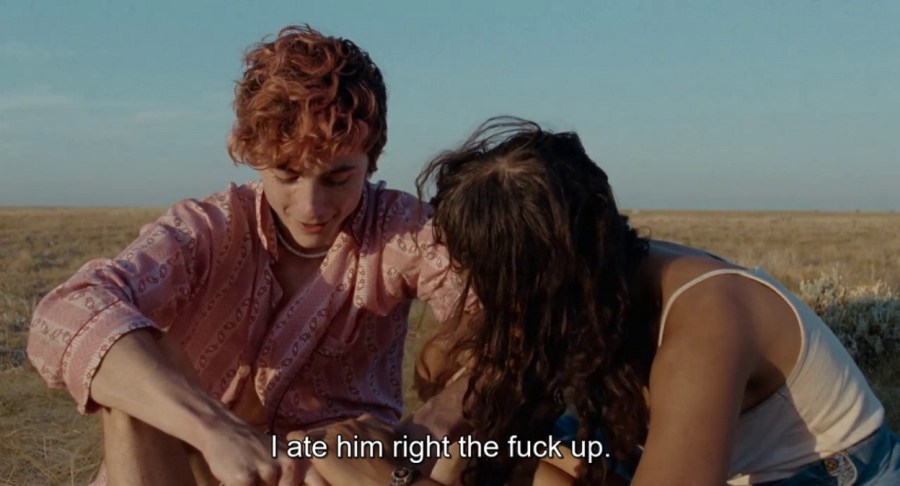
Bones and All presents as a coming of age cannibal romance, taking a sharp turn back into cannibal history for its themes. Maren (Taylor Russell from Lost in Space) is finishing high school, a spectacular end of term in which she is invited to her friend’s sleepover and bites a girl’s finger off, instead of, you know, just admiring the nail polish, as she had been invited to do.
She then goes on the run with her father, who has been keeping her ahead of the law as she grew up (her first human meat was her babysitter when she was three) but now ditches her, with a few hundred dollars and a birth certificate.
It then becomes a road movie, as she travels through the American Mid-West trying to find her mother, attracting suspicion not because of her eating habits but just because she looks too young to be on the road. She comes across another cannibal (they are called “eaters”) in the shape of a weird old man named Sully (Mark Rylance, Bridge of Spies) before meeting up with Lee, played by the love interest of seemingly everyone nowadays, Timothée Chalamet. Chalamet appeared in the third instalment of Guadagnino’s “Desire Trilogy”, Call Me by Your Name), in which he was the love interest of Oliver, played by Armie Hammer, who has recently been generating his own cannibalism headlines.
As a road movie it’s Thelma and Louise mixed with Romeo and Juliet, if they had been cannibals. In other words outsiders, star-crossed lovers, and lots of flesh being torn off dead (and sometimes living) bodies. Road movies rely on meeting new and weird people, and learning about the protagonists (and ourselves) from their stories.
Sully is a lonely old man who teaches Maren about being an eater, and how an eater has a super-power – like a vampire, they have a nose that can smell other eaters at great distances, and can also smell dying people, which allows him to feast on them fairly inculpably, although Maren rather wonders if they should be calling 911 rather than letting them gasp their last breaths. So they are anthropophagi, they smell different, have a strong sense of smell, and so are not quite human. We subsequently discover that the cannibal gene is passed on – Lee’s dad and Maren’s mother were also eaters. They are a breed apart, hybrid humans, who can mate with non-eaters.
They are also presented as ‘savages’ – related to the colonised peoples who were declared cannibal by the imperial powers. Maren is biracial, and Sully (although played by a classical British Shakespearean actor) seems to be presented as a Native American, with a long ponytail and a feather in his hat. The marginalised and disenfranchised are regularly presented as dangerous, thieves, murders, cannibals, regardless of any evidence.
An interesting character from colonial times is the wendigo, a figure from Algonquin mythology who eats his fellow humans and draws on their strength to grow huge and powerful, which only makes him hungrier and deadlier. Sully tells Maren that her fate is to need more and more flesh as she gets older.
Just like the wendigo, who is an indigenous version of the anthropophagus, and one that was used by the victims to characterise the European invaders and their voracious appetite for land and gold. The phrase “bones and all” reminds us of the colonial greed that denied the humanity of those invaded and insisted on taking everything, leaving nothing and nowhere to go but a few reservations or missions in remote, unprofitable areas. Eating bones and all is also a perfect way of getting rid of the evidence.
The title Bones and All is taken from the book of the same name by Camille DeAngelis, but the phrase was not used in the book – it just meant that Maren and the other eaters would automatically eat the whole person, bones and all. Except for her first, the babysitter, because she was too small to swallow bones – she left a pile of them, a pool of blood, and the hammer from an eardrum. In a movie, though, it can be harder for the viewer to maintain a willing suspension of disbelief, so eating the victim bones and all becomes a rite of passage – the next level of being an eater. Maren and Lee don’t know how to eat a person bones and all, so they are not yet postgrad eaters. Maren puts it succinctly – “that’s impossible.” But what about eating the flesh? Armin Meiwes took ten months to eat 20 kilograms (44 lb) of Brandes, but we are asked to accept that Maren and Lee can eat a whole body in a night.
But then, everything is ambiguous in this story, which has been widely described as a metaphor for otherness and queerness. The story is set in 1981, as Ronald Reagan is entering the White House. Being different, queer, compassionate, seeking social justice were all considered laughable or dangerous. Greed was good, and so eating a victim bones and all might have seemed laudable. Drug addiction was escalating, and some have seen the cannibalism in this film as a metaphor for this as well – Maren and Lee can’t go too long without their feed, and will do whatever they need to in order to get it.
Some of the ambiguities are more subtle: Maren looks young, which bothers various people she deals with, although she is 18 and technically an adult in most places. Lee falls in love with her, but is also capable of appearing to be cruising for gay sex.
He chooses a carnival worker who has been mean to a child, leads him into the bushes and masturbates him, slitting the man’s throat as he orgasms. It was not until twenty years later that gay sex was legalised in the US, and this man’s secret desire for same sex petite mort becomes his real mort. They then discover that the man had a wife and family, and are stricken with guilt, because apparently eating some people is OK, but not family people.
Then we have the eaters – Maren is naïve and caring, horrified by her need to feed. Lee is a puny dude who kills seemingly effortlessly, but like Hannibal Lecter, Lee prefers to eat rude people – when we first meet him, he challenges a rude person in a supermarket and leads him to a deserted shed where he kills and eats him. Sully is an senior eater, so has to eat regularly, but says he tries not to kill people – sniffs out those who are dying, but later he gets violent when Maren rejects his advances.
Jake (Michael Stuhlbarg) is an eater who has graduated to eating bones and all, but he is accompanied by a friend named Brad (David Gordon Green), a cop (!), who is not a natural eater, but just likes doing it. Maren accepts that she and Lee have to eat people, but is revolted by Jake’s wish to do the same. We’re back to the old debate of nature versus nurture. Are people born queer? Or with addictive personalities? Or psychopathic? Or cannibalistic?
The Director, Luca Guadagnino, has made a number of changes from the book, which are examined elsewhere. The most obvious one, though, is that Maren is brought up and then eventually abandoned by her mother in the book, but her father in the film. This changes the dynamic considerably, because we now have two eaters in the family, both female. The eater parent in both versions is locked up in an asylum, having eaten their own hands, but in the movie it’s her mother, (a short but superb appearance by Chloë Sevigny). We arrive at last at the modern horror archetype, the “monstrous-feminine”, the figure that confronts the male viewer with his fears of being castrated (Freud’s favourite explanation), as well as “the monstrous womb” – a terrifying image of a “black hole which threatens to reabsorb what it once birthed” (Creed, The Monstrous-Feminine, p. 27). The female cannibal is quintessentially monstrous-feminine, terrifying men with the antithesis of popular female stereotypes of giving life and nurturing. In the book, Maren only eats boys or men (after the initial babysitter) – she is drawn to eat those who seek to be close to her. In both versions of the story, the ambiguity is clear to us and the female cannibals – they have a compulsion to eat, but don’t want to hurt others.
Maren’s solution is to try to act normal, fall in love, get a job, get “clean” of the eating. Her mother’s was to lock herself away, and even then she chewed off her own hands.
To me, the most fascinating ambiguity in this film and in our societies generally is the question “who can you eat?” Eating some animals is considered just “normal” – Lee is chewing on bacon (pig flesh) served to him in a very respectable café, and has been working in an abattoir. When they need money, he and Maren rob the abattoir at night, later sitting on the overhead walkway watching the cows who are to be killed for legal, non-controversial eating, when Maren observes
“every one of them has a mom and a dad, sisters, brothers, cousins, kids. Friends even.”
The real question, Derrida says, is not what to eat but how to eat well. Perhaps, as Chalamet has said, it is impossible to live ethically – every act of consumption or energy usage wrecks the environment a little bit more. For some carnivores, this is seen as a ‘bones and all’ issue, they call it “nose to tail” – killing is OK, but wasting any part of the animal is the real crime. But as Maren says, cows also feel terror, pain, bereavement when their babies are taken from them. The author of the book, Camille DeAngelis, went vegan before writing it, indicating that the problem of who to eat, the rude or dying, the human or the cow, weighed on her, and the scene filmed in the slaughterhouse indicates that Guadagnino may have felt the same. Cat Woods’ review in Salon reminds us that Brad, the off duty policeman, chooses to be a cannibal:
“Why would he hunt, slaughter, and feast upon human flesh if he doesn’t need to? And, if we the audience can be repulsed by that – and his evident choice to slaughter and eat flesh when there is abundant satiety that doesn’t cause violence, pain and loss – then perhaps we need to venture a little deeper into our own psyches and ask: Why would we feast upon flesh if we don’t need to?”
This is a seriously good film, with a great cast and, in the midst of all this carnage, we are treated to magnificent scenery beautifully captured by cinematographer Arseni Khachaturan. I have not revealed the ending, and hope I have not revealed too many other plot points. I recommend you go see it.
Issei Sagawa, a Japanese murderer known as the “Kobe Cannibal”, died of pneumonia on November 24 2022 at the age of 73. His funeral was attended only by relatives, with no public ceremony planned, according to a statement from his younger brother and the publisher of the brother’s 2019 memoir.
In 1981, 32 year old Sagawa, then a Japanese exchange student, murdered a young Dutch woman, Renée Hartevelt, a fellow student at the Paris Sorbonne, then raped, mutilated, and cannibalised her corpse over two days.
After that, he cut up her remains and packed them into two large suitcases, called a taxi and tried to drop the cases off in a park in the middle of Paris. He fell asleep in the park (eating too much meat can have that affect) and someone opened one of the cases. Sagawa walked calmly away, but within four days, the police tracked Sagawa through the taxi driver, and he confessed immediately. In his refrigerator and on his dining table, they found a large quantity of human flesh.
Sagawa was declared insane, but his father employed an influential French lawyer to argue, successfully, that it was unfair for the French taxpayer to pay for indefinite confinement in a mental hospital, and that he should be sent back to Japan to be cured. Accordingly, less than three years after his confession, Sagawa was put on a plane and sent back to Japan, the only condition being that he could never come back to France. He could not be prosecuted in Japan because the French had sealed the case files after the murder charge had been dropped. He spent 18 months in a Japanese mental hospital but then checked himself out, and has been free ever since.
There is a comprehensive study of the case in the documentary THE CANNIBAL WHO WALKED FREE, which I reviewed in this blog in February – you can read it here. It contains a link to the documentary on YouTube.
Another fascinating documentary which looks more closely into the psyche of both Sagawa and his brother through interviews (sometimes disturbingly close-up ones) is CANIBA, made by two artists/anthropologists in 2017. I reviewed that in May, and you can read it here. It has a link to the production site where you can buy the DVD should you be so inclined.
The French philosopher Georges Batailleis widely quoted on the Internet as saying
“A kiss is the beginning of cannibalism.”
I hate to be a party pooper, but there is no evidence of Bataille ever saying this. Nonetheless, the concept makes sense. Sex is a very oral experience – from passionate kissing to cunnilingus and fellatio, much of foreplay consists of licking, tasting and biting. Even non-sexual love often involves phrases such as “I could just eat you up.” Cannibals like Armin Meiwes and Jeffrey Dahmer ate their victims to keep them close. Sagawa did the same, claiming he loved Renée.
Sagawa, with a massive inferiority complex based around his conviction that he was small and ugly, saw a bullet in the neck as his only way he would ever have sexual experiences with a live partner, particularly a beautiful young woman who seemed totally out of his league. Murder in such a belief system must have seemed like a form of courtship, and cannibalism a way to keep her with him forever. For forty years, he has done just that, living off his notoriety, making films, appearing in torture porn, writing books and comics (from which the drawings in this blog are taken), and even reviewing restaurants for foodie magazines.
Sagawa appears in the documentaries mentioned above (and several others I have not yet reviewed) as a repulsive, sick individual, but never as repulsive and sick as he firmly believed himself to be.
So, the buzz for this movie is ‘Ted Lasso goes cannibal’. By that, they don’t imply we will need to sit through any football matches, but that there is going to be a lot of American “can-do” ardour, conflicting with British reticence and melancholy. Also some dark humour, and a whole lot of gore, which some may find objectionable. Consider yourselves warned.
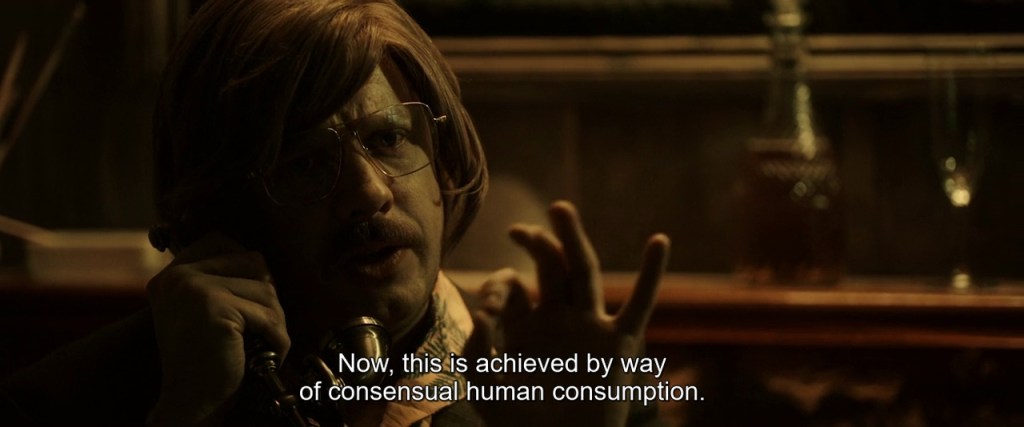
Feed Me is directed by Adam Leader and Richard Oakes (Hosts). XYZ Films released the horror-comedy on October 27 2022 on digital and on demand platforms. Feed Me follows Jed (Christopher Mulvin) whose life is shattered when his wife Olivia (Samantha Loxley) suddenly dies, leaving him feeling guilty. The blurb says:
“Spiralling into an abyss of depression, he finds himself in a bar with a deranged cannibal, Lionel Flack (Neal Ward) who convinces him he can redeem himself through the glorious act of allowing himself to be slowly eaten to death.”
Suicide, usually unassisted, is sadly common in modern society, and besides making the relatives wretched, it is also an enormous inconvenience to the police, medics and trauma-cleaners who have to deal with it. So why not benefit someone – the local cannibal who promises a painless death that will not require housekeeping, because he will eat the resulting mess? Jed moves in with Lionel, whose tiny house is filthy and full of body parts. But Jed is ready, eager to die, and Lionel is tremblingly eager to eat him.
Cannibalism, particularly vorarephilia (the erotic desire to consume or be consumed by another) can be seen as a type of eating disorder, particularly in cases where there are other foods readily available, but if that is the case, so can any form of carnivory. The film starts and finishes with such reflections – Jed’s wife is a beautiful young woman who is convinced she is fat and ugly, and eventually dies from the effects of bulimia – she starves herself and vomits out whatever nourishment she does eat, until her body closes down.
As Jed explains it, her mental illness meant that she “was eaten from the inside out.” Lionel’s solution is that, if Jed is determined to kill himself, he should do it from the outside in.
Lionel quotes some fake anthropology – a tribe called the Yiurkun who, he says, live in perpetual happiness,
His offer (and there is a written contract involved) is to eat Jed, quickly and painlessly, so he can join his beloved. Why not, Jed thinks, since Olivia has effectively (in his dreams) eaten his heart?
Lionel starts small – local anaesthetic, one finger chopped off with secateurs and carefully cooked, the wound cauterised with a hot clothes iron. “How do you feel?” Lionel asks.
But of course you can’t eat a whole person one finger at a time, and it’s not long before Lionel is removing limbs, but now without anaesthetic, because he gets mad at Jed.
Lionel says he has heard that
“some cultures believe that torturing the animal alive improves the taste and quality of the meat.”
This is not an invention of the director – it’s well known that dogs and cats and other animals are often beaten or burnt or at least made to watch the death of other animals, to make the terror and agony generate adrenalin, which is supposed to add flavour. Astonishingly, Hillary Clinton was accused of doing the same to small children. Other politicians have had the same accusations hurled at them. While these are almost certainly nonsense, it is true that almost every one of the seventy billion land animals humans eat each year will go through extremely painful ordeals, and all of the trillions of sea creatures. Jed is just one more animal in agony.
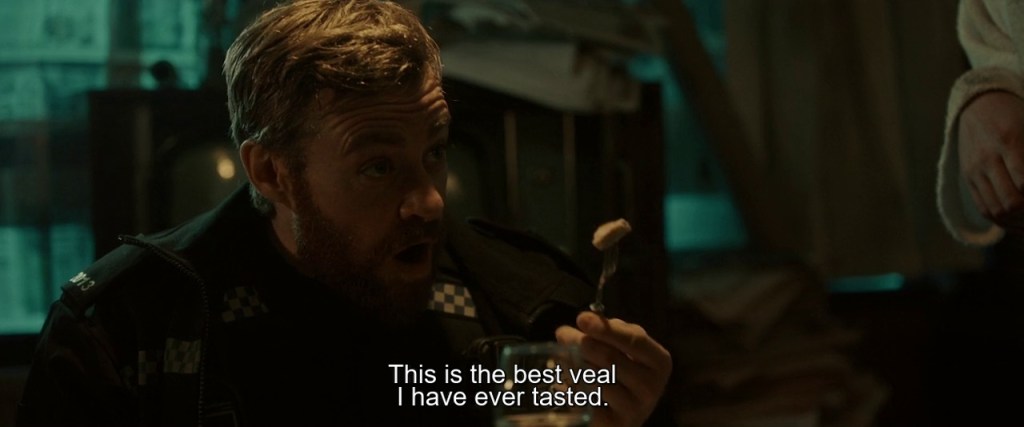
When the neighbour calls police about all the screaming going on, Lionel invites them in and feeds them some of his “mild veal”.
The enjoyment of food depends largely on what we believe about it. The actor playing the cop is probably in fact eating a piece of veal. His character, the cop, believes he is indeed eating veal. The audience, us, suspends disbelief so we can imagine that he is actually eating part of Jed’s leg. This turns the meal from gourmet to horror – a simple change of species, entirely within our imagination. The title, FEED ME, challenges the assumption that food will be prepared and served with our preconceptions catered for – it will be tasty and uncontroversial. In this society, eating a baby cow who wanted to live is praiseworthy; eating a man who wants to die is horrific.
The title reminded me of a foodie show called “Somebody Feed Phil” which sees writer and producer Phil Rosenthal (Everybody Loves Raymond) travelling around the world eating huge dishes of food while adding no weight to his irritatingly slim frame. In a recent episode, Phil lands in Madrid and apologises to a suckling (newborn) pig –
“you’re very cute, but I’m going to eat you.”
Most cannibals, like carnivores everywhere, do not usually have their victim’s permission, and usually do not apologise either, although they may feel some cognitive dissonance, knowing that their meal required the suffering and slaughter of the animal whose flesh is involved. Phil didn’t kill the new-born baby pig, but did apologise for eating him. Jeffrey Dahmer killed seventeen men and boys and also didn’t apologise (until it was far too late). The closest parallel to the plot of this film (the trailer above states it was “inspired by true events”) is the true case of Armin Meiwes, who advertised for a man who wished to be killed and eaten, had dinner and sex with the only genuine respondent, and then killed and ate him. He felt there was no apology needed, since Jorgen Brandes had wanted, indeed demanded, to be eaten. So it is with Lionel, who offers to kill and eat Jed, and then slowly and gradually makes good on his promise.
Neal Ward plays Lionel as an over the top, twitchy, verbose American con-man, the kind of man we like to think serial killers and cannibals look like, because that would make them easy to spot. Yet the essence of the real modern cannibal is his (or sometimes her) completely normal and unremarkable appearance – they walk among their peers, unknown and unidentified until their arrest (if they are ever found). Neighbours, for example, praised Meiwes as a nice young man who would mow the lawn for them. Issei Sagawa was so small and apparently innocuous that the young woman he killed and ate had been happy to come to his apartment to read poetry together.
The tagline for this movie is
“You are who you eat…”
The concept is interesting – if you are who/what you eat, do you want to eat pigs or chickens or sheep, all of whom are used, quite unjustly, as common insults (for gluttons, cowards or mindless followers). If you are what you eat, Lionel tells us, you should eat humans.
The anthropologist Marvin Harris wrote in his book Good to Eat: Riddles of Food and Culture that, while humans are clearly not obligate carnivores, “our species-given physiology and digestive processes predispose us to learn to prefer animal foods”. This presents a problem for him, since “strictly speaking, human flesh itself contains the highest-quality protein that one can eat”. Lionel’s pathology stems from his calculating, impeccable logic.
The film is a fascinating study of love, loss, despair, friendship, loneliness and appetite. The gore is perhaps a bit over the top, but no longer unusual in modern films. The acting, despite what other reviewers have said, is great and the story compelling. Neal Ward plays Lionel as both a monster and a clown, a hard role to portray, but he is, in the end, seeking the same as all of us – self-acceptance, love, a validation of his humanity, and a good meal.
Seems to be the month for cannibal music videos. Last week we looked at the new song CANNIBAL by Marcus Mumford, directed by Steven Spielberg. A beautiful ballad about metaphoric cannibalism, the kind of cannibalism that relationships can turn into, particularly abusive ones. Mumford seems to be referring to child abuse, accusing his abuser of taking “the first slice of me and you ate it raw. Ripped it with your teeth and lips like a cannibal.”
This week’s video (the clip is at the top of this blog) is by the industrial/electronic music duo SKYND, who pioneered the true crime music genre, which presents stories based on murders and other crimes. They have previously written about the death of Elisa Lam whose body was found in a hotel cistern in LA, the manslaughter of Conrad Roy whose girlfriend sent text messages encouraging him to commit suicide, the mass suicide in Jonestown, the Columbine High School massacre, and killers such as Gary M. Heidnik and Katherine Knight.
Most of those songs weren’t about cannibals (Katherine Knight maybe, who killed and cooked her husband, although she didn’t eat him). But the song we are reviewing today retells poetically the story of one of the world’s most famous cannibals, Armin Meiwes, the German man who advertised for someone who wanted to be eaten, and then ate him.
The song starts with the repeated refrain
Let him be fat or lean, let him be fat or lean Tomorrow I will kill him, tomorrow I will… Let him be fat or lean, let him be fat or lean Tomorrow I will cook him, tomorrow I will…
This is a reference to the fairy tale Hänsel und Gretel, recorded by the Brothers Grimm and published in 1812. You may remember this one giving you nightmares when you were very small – two children are abandoned in a forest by their penurious parents and, on the verge of starvation, come across a gingerbread house which they proceed to chew on, only to be captured by the owner, a witch, who wishes to enslave Gretel and eat Hansel, be he fat or lean. The story was reimagined a couple of years ago as the splendid movie Gretel and Hansel.
You may also remember (at least, Fannibals will) that Hannibal Lecterreferred to this fairy-tale when he was serving up dinner to Abel Gideon; Gideon’s own leg, smoked in candy apples and thyme, glazed, and served on a sugar cane quill.
Armin Meiwes advertised in 2001 on a fetish website called The Cannibal Café for “a well-built 18 to 30-year-old to be slaughtered and then consumed”. The only reply that seemed sincere, indeed eager, was from a man named Jürgen Brandes, who was not really well-built or 18-30, but Meiwes was a tolerant sort of bloke, or perhaps desperate for his first human-meat meal, so they got together and, after getting to know each other (which included slicing off Brandes’ penis and cooking it), Meiwes left his friend to bleed out in the bath, and then proceeded to butcher his carcass and eat the meat, in a variety of cuts:
Cutlets Ham Goulash Steaks Knuckles Bacon Portion by portion Cator, you’re a part of me now… Forever
There is also a reference to Meiwes in the Hannibal episode “Digestivo”, when Mason Verger is planning on eating Hannibal and refers to Meiwes and Brandes eating the latter’s penis, even though it was radically overcooked.
If you want to know more about the case (for which Meiwes is still serving time), there are several excellent links on the Skynd case files website (these guys do their homework!).
“When I investigated the case, I watched an interview with him. Meiwes didn’t seem like the typical beast you’d imagine when you think of a ‘cannibal.’ But then again, you might ask yourself, ‘What does a cannibal even look like?’ It’s a story that hasn’t left me for years and I feel like I have finally translated it into music.”
There are a lot of documentaries on this event, which mostly involve ominous music and hushed narratives and absurd comparisons to Hannibal Lecter. Also a movie in which their names were changed, and another one in which they weren’t given names at all.
Or you can just watch this video, which sums up the salient points rather succinctly.
Table set for tonight Waited for this all my life Candle lights shining bright Pull the cork, pour the red wine Long, big steak on my plate Potatoes and sprouts on the side I savor my first bite Satisfied my appetite.
But before the killing and eating, which Meiwes had wanted to do for most of his life (and which Brandes seemed to want just as much), there was the question of what the “livestock” industry likes to call “humane slaughter”, one of the great oxymorons of the modern world. Brandes apparently wanted to be eaten alive, feel teeth tear into his flesh, but Meiwes was more considerate – pain may be a fun sexual fantasy, but it can really hurt. So they stopped on the way home (Brandes had only bought a one-way train ticket) and bought cough medicine (BREToN, which according to Google is Tulobuterol Hydrochloride and is for “asthma exacerbation”, although the website does rather hilariously say:
“Breton Syrup may also be used for purposes not listed here”
Two bottles of that, a fistful of sleeping tablets washed down with a bottle of schnapps, and Brandes was good to go. They collaboratively cut off his penis (again, it was supposed to be a tooth job, but it was too tough) and cooked it. It was inedible, and Meiwes threw it out (although an urban myth has developed that he fed it to a dog). Then Meiwes put Brandes in the bath to bleed to death and went off to read a Star Trek novel.
Pain killers, cough syrup Sleeping pills, bottle of schnapps Sink your teeth, chew it up Take a knife, make a clean cut Roast the flesh, medium heat Add garlic, pepper and salt Meat is too tough to eat So I’ll feed it to the dog.
Waiting for him to bleed out Reading Star Trek for three hours Finally kiss him once and kill him then slaughter him like a piece of… Like a piece of livestock.
The clip ends with Father (the multi-instrumentalist other half of the duo) appearing as Meiwes, sitting down to have ‘an old friend for dinner’.
Of course, that is the point of this story. Farmers claim to love their animals and then send them off to a terrifying death, hung upside down with their throats cut. There is evidence that Meiwes probably witnessed the slaughter of pigs when he was a child, and found it arousing. In an interview, Meiwes said the butchering was simple:
“It was like cutting up a pig. Meat is meat.”
Meiwes was originally convicted of manslaughter, which caused an uproar in the media. His story was soon adapted in movies, and in the song “Mein Tell” by Rammstein, who then faced the threat of being sued by the cannibal for plagiarism!
Meiwes’ verdict was later amended to murder, a strange decision – can you murder someone who wants to die? His simple claim in his defence was that, unlike pigs, sheep, cows, chickens and other animals, here was a willing victim who consented to, indeed demanded, his own slaughter and consumption. Is it not clearly more ethical to eat an animal who wants to be eaten, whatever the species, than one who does not?
Imagine you are trapped on a ship surrounded by ice in the Arctic, and some of your friends might actually not be whom they seem. Dread Hunger, a New Zealand computer game in which players can cannibalise their friends, has become a huge success, mainly in China.
I usually blog about cannibal movies here, or news stories about cannibalism when they break. This is the first game I have covered, although I am waiting to see the game “Borneo: A Jungle Nightmare” which is due for release this year – it is scripted and directed by Ruggero Deodato, who brought us one of the seminal cannibal movies in 1980: CANNIBAL HOLOCAUST. This game was originally going to have the same title, but is not a remake (in game form) of the original, but more like fourth in Deodato’s cannibal saga. Due out sometime in 2022.
Anyway, back to DREAD HUNGER! When the Christchurch company, Digital Confectioners, released the game earlier this year, they were hoping they might reach 10,000 players in the US. To their surprise, they found that more than 260,000 people in China play the game every day. Due to time zones, says Director Sam Evans, the demand is mostly between the hours of 12.30am and 5am New Zealand time (which for computer nerds is a fairly normal operating time).
Dread Hunger is a survival game set during an Arctic exploration in 1847-48. Players can build fires, fight off wolves, and hunt for food, including, sometimes, human flesh from their shipmates.
There are various weapons, and the players can also “pick up severed heads and limbs and use them to kill.”
One of the strategies is:
“Betray Your Friends Feed them tainted food, lure animals to attack them, hex them with blood magic, or if all else fails… just shoot them in the back.”
The game has become a target of hackers, including DDOS attacks and “cheats” where hackers find a loophole in the game code they can exploit to give players an unfair advantage.
Dread Hunger has just passed 1 million copies sold, a figure Evans called “insane”. The graphics are splendid and, well, graphic.
This has led to some new, if profitable, challenges.
“The American market largely treats games like a product. They buy the game, they play the game on average 10-15 hours over a few weeks, then they move on. But in China when they find a game they like, they play it for hundreds of hours, for years and years. This forced us to treat the game like a service. We now have to focus on continual development and regularly updating the game to add more cool features over time.”
The game is mainly based on the 1845 expedition of 129 men led by explorer Sir John Franklin, which left Britain for the Canadian Arctic in search of the elusive Northwest Passage. Their ships, the H.M.S. Erebus and the H.M.S. Terror never returned.
Rumours that the crew resorted to cannibalism have swirled around the doomed expedition since the nineteenth century. Evidence suggests that Franklin’s crew may have not only consumed the flesh of deceased compatriots, but also cracked their bones, to eat the marrow inside. In 1854, interviews with local Inuits described piles of human bones, cracked in half.
In 1864, Sir Edwin Landseer‘s painting Man Proposes, God Disposes caused a stir at the Royal Academy exhibition for its depiction of two polar bears, one chewing on a tattered ship’s ensign, the other gnawing on a human ribcage. Cannibalism did not get a mention – yet.
More recently, in the 1980s and 1990s, researchers recovered remains of the crew on King William Island. Knife marks on the bones backed up early accounts of human cannibalism. A newer analysis of 35 bones by anthropologists Simon Mays and Owen Beattie suggests that the men did indeed eat each other. The bones showed signs of breakage and heating—indicating that the crew members probably cooked them to extract the marrow. Mays and Beattie published their results in 2015 in the International Journal of Osteology.
Horror writer Dan Simmons‘s 2007 book The Terror was developed as a 2018 AMC television series also called The Terror. The expedition has, over the years, taken on the mythic value to the British that the Donner Party holds in the USA.
One of the lines from the launch trailer (above):
“I have heard it said that this land can change a man. Turn him into a beast. Well, to that I would say—men were always beasts. Some you see, well, they’re just better at hiding it than others.”
Dread Hunger is what is called in games parlance a “social deduction game”. This is a category of game in which players attempt to uncover each other’s hidden role or team allegiance. It’s an ideal formula for a population who never know quite who the agents of their government might be. And also an ideal cannibalism game for the recent history of man-eating, in which the cannibals like Albert Fish, Jeffrey Dahmer, Issei Sagawa and Armin Meiwes all appeared as very ordinary, normal neighbours.
We all need to do some social deductions, it seems.
‘Cannibal teacher’ hid his victim’s penis to avoid being outed
A man dubbed by the press a ‘cannibal teacher’ has been convicted of murder and sentenced to life in prison. The judge said the murder was carried out as part of his “cannibalism fantasies”. The 42-year-old, identified only as Stefan R, was also convicted of disturbing the peace of the dead, after a trial that opened in August 2021 and concluded this week.
German prosecutors described evidence of cannibalism in the killing of 44-year-old high-voltage technician, Stefan Trogisch, on 6 September 2020.
Stefan R. allegedly ate parts of his lover after sex, and subsequently concealed somehow the victim’s penis, so he wouldn’t be “outed” as gay. German police arrested the 41-year-old maths and chemistry teacher in November 2020 on suspicion of “sado-cannibalism for sexual gratification” after they found human bones stripped completely of flesh in a Berlin suburb. Under German law, the man’s surname cannot be revealed, yet there are pictures of him everywhere, so I’m guessing this is not a serious privacy issue.
A Berlin prosecutor’s office spokesperson said
“The suspect had an interest in cannibalism. He searched online for the topic.”
Well, hello! So do I, and maybe you, dear reader. I also look up COVID and cricket, but that doesn’t mean I caught one or played the other. Maybe he was writing a PhD thesis?
No one knows whether the victim, the other Stefan, had an interest in cannibalism, but we know that the two men were communicating on a gay dating website called Planet Romeo, according to a report in Der Spiegel. Stefan R. called himself “Spieltrieb1976” (roughly translated as “instinct to play”) and Stefan T. (now deceased) was “Dosenöffner79” (tin opener). Stefan R. also used the handle “Masterbutcher79” which prosecutors claimed was a reference to Armin Meiwes, who was dubbed the “Master Butcher of Rotenberg.”
The bones of Trogisch were found a couple of months after the murder, and showed signs of bite marks, although having been out in a field for a couple of months, it’s hard to say what species of animal had been biting them. A police officer told the newspaper Bild:
“Based on the bones found, which were completely stripped of flesh, and further evidence, we strongly suspect that Stefan T was the victim of a cannibal.”
Sniffer dogs led police to the apartment of the suspect, where they discovered knives, a medical bone saw, and a large freezer. Investigators also discovered 25kg of sodium hydroxide, a reagent that can be used to dissolve bodily tissue. It can also be used to make soap, which the accused claimed he bought it for. Traces of blood were discovered in the hallway of the suspect’s flat. The defendant had previously erected a sex swing in the living room and had a sign on the window ledge that read: “Instructions for emasculating and slaughtering a person.” He reportedly searched terms associated with cannibalism on the dark web such as “long pig” and “fatten and slaughter people” before Trogisch arrived at his residence. According to German newspaper Bild, he had also previously searched whether or not a person could survive after having their penis cut off.
Stefan R. told the court that Trogisch had died in his sleep on the sofa after a (presumably vigorous) sexual tryst. He claimed that Trogisch had consumed a cocktail of drugs and alcohol, and that he tried to revive him, but did not call emergency services “because it would have come out that I am homosexual”, according to Bild.
He said he decided to dispose of the body, and opted to separate Trogisch’s genitals “since my DNA could still have possibly been present due to the oral sex I performed”. But hours after the death, he logged back into the human slaughter forum where he proudly told a man from the city of Bremen: “I have it [the penis] now!”
In the sensitive style that we have come to expect from British news media, The Sun wrote
“the victim’s manhood has not yet been found.”
Judge Schertz said that, in 30 years as a judge, “nothing like this has come across my desk before”. He added that the defendant’s version of events was “unbelievable from start to finish”, noting the “very careful separation of testicles and penis” as evidence of a cannibalistic ritual.
The trial began in August 8 2021 and heard an autopsy report which revealed that the cause of death was a fatal loss of blood from the pelvic area due to a severed artery. This would seem to indicate that Trogisch bled to death after his penis was chopped off. The autopsy also ruled out the defendant’s claim that the victim was affected by alcohol or drugs, causing his death.
It’s a sensitive subject in Germany, where cannibalism was not uncommon between the world wars and was made into the subject of Fritz Lang’s masterpiece – “M – EINE STADT SUCHT EINEN MÖRDER” one of my favourite cannibalism movies. More recently, Armin Meiwes in 2001 met Bernd Jürgen Brandes on a site called Cannibal Café, and after a romantic interlude, agreed to Brandes’ request to kill him and eat him. The first act of the killing (all captured on video) was Meiwes cutting off Brandes’ penis, which he then cooked and the two men attempted to eat, very unsuccessfully. Meiwes subsequently killed Brandes and ate an estimated 45-65 pounds of flesh (20-30kg) from him. Meiwes is still in jail, and Brandes is still in Meiwes (well, only in spirit, unless he has a very slow digestive tract). Unlike Brandes, there is no evidence that Trogisch had “consented” to his killing.
Then in 2013, Detlev Guenzel, a German police forensic specialist (you couldn’t make this stuff up), chopped up a man he met on a cannibalism fetish website and buried the pieces in the garden, taking a picture of himself standing next to a skeleton and holding an axe, wearing nothing but socks and sandals. There is little evidence to show that Guenzel ate any of the victim, although the victim’s penis and one testicle were not found in the flowerbed where the other pieces of the puzzle were unearthed.
There is probably another thesis to be written on the proportion of cannibalism reports that involve queer sexuality. Meiwes, of course, and Jeffrey Dahmer, who collected young men and killed them to keep them close. The film The Silence of the Lambs was heavily criticised when it was released for showing the serial killer Jame Gumb (“Buffalo Bill”) as a transsexual, although the plot was all about how he wasn’t authentically trans, and was killing women because he was rejected for gender reassignment surgery, and so was making himself a woman suit out of the skin of his victims. The film’s cannibal, Hannibal Lecter, was not gay in that series of films and books (he fancied the hell out of Clarice Starling), although Krendler, the nasty dude from the Justice Department in the book Hannibal, said he “figured he [Hannibal] was a homosexual” because, you know, he had good taste in food and wine and music – “artsy-fartsy stuff”. Krendler’s brain is later eaten by Hannibal and Clarice, so we have no reason to take him too seriously. But there was certainly plenty of homoerotic interaction in the twenty-first century reboot of Hannibal on TV, particularly when Hannibal is holding Will tenderly while cutting him up.
Is this tendency to depict cannibals as queer a reflection on the traumas experienced by gay youths and where they may lead behaviourally, or simply a noxious reaction against the lifting of restrictions on gay couples? Someone will write a paper on that one day. They probably already have.
The other issue raised by this case if of course the persistent theme (Meiwes and Guenzel again) of the chopping off and consumption of the male penis. Stefan R. discussed on one forum whether it was possible to survive a genital amputation – saying that some people desired it in order to feel like women, or else take masochistic pleasure in it. Prosecutors argued that Stefan R. had cut off the victim’s genitals with the intention of eating them, and the judge agreed, but it could not be established whether he had carried out that plan.
Freud had a lot to say about this! When little boys discover that their mothers or sisters have no penis, they assume the women were castrated, and as a result fear their own castration by their father (whom they suspect of the act). This is supposed to be the basis of the repression that eats away at the male mind and drives us to our various deviant behaviours.
Subsequent psychological studies as well as feminist analyses have demolished much of Freud’s speculative theories, but there is one thing we still don’t know – where is Stefan Trogisch’s penis?
The presiding judge, Matthias Schertz, told Stefan R. “What you did was inhuman”. But another German, Friedrich Nietzsche, might have called it “Human, all too human”.
“Egoism is not evil, for the idea of one’s “neighbour” (the word has a Christian origin and does not reflect the truth) is very weak in us; and we feel toward him almost as free and irresponsible as toward plants and stones. That the other suffers must be learned; and it can never be learned completely.”
Marcellus (Hamlet Act I, scene iv) claimed that “something is rotten in the state of Denmark”, but it’s not their cannibal films or actors. The Neon Demon is directed by Nicolas Winding Refn (currently in trouble with PETA for killing a pig for a TV series). Refn has made several movies (Pusher, Valhalla Rising, etc) starring Mads Mikkelsen, probably known best by the readers of this blog as Hannibal Lecter, or perhaps Svend in Anders Thomas Jensen’s The Green Butchers. This film does not have Mads in it, but it does have Elle Fanning as a sixteen-year-old model who, we just know, is going to be chewed up, swallowed and spat out by the Los Angeles fashion industry.
Books about screen-writing always stress the opening image – it sets the scene, establishes the atmosphere, tells the viewer what to expect. Well, this one sure does.
Jesse (Elle Fanning from The Great) dead on a couch, blood caked onto her throat and down her arm. A grim male gaze from a photographer. The killer? Police forensics?
No, he’s an amateur photographer doing audition shots for her, and is probably the only nice guy in the story, and we all know where nice guys finish. Anyway, Jesse is befriended, as she wipes off the fake blood, by a make-up artist named Ruby (Jena Malone from The Hunger Games), who takes her to a party to meet the LA fashion scene.
The other models hate her for being young and pretty and not needing the constant plastic surgery to fix all the things the surgeon and our culture say is wrong with their bodies. In the bathroom, as you do, they discuss lipsticks, which they note are always named after either food or sex, and speculate on this new commodity, Jesse. Is she food or sex?
Either way, it’s about appetite. Think of an animal, any animal – a snail, a snake, a human. What is the animal thinking about? It’s almost certainly food or sex. This film combines the two. The men have the power – the celebrity photographer, the fashion designer, even the sleazy motel manager (played with black humour by Keanu Reeves) – Jesse is their fresh meat.
The young, hopeful girls have their looks, and a useful booster of narcissism, a taste for the neon demon of fame, which fuels their journey through the fashion jungle.
When they get “old” (over twenty apparently), they inject various toxins and go under the plastic surgeon’s knife to fix what they are convinced are their failings. But it’s never enough. Jesse sees visions which confirm her own beauty in her eyes:
Women would kill to look like this. They carve and stuff and inject themselves. They starve to death, hoping, praying that one day they’ll look like a second-rate version of me.
But once used up, the women and girls are rejected, discarded, left to fight among themselves – to the death. Jesse is edible to them too, but not in the male way, more in the way that Elizabeth Báthoryis alleged to have bathed in the blood of virgins to keep her youth.
That’s a small taste of the real cannibalism in the film, which infiltrates the metaphoric cannibalism of the meat markets of advertising and fashion. There is an ancient tradition, from the earliest days of tribal ceremonies and the Wendigo to Richard Chase and Armin Meiwes, that eating the flesh or drinking the blood of a victim (preferably a young fit one) will transfer their strength and attractiveness to the eater. If you can keep them down of course.
An even older tradition talks of killing and eating the gods of the harvest, in order that they may be reborn and bring with them next year’s prosperity. The tradition survives in the transubstantiation of the Eucharist service. Jesse is a young and beautiful. She is, or thinks she is, a goddess. How can she not be eaten, in this film both metaphorically and literally?
There is no point in going on with the plot, it’s filled with rape, paedophilia, murder, masturbation, necrophilia, and of course cannibalism, but you really need to see it yourself, and anyway, the plot is not the point. Brian Tellerico, the reviewer from Rogerebert.com, summed this up:
“It is a sensory experience, driven by the passion of its fearless filmmaker and a stunning central performance by Elle Fanning.“
“I woke up one morning a couple of years ago and was like, ‘Well, I was never born beautiful, but my wife is,’ and I wondered what it had been like going through life with that reality. I came up with the idea to do a horror film about beauty, not to criticize it or to attack it, but because beauty is a very complex subject. Everyone has an opinion about it.”
Everyone had an opinion about The Neon Demon too, with some of the audience at Cannes booing it and the rest giving it a standing ovation. You can make up your own mind – it’s an Amazon original, so you should be able to find it quite easily wherever you are in the world. It is a beautiful film, the acting is superb, the direction is assured and precise. The horror is not so much from the gore, as the scenes of young girls being treated as meat. But that is exactly the point.
The French philosopher Jacques Derrida spoke of what he called “carnivorous sacrifice”:
“The establishment of man’s privileged position requires the sacrifice and devouring of animals.”
The animals we sacrifice and devour are little more than infants – chickens for example are slaughtered at seven weeks of age. Pigs are killed at six months (less if they run into Refn, apparently). We no more eat old animals than photographers seek out old models. Remember Curtis’ line in Snow Piercer:
“I know what people taste like. I know that babies taste best.”
Or the words of John Jacques Rousseau:
“The animals you eat are not those who devour others; you do not eat the carnivorous beasts, you take them as your pattern. You only hunger after sweet and gentle creatures who harm no one, which follow you, serve you, and are devoured by you as the reward of their service.“
Cannibalism is no more or less than the sacrifice and devouring of animals – in this case, the Great Ape known as Homo sapiens. As voracious consumerism and greed extends its reach, to plunder the entire planet, the distinction between us and the other animals seems increasingly to evaporate.



































 The Cannibal Guy