The last CANNIBAL on Earth — (“Last Man on Earth” Season 4, episodes 9-11, Will Forte)

The Last Man on Earth was a four-season American post-apocalyptic comedy series that showed on Fox from 2015-17. The protagonist (Will Forte, who also created the series) is Phil (or Tandy as everyone calls him – long story). Phil believes he is the only survivor of a mysterious virus (not coronavirus, but hard not to think about it while watching) that has killed off humanity and most other animals. He travels around the USA leaving signs on billboards asking other survivors to contact him in Tucson, but gradually goes crazy from loneliness.

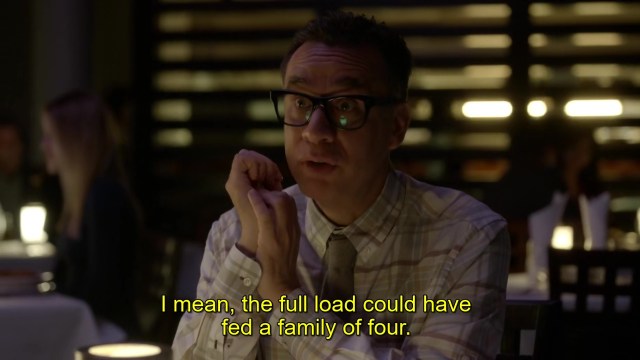
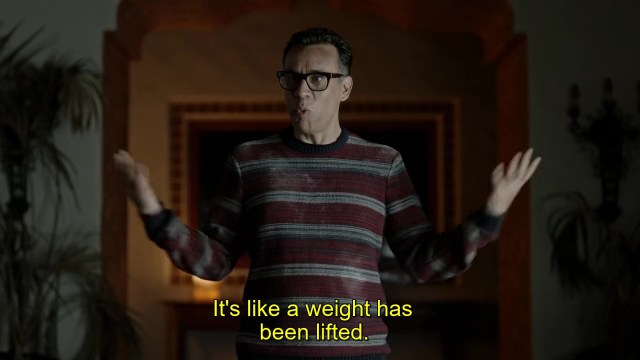
Then he starts meeting other humans. As it’s a comedy, they are (nearly) all nice, friendly, peaceable people, who bicker but generally don’t bite. Until season 4, when he meets Karl (Fred Armisen), a serial-killer cannibal. In a flashback to before the virus, Karl is being socially inept, disgusting his dinner date with recollections of a boil he had just had lanced.

vlcsnap-00005.jpg

vlcsnap-00008.jpg

The art of cannibalism stories is to disgust the viewer. Otherwise, where’s the conflict?

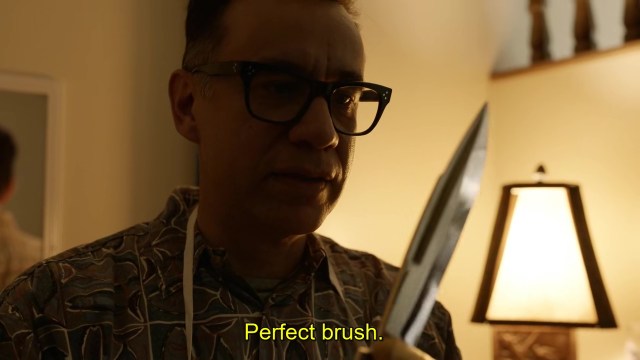
Karl’s modus operandi is to invite his prospective victim in for a sitting where he paints their portrait (a skill in which he is almost as deficient as his romantic conversation), then reach for his
vlcsnap-00024.jpg

When his model goes looking for a refreshing drink in the fridge, Karl has to run.

vlcsnap-00025.jpg

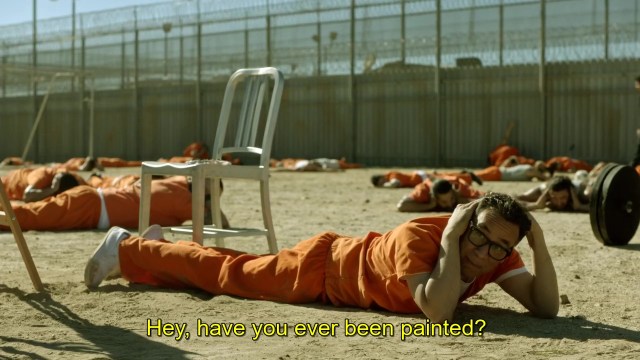
He flees to Mexico and sets up the same artistic practice, but is soon arrested and sent to a maximum-security prison, where he starts painting the other inmates, with designs to convert them into his next meal.
vlcsnap-00026.jpg

Karl is also somehow immune to the virus, but has been unable to escape the prison in which he was confined for the four years after everyone else died. Karl has killed the only other virus survivor, a guard, and is wearing his uniform, to hide his status as prisoner/cannibal. Karl is nice too. Except for being a serial killer cannibal.

vlcsnap-00033.jpg

Karl has an unexplained compulsion to eat human flesh, and is powerless to defy it, despite his desperate efforts to do so.
vlcsnap-00027.jpg

He is obsessively drawn to a used Band-Aid, which is stained with the flesh of a burnt finger.

vlcsnap-00032.jpg

He is unmasked when he is followed to a cemetery, where he hopes to satiate his longings with some well-rotted corpse-flesh, much to the disgust of the observers.

vlcsnap-00049.jpg

vlcsnap-00051.jpg

What makes a cannibal? We have looked in this blog at several motivations such as savageism, starvation, revenge, psychopathy and entrepreneurship, and particularly at the figure of the wendigo, the mythical Algonquin spirit that inhabits the lost and drives them to an ever-escalating hunger for human flesh. Bryan Fuller implies in Hannibal that the good doctor Lecter is such a spirit, appearing as a figure with antlers, often disturbingly dressed in suit and tie. Traditionally, the cannibal required no explanation. In Classical stories, he (and cannibals were usually male) was a super-human or else hybrid figure, monstrous in appearance and easily identified as an ‘other’. In colonial times, they were tribes of savages, whose ignorance of the morals of Europe required the intervention of the conquistadors to ensure they were re-educated, which would usually involve the appropriation of their lands and the enslavement or extermination of the ‘cannibals’.

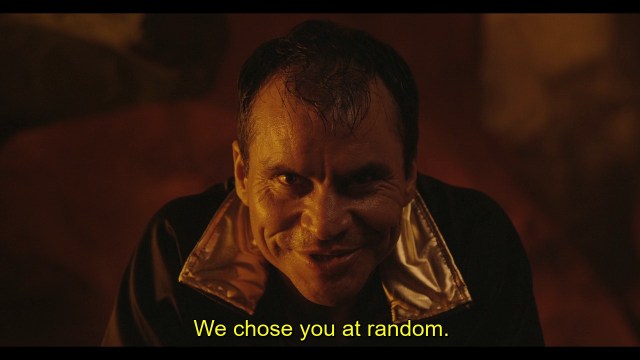
The contemporary cannibal is often typified by his inconspicuousness – acquaintances of cannibals like Jeffrey Dahmer, Albert Fish or Armin Meiwes often spoke of how normal and prosaic they seemed. Karl fits exactly into this model of the contemporary cannibal – the others like him, and can hardly believe it, even when he admits to his addiction, as if it was an AA meeting.

vlcsnap-00024.jpg

vlcsnap-00025.jpg

There are many ethical issues raised in this apparently light-hearted comedy. Everything in the world before the virus was about voracious appetite and power, and things have not changed that much. Now of course there is no money, and the stores are full of whatever you could want, but it’s all starting to go bad, even the tins. The few animals they have found alive have usually come to a sticky end – the cow whose milk they took died, her calf was left behind when they left for Mexico, the bull was killed and eaten. They found crickets and ate them. They catch a fish with a hook, much to their surprise. Phil threatens to eat a little dog’s butt at one point. Anthropocentrism, sometimes called speciesism or human narcissism, is now the supreme ideology, even though it has apparently led to the extermination of almost all life on Earth.

The main question of this brave new world, then, is: are there any ethical constants? The survivors are mostly besotted with the idea of having babies and repopulating the world with humans: is that a great idea? And while they are satisfied to smash down shop doors and take whatever they need, they are shocked at the cannibal doing the same. To Karl, to all of us, morality is simply relative to his immediate needs. Certainly not a view confined to cannibals.

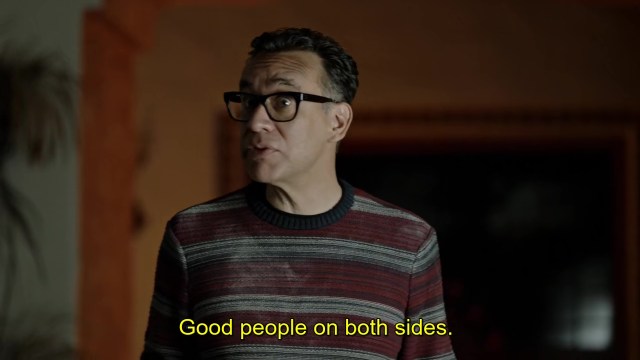
Karl suggests they all go to bed, and discuss the problem in the morning. They will have questions for him. He will have questions for them too! His morality is straight out of Trump at Charlottesville:vlcsnap-00031.jpg

vlcsnap-00032.jpg

As Dostoevsky said in the Brothers Karamazov:

“…there was no law of nature that man should love mankind, and that, if there had been any love on earth hitherto, it was not owing to a natural law, but simply because men have believed in immortality…. if you were to destroy in mankind the belief in immortality, not only love but every living force maintaining the life of the world would at once be dried up. Moreover, nothing then would be immoral, everything would be lawful. even cannibalism.”

Karl exemplifies what Aristotle called the “rational principle”.
Hansel, Gretel and incestuous cannibalism: WE ARE THE FLESH – Tenemos la carne (Emiliano Rocha Minter, 2016)

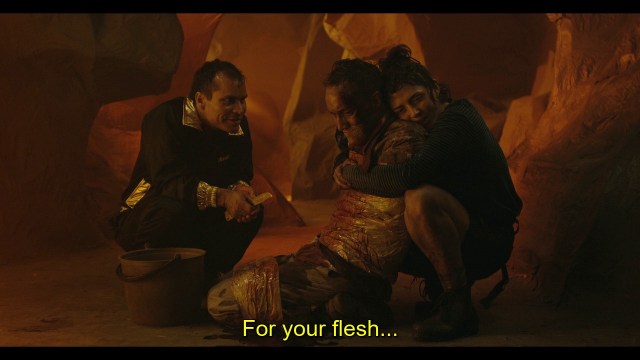
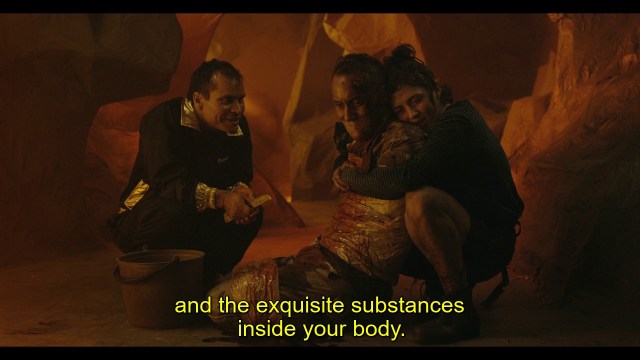
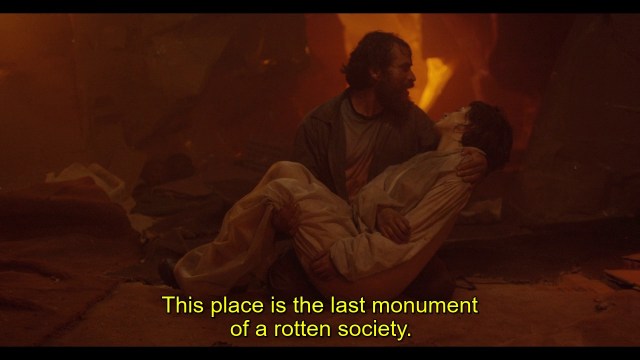
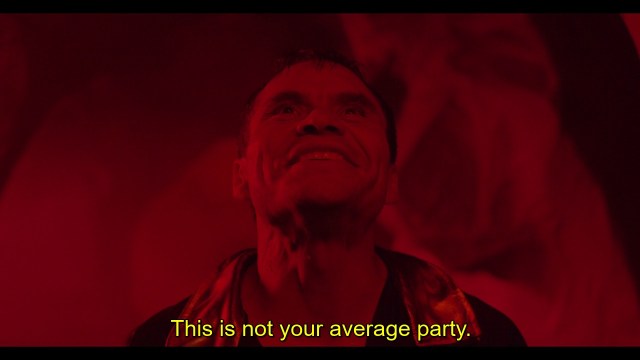
It’s Hansel and Gretel, Captain, but not as we know it. This Mexican film is a visual experience, rather than a traditional narrative. It is set, like many of the films we have covered in this blog, after what appears to be an unexplained apocalypse. The “witch” is a crazy old guy named Mariano (Noé Hernández) who makes fuel out of old bread and trades it to persons unknown, through a hole in the wall, for food – mostly eggs and meat. Mariano is more Satan than witch.

vlcsnap-00059.jpg

He believes in chance, which, he says, is “the greatest criminal to ever roam the Earth.”

He is an aficionado of solitude, but when a young brother and sister, Lucio (Diego Gamaliel) and Fauna (María Evoli), appear in his abandoned apartment, he feeds them and puts them to work on ever more peculiar projects, such as a womb-like cocoon, made of wooden struts and vast amounts of packing tape.

vlcsnap-00009.jpg

Mariano receives some meat through the hole in the wall, and cooks it for his guests. But there’s a problem: Lucio is a vegetarian. Fauna tucks into her steak, rather reversing the normal situation where Hansel ignores Gretel’s warnings and eats the gingerbread. But Mariano has laced the meat with poison that, he says, the Nazis used to kill Jews. He won’t give Fauna the antidote until Lucio eats his meat.

vlcsnap-00019.jpg

So, it’s all about transgression, overcoming taboos, abandoning inhibitions, accepting pleasure rather than bothering with difficult questions of ethics. Mariano then decides that the kids need to have sex, and Lucio’s objection, that she is his sister, is dismissed:

“Do you think your cock gives a damn about her being your sister?”

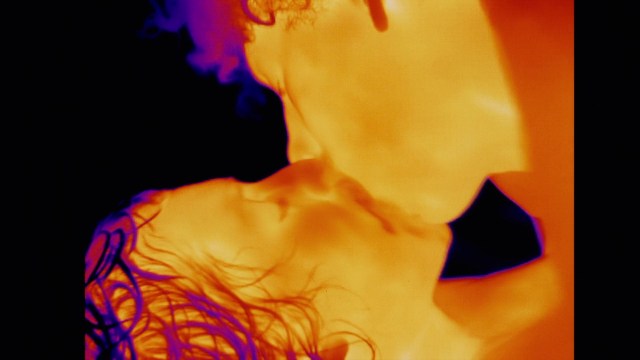
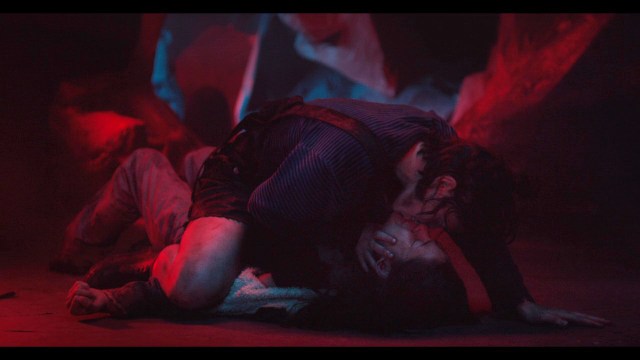
So then there’s lots of incestuous sex, some of which is captured in lurid neon heat-map images. Mariano sings to them and masturbates as they perform for him, finally fainting as he ejaculates. Or dies, but is resurrected, because, as we know, the monster is never really gone.

vlcsnap-00034.jpg

vlcsnap-00036.jpg

The Brothers Grimm was never like this. Although who knows what siblings Jacob and Wilhelm Grimm got up to before they became philologists?

Anyway, we finally get to the cannibalism, about an hour into the film, as Mariano captures a soldier, tells him exactly what they have planned.

“We won’t kill you for money. We won’t kill you for an ideology. Or for the pleasure of watching you suffer. It’s not revenge for what you have done. We are neither avengers nor executioners.”

vlcsnap-00056.jpg

vlcsnap-00057.jpg

vlcsnap-00058.jpg

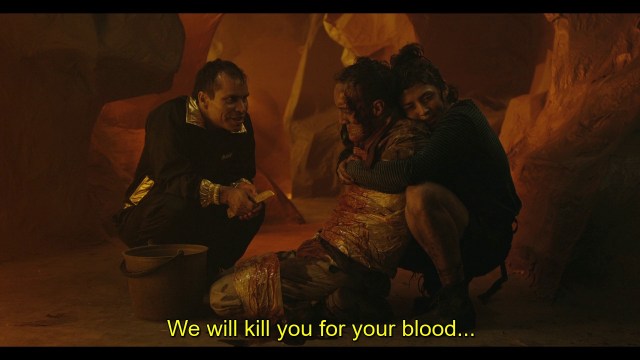
They sing the Mexican anthem and then slit his throat, catching his blood in a container. Various body parts are rendered into liquid and sealed into buckets, presumably to be traded through the hole in the wall.

Another girl comes into the maze looking for shelter, but is instead raped by Fauna and then Lucio.

vlcsnap-00070.jpg

Have we shattered every convention and broken every taboo yet?

vlcsnap-00022.jpg

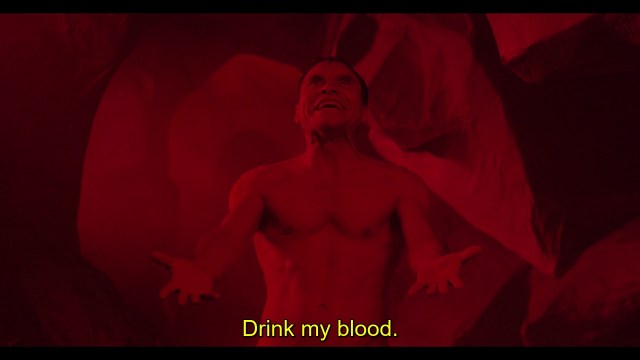
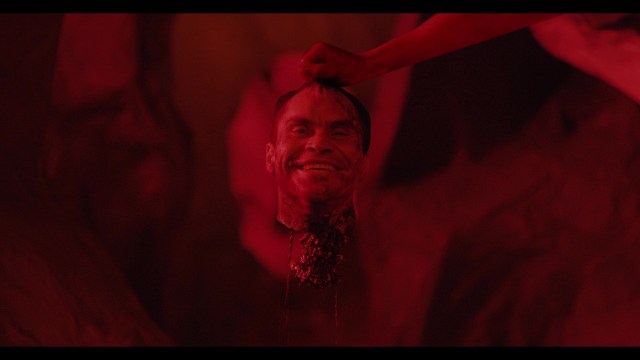
Not quite. Mariano celebrates his naming day, a party in which all sorts of weirdos turn up and get it on. Mariano is to be the guest of honour, but also the main course.

vlcsnap-00076.jpg

“It is also the day I’ll live inside your squalid bodies. Don’t forget that the spirit does not reside in our flesh. Flesh is the spirit itself! So I kindly ask that all you lowlifes devour me until there is nothing left.

vlcsnap-00082.jpg

vlcsnap-00083.jpg

vlcsnap-00090.jpg

There’s a twist at the end, but hey, enough spoilers. Go watch it – it’s only 80 minutes.

Catherine Bray in Variety called the movie a “joyously demented portrait of humanity.” She summarised the theme very well:

“Much of its most vivid imagery is purpose-built to interrogate the moral values society projects onto biological matter: human meat ground to a slush, slopping about in a bucket; a clitoral close-up; a pipette inserted casually into a hole in a boy’s temple; a sister’s gelatinous menses dripping into her brother’s mouth.”

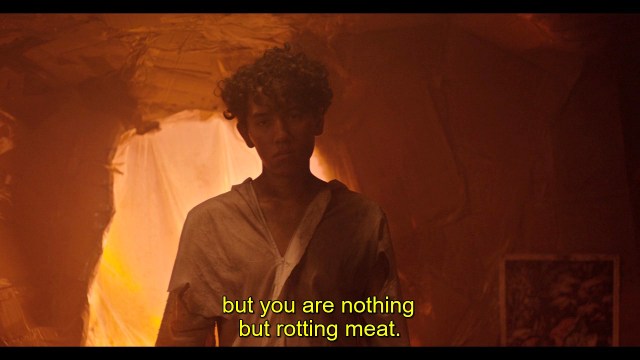
The stubborn belief that humans, unlike other animals, have some sort of spirit that elevates us into the ranks of demi-gods and therefore justifies the havoc we unleash on the rest of nature has crumbled. As Mariano insists, flesh IS the spirit. We are meat, driven by our appetites. Our carefully crafted moral convictions can vanish like smoke in the face of hunger or desire.

vlcsnap-00024.jpg


Hansel and Gretel is a seminal cannibal text of course: innocents, abandoned for daring to expect to be fed, and left to face the voracious appetite of the outside world. Many of us probably first heard about cannibalism while sitting on a parent or relative or baby-sitter’s knee, crafting our next nightmare as they read us stories from the Brothers Grimm. Variants of the story are everywhere – a new movie is due soon (I’m looking out for it) called Gretel and Hansel. Here’s the trailer:

Dexter is delicious: “What’s Eating Dexter Morgan?” DEXTER Season 8 Episode 3

00 title.jpg

Dexter is a television series that ran for 96 episodes from 2006-13. This episode is from the final season, and is the only one to feature a cannibal, which seems like a pretty shocking oversight really.

Dexter Morgan (Michael C. Hall, who played David Fisher in Six Feet Under) is a serial killer who also works as a blood spatter technician for the Miami metro police. There’s a lot of analysis of how he got that way (didn’t help that he saw his mother chopped up with a chainsaw when he was little) but, as he is not the cannibal in this tale, we don’t have to concern ourselves too much about that. Interesting to note, though, that although he is presented as a psychopath, he is often shown to have emotions and feelings that might not result in that diagnosis. In fact, Dexter only kills very bad people (just as Hannibal Lecter mostly only kills very rude ones) so he is really more a vigilante than a psychopath, and is motivated by a sense of justice that the Nietzschean Dr Lecter might find laughably absurd. We would have to conclude that both, however, are trying to improve the world by removing objectionable characters from its surface.

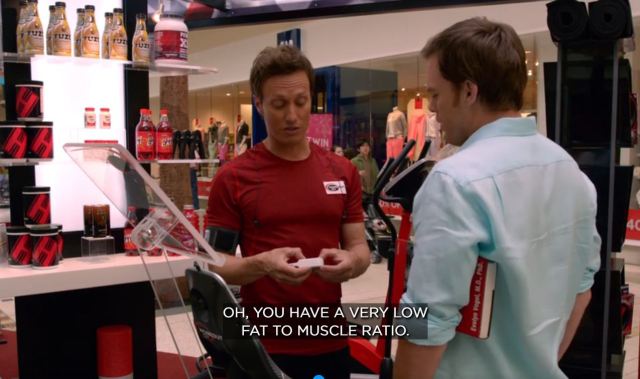
Dexter follows a suspect, Ron Galuzzo (Andrew Elvis Miller), to the mall where he sells exercise equipment. Galuzzo measures Dexter’s body/fat ratio, a wink to what we are about to find out about the dude and his culinary interests.

02 very low fat to muscle.JPG

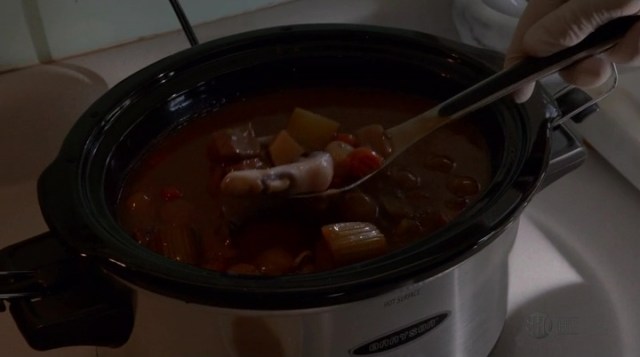
Dexter breaks into Galuzzo’s house and it’s a mess, except for the kitchen, which is clean and spotless. Dexter opens a crock pot and finds a finger in the stew. Dexter is horrified, because I guess serial killers are not used to seeing body parts. Or perhaps Dexter is secretly a vegan.

vlcsnap-00005.jpg

vlcsnap-00004.jpg

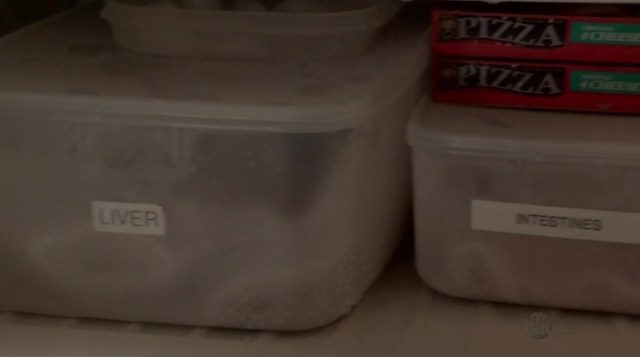
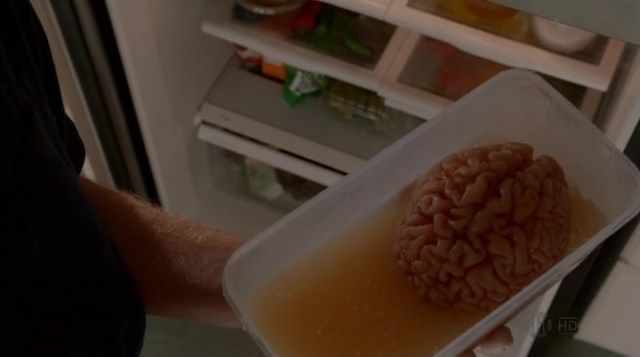
In the fridge, Dexter finds plastic containers containing various body parts. One of them holds a whole brain marinating in a garlic sauce.

vlcsnap-00007.jpg

vlcsnap-00009.jpg

Dexter has a killing ritual, in which the victim is bound and gagged; in this case, it takes place in Galuzzo’s kitchen.

11 Disgusting.JPG

12 cannibal.JPG

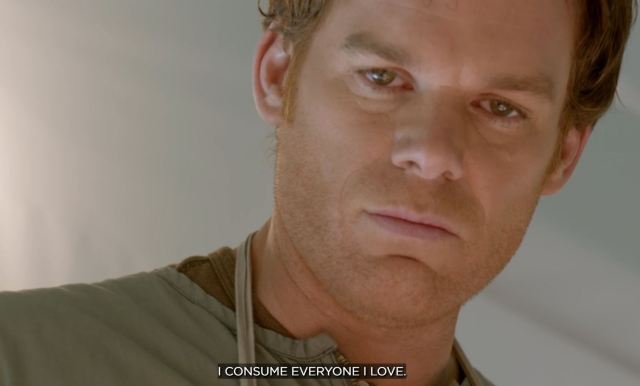
He first lectures Galuzzo on the evils of cannibalism (bit of a nerve from someone whose hobby is slicing people up) then admits that he thinks that he and Galuzzo are alike, because

15 consume everyone I love.JPG

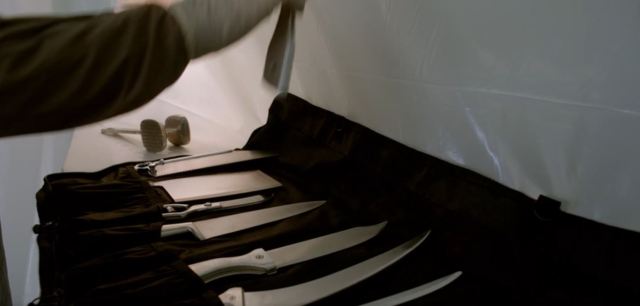
Of course, Dexter has a rather better set of knives than most cannibals.

16 knives.JPG

Galuzzo is the only cannibal featured in the TV series, which is all based around the first book of an entertaining and highly amusing series of eight novels by Jeff Lindsay. A quite different case of cannibalism is featured in the fifth novel, Dexter is Delicious (2010). In the book, Dexter faces a coven of cannibals who eat (sometimes willing) victims in a Dionysian romp.

Image result for dexter is delicious

The story revolves around Dexter and his sister, Deb, trying to save a young girl who doesn’t want to be saved; she wants to be eaten. I shall leave the cannibal unnamed in this extract, so as not to be accused of spoilers.

“Some of them do. They want to be eaten – just as much as I want to eat them…. Almost makes you believe in a benevolent God, doesn’t it?”

The book (IMHO) offers a much better cannibal story than the one in this episode, and we can only wish that the television gods had adapted it instead of this rather insipid character who presents no real challenge to Dexter, beyond offending his delicate sensibilities. Maybe Legal forbade it. Fine to tie a cannibal up, abuse him and slaughter him, but to eat someone who wants to be eaten? Now there’s an ethical dilemma for our times.

vlcsnap-00001.jpg

Cannibalism as female empowerment: JENNIFER’S BODY (Karyn Kusama, 2009)

Jennifer’s Body is classified as a comedy, even though it’s rated R for sexuality, bloody violence, language and drug use. Well, all those things can be funny. Even cannibalism is sometimes the butt of jokes (well, quite often), and a lot of people get eaten in this movie.

poster-jennifer-body-quad.jpg

The story does not start with Jennifer (Megan Fox) but with her nerdy bestie Needy (Amanda Seyfried), “short” for Anita, although no one calls her that. Needy is revealed to be an ultra-violent resident of an asylum.

vlcsnap-00002.jpg

The rest is flashback. Jennifer is the popular girl, the sexy girl, the one no one can believe is friends with the boring Needy, but she is bored in their little town of – wait for it – Devil’s Kettle. Jennifer wants to get off with the big city band in town, Low Shoulder. At their gig, Needy hears them arguing about whether Jennifer is a virgin, and leaps to her friends defence

vlcsnap-00008.jpg

Jennifer later tells her that’s not even close to the truth.

vlcsnap-00009.jpg

Now, when men are looking for virgins, there are only two possible explanations, depending on whether they are of a metaphysical bent, and these guys are very bent. So telling them Jennifer fits their shopping list turns out to be a very bad idea. Jen gets in the band’s truck as the venue burns down. Needy is distraught.

But she meant well. And later that night, here’s Jen, looking quite sanguine, in both sense of the word.

vlcsnap-00016.jpg

Jennifer has been a virgin sacrifice to a demonic force, which promised greatness to the band. However, not being a virgin (even backdoor) means that the sacrifice, instead of killing her, left her possessed by the demon, a succubus.

vlcsnap-00018.jpg

Yeah, OK, but the audience needs a good reason for a woman to start eating her dates (even if, after 100+ blogs, you and I could think of a dozen good ones). So she is possessed, and eating people. When she’s hungry, she’s weak and unhealthy, but when she’s fed (and cleaned up) she’s the life, or undeath, of the party.

vlcsnap-00052.jpg

This is a really good film, with all the ingredients of greatness: the cast are excellent, the director, Karyn Kusama, is in her element (she made Destroyer with Nicole Kidman recently) and it was written by Diablo Cody, fresh from the triumph of Juno, for which she won an Oscar for best original screenplay. But the film bombed at the box-office, the accepted wisdom in those days being that successful films were made exclusively for 14-year-old (white) boys. This one wasn’t, it was about strong and often violent women, and has been gathering a cult following in the decade since its release.

vlcsnap-00035.jpg

There have been many horror movies about women, often (e.g. Carrie or Teeth) involving revenge for something done to them. This fits with the cultural expectation that men will be the aggressors and the monsters, and from this fetid swamp arose the slasher movies, including most cannibal films. Jennifer herself has been sexualised by most of the men and boys who appears in the plot. She is kidnapped and murdered by the band, despite begging for mercy.

But Jennifer is not seeking revenge on the band – that will (but not until the credits) be Needy’s job.

vlcsnap-00091.jpg

Jennifer is a monster for all the males who have objectified her.

vlcsnap-00037.jpg

The film plays with the assumptions about male power and appetite. The boys Jennifer eats are gentle and considerate, not violent or aggressive – the huge line-backer she tears apart after her return is seen first crying for his friend, who died in the fire.

vlcsnap-00036.jpg

Everyone assumes, of course, that his killer is male.

vlcsnap-00038.jpg

vlcsnap-00039.jpg

But the body when found is being eaten by a gentle fawn.

vlcsnap-00025.jpg

Despite widespread cultural beliefs, female monsters are not rarities.  Earliest mythology tells of the Medusa, the sight of whom “made the spectator stiff with terror” (much to Freud’s amusement) and even earlier, there are claims that Lilith, Adam’s ex before he met up with Eve, was, or became, a succubus. Jennifer is an ideal example of what film scholar Barbara Creed calls “The Monstrous-Feminine”, a concept of monstrosity that depicts not a female version of male monsters, but a cultural force defined by male fears about the feminine. These fears include being castrated (Freud’s favourite explanation), as well as confronting “the monstrous womb” – a terrifying image of a “black hole which threatens to reabsorb what it once birthed” (Creed, The Monstrous-Feminine, p. 27). As the writer, Diablo Cody, says, it is an unashamedly feminist horror movie.

Jennifer’s Body was before it’s time. In an article explaining the woeful critical reaction to the film, Vice summed up:

‘Jennifer’s Body’ Would Kill if It Came Out Today

vlcsnap-00024.jpg


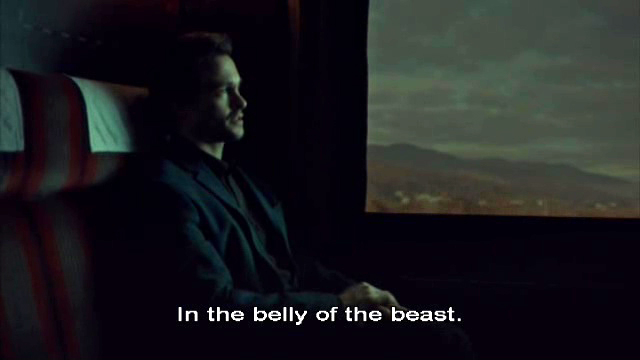
“In the Belly of the Beast” HANNIBAL Season 3 Episode 5 “Contorno”

Cannibalism is at its heart all about food, food from a particular species of animal. This episode, Contorno (Italian for side dishes) is also about food – our choices, our enjoyment, how food affects us and how it identifies us.

We start with Chiyoh and Will on a train to Italy. Chiyoh fills in a little bit of what we don’t know about the early Hannibal. Chiyoh was sent to be attendant to Hannibal’s aunt, Lady Murasaki. The young Hannibal was there, an orphan. He was meant to be with his sister, but he was alone. We don’t know why, although we will be told (episode 7) that Hannibal ate, but didn’t kill, his sister, Mischa.

They get talking about snails, a side dish of which we know Hannibal is inordinately fond, particularly when they have been snacking on human flesh. Chiyoh observes:

“Birds eat thousands of snails every day. Some of those snails survive digestion and emerge to find they’ve travelled the world.”

vlcsnap-00010.jpg

Then we see Hannibal feeding snails to Bedelia – he explains that, as a young man, he kept sea-snails to attract fireflies.

“Their larvae devour many times their own bodyweight. Fuel, to power a transformation into a delicate creature of such beauty.”

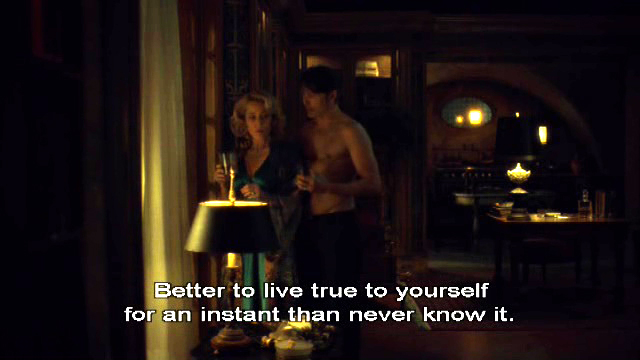
Snails, Hannibal tells Bedelia, follow their nature. She dismisses his metaphor: fireflies live such brief lives. A bit more evidence follows that Hannibal is a Nietzschean:

vlcsnap-00016.jpg

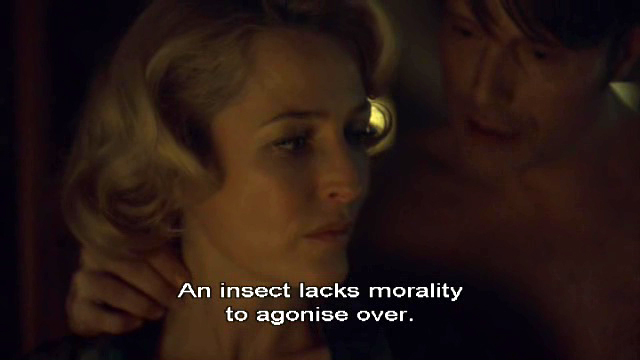
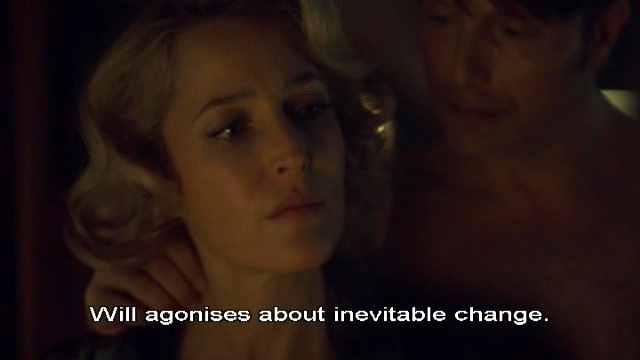
In a scene in which Hannibal is clearly checking whether Bedelia is ready for dinner yet (his), they move on from snails and fireflies, a story about transformation, to a discussion on Hannibal’s other main interest: Will Graham. In particular, Will’s fascinating struggle to retain his ethical certainty in the face of Nietzsche’s amor fati – the love of fate, and his true nature as a hunter.

vlcsnap-00017.jpg

vlcsnap-00018.jpg

Bedelia protests: “Almost anything can be trained to resist its instincts. A shepherd dog doesn’t savage the sheep.”

vlcsnap-00021.jpg

Still on the food theme, Alana has laid out Hannibal’s table setting for Mason Verger – she has worked out that he can be traced through his exquisite purchases, just the way Clarice did in the book Hannibal. She has tracked him to Florence through receipts for Bâtard-Montrachet (Chardonnay) and tartufi bianchi (white truffles). Mason, never one for social niceties, observes that Hannibal must have liked the taste of her too, and perhaps she enjoyed her own taste of him. He offers a double-entendre that the Guardian critic described as

“actually the most disgusting part of the episode. That’s pretty impressive given the extreme close-ups on snails and Pazzi’s bowels flopping to the ground as he is hanged from a window”.

vlcsnap-00037.jpg

Chiyoh is not really getting Will. She cannot seem to see the attraction between the men, just the shared aptitude for violence: “If you don’t kill him”,

vlcsnap-00056.jpg

He agrees. So she pushes him off the train. As you do.

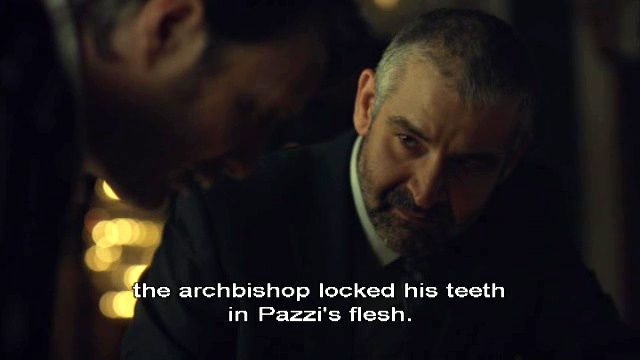
No humans were eaten in the making of this episode; snails are the man-eaters. But we do get the gory killing of police inspector Pazzi, who goes as his ancestor went – hanged with his bowels out as punishment for treachery. His ancestor tried to kill Lorenzo the Magnificent in 1478; this Pazzi recognised Hannibal and tried to sell him to Mason Verger rather than turn him over to the FBI.

vlcsnap-00062.jpg

Hannibal shows Pazzi a woodcarving of his ancestor’s death, and mentions that the Archbishop bit Francesco.

vlcsnap-00085.jpg

Running out of time, Hannibal just tells Pazzi “I’ve been giving very serious thought to doing the same” (although in the book and film Hannibal, this line was “I’ve been giving very serious thought to eating your wife”).

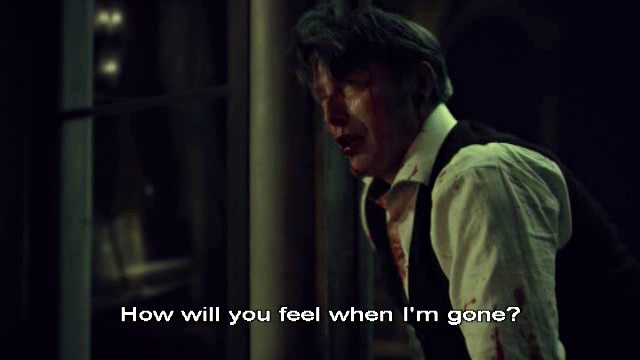
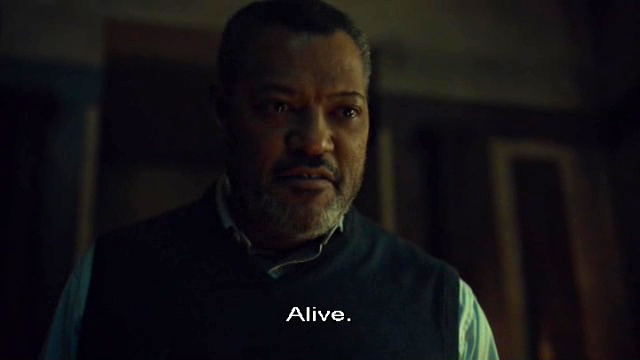
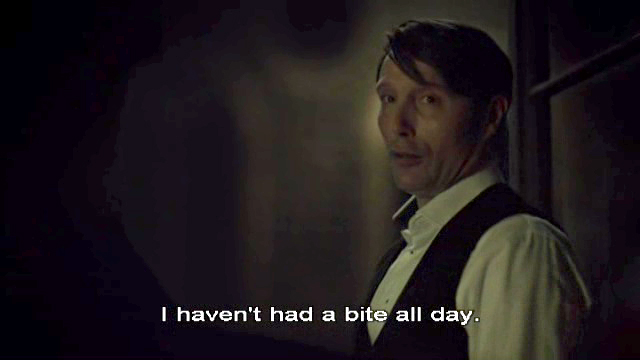
No one actually gets eaten, but Hannibal gets a solid beating from Jack Crawford, who has just dumped his wife’s ashes in the Arno and is fighting mad, particularly after spending the afternoon with Pazzi’s soon-to-be widow. Some readers interpret this scene as Hannibal finally discovering he is not as smart and invulnerable as he thinks, but I hold to the oft-stated theme that Hannibal is always way ahead of the plot. The beating that Hannibal takes is almost without resistance; as if he somehow feels that he owes Jack a chance at revenge for betraying his friendship, a chance to grow into a predator.

vlcsnap-00115.jpg

vlcsnap-00116.jpg

So Jack pushes Hannibal out the window, but he catches himself on Pazzi’s corpse and limps off. The inspector is without his bowels, but not without his uses.

vlcsnap-00093.jpg


Rage and appetite: SKIN AND BONES S1E08 of “Fear Itself” (Larry Fessenden, 2008)

Fear Itself was an American horror/suspense anthology television series shot in Canada. It began airing on June 5, 2008.

vlcsnap-00002.jpg

Look, it’s a TV video nasty, but the cast is great, and it features a Wendigo, a figure made famous in Hannibal and the movie Ravenous.

The Wendigo (sometimes called Wetigo) is a figure from North American Algonquin folklore. He is a mythical figure – giant, fierce and cannibalistic. He gathers strength from feeding on human flesh, but the flesh makes him grow larger, and so his appetite can never be satisfied. He is sometimes protective, and sometimes a figure of revenge (Cartman may have been taken over by a Wendigo in last week’s blog!) In this story, the Wendigo is “the spirit of the lonely places” and is all about revenge. The Wendigo gets inside people who are weak, hungry, and filled with rage.

We know what’s going to happen. So does the token wise old Native American, Eddie Bear (Gordon Tootoosis) who knows all about Wendigos, as did Joseph Runningfox in Ravenous. Of course, no one is interested in metaphysical explanations from those who might understand the land, so it just escalates from there.

vlcsnap-00006.jpg

“Don’t matter what you call it. It’s a madness, it’s fierce, it’s a hunger that can’t be satisfied. It’s an anger that can’t be settled. It’s the Wendigo!”

Grady (Doug Jones from Pan’s Labyrinth, Hellboy II and Star Trek Discovery) has a ranch but knows nothing about living off the land. His brother Rowdy (John Pyper-Ferguson) is running the ranch, and is clearly making out with his wife Elena (Molly Hagan). There are two children (Cole Heppell and Brett Dier, who you might recognise as Michael from Jane the Virgin).

vlcsnap-00003.jpg

The kids challenge Rowdy with the usual line “You’re not our father!” so of course we know he must be. The Wendigo has taken over Grady while he was on a hunting trip (with Chuck and Billy who have, you know, disappeared: down the hatch) and when Grady stumbles back to the ranch, he is skinny, covered in frostbite, and remarkably creepy. And hungry. So hungry, he could eat a horse (and does).

vlcsnap-00001.jpg

But he certainly doesn’t want Elena’s soup. When she feels his forehead, he licks her arm, and mutters, “tastes good!” Soon he is feeling fine. And still hungry. Soon it’s Rowdy’s turn to be the family meal. He makes Elena cut up and cook and then eat his brother. OK, he’s possessed by a Wendigo, but it’s still cannibalism in my book.

vlcsnap-00009.jpg

CUT IT UP AND COOK IT! …it’s just meat.

Director Larry Fessenden had made an earlier Wendigo movie called, well, Wendigo, which got a respectable 60% on Rotten Tomatoes.

If you want to know what happens in this one (and you can really sort of guess), you can watch the whole episode on Youtube.

It’s worth watching, if only for Doug Jones’ performance as the Wendigo.

vlcsnap-00011.jpg

“I could feel a rage growing up inside me. A rage that would not let me die!”

Sounds like an allegory of twenty-first century politics.

vlcsnap-00008.jpg

“You’re only as good as you taste”, Cannibal Christmas

I was hoping to review Cannibal Claus, for those of you reading blogs on Christmas day (and a fine way to spend the day it is to be sure). No sign of it in the usual sources, but since IMDB says it was made with the impressive budget of $1,200, it may not be widely available. Let me know if you find it.

There’s quite a funny review of it here.


So…

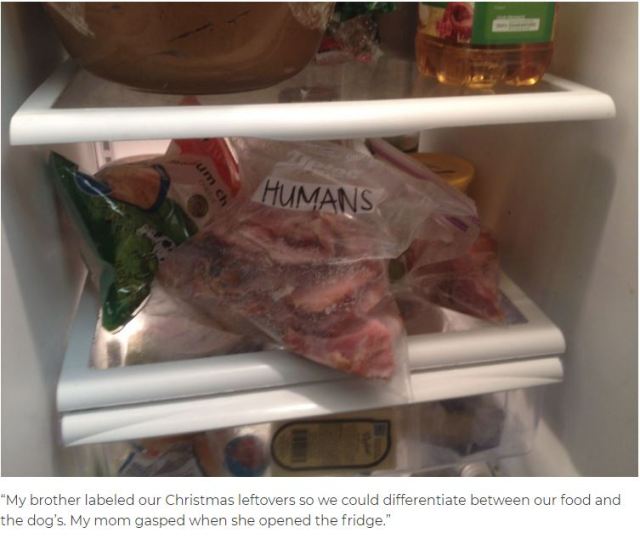
If you celebrate Christmas, have a merry one, and think about who you put in the fridge.

Cannibal Christmas.JPG
Awkward family photos


Cartman’s Cannibalism: SOUTH PARK S5E4 “Scott Tenorman Must Die” (Parker & Stone, 2001)

“Scott Tenorman Must Die” was the 69th episode of South Park, and first aired on July 11, 2001. It contains nods to a number of classic cannibal narratives.

Eric Cartman’s cousin, 8th-grader Scott Tenorman, tricks Cartman out of $16.12 in return for some pubic hairs, the possession of which, he tells Cartman, means that he has reached puberty. Realizing that he has been tricked, Cartman swears revenge.

vlcsnap-00004.jpg

“Did you see that movie Hannibal? Where the deformed guy trained his pigs to eat his enemy alive? Well, if we find a pony, we can train it… to bite off Scott Tenorman’s wiener.”

vlcsnap-00007.jpg

The pony misunderstands the training.

vlcsnap-00008.jpg

Cartman’s schemes become more convoluted, involving a letter to the band Radiohead asking them to visit South Park, where Scott will be humiliated as his favourite group get to watch the pony mutilate his member.

Cartman arranges for Scott’s parents to be killed.

vlcsnap-00010.jpg

He steals the bodies and cooks them up for his “chili con-carnival.”

After Scott eats the chili, Cartman asks him:

“Do you like it, Scott? I call it Mr and Mrs Tenorman chili.
Nyah nyah nyah nyah nyah – I made you eat your parents”.

vlcsnap-00014.jpg

Cartman enjoys licking up Scott’s tears.

vlcsnap-00018.jpg

We have here a passing reference to Hannibal again, in which Mason Verger collects the tears of orphans to make into his favourite cocktail.

But the main reference is to all revenge cannibalism narratives, from the Greek legend of Atreus and Thyestes to Titus Andronicus, to Liver-eating Johnson, John R. Weber and Omaima Nelson, and of course the Tim Burton version of Sweeney Todd.

vlcsnap-00012.jpg

Cartman is not a cannibal in this episode, but he facilitates an act of cannibalism as revenge, just as Sweeney Todd did. Eating a relative, as Scott Tenorman (and Thyestes) unwittingly did, is horrific not because of the flavour – they find the fare delicious. It’s because a life you cared about was snuffed out, not just extinguished, but totally annihilated by digestion, just as we do to those we eat every day, whose lives may have been just as precarious and precious – to someone.


Remembrance of Things Past: HANNIBAL Season 3 Episode 4: “Aperitivo”.

There was a “Hannibal” in Proust: Comte Hannibal de Bréauté-Consalvi in The Guermantes Way. Now there is some Proust in Hannibal – everything in this episode is à la recherche du temps perdu – “Remembrance of Things Past” or, more accurately, “In Search of Lost Time”.

Hannibal, let’s be clear, gets into people’s heads (including those of his loyal Fannibals). That of course is his job as a psychiatrist, but he takes it well beyond work hours, getting into the heads of everyone with whom he deals, including Miriam Lass, who was his captive for a long time, and shot Frederick Chilton, because Hannibal was in her head.

vlcsnap-00012.jpg

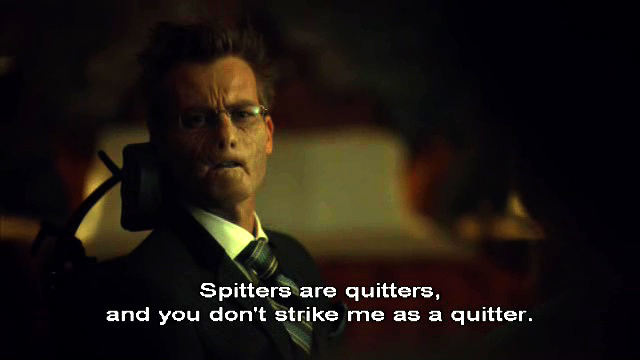
It’s episode 4, and we are finally finding out what happened to all the people knifed, shot and pushed out of windows (or made to eat their own faces) in the previous season. Those still alive have it in for him, are hunting him in their own ways. Mason Verger, whose fortune is based on breeding and killing pigs, wants to catch Hannibal and feed him to those pigs. He has offered a reward of one million dollars for his capture. Chilton, less one eye and half his teeth from Miriam’s bullet, just says “Happy hunting!” Verger’s words about Hannibal are taken from the Bible, the Book of Job, where Satan tells God he has been “going to and fro on the earth, and from walking back and forth on it”. He is relating Hannibal to a supernatural being: Satan. But also to an edible being: a pig. This can’t end well.

vlcsnap-00021.jpg

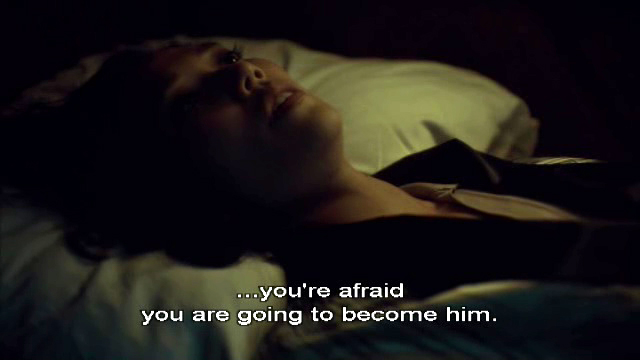
We know Will was cut up good in his last dance with Hannibal, but we get a new perspective in the next scene after the credits – we are inside Will’s body cavity, in the coil of guts, looking at the stomach skin as it is punctured by Hannibal’s linoleum knife. Waking up in the hospital, he is visited not by Abigail, as he had hoped and imagined in episode 2, but Chilton, who wants help catching Hannibal, who would be a prize specimen for his “hospital” for the criminally insane.

Will spurns Chilton’s offer of compassion and friendship, which leads to one of Chilton’s best lines of the show:

The optimist believes we live in the best of all possible worlds;

vlcsnap-00024.jpg

Will is still imagining scenarios – in the next scene, he and Hannibal are plunging knives into Jack Crawford in a scene that could only have been inspired by Julius Caesar.

Et Tu Brute.JPG

vlcsnap-00025.jpg

But Will finally didn’t go with Hannibal, and Jack’s not dead – he’s tracking to Will’s boatshed to seek Will’s help, just as he did at the beginning of Red Dragon, where the whole saga started. Will admits that he warned Hannibal, wanted him to run, because “he was my friend”,

vlcsnap-00029.jpg

Alana is still alive too, despite being pushed out of a first storey window. She wakes up full of rods that hold her together. The doctors have told her that a lot of marrow got into her bloodstream from her multiple broken bones, so she should expect to think differently. And she does.

vlcsnap-00031.jpg

She goes to see Mason Verger, who tells her he has found religion, been saved by the risen Jesus or, as he familiarly calls him “the Riz”. As a believer, he says he has forgiven Hannibal. Alana is not so convinced.

vlcsnap-00043.jpg

Jack remembers his apparent death at Hannibal’s hands, but has somehow recovered. His health, not his career – he has been forced to retire from the FBI. The culture has found a new nightmare to slap its clammy flab and ruin its sleep.

vlcsnap-00044.jpg

He also remembers waking up in hospital, lying next to Bella, his wife, who is continuing to die without him as it turns out. He takes her home, sits with her, holds her while her heart stops and her brain dies. He dresses for church and visualises their wedding, but it’s a funeral, she is in a casket, and there is a splendid bouquet from – who else – Hannibal. The card contains a John Donne poem and finishes “I’m so sorry about Bella, Jack”. Fighting to the death does not, apparently, reduce the respect or affection Hannibal feels for his opponents.

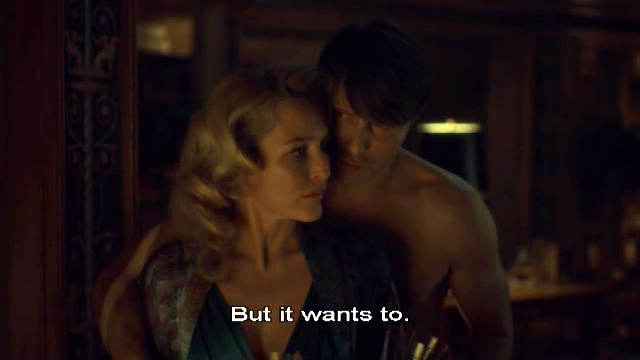
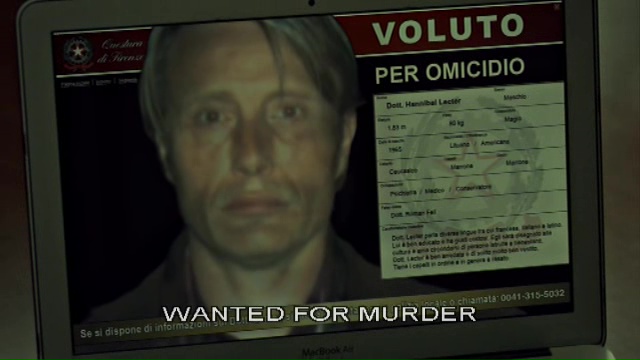
Everyone, everyone alive that is, wants to find Hannibal, and most of them want to kill him. What does Will want, as he embarks on a sustainable sailing voyage to Europe to find Hannibal? We don’t know. Mason Verger is talking transubstantiation – his face has been (somewhat) restored by extensive surgery, now he wants to transubstantiate Hannibal. In most ceremonies

vlcsnap-00052.jpg

He is planning a more elaborate ceremony. He tells his major-domo nurse Cordell

vlcsnap-00055.jpg

Alana is helping, telling Verger that Hannibal will be traceable because, wherever he goes, he will be ordering the very best wine, truffles, etc. She tells him “You’re preparing the theatre of Hannibal’s death. I’m just doing my part to get him to the stage.”

It sounds like they are all conspiring against poor Hannibal. But remember what Alana told Jack when they thought they were outsmarting him – Hannibal is always in charge of the narrative. Whatever the others are doing, he wants them to be doing. Or as Bedelia said, he is drawing them to him. Nietzsche wrote:

“In your friend, you should possess your best enemy. Your heart should feel closest to him when you oppose him.”

While everyone else is remembering things past, or searching for lost time, Hannibal is making friends.

Cannibalism rocks! THE ROCKY HORROR PICTURE SHOW (Jim Sharman, 1975)

This movie was a cultural phenomenon. The critics hated it; the fans loved it. More and more viewers kept turning up to midnight showings, dressing the part, dancing the dances, singing the songs. It remains the longest running theatrical release in history, because somewhere a cinema will have it on, at midnight, tonight.

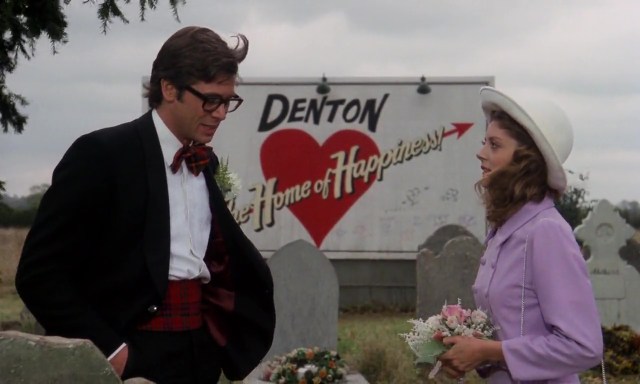
Shot in the style of Hammer Horror films, it is an affectionate satire on the science fiction and horror films that developed in the 1930s, and never went away. There are a mix of tropes, the main ones being the mad scientist (based on Frankenstein) creating life in his lab, and an innocent young couple knocking on the door of a spooky old house after their car breaks down. They are clean-cut Brad and Janet from middle-America town Denton (Barry Bostwick and the brilliant Susan Sarandon).

vlcsnap-00003.jpg

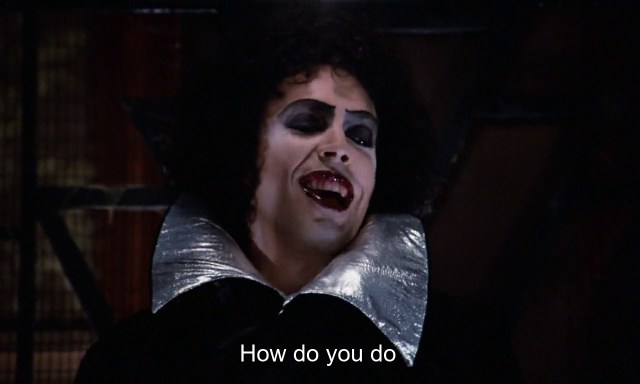
They find themselves in the midst of Dionysian scenes of rock, dancing and sex, presided over by Dr. Frank-N-Furter (Tim Curry, who later played Pennywise), a self-proclaimed “sweet transvestite from Transsexual, Transylvania”. How could this not be popular?

vlcsnap-00004.jpg

vlcsnap-00005.jpg

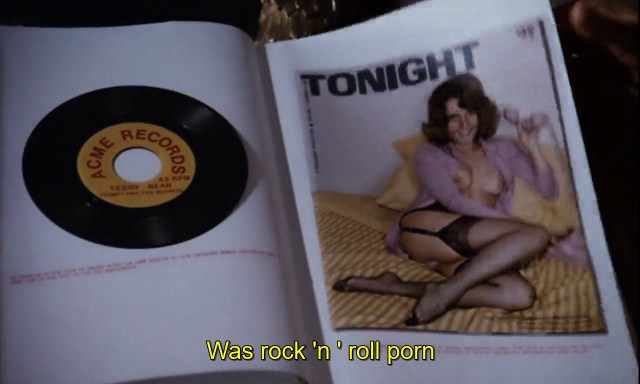
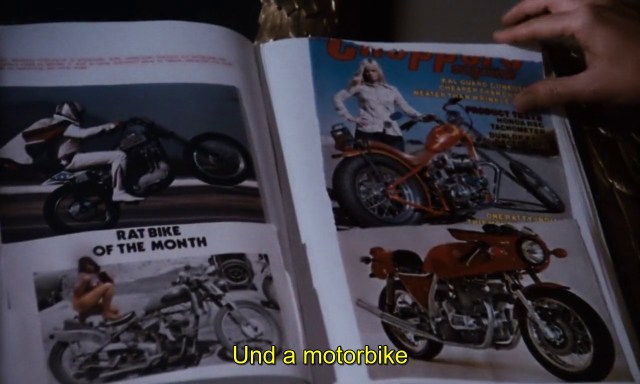
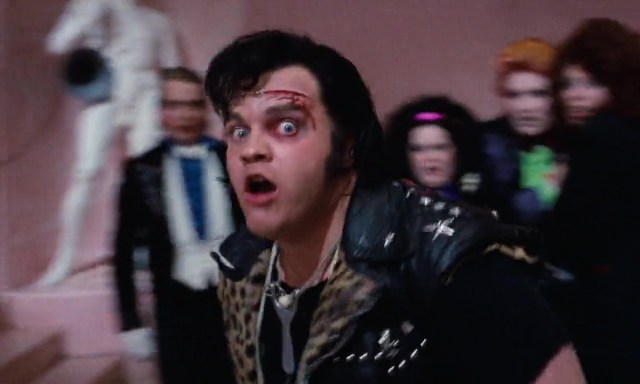
So why is this movie on a cannibal blog? Oh right, EDDIE (Meat Loaf). Some saw Eddie as representing old-time Rock & Roll, being annihilated by Glam Rock, with its emphasis on costumes and makeup. I prefer to speculate that the movie glimpsed the future, say the end of the 2010s. If Frank is alternative, iconoclastic culture, Eddie is one of the basket of deplorables, crashing the party on a motorbike, leather clad and bleeding, part of his brain removed to make the new creature, and preaching the joys of cis-masculinist rock and roll. His knuckles are tattooed “love” and “hate”. We are told that all Eddie wanted

vlcsnap-00022.jpg

vlcsnap-00023.jpg

vlcsnap-00024.jpg

Until Frank takes to him with a pickaxe.

vlcsnap-00008.jpg

vlcsnap-00009.jpg

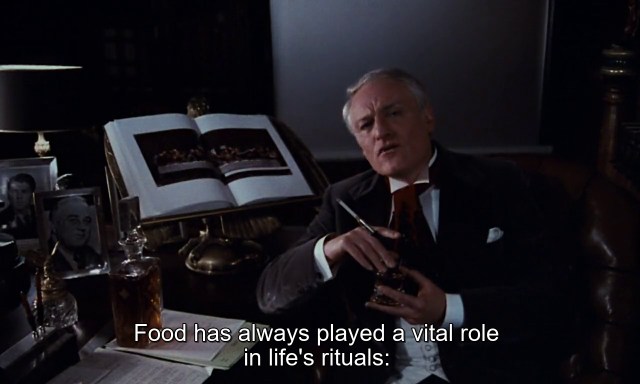
So, what happens to dead Eddie? Well, that’s how we ended up on the cannibal blog. The narrator (Charles Gray, a regular Bond villain) announces what could almost be the mission statement of cannibal studies

vlcsnap-00010.jpg

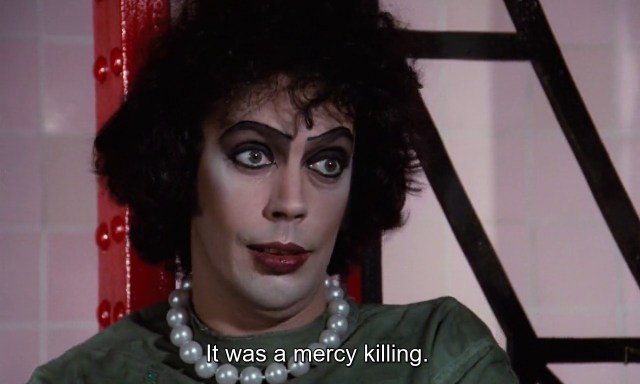
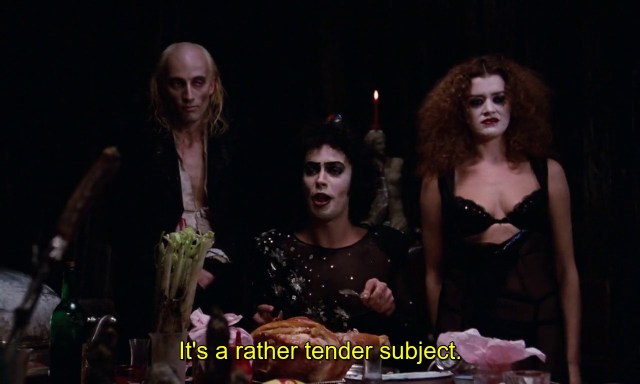
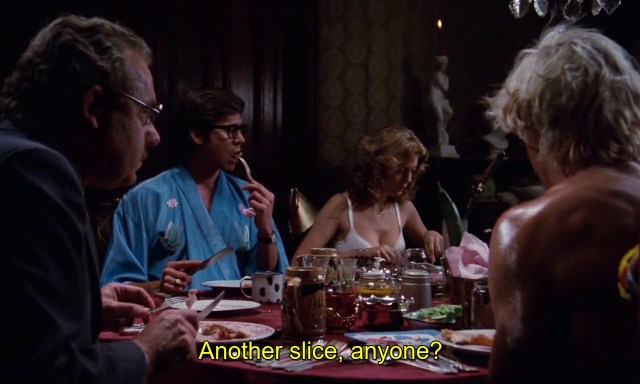
Frank is carving a roast, with an electric knife (anyone remember them?). When the subject of Eddie comes up, he says

vlcsnap-00018.jpg

vlcsnap-00019.jpg

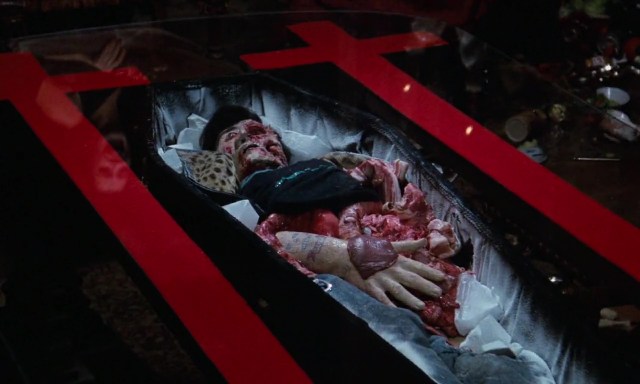
Just in case there was any doubt, Frank pulls off the tablecloth, revealing the rest of Eddie, inlaid in the table

vlcsnap-00027.jpg

The narrator sums up

“Just a few hours after announcing their engagement, Brad and Janet had both tasted forbidden fruit”

Taboos are the sweetest fruit. Brad and Janet have engaged in debauched sex and cannibalism – two areas where humans imagine themselves demarcated from other animals. In fact, the 2016 remake of this film by Fox found the cannibalism scene a bit rich for network television, and when the tablecloth is removed, Eddie is there, dead, but intact and fully dressed.

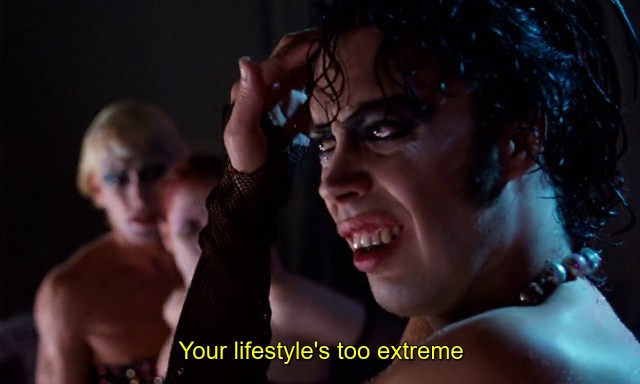
In our strange moral system, murder is fine, but cannibalism is still the final frontier. And it seems to be a universal moral imperative – Frank’s flunkies depose him and kill him because

vlcsnap-00046.jpg

That’s what makes cannibal studies so fascinating.

Anyway, turns out that Frank and his staff are aliens from the planet of Transexual in the galaxy of Transylvania, and the castle is their spaceship. The humans are left crawling in the dust and smoke after the takeoff, and the narrator tells us

“And crawling on the planet’s face, some insects called the human race.
Lost in time and lost in space. And meaning.”

vlcsnap-00002.jpg

Next week: ‘HANNIBAL’ Season 3 Episode 4, ‘Aperitivo’.