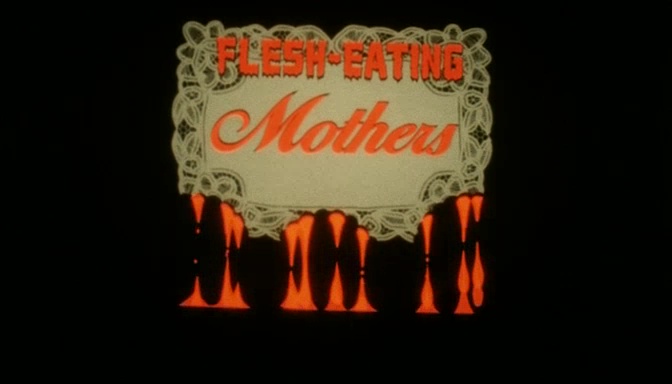
“FLESH EATING MOTHERS” (James Aviles Martin, 1989)

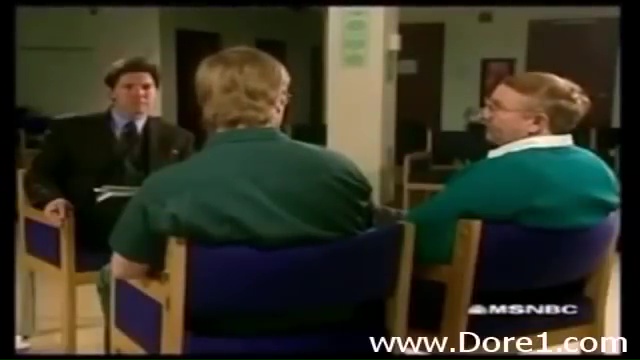
OK, I’m posting this on Mother’s Day, and a very happy occasion may it be for those who have a mother, particularly one who doesn’t routinely eat her children. But the film is also about a deadly virus, one which has been covered up by the authorities, so it’s not just schlock horror, but also somewhat prophetic.

vlcsnap-00005.jpg

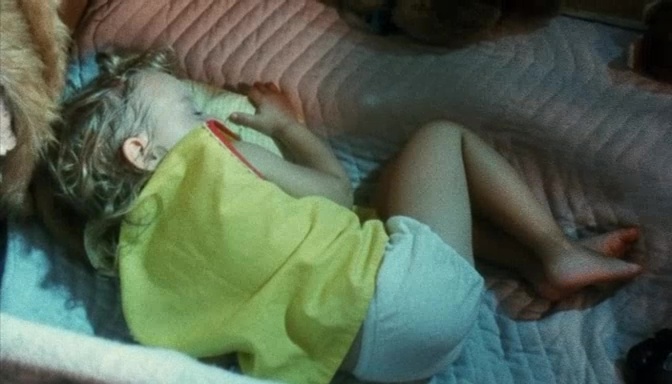
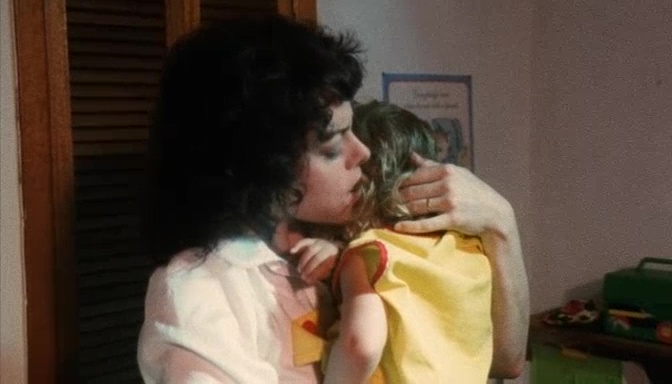
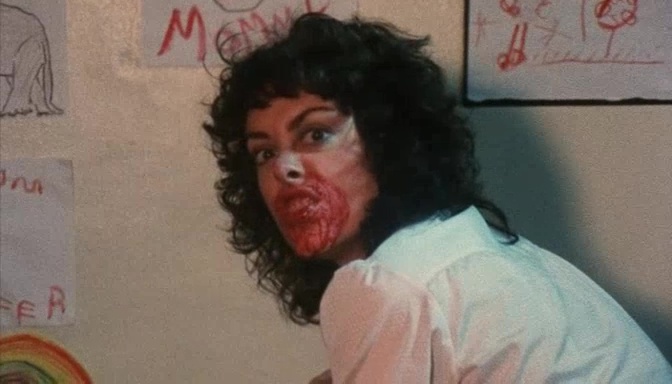
This has it all: cannibalism, domestic violence, murder, lots of blood, adultery and filicide – yes, the mothers eat everything in the fridge and then start on their kids. Early in the piece, one mother stuffs a whole sandwich in her mouth (possibly the most abject scene) then starts on her son, who is still, absurdly, wearing his baseball mitt.

vlcsnap-00020.jpg

vlcsnap-00023.jpg

Her husband is a cop and manages to shoot her as she nominates him as main course, then he’s arrested, has to prove his innocence with the help of a scientist who is being stymied by official obstruction, and at this point there is a tendency to turn off and watch something else, particularly as the acting is so bad that one suspects it has to be deliberate.

This one literally is the best actor in the film:

vlcsnap-00027.jpg

vlcsnap-00031.jpg

vlcsnap-00032.jpg

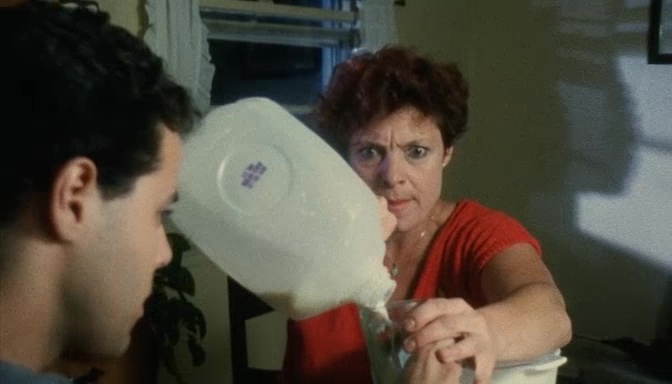
You get the idea. One mother makes her son special creamy mashed potatoes, which he eats as she describes the process of producing milk-fed veal. Is there a message here – a cream-fed kid who is about to be her dinner?

“Milk-fed baby cows…. The calf is taken from the mother and put in a small room, so small that he can’t move around, see, so that his muscles are real tender. And they don’t feed him anything but milk, so that he’s really soft by the time they kill him. And so he’s really delicate to eat.”

She pours him another glass of milk.

vlcsnap-00034.jpg

vlcsnap-00035.jpg

“Mom’s on the rag again” he complains to his friend after he escapes, adding that he doesn’t blame her: “it’s all society’s fault”.

The kids work out what’s going on and unite in opposition, but not until plenty of makeup and fake blood has been added to this powerful stew of nonsense.

vlcsnap-00037.jpg

vlcsnap-00041.jpg

vlcsnap-00046.jpg

“My mother ate my brother.”
“My mother too!”
“My mother ate my father.”
“She’s never done anything like this before!”

Look, it’s all very light-hearted, despite the R rating, and it’s a bit unfortunate that I decided to review it the week after one of the greatest cannibalism movies, Fritz Lang’s M. But there’s an important point here, for us keen Cannibal Studies scholars. So many cannibal films feature male cannibals, from Hans Beckert to Sweeney Todd to Hannibal Lecter. Yet as Barbara Creed told us in The Monstrous Feminine, published not long after this movie hit the big screen, mythical tales and modern horror films teem with female monsters. But the stereotype for cannibal films is the male cannibal and, often, the female victim. Where monsters are female, they often follow Freud’s odd designation of women as terrifying and abject because little boys are supposed to see their lack of a penis as proof their mothers were castrated. Thus, we get the dumb teenager saying “Mom’s on the rag again”. She is, even after trying to eat him, a victim in his eyes.

But Creed, and this film, argue that the female monster relates not to her lack but her centrality to reproduction and nurturing. Woman is the all-consuming womb, the witch, the vampire, the castrator rather than the castrated. We know we came out of her, and fear we may be reabsorbed. But hey, the scene of the battered wife eating the fist of her abusive husband fills us with a certain satisfaction.

vlcsnap-00044.jpg

Of the more than 300 films involving cannibalism that I will be discussing in this blog (eventually), only a handful involve female protagonists or even female directors. When they do, they are often presented as comedy as (I presume) this film is; films such as Cannibal Women in the Avocado Jungle of Death or Santa Clarita Diet. Even in those, though, as in the more serious offerings such as Raw or Jennifer’s Body, cannibalism is presented as a form of empowerment, never as a lack.

Here’s the virus under a microscope.

vlcsnap-00045.jpg

The authorities knew about it, but kept it hidden, apparently because they thought it was a punishment for adultery. Plenty of Trump supporters who doubtlessly believe the same about COVID-19. Luckily, there’s a smart scientist with an instant vaccine.

vlcsnap-00047.jpg

This is a very silly movie, but it’s refreshing to see some women do the flesh-eating for a change.

Poster.jpg

Happy Mother’s Day!

Fritz Lang’s Cannibalism Masterpiece – “M – EINE STADT SUCHT EINEN MÖRDER”, (1931)

Fritz Lang considered this film to be his magnum opus. It regularly appears on lists of the best movies ever made, it was voted the best German film of all time by the Association of German Cinémathèques, and it is one of the few movies with 100% on the website Rotten Tomatoes. It set the standard by which police procedurals and serial killer stories would be judged for the next century. But is it a cannibal movie?

01.png

The story starts with a group of small children standing in a circle, and a little girl, Elsie, is choosing who is eliminated from the game, using a song:

“Soon will come the man in black for you…”

03.png

04.png

Ja, it’s a cannibal film. We don’t see anyone get eaten, but that is not unusual, particularly in the older films from the cannibal genre.

Elsie is heading home after school, bouncing her ball, past a poster seeking information about the murderer of eight children.

06.png

A nice man, Hans Beckert (Peter Lorre in his first major film role), compliments her colourful ball and offers to buy her a balloon. He is whistling Grieg’s “In the Hall of the Mountain King”. The music is best known for its use in Ibsen’s Peer Gynt, which is not actually a cannibal story, but does involve a lot of stuff about trolls eating people.

Soon we see the ball rolling away, the balloon floating off, briefly caught on telegraph wires.

09.png

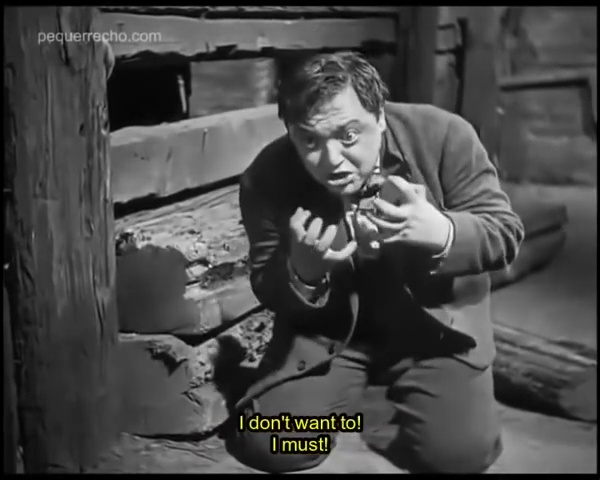
Like most modern cannibals since Jack The Ripper, the killer is indistinguishable from the rest of the public – just a normal guy (well, as normal as Peter Lorre could ever be).

13.png

The panic over the ninth murder makes everyone a suspect, particularly after Beckert writes to the papers, boasting that he’ll keep on killing.

11.png

12.png

vlcsnap-2020-04-26-22h18m29s472.png

The police raid the criminal underground every night, which is terrible for business.

14.png

16.png

The bar owner complains to the police that even the hardest working prostitute…

“hides a mother inside… I know many hard crooks whose eyes mist up looking at the little children playing.”

19.png

And so it goes. The coppers can’t catch him, so the underworld decides they will catch him, just so they can get back to business as usual.

vlcsnap-00007.jpg

The police have their own theories of why they cannot catch him:

“He’s not a real crook! Maybe he’s somebody who shows the harmless look of a good citizen who wouldn’t kill a fly.”

vlcsnap-00009.jpg

“If it wasn’t for this… apparent innocence of murderers, it would be unthinkable that a man like Grossmann or Haarmann could live for years next door to their neighbours, without raising any kind of suspicion”.

The police follow leads from the asylums; the crooks have other methods. Of course, everyone is a suspect, except – the beggars. The heads of the underworld offer them a reward to watch all the children of the city. Meanwhile, Beckert is watching little girls in shop window reflections.

vlcsnap-00022.jpg

The “M” of the title is chalked onto his coat by one of the beggars, as he is taking away his next child.

vlcsnap-00036.jpg

No more spoilers. Let us just say that the climax is a trial, in which Lang asks some hard questions about whether we are responsible for our actions, even when we cannot control our own minds.

vlcsnap-00044.jpg

vlcsnap-00063.jpg

vlcsnap-00110.jpg

The moral of the story is presented by Elsie’s mother, sitting outside the court, who says:

“This will not bring our children back to life. People should take better care of their children!”

Indeed.

No mention is made of the precise fate of the victims in the movie – Lang leaves that up to our imagination, and some knowledge of German serial killers of that time. They disappeared without trace for some days and…

21.jpg

*   Some critics and reviewers claim that M was based on serial killer Peter Kürten—the Vampire of Düsseldorf—whose murdered at least ten people including several children in the 1920s and achieving sexual climaxes from the killings, and from drinking the blood of some of the victims. He was also keen on writing to newspapers, as is depicted in the film. Kürten was beheaded in 1931 for his crimes, so would have been very much in the news at the time of the film’s creation.

Fritz Lang, however, in an interview in 1963 with film historian Gero Gandert, denied that M was based solely on Kürten

“At the time I decided to use the subject matter of M, there were many serial killers terrorizing Germany—Haarmann, Grossmann, Kürten, Denke”

The first two are actually mentioned in the film. Fritz Haarmann, known as the “Butcher of Hanover”, killed at least 24 boys and young men between 1918 and 1924, often by biting their throats, and then allegedly eating or selling the meat from their corpses as pork or horse-meat. Carl Großmann was arrested in 1921, a suspect in up to 100 murders of women and girls, whose flesh he was suspected of selling on the black market and from a hot-dog stand in Berlin during the Great War. Karl Denke killed and sold the flesh of dozens of homeless vagrants and travellers from 1903-1924.

The fact that Lang quoted those four serial killers as his models indicate that he certainly had cannibalism in mind when creating the role presented by Peter Lorre – the serial killer who cannot control his urges.

vlcsnap-00098.jpg

M is highly recommended as a classic, not just of the cannibal genre, but of cinematic art.

The full movie is currently available (and with excellent quality) on Youtube:

Essential worker cannibals: THE TIME MACHINE (Wells, 2002)

Those of us who can get away with it are locked up at home, some of us writing blogs. Meanwhile, outside in the world, the ‘essential workers’ – doctors, nurses, check-out operators, delivery drivers, teachers and, of course, hairdressers – have never been busier. We are splitting into two groups – the enforced idle, and those with hazardous, possibly lethal jobs, upon whom we rely. That will last, we are told, until a COVID-19 vaccine arrives, but those identities are already forged and will leave their cultural fossils behind. The idle, basking in their gardens (if they have them) and the toilers, looking after them. Both, of course, share the need to eat.

In 2011, Guy Standing released a book called The Precariat: The New Dangerous Class.  It was about how a new class was being produced by neo-liberal capitalism – people whose jobs, lifestyles and sense of stability had been devastated by the imposition of the free market and globalisation. The divergence between rich and poor has never been greater, and not just in the “developed” nations. Workers everywhere are being cast down into poverty and despair, not just by their bosses, but by workers in other countries who are willing to work for a pittance. The precariat, said Standing, “are prone to listen to ugly voices, and to use their votes and money to give those voices a political platform of increasing influence”.

Neo-libs found a voice in Margaret Thatcher and Ronald Reagan, and later the Tea Party in the USA. Trump, Putin and Brexit and fascist leaders in Hungary and Brazil rode to power as those ugly voices grew, looking for a scapegoat, an “other”, to blame. The splits in our societies continue to widen, so the ugly voices, and the hunger, increase. Fritz Lang in the film Metropolis (1927) told of workers being condemned to work in the dark caverns underground while the rich enjoyed life in skyscrapers.

What do these two trends have in common? Enforced idleness, medical or economic, and frantic toil, often with disproportionately meagre rewards, often in appalling conditions. The calls to strike out against real or imagined elites. It’s taken to its logical conclusion in THE TIME MACHINE, the original 1895 book by H.G. Wells, George Pal’s 1960 film, and this 2002 DreamWorks remake, directed by Simon Wells (the great-grandson of H.G.), which takes a new look at this story of human evolution. Where exactly are we heading?

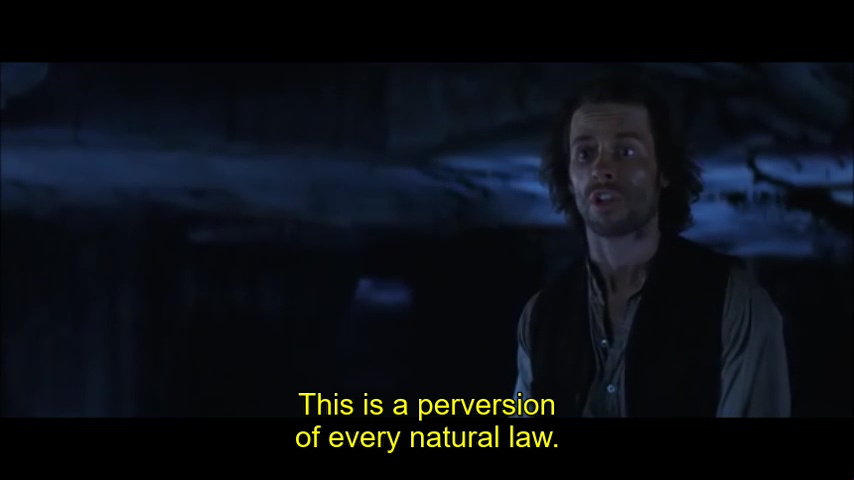
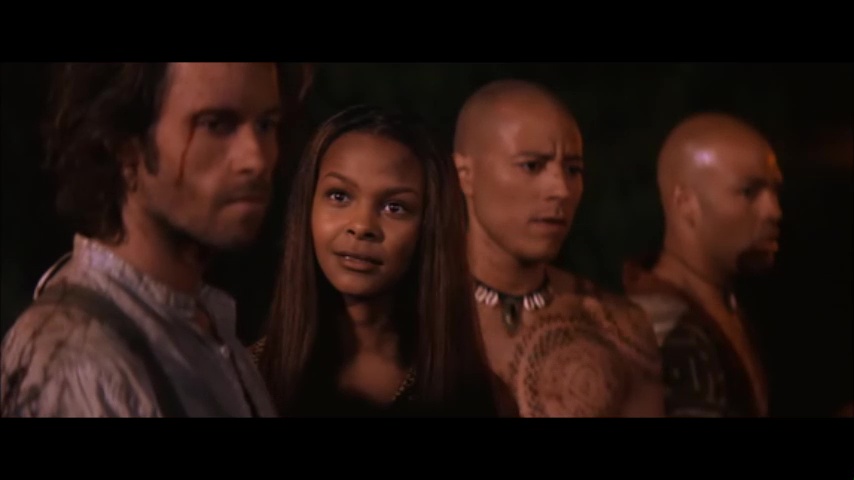
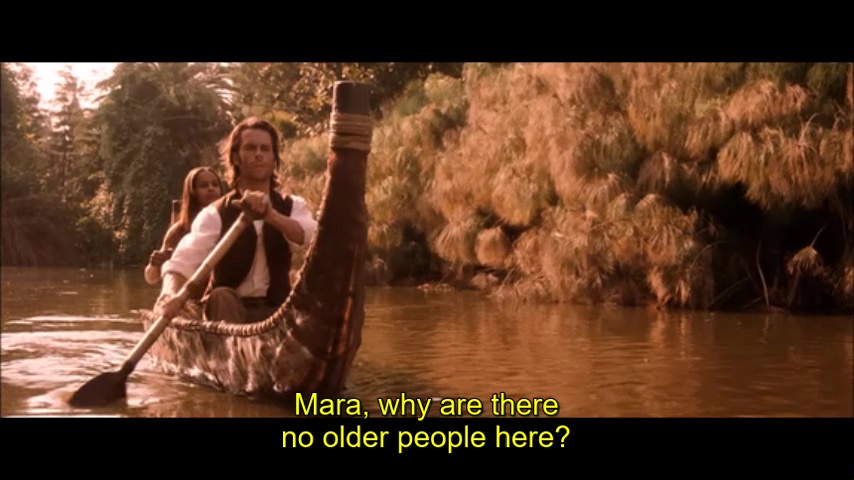
In this version, unlike the original, “the Time Traveller” has a name: Dr. Alexander Hartdegen, associate professor of applied mechanics and engineering at Columbia University. He is played by Guy Pearce, an Aussie actor whom we know from Priscilla Queen of the Desert, Memento, Jack Irish and of course Neighbours. Pearce has also appeared in a couple of cannibal films, including the lead role in Ravenous and “the Veteran” in The Road.

vlcsnap-00079.jpg

Modern movies insist on specific and personal motivations – think of Sweeney Todd, who in Tim Burton’s 2007 version was motivated by revenge for his wrongful transportation to Australia while his wife and child were abducted by the judge. In the 1936 version, however, he was just a greedy bastard who liked killing people and stealing their goods (and selling their flesh). Just so, in this 2002 Time Machine, professor Hartdegen’s fiancé is murdered in a mugging gone wrong, and he is driven to invent a time machine to see if he can go back and save her.

In the book and the 1960 movie, the humans of the future had regressed, defying the then (and still) popular concept of a “great chain of being” in which evolution inexorably means progress to ever higher forms. This ideology had become known as “social Darwinism” although the assumption of progress would have baffled Charles Darwin, who saw evolution as natural selection of those species who best fitted an environment. Darwin did not, therefore, involve subjective terms like “progress” in his theories (much). In H.G.Wells’ vision, the effete ruling classes had become the beautiful but useless Eloi, who sat in a bucolic paradise picking flowers. They were, in turn, picked off at night for dinner by the cannibalistic Morlocks, descended from the workers, who had gone underground and were now subterranean predators, spooky, but easily defeated by shining lights in their eyes (or by the ham-like fists of Rod Taylor – another Aussie who played the Time Traveller in the 1960 movie).

vlcsnap-00012.jpg

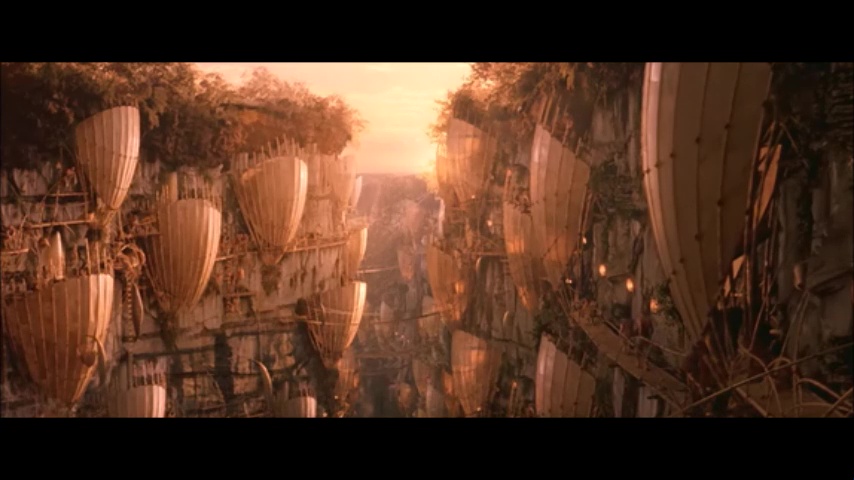
But the Eloi of the year 802,701 in this 2002 version are a somewhat sterner lot, building sanctuaries high in the mountains to avoid the nocturnal depredations of the Morlocks, but fatalistically accepting what would probably happen to them one dark night.

vlcsnap-00014.jpg

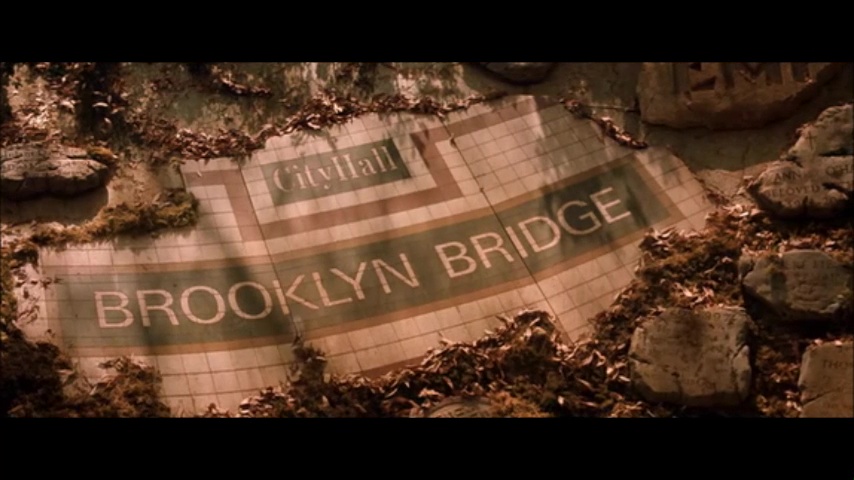
Hilariously, they have set up a shrine to the America of our time, and learn from childhood a perfect 21st century American English, taught by the film’s love interest (and damsel in distress) Mara (played by the Irish singer Samantha Mumba).

vlcsnap-00018.jpg

vlcsnap-00114.jpg

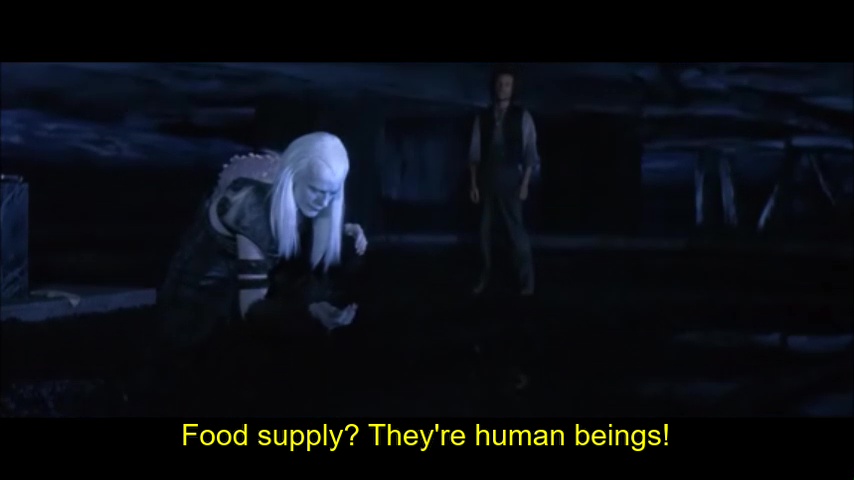
The Morlocks are a far more formidable foe too, appearing from the ground, in daylight, and capturing their prey with poisoned darts; they are immensely strong, not too smart, and hideously ugly. They are also, like the humans of the present and most other periods, voraciously hungry, and capable of eating all their supplies (roasted Eloi) at once if not controlled.

vlcsnap-00048.jpg

And here is the main interest in this story – the Morlocks are controlled, psychically, by an “Übermorlock” (Jeremy Irons, looking a lot like the late, great Tom Petty).

vlcsnap-00060.jpg

tom-petty-mn-02_6b4798f8561588a96f9500a199ee96b6.jpg

Civilisations, as this story illustrates, do not trend toward constant progress, but rise and fall in cycles, as John Gray has been trying to tell us,

“To believe in progress is to believe that, by using the new powers given to us by growing scientific knowledge, humans can free themselves from the limits that frame the lives of other animals. This is the hope of nearly everybody today, but it is groundless.”

As if to prove this point, a quick trip to the year 635,427,810 shows a burning wasteland with armies of soldiers or slaves wandering in the desolation.

vlcsnap-00107.jpg

At their most perilous, civilisations turn to power-hungry dictators – think Caligula, Hitler, Stalin, Mao, or the Übermorlock. They offer simplistic solutions to increasingly complex problems. Those solutions find a scapegoat, an alien group, an easy sacrifice, and death for those target populations is common, as is their consumption, if not as food, then as slaves.

vlcsnap-00070.jpg

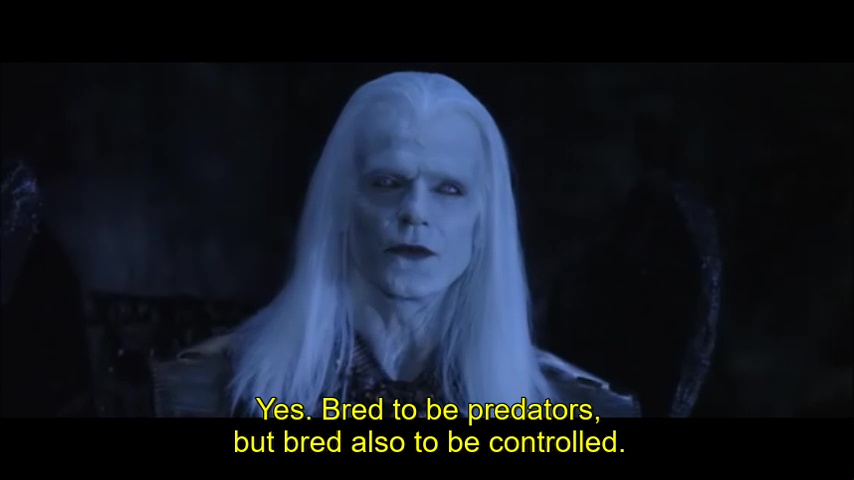
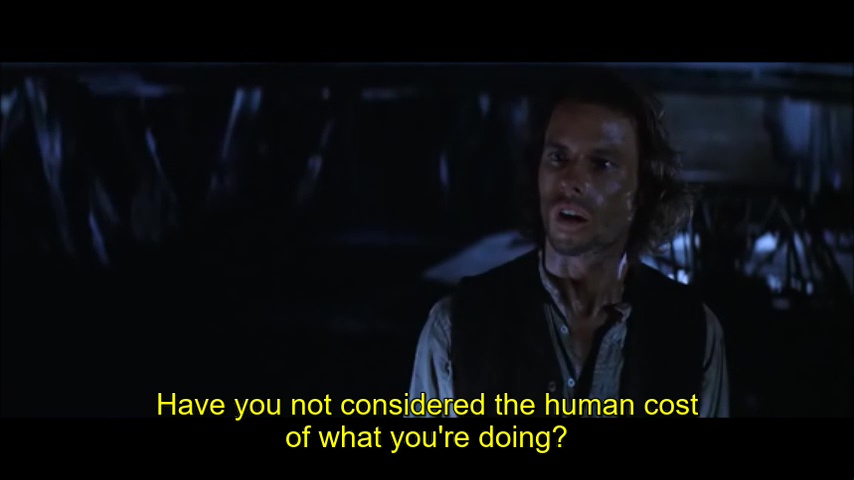
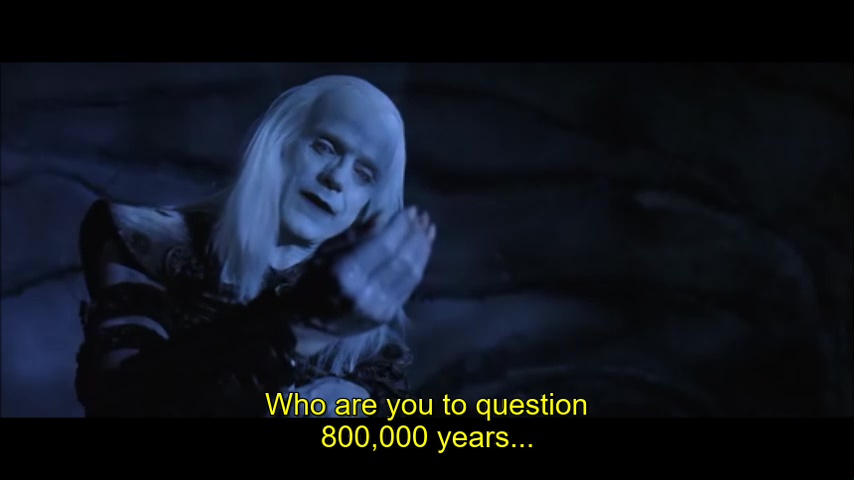
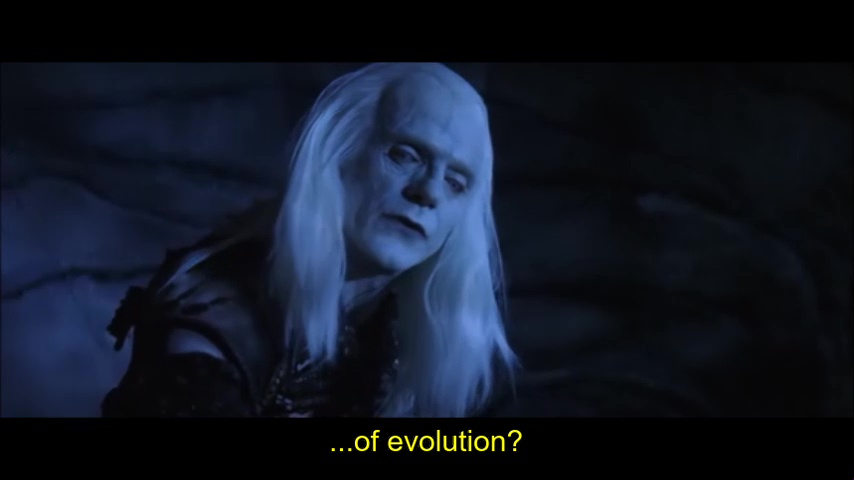
The Übermorlock explains that the underground workers and the above ground hedonists evolved into two separate species, and that within his own type, castes developed – the brutish predators and the intelligentsia, who use mind control. The Eloi are simply “livestock” and the Übermorlock is unimpressed by our hero’s attempts to impose the anti-cannibal ethics of 800,000 years ago.

vlcsnap-00077.jpg

vlcsnap-00078.jpg

And is he wrong? Think of the COVID dialogues about letting the vulnerable old people die to allow the economy to grow.

vlcsnap-00021.jpg

Yes, the Morlocks, like humanoid coronaviruses, find it much easier to catch old people. The rest of the Eloi are allowed to get fat and sassy until time for slaughter – just like some seventy billion other animals we inculpably slaughter and eat every year. Hartdegen does not realise this until he falls into the Morlock waste processing system.

vlcsnap-00047.jpg

Are the Morlock’s evil? Perhaps by the standard of 20th century liberal humanism. In 800,000 years, or now if we choose, we may have other ideas.

vlcsnap-00075.jpg

Rotten Tomatoes gave it a paltry 29%, saying

“This Machine has all the razzle-dazzles of modern special effects, but the movie takes a turn for the worst when it switches from a story about lost love to a confusing action-thriller.”

Bit harsh, IMHO. The cast is good, the special effects great fun, and the reimagining of the story shows some interesting thoughts about evolution and human ethics. Entertaining and worth a look, I’d say.

“Got me spread like a buffet” – KATY PERRY “Bon Appétit”

Katy Perry goes full cannibal? Her 2017 online clip Bon Appétit was a huge hit, with 14 million hits in the first 24 hours. But is it liberation or just lunch? Well, she claims it is about liberation, posting that  she is “hot and ready to serve but make no mistake I’m not your piece of meat”.

Katy Perry about to be prepared by an array of chefs in the Bon Appetit video.

The clip shows her being covered in flour and kneaded by a bunch of chefs, her limbs stretched out, then dropped into a steaming cauldron to baste herself. At one point, her tongue is burned by the kind of torch you might see in a French or Japanese restaurant.

Katy Perry is stretched like dough by chefs in her video.

One tweet stated that Perry was “targeting the cannibal demographic”. Was she appealing to the voraphilia market, or criticising the objectification of the female body?

Baste it: Katy Perry is dropped into a large vat of water.

Appetite for seduction
Fresh out the oven
Melt in your mouth kind of lovin’
Bon a, bon appétit, baby

It looks a lot like exploitation pseudo-porn. But hey, maybe it’s a subtle and clever dig at the way artists, and particularly women, are ‘consumed’ by their fan-base. Yes, and maybe cannibal movies are a subtle and clever dig at the anthropocentric objectification of certain species to satisfy the voracious appetites of humans. Seems unlikely to be intentional but, perhaps at some level, that is what is happening here.

Katy Perry's new music video Bon Appetit had 14 million views on You Tube in 24 hours.

“The most violent film ever made” – CANNIBAL FEROX (Lenzi, 1981)

The US distributor of this film (where it was renamed Make Them Die Slowly) made the claim that it was the most violent film ever made, and had been banned in 31 countries.

Warning.JPG

Both claims are highly dubious, but it is certainly one of the nastiest of the so-called “cannibal boom” movies that came out of Italy in the 1970s and 1980s. These films depicted a savage world in which the primitive natives were merciless cannibals, while the white victims were mostly corrupt and exploitative thugs, who invariably brought on the savagery by their own greed and violence (this one involves eye-gouging and penisectomies as well as brain and intestine munching). They deserved to be killed and eaten, especially since they were aware that all primitive people are cannibals. This from the civilisation that brought you Christopher Columbus, who coined the term “cannibal” and demonised the diverse nations of a whole continent.

cfblu4_original.jpg

Lenzi’s film was made a year after the most famous of the Italian cannibal slashers, Deodato’s Cannibal Holocaust. Although Cannibal Ferox seemed to be a rip-off of Deodato’s magnum opus, let us not forget that Lenzi started the boom back in 1971 with Man From Deep River. That in turn was lifted from the Mondo films like Mondo Cane, films which showed the disturbing violence within nature and primitive societies, and pointed out that such dark forces still swirled within the well-dressed breasts of modern, cosmopolitan Europeans.

cannibalferoxhd_pub.png

Look, I’ve been kinda avoiding reviewing this one, not because I  thought you couldn’t handle it (you are reading a cannibal blog fergoodnessake!) but more because I was wondering if I could. More gratuitously violent than Cannibal Holocaust, the scenes of torture are really all that this one is remembered for (certainly not for the plot or acting). Make up artist Gianetto de Rossi created the realistic special-effects, most infamously remembered for the scene where a woman is hoisted in the air by hooks through her breasts. De Rossi had previously worked on Emanuelle in America and Zombie II, the latter becoming famous as the goriest movie ever made.

MV5BNmVmOTkwMTctNzU0OS00YzIwLWI0MTktNWFkNDA5MWRlNGVmXkEyXkFqcGdeQXVyMjUyNDk2ODc@._V1_SX1777_CR0,0,1777,999_AL_.jpg

There’s a convoluted plot that you can follow on Wikipedia if you want, or even watch the movie if you must. It involves drugs, the Mafia, cannibals growing drugs for the Mafia, and cannibals eating greedy and vicious, or stupid and naïve, white people. The interesting part of the plot, from a Cannibal Studies point of view, is that the stupid, innocent Westerners who find themselves being caught up in all this (and tortured and eaten) are there on a fool’s errand – one of them, Gloria, is writing a thesis that is going to prove that cannibalism doesn’t exist and never existed. Her thesis is entitled “Cannibalism: End of the Myth”. [Holy excreted humanflesh; that’s kinda what I’m doing!] Radical as this thought is, it had actually been presented in an academic form by William Arens two years before this movie, in his book The Man-Eating Myth: Anthropology and Anthropophagy. Don’t you love coincidences like that? Wanton violence, abusive sex, torture, cannibalism and academic dishonesty – an honest portrait of the PhD process. Then there’s the invariable PhD curse – half way through your research, someone sits down with a bowl of intestines and screws up everything you’ve written.

PhD thesis.JPG

Cannibal Boom movies cannot be accused of involving any sort of academic rigour, concentrating instead on slaughter, torture, exploitative female nudity (and more torture) and cannibalism, as well as the totally gratuitous filming of real animal abuse. Italian cannibal directors love to put real footage into their stories of fake violence. Look, they say, a real animal suffered and died, so now you’ll accept that the actors were also killed. Actually, that sort of worked for Deodato, who was almost tried for murder,until he was able to get his Cannibal Holocaust actors to appear in court, to prove they were still alive.

tumblr_lhgoz0dPwo1qa4d9fo1_540
The German version was called “Revenge of the Cannibals”

Cannibal Ferox is torture-porn – it didn’t invent the genre, but it took it to new levels and laid the foundations for some of the grindhouse horror that was to follow. For example, the scene of a skull being opened and the brains eaten from it had already appeared in Deranged (Gillen & Ormsby) in 1974, and was perfected in Hannibal (Ridley Scott, 2001).

Cannibal Ferox managed to scrape together a 40% fresh rating on Rotten Tomatoes, from only five critics, one of whom summed up that “it both feeds and condemns our desire for the taboo sensations promised by its title”.

Couldn’t have put it better myself.

If you can’t be bothered watching the whole thing but would enjoy some highlights, this video review by “The Horror Geek” is hilarious!

“Cannibal Ferox” means fierce cannibals. In the US, it was renamed “Make Them Die Slowly”, and in Australia “Woman from Deep River”. Not sure if that reveals some sort of cultural distinction right there.

Capture

Would you like virus with that? EBOLA SYNDROME (伊波拉病毒) (Herman Yau, 1996)

Director Herman Yau has made a bit of a career from telling stories of “innocent cannibalism”, in which diners in restaurants unknowingly eat human flesh. His 1993 film The Untold Story was based on the “Eight Immortals Restaurant murders” of a family of ten, which took place in August 1985 in Macau. Portions of the bodies were never found, leading to speculation – yeah, you got it.

Following Gordon Gecko’s statement that “greed is good!” in Wall Street (1987), the 1990s saw a spate of films about entrepreneurs selling human flesh for fun and profit. Beside The Untold Story, Untold Story II and Ebola Syndrome from Hong Kong, we saw Delicatessen from France, Aranyak from India, The Deathmaker from Germany, Perdita Durango from Mexico, while the Americans contributed Ice Cream Man and Fried Green Tomatoes.

You see what I’m up against, trying to update you on all these masterpieces?

vlcsnap-00015.jpg

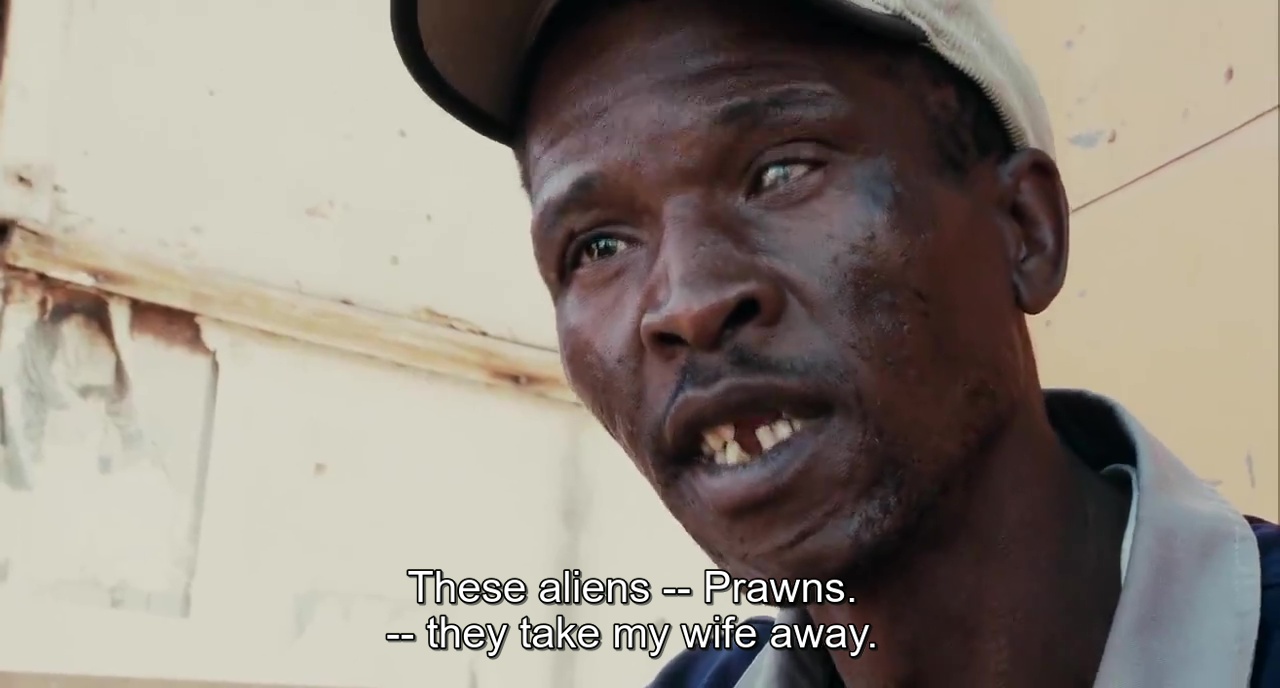
This film gets even weirder, because there is also a pandemic involved – Ebola, the so-called “flesh-eating” disease. Ebola never really got the public going like COVID-19, maybe because it only affected people in places like the Congo and so did not keep the rest of us awake at night. Also, it spreads much more slowly but, if you do get it, you have a 50-90% chance of dying, and it isn’t “just” pneumonia – it is haemorrhagic, meaning that you can bleed out “through your wazoo”, as they say in Last Man on Earth.

“People with Ebola first have symptoms of influenza, but within 72 hours after infection, the virus will dissolve the internal organs”

Ah Kai (Anthony Wong) is an escaped criminal from Hong Kong who bolts to South Africa after killing his former boss, his boss’s wife and another employee. Here is an image showing Hong Kong industrial relations in action.

vlcsnap-00014.jpg

In South Africa, he works at a Chinese restaurant and one day travels with his boss to a Zulu tribe that is infected with the Ebola virus [NOTE: there is no record of Ebola among the Zulu]. He comes across a woman dying of the disease, and decides to rape her – he’s that sort of guy.

vlcsnap-00047.jpg

He is immune to the effects of the virus, so becomes a living carrier, spreading the disease to others through his bodily fluids. He kills his new boss and his boss’s wife and cousin (seems to be becoming a habit), but he has already given the virus to them, so when he cuts up their corpses and serves them as hamburgers in the restaurant, he spreads the virus all over South Africa.

vlcsnap-00064.jpg

vlcsnap-00068.jpg

He heads back to Hong Kong with the boss’ cash and moves into a fancy hotel, where he proceeds to spreads the virus to the prostitutes he hires, and everyone else he encounters – dramatic music accompanying each new infection.

vlcsnap-00077.jpg

vlcsnap-00082.jpg

Cannibalism as a carrier for pandemics seems apposite right now. Cannibalism and incest, Freud said, were the two great taboos of civilisation, but their prohibitions also define civilisation, so it is not unreasonable to expect at least one of them to pop up in a civilisation-wide disaster. COVID-19 hasn’t been spread by cannibalism yet, or incest (as far as we know) but this movie looks at more than just crime and disease as social disrupters. Ah Kai is aggressive and violent to anyone whom he believes bullies him, usually the rich people who take advantage of his fugitive status. In South Africa (not a place known for Ebola), he is subject to casual racism from the whites, including prostitutes who refuse him their services. The whites, he complains, treat him like a black, and the blacks treat him like a white. He and his victims are dehumanised, which is a precondition for cannibalism – humans are animalised, animals are objectified and become meat.

vlcsnap-00018.jpg

Chinese restaurants, where he works, use a lot of pork, and several scenes problematise the close proximity of pigs to humans in the way they look and, according to some informants, the way they taste. The Ebola is caught at a Zulu camp where multiple people are dying from it; Kai and his boss are there because the racist white butcher is charging too much for pigs.

vlcsnap-00034.jpg

vlcsnap-00035.jpg

When they go to pick up their purchases, Kai uncovers human bodies instead, before he finds the pig corpses.

vlcsnap-00040.jpg

vlcsnap-00043.jpg

Is there really such a difference between corpses? More than 75% of emerging diseases originate in other animals. COVID-19 is said to have originated at a fish market, where close contact between humans and live animals in a small space made it easy for the virus to jump species. Other coronaviruses, such as severe acute respiratory syndrome (SARS) and Middle East respiratory syndrome (MERS), not to mention bird flu and swine flu, all spread due to the human appetite for flesh.

We used to assume that exotic diseases came from wilderness areas where they had been hosted in exotic animals, which then, like the dying Zulu, were used and abused by humans. But a lot of current research seems to indicate that it is actually our destruction of habitat and biodiversity that causes the spread of diseases like Ebola and COVID-19.

“We invade tropical forests and other wild landscapes, which harbor so many species of animals and plants — and within those creatures, so many unknown viruses. We cut the trees; we kill the animals or cage them and send them to markets. We disrupt ecosystems, and we shake viruses loose from their natural hosts. When that happens, they need a new host. Often, we are it.”

David Quammen in the New York Times January 28, 2020

vlcsnap-00086.jpg

vlcsnap-00088.jpg

Really?

Dread Central summed up the movie:

“The horrid acting and paper thin story are forgivable only for the hilarity with which it’s presented.”

That’s a bit harsh! Chinese movies are not as a rule exemplars of subtlety, but Anthony Wong as the virus super-spreader gives it all he’s got, and a bit more too. It’s a rollicking yarn, and it asks some serious questions too. I was surprised to find I quite enjoyed it.

The full movie has been removed from YouTube, but you can still watch the always delightful review by THE HORROR GEEK, Mike Bracken.

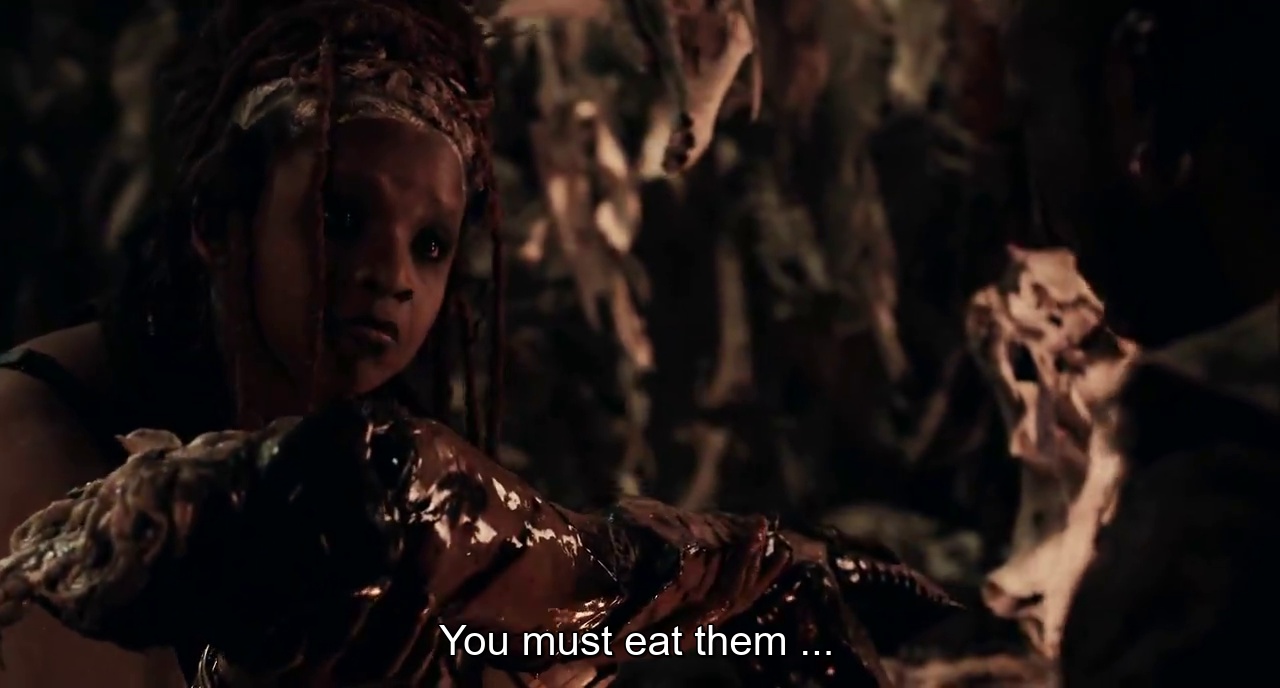
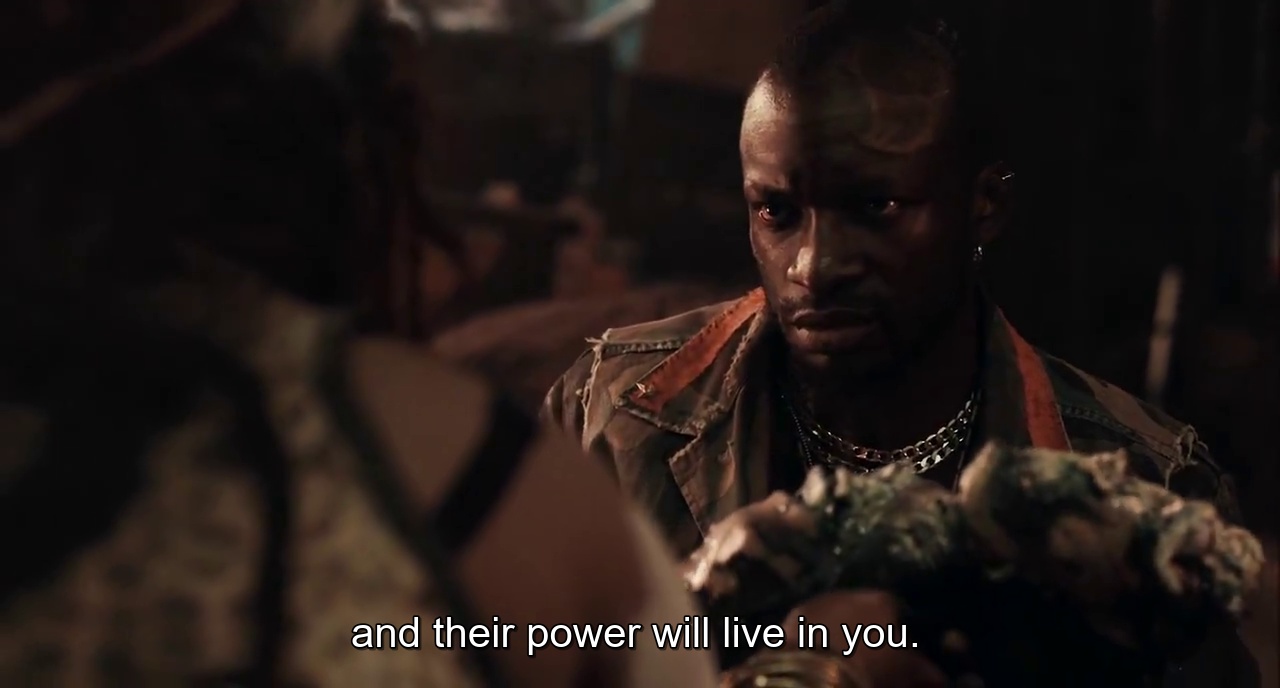
“I’m not insane” HANNIBAL S03E08: “The Great Red Dragon”

Aficionados of Hannibal will remember that the good Doctor Lecter was introduced to the world in the book Red Dragon in 1981. That book became the first Hannibal movie Manhunter in 1986 with Brian Cox as Hannibal, and was then remade under its original title with Anthony Hopkins in 2002, years after he had made Hannibal (in)famous in The Silence of the Lambs. A lot of the characters, plots and dialogues of Red Dragon were used by Bryan Fuller in making the television series Hannibal, but the main plot, Will Graham trying to track down the serial killer Francis Dolarhyde, only comes to the television screen in this, the eighth episode of the final season. The rest is all prequel.

We’re not going to get an origin story for Hannibal here, except – he ate his sister, but he didn’t kill her. That’s all we get, and it’s all we need. We get one right at the start of this episode, though, for Francis Dolarhyde (Richard Armitage, who also played Thorin Oakenshield, the Dwarf Prince in The Hobbit). Dolarhyde is slightly disfigured – a cleft palate that has been repaired but is still visible, and gives him problems with his speech, and a major case of social anxiety. He sits alone, OK, he’s a loner (sometimes called “rugged individual”), and he reads Time Magazine, OK, he’s a loser. No wait – there’s an article on the cover about William Blake and his extraordinary 1805-10 watercolours of the “Great Red Dragon”. He heads off to his gym to work on some already pretty beefy musculature. He gets a huge tattoo of the Dragon. He gets some dentures made, snaggly-toothed ones. It’s a cannibal show – so people are going to get bitten. He’s going to become that Dragon, or more accurately, the Dragon is going to become him. On the full moon, he sacrifices to the Dragon, by murdering “perfect” American families. As Frederick Chilton puts it in a visit to Hannibal:

vlcsnap-00047.jpg

The press call him the “Tooth Fairy” because he likes to bite his victims.  We see him dripping blood into the snow. It’s all super-gothic.

vlcsnap-00024.jpg

Three years after his surrender, Hannibal is locked in an asylum – at least, his body is, but his mind wanders freely through his memory palace – we see him in church listening to a young boy singing Hallelujah, while in fact he is being processed and incarcerated. Then he’s talking to Alana, in his office, drinking Montrachet, but really he’s in his painfully white cell in the asylum, and she is his jailer. He has been spared the death sentence everyone expected after his trial for the murder of a dozen people.

vlcsnap-00003.jpg

Hannibal and Alana were friends, lovers at one point. He asks her if she still prefers beer to wine.

vlcsnap-00009.jpg

Hannibal is the trickster. Not what, “who” he corrects her. She had people in her beer.

vlcsnap-00017.jpg

Will doesn’t want anything to do with the FBI or, apparently, Hannibal; he is living a peaceful life with Molly and Walter (her son).

vlcsnap-00053.jpg

But Jack Crawford comes looking for him. No one can profile serial killers like Will. Will he go with Jack? He reads a letter from Hannibal, with a cutting about the Tooth Fairy, warning him that Jack will come knocking, and cautioning him not to accept.

“We have all found new lives. But our old lives hover in the shadows. Soon enough Jack will come knocking. I would encourage you as a friend not to step back through the door that he holds open.”

vlcsnap-00054.jpg

Will goes though, and visits the crime scenes, where he recreates the crime in his mind, with the swinging pendula, just the way he did in the first season, that we all miss so much.

vlcsnap-00058.jpg

vlcsnap-00061.jpg

Will figures that he (as serial killer) would take his gloves off to touch his victims. The team is thus able to get a partial thumb-print from the victim’s eyeball. And then there’s a piece of cheese that he bit. And the victim that he bit. They have his (or his denture’s) toothprints.vlcsnap-00066.jpg

Dolarhyde is assailed by roars and high pitched tones as he tries to watch his home movies of his murders. Where are they coming from? Ah yes, the false teeth. Dolarhyde is being taken over by the Dragon, becoming the Dragon. He is, to his own tortured psyche, becoming more than human, an Übermensch like Hannibal. He will need to absorb the essence of Hannibal to become the superman. Will has to do the same to identify and stop him.

There’s only one way to get into the mind of a biter.

vlcsnap-00072.jpg

vlcsnap-00073.jpg

Walt Disney: eating children: ROBOT CHICKEN S1E2 “Nutcracker Suite”

Robot Chicken is a stop-motion television series which started in 2005 on Adult Swim, the “adult” channel of Cartoon Network. It is created and produced by Seth Green and Matthew Senreich along with co-head writers Douglas Goldstein and Tom Root.

The show takes a sometimes sardonic look at popular culture. This episode, the second ever shown (and it’s now in its tenth season!) took on the rumour circulating on social media that Walt Disney’s head had been frozen after his death in 1966, in the hope that he could be revived later (there is a huge industry of cryogenics).

vlcsnap-00001.jpg

vlcsnap-00002.jpg

It’s not true, just BTW.

In this reimagining of the Disney legend, Walt is not the lovable avuncular figure that (older) readers may remember from black and white TV. The episode starts by rehashing the old story about his antisemitism, then we see his head being cut off with a chainsaw for freezing. Under the Matterhorn, later, his head is thawed out and grafted onto a steel spider frame, reminiscent of War of the Worlds. He has death rays in his eyes, and he HUNGERS!

vlcsnap-00017.jpg

vlcsnap-00014.jpg

He’s in this cannibal blog because he’s, well, become a cannibal, eating children to keep his monstrous form alive. They are brought to him by his minions.

vlcsnap-00005.jpg

“Bring in the first human child!”

vlcsnap-00006.jpg

He builds a theme park in Florida, so that he can access lots of children, and keep his appetite satiated. But then, “one fateful day”, he sees on television the story of Elián González, the little Cuban boy was was involved in a huge custody battle which became an international incident between the US and Cuba.

He hungers for Elián and decides to invade Cuba. As he begins his attack on Cuba, the Cuban standing at the monitor can be heard yelling the same Spanish phrases as the popular cartoon character Speedy Gonzales.

Disney causes havoc, knocking planes out of the sky à la King Kong. Poor Elián appears on the shore, offering to sacrifice himself to save his beloved Cubans, but then Fidel arrives!

vlcsnap-00018.jpg

vlcsnap-00020.jpg

Look, it’s a satire on American imperialism of course, but it has a lot to say about the cannibalistic nature of capitalist consumerism and the voracious appetite of corporates who look to eat up the culture and the cash of their target audience. Imperialism is not just via planes and tanks and giant spiders with frozen heads on top. Cuba has been embargoed from receiving the benefits of American culture for decades, and some of them seem to like it just fine that way.
vlcsnap-00009.jpg

Cannibalism costs an arm and a leg: THE BAD BATCH (Ana Lily Amirpour, 2017)

What do we do when dystopian stories start to look like the daily news? This film was made in the first year of the Trump presidency, which, you will remember, was partly won on the promise to build a “big beautiful wall” to keep criminals and rapists out of the USA. But what do you do with the criminals already inside the big beautiful wall? “Non-functioning members of society” are, in this dystopia, exiled, quarantined as “bad batch”.

Arlen (Suki Waterhouse) is bad batch number 5040, a number which is tattooed behind her ear, similar to the way Holocaust victims were stripped of their names and their humanity and became just numbers. She is then sent through the wall into a vast desert with little more than a sandwich and a bottle of water.

vlcsnap-00002.jpg

She is almost immediately captured by the cannibals, the “bridge people”, who live in crashed planes and work out like Muscle Beach.

vlcsnap-00012.jpg

The two women who caught Arlen hacksaw her leg and arm off, cauterise the stumps with their frying pan, presumably to keep the rest of her fresh, and go off to cook the limbs.

vlcsnap-00008.jpg

Arlen escapes on a skateboard, pushing with one arm and one leg, and, just as she is about to be eaten by crows, is found by a hermit (an unrecognisable Jim Carrey!)

vlcsnap-00028.jpg

The hermit takes her to Comfort, a settlement which seems to be a continuous rave club, run by a charismatic cult leader, The Dream (Keanu Reeves), who throws the parties and has his own harem of pregnant young women. In Comfort, they seem to prefer to eat noodles and rabbits (and lots of drugs) to human flesh, but – who knows? Like the bad bunch people, the camp structures are the rejects and wreckage of society – yet there never seem to be serious shortages of anything, particularly drugs. And The Dream lives in luxury, on the proceeds of the drugs, which are the currency of Comfort.

The folks at Comfort have given Arlen a prosthetic leg, but she still misses her arm. But one hand is enough to handle a gun. Is there some symbolism here that is even more Freudian than Trumpian?

vlcsnap-00019.jpg

Meanwhile, back at cannibal HQ, the leader, Miami Man (Jason Momoa- you might remember him as Aquaman), is killing and carving up a woman for dinner.

vlcsnap-00016.jpg

Is this going to be a simple good (rabbit eaters) vs evil (human eaters) story?

vlcsnap-00040.jpg

Not quite. How can there be good and evil, when everyone is on the wrong side of the wall? Miami Man turns out to be a devoted Dad; he has a cute little daughter, and you know how much kids eat, right? Some of his tribe collect rubbish from the tip, others collect humans for dinner – is there a difference in a world where value is only assigned to those deemed worthy of being on the right side of the big, beautiful wall?

Arlen is gunning for revenge. She comes across the little girl and one of the bridge people women who kidnapped her, foraging for plates.

vlcsnap-00022.jpg

She shoots the woman and takes the girl back to Comfort, buys her a rabbit. But then Arlen takes drugs, handed out at the party like Eucharist wafers, and wanders into the desert, to wonder at the glories of the galaxy, as you do when you take psychedelics (or so I hear).

vlcsnap-00038.jpg

Well, we know there is going to be a meeting and a reckoning with the cannibal king. It’s hard to tell, though, who are the good guys in a world where everyone is an exile, and maybe a cannibal? As Arlen says to MM:

“Here we are in the darkest corner of this Earth, and we’re afraid of our own kind.”

The film is loosely based on a true story: the so-called “Cannibal Island”, a small island called Nazino in Siberia to which Stalin deported around 4,000 people declared to be “declasse and socially harmful elements” including political dissidents, disabled or impoverished people and criminals. They were dumped on the island with no food except some raw flour, which gave them dysentery. Before long, they turned to cannibalism. Two thirds of the deportees were killed or died of hunger and disease.

Cannibal Island.jpg

It makes Comfort look positively comfortable.

The Vancouver North Shore News said “The Bad Batch could as easily be described as “a Futuristic Cannibal Spaghetti Western,” a dystopian genre mash-up.” It has a disappointing 44% on Rotten Tomatoes, and is admittedly a bit slow in parts (and a bit daft in others), but the cast is great, the photography often superb, and the political timing spot-on. Walls lead to wars, and the phrase “dog-eat-dog” should really be “human-eat-human”. Eating rabbits, eating humans.

vlcsnap-00045.jpg

Because when it all hits the fan, whether it’s outside the wall or sleeping in the streets eating Soylent Green, humans are usually only one species barrier away from cannibalism. Expelled from under the thin camouflage of civilisation, we are all bad batch cannibals.

Poster.jpg

Don’t play with your food… HANNIBAL Season 3 Episode 7, “Digestivo”

Pigs and people. Are they identically different, like Hannibal and Will?

vlcsnap-00001.jpg

Why do we consider pigs uncontroversially edible, and yet are so shocked at Hannibal or Mason eating human? [If you have the answer to that, please let me know – I’m up to 65,000 words and still haven’t come to a conclusion]. We use them in gruesome experiments because they are like us, but then justify it by saying they are not really like us at all. This episode is all about pigs and people interchangeably being used, abused, and prepared for dinner.

Pigs of course are remarkably similar to humans – have you ever seen a butcher carrying a pink corpse into the shop and wondered for a moment who he has killed? Geneticists have proved the similarity:

“We took the human genome, cut it into 173 puzzle pieces and rearranged it to make a pig. Everything matches up perfectly. The pig is genetically very close to humans.”

The episode is called Digestivo, which in Italian is an after-dinner drink, usually a liqueur or bitter, which is meant to settle the stomach. We have, in this episode, finished consuming the plot of the book and movie Hannibal, which follows Mason’s quest for revenge. Next episode, we go to the central plot of Red Dragon, which of course pre-dated the other books but, by the brilliance of Bryan Fuller, is readily reimagined as a later time in this new universe.

Mason always carries a little knife that belonged to his father. Perhaps it’s the same one that he used to slice off his face. His father would test the depth of fat on a pig’s back by poking him or her with this knife, something neither the pig nor farmer found terribly acceptable. Now he is doing it to Hannibal. It’s clear that he is planning to turn Hannibal into a pig before he eats him.

vlcsnap-00013.jpg

vlcsnap-00014.jpg

Of course, there’s many a slip, as they say, or as Nick Cave says:

“If you’re gonna dine with the cannibals, sooner or later baby you’re gonna get eaten”.

Or as Alana warns:

vlcsnap-00019.jpg

To the sublime tones of the Mozart Piano Concerto 21, Hannibal and Will are dressed and brought to Mason’s table. In the opulent dining room of Muskrat Farm, Mason tells Hannibal that “I snatched Will Graham right out of your mouth.” He is referring to Hannibal’s plan to eat Will’s brain, foiled by the arrival of the Italian police, who were in Mason’s pay.

vlcsnap-00024.jpg

Hannibal and Mason compare their depth of reading, as Hannibal reminds Mason of the biblical story of Jezebel, who was, like Mason’s face, eaten by dogs. Mason in return spouts a news story he read about “that German cannibal” (he can’t remember the name of Armin Meiwes?) who advertised on the Internet for someone who wanted to be eaten.

The cannibal and the intended meal ate the man’s penis together before the latter died and was packaged up in the freezer. Mason’s assistant, Cordell, arrives hilariously at that moment with some pork sausages, thus emphasising the human/pig parallels.

vlcsnap-00033.jpg

“Go to all that trouble to eat a friend and you overcook his penis. They ate it anyway, they had to, they committed. But they didn’t enjoy it.”

vlcsnap-00038.jpg

Mason reveals part of his plan – he likes Will’s face, and intends to graft it onto Hannibal before he eats him. The rationale is that Will and Hannibal were both there watching as the dogs ate Mason’s face. They banter pleasantly (Hannibal shows no fear) about the order in which Mason will eat the various parts of Hannibal’s body. Everyone loves to chat about cannibalism! Will’s banter is a little less polite, as he takes a healthy bite of Cordell’s cheek, much to Hannibal`s amusement, and is left with a bloody chin, reminiscent of Anthony Hopkins in Silence of the Lambs. Will has become at least a functional cannibal.

vlcsnap-00062.jpg

vlcsnap-00064.jpg

Cordell sews up his own face, then advances on Hannibal with the Verger branding iron. He brands Hannibal with the Verger emblem.

vlcsnap-00071.jpg

Hannibal is being turned into an edible pig, because as Mason admitted, he did not really fancy eating human flesh. Much easier to eat the animal that daddy made his fortune exploiting, than to eat the man who consistently outsmarted him.

“Mason would have preferred to brand your face. He fought bravely, and with his own funds, against the humane slaughter act, and managed to keep face-branding legal.”

vlcsnap-00078.jpg

Part of what supposedly makes us superior to other animals is the power of speech. Pigs can grunt and scream eloquently, but they can’t form their words into either maxims or complaints. The tongue is crucial, and Cordell tells Hannibal he intends to

“…boil it, slice it very thin, marinate it in olive oil, garlic, parsley and vinegar.”

vlcsnap-00083.jpg

Cordell describes the rest of his plans, in something almost out of a cooking show. But looking down appreciatively, he adds

vlcsnap-00087.jpg

“Every day I’ll feed Mason some new part of you. And don’t you worry Dr Lecter, you will always be cooked to perfection.”

Anyway, we know that nothing like that is going to happen, because we still have six episodes to go. AND SEASON 4 [please?] The rescue involves Alana and Margo, who find that Mason kept Margo’s eggs and that there is a surrogate having her baby.

vlcsnap-00153.jpg

A pig, of course. Not too successfully; the baby is dead, which makes her fighting mad. They head off to kill Mason. First, they release Hannibal, because he has to save Will (about to have his face cut off without anaesthetic). Alana knows that Hannibal promised to kill her at the end of Season 1. But she has no other choice if Will is to survive.

“You’re the only one who can save Will. Promise me you’ll save him?”

vlcsnap-00127.jpg

vlcsnap-00128.jpg

The “abyss” that Heidegger described between human and animal is further breached as Mason is eaten by his pet eel. Or chokes as he eats the eel. All lines are crossed.

vlcsnap-00166.jpg

Having saved Will, Hannibal finally meets up with Chiyoh. She is willing to watch over him, but not in a cage: “Some beasts shouldn’t be caged.” Her obsessive hunt, she tells him, was motivated not by his plight or hers, but Mischa’s.

vlcsnap-00177.jpg

“Yes,” says Hannibal, “but I did not kill her”.

We see the broken teacup that has bothered Hannibal throughout the books, movies and this TV series. Can time reverse? Can we undo what has been done?

vlcsnap-00185.jpg

As he waits for Will to recover and awake, Hannibal is working on some higher level calculus, presumably still trying to work the maths on how to reverse time.

vlcsnap-00187.jpg

But Will is having none of it.

vlcsnap-00190.jpg

“I miss my dogs. I’m not going to miss you. I’m not going to find you. I’m not going to look for you. I don’t want to know where you are or what you do.”

vlcsnap-00203.jpg

vlcsnap-00204.jpg

“You delight. I tolerate. I don’t have your appetite.

Goodbye Hannibal.”

vlcsnap-00211.jpg

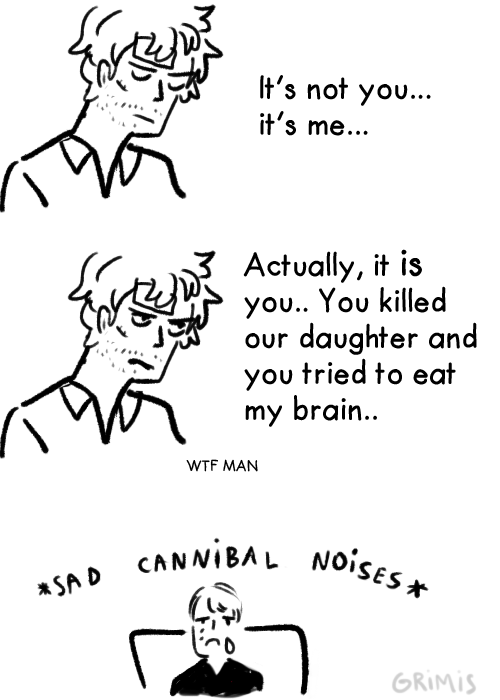
The digestivo here is a bitter drink – look at Hannibal’s face. Takes a hell of an actor to portray strong emotion so simply. Will has divorced Hannibal. But Hannibal is not giving up – he never does. He escapes before the FBI arrive, but then returns and surrenders.

vlcsnap-00220.jpg

vlcsnap-00222.jpg

Next episode, Will takes on the Red Dragon, but – can he do it without Hannibal? Silly question really, don’t know why I bothered asking it.