This blog reviews films and TV shows involving human cannibalism. Sounds creepy, well, it is a bit, but it’s part of an exercise investigating how we decide what is edible and what is repulsive. Why are we happy to kill for food an animal that doesn’t want to die, yet unwilling to eat another animal that is already dead? Every work considered contributes to the answer to that question, some more than others of course.
Anyway, this post is to say thanks for reading this blog. In May, for the first time, the blog received well over 1,000 views, which is very exciting. As a special thank you, here is one of my favourite cannibal songs, by the wonderful Mr Tom Lehrer.
Here’s a trivia question for the serious Hannibal aficionados: what is the name of
Will Graham’s son /step-son?
*Answer at the bottom of the blog.
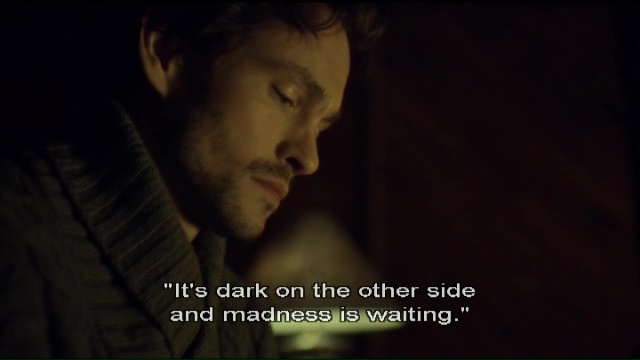
Hannibal has been in a cell in the Asylum for the whole season, so not many people are getting eaten. Will is back in the game, desperately trying to catch the “Great Red Dragon”, who is certainly a biter, and a necrophile, but not so much a swallower of human flesh. But to understand why the GRD (Francis Dolarhyde) does what he does, and why Hannibal did what he used to do, we need to understand a bit about Hannibal’s Nietzschean understanding of the Übermensch (superman) and how, Will finally realises, he encourages his patients and acquaintances to “change” people as part of the development of the “higher self”.
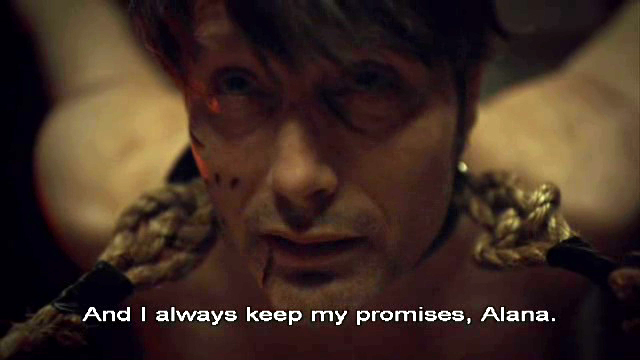
The asylum security is surprisingly lax, considering Alana Bloom is in charge, and she is deeply motivated by the fact that Hannibal has promised to kill her as soon as he can. Nonetheless, calls come in from what appears to be Hannibal’s lawyer’s office and are patched through to his cell, and so he can happily chat to the GRD and give him advice on life, love, and killing, or what you might call “eat, prey, love”.
Dolarhyde is worried about his new girlfriend, and what the Dragon (his higher self) will do to her.
Like, frinstance, Will. Hannibal tells him: “He has a family. Save yourself.”
There’s always a problem bringing a classic story into the present day. Imagine Henry V with machine guns. Clarice Starling with a cell phone (“just on my way down the basement stairs now. Send a coupla dozen agents over stat”). Dolarhyde, in the book and films, was choosing his victims on the super-8 family movies he developed at work. Probably read telegrams too. But this is a new century – how does he choose them in 2015?
Indeed. Dolarhyde is watching videos of Will’s wife and step-son, Molly and Walter – Reba, who is blind, asks if these are his nocturnal animals? Yes. Do you think they know they’re being filmed? No.
Will has a vague idea he’s being played, but is clueless to what is really happening. He says he is not fortune’s fool, he is Hannibal’s fool, and that is certainly true. “Fortune’s fool” is a phrase Shakespeare liked a lot. It’s used in Romeo and Juliet, King Lear and Timon of Athens. Will hasn’t got his head around Hannibal’s coaching system yet, despite some very broad hints. He has worked out that he ran into Dolarhyde last episode at the museum because Hannibal planned it that way. Now he wants Hannibal’s help to identify the next family that Dolarhyde will kill, but he’s still not getting those broad hints from Hannibal about who that family might be.
Still clueless, Will asks, “you’re willing to let them die?”
Now Molly (Nina Arianda), Will’s wife (sorry Hannigrammers, he got married when we weren’t looking) is not fortune’s fool, and she’s not Hannibal’s either. It’s almost like she was expecting the GRD to come looking. She bundles her son out of the window, distracts Dolarhyde with the car alarm, flags down a passing car (in the middle of nowhere, mind you) and drives off as the Dragon shoots the driver. When Will visits her in hospital, she jokes about getting angry. She may be the best adjusted person in the whole series.
Anyway, Jack and Alana are woke to Hannibal’s little game now.
Mads Mikkelsen plays Hannibal as Satan, and Jack wants him to be the Devil’s advocate. They want Hannibal to talk to the GRD, keep him on the phone while they run a trace. What he says to Dolarhyde, though, is a direct line into Lecter/Nietzschean philosophy.
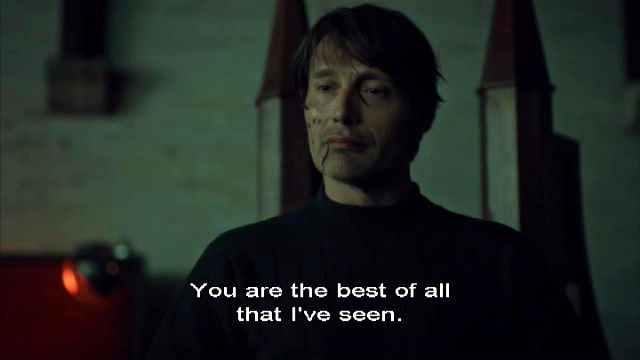
“You are the Dragon, you don’t have to be afraid. You know who speaks. From the beginning, you and the Dragon had been one. You are Becoming. And the Dragon is your higher self. Don’t let fear leach your strength. You are almost blind to your own true feelings. No more able to express them than a scar can blush.”
Dolarhyde is still worrying about Reba and his unlikely ability to be loved. “She called me a man! A sweet man!”
Hannibal talks just long enough for them to get a trace, but not to catch him, as he then warns Dolarhyde, just as he warned Garrett Jacob Hobbs in the very first episode of season one.
This just gives Hannibal an opening for more philosophy.
“The essence of the worst in the human spirit is not found in the crazy sons of bitches. Ugliness is found in the faces of the crowd.”
The Dragon, Hannibal muses, “likely thinks you are as much a monster as you think he is.” Hannibal of course realises the “nice” Dolarhyde is trying to overcome the Red Dragon side of his personality, and Hannibal of course knows Goethe’s Faust off by heart:
“Two souls, alas, are dwelling in my breast, and one is striving to forsake its brother.”
The episode finishes with Hannibal offering Will friendship, absolution, the chance to start again.
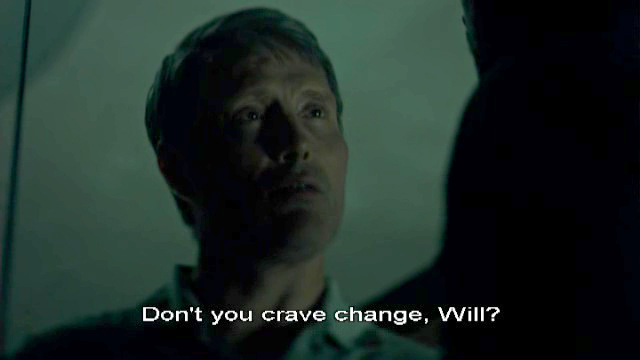
“The Great Red Dragon is freedom to him. Shedding his skin. The sound of his voice. His own reflection. The building of a new body and the othering of himself, the splitting of his personality, all seem active and deliberate. He craves change.”
Will finally gets it: “He didn’t murder those families.”
* Will’s son/stepson? It’s a trick question – the little boy’s name keeps changing.
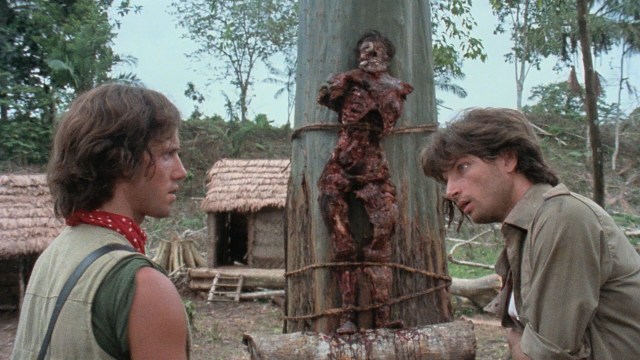
The US distributor of this film (where it was renamed Make Them Die Slowly) made the claim that it was the most violent film ever made, and had been banned in 31 countries.
Both claims are highly dubious, but it is certainly one of the nastiest of the so-called “cannibal boom” movies that came out of Italy in the 1970s and 1980s. These films depicted a savage world in which the primitive natives were merciless cannibals, while the white victims were mostly corrupt and exploitative thugs, who invariably brought on the savagery by their own greed and violence (this one involves eye-gouging and penisectomies as well as brain and intestine munching). They deserved to be killed and eaten, especially since they were aware that all primitive people are cannibals. This from the civilisation that brought you Christopher Columbus, who coined the term “cannibal” and demonised the diverse nations of a whole continent.
Lenzi’s film was made a year after the most famous of the Italian cannibal slashers, Deodato’s Cannibal Holocaust. Although Cannibal Ferox seemed to be a rip-off of Deodato’s magnum opus, let us not forget that Lenzi started the boom back in 1971 with Man From Deep River. That in turn was lifted from the Mondo films like Mondo Cane, films which showed the disturbing violence within nature and primitive societies, and pointed out that such dark forces still swirled within the well-dressed breasts of modern, cosmopolitan Europeans.
Look, I’ve been kinda avoiding reviewing this one, not because I thought you couldn’t handle it (you are reading a cannibal blog fergoodnessake!) but more because I was wondering if I could. More gratuitously violent than Cannibal Holocaust, the scenes of torture are really all that this one is remembered for (certainly not for the plot or acting). Make up artist Gianetto de Rossi created the realistic special-effects, most infamously remembered for the scene where a woman is hoisted in the air by hooks through her breasts. De Rossi had previously worked on Emanuelle in America and Zombie II, the latter becoming famous as the goriest movie ever made.
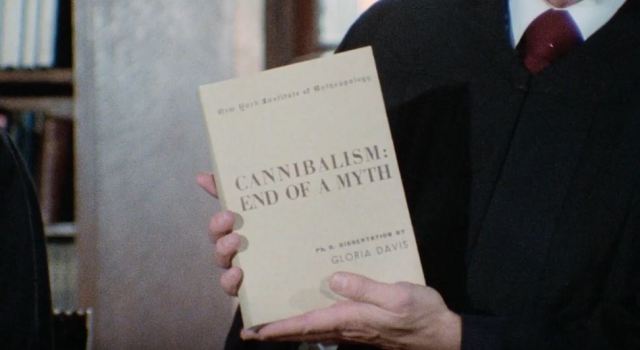
There’s a convoluted plot that you can follow on Wikipedia if you want, or even watch the movie if you must. It involves drugs, the Mafia, cannibals growing drugs for the Mafia, and cannibals eating greedy and vicious, or stupid and naïve, white people. The interesting part of the plot, from a Cannibal Studies point of view, is that the stupid, innocent Westerners who find themselves being caught up in all this (and tortured and eaten) are there on a fool’s errand – one of them, Gloria, is writing a thesis that is going to prove that cannibalism doesn’t exist and never existed. Her thesis is entitled “Cannibalism: End of the Myth”. [Holy excreted humanflesh; that’s kinda what I’m doing!] Radical as this thought is, it had actually been presented in an academic form by William Arens two years before this movie, in his book The Man-Eating Myth: Anthropology and Anthropophagy. Don’t you love coincidences like that? Wanton violence, abusive sex, torture, cannibalism and academic dishonesty – an honest portrait of the PhD process. Then there’s the invariable PhD curse – half way through your research, someone sits down with a bowl of intestines and screws up everything you’ve written.
Cannibal Boom movies cannot be accused of involving any sort of academic rigour, concentrating instead on slaughter, torture, exploitative female nudity (and more torture) and cannibalism, as well as the totally gratuitous filming of real animal abuse. Italian cannibal directors love to put real footage into their stories of fake violence. Look, they say, a real animal suffered and died, so now you’ll accept that the actors were also killed. Actually, that sort of worked for Deodato, who was almost tried for murder,until he was able to get his Cannibal Holocaust actors to appear in court, to prove they were still alive.
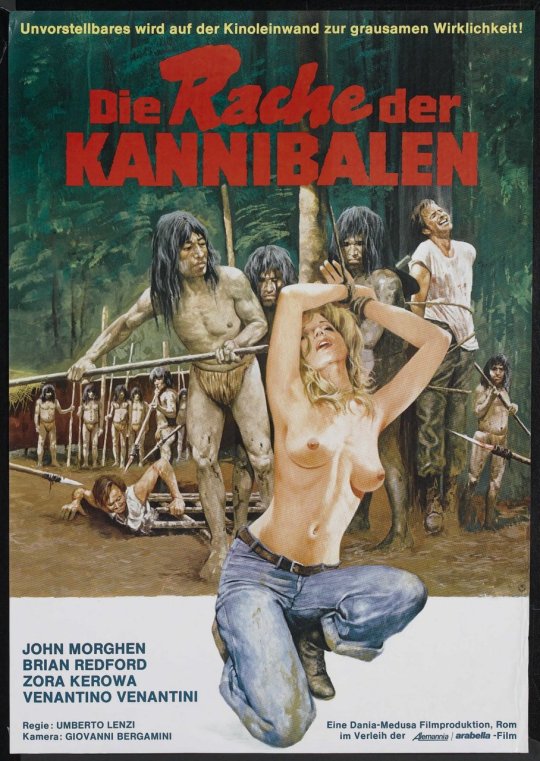
The German version was called “Revenge of the Cannibals”
Cannibal Ferox is torture-porn – it didn’t invent the genre, but it took it to new levels and laid the foundations for some of the grindhouse horror that was to follow. For example, the scene of a skull being opened and the brains eaten from it had already appeared in Deranged (Gillen & Ormsby) in 1974, and was perfected in Hannibal(Ridley Scott, 2001).
Cannibal Ferox managed to scrape together a 40% fresh rating on Rotten Tomatoes, from only five critics, one of whom summed up that “it both feeds and condemns our desire for the taboo sensations promised by its title”.
Couldn’t have put it better myself.
If you can’t be bothered watching the whole thing but would enjoy some highlights, this video review by “The Horror Geek” is hilarious!
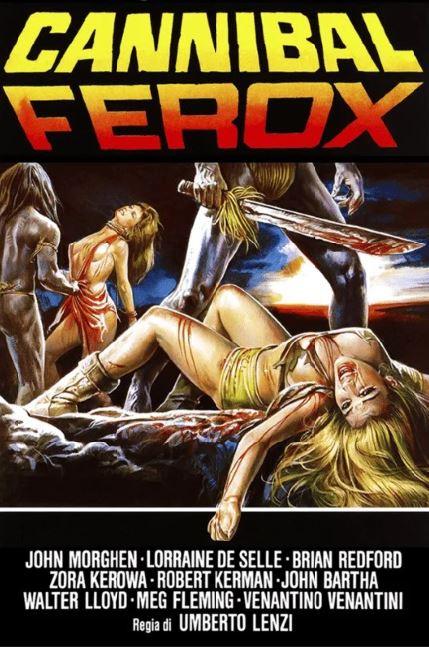
“Cannibal Ferox” means fierce cannibals. In the US, it was renamed “Make Them Die Slowly”, and in Australia “Woman from Deep River”. Not sure if that reveals some sort of cultural distinction right there.
Aficionados of Hannibal will remember that the good Doctor Lecter was introduced to the world in the book Red Dragon in 1981. That book became the first Hannibal movie Manhunterin 1986 with Brian Cox as Hannibal, and was then remade under its original title with Anthony Hopkins in 2002, years after he had made Hannibal (in)famous in The Silence of the Lambs. A lot of the characters, plots and dialogues of Red Dragon were used by Bryan Fuller in making the television series Hannibal, but the main plot, Will Graham trying to track down the serial killer Francis Dolarhyde, only comes to the television screen in this, the eighth episode of the final season. The rest is all prequel.
We’re not going to get an origin story for Hannibal here, except – he ate his sister, but he didn’t kill her. That’s all we get, and it’s all we need. We get one right at the start of this episode, though, for Francis Dolarhyde (Richard Armitage, who also played Thorin Oakenshield, the Dwarf Prince in The Hobbit). Dolarhyde is slightly disfigured – a cleft palate that has been repaired but is still visible, and gives him problems with his speech, and a major case of social anxiety. He sits alone, OK, he’s a loner (sometimes called “rugged individual”), and he reads Time Magazine, OK, he’s a loser. No wait – there’s an article on the cover about William Blake and his extraordinary 1805-10 watercolours of the “Great Red Dragon”. He heads off to his gym to work on some already pretty beefy musculature. He gets a huge tattoo of the Dragon. He gets some dentures made, snaggly-toothed ones. It’s a cannibal show – so people are going to get bitten. He’s going to become that Dragon, or more accurately, the Dragon is going to become him. On the full moon, he sacrifices to the Dragon, by murdering “perfect” American families. As Frederick Chilton puts it in a visit to Hannibal:
The press call him the “Tooth Fairy” because he likes to bite his victims. We see him dripping blood into the snow. It’s all super-gothic.
Three years after his surrender, Hannibal is locked in an asylum – at least, his body is, but his mind wanders freely through his memory palace – we see him in church listening to a young boy singing Hallelujah, while in fact he is being processed and incarcerated. Then he’s talking to Alana, in his office, drinking Montrachet, but really he’s in his painfully white cell in the asylum, and she is his jailer. He has been spared the death sentence everyone expected after his trial for the murder of a dozen people.
Hannibal and Alana were friends, lovers at one point. He asks her if she still prefers beer to wine.
Hannibal is the trickster. Not what, “who” he corrects her. She had people in her beer.
Will doesn’t want anything to do with the FBI or, apparently, Hannibal; he is living a peaceful life with Molly and Walter (her son).
But Jack Crawford comes looking for him. No one can profile serial killers like Will. Will he go with Jack? He reads a letter from Hannibal, with a cutting about the Tooth Fairy, warning him that Jack will come knocking, and cautioning him not to accept.
“We have all found new lives. But our old lives hover in the shadows. Soon enough Jack will come knocking. I would encourage you as a friend not to step back through the door that he holds open.”
Will goes though, and visits the crime scenes, where he recreates the crime in his mind, with the swinging pendula, just the way he did in the first season, that we all miss so much.
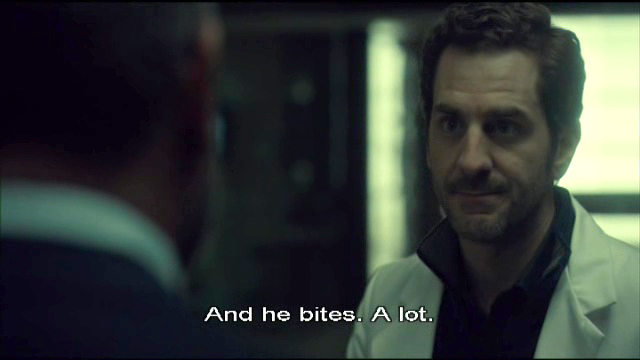
Will figures that he (as serial killer) would take his gloves off to touch his victims. The team is thus able to get a partial thumb-print from the victim’s eyeball. And then there’s a piece of cheese that he bit. And the victim that he bit. They have his (or his denture’s) toothprints.
Dolarhyde is assailed by roars and high pitched tones as he tries to watch his home movies of his murders. Where are they coming from? Ah yes, the false teeth. Dolarhyde is being taken over by the Dragon, becoming the Dragon. He is, to his own tortured psyche, becoming more than human, an Übermensch like Hannibal. He will need to absorb the essence of Hannibal to become the superman. Will has to do the same to identify and stop him.
There’s only one way to get into the mind of a biter.
Pigs and people. Are they identically different, like Hannibal and Will?
Why do we consider pigs uncontroversially edible, and yet are so shocked at Hannibal or Mason eating human? [If you have the answer to that, please let me know – I’m up to 65,000 words and still haven’t come to a conclusion]. We use them in gruesome experiments because they are like us, but then justify it by saying they are not really like us at all. This episode is all about pigs and people interchangeably being used, abused, and prepared for dinner.
Pigs of course are remarkably similar to humans – have you ever seen a butcher carrying a pink corpse into the shop and wondered for a moment who he has killed? Geneticists have proved the similarity:
“We took the human genome, cut it into 173 puzzle pieces and rearranged it to make a pig. Everything matches up perfectly. The pig is genetically very close to humans.”
The episode is called Digestivo, which in Italian is an after-dinner drink, usually a liqueur or bitter, which is meant to settle the stomach. We have, in this episode, finished consuming the plot of the book and movieHannibal, which follows Mason’s quest for revenge. Next episode, we go to the central plot of Red Dragon, which of course pre-dated the other books but, by the brilliance of Bryan Fuller, is readily reimagined as a later time in this new universe.
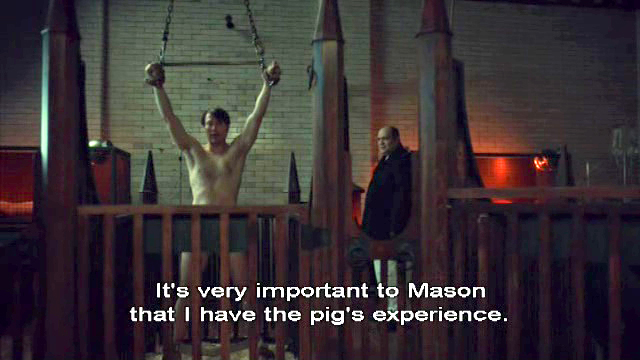
Mason always carries a little knife that belonged to his father. Perhaps it’s the same one that he used to slice off his face. His father would test the depth of fat on a pig’s back by poking him or her with this knife, something neither the pig nor farmer found terribly acceptable. Now he is doing it to Hannibal. It’s clear that he is planning to turn Hannibal into a pig before he eats him.
Of course, there’s many a slip, as they say, or as Nick Cave says:
“If you’re gonna dine with the cannibals, sooner or later baby you’re gonna get eaten”.
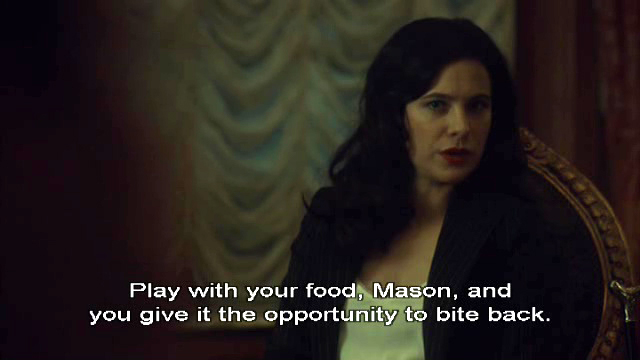
Or as Alana warns:
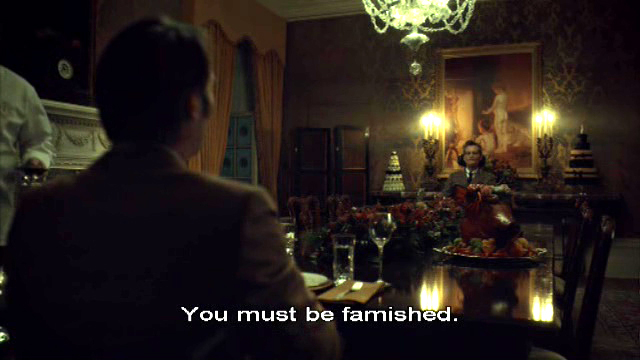
To the sublime tones of the Mozart Piano Concerto 21, Hannibal and Will are dressed and brought to Mason’s table. In the opulent dining room of Muskrat Farm, Mason tells Hannibal that “I snatched Will Graham right out of your mouth.” He is referring to Hannibal’s plan to eat Will’s brain, foiled by the arrival of the Italian police, who were in Mason’s pay.
Hannibal and Mason compare their depth of reading, as Hannibal reminds Mason of the biblical story of Jezebel, who was, like Mason’s face, eaten by dogs. Mason in return spouts a news story he read about “that German cannibal” (he can’t remember the name of Armin Meiwes?) who advertised on the Internet for someone who wanted to be eaten.
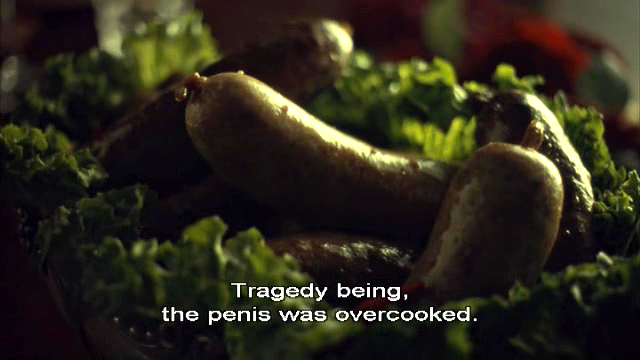
The cannibal and the intended meal ate the man’s penis together before the latter died and was packaged up in the freezer. Mason’s assistant, Cordell, arrives hilariously at that moment with some pork sausages, thus emphasising the human/pig parallels.
“Go to all that trouble to eat a friend and you overcook his penis. They ate it anyway, they had to, they committed. But they didn’t enjoy it.”
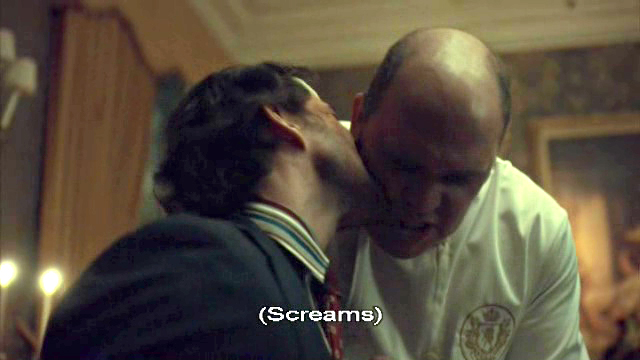
Mason reveals part of his plan – he likes Will’s face, and intends to graft it onto Hannibal before he eats him. The rationale is that Will and Hannibal were both there watching as the dogs ate Mason’s face. They banter pleasantly (Hannibal shows no fear) about the order in which Mason will eat the various parts of Hannibal’s body. Everyone loves to chat about cannibalism! Will’s banter is a little less polite, as he takes a healthy bite of Cordell’s cheek, much to Hannibal`s amusement, and is left with a bloody chin, reminiscent of Anthony Hopkins in Silence of the Lambs. Will has become at least a functional cannibal.
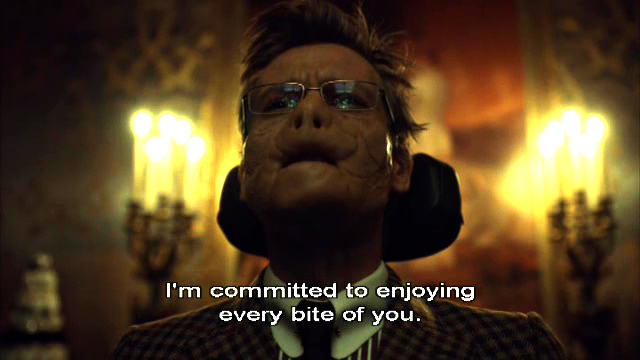
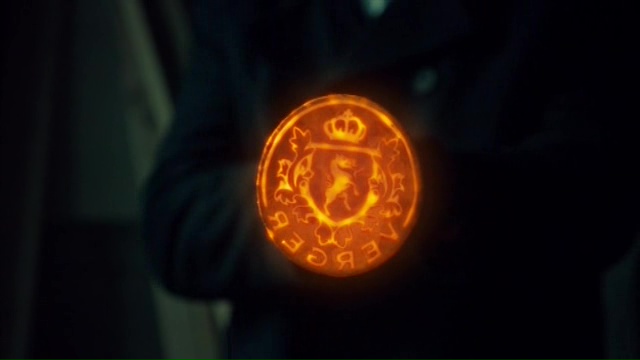
Cordell sews up his own face, then advances on Hannibal with the Verger branding iron. He brands Hannibal with the Verger emblem.
Hannibal is being turned into an edible pig, because as Mason admitted, he did not really fancy eating human flesh. Much easier to eat the animal that daddy made his fortune exploiting, than to eat the man who consistently outsmarted him.
“Mason would have preferred to brand your face. He fought bravely, and with his own funds, against the humane slaughter act, and managed to keep face-branding legal.”
Part of what supposedly makes us superior to other animals is the power of speech. Pigs can grunt and scream eloquently, but they can’t form their words into either maxims or complaints. The tongue is crucial, and Cordell tells Hannibal he intends to
“…boil it, slice it very thin, marinate it in olive oil, garlic, parsley and vinegar.”
Cordell describes the rest of his plans, in something almost out of a cooking show. But looking down appreciatively, he adds
“Every day I’ll feed Mason some new part of you. And don’t you worry Dr Lecter, you will always be cooked to perfection.”
Anyway, we know that nothing like that is going to happen, because we still have six episodes to go. AND SEASON 4 [please?] The rescue involves Alana and Margo, who find that Mason kept Margo’s eggs and that there is a surrogate having her baby.
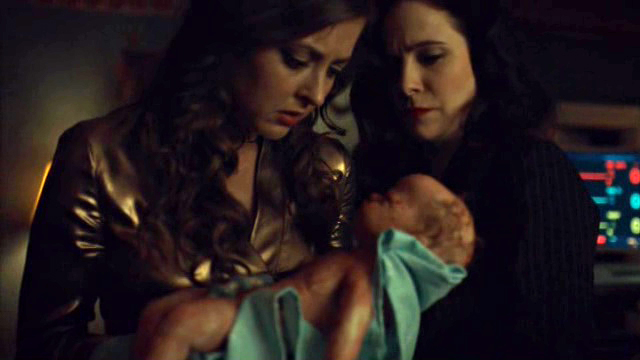
A pig, of course. Not too successfully; the baby is dead, which makes her fighting mad. They head off to kill Mason. First, they release Hannibal, because he has to save Will (about to have his face cut off without anaesthetic). Alana knows that Hannibal promised to kill her at the end of Season 1. But she has no other choice if Will is to survive.
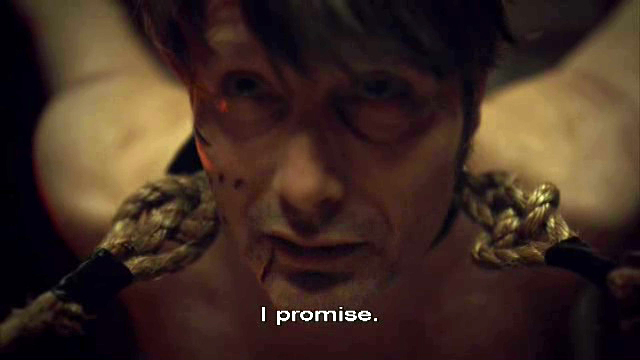
“You’re the only one who can save Will. Promise me you’ll save him?”
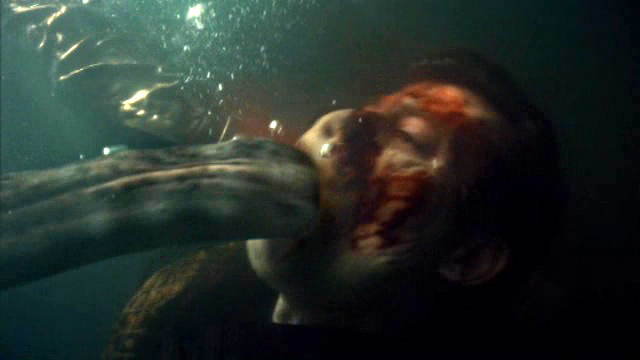
The “abyss” that Heidegger described between human and animal is further breached as Mason is eaten by his pet eel. Or chokes as he eats the eel. All lines are crossed.
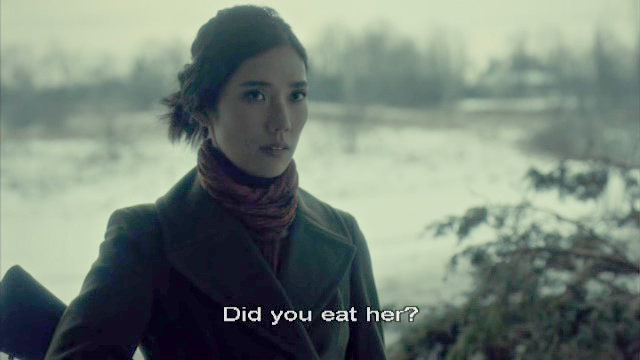
Having saved Will, Hannibal finally meets up with Chiyoh. She is willing to watch over him, but not in a cage: “Some beasts shouldn’t be caged.” Her obsessive hunt, she tells him, was motivated not by his plight or hers, but Mischa’s.
“Yes,” says Hannibal, “but I did not kill her”.
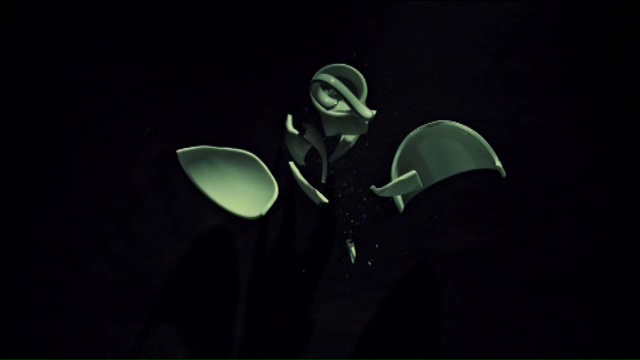
We see the broken teacup that has bothered Hannibal throughout the books, movies and this TV series. Can time reverse? Can we undo what has been done?
As he waits for Will to recover and awake, Hannibal is working on some higher level calculus, presumably still trying to work the maths on how to reverse time.
But Will is having none of it.
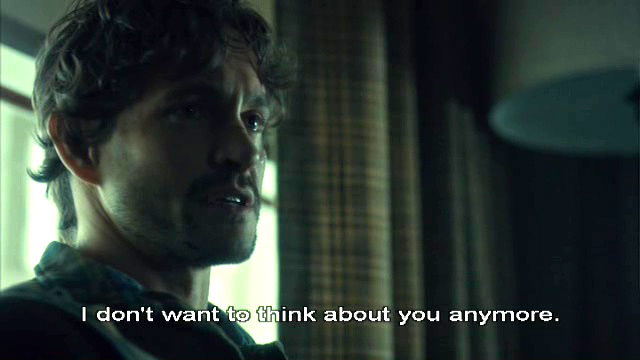
“I miss my dogs. I’m not going to miss you. I’m not going to find you. I’m not going to look for you. I don’t want to know where you are or what you do.”
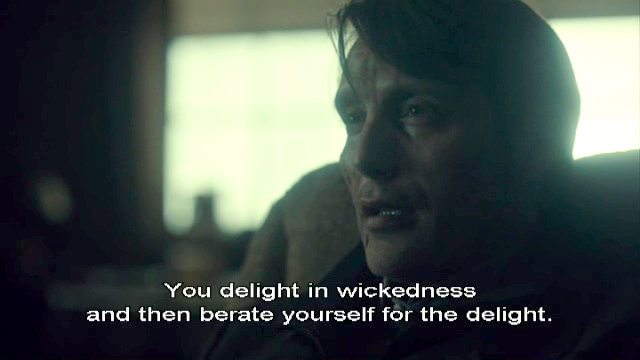
“You delight. I tolerate. I don’t have your appetite.
Goodbye Hannibal.”
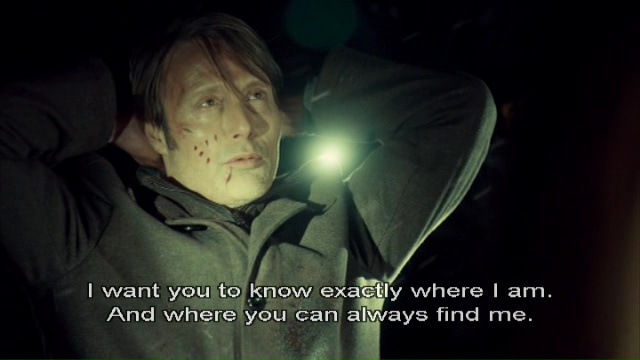
The digestivo here is a bitter drink – look at Hannibal’s face. Takes a hell of an actor to portray strong emotion so simply. Will has divorced Hannibal. But Hannibal is not giving up – he never does. He escapes before the FBI arrive, but then returns and surrenders.
Next episode, Will takes on the Red Dragon, but – can he do it without Hannibal? Silly question really, don’t know why I bothered asking it.
Cannibalism is at its heart all about food, food from a particular species of animal. This episode, Contorno (Italian for side dishes) is also about food – our choices, our enjoyment, how food affects us and how it identifies us.
We start with Chiyoh and Will on a train to Italy. Chiyoh fills in a little bit of what we don’t know about the early Hannibal. Chiyoh was sent to be attendant to Hannibal’s aunt, Lady Murasaki. The young Hannibal was there, an orphan. He was meant to be with his sister, but he was alone. We don’t know why, although we will be told (episode 7) that Hannibal ate, but didn’t kill, his sister, Mischa.
They get talking about snails, a side dish of which we know Hannibal is inordinately fond, particularly when they have been snacking on human flesh. Chiyoh observes:
“Birds eat thousands of snails every day. Some of those snails survive digestion and emerge to find they’ve travelled the world.”
Then we see Hannibal feeding snails to Bedelia – he explains that, as a young man, he kept sea-snails to attract fireflies.
“Their larvae devour many times their own bodyweight. Fuel, to power a transformation into a delicate creature of such beauty.”
Snails, Hannibal tells Bedelia, follow their nature. She dismisses his metaphor: fireflies live such brief lives. A bit more evidence follows that Hannibal is a Nietzschean:
In a scene in which Hannibal is clearly checking whether Bedelia is ready for dinner yet (his), they move on from snails and fireflies, a story about transformation, to a discussion on Hannibal’s other main interest: Will Graham. In particular, Will’s fascinating struggle to retain his ethical certainty in the face of Nietzsche’s amor fati – the love of fate, and his true nature as a hunter.
Bedelia protests: “Almost anything can be trained to resist its instincts. A shepherd dog doesn’t savage the sheep.”
Still on the food theme, Alana has laid out Hannibal’s table setting for Mason Verger – she has worked out that he can be traced through his exquisite purchases, just the way Clarice did in the book Hannibal. She has tracked him to Florence through receipts for Bâtard-Montrachet (Chardonnay) and tartufi bianchi (white truffles). Mason, never one for social niceties, observes that Hannibal must have liked the taste of her too, and perhaps she enjoyed her own taste of him. He offers a double-entendre that the Guardian critic described as
“actually the most disgusting part of the episode. That’s pretty impressive given the extreme close-ups on snails and Pazzi’s bowels flopping to the ground as he is hanged from a window”.
Chiyoh is not really getting Will. She cannot seem to see the attraction between the men, just the shared aptitude for violence: “If you don’t kill him”,
He agrees. So she pushes him off the train. As you do.
No humans were eaten in the making of this episode; snails are the man-eaters. But we do get the gory killing of police inspector Pazzi, who goes as his ancestor went – hanged with his bowels out as punishment for treachery. His ancestor tried to kill Lorenzo the Magnificent in 1478; this Pazzi recognised Hannibal and tried to sell him to Mason Verger rather than turn him over to the FBI.
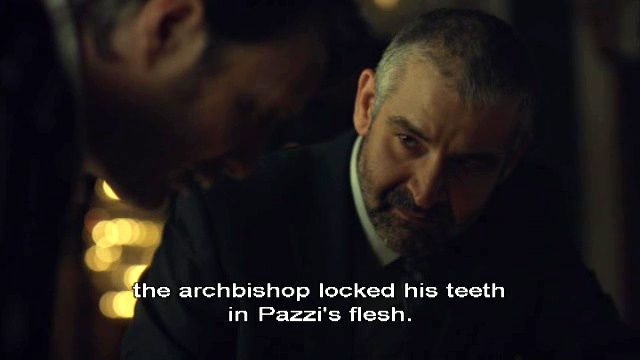
Hannibal shows Pazzi a woodcarving of his ancestor’s death, and mentions that the Archbishop bit Francesco.
Running out of time, Hannibal just tells Pazzi “I’ve been giving very serious thought to doing the same” (although in the book and film Hannibal, this line was “I’ve been giving very serious thought to eating your wife”).
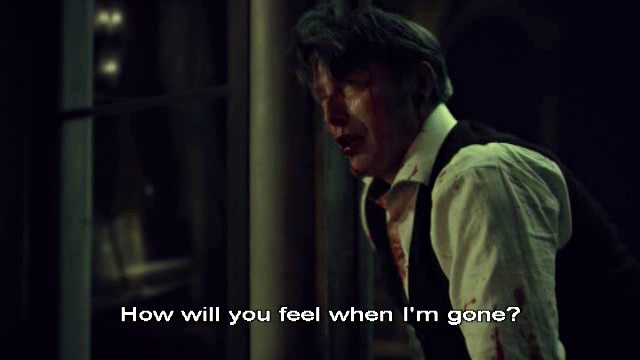
No one actually gets eaten, but Hannibal gets a solid beating from Jack Crawford, who has just dumped his wife’s ashes in the Arno and is fighting mad, particularly after spending the afternoon with Pazzi’s soon-to-be widow. Some readers interpret this scene as Hannibal finally discovering he is not as smart and invulnerable as he thinks, but I hold to the oft-stated theme that Hannibal is always way ahead of the plot. The beating that Hannibal takes is almost without resistance; as if he somehow feels that he owes Jack a chance at revenge for betraying his friendship, a chance to grow into a predator.
So Jack pushes Hannibal out the window, but he catches himself on Pazzi’s corpse and limps off. The inspector is without his bowels, but not without his uses.
There was a “Hannibal” in Proust: Comte Hannibal de Bréauté-Consalvi in The Guermantes Way. Now there is some Proust in Hannibal – everything in this episode is à la recherche du temps perdu – “Remembrance of Things Past” or, more accurately, “In Search of Lost Time”.
Hannibal, let’s be clear, gets into people’s heads (including those of his loyal Fannibals). That of course is his job as a psychiatrist, but he takes it well beyond work hours, getting into the heads of everyone with whom he deals, including Miriam Lass, who was his captive for a long time, and shot Frederick Chilton, because Hannibal was in her head.
It’s episode 4, and we are finally finding out what happened to all the people knifed, shot and pushed out of windows (or made to eat their own faces) in the previous season. Those still alive have it in for him, are hunting him in their own ways. Mason Verger, whose fortune is based on breeding and killing pigs, wants to catch Hannibal and feed him to those pigs. He has offered a reward of one million dollars for his capture. Chilton, less one eye and half his teeth from Miriam’s bullet, just says “Happy hunting!” Verger’s words about Hannibal are taken from the Bible, the Book of Job, where Satan tells God he has been “going to and fro on the earth, and from walking back and forth on it”. He is relating Hannibal to a supernatural being: Satan. But also to an edible being: a pig. This can’t end well.
We know Will was cut up good in his last dance with Hannibal, but we get a new perspective in the next scene after the credits – we are inside Will’s body cavity, in the coil of guts, looking at the stomach skin as it is punctured by Hannibal’s linoleum knife. Waking up in the hospital, he is visited not by Abigail, as he had hoped and imagined in episode 2, but Chilton, who wants help catching Hannibal, who would be a prize specimen for his “hospital” for the criminally insane.
Will spurns Chilton’s offer of compassion and friendship, which leads to one of Chilton’s best lines of the show:
The optimist believes we live in the best of all possible worlds;
Will is still imagining scenarios – in the next scene, he and Hannibal are plunging knives into Jack Crawford in a scene that could only have been inspired by Julius Caesar.
But Will finally didn’t go with Hannibal, and Jack’s not dead – he’s tracking to Will’s boatshed to seek Will’s help, just as he did at the beginning of Red Dragon, where the whole saga started. Will admits that he warned Hannibal, wanted him to run, because “he was my friend”,
Alana is still alive too, despite being pushed out of a first storey window. She wakes up full of rods that hold her together. The doctors have told her that a lot of marrow got into her bloodstream from her multiple broken bones, so she should expect to think differently. And she does.
She goes to see Mason Verger, who tells her he has found religion, been saved by the risen Jesus or, as he familiarly calls him “the Riz”. As a believer, he says he has forgiven Hannibal. Alana is not so convinced.
Jack remembers his apparent death at Hannibal’s hands, but has somehow recovered. His health, not his career – he has been forced to retire from the FBI. The culture has found a new nightmare to slap its clammy flab and ruin its sleep.
He also remembers waking up in hospital, lying next to Bella, his wife, who is continuing to die without him as it turns out. He takes her home, sits with her, holds her while her heart stops and her brain dies. He dresses for church and visualises their wedding, but it’s a funeral, she is in a casket, and there is a splendid bouquet from – who else – Hannibal. The card contains a John Donne poem and finishes “I’m so sorry about Bella, Jack”. Fighting to the death does not, apparently, reduce the respect or affection Hannibal feels for his opponents.
Everyone, everyone alive that is, wants to find Hannibal, and most of them want to kill him. What does Will want, as he embarks on a sustainable sailing voyage to Europe to find Hannibal? We don’t know. Mason Verger is talking transubstantiation – his face has been (somewhat) restored by extensive surgery, now he wants to transubstantiate Hannibal. In most ceremonies
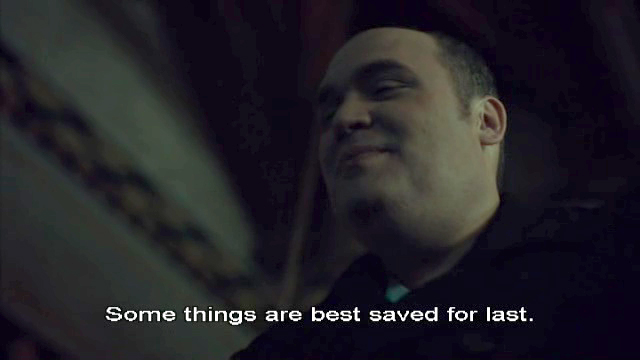
He is planning a more elaborate ceremony. He tells his major-domo nurse Cordell
Alana is helping, telling Verger that Hannibal will be traceable because, wherever he goes, he will be ordering the very best wine, truffles, etc. She tells him “You’re preparing the theatre of Hannibal’s death. I’m just doing my part to get him to the stage.”
It sounds like they are all conspiring against poor Hannibal. But remember what Alana told Jack when they thought they were outsmarting him – Hannibal is always in charge of the narrative. Whatever the others are doing, he wants them to be doing. Or as Bedelia said, he is drawing them to him. Nietzsche wrote:
“In your friend, you should possess your best enemy. Your heart should feel closest to him when you oppose him.”
While everyone else is remembering things past, or searching for lost time, Hannibal is making friends.
Season 3, and particularly this episode, is presented as Gothic horror. There are dark churches, gloomy castles, even Hannibal’s shadowy kitchen, where he is removing a hand from the Sunday roast.
This episode is all about identity. All our protagonists (if still alive) have gone through trauma, Will and Jack were clinically dead for a while, and such trauma usually leads to questioning – who am I, what am I doing, and what is this on my plate?
It’s the third episode of the final season (looking forward to being proved wrong here), and we still don’t know what happened to many of the victims of the last series. Hannibal of course is doing nicely in Florence under the name of Dr Fell, Curator at the Palazzo Capponi. Bedelia is living with him, a somewhat nervous room-mate, pretending to be Mrs Fell, but there is no sign of intimacy, and some definite portents of doom. Last episode, she witnessed the murder of Anthony Dimmond. Dimmond knew Hannibal was not Fell, and was duly killed with a bust of Aristotle (was it really Aristotle?) Hannibal, who believes Bedelia betrayed him, explained to her that she was not just observing the murder, she was participating. She knows, Dimmond knew, we know, that she is slated to be one of his next courses.
They speak, somewhat obsessively, about betrayal (not just Bedelia’s, but Will’s) and forgiveness. Hannibal forgave Will last season. Will forgave Hannibal last episode. Bedelia points out that betrayal and forgiveness are
Hannibal is looking wistful. It is possible that he has not experienced love before, or at least not since the happy time before he ate his sister, Mischa. This is his search for identity – Hannibal as lover.
Will has two searches. He is of course searching for Hannibal, for love of for revenge is not clear to us, or to him. He is also searching for his own identity – is he a lawman or an acolyte of Hannibal? Where will he look?
Will is in Aukštaitija, Lithuania. It’s the Lecter castle, which we last saw in the movie Hannibal Rising. Bryan Fuller, in his incomparable way, has brought to life a character who had a minor role in the book and no part in the movie – Hannibal’s aunt’s protégé, Chiyoh.
Will walks past the grave of Mischa. He treads Hannibal’s sacred ground.
He imagines a conversation with Hannibal, who tells him
“It’s not healing to see your childhood home – but it helps you measure whether you are broken, how and why, assuming you want to know… Its door is at the centre of my mind, and here you are feeling for the latch.”
Hannibal’s identity is all tied up with the tiny girl who someone killed, and Hannibal ate.
We see Chiyoh shoot a bird and cut off the bird’s feet. The scene switches to Hannibal cutting off a human hand, presumably Dimmond’s. Then he is making cocktails for Professor Sogliato, the epitome of rudeness and intellectual pretension. The cocktail is Punch Romaine, a drink, he tells Sogliato, served to first class guests on the Titanic during their last dinner. Not a good omen. Sogliato has bad timing, and makes his one snide comment too many just as Hannibal is wielding the cocktail ice-pick.
Sogliato, his frontal lobe partly destroyed, can only stutter and giggle. Bedelia, even though she is a trained doctor, pulls the ice pick out, and Sogliato immediately collapses on the table.
Witty as ever. Bedelia asks if Hannibal is longer interested in “preserving the peace you found here?” Hannibal understands physics as well as medicine.
Hannibal grows through conflict and engagement; it’s all a giant game of life and death to the evolving Übermensch. But it was far from impulsive. Bedelia sees what he is doing: the Titanic cocktail was a giveaway.
He is drawing Will, who is of course in Lithuania, when Jack arrives in Italy. Jack is seeking not Hannibal, but Will. He has broken Will, perhaps turned him into Hannibal’s disciple, and while he would like the Italian police to find Hannibal, his main concern is Will.
Chiyoh is guarding a man, a wild, Robinson Crusoe type figure who, she says, is the one who ate Mischa. Fed her to Hannibal we suppose (that’s how it went in the movie). Hannibal is serving dinner to another couple from the Studiolo, who are lamenting the absence of Sogliato (who is probably at, or on, the table, unbeknownst to them).
Hannibal wanted to kill the dude in the cage, but Chiyoh wouldn’t let him, so he left her to guard the man, for years and years. Will sets the man free, but he returns to his cage and tries to kill Chiyoh, and she then kills him. She accuses Will of doing it for the same reasons as Hannibal would – to see if she would kill. But he says he just wanted to set her free.
But here’s the thing. Our motivations for our actions come from our stories. As Will says:
“We construct fairy tales and we accept them. Our minds concoct all sorts of fantasies when we don’t want to believe something.”
Chiyoh believes Hannibal’s story about the man in the cage. She believes that his cannibalism is simply a re-enactment of what he saw happen to his sister. Will has doubts.
What makes Dr Lecter into “Hannibal the Cannibal”? Was it watching his sister slaughtered and eaten? Will argues this does not “quantify” him. Remember an earlier Hannibal who objected to being “quantified” by a census-taker? Remember also that thousands of people have watched appalling brutality being visited on their families and not reacted as Hannibal does.
We have not finished considering that question. Hannibal is washing Bedelia’s hair as she luxuriates in the free-standing bath tub. She asks him “What were you like as a young man?” His answer reminds us that Mads is playing the role as a demonic force.
So, Bedelia asks the same question that Will and Chiyoh are covering. “Why can’t you go home, Hannibal? What happened to you there?”
In Silence of the Lambs, this was followed up with
“You can’t reduce me to a set of influences. You’ve given up good and evil for behaviourism… Look at me, Officer Starling. Can you stand to say I’m evil?”
Will took on that speech, back in Season 2, during their cannibal feast. But here, Bedelia is winning the debate. She has already told him that she knows he is drawing Will and Jack to him with his murders, and warned him that he will get caught. Diving under the water, she cheekily asks
Bedelia is once again Hannibal`s therapist; her fee is staying alive. She tells him that
“What your sister made you feel was beyond your conscious ability to control or predict. I would suggest what Will Graham makes you feel is not dissimilar. A force of mind and circumstance.”
“Same with forgiveness. And I would argue, the same with betrayal” comments Bedelia.
Bedelia plays her trump card.
“If past behaviour is an indicator of future behaviour, there is only one way you will forgive Will Graham.”
Season 2 ended with pretty much all the main characters lying dead or dying in pools of blood, except for Hannibal, who was sitting on a plane with a glass of champagne and his former psychiatrist Bedelia next to him.
The first episode of Season 3 saw Hannibal very happily ensconced in Florence with a new name, a new job, and a chance to show off his expertise in Dante’s sonnets, of course delivered in perfect Italian. So happy, he had hardly killed anyone, although that had changed by the end of the episode.
But what of the gore-splattered rest of the cast? Did any of them live to see Season 3? Well, some did of course although, in some cases, only just. The episode starts with a long reprise of what happened to Will and Abigail, but it’s all in Will’s fevered dreams as he lies in hospital, and he sees it as the killing of his higher self: blood pours out of a dying stag and fills the room – he is sinking, in an ocean of blood.
This is a love story, but of star-crossed lovers. In this case, double-crossed lovers.
Time did reverse. The teacup that I shattered dared to come together. A place was made for Abigail in your world. That place was made for all of us. Together. I wanted to surprise you.
And you… you wanted to surprise me. I let you know me. See me. I gave you a rare gift.
The teacup is a crucial symbol to Hannibal. It represents two important discourses that inform his somewhat unorthodox life choices: Nietzsche’s concept of amor fati – the love of fate, the acceptance that what has happened could not have happened any other way, and will happen again, and again. It is not fatalism though, in which we can sit and wait for the inevitable – Nietzsche and Hannibal want to be out there making it happen as it should, as it will, as it must.
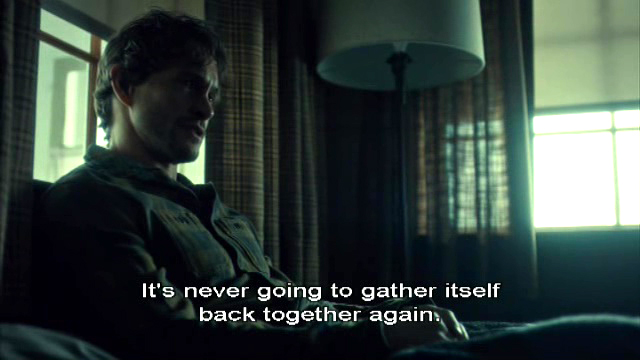
Hannibal wants to speed up the cycle of eternal recurrence, reverse time and repair all that has been lost, particularly his sister, Mischa, who was eaten. He is obsessed with Stephen Hawking’s description of entropy as proof of the “arrow of time” – we “know” that time only flows one way because a shattered teacup does not gather itself back together. Hannibal really likes Hawking’s early theory that, when the universe stops expanding and starts contracting, time will reverse and entropy mend itself; the teacup will mend, Mischa will be whole again, Abigail will be returned to Will. Undoing all the bad things that happened. He just wants to speed things up.
Has the teacup re-formed after all? Abigail wanders into Will’s hospital room as he wakes up.
Will is hallucinating, but it gives him a chance to state his own metaphysical opinions. Will is more a follower of Leibniz; he thinks there are an infinite number of universes and everything that can happen will, does, did happen in one of the multiverses. Just, not in this one, which makes him sad.
It has to end well. And it has to end badly. It has to end every way it can.
OK, but Abigail wants them to find Hannibal, or rather believes the Hannibal wants them to find him. Even after all that happens, she wants to go to him. And so, of course, does Will, although he won’t admit it. He remembers Hannibal taking about his “memory palace”, a place where memories can be stored and restored, and brought out and relived even, or especially, in bad times. Hannibal’s palace is “vast, even by mediaeval standards” and
Off to Palermo goes Will and, maybe, Abigail, and meets Inspector Pazzi, who has been chasing Hannibal for twenty years. As a young man, Hannibal was “Il Mostro”, the monster of Florence, and would kill people to make them into art works, particularly based on Botticelli’s Primavera. A real case, which remains unsolved.
We hear more philosophy – Will has taken on Hannibal`s theology; as far as God is concerned
Elegance is more important than suffering. That’s his design.
Then he gives us his views on Hannibal`s motivations: it’s all about fun. This is basic Hannibal philosophy, going all the way back to his letter to Will Graham in the book Red Dragon.
Hannibal’s not God. Wouldn’t have any fun being God. Defying God – that’s his idea of a good time. Nothing would thrill Hannibal more than to see this roof collapse, mid-Mass, packed pews, choirs singing, he would just love it. And he thinks God would love it too.
And of course, the roof starts to drop a fine powder on Will’s outstretched hand.
Inspector Pazzi points out that Hannibal never leaves evidence.
Which raises the big question – what exactly is cannibalism? Was Jame Gumb a cannibal when he used women’s skin to make a “suit with tits” (which he will hopefully be doing again in Season 4)? Was Francis Dolarhyde a cannibal for killing whole families to fuel his radiance (as he will do again later in Season 3)? Hannibal eats people when he can, and when he wants to, but didn’t Jack Crawford enjoy his elegant dinners at Hannibal`s house, pretending to be a friend, knowing what was probably being served? When Will brought the long pig, pretending it flesh of Freddie Lounds, was it really Randall Tier they were eating? Hannibal sure as hell knew it wasn’t pork. Will happily ate it.
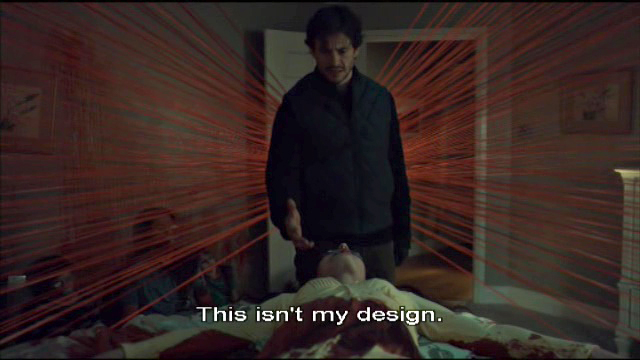
Now Hannibal has found a new, non-gustatory use for human bodies: art. He has taken the body of the annoying art student he killed last episode, and made it into a heart, his heart, broken by Will’s betrayal and the loss of the space he made for them. Will uses his powerful forensic imagination to read Hannibal`s design:
I splintered every bone. Fractured them. Dynamically. Made you malleable. I skinned you. Bent you. Twisted you. And trimmed you. Head hands, arms and legs. A topiary. This is my design. A valentine written on a broken man.
Hannibal is – complicated. Will explains to Abigail that “he follows several trains of thought at once without distraction from any – and one of the trains is always for his own amusement.”
He gave you back to me, then he took you away. It’s Lucy and the football; he just keeps pulling you away. What if no one died? What if – what if we all left together? Like we were supposed to. After he served the lamb. Where would we have gone? …A place was made for you Abigail, in this world. It was the only place I could make for you.
Will finally realises that Abigail is dead, and he is talking to his delusion, to his own subconscious thoughts (which are dominated by finding and rejoining Hannibal). He heads through the arch into the catacombs; he knows Hannibal is waiting in there. Pazzi is behind him, despite Will’s warnings that Hannibal will kill him. Pazzi wants to know what Will might do when/if he finds your Il Mostro?
In an atmospheric scene somewhere between Phantom of the Opera and The Name of the Rose, Will and Hannibal wander the winding tunnels, Will calling Hannibal’s name, Hannibal silent. Waiting for Will to say it. At the end of the last season, Hannibal had said to Will as he cut him up “I forgive you, Will. Do you forgive me?”
We finally get the answer.
Next week: a new cannibal movie from Brazil: THE CANNIBAL CLUB
The TV series Copycat Killerswhich debuted in 2016, attempts to match real-life crime with murder cases in film. The premise is really a bit of a long-shot. For example, episode 4 is called “Silence of the Lambs” and shows long lingering shots of the naked butt of serial killer Jame Gumb (Buffalo Bill). It covers the case of a 14-year-old boy, Michael Hernandez, who cut the throat of a friend, and years later joked on the phone, from jail, about “skin suits” (Gumb’s main preoccupation) and Mason Verger cutting off his own face. The boy also, the judge revealed, listened to death-metal band Cannibal Corpse, a group that thrives on notoriety and violent lyrics, but does not, as far as anyone is aware, actually eat people or recommend that others do so. So this boy did not skin people, like Gumb, nor did he eat them, like Lecter.
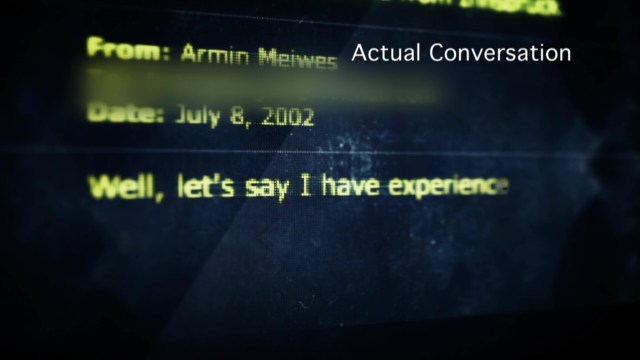
The episode reviewed in this blog, episode 8, is also Hannibal Lecter-based. This particular killer, a German named Armin Meiwes, was nothing like the Hannibal in the books, the movies or the television show. Nonetheless, when the police searched his house, the solemn narrator tells us:
“even the most jaded detective on that case was sickened by what they found in that freezer…. Police had discovered a real life Hannibal Lecter.”
Pictures of Meiwes and Lecter are flashed on screen consecutively, to draw a visual conclusion that is hardly supported by the text.
An actor re-enacting the Meiwes story cuts meat and drinks wine, which an on-screen expert (crime writer Lisa Coryell) compares to Hannibal’s line from the movie Silence of the Lambs “I ate his liver with fava beans and a nice Chianti”.
A Professor of Film Studies at the American University explains that Lecter’s elegance, charm and humour makes him “irresistible”. Hannibal, he says, is the top movie villain of the century, and there isn’t even a close second.
Meiwes, a German computer technician, advertised on a fetish website called The Cannibal Café for “a well-built 18 to 30-year-old to be slaughtered and then consumed”. He actually received a heap of replies, but the only one that seemed sincere was Jürgen Brandes. The two met in 2001, had sex, then Brandes took a lot of sleeping pills and half a bottle of schnapps, and they collaboratively sliced off Brandes’ penis and tried, unsuccessfully, to cook and eat it with salt, pepper, wine, and garlic (it ended up in the dog’s bowl). Brandes went off to die in the bath while Meiwes read a Star Trek novel and, when he found Brandes still alive and suffering hours later, killed him and proceeded to eat quite a lot of him over the coming weeks and months.
When Meiwes started running low on flesh, he advertised again, and this time one respondent reported him to police, who found some of Brandes still in the fridge. Meiwes was charged with manslaughter as he had killed Brandes (at worst it was assisted suicide), and was sentenced to eight years. Due to the ensuing publicity, a retrial was ordered and he was convicted of murder, on the grounds that he had talked Brandes into giving permission to kill him, for his own sexual pleasure.
Silence of the Lambs and its sequel Hannibalcaused, we are told in this doco, a surge of interest in cannibalism, leading Meiwes to pursue his obsession with cannibalism. Still didn’t make him into Hannibal though, IMHO.
A forensic psychologist who glories in the name Dr J. Buzz von Ornsteiner: tells us “I’ve worked with a lot of criminals within my criminal history. But this is by far the worst case I’ve ever encountered.”
The recreation goes into Meiwes unfortunate history with his controlling mother, one more thing that he and Hannibal do not have in common (you may remember from Hannibal Rising that Lecter’s mother was a delightful woman, who was killed in a duel between a tank and divebomber while he was still a small boy).
At the same age, Meiwes father left the family. From this trauma, we are led to believe by Dr Buzz, Meiwes decided the best way to keep people in his life was to eat them. The crime writer explains to us that
“If you’ve experienced loss as a child, as Armin clearly did, cannibalism is one way, it’s a sick way, to make sure that no one ever walks out on you.”
Now the idea that Meiwes and Lecter are cannibals because they lost one or more parents is pretty terrifying, since there are a lot of people to whom that applies. On that logic, you might as well suspect Princes William and Harry. However.
Once mum died, Meiwes was free to get on the internet and find others interested in his hobby.
Lisa Coryell (the crime writer):
“You couldn’t look at the facts of this case and not think of Hannibal Lecter.”
Well, actually, I think I could. Meiwes joined a chat room, something Hannibal did not do and would not do, even in the TV version (set in the Internet era). Brandes, his co-conspirator, wanted to be killed and eaten. Meiwes and Brandes were both convinced that this act of cannibalism would make their bond permanent. It is possible that Hannibal believes eating Will Graham would help Hannibal forgive him for his betrayal. Will, however, was not a willing collaborator in such a scheme.
Is there anything Meiwes has in common with Lecter? Buzz points out that “Somehow between these two men there doesn’t seem to be any value for human life”. I guess Hannibal would agree that human life is not sacred in any way, and that rude people are good to eat. Meiwes, on the other hand, seemed to have liked Brandes, and wanted to keep him around, or more accurately inside.
Brandes wanted to die, but he wanted to taste human flesh before he did so. The show finds a Hannibal parallel here: Hannibal feeding Ray Liotta’s character, Paul Krendler, a portion of his own brain in the movie Hannibal. But of course Krendler was not a willing participant, and once his frontal lobe was on the hotplate, he couldn’t be said to have had any opinions at all.
The rest of the documentary is full of some painful reminders of the speciesism with which philosophers from Aristotle to Descartes to Kant, and even Derrida, have considered the abyss between human and “animal”.
Lisa Coryell:
“Armin begins drawing on Berndt’s body to map out the places he wants to eat most. Armin was treating Brandes like a piece of meat, like an animal for slaughter and it defies humanity.”
It wasn’t of course “like a piece of meat”; it was exactly as a piece of meat. The commentators assume that we, humans, are not animals and are not made of meat, which is ludicrous.
Buzz sums up:
“he doesn’t think there anything wrong with killing someone provided they want to be killed.”
I spat out my tea at this point. It just reminded me of the scene from Douglas Adams’ Restaurant at the End of the Universe:
Arthur: I don’t want to eat an animal that’s lying there inviting me to. I think it’s heartless!
Zaphod: It’s better than eating an animal that doesn’t want to be eaten.
The grave tone of the narrator and commentators of the show, and the ominous music, are intended to convey the extreme gravity of Meiwes’ crime. Meiwes meanwhile has reportedly been a model prisoner, and has also become a vegetarian. In 2018, his appeal to be eligible for release one day (he was given a life sentence) was denied, and he will probably die in jail.
Yet, when compared to other crimes, what has Meiwes actually done? He sought willing victims, men who wanted to die and fantasised about being eaten after their death. He helped Berndt commit suicide, delivering the coup de grâce only when he found Berndt still suffering hours later. He then followed Berndt’s fervent wishes by eating large parts of the man’s corpse. The police originally could not charge him with murder, because there was no evidence that he had intended to kill, until the suicide went wrong and he saw it as an act of mercy. It was the cannibalism that inflamed public opinion around the world, and forced the police to cobble together an appeal, which claimed that he had influenced Berndt to agree to the scheme, which was a bit absurd (he actually offered to take him to the train station if he got cold feet). The problem was that there was no law against cannibalism, and still isn’t in most of the world.
So the parallels with Hannibal Lecter are bizarre. Hannibal killed and ate people he considered rude and discourteous. He felt that they deserved it, that he was improving the gene pool maybe. He considered himself superior to the people he ate, just as the average carnivore considers himself superior to a cow or a pig. But what Hannibal does is considered murder, because of his intentions and the fact that the victims presumably did not want to be killed or eaten.
But after considering the case of Armin Miewes, we have to consider the question: if a being wants to die, and you help him along, and then eat him, is that really worse than confining a being who doesn’t want to die (from any species), deliberately killing him or her (or paying someone else to do so) and then eating their flesh? Which is what we humans do well over eight million times every hour of every day.
This issue is discussed in a simpler form in the Australian television series Rake. In a re-imagined version of the Meiwes case, the cannibal is a respected economist and the victim’s suicide is successful. There is no murder; all the economist does is eat the body, yet is told “you ate someone. You’re never going home”. Is that scenario also worse than the intentional killing of a cow or pig for human consumption?























 The Cannibal Guy