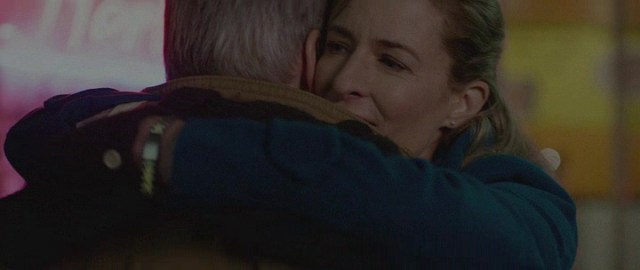
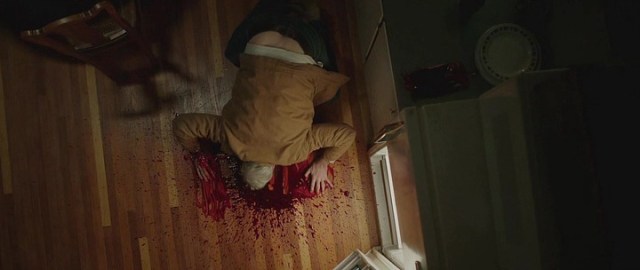
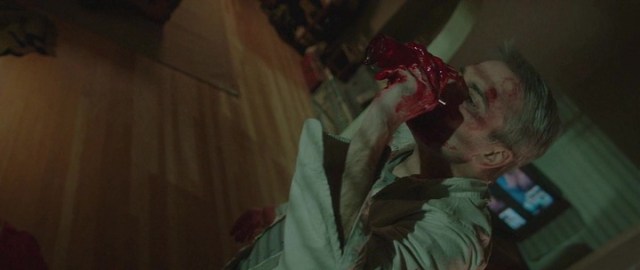
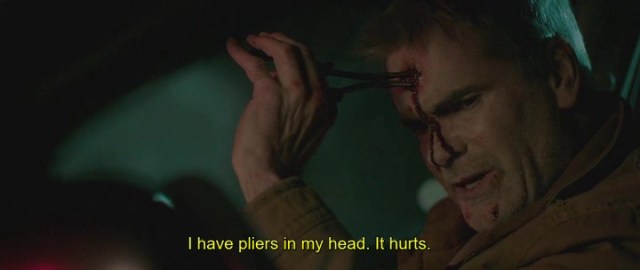
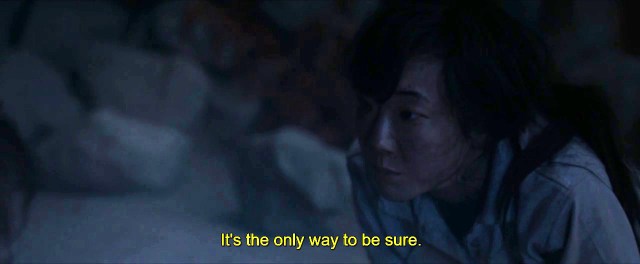
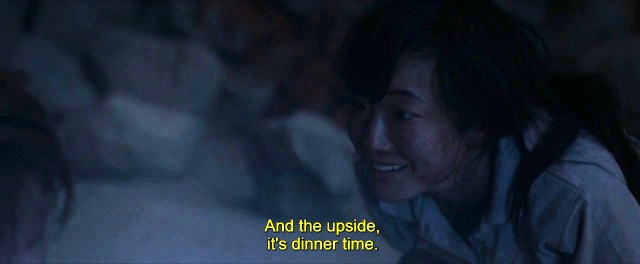
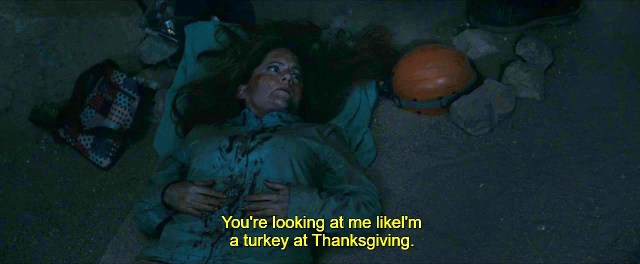
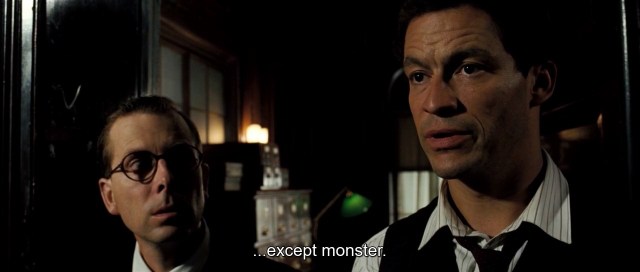
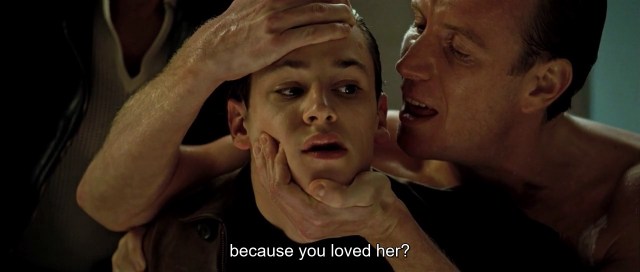
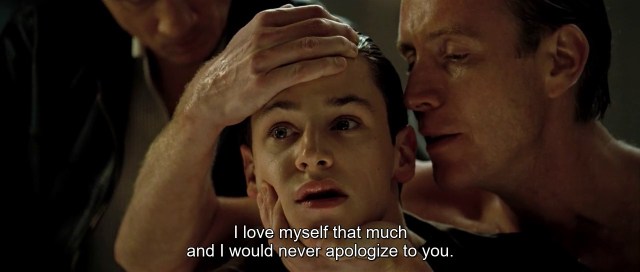
American cannibal: THE DONNER PARTY (T.J. Martin, 2009)

The Donner Party was the name given to a group of pioneers heading from Missouri to California in 1846. They became snowbound in the Sierra Nevada over winter, and famously turned to cannibalism to survive. Only 48 of the original 87 members of the party survived.

There have been quite a few films and books about the events of that winter, including documentaries such as “Trail of Tragedy: The Excavation of the Donner Party Site by US Forest Service” and an episode of the PBS series American Experience (Season 5 Episode 3) called “The Donner Party” (you’ll need a VPN if you are outside the US). There are also a few supernatural potboilers like Donner Pass, about evil forces that turned poor George Donner and his mates into ravenous cannibals, and will do the same to any nice-looking millennials who stumble into the region. I am not intending to write about them until I run out of movies about “real” cannibals, which looks like it will be in several years, at the present rate.

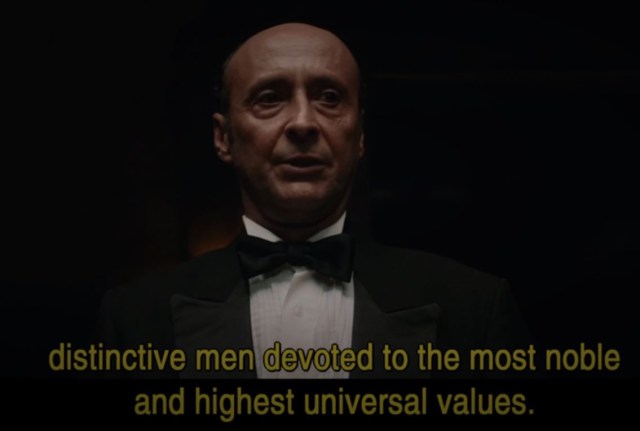
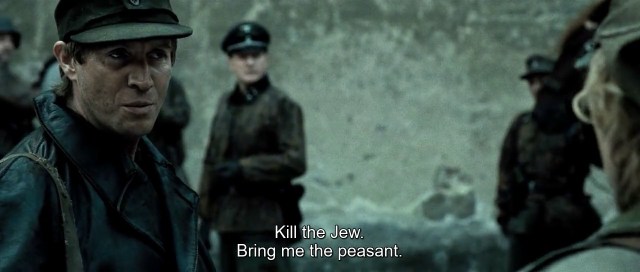
Look, this movie doesn’t mess about with any set up. The opening is some written explanation of how they got into that mess
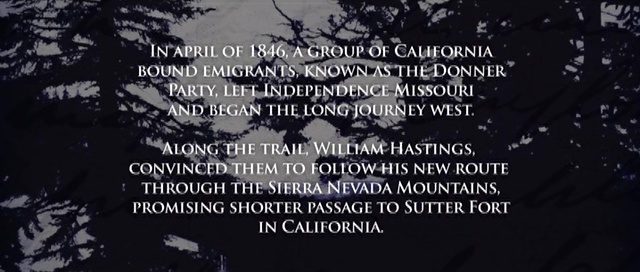
vlcsnap-00001.jpg

Then there’s a dude, who turns out to be William Eddy (Clayne Crawford) pointing a gun, with his voiceover

“In situations like this, some men may abandon their obligations. This being said, I am resolved to provide for my family.”

vlcsnap-00002.jpg

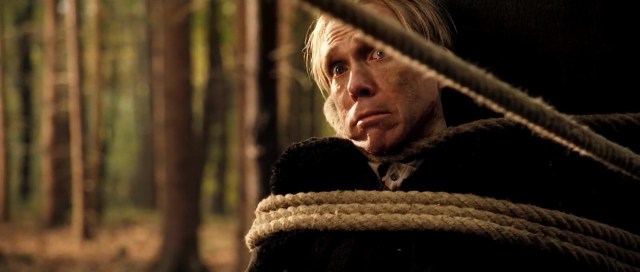
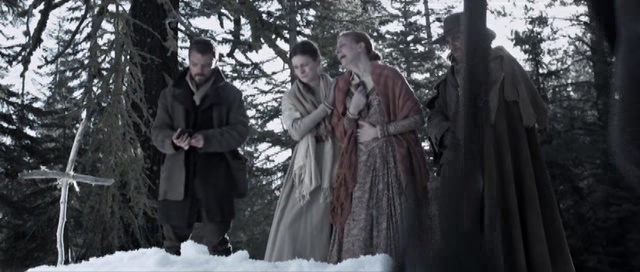
He goes back to camp with some meat (a bear? In winter?) which he shares with William Foster (Crispin Glover from lots of things including Back to the Future and American Gods). Eddy is the group’s guide, and feels that he was pressured to lead them the wrong way, onto the Hastings Cutoff; Foster argues that they all agreed to take the “short cut”. The audience by this point is yawning. From there, as Homer says, “it just gets worse and worse”. The Foster camp is running out of food when the “rescue party” reappears – with no rescue and no food. One of them dies on arrival and they bury him in the snow. Clearly, they had never seen Alive! Once you die, you’re assigned to the frozen food department.
vlcsnap-00003.jpg

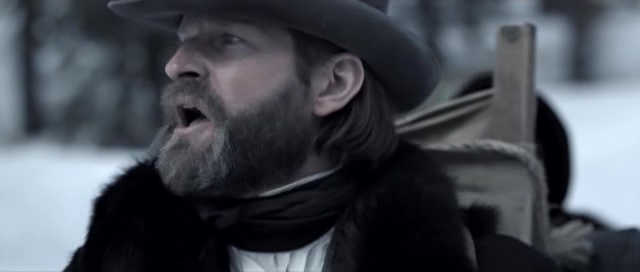
But as they set out for a last ditch expedition, later called “The Forlorn Hope”, Foster boasts that they have maintained a “clear line of civility”. We know from history that this won’t last.
vlcsnap-00004.jpg

There is talk of going back to the camp, but Franklin Graves (Mark Boone Jnr from Sons of Anarchy and Memento) disagrees.

vlcsnap-00006.jpg

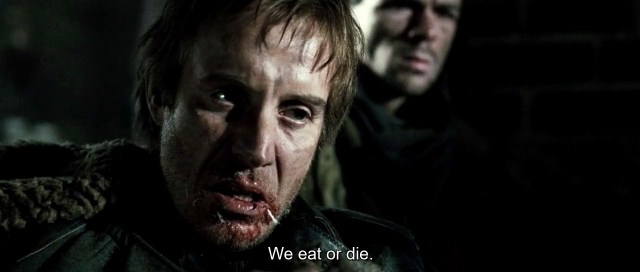
As they get colder, hungrier and weaker, Foster suggests what we’ve been waiting 51 minutes to hear:

“In the misfortune that one of us should pass, in death we may save the living.”

vlcsnap-00007.jpg

In a scene worthy of Monty Python, they all start volunteering. Eddy suggests he and Foster

“fight to the death, the loser dies like a man, feeds the group”.

Instead, they draw straws – Dolan (Crispian Belfrage – who is a bit wasted in this flick) gets the shortest stick and Foster shoots him (not what really happened, BTW). Eddy refuses to join in the lottery or the meal, but then it turns out he has a lump of bear that his wife smuggled into his backpack, so he’s doing OK.

vlcsnap-00008.jpg

Graves stabs himself and becomes the next course. Before each meal, they say grace and thank God for what they have received. When they run out of those guys, Foster decides, against Eddy’s opposition, that the “Indian” guide will be the next course. This is the hierarchy of eating – the plant, the animal, the human, with the sub-human squeezed in there, defined by layers of contemptuous racism that was standard procedure in 19th century America (and in some places still is). Rather than wasting bullets, he uses the gun as a club.

vlcsnap-00017.jpg

There are long scenes of the group trudging through the snow, interspersed with the survivors sitting around the campfire chewing on some guy and looking vaguely disgusted, but not looking all that gaunt. I guess it would require some pretty good makeup or CGI to make someone look to be genuinely starving, so I can accept that.

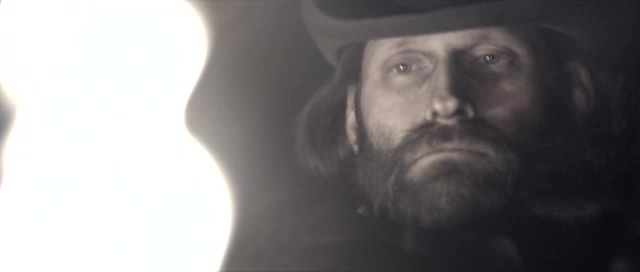
What I found disappointing was the total lack of moral debate – one person complains “we’ll go to hell” and Eddy points out that the “Indian” is a man, but still hands the rifle to Foster so he can do the deed. Foster, the gentleman, points out that he is their only hope because he is the only one willing to do whatever it takes. The fascination of the movie Alive! was the deliberation in the plane of the ethical situation, the immortal soul having fled, etc. This lot are devout enough that they could make it a lively discussion, the nature of humanity, why they think it’s wrong to eat white people but not “Indians”, but it never gets past the look of distaste as they chew on bits of other humans. The best scene is the long shot of Foster, the man of God, the keeper of civility, turning into a cannibal king as he watches his flock, waiting to see who will die next.
vlcsnap-00015.jpg

It’s a fictionalisation of a true event, which is always fraught, because the historians will object to the inaccuracies, and everyone else to the squalid reality. But as an imagining of one incident from the Donner story (Donner himself never gets a look in) it’s not a bad taste of nineteenth century morality and its fragility. The disappointment is that the cannibalism is direct and honest, but never considered as anything other than abject but necessary. This is one of the defining stories of modern America, and much more could have been made of it. However.

Now, I’ve seen some great cannibal films and some pretty awful ones, and I don’t always agree with the verdicts of the reviewers on Rotten Tomatoes, but I think this is the first one I have seen where none of the reviewers even bothered to see it.

HorrorNews.Net gave the film a positive review, writing

“Overall The Donner Party was a nice change from the hard core horror films that I usually watch. … I also recommend that you have something to eat on hand while watching it as I was starving by the time I was done watching it. Then again, maybe I have issues.”

Incidentally, Horrornews.net has released their comprehensive survey of the favourite horror movies of each (US) State:

Best Horror Movies: Which Does Each US State Love Most?

donnerparty2.jpg

The log line “They survived by doing the unthinkable” is clearly borrowed from Alive! (“They overcame the impossible by doing the unthinkable”).
THE CANNIBAL CLUB – O Clube dos Canibais (Guto Parente, 2018)

This is a movie about privilege – the rich literally eating the poor. It may be a metaphor, but it is particularly apposite to current Brazilian politics, where the destruction of the Amazon is threatening to kill and consume us all. But is there a nation, even a community, where someone is not eating someone else, if not literally then practically? The film was made in 2018, before President Jair Bolsonaro was sworn in and gave the green light for the burning of the Amazon rainforest. But the cannibalism of this club is not just political – it is about the consumption of the poor by those who own the wealth. It would have made the same points whatever the results of the election.

cc002.JPG

Otavio (Tavinho Teixeira) and Gilda (Ana Luiza Rois) have a hobby – Gilda seduces members of their staff and Otavio watches from a distance then kills the worker with an axe as they both climax. They then prepare the meat for their dinner.

cc004.JPG

A bit over a year ago, this blog looked at the film “Eat the Rich”, in which the workers fought back against their effete bosses. Pure fantasy of course; in reality, the rich eat the poor: they swallow their surplus labour, they squeeze rent from them, they sell them their shoddy products paid for by lending them money at ruinous rates, and they send their children off to war. Why not go the next step and literally cook them for dinner?

The rich also hang out together with other rich people, and despise the poor. Everything decadent is considered better and more desirable.

cc008.JPG

The club in the title is an elite group of privileged and powerful men – women are not invited. For their pre-dinner entertainment, they sit and watch two performers have sex, during which they are beaten to death and subsequently served at the black-tie dinner.

cc012.JPG

Their chairman is the influential politician Borges (Pedro Domingues) who rails against the depravity of those who threaten the traditional morality of Brazil, whom he describes as “poors, delinquents, pederasts and filthy scum”. That makes is awkward when Borges is seen by Gilda as he is being buggered by a servant.

cc014.JPG

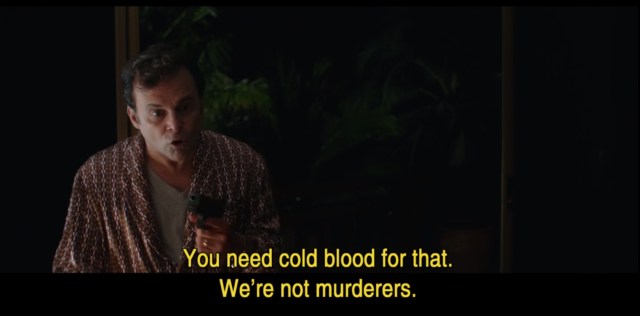
This puts Otavio and Gilda in peril – they have a secret that Borges will happily kill to conceal. But can they kill Borges first? In the funniest line of the movie, Otavio objects to Gilda’s murderous plan:

cc016.JPG

Because to the rich, killing and eating the servants is no more murder than beheading a chicken. So they plan to get the new caretaker, Jonas (Zé Maria) to do the dirty work, then they will go through their ritual: Jonas will have sex with Gilda, then at the climax, Otavio will kill him with an axe.

cc018.JPG

Of course, these things never go as smoothly as the conspirators wish.

It’s pretty slapstick cannibalism, which is a shame, because it’s a Brazilian film, and that should make it a bit more interesting – Brazil was the source of so many of the stories of cannibalism that early explorers brought back to shock the gentle folk of Europe and secure funds for journeys of colonialism and genocide. The Brazilian anthropologist Eduardo Viveiros de Castro, in his book Cannibal Metaphysics (2014), sought to ‘decolonise’ anthropology by challenging the increasingly familiar view that these stories were mere fictions of colonialism. Rather than deny the existence of cannibalism, which would simply reclassify the Amerindian peoples as ‘like us’, de Castro examines the details of Tupinamba cannibalism, which was ‘a very elaborate system for the capture, execution, and ceremonial consumption of their enemies’. This alternative view of Amerindian culture rejects the automatic assumption of the repugnance of cannibalism – instead, it owns the history or mythology. This could have been a far more interesting film if the cannibalism had been owned by all sides and interpreted as a unique identity, rather than just being a rather crude metaphor of class struggle.

The film got 57% on Rotten Tomatoes, which is not bad, but not good. The reviewer from Variety said

“A diverting, stylish, but ultimately rather trite satire whose social critique and grand guignol aspects never quite come to a full boil.”

By the way – check out the Cannibal Club in Los Angeles.

cannibal club LA.JPG

No, I haven’t been there. I understand they do not have a vegetarian option.

Also, it’s a fake website. Sorry.

Poster.jpg


“He knew exactly how to cut me”: HANNIBAL Season 3 Episode 2 “Primavera” (Fuller, 2015)

Season 2 ended with pretty much all the main characters lying dead or dying in pools of blood, except for Hannibal, who was sitting on a plane with a glass of champagne and his former psychiatrist Bedelia next to him.

The first episode of Season 3 saw Hannibal very happily ensconced in Florence with a new name, a new job, and a chance to show off his expertise in Dante’s sonnets, of course delivered in perfect Italian. So happy, he had hardly killed anyone, although that had changed by the end of the episode.

vlcsnap-00001.jpg

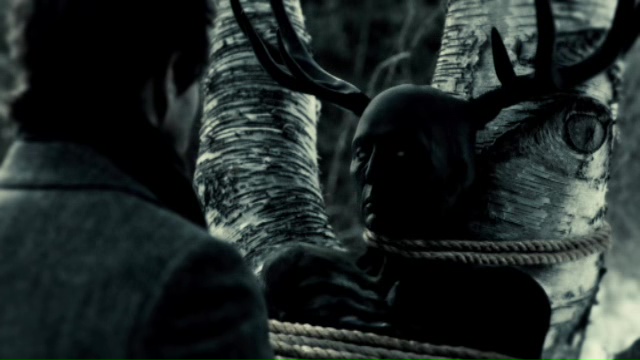
But what of the gore-splattered rest of the cast? Did any of them live to see Season 3? Well, some did of course although, in some cases, only just. The episode starts with a long reprise of what happened to Will and Abigail, but it’s all in Will’s fevered dreams as he lies in hospital, and he sees it as the killing of his higher self:  blood pours out of a dying stag and fills the room – he is sinking, in an ocean of blood.

vlcsnap-00032.jpg

This is a love story, but of star-crossed lovers. In this case, double-crossed lovers.

Time did reverse. The teacup that I shattered dared to come together. A place was made for Abigail in your world. That place was made for all of us. Together. I wanted to surprise you.
And you… you wanted to surprise me. I let you know me. See me. I gave you a rare gift.

vlcsnap-00014.jpg

The teacup is a crucial symbol to Hannibal. It represents two important discourses that inform his somewhat unorthodox life choices: Nietzsche’s concept of amor fati – the love of fate, the acceptance that what has happened could not have happened any other way, and will happen again, and again. It is not fatalism though, in which we can sit and wait for the inevitable – Nietzsche and Hannibal want to be out there making it happen as it should, as it will, as it must.

vlcsnap-00037.jpg

vlcsnap-00040.jpg

Hannibal wants to speed up the cycle of eternal recurrence, reverse time and repair all that has been lost, particularly his sister, Mischa, who was eaten. He is obsessed with Stephen Hawking’s description of entropy as proof of the “arrow of time” – we “know” that time only flows one way because a shattered teacup does not gather itself back together. Hannibal really likes Hawking’s early theory that, when the universe stops expanding and starts contracting, time will reverse and entropy mend itself; the teacup will mend, Mischa will be whole again, Abigail will be returned to Will. Undoing all the bad things that happened. He just wants to speed things up.

vlcsnap-00023.jpg

Has the teacup re-formed after all? Abigail wanders into Will’s hospital room as he wakes up.

vlcsnap-00044.jpg

Will is hallucinating, but it gives him a chance to state his own metaphysical opinions. Will is more a follower of Leibniz; he thinks there are an infinite number of universes and everything that can happen will, does, did happen in one of the multiverses. Just, not in this one, which makes him sad.

vlcsnap-00062.jpg

It has to end well. And it has to end badly. It has to end every way it can.

OK, but Abigail wants them to find Hannibal, or rather believes the Hannibal wants them to find him. Even after all that happens, she wants to go to him. And so, of course, does Will, although he won’t admit it. He remembers Hannibal taking about his “memory palace”, a place where memories can be stored and restored, and brought out and relived even, or especially, in bad times. Hannibal’s palace is “vast, even by mediaeval standards” and

vlcsnap-00078.jpg

Off to Palermo goes Will and, maybe, Abigail, and meets Inspector Pazzi, who has been chasing Hannibal for twenty years. As a young man, Hannibal was “Il Mostro”, the monster of Florence, and would kill people to make them into art works, particularly based on Botticelli’s Primavera. A real case, which remains unsolved.

vlcsnap-00111.jpg

We hear more philosophy – Will has taken on Hannibal`s theology; as far as God is concerned

vlcsnap-00092.jpg

Elegance is more important than suffering. That’s his design.

Then he gives us his views on Hannibal`s motivations: it’s all about fun. This is basic Hannibal philosophy, going all the way back to his letter to Will Graham in the book Red Dragon.

Hannibal’s not God. Wouldn’t have any fun being God. Defying God – that’s his idea of a good time. Nothing would thrill Hannibal more than to see this roof collapse, mid-Mass, packed pews, choirs singing, he would just love it. And he thinks God would love it too.

And of course, the roof starts to drop a fine powder on Will’s outstretched hand.

Inspector Pazzi points out that Hannibal never leaves evidence.

vlcsnap-00113.jpg

Which raises the big question – what exactly is cannibalism? Was Jame Gumb a cannibal when he used women’s skin to make a “suit with tits” (which he will hopefully be doing again in Season 4)? Was Francis Dolarhyde a cannibal for killing whole families to fuel his radiance (as he will do again later in Season 3)? Hannibal eats people when he can, and when he wants to, but didn’t Jack Crawford enjoy his elegant dinners at Hannibal`s house, pretending to be a friend, knowing what was probably being served? When Will brought the long pig, pretending it flesh of Freddie Lounds, was it really Randall Tier they were eating? Hannibal sure as hell knew it wasn’t pork. Will happily ate it.

Now Hannibal has found a new, non-gustatory use for human bodies: art. He has taken the body of the annoying art student he killed last episode, and made it into a heart, his heart, broken by Will’s betrayal and the loss of the space he made for them. Will uses his powerful forensic imagination to read Hannibal`s design:

I splintered every bone. Fractured them. Dynamically. Made you malleable. I skinned you. Bent you. Twisted you. And trimmed you. Head hands, arms and legs. A topiary. This is my design. A valentine written on a broken man.

vlcsnap-00131.jpg

Hannibal is – complicated. Will explains to Abigail that “he follows several trains of thought at once without distraction from any – and one of the trains is always for his own amusement.”

He gave you back to me, then he took you away. It’s Lucy and the football; he just keeps pulling you away. What if no one died? What if – what if we all left together? Like we were supposed to. After he served the lamb. Where would we have gone? …A place was made for you Abigail, in this world. It was the only place I could make for you.

Charlie Brown.gif

Will finally realises that Abigail is dead, and he is talking to his delusion, to his own subconscious thoughts (which are dominated by finding and rejoining Hannibal). He heads through the arch into the catacombs; he knows Hannibal is waiting in there. Pazzi is behind him, despite Will’s warnings that Hannibal will kill him. Pazzi wants to know what Will might do when/if he finds your Il Mostro?
vlcsnap-00161.jpg

In an atmospheric scene somewhere between Phantom of the Opera and The Name of the Rose, Will and Hannibal wander the winding tunnels, Will calling Hannibal’s name, Hannibal silent. Waiting for Will to say it. At the end of the last season, Hannibal had said to Will as he cut him up “I forgive you, Will. Do you forgive me?”

We finally get the answer.

vlcsnap-00163.jpg


Next week: a new cannibal movie from Brazil: THE CANNIBAL CLUB

Copycat Killers 1.08 HANNIBAL: “A real life Hannibal Lecter comes to light”

The TV series Copycat Killers which debuted in 2016, attempts to match real-life crime with murder cases in film. The premise is really a bit of a long-shot. For example, episode 4 is called “Silence of the Lambs” and shows long lingering shots of the naked butt of serial killer Jame Gumb (Buffalo Bill). It covers the case of a 14-year-old boy, Michael Hernandez, who cut the throat of a friend, and years later joked on the phone, from jail, about “skin suits” (Gumb’s main preoccupation) and Mason Verger cutting off his own face. The boy also, the judge revealed, listened to death-metal band Cannibal Corpse, a group that thrives on notoriety and violent lyrics, but does not, as far as anyone is aware, actually eat people or recommend that others do so. So this boy did not skin people, like Gumb, nor did he eat them, like Lecter.
vlcsnap-00003.jpg

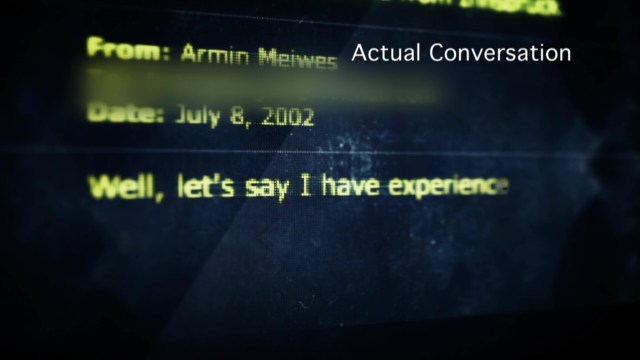
The episode reviewed in this blog, episode 8, is also Hannibal Lecter-based. This particular killer, a German named Armin Meiwes, was nothing like the Hannibal in the books, the movies or the television show. Nonetheless, when the police searched his house, the solemn narrator tells us:

“even the most jaded detective on that case was sickened by what they found in that freezer…. Police had discovered a real life Hannibal Lecter.”

Pictures of Meiwes and Lecter are flashed on screen consecutively, to draw a visual conclusion that is hardly supported by the text.

vlcsnap-00001.jpg

vlcsnap-00002.jpg

An actor re-enacting the Meiwes story cuts meat and drinks wine, which an on-screen expert (crime writer Lisa Coryell) compares to Hannibal’s line from the movie Silence of the LambsI ate his liver with fava beans and a nice Chianti”.

A Professor of Film Studies at the American University explains that Lecter’s elegance, charm and humour makes him “irresistible”. Hannibal, he says, is the top movie villain of the century, and there isn’t even a close second.

Meiwes, a German computer technician, advertised on a fetish website called The Cannibal Café for “a well-built 18 to 30-year-old to be slaughtered and then consumed”. He actually received a heap of replies, but the only one that seemed sincere was Jürgen Brandes. The two met in 2001, had sex, then Brandes took a lot of sleeping pills and half a bottle of schnapps, and they collaboratively sliced off Brandes’ penis and tried, unsuccessfully, to cook and eat it with salt, pepper, wine, and garlic (it ended up in the dog’s bowl). Brandes went off to die in the bath while Meiwes read a Star Trek novel and, when he found Brandes still alive and suffering hours later, killed him and proceeded to eat quite a lot of him over the coming weeks and months.

vlcsnap-00005.jpg

When Meiwes started running low on flesh, he advertised again, and this time one respondent reported him to police, who found some of Brandes still in the fridge. Meiwes was charged with manslaughter as he had killed Brandes (at worst it was assisted suicide), and was sentenced to eight years. Due to the ensuing publicity, a retrial was ordered and he was convicted of murder, on the grounds that he had talked Brandes into giving permission to kill him, for his own sexual pleasure.

Silence of the Lambs and its sequel Hannibal caused, we are told in this doco, a surge of interest in cannibalism, leading Meiwes to pursue his obsession with cannibalism. Still didn’t make him into Hannibal though, IMHO.

A forensic psychologist who glories in the name Dr J. Buzz von Ornsteiner: tells us “I’ve worked with a lot of criminals within my criminal history. But this is by far the worst case I’ve ever encountered.”

The recreation goes into Meiwes unfortunate history with his controlling mother, one more thing that he and Hannibal do not have in common (you may remember from Hannibal Rising that Lecter’s mother was a delightful woman, who was killed in a duel between a tank and divebomber while he was still a small boy).

At the same age, Meiwes father left the family. From this trauma, we are led to believe by Dr Buzz, Meiwes decided the best way to keep people in his life was to eat them. The crime writer explains to us that

“If you’ve experienced loss as a child, as Armin clearly did, cannibalism is one way, it’s a sick way, to make sure that no one ever walks out on you.”

Now the idea that Meiwes and Lecter are cannibals because they lost one or more parents is pretty terrifying, since there are a lot of people to whom that applies. On that logic, you might as well suspect Princes William and Harry. However.

Once mum died, Meiwes was free to get on the internet and find others interested in his hobby.

vlcsnap-00015.jpg

vlcsnap-00017.jpg

vlcsnap-00018.jpg

Lisa Coryell (the crime writer):

“You couldn’t look at the facts of this case and not think of Hannibal Lecter.”

Well, actually, I think I could. Meiwes joined a chat room, something Hannibal did not do and would not do, even in the TV version (set in the Internet era). Brandes, his co-conspirator, wanted to be killed and eaten. Meiwes and Brandes were both convinced that this act of cannibalism would make their bond permanent. It is possible that Hannibal believes eating Will Graham would help Hannibal forgive him for his betrayal. Will, however, was not a willing collaborator in such a scheme.

Is there anything Meiwes has in common with Lecter? Buzz points out that “Somehow between these two men there doesn’t seem to be any value for human life”. I guess Hannibal would agree that human life is not sacred in any way, and that rude people are good to eat. Meiwes, on the other hand, seemed to have liked Brandes, and wanted to keep him around, or more accurately inside.

Brandes wanted to die, but he wanted to taste human flesh before he did so. The show finds a Hannibal parallel here: Hannibal feeding Ray Liotta’s character, Paul Krendler, a portion of his own brain in the movie Hannibal. But of course Krendler was not a willing participant, and once his frontal lobe was on the hotplate, he couldn’t be said to have had any opinions at all.

The rest of the documentary is full of some painful reminders of the speciesism with which philosophers from Aristotle to Descartes to Kant, and even Derrida, have considered the abyss between human and “animal”.

Lisa Coryell:

“Armin begins drawing on Berndt’s body to map out the places he wants to eat most. Armin was treating Brandes like a piece of meat, like an animal for slaughter and it defies humanity.”

It wasn’t of course “like a piece of meat”; it was exactly as a piece of meat. The commentators assume that we, humans, are not animals and are not made of meat, which is ludicrous.

Buzz sums up:

“he doesn’t think there anything wrong with killing someone provided they want to be killed.”

I spat out my tea at this point. It just reminded me of the scene from Douglas Adams’ Restaurant at the End of the Universe:

Arthur: I don’t want to eat an animal that’s lying there inviting me to. I think it’s heartless!

Zaphod: It’s better than eating an animal that doesn’t want to be eaten.

The grave tone of the narrator and commentators of the show, and the ominous music, are intended to convey the extreme gravity of Meiwes’ crime. Meiwes meanwhile has reportedly been a model prisoner, and has also become a vegetarian. In 2018, his appeal to be eligible for release one day (he was given a life sentence) was denied, and he will probably die in jail.

Yet, when compared to other crimes, what has Meiwes actually done? He sought willing victims, men who wanted to die and fantasised about being eaten after their death. He helped Berndt commit suicide, delivering the coup de grâce only when he found Berndt still suffering hours later. He then followed Berndt’s fervent wishes by eating large parts of the man’s corpse. The police originally could not charge him with murder, because there was no evidence that he had intended to kill, until the suicide went wrong and he saw it as an act of mercy. It was the cannibalism that inflamed public opinion around the world, and forced the police to cobble together an appeal, which claimed that he had influenced Berndt to agree to the scheme, which was a bit absurd (he actually offered to take him to the train station if he got cold feet). The problem was that there was no law against cannibalism, and still isn’t in most of the world.

vlcsnap-00004.jpg

So the parallels with Hannibal Lecter are bizarre. Hannibal killed and ate people he considered rude and discourteous. He felt that they deserved it, that he was improving the gene pool maybe. He considered himself superior to the people he ate, just as the average carnivore considers himself superior to a cow or a pig. But what Hannibal does is considered murder, because of his intentions and the fact that the victims presumably did not want to be killed or eaten.

But after considering the case of Armin Miewes, we have to consider the question: if a being wants to die, and you help him along, and then eat him, is that really worse than confining a being who doesn’t want to die (from any species), deliberately killing him or her (or paying someone else to do so) and then eating their flesh? Which is what we humans do well over eight million times every hour of every day.

This issue is discussed in a simpler form in the Australian television series Rake. In a re-imagined version of the Meiwes case, the cannibal is a respected economist and the victim’s suicide is successful. There is no murder; all the economist does is eat the body, yet is told “you ate someone. You’re never going home”. Is that scenario also worse than the intentional killing of a cow or pig for human consumption?

If you think it is, please tell me why in the comments, or email cannibalstudies@gmail.com.

I’d really like to know.


NEXT WEEK: HANNIBAL Season 3 Episode 2.

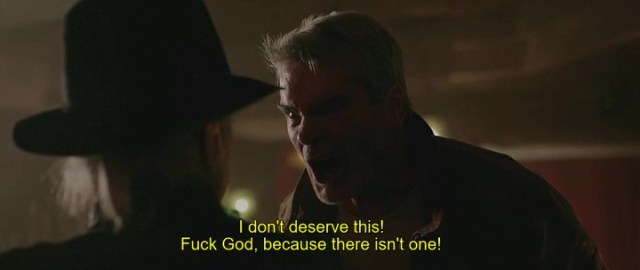
The Cannibal as superhero – “HE NEVER DIED” (Jason Krawczyk, 2015)

This is a smart, sassy and quite funny cannibal movie, which does not conform to most genre rules. I wanted to review it now, because the next movie in the series (not exactly a sequel), She Never Died, is going to be released this year.

The protagonist (I won’t say hero, even though modern superheroes shares a lot of his alienation and angst) is Jack (Henry Rollins). Rollins is wonderful in the role, making the film seem a lot less silly than it really is. The critic from rogerebert.com said:

“You don’t need to know anything about Henry Rollins to appreciate his tongue-noticeably-in-cheek action hero performance in horror/superhero genre hybrid “He Never Died.

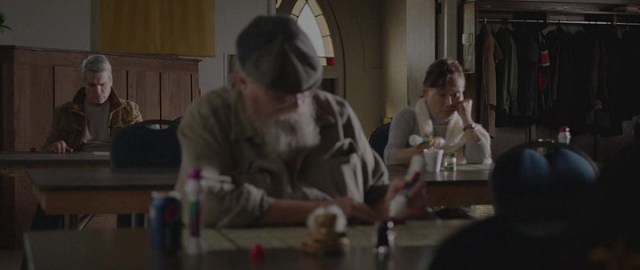
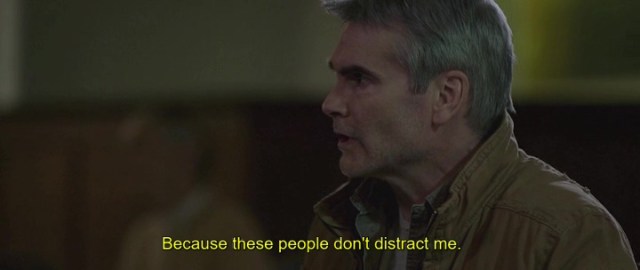
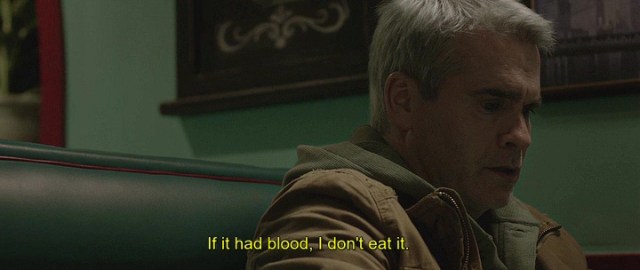
Unlike most superheroes, Jack is immortal, indestructible, and a cannibal. As a result of the first, he is deeply depressed, and as a result of the third, he has found a quiet routine (watching TV, playing bingo at the church hall) to keep his cannibalistic tendencies under control. Why bingo?

vlcsnap-00028.jpg

vlcsnap-00012.jpg

As a cannibal who doesn’t want to eat people, he has to buy blood from a hospital intern. A couple of thugs come looking for the intern but Jack beats them up and throws them out. When they find the intern, Jack rescues him, because he needs the blood. It satisfies his cravings, without actually having to kill anyone.

Then he discovers he has a daughter from a failed marriage. Andrea (Jordan Todosey from Degrassi) has her own problems with alcohol. Everybody has problems involving consumption, but isn’t that universal? She also asks a lot of questions. She is surprised when Jack says he doesn’t eat meat, I guess he looks pretty macho, and meat is so – well – culturally male.

vlcsnap-00004.jpg

vlcsnap-00005.jpg

Which is weird since he eats blood all the time. Sort of a reverse kosher rule I guess. Andrea asks if she can stay with him for a few days, which is another problem for his routine. Don’t we all sometimes wake up at night with the munchies?

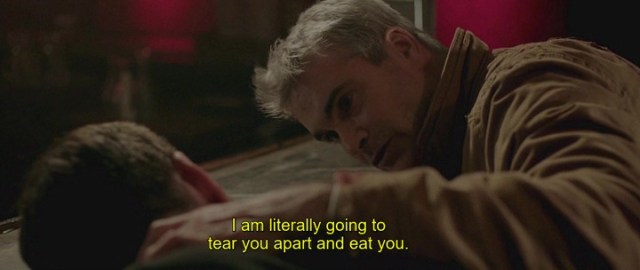
When the thugs come looking for Jack, he tears the throat out of one of them, and eats it. It revives his hunger for flesh.

vlcsnap-00013.jpg

vlcsnap-00015.jpg

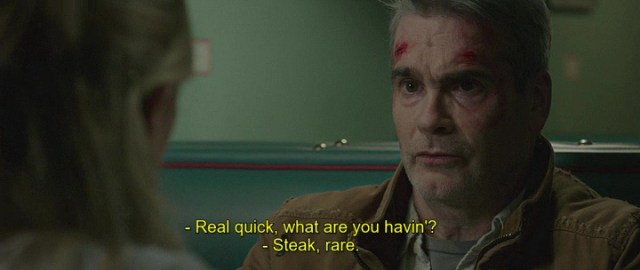
Jack then eats a particularly obnoxious neighbour. He walks the streets looking for people who deserve to be eaten (a bit like Sheila from The Santa Clarita Diet). He drops a wad of cash, but the proposed victim hurries to return it to him, making him apparently ineligible for consumption. He bumps into the leader of a gang of men on a dark street, but the man apologises, much to Jack’s disappointment. Luckily, he vomits on a bunch of street toughs, one of whom is aggressive enough and old enough to eat. Yes, there is also an age-limit to his cannibalism.

vlcsnap-00020.jpg

When he goes back to the diner, he is no longer a vegetarian. Well, cannibalism will do that. Lévi-Strauss wrote in “A Lesson in Wisdom from Mad Cows” about the link between a meat-based diet and cannibalism.

“The link between a meat-based diet and cannibalism (a notion broadened to take on a certain universality) thus has very deep roots in thought…. Indeed, a day may come when the idea that human beings in the past raised and slaughtered living things for food and complacently displayed slabs of their flesh in shop windows will inspire the same revulsion as what travellers in the sixteenth and seventeenth centuries felt about the cannibal meals of American, Oceanian, or African indigenous peoples.”

vlcsnap-00023.jpg

So, in life there’s appetite, and there’s love. A phone message informs Jack that Andrea has been kidnapped and her mother killed, but he hardly reacts, doesn’t even go to the assigned rendezvous. But then Jack walks home Cara, the waitress from the diner (Kate Greenhouse), and is surprised by a sudden show of affection.

vlcsnap-00025.jpg

He rushes home, intent on going back to his peaceful life of drinking blood and not killing people, but spills the last bag of blood all over the floor. He tries to lick it up, sponges up what he can, squeezes it into a glass, but it’s not enough. It’s never enough.

vlcsnap-00026.jpg

vlcsnap-00027.jpg

When the bad guys turn up at the diner and kill the boss, Jack wipes them out, snacks on parts of them, and goes looking for his daughter. Love, supported by appetite.

vlcsnap-00037.jpg

He gets shot in the head and has to borrow Cara’s toolkit to get the bullet out, because otherwise it will heal over and he’ll get migraines. She is starting to realise he is not what she expected.

vlcsnap-00030.jpg

So we find out what we sort of knew from the unfortunate, spoiler title of the movie:

vlcsnap-00034.jpg

vlcsnap-00035.jpg

vlcsnap-00036.jpg

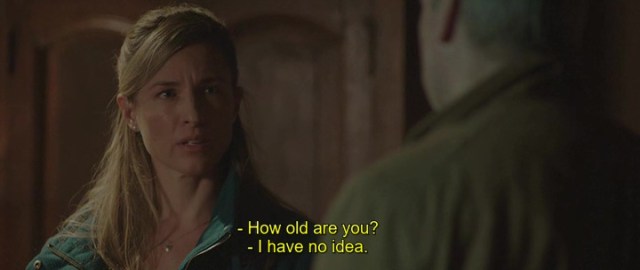
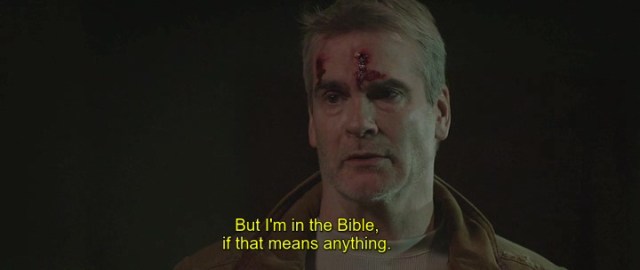
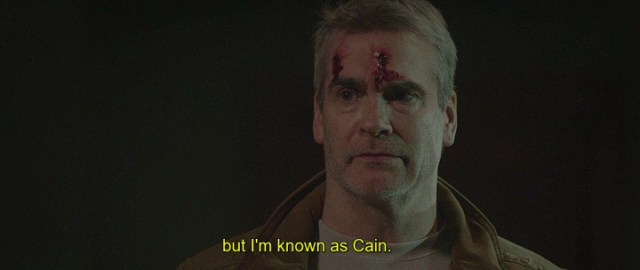
Yes, Jack is Cain, son of Adam and Eve, who killed his brother Abel and has been cursed to wander the planet ever since. Cain makes another appearance in the TV series Lucifer, but not as a cannibal, so outside the scope of this blog. Good show though.

vlcsnap-00043.jpg

vlcsnap-00044.jpg

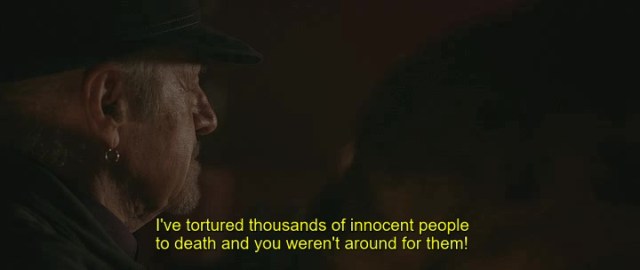
The bad guys have turned Jack back into one of them. But there’s all sorts of dodgy metaphysical questions raised, most of which don’t get answered. Since when is Cain a cannibal? Why has he been involved in famines and massacres throughout history? Who is the dude in the pork pie hat who appears only to Jack?

vlcsnap-00057.jpg

Cain was a peaceful grower of crops, a tiller of the land, while Abel was a shepherd, presumably killing his lambs for his sacrifice. How does that make Cain the bad guy in the argument? Anyway, why do we need a reason for Jack’s cannibalism: a divine punishment? Can’t it be enough that he just is the way he is? As Hannibal says: “nothing happened to me, Agent Starling. I happened.”

Jack cannot die, and cannot live without being a cannibal.

vlcsnap-00066.jpg

vlcsnap-00067.jpg

But isn’t that the story of Homo sapiens?

vlcsnap-00049.jpg

The movie has 87% “fresh” rating on the Tomatometer.


Apologies to those who noticed that I mentioned in last week’s blog that the next review would be Beneath the Planet of the Apes. An otherwise excellent academic text on cannibalism spoke of “an underground tribe of post-apocalyptic mutant cannibals” in that film, so I eagerly watched the whole turgid 1.5 hours. Not a sign of cannibalism anywhere. It was, in fact, one of the worst movies I’ve ever seen, so it has moved all my other bad movies up one notch. Every cloud…
Next week: COPYCAT KILLERS episode 8: “A real life Hannibal Lecter comes to light.”

“The eating of the heart is a powerful image” HANNIBAL Season 3, Episode 1 “Antipasto” (Fuller, 2015)

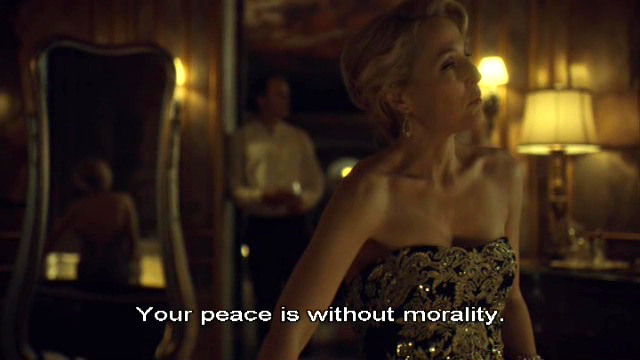
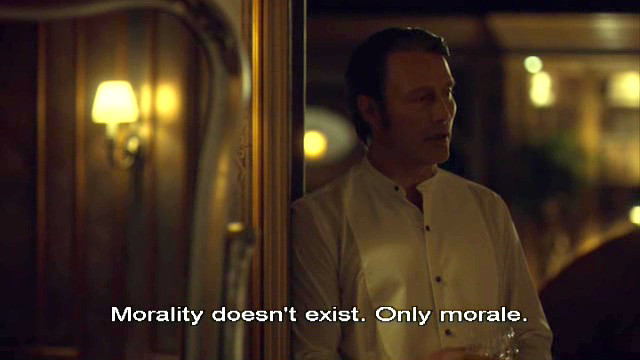
Look, I know from the Fannibals sites that some people didn’t like Season 3, or at least not as much as one and two. I humbly beg to disagree. This season sees Hannibal exposed and ferocious, no longer wearing his “person suit” in which he was pretending to be the respectable psychiatrist, trying to help the FBI catch – well, himself. At the end of Season 2, he left most of the cast writhing in pools of their own blood, and we saw him drinking champagne on a plane to France. His psychiatrist, Bedelia, was by his side, wedded to him, it seems, by their shared responsibility for the death of her patient, whom Hannibal had referred to her. Obligated to him by his helping her cover up her killing.

vlcsnap-00042.jpg

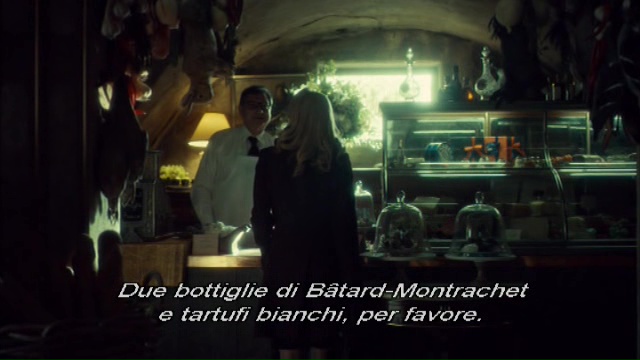
Hannibal’s fairy tale is set in Florence, Italy. You may remember a Hannibal of a different generation, in Silence of the Lambs, telling Clarice Starling that memory is what he had instead of a window, as she admired his drawings of the Duomo. Hannibal, it turns out, is an expert on pre-Renaissance Italian literature, particularly Dante, and wants the job of Curator and Translator at the Palazzo Capponi, which of course he gets, by killing the previous Curator and then consuming the man chosen to replace him: Dr Fell, who he meets and eats in Paris. Also by being able to recite Dante from heart at a moment’s notice:

Joyous appeared he in his hand to keep
my very heart, and, lying on his breast,
my lady, veil-enwrapped and full asleep.

But he awakened her, and of my heart,
aflame, he humbly made her, fearful, taste
I saw him, finally, in tears depart.

vlcsnap-00010.jpg

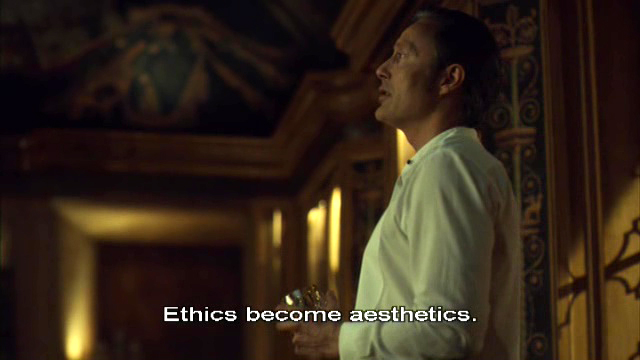
Bedelia is no longer pretending not to know what Hannibal does, or of what he is capable. She has an insight into his Nietzschean ethos

vlcsnap-00070.jpg

vlcsnap-00071.jpg

vlcsnap-00072.jpg

And Hannibal is loving Florence.

“I’ve found a peace here that I would preserve. I’ve killed hardly anybody during our residence”.

Well, the old Curator. And Dr Fell. And Mrs Fell. But the rude Professor Sogliato, who is a natural for dinner because he has been opposing Hannibal’s appointment and being, well, rude about his Italian – will he kill and eat him? No, that would not serve to preserve the peace.

vlcsnap-00076.jpg

vlcsnap-00077.jpg

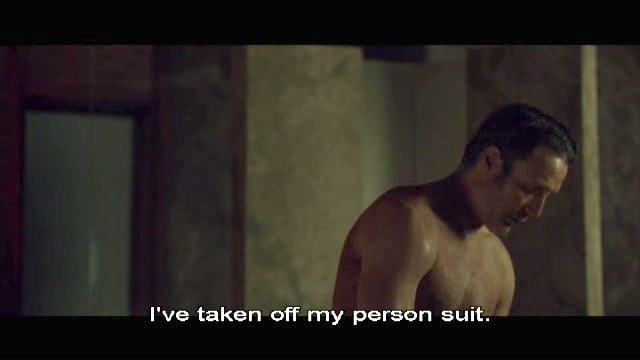
Bedelia has a flashback to her apartment, just after the bloodbath of the Season 2 Finale, where Hannibal is showering, washing off the blood. She asked him then what he had done.

vlcsnap-00092.jpg

Bedelia is terrified of him, but still, they are living the high life.

vlcsnap-00110.jpg

There’s a complication, of course, as can happen when you kill people (maybe eat them) and take their identity. This complication is a young scholar from England, Anthony Dimmond (Tom Wisdom from The Boat That Rocked and Avengers: Endgame) who worked for Dr Fell, cordially detested him, and won’t be too upset when he finds out that Hannibal is taking his place. Hannibal appears to show friendship, in one of those double entendres that Hannibal does so well

vlcsnap-00120.jpg

We have another flashback to Hannibal’s extended feast on Abel Gideon, at which the only guest of honour was Abel himself.

vlcsnap-00125.jpg

“you wish me to be eating oysters, drinking sweet wines and snacking on acorns.
All to make me tastier?”

Abel’s arm is hanging up in the basement being consumed by snails, to make them tastier. And Abel’s tasty flesh is being eaten by Hannibal

vlcsnap-00131.jpg

vlcsnap-00132.jpg

At the dinner, Dimmond asks Bedelia (AKA Mrs Fell) if she is avoiding meat. She replies with one of the great vegan ripostes

vlcsnap-00143.jpg

But what is she eating instead? Ah yes

vlcsnap-00144.jpg

Dimmond, being a scholar, tells her

vlcsnap-00145.jpg

Yes, Bedelia is being fattened up for a future feast. And she knows it.

vlcsnap-00146.jpg

vlcsnap-00147.jpg

Dimmond gets his hopes up: “Is it that kind of party?” “It is not that kind of party” replies Hannibal. To Bedelia’s amazement, Dimmond gets up and leaves at the end of dinner. Alive.

But not for long. Hannibal is giving a lecture to prove his qualifications for the Curatorship. He lectures on mediaeval art, particularly drawing the comparison between Judas, who betrayed Jesus, and Pietro della Vigna, whose alleged treachery and suicide earned him a place in Dante’s Hell. Disappearing in the glow of his slideshow, Hannibal is soon replaced by the One whom Mads seems to be using as inspiration for his portrayal of Hannibal

vlcsnap-00174.jpg

The theme of his talk is

vlcsnap-00178.jpg

Lo fe gibetto a me de la mie case: I make my own home be my gallows”.

Realising that he is looking at her, and that he considers that she betrayed him (by resigning as his therapist), Bedelia gets up and rushes home to pack. Dimmond comes to the lecture, realises immediately that Hannibal has replaced Dr Fell, and they stroll through an exhibition of instruments of torture. Why do people love such exhibitions? In fact, why do we love stories about zombies, vampires, cannibals? Hannibal explains

vlcsnap-00183.jpg

vlcsnap-00184.jpg

Or as Dimmond puts it

“What still slaps the clammy flab of our submissive consciousness hard enough to get our attention?”

Dimmond offers a sort of partnership with Hannibal. Big mistake. Since Will, Hannibal is not looking to take on new partners. Hannibal takes him home for dinner, just as Bedelia is about to leave, her bag packed and ready.

Wasting no time, Hannibal wallops Dimmond with a bust of Aristotle (appropriate on so many levels) and has a fascinating exchange with Bedelia as she wipes blood off her face, and Dimmond crawls painfully toward the door. He asks her, and us:

vlcsnap-00202.jpg

She knew what he would do. She was curious about what would happen. She anticipated their thoughts, counter-thoughts, rationalisations. Is this (the bloody mess) what she expected? Yes, it was.

vlcsnap-00211.jpg

He helps her off with her coat. She’s not going anywhere.

And nor is Dimmond, whose corpse Hannibal folds up into the shape of a heart and leaves in a distant cathedral – but more of that next episode.

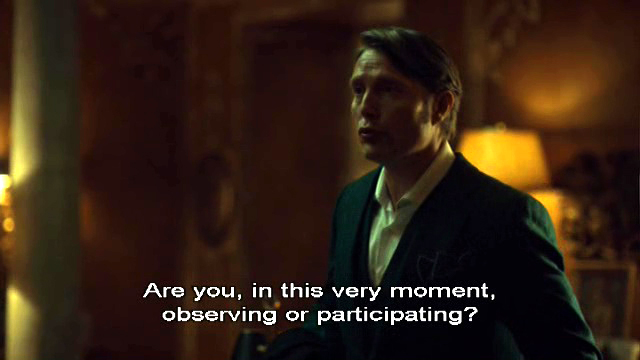
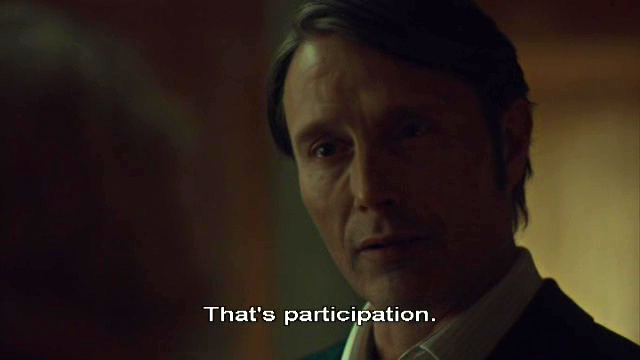
And nor are we. We are also curious about what will happen. We also anticipate thoughts, counter-thoughts and rationalisations. We also expect things to happen, whether it be in this show, or in our own lives, filled with appetite and consumption and instruments of torture.

That’s participation.

As usual, Hannibal has the final word, in a line that sums up pretty much everything I have been trying to say about cannibalism, and the link to carnivorous virility, and our assumption that it’s OK  to eat anyone whom we classify as less than us.

vlcsnap-00026

As Claude Levi-Strauss said:

“We are all cannibals”.
Next week: Beneath the Planet of the Apes

#EatTheBabies – climate change and cannibalism

The new trending hashtag on Twitter is #EatTheBabies. Why?

A right-wing group of climate change deniers decided to prank US House of Reps member Alexandria Ocasio-Cortez at a meeting in Queens this week, by getting a woman to stand up and insist that the only way to stop climate change was, as her t-shirt says

T-shirt-save the planet-eat the children.JPG

“We got to start eating babies! We don’t have enough time! … We have to get rid of the babies! … We need to eat the babies!”

Yes, of course, the t-shirt is widely available on the Internet now.

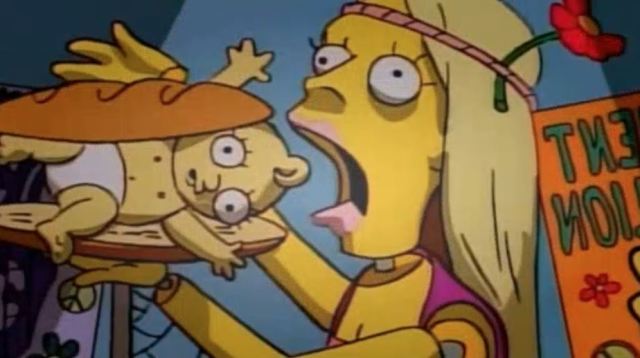
Besides being a cannibal story, and getting the Republicans to accuse AOC of not denying she ate babies (really!?), it also reminded a few people of an episode of The Simpsons, in which Chief Wiggum warns the kids off drugs by showing them a drug-addled hippie who has:

the munchies for a California cheeseburger

California cheeseburger.JPG

It’s Season 8 episode 25, “The Secret War of Lisa Simpson”, in which Bart is sent to military school, and Lisa follows because she wants a challenge, only to be met by extreme misogyny by the other students. You can watch it on-line at daily motion, although the video is reversed (i.e. mirrored) which makes all the writing back to front, but at least puts Homer’s steering wheel on the right side of the car.

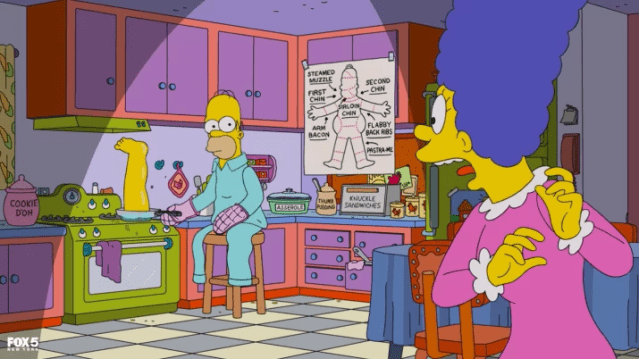
This was not the only stab at cannibal themes in The Simpsons, but the others were in the Treehouse of Horrors specials, where you expect those sort of things.

0201 leg

So that’s a good enough excuse for mentioning AOC’s run-in with cannibalism on a film/TV cannibalism blog, isn’t it?

Meanwhile, last month a Swedish scientist caused an uproar for mentioning cannibalism and climate change in the same Powerpoint presentation at a Gastro conference. Discussing food shortages that are likely to result from the warming of the planet, behavioral scientist and marketing strategist Magnus Soderlund from the Stockholm School of Economics asked for feedback (sorry) of what sort of foods people would be willing to eat, including, at one point, human flesh. This was quickly turned into sensationalist headlines around the world, including  Fox News, which said “Swedish Scientist Floats Eating Human Flesh as Solution to Global Climate Change,” and the London Evening Standard, whose headline read “Scientist Suggests ‘Eating Human Meat’ to Tackle Climate Change.”

Snopes has a detailed look at this story, although it is hard to work out exactly what Soderlund said, since it was in Swedish. But in a statement after the shit hit the fan, the scientist stated:

I do not want to eat human meat, I do not want to be eaten, I do not think that eating humans influences the climate, I am not an activist, I am just a researcher who thinks that it must be possible to ask questions about also the dark sides of what we humans do and do not do.

Amen to that. Let’s also ask WHY we eat what we do, and are disgusted by what we don’t. That’s worth considering, in any language.

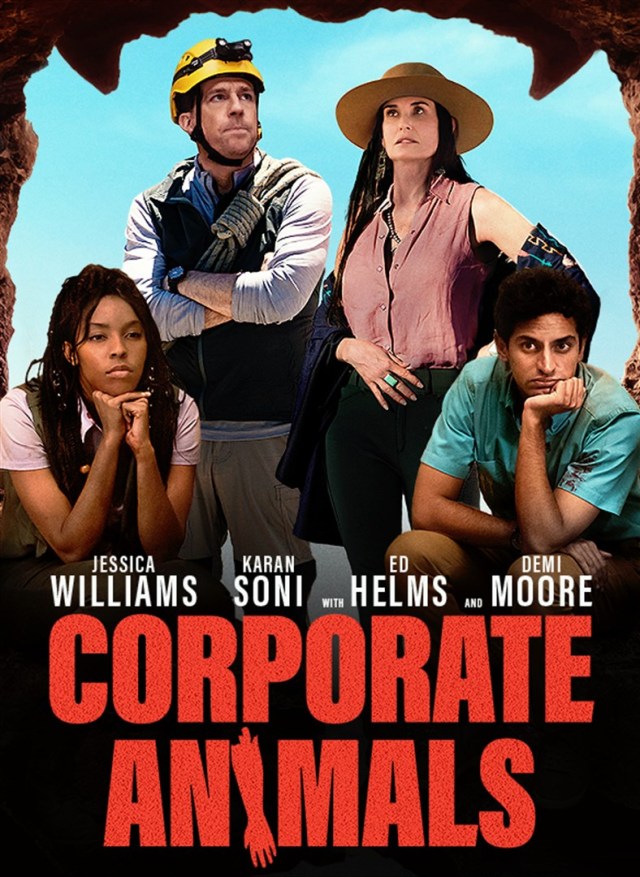
T-E-A-M spells MEAT “Corporate Animals” (Patrick Brice, 2019)

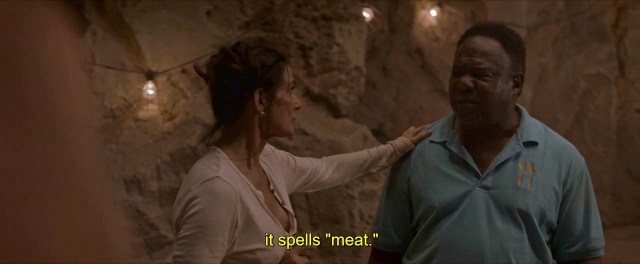
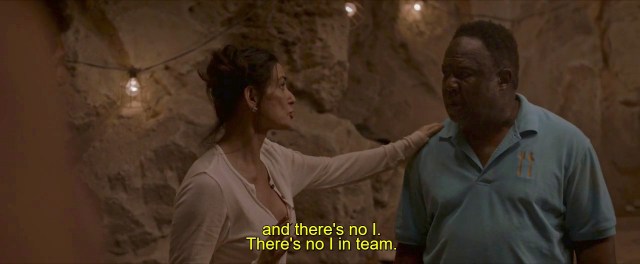
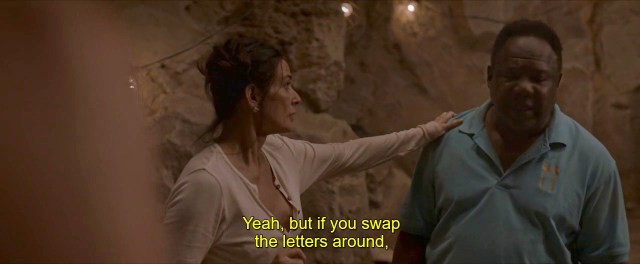
“There’s no “I” in TEAM. But if you swap the letters around, it spells MEAT”

Last week’s blog was a psychotic serial killer based on the case of a real psychotic serial killer, so maybe a bit of comedy to lighten the mood this week? Cannibal comedy of course. This is a cannibal blog.

vlcsnap-00004.jpg

Corporate Animals opened at Sundance in January 2019 and in selected cinemas in September, so it’s right up to date, both in its release and its message. When you google “cannibalism”, you will get lots of flesh-eaters, but also lots of stories about businesses swallowing competitors or smaller subsidiaries – which is often described as “corporate cannibalism”. To Marxists, of course, the relations of capital to its workers has always implied a type of cannibalism – production is supplied by the labourer but owned by the corporation, and surplus value is syphoned off, consumed, before payday.

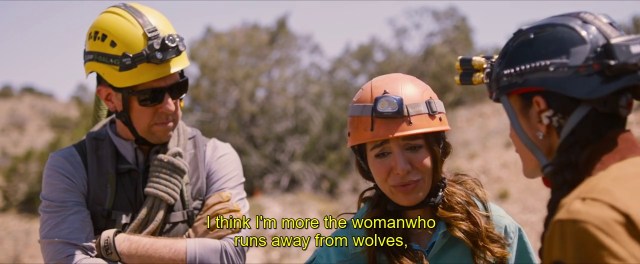
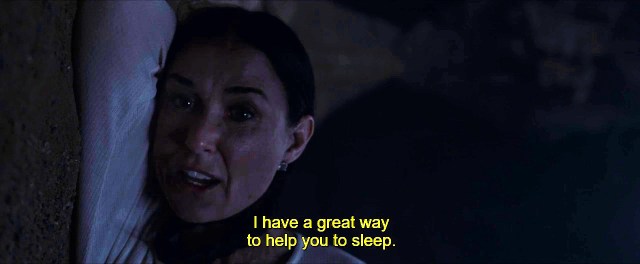
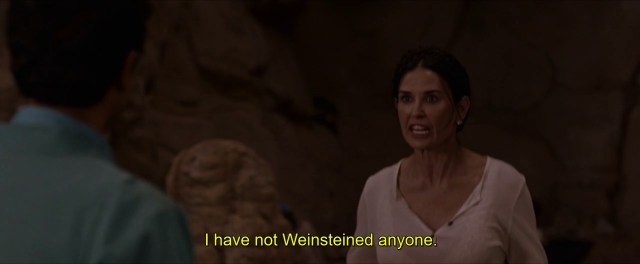
Corporate Animals is a story about a rapacious business owner, Lucy (a wonderful performance by Demi Moore), whose main product is edible cutlery.

vlcsnap-00011.jpg

Lucy wants to revive her failing company by taking the staff on a team-building expedition, caving in New Mexico. Team building is about conquering fear, and so she takes them on an extreme caving expedition, despite their fears.

vlcsnap-00023.jpg

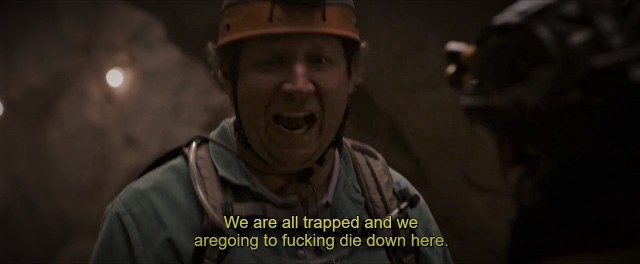
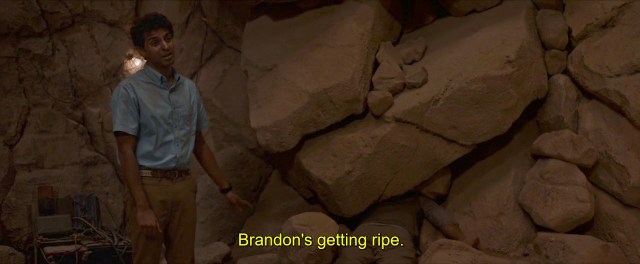
A “geological incident” (an earthquake and rock fall) kills their guide Brandon (Ed Helms from The Daily Show and The Office) and leaves them stranded in the cave. A perfect opportunity for team building and positive thinking.

vlcsnap-00025.jpg

Instead, they can only think about imminent death, which makes them both hungry and, as Jess (Jessica Williams from The Daily Show and 2 Dope Queens) points out, also super-horny. Lucy takes charge here too

vlcsnap-00024.jpg

Which leads to a discussion of power and exploitation and the coining of a wonderful word

vlcsnap-00026.jpg

The heart of the film (I’m trying to avoid the cannibal puns, but it’s hard to resist) is the debate. As they get to day five without food or water, they start to discuss the elephant in the room, which is the dead guide.

vlcsnap-00034.jpg

vlcsnap-00035.jpg

Lucy expresses disgust, and they all agree.

vlcsnap-00040.jpg

The debate is a spoof on a few cannibal films, most notably Alive! In which Ethan Hawke’s character suggests eating the pilots of their plane who were killed in the crash which left the others in the snow on top of the Andes.

vlcsnap-00041.jpg

There is also (I presume) a reference to Snowpiercer, when Lucy suggests that they are hungry enough to eat someone, it’s

vlcsnap-00044.jpg

Then they get this idea mixed up with the movie 127 Hours

vlcsnap-00045.jpg

vlcsnap-00046.jpg

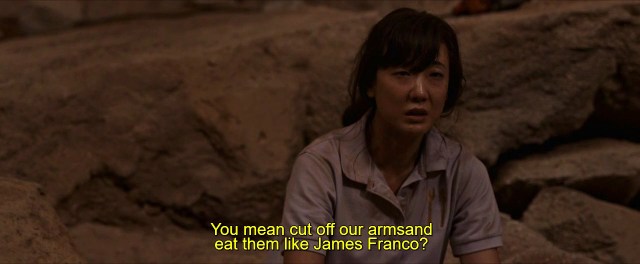
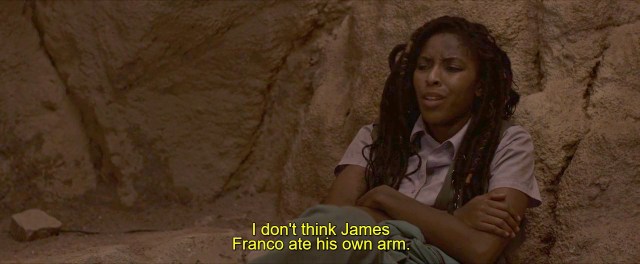
Nah, James Franco, had to cut off his own arm to escape a large boulder that had trapped him, but he didn’t eat it. In Snowpiercer, lots of people eat their own arms. It’s kind of a badge of honour to be lop-sided.

In Alive! Ethan Hawke wanted to eat the pilot, remember, for crashing the plane. Jess points out that in Alive! the bodies were conveniently frozen until required by the high altitude snow, but in the cave

vlcsnap-00069.jpg

Now we get to the key question of cannibalism. Who gets et? Ethan Hawke was the one to suggest cannibalism in Alive!, but only agreed to join in if the others could assure him that he wasn’t actually eating his sister. In the cave, they are consoled by the thought that at least Brandon wasn’t part of their company.

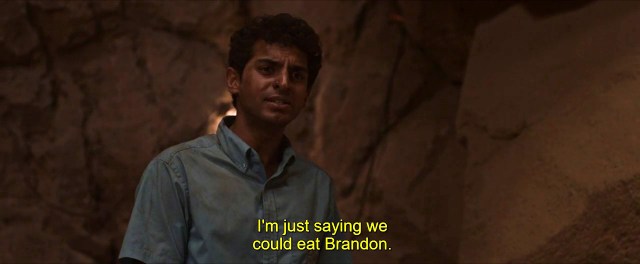
It wouldn’t be like we’re eating a colleague.

So it’s OK to eat a stranger, just not your mom?

I’m not saying it’s OK to eat anyone. But yes, I’d rather eat a guy I just met who I thought was an asshole, than my mom.

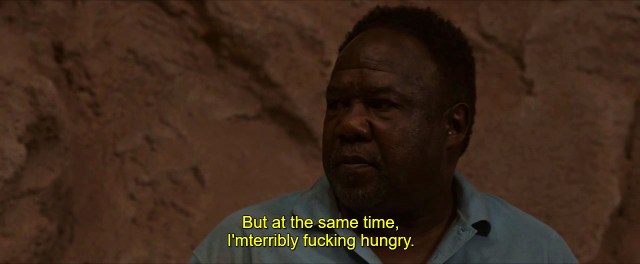
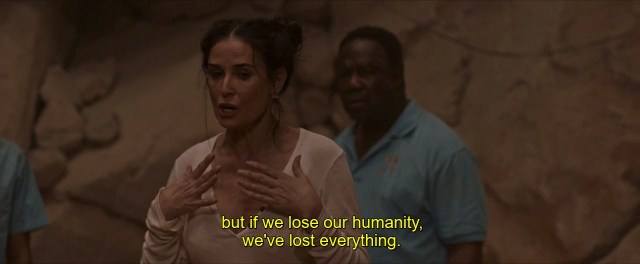
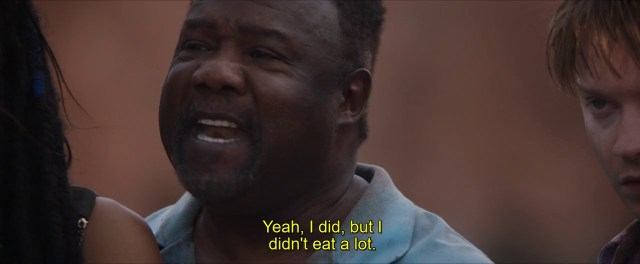
Lucy objects to cannibalism, first on the basis that they are making individual decisions during a team building exercise, using her usual inspirational jargon, but Derek (Isiah Whitlock Jr) has the line of the movie.

vlcsnap-00084.jpg


vlcsnap-00085.jpg

vlcsnap-00086.jpg

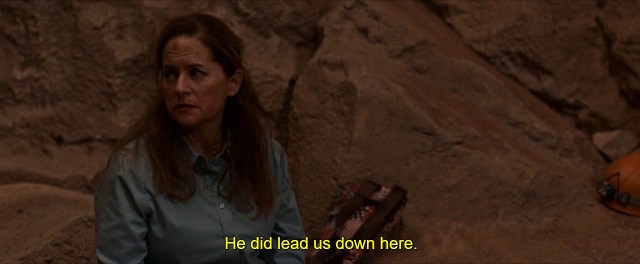
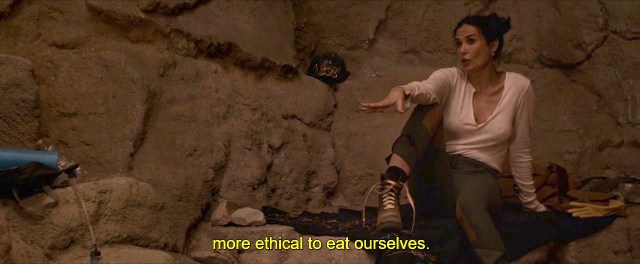
But then Lucy moves to the ontological question, the key question of cannibal studies – does cannibalism define or exclude humanity?

vlcsnap-00092.jpg

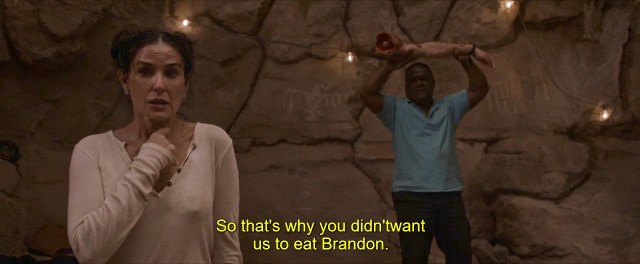
They take a vote, and decide to eat him, but find he is already missing one arm. Who took Brandon’s arm? Yep, it’s Lucy, objecting to cannibalism per se, but not to assuage her own hunger.

vlcsnap-00112.jpg

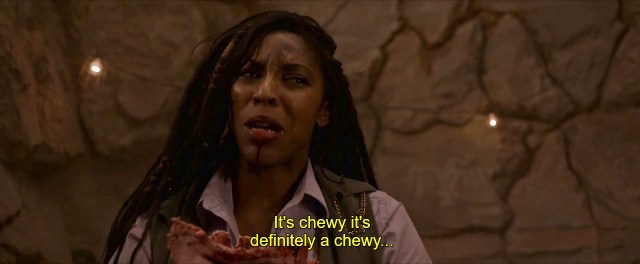
They decide to eat the rest of Brandon, and Jess volunteers to start.


Does it taste like chicken?

vlcsnap-00131.jpg

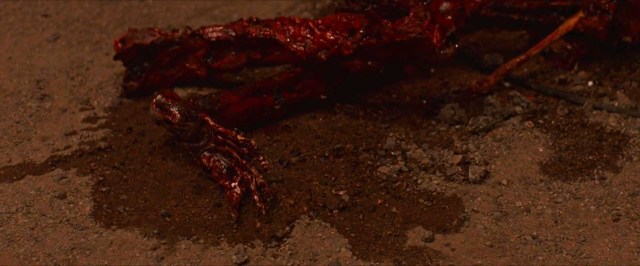
Before long, Brandon is all gone.

vlcsnap-00132.jpg

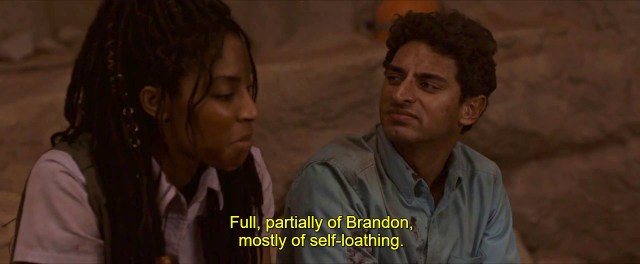
Jess asks Freddie (Karan Soni from Deadpool) how he feels after eating a fellow human?

vlcsnap-00140.jpg

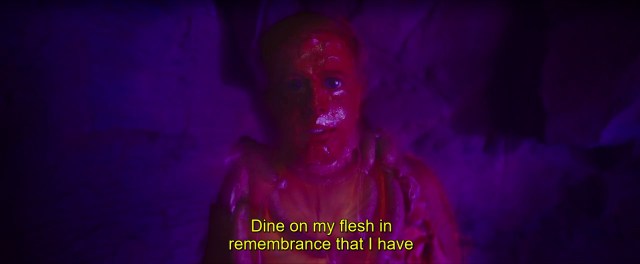
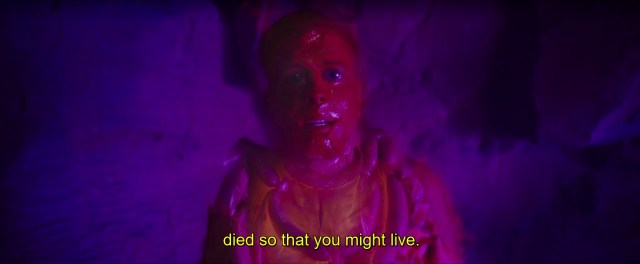
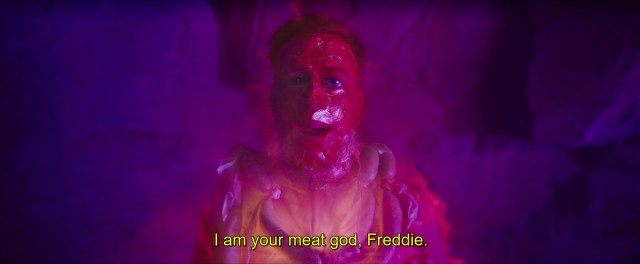
Brandon comes back to Freddie in a hallucination, and now we are referencing the Eucharist

vlcsnap-00156.jpg

vlcsnap-00157.jpg

vlcsnap-00158.jpg

So then, having reduced Brandon to a memory (and a meat god), the question becomes: who is next? Each person’s ailments, and the likelihood of mortality from them, become of huge interest to the rest of the group. Aidan (Calum Worthy) has a weeping wound which could turn gangrenous and require amputation.

vlcsnap-00166.jpg

vlcsnap-00167.jpg

Gloria (Martha Kelly) has Lupus, and could have a seizure (they kind of hope).

vlcsnap-00175.jpg

So this is the debate over what William Irvine calls active vs passive cannibalism. Even though both are usually considered repugnant, eating someone who has died is passive, but killing them to do so, active cannibalism, is considered far worse. In this case, they are willing to eat a corpse with no hesitation, but killing someone to harvest that corpse? As Lucy says

“Not everyone has balls big enough to make the hard decisions.”

vlcsnap-00218.jpg

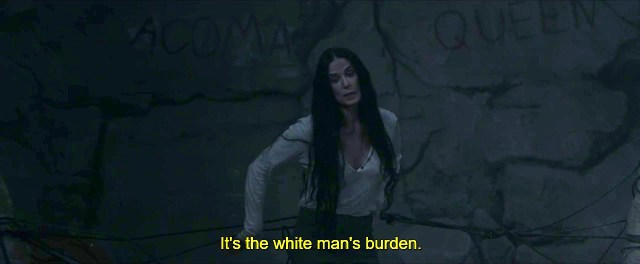
So cannibalism, traditionally ascribed to the non-white, non-European, the “savage”, is now the white man’s burden in this looking-glass world (which, to keep the Alice reference going, is down a rabbit-hole).

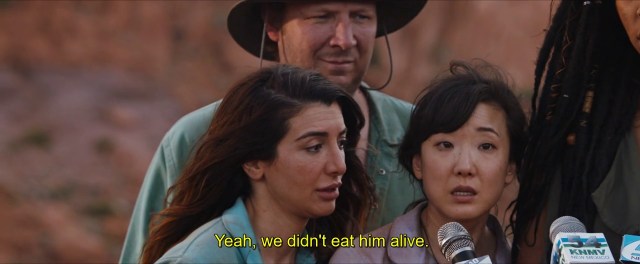
The active/passive debate goes on after rescue. At first, they claimed they survived by eating the edible cutlery, then Jess admits

vlcsnap-00232.jpg

vlcsnap-00233.jpg

vlcsnap-00235.jpg

The apologia of he carnivore: I don’t eat much meat; I only eat humanely killed meat. But when there’s nothing else to eat, no other species available, murder is still murder, but cannibalism is just a handy meal.

Poster.jpg


Next week: Episode 1 of SEASON 3 of HANNIBAL

The vampire of Sacramento: “RAMPAGE” (Friedkin, 1987)

Rampage is a 1987 film from William Friedkin, the director of The French Connection (1971) and The Exorcist (1973). It is based on the case of RICHARD CHASE, an American serial killer who murdered six people in the span of a month in December/January 1977-78. He was nicknamed “The Vampire of Sacramento” because he drank his victims’ blood and cannibalized their remains. In this version, the victims have been altered, as has the killer, who is now named Charlie Reece (Alex McArthur). Charlie is presented as the nice, helpful boy-next door. He’d mow your lawn, or bring in your shopping.

Rampage-1987-poster-438x650.jpg

Then maybe kill you and drink your blood.

vlcsnap-00002.jpg

The film wastes no time on showing Charlie getting hungry, killing three people who appear to be chosen at random, and then revealing his self-perception, as a caged tiger.

vlcsnap-00003.jpg

vlcsnap-00012.jpg

The film is mostly about the keen young prosecutor, Anthony Fraser (Michael Biehn). Fraser is caring, empathetic, liberal, an opponent of capital punishment, until he comes across this case.

vlcsnap-00010.jpg
“The women’s bodies were cut open to get at the organs… Some of the organs were removed.”

There’s also a glass that has been filled with blood, and drained.

Another family are burying their dog. They know Charlie poisoned the dog, and report him to the police. Then Charlie comes visiting. The mother is cut up like the others and sexually assaulted, the child has vanished.

Charlie is quickly arrested, and we see his cellar, full of body parts, weapons and Nazi regalia. His mother tells his lawyer about how Charlie had to witness domestic violence at a very young age. Charlie tells his psychiatrist about hearing Satan on the radio, telling him to kill people, and taking his blood from him when he disobeys. He describes shooting the little boy so he could suck his blood, then putting him in a trash can.

vlcsnap-00013.jpg

All the pieces are there for an insanity plea. The psychiatrists agree to say he was a paranoid schizophrenic who believed his blood was poisoned and his heart failing.

At the trial, we hear how normal Charlie was – his friends talk of his reasoned non-violence, his scout master says he was a good boy, his steady girl tells how thoughtful he was. Then a nurse tells of finding his diary, listing all the dogs, cats and rabbits he had killed. The prosecution’s psychiatrist is asked “did he know he was killing living human beings?”

vlcsnap-00014.jpg
That was the point. That was why he did it. He claims he has a belief that his body is failing and infected and he’s convinced himself that someone else’s blood will repair him. He had to kill them to get the blood.

In other words, he was psychotic, but he knew what he was doing at all times, and is therefore legally sane.

As the movie bogs irretrievably down in legal and psychiatric argument, Charlie livens it up as he escapes (something Chase did not do), kills the guards and then invades a church, killing the priest and drinking his blood.

vlcsnap-00016.jpg

vlcsnap-00017.jpg

Back in court, the defence’s psychiatrist says Charlie was driven by his sickness and had no free will. He asks

What makes a respectable young man turn into a killer?

After he is found guilty, the judge orders a PET scan, a new technology that scans the brain.

vlcsnap-00018.jpg

“We’re looking at a computer enhanced image of the chemistry of the brain. And what we’re seeing is a picture of madness.”

But it’s too late; in the original version of the film at least, Charlie’s mom has smuggled him pills, and he kills himself.

vlcsnap-00019.jpg

Rampage was completed in 1987, just in time for DEG, the production company, to go bankrupt. It was not released in the US for the next five years, and was finally released, with a different ending, in 1992 by the Weinstein company. In that version, he is sent to a state mental hospital, and writes to a man whose wife and child he has killed, asking him to visit. A final title card reveals that Reece is scheduled for a parole hearing in six months. He will probably kill again. While the original version quibbled with the idea of capital punishment, the revised version reinforced the necessity of putting him down. European versions usually show the original ending, in which Charlie commits suicide, and the DA regrets fighting for the death penalty.

Basically, this movie is like a long episode of CSI or SVU, and in fact there is an episode of CSI called “Justice Is Served” which is also based on Chase’s murders. The director, Friedkin, called it “among the lowest points in my career.” The film scored what could charitably be called a modest 44% on Rotten Tomatoes. With only nine reviews, you might call it ignored rather than despised. The script is clunky and some of the acting is wooden, although Alex McArthur as the killer is great, looking a bit like a (more) demented John Travolta. The soundtrack is by the wonderful Sergio Leone, who wrote over 400 movie scores, including The Good, the Bad and the Ugly. Roger Ebert, the doyen of movie critics, wrote, “This is not a movie about murder so much as a movie about insanity”.

Real.jpg
The real Richard Chase

Well, yes – Chase was, by the age of ten, exhibiting evidence of all three parts of the Macdonald triad: bed-wetting, arson, and cruelty to animals, considered as indicators of future violent tendencies.

Rampage is a classic psychogenic cannibalism story. Like Jeffrey Dahmer or Albert Fish, we can hate what Charlie did and yet not quite blame him for it – he is driven by what we consider wrong beliefs, which cause him to ignore the sanctity of human life. Yet how sacred is human life, in a world in which thousands of children die of malnutrition every day while their government exports grain to the West to feed pigs and chickens? Charlie believes he needs blood due to an imaginary illness, just as so many people are convinced they need to eat animal flesh. He starts on dogs, cats and rabbits and graduates to humans. To the cannibal, we are just one more species on the shopping list: if it’s OK to eat Fido, it must be OK to eat the neighbours. There is a logic there, which the meat industry would much rather you ignore.


Next week = some light cannibal relief with the new comedy CORPORATE ANIMALS

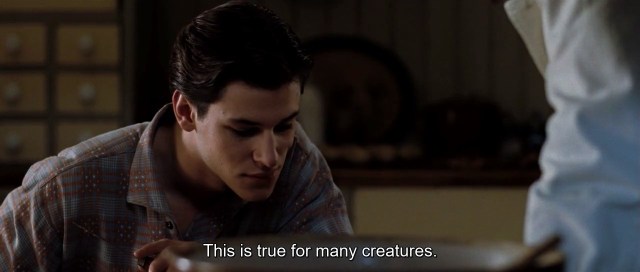
The First and Last Hannibal movie: HANNIBAL RISING (Webber, 2007)

Well, it’s the first Hannibal movie, because it starts with him as a child, and it’s chronologically the last one released. Unless #BryanFuller makes a movie, instead of Season 4 of the TV show. Or Sir Anthony Hopkins comes back as an octogenarian Hannibal, with his wife (Clarice – Jodie Foster or Julianne Moore would both be fine) running the meat business. Martha De Laurentiis @neoprod – I have a script treatment ready!

vlcsnap-00002.jpg

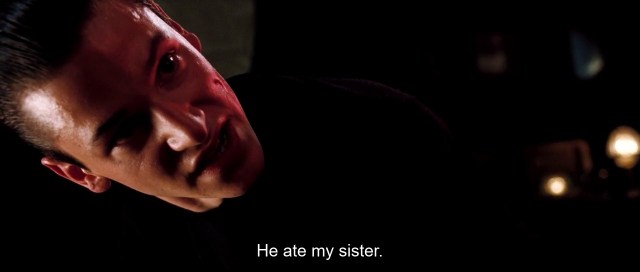
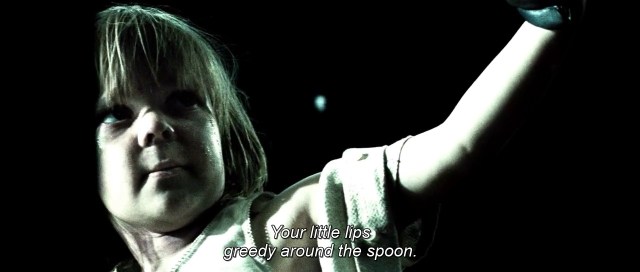
This is the Hannibal film everyone loves to hate. We are treated to a sweet young Hannibal (Aaran Thomas) having to watch his beloved little sister Mischa being eaten by Nazi collaborators and deserters, and then discovering that he himself unwittingly joined the feast.

vlcsnap-00003.jpg

From this, we deduce, came his hunger for human flesh. Like the desperate young crash survivors carving meat from the corpses of their dead teammates in Alive, his subsequent actions may not be acceptable, but become at least partially understandable. Psychopathy founded in trauma.

Hannibal of course would have hated this – remember that he told Clarice in Silence of the Lambs

“You can’t reduce me to a set of influences. You’ve given up good and evil for behaviourism… Look at me, Officer Starling. Can you stand to say I’m evil?”

Or as the 21st century Hannibal said:

when it comes to nature versus nurture I choose neither. We are built from a DNA blueprint and born into a world of scenario and circumstance we don’t control.

There are two streams of thought on the subject of evil: one, from Rousseau to Arendt, is adamant that morality requires an explanation for evil, while an alternative stream from Voltaire to Jean Améry, insists that it be left unaccountable. Clarice Starling and Dino De Laurentiis would seem to favour the side of Rousseau, while Harris and Hannibal, and many critics of the film, seem more aligned with Voltaire. Harris apparently faced the awful choice of accepting large sums of money to divulge the origin story, or else see it betrayed by another writer.

The opening image of a film, they tell you in film studies, sets the mood and the theme. This one opens with a spider-web.

vlcsnap-00001.jpg

People are afraid of spiders, for reasons that I have never quite understood. Beware, this one seems to be saying, and we hear childish Hannibal in the background, telling Mischa to run and hide! But it’s just a game. Until the Nazis appear, with their Hiwis, or Lithuanian collaborators, led by the irredeemably despicable Grutas (Rhys Ifans), bandits who are all too willing to assist the SS, for their own profit.

vlcsnap-00011.jpg

Hannibal’s parents are killed, and the Hiwis take over the lodge, desperate for food, and finding none.

vlcsnap-00014.jpg

Except for the children.

vlcsnap-00013.jpg

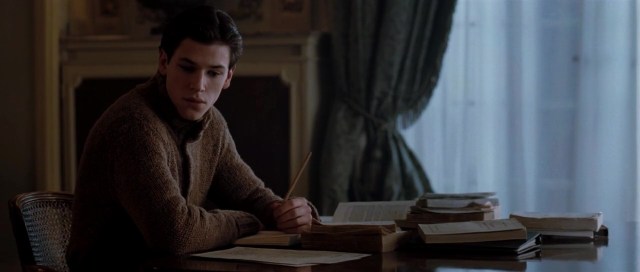
We do not witness the cannibal acts then, but in nightmare flashbacks eight years later. Hannibal (Gaspard Ulliel) is now a teenager, still mute from PTSD, in an orphanage which uses the former Lecter Castle. He is accused of not honouring “the human pecking order”

vlcsnap-00017.jpg

Yes, he hates discourtesy. He won’t swallow bullying. Yet.

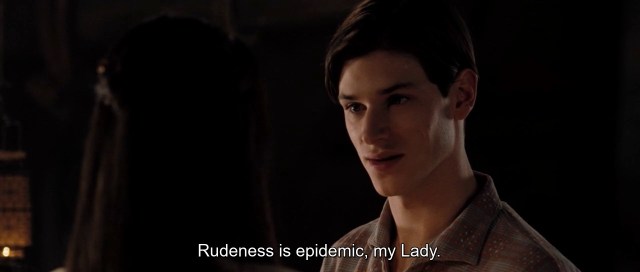
He escapes the orphanage, crosses Lithuania, Poland, East Germany (hops over the Wall, easy as anything) and arrives in his uncle’s home in Paris. Uncle is dead, and he moves in with his beautiful young Japanese aunt, Lady Murasaki (Gong Li, who is Chinese, but, ah well). Will there be romance as she helps him recover his voice?

vlcsnap-00018.jpg

She teaches him about the Samurai code, in front of the armour of her ancestors, strangely evocative of a later Hannibal.

vlcsnap-00021.jpgvlcsnap-00006.jpg

She teaches him the art of fighting. And the treatment of enemies.

vlcsnap-00020.jpg

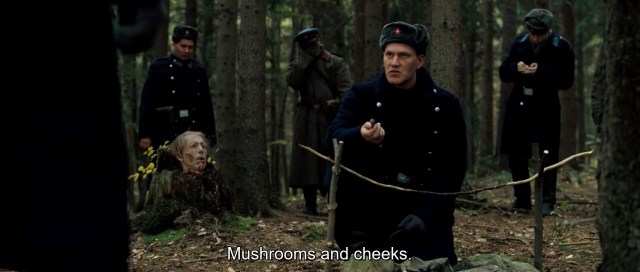
A butcher in the marketplace insults Murasaki, and Hannibal is enraged. The butcher (a Nazi collaborator) becomes Hannibal’s first kill, and then his first human meat, after the chef explains the delights of eating cheeks.

vlcsnap-00025.jpg

vlcsnap-00026.jpg

Hannibal presents Murasaki with the butcher’s head. When she objects that he did not need to do that for her, he replies

vlcsnap-00028.jpg

Discourtesy is unspeakably ugly to Hannibal. Ah, so young, and already eating the rude. And already seeing cannibalism everywhere – looking at a fresco of Abraham on the mount, about to sacrifice his son, he asks

vlcsnap-00032.jpg

So much about older Hannibal is revealed – the police inspector (Dominic West from The Wire) gives him a lie detector test – but he responds to nothing.

vlcsnap-00030.jpg

Hannibal is also brilliant – the youngest student ever admitted into medical school. But he is still obsessed with Mischa and the men who took her from him. He can draw their faces from memory, but cannot remember their names. A dose of sodium thiopental, truth serum, with the Goldberg Variations (another Silence of the Lambs reference) playing in the background, gives him his mental break. Or maybe breaks something in him, depending on your propensity for behaviourism. He remembers that there was a bag of dog-tags left in the lodge, returns to the Soviet Union (no problem crossing the Iron Curtain for Hannibal apparently) and finds all the names. And Mischa’s teddy bear, and her bones. And one of the Hiwis, whom he dispatches, much as Will later dreams of dispatching Hannibal.

vlcsnap-00039.jpg

Pic-00010.jpg

He licks the blood off his glove, with some gusto, and prepares the cheeks for a fresh-air feast.

vlcsnap-00040.jpg

vlcsnap-00043.jpg

Hannibal spends the rest of the movie tracking down the rest of the gang, who are now into respectable industries like human trafficking and drowning ortolans for lunch.

Along the way, there are interesting discussions of our topic – cannibalism. One of the gang tell Hannibal, as he is about to be killed:

vlcsnap-00044.jpg

Survival cannibalism. Common in the days of sail, and in various famines. But the Inspector knows what happened, back in the USSR.

vlcsnap-00046.jpg

vlcsnap-00047.jpg

Cannibalism happened on the Eastern Front, says the Inspector. This is not news to Hannibal. He is determined to find the gang leader, Grutas. The Inspector tells him (us) what a lovely guy Grutas is. He sawed off the head of the Rabbi at Kaunas.

vlcsnap-00048.jpg

He walked away from his war crime trial because a witness got acid poured down her throat. So really, whatever Hannibal does, well, it’s OK with us. But the Inspector has decided Hannibal is insane.

vlcsnap-00049.jpg

vlcsnap-00050.jpg

vlcsnap-00051.jpg

Murasaki tries to persuade him to give the gang up to the police. She can be quite persuasive.

vlcsnap-00052.jpg

But Hannibal cannot make that promise. He has already promised Mischa – revenge.

At his first encounter with the villain, Grutas, he has an interesting outlook on cannibalism too.

vlcsnap-00054.jpg

vlcsnap-00053.jpg

There you have it. Cannibalism is about love.

vlcsnap-00057.jpg

Then the big reveal. Lady Murasaki is a captured by Grutas, Hannibal comes to the rescue and has Grutas at his mercy. Mercy is not a word Hannibal uses much, and when Murasaki asks him to stop, he says

vlcsnap-00058.jpg

Grutas replies:

So did you. You ate her too. So why don’t you kill yourself? Pot Watcher fed her to you in a broth. You have to kill everyone who knows it, don’t you? You ate her, half conscious…

vlcsnap-00067.jpg

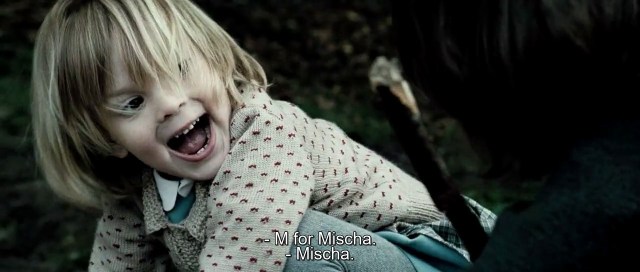
Hannibal snaps, and carves M for Mischa on Grutas’ chest.

vlcsnap-00069.jpg

vlcsnap-00070.jpg

Murasaki gives up, despite Hannibal’s protestations of love.

vlcsnap-00072.jpg

Instead of following her, Hannibal stops for a quick snack on Grutas’ cheeks.

vlcsnap-00076.jpg

Trivia time: Hannibal is not only a brilliant doctor, musician and cook, but he is also apparently ambidextrous. Check him out writing left-handed in this movie, whereas he is right-handed in all the others, and in the TV series.

vlcsnap-00031.jpg

The film got a measly 16% on Rotten Tomatoes. Most criticism centres on the fact that it is not particularly scary, but that rather misses the point, IMHO. The question the film asks is: how do people overcome the social conditioning of their childhoods to become what they are – killers, cannibals, rapists, politicians? It may be genetic, as Hannibal tells Clarice: “nothing happened. I happened”. Or maybe the childhood itself offers a clue to how, as Clarice asked “you got that way”. The film offers a view of the latter – a gentle, loving little boy with, clearly, a brilliant mind, but so traumatised that he can think of nothing but revenge. His target – rude people and bullies. No one minds seeing them get their comeuppance. But you take a bite out of their cheeks, and suddenly everyone is convinced you’re a monster.

But here’s why I like this film:

  • The book and the screenplay are both written by the brilliant Thomas Harris, who of course created Hannibal. This is the only film in the series for which Harris wrote the screenplay
  • The Director is Peter Webber (Girl with a Pearl Earring)
  • There are two Hannibals in this movie (a 100% increase on all the other movies)! One at age eight, and the other a young man
  • It only takes Hannibal’s story up to his arrival in North America, leaving a nice narrative gap between that and his eventual capture and captivity by Will Graham in Red Dragon, which was perfectly filled by Bryan Fuller’s Hannibal (even if time shifted by a few decades)
  • It shows the humanity of Hannibal, his devotion to his sister, and his determination to hunt down her killers. If you don’t want your Hannibal to show humanity, then this can be a problem
  • It was a prequel. Every great character gets a prequel – Darth Vader, Indiana Jones, Vito Corleone, Mr Spock, Zorro, Batman – even Jesus has scored a few. Why not Hannibal?

Poster.jpg