“Cannibal chocolates”: CONSUMING PASSIONS (Giles Foster, 1988)

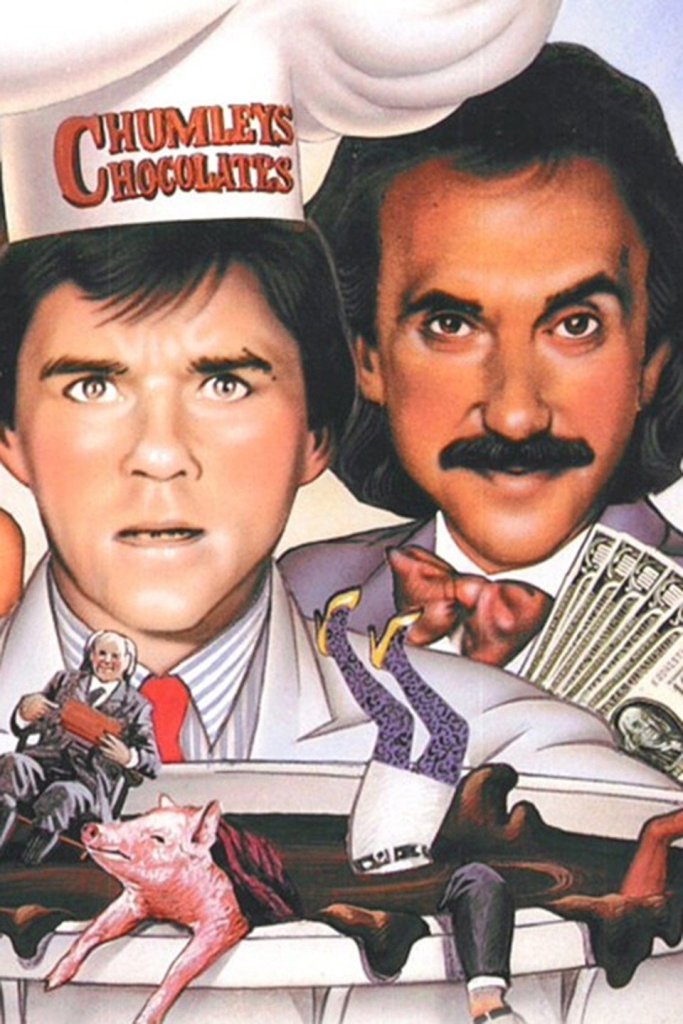
Consuming Passions is a black-comedy film directed by Giles Foster (Hotel du Lac). The film is based on the stage play Secrets by two of the Monty Python greats, Michael Palin and Terry Jones, which was filmed and shown on the BBC in 1973.

This is what I call entrepreneurial cannibalism, with a subgroup of accidental or fortuitous circumstances. A chocolate factory is preparing to launch a new luxury range, Passionelles. However, during production, the new management trainee causes three of the workers to fall into the giant vat of chocolate, where their flesh is mixed into the first batch.

The horrified boss tries to recall the chocolates, but they have already gone on sale. They prove a huge hit with the public. Market feedback says:

“Pleasantly nutty
subtle and delicious
addictive, compulsive
tasted full of goodness…”

They try to replicate the taste with meat from other animals, including a horrific scene where the guileless protagonist, Ian, orders a mountain of meat from the local butcher, including:

“three young porkers, with heads, ears and trotters”

But this bombs – only human flesh will give the chocolate that something special. As the secretary of the company (played by the wonderful Prunella Scales) says:

“People don’t want to eat chocolates with cows and pigs in them. People want to eat chocolates with people in them.”

They contemplate various ways to obtain dead bodies to use in their chocolate, including murder and/or chucking unemployed people in the vat. The new boss, played by the wonderful actor Jonathan Pryce (Brazil, The Two Popes, and many more) states the ultimate in neolib rationalisation:

“Think of all those millions and millions of unemployed school-leavers, yeah? A tragic, tragic situation. But we can give them a chance to do their bit for society yeah… think how it will shorten the dole queues.”

This seems to be based on Jonathan Swift’s 1729 pamphlet A Modest Proposal, in which he satirically suggested that the Irish, who were already being devoured economically by the landlords, should now sell the oppressors their children to make “a most delicious, nourishing, and wholesome Food; whether Stewed, Roasted, Baked or Boiled.”

In fact, the whole film is a commentary on the neoliberal ideologies that were dominating political policy at the time under Reagan and Thatcher. This toxic reasoning, which is still rampant, aspired to free up corporations while crippling any resistance from workers. Profit became the only determinant of policy – here the new owner of the company rejects the idea of putting real chocolate in the product, preferring artificial flavours and colours. When the market demands human bodies, that’s what they must have. Ian has to trawl morgues, hospitals, funeral parlours and medical schools. When his girlfriend, the quality control chemist, discovers there is human flesh in the chocolates, he assumes she will leave him, but she tells him,

“doesn’t hurt them if they’re dead. They’d probably be glad to know they’re being useful, like!”

By the end of the film, Ian is chocolate man of the year, knighted by the Queen, and made chairman of the company. He is no longer disgusted by cannibalism, but in fact is appraising everyone he meets, including his fiancée, for their weight, fat content and likely edibility. In an extreme example of what Marx called commodity fetishism, we have all become comestible commodities. Nancy Fraser writes and speaks convincingly about the way Cannibal Capitalism systematically destroys and consumes the sectors of society on which its own survival depends. In order to sell more commodities to the public, corporations will consume any resource, including the air we breathe, and our bodies too.

The Danes used a similar plot device later with The Green Butchers, starring Mads Mikkelsen (yep, it’s Hannibal, but not as we know him) as a butcher who accidentally locks the electrician in the freezer overnight and finds his customers love the resulting offcuts. The French tried it more recently with Some Like it Rare, in which a couple who own a butcher store accidentally run over and kill a vegan who has been protesting against their store for selling the flesh of animals. They too find their customers love human flesh, but only if it is uncontaminated by eating the meat of other animals – they only kill and cook vegans, a consummation (or consumption) of which Annie Potts and Jovian Parry have found, on social media, many carnists dream.

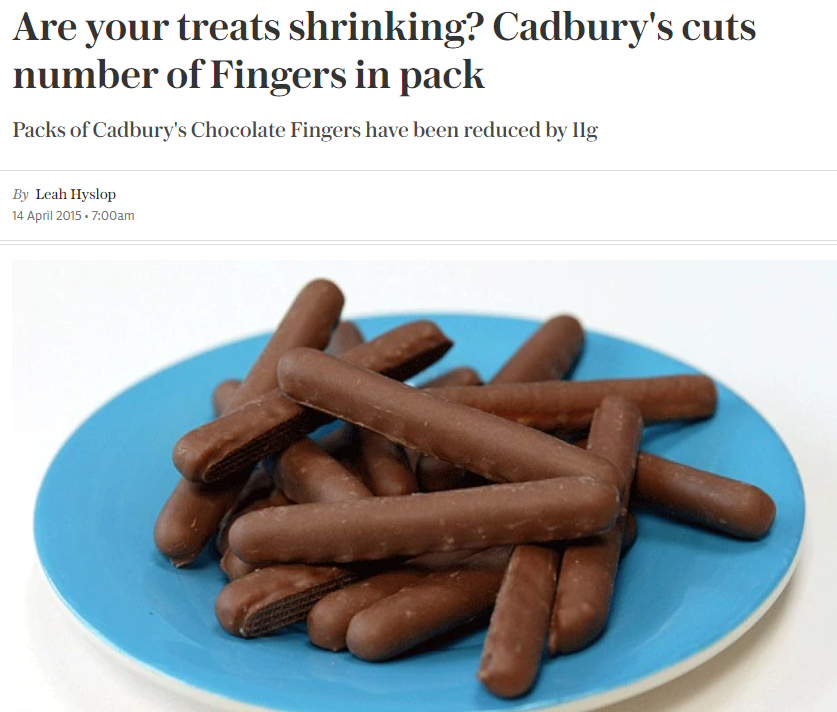
Talking about human body parts in chocolates, do you remember choc fingers? I used to scoff them down as a child. I was somewhat surprised to see they were still available, and were subject of a scandal in the UK in 2015 – Cadbury had reduced the size of the packet by two biscuits!

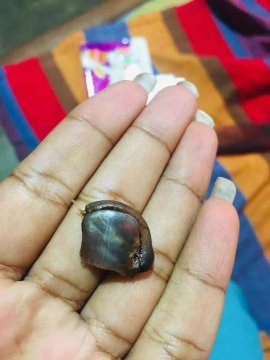
The headline is somewhat unfortunate, and that’s not what this movie is about. But I’d forgotten their very existence, until a recent ‘news’ report that a Sri Lankan woman bit into a chocolate and found the inside rather hard. Thinking it was a ‘fruit and nut’ variety, she persevered, but when the nut still did not crack she decided to check it out by holding the piece of chocolate under tap water. 

In case her tweet has been removed, here is the photo:

It was a bit of a finger, and it reminded me of this long-forgotten (perhaps deservedly) movie. That news, story, like the film, reminds us that, like the ouroboros, our society is busy eating its own tail, it’s workers.

For me, the only really repulsive bit was the dead piglets being dropped into the vat. I’m going to assume they were very realistic models, perhaps made of marzipan, but I’m aware that in a world that kills 1.3 billion pigs a year, buying real corpses would be a lot cheaper for a low-budget movie.

Consuming Passions received a 20% rotten rating on Rotten Tomatoes. It’s a nice idea, but they play it as farce, hanging the comedy on the assumption that we will all be so disgusted by the thought of eating human flesh that we will ignore the often silly dialogue and the occasionally appalling acting, particularly Vanessa Redgrave who, totally unnecessarily, flounces through the film proclaiming herself a “loose woman” and butchering a Maltese accent.

But there are some interesting ideas about masculinist theories of meat-eating, with one woman saying she was going to buy those chocs for her husband to “put the lead back in his pencil”. The idea that men somehow need meat for virility is a basic plank of meat marketing, despite the clear links to heart disease, colon cancer, environmental crises, and of course appalling animal cruelty. And the film’s basic principle, that we are all edible in our consumerist culture, is apposite and well argued, as more and more bodies are sucked into that vat of delicious brown ooze.

“Just Darwin and shit”: THE HORROR OF DELORES ROACH episodes 2&3

I’m spreading this out, one or two episodes at a time rather than binge-watching the whole eight, because I want to savour them, also because that would be like watching a four-hour movie, which I usually only do if Peter Jackson is involved. And I’m trying to finish my thesis, so no four-hour movies for this old student!

If you haven’t read my blog on the first episode, you might want to do that first, as it makes more sense if you know that Delores has just been released from prison after 16 years. Just click here.

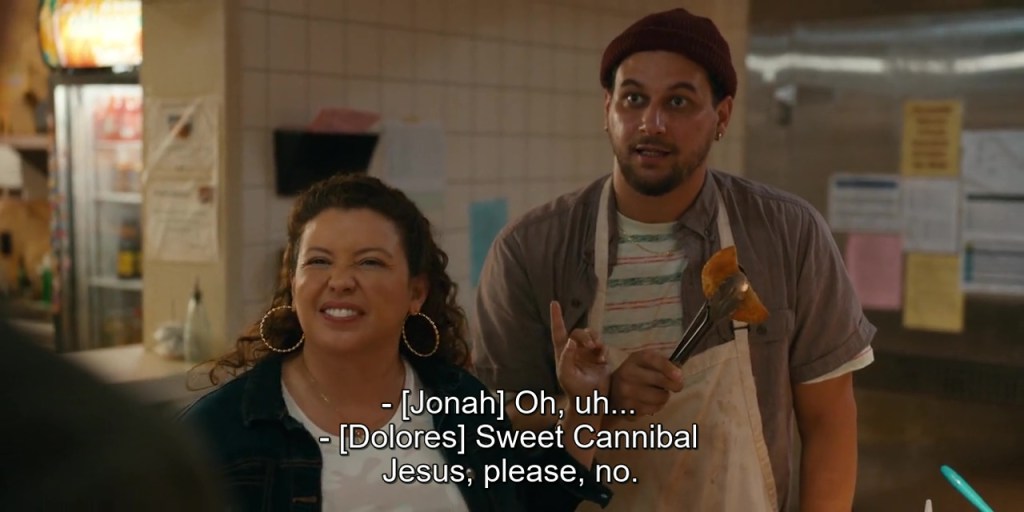
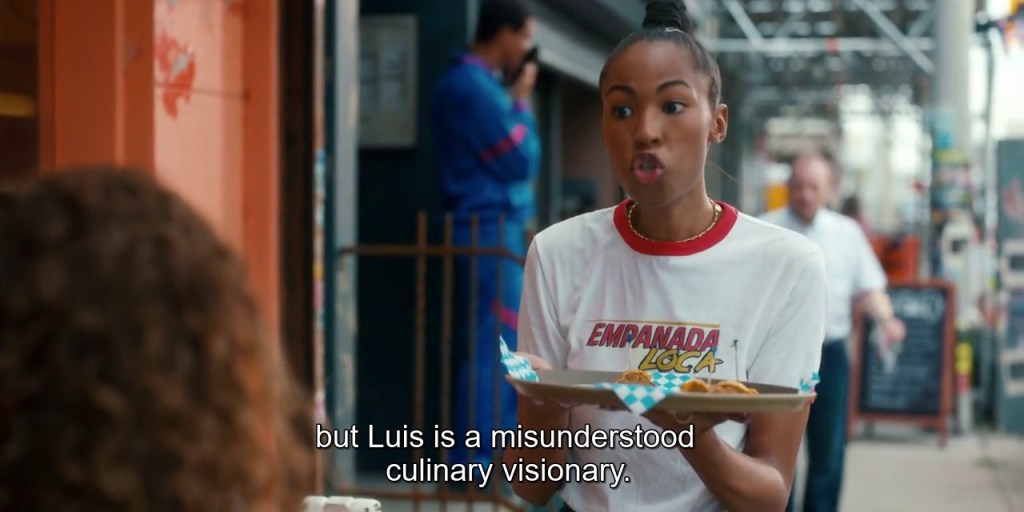
Delores is living in the basement of an empanada shop run by Luis, but he is a dreamer, and is quickly going broke. The whole neighbourhood has been gentrified, and people don’t buy empanadas like they used to. Luis keeps inventing new flavours, but none have caught on.

Episode 2 is the setup for the cannibalism to come in episode 3. We know it’s coming, but Delores doesn’t.

Luis is feuding with his landlord, Gideon Pearlman, played by the wonderful comedian Marc Maron (the cranky entrepreneur from the TV show GLOW). Delores plays peacemaker, takes him downstairs and gives him all her money, which turns out to be negligible amount, due to the massive gentrification that has happened in Washington Heights in the last sixteen years while she was in the pokey. He sees her massage table and she offers him her “magic hands”, which of course he misinterprets as an offer of a hand-job. But Delores has learnt self-defence in jail.

“Got to break the C2 or C1 to kill somebody”

Which she does. Not knowing what to do with the body, she runs to the shop and buys spades, saws, gaffer tape and, to be inconspicuous, a whole load of birthday balloons. It really is a dark comedy!

When she comes back, she finds Nellie, who works in the empanada shop, giving away samples of the new taste sensation, MUY LOCO. What’s in it?

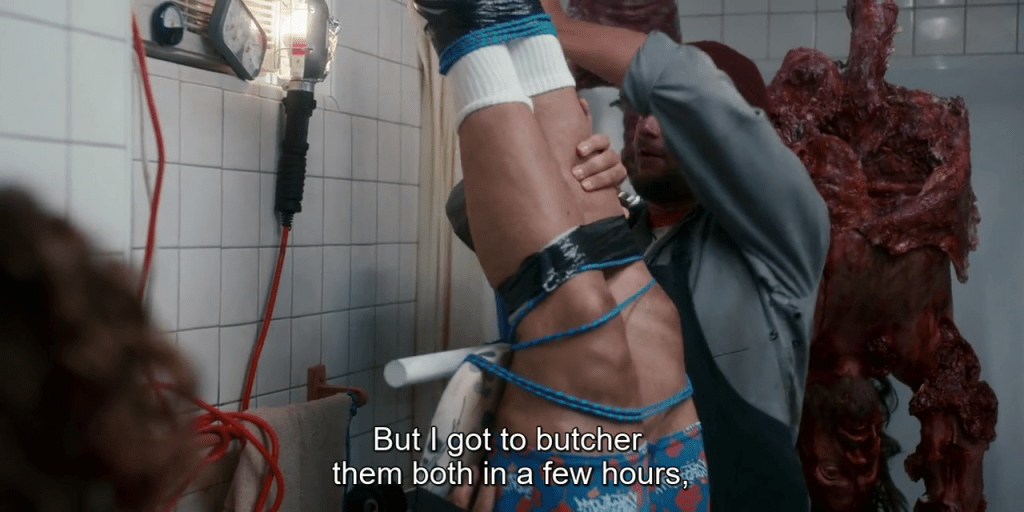
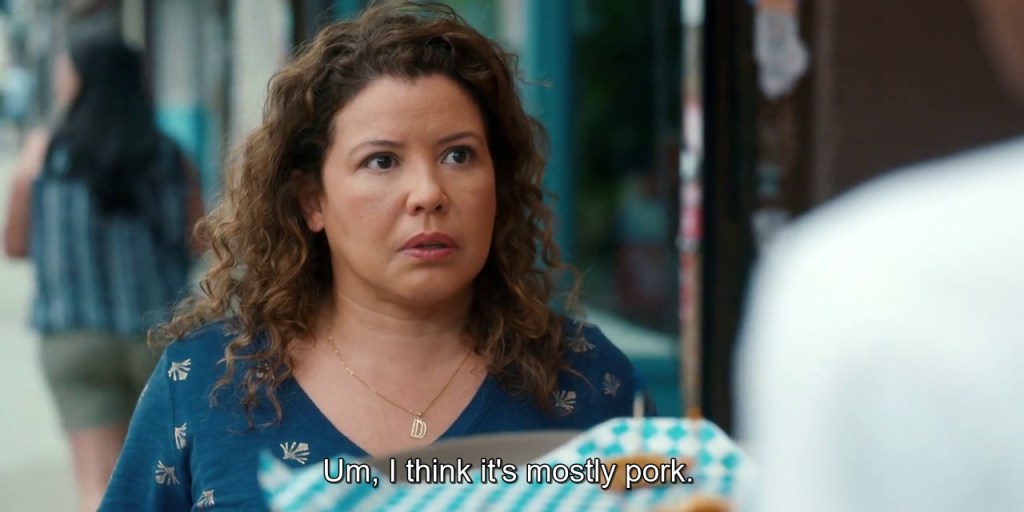
Yeah, it’s not pork, it’s long pig, and when she confronts Luis, he tells her he “took care of it”.

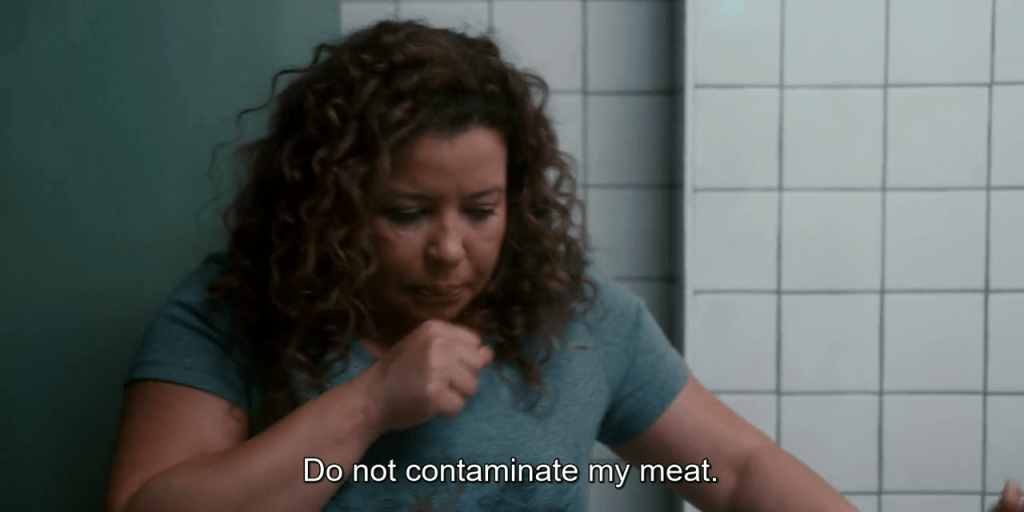
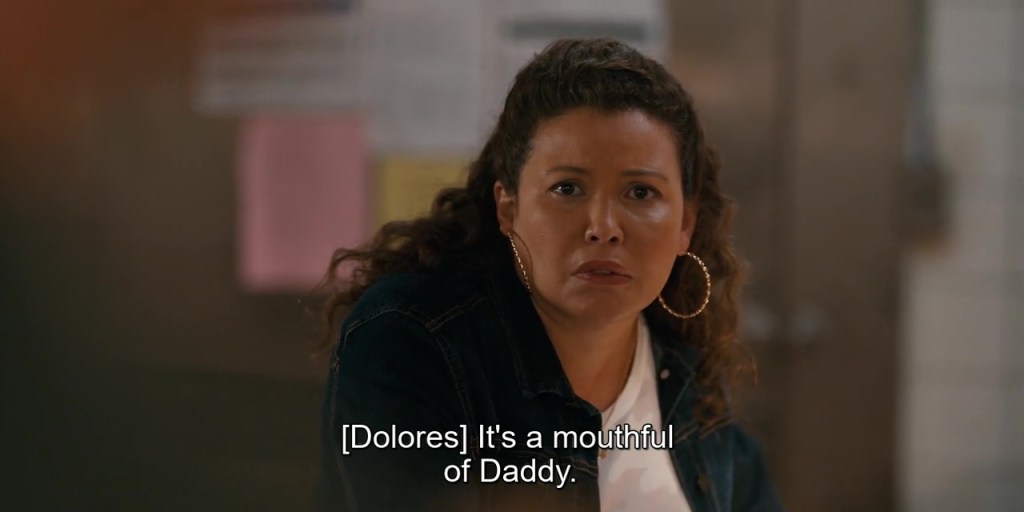
Luis is suddenly a huge business success. Everyone loves Muy Loco, including the local cops. And he wants to give Delores the credit, whereas all she wants to do is barf.

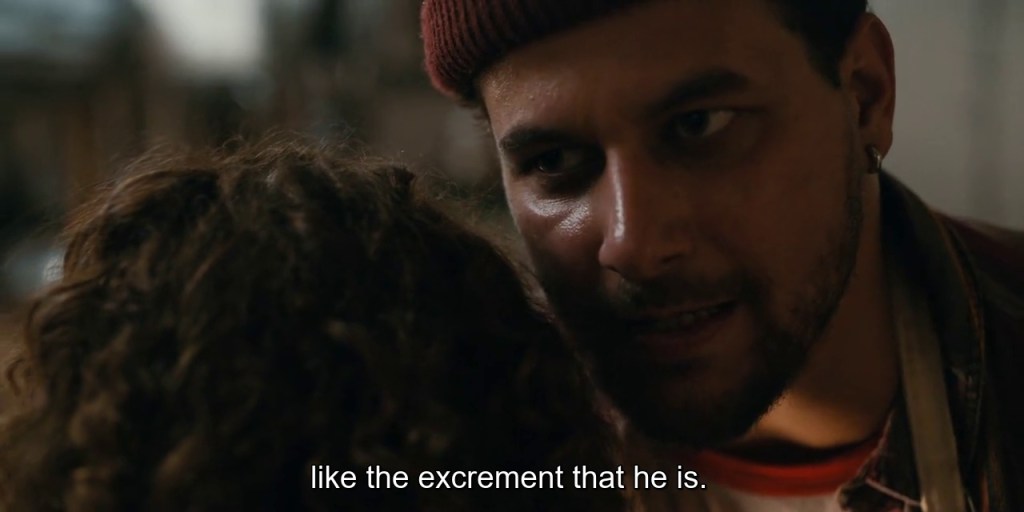
But you, my Delores, you just changed the game for me. You have led me to a pantheon that very few of us who are called to this art are ever privileged enough to touch.
So now, that greedy son of a bitch will get chewed up, shat out and flushed down the toilet.”

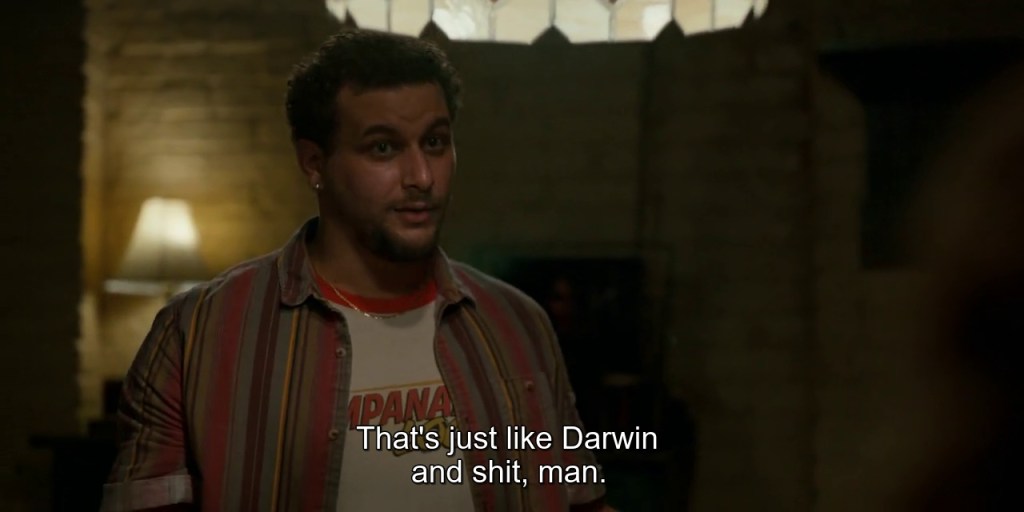
The other reason I didn’t want to go past episode three is that Luis and Delores engage in a fundamental philosophical discussion that is key to Cannibal Studies, which we might summarise as “meat is meat”. When Delores refuses to taste Muy Loco because “it’s human fucking flesh in an empanada!”, Luis responds:

“Delores. Meat is meat. Flesh is flesh. The only reason that we eat a pig, or a cow or a lamb, like whatever, is because we are more powerful than them. So we get to feed off them. That’s how we survive, because we are carnivores. That’s just like Darwin and shit, man”

We’re actually not carnivores – that name is reserved for the true predators – tigers, sharks, that sort of animal. We are scavengers, like anchovies, or pigs.

We’re treated to lots of close-ups of meat being chopped, meat being cooked, meat being gobbled up. Viewers may at this point be consoling themselves by saying “it’s not human”, but it’s red meat, it’s from some mammal, and what difference does it make which species?

Luis has taken care of the body, removed the evidence, and become a successful business owner, all with one radical idea. The only problem is,

MIRACLE MEAT (yes, it’s baby cannibalism)

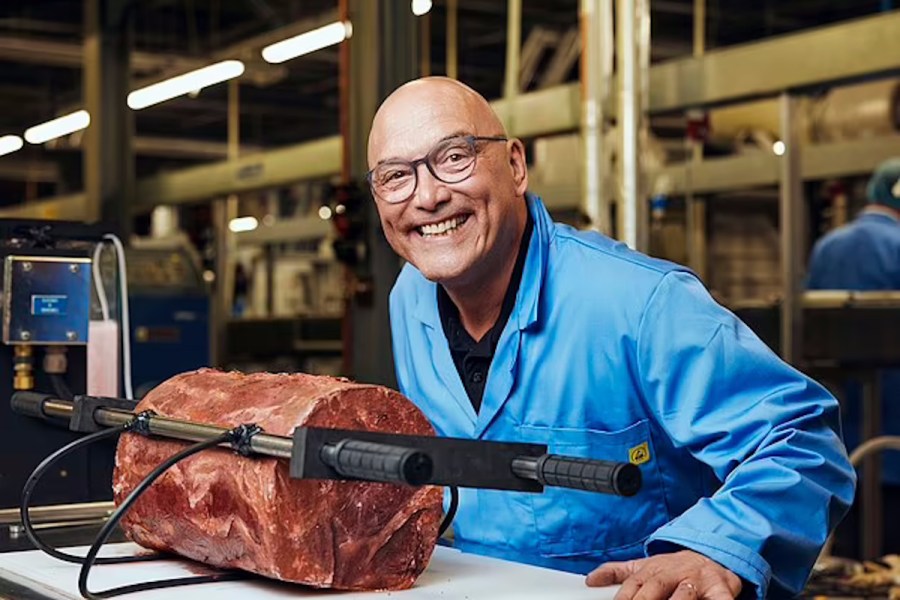
Gregg Wallace is arousing the fury of the Internet for hosting a show in which human meat is grown for human consumption. Yes, engineered cannibalism.

If you haven’t heard of Gregg Wallace (I plead guilty), he is a host of the UK version of MasterChef, a reality show where people have to cook flesh in a way that – I don’t really know, I don’t watch it.

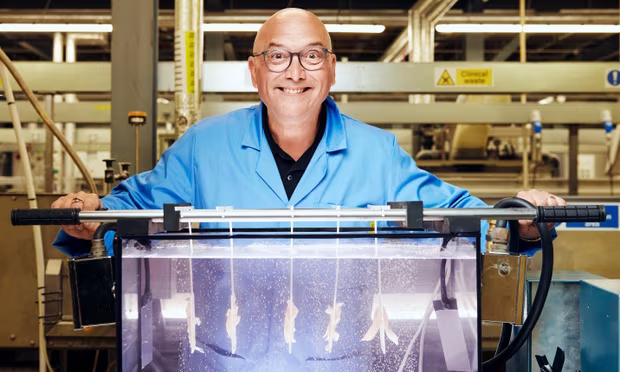
This show is called The British Miracle Meat, and is quite obviously a satirical documentary, set in a factory which purportedly manufactures ‘engineered human meat’.

Following its debut, 408 people complained to the broadcasting regulator. The majority of complainants objected to the theme being the consumption of human meat. Which is, IMHO, pretty rich coming from people who tuned in to a show about meat.

It seems to have been inspired by a work written in 1729 by Jonathan Swift (the author of Gulliver’s Travels), which was called:

A Modest Proposal For preventing the Children of Poor People From being a Burthen to Their Parents or Country, and For making them Beneficial to the Publick

Swift suggested that the Irish could be relieved of their destitute states by selling their children to the Landlords who “have already devoured most of the parents”:

A young healthy Child, well nursed, is at a Year old, a most delicious, nourishing, and wholesome Food; whether Stewed, Roasted, Baked or Boiled; and I make no doubt, that it will equally serve in a Fricasie, or Ragout

Since the British Empire was sucking the Irish populace dry and leaving them to starve, why not eat them as well? Satire has remained a popular form of political action ever since, and is used extensively, particularly in American politics (watch any late-night show).

Wallace is shown visiting a heavily guarded processing plant in Lincolnshire, which houses a production line and clinical facilities. He is told that, for the last eight months, they have been producing meat made from human cells. Line manager Mick Ross explains that it is a relatively new process. “Under EU law we couldn’t possibly operate machines like this.”

We see little shavings of flesh hanging in a nutrient-rich vat and quickly developing into huge slabs of meat. Wallace interviews ‘donors’ who sell their flesh to fictional firm ‘Good Harvest’ as a solution for cash-strapped families. One 67-year-old retired receptionist said she had agreed to have flesh taken from her buttock and thigh in order to fund two weeks’ energy bills. The flesh is then shown growing in labs into larger slabs of meat – which can be used to make steaks, burgers and sausages.

These can yield up to one hundred steaks, which— according to taste tests carried out with men and women in the street by co-presenter Michelle Ackerley—are remarkably fine substitutes for beef, and at a fraction of the price. Is this the answer to the cost of living crisis?

“Why human meat, why not animal meat?” asks Wallace, and Ross explains that we know more about humans, we have centuries of medical and scientific knowledge, so can more easily manipulate it.

Good Harvest’s chief executive revealed the firm’s premium range comes from the flesh of children aged six and below – with a promotional video which billed the womb as ‘nature’s oven’. Well, we already know from watching Snowpiercer that babies taste best. And Gregg – let’s try to remember that humans ARE animals, yes?

But apparently many of the British viewing public did not get Gregg Wallace’s joke. The show gave no warning ahead or during the broadcast to indicate that it was fictional. That was supposed to be, in British parlance, bleedin’ obvious. Interviewed after the show aired, Wallace said:

It’s satire – so I suppose that was the point. Everybody was an actor. I was acting. None of it was real… While it was a complete fantasy, we wanted to raise important questions about the nation’s relationship with food and what those struggling with the cost of living are being asked to do in order to stay afloat.

A Channel 4 spokesman said:

This “mockumentary” is a witty yet thought-provoking commentary on the extreme measures many people are being forced to take to stay afloat in our society during the cost-of-living crisis. Channel 4 has a long and rich history of satire and has often used humour as an accessible way to highlight society’s most important issues.

The problem was, it was not clear what the point was. Lab meat can be grown from any animal cell. Find a readable chain of DNA and it may be possible to try whale, dodo or dinosaur flesh. Of course, the easiest cells to source are human ones – we routinely hand them to pathologists and crime scene investigators. When clean meat becomes commercially viable, there is no reason (other than administrative) to assume we could not grow human steaks, livers or sweetbreads. The eating of lab-grown flesh from celebrities is the starting point of the film Antiviral. Eating human meat grown in a lab would technically be cannibalism, but it would not, as with traditional cannibalism, involve cruelty, murder or despoiling of corpses.

The show concentrates on the cost of living crisis, and clearly cheaper food prices would help. Would people sell their own flesh, and would other people eat steaks grown from it? A better point might have been to point out that humans currently breed and slaughter some eighty billion (that’s 80,000,000,000) land animals every year to eat their flesh, not counting sea animals, whose numbers can only be estimated but might be about three trillion. Although most people prefer not to see the appalling conditions of the factory farms or the brutal deaths in the abattoirs, they tune in by the millions to watch cooking shows like MasterChef which treat the consumption of this flesh as unremarkable, and often the butt of crude humour.

So why not add one more animal to the conveyor belt?

As Herbert M. Shelton said in his book Superior Nutrition:

The cannibal goes out and hunts, pursues and kills another man and proceeds to cook and eat him precisely as he would any other game. There is not a single argument nor a single fact that can be offered in favor of flesh eating that cannot be offered with equal strength, in favor of cannibalism.

I wonder if Jonathan Swift would have recognised the plagiarism of his book? His brand of satire is usually called “Menippean” and is characterised by attacking mental attitudes and beliefs.

The joke is not that Wallace pretended to visit a factory that pretended to pay willing donors for flesh. The real belly laugh is that over 400 people complained about that, while probably tucking in to the corpse of an animal who really did not want to die.

Deep tissue cannibalism: THE HORROR OF DELORES ROACH Episode 1 (Aaron Mark, 2023)

This is not only a fabulous story, but possesses a proud heritage in the field of Cannibal Studies, and is not afraid to flaunt it. Delores Roach is a young woman in a basement in Washington Heights Manhattan, who gives massages for a living, occasionally killing her clients and delivering their bodies to Luis, who runs the struggling empanada store above, to use as meat. Yes, it is unapologetically the offspring of the legend of Sweeney Todd, the “Demon Barber of Fleet Street”, who killed his customers instead of shaving them and then dropped them through a trapdoor to his colleague and perhaps lover, Mrs Lovett, who turned them into delicious meat pies. There is some controversy over whether or not Sweeney was a real person who was publicly hanged outside Newgate Prison in 1802 or just an urban legend of early capitalism. In any case, Sweeney appeared in a number of movies; in 1936 he was just plumb crazy, while in 2007 Tim Burton made him an honest man wronged by a corrupt power establishment. Burton’s film is based on a Sondheim musical that played interminably on Broadway and around the world.

In this version, Delores (Justina Machado) turns everything upside down; it’s Sweeney through the looking glass. We’re in New York instead of London, with a female serial killer instead of a male, and a male pastry chef instead of a female. Delores is downstairs killing people for Luis who is upstairs cooking them, again turning the Sweeney legend upside down. Like Sweeney, at least in the Tim Burton musical version of the story, Delores has returned from a long and unjust term of incarceration.

She finds her shabby neighbourhood, Washington Heights, gentrified after 16 years in the slammer, to the extent that she doesn’t even recognize any of the shops. A lot of the reviews seem to focus on gentrification as the main crime in this story.

Except for her favourite fast food store, Empanada Loca, run by Luis (Alejandro Hernandez), the son of the man who used to make the empanadas. He has a soft spot for Delores, who used to pay him in cash and spliffs when he delivered her lunches. Luis offers her accommodation, for old time’s sake, and maybe the odd massage.

There are plenty of stories based on butchers serving human meat to unwitting customers, turning them into innocent cannibals. Among them are Hitchcock’s Speciality of the House, Mielche’s The Butchers, Yau’s The Untold Story, Jensen’s The Green Butchers, Stjernswärd’s The Farm and Eboué’s Some Like it Rare. And of course our old friend Hannibal, who tells his guests “Nothing here is vegetarian”.

Burton’s Sweeney Todd was based on a Broadway musical, but Delores is a generation later, and so now her Broadway show is based on a more contemporary form of popular culture, the TRUE CRIME podcast.

Of course, it’s not true, but in the postmodern age, a true crime podcast needs a true crime, which is also confected for our narrative pleasure.

The podcast becomes a Broadway play, with the actor Jessica Pimentel (Orange is the New Black) playing Flora who is playing Delores in the play (stay with me here). Her performance is a triumph; in her final soliloquy she is covered in blood and holding a human heart.

The performance of the play, and the episode we are watching, both end with a song: Stanley Holloway’s “Sweeney Todd the Barber”:

“Sweeney Todd the barber,
by gob he were better than the play
Sweeney Todd the barber,

I’ll polish them off he used to say
and many’s  the poor young orphan lad
had the first square meal he ever had
a hot meat pie made out of his dad
from Sweeney Todd the barber”

For those of us who have been waiting for this series, or those who just saw the advance publicity, we are now in the omniscient position of knowing what is going to happen. We have seen the newspaper headline of the “real” murder and the review of the “real” true crime podcast, and seen the full house audience cheering the performance. In case we aren’t sure, a couple of friends pour drinks in Flora’s dressing room, chatting about the play and its reflection in the “real” world.

“…the café in Taipei serving human flesh dumplings?”
“Yes, yes, yes, yes and the human bone marrow in that bistro in Paris!”

Then the “real” Delores appears in the dressing room after the friends leave. No, not to murder Flora for impersonating her, but to tell her the true story.

“I’m gonna tell you shit you could never un-know.”

So now, we have a dramatisation of a fake true crime podcast about an actual crime that doesn’t exist, and the dramatisation is being applauded for creating a wave of actual cannibalism events (that also didn’t happen). They concern a female serial killer who is based on a male serial killer who also probably didn’t exist. An actor playing the (unreal) serial killer is telling her story to the actor playing the actor who is playing that serial killer. It plays (sorry) with the mind.

So does cannibalism. Except for a few rare cases where the cannibal is prepared to admit all his or her activities, such as Albert Fish, Jeffrey Dahmer and Issei Sagawa (who laid out the whole project in a manga), cannibalism narratives are very difficult to nail down. Some like Ottis Toole over-confess, leading to speculation that they are making it all up, helped by police who want to clear the cold case log. Others deny everything. And some just disappear and are never found, like Jack the Ripper. Cases of cannibalism are so sensationalised that the reports of the popular press are dubious in their accuracy.

But what we do know is that cannibalism is real, and is one of the primal drives among every type of animal from comb jellies to humans. Freud and Abrahams called the first six months of an infant’s life “the cannibalistic stage”. We all have a cannibal inside; it just comes out more readily for some people than others.

The series is a Blumhouse production on Prime Video and is so good that I am spreading this blog over all the episodes. Among the many great names to appear in future will be Cyndi Lauper as a detective.

Cannibals just wanna have fun.

Internet Phantasies of Cannibalism

Trigger warning

This blog contains graphic scenes of sexual abuse, violence and cannibalism. These are all imaginary phantasies (in the Freudian sense of wish fulfilment rather than whimsical fiction or “fantasy”), drawn, written or simulated. None claim or even appear to be anything other than phantasies.

Note: these images were all taken from a standard browser search of the Internet in 2023. Most were captured from the short form blogging platform Tumblr, which hosts a wide range of different sites, including cannibalguy. None of these images below are from the “dark web” where there are supposed to be far more graphic scenes including, allegedly, genuine instances of rape, murder and cannibalism.

If you don’t like graphic images (he said to people reading a blog called thecannibalguy), please exit, and come back next week.

cannivore2

Tumblr has deleted this account since I downloaded these images in January 2023. The link below is to his or her new account at an aggregation site called Tumbex. Some of these images appear there, while others not shown here have been added. The images reflect a deep male fear of the female cannibal, an extreme form of what Barbara Creed calls Phallic Panic.

Severityschool

This site seems to explore the eating of the male; some images such as the one below consider the parallel with those considered ontologically animal and so morally inconsequential, and question why humans might not be the same.

Murray David

More cannibalism of the male, but this time on Facebook, which is usually considered a little more, shall we say, demure than Tumblr. The most interesting aspect of this image is that the male has been penetrated (an outrage usually reserved for the female) and that, although the site censors seem to have no quarrel with the steel rod entering his anus and exiting his mouth, the penis has been blurred for the sake of decorum. Torture and cannibalism are, it seems, less offensive than images of human genitals.

grandahl2

Cannibalism can fascinate not just objectively but subjectively. Many web users claim to crave their own consumption by a cannibal, and some of them like Bernd Juergen Brandes achieve their desires. For most, it is phantasy, often expressed in long rambling narratives.

Preparing my meat

I know it’s unusual, but I’ve wanted someone to eat my genitals for as long as I can remember.  If you think you might be interested in cooking and eating my cock and balls, please drop me a note.
You should prepare me however you think best.  I’m willing to help prepare and serve myself to you to eat if you desire.  One cooking method I’ve thought a lot about has me sitting on a low mound, my legs straddling a wood fire burned down to coals. My butt is impaled on a short steak pounded into the mound to keep me from moving and some insulation is placed on my inner thighs.
Before I’m placed over the coals to cook, the chef has tied my erect cock and balls off tightly.  He tamps a seasoned stuffing mix down my pee hole to season me from inside and forces a large clove of garlic in my glans to keep the stuffing in me.  He then takes a large syringe and injects some seasoned Cabernet into my ball sack.  He tells me my balls will braise in the wine and cook more slowly as my penis is roasting.
At first just a few coals are placed under my genitals at first to provide a little heat. Foil is tented over my genitals so they cook evenly from all sides. I’m grinning and trying not to cum with my cock tied off. I feel some pain from the heat, but my cock is getting numb from being tied off. At this point the chef occupies me with some conversation as I start to cook…
The chef and I continue to chat about dinner. He bastes my balls and cock head frequently so they don’t burn and periodically sifts more seasoning onto my genitals. My cock is continuously twitching. My cum seeps into the stuffing chef forced down my pee hole, but can’t escape to the end of my cock. My balls move in the wine that fills my sac, but can’t get away from the heat. Chef keeps adding a few more coals around my genitals. Then I realize: I’m starting to cook! and get the first whiffs of my roasting sausage – musky pork ! I’m so excited to finally be dinner. I hope I’m tasty.
After some time my cock is mostly numb and I’m cumming deep in my groin. My cock is a golden brown and my ball sac is getting crispy on the outside. Some stuffing has blossomed out the end of my penis around the garlic.  Some wine has leaked from the hole used to fill my sac and mixed with the seasoning I’m coated with. I’m ready to be served! The chef helps me up off of the dowel that impales my butt and I hobble to a sturdy outside table…
I sit on a large platter facing the chef and spread my legs as far as possible to present myself for his dinner.  He shakes some salt and ladles juniper berry sauce on my browned and steaming cock and I’m ready to be carved. With wide eyes I watch the chef spear my cock head and slice it off. He smiles just before popping it in his mouth and starting to chew. I’m trying desperately to cum, but can’t with the tight binding at the base of my genitals. Piece by piece he carves and eats my roasted penis, dipping each bite in the juniper berry sauce. Eventually, it’s a twitching red circle even with my balls.
He eyes the second course greedily, and smiles again as he slices open my crispy ball sac. My roasted testicles pop out with the remaining wine sauce. The cords are cut and my oysters sliced. (he gives me a piece to taste, interesting flavor with a hint of cum.)
With my testicles devoured, he trims off the crispy bits of my sac and wipes the plate with them. They crunch in his mouth. The root of my penis is now exposed and dripping juice on the plate. He comes at it with you carving knife and starts to cut. I feel him slicing through my living meat. I grit my teethe and push into the knife, willing him to carve out my root for the final bites of his meal.
He pops it in his mouth and walks off chewing as I collapse on the table.

sashaotaku

Much hand-drawn art involves violence against women, usually helpless but sometimes compliant and occasionally even enthusiastic. This image suggests that penetration by penis and skewer or spear are analogous, and the figure in the middle appears to be a woman with a camera who is at least voluntarily documenting the intercourse and likely murders, possibly to prepare herself for the same fate from the man who is sexually fondling both her and the prospective killer.

Coffingag

The artist who posted this is unapologetically into ‘dolcett’, a subset of vorarephilia, usually abbreviated to ‘vore’. Vore of women (gynophagia) can be ‘soft vore’ where the victim is eaten while still alive and whole or ‘hard vore’ where killing and dismemberment is depicted with attendant gore, while male diners usually express appreciation for the meat. Dolcett is hard vore gynophagia that depicts females being killed and cooked, often on a spit, and often with their enthusiastic agreement.

The artist of this piece stated that the art was “commissioned” and would be the first of a series that would be drawn when time allowed during their semester. I wonder if the semester covers the writings of Julia Kristeva, who speaks of the “fragile states where man strays on the territories of animal”. This image is clearly based on the roast chicken which appears on millions of dining tables nightly, but is clearly a woman – it shows breasts and a round but stitched stomach, implying an equivalence between being pregnant and being ‘stuffed’. The pregnant woman is the ultimate disrupter of the patriarchal symbolic order, a symbol of fertile, fecund nature.

sexual-freak-show

This is a hard vore site, but also promotes other paraphilias such as scopophilia, voyeurism, bondage, incest, torture and bestiality, interspersed with innocuous images of entirely healthy young women, conceivably placed to allow readers to exercise their own imagination. The concept of a person seeming to enjoy being roasted alive is pure phantasy; there have been no reports to my knowledge of anyone ‘enjoying’ this, even Joan of Arc. This image appears to have been removed, but replaced with many more graphic scenes.

Flostress

This site is no longer available, or at least cannot be opened safely, indicating that it may have been appropriated by a fraud site. It demonstrates the equivalence of women and animals that Carol J. Adams has studied comprehensively. The face and breasts are clearly human, the ears and tail clearly porcine.

Hills-finest

This site involves many purported recipes for “girl meat” and line drawings imagining various abuses. The one below seems to have been removed but while there it expressed (with appallingly ignorant spelling) a profound misogyny.

Fluidcravings

Originally uploaded to Tumblr but since deleted, in fact the whole account has been removed.

A succinct summary of the problem with cannibalism and carnivorism in general. The eater is motivated by a voracious appetite and objectifies the victim as simply food. The victim is terrified, experiencing an agonising death immersed in stomach acid. The end result is satisfaction for the cannibal while the victim is reduced to ordure. “I’m not food” is what the trillions of animals slaughtered every year for human consumption would say if they could make themselves understood by the consumers, and sums up the struggle against carnivorous virility.

Madalot

Clearly Creed’s archaic mother, the basis of so many man-eating monsters, who reflect an unconscious fear that the mother’s body, from which we all emerged, has the power to re-absorb the child. In this drawing, we see one who is seemingly willing to re-enter her body, assuming a foetal position in her stomach.

ForbiddenFeast

This is a site dedicated to gynophagia and dolcett images, and is only fully accessible by paid subscription, but there is still plenty of free content for those who happen upon it. The explanatory page states that it features

“exclusive artworks depicting food in a “unmentionable” nature (sic). If I seem vague, I’m sorry. You should check out the terms “dolcett” and “gynophagia” to get what we mean. If you are here by mistake and do not know the context of what this site is about already, you should leave now.”

I’ve spent a lot of time and a lot of words wondering why an image such as the above is so abject and repugnant, while the same scene is unremarkable in any butcher shop, just because it involves a different species of mammal.

Reddit

Reddit is a social news aggregation, content rating, and discussion website where readers can join and participate in discussions on particular topics in dedicated areas called “subreddits”. This subreddit is simply entitled “cannibalism_lounge”. It offers a rather more sophisticated version of the defunct Internet fetish forum “The Cannibal Café” where Armin Meiwes contacted prospective victims in the year 2000.

@iampigmeat

This account has been removed from Tumblr but content is still available in Tumbex. Objectifies the human body into “choice cuts”, a process common to butcher shops, but usually showing the bovine rather than human form.

Content removed by the website

Sites like Facebook and Tumblr spend a lot of time and money deleting gratuitously offensive posts. Most effort seems to be spent in tracking down and removing porn, which I would think might be less offensive to many than the scenes of bloody mayhem in the vore posts. The ones like those shown in this blog, which last long enough to be captured, are probably relatively mild content. Anything stronger (or focused on genitals) usually gets the boot, often accompanied by a triumphant statement such as the one below, which seems to say “we caught you”.

They are pretty successful capturing consensual sex, but rape, torture and cannibalism? Not so much.

Cannibalism news July 2023: Two men arrested for eating partially-cremated human flesh

Two men in Odisha (eastern India, formerly known as Orissa) have been arrested and accused of cannibalism after locals found them eating half-burnt flesh from the body of a woman who was being cremated at a funeral in Mayurbhanj, Odisha. 

The incident happened in a tribal village called Bandhasahi. The accused were identified as Sundar Mohan Singh, 58, and Narendra Singh, 25, both from Dantuni village. The deceased woman was identified as Madhusmita Singh, 25, who had died in the Bandhasahi village hospital. The family took her body to the cremation ground and performed the last rites. In Hinduism, the preferred way of disposing of the dead is Antyeṣṭi (अन्त्येष्टि), a composite Sanskrit word of antya and iṣṭi, meaning “final sacrifice.”

The two men, who were said to be drunk, were overseeing the proper burning of the body. As the cremation progressed, the body had been burnt almost entirely to ashes, except for a single unburnt piece of flesh. Mohan and Narendra claimed that it wouldn’t burn unless it was cut into smaller pieces and then thrown back into the fire.

Lobo Singh, the grandfather of the deceased girl, watched the men pull the unburnt flesh out of the fire. Narendra proceeded to divide it into three pieces, with Mohan tossing two pieces back into the flames. However, Lobo Singh said he witnessed Mohan concealing the remaining piece in his left hand, He questioned Mohan about this, to which Mohan casually replied that he would discard it later.

The woman’s uncle said that, when he asked them what they would do with the flesh, one of the accused, Sundar Mohan Singh, replied, “You don’t know about witchcraft.” After around 10 minutes, he announced that he would eat the piece of flesh. Before the others could do anything, Mohan put the piece in his mouth and began chewing it; he also offered a portion of flesh to Narendra, who also commenced eating it. 

The villagers caught and beat the accused duo, tied them up in rugs, and informed the local police. Both accused admitted committing the crime, claiming that they had consumed the flesh in an inebriated condition. They were charged under section 297 of the Indian Penal Code. Senior police officer Sanjay Kumar Parida stated that the accused were arrested based on the complaints of the villagers, but no trace of human flesh was found on them. Further investigation into the case continues.

This sort of phantasy, that eating human flesh will give the eater special powers, is not uncommon in Cannibal Studies texts; essentialist speculations that some part of the ‘donor’ remains imbued – such as the courage embodied in the brave enemy’s heart or strength in his or her limbs. Brigid Brophy, one of the seminal voices in the animal justice movement, called this “the primitive superstition that eating the flesh of bulls endows you with the strength of the bull”. Even Freud seemed to have subscribed to such thoughts, claiming in Totem and Taboo that the birth of civilisation occurred when a group of young prehumans came to resent their father’s monopolisation of the tribe’s females (common among primates) and rose up, killing the father to take their mothers and sisters for themselves. “Cannibal savages as they were, it goes without saying that they devoured their victim as well” and, Freud added, as well as the protein they ingested from the fresh meat, the brothers would each have “acquired a portion of his strength”. Freud went on to speculate  that their sense of remorse created the first ethical basis for civilisation, which seems rather far-fetched, and there is no evidence that the Singhs, even when they sober up, will be creating a new form of civilisation in Odisha. Although, to counter my obvious scepticism, there are reports that Armin Meiwes, currently in prison in Germany, allegedly claimed that, after he ate his bilingual lover in 2001, his own English improved considerably. We absorb the nutrition of our food, why should cannibals not absorb the strength, spirit and experiences of their victims?

The Orissa Post called the incident “extremely rare”, but this blog has reported on similar incidents in the past. In Assam in 2022, another inebriated man found edible flesh within the cremation flames.

In 2019, The Global Report on Food Crises estimated that there were some 135 million “acutely food-insecure people in crisis or worse”, including 17 million acutely malnourished children under 5 years old. The changing climate, or future pandemics, could easily double that number, leading to what the head of the UN’s food relief agency warned could be “a famine of biblical proportions”. Globally, over a million people die each (normal) week, many of them still covered in healthy flesh; if human meat is similar to that of other animals, why not let those who are starving eat some of the corpses, at least those who are minimally diseased? Is an agonising death by starvation less abject than eating human meat? And if, as most societies (not including Hindus) seem to believe, it’s OK to eat animals, and humans are animals (a species of Great Ape), then from carnivory to cannibalism is only a very thin red line.

Cannibal News July 2023: THE CANNIBAL OF PUEBLA

A 32-year-old Mexican man, identified only as Alvaro N, and also known now as the CANNIBAL OF PUEBLA and the CANNIBAL OF RESURRECCIÓN (a town in the Municipality of Puebla), has allegedly killed his wife while under the influence of drugs. He is accused of dismembering her body, consuming parts of her brain inside some tacos, and using her shattered skull as an ashtray.

The incident occurred on June 29 2023, and Alvaro was apprehended at their home in Puebla on July 2. Authorities say that he claimed he committed the crime under the orders of Santa Muerte (Our Lady of Holy Death) and the devil. Death and the devil were contacted for comment, but have not responded.

His wife, known as Montserrat, was the mother of five daughters, aged 12 to 23. She and Alvaro had been married less than a year.

After committing the murder, Alvaro alegedly called the victim’s mother, Maria Alicia Montiel Serran, and said one of the victim’s daughters should come and collect their mother because “I already killed her and put her in bags”.

Grieving Maria Alicia added that Alvaro chopped up the 38-year-old victim’s body ‘with a machete, a chisel, and a hammer’. She went on: ‘I called him crying, asking why he did that to her if she wasn’t a bad person.’

According to Maria Alicia, the suspect confessed: ‘I killed her, I cut her into pieces, and I threw her into the ravine in bags.’ She added that he claimed: ‘She didn’t suffer.’

Alvaro’s family have requested his release, presumably on the basis that, you know,

Montserrat’s family believe otherwise, and he will be held in custody for at least two months while investigations continue. The victim’s mother, Maria Alicia Montiel Serran, said that Alvaro subjected her daughter and the youngest two stepdaughters (who lived with them) to violence and sexual abuse. She described instances of voyeurism while they showered, and lamented that her daughter often sided with Alvaro, despite the offensive behaviour.

The family claims that Alvaro, a builder, struggled with substance abuse and was often violent towards his wife.

The couple frequently posted about their devotion to Santa Muerte on social media, and the police reportedly found a black magic altar in their home. Maria Alicia mentioned Alvaro’s drug use, including cocaine, and said she had expressed concerns about his mental state. She disclosed that her daughter had a tattoo of Santa Muerte.

The victim’s family is still awaiting the opportunity to lay Maria Montserrat to rest as authorities continue their search for some of her remains. These remaining body parts need to undergo DNA testing for identification. Maria Alicia has called for justice, urging that her daughter be buried with dignity and emphasising that no mother would want her child sent back in pieces.

Mexico has a proud record of acts of cannibalism. Last year, we learned that eating rival sicarios is standard training to graduate as a fully-fledged member of certain Mexican cartels. Refugees from South and Central America are sometimes kidnapped by criminal gangs as they try to enter the United States, and sometimes eaten if a ransom is not paid. In 2021, a 72-year-old man was arrested in the Mexican municipality of Atizapan de Zaragoza and reportedly admitted to slaughtering around thirty women over the last twenty years, eating their body parts and saving their faces and scalps. And don’t forget the wonderful Mexican cannibalism film We Are What We Are (Somos lo que hay) in which a family in Mexico City live on human flesh, and the coroner famously says “It’s shocking how many people eat one another in this city”.

Of course, the taco is now enjoyed internationally, and particularly in the US, where a man who calls himself Incrediblyshinyshart, served his friends tacos, made from his own amputated leg.

One news report used an image of a taco to illustrate the story of the Cannibal of Puebla, noting only that it was a “representative image”. In other words, this particular taco contains no human brains (as far as can be ascertained), but certainly includes body parts of some other unfortunate earthling. There is a thin red line between eating humans and eating other animals, and the difference is very hard to distinguish once the meat cooked, and particularly when minced and thrust into a taco.

Buen apetito!

Peter Jackson’s first feature film: BAD TASTE (1987)

Peter Jackson is a New Zealander, and the fourth-highest-grossing film director of all time, behind only Spielberg, Cameron and the Russo brothers. He is best known for The Lord of the Rings and The Hobbit trilogies, as well as movies like King Kong and the documentary The Beatles: Get Back.

But we all have to start somewhere, and Jackson’s first feature was Bad Taste, a splatter comedy which took years to make as it began life self-funded and only later received a grant from the NZ Film Commission. Many of Jackson’s friends acted and worked on it for no charge. Shooting was mostly done on weekends since Jackson was then working full-time for a newspaper in Wellington, the NZ capital. 

Bad Taste is about aliens who plan to capture humans for food. They take over a (fictional) NZ town called Kaihoro (which means something like “fast food” in Maori) and butcher all the residents.

“There’s no glowing fingers on these bastards. We’ve got a bunch of extra-terrestrial psychopaths on our hands.”

It turns out that they are not just hungry but entrepreneurs from the “Crumbs Crunchy Delights” company, and need to collect human flesh for the home planet market, and get it there before competing alien corporations.

“I am certain  that when the Homo sapiens taste takes the galaxy by storm, as it will, Crumbs Crunchy Delights will be back at the top”

They are disguised as humans until they drop the pretence and, luckily for us, they speak English to each other to reveal their plans. Their plans are foiled by a team of agents from the Astro Investigation and Defence Service (AIDS) entering the town to take down the invaders.

The action sequences are actually very well done, long before Jackson had access to special effects studios, with choreographed fight sequences and buckets of gore and brains and other body parts. Jackson took two roles, a nerdy scientist who is a member of the government agents, and a leader of the aliens, including a famous scene in which he fights himself on top of a cliff.

The film is most famous for its unapologetic gore, including half-eaten bodies, heads coming off, and brains leaking out of skulls. The brave Kiwis mow the aliens down in an interminable gun-fight, which culminates in Derek (Jackson) killing the alien leader, Lord Crumb, by jumping on him from the floor above while wielding a chainsaw, a favourite of cannibal films, cutting the alien’s body in half and disappearing inside the corpse. The film was banned in Queensland briefly, which did wonders for its publicity; the video release proudly proclaimed on the cover “Banned in Queensland”.

But is it cannibalism? It is after all a completely alien species from another world eating humans, or at least trying to. So not strictly cannibalism, but humans being eaten by aliens dressed as humans is a popular narrative in science fiction texts (see for example Under The Skin), and raises some interesting questions. Anthropocentric humanism maintains that we are somehow on a higher level than “animals”, even though we are animals, a species of Hominidae (Great Apes). Because of this ontological division, bolstered in past centuries by religious beliefs about humans being made in the image of the divine, we tend to judge other animals as possessions, inferior beings to whom we can do as we wish, so we kill them, skin them, shear them, eat them, experiment on them, race them, and so on. Not just other animals; the colonisers of Africa, South America and other parts of the world felt the same way about the indigenous peoples who lived in the areas they coveted, and so they were conquered, enslaved, converted or simply exterminated.

What if travellers from another planet, considering themselves far superior to us (not an entirely unreasonable proposition if they have conquered deep space travel), decide to colonise, exploit or even eat us? If we could take them to the Galactic High Court, the learned judges might rule that the aliens were simply doing to us what we do to billions of other earthlings each year. As John Harris wrote:

Suppose that tomorrow a group of beings from another planet were to land on Earth, beings who considered themselves as superior to you as you feel yourself to be to other animals. Would they have the right to treat you as you treat the animals you breed, keep and kill for food?

Bad Taste is well made, entertaining and, if you are not worried by lots of gore and brains, very watchable. It debuted at the Cannes Film Festival in May 1987, which is not bad for a first movie, a splatter comedy, made on a shoestring. It currently has 71% “fresh” rating on Rotten Tomatoes, which is far better than many far better financed films. A number of critics made great sport of the title, saying that “bad taste” described the film well, but that was deliberate, a clever combination that tells the audience that it is bad taste cinema (may leave a bad taste in your mouth) and that human meat tastes bad, which according to all the cannibals who have testified about it, is simply not true. We taste somewhere between veal and pork, and would certainly be very popular in galactic fast-food joints.

MOUNTAIN OF THE CANNIBAL GOD (Sergio Martino, 1978)

“Why is everyone so scared of the Pooka?”
“In their language, Rara Me means mountain of the cannibal god

Well that explains it then. Why Susan (Ursula Andress, who was the first “Bond Girl” in Dr No), is tied up in the jungle naked, being smeared with cream by some local girls. Why her husband’s skeleton is being worshipped as a god because his Geiger counter is still ticking within his bones. Why Professor Foster (Stacy Keach) is admitting to having been a cannibal (spoiler: he didn’t like the taste much).

Hey, that pretty much sums up the whole movie. The film starts with stock footage of animals, intended to persuade us we are in the jungles of PNG, but they seem to be chosen at random. The grey-headed flying fox, for example, is native to Australia. Close, but no points.

Like all the Italian horror movies of the seventies, this one has the obligatory scene of real animals being cut up and eaten, some of them while still alive. It was intended to add “realism” to what were pretty dumb plots, but just managed to put a lot of people off watching the films. There is an inordinately long scene of a python eating a monkey alive, and then humans eating a lizard, which Foster tells us is “part of their religion”. Just like eating meat is part of the religion called ‘Humanism’. I guess these scenes also try to teach us that the law of the jungle applies just as much to humans as to other animals. Or else it teaches us to appreciate the fast-forward button.

Manolo (Claudio Cassinelli), a wandering adventurer, joins the merry band and tells them:

“Animals only follow their instincts. That of all living beings – killing and eating. Man too has the same instincts. To satisfy them, he uses more subtle means. Lying, trickery.”

He also tells them he doesn’t kill animals, which would probably make living in the jungle difficult (not many vegan restaurants), but they all seem to enjoy coconuts, so who knows?

The first half of the film is about a motley bunch of white people heading for Papua New Guinea (it was actually filmed in Sri Lanka) on a Pakistani plane, to explore a heavily wooded island inhabited by cannibals called the Pookas, and the various reasons they are there (uranium, that sort of thing, yawn).

The title card explains that “life has remained at its primordial level” – meaning the rest of us have advanced? Just turn on the news channel any time to fact-check that.

Cannibalism doesn’t get a look in until after the first half, when Foster admits to having lived with the Pooka tribe, where he had to eat human flesh. It haunts him still, and he wants to exterminate them. Sure, eating dead humans is horrifying, but killing live ones is fine.

Thirty minutes before the end, they finally agree that the Pooka exist, when they stumble into their pantry.

They are soon captured and the Chief checks them out for meat quality, but then he remembers that he has a photo of her with her husband who, I may have already mentioned, is being worshipped due to his clicking Geiger counter, a proof of his immortality, despite being a rotting corpse.

So now Susan is the new god, and gets dolled up for the occasion, while her brother, luckily dead, is disembowelled for the coronation feast.

Susan gets to eat some of her brother, while the girls who so enjoyed smearing her with whipped cream lie around pleasuring themselves, and the guys engage in bestiality with a totally uninterested pig. This is getting sillier and sillier.

One of the men, perhaps tiring of being ignored by the pig, tries some hanky-panky with the new goddess, and is pulled off and given a rather extreme form of circumcision. Following which, the tribesmen all start eating snakes, for no apparent reason, but with considerable gusto. The film by now is longing to reach some conclusion, so Manolo has a snack with his new friends (seems to be Kentucky Fried Lizard).

Susan is invited to chop up the rapist, but chooses to stick the knife in the Chief instead, and there is now so much meat to go around that everyone goes for a post-prandial nap. Except for Manolo, who watches a bird fight a snake (Pooka version of Netflix perhaps). Finally bored silly, Manolo and Susan fight their way out, kill a lot of cannibals on their way, and escape on a floating log into a river that we have been shown is full of crocodiles. Yes, it’s a happy ending. Maybe more so for the crocs.

Mountain of the Cannibal God is the translation of the Italian title (La montagna del dio cannibale). The movie was released in the US as Slave of the Cannibal God in 1979 and the UK as Prisoner of the Cannibal God, but not until 2001 due to its “graphic violence”. Can’t see the problem myself, but maybe I have watched too many cannibal movies.

The review from Allmovie said:

“a graphic and unpleasant film, with all the noxious trademarks intact: gratuitous violence, real-life atrocities committed against live animals, and an uncomfortably imperialist attitude towards underprivileged peoples.”

I found it a bit dull, with long scenes of exposition and lingering images of the cast struggling through the jungle or over waterfalls. I guess they had to pad it out somehow, considering all the action takes place in the last ten minutes.

The complete movie, at the time of writing, was available on YouTube.

200 And don’t miss “The Horror Geek” Mike Bracken’s hilarious review at Sick Flicks:

Vegan eats his own blood as a meringue

I don’t usually put warnings about graphic images in my blogs; I figure if you are reading a blog called “thecannibalguy.com” that you are probably not expecting unicorns and fairies. But this short clip has its own trigger warning, so I’ll just reproduce it here.

Vegans are often told by caring or sanctimonious friends and relatives that they need animal protein or they will get sick and die. This can be a bit wearisome, particularly for long-term vegans. Now here’s a novel solution.

Jamie Lee Curtis Taete (I wonder who his parents’ favourite film star was?) has been vegan or vegetarian for almost 20 years (and clearly has not died yet). After years of carnivorous peer-pressure, he’s decided to consume animal products from what he calls the only truly ethical source: himself.

Jamie seeks advice from “Blood for Food” activist, Laura Schälchli, about her recipes, which are made with blood from other animals. He follows her recipe for blood meringues, substituting his own blood for whatever unfortunate animal is usually slaughtered and bled.

And eats the results.

He starts by whisking the blood, because blood tends to clot, which even he describes as “disgusting”. But,

“I find the thought of it less gross than if I were eating the blood of an animal.”

Jamie is perhaps using shorthand, or forgetting that we are all animals?

The protein albumin comprises about fifty percent of human blood plasma, and is similar to egg whites, so the obvious choice for Jamie was to make a meringue, which is usually made from the whites of chicken eggs or, far less often, in the recipe he has chosen, the blood of goats or cows.

“I was expecting a sugary bowl of gore, but this looks like it could be real food.”

So look, autocannibalism is not an appetising prospect, but most vegans would say the same about dishes made from the organs, muscles or blood of an animal who was unwillingly slaughtered for the purpose.

 “I think I probably enjoyed this more than if I had made it using animal blood, because there was no death involved. I am really the only ethical source of animal products, because I can give my consent to myself in a way that a sheep can’t.”

Here are some of the comments from YouTube:

Some suggested that Jamie would end up a cannibal, a common thread through the literature – if you eat human flesh (or blood I guess), you will become addicted, because we are somehow irresistible. It is absolute nonsense of course. Others felt like it had made the point: eating any animal product, including from the ape known as Homo sapiens, is a bit disgusting. I have seen people flinch as they pull a piece of meat out of the fridge and pour out the blood that pools under it.

As Jamie says, if you must eat animal protein, use the nearest animal, and the only one that is able to consent, although the occasional cannibal like Armin Meiwes manages to find a willing third party to sate his cannibalistic desires. Remember the scene from The Restaurant at the End of the Universe, when the “dish of the day” offers them his shoulder to eat, braised in a little white wine sauce, saying “naturally mine, sir, nobody else’s in mine to offer!”

Jamie is not unique in this – remember Gwen van der Zwan, who made blood sausages out of her own blood, commenting, “Why is my idea considered disgusting, but doing the same thing with pigs’ blood isn’t?”

Jamie has the final summation, commenting perhaps on the flesh and blood of himself, and every other sentient being:

“It’s like eating a little baked nightmare.”