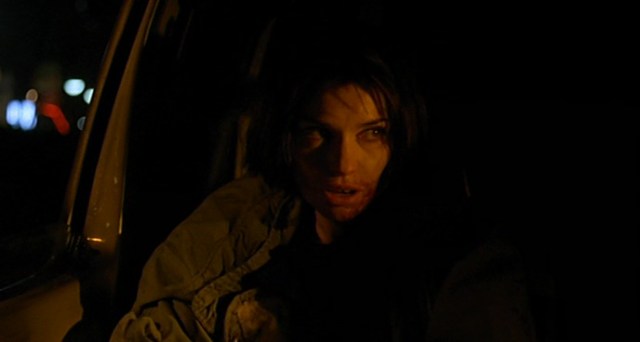
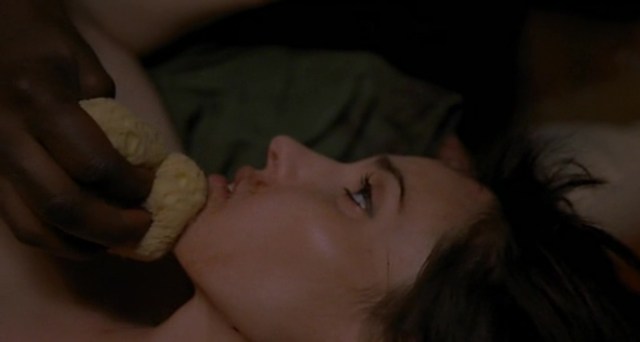
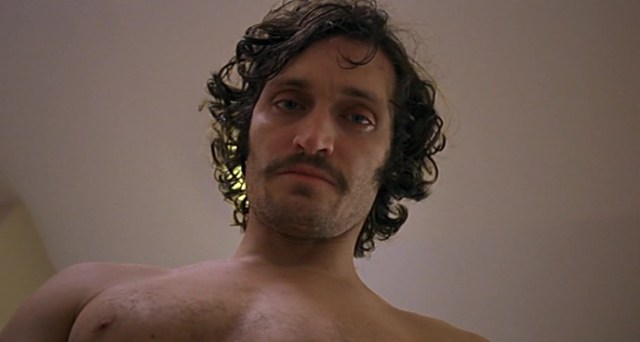
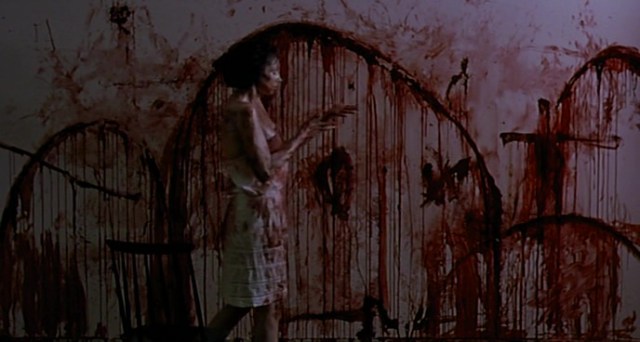
“I wonder who the real cannibals are” CANNIBAL HOLOCAUST (Deodato, 1980)

This movie is a big deal, in cannibal studies.

When you hear terms like “video nasties” or “grindhouse”, Cannibal Holocaust tends to be high on the list of titles mentioned. The film’s violence was extreme in 1980, although it has certainly been exceeded since then, with the “benefit” of CGI special effects. The scenes of death and cannibalism were enough to get the director, Ruggero Deodata, arrested for suspected murder, as he had arranged for the actors to go underground to give the impression that, just maybe, he had gone for the ultimate in cinéma vérité: a snuff movie. Where the film remains at the cutting edge (sorry) of extreme cinema even today was in its presentation of authentic animal cruelty, in the midst of fictional human deaths. For this it was widely condemned, even by those who otherwise enjoyed the film, and it was banned in several countries, including Italy and Australia. The best part of the film is probably Riz Ortolani’s stunning soundtrack. But in the end, I must grudgingly say that Cannibal Holocaust is a film more relevant than ever – because it is a direct indictment of “fake news”.

Pic-00001.jpg

At a time when news stories were increasingly becoming sensationalist beat-ups, and the American failure in the Vietnam war was still being blamed on the ubiquitous media coverage of the gruesome results of that conflict, Deodato is asking the question: “what can we believe”? Or, as the protagonist of the film, anthropologist Harold Monroe (Robert Kerman) asks in the last few frames

“I wonder who the real cannibals are?”
Pic-00008.jpg

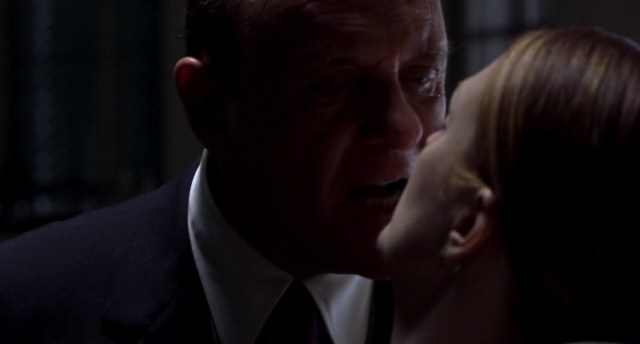
This is the question that every cannibal film or TV show asks, in its own way. Hannibal Lecter denies he is a cannibal in season 3 of Hannibal (I’ll get to it in a couple of months) when he tells a victim, whose leg they are both eating:

“This isn’t cannibalism, Abel. It’s only cannibalism if we’re equals”.

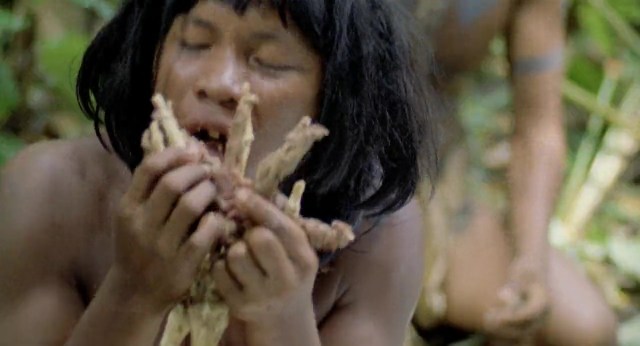
Cannibalism is about power and appetite. Those we accuse of cannibalism, in this case the indigenous peoples of the Amazon, were in all probability never cannibals. The imperialists who came in search of gold, like Columbus, or oil or timber or news footage were the real consumers – of humans who had been transformed into commodities and resources. Cannibal Holocaust asks us to think about what, in the panorama of abuse, death and torture that surrounds us, is real?
Pic-00022.jpg

This wasn’t the first Italian cannibal film: that was Man From Deep River. It wasn’t even Deodato’s first cannibal film, which was Last Cannibal World (Ultimo Mondo Cannibale). He had gratuitous animal cruelty in that one too. But Cannibal Holocaust asked new questions about the media in which it was made, about the motivations of the documentary, and about what Deodato himself was doing.
Pic-00033.jpg

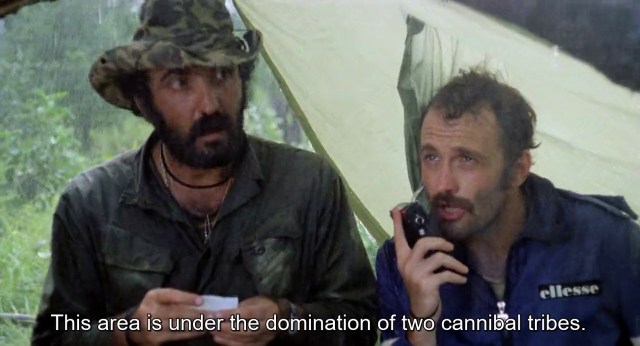
The film is told from the viewpoint of an anthropologist, Monroe, who is asked to go to the Amazon, to the area frequented by cannibal tribes and known as the “Green Inferno” (a name that spawned a tribute movie 33 years later). His mission is to find out what happened to four young American film-makers who disappeared there without a trace. Well, guess who came to dinner?

Pic-00039.jpg

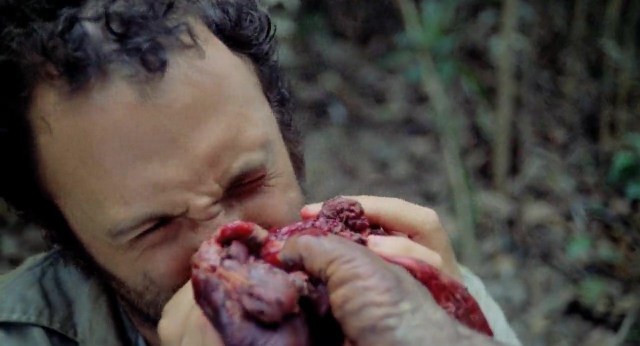
The first half of the film is Monroe negotiating with the locals, watching a rape and murder, helping eat an adulterer, shooting several natives, and finding and recovering the cans of film that have survived the whole sordid adventure. And yes, making friends, but not enjoying dinner with the cannibals.
Pic-00043.jpg

The second half of the film purports to show that recovered film, which a television network wants to show uncut to the public to sensationalise their deaths. This part is often referred to as the forerunner of the “found footage” movies that became enormously popular later with Blair Witch Project. In fact, Punishment Park (Watkins, 1971) was probably the first found footage film, claiming that its story of anti-war protesters being dumped (and filmed) in the California desert is actual newsreel. But in that period, what was genuine newsreel footage was on television every night, and showed dead American soldiers, burning Vietnamese civilians, and Kent State University students being gunned down by the National Guard. The difference between real and fake news was becoming opaque, years before the time of Trump (in fact, when he was still busy avoiding the draft). Deodato said he believed a lot of the news reports of Red Brigade terrorism in Italy had been staged for the cameras. In any case, even in unvarnished reporting, the framing of the camera and choice of which shots to use make the concept of real, impartial news unattainable.


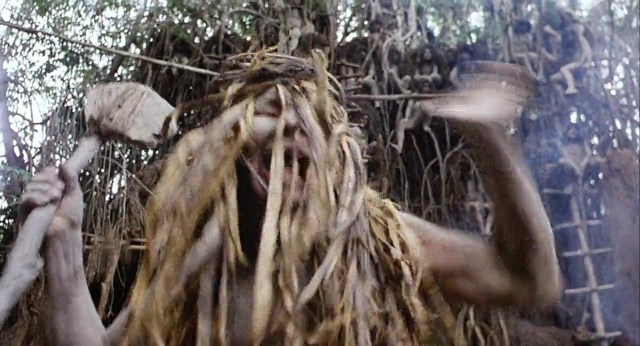
Who were the cannibals? The ones depicted as real savage cannibals in Cannibal Holocaust were described by Francesca Ciardi, who played Faye, one of the lost American filmmakers, as:

…perhaps the sweetest people I have ever met. The cannibals were just local people. They put wigs on them but in real life they were very clean people: they worked in offices and they wore well-pressed shirts”.

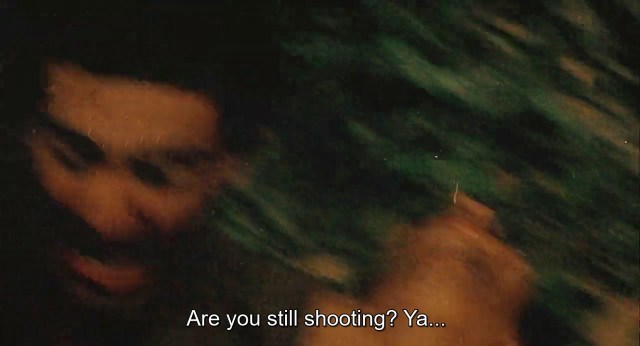
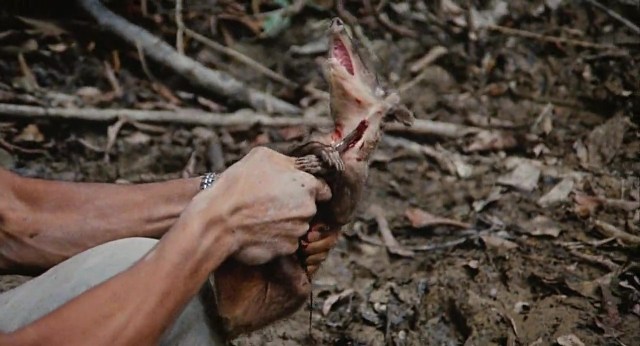
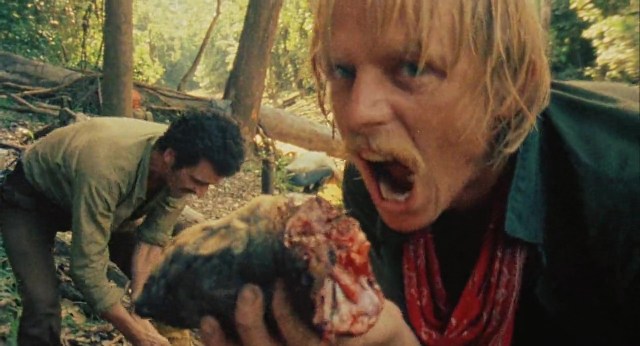
The most controversial legacy of this film is the appalling animal cruelty. Deodato juxtaposes brutal violence on humans (rape, murder, cannibalism) through special effects, while filming live and in gory detail the killing of a coatimundi, a giant turtle, a monkey (whose brains are eaten while still alive), a tarantula, a snake and a pig. When their guide gets bitten by that snake, we get “live action” of them chopping up the snake, then chopping off the man’s leg. The team make sure the camera is rolling before wielding the machete.
Pic-00055.jpg

What is he trying to achieve through this collision of fake human and actual animal deaths? Is it simply to try to extend the illusion that, just perhaps, these shaky images were indeed real footage, and the actors were dead? Well that didn’t last past his murder trial, where he had to produce them in the court in order to be exonerated.

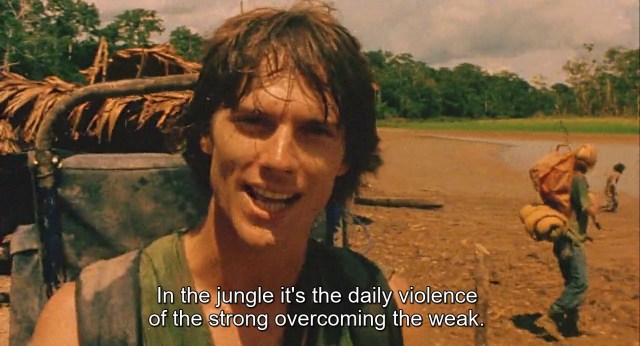
Critic and media academic Calum Waddell points out that this movie shows vile and debased behaviour on both sides – the ‘savage’ natives and the ‘civilised’ Westerners. But the Americans are punished for it – they are eventually killed and eaten for their troubles. The natives? A few get shot or burned, but there is no judgement. Waddell calls this a “fascist perspective”, because white people shouldn’t act like this, and so get punished, but the “savages” – well, that’s just the way they are. We can’t expect better of them, and in fact the Americans, when they first land, young, strong and white, are the picture of gung-ho adventurers, seemingly invincible. Then they regress into savagery, as they trek deeper into the green inferno.
Pic-00057.jpg

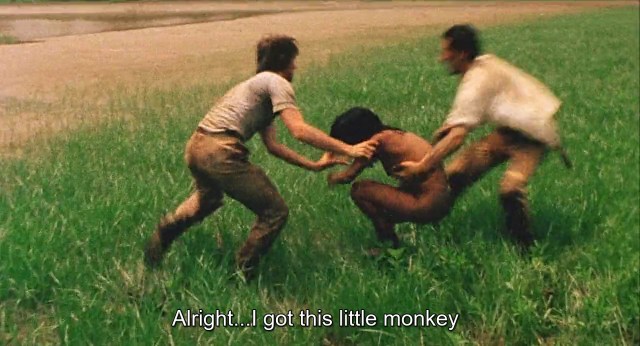
They (the savages) are cannibals by nature, and we (the civilised) risk becoming like them. The civilised whites lose their humanity as they enter the inhuman world of the cannibals, just as American troops in Vietnam lost theirs as they became enmeshed in that jungle war and started to massacre villagers. The film crew set fire to the native village so they can film an imaginary war between tribes. They capture a young girl and rape her just for fun, then film her body, impaled on a stake for losing her virginity.
Pic-00085.jpg

Cannibal Holocaust documents the loss of belief in the inevitable progress of humanity, usually told through the invincibility of white privilege.

Pic-00093.jpg

The Americans film everything, even their own death at the hands of the infuriated natives. The interlopers act as imperialists always have, but now they get eaten for it.

Pic-00099.jpg

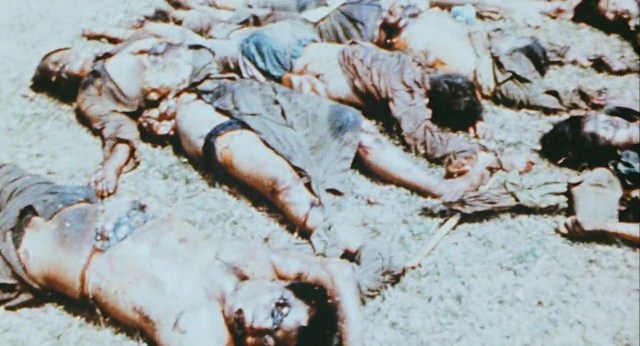
To complicate the question of truth or simulation, we are shown a series of clips that the Americans are said to have recorded earlier in their careers, which we are told were staged for the cameras. These were clips of actual executions and abuses that Deodata presents here as fake news, created to be sensationalist newsreels.
Pic-00046.jpg

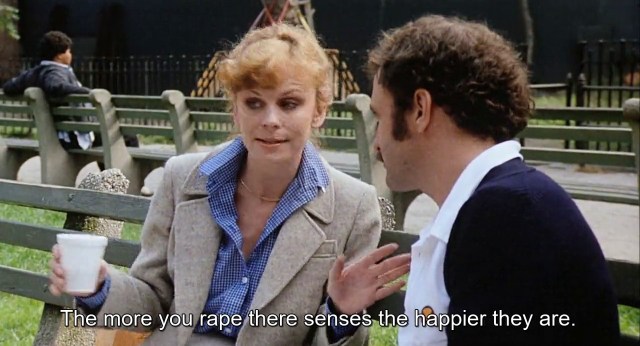
So now we have Deodato playing with our heads: real human executions are presented as fake, while fake rape and killing is presented as real. Real animal abuse, insisted upon by the director, is accompanied by gallons of human gore and agony which we know is fake.  Monroe is told: “Today people want sensationalism.”
Pic-00061.jpg
The subtitles did not use spell-checking

Yet the roller-coaster of fact and fake does not really work. Did Deodato really expect people to file out of the cinema (when it was finally shown after years of censorship) scratching their heads and saying “those guys really did get eaten! Damn shame.” The scenes of actual vicious killings of animals seem meant to drive home the point that, just maybe, the deaths of the young Americans are real too. But, as Waddell points out, the coatimundi is killed in the first half, which is unequivocally a fictional presentation (or at best re-enactment) of the expedition to find the lost tapes. So that creature’s death is totally gratuitous.
Pic-00014.jpg

Or is it? Deodato seems to be saying: don’t swallow anything you see on screen.

Here’s the thing. Real atrocities go on, but usually in the dark, or behind walls, at least not near any cameras. The Americans catch and chop us a giant turtle who continues to move as his head is removed and he is disembowelled.
Pic-00051.jpg

We can be squeamish at the death of that beautiful turtle – Faye is filmed throwing up as they chop the animal’s head off, but then we see her biting into the cooked meat soon afterwards.

Pic-00053.jpg

The turtle died totally unnecessarily for the sake of a cheap movie shot. We can also be sickened by the scenes of rapes and murders of humans, which are fake, but look pretty real. But every moment, as we reach for the remote and gratefully turn off the movie, real atrocities are continuing everywhere, in wars and domestic abuse and abattoirs and laboratories. Real animals quiver in their death throes, millions of them every second, while we turn our faces away from the dying turtle. We are not filming those abuses, but very often we are paying for them, through our taxes or our shopping. Like Faye, the cruelty repels and nauseates us, but the appetite makes us forget. This film, perhaps, helps us to remember.


Pic-00118.jpg

If you like my blog, please feel free to recommend it (with discretion) to friends on social media.
If you have any questions or comments, you can use the tag, or email me  on cannibalstudies@gmail.com.

“I know that babies taste best”: SNOWPIERCER (Bong Joon-ho, 2013)

download.jpg

Verschlimmbesserung: a word I found in the Urban Dictionary. It means an attempted improvement, which just makes things worse.

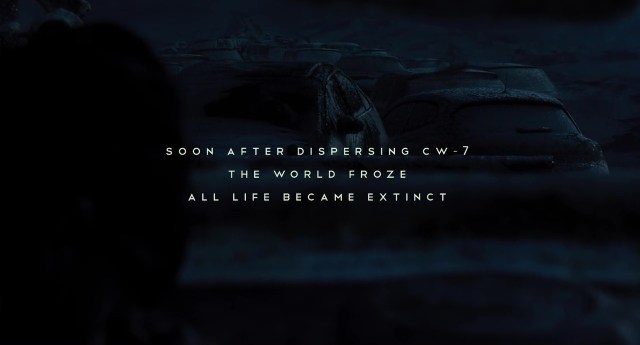
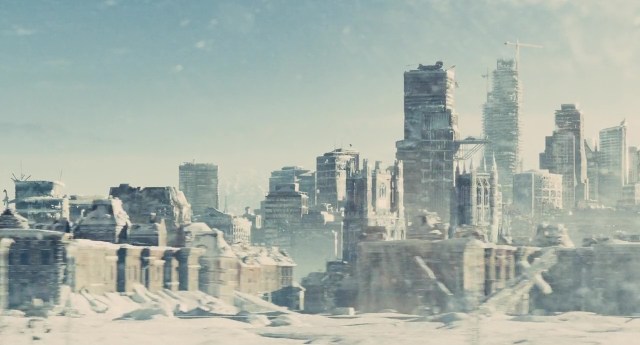
How can we make the frightening prospects of global catastrophe due to climate change even worse? Well, apparently the best way is to come up with a half-arsed way of fixing it. In Snowpiercer, a corporation has come up with a substance, CW-7, which is sprayed into the atmosphere to deflect the sun’s rays and cool the planet. It succeeds brilliantly:

Pic-00001.jpg

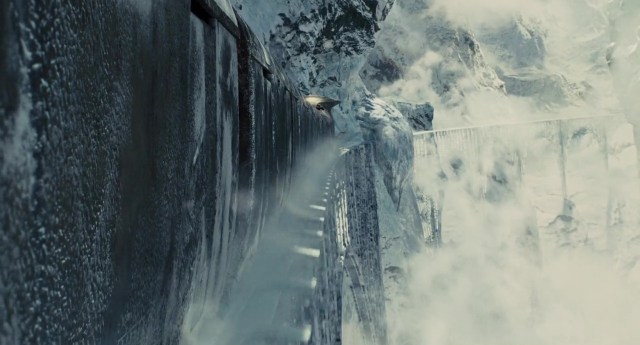
The only humans left alive are on a train, the SNOWPIERCER, which dashes through the snow, circumnavigating the earth once a year. The grateful survivors form a happy band of brothers who work together to survive.

Just kidding!

Pic-00002.jpg

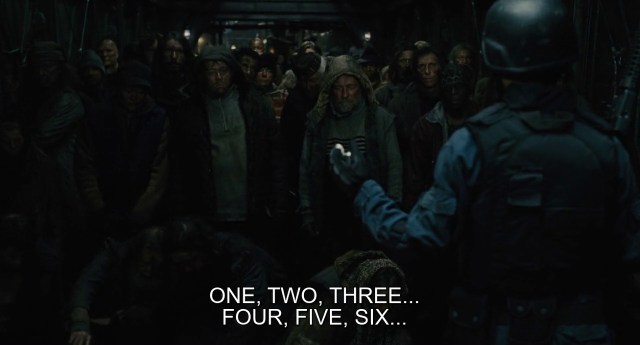
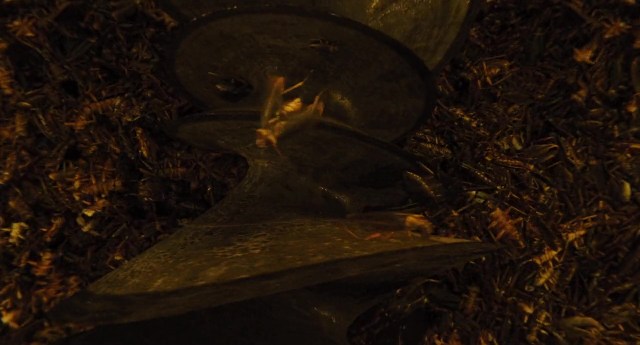
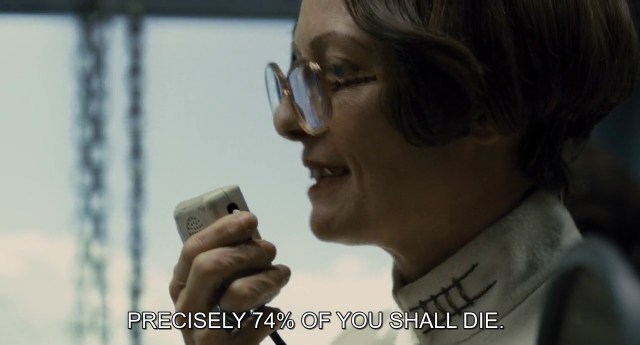
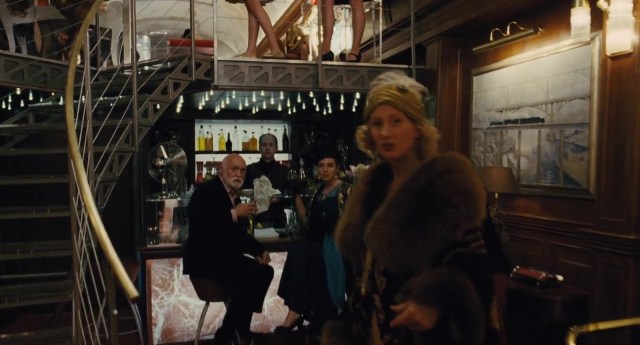
There is, as in all human society, a strict hierarchy of power and privilege. It’s the year 2031. The rich, including the train’s inventor Wilford (Ed Harris) live in luxury at the front of the train, the “scum” live at the back in squalor, beaten and tormented by armed soldiers and fed a mysterious protein bar made of what?

Pic-00008.jpg

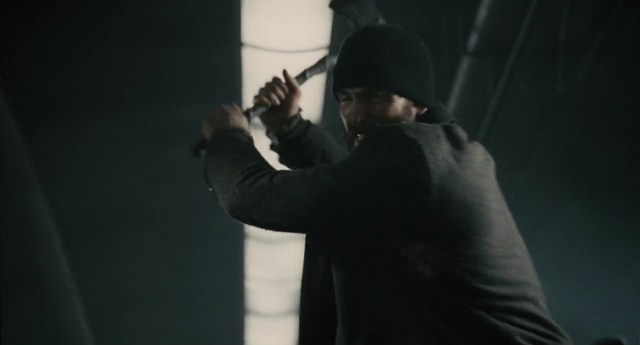
There is revolution brewing though, led by Curtis (Chris Evans, in a far meatier role than Captain America ever offered him).

Pic-00012.jpg

There’s a lot to like in this movie – the plot is interesting, the action plentiful, the cast are stellar (including also John Hurt, Octavia Spencer, Song Kang Ho, and Tilda Swinton, as well as Paul Lazar, who played a nerdy scientist in Silence of the Lambs) and the photography, particularly of the frozen world and the train, is superb.

Pic-00004.jpg

Pic-00015.jpg

Bong Joon-ho is one of the most exciting filmmakers working today. Metacritic has ranked him one of the 25 best film directors of the 21st century, and he recently became the first Korean director to win the top prize at Cannes – the Palme d’Or, for his 2019 film Parasite, which also explores class and social divisions. Parasite went on to win four Oscars at the 92nd Academy Awards for Best Picture, Best Director, Best Original Screenplay and Best International Feature Film.

The film between Snowpiercer and Parasite was Okja, an animated piece that was also nominated for a Palme d’Or but was voted down, perhaps because it was released on Netflix. Okja crossed the anthropocentric line of privilege, featuring cruelty to a giant pig specially bred for human consumption (like so many animals today) and the horrors she faces in the slaughterhouse.

Pic-00020.jpg

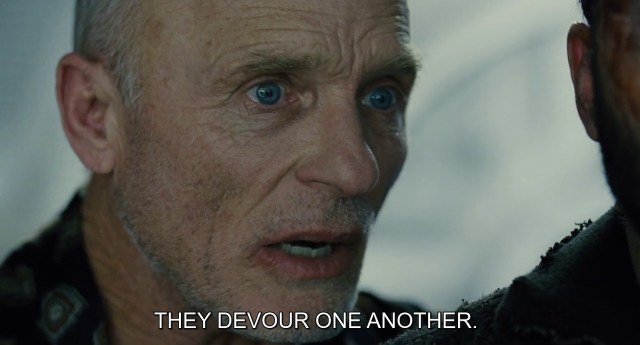
Snowpiercer also explores some fascinating ethical issues to do with leadership, biopolitics, class privilege, revolution, violence, the Holocaust, our reliance on technology and yes, finally, cannibalism.

Pic-00023.jpg

Wilford explains to Curtis: “You’ve seen what people do without leadership.”

Pic-00074.jpg

Look, this is a pretty recent movie and got a woeful cinematic release, so you may still be planning to see it. Therefore, I won’t disclose the ending. But you need to know the cannibalism angle, because you are, after all, reading this blog on cannibal films and TV shows.

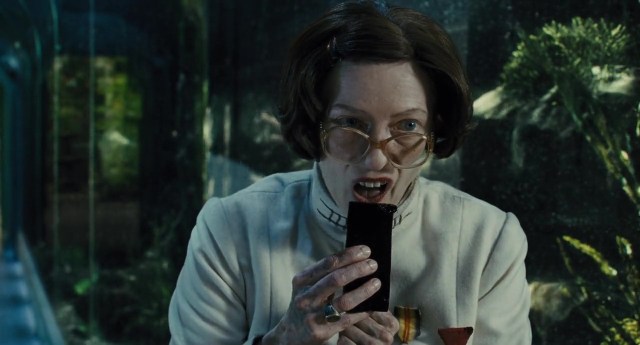
There are hints in the first half of the film, discussions about the number of arms people have, and then more food references as they march their prisoner Mason (Tilda Swinton), who previously lectured them on their place at the bottom of society, through the front cars. First they go through a greenhouse, then an aquarium, and we hear Bach’s Goldberg Variations, a tribute (one hopes) to Silence of the Lambs.  At the front of the aquarium, ecological balance is maintained by eating the fish twice a year as sushi. They sit down for this elite meal, but make their captive eat the protein bars that are the only food given to the “scum”.

Pic-00032.jpg

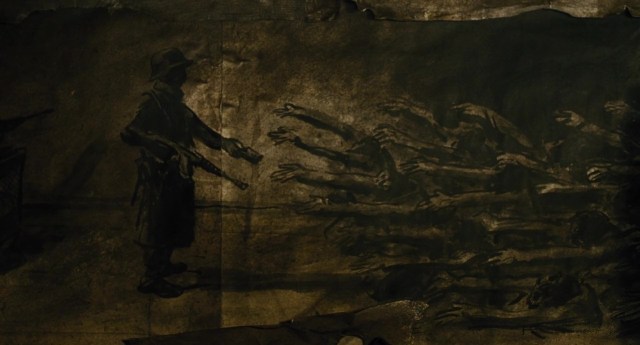
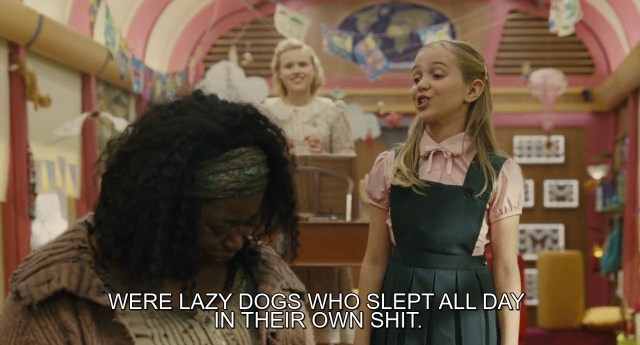
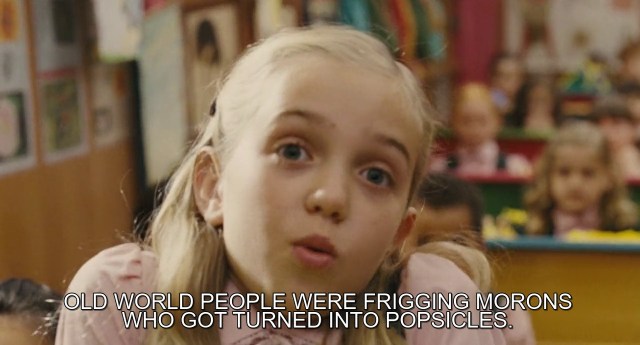
Curtis and his dwindling band of fighters go through a butchery, then a school, where the children are taught that tail-enders

Pic-00034.jpg

And that we, the pre-trainers,

Pic-00035.jpg

There are dentists, tailors, hairdressers, a fancy dining-car, an aquatic centre, a disco, a drug lounge – all the things that make up decadent, modern society.

Pic-00036.jpg

We are socially and culturally determined in large part by what we eat. The food is always better in first or business class. The higher classes eat beautifully prepared, gourmet tidbits. The lower classes, the starving and the deranged eat what they are given, or what they can hunt.

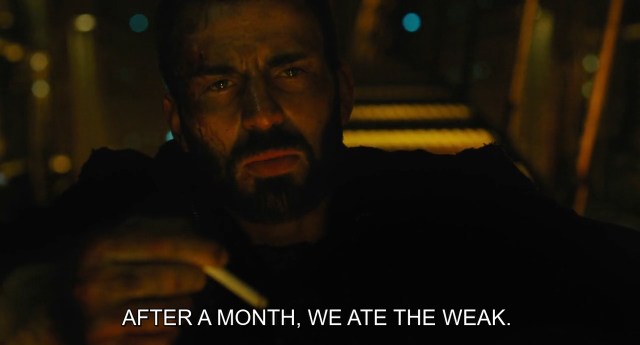
Just before the showdown, Curtis reveals what it was like when they first boarded the train: “A thousand people in an iron box. No food, no water.”

Pic-00042.jpg

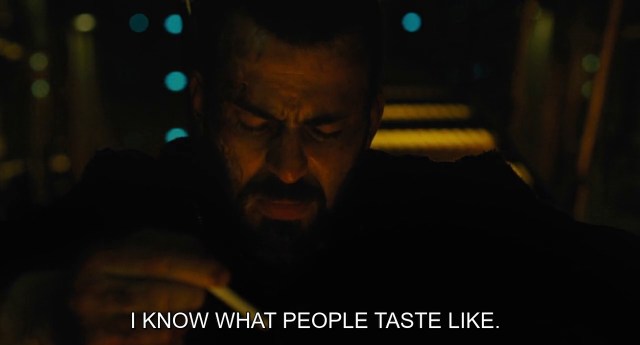
“There was a woman. She was hiding with her baby. And some men with knives came. They killed her and they took her baby.”

Then an old man took the knife and cut off his own arm, offering them that as food, to save the baby. Then others started doing the same. Sacrificing to the cannibals to save the next generation. Then the rich started sending through protein bars. And we thought they were going to be the cannibals!

Things Curtis hates about himself:

Pic-00044.jpg

Pic-00045.jpg

Well, there’s a lot more to the story, and a lot more to like, but you can find out by watching the movie. It’s worth it.

Here’s the trailer:

IF YOU LIKE MY BLOG, PLEASE FEEL FREE TO RECOMMEND IT (WITH DISCRETION) TO FRIENDS ON SOCIAL MEDIA.
IF YOU HAVE ANY QUESTIONS OR COMMENTS, YOU CAN USE THE TAG, OR EMAIL ME ON CANNIBALSTUDIES@GMAIL.COM.

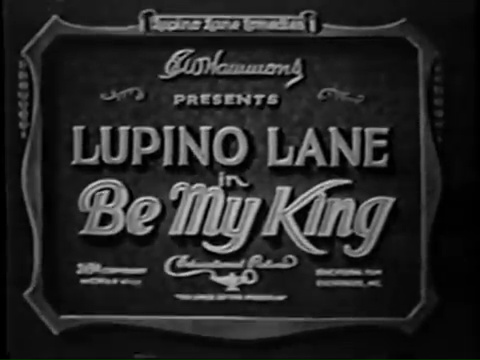
Slapstick cannibals: BE MY KING (Lane, 1928)

Lupino Lane Be My King 1928.jpg

A short movie from Lupino Lane, who was the most famous of the English Lupino family, until eclipsed by his cousin Ida Lupino, one of the only female filmmakers working during the 1950s in the Hollywood studio system, and the first woman to direct a film noir with The Hitch-Hiker in 1953.

Lupino Lane stars in this short silent movie with his brother Wallace Lupino, who plays an older authority figure, despite being some years younger than Lane. The Lupino brothers later shot to fame with a show called Me and My Girl in the 1930s, which inflicted the song “The Lambeth Walk” onto an unsuspecting public.

vlcsnap-00001.jpg

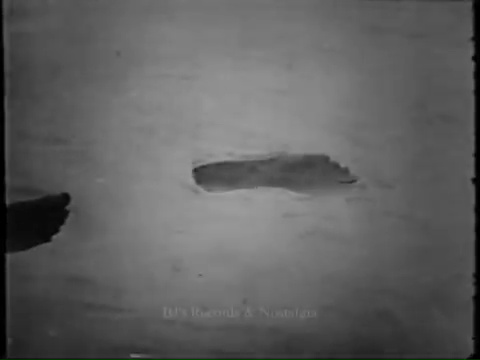
Lane is a cabin boy, shipwrecked with Wallace on an island, where they come across the obligatory foot print (think Robinson Crusoe).

vlcsnap-00002.jpg

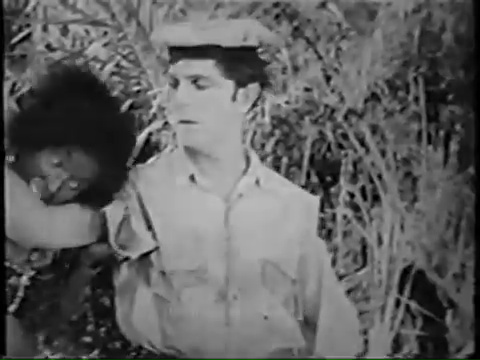
Lane sets off to find signs of civilisation. Various animals cross his path – a chimp, a lion, a leopard, even an elephant, none of which he notices, until he is frightened by a rabbit. Wallace is captured by cannibals (male) while Lane is accosted by the females, who takes a bite at him.

vlcsnap-00004.jpg

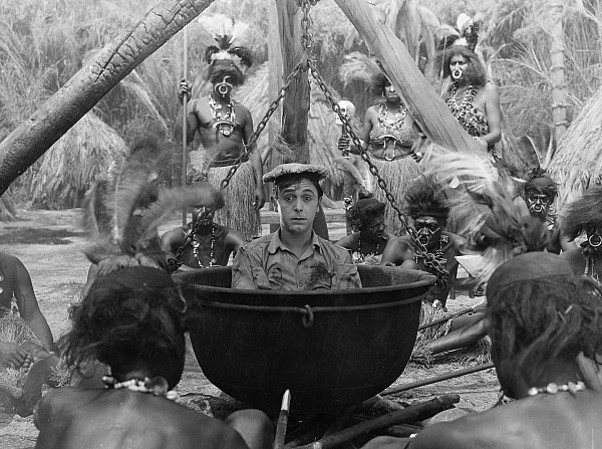
He is captured by the male cannibals and taken to the – yes – cooking pot that was so much part of the myth of primitive cannibalism.

vlcsnap-00009.jpg

In fact, the trope of the sad-eyed missionary or sailor in a cooking pot surrounded by fierce savages with bones in their noses is perhaps the first image most people conjure up when (if) they think about cannibalism. There is, of course, no evidence that this ever happened anywhere, but there is some speculation that the story was spread by missionaries, as it did wonders for their fund-raising efforts.

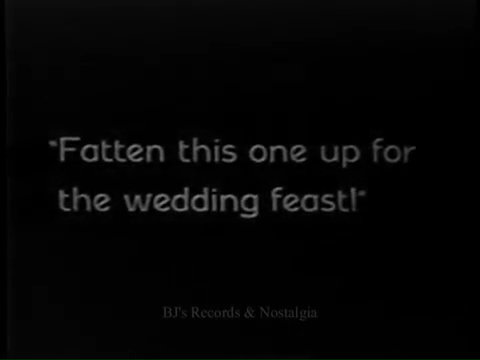
Lane is rescued by the love of the chief’s daughter (think Man from Deep River) – and dressed for the wedding, while Wallace is fattened up for the feast. In fact, there are many precursors to the later cannibal movies in this absurd little piece.

vlcsnap-00014.jpg

This is a very early celluloid version of the white man in the cooking pot, which is why I have included it here. The movie is mostly very silly, but funny in parts, in that early Chaplin-esque slapstick way.

vlcsnap-00015.jpg

But there is a sinister aspect – this dismissal of ‘savage’ races as unquestionably cannibals was useful not just for mission fund-raising but also as a pretext for the invasion, conversion, subjugation and often extermination of the indigenous peoples of the lands that Europeans wanted to exploit. The uncritical acceptance by Western audiences of this image of the native as cannibal construed colonised peoples as racially degenerate, and made the appalling atrocities of colonialism somehow less bothersome, particularly to its beneficiaries.

This Youtube link below is actually not a trailer, but the complete movie.

IF YOU LIKE MY BLOG, PLEASE FEEL FREE TO RECOMMEND IT (WITH DISCRETION) TO FRIENDS ON SOCIAL MEDIA.
IF YOU HAVE ANY QUESTIONS OR COMMENTS, YOU CAN USE THE TAG, OR EMAIL ME ON CANNIBALSTUDIES@GMAIL.COM.

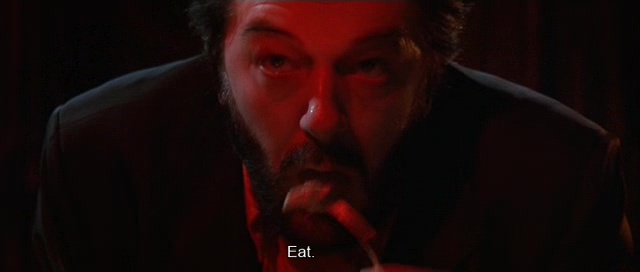
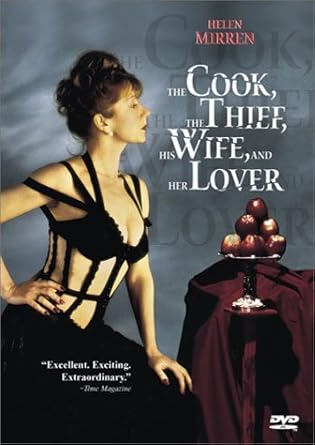
Cannibalism and the limits to appetite: THE COOK, THE THIEF, HIS WIFE AND HER LOVER (Greenaway, 1989)

Michel Montaigne wrote, back in the sixteenth century, that savagery is not all on the side of the cannibal:

There is more barbarisme [sic] in eating men alive, than to feed upon them being dead; to mangle by tortures torment a body full of lively sense… than to roast him after he is dead”.

vlcsnap-00001.jpg

Peter Greenaway’s The cook, the thief, his wife and her lover (1989) is the perfect representation of the savage cannibal within our own civilisation, even though the actual act of cannibalism does not occur until the closing minutes of the film. The film however is replete with images of physical and metaphoric incorporation and abjection: eating, corpses, excrement, violence and humiliation. This is such a perfect representation of abjection that the Reelviews reviewer was “at a loss” to find anything disgusting that had been left out.

vlcsnap-00003.jpg

The film is almost entirely set inside the upmarket restaurant Le Hollandais which has been bought by gangster Albert Spica (Michael Gambon) who torments and humiliates the patrons, staff, his men and his wife Georgina (Helen Mirren). Crystal Bartolovich describes this process as “making everyone around him miserable in ways that depend upon the alimentary canal”. Another reviewer observed that the restaurant metaphorically presents a reversed alimentary canal: the back door with its dog-shit is the anus, the stomach is the kitchen where the food is processed and finally the dining room is the mouth, the site of cultured discrimination, but also of abuse.

vlcsnap-00016.jpg

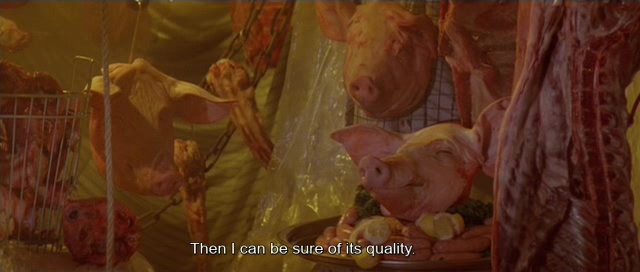
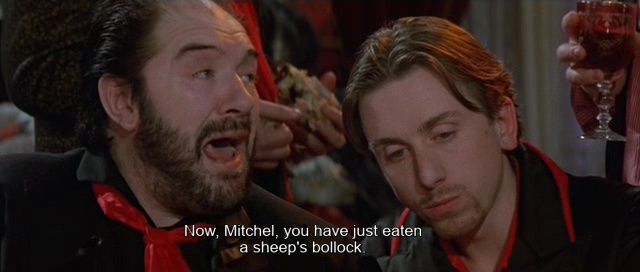
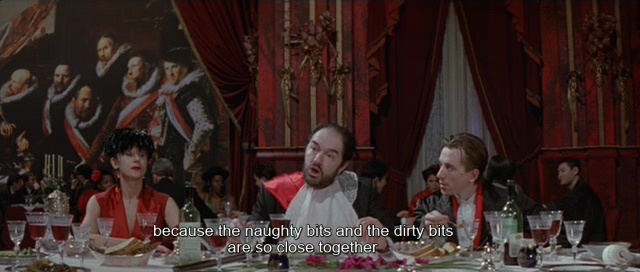
While Spica eats and belches and spouts abuse and absurd bon mots, Georgina escapes, in brief interludes, to have a sexual and then a loving relationship with the very refined bookshop owner Michael (Alan Howard), with the connivance of the cook, Richard Borst (Richard Bohringer). The world of the restaurant is surreal, with each room coloured differently and the costumes of the protagonists changing to match as they move between them. Tables in the kitchen and the dining room are groaning under the bodies of dead birds and mammals. Spica shows little distinction between his three pet subjects: food, excrement and sex. The pleasures of sex and eating and the abjection of excretion are important messages from Greenaway’s film: Spica sums up “the naughty bits and the dirty bits are so close together, that it just goes to show how eating and sex are related”.

vlcsnap-00008.jpg

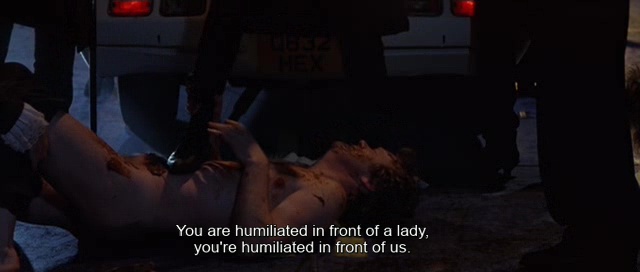
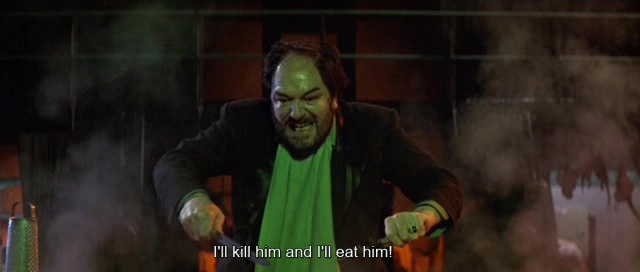
He forces an enemy to eat dog-shit, his men gorge on the fine dining and vomit on the table, and his wife reveals that sex for him involves only violence and degradation. Spica’s favoured method of torture is force feeding: he feeds excrement in the opening scene to a man who owes him money, he feeds buttons to the kitchen boy, and when he discovers the love affair, he promises to catch the lover, kill him, and eat him. He and his men kill Michael by making him eat one of his books.

vlcsnap-00024.jpg

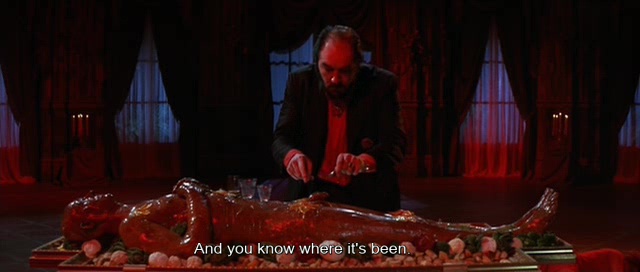
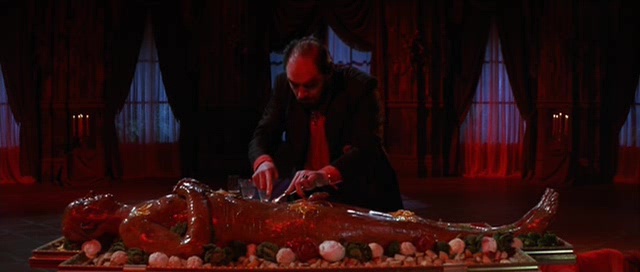
Georgina persuades Borst to cook Michael’s body; in a ceremonial scene, she reverses his force-feeding tactic and at gunpoint forces him to make good his earlier threat to eat the lover, suggesting he starts with Michael’s cock: “it’s a delicacy, and you know where it’s been”.

vlcsnap-00067.jpg

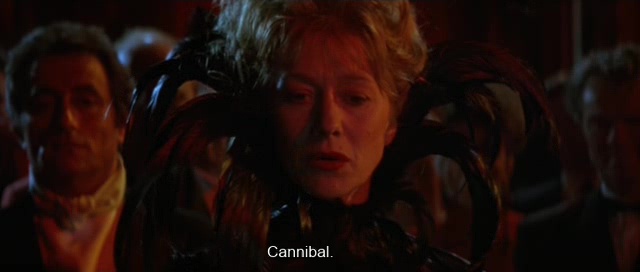
As she kills Spica with another phallic symbol, his own gun, she hisses at him (while looking at us, the viewers) the single, final word of the film: “cannibal!”

vlcsnap-00072.jpg

The film’s alterity focuses on the criminal crew against polite society. It was made toward the end of the long period known as Thatcherism, in which Britain was hugely polarised between followers of “libertarianism” and their opponents who felt that money and power were crushing all vestiges of civil society. The film has widely been interpreted as a protest about the politics of that time, with the thief as Thatcher and her greedy plutocrats and the lover as the ineffectual left opposition, the cook as the civil service and the wife as the people, being alternately wooed and abused. Roger Ebert saw a more universal message about an entrepreneurial class that is raping the earth and its environment while the “timid majority” finds distraction in romance and escapism. The New York Times felt that Greenaway was asking the question: what happens when “the most crass and sadistic people” gain power? Greenaway himself said that his use of cannibalism was a metaphor of consumer society: “once we’ve stuffed the whole world into our mouths, ultimately we’ll end up eating ourselves”.

vlcsnap-00068.jpg

Some critics, however, sees Greenaway’s message as elitist: consumption is only an issue when the “wrong” people are doing it. Spica and his crew debase the high culture of Le Hollandais with their ignorance, crudity and violence. Georgina (whom Spica insists on calling “Georgie” as if trying to alter her gender), Michael and Borst are refined, aesthetic and vulnerable, like the high culture which the thieves despise and aspire to at the same time. Greenaway seems to be accusing the “low culture” thieves, and his audience, of the same “voracious hunger” that colonialism cited to calumniate the natives they wanted to subdue.

vlcsnap-00070.jpg

Greenaway is exploring these “limits to appetite” in his scenes of sex, food and excrement; the contemporary cannibal demonstrates a new and uncertain relation to commodities. The cook is a film about abjection, but also desire. Cannibalism reduces the human to a roast dinner, but at the same time questions the limits we increasingly need to put on our meals, as we overconsume our share of natural resources.

Related image

“Truly living with nature” – CANNIBAL TOURS (O’Rourke, 1988)

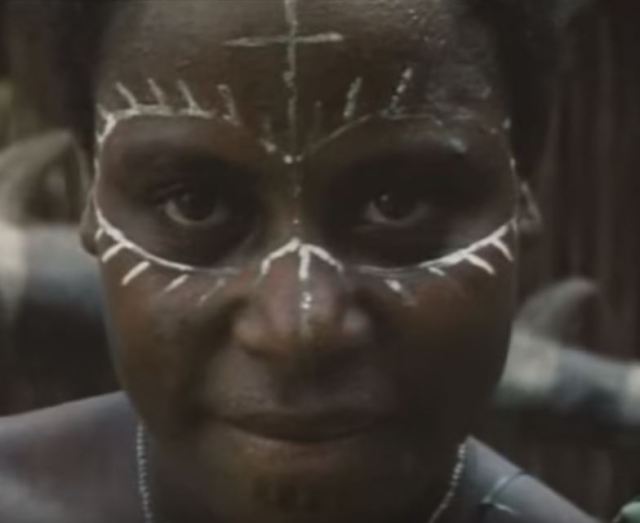
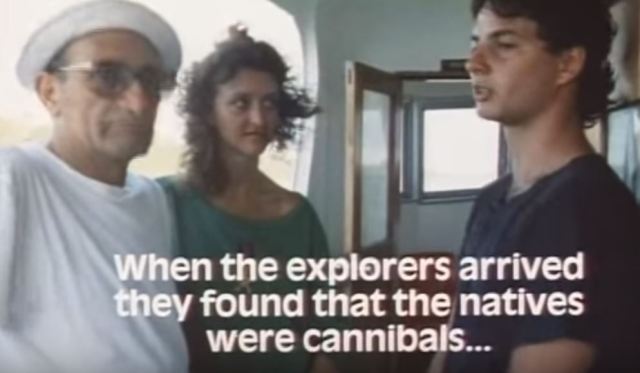
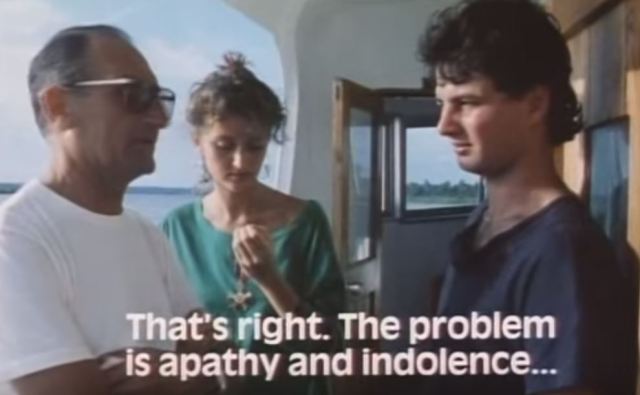
Cannibal Tours is a documentary by Australian director and cinematographer Dennis O’Rourke. The scenes in it are presented without comment, but its irony and disquiet at the nature of ‘cannibal tourism’ is blindingly obvious.

The soundtrack of the film is a mixture of music, sounds of nature, and a symphony of camera shutters.

20 smile for the cameras.JPG

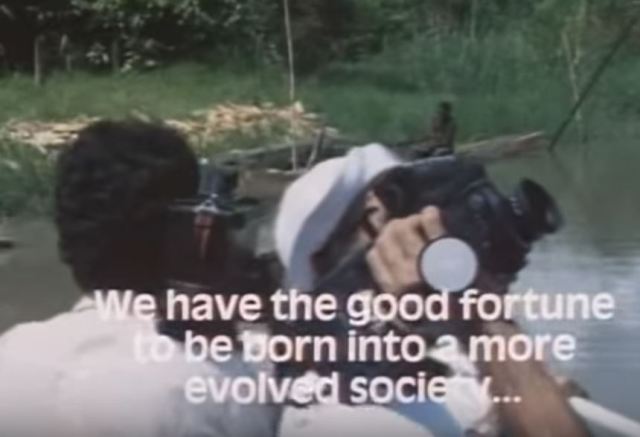
The film follows European and American tourists as they travel the middle Sepik River in Papua New Guinea. Most of the villages in the film are inhabited by the Iatmul people. The tourists enjoy bargaining for local handcrafts such as woodcarvings and baskets, snap endless photos of the colourful savages, hand out cigarettes, watch dance performances, and offer naive comments about native people and how they live in harmony with nature.

10 sepia photo.JPG

It intersperses the scenes of the tourists with black-and-white photographs from the era of German colonialism of New Guinea.

38.JPG

The pervasive ethnocentrism of the tourists casts them as the savages, as they dehumanise and exoticise Sepik River life.

60.JPG

Some of the tourists’ observations are reproduced below without comment, just as O’Rourke does on camera.

German tourist: I heard that German colonists were very popular!
Where have they killed the people? Here?
Local: At those stones we would dance and cut off heads.
German tourist: Now I need a photograph!

An Italian tourist observes:

They are truly primitive. I wonder though if their way of life is better than ours. Truly living with nature. Not really living, more like vegetating. The experts assure us they are satisfied. Happy and well fed. Nature provides them with the necessities of life. And they don’t have to worry about thinking of tomorrow.

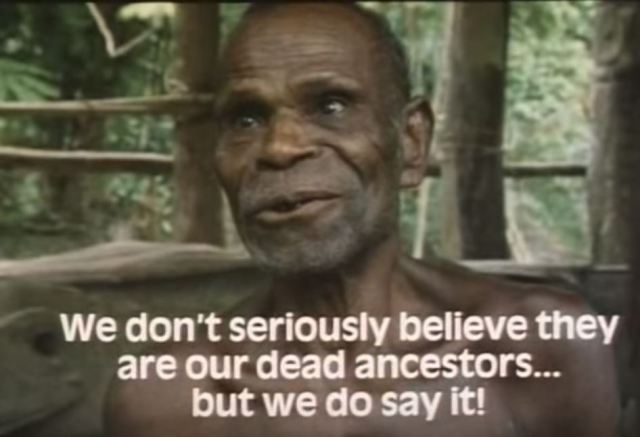
Local: The previous generation saw the Germans arrive by boat and thought their dead ancestors had returned. Now, when we see tourists, we say about them ‘the dead have returned!’

42.JPG

There are lengthy scenes of tourists bargaining for carvings and masks.

Native woman – tourists come and look but never buy. You white men have all the money! We village people have no money!

Talking about the Spirit House, one local person recalls:

The Germans, the English and Australians took all the sacred objects. The missionaries destroyed all the most powerful symbols kept in the spirit house. The missionaries threw them out saying “It’s the devil! Get rid of it!”


German tourist [into his tape recorder]: Now we see the remains of a house where, in the past, cannibalism was practised.

44.JPG

…for reasons of survival. And custom too, I think. It was symbolic. I think cannibalism was a cultural practice, not a necessity. Because wildlife must have been plentiful.

Local: We sit here confused while they take pictures of everything. We don’t understand why these foreigners take photographs.

Italian: we must try to help them advance in the world, bringing to them some values and convictions. Naturally, this will involve going into their villages as the missionaries do to teach them. To educate and stimulate them to behave differently.

45.JPG

… living in a world completely overwhelmed by nature. They are also human.

47.JPG

even though our evolution could still be disputed by some.

There is much hilarity when the tourists find a phallus for sale.

50.JPG

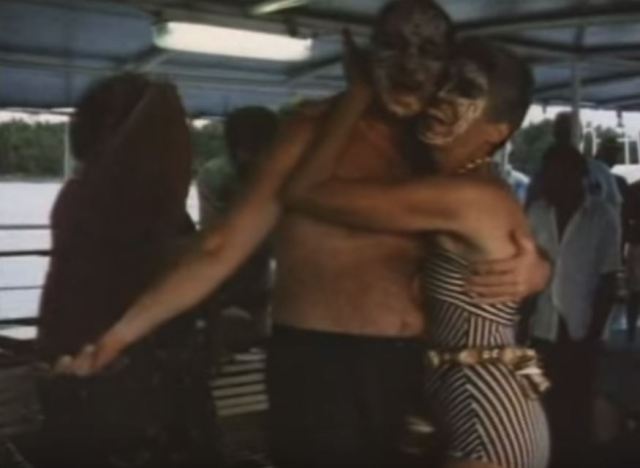
Back on their boat, the tourists wear native warpaint and play at being savages.

55.JPG

Maggie Kilgour wrote that

“the figure of the cannibal was created to support the cultural cannibalism of colonialism, through the projection of western imperialist appetites onto the cultures they then subsumed “.

The imperialists now have cameras rather than guns. The film really asks – who are the cannibals?

70.JPG

The film is available (at time of writing) on YouTube:

IF YOU LIKE MY BLOG, PLEASE FEEL FREE TO RECOMMEND IT (WITH DISCRETION) TO FRIENDS ON SOCIAL MEDIA.
IF YOU HAVE ANY QUESTIONS OR COMMENTS, YOU CAN USE THE TAG, OR EMAIL ME ON CANNIBALSTUDIES@GMAIL.COM.

“No eat man, wrong!” ROBINSON CRUSOE (Buñuel 1954)

Although film directors have revisited colonial era stories of cannibalism with gusto, they have generally done so with modern perspectives. Cannibals in most films, therefore, are not the inhuman savages of Daniel Defoe, Edgar Rice Burroughs or Edgar Wallace. The ‘savages’ in even the earliest films are often presented with humour, for example Lupino Lane’s Be my King (1928), Crosby and Hope in Road to Zanzibar (Schertzinger 1941) or The Wrong Box (Forbes 1966) in which amorous cousins Michael and Julia are reassured that she is not a blood relation: she was adopted after her missionary parents were “eaten by his bible class”. In more serious depictions, the ‘savage’ is either a noble one, or at least is offered some humanity, and often his characterisation (we rarely see female savages) is given an ironic edge to criticise modern, “civilised” society. However, a positive image can be as degrading as a negative one.

00 poster.jpg

The example here of the cannibal as colonised savage is Luis Buñuel’s Robinson Crusoe (1954). Crusoe is, according to James Joyce “the true prototype of the British colonist… the manly independence, the unconscious cruelty, the persistence, the slow yet efficient intelligence, the sexual apathy, the calculating taciturnity”.

vlcsnap-00001.jpg

Buñuel opens his film of the eighteenth-century novel with a shot of Defoe’s book sitting on an ancient map, a nod to the importance to film makers of classic literature. Crusoe (Dan O’Herlihy, who was nominated for Best Actor at the 1955 Oscars) tells us he was on a voyage

vlcsnap-00003.jpg

when his father’s warnings of disaster came true; we next see him struggling ashore amid the debris of his lost ship. The island, or at least a severely constrained and isolated space, was considered a prerequisite for cannibalism in the eighteenth century. All his shipmates, or at least the human ones, have been consumed by the sea. Barefoot and hungry, he cracks an egg he finds in a nest, but his European sensibilities do not allow him to eat the baby bird inside.

vlcsnap-00007.jpg

Unlike the savages he is yet to meet, he has little hope of surviving in the wild, but is saved by finding and plundering the wreck of his ship, salvaging building supplies, guns and flint to make fire (more important, he realises, than the gold in the drawer below). His whole focus is to secure himself against the wild world: beasts and savages. Although this is a long way from his early surrealist movies, this is still classic Buñuel, particularly the fever dream, reminiscent of his later films The Discreet Charm of The Bourgeoisie and Belle De Jour in which his giggling father pours water on a pig, while the delirious Crusoe begs for a mouthful.

vlcsnap-00016.jpg

On the island, European civilised life is represented by Crusoe and his weaponry, and Rex, a dog who has also swum ashore. He finds in a ship’s chest a cure for

vlcsnap-00019.jpg

tobacco and the Bible.

Buñuel seems to have felt Crusoe’s pain – he had been exiled from his native Spain for 14 years when he made the film, and was living in Mexico, having lost his job in MOMA after being denounced as a Communist. His longing for home while surrounded by “the other” is obvious in his character’s affection for the dog, while he is quite prepared to shoot birds and stamp on rats and spiders. He domesticates native goats and parrots, but is devastated by the death of Rex, feeling “now truly alone”. Sinking into eccentricity, he talks to two insects, “my little friends” and feeds them an ant.

vlcsnap-00023.jpg

But his difficulties on deciding which species of insects are friends soon escalates as Crusoe has to decide which humans deserve to be saved, and which sacrificed. The difference is their status: as cannibals or victims. His reunification with humans after 18 years comes as we follow his footsteps along the beach, only to be confronted with another distinctly human footprint. His abjection is immediate.

vlcsnap-00026.jpg

vlcsnap-00025.jpg

“Men-eaters! From that very land I had once thought to sail to. Revolted, horrified, all that night I watched the cannibals at their ghastly entertainment”.

Their guilt is assumed, but only confirmed after they leave and he comes across their fire-pit which is surrounded by human heads and bones: Typically, cannibal literature paints a “primal scene”, the proof of cannibalism, which is usually not the act of eating human flesh, but the aftermath.

vlcsnap-00034.jpg

vlcsnap-00035.jpg

Crusoe plots a technology-based massacre, including another dream sequence, this time of planting a bomb under their fire-pit, but realises

“I had no heaven-sent right to be judge and executioner on these people, who had done me no injury. I would leave them to God’s justice”.

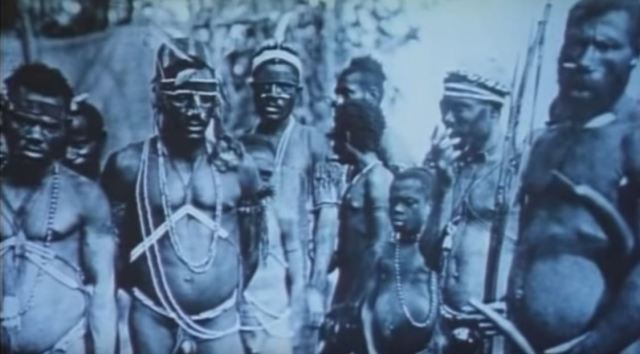
This resolve is short-lived; seeing Friday (Jaime Fernández, who won a Silver Ariel award – the Mexican equivalent of the Oscar) escape from the cannibals, he steps in to kill the pursuers and rescue the boy. Friday bows to him in a homo-erotic scene in which Crusoe puts his foot on the boy’s head.

vlcsnap-00039.jpg

He explains that the boy will be called Friday, while Crusoe’s name is “Master” and that they are “friends”. The boy spits out Crusoe’s carefully harvested and baked bread, indicating that he would rather dig up the pursuers whom they buried earlier.
vlcsnap-00043.jpg

Crusoe sits up all night in fear of this new “friend”: “if the cannibals fail to come at me before morning, he might”. He won’t let Friday handle weapons; he shoots birds out the sky to frighten him and puts a strong door on his cave so he can sleep securely. He is reassured to watch Friday eat the flesh of animals, “knowing that the only source of that other meat he so relished”

vlcsnap-00049.jpg

He comes to appreciate once more having a servant. The balance of alterities, man to animal, civilised man to cannibal, master to servant, has been restored, yet his fear of the primitive cannibal increases. When Friday sneaks into his room hoping to try his pipe, Crusoe decides to put leg-irons on him, remembering how he had intended those instruments to be used on the savages he planned to carry off to slavery. But Friday is misjudged: “Friday love Master always.” He seizes Crusoe’s gun, but it’s a suicide plan – “kill Friday – no send Friday away.”

vlcsnap-00052.jpg

vlcsnap-00053.jpg

In a moment that crystallises the dreams of empire, Friday has become the good savage, brought to civilisation by the white man, even feminised when he finds a dress in Crusoe’s chest. The primitive cannibal has submitted to our will, but lovingly, in gratitude rather than through force. In the next scene, Friday is armed and helping hunt wild pigs, with Crusoe’s admission that Friday was “as loyal a friend as any man could want.”

vlcsnap-00054.jpg

But if Friday is to take on Crusoe’s civilisation, he must also accept his morality. Friday finds Crusoe’s gold coins and thinks them a gift from God. “From the devil”, Crusoe mumbles, but Friday goes off to make a necklace with these baubles, which in this closed circle are of value only to the savage. While they shave each other and share a pipe, Crusoe tries to explain the devil and his works – he also has evolved, or converted, from conquistador to missionary. Yet he is baffled by Friday’s broken epistemic posing of the problem of evil – why doesn’t God just kill the devil? Why is God mad when we sin, if he lets the devil tempt us? Friday, the innocent, the savage, baffles Crusoe, the colonialist, expressing Buñuel’s overt anticlericalism.

vlcsnap-00059.jpg

vlcsnap-00060.jpg

They are set upon by the cannibals and Crusoe is saved by Friday’s gun, just as Crusoe’s gun saved Friday years before. The civilised savage fights the cannibal savages for the life of the Englishman. His gunpowder exhausted, Friday kills the third cannibal in hand-to-hand combat, but the beach is swarming with others. Their preparations for a last stand are interrupted by gunfire; to their amazement the beach is now full of white men who are slaughtering the fleeing cannibals. Like Friday’s foes, these white men have prisoners tied up – their ship’s captain and bosun, against whom they have mutinied.

vlcsnap-00072.jpg

Friday and Crusoe free the prisoners, who agree to take Crusoe and “my man” to England if he helps them recover the ship, which of course they do in due course, tempting the ‘civilised’ mutineers, like the devil, with Friday’s gold necklace.

vlcsnap-00074.jpg

vlcsnap-00075.jpg

vlcsnap-00076.jpg

Dressed like an Englishman again, Crusoe makes a melancholy farewell to his kingdom. He has defeated the evil of the savages and the mutineers, whom he leaves to rule his kingdom.

vlcsnap-00078.jpg

vlcsnap-00079.jpg

Friday has witnessed the violence and oppression of the “civilised” white men, but avers that he is not afraid to go back to civilisation “if master is not”. He is already dressed as a servant. The cannibal can become tame, can learn to eat what he is told, but clearly he can never become “your own kind.”


IF YOU LIKE MY BLOG, PLEASE FEEL FREE TO RECOMMEND IT (WITH DISCRETION) TO FRIENDS ON SOCIAL MEDIA.
IF YOU HAVE ANY QUESTIONS OR COMMENTS, YOU CAN USE THE TAG, OR EMAIL ME ON CANNIBALSTUDIES@GMAIL.COM.

The Young cannibal: PIGSTY (Italian: PORCILE), Pier Paolo Pasolini, 1969

Pasolini’s films were usually brilliant, but rarely easy to watch. They were not designed as entertainment, but to make a point, usually political, and even then don’t ever go straight to it, but leave it up to the viewer to interpret. Some of his films were extremely graphic – his final film, Salo, was based on de Sade and was particularly difficult to watch. He was murdered soon after that one was released, so who knows what might have come next?

This slideshow requires JavaScript.

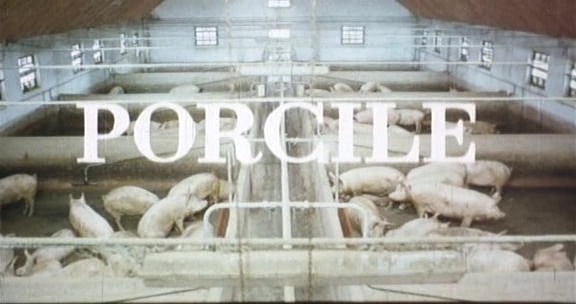
The opening credits roll over some very cute pigs in a sty, although they are not a major part of the rest of the movie, until the end. I guess for Pasolini they represent the European bourgeoisie, which I think is appallingly offensive. To the pigs.

vlcsnap-00068.jpg

Two separate stories are being told, interwoven. Segments of one are followed by the other, or sometimes the same one again. One story is set in 1967 and is about a German industrialist who looks a lot like Hitler, his son Julian, described by his mother as a “Mannerist San Sebastian”, and his radical fiancée Ida who joins protests to piss on the Berlin wall.

vlcsnap-00080.jpg

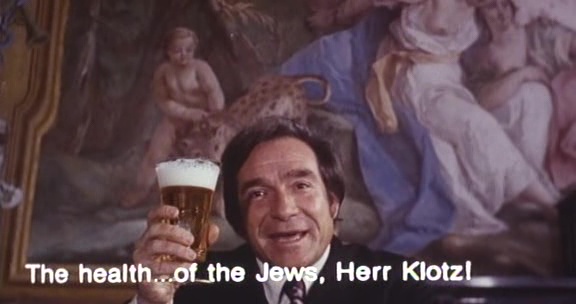
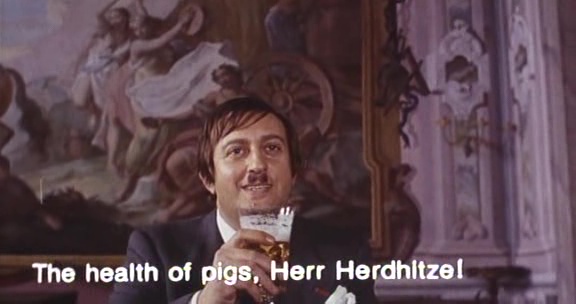
Julian will not go with her to the wall, nor even kiss her – he becomes catatonic after telling her that he has another love. Turns out to be the pigs in the porcile (sty). He prefers them to the hedonistic existence of his father who makes an alliance with an old rival, Herr Herdhitzel, even though he knows of that rival’s involvement in the Holocaust, and could destroy him.

vlcsnap-00081.jpg

vlcsnap-00082.jpg

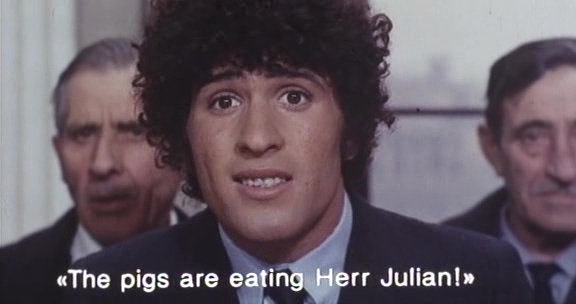
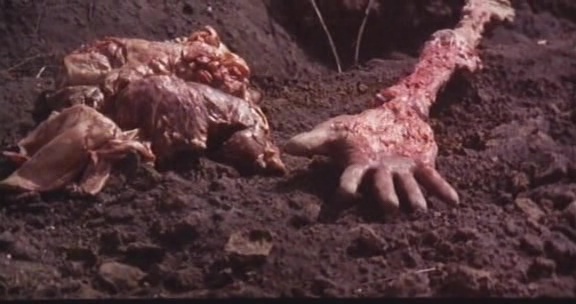
The locals arrive to tell of Julian’s fate, eaten by the pigs. Like Sebastian in Suddenly Last Summer, Julian is eaten by those he loved, or lusted after, or ate.

vlcsnap-00099.jpg

But the industrialist doesn’t want to spoil the celebrations, and tells the locals:

vlcsnap-00107.jpg

The other is set sometime in the middle ages (judging by the weapons and armour) and in a volcanic waste-land. A young man, called only “the young cannibal”, wanders around catching and eating whatever he can find, including lone soldiers.

vlcsnap-00078.jpg

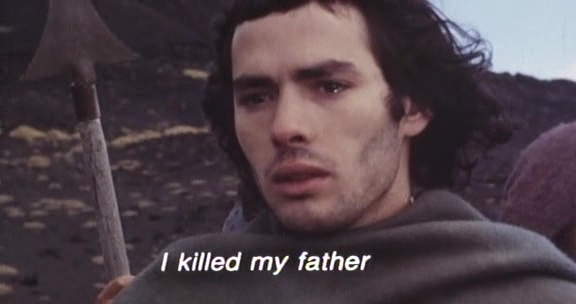
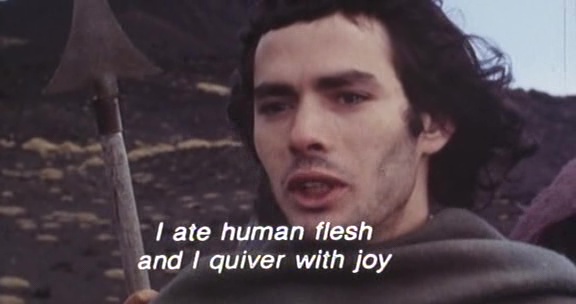
He joins up with other brigands who wander the smoking hills catching, killing and eating, throwing their victims heads into the volcano. When he is caught and prepares to be executed, tied down to four wooden stakes and left for the wild dogs to tear to pieces, he utters the words for which the film is most famous:

vlcsnap-00089.jpg

vlcsnap-00090.jpg

The young cannibal is a mirror image of Christ, killing his father instead of being killed, tied to the ground instead of raised on a cross, quivering with joy instead of asking why he has been forsaken. For Nietzsche, God is dead. For Pasolini, we have eaten him.

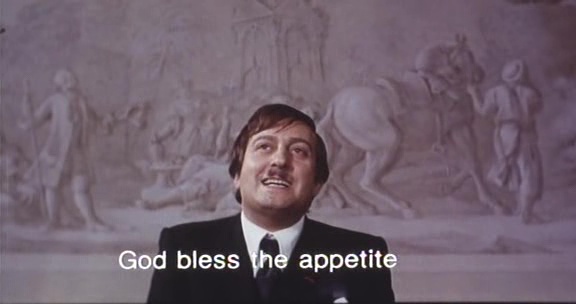
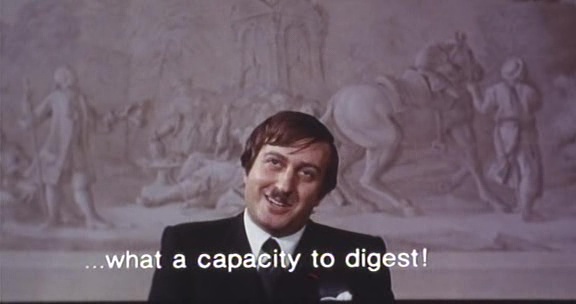
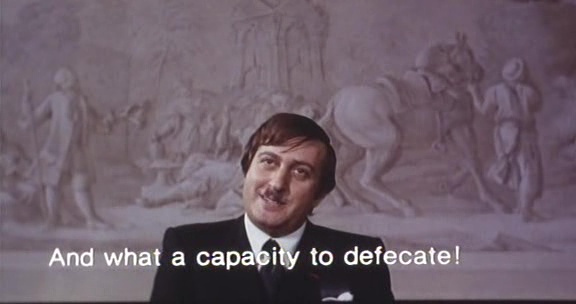
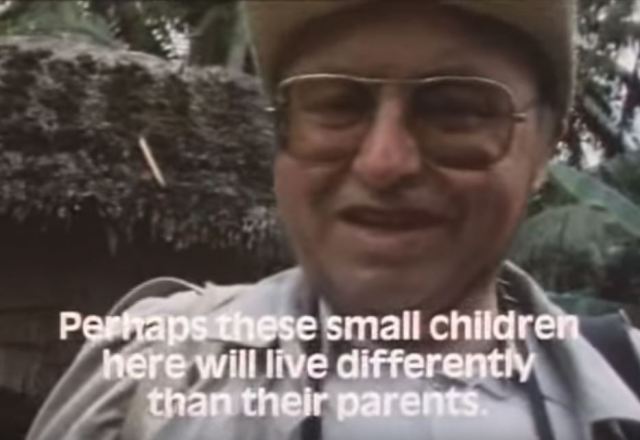
Cannibalism is usually defined as the eating of human flesh by humans. There are a lot of grey areas (and pink ones when pigs are involved). We eat them, they eat us, we eat each other. It’s about greed and power, and is the same whoever is eating or being eaten. Julian’s father sums it up:
vlcsnap-00085.jpg

vlcsnap-00086.jpg

vlcsnap-00087.jpg

IF YOU LIKE MY BLOG, PLEASE FEEL FREE TO RECOMMEND IT (WITH DISCRETION) TO FRIENDS ON SOCIAL MEDIA.
IF YOU HAVE ANY QUESTIONS OR COMMENTS, YOU CAN USE THE TAG, OR EMAIL ME ON CANNIBALSTUDIES@GMAIL.COM.

Loving and biting: “TROUBLE EVERY DAY” (Denis, 2001)

Trouble Every Day (its real title, not a translation from French) is a love letter from director Claire Denis to Paris, the ‘city of love’. It opens with some serious French kissing and there is a lot of oral action during the film – kissing, licking, biting, eating – they are all variations on the theme of seeking pleasure through oral connection.

Poster.jpg

Variety described the film as “”over-long, under-written and needlessly obscure” but that is not uncommon in American reviews of French films. It lingers on images, particularly Paris, sometimes beautiful, sometimes grey and seedy, sometimes both, the grunge lit by the sunset.

vlcsnap-00005.jpg

Like any big city, Paris is a place to seek love, make love, hide, sometimes get killed (and sometimes even eaten). Certainly the city (not just Paris) is famous for eating up and spitting out its residents, at least on a metaphoric level. And sex, particularly in Paris it seems, tends to be a mixture of tenderness and extreme violence.

The plot is simple and immune to spoilers – people are obviously going to get eaten (it happens a lot, particularly on movies reviewed on this cannibal blog) and that action starts pretty much right away. Coré (Béatrice Dalle) lures men with the promise of sex, then tears them to pieces and eats them. Léo (Alex Descas) loves her, protects her, buries the bodies, cleans her up, kisses her and then locks her in her room when he goes to work. But she always escapes (helps that she has keys and electric saws hidden strategically around the room).

vlcsnap-00011.jpg

vlcsnap-00016.jpg

When a couple of neighbours take his absence as an opportunity to break in, well, you can guess the rest.

Shane (Vincent Gallo) and June (Tricia Vessey) arrive in Paris for their honeymoon, but Shane has other images filling his mind, and we glimpse some of them even as he sits, desolate, in the plane’s toilet, not even bothering to have a wee (come on – you know how hard it is to get a turn in one of those?)

vlcsnap-00001.jpg

Shane is seriously creepy and, as he stares down at June in their Paris hotel, we find that his loving is also not without teeth.

vlcsnap-00009.jpg

vlcsnap-00010.jpg

Turns out he knew Leo and Coré, worked with them on bioprospection research, looking for plants that would cure nervous diseases, mental diseases and problems of libido. Think there is any money in that lot? But Leo was impatient with their caution, wanted to test it on humans. And of course, that experiment backfired. Some plants heal mental diseases and libido, others turn you into cannibals. C’est la vie.

vlcsnap-00032.jpg

But the plot is not so important. Denis is telling us that love, or at least sex, is about touch, communion, intimacy. And what is more intimate than not just kissing and biting your partner, but swallowing, incorporating them? The definition of marriage in the Bible is “they shall become one flesh”. Cannibalism is the ultimate expression of that – once the blood is wiped off, the lovers have indeed become one flesh.

vlcsnap-00029.jpg

The movie got 50% on Rotten Tomatoes website, so no one can quite make up their mind. I liked (although disagreed with) the review in the Seattle Times:

“I’m not sure these words have ever been together in the same sentence: This erotic cannibal movie is boring.”

The film is probably a lot more disturbing on the big screen, as Denis glories in extreme close-ups, particularly of touching, kissing, licking, bleeding, as well as lingering on areas of the body that usually don’t make it into Hollywood films (but usually do in French films). Luckily, having sat through a guy having his tongue ripped out and a hotel maid being raped and killed, there is at least, at the end, a puppy.

vlcsnap-00036.jpg

IF YOU LIKE MY BLOG, PLEASE FEEL FREE TO RECOMMEND IT (WITH DISCRETION) TO FRIENDS ON SOCIAL MEDIA.
IF YOU HAVE ANY QUESTIONS OR COMMENTS, YOU CAN USE THE TAG, OR EMAIL ME ON CANNIBALSTUDIES@GMAIL.COM.

Cry me a Reaver: “SERENITY” (Whedon, 2005)

Futuristic cannibal movies usually involve social dislocation and roving gangs of urban starvelings, but this one has the added attraction of being set well into the future, and in outer space. Space cannibals, what more could we ask? How about plenty of action, smart, sassy dialogue, and Joss Whedon at the helm, the man behind Buffy and Angel?

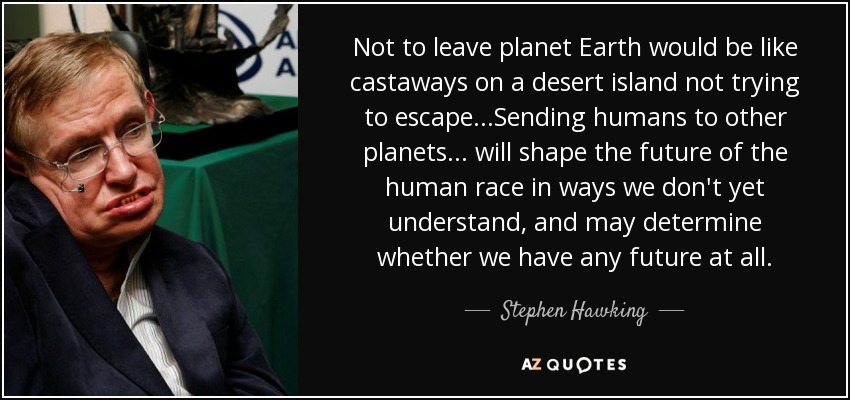
Stephen Hawking, among a lot of other people (none as smart as him though), suggested that humans will need to “escape the earth” sooner or later.

Image result for stephen hawking escape the earth

Currently, the pace of climate change seems to suggest sooner rather than later might be a good idea, but in Serenity, it’s several hundred years into the future (the year 2517 to be precise). Humans have escaped an overcrowded planet Earth and colonised a new solar system. The central planets have formed the Alliance and won a war against the outer planet Independents, a war that they see as civilisation against barbarism. Most barbaric of all are the Reavers, They are savage, brutal and primal; as Zoe (Gina Torres from Hannibal) puts it in the TV series Firefly:

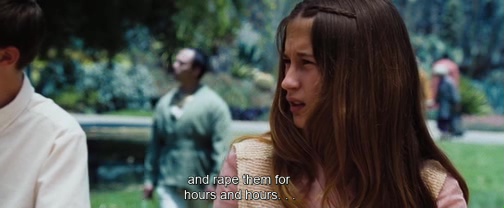
“If they take the ship, they’ll rape us to death, eat our flesh, and sew our skins into their clothing – and if we’re very, very lucky, they’ll do it in that order.”

vlcsnap-00014.jpg
Not pretty, but Reavers have good teeth

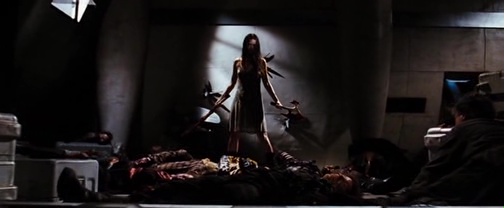
The Alliance government denies their existence. But the Reavers, like Jeffrey Dahmer and Andrei Chikatilo and dozens more cannibals in our own times, are real, and are more than ready to eat us. They first appeared in Joss Whedon’s TV series Firefly, which sadly was cancelled after one season, only to become cult viewing thereafter. Serenity is the continuation of that story. Look, it’s a complicated plot, quite a lot of which has nothing for a cannibalism blog to chew on so, here, we’re just interested in the Reavers, who are particularly nasty cannibals.
vlcsnap-00011.jpg

More than one critic has described the Firefly/Serenity story as “galactic Cowboys and Indians”, and the Reavers are the “Injuns”, in the sense that, in the old Westerns, they were portrayed as mindlessly aggressive, had no subjectivity in terms of any personal anecdotes, and could be gunned down (“bite the dust”) with no moral qualms. Joss Whedon himself said “Every story needs a monster. In the stories of the old west it was the Apaches.”

vlcsnap-00025.jpg

We can’t do that anymore in movies – First Nation people are far more likely to be the sympathetic protagonists, while cowboys are either unemployed gunfighters, drunks, or psychopathic murderers. The unthinking racism of the early Westerns has been transformed into Reavers, Klingons, Sith lords, and so on. Westerns boldly migrated into space (think Star Wars, Star Trek). But in space, we still need evil degenerates facing off against a noble warrior (who is increasingly likely to be a female).

vlcsnap-00036.jpg

So if we need a new terrifying, mindlessly destructive enemy, who better than the cannibal? The fear of cannibals worked for Columbus 500 years ago, and works for the Alliance 500 years hence. But the curse of modern cannibal films is that the audience, or perhaps just the producers, demand a back story, how did they get that way – or, as Clarice asks Hannibal, “what happened to you?”

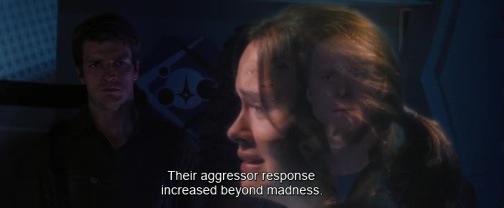
This film tells us, at last, how the Reavers got that way, and it doesn’t reflect too well on the civilised parliamentarians of the Alliance. Imagine an experimental chemical distributed globally, that can reduce or remove human aggression. It stops people fighting. It also stops them doing anything, including eating and moving. Without some aggro, we become zombies. But without the appetite.

But on those who are resistant to the chemical, it has the opposite effect. Their aggression levels go through the roof. They become Reavers. So really, any of us could be Reavers, given the opportunity and the right (or wrong) chemicals.

vlcsnap-00028.jpg

What would the government do? Bury the information of course. Pretend the dead world doesn’t exist. Then, sooner or later, come out with another way to make people “better”. As the philosopher John Gray says:

“the idea that humans may one day be more rational requires a greater leap of faith than anything in religion.”

serenity.2005.jpg
IF YOU LIKE MY BLOG, PLEASE FEEL FREE TO RECOMMEND IT (WITH DISCRETION) TO FRIENDS ON SOCIAL MEDIA.

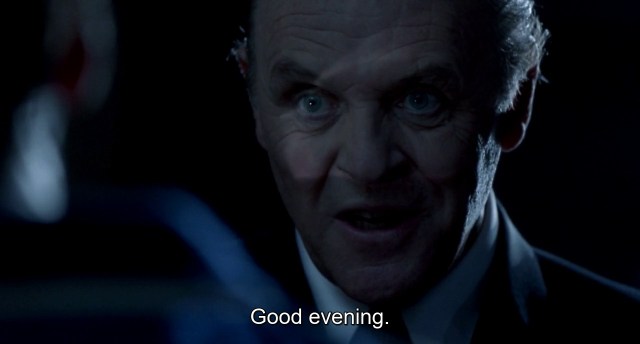
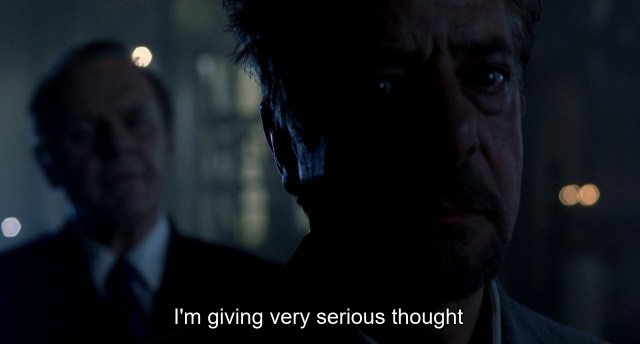
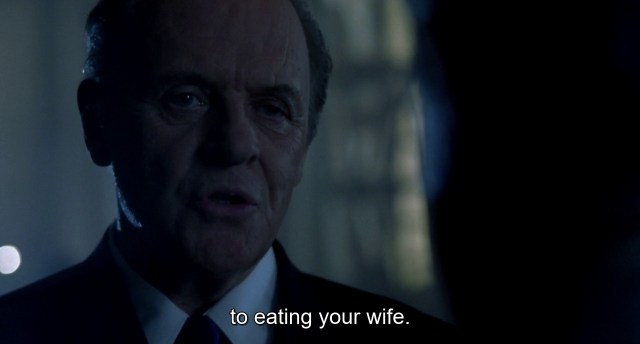
“I’m giving very serious thought to eating your wife”: “HANNIBAL” (Scott, 2001)

It is quite extraordinarily, in retrospect, to realise that this 2001 film was the first Hannibal Lecter film to be about Hannibal Lecter. He was very much a bit player in both Manhunter and Red Dragon (both based on the book Red Dragon) – he was in an asylum and visited occasionally by Will Graham, desperate for a clue as to the identity of the serial killer the FBI was hunting. The movie that made him a household name, The Silence of the Lambs, saw him still in that Baltimore Asylum for the Criminally Insane, but now he was a major figure, even though only on screen for a bit under 16 minutes. But very good minutes they were (he won the Oscar for it, and the film won five in total) and, importantly, we saw him escape, to rejoin us, the viewers, in the breathing world, as we crept, with wide eyes, back to the dark parking lot of the cinema after the credits had rolled.

Hannibal.jpg

“I need to come out of retirement and return to public life.”

In Hannibal, he is free, and doing what he loves best – being an expert on Renaissance art and poetry in Florence, drinking fine wines, and occasionally eating people. But, as in the previous movies, and in the TV series, Hannibal takes his sweet time before he actually appears on screen. His image appears at 24 minutes: an archive video of him attacking a nurse who was careless with his ECG (any comments on why he attacks the nurse would be appreciated. It seems out of character for Hannibal: discourteous even).

vlcsnap-00017.jpg

His voice appears at 28 minutes, and his person at 30. Hannibal never rushes things. Instead, the film starts with Hannibal’s nemeses: Mason Verger, intent on revenge and plotting to capture Hannibal and feed him to his pigs, and of course Clarice Starling, her career in tatters due to a combination of law enforcement ineptitude and toxic masculinity working to bring her down. She is caught on the news shooting a woman with a baby, even though that woman was a drug dealer who was shooting at her.

vlcsnap-00004.jpg

Her only possible way to reinstate her career will be to work with Verger to capture Hannibal.

This wasn’t an easy film to make – sequels rarely are, particularly when they are following a film that did a lot better than anyone expected. And this film was made ten years after Silence, so there was a huge, pent up demand. There was also the brilliant book from Thomas Harris on which this was based; it had come out two years previously, and many, including the director of Silence, Jonathan Demme, the screenwriter, Ted Tally, and the star, Jodie Foster, considered the plot a bridge too far. All three declined to be involved in the new film. Lucklily, Anthony Hopkins was ready to get back in the saddle, so the film proceeded – without him, it would seem to have been unlikely.

So, sad not to get Demme back to direct, but hey, Dino di Laurentiis found a substitute: the brilliant Ridley Scott (Alien, Blade Runner, Thelma and Louise), who had just finished Gladiator and at first declined the script, as he thought it was another ancient history epic, and didn’t want to have to direct elephants crossing the Alps. Oh, it’s about a cannibal in Florence? OK then. The screenplay was first drafted by Pulitzer Prize winner David Mamet and then written by Steven Zaillian (Schindler’s List). And instead of the incomparable Jodie Foster, he chose, from a list of the greatest actors of the time, Julianne Moore, apparently the recommendation of Hopkins. di Laurentiis said of Jodie Foster’s refusal to take part: “when the Pope dies, they get a new Pope”. So it was off to a rollicking start.

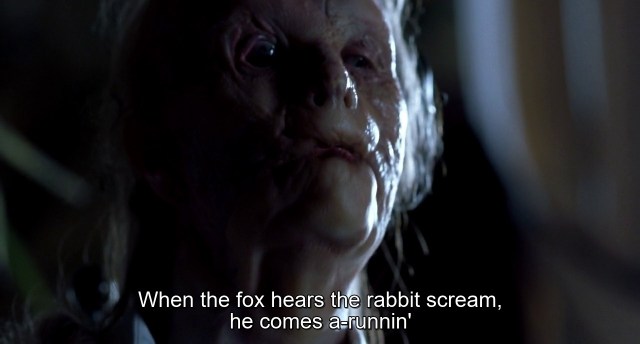
Then there’s the supervillain. In Hannibal movies, there is always a much worse monster for us to hate, giving us licence to like Hannibal that much more. In this case, it is Mason Verger (Gary Oldman), heir to a huge fortune built on the cruel pork trade, a sadist and child molester in his youth.

vlcsnap-00012.jpg

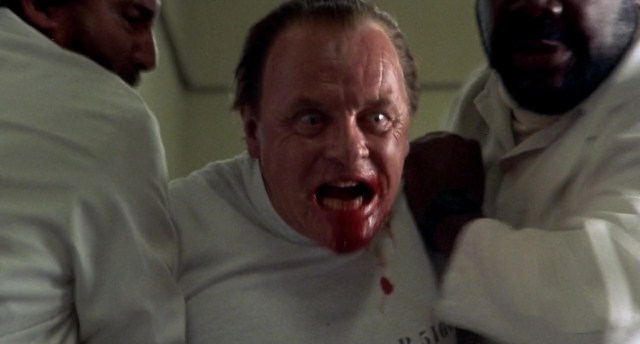
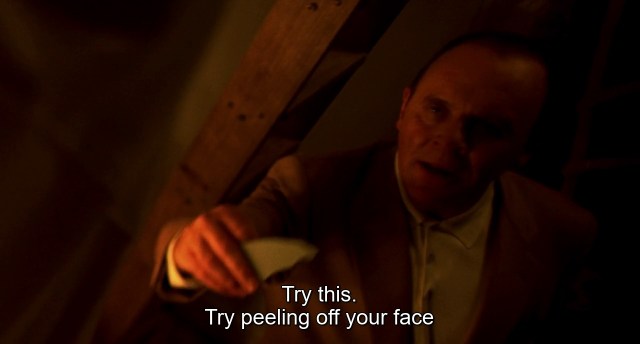
He is the only surviving victim of Hannibal: instead of killing him, Hannibal got him whacked on psychotropic drugs and suggested that he slice his own face off and feed it to the dogs. In the book, this is explained: Mason had adopted two dogs who were good friends, and put them in a cage with no food, to see if they would turn to cannibalism. Gratuitous cruelty and cannibalism – not what Hannibal is about at all. Hannibal’s cannibalism contains a nugget of justice. As the Asylum orderly Barney tells Clarice:

He told me that whenever feasible, he prefers to eat the rude. Free range rude, he called them.

Incidentally, Barney is portrayed by Frankie Faison (The Wire) who is the only actor to appear in all four Hannibal films up to this one.

Hannibal manages to communicate with Clarice throughout the film, usually by letter or phone call, explaining his point of view and questioning why she continues to serve her corrupt and venal masters.

Tell me Clarice, would you want to harm those who have forced you to consider it though? It’s perfectly OK to feel this. It’s perfectly au naturel to want to taste the enemy. It just feels so good.

vlcsnap-00013.jpg

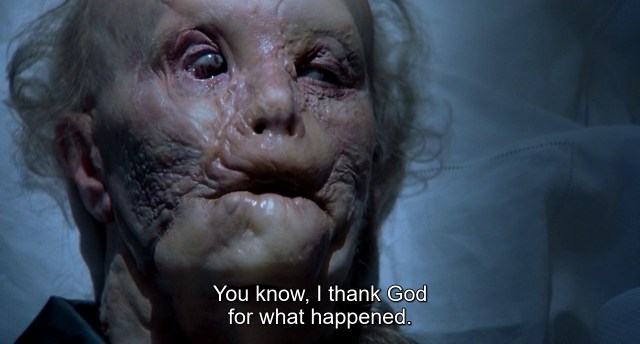
The camera lingers lovingly on Mason’s disfigurements: according to the DVD, Oldman spent six hours each day in makeup to make him so lovable. Hopkins, on the other hand, did not bother with makeup for this movie, allowing his advancing years and natural pallor to tell the story of the years since his escape.

vlcsnap-00067.jpg

With Hannibal, there is always the question of who is the cannibal. In Red Dragon, was it Hannibal in his cell or Dolarhyde collecting movies of women he had killed and raped? In Silence, was it the same Hannibal in the same cell, or Jame Gumb, killing and skinning women to make a vest with tits? In this one, is it the Renaissance scholar Hannibal seeking a job as curator of the Capponi library or Inspector Pazzi (Giancarlo Giannini), threatening a local pickpocket into ambushing Hannibal, hoping to sell Hannibal to Verger to be fed to his pigs? The pickpocket loses his femoral artery to a small knife that Hannibal keeps in his sleeve. He dies, but Pazzi gets the fingerprint he needs for the deal to go ahead and in a scene full of Catholic symbolism, washes his bloody hands in the fountain of Il Porcellino, a porcine reference to the greed of Judas and the cowardice of Pontius Pilate, as well as a foretaste of the pigs who have been bred to eat Hannibal. Verger and his thugs get the pigs flown to the US and primed to eat humans (pigs usually prefer not to). Pazzi later gets from Hannibal the same treatment his treasonous ancestor received in Florence 500 years earlier – hanging from the window with his bowels protruding. But not until Hannibal has offered the line of the movie:

vlcsnap-00048.jpg

vlcsnap-00049.jpg

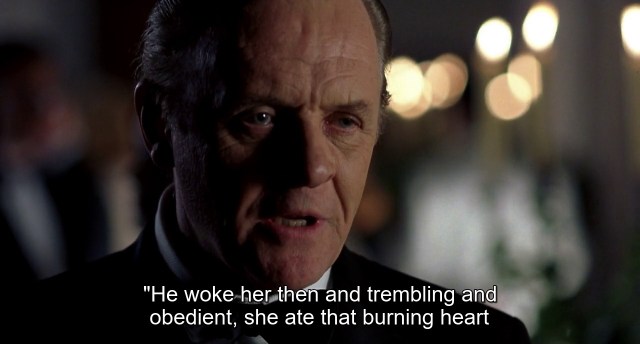
Hannibal has met Pazzi’s wife, Allegra (Francesca Neri), at the sublime opera of Dante’s sonnet A ciascun’alma presa from Vita Nuova, which Hannibal and Allegra recite to each other meaningfully, all about Beatrice eating Dante’s heart, and clearly referencing Hannibal’s growing obsession with Clarice.

vlcsnap-00037.jpg

In a scene that reveals both Pazzi’s desperation to make Allegra happy, including risking his career and life to capture Hannibal, and Hannibal’s own burning love for Clarice, she asks him:

Allegra: Dr Fell, do you believe a man could become so obsessed with a woman from a single encounter?
Hannibal: Could he daily feel a stab of hunger for her and find nourishment in the very sight of her? I think so. But would she then see through the bars of his plight and ache for him?

Dante and Beatrice were nine years old when his obsession with her started. Hannibal’s obsession with Clarice started at a more mature age, but burns just as brightly.

The music, Vide Cor Meum, is by Hans Zimmer (Lion King, Gladiator, the Dark Knight trilogy and heaps more) and is so beautiful that it is used again in the TV series Hannibal, in the season finales of both the first two seasons. As she leaves with Pazzi, another couple brush past saying “let’s get something to eat!” Hannibal mutters to himself, and to us, “why not?”

Verger understands that the way to trap Hannibal is by threatening Clarice, and pays Paul Krendler (Ray Liotto), the man who has conspired to destroy Clarice’s career since she first rebuffed his advances, to fabricate evidence of collusion with Hannibal.

vlcsnap-00076.jpg
“But not to help…”

She is suspended from the FBI. Hannibal goes shopping for fine furniture, and burglaring for medical equipment. He breaks into Clarice’s apartment in DC, where she has drunk herself to sleep, and leaves a collage of her face on a fashion shoot in a magazine. The game is afoot. He leads her to Union Station where he engages her in a discussion of her life, her future, and why the forces of the law, the law she loves and respects, have totally betrayed her.

Why are you so resented? You serve the idea of order, Clarice. They don’t. You believe in the oath you took. They don’t. You feel it is your duty to protect the sheep. They don’t.

As he leaves, Verger’s Sardinian hit-men hit him with a tranquiliser dart and drive him off. Now who will save whom?

vlcsnap-00100.jpg

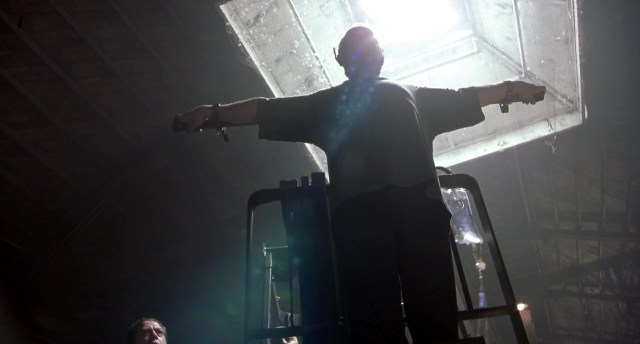
Hannibal is strapped to a forklift in a crucifixion position, his feet are to be fed to the pigs, then he is to be kept alive for several hours until the rest of him is given to them. She cuts him loose, leading to one of the funniest exchanges in the film.

vlcsnap-00107.jpg

Clarice can deal with most of these thugs, but is shot while rescuing Hannibal, who picks her up and walks through the hogs. They leave him alone – since they cannot smell fear on him. He arranges for Verger’s helper to push the furious billionaire into the pig pen. Dinner is served.

vlcsnap-00111.jpg

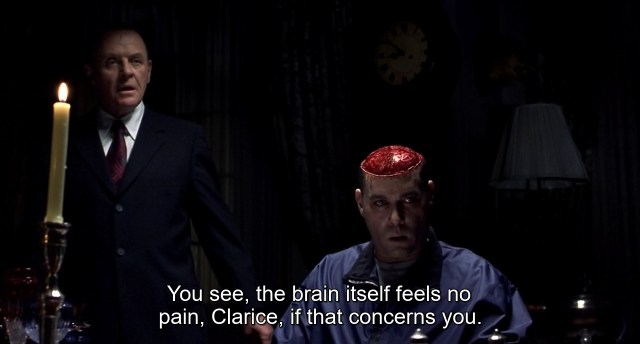
Krendler returns to his lakehouse, but Hannibal is already there. So is Clarice; Hannibal has removed the bullet and she is sedated. She wakes dressed in full evening gown and high heels and staggers downstairs where, in the most famous scene of the film, Hannibal has sawn Krendler’s cranium off, and is preparing to serve his brain. Of course, the brain has no pain receptors on its surface, so Krendler is awake and joins the meal.

vlcsnap-00117.jpg

Most of this is fairly true to the book. Only the ending was changed, apparently to appeal to those whose morality could stand seeing a man eat his own brains, but not to seeing Starling, so long an honest cop, go over to Lecter’s side – the side of cynicism about authority and enjoyment of the finer things of life. Instead, she rebuffs him and with her remaining strength tries to stop the dinner, and then the escape. She hancuffs the two of them together, Hannibal goes to bite her, then to cut off her hand, but it is he that leaves minus one. That’s love.

vlcsnap-00128.jpg

vlcsnap-00129.jpg

But then, there is the single tear – does she regret the opportunity to dance with the devil?

vlcsnap-00137.jpg

I admit to preferring the story the way the author wrote it in the book. I think Hannibal would have too. Read the book and you will see that is the perfect denouement to the Hannibal saga. I think they compromised on the end to avoid controversy (although they did get away with feeding Krendler his own brain, so they weren’t totally devoid of courage).

I suspect that the idea of amputation of his hand came from Sir Anthony Hopkins, who had starred in Shakespeare’s Titus only two years earlier, in which he cuts off his hand, and his daughter suffers a worse fate involving both hands and her tongue. [I nearly said Hopkins had a hand in the decision, but I restrained myself].

Titus is also a cannibal movie, by the way. You can read my blog about it at Titus.

Why does Hannibal eat people? Clarice speculates on this earlier in the film, while she is still on the case, as Krendler asks her what she’s doing sitting in the dark.

Thinking about cannibalism. Aren’t you curious why he dines on his victims? To show his contempt for those who exasperate him. Or sometimes to perform a public service. In the case of the flutist, Benjamin Raspail, he did it to improve the sound of the Baltimore Philharmonic Orchestra, serving the not so talented flute player’s sweetbreads to the Board with a nice Montrachet at $700 per bottle.

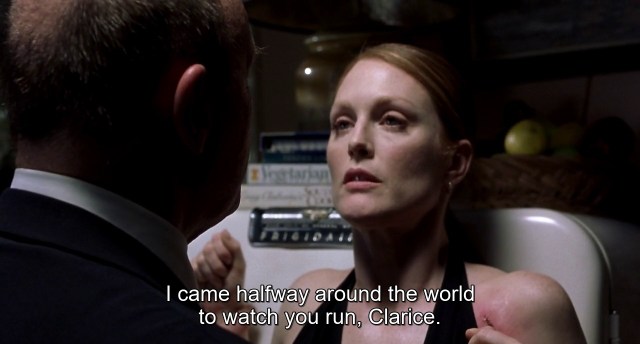
Yes, Clarice, quite right. But also, like any cuisine, it’s a habit, or a preference. Hannibal simply cannot see any reason not to eat people, particularly rude ones. In the final scene, he offers to give it all up for her:

vlcsnap-00130vlcsnap-00131vlcsnap-00132vlcsnap-00135vlcsnap-00134

BTW: note the books on Krendler’s fridge: Southern Cooking and Vegetarian Times. Our ethical choices: what we consider right, or what we consider delicious. Hannibal, unlike everyone else, makes his choices without hesitating. He considers them the same thing.

IF YOU LIKE MY BLOG, PLEASE FEEL FREE TO RECOMMEND IT (WITH DISCRETION) TO FRIENDS ON SOCIAL MEDIA.
IF YOU HAVE ANY QUESTIONS OR COMMENTS, YOU CAN USE THE TAG, OR EMAIL ME ON CANNIBALSTUDIES@GMAIL.COM.