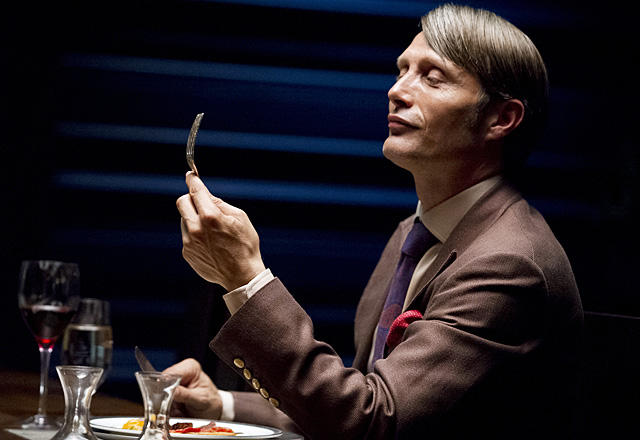
Anders Thomas Jensen directed this Danish black comedy, which is only really listed early in this blog because it stars – yep, that really is him – Mads Mikkelsen, better known to readers of this blog, I daresay, as Hannibal Lecter in the television series Hannibal (2013-15).
Svend (Mads Mikkelsen) and Bjarne (Nikolaj Lie Kaas) work in a butcher shop, but are browbeaten by their mean boss, “Sausage” Holger (Ole Thestrup), who says Bjarne’s pate tastes like jockstrap, and even disparages Svend’s marinade (believe it or not, this becomes an important plot point). Holger opens the film with a great summary of animal agriculture:
“I’ve always been fascinated by sausages. It’s almost mythological to kill an animal and then mock it by sticking it in its own intestine. Can you imagine anything worse than being stuck up your own ass?”
They can’t stand this rude dude, so they start their own butcher shop (slagtermester). Bjarne has problems: he smokes twenty joints a day and kills animals so he can collect their skeletons. But it turns out he is the saner of the two partners.
Their grand opening attracts a total of zero customers. Next morning, Svend does not have a good day: he breaks up with his fiancé and then discovers that he has inadvertently locked the electrician in the meat freezer all night. What to do with a frozen electrician? Holger appears, demanding fillets for the Rotary dinner, and Svend panics.
Next day, the guests from the Rotary dinner are queueing up outside the shop – they all loved the fillets. Business is booming and, as Svend says, we had to get rid of him, one way or another. The electrician becomes “Svend’s chicky-wickies”. Then the real estate agent turns up, wanting a tour of the premises. So it goes.
It’s an accidental Sweeney Todd. They meant no harm, and are just being rewarded for bumbling incompetence. And isn’t that the way the world really operates? The Peter Principle!
Then the local pastor reveals that he didn’t like the Rotary dinner. It reminded him of his wife. The wife he had to eat after a plane crash on their honeymoon. Yes, it’s not just Danish Hannibal, it’s also Alive!
Mads Mikkelsen is very good in the role of the nervous, sweating, irritable Svend, although it’s hard to reconcile this farcical character, and his extraordinary haircut, with the cool, sophisticated and brilliant Dr Hannibal Lecter, let alone Le Chifre in Casino Royale or even Kaecilius in Dr Strange.
By the end of the film, we are asked questions of perception: what is appetite? What is “meat”? Is the secret in the sauce? Is that a wig?
The promoters had no idea what to do with this film. Check out some of the posters – hard to tell that they are for the same thing!
This slideshow requires JavaScript.
It’s a quirky comedy, pleasant enough and inoffensive, unless you are offended by either butchers or cannibalism. If you are equally offended by both, then perhaps it has done its job well.
If you like my blog, please feel free to recommend it (with discretion) to friends on social media.
If you have any questions or comments, you can use the tag, or email me on cannibalstudies@gmail.com.
Six months into this blog, I ask you: have we actually defined cannibalism? I answer you (because it’s a rhetorical question): no, we have not.
The Oxford Dictionary says that a cannibal is “a person who eats the flesh of other human beings”. But what does “eat” mean, then? “Put (food) into the mouth and chew and swallow it.” So then we have problems with zombies, who eat the flesh of other humans, but may or may not be “persons” (since they are dead, or undead). And with bulemics, who chew and swallow, but then bring it up again?
Why am I being such a pain about this? Because I like this film, and would love to fit it into my cannibal blog. But she, to put it politely, does not swallow…
Teeth is directed by Mitchell Lichtenstein, the son of far more famous pop artist Roy Lichtenstein. It is awkwardly defined as “comedy horror” which can be a problematic mix, and often ends up with silly movies like Eat the Rich. But this one works, although I didn’t find it terribly funny. I guess if you were sitting in a cinema watching a bunch of teenage boys squirm, that might have been good for a laugh.
Dawn O’Keefe (Jess Weixler) is a teenage spokesperson for a Christian abstinence group called the “Promise”. This is a terrifying crowd – young teens can be pretty off-putting anyway, but this lot want to chant stuff about Eve and the Devil and Sin, and do so with a flint-eyed seriousness that is disturbing (or funny if you see it from a certain angle).
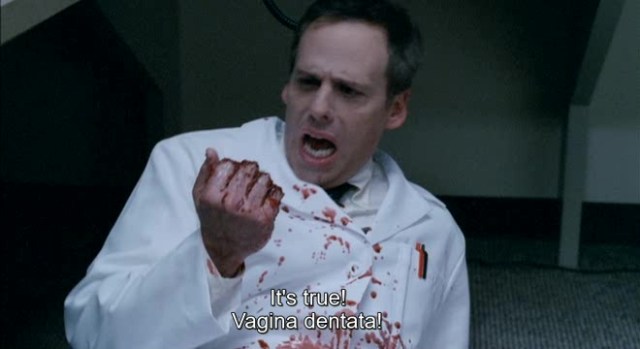
Dawn has a talent which is not known to anyone, including her, or the various males who try to assault and penetrate her: she has a vagina dentata: a toothed vagina. As a tiny girl, she almost bites off the finger tip of her step-brother who is doing naughty things under her swim suit in the wading pool, but the talent comes into its own when a boy from the abstinence group decides that God will forgive and understand if he takes advantage of their solitary swim, knocks her almost unconscious and then starts to rape her. Well, God might forgive, but Dawn’s lower teeth don’t, and he discovers a new and very agonising weight loss method.
This slideshow requires JavaScript.
The vagina dentata is an ancient myth that is found in many folk legends from a wide range of peoples. Freud and the classical theorists liked to say that it is a representation of the fear that little boys have of their penis-less mothers, which leads them to assume that they are next for castration, either by her or by their fathers who are angry at their budding Oedipal desires. Joseph Campbell in The Masks of God talks about a New Mexico myth in which “vagina girls” ate men who came to their house for sex. We’re getting close to cannibalism now, I think.
It’s a huge subject, covering quite a lot of what goes in the festering sewers of our unconscious minds. If you wish to research it more (and it is fascinating stuff), Barbara Creed has covered the subject comprehensively in The Monstrous Feminine.
So: young Dawn, played brilliantly by Jess Weixler, whom you may recognise as the investigator Robyn in the TV series The Good Wife, believes in saving herself for marriage, a view that is considered somewhat old fashioned now, but still resonates in many parts of the world, particularly the Bible belts. Those around her, including her step-brother with the disfigured finger, feel that she should “put out” as they say, but when she does, boy are they sorry. Creed looks closely at the “taboo of virginity” and Freud’s view that this arises from penis envy and frigidity. Men fear that women will castrate them, particularly when the loss of virginity is painful, as it clearly is to Dawn. Freud ignores the possibility that it is men’s irrational fear of the deadly power of the vagina that leads to fear of sexual intercourse. Brought up in this oppressive environment, Dawn is unaware of her power. The film unravels this power.
Weixler won the Special Jury Prize at the Sundance Film Festival “For a juicy and jaw-dropping performance”, and it was well deserved.
You have to watch closely to catch the “banana split” gag
The horror of cannibalism is at least as much to do with their power to snap, bite and destroy as it is with their tendency to swallow (any old Jaws can do that). The vampire, without whom the Horror industry would be toothless (sorry), swallows, but only blood, not flesh. Yet it is the sharp teeth and the swallowing that gives vampires their welcome into at least the outer limits of cannibal fiction. Dawn is an unwilling but not totally innocent cannibal, because she soon figures out (through google) what it means to be the bearer of the vagina dentata.
A film like this could easily degenerate into farce, and the celibate teens could end up laughable stereotypes of conservative bigots. Yet, Dawn takes us with her on her quest to understand what she is, what she wants, and what she can do to those who wish to force themselves on her. The logline states “every rose has its thorns”, and the trailer says “Something is wrong with Dawn O’Keefe”. But surely that’s not true – there is something very wrong with the rapists, and it gets a lot wronger as they get closer to the climax of their plans. One review said:
“What’s most important for Dawn is she discovers her vagina is not a curse but a source of power.”
Dawn at first thinks that her vagina dentata might be the “Adam within”, a forbidden male side of her character that causes gratuitous havoc. But in fact, the teeth are her defence and her weapon against injustice. With her extra teeth, and the ‘dawning’ of the realisation of her own power, Dawn is a superhero of the #MeToo age.
The film has a respectable 80% on Rotten Tomatoes website, with the concensus being:
“Smart, original, and horrifically funny, Teeth puts a fresh feminist spin on horror movie tropes.”
This poster was apparently banned
The final credits state:
If you like my blog, please feel free to recommend it (with discretion) to friends on social media.
If you have any questions or comments, you can use the tag, or email me on cannibalstudies@gmail.com.
The film blogs arrive on Sunday morning (eastern Australian time) but occasionally another possible cannibal connection arrives which is too good to miss. Take a look:
Yep, not dead fingers at all. It’s a fungus, that happens to look like grey fingers with nails. It’s Xylaria polymorpha, commonly known as dead man’s fingers, a saprobic fungus.
So what’s it doing on a cannibal blog? Only this: it reminded me of the scene from the TV series Hannibal called “Amuse-Bouche“. People are being buried, alive, to feed fungi.
This slideshow requires JavaScript.
I guess you’d call that: life imitates art?
One of the best shows on television, and I will get to it soon on this blog.
If you like my blog, please feel free to recommend it (with discretion) to friends on social media.
If you have any questions or comments, you can use the tag, or email me on cannibalstudies@gmail.com.
Jean-Jacques Rousseau is reported to have told the Paris Commune during the French Revolution that:
“When the people have nothing more to eat, they will eat the rich.”
It caught on, some 200 years later, and became the title of a number of songs from such revolutionary outfits as Aerosmith, Motörhead and State of Mind.
Rousseau could have added “and when the people have nothing to watch, they will watch cannibalism comedies”. Lucky he didn’t though, because not many people watched this particular lemon.
Eat the Rich is a black comedy featuring the cast members of the popular television series The Comic Strip Presents…. (Adrian Edmondson, Dawn French, Rik Mayall, Nigel Planer, Peter Richardson, Jennifer Saunders and Alexei Sayle), plus a whole lot of big name cameos. Among the cameos are two really great bass guitarists: Paul McCartney and Bill Wyman!
Enough trivia – time to get to the serious business of comedy. The film is set in a restaurant named ‘Bastards’ where Alex (Al Pellay), is a waiter, trying to put up with the contempt and disgust of the upper-class clientele, who order dishes like “sliced baby koala, poached in its mother’s milk”. Alex is fired for being rude and turns to a life of crime and revolution. The denouement comes when Alex and his friends return to Bastards and start killing and cooking the customers, renaming the establishment “Eat the Rich”.
This is the police. Lay down your knives and forks!
The film was a very thinly veiled satire on Thatcher’s England, but never really seemed likely to be a call to arms. Timeout London said:
“the back-alley production values and total lack of comic invention on display in this Thatcher-baiting misstep meant that any hopes of a Pythonesque run at the movies were knocked way back on their heels.”
It was a commercial flop, taking in only $200,000 in the US. This may have set cannibal humour back decades but, fortunately, we have just learnt that John Cleese is writing a cannibalism film! According to recent press releases, Cleese has revealed that:
“My greatest professional accomplishment will be a movie I’m writing now, a light comedy about cannibalism. It’s called Yummy.”
Of course, that could be Cleese being too silly, too silly.
But it shows a certain zeitgeist – cannibal films are the flavour of this era of our culture. I wonder if it relates to our fears about the increasingly apparent hazards of a society and economic system based on ever more voracious appetite?
If a vegetarian eats vegetables, what does a humanitarian eat?
If you like my blog, please feel free to recommend it (with discretion) to friends on social media.
If you have any questions or comments, you can use the tag, or email me on cannibalstudies@gmail.com.
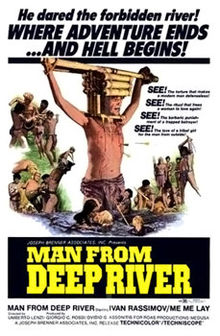
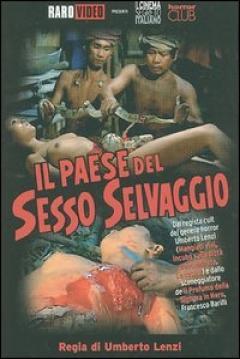
Man From Deep River, otherwise known as Deep River Savages, Sacrifice and (originally) Il paese del sesso selvaggio (English: The Country of Savage Sex), is a 1972 Italian cannibal film directed by Umberto Lenzi. Largely overlooked in the world of cannibal studies (with some justification), it is best remembered for starting the “cannibal boom” of Italian exploitation cinema that filled our big screens with blood and body parts in the late 1970s and early 1980s.
Lenzi was probably trying to imitate the content of the notorious Mondo cinema, which had gained grindhouse popularity after Mondo Cane (Jacopetti and Cavara) in 1962. Mondo films tended to focus on exotic customs and locations, graphic violence, and animal cruelty, often presented as fact. Man from Deep River turned this into a fictional formula.
The film was inspired by A Man Called Horse (Silverstein, 1970), which also featured a white man who is incorporated into a tribe that originally held him captive. Horse had the advantage of a big star: Richard Harris, who went on to be King Arthur, Marcus Aurelius and Albert Dumbledore (in the first two Harry Potter movies), as well as having a brief but glorious singing career with one huge hit: Macarthur Park. This is all totally irrelevant to this blog, which is about cannibal movies, but you should watch the clip of the Jimmy Webb song Macarthur Park, which has little or nothing to do with anything, even the song, but helps explain why Baby Boomers are, well, the way we are.
Don’t drop the soap
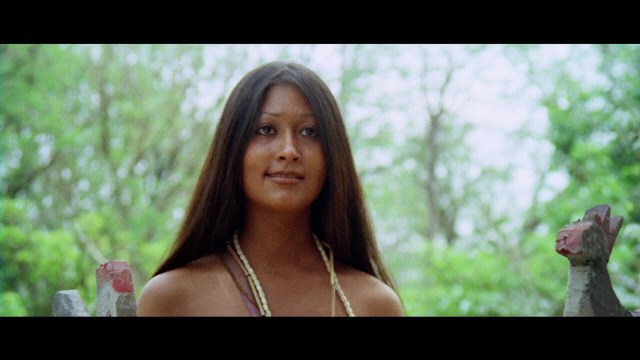
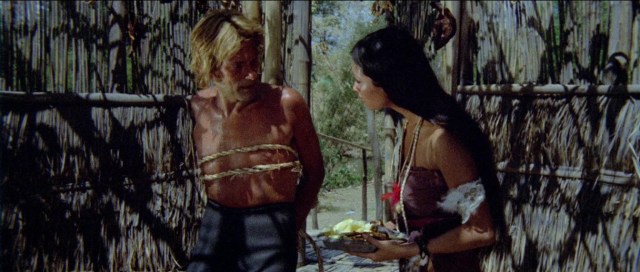
In Man From Deep River (see? back on track already!) British wildlife photographer John Bradley (Ivan Rassimov) kills a man after a boxing match in Bangkok (as if to say “we can be savages too!”) and heads into the rain forest, with his camera. Naturally, he is captured by a native tribe. Bundled in a net, he is and carried to their village, where they tell the chief that they have caught a large fish-man. After a bit of xenophobic torture and witnessing a couple of murders of members of a rival tribe of – yes – cannibals (the tongue scene is hard to forget), John attracts the attention of Marayå (Me Me Lai), the beautiful and naked daughter of the chief, who convinces her father that John is not a fish-man, just a hu-man. Dad agrees to release Bradley, as Marayå’s slave. Could be worse.
There’s an escape attempt, and then the chance to join the tribe through a trial by ordeal – but of course, the cannibals are still next door, as they must be to qualify this film for this blog. Things get sticky. And red.
Cannibalism is certainly featured in the film, but director Umberto Lenzi stated that cannibalism was not intended to be the central theme, and the “cannibal boom” did not really start until Ruggero Deodato released his film Last Cannibal World in 1977 (we’ll get to it eventually). Nevertheless, Man from Deep River is seen as either the inspiration or the start of the cannibal boom, as its combination of the rain forest setting and onscreen cannibalism was a revolutionary innovation (Tarzan movies never dared). Lenzi was asked to direct Last Cannibal World, but the producers chose Ruggero Deodato (Cannibal Holocaust, 1980) when Lenzi’s price was too steep. Lenzi didn’t miss the boom, though, making Eaten Alive! (1980) and his most famous work, Cannibal Ferox (1981).
Looks delish, but I’m a bit tied up right now
Man from Deep River also set the standard for scenes of extreme violence and carnage, including on-screen killing of animals, which rightly incited the wrath of censorship authorities around the world. It is a simplistic although surprisingly sympathetic look at the clash of modern and ‘savage’ cultures, mixed with a rather touching love story. It is elegantly filmed, although Lenzi’s obvious affection for twiddling his zoom lens can get a bit nauseating. But most of all, Man from Deep River set the pace for the cannibal exploitation movies that came after it: the white man, lost and bound, finding that his pretensions of superiority just don’t stand up to the scrutiny of the jungle.
Literally: ‘the place of savage sex’. Fake news.
If you like my blog, please recommend it (with discretion) to friends on social media.
If you have any questions or comments, you can use the tag, or email me on cannibalstudies@gmail.com.
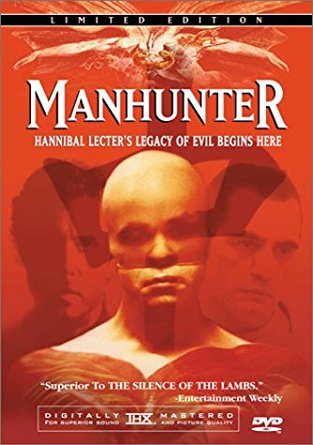
Polite cannibal films are careful not to show teeth sinking into flesh. But it’s a bit odd to have a cannibal film, especially one involving “Hannibal The Cannibal”, which doesn’t even mention the subject of cannibalism!
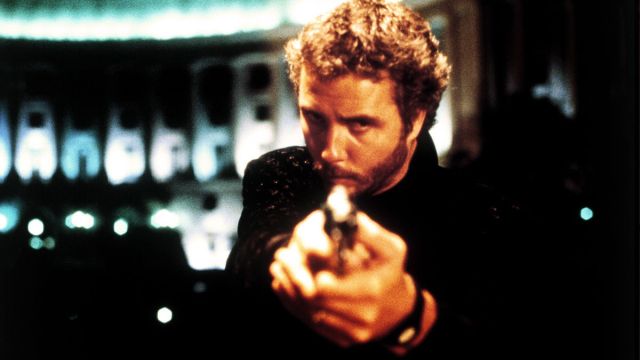
Hannibal Lecter first appeared in print in 1981 in Thomas Harris’ novel Red Dragon. Incredibly (in hindsight), there was a five year gap before Robert Mann directed Manhunter, a corker of a movie – and the very first Hannibal film. Mann altered both the title of the story and Hannibal’s surname, for no particularly good reason – it seems there may have been some doubt over the copyright to the name, although the plot was almost identical to the book. There have been suggestions in interviews that, because Bruce Lee was churning out Dragon movies at the time, producer Dino De Laurentiis was worried that people would think “Red Dragon” was just another Kung Fu movie.
The Director, Michael Mann, was named 28 on Total Film’s list of “the 100 Greatest Directors Ever”. Before he got the gig, David Lynch was considered for the job, but reportedly rejected the role after finding the story to be “violent and completely degenerate”. Quite a judgement call from the man who made Eraserhead, Blue Velvet and Twin Peaks!
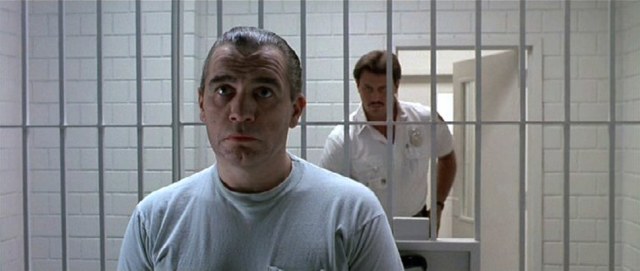
Brian Cox plays Hannibal Lecktor (as it is spelt in the credits). It’s a masterful performance, but “Lecktor” is a minor character who is a foil for the protagonist, Will Graham (played by a young William Petersen, later the star of CSI), rather than a menacing and cannibalistic presence. In fact, Hannibal does not appear until 23 minutes into the film, and then there is no mention of his gustatory predilections. This Hannibal is a simple monster, a serial killer, and is played by Brian Cox as a rendering of the Scottish serial killer Peter Manuel. As Cox says in an interview, “Real evil is something that is so scarily normal”. The back story is that Will was the first to recognise that Hannibal was the serial killer that the FBI was seeking. The book Red Dragon, if not so much this film version, is the fertile soil from which sprouted most of Bryan Fuller’s TV series Hannibal. Also, of course, the Anthony Hopkins version of Red Dragon in 2002, which was a bit jarring, in that Hannibal had visibly aged, despite it being supposedly a prequel to Silence of the Lambs.
I’ll get to that one. As Hannibal likes to say: “All good things to those who wait”.
Brian Cox in his lonely cell
So, Cox’s Hannibal is normal, urbane, brilliant and uncomplicatedly “evil”. This approach makes sense: Hannibal can understand the Tooth Fairy (the psychotic killer who is the actual villain of the film – Hannibal is in a cell the entire film). The Tooth Fairy believes he is becoming a higher form of life. He writes to Hannibal:
“You alone can understand what I am becoming. You alone know the people I use to help me in these things are only elements undergoing change to fuel the radiance of what I am Becoming. Just as the source of light is burning.”
Hannibal, in his lonely cell, enjoys collecting articles about disasters, particularly those in which churches collapse and kill worshippers. He deduces from this, as he tells Will, that killing must feel good to God:
“It feels good, Will, because God has power. And if one does what God does enough times, one will become as God is.”
Hannibal believes in a maleficent god, one who enjoys the power of killing. So does he, and so does the Tooth Fairy. Hannibal offers to help Will find the TF, but only because he seeks revenge – he finds out Will’s home address, and passes it on to the TF with instructions to “kill them all”. These are not simple projects when you’re in solitary in a high security mental asylum. He is not just brilliant (and evil) but very resourceful.
Will before he became Gil on CSI
John Lithgow, Mandy Patinkin, Brian Dennehy and even the director William Friedkin were considered for the part of Hannibal, but Brian Cox got the part, and played it brilliantly. He has on numerous occasions denied feeling cheated that Anthony Hopkins got the sequel (and the Oscar) in Silence of the Lambs. Well, he’s either telling the truth or a very great actor (he’s both).
Brian Cox and Anthony Hopkins as telephonic manipulator Hannibal Lecter/Lecktor
Hannibal’s main scene is below:
Cox did express an opinion that, after Silence of the Lambs, Hannibal had “lost his mystery”. You may have seen Cox not that long ago as General Kutuzov in the BBC production of War and Peace, or as Churchill, in the movie of the same name.
In 1986, the idea of some sort of homoerotic relationship between Hannibal and Will was pretty much unthinkable – that had to wait for Bryan Fuller’s masterful television prequel Hannibalsome quarter of a century later. Nonetheless, Will Graham gets the best line in this film. As Lecktor waxes lyrical about the way Will has managed to get a journalist killed during the investigation, Will blurts out:
“I’m sick of you crazy sons of bitches!”
But the rest of us are not, Will. We enjoy cannibals, even if they are as modest about their eating habits as Hannibal Lecktor. They remind us that we are not gods, but edible animals.
If you like my blog, please feel free to recommend it (with discretion) to friends on social media.
If you have any questions or comments, you can use the tag, or email me on cannibalstudies@gmail.com
Are cannibals worse (horror-wise) than other notorious monsters? Spider Baby thinks so: the theme song (sung by Lon Chaney Jr) goes through the usual full-moon etc scenarios and then suggests that
“Frankenstein, Dracula, even the Mummy,
are sure to end up in somebody’s tummy!”
Cannibals are real humans who have chosen to eat from their own species, while the others are undead, reanimated, aliens, etc – less believable for being (to most of us) not true. Cannibals are true – they have existed, they do exist, they will exist. Not quite like this little family, though.
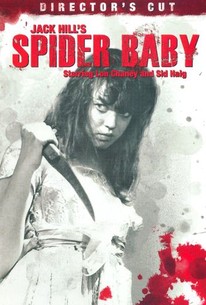
Spider Baby is a 1967-ish black horror comedy film, written and directed by Jack Hill. I say “1967-ish” because the film was made in 1964, whereupon the producer went bust, and it was finally released to less than ecstatic reviews in December 1967. Spider Baby was barely marketed (no budget) and also suffered a series of title changes, being called at various times The Liver Eaters, Attack of the Liver Eaters, Cannibal Orgy, and The Maddest Story Ever Told. Two of the titles were incorporated in the title song: “This cannibal orgy is strange to behold, in the maddest story ever told.” And the opening titles of the film read Spider Baby or, The Maddest Story Ever Told.
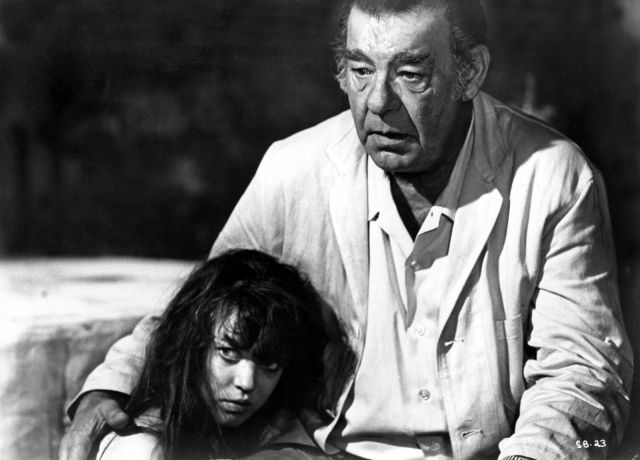
Three siblings live in a decaying rural mansion with their guardian and chauffeur, Bruno (Lon Chaney). The children suffer from “Merrye Syndrome”, a genetic affliction unique to members of their family, which causes them to mentally, socially and physically regress down the evolutionary ladder until they reach:
…a prehuman condition of savagery and cannibalism.
Bruno describes it as “rotting of the brain” and compares it to paresis, one of the latter stages of syphilis.
Two distant relatives arrive with their lawyer and his secretary in order to examine and claim the property as rightful heirs. They insist on staying for dinner, so the crazy brother, Ralph (Sid Haig, who appeared recently in another cannibal movie, Bone Tomahawk), catches a stray cat. The family won’t eat it though – they are vegetarians. “It’s dead” the other sister explains. “We don’t eat dead things.” Eating meat hastens the process of the syndrome. Another good argument for veganism.
Virginia smells a bug
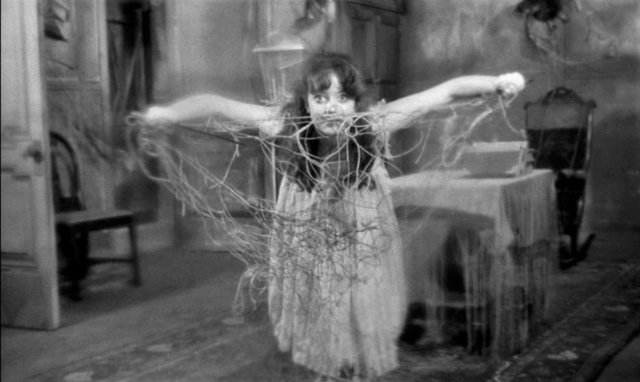
Virginia (Jill Banner) is the eponymous “Spider Baby”, so called because of her obsession with spiders. She stalks and eats bugs, moving with a strange and spider-like grace. She also enjoys trapping unsuspecting victims in her rope “web”, and “stinging” them to death using two butcher knives. After murdering an innocent delivery man (Mantan Moreland), Virginia cuts off one of his ears, which she keeps in a match box.
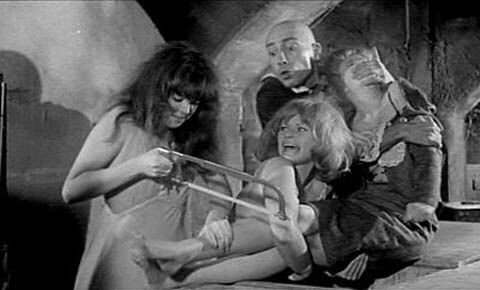
The mysterious Aunt Clara, Aunt Martha, and Uncle Ned, who have regressed even further than the Merrye siblings, are kept in the cellar. The family also keep the skeleton of the family’s dead father, in striped pyjamas, in a bedroom, and Virginia likes to kiss him goodnight. She also eats spiders, explaining that this is something “cannibal spiders do”. Which is quite insightful. Bruno leaves on an errand, first warning the children to “behave”, but of course murder, rape and cannibalism ensue.
The bodies end up in the cellar, where the older generation of Merryes eat them. Family relations go rapidly downhill, culminating in Bruno blowing up the house and its occupants. The surviving cousin speaks to the camera at the end, boasting that he has inherited the family fortune, and that the “Merrye Syndrome” has been eradicated in the exploding house. As he speaks, the camera pans to his young daughter, who looks a lot like Virginia, as she admires a spider.
Lon Chaney Jr is of course one of the greats of the horror genre. His father was probably more famous, a giant of the horror silents, but Junior did OK. He first shot to fame not in horror but in the 1939 film of John Steinbeck’s Of Mice and Men. He entered the world of horror two years later as The Wolfman (Waggner, 1941) and subsequently played the whole gamut of reboot monsters in The Ghost of Frankenstein (Kenton, 1942), The Mummy’s Tomb (Young, 1942) and Son of Dracula (Siodmak, 1943). He appeared in a vast range of parts, not just horror but Westerns, comedies and dramas and even had a guest role in The Monkees. The great director Stanley Kramer told the press in the 1950s that, whenever a script came in with a role too difficult for most actors in Hollywood, he called Chaney.
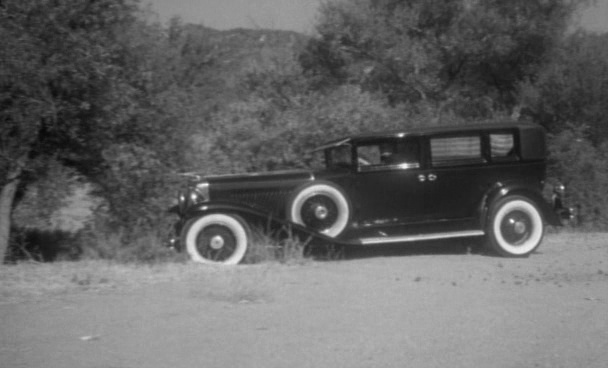
Fun fact: Bruno drive a Duesenberg, a classic American limousine
Spider Baby cost about $65,000 to make, and took only 12 days to shoot, in black and white. The promo said:
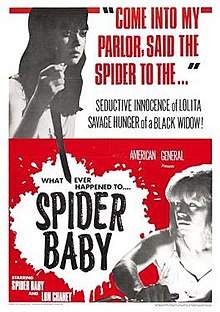
Spider Baby has the seductive innocence of Lolita and the savage hunger of a Black Widow.
The film was barely noticed on release but has since achieved cult status (it has its own website due to plans for a remake, which never eventuated) and has achieved an extraordinary 100% rating on Rotten Tomatoes with one critic saying:
Simultaneously creepy and hilarious, this is the perfect slice of Grand Guignol for a humid summer’s night.
The full movie is available, last time I checked, on Youtube.
IF YOU LIKE MY BLOG, PLEASE FEEL FREE TO RECOMMEND IT (WITH DISCRETION) TO FRIENDS ON SOCIAL MEDIA.
IF YOU HAVE ANY QUESTIONS OR COMMENTS, YOU CAN USE THE TAG, OR EMAIL ME ON CANNIBALSTUDIES@GMAIL.COM.
OK, last week’s cannibal film blog, Dahmer, was a bit grim (even if we didn’t see anyone eat anyone, for a change), so this week something witty and clever, and with lots of people-eating.
I’ve watched 20 episodes now of the Netflix series Santa Clarita Diet, and I’m still wondering: is this even a cannibalism show? Without risking too many spoilers, the protagonist, Sheila (the wonderful Drew Barrymore) is undead, what we sometimes (but never in this show) call a “zombie”. But she’s not the type that shuffles about, rotting bits falling off of her (well, maybe a few) and drooling for brains. She is sweet, witty, strong, loving and over-sexed. And dead. Sorry, undead.
She just seems so human. Presently human, not just formerly, decrepit, rotting human. I guess there’s room in cannibal studies for the undead human people-eater?
Sheila and husband Joel (Timothy Olyphant) are realtors, living the perfect suburban life-style in sunny Santa Clarita, Los Angeles County. The American Dream becomes more dream-like when Sheila is showing a house to a prospective buyer, but ruins the sale by expelling copious amounts (we’re talking gallons) of vomit on the perfect bedroom carpet, together with a small object that might be her life force or soul or something (later it grows legs, so maybe not a soul). She realises that night that, while she is feeling just fine and dandy, she no longer has a pulse.
And then she gets hungry, and it’s a diet that could only be zombie, or perhaps broadminded paleo. No carbs, just meat. And only one species will do. But, like Hannibal, she will only eat bad people – rude, abusive, Nazis, etc. Can they find a cure? Does Sheila want to?
Don’t you want to be cured?
Of course I do. Although, I do like the way I feel. I have endless energy, and I sleep two hours a night. I get so much done.
You eat people!
I know, it’s just that I’m so much more confident now. And our sex is incredible… And I can parallel park in one move now.
The dialogue is sparkling and very funny. I can imagine the hilarity in the writers’ room when they were putting all this together. Lines like:
We have to kill someone who won’t be missed. Someone without a family. And someone bad, who deserves it… the prototype would be a young, single Hitler.
I’m feeling a little low energy. Maybe I need to eat people with more iron in their diet.
She gets this look in her eye. The next thing you know, she’s yanking intestines out of these guys, like a magician pulling out scarves! The other day I came home and my kitchen looked like someone shot a person out of a confetti gun. There was a dick in my fruit bowl. The next morning I’m eating oatmeal at the same counter like my life is Leave it to Fucking Beaver!
Here’s the thing: it’s very funny, and the characters are sympathetic and honest. Barrymore and Oliphant are brilliant, and so is their daughter, Abby (Liv Hewson) and her friend Eric (Skyler Gisondo), the nerd next door who understands both the science and the occult aspects of the problem.
I’m asking because last night you saw your mom and dad scrape a half-eaten dead guy into a grave.
Please. I once walked in on my grandparents changing in a cabana. That was intense.
Yes, lots of gore (also vomit in episode 1) but in so much surfeit that it is cheerfully fake. The manicured lawns and perfect houses feel even faker – this is the Stepford Wives gone feral. The neighbours suspect nothing, even when Sheila eats one of them.
If you’re wondering how cannibal movies prepare the flesh, the special effects designer said in an interview:
Drew Barrymore is essentially a vegetarian, so a lot of the methods that we might have used traditionally — sushi, tuna coated with fake blood or ground meat or turkey meat or anything like that — was an absolute no. So we had to find other resources. One of the resources that we went to was gummy bears.
And this is the heart of the Santa Clarita Diet. For one thing, it celebrates the resurgence of the monstrous feminine cannibal. From Sheila, to Justine in Raw, and Melanie in The Girl With All The Gifts, and even the Cannibal Women of the Avocado Jungle of Death, we see women cannibals emerge from their niches in myth and fairy tale to stand their ground, glorying in their power. Sheila says she hunts when she feels “a tingle in her vagina” and tells Joel all about the orgasm she enjoyed while eating a human liver.
She so did not eat this heart sandwich. It’s a strictly no-carb diet
It’s also a biting commentary on the stories we tell about appetite and about power. Sheila believes she is a good person, who is strong enough to hunt anyone she chooses, and to eat whatever or whoever she feels she needs or wants. And isn’t that the story of every carnivore?
The only things I believe in enough to crochet on a pillow are “I’m winging it” and “all races taste the same.”
IF YOU LIKE MY BLOG, PLEASE FEEL FREE TO RECOMMEND IT (WITH DISCRETION) TO FRIENDS ON SOCIAL MEDIA.
IF YOU HAVE ANY QUESTIONS OR COMMENTS, YOU CAN USE THE TAG, OR EMAIL ME ON CANNIBALSTUDIES@GMAIL.COM.
Dahmer is a 2002 American semi-biographical film starring Jeremy Renner as the serial killer Jeffrey Dahmer, who drugged and killed at least 17 men and boys, and ate parts of some of them, giving him the title in the popular press after his arrest of “The Milwaukee Cannibal”. Dahmer (the man, not the movie) became perhaps the best-known modern real-life cannibal, not because he killed or ate more people than, for example, Andre Chikatilo, the “Rostov Ripper”, but perhaps because he did it in the belly of the beast, the consumer society of the USA.
The film shows two timelines; the story starts with a couple of days in the life of Dahmer before his arrest; the flashbacks show the evolution of his murderous career.
As the film begins, there are pools of – not blood – chocolate! Jeffrey Dahmer works in a candy factory in metropolitan Milwaukee. Enduring crippling shyness, partly due to his overbearing and intolerant father, he slips into alcohol abuse, drugs, and murder. In his flashbacks, he frequents gay clubs, but can only have sex with young men who have been rendered unconscious by mixing barbiturates into their drinks. Leaving a string of unconscious and sodomised men in the hourly rent rooms, he is caught by the barman, beaten and thrown out. The lesson he seems to draw: everything’s easier at home.
Dahmer’s M.O. was to lure young men to his home, drug them with pills crushed into their rum and Coke, and then conduct experiments involving drilling holes in his their heads and pouring in acid, trying to create living zombies, partners who would never leave him. Cannibalism was a further attempt to achieve the same ends – rather than keeping their bodies with him, he hoped to keep their bodies inside him. Incorporation as love.
Although the script recreates actual events, the names of the victims were changed out of respect for the families. Some time is spent on the case of Khamtay, who is drugged and has a hole drilled in his head and acid injected into his brain. This really happened, except the young man was really a 14-year-old boy named Konerak Sinthasomphone. Like Khamtay in the film, he wandered out of the apartment while Dahmer was out buying booze, and was picked up by the police. When Dahmer came around the corner, he persuaded the police that the boy was his drunken boy-friend, and they helpfully delivered the child back to the apartment, where he was subsequently killed.
Dahmer received mixed reviews. It currently holds a 68% “Fresh” rating on Rotten Tomatoes. Entertainment Weekly said “It lets you brush up against the humanity of a psycho, without making him any less psycho.” Most reviews, even those that did not like the film, praised the performance of Jeremy Renner. In fact, Kathryn Bigelow said that she cast Renner in The Hurt Locker because of his performance in Dahmer.
Chocolate, pooled, shaped and incorporated, is a continuing image throughout the film. Chocolate typifies our consumer fetishism: it is purely pleasurable (I keep hearing that the dark version is good for us, but my dentist disagrees). People love chocolate. The hypnotic pull of continuous, voracious and escalating consumption drives our society. When commodities run out, or try to escape, then incorporation, Dahmer argues, is the only solution. He cannot give up his nightly hunting sessions, even when he makes an emotional connection to a victim, any more than the rest of us can give up chocolate. Rejecting his family’s intolerant religiosity, he argues that he is not weird: “What’s weird is when you go to church and they make you eat Christ’s body and drink his blood”.
The band Macabre released an album in 2000 called “Dahmer”
There is remarkably little gore in the film and surprisingly no mention of what made Dahmer so famous: his cannibalism. The violence is mainly in Dahmer’s words. He projects his own pain onto his intended victims. His last intended victim, Rodney (whose name in real life was Tracy Edwards), offers real affection and the possibility of a loving relationship to Dahmer, who projects his own pain back onto this gentle young man.
“You’re pissed at everyone because you’re gay. Everyone laughs at you. Shits on you.”
Yet Rodney returns opposite, loving words: “You’re beautiful. You’re tall, you’re strong, but gentle. I always dreamed about somebody – just like that.” But Dahmer cannot accept love (also there is the problem of the corpse of Khamtay in his bedroom). He responds to Rodney: “I am a pervert. I am an exhibitionist. I am a masturbator. And a killer. Like you”.
Dahmer is the incarnation of Bataille’s “accursed share” – the segment of production that must and will be spent on sex, destruction, sacrifice.
The victim is a surplus taken from the mass of useful wealth. And he can only be withdrawn from it in order to be consumed profitlessly, and therefore utterly destroyed. Once chosen, he is the accursed share, destined for violent consumption. But the curse tears him away from the order of things; it gives him a recognizable figure, which now radiates intimacy, anguish, the profundity of living beings.
Yet there is no power in hidden destruction; power for the giver is in the obligation of the receiver to reciprocate. So Dahmer is driven by the need to be caught. Not because he wants to be stopped, but so that he can be celebrated. Rodney escapes, after Dahmer cannot go through with his attempt to strangle him. The real-life victim, Tracy, led the police back to Dahmer’s lair, where they found much more than they expected.
The real Jeffrey Dahmer was not celebrated either, although he did receive several offers of marriage while awaiting trial (from women who, like his father, seemed to have no understanding of his sexual preferences). In 1992, he was handed a 937 year sentence, subsequently became a born again Christian in prison, and then in 1994 had his head caved in by a fellow prisoner with a metal bar.
The killer told a prison guard “God told me to do it”.
The real Jeffrey Dahmer, in a popular vegan meme
If you like my blog, please feel free to recommend it (with discretion) to friends on social media.
If you have any questions or comments, you can use the tag, or email me on cannibalstudies@gmail.com.
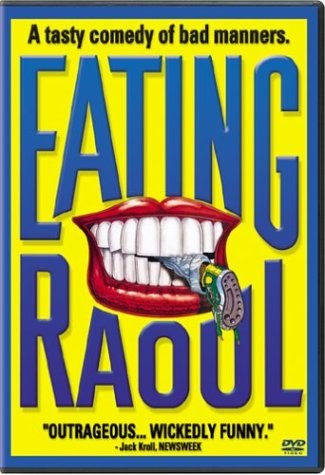
Eating Raoul has become a cult classic since its release in 1982. It was directed by Paul Bartel, who also plays the role of Paul Bland, a use of nominative irony, since he and his wife Mary (played by the wonderful Mary Woronov who starred in Warhol and Corman films) are a bland and horribly normal couple. They live in a block of apartments and eke out an existence working at unsatisfying jobs, while dreaming of somehow opening their own restaurant.
The film starts with a shot of the iconic Hollywood sign and a voice-over, of the type that was popular in film newsreels, describing the contrasts in that town between rich and poor, and tells us that “sex hunger is reflected in every aspect of daily life”.
“The barrier between food and sex has totally dissolved.”
This contrast then goes to the microcosm of the life of Paul and Mary. They are prudes; they sleep in separate beds and disapprove of sex, except for “a little hugging and kissing”. But there are almost constant “swinger” parties in an adjoining apartment: as if to exacerbate their financial woes, rich and decadent swingers share their lift and their corridors. When one of the swingers tries to rape Mary, Paul kills him with the cast iron frypan, finds $600 in the guy’s wallet, and thus begins a career of hilarious and profitable murders of “rich perverts”, whom they lure with ads offering kinky sex.
But that doesn’t make it a cannibal film, suitable for this blog. That comes later, when their locksmith, Raoul, enters the scene, ready to make money from the bodies and the victims’ cars.
But when Raoul himself has to be disposed of, and there is nothing to serve the real estate agent who is going to secure the purchase of their dream restaurant… Well, as Hannibal said in Silence of the Lambs:
“Haven’t you had company coming and no time to shop? You have to make do with what’s in the fridge, Clarice.”
Cannibalism is all about power and appetite, and so Eating Raoul is a perfect allegory for Western (and particularly Hollywood) society. Everyone is either exploiting or fucking everyone else, and why should Paul and Mary Bland be any different? Cannibalism – it’s the ultimate American Dream.
The sex shop scene on Youtube:
If you like my blog, please feel free to recommend it (with discretion) to friends on social media.
If you have any questions or comments, you can use the tag, or email me on cannibalstudies@gmail.com.


















 Dahmer’s M.O. was to lure young men to his home, drug them with pills crushed into their rum and Coke, and then conduct experiments involving drilling holes in his their heads and pouring in acid, trying to create living zombies, partners who would never leave him. Cannibalism was a further attempt to achieve the same ends – rather than keeping their bodies with him, he hoped to keep their bodies inside him. Incorporation as love.


 Eating Raoul has become a cult classic since its release in 1982. It was directed by Paul Bartel, who also plays the role of Paul Bland, a use of nominative irony, since he and his wife Mary (played by the wonderful Mary Woronov who starred in Warhol and Corman films) are a bland and horribly normal couple. They live in a block of apartments and eke out an existence working at unsatisfying jobs, while dreaming of somehow opening their own restaurant.


 The Cannibal Guy