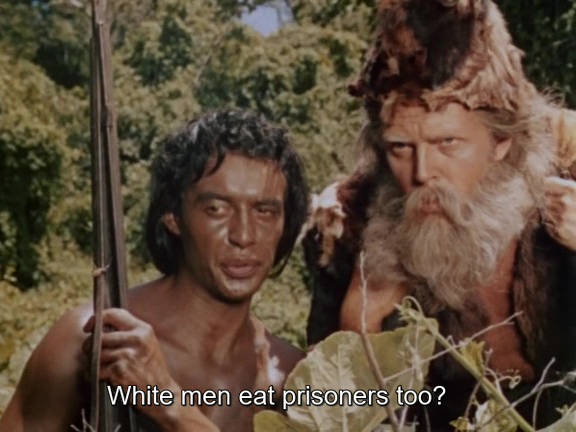
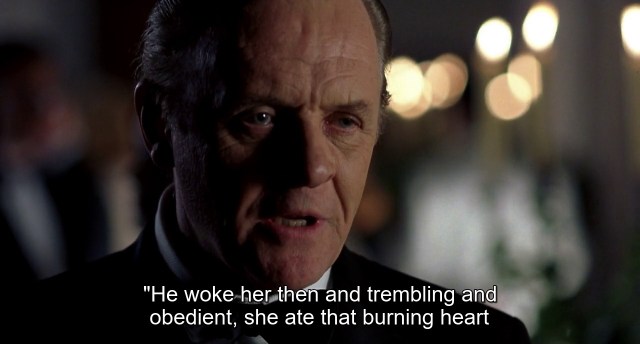
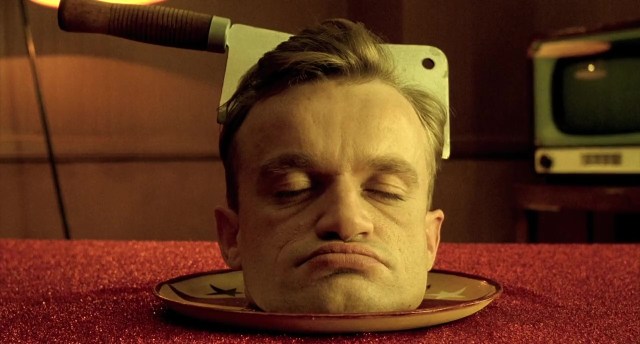
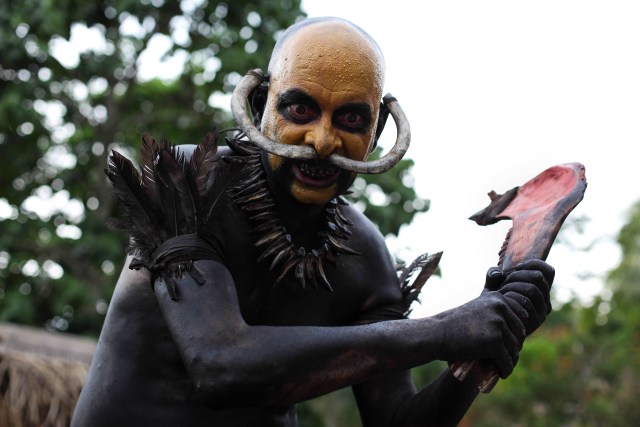
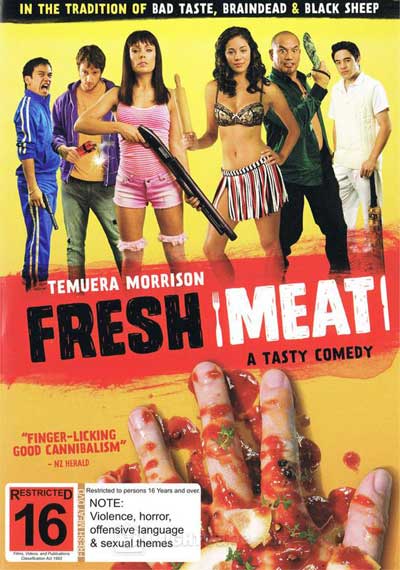
“We’re NOT Maori cannibals”, FRESH MEAT (Danny Mulheron, 2012)

New Zealand has produced some world class directors; think of Jane Campion, or Peter Jackson. Not a lot of cannibal movies unfortunately, considering the country’s reputation – Jackson’s first feature film Bad Taste had a lot of humans being eaten but, unfortunately for this blog, the eaters were space aliens, so not technically cannibals. Jackson’s Braindead was closer, involving zombies. Can you be a cannibal if you are undead? We’ll have to consider that question some time, perhaps when we run out of movies about living cannibals (probably about the time we get to net zero).

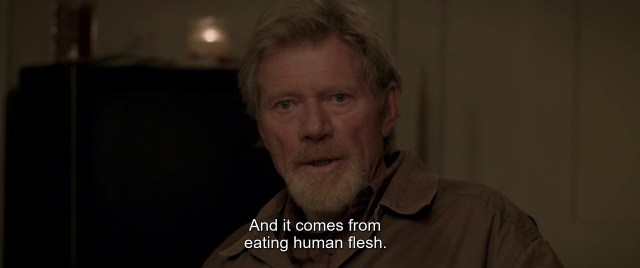
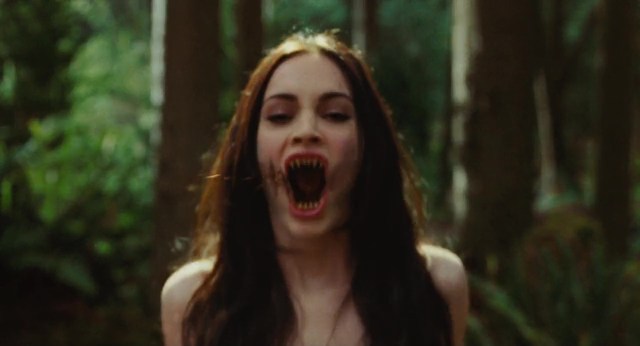
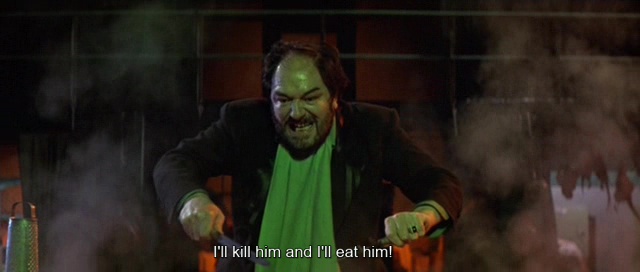
But Danny Mulheron gets right into freshly killed, cooked (and sometimes raw) human body parts in this film. Like Jackson’s Bad Taste, Fresh Meat was Mulheron’s first feature film, and it’s an impressive inception.

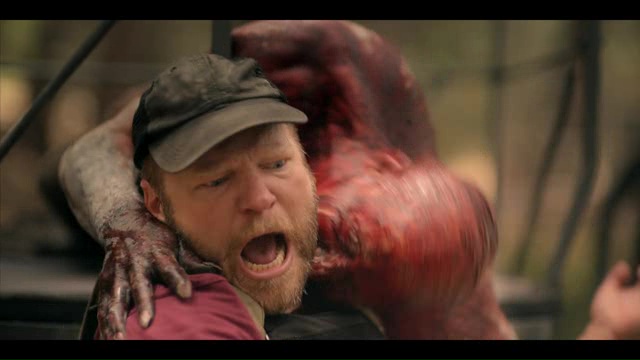
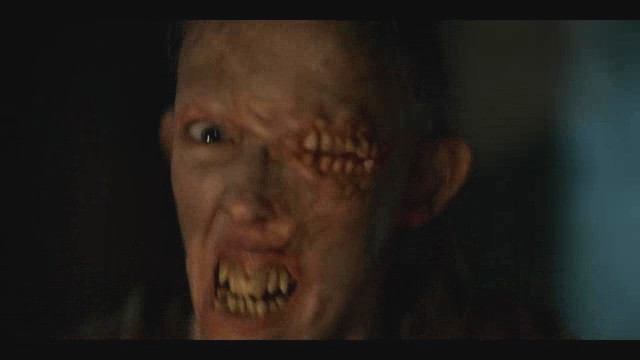
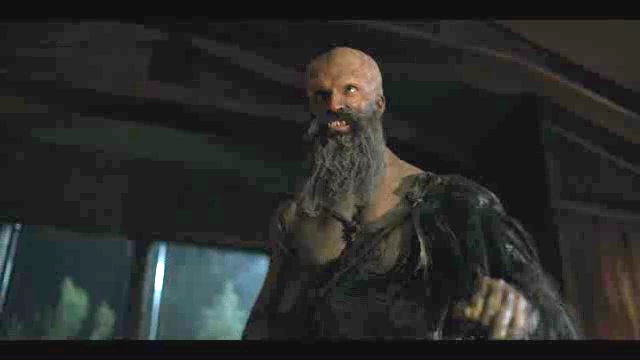
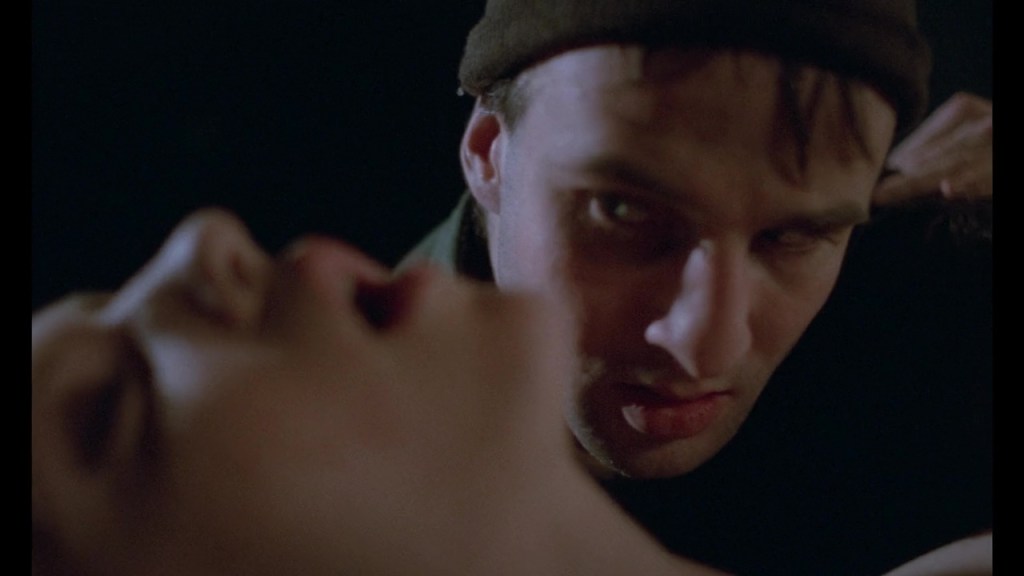
The plot involves a family of Maoris, recently converted cannibals, being taken hostage by some bumbling criminals. Rina (Hanna Tevita) is home from her lesbian explorations at “St Agnes Boarding School for Young Maori Ladies” when a bunch of criminals break in to her home to hide from the police, having killed some prison guards to free their boss from a prison van.

But that’s Rina’s second shock of the day; the first was finding her parents’ new eating regime in the fridge.

Turns out her Dad (Temuera Morrison from Once Were Warriors and The Mandalorian)  is reviving an “eighteenth century post-colonial religion” – he has found the prophecies of Solomon Smith and become a “Solomonite”; he now believes that eating people (“taking their life-force”) will cause the family to flourish.

Yes, among the satire on Maori and Pakeha cultures, there is the odd dig at Christian transubstantiation.

Mum (Nicola Kawana) produces hugely popular cooking shows and books, she’s a Maori Nigella, into marinades, and she describes the meat she uses:
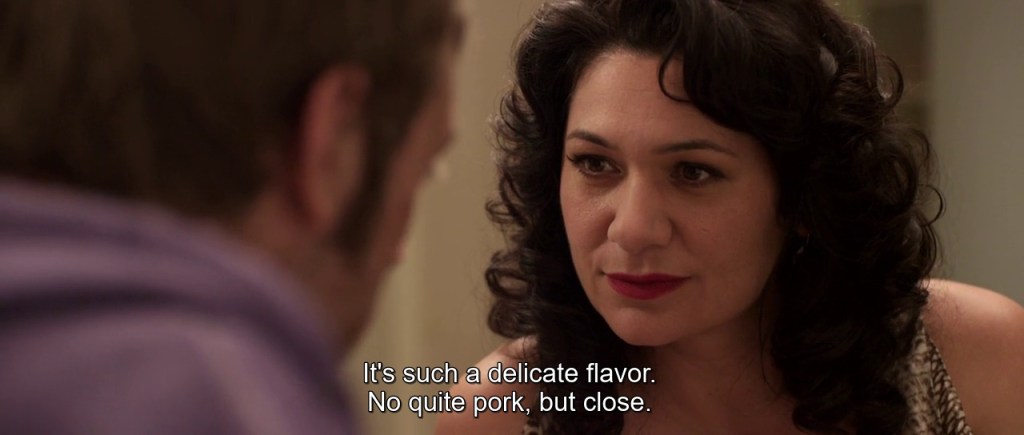
Rina is shocked that her brother (Kahn West) would agree to eat human flesh, until he tells her about the pork and rosemary pies that her family sent to her at school. It wasn’t a choice.

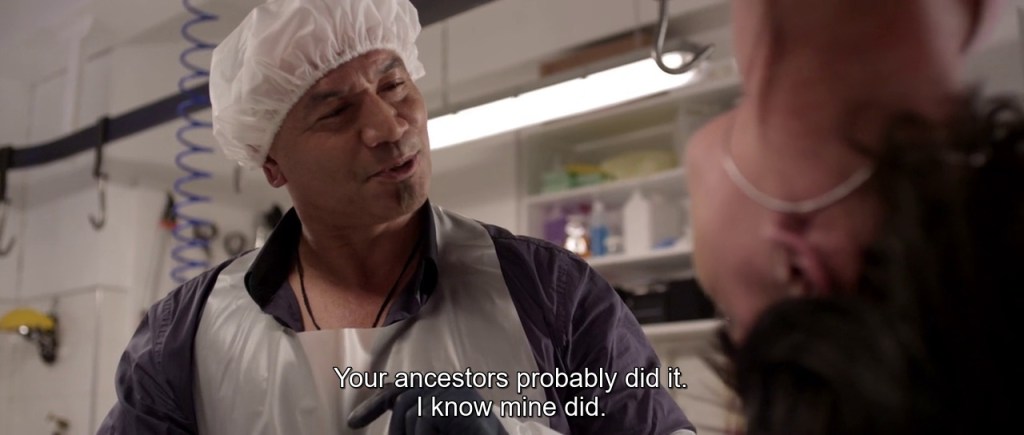
The subsequent bloody altercation with the criminals is set to fill the larder nicely. Dad tells the last living criminal, Gigi (Kate Elliott), who is hanging upside down ready for slaughter, that

“ritualistic cannibalism dates back to 1000BC to the Hun phase in Germany. The Bible itself refers to the siege of Samaria in which two women made a pact to eat their children. The Aztecs, the French, the Brits… Your ancestors probably did it. I know mine did.”
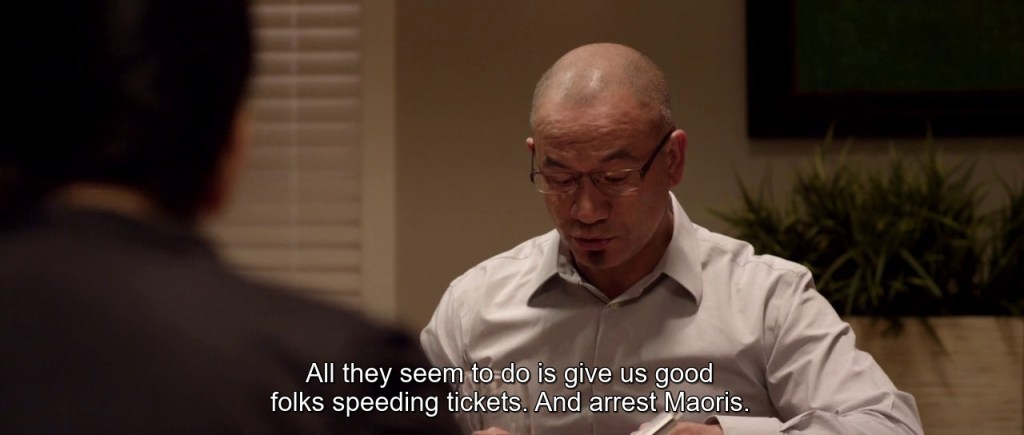
There is lots of Maori humour, and not all relating to cannibalism. Dad is an Associate Professor at the University, and blames white racism for his failure to be given tenure as full professor. When the cops knock at the door, he complains
Rina’s neighbour is a white boy who is in love with her. When he appears and is invited in (“we’ll have him for dinner” says Dad – yes, Hannibal lives), he points out that he is a vegetarian, but politely eats what turns out to be a human testicle, only getting suspicious when he spots something else on his plate.
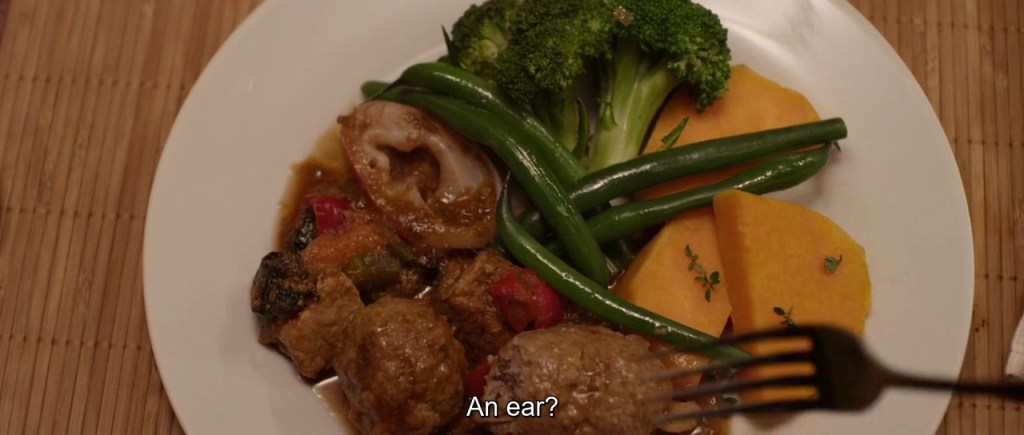
Even when they have him tied up in the basement ready for slaughter, he politely tells them
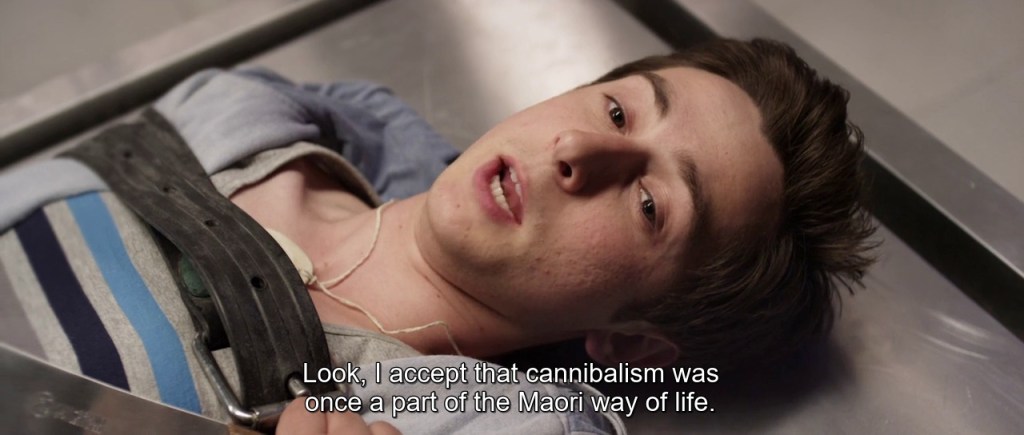
Dad replies with the best line of the movie:
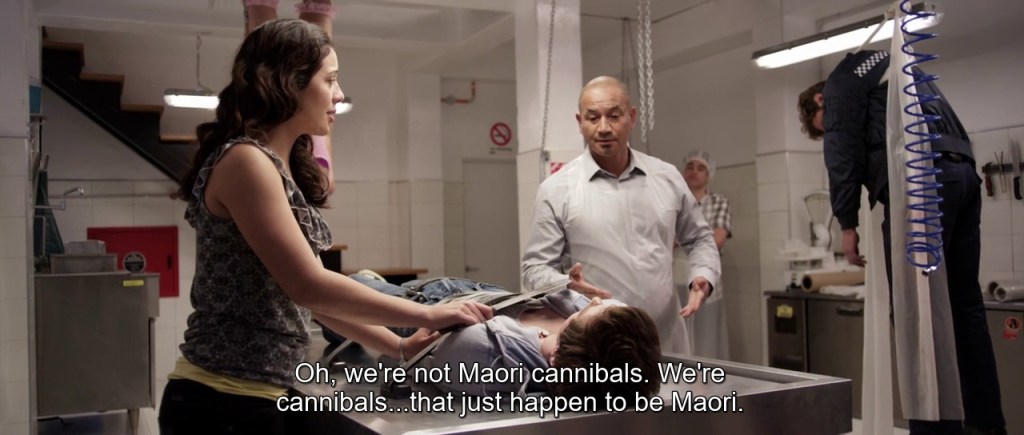
“Oh, we’re not Maori cannibals. We’re cannibals… that just happen to be Maori.”

But Dad has his own agenda: to become immortal:

“By eating the still-beating heart of my youngest son, I’m halfway towards immortality. But I still need to drink the blood of my virgin daughter.”

Doesn’t quite work out that way, Rina’s not a “virgin” after that scene in the shower with her girlfriend. Or does it?

What is it about virgins and blood sacrifices anyway? Are the rest of us not good enough to sanitise humanity’s sins with our polluted blood? We exploit the innocent and gentle ones, and then expect that, by slaughering them, we somehow clear our guilt at doing so. Remember the line from Leonard Cohen’s song Amen:

Tell me again
When the filth of the butcher
Is washed in the blood of the lamb…

Anyway, the takeaway from this movie is that Maoris, traditionally accused of cannibalism, can be Maoris and cannibals without being “Maori Cannibals”. The two identities can be separated, even as they coexist. There are other families of cannibals who are not defined by their race; consider the Mexican film Somos lo que hay or its American adaptation We are what we are.

In cannibal studies, it is not unusual to be buttonholed by someone who has become aware of your field of interest and told with great solemnity “the Maori were cannibals, you know.” I tend to politely thank the informant for sharing a “fact” that almost everyone “knows”. But if I am feeling feisty, or have had a few drinks, I might invite them to unpack that statement – which Maori, whom did they eat, and what evidence are you presenting for this?

The British invaders of New Zealand were keen on declaring that the indigenous peoples, of wherever they went, were cannibals – it made their job of invading, enlightening and/or exterminating the inconvenient locals so much easier. But there is some evidence that much of the talk of Maori cannibalism was either misinterpretation or just slander – imperialists in the age of expansion tended to use words like “savage”, “barbarian” or “cannibal” pretty interchangeably – if you had dark skin and didn’t speak English, you were probably a cannibal, with no evidence required other than some hearsay from conquistadors or missionaries. But if an alien civilisation invaded Earth and found a copy of the Grimm’s Fairy Tales in a bookshelf, they might well assume that it was a history book, and that we were all cannibals.
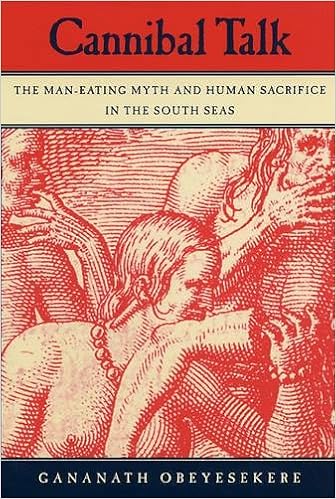
Amazon.com: Cannibal Talk: The Man-Eating Myth and Human Sacrifice in the  South Seas: 9780520243088: Obeyesekere, Gananath: Books

Ganath Obeyesekere’s excellent book on cannibalism in the South Seas makes clear that the oversimplification of Maori culture and mythology (and perhaps humour) probably led to often tragic misinterpretations of local customs. In fact, he says, it is likely that many Maori were convinced that the British were cannibals. And who could blame them? If those aliens mentioned above put down Grimm’s Fairy Tales and took a look inside our industrialised slaughter factories, where 135,000 farmed animals are killed every minute, they would assume we were far more bloodthirsty than they, or the Brothers Grimm, could have imagined. No wonder they don’t make contact.

It is interesting to consider the differing responses to cannibalism in the family of this film. Social Psychologist Melanie Joy calls the ideology surrounding and justifying the eating of meat, dairy and eggs “carnism” – a set of largely unconsidered beliefs in three beliefs that start with the letter N: that these products are “normal, natural and necessary“. We drink milk, eat meat, scramble eggs, based on the insouciant assumption that all these things are normal, necessary and natural (and, a fourth N, nice to taste). The family members reflect these views, but in relation to a different food source: Homo sapiens. Dad thinks eating humans is “necessary” in order to absorb the life force of the victims, and make himself immortal. Mother is a celebrated chef; for her, eating meat is “natural”, and where it comes from is not an issue, as long as it cooks well and tastes good. Rina’s brother finds the whole thing “normal” – his parents do it, and he wants to learn from them, and make them proud. Only Rina objects, although she was willing to eat the pies they sent her when she thought they were bits of a different animal. She’s like a vegan at a barbecue, heart-broken to see her family so unthinkingly accepting the death of animals, or at least, those that she can see and talk to.
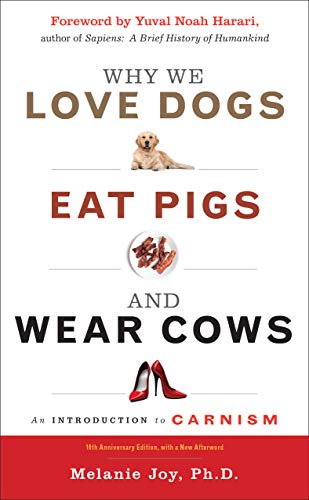
Why We Love Dogs, Eat Pigs, and Wear Cows: An Introduction to Carnism, 10th  Anniversary Edition - Kindle edition by Joy, Melanie, Harari, Yuval Noah.  Politics & Social Sciences Kindle eBooks @

If you don’t like gore and body parts (and violence and lesbian kissing) then you might want to skip this movie. But if you don’t mind all that, and like a rip-snorting plot, plenty of humour, a little suspense, and lots of intertextual winks to cultural foibles, some (perhaps unintentional) observations on the ideology of carnism, as well as some great acting and direction, then watch Fresh Meat. Recommended.
“FERAL” (American Horror Stories, episode 6 – August 2021)

Last week’s blog was not a film or TV story but a real event, the account of displaced people being kidnapped for ransom by Mexican cartels, and chopped up for their meat if the money was not found. This segues nicely into this week’s blog, in which a boy disappears and the parents suspect a cartel kidnapping, but in fact (spoiler alert) he has joined a group of feral cannibals.

The response to news of cartels, kidnapping and cannibalism is to shake our heads and ask how people can DO such things. The assumption behind such a question is that we have ‘progressed’ and, while cannibalism may have been a part of our savage past, it should have been left behind in today’s enlightened civilisation. Yet we are aware that cannibalism continues to exist, and that it can reappear when food is short, as in the siege of Leningrad, or for revenge like the man who killed and ate up to thirty women because he resented their rejection of him, or sexual attraction and desire to keep the person with us (or within us) like Jeffrey Dahmer and Armin Meiwes, or just for fun and profit, like Fritz Haarmann.

Sigmund Freud wrote of an ORAL SADISTIC or CANNIBALISTIC STAGE, which coincides with the time babies’ teeth start to erupt. We recognise our mother’s breast as external to us, and wish to retain ownership, by biting and swallowing it. At the same time, the aggression is tempered or sometimes instead magnified by anxiety at the potential loss of the other (mothers don’t like to be bitten) or fear that the much stronger parent will instead choose to devour the child. Our first instance of logical reasoning – if I can bite her, she can surely bite me harder. These early influences may sink into the sludge at the bottom of our unconscious minds as we grow up, but they remain there, and can reappear at any time in different forms.

It is tempting, therefore, to see acts of cannibalism as simply throwbacks – to our earlier social models (savagery) or to psychotic deviance dredged up from tortured unconscious memories. Civilisation, we think, can conquer such eruptions. But not always, and not in this episode of American Horror Stories, another episode of which we considered recently.

This one is set in, and against, nature. A man, woman and three-year-old boy are driving into Kern Canyon National Park in California for a camping trip. The father wants to return to nature, get them out of their comfort zone. The mother points out that “out of the comfort zone” is equivalent to “uncomfortable”, and the little boy wants a TV. A phone call on the way tells us that the father is a lawyer defending a “greedy-ass corporation” – the type that exploits and destroys the environment for profit. This is going to be about nature, red in tooth and claw, and revenge.

The boy, Jacob, disappears while camping with his family. Ten years later, his father, Jay, is approached by a hunter who tells him that he believes Jacob is alive, kidnapped by a drug cartel running pot farms in the park. The hunter leads Jay and Jacob’s mother, Addy, into the woods to look for him. The Park Ranger, who for some reason is Australian, warns then not to go, but of course they head off and, like last week’s Mexican abduction, it’s a trap.

Deep in the woods, they are attacked by wild, human-like creatures, who eat their abductor. Jay and Addy seek refuge at the Park Ranger’s station, where the Ranger tells them that the National Park Service was created by the government

“…to keep Americans from things that would kill and eat them.”

These are feral humans, he says, possibly descendants of Vikings, or of mountain men who never came down from the mountains, or maybe Civil War soldiers who never surrendered. Or people who just checked out, had enough of the world. In any case, they have gone back to nature, gone feral, and so are a threat to the civilised, cultured humans who use and abuse the natural world. The Ranger tells them there are are tribes of ferals in every National Park – over 2,000 people have vanished from the parks over the years. There are certainly people living off the grid in the wild areas of the world, but not necessarily feral cannibals. Why is it kept top secret?
“Governments need their citizens to believe they are in control. Plus, the National Parks generate billions of dollars in revenue every year. Capitalism, baby! If people knew there were feral cannibals running around, attendance might drop off.”

The Station is attacked by the feral cannibals, and the ranger is killed. Jay and Addy are taken to the leader of the creatures, seated on a throne of skulls, looking remarkably like a Renaissance Jesus.
Of course it is Jacob (speculation is already mounting that Jacob, the cannibal king, might get his own spin-off series). Jacob seems to recognise his parents, but when one of the creatures asks Jacob who they are he answers, “dinner“. Freud would have enjoyed the feast that follows: the “primal hordes” overthrowing and eating the father; Jacob, frozen in his infantile cannibalistic phase, tasting his parents’ blood.
This episode is also a study in what Georgio Agamben calls the “anthropological machine”, a paradigm that we use to separate ourselves from other animals. In the pre-modern machine, non-humans were depicted as human-like to draw the distinction – we spoke of werewolves, minotaurs and cyclops; in this episode they evoke Bigfoot or the Australian equivalent, the Yowie. But the modern anthropological machine instead declares certain humans to be less than human or else inhuman – race, ability, gender or social status may be used to divide us into human and “other”. The ferals are inhuman because they have regressed to savagery, chosen nature over civilisation. For hundreds of thousands of years, we existed in small clans, and anyone outside the immediate family was assumed inhuman. We need to fear, and sometimes eat, the outsider, because we evolved to do so.

We like to think that this is all ancient history. But our sanguine belief in social progress lulls us into supposing that that acts of cannibalism (as depicted in this blog thecannibalguy.com, for example), are simply aberrations, throwbacks to a savage past, or unfortunate outbursts by deranged or psychopathic individuals. What this confident diagnosis ignores is the inherent violence of the human species.

As sociologist Zygmunt Bauman points out, the civilising process has simply presented a “redeployment of violence”. Instead of hunting animals or, more recently, slaughtering them in the street in what used to be called “the shambles”, we now mass produce death in huge factories called abattoirs, which are placed away from residential areas and surrounded by high walls and sophisticated security systems. Violence against our fellow humans has been similarly redeployed, with drones and smart bombs replacing hand to hand conflict. Fear of social sanctions or maybe divine punishment keep us in control of our internalised aggressive drives against our fellow citizens, at least some of the time. But at any moment, for reasons usually unclear, we can loose this violence, together with the voracious appetite that characterises consumerism, and redeploy it against adversaries. Call it feral, as per this episode, or perhaps, instead, call it authentic, cannibalistic humanity.

Satanic rituals and forced cannibalism. How many refugees share this fate?

The news service Noticias Telemundo recently reported a case of kidnapping, murder and cannibalism which, it seems, may not be so uncommon among refugees trying to cross Mexico into the United States.

Noticias Telemundo Investiga interviewed 32 migrants kidnapped from 2019 to 2021 in Mexico and the U.S. Their relatives were made to pay $1,500 to $5,000 as ransom to criminal gangs for the release of the kidnapped migrants.

The latest story follows the ordeal of a young man named David Sanabria and his little girl Ximena, who are from Honduras.

David Sanabria had arranged a coyote (smuggler) to escort them to the Texan border, where he planned to turn himself and his daughter in to U.S. immigration authorities and seek asylum. But when they reached Reynosa in the Mexican state of Tamaulipas, the coyote turned them over to a cartel gang. David and other captives were repeatedly made to call relatives to ask for a ransom, and were beaten if the relative said they couldn’t afford it. The victims are not US citizens so relatives cannot ask for help from the FBI, and in many cases the local police in Mexico are in the pay of the cartels.

If the ransom was not paid by the deadline, the captives would be murdered. David said:

“With a machete they dismembered them, killed them, and the only thing I could do was cover my daughter’s eyes and ears so that she would not know what was happening, nor would she have those memories for her whole life.”

After that, the corpses were cooked and the surviving migrants were made to eat the human meat, “so that there would be no trace of anything — that’s what one had to eat.” The term “innocent cannibal” is usually reserved for those who are not aware that human meat is in their meal, but in this case, I think we can apply it to David and Ximena.

At night, the kidnappers performed satanic rituals. “They knelt down. They had images of the devil, of Santa Muerte. They made pleas. They made offerings. It was something horrible,” he said. Several survivors who spoke to Noticias Telemundo Investiga talked about the kidnappers’ “cult of death”.

David’s brother borrowed money from his co-workers, friends and relatives and even asked strangers for money on the streets of Nashville. He eventually raised the $7,500 ransom and David and Ximena were released. David waded across the Rio Grande with Ximena on his back. So they made it to the US border where they were detained for three days, but then were returned to Mexico. Under Title 42 to curb the spread of COVID-19, migrants who are detained at the border are returned to Mexico while their petitions for asylum are processed. This year, 100,000 migrants a month are being returned to Mexico.

They were put in a shelter by the National Migration Institute of Mexico, and Al Otro Lado, which provides free legal assistance to migrants from Baja California, helped David fill out an asylum application.

In August, the U.S. granted David and Ximena humanitarian parole so they could enter the country and live with his brother in Tennessee while they await the results of their asylum petitions.

This is Ximena in the shelter.

The United Nations estimates there are over 82 million people in the world who have fled their homes, of whom 26 million are refugees, half of those under the age of eighteen. That means one in every ninety-five people on earth has fled their home as a result of conflict or persecution.

Imagine, if you can, being a refugee, anywhere in the world. You are fleeing from a place which doesn’t want you, and where people are possibly threatening to imprison or kill you, to another place that also does not want you and may send you back, and almost no one will support you en route. Men, women and children are helpless, easy prey for unscrupulous smugglers and criminal gangs. If you disappear, no one will find you, particularly if you have been eaten.

Migrant kidnappings happen all the time. Mexican authorities at the beginning of September 2021 reported a total of 697 migrants kidnapped and rescued in just 10 days. These are not statistics. They are people like David and Ximena, who may be robbed, kidnapped, beaten, killed, forced into cannibalism, and even eaten themselves, as the world ignores them. In a world where we capture, kill and eat some 350 million animals every hour of every day, is it really surprising that we sometimes do the same to members of our own species?

It made me think of the last line of the film Cannibal Holocaust:

“An army of pissed-off man-hating feminist cannibals” DOGHOUSE (Jake West, 2009)

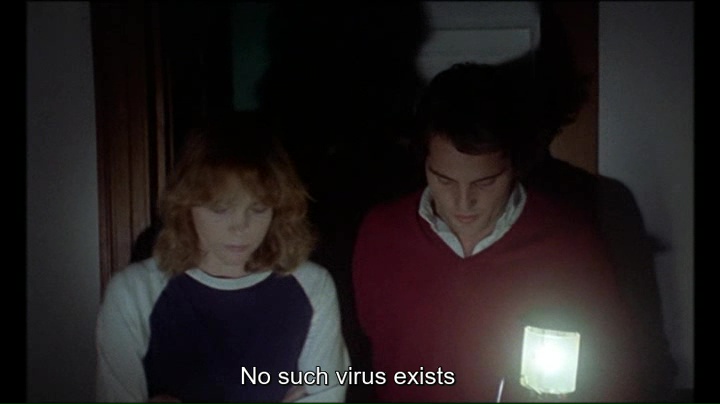
Doghouse is a British slapstick / splatter movie. The danger of mixing genres like that is that sometimes neither one will work, and this is a good example of just that. A bunch of young men head off for a weekend to cheer up one of their friends who has just been divorced. The film introduces them one by one with a placard showing their name (hoping vainly that we will thereafter remember them). They are all being verbally abused by their partners for leaving them, a condition sometimes known as being “in the doghouse”. They diagnose their situation as suffering from what they call “social gender anxiety” and plan to do male things like, you know, drink and smoke and piss on trees. They think they are recapturing their animal essences, whereas in fact they are just being dicks.

They head for a little town where, they have heard, the women outnumber the men four to one. Their minibus driver tells them that it is the middle of nowhere, and hey, there are worse things than divorce.

They are expecting

“an entire village of man-hungry women, waiting to jump the first band of desperadoes rolling up from London.”

Turns out that’s exactly what they get (yes, such subtle irony) because the women have all been infected with a virus in a biological warfare trial intended to turn one half of an enemy population against the other, and isn’t that a decent summary of human history? This virus turns them into what these guys call

“an army of pissed-off man-hating feminist cannibals”

Each woman is a caricature of her womanly role – a bride, a hairdresser, a grandma, etc.

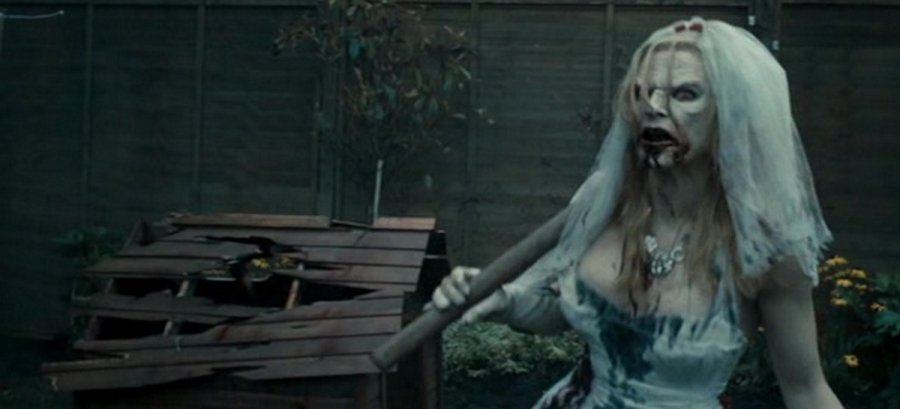
While this is a remarkably silly film, it does illustrate quite nicely the themes of abjection and the monstrous feminine. Monsters are by definition outsiders, but more so when their appearance and violent activities are in a female form, because we are reminded of the archaic mother – the authority figure of early childhood who toilet trained us, dominated us, exemplified adult sexuality and offered us both nurturing and the threat of Oedipal competition with the father and ultimately castration or reabsorption. Just so, the women of the town represent female roles: the crone (one of the men’s gran), the bride (in virginal white), the hairdresser, the barmaid, the traffic warden. Freud might have enjoyed this film – the women carry castrating weapons – knives, scissors, axes, teeth, a dental drill. Even stilettos. One woman represents voracious appetite and therefore body dysmorphia (obesity) – she has an electric carving knife and kneels in front of her victim in a recreation of every fellatio-gone-wrong castration nightmare, cutting off his, well, his finger. But you know, symbolism.

In case the symbolism is still not clear, the local shop, with a mummified penis in the display case, is called

The men plan a violent exit, declaring “Today is not the day to stop objectifying women”. This gives the film an excuse to answer the women’s cannibalistic violence against the men with some very nasty misogynistic attacks by the surviving men, the ones who were the most obdurate male chauvinists, using ‘male’ weapons like fire and vehicles and sporting equipment, resulting in women being variously burnt, having their teeth knocked out, beheaded and beaten to death with golf clubs. At the climax, one of the surviving men growls “give me a wood” – yeah, you get the picture. There would be a certain section of the audience cheering those scenes, I suspect.

The movie managed to stumble to a surprising 48% on Rotten Tomatoes, with the Guardian reviewer summing it up as:

“misogyny and creative bankruptcy in Jake West’s Brit gender-wars comedy horror about a bunch of hen-pecked blokes stuck in a village of cannibalistic women”

If I still haven’t dissuaded you, the full movie can be watched (when I last checked) on YouTube.

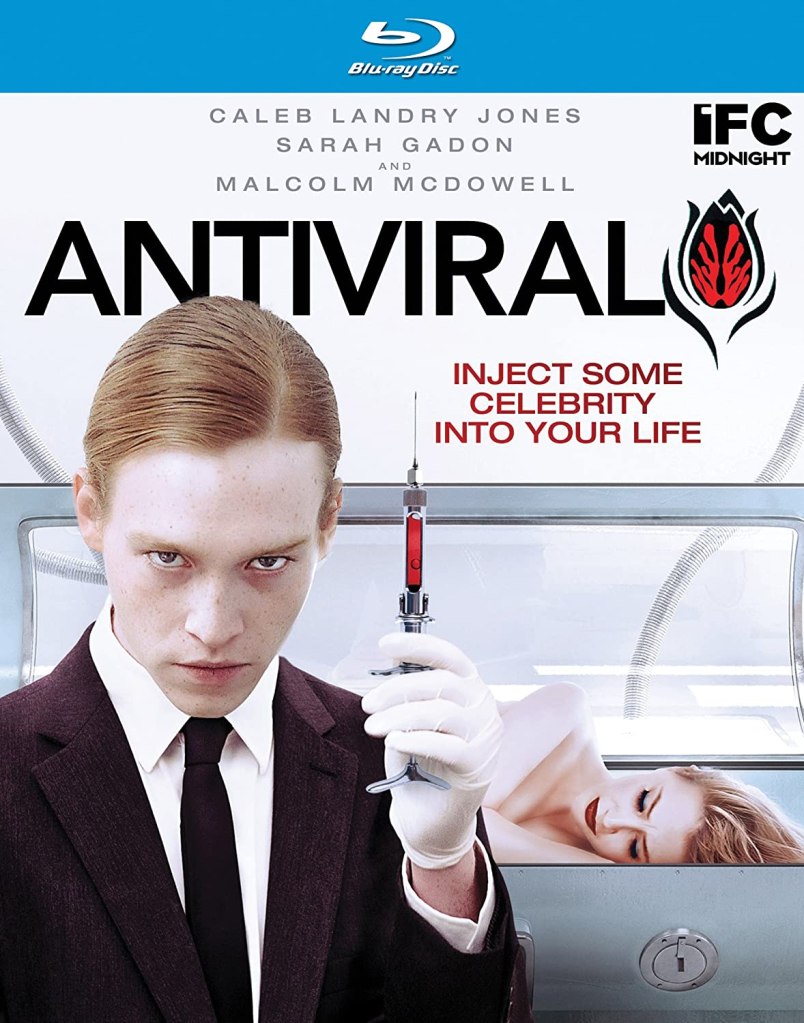
“From the perspective of the virus, the human being is irrelevant” – ANTIVIRAL (Brandon Cronenberg, 2012)

I have in my (admittedly odd) library a title called The In Vitro Meat Cookbook. It has a series of recipes, none of which you can cook yet, because they require as their main ingredient meat grown in the laboratory rather than cut from the quivering corpse of an animal who probably lived her whole life in horrendous conditions. When this lab meat becomes commercially available, it will doubtlessly be great news for the billions of animals who die in terror for our plates each year, but these recipes go beyond the meats you might see at a butcher shop, to such suggested dishes as Dodo Nuggets and Dinosaur Leg and, yes, Celebrity Cubes:

“Forget autographs and posters. Prove that you’re the ultimate fan of a celebrity by eating him or her.”

Pop stars in whiskey glaze. If that isn’t intimate enough, how about “IN VITRO ME”? Yep, it’s grown from your own stem cells, and it’s “best shared with a lover as the ultimate expression of unity”.

I digress, but it is relevant to this week’s movie. Antiviral is a film even more relevant now than when it was released a decade ago. For a start, the daily news speaks of little else than viruses and antivirals, and when they do turn to other issues, these usually involve celebrities. This film covers both. It is set in an alternative present, where the obsession with celebrities has moved past adulation and stalking (and occasional cannibalism) to a lucrative business – selling their diseases. For a lot of money, you can suffer the same symptoms and weeping, bleeding pustules as your favourite star!

The movie is the first work by Brandon Cronenberg, the son of body-horror pioneer David Cronenberg (The Fly, The Dead Zone, A History of Violence, etc), sometimes known as “the King of Venereal Horror” or “the Baron of Blood”. Quite a legacy to live up to, but Brandon Cronenberg does it brilliantly in this work, which features cannibalism among its panoply of abjection. The imagery is stunning – bleak scenes in monochromes, then a flash of crimson – blood or lipstick. Needles sticking in arms and gums, lumps of meat grown from celebrities and sold to customers desperate for a touch and a taste of their favourite star.

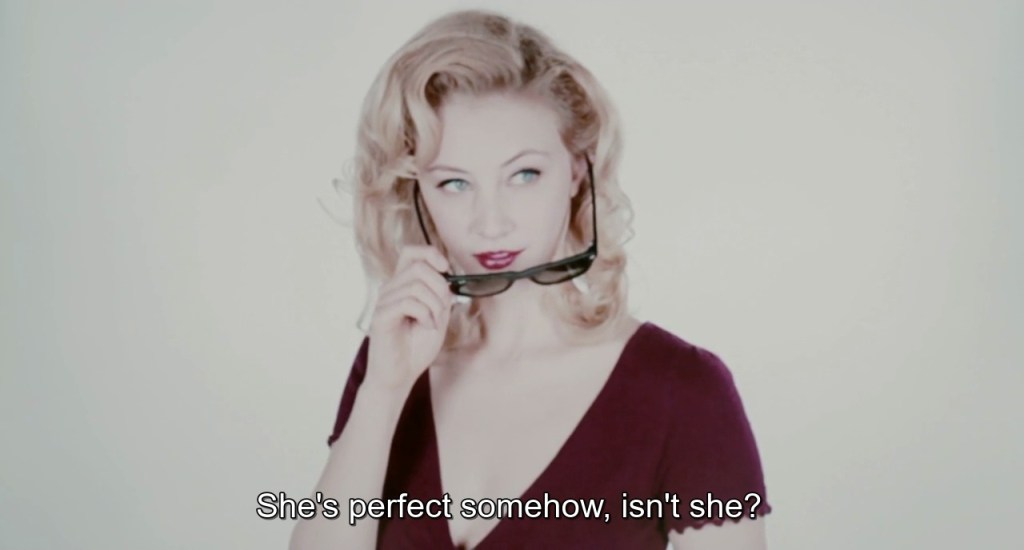
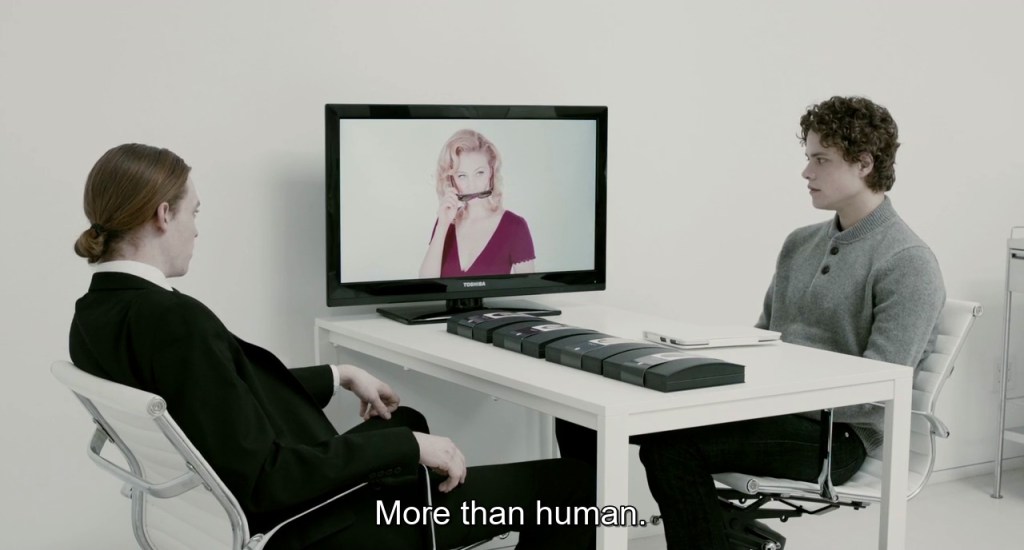
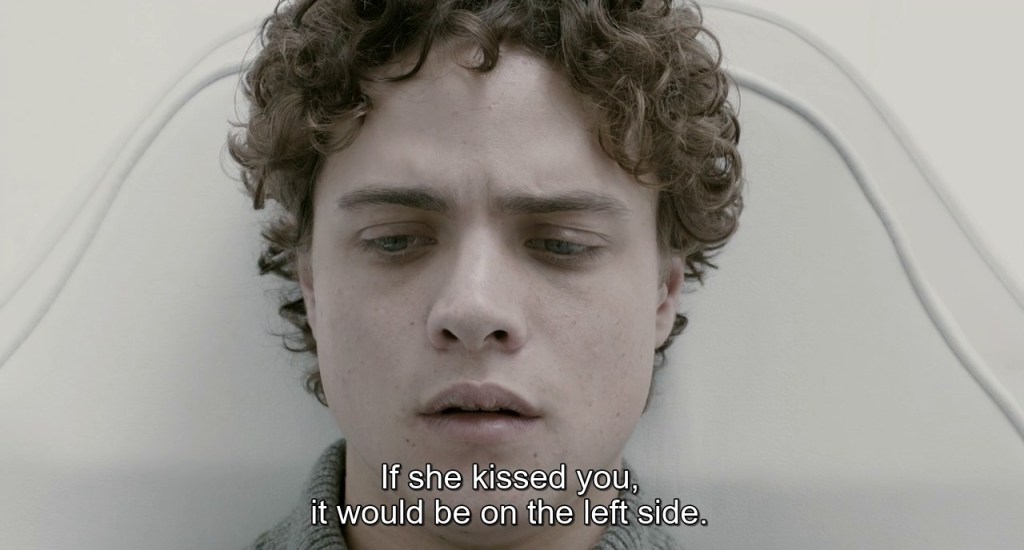
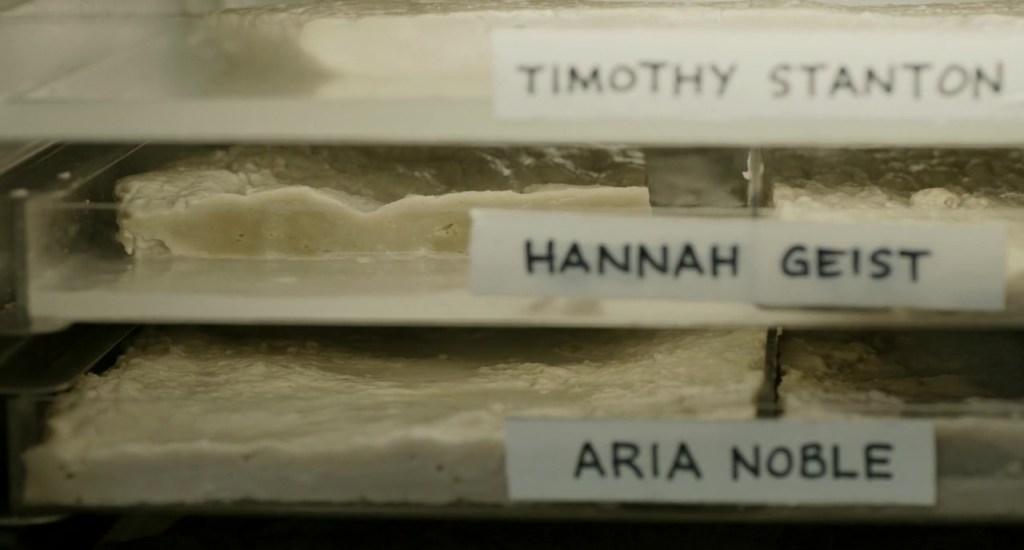
The protagonist of the film is Syd (Caleb Landry Jones from Get Out, Nitram etc), an employee of the Lucas Clinic. Syd sells customers the dream of being close to their favourite celebrity. What does the avid fan do after already seeing all the movies, reading the magazines, collecting the images? In this world, they pay to get the same diseases as the celeb. Syd knows how to sell, he talks a fan into a dose of herpes simplex, collected by his employer from the superstar Hannah Geist, whom he describes as “more than human”. She had the pus-filled blisters on the right of her mouth, so you really want to be infected on the left, because

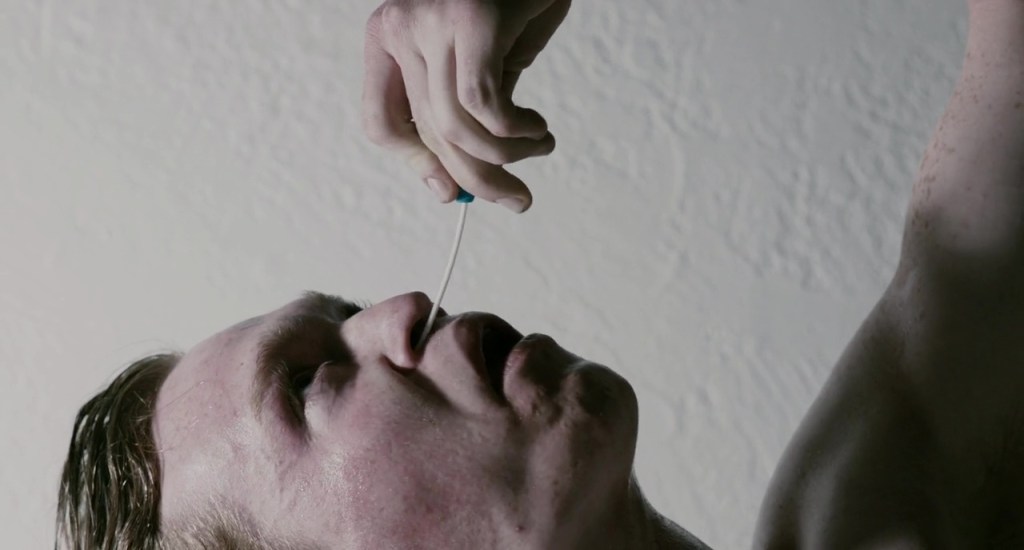
Syd is a trusted employee of Lucas (where the archivist is played by Lara Jean Chorostecki, who played Freddie Lounds in Hannibal!), but he is ambitious, hoping to sell the virus that is killing Hannah on the black market. He takes some of her blood (Lucas Clinic has exclusive rights to Hannah’s diseases) and infects himself, then waits, taking his temperature, doing things with cotton probes that we all now understand.

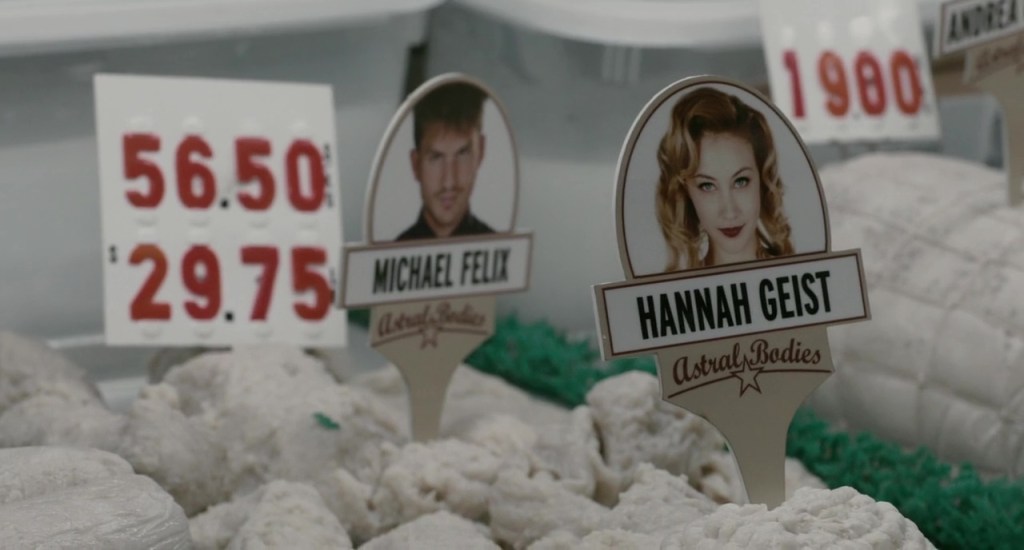
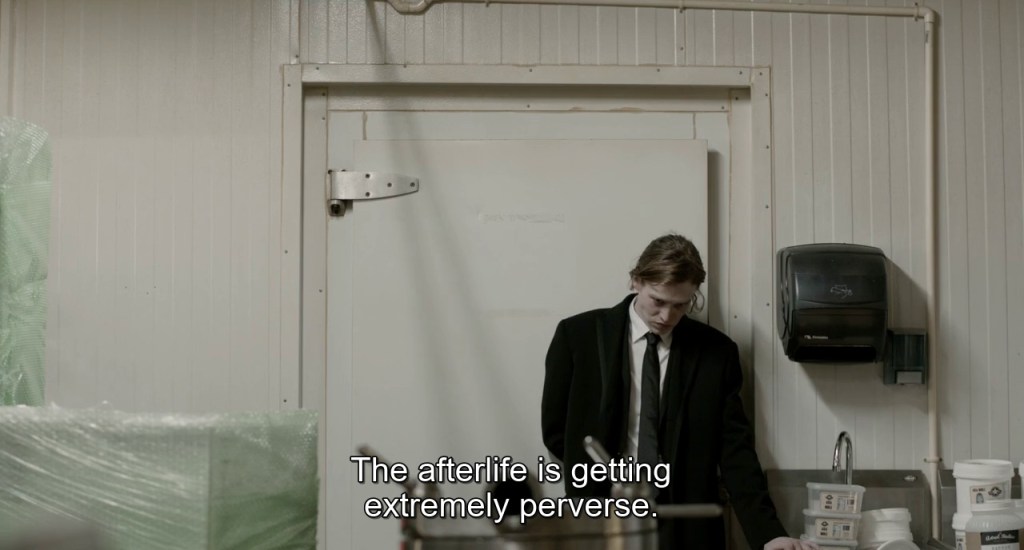
He is hoping to sell the new virus through the specialist butcher Arvid (Joe Pingue), whose business Astral Bodies does a thriving trade in celebrity cell steaks – edible flesh grown from the cells of celebrities.

Syd tells Arvid “I don’t understand how this is not considered cannibalism”. Arvid is more philosophical. What does it mean to be human, he asks – is the human “found in its materials” or is it something more religious, as the law currently tends to assume – a soul perhaps?

“But we’ll see what happens when we go from growing celebrity cell steaks to growing complete celebrity bodies.”

When Hannah’s death is announced, Syd’s diseased blood is suddenly in demand – those who have already eaten Hannah now want to either watch him die the way she did, or buy the virus and die along with her. Syd has to escape the virus coursing through his body, and the various business types who want it.

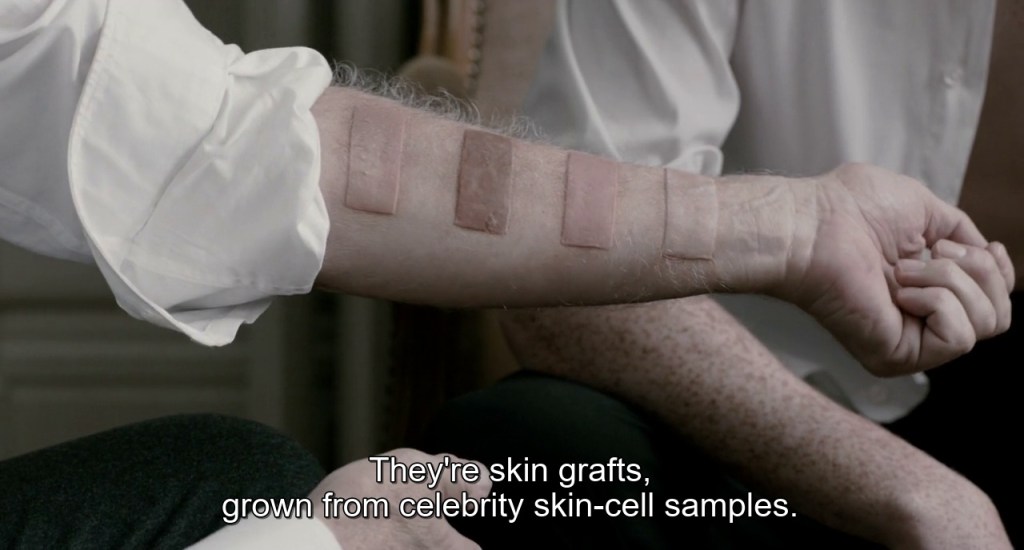
Anything related to a celeb is valuable. Lucas Clinic is even planning to sell ringworms from Hannah’s dog. Or if you don’t want a disease, you can get a skin graft from your favourite celebs, as Hannah’s doctor, Dr Abendroth (played by the magnificent Malcolm McDowell) shows Syd.

What does it mean to “go viral”? This humble blog has gone viral (a very mild, non-toxic one) in that it is viewed thousands of times a month, presumably because wonderful readers like you share it (please?) on social media, or perhaps (socially distanced) word of mouth. But a celebrity who goes viral has his or her impact measured not in the thousands of views but in the millions. Celebrity becomes the message in itself; as the head of Lucas Clinic says, when asked if the current crop of celebs deserve to have the levels of mania surrounding them,

“Anyone who’s famous deserves to be famous. It’s more like a collaboration that we choose to take part in. Celebrities are not people. They’re group hallucinations.”

Hannah’s doctor Abendroth is more metaphysical, musing that

“there is a power, something in the thrall of the collective eye, that can be consumed and appropriated.”

Certainly we devour our celebrities, with the paparazzi as the hunters and the rest of us sitting with a magazine or a tablet and consuming them – think of Marilyn Monroe, Princess Diana, Amy Winehouse, Michael Jackson and many, many more. Unlike most of us mere mortals, the celeb who has gone viral remains consumable after death, perhaps more so. So it is with Hannah.

The marketing of Hannah’s “afterlife” expresses the vulnerability of humans, the paragon of animals, to a virus, a type of genetic code so tiny that we are not even agreed on calling them “alive”.

“From the perspective of the virus, the human being is irrelevant. What matters is the system that allows it to function. Skin cells, nerve cells, the right home for the right disease.”

But no spoilers – go get this one out and watch it (if you’re not the squeamish type) – it is well worth it.

We long for connection. Cronenberg mentioned a moment of inspiration:

“A friend of mine said he was watching Jimmy Kimmell one night and Sarah Michelle Gellar was on the show. She said she was sick and if she sneezed she’d infect the whole audience, and everyone just started cheering.” 

The philosopher Blaise Pascal said that there was, in every human, an “infinite abyss [which] can be filled only with an infinite and immutable object”. He suggested that this infinite and immutable object should be God. Humans are big on eating gods – Dionysus was torn apart and reborn by means of his mother eating his heart, which made her pregnant. Christians eat the Eucharist – the body and blood of Jesus, according to John 6:55-66

“For my flesh is meat indeed, and my blood is drink indeed. He that eateth my flesh, and drinketh my blood, dwelleth in me, and I in him.”

We live vicariously, by eating our gods. But in our culture, the celebrity is god. The viral, consumable, more-than-human celebrity.

What’s your favourite cannibal movie?

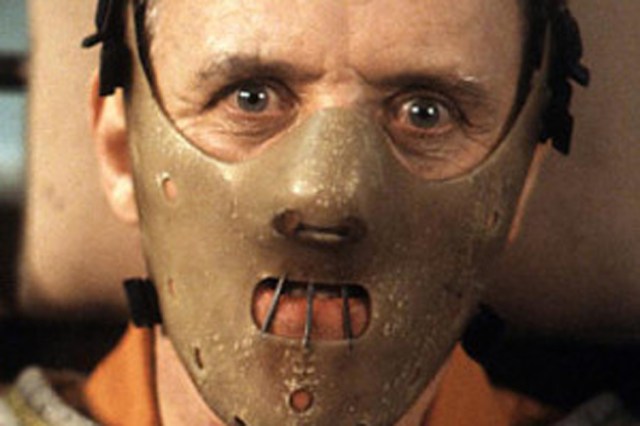
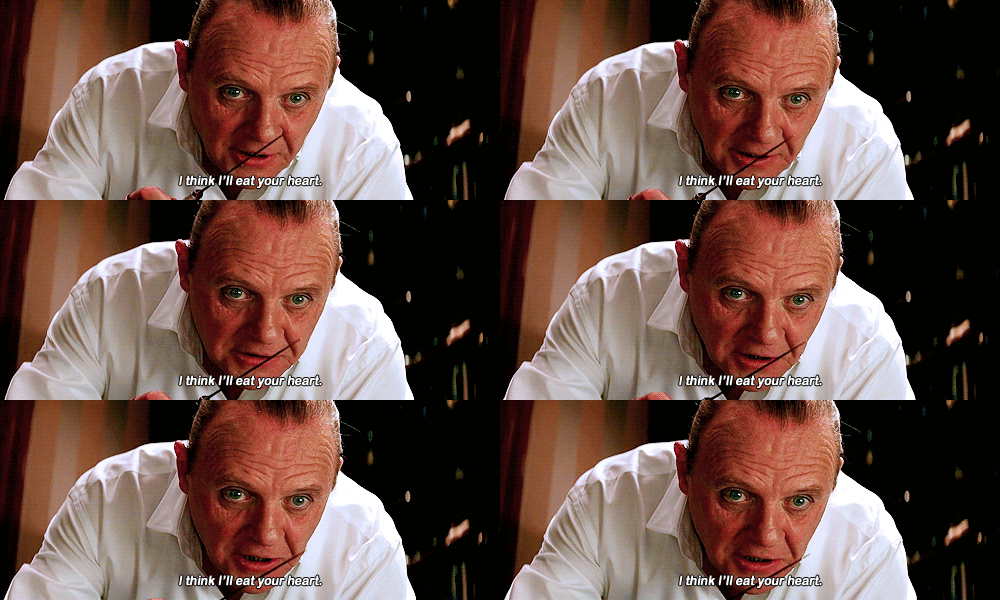
Of all the (sometimes) wonderful cannibal movies and shows I have reviewed in this blog, my personal favourite is still The Silence of the Lambs with Anthony Hopkins as Hannibal the Cannibal. It was the first film I reviewed on this blog (does that mean I liked the others less each time? Not at all), and interestingly, it does not actually feature any cannibalism, although we hear a lot about it.

Fun fact!

So I was pretty chuffed to find that The Silence of the Lambs is the favourite horror movie of the State of Utah, according to the Horrornews.net website. They used information from Rotten Tomatoes and Google Trends, and partnered with Mindnet Analytics, to analyse how interest in horror movies varied in each US state and the District of Columbia (DC). The results are presented on their website:

Best Horror Movies: Which Does Each US State Love Most?

This survey covers all horror, whereas in this blog we concentrate on the cannibal, so please let us know your favourite cannibal film (or TV show, but if it’s a series, your favourite episode) either in the comments at the bottom of the page (after a few suggestions) or at cannibalstudies@gmail.com. I’ll let you know the results.

The “vampire of Hanover” – DEATHMAKER (Der Totmacher, Romuald Karmakar, 1995)

I expected this to be either graphically violent or else painfully dull, but it was neither. It is quite different from any cannibal movie I have reviewed on this blog.

Deathmaker (German: Der Totmacher) is a re-enactment of the transcripts of the interrogation of the serial killer and cannibal Fritz Haarmann who killed and ate parts of at least 24 homeless boys between the end of the Great War in 1918 and his eventual capture and execution in 1924-5.

Haarmann became known as the “Vampire of Hanover” for killing his victims with a “love bite” that went right through their windpipes. He made a living selling the victims’ clothes and flesh (marketed as “pork”) on the black market to grateful customers who were barely surviving the collapse of the German economy after the war.

There are no flashbacks or re-enactments of violent incidents, just three men sitting in a room, and only two of them speak. Imagine it as a play that has been recorded to film. Or think Louis Malle’s My Dinner with Andre mixed with In Treatment. The great German film maker Ulli Lommel had made a re-enactment of Haarmann’s killing spree some twenty years earlier called The Tenderness of Wolves (Die Zärtlichkeit der Wölfe). The two films are a wonderful glimpse into the mind of a cannibal, although the characterisation is so different as to be almost unrecognisable

Almost the whole film is set in one room in an asylum, with psychology professor Ernst Schultze (Jurgen Hentsch) interviewing mass-murderer and cannibal Fritz Haarmann (Götz George, who won best actor at Venice Film Festival for this role) to determine if he is sane, or at least lucid enough to be tried and executed. Except for entrances and exits and the occasional visiting doctor, no other people are present, and the only other member of the cast is the stenographer (Pierre Franckh) – whose notes of the meetings this film used as its script – he is variously terrified, fascinated and sympathetic to Haarmann, all depicted entirely in his face, as he never says a word.

The Director, Romuald Karmakar, is known for producing thoughtful films that often follow perpetrators who are responsible for their own downfall. The professor asks unexpected questions about maths or geology, while Fritz plays the clown, but as the questions close in on his life and sexuality, he becomes more lucid, trying to justify his actions, and trying to win the sympathy of his interrogator. The professor has full control over the hulking Fritz, who is soon describing exactly how he killed the boys and young men during sex, with graphic details of how he dismembered them and disposed of the body parts.

“Took out the bowels. And threw them in a bucket. Dumped them in the toilet. It’s all rumpled up. I cut them up and threw them away.”

Haarmann’s boyfriend, Hans, would acquire the boys, sometimes just because he wanted their clothing, and knew he would get it after Fritz finished with them.

The professor, unlike modern psychs, pours scorn on Fritz, contemptuously condemning his homosexuality and violence and dismissing his claim that he will be allowed into Heaven to meet his mother. Would Haarmann have acted as he did if his homosexuality had been accepted? We can’t know that, but we do know that German laws against homosexuality were made more draconian after Haarmann’s case in 1924.

The boys won’t be able to testify against him to the heavenly judge, Haarmann says, because he caved their heads in, and he demonstrates how he did it, smashing his fist into his hand repeatedly.

He laughs, he boasts, he complains, and eventually he cries as he realises that his rampages, which he at first maintained were not his fault, will surely have him condemned to the guillotine.

The subject of cannibalism is barely mentioned, even though that is about all that Haarmann is remembered for now.

The professor tells him there is plenty of evidence that Fritz fried shrimps in human fat, made bouillon, sausages and brawn

We are told that he stripped the flesh from his victims and sold their clothes, and finally we get a quick reference to “Haarmann’s sausages”, almost as a double entendre joke. The ethical debate between the professor and Fritz is not about cannibalism but about the families who lost their sons, and his response each time is that they were just “joy-boys”.

The basis of exploitation, killing and eating others is objectification. A cow or pig can be “just an animal” and a homeless boy can be “just a joy-boy”. Just words, but powerful enough to allow the most despicable acts, as they strip all moral value from the intended victim. Haarmann claimed he did not remember killing them, they would just be lying next to him, dead, next morning. And of course, once they were dead, they were no longer “just joy-boys” and were instead now just meat. Our ability to objectify does not necessarily stop at the species line.

The film received several awards and nominations from the Deutscher Filmpreis in 1996 including Best Feature Film, Best Direction and Best Actor. Götz George is simply superb in the role, for which he also won the Volpi Cup at the Venice Film Festival. Deathmaker was chosen as Germany’s official submission to the 69th Academy Awards for Best Foreign Language Film, but did not manage to receive a nomination.

It is not a film for everyone, both because of the descriptions of the dismemberment of human bodies, as well as the fact that, if you don’t speak German, following the dialog in subtitles can be wearing for some people. But it is quite brilliant, and if you can’t find it on a streaming service, it is available on DVD. Well worth the effort.

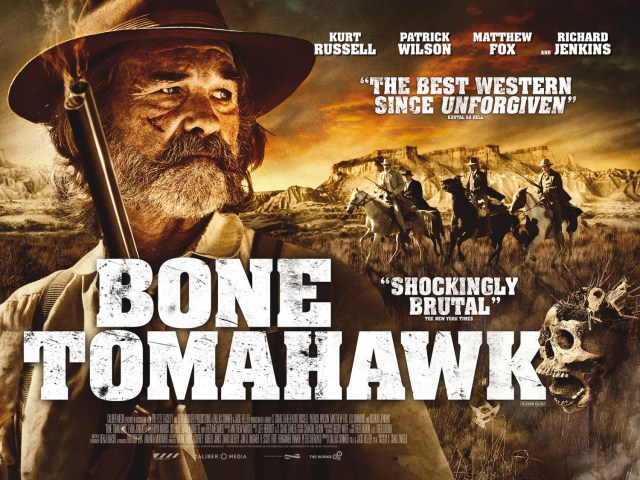
“A spoiled bloodline of inbred animals”: BONE TOMAHAWK (S. Craig Zahler, 2015)

This is a cannibal film, also a Western and a horror movie, so it has something for (almost) everyone. Although a low budget work by a first-time film-maker, the film has been widely recognised for the excellence of the script and direction, and the characterisation by a team of top actors. And the graphic nature of its climax.

Bone Tomahawk is set in a small town in the last days of the Old West, a frontier society held together by a sheriff, Franklin Hunt, played by Kurt Russell (who managed to fit in a starring role in Tarantino’s The Hateful Eight that year as well), with an understated calm and a brooding power. A drifter comes into town and Hunt shoots him when he tries to run from the saloon, necessitating Samantha (Lili Simmons from Banshee), who practices medicine, to treat him in the jail. She, the drifter and a deputy are all abducted during the night – the only evidence is an arrow in the wall, and a dead African-American stable boy. Who could have done that?

We assume ‘Indians’, but a Native American they trust, “the Professor” (Zahn McClarnon, from Longmire and Fargo), tells them these are not the ‘Indians’, or at least the ones with whom the American invaders have been at war. They are a tribe with no name, no language (i.e. less than human). The local Indians call them “troglodytes”, cave dwellers,

The Sheriff, his “back-up deputy” and comic relief, Chicory (Richard Jenkins from Six Feet Under and Shape of Water), the mysterious Indian-fighter Brooder (Matthew Fox from Party of Five and Lost) and Samantha’s husband Arthur (Patrick Wilson from Fargo) with a broken leg that is fast turning gangrenous, set out in pursuit. Most of the film, until the climax when they meet the trogs, is more a road movie than a Western or a cannibal horror film. It’s four cowboys against the elements. On the long ride out to the land of the trogs, they come across two Mexicans and Brooder kills them, suspecting that they are scouts for a bandit gang. Chicory explains,

“Mr Brooder just educated two Mexicans on the meaning of manifest destiny”.

Manifest destiny was a widely held cultural ideology that proposed that the culturally and racially superior American settlers were destined to expand across North America. Inferior, backward, savage peoples were meant to get out of the way, or be exterminated. Even the horses were supposed to be racially intolerant. When the rest of the gang comes in the night and steals their horses, Brooder is incredulous that his horse would allow a Mexican to ride her.

Discrimination, be it racism, speciesism, ageism, ableism or any other, is never all-encompassing. Most racists don’t hate everyone, or at least not equally. The settlers in areas like the old West hated the ‘Indians’ for defending their lands, which the white men wanted. Even in the era when this movie is set, sometime in the late nineteenth century, some Native Americans like the Professor were accepted as, if not equals, at least semi-civilised negotiating partners, while others, who maintained their resistance, were considered bloodthirsty savages, and portrayed as killers, rapists and sometimes cannibals.

In this film, this second group is distilled into a people so inhuman that they do not even have language, which is often the first thing quoted in defining the supposed gulf between humans and other animals. They are accused of raping and killing their mothers and, worse yet, abducting and raping white women, requiring the gallant sacrifice of heroes such as those depicted here. One of the party, Brooder, boasts of having killed more Indians than all the rest of the town put together. When pressed, he admits that not all were men, as Indian women and children can also handle an arrow or a spear, and he tells of losing his mother and sisters to an Indian massacre when he was ten. For Brooder, white vs red, civilised vs savage is no different to good vs evil. He is an absolute racist, but for what he considers good reasons.

Yet even these less-than-human troglodytes are racists – they left the black stable-boy behind, because “they don’t eat Negroes”. No explanation is given, and it makes no sense since, under the skin (of whatever colour) we are all red meat. Yet their refusal to eat black people paints the white supremacism of the others as less vile somehow – look, these brutal savages must be exterminated – and they’re racists too, so it’s OK for us to discriminate against them.

Of course, those we wish to destroy must be dehumanised, vilified, and preferably accused of vile crimes, of which cannibalism usually seems to be the leading contender. But there is little evidence of Native Americans indulging in the flesh of their victims, whereas only fifty years before the demise of the Old West, the Donner Party had tucked into the remains of the members of their party who had died in the bitter winter snows of the Sierra Nevada in 1846-47. When they ran out of corpses, they murdered and ate their Native American guides.

The film is written and directed by S. Craig Zahler who also wrote the music with Jeff Herriott. It is a tour de force, a modern film that manages to bring to life the Western, a genre that, like its heroes, does not ever seem to die. American Frontier scholar Matthew Carter points out that this story is

“informed by one of white America’s oldest and most paranoiac of racist-psychosexual myths: the captivity narrative

In these narratives, civilised society is threatened by an evil outside force, and something precious (usually a woman, seen as a possession) is stolen and must be recovered. In Bone Tomahawk, traditional narratives are challenged to some extent – the women are not passive, Brooder’s prejudice is challenged, the savages are motivated by the drifters desecrating their burial ground. But the heroes are white men, the story is told from their perspective, the fear of the outsider or alien (remember this is only a few years after 9/11) offers a stark binary which equates civilised with good and savage with evil. It is the myth that was used to justify manifest destiny and the genocide of the Native American tribes. The trogs are barely human – they are covered in white mud which disguises their humanity and they have whistles implanted in their throats instead of having voices, so they cannot be engaged in rational discussion. We see a prisoner scalped and then cut open while alive, to establish their monstrosity.

Their own women, we see at the end, are heavily pregnant, blinded and their limbs removed, so they are simply breeding machines for more warriors, a reference, intentional or not, to the way anti-Islamic propaganda depicts Moslem women as blinded by fundamentalist controls and their burqa.

But perhaps the Professor is the most interesting character. In Westerns, there were ‘good Indians’ who were assimilated into the dominant culture, often assisted in spreading ‘civilisation’ (think Tonto in The Lone Ranger).

Then there were the ‘bad Indians’ – the outsiders, vicious and merciless, uninterested in accommodating the invaders on their land, and often (although not always) portrayed as cannibals.

Vietnam vets and cannibals: CANNIBAL APOCALYPSE (Antonio Margheriti, 1980)

This is one of those horror flicks that’s a bit hard to categorise. It’s an Italian “cannibal boom” film in the tradition of Ruggero Deodato’s classic Cannibal Holocaust which came out the same year, as well as earlier efforts such as Deodato’s Last Cannibal World, Joe D’Amato’s Black Emanuelle films, and the one that started the Italian cannibal boom, Umberto Lenzi’s The Man from Deep River. But Antonio Margheriti, using his alias Anthony M. Dawson, turned the genre on its head. The cannibal boom movies were usually set in the jungle, where tribes of primitive savages killed and ate Western interlopers, who richly deserved their fate. In other words, the archetypal colonialist cannibal story with a post-colonial twist (revenge!)

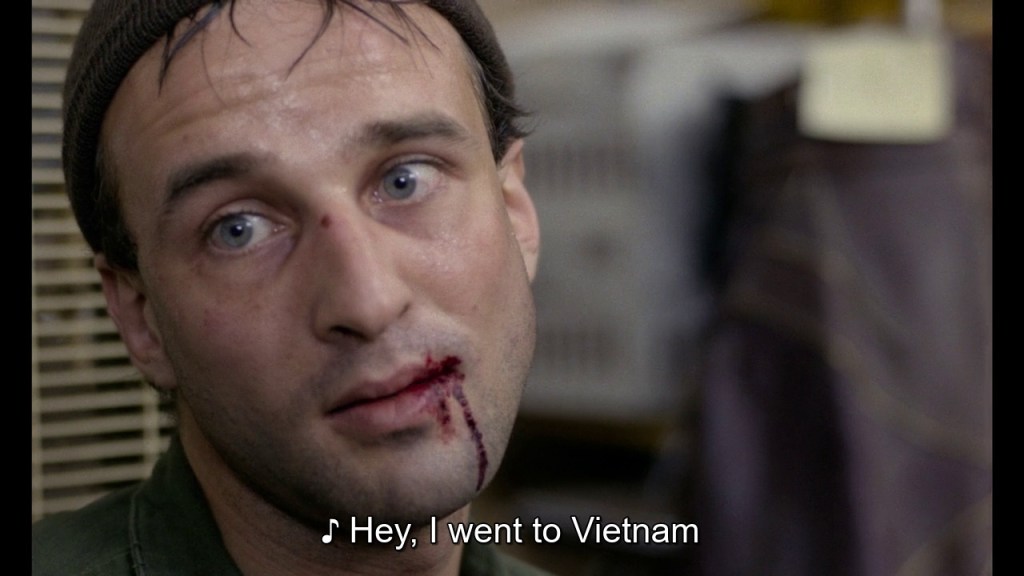
This one starts in the jungle too, but it’s a jungle in Vietnam, and the Western interlopers are American soldiers prosecuting the disastrous and eventually futile Vietnam War. A squad led by super-macho Norman Hopper (John Saxon from Nightmare on Elm Street) lands in a village and torches the place, after getting blown up by a dog (yeah, it gets worse). They find some POWs captured from their squad, Tommy Thompson (Tony King, who is now head of security for the hip-hop group Public Enemy) and Charlie Bukowski – a intertextual reference to the poet Charles Bukowski I guess, although the link seems tenuous. Bukowski (the soldier, not the poet) is played by John Morghen from Cannibal Ferox, an actor who pretty much always dies horribly in every movie he’s been in, and this is no exception.

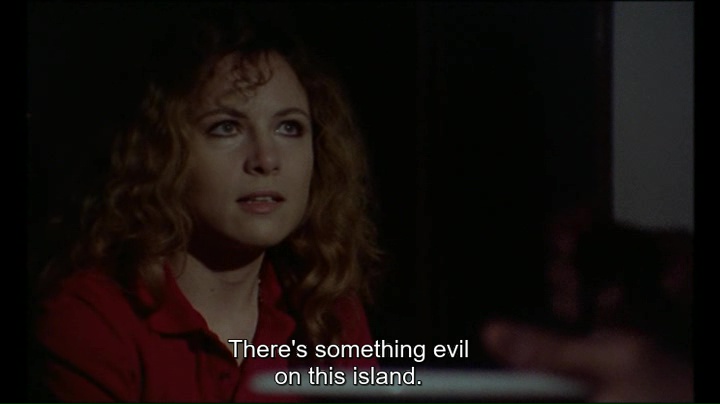
They have somehow caught a virus (?) which makes them crave human flesh. That makes it sound more like a zombie movie than a cannibal one (think 28 Days Later), but let’s give it a cannibal pass by referencing the Wendigo films like Ravenous or Eater. Or you could claim, as the doctor says to Norman, it’s a “form of rabies.”

No, it isn’t. He really should have gone with Wendigo, a mythical figure – giant, fierce and cannibalistic, who gathers strength from feeding on human flesh, but the flesh makes him grow larger, and so his appetite can never be satisfied. He is sometimes protective (like Norman), and sometimes a figure of revenge (like Charlie and Tommy). The Wendigo gets inside people who are weak, hungry, or filled with rage.

Anyway, the squad is using flamethrowers to fight the Vietcong (and their women and small children) and one burning woman falls into the pit where the POWs are confined, making for a cooked meal. No home delivery jokes please.

Back in the States, Norman is having nightmares of being bitten by the POWs as he rescued them from their meaty pit. He realises something is wrong with him (the virus from getting bitten maybe?) and stares in horror and fascination at a bleeding lump of flesh in the fridge. Why is there flesh left to bleed in the fridge – isn’t that a health hazard?

One of the rescued POWs, Bukowski, suddenly phones him – he’s on day release from the “Hospital for Nervous Disorders”, or what the cops call a “loony bin”. Norman can’t meet him because the teenage neighbour is lasciviously pointing a hairdryer at him, and he is drawn to her lower regions, but for someone infected with the cannibal virus, ‘eating her out’ means something different to what she expects. She drops by later to tell him that she enjoyed being bitten. What do you know.

Meanwhile, Charlie has gone to see a war movie, as you do when you’re been treated for months for severe PTSD. It’s Umberto Lenzi’s From Hell to Victory, a lovely in-joke among amici, with lots of explosions and deaths. But no one is watching the war.

In front of him, a couple are doing oral things – exchanging saliva and sucking on boobs, erotic cannibalism, but Charlie joins in by taking a healthy bite of the girl’s neck as she leans back in her seat. He runs, there’s a shootout, he kills and eats a bikie and a security guard – it’s all downhill from here. The Atlanta police chief wants to know about him, not his name (despite it’s fascinating intertextuality):

Is he a subversive, a queer, a black, a commie, or a Moslim fanatic?

No, he’s a clean cut all-American (Italian) Vietnam vet, who wants to eat people.

Lots of people get bitten or scratched – a cop, a nurse, who then bites off the doctor’s tongue, and of course there’s that wanton teenager from next door (what horror film would be complete without promiscuous teenagers?), who was infected by Norman’s bite, even though he thought he could overcome the craving for meat.

Point is, they all have the cannibal virus, and the cannibals end up in the sewers (apparently hoping to hoof it to the airport and hop on a flight back to Vietnam), where they are chased by men with guns and flamethrowers; it’s really just like Nam, but now they have become the enemy.

The movie was one of 39 films to be prosecuted in Britain during the 80s as a ‘video nasty’. The acting sometimes leaves a little to be desired, but the main characters, Saxon and Morghen, are great. The special effects are by the legendary Giannetto De Rossi and are, like most of his work, spectacularly abject. The music is a mix of elevator and disco, creating what TV Tropes calls “soundtrack dissonance” – it’s either disturbing or just annoying, I’ll leave that up to you to decide.

In his commentary on the film, the director Antonio Margheriti proudly states that this film was Quentin Tarantino’s favourite of his movies. Tarantino referenced the film a couple of times: in Inglourious Basterds, Donnie Donowitz uses an alias “Antonio Margheriti”, while in Once Upon a Time in Hollywood, Leonardo DiCaprio character goes to Italy in 1969 to star in Spaghetti Westerns and also one Bond-type spy thriller supposedly directed by Margheriti titled Operazione Dyn-o-mite.

But video nasty or not, Cannibal Apocalypse has some interesting things to say about the fallacies and phalluses of war and cannibalism. The cannibal virus comes back to the USA with Vietnam veterans, a group who were sent to fight a vicious and often brutal war, often against civilians, and returned to abuse or neglect, with far more veterans dying from suicide than died in that war. They also brought back with them, on top of their trauma, exotic diseases, drug habits, and acute psychological damage. Many went as conscripts, and came back as severely damaged killing machines, metaphorically lusting for human flesh and spreading the anger and violence to all those near to them. It’s happened over and over in every war – a culture of killing leads to a spiral of violence. Even when you think the nightmare is over and all the cannibals dead, there’s still the teenager and her little brother to consider (hey, it’s been over forty years – where is the sequel this seems to promise?)

Probably not.

The drive to kill and to eat flesh are closely linked in human history. Consider the words of Isaac Bashevis Singer in the forward to the book Vegetarianism, a Way of Life, by Dudley Giehl:

As long as human beings will go on shedding the blood of animals, there will never be any peace…

If you think Cannibal Apocalypse sounds interesting but you’re short of time, most of the good (gory) bits are covered fully in the review by Mike Bracken, AKA The Horror Geek (@horrorgeek). Mike’s vodcasts are always very entertaining, but this review had me guffawing out loud, which is a bit weird when you’re watching with headphones, in apparent silence, and pretending to be writing an academic thesis. In fact, Mike’s review is much better than the film, IMHO.

Eat your heart (ETC) out: ANTROPOPHAGUS (Joe D’Amato, 1980)

Joe D’Amato was a prolific director of around 200 films in a wide range of genres, but is best known for his horror and erotic ones. Antropophagus is not one of his ‘best’ (if that word even means anything in these genres) but has developed a cult following in the forty years since its release. D’Amato did not make many cannibal films for some reason – we have previously reviewed his Black Emanuelle film Emanuelle and the Last Cannibals, and we still need to look at (eventually) a few more including Emanuelle’s Revenge, Papaya Love Goddess of the Cannibals, Beyond the Darkness, Orgasmo Nero and the sequel to this one, directed under the pseudonym Peter Newton, Antropophagus II. Looks like we’re going to be here for a while, folks!

Joe D’Amato’s cameo appearance in the Athens cable-car scene

The lost travellers encountering savage or insane cannibals is one of the favourite tropes of cannibal stories. Odysseus and his men getting gobbled up by the Cyclops would be an early version (assuming a guy with only one eye in the middle of his head and a god-father is “human” which is pretty important for the definition of cannibalism). But ancient tales loved to dwell on the semi-human monsters outside civilisation eating unwary travellers, as did the lurid tales told by explorers and missionaries in colonial times. Robinson Crusoe is part of the tradition, although he was on his own until he met Friday (whom he saved from, yep, cannibals).

In films, the defining moment for sexed up teens in faulty cars getting slaughtered and eaten by crazed cannibals was Tobe Hooper’s The Texas Chain Saw Massacre in 1974, where the cannibals were rust-belt hillbillies killing tourists to replace the closure of the slaughterhouses and loss of their usual victims, and The Hills Have Eyes where the cannibals were mutants created by atomic testing in the desert. The killers got progressively weirder with such offerings as Wrong Turn which was sort of Deliverance with a meat department, but the prize for weirdest demented cannibal probably goes to this one: Antropophagus.

Instead of driving around or breaking down in dodgy areas of derelict states to run into cannibal tribes, this lot are touring the Greek Islands on a yacht. Well, if you’re going to get killed and eaten, do it in style. We start off with a couple of German tourists relaxing on probably the most uncomfortable beach you’ve ever seen, the girl going for a swim because apparently Jaws hadn’t been released in Germany five years before this movie was made?

Her boyfriend, relaxing on some sharp lava, has a rude awakening involving a meat cleaver through his head.

We immediately switch to our jetsetting tourists on a cable car in Athens. One of the tourists is heavily pregnant, so sailing around the islands is an even weirder choice when you think about it, and leads to the most famous cannibal scene involving a fetus in any movie (not many directors other than D’Amato have dreamed of getting away with anything like that).

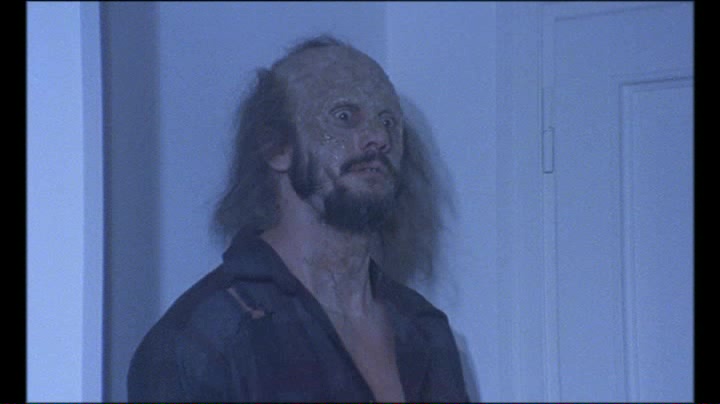
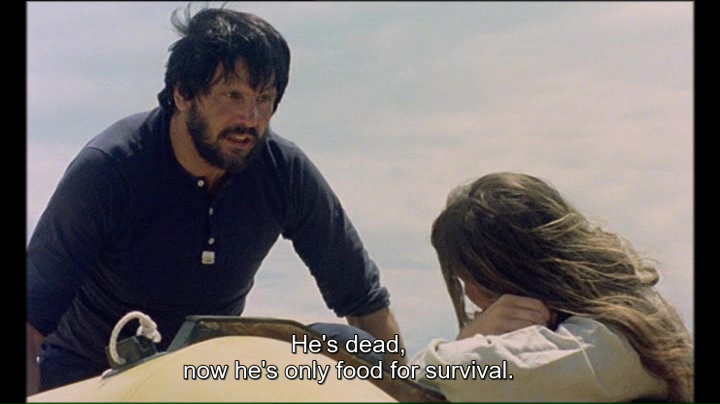
Antropophagus was written by D’Amato and George Eastman (born Luigi Montefiori), the incredibly tall villain of heaps of Italian B-movies and Spaghetti Westerns as well as several of D’Amato’s other movies. In this one, Eastman plays the slasher, who (it turns out from a journal he left lying around on the island) was driven mad when he and his family were shipwrecked and he ended up eating the wife and child to survive. So now he kills and eats people who come to his island. Everyone needs a hobby. And the role of the cannibal has always been to explore the limits of humanity, and the extremes of inhumanity.

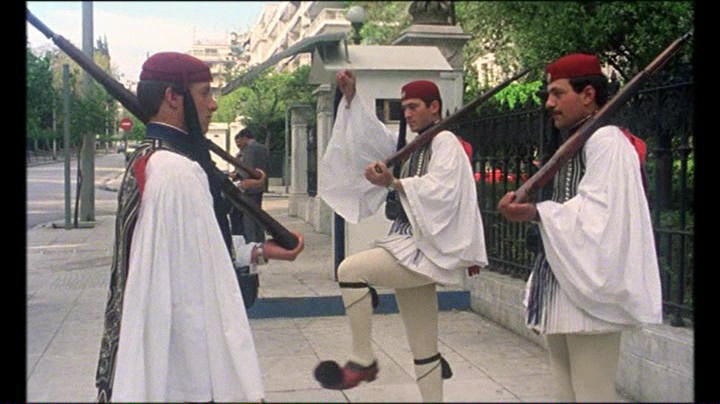
Look, it’s a slasher, and they are not to everyone’s taste, in fact a version of the film without most of the gore was released in the US and UK under the title The Grim Reaper. The acting is pretty awful, ranging from wooden to way over the top. But D’Amato was a talented director (as well as prolific) and the scenes of Athens including the changing of the Guard at the Tomb of the Unknown Soldier, and the Greek Islands, are glorious, and accompanied by suitably cheerful bouzouki music.

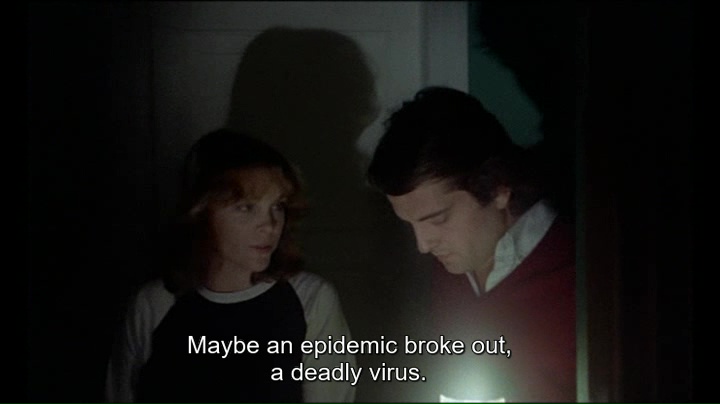
The team head for an island which turns out to be ‘almost’ deserted (because everyone’s dead of course). They can’t understand it and ask, forty years too early:

Well, they’ll laugh about that one when they tell the story to their grandkids in 2020 or so. The “final girl” (there’s usually a final girl who survives the slasher) is played by Tisa Farrow, little sister of Mia Farrow, and daughter of Maureen O’Sullivan. Quite a lineage. She’s supposed to be there to look after a blind girl, who doesn’t know where her parents are, but can still tell when the antropophagus is lurking.

The middle section of the film follows the mystified tourists as they explore an apparently deserted town on a remote island, but it’s not really dull, more atmospheric, establishing the existence of evil, a malevolent presence that smells of blood.

Besides the blind girl with the supernose who can smell blood (but can’t apparently smell a room full of corpses), there is Carol (Zora Kerova from Cannibal Ferox) who can read Tarot cards and sense evil vibes.

There’s an electrical storm worthy of King Lear. A scene in a cemetery (of course). A mysterious woman who leaves threatening messages. A blind girl who attacks them with a knife. A whole lot of rooms full of bodies, which surprisingly are discovered by pulling off their shrouds rather than by smelling their decomposition. A seemingly inexhaustible packet of Marlboro (product placement maybe?) A lot of pointless relationship arguments. But, if you’ve bought a ticket to see the gore, then as one critic wrote on IMDB,

“The movie starts with a brutal meat cleaver scene then becomes very slow n downright tedious. The last twenty mins contains the two nasty scenes coz of which this film earned the video nasty label.”

I liked the way the violence is mostly presented from the point of view of the cannibal, rather than the victim. At the beginning we see forward movement, drops of blood, a meat cleaver. Later there is a view of the boat through metal palings and some guttural breathing. When one of the men has his throat torn out, we see the throat, before we finally see the antropophagus with his bloody mouth, bad haircut and poor dental hygiene, but that’s already fifty minutes into the film.

So the scenes of the “normal” people are intentionally dull – there’s pretty scenery, with the occasional interruption for carnage and slaughter. Something for everyone. Makes a nice contrast with the depraved cannibal, who we eventually find out (by flashback!) was a shipwreck survivor and accidentally killed his wife when she wouldn’t let him eat their dead son. Domestic cannibal in domestic dispute.

So – the famous last twenty minutes. Pregnant lady is found by her pretty useless husband in a crypt where rats with red eyes (hungover? Late flight?) are eating corpses.

The antropophagus stabs the guy, who dies slowly enough to watch him pull the fetus from her body and, yep, eat it (turns out it was a skinned rabbit, as if that makes us feel better).

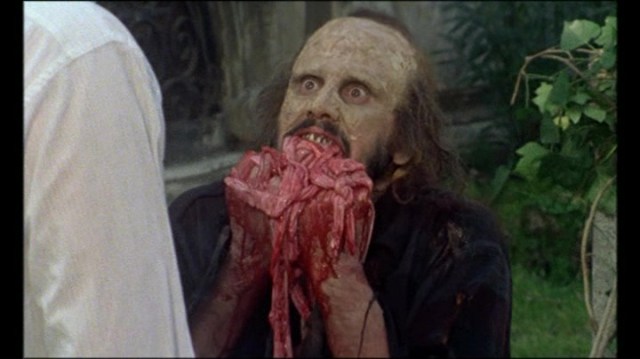
Then in the climax, he gets disembowelled with a pickaxe, and in the last moments of the film, starts to chew on his own intestines.

Yep, both of those scenes were left out of The Grim Reaper. The full film is still banned in England according to The Horror Geek, because they thought it was a real fetus. Read Wikipedia before making censorship decisions, guys!

Antropophagus is available in Blu-ray from Amazon, or the full movie is (or was when I checked) on YouTube – but has Czech subtitles, which some may find distracting. Or you might learn some Czech, and you never know when that may prove useful.

If you can’t / don’t want to watch the whole movie, you can get a comprehensive and extremely funny summary together with some priceless Gilligan’s Island references on the YouTube site of the Horror Geek. Highly recommended.