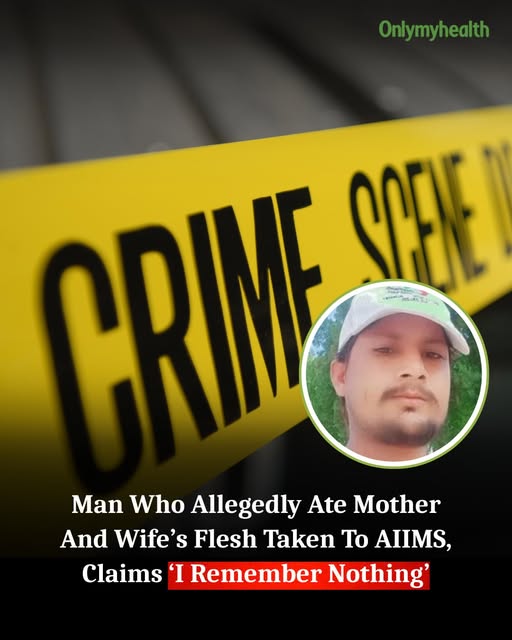
Screams, smashed skulls, flying flesh were not what villagers of an Uttar Pradesh village expected on a quiet Monday morning when a 30-year-old labourer brutally murdered his wife and mother on the rooftop of his house and then chewed flesh from their smashed skulls as his neighbours watched.
A 30-year-old man was arrested on 12 January 2026 in Kushinagar’s Parsa village for the double murder of his mother and wife. The suspect, who has been identified as Sikandar Gupta, had returned to the village about a month previously after working as a labourer in Mumbai. According to police reports, the victims were identified as his wife, Priyanka (28), and his mother, Runa Devi (60). Gupta initially attacked the victims with wooden sticks, and then with cement bricks, causing fatal head injuries to them.
Local residents rushed to the scene as the screams of the women echoed through the neighbourhood. Witnesses reported seeing Gupta mutilate the bodies and consume portions of the remains. When the crowd attempted to stop him, Gupta began throwing pieces of debris and human flesh at them, which caused widespread panic until the Ahirauli police arrived to detain him.
Kushinagar Superintendent of Police, Keshav Mishra, said that,
“a case of double murder was registered, and police are also examining the accused’s mental condition as part of the investigation.”
Neighbours informed police that Gupta had a history of substance abuse involving alcohol and cannabis and was known for frequent domestic disputes. The accused remains in custody pending a formal psychiatric evaluation to determine if he is fit to stand trial or if the murders were the result of a total psychological collapse.
Gupta has been admitted to the Psychiatry Department at AIIMS (All India Institutes of Medical Sciences) under police custody. According to reports, Gupta is speaking incoherently, at times claiming he was drunk during the incident and at other times saying he does not remember anything at all. Doctors have sedated him due to aggressive behaviour and are closely monitoring his condition.
Experts suggest the violence points to deep-seated psychological issues. Dr. PK Khattri, a senior clinical psychologist in Lucknow, said that Gupta’s agitated and non-communicative behaviour “points toward a severe psychotic break” that led to cannibalism.
As Dr Watson used to say, “No shit, Sherlock!”
Ashok Srivastava, an independent criminologist and an associate of the National Forensic Sciences University (NFSU), said that such extreme acts often stem from a
“desire for total domination”
He added that this type of behaviour represents an “ultimate expression of control, often triggered by internal frustrations or extreme psychopathology.”
Which could be said of human societies generally. From bullying in school to sexual abuse to war atrocities to the commercially pressured obsession with eating the flesh of other animals, appetites are driven by this “desire for total domination”, of territory, of food, and of the bodies of others. Anthropocentrism, sometimes called speciesism, is maintained by the practice of killing other animals in ever increasing numbers, to prove our superiority and deny our own animality and mortality. The French philosopher Jacques Derrida called that “carnivorous virility”, the sacrificial slaughter and consumption of “inferior” animals by the rational, patriarchal civilised meat-eater.
What happens when the lust to dominate or kill outruns the limits of anthropocentrism and is instead turned back on fellow humans? The biological fact is that humans are animals, and animals are made of meat. When a society reaches a point where the old ethical agreements are disintegrating, it can either forge new ones or dissolve into chaos, war and, yes, cannibalism. The psychopath, such as the one in this case who allegedly started his brutal rampage with domestic violence before turning to murder and flesh eating, seems to understand this better than most ‘sane’ people.
With the release of another Lion King franchise film, Mufasa, this one a prequel to the earlier story, it is perhaps worth considering the subject of talking animals, and particularly whom they feel OK about eating.
The first film was released in 1994, and was a glorious animation, with music by Elton John and Tim Rice, but was clearly a cartoon, one that has earned almost a billion dollars since its release.
Although we can get into the plot and the emotions of the film, we don’t really feel obliged to believe in the anthropomorphic veracity of cartoon characters. Do we really care if a cartoon duck eats other birds? No, not if he wears clothes and speaks (a form of) English. It is clearly a line drawing that moves, and requires no ethical work.
But in 2019, the film was remade as a photorealistic animation. With a small dose of suspension of disbelief, the animals looked like they were real, roared like lions, but somehow spoke English, some of them, strangely, with an eastern European accent. It was a sensation, so far earning over 1.6 billion dollars.
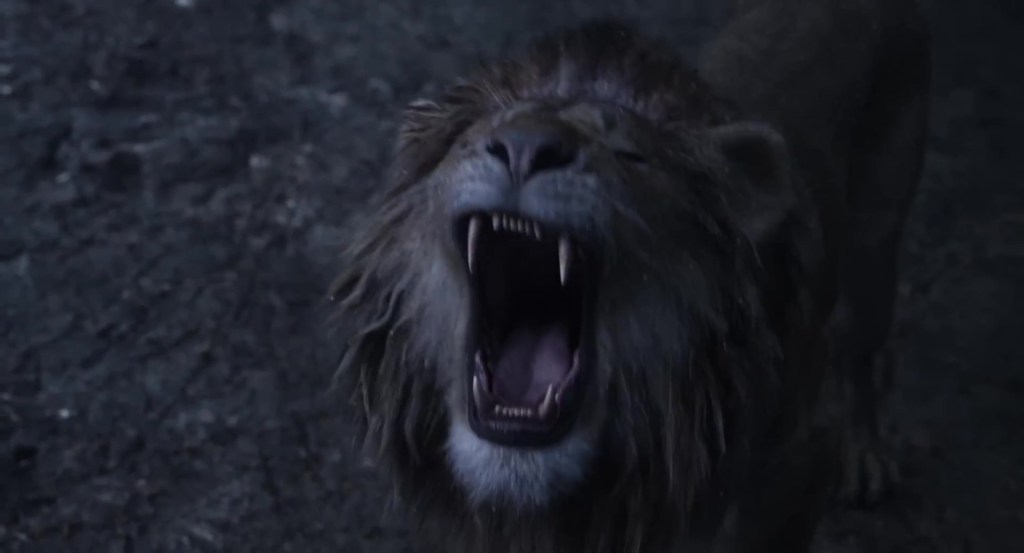
This blog will appear around Christmas, so I guess it is not unreasonable to unleash my inner Grinch, at least when it comes to anthropomorphic representations of carnivorous virility. As far as we are aware, lions can’t talk, except in movies. They can certainly communicate though, and that communication, particularly the roar that can be heard miles away, is featured prominently in all versions of the Lion King.
If they could talk, would they say and do the things shown in the film? Would they, for example, let a mandrill take their cub and hold him, Michael Jackson-like, over a cliff for the other animals to worship and celebrate? I’m even less sure of how celebratory the prey animals would be about the birth of yet another predator, no matter how cute.
But the main thing that bothered me throughout the film was the food, and it wasn’t (just) because I watched it at lunchtime. We are shown a happy monarchy (the “pride land”) where the devoted subjects are summarily executed and eaten by the king and his family. This is later turned into a blasted desert filled with the bones of the prey animals by a usurper king lion, an evil uncle lifted from Hamlet and made leonine.
Those not privileged to live in the pride-land inhabit a shadow terrain, the “elephants’ graveyard”, where (dark-skinned) hyenas skulk, with little evidence of anything to eat and, we are assured, always hungry. We have the “circle of life” followed by a circle of hell.
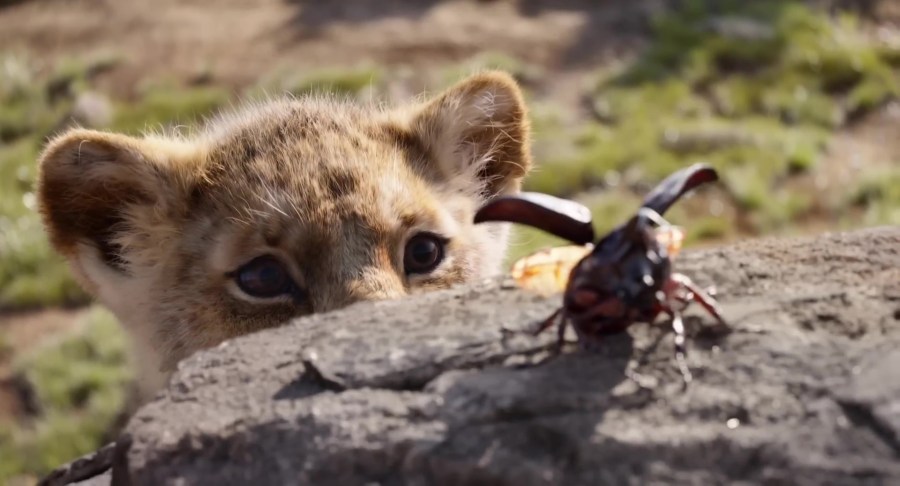
Even further away, in a wildness to which the exiled lion cub Simba flees from his evil and murderous uncle, we have a sort of Garden of Eden II. Here, mammals take a pledge not to eat each other, an expanded ring of utopian privilege, which excludes only insects and their pupal forms, who clearly would have to exist in immense numbers to feed a growing lion, let alone his friends.
Listen kid: if you live with us, you’re gonna have to eat like us. This looks like a good spot to rustle up some grub. A grub. What’s it look like? Tastes like chicken.
What is the ecology here, and the ethic behind the food choices?
Simba, the cub and heir apparent, wonders about this too. He and his future wife (lions get married?) are the only ones to connect with all these environments, and Simba the only one to question the implicit ethos of each one. Early in the piece, as he surveys the kingdom where “the light touches” (as opposed to the darkness of the hyena shadowlands), he asks his father why they eat their loyal subjects, the zebras, antelopes and presumably anyone else slower than them. It’s a question most parents dread as they feed lumps of animal flesh to their children, and then read them books about happy animals. It’s the circle of life, says Simba’s Dad, clearing his throat for us all to join a singalong. We eat them, then when we die, our bodies feed the grass, and future victims eat the grass.
Now this is just absurd. I’m not sure how much grass the average antelope eats, but it would need an awful lot of dead lions buried underneath it to make it fecund. Photosynthesis, which combines carbon dioxide and water into carbohydrate and oxygen, is what makes the grass grow. Lion corpses (and presumably lion shit, now enriched with zebra fat) might add some trace elements, but they are hardly necessary. What lions actually do for the environment is thin out the number of herbivores so that they don’t eat all the vegetation and turn the area into desert, which is what inexplicably happens when the bad lion, Scar, and his army of hyenas, eat all the herbivores. Where does all the grass go? It should be a jungle without all those antelopes and giraffes.
Then we have the entemo-vegetarians of the land beyond the shadows where, you know, hakuna matata, there are no worries, unless of course you are an insect. If you search the internet, you will find learned articles on how many hours a day a lion would need to be chewing pupae (it’s a lot more than 24) in order to sustain his life, let alone progress from cub through puberty to full sized adult male. And why can the various mammals and birds talk, but the insects can’t? Jiminy Cricket could talk in the early days of Disney – when did he fall out of the circle of privilege?
It’s all absurd, of course, but it’s what we teach kids, and not just by taking them to see Lion King. When they ask questions like “I love animals, so why are we eating them?” talk of feeding grass with our bones doesn’t cut it, which is probably why so many young people go vegan. The correct answer, which won’t satisfy anyone, is “because we want to, and because we can”. We have the appetite, and we have the power. We arbitrarily decide who is within our circle of privilege.
In the film, lions and all mammals, and some other odd creatures, live without being eaten in a hippie paradise. In the pride-land, under good king Mustafa (Simba’s dad) certain animals are part of the elite and don’t get eaten, while the anonymous proletariat animals seemingly go willingly to their just deserts (or desserts). Contrast this with the hyena shadow land, where, according to a Disney comic book, the hyenas enthusiastically engage in cannibalism, as well as presumably eating the dead elephants who come to the elephant graveyard to die (which, BTW, elephants don’t really do). The human circle of life is less well defined, depending on the culture: in the West, humans consider chickens, pigs and cows outside the elite of the inedible, while dogs, cats and dolphins are inside, and we express moral outrage when these capricious lines are crossed. In other parts of the world, dogs and cats may be delicacies, or cows or pigs may be forbidden. And this blog has brought you many films in which humans are the preferred repast.
Animal activists are often accused of anthropocentrism, having the nerve, for example, to suggest that fish feel pain or dogs feel love. But truly toxic anthropomorphism appears in narratives of talking animals, where we offer temporary anthropomorphic capacities to other species, so that we can push ideological or commercial messages like a “circle of life” to an audience of minors, while pleading disingenuously that these are just cartoons. This cartoon lies to kids about the nature of nature, to promote the acceptability of carnivorous virility.
We don’t do our society any favours by lying to our kids. Lions don’t think about dying or the benefits their carcasses will bestow on the grass. They hunt because they are obligate predators and will starve otherwise, regardless of the available insect population. Humans, on the other hand, are closer to hyenas – scavengers who are never satiated. We don’t keep herbivore numbers in check by eating them; the opposite is the case – we deliberately breed them by the billions, often in appalling conditions, then slaughter them, in terror and agony, in industrial killing centres, polluting the land, degrading the water and filling the air with methane.
It’s not clear if Simba will impose insectivarianism on his kingdom after the credits roll – he may have to, insofar as the flocks seem to have been decimated. But Simba, if he really could talk, would be appalled by the way humans cynically misappropriate the role of predator in order to feed our insatiable appetites. I think perhaps even the hyenas would agree with him.
SNOWTOWN is back in the news at the moment, due to one of the perpetrators being granted parole after serving his 25-year sentence. Mark Haydon was convicted of assisting John Bunting and Robert Wagner in the murders of 11 people, including his wife, between 1992 and 1999.
Haydon reportedly rented the abandoned state bank building at Snowtown in which the bodies were stored in barrels of acid. A jury deadlocked on the charge that he was involved in the murders of his own wife, Elizabeth Haydon, and of Troy Youde, and he was never retried. His 25-year sentence was completed this year, and he will be freed into the community with no restrictions in May 2024 (unless the government succeeds in attempts to change the law to broaden the definition of a “high-risk offender”).
Above: the real Mark Haydon – then and now.
Relatives of the victims have long voiced their anguish and fear at any prospect of any of the perpetrators being released.
The film Snowtown is a recreation of this case, the most famous serial killer case in Australia (with the exception of the attempted genocide of the Indigenous population). A total of twelve victims were identified, and eight of the bodies were eventually found by police in barrels filled with acid, which were stored in an abandoned bank vault in the small town of Snowtown, in South Australia.
Although the press called this the “bodies in barrels” murders, it soon became known, to the sorrow of that little town, as THE SNOWTOWN MURDERS, even though only one of the murders had taken place there, the rest happening in the big city, Adelaide, between 1992 and 1999.
The final murder that took place in Snowtown, however, involved CANNIBALISM. We’ll have a look at that in this blog, although unfortunately the film doesn’t.
The film is a true Crime retelling, which means that none of the names have been changed to protect – anyone, and of course the dialogue has to be imagined to some extent. But we know a lot of what went on, and so did the film makers.
True Crime has been a popular genre for centuries, and transgressed the line between fiction and non-fiction in 1965, when Truman Capote released In Cold Blood, a “non-fiction novel”, relating or interpreting a 1959 Kansas murder. Modern versions of the genre extend beyond literature to films, podcasts, vodcasts and television shows. They tend to concentrate on the most sensationalistic cases and are grittily and brutally realistic in portraying the violence and gore.
In Australia, where this film originates, a survey found that some 44 percent of podcast listeners had listened to true crime podcasts, with an considerable proportion of them being women.
The protagonist of the film is Jamie Vlassakis, a teenager living with his single mother and two siblings. The mother’s boyfriend is a helpful sort of bloke who makes the kids dinner when mum has to go out, then strips them and takes photos of them for his own gratification. The mother deals quite effectively with this, beating him up and kicking him repeatedly, but soon a new man comes into their lives – John Bunting.
Bunting has a winning smile and a certitude that gets him into the family, and he takes Jamie under his wing. John also has a burning hatred of gay men and paedophiles, two rather different beasts whom he conflates into one evil figure. When Jamie tells him that he was raped by his older half-brother Troy, John tells Jamie he needs to “grow a pair” and take revenge. He involves Jamie in his plans to identify, capture and kill a range of people he considers monsters. He collects detailed information on a “spider wall” in his house. “Rock spider” is Australian slang for a paedophile.
But John Bunting has clearly not read Nietzsche:
He starts by involving Jamie in his plans to drive the erring boyfriend out of town. Jamie finds him in the garden, chopping up and mincing kangaroo body parts to toss onto the neighbour’s front door and sofa.
He involves Jamie in a raucous discussion of paedophile teachers, asking him what he thinks should be done with them. Jamie follows the fatal logic.
John takes Jamie under his wing, teaching him to ride a bike, shaving his head, showing him the spider wall, giving him a gun, and getting him to shoot John’s dog, a brutal blooding. When he introduces Jamie to the act of killing humans, there is also the accompanying deception: each victim is made to record a message that will be played on the answering phone of their loved ones. Jamie’s mum hears Troy say he hates her, and Jamie lies to her, letting her believe that forced call was true. Jamie goes off to doctors and government offices to collect payments, posing as the people they have killed. He doesn’t look happy about it, but he is sinking deeper and deeper into John’s machinations. After a while, collecting the government support payments becomes the motive as in the murder of Gary O’Dwyer; the vigilante pretext is forgotten. O’Dwyer invites the men to his place to watch him feed rats to his python, a process we see in slow motion in which the snake unhinges his jaw to swallow the prey whole, just as the men become unhinged in their growing lust to kill.
So John makes a man of Jamie, in the most toxic sense. He teaches him carnivorous virility – in order to be a man, you have to kill and eat. Not always the same carcass, but that does seem the logical consequence of the objectification of all victims.
The film traces the increasingly violent actions in which Jamie becomes involved, unwillingly at first, but totally under the control of John. He is made to watch them torture his half-brother Troy, who was earlier shown sodomising Jamie, and he finally steps in to finish the killing, tears rolling down his face, while John strokes his cheek and murmurs “good boy.”
Jamie is now a fully-fledged killer and a vigilante, not just an observer and helper the way Mark Haydon (the man currently being released on bail) is portrayed. Mark is a minor character, buying rubbish bags and digging holes for corpses, until near the end of the film, when he tells John he got into a fight with his wife, who called him a pussy. He told her what a big man he was – burying bodies. John brushes the story off, but we know she is next.
Although this murder is not shown in the film, evidence was given that Haydon saw his wife’s body and laughed. Her body was one of the ones found in barrels in the Snowtown bank building.
The final murder was Jamie’s half-brother (through a different father) David Johnson, whose only offence was his fastidiousness and unwillingness to go along with John’s rhetoric of violence. The final scene of the movie shows Jamie persuading David (one of the few wholesome characters in the film) to check out a computer supposedly offered for sale in Snowtown. They stop for a beer, they stop again so Jamie can urinate in a creek. He runs back to the car to accompany David to his death; the car is parked at a crossroads, clearly a symbol, a suggestion that Jamie, who is depicted as hating all the violence, could have chosen a different path at any time.
John Bunting, Australia’s most prolific serial killer, was convicted of eleven murders and sentenced to life imprisonment without the possibility of parole. Robert Wagner, his main accomplice, was convicted of ten murders and sentenced also to life without parole. Mark Haydon was initially charged with two murders but was only convicted on five counts of assisting. The jury did not come to a decision on two murder charges against Haydon, and another charge of assisting murder, which never came to retrial.
More than 250 suppression orders originally prevented publication of the details of this case at the time. In early 2011, a judge lifted the remaining orders in response to a request by the producers of the film Snowtown. Haydon was sentenced to 25 years, which he has now completed; he is back in the community on parole, with the head of the parole board saying he’s well behaved and poses no risk to the community. He has been moved to the Adelaide Pre-Release Centre – a low security facility where prisoners can participate in accompanied and unaccompanied leave, including for work and education. The usual conditions of parole apply (no binge drinking – yet), but he will be a free man in May 2024 when his sentence expires.
Jamie, presented in the film as an unwilling and even sympathetic killer, pleaded guilty to four murders and provided testimony against the other men, in exchange for a lesser sentence. He testified about the cannibalism that is not shown in this film — that Bunting and Wagner hacked at David’s body to make sure it would fit in the barrel and then sliced off a sliver of flesh from the right thigh. They heated a frying pan, cooked the flesh, and handed it around. Jamie’s testimony was the only evidence police had that cannibalism had taken place, and was presented by his attorney as proof that he was fully cooperating and deserved a lighter sentence. In 2005, when Haydon’s murder charges were dropped by the Director of Public Prosecutions, several suppression orders were lifted. These detailed the murder and cannibalism of the final victim, David Johnson.
Jamie Vlassakis was sentenced to four consecutive life sentences with a non-parole period of 26 years, which means it is possible he could be released on parole in 2025. He will be 45 years old.
The film is gritty and brutal, particularly the scenes of Jamie’s rape, and the torture of their victims. But it is compelling watching, and the acting and directing are quite brilliant, capturing the loss of innocence that starts with abuse and ends with brutality. Bunting’s early life reportedly was very rough; he said he enjoyed killing ants with acid, an idea he later transposed to those humans he saw as vermin. When he grew up, he worked at a slaughterhouse, where he would brag about slaughtering animals, saying that’s what he enjoyed the most. Later, when he moved in on Jamie’s family, he would kill cats and dogs and skin them while making Jamie watch. We see Jamie transform from the innocent teenager who stands around smoking at the start of the film to a shaven-headed killer, and even his little brother is shown with his head shaved, starting his short journey from childhood abuse to callousness.
The film is all about that loss of innocence. At an early age, these kids are introduced to poverty, abuse and violence that is a hallmark of violent, carnivorous society. Children famously love “animals” when they are little, recognising their own infant state of being helpless and unable to communicate, yet are socialised into carnivory by the peer pressure to conform and their recruitment into the ceaseless human war on nature. Animals, particularly the chattel slave animals generally referred to by their monetary value, “livestock”, are nothing and nobody. It is only a small step for John Bunting to assume the same about those he hunts, and so why would he flinch at eating them? It is the logical next step.
The film closes as Jamie shuts the door of the vault, trapping the unfortunate David Johnson with the killer gang. We don’t see the murder, or the frying pan. Unfortunately, that final step over the thin red line between humans and other animals appears to have been a bridge, or a meal, too far for this film.
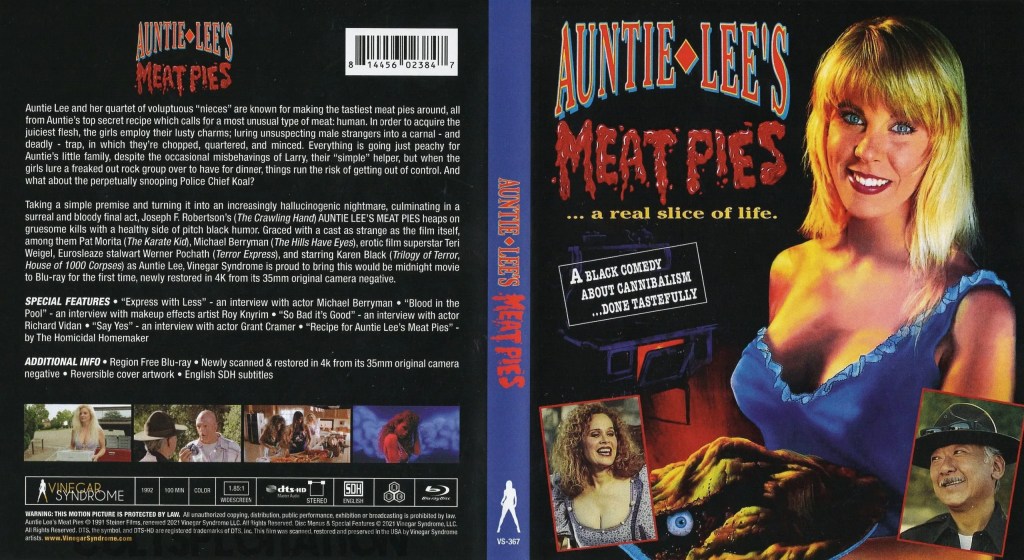
This is described on the cover of the Bluray disc as:
“A black comedy about cannibalism… done tastefully”
The particular genre of this little known 1992 film is “innocent cannibalism” – humans slaughtered and made into meat dishes for sale to unwitting customers; those customers thereby becoming the cannibals. It’s eternally fascinating, because everyone at one time has pulled something a bit lumpy or fibrous from their pie, hot dog or burger and wondered what (or who) that came from.
The plot is simple, even simplistic. Auntie Lee (the wonderful Karen Black) is a Satan-worshipper who sends her nubile nieces out to lure men back to the house/bakery (often by shooting out their tyres and then offering them a lift) where they are slaughtered in various grisly ways and then chopped up and made into pies, which are irresistibly delicious and widely sought after in the nearby restaurants.
This trope started with Sweeney Todd, the “Demon Barber of Fleet Street”, a crucial figure to modern cannibalism. There are those who argue that Sweeney really existed and was hanged outside Tyburn Prison in London in 1802. At any rate, his story was popularised in the 1846 “penny dreadful” A String of Pearls: a Romance (Prest, 2010) and remains enduringly popular. Sweeney in his early nineteenth century incarnation insouciantly slaughters his clients, dropping them through a trap-door and supplying their corpses to his partner, Mrs Lovett, to use in her popular meat pies, unwittingly setting a precedent for the industrial slaughter facilities that would proliferate in following years. The first movie version was a silent film in 1928, in which the whole narrative turned out to be a nightmare. A 1936 version showed Sweeney as a true hedonist, a man who just enjoyed killing and robbing his customers. Several remakes have happened since, most recently a musical by Tim Burton. A Danish adaptation called The Green Butchers with Mads Mikkelsen, who later played Hannibal in the eponymous television series, depicted unsuccessful butchers suddenly becoming wildly popular when they start serving human flesh. The 2021 French film Barbaque [Some Like it Rare] depicts French butchers hunting vegans whose flesh, unpolluted by animal products, turns out to be hugely popular with their customers.
Most recently, the Sweeney story has been reborn as a fictional “true-crime” podcast becoming a Broadway play, which in turn becomes a television series: the wonderful Horror of Dolores Roach, which I finished reviewing last week. Like Dolores Roach, Auntie Lee reverses the usual order of carnivorous virility—instead of the psychopathic male murderer (there is one, but he is dispatched quickly after raping one of the women), the killing is done by young, nubile women who lure men into traps which are increasingly intricate and gory. This is the monstrous-feminine – the male fear of what may happen when lust overcomes caution and the female reverses the birthing role and instead reabsorbs her victim.
The female killers are Playboy models, and were clearly chosen for talents other than their acting. However, other main characters are really good—Karen Black who has appeared in several horror B-movies is Auntie Lee, sending the girls out to bring home “the makings”, Pat Morita (Happy Days, Karate Kid) as the witless sheriff, and the inimitable Michael Berryman (One Flew Over the Cuckoo’s Nest (1975), The Hills Have Eyes), whose hypohidrotic ectodermal dysplasia gave him such an unusual appearance that he made a career from portraying everything from idiots to monsters.
Except for the wooden acting by the “nieces”, this is a well-acted, light-hearted if gory comedy, and many of the images are very striking.
At the end, after every man who enters the house is dead and being cooked, Auntie Lee and the nieces speculate about moving out of the town to New York City, where “we’ll never run out of beef”. In popular parlance, the brawny male is often called “beefsteak”, while sex is offered as a transaction, becoming almost indistinguishable from any other form of commodity, including feeding. As Coral says to the man she is leading to his death (using one of the most popular double entendres in Cannibal Studies):
“I can’t wait to have you inside me”
Such is the nature of modern capitalist cannibalism – the human is just another species, a resource like any other, potentially exploitable, vulnerable, even edible. Auntie Lee won’t cook Mormons or Californians, but New Yorkers are fair game, just as some people won’t eat pigs or dogs but will eat sheep or chickens. As Isaac Bashevis Singer said:
“As long as human beings will go on shedding the blood of animals, there will never be any peace.”
At the time of writing, the full movie is available on YouTube.
Gannibalis a new seven-episode television series set in present day, rural Japan. The show is based on a Manga series (comic or graphic novel) which appears to be available on-line.
In the first episode, we see a policeman raging outside a house, accusing the occupants of cannibalism. He soon comes to a sticky end.
Police officer Daigo Agawa becomes Chuzai (residential police officer) at the Kuge village, accompanied by his wife Yuki and daughter Mashiro, after the previous Chuzai mysteriously went missing (the same officer seen being killed in the opening). Daigo has caused some incident in his previous posting, which has led to his transfer to this remote and eerie (but very beautiful) village.
The daughter, Mashiro, seems to have no fear, but also refuses to speak, which Daigo believes is his fault. On his first day, Daigo is summoned by the Goto family, who seem to run the small forestry village, like a local crime family.
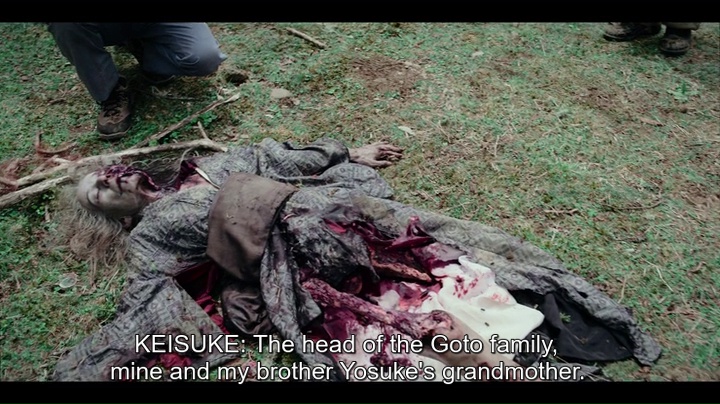
They have found the body of their grandmother, Gin Goto, the head of the family. They insist she was attacked by a bear, and pull out firearms when Daigo points out that the tooth marks on her arm are human.
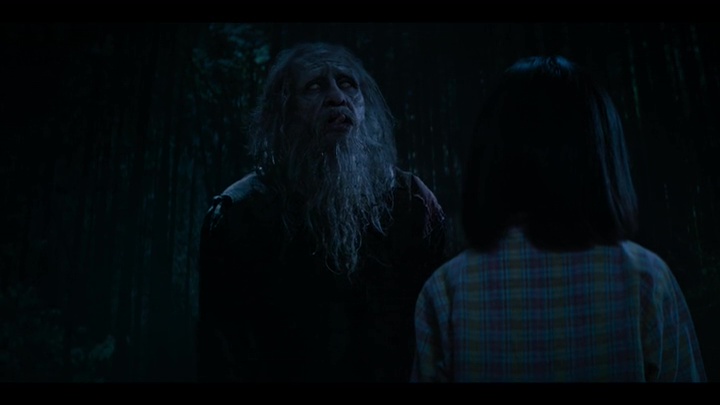
Meanwhile the little girl Mashiro wanders away from home, and meets up with a large blind guy who seems only able to snarl.
Showing no fear, she offers him a sugar candy, and in turn comes home with a human finger.
Problem: the finger is not from Gin Goto. Lots of people are, apparently, getting dismembered.
Daigo accompanies the Goto family on a hunt to find the bear that they claim ate Grandma, and is then attacked by a bear, who turns out to have granny’s specs in his stomach.
In a scene that could almost define carnivorous virility, the men gather around the bear and eat his flesh, a ritual that is supposed to keep Grandma within them.
This is what we call, in Cannibal Studies, “essentialism”, the idea that the spirit or strength of a person lives on by eating them, even if only via the bear that ate her (even though that’s clearly not what happened).
In the following episodes, Daigo slowly unravels the truth about cannibalism in the village.
Gannibal is directed by Shinzô Katayama, the director of the horror-thriller Missing. Reviews have been glowing, stressing how ‘gross’ and unsettling the show is. One tweet said:
Except for the opening, which is over the top in Japanese anime style, the acting is great, the suspense interesting without jump scares, the music eerie, and the photography beautiful. If you like a good suspense show and don’t mind subtitles, this one is highly recommended.
Gannibal started streaming December 28 on Hulu. Also available on Disney+.
Oxygen True Crime is a program brand within the NBCUniversal stable, and is rather oddly described as:
“a multi-platform high quality crime destination brand for women”
I guess because most of the murderers reported by the show are men?
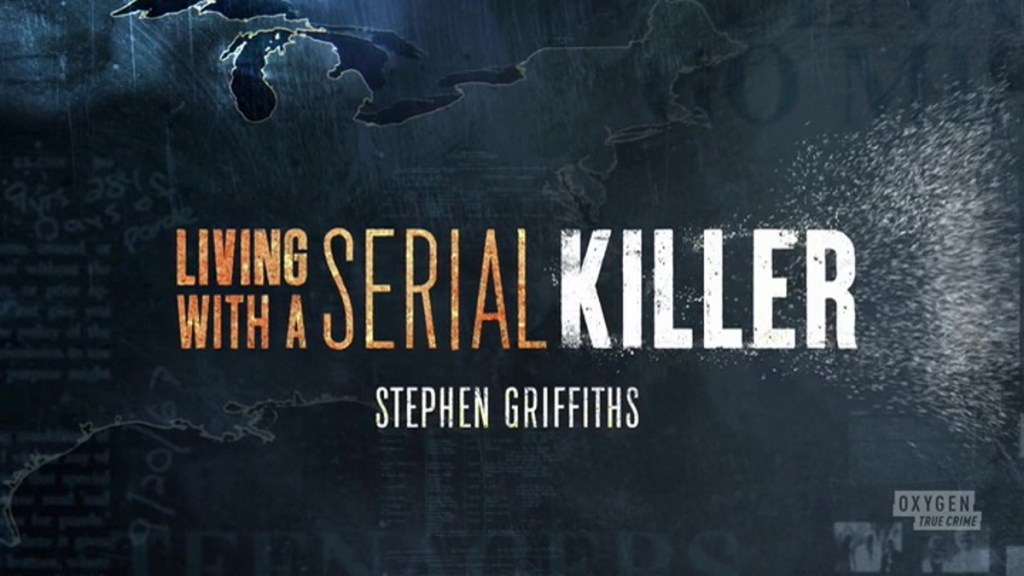
Anyway, the show we are reviewing here is part of the 2022 second season of an Oxygen series called Living with a Serial Killer, the first season of which aired in 2021. The program has covered a number of British and North American killers, including Steve Wright (the Suffolk Strangler), Peter Tobin, Timothy Boczkowski and a couple of women: Elizabeth Wettlaufer, a Canadian nurse who murdered several of her patients and Joanne Dennehy, who stabbed three men to death in 2013.
Living with a Serial Killer concentrates not so much on the killer, as do most true crime shows, but on the partners or friends or even children who lived with them, the people who thought they knew them, and it tells how they lived either in fear or else were oblivious to the exploits of the murderers. Most, but not all, of these unwilling companions were women.
Most of the killers were not cannibals, disappointingly for this blog, but one was, or says he was, despite there not being enough left of his victims to confirm or deny his claim. This was Stephen Griffiths, who stood up in court for his arraignment for murder and, when asked his name, identified himself as THE CROSSBOW CANNIBAL.
Griffiths killed three women in the city of Bradford, West Yorkshire, England in 2009 and 2010; 43-year-old Susan Rushworth disappeared on 22 June 2009, followed by 31-year-old Shelley Armitage on 26 April 2010 and 36-year-old Suzanne Blamires on 21 May that year.
The women were all Bradford sex workers. Parts of Blamires’s body, including her severed head still containing a crossbow bolt, were found in the River Aire in Shipley, near Bradford, on 25 May. Other human tissue found in the same river was later established to belong to Armitage. No remains of Rushworth were ever found. Griffiths was arrested after CCTV security footage caught him in the act of killing Suzanne Blamires. He not only committed the execution on camera but, after dragging her body inside his apartment, returned carrying his crossbow and gave a middle finger to the camera, knowing he had been seen.
Griffiths was a postgraduate research student studying criminology and specialising in British murderers, so he knew a great deal about killing and disposing of bodies. He also knew what sort of activities led to sensationalist press coverage, and he seems to have been determined to become more famous than one of his pin-ups, the Yorkshire Ripper, Peter Sutcliffe. Sutcliffe had murdered thirteen women in the same area between 1975 and 1980, and was at the time rotting in prison with several life sentences to serve, and judicial instructions that he was never to be released. Sutcliffe died in November 2020 after refusing treatment for COVID-19.
After his arrest, which happened a few days later when the caretaker checked the CCTV tapes, Griffiths readily admitted the murders to the police, telling them he had eaten some of his victims’ flesh, and adding, “That’s part of the magic.”
The program focuses on Kathy Hancock, who lived with Griffiths for a considerable time. A tough woman, a prison officer when they met, she was physically abused by him, poisoned, and perhaps worst of all psychologically tortured (particularly when he stole her dogs) to the extent that she was unable to escape his influence. She did not know that he was a serial killer, but was not very surprised when she found out. Despite the occasional escape, she was with him or under his influence for much of the decade from 2001 until his arrest in 2010.
When interviewed by West Yorkshire Police (extract at the top of this blog), Griffiths was asked why he killed the three sex-workers. His reply:
“I don’t know. Well, I’m misanthropic. I don’t have much time for the human race.”
Police divers found 159 pieces of human tissue when they searched the River Aire; almost all were from the final victim, Suzanne Blamires. There were only two parts of Shelley Armitage found – a part of her spine and a section of flesh revealing knife marks. Susan Rushworth’s family had no definite confirmation of her death or disposal, and no remains over which to mourn. He told the police:
“… it was just meat in the bath that was chopped up and churned, some of it eaten raw and I don’t know after that. I don’t know where she is.”
Griffiths claimed to be possessed by an alter ego named Ven Pariah who took over his social media accounts and boasted of his exploits. Psychiatrists found him fit to be tried, but it is still possible that his psychotic episodes (he was diagnosed as a sadistic schizoid psychopath) accompanied the murders and he really does not know what happened subsequently. It does sound a bit convenient though, like Hans Beckert in Fritz Lang’s M – EINE STADT SUCHT EINEN MÖRDER, who claimed he could not remember murdering and consuming his child victims, particularly as Griffiths seems to have clear recall of the actual murders and dismemberments.
Or he could be making it all up, since we know that Griffiths was desperate to be (in)famous and, as a student of criminology, would have been aware that cannibalism would make far bigger headlines than murder.
But here’s another explanation. Griffiths told police that he did not particularly despise sex workers, but that they were easy targets – they worked on dark, run-down streets and, due to their propensity for addiction, the police were unlikely to worry too much if they disappeared – there were plenty of other possible explanations besides murder. This is reminiscent of Albert Fish, who killed and ate African-American and Latino children, not because he was a racist, but because he knew the police would not look too hard for them.
Griffiths’ hatred was not aimed at sex workers but at women in general. He was insecure, vain, and had a desperate need to dominate. This is indicated in his relationship with Kathy Hancock, whom he abused and tormented despite the fact that she was voluntarily cohabiting with him. When she finally left he stalked and threatened her, to the extent that she finally moved overseas to get as far away from him as possible.
The ultimate form of control is to kill and consume the ‘other’. Humans do it all the time to other animals to establish an ideological superiority and supremacy – we eat meat (some of us) not because it is necessary for our health but because sacrificing the animal demonstrates human exceptionalism. It elevates the human, or those privileged to be considered human, to a higher plane than other animals and ‘lesser’ or sub-humans (untermenschen), whom we feel free to exploit in a wide variety of ways such as slavery, sweatshops and, in the extreme, cannibal feasting. Griffiths’ profound misogyny could find its deepest expression not in paying for the use of their bodies, or even ‘just’ killing them, but in utterly destroying them, and at the same time absorbing them into his own body, thereby destroying their independent subjectivity and making them exist only as part of him. Cannibalism offers ultimate power and control over the victims.
David Wilson, Professor of Criminology and Criminal Justice at Birmingham City University, said that
“We want to see serial killers as real aberrations, as different from dominant beings in our culture, but often they are just extreme versions of other beings of their time.”
Was Stephen Griffiths a cannibal or a braggart? We’ll never know for certain. Claims of cannibalism are hard to confirm, as the perpetrator is often undiscovered, unreliable, or dead. Except for cases where cannibals recorded their acts on video tape (such as Armin Meiwes), we only have the verification of missing flesh or slashed bones, evidence over which everyone from archaeologists to forensic scientists can argue forever, or the confessions of the cannibal, which can be easily retracted before trial or may prove to be just boasting and narcissistic grandstanding. Griffiths told the police:
“It was just a slaughterhouse in the bath tub.”
The cannibal, whether literal or metaphorical, is essentially enacting an extreme form of carnivorous virility, and thereby questioning the conventional view of humans as above nature, as not animals, not meat. The cannibal makes us look at ourselves as edible, and thereby question our place in, and exploitation of, the natural world. The bath tub, our symbol of cleanliness and separation from the dirt and smell of nature, becomes a slaughterhouse. The slaughterhouse, normally hidden in remote towns behind high walls, comes home.
The world’s most popular pastime is eating. Plants “eat” carbon dioxide and water and turn it into carbohydrates, which animals then eat. Some animals then eat those animals. The theologian William Ralph Inge described nature as “a conjugation of the verb to eat, in the active and the passive”. Everyone is eating most of the time. When appetite becomes too voracious, we end up eating each other, or being eaten.
The video starts with members of a focus group being told they were trying human flesh.
The video shows Erik Karlsson as an entrepreneur who is trying to persuade investors to back his project to grow human meat for sale in supermarkets, and especially meat that is grown from the cells of Sweden’s national treasure, the actor Alexander Skarsgård. He then tries to persuade Skarsgård to donate some cells, for which he offers a partnership in the company. No dice.
The trailer at the top of this blog links to a website which explains the theory behind the longer clip, which is also available on YouTube: Eat a Swede (which has subtitles) or at the Eat a Swedewebsite. Karlsson tells us that
“In 2050, the global population will reach 10 BILLION. The demand for food is expected to increase by 98%.”
There is no doubt that current meat industries are environmentally unsustainable. Humans slaughter some seventy billion (70,000,000,000) land animals every year for food, and trillions of sea animals. Yet most of the world’s people eat far less meat than Americans or Australians, and biologist E.O. Wilson estimated that for the rest of the world to reach those levels of consumption would require four more planet Earths. Other options for replacing meat include fungus, insects, larvae, etc. But why would we eat maggots (or pigs) when we have flesh from clean-living, environmentally conscious Swedes?
So anyway, meticulous detective work (AKA a quick glance at the website) revealed that this is not in fact a real company, nor are they growing real human flesh in the lab. It’s what they describe as “edutainment” or “mockumentary”. The Swedish Food Federation – an industry organization with about 800 member companies from Arla and Absolut to Oatly and Orkla – wanted to share their knowledge about sustainable food production, and in the process increase the competitive edge for Swedish food. Release a website on sustainable agriculture and you may get a few dozen likes. Make a “mockumentary” on growing human meat and
The people in the focus were actually eating “Swedish tenderloin” cut from the loin of an animal who had no doubt suffered and died at a tender age (as the name seems to imply). Probably a cow, although there is also a cut known as tenderloin from chickens, but for this process, I would think they would choose a cow because, apparently, our flesh tastes like beef, according to some people who have tried it (others say pork from wild pigs).
But the technology is already here. It is possible to grow cells in the laboratory, taking cells from an animal (and let us not forget that we ARE animals) and culture them into, well, meat. Clean meat, often called in vitro or lab meat, is meat grown in sterile laboratory conditions from animal cells. It is not plant-based meat, as so many supermarkets now offer, but actual flesh, grown in a nutritional medium, instead of cut from the carcass of a slaughtered animal. The idea is the basis of Brandon Cronenberg’s film Antiviral. While this may be a potential threat to the meat industries if /when it becomes commercially viable, it presents an immediate challenge to our culture of carnivorous virility, the ideology that makes us feel superior to other animals, demi-gods, the sacrificial violence that maintains the abyss between humans and other animals while bolstering the image of masculinity in most cultures.
More relevant to this thesis is the fact that clean meat could be grown from any animal cell. Want to try whale meat? Like to see what dodos or dinosaurs tasted like? Find a readable chain of DNA and contract the lab. And of course, the easiest cells to source are human ones – we hand them over to pathologists and crime scene investigators all the time. If clean meat becomes a reality, there is no reason (other than administrative) to assume we could not grow human steaks, livers or sweetbreads. And as Erik says:
“It’s the only product where we have consent that it’s fine to eat it. We have a donor – that person has said ‘you can take my cells, you can grow them, and it’s fine with me that you eat them.’”
The artist Diego Rivera claimed in his memoir that human flesh is the most “assimilable” of foods for humans. Most testimonies by actual cannibals attest that human meat is not unique, and tastes similar to veal or pork. Erik says, tongue presumably in cheek, that human meat tastes like crocodile. Which, he says, tastes like – chicken.
“Since they say you are what you eat, why not eat a Swede?”
It is fascinating that polite society finds perfectly acceptable the confinement and torment of billions of animals in wretched conditions until they are slaughtered, yet so many people are shocked and repulsed by the idea of meat from a different animal, Homo sapiens, grown in sterile conditions with no need for branding, castration, confinement, slaughter and disembowelment.
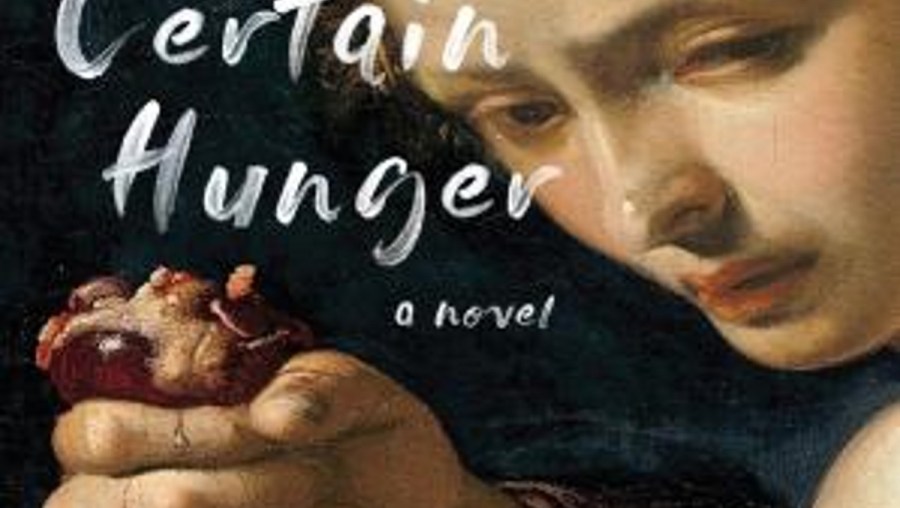
I guess it was only a matter of time before cannibalism became part of the culture wars. A light-hearted article in the New York Times July 23 by freelance writer Alex Beggs looked at the undeniable plethora of cannibalism narratives in contemporary movies, TV series, books and news reports, including the TV series Yellowjackets and the recent novel A Certain Hunger by Chelsea Summers, in which a (female) restaurant critic develops a taste for (male) human flesh. The article asserted:
“Turns out, cannibalism has a time and a place. In the pages of some recent stomach-churning books, and on television and film screens, Ms. Summers and others suggest that that time is now.”
Alex Begg has also written for Bon Appétit magazine, making her well qualified to write about food, of whatever provenance. Cooking shows are full of lumps of meat being baked and braised and broiled and smothered in sauces; why not add humans to the livestock list? There certainly are billions of us.
The appearance of cannibalism in secular culture reflects the fading of traditional morality. As Dostoevsky warned in The Brothers Karamazov, without a belief in “immortality” (implying divine judgement), “everything would be lawful, even cannibalism”. Our reflexive distaste for cannibalism (and our fascination with it) comes from the belief that humans are somehow not animals, or animals that have transcended animality – it all comes back to the Biblical statement that we are made in “the image of God”, whatever that means.
Such a belief, with or without support from on high, is called anthropocentrism, or sometimes speciesism, and is maintained by the practice of killing other animals in ever increasing numbers, to prove our superiority. Jacques Derrida called that “carnivorous virility”, but what happens when the lust to kill outruns the limits of anthropocentrism and is instead turned back on fellow humans? We have people who see humans as just another edible species, like Sawney Bean, Sweeney Todd, Albert Fish, Ed Gein, Jeffrey Dahmer and of course Hannibal Lecter. Not all of those were real people, and not all the facts about the real ones are real facts, but one fact remains: humans are animals, and animals are made of meat. When a society reaches a point where the old ethical agreements are disintegrating, it can either forge new ones or dissolve into chaos, war and, yes, cannibalism. At a time when the news is full of pandemics, climate change, famine, school shootings and political turmoil, is it so surprising that cultural representations show us eating each other?
Did I mention culture wars? Those who despise the New York Times (a certain and fairly large section of America apparently) came out with their anti-cannibalism guns blazing (they like guns, love meat, don’t like cannibals – it does seem a little inconsistent.)
“It’s a sign that our culture and civilization has become so decadent, so enamored by sensation, that we actually fetishize eating death…. We now live in a Culture of Death, in which we regard books, television, and film drama about the eating of human beings as pleasurable, as exciting.”
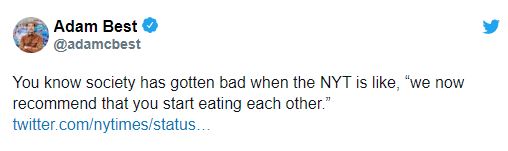
On Twitter, reactions poured in such as that of writer Emmanuel Rincón:
Zack Kanter tweeted
“A zero sum worldview, irrational fear of overpopulation, and hatred of success will inevitably lead NYT journos to the literal conclusion of ‘eat the rich.’”
Journalist Tom Fitton tweeted
“NY Times, taking a break from promoting the mass killing of the unborn through abortion, promotes cannibalism.”
Many had clearly not even bothered to read the article:
And a blessedly brief journalist, Sameera Khan, tweeted
“THIS IS SATANISM”
Greg Gutfeld on his high rating Fox talk show (if you haven’t seen him, imagine a fairy waved a wand and turned The Colbert Report into a real boy) took the opportunity to pack every cannibal pun imaginable (“it’s an ATE part series”) into a short segment, as well as several digs at other shows run by Liberals such as Samantha Bee, and their regular target, CNN. Gutfeld accuses comedian Tom Shillue (formerly of The Daily Show!) of thinking he would be delicious, because he is all white meat.
The gist of much of the criticism was that the Liberal elite are trying to normalise cannibalism, as a way to – what? Reduce overpopulation? Feed the hungry? The website Editorials 360 accuses a “globalist cabal” of planning to make us all eat insects and humans, and drink recycled sewage, a fiendish plot “to enslave, denigrate and dehumanize humanity.”
The website TMZ recalled that the movie Soylent Green was set in 2022, which was then fifty years in the future, but is now, well, now. Are we in fact normalising cannibalism, because it is the logical end-point of voracious consumerism?
Soylent Green is a good place to start the analysis of this “normalizing” phenomenon. Even after fifty years, it is still the movie many people name when cannibalism comes up in discussion (as it seems to do quite a lot whenever thecannibalguy is around). The movie [spoiler alert] was set in 2022 New York, which is portrayed as part of a failed state, in which overpopulation and global warming has led to a chronic shortage of food, leading the authorities (secretly) to grind up humans who have died (or agreed to be euthanised) and convert them into nutritious protein crackers called Soylent Green. Setting it in 2022 was a bit pessimistic, but let us remember that the world’s human population has almost doubled since the movie was made fifty years ago, and that CO2 concentration was 330 parts per million in 1973, compared to around 420 now. Are we entering a time when our voracious consumerism will so deplete the planet that, as Cormac McCarthy suggested, the only thing left to eat will be each other?
Chelsea Summers put it in a political context, relating cannibalism to capitalism:
“Cannibalism is about consumption and it’s about burning up from the inside in order to exist.”
“Cannibalism is the extreme conclusion of the idea that humans – and their bodies – do not have inherent value that demands respect. American society has been traveling down this philosophical road for a while. It started with legalizing abortion: After Roe v. Wade in 1973, any baby born or killed was just a “choice” at the mercy of their parents. They were not recognized as having inherent value with rights to their body or their life. More recently were the mandatory lockdowns, mask wearing, and vaccinations for Covid-19. Again, a lack of respect for human bodies and for our ability to make decisions for ourselves occurred. The encroachment on human dignity could potentially continue to progress into cannibalism – where the bodies of others have no inherent meaning, value, or sacredness that separates them from the animals we do rightfully and naturally eat.”
Lots of problems with that explanation, not least no attempt to explain the “inherent value” of humans or the assumption that we can eat other animals “rightfully and naturally.” But it is a pretty good summation of the unexamined assumptions at the heart of most writings on cannibalism, or carnivorism, or vivisection, or hunting – the idea that humans are somehow more than animals, and less than edible, while every other species on the planet is stripped of all moral value.
However, talking about cannibalism can put people off the slaughter treadmill altogether. When fact checkers came to ask Chelsea Summers about the way the book’s anti-heroine gastronomically prepares her murdered lovers, their questions about the intricacies of human butchery so disturbed her that she went “full raw vegan for two weeks.” Tobe Hooper gave up meat while making The Texas Chain Saw Massacre, saying “the heart of the film was about meat; it’s about the chain of life and killing sentient beings”. He also claimed that Guillermo Del Toro, no shrinking violet himself in abject filmmaking, gave up meat after seeing it. Bryan Fuller, creator of Hannibal, gave up eating meat during filming of the first season, telling Entertainment Weekly he had been:
“writing about cannibalism for the last three years but also doing considerable research on the psychology of animals, and how sophisticated cows and pigs and the animals that we eat actually are.”
Shows like Hannibal and The Santa Clarita Diet show human flesh as “just meat.” But to do that, they have to (their legal departments insist) come up with ways of simulating the human flesh without actually killing people (or digging them up like Ed Gein). The Yellowjackets prop team chose to use venison (think Bambi). But, the showrunners warned,
“they’ll have to find an alternative for future episodes, because many in its cast are vegan.”
Portrayals of cannibalism, whether actual or fictional, can make some people hungry, and turn others against eating flesh.
Gutfeld points out that:
“In the mind of the NY Times, it’s probably more humane to eat a human being than an animal.”
By “animal”, Gutfeld presumably means every multicellular, eukaryotic organisms in the biological kingdom Animalia except one – Homo sapiens. We know we are a species of great ape, but spend much of our time pretending we don’t know that.
Being humane, being ethical, is largely about respect and consent. Which was precisely the defence offered by Armin Meiwes when arrested for eating a man who had made it very clear he wanted to be eaten. Cannibalism texts, in ever-increasing numbers, joyfully confound the human/animal divide, and show the human body as edible flesh. So it is not surprising that such questions will be raised, and that, as the NYT said, “that time is now.”
However, Ted Cruz, who likes cannibalism jokes as much as the next meal, came up with a brilliant two-word solution that will put people off human flesh for a considerable time:
In 1987, Japanese student Issei Sagawa murdered a young Dutch woman, Renée Hartevelt, a fellow student at the Paris Sorbonne, then mutilated, cannibalised, and performed necrophilia on her corpse over a period of two days.
Sagawa was declared insane in France and returned to Japan, where he could not be tried for murder as no evidence had been sent by the French. A free man, he became something of a celebrity, making torture porn movies, selling paintings (many of them nudes), writing books and manga showing his crime, and even becoming a food critic. The fascination so many people feel with the life and crimes of Issei Sagawa is shown by the number of documentaries made about him:
Cannibal Superstar (Viasat Explore, Sweden, 1986, 47 minutes)
Excuse Me for Living (Channel 4, UK, 1993, 60 minutes)
Interview with a Cannibal (Vice, US, 2011, 34 minutes)
And, most recently, this one: Canniba, made by two artists/anthropologists, Véréna Paravel and Lucien Castaing-Taylor from Harvard’s Sensory Ethnography Lab. Unlike the more standard documentaries which deal in psychoanalytic speculations and dramatic narration, this one is an extreme close-up of the cannibal himself, in his declining years. The only characters shown are Sagawa himself, his brother Jun and a young woman carer, who is inappropriately dressed in a maid’s uniform and happily tells him zombie stories as she prepares him for bed. Sagawa was hospitalized in 2013 from a cerebral infarction, which permanently damaged his nervous system, and due to this and severe diabetes is largely unresponsive through most of the filming, becoming animated only when discussing his murder of Renée. Jun sums his brother up:
“Cannibalism is really very much nourished by fetishistic desire. The desire to lick the lips of your lover, and things like that, are based on primal urges. Cannibalism is just an extension of that. Both extremes exist within him. Cannibalism is a totally different world for him.”
The film seems to ask us to consider our own fetishes (you don’t have any? That would make you unique) and asks whether we are repulsed by Sagawa’s acts, or by the abjection in ourselves which he forces us to confront.
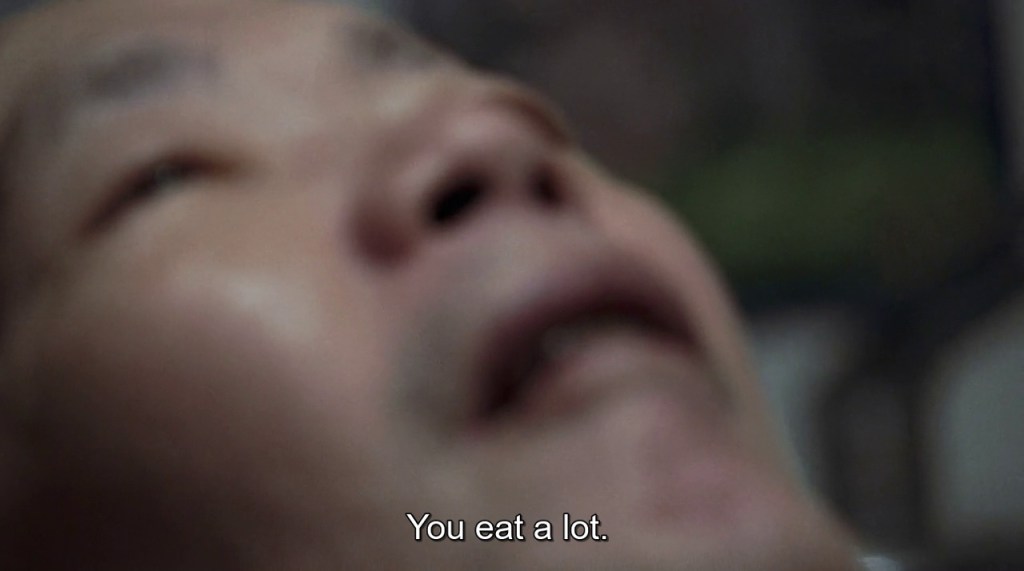
The first thirty minutes are a gruelling close-up of the two men – Issei and Jun and their desultory interactions, with the camera so close you can see every pore, except when it (blessedly) goes out of focus. Issei is largely catatonic, staring sightlessly as we, in turn, stare in extreme close-up at his face, which looks almost like a death mask. The only signs of animation are when he is offered chocolate, of which he seems inordinately fond, perhaps as a substitute for the human flesh he so craved. Probably not great for his diabetes, but we’re not really hoping for a happy ending to this story.
Unable to see a future, Issei dwells on the past. He remembers his mother telling him in graphic detail about falling down some stairs in a department store and miscarrying.
From this glimpse of the behavioural background to his subsequent actions, we are suddenly catapulted to a clip of a much younger Issei in a porn film, biting a woman’s buttocks, as he did to the dead victim, then being urinated on and finally masturbated by her.
The horror of his ruined visage is contrasted to the prudish pixilation of the debauchery.
If we haven’t walked out by now, as many of the audience did at the early screenings in the Toronto and Venice film festivals, we are then treated to his commentary, now quite animated, on his manga – a comic-book format showing his murder, rape and cannibalisation of the young woman. His brother tut-tuts throughout, saying he doesn’t want to see such things, while Issei explains what he did, and what it meant to him.
“For a hideous person like me, she was out of reach.”
A bullet in the back of her neck was the only way he could think of to bring her into his reach.
“Finally the thing I was craving to eat was right in front of me! The stench doesn’t matter. I started with the richest part of her right buttock.”
The murder and cannibalism turned a shy, diminutive man-child into a fierce Samurai, in his own mind.
He describes the eating the flesh (the harvesting of which is shown in detail in the manga) as “an historical moment!” For that brief time, the woman was entirely his, and what Derrida called carnivorous virility gave him an absurd sense of masculine power as he “dominated” the woman’s corpse for his sexual and gastronomic pleasure.
There’s heaps more, but you’ll have to watch the film or get the manga – my blog has its limits.
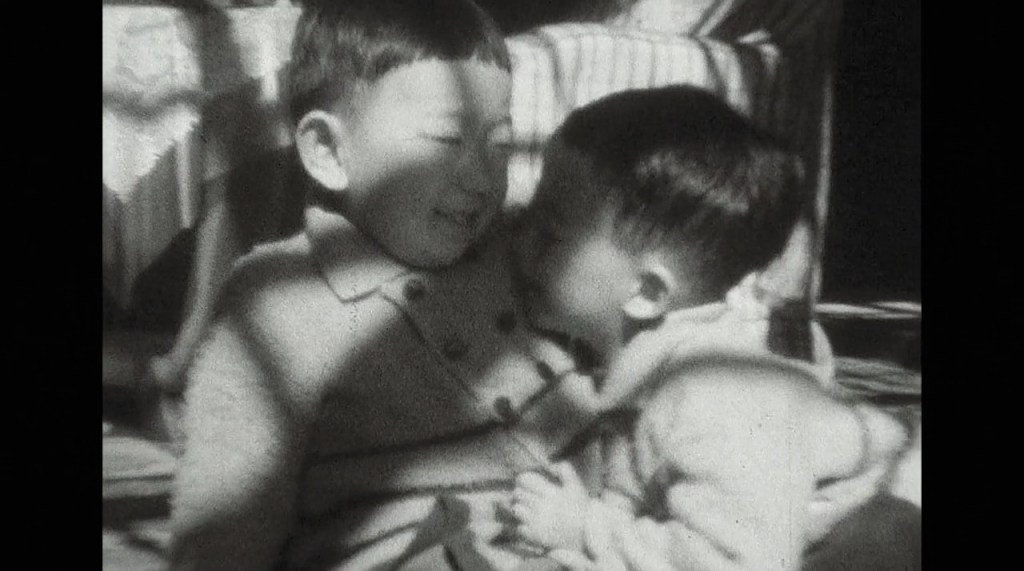
The film then disconcertingly lurches into home movies of the two men when they were cute little boys.
We are not given a commentary, but we know from other accounts that their uncle would dress up as a cannibal and capture them for his cooking pot. The psychoanalysts would eat that up, but we should consider that many of us are chased by various demented relatives in our childhood games without going on to become monsters in their likeness.
Issei’s brother Jun, now his carer, appears as the sane one in the family, but we are quickly disabused of that as we see his own self-abuse – he likes to wrap his arms in barbed wire, and cut his arms with knives. Everyone needs a hobby I guess. Issei is not impressed – compared to shooting a woman from behind and then having sex with the body and eating parts of it, a bit of cutting would seem fairly tame to him.
Finally we meet the carer, a young, attractive women dressed as a maid. This is actually Satomi Yôko, an actress playing a maid playing a carer, a further jolt to our fragile sense of reality. She giggles over Issei, telling him, as he stares into her breasts (a particular fetish of his):
She asks him if he wants to cosplay a zombie, and tells him a convoluted story about a zombie woman who eats the old man who keeps her in chains, a reversal of his history, and another fetish of Issei’s, who early in the film says “I want to be eaten by Renée.” She tells him:
“For the zombie to survive, I have to keep eating live humans… I’m alive, but I can’t be with normal humans.”
It’s a perfect summation for the fate of Issei Sagawa.
The only soundtrack is at the very end, TheStranglers’ 1981 song “La Folie” (“madness”) which concerned Sagawa’s crime.
It’s in French, but the partial translation is:
He was once a student Who strongly wanted, like in literature, His girlfriend, she was so sweet That he could almost eat her Rejecting all vices Warding off all evils Destroying all beauty
The film managed 53% fresh on Rotten Tomatoes, while the New York Times called the movie “an exercise in intellectualized scab-picking.” IndieWire summed up:
“Caniba” ranks among the most unpleasant movies ever made, but that doesn’t mean you shouldn’t see it.
This is an English film, unlike most of the reviews in this blog, which overwhelmingly come from the USA or, if we are thinking real video nasties, Italy. It falls into the delightful genre of dystopian cannibalism films, in which some disaster, often unnamed, has stripped the thin veneer of civilisation from the survivors and left them with one option to survive – human flesh. There are lots of films in the survivor genre – The Time Machine is a classic, set thousands of years in the future, but most are set in the very near future or even an alternative present – think Soylent Green (set in 2022), 28 Days Later or Delicatessen.
The closest to Tear Me Apart, though, is the chilling 2009 film version of Cormac McCarthy’s The Road, in which an unnamed man and boy travel through a world stripped of all animals and plants except for a few humans, most of whom have become cannibals to survive. Will they maintain their anthropocentric belief in the sacredness of human life and flesh?
In this film, it’s two brothers, also unnamed, the younger as naïve and clueless as the little boy in The Road. But it’s also a coming-of-age story, because one of the proposed victims who they intend to feast on is a young woman (like us, the older brother says, only different), perhaps the last surviving woman on earth, and do they really want to eat her?
Making the story line more intriguing is the constant presence of the ocean, the source of all life, the original mother, where the young men wait for a father who has long since vanished. The ocean supplies them limited amounts of fish to eat, but in the opening scene, the younger brother smothers a man, cuts and eats pieces of his flesh, only to be admonished by his brother –
“What would father say? I won’t warn you again – NEVER PEOPLE!”
Father may have left them on the beach to “wait it out” but now he is a mythical figure, whose rules override the primal instincts of the unschooled younger boy, who constantly gets in trouble for snacking on his victim. Because, you know, “he’s a man!” But his instinct is to fight, to kill, to eat. He is the carnivorous male, unpolished and uninhibited by social morality; as his brother says “he doesn’t know the difference between eating a fish and eating a human”. This is precisely the point – the young man has no social conditioning – he is not the vicious cannibal of so many horror films; he eats humans because he is hungry, just as a hungry dog or any other animal might.
He is a savage, simian Adam in Eden, following the rules without understanding them, rules passed down by a “father” he scarcely remembers, who may offer a second coming in some indefinable future, and who has bequeathed dietary restrictions that must be followed even though they make little sense.
But then he comes across the young woman, no physical threat but much smarter than both of the brothers. In a piece of blindingly obvious symbolism, she hands the young man an apple, with a smile. She’s also looking for her dad. Aren’t we all?
The boy goes back to his brother, who takes the apple and tells him “don’t eat this stuff, OK? It’ll make you ill”. We’re still referencing Genesis, a fierce version, in which they may eat of anything in the garden (even people) but not of the tree of the knowledge of good and evil. Her fruit actually does make him ill, because he hasn’t eaten fruit for many years. This is the carnivorous virility that Derrida said was the basis of subjectivity, but without community it turns back onto his own gut.
The brothers don’t have names because names don’t mean anything, at least until the “old world” comes back. But she has a name, Molly, and she declares the younger man will be called Joe. Like Adam, she gives names to all the animals. She makes them bury the stiff they have been eating, because, she says, the world can’t survive like this.
She even rigs up a cross for his grave, just as Joe chews the last of the dead man’s flesh.
But she has introduced them to temptation. Also to vegetarianism:
“You can’t eat meat forever. The people you eat – they have people who loved them.”
A beautifully simple argument against eating meat.
She takes his hand and puts it on her breast. Bright eyed and vulnerable, she asks “do you want to eat me?” The double entendre here is far from Biblical.
There may perhaps not be any other women left – Molly says that there was a collective in “the town” – the symbolic civilisation for which both fathers have disappeared while searching for it – but now that is just a myth as well. Well, there is one other woman but she has become “an animal” – growling and threatening. A Lilith reference perhaps? But there are certainly other men, not just the lone men who Joe ambushes and eats, but a more vicious group, with guns. Like The Road, but with a touch of On the Beach.
The trio learn fear, hunger, desire. Molly tells Joe “You don’t have to follow the rules any more.” There’s a menage-a-trois which of course leads to jealousy and we get a serve of Cain and Abel as the brothers brawl. Molly’s father makes a brief appearance, as (spoiler alert) a good meal for their return to the beach, their wild Eden. So now we’re dipping into the New Testament, eating the blood and body of their saviour. Yes, the last humans, like the first humans, have truly eaten from the tree of the knowledge of good and evil.
The film is only 82 minutes, but a lot of reviewers thought that it drags. I didn’t see it that way – the story is low key but the acting is great and the characterisation is quirky and interesting in its peeling back of the sociality we take for granted. I think a lot of critics watched the film expecting a cannibal gore-fest, and that it is not. It’s a low budget film, yet the cinematography is splendid with the scenery of the sea (it’s filmed in Cornwall) quite beautiful. It may be hard to find, but at the time of writing the full film is available on YouTube, with Arabic subtitles. Since the Scottish accents are often impenetrable, that will prove quite useful – if you speak Arabic.


























 The Cannibal Guy