The revenge of nature: WENDIGO (Larry Fessenden, 2001)

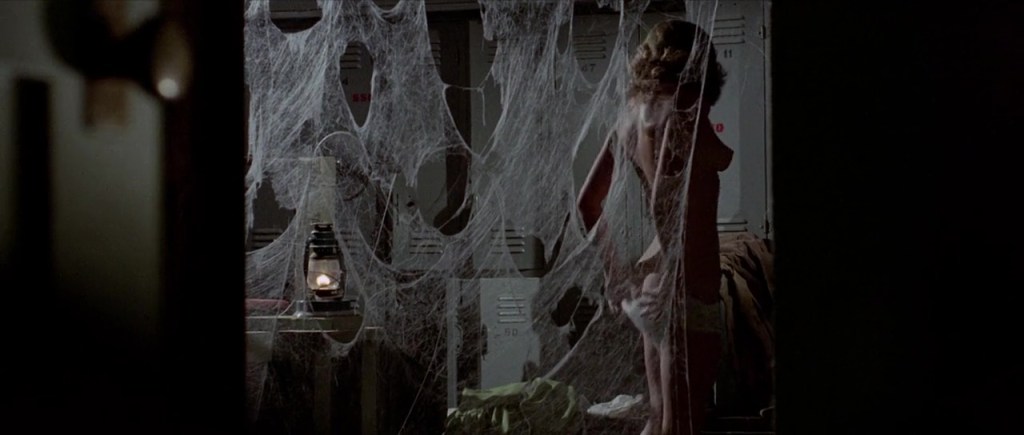
Wendigo is a film written, directed and edited by Larry Fessenden, who would, a few years later, make an episode of the TV horror series Fear Itself called SKIN AND BONES, which was about a guy who disappears on a hunting trip with friends and returns cold, thin and desperately hungry. He has, we quickly discover, become a Wendigo! In this, the earlier film, there are also crazy hunters led by Otis (John Speredakos), who are mad with our protagonists for driving into a stag (the traditional symbol of the Wendigo) who they have been tracking and, worst of all, breaking his antlers, which are apparently very valuable. The Wendigo is already there in their cabin as a “dark presence”, so we just need to be introduced.

First, the really good cast – George (the Dad) is played by Jake Weber, from the 2004 remake of Dawn of the Dead and Meet Joe Black. He is a super-stressed New York photographer, and the last thing he needs is a run-in with a bunch of redneck hunters. Kim, the Mom, is played by the wonderful Patricia Clarkson (most recently starring in Gray) and the kid, Miles, is played by Erik Per Sullivan, who was Dewey in Malcolm in the Middle.

George is more disturbed by the rednecks than he is willing to let on, telling Kim, who is a psychologist, that he is distressed by the “abyss” between him and them, with no possibility of communication. She tells him that:

“It’s very archetypical for the civilised man to feel threatened by the man of the country.”

George is utterly divorced from nature, seeing it as alien and menacing. So, the other last thing he needs to meet is a Wendigo, a figure on the front line of the human war on nature.

They head into town to buy curry (as you do in small towns) and Miles meets in the store a Native American Elder who tells him about the Wendigo, a small carving of which Miles is drawn to.

“The Wendigo is a mighty powerful spirit… it can take on many forms, part wind, part tree, part man, part beast. Shape shifting between them… It can fly at you, like a sudden storm, without warning, and consume you with its ferocious appetite. The Wendigo is hungry, always hungry. The more it eats, the bigger it gets, and the bigger it gets, the hungrier it gets, and we are hopeless in the face of it. We are consumed, devoured…. There are spirits that are angry. Nobody believes in spirits anymore. Doesn’t mean they’re not there.”

The Wendigo is a figure from the mythology of the Algonquin people of North America. They lived in a land of long winters where the competition for food would have been intense and cannibalism of the dead probably not unusual. Myths help to spell out behaviours that societies need to discourage – cannibalism could decimate small, isolated communities. That myth, of the voracious monster whose hunger only grows with feeding, was later applied to the invaders, the colonists who took their land, their produce and often their lives. In such a struggle, the Wendigo, as an original figure of their culture, could take almost a vengeful role, eating the technologically superior invaders. George inadvertently confirms this, telling Miles “the Wendigo only goes after bad guys.”

The Elder tells Miles he can keep the figure, but there is no sign of him when Kim is subsequently asked to pay for it. He is presumably one of those spirits, not angry but advisory.  He warns Miles about the “cry of the Wendigo”. The Wendigo is clearly (to the audience) imbued into that carving.

Then the Wendigo strikes. Or is it the rednecks? Did the Wendigo knock George off his sled, or did it carry him home after Otis shot him? Was it the revenge of nature, or society? When the Wendigo later demands of Otis “Give me my liver!” it voices the cry of revenge of every animal, human and otherwise, killed for fun or profit. When Otis meets justice, Miles awakes with his Wendigo figure in his hand.

It’s a great cast, with an absorbing plot, although it gets a bit lost at the end. But the questions it asks are compelling.  The New York Times critic wrote:

“Mr. Fessenden carefully blurs the line between psychology and the supernatural, suggesting that each is strongly implicated in the other. The rampaging Wendigo may be a manifestation of Miles’s incipient Oedipal rage, but at the same time it is a force embedded in nature and history.”

The Wendigo carries so much symbolism, besides the horror trope in which he seems so regularly to find himself, such as in Fear Itself or the classic Wendigo film, Ravenous, which was made a couple of years before this film. He expresses the anger that rages within George, the father who cannot show interest in his son’s curiosity because of his own issues brought with him from the city, frustration and fear of failure. And we can infer (as the NYT does) that Miles himself feels an Oedipal rage toward his father who, Freud tells us, is the child’s rival for sexual possession of the mother throughout childhood. The voracious hunger comes from an even earlier stage, what Freud called the “cannibalistic stage” of babyhood, where the infant wants to own the breast, consume it so it will always remain in his possession. George’s playacting the cannibal, attacking and pretending to eat Miles, is a common parent/child game, but is also deeply revealing of these forces hidden deep in the unconscious.

At yet another level, the Wendigo represents the revenge of nature on the civilised, those whose insatiable hunger for growth decimates the land and finds sport in killing its inhabitants, be they human, deer or any ‘other’. The antler is a weapon used by the stag, a normally shy and timorous animal who becomes a formidable fighter in the mating season, and the size and strength of its antlers represents both its sexual and fighting prowess. In the hybrid shape of a human and a stag, the Wendigo recasts humans from hunters to hunted, from predator to prey. This is precisely why Hannibal Lecter is shown in Wendigo form throughout much of the three seasons of the television series Hannibal. Hannibal is the civilised, rational, erudite man of science, a psychiatrist who knows of the dark forces inside the human psyche, and has determined that the human is just another animal, no more deserving of respect or inedibility than any other species, and even less if he happens to be rude. Who judges that – the supernatural force, the inhuman, the less-than-human or, in Hannibal’s opinion, the more-than-human? Whichever you choose, it appears as the Wendigo.
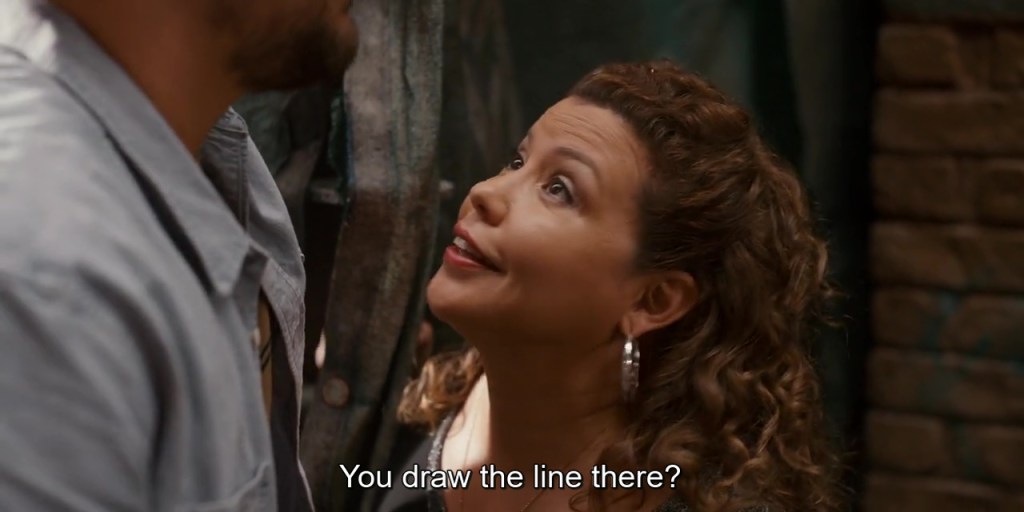
“You draw the line there?”: DOLORES ROACH episodes 7 & 8

The climax. The denouement. The final two episodes of this quite brilliant podcast that became a Broadway show that became a television series about an untrue true crime, and includes podcasts and Broadway shows. If you need to catch up on the earlier episodes, I would suggest watching them, but if you can’t wait, here are my earlier blogs.

Episode 1

Episode 2 & 3

Episode 4

Episode 5

Episode 6

And here is the very brief synopsis.

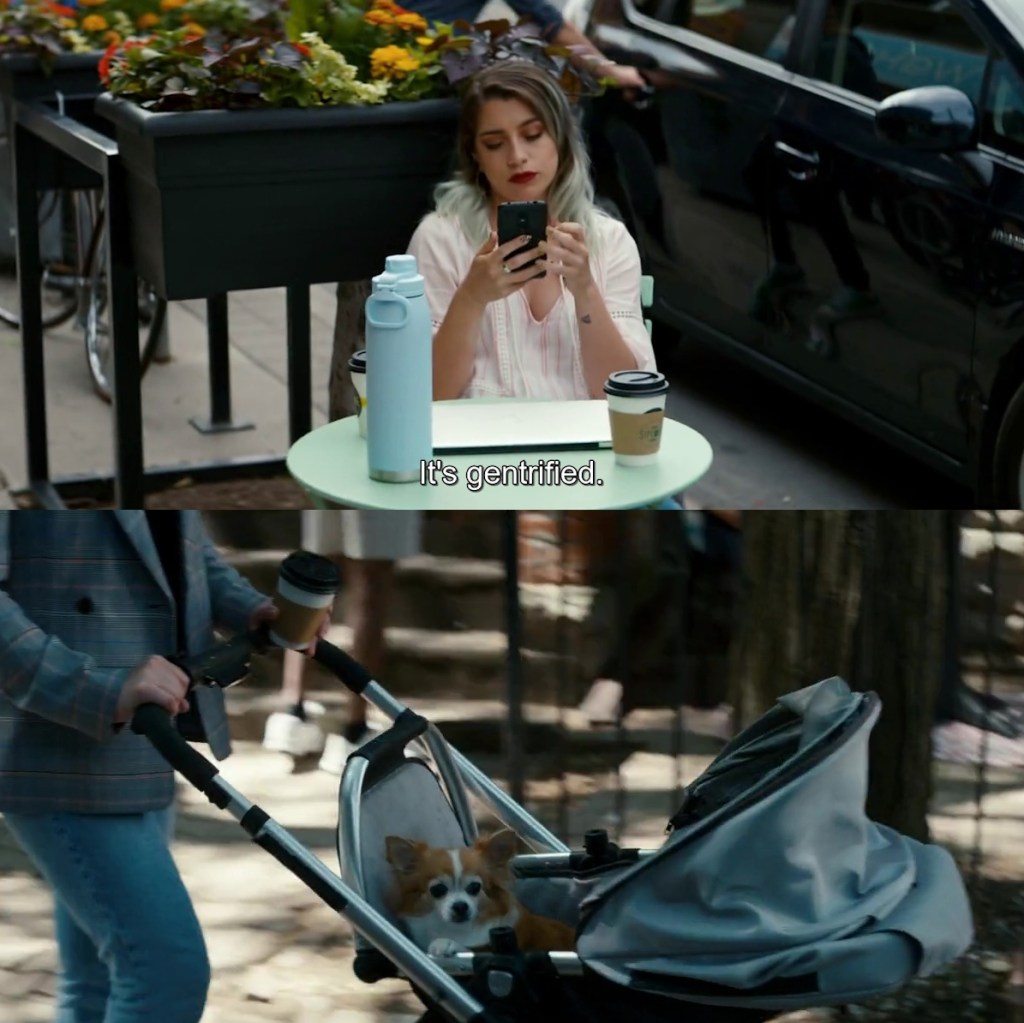
  • In episode 1, Dolores has just been released from prison after 16 years – she took the fall for her boyfriend, who has since disappeared. She heads back to Washington Heights New York. but it’s all gentrified now, except for Empanada Loca, the shop of her old friend Luis, who offers her a room and sets her up as a masseuse, a skill she learnt in jail.
  • In episodes 2 and 3, Dolores kills the landlord who has been harassing Luis for his overdue rent, which he can’t afford because the neighbourhood is now fancy, and people don’t buy empanadas much. Luis creates a new empanada, MUY LOCO. It is hugely successful, because it contains, yep, human flesh, in this case, the landlord, Mr Pearlman, whose son, Jonah, appears in the shop at the end of episode 3, with two cops behind him.
  • In episode 4, Dolores is shocked to find what Luis has done with the body of the landlord she murdered, and disgusted by the secret contents of the muy loco empanadas—Mr Pearlman. She is particularly horrified when Luis offers Jonah an empanada to try, a muy loco, which she knows is a “mouthful of daddy”. Meanwhile, the local drug dealer, Marcie, has pissed off Dolores, and now she is also in Luis’ fridge, and bits of her are now in the empanadas.
  • In episode 5, Dolores hires a private eye called Ruthie, played by Cyndi Lauper, to trace her ex, who cheated on her and let her take the fall in a drug bust. Ruthie’s motto (or perhaps mission statement) is I NEVER DON’T FIND THEM. But the last thing Dolores wants is for Ruthie to find Mr Pearlman.
  • In episode 6, we see cannibalism as a business. Luis has been clear-eyed about this all along – he gets rid of the annoying landlord, he thoroughly destroys the evidence (in customers’ stomachs) and he makes money from the meat, which is apparently delicious and hugely popular, while saving money by not buying the flesh of other animals from the food-services man, Jeremiah, the only sympathetic character in the story so far.

Not a lot of human flesh being eaten in these final two episodes, because everything is turning to shit, largely due to the impulsive plans of Luis, and the tendency of Dolores to snap the neck of anyone who annoys her. Police are looking for the drug dealer Dolores killed back in episode 4, and threatening to call in the DEA. Luis is still chopping up the bodies of Dolores’ victims to fill his empanadas, but he doesn’t want anyone to find the marijuana he is growing. THAT would be incriminating. Dolores points out that his fridge and apartment are full of chopped up bodies, and asks him the question that defines all ethical discussions.

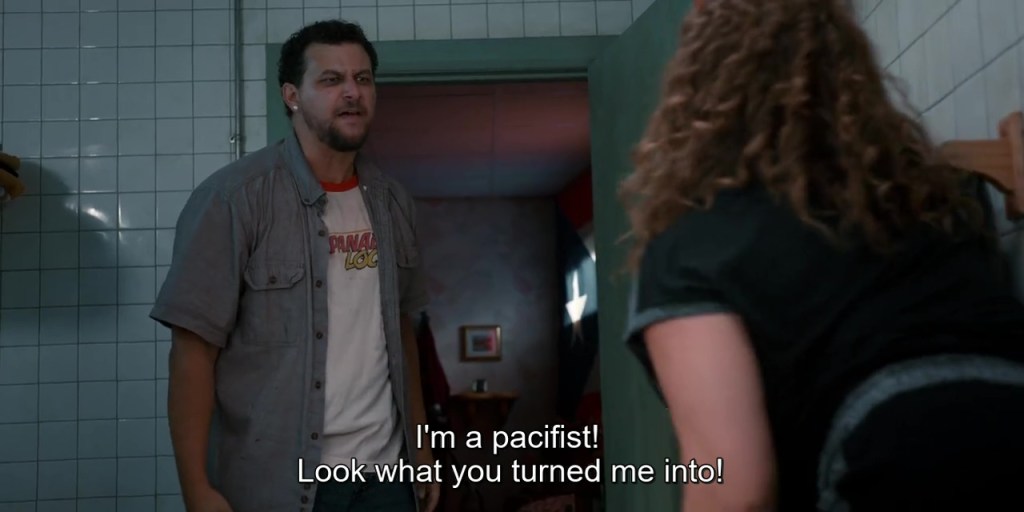
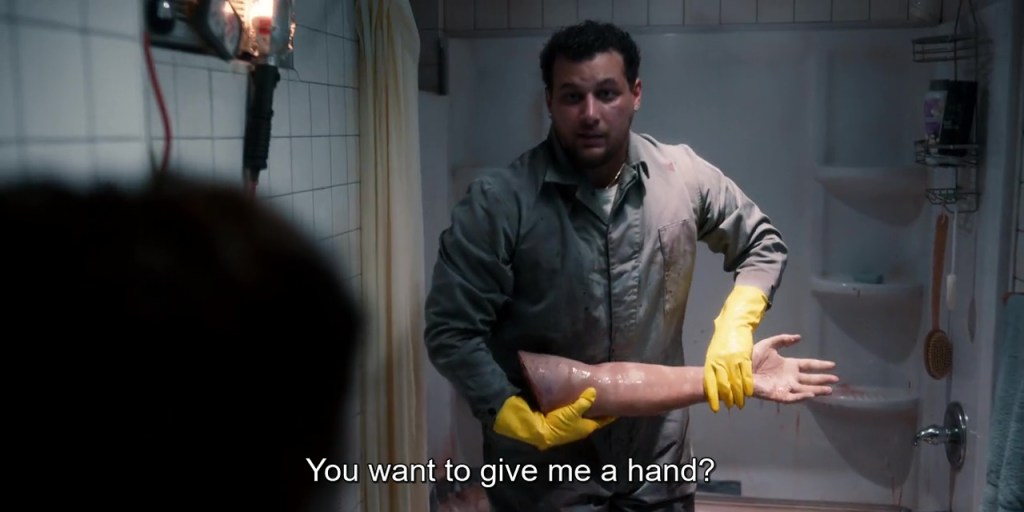
 She’s much more upset about the cannibalism than the increasing number of corpses she is leaving all over the shop. Odd that. Luis sees meat as his business, and Dolores’ steady body count as his (very reasonably priced) supplier. He’s not too fussed about all the killing, as long as he doesn’t have to do it – like customers in a butcher shop. When he finally kills a man, he is upset: “Look what you made me do!”

Luis cracks some of the best jokes in this show, in the middle of the street (much to Dolores’ fury) about the “fat fuck” she killed last episode, and how he is going to use the body fat in his pastry.

And some of the worst.

Lots of interesting Freudian things going on here – in earlier episodes, they discussed the difference between edible and Oedipal, and then there’s the whole thing with Luis only wanting to give Dolores cunnilingus, not penetrative sex, even though she has her period. She considers that eating her menstrual blood makes him a cannibal, even though he has been snacking on human empanadas all through the show, so it shouldn’t really be a surprise.

And his pet name is Mami. It’s apparently the Spanish equivalent of “baby” or “darling”, but is also used for, yep, mother. Freud said the two primary taboos are incest and cannibalism, and Luis definitely has an edible complex.

We find out why Luis doesn’t want sex – he fell in love with his father’s girlfriend when he was 12, had sex with her (so now we have another taboo covered) and then tried to castrate himself in punishment. He couldn’t cut through his penis (Meiwes and Brandes found it was much harder than you might think) and poured hot oil on the wound, leaving him horribly disfigured. Yes, Dr Freud, the threat of castration can be as big a motivation for mental illness as you thought.

Dolores just thinks she is a monster. But one of the fascinating things about cannibalism is that unlike other horror movie tropes, they are not supernatural or even particularly superhuman. And they really exist.

“I’m a monster. Worse, I’m real.”

Luis ends up “deep fried, like everybody else” in one of the most dramatic scenes, and Dolores escapes:

She goes looking for the showrunner of the play, a nice piece of postmodern complication as he clearly represents the creator of the show we are watching, Aaron Mark.

He is accused of humanising a serial killer, but hey, Dolores is very human, just like Macbeth and Oedipus and every tragic protagonist in literature. She’s not even a cannibal; in the whole eight episodes, we have not even seen her eat a human empanada! She’s just a misunderstood serial killer.

As she says, you have to draw a line somewhere.

She forces the showrunner to take her to a house where, he says, someone knows the whereabouts of the man who betrayed her and left her to rot in jail. When the door opens, she roars with laughter, and then pounces, but at whom? All we know is that, like Georgina in The Cook, The Thief, she is directing her invective at us, the audience! We may not know where her ex is living. But we do know that cannibalism starts at home.

Deep tissue cannibalism: THE HORROR OF DELORES ROACH Episode 1 (Aaron Mark, 2023)

This is not only a fabulous story, but possesses a proud heritage in the field of Cannibal Studies, and is not afraid to flaunt it. Delores Roach is a young woman in a basement in Washington Heights Manhattan, who gives massages for a living, occasionally killing her clients and delivering their bodies to Luis, who runs the struggling empanada store above, to use as meat. Yes, it is unapologetically the offspring of the legend of Sweeney Todd, the “Demon Barber of Fleet Street”, who killed his customers instead of shaving them and then dropped them through a trapdoor to his colleague and perhaps lover, Mrs Lovett, who turned them into delicious meat pies. There is some controversy over whether or not Sweeney was a real person who was publicly hanged outside Newgate Prison in 1802 or just an urban legend of early capitalism. In any case, Sweeney appeared in a number of movies; in 1936 he was just plumb crazy, while in 2007 Tim Burton made him an honest man wronged by a corrupt power establishment. Burton’s film is based on a Sondheim musical that played interminably on Broadway and around the world.

In this version, Delores (Justina Machado) turns everything upside down; it’s Sweeney through the looking glass. We’re in New York instead of London, with a female serial killer instead of a male, and a male pastry chef instead of a female. Delores is downstairs killing people for Luis who is upstairs cooking them, again turning the Sweeney legend upside down. Like Sweeney, at least in the Tim Burton musical version of the story, Delores has returned from a long and unjust term of incarceration.

She finds her shabby neighbourhood, Washington Heights, gentrified after 16 years in the slammer, to the extent that she doesn’t even recognize any of the shops. A lot of the reviews seem to focus on gentrification as the main crime in this story.

Except for her favourite fast food store, Empanada Loca, run by Luis (Alejandro Hernandez), the son of the man who used to make the empanadas. He has a soft spot for Delores, who used to pay him in cash and spliffs when he delivered her lunches. Luis offers her accommodation, for old time’s sake, and maybe the odd massage.

There are plenty of stories based on butchers serving human meat to unwitting customers, turning them into innocent cannibals. Among them are Hitchcock’s Speciality of the House, Mielche’s The Butchers, Yau’s The Untold Story, Jensen’s The Green Butchers, Stjernswärd’s The Farm and Eboué’s Some Like it Rare. And of course our old friend Hannibal, who tells his guests “Nothing here is vegetarian”.

Burton’s Sweeney Todd was based on a Broadway musical, but Delores is a generation later, and so now her Broadway show is based on a more contemporary form of popular culture, the TRUE CRIME podcast.

Of course, it’s not true, but in the postmodern age, a true crime podcast needs a true crime, which is also confected for our narrative pleasure.

The podcast becomes a Broadway play, with the actor Jessica Pimentel (Orange is the New Black) playing Flora who is playing Delores in the play (stay with me here). Her performance is a triumph; in her final soliloquy she is covered in blood and holding a human heart.

The performance of the play, and the episode we are watching, both end with a song: Stanley Holloway’s “Sweeney Todd the Barber”:

“Sweeney Todd the barber,
by gob he were better than the play
Sweeney Todd the barber,

I’ll polish them off he used to say
and many’s  the poor young orphan lad
had the first square meal he ever had
a hot meat pie made out of his dad
from Sweeney Todd the barber”

For those of us who have been waiting for this series, or those who just saw the advance publicity, we are now in the omniscient position of knowing what is going to happen. We have seen the newspaper headline of the “real” murder and the review of the “real” true crime podcast, and seen the full house audience cheering the performance. In case we aren’t sure, a couple of friends pour drinks in Flora’s dressing room, chatting about the play and its reflection in the “real” world.

“…the café in Taipei serving human flesh dumplings?”
“Yes, yes, yes, yes and the human bone marrow in that bistro in Paris!”

Then the “real” Delores appears in the dressing room after the friends leave. No, not to murder Flora for impersonating her, but to tell her the true story.

“I’m gonna tell you shit you could never un-know.”

So now, we have a dramatisation of a fake true crime podcast about an actual crime that doesn’t exist, and the dramatisation is being applauded for creating a wave of actual cannibalism events (that also didn’t happen). They concern a female serial killer who is based on a male serial killer who also probably didn’t exist. An actor playing the (unreal) serial killer is telling her story to the actor playing the actor who is playing that serial killer. It plays (sorry) with the mind.

So does cannibalism. Except for a few rare cases where the cannibal is prepared to admit all his or her activities, such as Albert Fish, Jeffrey Dahmer and Issei Sagawa (who laid out the whole project in a manga), cannibalism narratives are very difficult to nail down. Some like Ottis Toole over-confess, leading to speculation that they are making it all up, helped by police who want to clear the cold case log. Others deny everything. And some just disappear and are never found, like Jack the Ripper. Cases of cannibalism are so sensationalised that the reports of the popular press are dubious in their accuracy.

But what we do know is that cannibalism is real, and is one of the primal drives among every type of animal from comb jellies to humans. Freud and Abrahams called the first six months of an infant’s life “the cannibalistic stage”. We all have a cannibal inside; it just comes out more readily for some people than others.

The series is a Blumhouse production on Prime Video and is so good that I am spreading this blog over all the episodes. Among the many great names to appear in future will be Cyndi Lauper as a detective.

Cannibals just wanna have fun.

Cannibalism news July 2023: Two men arrested for eating partially-cremated human flesh

Two men in Odisha (eastern India, formerly known as Orissa) have been arrested and accused of cannibalism after locals found them eating half-burnt flesh from the body of a woman who was being cremated at a funeral in Mayurbhanj, Odisha. 

The incident happened in a tribal village called Bandhasahi. The accused were identified as Sundar Mohan Singh, 58, and Narendra Singh, 25, both from Dantuni village. The deceased woman was identified as Madhusmita Singh, 25, who had died in the Bandhasahi village hospital. The family took her body to the cremation ground and performed the last rites. In Hinduism, the preferred way of disposing of the dead is Antyeṣṭi (अन्त्येष्टि), a composite Sanskrit word of antya and iṣṭi, meaning “final sacrifice.”

The two men, who were said to be drunk, were overseeing the proper burning of the body. As the cremation progressed, the body had been burnt almost entirely to ashes, except for a single unburnt piece of flesh. Mohan and Narendra claimed that it wouldn’t burn unless it was cut into smaller pieces and then thrown back into the fire.

Lobo Singh, the grandfather of the deceased girl, watched the men pull the unburnt flesh out of the fire. Narendra proceeded to divide it into three pieces, with Mohan tossing two pieces back into the flames. However, Lobo Singh said he witnessed Mohan concealing the remaining piece in his left hand, He questioned Mohan about this, to which Mohan casually replied that he would discard it later.

The woman’s uncle said that, when he asked them what they would do with the flesh, one of the accused, Sundar Mohan Singh, replied, “You don’t know about witchcraft.” After around 10 minutes, he announced that he would eat the piece of flesh. Before the others could do anything, Mohan put the piece in his mouth and began chewing it; he also offered a portion of flesh to Narendra, who also commenced eating it. 

The villagers caught and beat the accused duo, tied them up in rugs, and informed the local police. Both accused admitted committing the crime, claiming that they had consumed the flesh in an inebriated condition. They were charged under section 297 of the Indian Penal Code. Senior police officer Sanjay Kumar Parida stated that the accused were arrested based on the complaints of the villagers, but no trace of human flesh was found on them. Further investigation into the case continues.

This sort of phantasy, that eating human flesh will give the eater special powers, is not uncommon in Cannibal Studies texts; essentialist speculations that some part of the ‘donor’ remains imbued – such as the courage embodied in the brave enemy’s heart or strength in his or her limbs. Brigid Brophy, one of the seminal voices in the animal justice movement, called this “the primitive superstition that eating the flesh of bulls endows you with the strength of the bull”. Even Freud seemed to have subscribed to such thoughts, claiming in Totem and Taboo that the birth of civilisation occurred when a group of young prehumans came to resent their father’s monopolisation of the tribe’s females (common among primates) and rose up, killing the father to take their mothers and sisters for themselves. “Cannibal savages as they were, it goes without saying that they devoured their victim as well” and, Freud added, as well as the protein they ingested from the fresh meat, the brothers would each have “acquired a portion of his strength”. Freud went on to speculate  that their sense of remorse created the first ethical basis for civilisation, which seems rather far-fetched, and there is no evidence that the Singhs, even when they sober up, will be creating a new form of civilisation in Odisha. Although, to counter my obvious scepticism, there are reports that Armin Meiwes, currently in prison in Germany, allegedly claimed that, after he ate his bilingual lover in 2001, his own English improved considerably. We absorb the nutrition of our food, why should cannibals not absorb the strength, spirit and experiences of their victims?

The Orissa Post called the incident “extremely rare”, but this blog has reported on similar incidents in the past. In Assam in 2022, another inebriated man found edible flesh within the cremation flames.

In 2019, The Global Report on Food Crises estimated that there were some 135 million “acutely food-insecure people in crisis or worse”, including 17 million acutely malnourished children under 5 years old. The changing climate, or future pandemics, could easily double that number, leading to what the head of the UN’s food relief agency warned could be “a famine of biblical proportions”. Globally, over a million people die each (normal) week, many of them still covered in healthy flesh; if human meat is similar to that of other animals, why not let those who are starving eat some of the corpses, at least those who are minimally diseased? Is an agonising death by starvation less abject than eating human meat? And if, as most societies (not including Hindus) seem to believe, it’s OK to eat animals, and humans are animals (a species of Great Ape), then from carnivory to cannibalism is only a very thin red line.

“they were cannibals, and they were going to eat him” – Texas teen arrested for killing family

A Texas teen has been arrested on murder charges, accused of slaughtering his parents and two siblings — including a 5-year-old brother — because he believed they were all “cannibals” planning to eat him.

Cesar Olalde, 18, was arrested after a standoff with police on Tuesday May 23 in suburban Texarkana and charged with capital murder — punishable by the death penalty or life in prison without parole.

Police in the town of Nash — population about 3,800 — went to Olalde’s home after getting a report that a man had harmed his family and was threatening to kill himself.

When they arrived, they found the teen holed up, while family members were inside.

An affidavit by Nash Police Officer Craig Buster, said that the teen, barricaded inside, had called police, saying “he had pulled the trigger, and shot his family.”

After persuading Olalde to end his standoff and surrender, police went inside the home and found the bodies of his parents, Reuben Olalde and Aida Garcia, older sister, Lisbet Olalde, and 5-year-old brother, Oliver Olalde — all in a bathroom.

“It appeared as if the victims had been shot at various places in the residence and [had been dragged] to the bathroom,” according to the affidavit. Multiple spent cartridge casings were found throughout the home, and “blood spatter on multiple surfaces.”

The affidavit said Joseph Flieder, a colleague of Lisbet Olalde, had gone to the house because she’d missed work that day. He knocked on the door but got no response.

Flieder, together with a family member who had also arrived to check on the family, forced his way inside, where he was confronted by Cesar Olalde. The teen allegedly pointed a gun at the man several times and brandished a knife.

Flieder told responding police officers that Cesar Olalde said,

“he had killed his family because they were cannibals, and they were going to eat him”

Olalde was jailed on a $10 million bond.

Neighbour Robert Ward described the victims as a “beautiful family” made up of “extremely nice” and “hardworking people.” He said the daughter had recently graduated from college and planned to become a teacher, and that Cesar was “such a good kid. He was going to get into an apprentice program to be a plumber.”

There is no actual cannibalism involved in this story (unless Cesar Olalde was right about his family, as suggested by several people online).

But what is interesting is the fear of cannibalism that must have been strong enough to drive him to this desperate act, killing those closest to him. There are clearly major mental problems involved, but that’s not a sufficient explanation. Why see them as cannibals – why not aliens or pirates or something else?

The terror of cannibalism relates directly to our experience as babies, when we are altricial – totally dependent on caregivers, for far longer than any other animal of similar size. We gestate as cannibals, eating from the placenta – our mother’s body. We are born and fed from a breast (usually human or bovine), which is more eating of the body. As we grow, we experience rage when our needs are not immediately recognised and satisfied, and this rage may be homicidal in nature (Freud called the first six months of a child’s life the “cannibalistic stage”). We want to eat our mother, and are terrified that, being so much larger and more powerful, she may feel like eating us first. We fear, in other words, reabsorption into the maternal body from which we emerged.

The only difference between eating human meat and that of other animals is that we fear consumption by other humans, whereas the animals we eat – cows, pigs, sheep, chickens, fish, etc, are generally herbivorous or gentle, peaceful animals. We don’t recognise this fear at a conscious level, but under stress or psychic collapse, we find ourselves back inside our mental image of Freud’s primal “cannibalistic phase”.

BLACK CHRISTMAS (Glen Morgan, 2006)

Black Christmas is the middle film in what is sometimes called the “Black Christmas series” – three films that actually have very little to do with each other, except that they bear the same title, one made in 1974, one in 2006, and one in 2019. The original was made in 1974 and widely panned, but has since been revived as the proverbial “cult classic” and hailed as one of the earliest slasher movies – it was released on the same day as The Texas Chain Saw Massacre, and is considered an influence on the making of the Halloween series (crazy killer, young women, buckets of gore). The remake in 2019 presented a completely different story and character list.

I am reviewing the middle, 2006 movie not because it’s the best of them, but it is the only one featuring CANNIBALISM, which is what this blog is all about. Also because I needed something uplifting to review on Christmas Day, 2022.

The films all involve a group of co-eds (young female college students for those of you who don’t speak American) being slaughtered by a serial killer. The 1974 film was about to be released for television in 1978 but was withdrawn because serial killer Ted Bundy had just murdered two young co-eds sleeping in their sorority house on the campus of Florida State University in Tallahassee. Bundy had started his killing spree in 1974 before being captured in 1975, incarcerated and then escaping, and there is some speculation that the film was based around his brutal murders, and that he in turn, might have been motivated to escape and return to his pathological ways by the imminent TV release of the film. The film may also be partly based on the exploits of Ed Kemper, who killed his family and then a number of co-eds in 1972-73, although his M.O. was to offer them lifts as they hitchhiked which, as we all know (I hope), is a very bad choice of transportation.

But Bundy was not a cannibal to the best of our knowledge, and nor was cannibalism mentioned in the 1974 film. Ed Kemper did admit under truth serum to slicing flesh from the legs of his victims and eating it in a casserole, although he later changed his mind and denied it. So Kemper, who is still locked up the California Medical Facility in Vacaville, may well have been an inspiration for this 2006 version. It is a very loose reimagining of the 1974 film, with the added frisson of child abuse and a bit of paedophilia, as well as incest and cannibalism – the taboos that Freud described as “the two original prohibitions of mankind”. Director Glen Morgan, who wrote several episodes of X-Files and The Twilight Zone reboot, is not skimping on any taboos in this one.

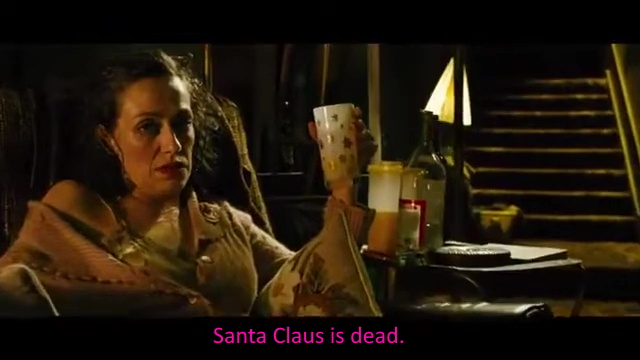
It starts off with a murder of course, then moves swiftly to an asylum for the criminally insane (a nice nod to Hannibal’s residence through all of Red Dragon and most of Silence of the Lambs, and quite a bit of the third season of Hannibal too). Here we come across Santa Claus, as you’d expect in a movie called Black Christmas, and we get the back story on the dude who killed his family many years ago, and is, we expect, going to kill lots more people before this movie drags itself to a gruesome end.

The asylum caterer, a very careless man who lets the high security door get jammed open with a carton of milk, says they are giving him a special Christmas dinner.

“It tastes like chicken, because it’s chicken. It’s the closest we could get to how Mom used to taste.”

Billy Lenz is clinically insane, so that may explain why he thinks his Mom tasted like chicken (humans are red meat, and most cannibals claim the taste is like pork or veal). Anyway, he scoffs his chicken/Mom substitute through the feed-hole on his door, pockets the candy cane as a handy weapon, and we are told that he tries to escape each year; he wants to go home for Christmas. And the Delta Alpha Kappa co-eds, whose sorority house at Clement University in New Hampshire is Billy’s old house, are not going to enjoy his visit.

Well, we don’t have to sit through all the jump scares, because they are just slasher gore with no one getting eaten (as far as we can see). There are some amusing rants against Christmas though. The girls know the history of the house, and their “Secret Santa” ritual includes someone having to buy a present for Billy each year. It’s a pagan sacrifice to ward off evil spirits on Christmas.

“What Christmas shit in this room resembles anything Christian, huh? It’s all neo-pagan magic. Christmas tree – a magical rite ensuring the return of the crops. The mistletoe is nothing but a conception charm. Fifth century Christians jacked a Roman winter festival – twelve days in December where the nights were long – and the Earth was roamed by the demons of chaos.
And fucking Santa Claus? This fat voyeur that watches you all year long to make sure you live up to his standards of decency, before breaking into your house? And that is different from what Billy did – how?”

So what, we wonder, did Billy do?

“Billy Edward Lenz was born with a rare liver disease that gave him yellow skin. His parents hated each other. The mother hated Billy. He was not the child she always wanted.”

When Billy is five, on Christmas Eve, his mother tells him the Russians shot down Santa.

He then witnesses his mother’s new boyfriend kill Billy’s father, who is the only one who ever loved him. Realising he saw it all, they lock Billy in the basement (did they see Tommy?), where he spends his time rocking (as in, in a rocking chair, not engaging in popular music).

When he is twelve, his mother, frustrated by her new husband who falls asleep mid-coitus, climbs up into the basement, drops her gown and reinstates the original meaning of “rock and roll”, adding incest to insult and injury. Not to mention paedophilia. This show has it all!

So Billy has a sister and a daughter and Mom has a granddaughter and a daughter, and step-dad is still snoring through copulation, so everyone lives happily ever after.

Just kidding – nine years later, Billy has been driven insane by isolation, while his sister/daughter is doted on by his mother, who constantly tells her “you’re my family now”:

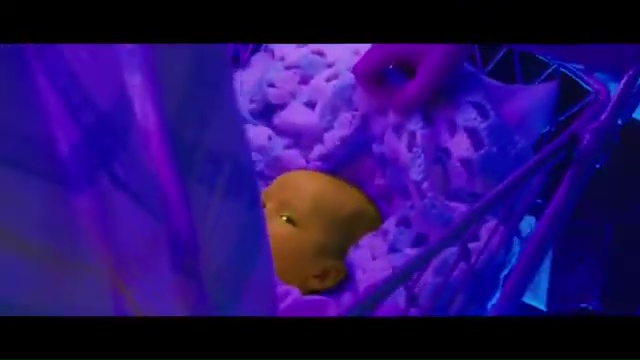
Billy escapes from the attic and disfigures his eight-year-old sister by gouging her eye out, and then eating it.

Much of the terminology of love and sex derives from cannibalism. When we tell a child “I could eat you up” or (at a different time and place presumably) perform oral sex on a lover, we use the metaphors of cannibalism.

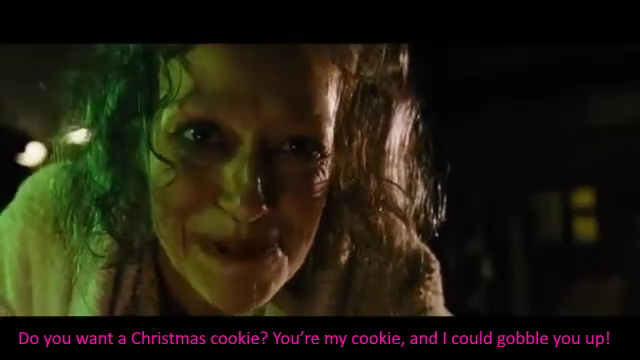
Billy murders his mother and her sleepy lover, and the cops find him eating cookies made out of his mother’s flesh. There’s a cookie-cutter involved, and a hot oven. Not sure where he got the recipe.

The rest is pretty standard slasher stuff, with some inventive deaths, but at least Billy has qualified as a cannibal, and it’s about time, because we’re 36 minutes into the film by now. If you can’t be bothered watching the whole thing, there is a trailer at the top of this blog that covers a lot of the good bits, plus a whole lot of other stuff that never made it into the movie, apparently filmed at the insistence of the distributor, Dimension Films, run by Bob and Harvey Weinstein, who have, between them, much expertise on matters of horror, family discord, and the abuse of young women.

Look, if you want an entertaining slasher with lots of gore, you might like this. From the point of view of Cannibal Studies, the film is interesting mainly as an example of revenge cannibalism – eating the rude and abusive, like Son or Titus or even Sweeney Todd. Also, horror movies timed to coincide with Christmas are very often based on some aspect of revenge, such as The Twelve Deaths of Christmas, also featuring a cookie-cutter used to make people-bread men. It’s a fascinating genre, in which the audience is offered the opportunity to sympathise with, or at least understand, the act of cannibalism as homicide and anthropophagy justified by grievance.

Not so much with Billy. The sorority sisters are treated the way humans treat animals contingently labelled as “vermin” – they are swarming around his house, and he exterminates them but, significantly, he doesn’t eat them. His Mom and his sister/daughter, though, they’re family, and the only way to keep them with him, restrained, constrained and compliant, is to eat them. It’s Billy’s version of love.

Merry Christmas and Gory in Excelsis to all my readers!

The full movie is available (at the time of writing) on YouTube:

The Michigan cannibal – he ate Grindr date’s testicles, on Christmas Eve

This case wasn’t in my summary of 2020 cannibalism incidents because it just missed out – it happened on Christmas Eve, 2019. So I thought I’d wait until it went to trial, and that took until OCTOBER 2022!

Anyway, Mark David Latunski and Kevin Bacon (not that one) have finally found their place on this blog. Mark Latunski has just entered a plea of guilty as charged to open murder and mutilation of a body. Open murder can cover both first- and second-degree murder. His lawyers had been working on an insanity defence, but just as his trial was due to start on October 18, Latunski changed his plea to guilty.

Lutunski, 53, from the Shiawassee County — a man with an extensive history of psychiatric diagnoses — confessed to inviting Bacon, 25, to his Bennington Township home — about 90 miles northwest of Detroit — after meeting him on Grindr, a dating app catering to the LGBTQ+ community. Bacon left his Swartz Creek home for Latunski’s house some 20 miles away on Christmas Eve 2019 and was reported missing by his parents when he failed to show up for the family’s Christmas breakfast.

Latunski told police he had met Bacon on December 24 in a parking lot in Clayton Township, the same place Bacon’s vehicle was later discovered. At Latunski’s house, Bacon stripped naked and put on a blindfold, earmuffs, ankle restraints and wrist restraints, Latunski said. 

He admitted to the court that he had stabbed Bacon in the back of his neck, just below the hairline. When he realized Bacon was not dead, police said Latunski told them he didn’t want Bacon to suffer, so he slit his throat as well. He then hung his body from the ceiling of his basement, to let the blood drain out, police said. It dripped onto the dirt under an open trap door, which had been set up so Bacon’s blood could fertilise the plants outside the house. 

He described how he then cut off Bacon’s testicles before frying and eating them. According to some sources, other body parts may also have been eaten.

Latunski told police their agreement was that he would end Bacon’s life and utilise his body. He would use bone meal to plant tulips, his intestines to grow chestnuts or peach pits and his muscles to make jerky, he said. After the murder, the U.S. Postal Service intercepted a package for Latunski containing a dehydrator. 

Police found Bacon’s car at a Family Dollar store parking lot, about five miles from his home. Inside was a cell phone, which contained messages between Bacon and Latunski, leading authorities to Latunski’s home. There, investigators found Bacon’s naked body hanging upside down from the basement rafters, the victim stabbed and his throat slit. Latunski confessed to the murder, as well as removing Bacon’s testicles for consumption, but claimed he was only carrying out a sexual fantasy with Bacon’s permission.

Latunski claimed Bacon was a willing participant and that the homicide was merely a matter of granting Bacon’s alleged wish to die. In 2020, a judge had denied Latunksi’s motion to have assisted suicide charges added to his existing criminal charges because, according to state law, defendants cannot add on charges.

Latunski previously told investigators the pair had even discussed how they could get rid of Bacon’s body before Latunski killed him, according to the Lansing State Journal.

The charges against Latunski on 30 December 2019 were “murder and mutilation of a corpse”. He was not charged with cannibalism, because cannibalism is not a crime in 49 of the 50 US states.

At a special hearing on 18 October, the judge found Latunski guilty of first-degree murder after finding he had acted with “cold calculation” in the murder. He was sentenced to life imprisonment. Latunski’s house was sold at auction in February 2020 for $101,000.

If Latunski is telling the truth (although the court seems to think otherwise), the situation is similar to the 2001 case in Germany in which Armin Meiwes met Bernd Jürgen Brandes, whose greatest desire was to be eaten. After they had sex, Meiwes cut off the victim’s penis, which they cooked and attempted to eat together (unsuccessfully – it was overdone and too tough). He left Brandes to bleed out in a bath, but when he found he was still alive hours later, cut his throat, and then dismembered his body and consumed his flesh over several months. Another German case in 2022 saw a young man known only as Stefan R. convicted of murder after killing a man he met on a gay/bi/trans dating website called Planet Romeo. Mr R. was found to have cut off the victim’s penis, which was never found.
Sigmund Freud would have loved a chat with these guys.

“Our women can’t get pregnant” A BOY AND HIS DOG (L.Q. Jones, 1975)

“Dog eat dog” is an odd expression. Dogs generally don’t eat each other. The phrase is really a euphemism for the way humans will exploit and kill (and sometimes eat) each other. Accusing the dogs is more socially acceptable, but the phrase is more about our own predilection for devouring our own kind to satiate our various hungers, particularly in times of societal collapse.

This cannibalism blog has reviewed a number of post-apocalyptic films, the best known being Soylent Green, Delicatessen, The Bad Batch, Snowpiercer, 28 Days Later and The Road. Lesser known films include No Blade of Grass, We Are The Flesh, Cadaver, The Girl With All The Gifts, Tear Me Apart and of course several versions of the H.G. Wells classic, The Time Machine.

Clearly, we love bad things happening, preferably well into the future (800,000 years in The Time Machine), and to other people. It’s Greek tragedy but set in our future, warning us of the inevitable unwinding of society and, as we have found, often the eating of the most vulnerable. In most such movies, food is the obsession of both the protagonist and the various antagonists that must be overcome.

The protagonist of such movies is almost always male, and males, in most cultures, are conditioned to eat meat. If humans are the only meat available, that will often do just fine. Other appetites appear occasionally (there was a controversial rape scene in No Blade of Grass), but Freud’s insistence on the primacy of the sexual urges is put on the backburner (sorry) when it comes to eating.

Not this one though. The film is a post-apocalyptic black comedy (we see mushroom clouds at the start, and are told that World War 4 (in 2007) lasted five days – enough time to empty the missile silos). This film is set in 2024 (well, Soylent Green was set in 2022, so now seems like a good decade for disasters). The humans who survive work together in “rover packs” or else hunt alone as “solos”. There is an implication that the rover packs are happy to engage in a bit of cannibalism, as we see a small child carried, struggling, into a campsite.

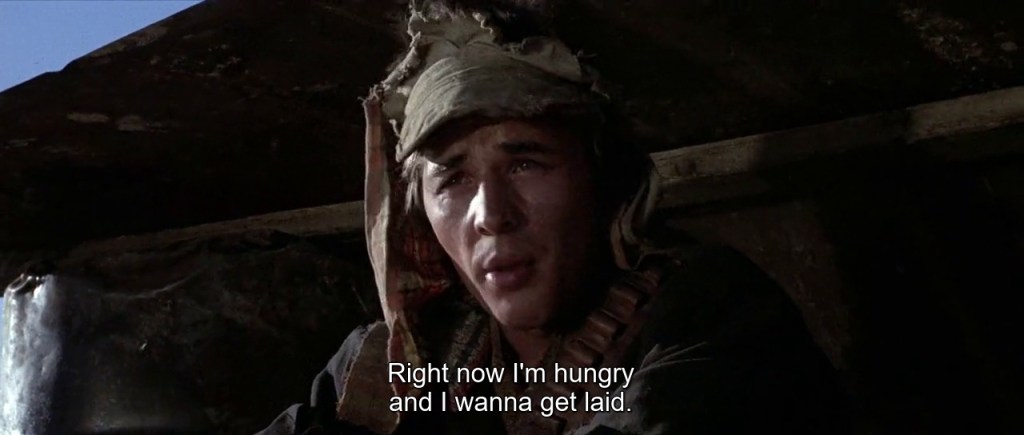
The main character is a solo – his name is Vic, and he is played by Don Johnson, who a decade later would become a huge star and win a Golden Globe for his role in Miami Vice.

Did I say main character? Arguably, the star of this film is Blood, a shaggy dog.

Blood is smarter, better informed, has an advanced sense of humour and irony (he calls Vic “Albert”, after the rather more conventional dog stories of Albert Payson Terhune), has a superb sense of smell, and can converse telepathically with Vic. But the genetic modification that allowed this telepathy (designed for war of course) also removed his ability to hunt for food. So, Vic and Blood are symbiotes – Vic hunts for food, while Blood smells out women for the sexually voracious appetite of Vic.

In this ultimate extension of what Barbara Creed calls “aggressive phallicity”, the frontier of the rugged individual, the gun is king and women are purely there as rape targets. In the opening scene, Blood finds a woman, but a rover pack has arrived first, and they have knifed her after they have had their fun. Vic’s anger is purely selfish – that she could have been used a few more times. Blood mocks him “you’re so funny when you’re sexually frustrated.”

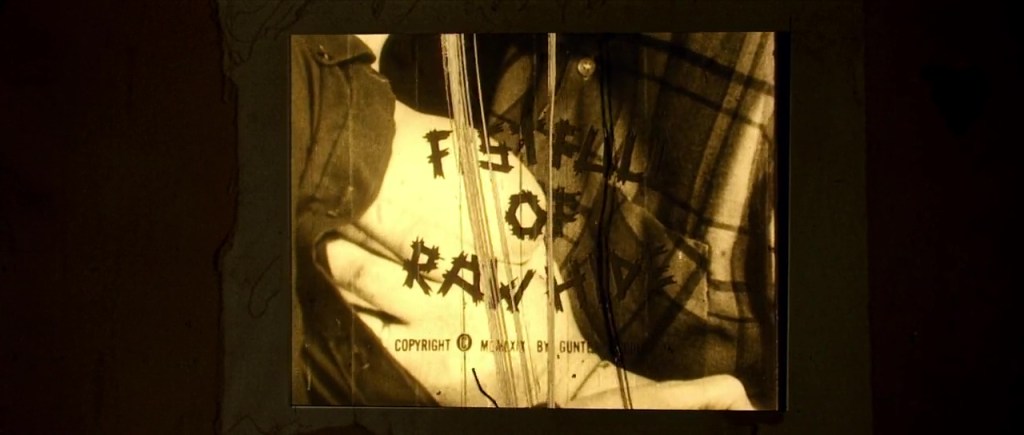
Later, Blood discovers a woman, Quilla (Susanne Benton) in disguise at the movies (there is one rover pack that exists as a sort of neutral space, putting on movies, running a brothel and selling popcorn). They put on old movies and cheesecake for lonely solos to beat off to. They watch Fistfull of Rawhide (it’s a real movie, from 1969) as Vic waits for the girl to leave and head someplace isolated where he can accost her.

They follow her to a deserted gymnasium, where she is getting changed from her male disguise, and he is enchanted by her youth, beauty and cleanliness.

Quilla comes from a different world, the “Downunder”, a series of underground cities where traditional American values rule – raised hats, marching bands, picket fences, apple pies, civility). Everyone is made up in white-face – everyone is Middle America is white, and seem to need confirmation. Quilla, it turns out, was “the cheese” – she came to the surface to tempt Vic, like Eve tempted Adam, so he would enter the underground world, and bring his sperm with him.

Yes, the solid citizens of the symbolic order or language and laws have become sterile. But Blood, she says, wouldn’t fit in there. Trouble in paradise. Blood, badly wounded defending Vic, who had refused to leave Quilla to a rover pack, waits at the portal as Vic descends like Orpheus in search of Quilla. They want Vic’s sperm, because being underground has made their men sterile, but it’s not going to be the orgiastic event Vic imagines – they strap him down and connect his member to an electro-ejaculation machine, just as modern agriculture does to prize-winning bulls and rams. Such a device is normally inserted into the rectum and positioned against the prostate, and an electric charge causes involuntary ejaculation. To the townsfolk, Vic is an animal to be milked of sperm and then killed when they are done with him.

The film is available on YouTube (at the time of writing) so I won’t give too many spoilers. It’s well acted, the dog is delightful, the plot is pretty faithful to the novella of the same name, which came from the brilliant mind of Harlan Ellison. Ellison published the story is a collection called The Beast That Shouted Love At The Heart Of The World, in the introduction to which he objected to the term “new wave science fiction”, and cast bitter scorn on the “clots” who called his work “sci-fi”. Ellison was known for his brilliant writing but also his outspoken, combative personality; the Los Angeles Times described him as “the 20th-century Lewis Carroll” while Robert Bloch, author of Psycho, called him “the only living organism I know whose natural habitat is hot water”. The story’s concept remains original and the narrative sparkling, even half a century after the book and film were made.

The genius of this story, captured in the film, is the deconstruction of some of the most basic assumptions of our (pre-world war IV) societies. One, Derrida tells us, is common to all philosophers up to now – that we look at animals, but assume they do not look back. It is the basis of anthropocentrism (human supremacism) to assume that only humans are aware, are subjects who think and observe. But in this film Vic is the dumb animal that only knows how to fight and fornicate, while the “rational animal” who keeps him alive, teaches him and cares for him, is Blood, the dog.

Then there is the myth of the hero, the man of action – men like Vic seem to be a dying breed. Vic is only interested in “getting laid” – and believes that is only possible through violent rape. But Quilla is smarter than Vic, manipulative and calculating, as well as having a stronger libido – “I’m the one who’s supposed to want it” he complains. Socially too the dominant male is an anachronism. Above ground, the solos are being recruited into rover packs or killed, while below ground, the patriarchal symbolic order that is trying to recreate America of the 1950s is dying out – the males infertile.

Finally, I need to address the question of cannibalism, because, hey, this is a cannibalism blog. There is an implication in the film that the rover packs are kidnapping children from other packs for dinner (we all know that babies taste best). That’s what happens after an apocalypse – check out the gangs in The Road. But there is an implication that the society below ground also eats meat, and the only animals we see are humans, plus one small white dog. Those who disobey “The Committee”, a triumvirate who rule the place, are sent to “the farm”, to be killed and perhaps eaten. That’s what farms do – provide food.

And what about Blood and the other dogs – dogs are scavengers, but they usually prefer meat. While Vic collects pre-war cans of food, and Blood is very pleased to eat popcorn at the movies, there are certainly a lot of bodies lying around. But we see no evidence of anyone, human or canine, eating (adult) humans, until, like most apocalypse movies, there is no choice.

Or rather there is a choice – sex or love.

There is a popular ethical question about whom you would save from a burning building – a human stranger, or your dog? I suspect most people who have dogs would feel required to answer “the human”, but sotto voce would answer “my dog of course”. When Vic emerges from the Downunder with Quilla, he finds Blood badly injured and starving. Quilla tells Vic she loves him, tells him to leave the dog and go live with her. There’s lust, and there’s love. What will a boy do for his dog?

“After you’ve taken everything, what will be left?” THE FEAST (Lee Haven Jones, 2021)

First things first, and this is a first – the first time THECANNIBALGUY.COM has reviewed a Welsh film. They are not as rare as we imagine (particularly in Wales) but the fortunate coincidence of Welsh language and cannibalism has not raised its head before. Luckily, this one makes up for lost time – Dread Central called it

“a delightful, sumptuous dish from start to finish”

And that is exactly what we are served – a fancy dinner party in which the hired help, Cadi (Annes Elwy) has a lot more to offer than just laying the table and preparing the feast. The feast is to be held in the Welsh mountain home of a rich family who clearly owe their fortune to outrages against the environment. They have invited a sleazy businessman, Euros (Rhodri Meilir), who has been drilling for oil on their land.

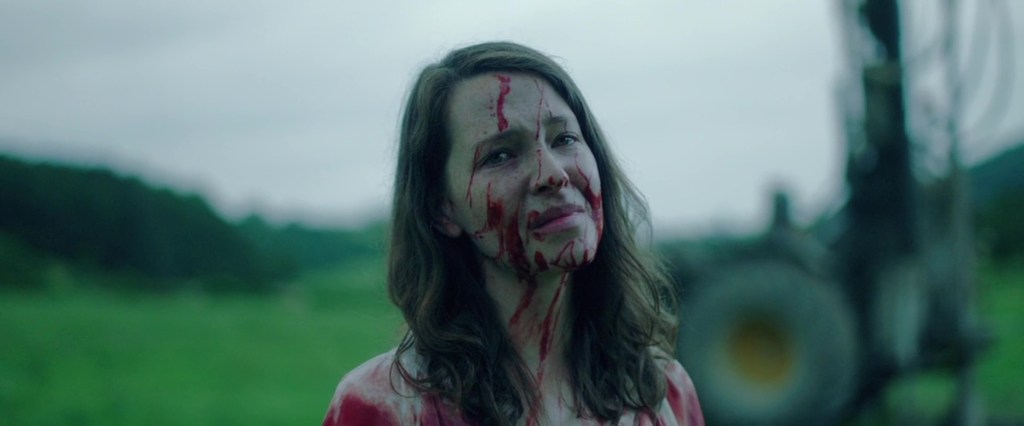
The film opens with the contrast of the green fields (and how green is Wales!) being penetrated, raped, by a giant exploration-drilling rig. A man standing next to the machine is then seen staggering through the fields, only to collapse with blood streaming from his ears.

This is a cannibalism blog, and the cannibalism takes place near the end of the film, so I apologise for spoilers. The Feast is on Hulu or available for purchase or rent on the usual platforms, so if you’re going to watch it, and don’t like spoilers, go and watch it then come back (please) for my analysis. Then again, the Director recommends watching it several times, saying you’ll get more out of it each time. So it is not really a mystery, more a mood piece, and knowing what is going to happen may actually enhance the enjoyment of the story.

Cadi as a hired kitchen hand is the epitome of the saying “you can’t get good help anymore” taking ages to actually do any work, and getting it all wrong – she knows nothing of human etiquette. Turns out she is a nature goddess, disturbed by the drilling, taking the body of a woman who has just drowned, and she knows the humans in that house are up to no good. She is badly frightened by the sound of the father, the local (and clearly corrupt) politician, shooting rabbits. Her hands excrete mud, and she stains the pure white tablecloth she has just laid out; messy nature is invading the stark and sterile human house. When he brings the rabbits for her to skin, she flees into the fields, where one of the sons tells her that’s why his father likes to come back to Wales from Parliamentary duties in London.

The MP’s wife Glenda (Nia Roberts) takes over the skinning of the rabbits, much to Cadi’s disgust. Nature, as Tennyson told us, is red in tooth and claw, and rabbits routinely come to a sticky end by way of fox or disease or trap. But Cadi, who it seems is not too worried by bloodshed when it comes to humans, is horrified not at the slaughter and plunder, but at the use of technology to do it – guns, oil rigs. Nothing natural enters this human world, because civilisation, in its modern technological form of patriarchal capitalism, is built on the rejection of animality and domination of nature.

The man most guilty is Euros (Rhodri Meilir), an oil driller who is hoping to use the dinner party to persuade the family’s neighbours to allow drilling on their land. Euros arrives in his fancy car and admonishes Cadi for slacking off, whereupon he drops (perhaps with her magical intervention) a bottle of expensive wine. Told to clean it up, Cadi tastes the wine on the driveway and then inserts a piece of the broken bottle in her vagina, with no sign of any discomfort. This acts as a vagina dentata; she subsequently uses it to kill one of the sons by offering him sex.

He’s the one who had left medical school to prepare for a triathlon, part of his training involving eating nothing but raw meat. And he’s not the weirdest person there. Nor is his the most gruesome death.

Some people don’t like subtitles, but generally hearing the words in another language adds a dimension, a music or poetry, and this film would not have been as powerful in English, even though the patriarch is an MP who spends most of his time in London. As the Director put it,

“Our culture’s incredibly rich in terms of myths and legends.”

The film adapts various Welsh folk legends. One is the story of Blodeuwedd, who was made of flowers by two magicians in order to help their protégé, Lleu Llaw Gyffes, who’d been cursed by his mother never to take a human wife. Jones explained:

“This wizard harnessed the forces of nature and put her in a body of flesh and blood. But, of course, Blodeuwedd was very frustrated by that, and therefore decided to get her revenge. The character of Blodeuwedd is very definitely in the DNA of Cadi.”

The drilling site is called “The Rise”, a burial site that is considered sacred, although modern, rationalist people like Glenda scoff at this, claiming it was just a way to frighten children away from the fields. But Cadi is the goddess who was resting in The Rise, and they have disturbed her. She is out for revenge.

Freud wrote about the “death drive” which propels all life in the direction of death, a return to its original organic form. In The Future of an Illusion, he described how humans connect this death drive to nature, which is interpreted as the enemy of civilisation. Humanity therefore fights an unremitting war with nature, seen as the cause of the excruciating “riddle of death”, a war in which we may win every battle but, as mortals, we must lose the war.

German philosophers Max Horkheimer and Theodor Adorno wrote in Dialectic of Enlightenment that

“Human beings are so radically estranged from themselves and from nature that they know only how to use and harm each other.”

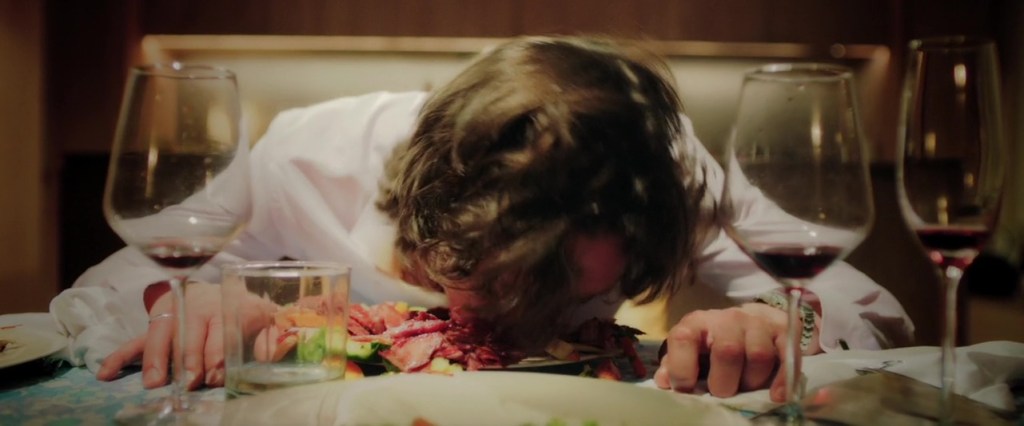
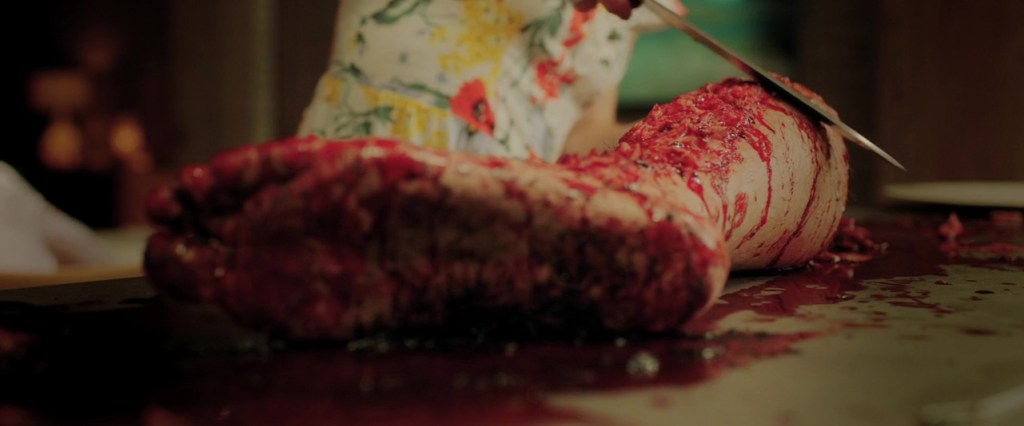
Humans invented the “seven deadly sins” to judge themselves and others. So now Cadi, or the goddess who controls her body, judges and executes judgement on the family according to their sins. The father represents greed (taking bribes even though he is already rich), the mother exhibits envy, trying to bully her friend, who is content being a simple farmer, into giving in to the oil company’s plans, and the sons exhibit wrath and lust (one is a drug addict who is furious with his family for confining him in the country, and the other has been fired from the hospital for raping sedated patients). Then there is Eunos, the skinny man who offers the perfect image of gluttony; the corrupt capitalist is voraciously eating everything left on their plates, his face plunged into the food, not bothering with cutlery. The mother, in a trance, butchers her son’s body and puts slices of his leg in front of the insatiable Eunos, who gobbles them down. This is the “feast” of the title, and it’s the last supper for that family.

Eunos falls into food catalepsy, and when he awakes, Glenda has a shotgun pointed into his mouth, and asks him the question that sums up the film, our society, Western civilisation and the era that has come to be called the Anthropocene.

“After you’ve taken everything, what will be left?”

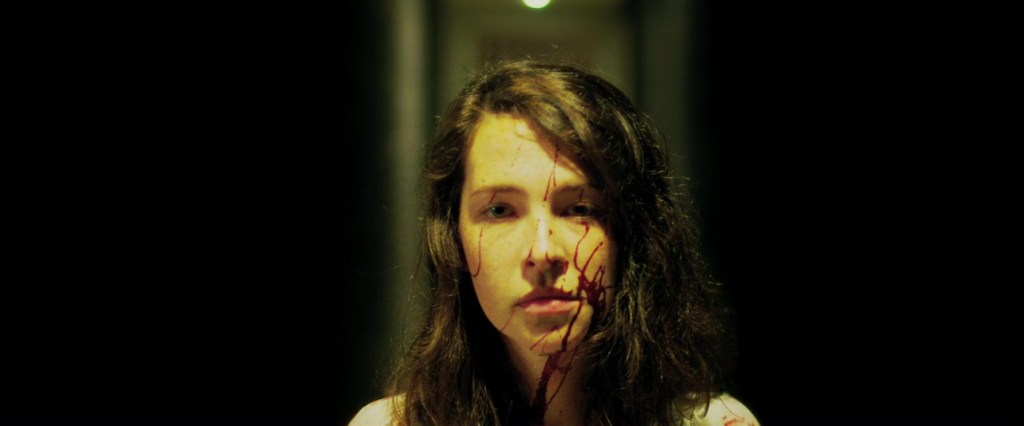
The final scene of the film is a tour de force by Annes Elwy, no longer Cadi but now the goddess, covered in blood, at first smiling at her triumph, but then sinking into grief at the prospect that the war will continue until either humanity or nature (including us) is destroyed utterly.

Like Helen Mirren in The Cook, The Thief, His Wife and Her Lover, she is looking directly at us, the viewers, accusing us of complicity, both in the war and the cannibal feast.

The film scored a very respectable 82% on Rotten Tomatoes, meaning that four times more critics liked it than didn’t. Those who didn’t carped about it being slow in the first half, a criticism that is often levelled at movies sold as horror but offering more intelligent themes than just slasher gore. The acting is superb, the photography is stunning, particularly of the natural environment and the contrast with the stark family home, and the soundtrack is never less than interesting, and often (especially the Welsh songs) quite enchanting. Well worth seeing, and perhaps, as the Director suggests, more than once.

Issei Sagawa: THE CANNIBAL THAT WALKED FREE (Toby Dye, 2007)

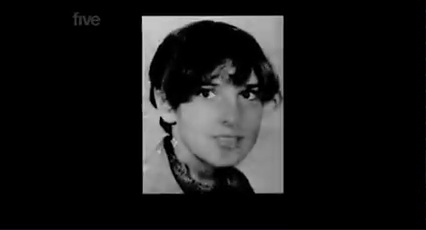
The Cannibal that Walked Free (AKA Cannibal Superstar) is a British documentary produced by Visual Voodoo for Channel Five which explores the case of Japanese cannibal Issei Sagawa. It uses dialogues with police and psychiatrists and, most intriguingly, extensive interviews with the cannibal himself.

Sagawa murdered a young Dutch woman, Renée Hartevelt, a fellow student at the Paris Sorbonne, then mutilated, cannibalised, and performed necrophilia on her corpse over two days.

The mellow voice of the narrator, Struan Rodger (Chariots of Fire), announces:

“This man murdered and ate a woman in Paris… he has never stood trial. Today he walks the Tokyo streets a free man, a free man with an ongoing appetite for human flesh.”

Around midnight on June 13 1981, 32 year old the Japanese exchange student, Issei Sagawa, emerged from his apartment at 10 Rue Erlanger in the 16th arrondissement of Paris with two large suitcases, hailed a taxi and travelled the short distance to the Bois de Boulogne. His hopes that the park would be empty at night were in vain, and several witnesses saw this 4’9” (145cm) smartly dressed Asian man trying to drag two large suitcases to the lake. Worn out (and probably full of meat), Sagawa fell asleep on a bench and woke to find an old man opening one of the cases. When the old man began to scream, Sagawa walked calmly away.

The police found that someone had removed flesh from parts of the body. During the autopsy, they discovered there had been post mortem sexual intercourse – necrophilia.

Within four days, the police tracked Sagawa through the taxi driver, and he confessed immediately. In his refrigerator, they found a large quantity of human flesh.

On the table was a plate with pieces of cooked human flesh, condiments and mustard.

The case was reported globally with the press expressing horror and disbelief. Patrick Duval, Author Le Japonais Cannibal interviewed Sagawa for several hours.

Sagawa said that the feelings began when he was very young: “I was very weak, very ugly, like a small monkey.” He described as an important memory from his childhood a game in which his uncle would play a ravenous cannibal, out to gobble up Issei and his brother.

As he grew up, he felt unable to attract the kind of women that he desired:

“Object of my desire is definitely the white girl, beautiful blonde hair, blue eyes.”

Jean-Pierre Van Geirt – a journalist from Paris Match, said “Sagawa was deeply in love with Renée, and his love was so mad that he thought the most he could love her was to eat her.”

Sagawa had invited the young student to his apartment to discuss literature. He said he asked Renée to read a German language poem he had chosen, a poem about cannibalism, and that she was unaware that he was standing behind her, holding a rifle. He shot her in the back of the neck.

“I had decided before that the first bite would be the buttocks. I was able to cut through the skin, I’m a fool so I didn’t have a clue about human body structure. I thought that red flesh would appear straight away but it wasn’t like that, and this layer that was like sweet corn just carried on for ages, however deep I cut through. I couldn’t reach with my knife so I ripped out the flesh with my fingers and put it in my mouth. After I had sex with her, I tried to kiss her I said out loud I love you, in French. And I felt a huge shiver.

He had a tape recording of the murder and a camera with which had recorded the stages of what he did to Renée after her death; police found both in his apartment after his arrest. He had also saved a good deal of her flesh in his fridge, before packing up her remains in two suitcases.

Just 34 months after his confession, Sagawa would be a free man.  Found to be insane and unfit to stand trial in France, his father employed an influential French lawyer who argued successfully that it was unfair for the French taxpayer to pay for indefinite confinement in a mental hospital, and that he should be sent back to Japan to be cured. Accordingly, less than three years after his confession, Sagawa was put on a plane and sent back to Japan. The only condition was that he could never come back to France. He spent 18 months in a Japanese mental hospital but then checked himself out, and has been free ever since.

The interviewers tracked down his psychiatric report: it said

“He was hung up by his height, not self-assured, over-sensitive and most of all emotionally cold and self-satisfied when he talked about the murder. Someone who is capable of feeling guilty wouldn’t commit such an act. You have to be completely devoid of some human emotions. Among which is the sharing of the universal taboo of cannibalism.”

The interviewer visited Sagawa’s Tokyo apartment where he lives under a false name and found him enjoying Beethoven’s 9th Symphony – the second movement, popularised in the film Clockwork Orange. He claims that he wept for the victim’s family and for his family, who were devastated – his father lost his high-powered job, his mother attempted suicide.

Despite his alleged distress, in the mid-1980s he wrote a book “In the Fog”, against the express wishes of both his and Renée’s family. It is the story of his crime, written from his perspective. It sold out. He wrote a further 19 books about his crime, became a columnist in magazines, joined a symposium at a Japanese university and appeared in two stage shows, finally appearing in torture porn, including recreations of his crime, using tall, Western actresses.

Under his false name, he told the interviewer, he meets up with Western sex workers.

“My final desire is just the same – when I see all the beautiful girls’ legs, I want to eat. So I’m not cured at all.
But now, I’m not interested in at all the white women. I hate them. I found that Japanese women are the most beautiful in the world.”

Sagawa now feels the urge to cannibalise young Japanese women.

At the programme’s request, Sagawa agreed to attend his first psychiatric assessment in over ten years. In the documentary, he tells the Criminal Psychiatrist, Dr Susumu Oda:

“My libido and appetite are connected. This is very important. For instance, you see the beautiful girls on the train in summer, and you see their legs, don’t you. I think they look delicious.”

He says that he masturbates to make his feelings disappear.

Oda reported:

“A child suckles on his mother’s breast. A child survives eating breasts. So it is not that strange that a child would want to eat something he loves.”

Sagawa was small, weak and spoiled, so he never learnt to suppress those desires.

“Deep down, he doesn’t regret what he has done. He has a tendency to slowly turn the other person into an object. I think this is very dangerous.”  

The doctor’s conclusion:

Freud maintained that there are two “pregenital” forms of sexual organisation in very young children not yet predominantly motivated by their genital zones. The first of these he called “oral-sadistic” or “cannibalistic”, in which sexual activity is not separated from ingestion (the second was “sadistic-anal”), and he suggested that these were “harking back to early animal forms of life”. In this “cannibalistic” stage, “the object that we long for and prize is assimilated by eating and is in that way annihilated as such.” It is not surprising, therefore, that Sagawa wanted to eat his ideal woman, and he made a particular point of eating her breasts.

“Too Much Blood”, a song on the Rolling Stones‘ 1983 album Undercover, is about Sagawa and violence in the media. His crime also inspired the Stranglers‘ 1981 song “La Folie”. The Noise Black Metal band Gnaw Their Tongues released an EP titled Issei Sagawa in 2006.

The documentary is available in full on Youtube at the time of writing. The link is at the top of this blog.

A more recent look at Sagawa is the 2017 documentary Caniba.