Batman and the cannibal: BATMAN: GOTHAM KNIGHT (2008)

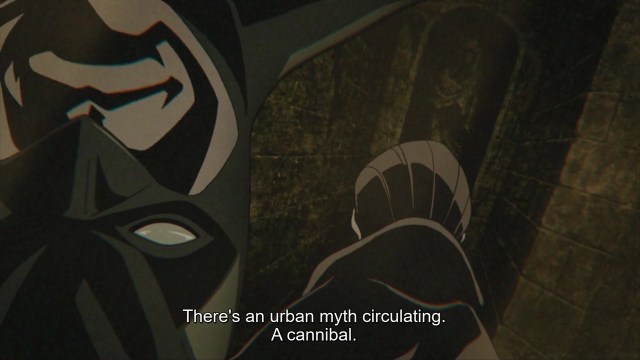
Batman: Gotham Knight (バットマン ゴッサムナイト, Battoman Gossamu Naito) is a 2008 anthology animated superhero film consisting of six shorts, supposedly set between the films Batman Begins (2005) and The Dark Knight (2008) although the narrative connection is tenuous.

vlcsnap-00006.jpg

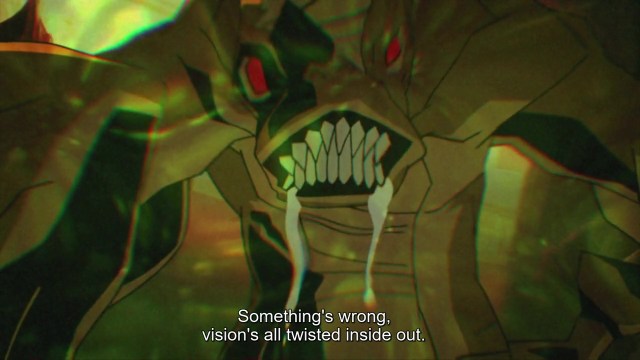
So, of course it has a cannibal in it! Killer Croc, who has been a Batman villain since the 1980s, although getting a grenade down his throat in this episode might, you would think, slow him down a bit. But no, he was back in the computer-animated TV series Beware the Batman in 2013-14. In that one, he bites Batman and boasts that he tastes like chicken. Perhaps a subtle insult rather than a gastronomic judgement. Anyway, that was a prequel, so let’s not give up on grenades just yet.

Batman is looking for a large, scaly monster. He finds some homeless dudes in the “ghost stations” under Gotham and asks them if they’ve seen the monster. In one of the great lines of all Batman stories, they answer:

vlcsnap-00009.jpg

Ain’t it the truth.

Killer Croc’s real name is Waylon Jones, and he is a cannibalistic serial killer. The urban legend goes that he was an infant born with the disfiguring skin disorder epidermolytic hyperkeratosis and that his mother abandoned him in the sewers of Gotham City.

vlcsnap-00011.jpg

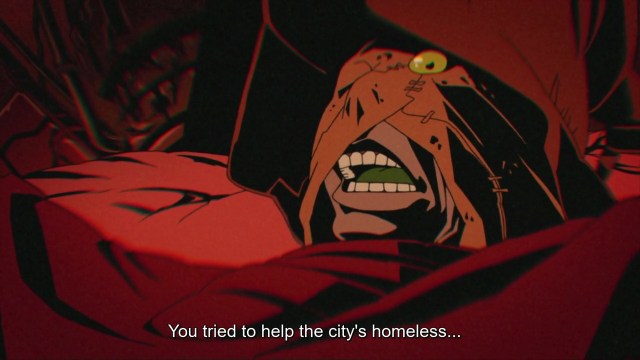
Probably having scaly skin and looking like a croc didn’t do much for his self-image either. As an adult, he files his front teeth into points to complement the reptilian appearance of his skin and became a circus sideshow performer. Later, he changed his name to Killer Croc and went on a killing spree that eventually landed him in Arkham Asylum. There, his homicidal impulses intensified during “fear aversion therapy”. Croc escaped from Arkham and fled to the sewers with a handful of escaped Arkham inmates. There, he had fear toxin injected into parts of his body. When Scarecrow orchestrates the kidnapping of Cardinal O’Fallon, Croc infiltrates the church and carries him down into the sewers. Batman comes to investigate, but Croc ambushes him, biting and infecting Batman with the fear toxin that is coursing through Croc’s own body.

vlcsnap-00017.jpg

Well, of course Batman works through pain, as he tells the cops. But why did the underground monsters kidnap the cardinal?

vlcsnap-00025.jpg

Yeah, they’re mighty cranky with that Cardinal.

vlcsnap-00020.jpg

Batman: Gotham Knight is the first animated Batman film to be rated PG-13.

cover.jpg

“I’m not insane” HANNIBAL S03E08: “The Great Red Dragon”

Aficionados of Hannibal will remember that the good Doctor Lecter was introduced to the world in the book Red Dragon in 1981. That book became the first Hannibal movie Manhunter in 1986 with Brian Cox as Hannibal, and was then remade under its original title with Anthony Hopkins in 2002, years after he had made Hannibal (in)famous in The Silence of the Lambs. A lot of the characters, plots and dialogues of Red Dragon were used by Bryan Fuller in making the television series Hannibal, but the main plot, Will Graham trying to track down the serial killer Francis Dolarhyde, only comes to the television screen in this, the eighth episode of the final season. The rest is all prequel.

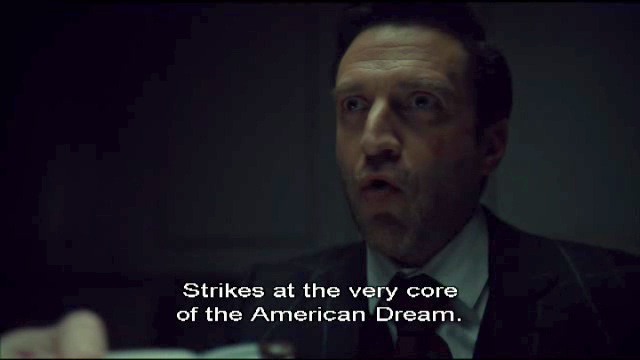
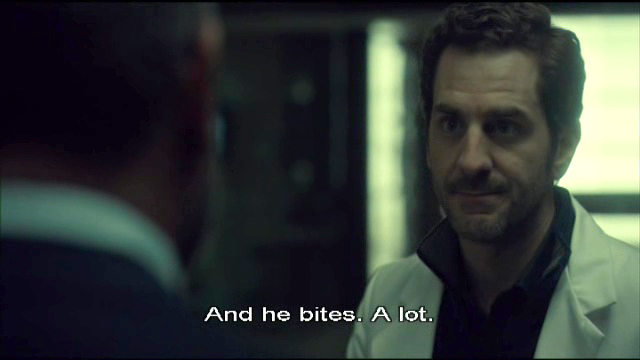
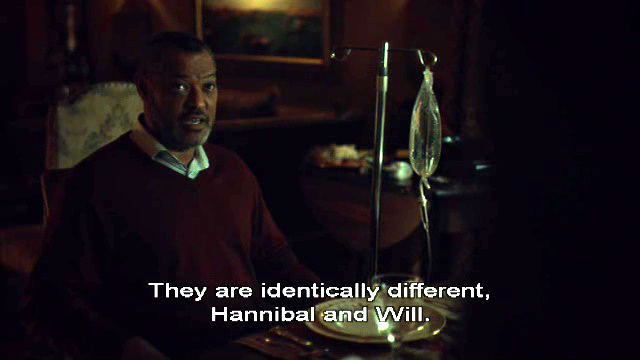
We’re not going to get an origin story for Hannibal here, except – he ate his sister, but he didn’t kill her. That’s all we get, and it’s all we need. We get one right at the start of this episode, though, for Francis Dolarhyde (Richard Armitage, who also played Thorin Oakenshield, the Dwarf Prince in The Hobbit). Dolarhyde is slightly disfigured – a cleft palate that has been repaired but is still visible, and gives him problems with his speech, and a major case of social anxiety. He sits alone, OK, he’s a loner (sometimes called “rugged individual”), and he reads Time Magazine, OK, he’s a loser. No wait – there’s an article on the cover about William Blake and his extraordinary 1805-10 watercolours of the “Great Red Dragon”. He heads off to his gym to work on some already pretty beefy musculature. He gets a huge tattoo of the Dragon. He gets some dentures made, snaggly-toothed ones. It’s a cannibal show – so people are going to get bitten. He’s going to become that Dragon, or more accurately, the Dragon is going to become him. On the full moon, he sacrifices to the Dragon, by murdering “perfect” American families. As Frederick Chilton puts it in a visit to Hannibal:

vlcsnap-00047.jpg

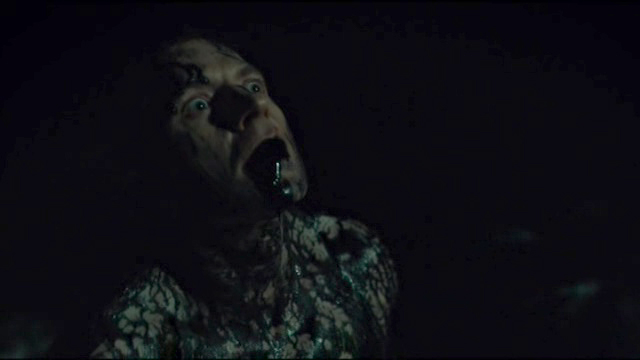
The press call him the “Tooth Fairy” because he likes to bite his victims.  We see him dripping blood into the snow. It’s all super-gothic.

vlcsnap-00024.jpg

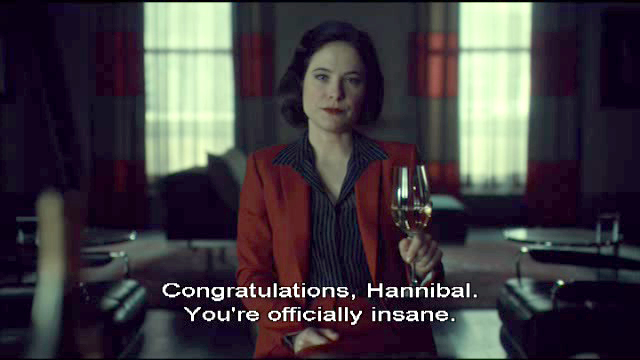
Three years after his surrender, Hannibal is locked in an asylum – at least, his body is, but his mind wanders freely through his memory palace – we see him in church listening to a young boy singing Hallelujah, while in fact he is being processed and incarcerated. Then he’s talking to Alana, in his office, drinking Montrachet, but really he’s in his painfully white cell in the asylum, and she is his jailer. He has been spared the death sentence everyone expected after his trial for the murder of a dozen people.

vlcsnap-00003.jpg

Hannibal and Alana were friends, lovers at one point. He asks her if she still prefers beer to wine.

vlcsnap-00009.jpg

Hannibal is the trickster. Not what, “who” he corrects her. She had people in her beer.

vlcsnap-00017.jpg

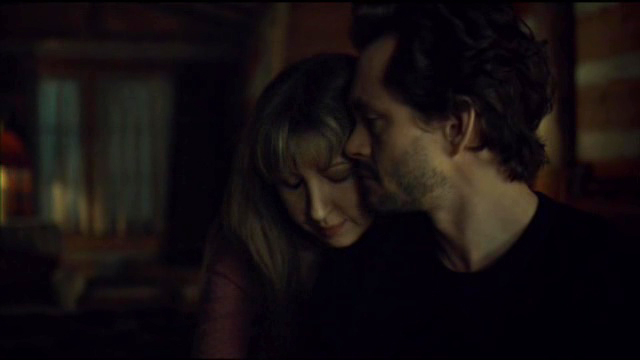
Will doesn’t want anything to do with the FBI or, apparently, Hannibal; he is living a peaceful life with Molly and Walter (her son).

vlcsnap-00053.jpg

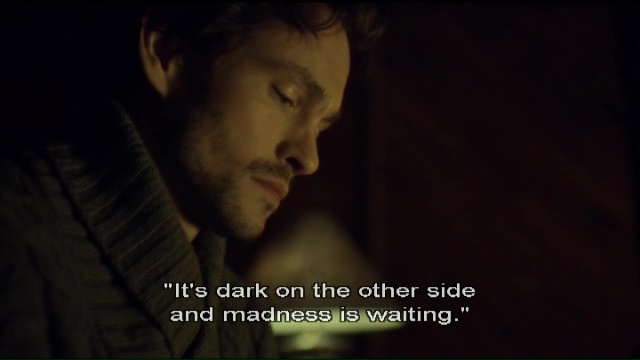
But Jack Crawford comes looking for him. No one can profile serial killers like Will. Will he go with Jack? He reads a letter from Hannibal, with a cutting about the Tooth Fairy, warning him that Jack will come knocking, and cautioning him not to accept.

“We have all found new lives. But our old lives hover in the shadows. Soon enough Jack will come knocking. I would encourage you as a friend not to step back through the door that he holds open.”

vlcsnap-00054.jpg

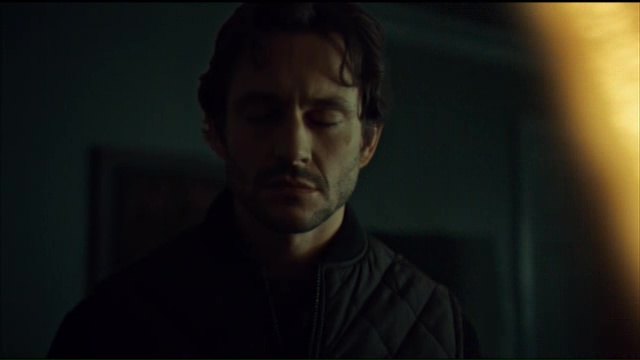
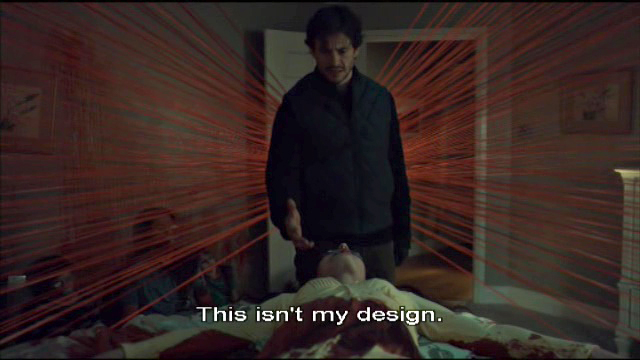
Will goes though, and visits the crime scenes, where he recreates the crime in his mind, with the swinging pendula, just the way he did in the first season, that we all miss so much.

vlcsnap-00058.jpg

vlcsnap-00061.jpg

Will figures that he (as serial killer) would take his gloves off to touch his victims. The team is thus able to get a partial thumb-print from the victim’s eyeball. And then there’s a piece of cheese that he bit. And the victim that he bit. They have his (or his denture’s) toothprints.vlcsnap-00066.jpg

Dolarhyde is assailed by roars and high pitched tones as he tries to watch his home movies of his murders. Where are they coming from? Ah yes, the false teeth. Dolarhyde is being taken over by the Dragon, becoming the Dragon. He is, to his own tortured psyche, becoming more than human, an Übermensch like Hannibal. He will need to absorb the essence of Hannibal to become the superman. Will has to do the same to identify and stop him.

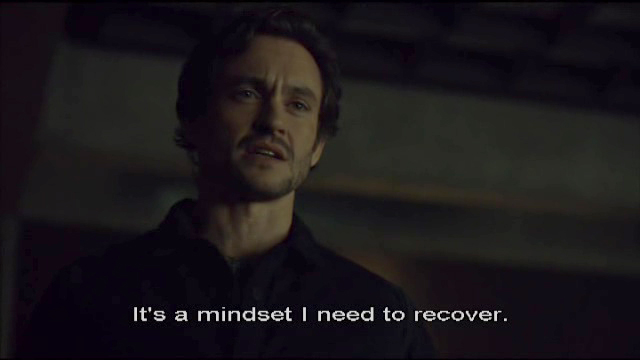
There’s only one way to get into the mind of a biter.

vlcsnap-00072.jpg

vlcsnap-00073.jpg

Walt Disney: eating children: ROBOT CHICKEN S1E2 “Nutcracker Suite”

Robot Chicken is a stop-motion television series which started in 2005 on Adult Swim, the “adult” channel of Cartoon Network. It is created and produced by Seth Green and Matthew Senreich along with co-head writers Douglas Goldstein and Tom Root.

The show takes a sometimes sardonic look at popular culture. This episode, the second ever shown (and it’s now in its tenth season!) took on the rumour circulating on social media that Walt Disney’s head had been frozen after his death in 1966, in the hope that he could be revived later (there is a huge industry of cryogenics).

vlcsnap-00001.jpg

vlcsnap-00002.jpg

It’s not true, just BTW.

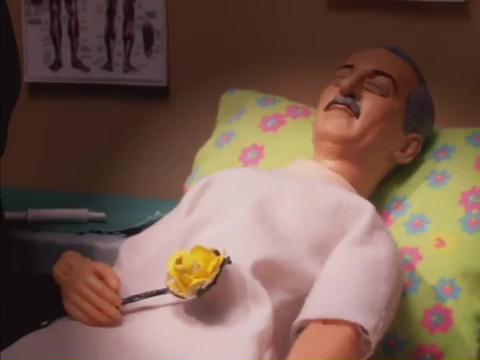
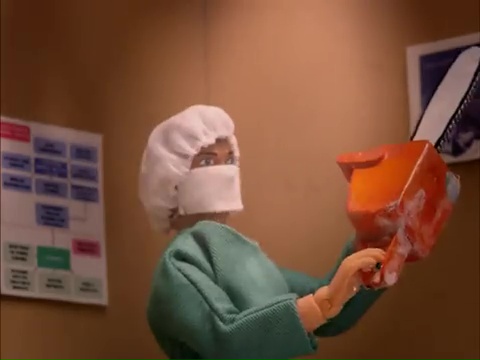
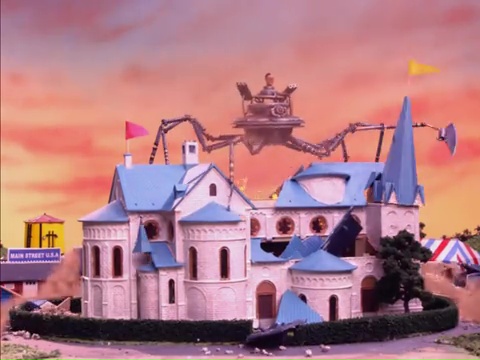
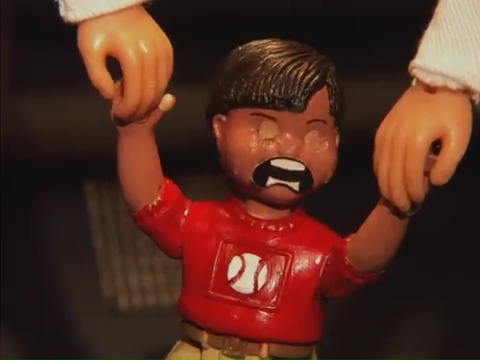
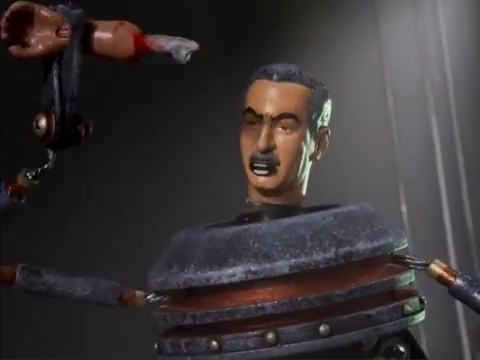
In this reimagining of the Disney legend, Walt is not the lovable avuncular figure that (older) readers may remember from black and white TV. The episode starts by rehashing the old story about his antisemitism, then we see his head being cut off with a chainsaw for freezing. Under the Matterhorn, later, his head is thawed out and grafted onto a steel spider frame, reminiscent of War of the Worlds. He has death rays in his eyes, and he HUNGERS!

vlcsnap-00017.jpg

vlcsnap-00014.jpg

He’s in this cannibal blog because he’s, well, become a cannibal, eating children to keep his monstrous form alive. They are brought to him by his minions.

vlcsnap-00005.jpg

“Bring in the first human child!”

vlcsnap-00006.jpg

He builds a theme park in Florida, so that he can access lots of children, and keep his appetite satiated. But then, “one fateful day”, he sees on television the story of Elián González, the little Cuban boy was was involved in a huge custody battle which became an international incident between the US and Cuba.

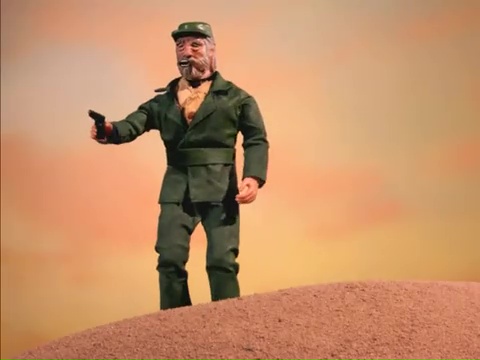
He hungers for Elián and decides to invade Cuba. As he begins his attack on Cuba, the Cuban standing at the monitor can be heard yelling the same Spanish phrases as the popular cartoon character Speedy Gonzales.

Disney causes havoc, knocking planes out of the sky à la King Kong. Poor Elián appears on the shore, offering to sacrifice himself to save his beloved Cubans, but then Fidel arrives!

vlcsnap-00018.jpg

vlcsnap-00020.jpg

Look, it’s a satire on American imperialism of course, but it has a lot to say about the cannibalistic nature of capitalist consumerism and the voracious appetite of corporates who look to eat up the culture and the cash of their target audience. Imperialism is not just via planes and tanks and giant spiders with frozen heads on top. Cuba has been embargoed from receiving the benefits of American culture for decades, and some of them seem to like it just fine that way.

vlcsnap-00009.jpg

Cannibalism costs an arm and a leg: THE BAD BATCH (Ana Lily Amirpour, 2017)

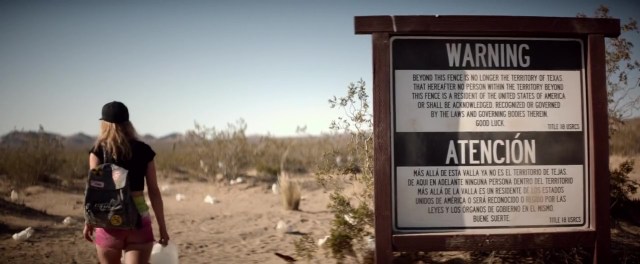
What do we do when dystopian stories start to look like the daily news? This film was made in the first year of the Trump presidency, which, you will remember, was partly won on the promise to build a “big beautiful wall” to keep criminals and rapists out of the USA. But what do you do with the criminals already inside the big beautiful wall? “Non-functioning members of society” are, in this dystopia, exiled, quarantined as “bad batch”.

Arlen (Suki Waterhouse) is bad batch number 5040, a number which is tattooed behind her ear, similar to the way Holocaust victims were stripped of their names and their humanity and became just numbers. She is then sent through the wall into a vast desert with little more than a sandwich and a bottle of water.

vlcsnap-00002.jpg

She is almost immediately captured by the cannibals, the “bridge people”, who live in crashed planes and work out like Muscle Beach.

vlcsnap-00012.jpg

The two women who caught Arlen hacksaw her leg and arm off, cauterise the stumps with their frying pan, presumably to keep the rest of her fresh, and go off to cook the limbs.

vlcsnap-00008.jpg

Arlen escapes on a skateboard, pushing with one arm and one leg, and, just as she is about to be eaten by crows, is found by a hermit (an unrecognisable Jim Carrey!)

vlcsnap-00028.jpg

The hermit takes her to Comfort, a settlement which seems to be a continuous rave club, run by a charismatic cult leader, The Dream (Keanu Reeves), who throws the parties and has his own harem of pregnant young women. In Comfort, they seem to prefer to eat noodles and rabbits (and lots of drugs) to human flesh, but – who knows? Like the bad bunch people, the camp structures are the rejects and wreckage of society – yet there never seem to be serious shortages of anything, particularly drugs. And The Dream lives in luxury, on the proceeds of the drugs, which are the currency of Comfort.

The folks at Comfort have given Arlen a prosthetic leg, but she still misses her arm. But one hand is enough to handle a gun. Is there some symbolism here that is even more Freudian than Trumpian?

vlcsnap-00019.jpg

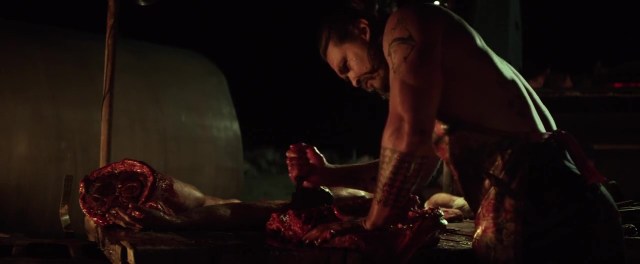
Meanwhile, back at cannibal HQ, the leader, Miami Man (Jason Momoa- you might remember him as Aquaman), is killing and carving up a woman for dinner.

vlcsnap-00016.jpg

Is this going to be a simple good (rabbit eaters) vs evil (human eaters) story?

vlcsnap-00040.jpg

Not quite. How can there be good and evil, when everyone is on the wrong side of the wall? Miami Man turns out to be a devoted Dad; he has a cute little daughter, and you know how much kids eat, right? Some of his tribe collect rubbish from the tip, others collect humans for dinner – is there a difference in a world where value is only assigned to those deemed worthy of being on the right side of the big, beautiful wall?

Arlen is gunning for revenge. She comes across the little girl and one of the bridge people women who kidnapped her, foraging for plates.

vlcsnap-00022.jpg

She shoots the woman and takes the girl back to Comfort, buys her a rabbit. But then Arlen takes drugs, handed out at the party like Eucharist wafers, and wanders into the desert, to wonder at the glories of the galaxy, as you do when you take psychedelics (or so I hear).

vlcsnap-00038.jpg

Well, we know there is going to be a meeting and a reckoning with the cannibal king. It’s hard to tell, though, who are the good guys in a world where everyone is an exile, and maybe a cannibal? As Arlen says to MM:

“Here we are in the darkest corner of this Earth, and we’re afraid of our own kind.”

The film is loosely based on a true story: the so-called “Cannibal Island”, a small island called Nazino in Siberia to which Stalin deported around 4,000 people declared to be “declasse and socially harmful elements” including political dissidents, disabled or impoverished people and criminals. They were dumped on the island with no food except some raw flour, which gave them dysentery. Before long, they turned to cannibalism. Two thirds of the deportees were killed or died of hunger and disease.

Cannibal Island.jpg

It makes Comfort look positively comfortable.

The Vancouver North Shore News said “The Bad Batch could as easily be described as “a Futuristic Cannibal Spaghetti Western,” a dystopian genre mash-up.” It has a disappointing 44% on Rotten Tomatoes, and is admittedly a bit slow in parts (and a bit daft in others), but the cast is great, the photography often superb, and the political timing spot-on. Walls lead to wars, and the phrase “dog-eat-dog” should really be “human-eat-human”. Eating rabbits, eating humans.

vlcsnap-00045.jpg

Because when it all hits the fan, whether it’s outside the wall or sleeping in the streets eating Soylent Green, humans are usually only one species barrier away from cannibalism. Expelled from under the thin camouflage of civilisation, we are all bad batch cannibals.

Poster.jpg

Dawkins won’t eat it, but can’t say why…

OK, this is a film and TV blog, but Richard Dawkins is always show biz, so let’s consider him briefly. He’s just posted a new Tweet in response to an article about the booming market for real meat, but grown in a laboratory instead of being cut from a living, sentient animal.

The Christians aren’t buying it, saying that we can’t eat people because people are made “in the image of God” (whatever that means).

But if you are not a believer in immortality and the sacred soul, then why should it be OK to eat an animal that wanted to live, but not to eat a dead human (who didn’t care) or a lump of flesh grown painlessly in the lab from any species? Richard Dawkins can’t say.

Interested in hearing your feedback. The comments on the Twitter page range from the sublime to the ridiculous.  What do you think?

Don’t play with your food… HANNIBAL Season 3 Episode 7, “Digestivo”

Pigs and people. Are they identically different, like Hannibal and Will?

vlcsnap-00001.jpg

Why do we consider pigs uncontroversially edible, and yet are so shocked at Hannibal or Mason eating human? [If you have the answer to that, please let me know – I’m up to 65,000 words and still haven’t come to a conclusion]. We use them in gruesome experiments because they are like us, but then justify it by saying they are not really like us at all. This episode is all about pigs and people interchangeably being used, abused, and prepared for dinner.

Pigs of course are remarkably similar to humans – have you ever seen a butcher carrying a pink corpse into the shop and wondered for a moment who he has killed? Geneticists have proved the similarity:

“We took the human genome, cut it into 173 puzzle pieces and rearranged it to make a pig. Everything matches up perfectly. The pig is genetically very close to humans.”

The episode is called Digestivo, which in Italian is an after-dinner drink, usually a liqueur or bitter, which is meant to settle the stomach. We have, in this episode, finished consuming the plot of the book and movie Hannibal, which follows Mason’s quest for revenge. Next episode, we go to the central plot of Red Dragon, which of course pre-dated the other books but, by the brilliance of Bryan Fuller, is readily reimagined as a later time in this new universe.

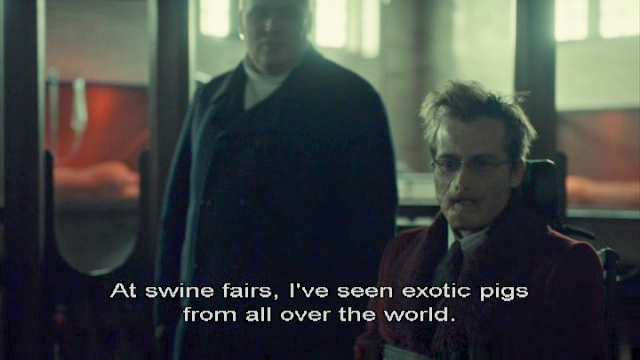
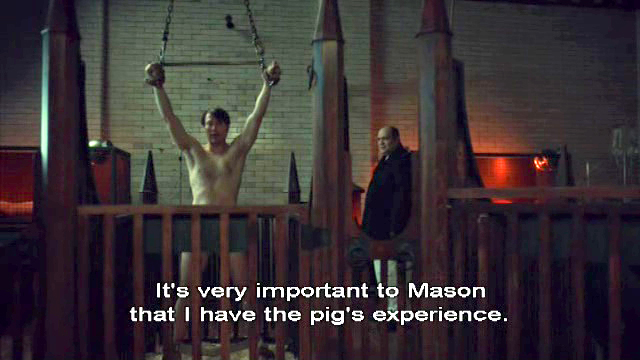
Mason always carries a little knife that belonged to his father. Perhaps it’s the same one that he used to slice off his face. His father would test the depth of fat on a pig’s back by poking him or her with this knife, something neither the pig nor farmer found terribly acceptable. Now he is doing it to Hannibal. It’s clear that he is planning to turn Hannibal into a pig before he eats him.

vlcsnap-00013.jpg

vlcsnap-00014.jpg

Of course, there’s many a slip, as they say, or as Nick Cave says:

“If you’re gonna dine with the cannibals, sooner or later baby you’re gonna get eaten”.

Or as Alana warns:

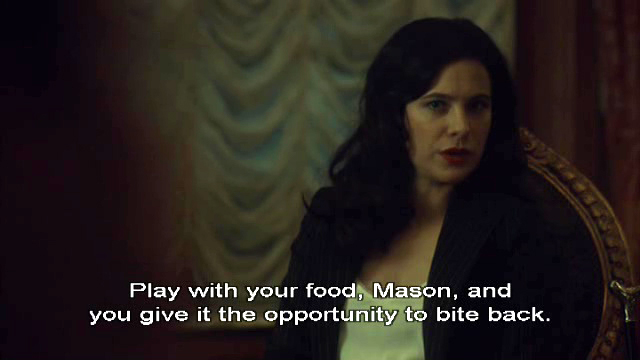
vlcsnap-00019.jpg

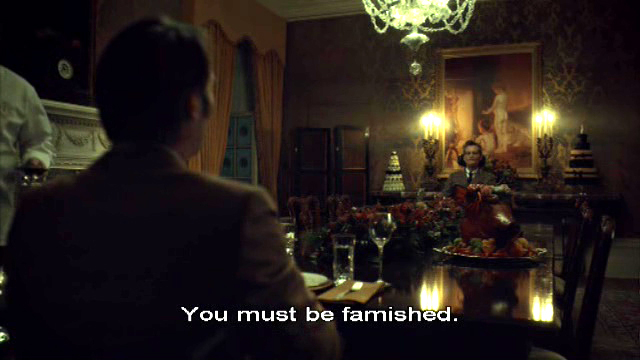
To the sublime tones of the Mozart Piano Concerto 21, Hannibal and Will are dressed and brought to Mason’s table. In the opulent dining room of Muskrat Farm, Mason tells Hannibal that “I snatched Will Graham right out of your mouth.” He is referring to Hannibal’s plan to eat Will’s brain, foiled by the arrival of the Italian police, who were in Mason’s pay.

vlcsnap-00024.jpg

Hannibal and Mason compare their depth of reading, as Hannibal reminds Mason of the biblical story of Jezebel, who was, like Mason’s face, eaten by dogs. Mason in return spouts a news story he read about “that German cannibal” (he can’t remember the name of Armin Meiwes?) who advertised on the Internet for someone who wanted to be eaten.

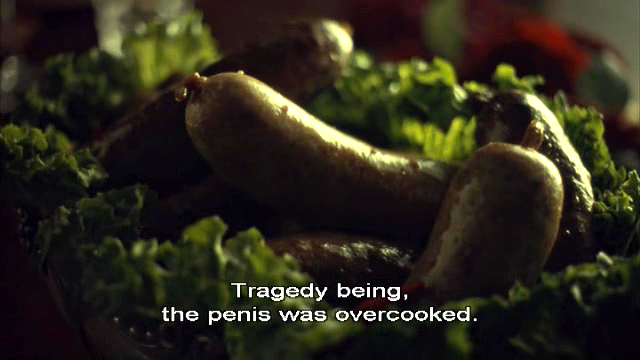
The cannibal and the intended meal ate the man’s penis together before the latter died and was packaged up in the freezer. Mason’s assistant, Cordell, arrives hilariously at that moment with some pork sausages, thus emphasising the human/pig parallels.

vlcsnap-00033.jpg

“Go to all that trouble to eat a friend and you overcook his penis. They ate it anyway, they had to, they committed. But they didn’t enjoy it.”

vlcsnap-00038.jpg

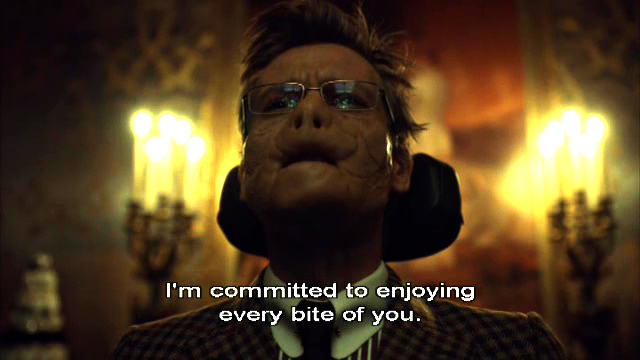
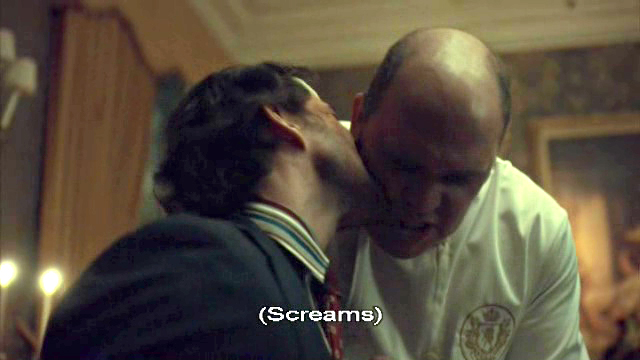
Mason reveals part of his plan – he likes Will’s face, and intends to graft it onto Hannibal before he eats him. The rationale is that Will and Hannibal were both there watching as the dogs ate Mason’s face. They banter pleasantly (Hannibal shows no fear) about the order in which Mason will eat the various parts of Hannibal’s body. Everyone loves to chat about cannibalism! Will’s banter is a little less polite, as he takes a healthy bite of Cordell’s cheek, much to Hannibal`s amusement, and is left with a bloody chin, reminiscent of Anthony Hopkins in Silence of the Lambs. Will has become at least a functional cannibal.

vlcsnap-00062.jpg

vlcsnap-00064.jpg

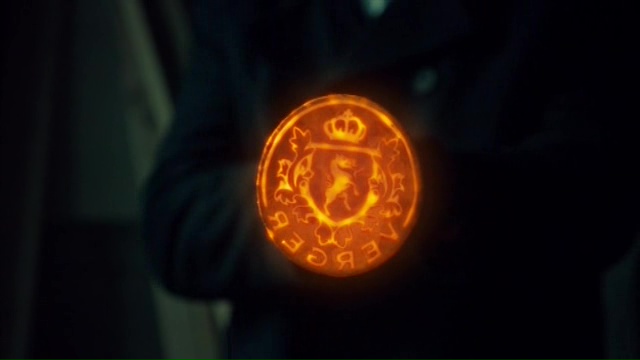
Cordell sews up his own face, then advances on Hannibal with the Verger branding iron. He brands Hannibal with the Verger emblem.

vlcsnap-00071.jpg

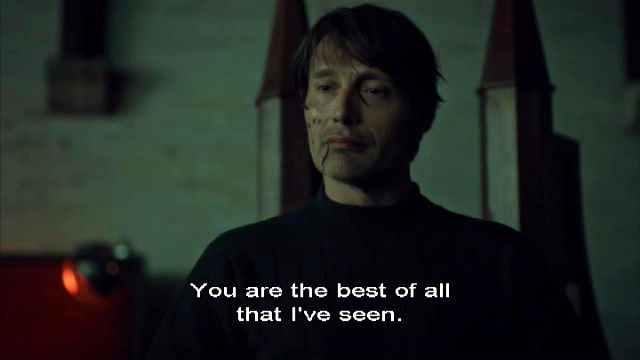
Hannibal is being turned into an edible pig, because as Mason admitted, he did not really fancy eating human flesh. Much easier to eat the animal that daddy made his fortune exploiting, than to eat the man who consistently outsmarted him.

“Mason would have preferred to brand your face. He fought bravely, and with his own funds, against the humane slaughter act, and managed to keep face-branding legal.”

vlcsnap-00078.jpg

Part of what supposedly makes us superior to other animals is the power of speech. Pigs can grunt and scream eloquently, but they can’t form their words into either maxims or complaints. The tongue is crucial, and Cordell tells Hannibal he intends to

“…boil it, slice it very thin, marinate it in olive oil, garlic, parsley and vinegar.”

vlcsnap-00083.jpg

Cordell describes the rest of his plans, in something almost out of a cooking show. But looking down appreciatively, he adds

vlcsnap-00087.jpg

“Every day I’ll feed Mason some new part of you. And don’t you worry Dr Lecter, you will always be cooked to perfection.”

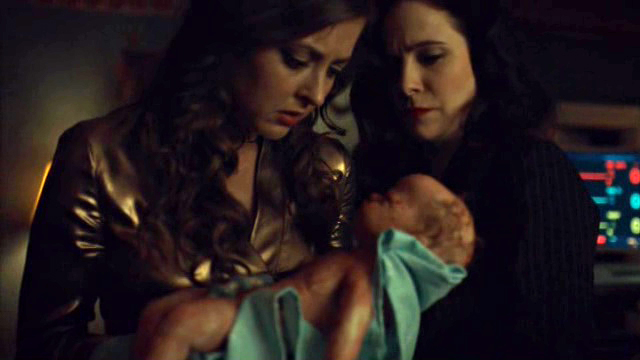
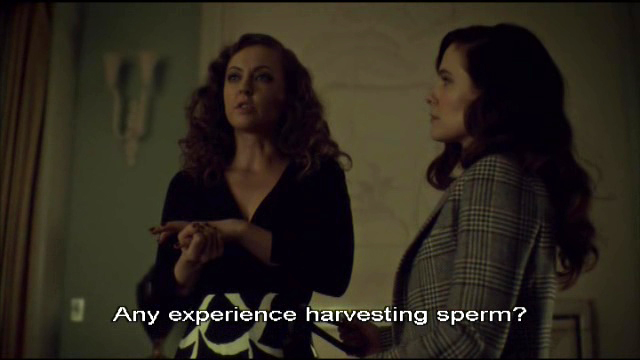
Anyway, we know that nothing like that is going to happen, because we still have six episodes to go. AND SEASON 4 [please?] The rescue involves Alana and Margo, who find that Mason kept Margo’s eggs and that there is a surrogate having her baby.

vlcsnap-00153.jpg

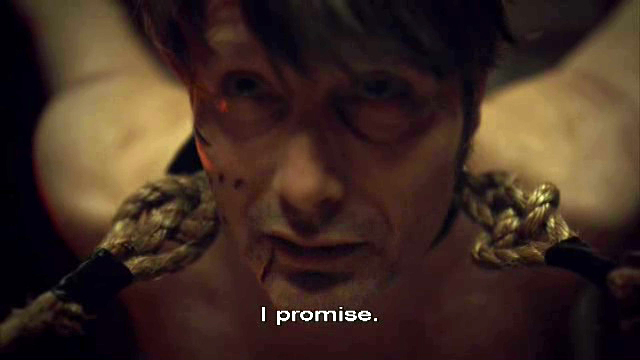
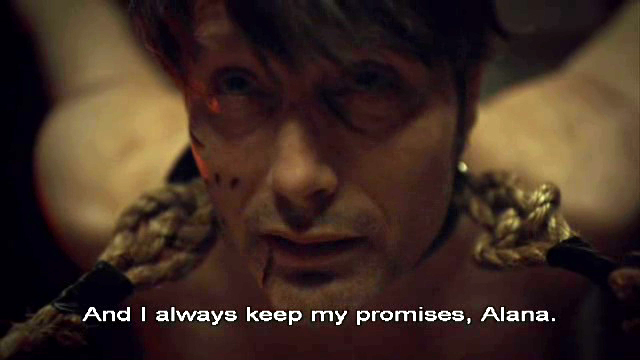
A pig, of course. Not too successfully; the baby is dead, which makes her fighting mad. They head off to kill Mason. First, they release Hannibal, because he has to save Will (about to have his face cut off without anaesthetic). Alana knows that Hannibal promised to kill her at the end of Season 1. But she has no other choice if Will is to survive.

“You’re the only one who can save Will. Promise me you’ll save him?”

vlcsnap-00127.jpg

vlcsnap-00128.jpg

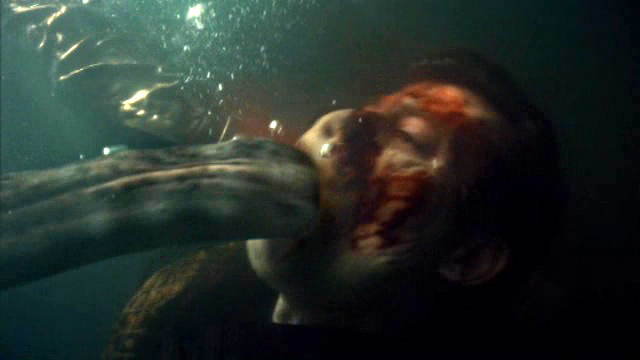
The “abyss” that Heidegger described between human and animal is further breached as Mason is eaten by his pet eel. Or chokes as he eats the eel. All lines are crossed.

vlcsnap-00166.jpg

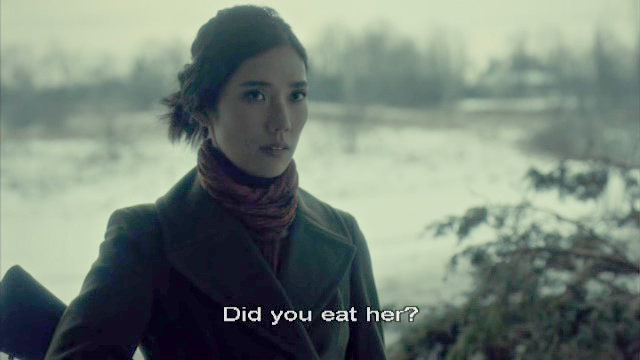
Having saved Will, Hannibal finally meets up with Chiyoh. She is willing to watch over him, but not in a cage: “Some beasts shouldn’t be caged.” Her obsessive hunt, she tells him, was motivated not by his plight or hers, but Mischa’s.

vlcsnap-00177.jpg

“Yes,” says Hannibal, “but I did not kill her”.

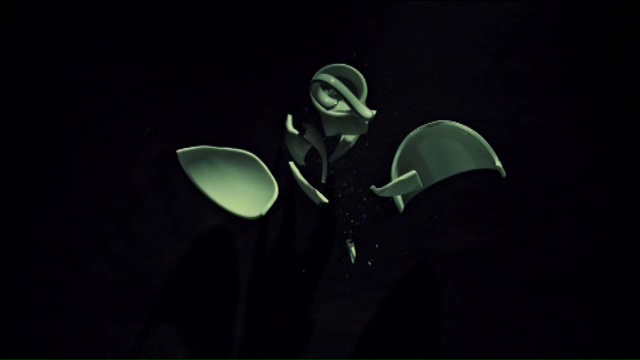
We see the broken teacup that has bothered Hannibal throughout the books, movies and this TV series. Can time reverse? Can we undo what has been done?

vlcsnap-00185.jpg

As he waits for Will to recover and awake, Hannibal is working on some higher level calculus, presumably still trying to work the maths on how to reverse time.

vlcsnap-00187.jpg

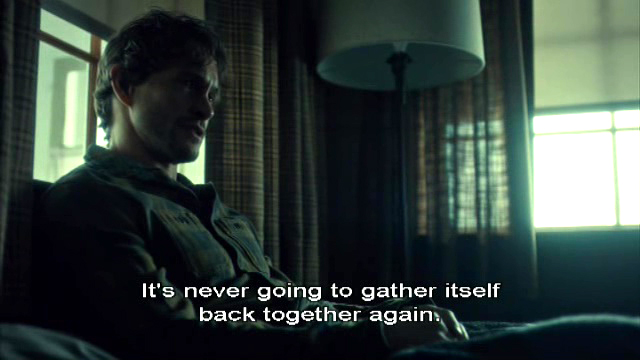
But Will is having none of it.

vlcsnap-00190.jpg

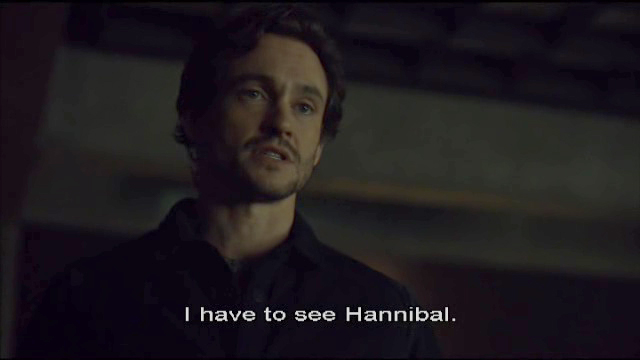
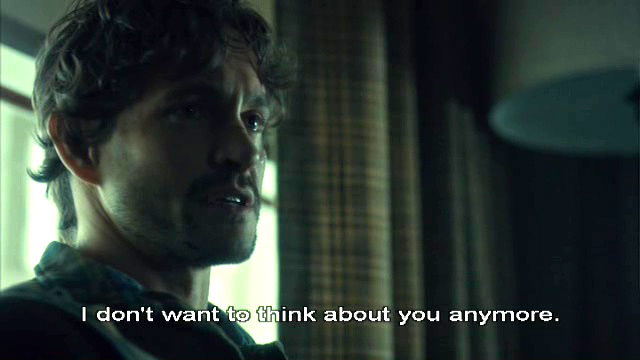
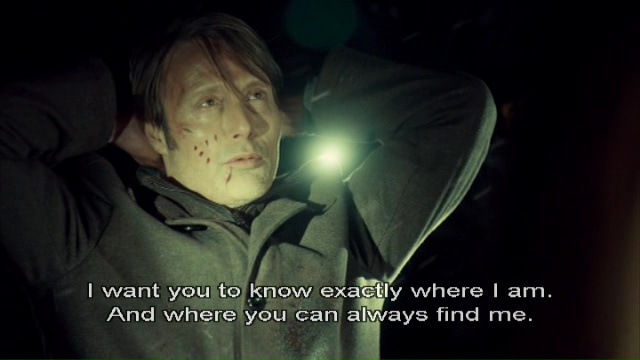
“I miss my dogs. I’m not going to miss you. I’m not going to find you. I’m not going to look for you. I don’t want to know where you are or what you do.”

vlcsnap-00203.jpg

vlcsnap-00204.jpg

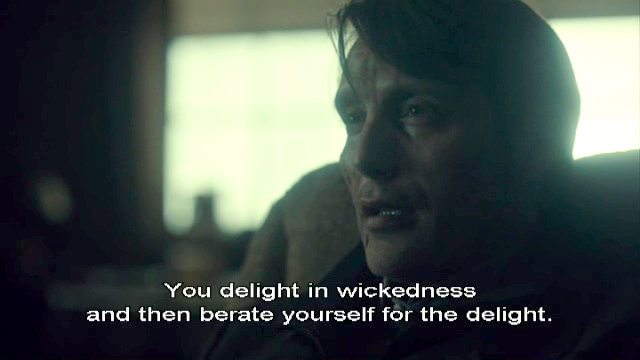
“You delight. I tolerate. I don’t have your appetite.

Goodbye Hannibal.”

vlcsnap-00211.jpg

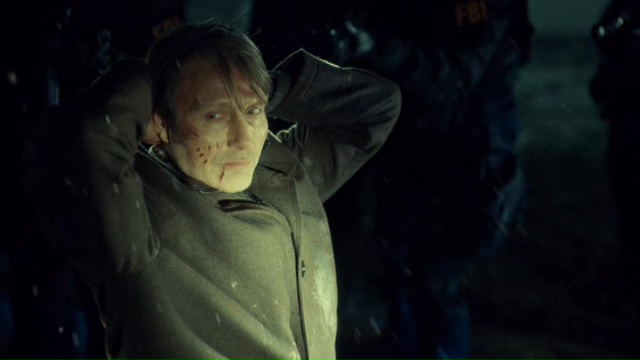
The digestivo here is a bitter drink – look at Hannibal’s face. Takes a hell of an actor to portray strong emotion so simply. Will has divorced Hannibal. But Hannibal is not giving up – he never does. He escapes before the FBI arrive, but then returns and surrenders.

vlcsnap-00220.jpg

vlcsnap-00222.jpg

Next episode, Will takes on the Red Dragon, but – can he do it without Hannibal? Silly question really, don’t know why I bothered asking it.

The last CANNIBAL on Earth — (“Last Man on Earth” Season 4, episodes 9-11, Will Forte)

The Last Man on Earth was a four-season American post-apocalyptic comedy series that showed on Fox from 2015-17. The protagonist (Will Forte, who also created the series) is Phil (or Tandy as everyone calls him – long story). Phil believes he is the only survivor of a mysterious virus (not coronavirus, but hard not to think about it while watching) that has killed off humanity and most other animals. He travels around the USA leaving signs on billboards asking other survivors to contact him in Tucson, but gradually goes crazy from loneliness.

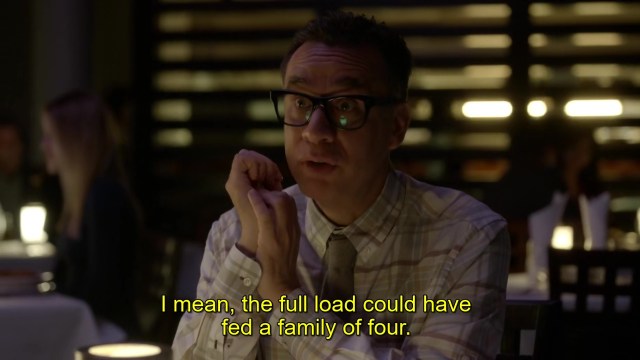
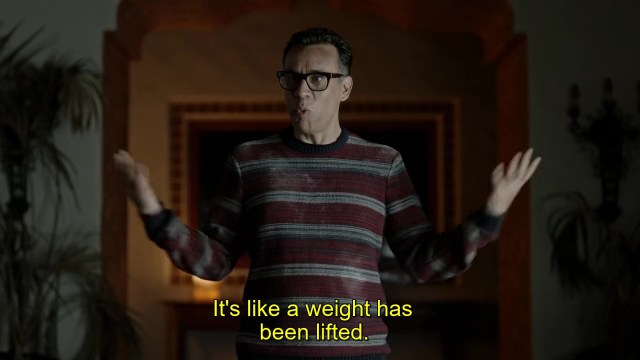
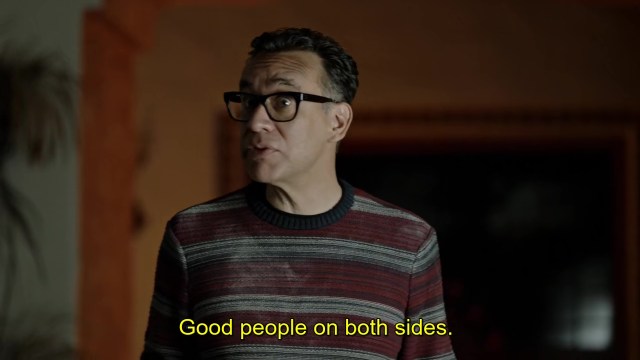
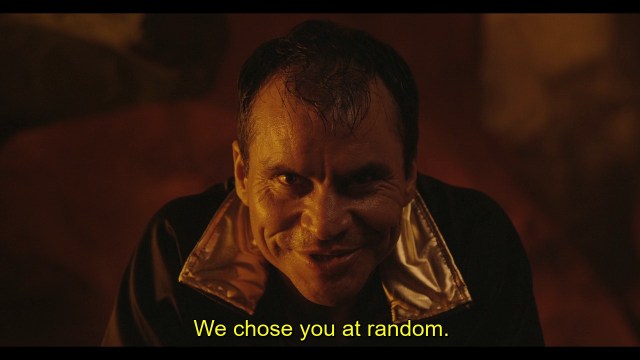
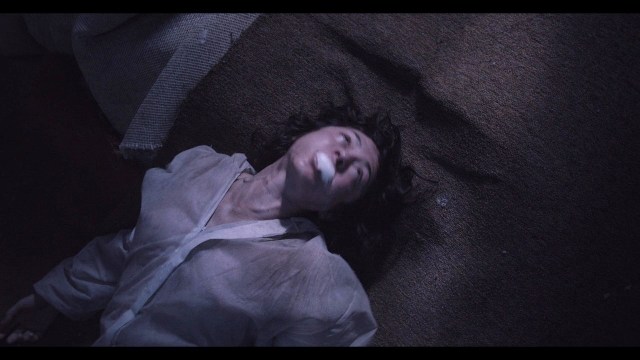
Then he starts meeting other humans. As it’s a comedy, they are (nearly) all nice, friendly, peaceable people, who bicker but generally don’t bite. Until season 4, when he meets Karl (Fred Armisen), a serial-killer cannibal. In a flashback to before the virus, Karl is being socially inept, disgusting his dinner date with recollections of a boil he had just had lanced.

vlcsnap-00005.jpg

vlcsnap-00008.jpg

The art of cannibalism stories is to disgust the viewer. Otherwise, where’s the conflict?

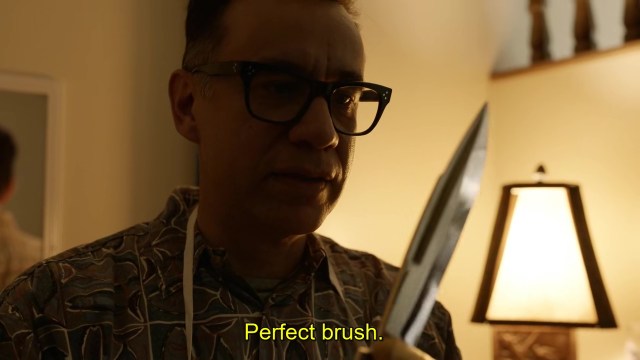
Karl’s modus operandi is to invite his prospective victim in for a sitting where he paints their portrait (a skill in which he is almost as deficient as his romantic conversation), then reach for his

vlcsnap-00024.jpg

When his model goes looking for a refreshing drink in the fridge, Karl has to run.

vlcsnap-00025.jpg

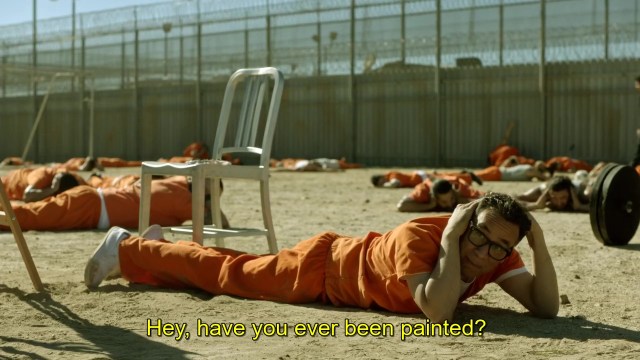
He flees to Mexico and sets up the same artistic practice, but is soon arrested and sent to a maximum-security prison, where he starts painting the other inmates, with designs to convert them into his next meal.

vlcsnap-00026.jpg

Karl is also somehow immune to the virus, but has been unable to escape the prison in which he was confined for the four years after everyone else died. Karl has killed the only other virus survivor, a guard, and is wearing his uniform, to hide his status as prisoner/cannibal. Karl is nice too. Except for being a serial killer cannibal.

vlcsnap-00033.jpg

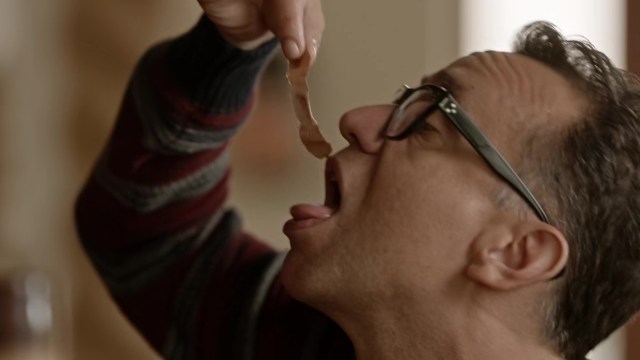
Karl has an unexplained compulsion to eat human flesh, and is powerless to defy it, despite his desperate efforts to do so.

vlcsnap-00027.jpg

He is obsessively drawn to a used Band-Aid, which is stained with the flesh of a burnt finger.

vlcsnap-00032.jpg

He is unmasked when he is followed to a cemetery, where he hopes to satiate his longings with some well-rotted corpse-flesh, much to the disgust of the observers.

vlcsnap-00049.jpg

vlcsnap-00051.jpg

What makes a cannibal? We have looked in this blog at several motivations such as savageism, starvation, revenge, psychopathy and entrepreneurship, and particularly at the figure of the wendigo, the mythical Algonquin spirit that inhabits the lost and drives them to an ever-escalating hunger for human flesh. Bryan Fuller implies in Hannibal that the good doctor Lecter is such a spirit, appearing as a figure with antlers, often disturbingly dressed in suit and tie. Traditionally, the cannibal required no explanation. In Classical stories, he (and cannibals were usually male) was a super-human or else hybrid figure, monstrous in appearance and easily identified as an ‘other’. In colonial times, they were tribes of savages, whose ignorance of the morals of Europe required the intervention of the conquistadors to ensure they were re-educated, which would usually involve the appropriation of their lands and the enslavement or extermination of the ‘cannibals’.

The contemporary cannibal is often typified by his inconspicuousness – acquaintances of cannibals like Jeffrey Dahmer, Albert Fish or Armin Meiwes often spoke of how normal and prosaic they seemed. Karl fits exactly into this model of the contemporary cannibal – the others like him, and can hardly believe it, even when he admits to his addiction, as if it was an AA meeting.

vlcsnap-00024.jpg

vlcsnap-00025.jpg

There are many ethical issues raised in this apparently light-hearted comedy. Everything in the world before the virus was about voracious appetite and power, and things have not changed that much. Now of course there is no money, and the stores are full of whatever you could want, but it’s all starting to go bad, even the tins. The few animals they have found alive have usually come to a sticky end – the cow whose milk they took died, her calf was left behind when they left for Mexico, the bull was killed and eaten. They found crickets and ate them. They catch a fish with a hook, much to their surprise. Phil threatens to eat a little dog’s butt at one point. Anthropocentrism, sometimes called speciesism or human narcissism, is now the supreme ideology, even though it has apparently led to the extermination of almost all life on Earth.

The main question of this brave new world, then, is: are there any ethical constants? The survivors are mostly besotted with the idea of having babies and repopulating the world with humans: is that a great idea? And while they are satisfied to smash down shop doors and take whatever they need, they are shocked at the cannibal doing the same. To Karl, to all of us, morality is simply relative to his immediate needs. Certainly not a view confined to cannibals.

Karl suggests they all go to bed, and discuss the problem in the morning. They will have questions for him. He will have questions for them too! His morality is straight out of Trump at Charlottesville:vlcsnap-00031.jpg

vlcsnap-00032.jpg

As Dostoevsky said in the Brothers Karamazov:

“…there was no law of nature that man should love mankind, and that, if there had been any love on earth hitherto, it was not owing to a natural law, but simply because men have believed in immortality…. if you were to destroy in mankind the belief in immortality, not only love but every living force maintaining the life of the world would at once be dried up. Moreover, nothing then would be immoral, everything would be lawful. even cannibalism.”

Karl exemplifies what Aristotle called the “rational principle”.

Hansel, Gretel and incestuous cannibalism: WE ARE THE FLESH – Tenemos la carne (Emiliano Rocha Minter, 2016)

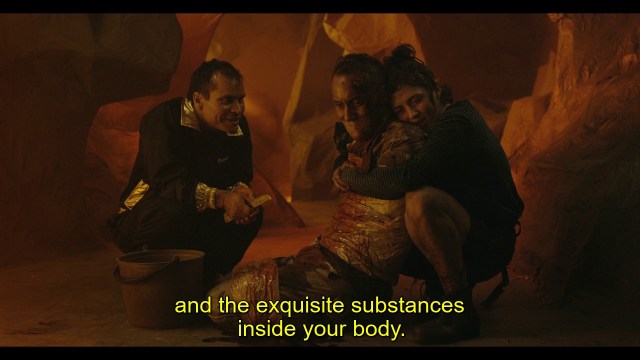
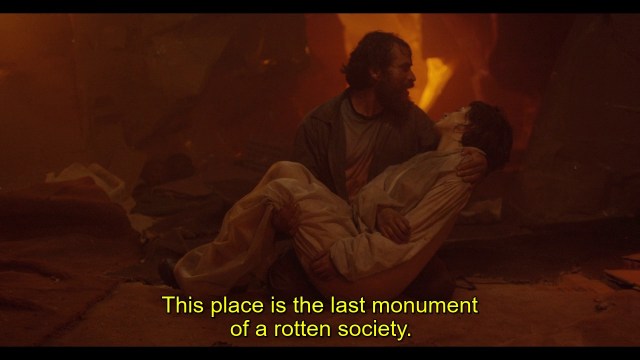
It’s Hansel and Gretel, Captain, but not as we know it. This Mexican film is a visual experience, rather than a traditional narrative. It is set, like many of the films we have covered in this blog, after what appears to be an unexplained apocalypse. The “witch” is a crazy old guy named Mariano (Noé Hernández) who makes fuel out of old bread and trades it to persons unknown, through a hole in the wall, for food – mostly eggs and meat. Mariano is more Satan than witch.

vlcsnap-00059.jpg

He believes in chance, which, he says, is “the greatest criminal to ever roam the Earth.”

He is an aficionado of solitude, but when a young brother and sister, Lucio (Diego Gamaliel) and Fauna (María Evoli), appear in his abandoned apartment, he feeds them and puts them to work on ever more peculiar projects, such as a womb-like cocoon, made of wooden struts and vast amounts of packing tape.

vlcsnap-00009.jpg

Mariano receives some meat through the hole in the wall, and cooks it for his guests. But there’s a problem: Lucio is a vegetarian. Fauna tucks into her steak, rather reversing the normal situation where Hansel ignores Gretel’s warnings and eats the gingerbread. But Mariano has laced the meat with poison that, he says, the Nazis used to kill Jews. He won’t give Fauna the antidote until Lucio eats his meat.

vlcsnap-00019.jpg

So, it’s all about transgression, overcoming taboos, abandoning inhibitions, accepting pleasure rather than bothering with difficult questions of ethics. Mariano then decides that the kids need to have sex, and Lucio’s objection, that she is his sister, is dismissed:

“Do you think your cock gives a damn about her being your sister?”

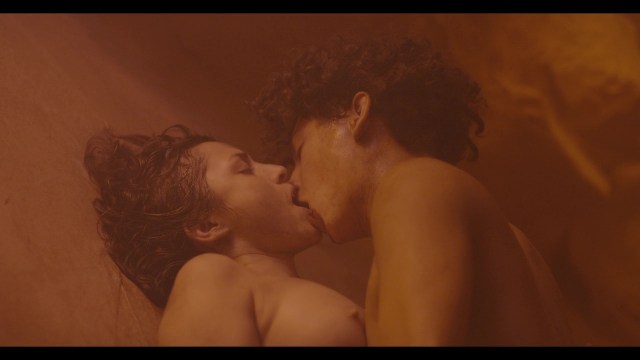
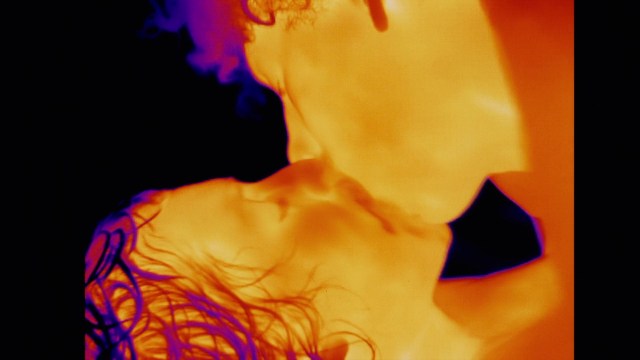
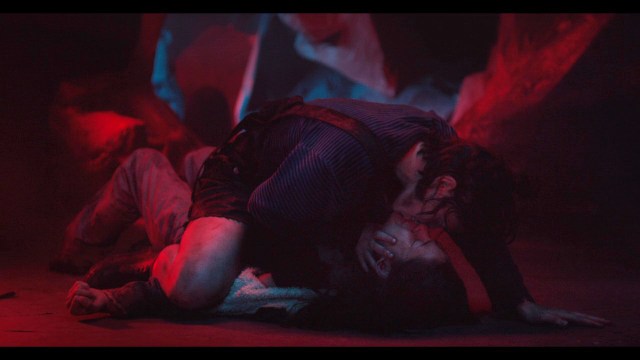
So then there’s lots of incestuous sex, some of which is captured in lurid neon heat-map images. Mariano sings to them and masturbates as they perform for him, finally fainting as he ejaculates. Or dies, but is resurrected, because, as we know, the monster is never really gone.

vlcsnap-00034.jpg

vlcsnap-00036.jpg

The Brothers Grimm was never like this. Although who knows what siblings Jacob and Wilhelm Grimm got up to before they became philologists?

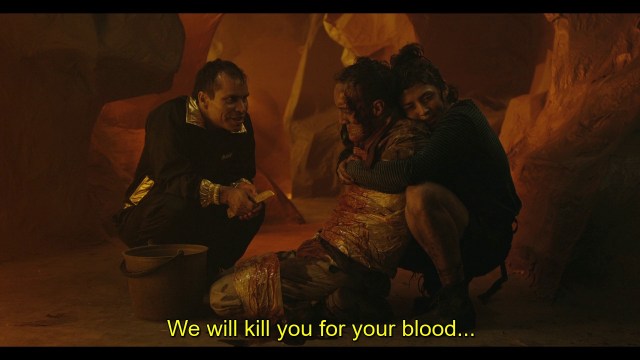
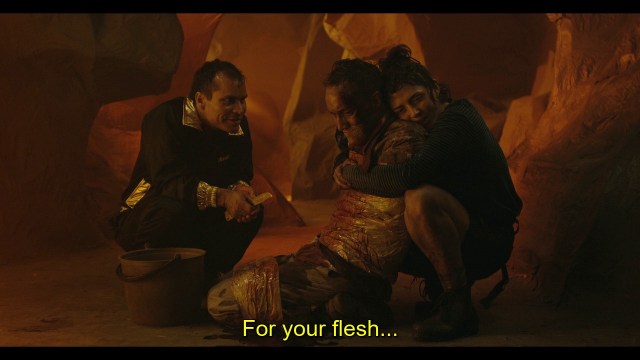
Anyway, we finally get to the cannibalism, about an hour into the film, as Mariano captures a soldier, tells him exactly what they have planned.

“We won’t kill you for money. We won’t kill you for an ideology. Or for the pleasure of watching you suffer. It’s not revenge for what you have done. We are neither avengers nor executioners.”

vlcsnap-00056.jpg

vlcsnap-00057.jpg

vlcsnap-00058.jpg

They sing the Mexican anthem and then slit his throat, catching his blood in a container. Various body parts are rendered into liquid and sealed into buckets, presumably to be traded through the hole in the wall.

Another girl comes into the maze looking for shelter, but is instead raped by Fauna and then Lucio.

vlcsnap-00070.jpg

Have we shattered every convention and broken every taboo yet?

vlcsnap-00022.jpg

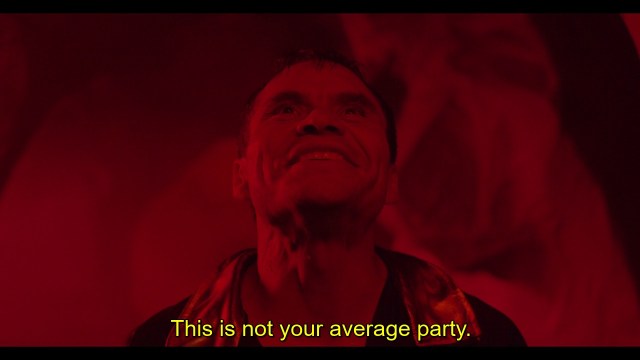
Not quite. Mariano celebrates his naming day, a party in which all sorts of weirdos turn up and get it on. Mariano is to be the guest of honour, but also the main course.

vlcsnap-00076.jpg

“It is also the day I’ll live inside your squalid bodies. Don’t forget that the spirit does not reside in our flesh. Flesh is the spirit itself! So I kindly ask that all you lowlifes devour me until there is nothing left.

vlcsnap-00082.jpg

vlcsnap-00083.jpg

vlcsnap-00090.jpg

There’s a twist at the end, but hey, enough spoilers. Go watch it – it’s only 80 minutes.

Catherine Bray in Variety called the movie a “joyously demented portrait of humanity.” She summarised the theme very well:

“Much of its most vivid imagery is purpose-built to interrogate the moral values society projects onto biological matter: human meat ground to a slush, slopping about in a bucket; a clitoral close-up; a pipette inserted casually into a hole in a boy’s temple; a sister’s gelatinous menses dripping into her brother’s mouth.”

The stubborn belief that humans, unlike other animals, have some sort of spirit that elevates us into the ranks of demi-gods and therefore justifies the havoc we unleash on the rest of nature has crumbled. As Mariano insists, flesh IS the spirit. We are meat, driven by our appetites. Our carefully crafted moral convictions can vanish like smoke in the face of hunger or desire.

vlcsnap-00024.jpg


Hansel and Gretel is a seminal cannibal text of course: innocents, abandoned for daring to expect to be fed, and left to face the voracious appetite of the outside world. Many of us probably first heard about cannibalism while sitting on a parent or relative or baby-sitter’s knee, crafting our next nightmare as they read us stories from the Brothers Grimm. Variants of the story are everywhere – a new movie is due soon (I’m looking out for it) called Gretel and Hansel. Here’s the trailer:

“What’s for dinner?” HANNIBAL Season 3 Episode 6, “Dolce” (Fuller, 2015)

“Some are born cannibals, some achieve cannibalism, and some have cannibalism thrust upon ’em. Thy Fates open their hands. Let thy blood and spirit embrace them.”
[With apologies to Shakespeare’s Twelfth Night]

This episode is, at last, a thorough exploration of cannibal theory. At this point, almost half way through the final season of Hannibal (unless our appeals and supplications are answered) we need to ask – who is a cannibal now, and did they achieve it or have it thrust upon ‘em?

Hannibal was almost born into it, apparently, fed, while quite young, some casserole made out of his sister Mischa; by Nazi collaborators in the books and films; by person or person as yet unknown (until Season 4?) in this television series. Jack, some members of the Baltimore Philharmonic who so enjoyed Hannibal’s hospitality, and quite a few others had cannibalism thrust upon them – they were “innocent” cannibals – fed human flesh while assuming it was, perhaps, a mature veal. Will Graham, on the other hand, seems to have achieved cannibalism, as a form of bonding with Hannibal. He killed the “cave bear” dude and probably took some of his flesh to Hannibal`s dinner party, pretending it was the journalist, Freddie Lounds. Yes, he was trying to fool Hannibal (always a foolish thing to do), but they ate it, and it bound them together.
vlcsnap-00092.jpg

And let’s not forget the wendigo mythology, which says that once you eat human flesh, you are destined to crave it forever more. Now, when Jack asks “Will you slip away with him?” Will replies,
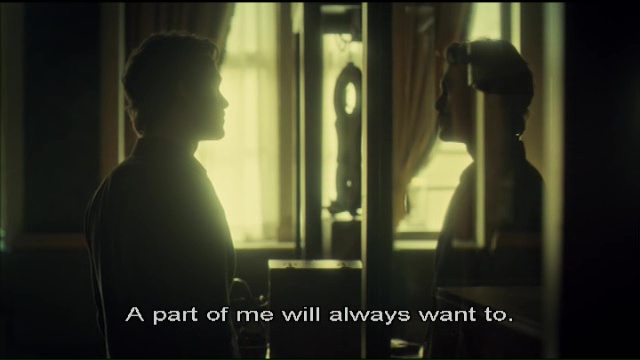
vlcsnap-00006.jpg

Hannibal is pretty upset about leaving Florence, and especially missing his planned feast – Bedelia. He tells her
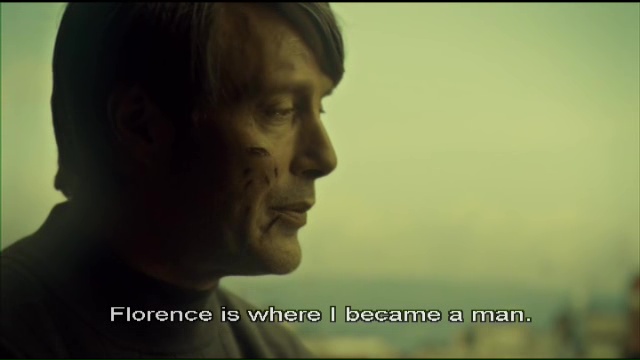
vlcsnap-00013.jpg

This refers to Il Mostro, the “Monster of Florence”, a real character who terrorised the city from 1974-85, killing couples as they had sex in their cars, and often cutting out the woman’s sexual organs, possibly for later consumption. He says he “sees my end in my beginning”, and Bedelia, who is becoming quite a Nietzschean herself, discusses the eternal recurrence:
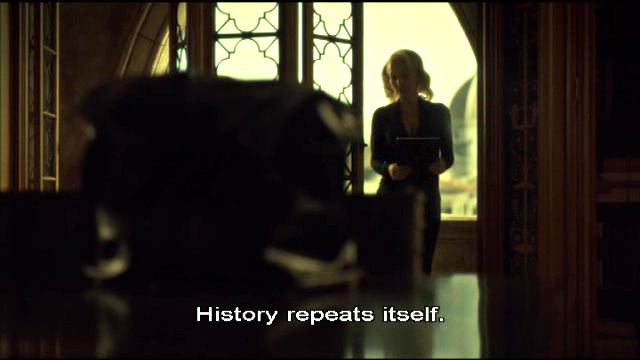
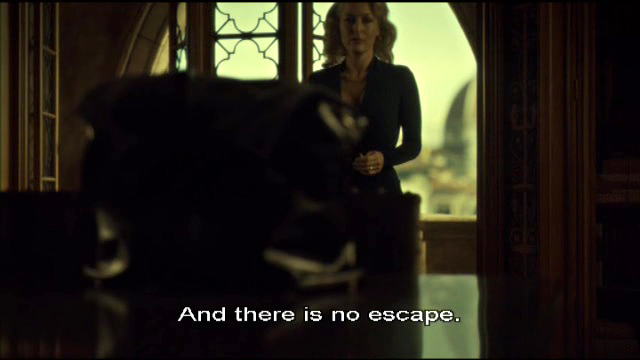
vlcsnap-00016.jpg

vlcsnap-00017.jpg

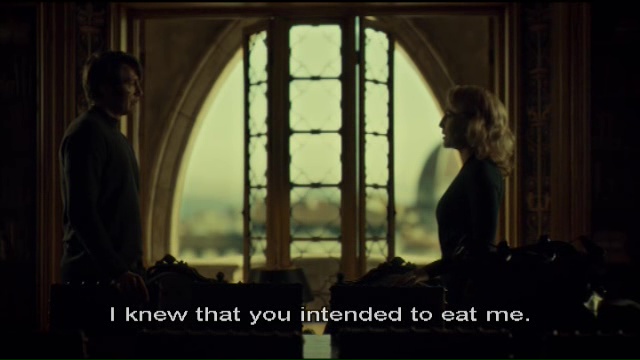
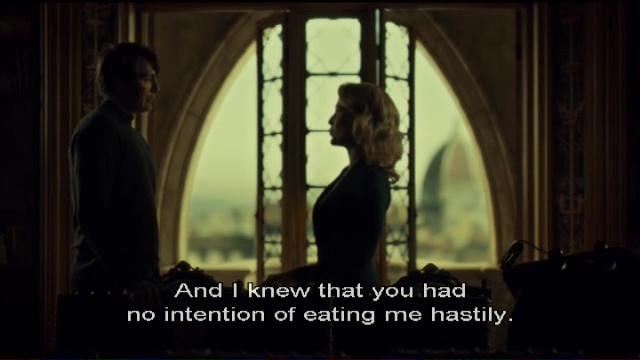
Bedelia has packed for a quick escape, but only for him. It’s not how Hannibal imagined their goodbye. She has outmanoeuvred him – probably the only character in the show who can.
vlcsnap-00022.jpg

vlcsnap-00023.jpg

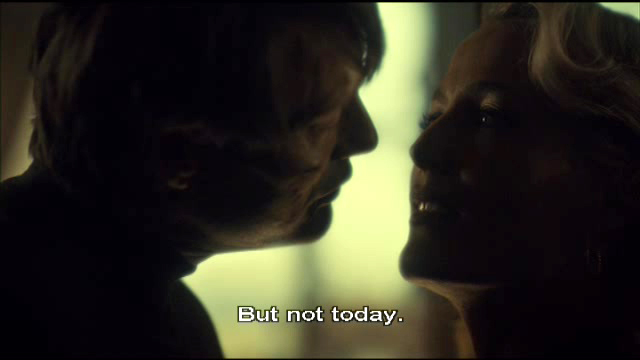
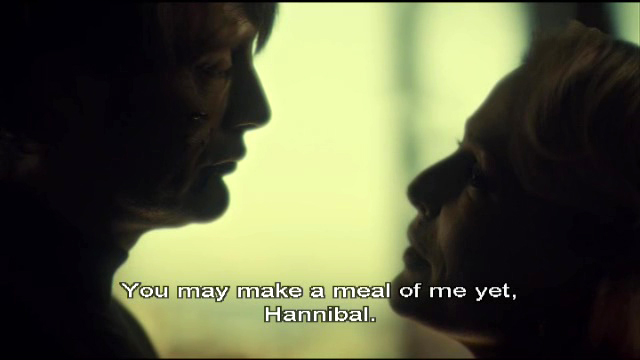
They exchange a rather chaste kiss; a taste, shall we say, of meals to come.
vlcsnap-00059.jpg

vlcsnap-00060.jpg

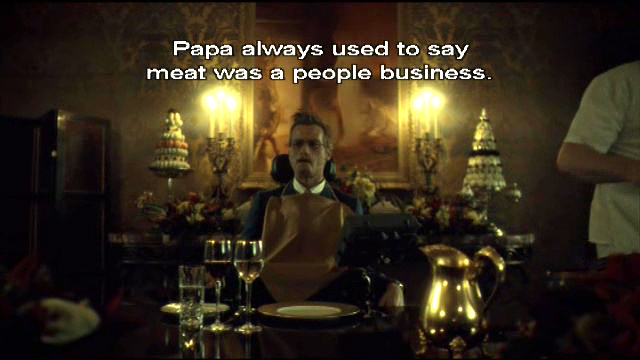
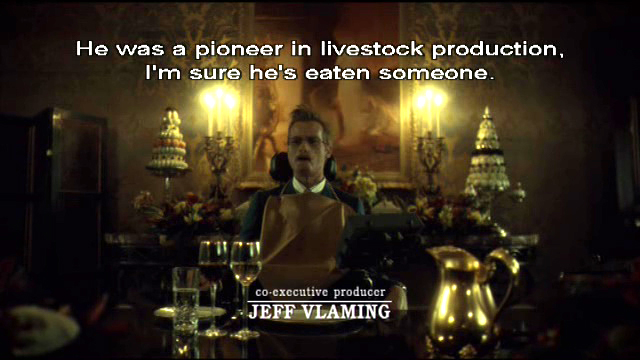
Meanwhile, back at Mason Verger’s estate, Muskrat Farm, Cordell is serving pig tails, cut to appear like human finger joints. They are planning to cook and eat Hannibal but, even for Mason, this is not an appealing prospect. Cordell has also made marrow in a similar shape, which Mason spits out into a Buddhist singing bowl, pointing out that Buddhists don’t eat meat (sic). Cordell replies:

“This isn’t meat. This is man.”

Not totally clear what the difference is (aren’t we made of meat?) but it’s bothering the hell out of poor Mason.
vlcsnap-00040.jpg

vlcsnap-00041.jpg

vlcsnap-00042.jpg

Mason is so old fashioned, so normative in his ethics! He is happy to molest children (even if the broken spine Hannibal gave him limits him to mental abuse). But Cordell tries to reassure him; eating Dr Lecter will make Mason

“the apex predator. We could Peking Duck him. You have to torture a duck to prepare it. Pump its skin up with air then glaze it with a hot honey and hang it by its neck until it dries.”

Mason dreams he is ambulant again, he dreams about Hannibal, who is pumped, glazed, hanged, and roasted until crispy.

vlcsnap-00052.jpg

vlcsnap-00054.jpg

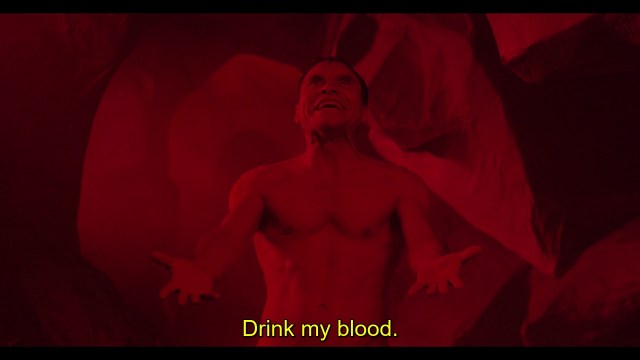
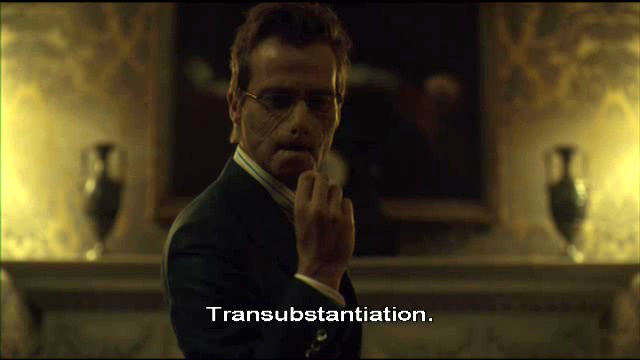
Yes, like Jesus turning the church wafers and wine into his body and blood, so Mason dreams of turning Hannibal into a Peking Duck. But he wakes to find Hannibal has killed his bounty hunter and escaped.

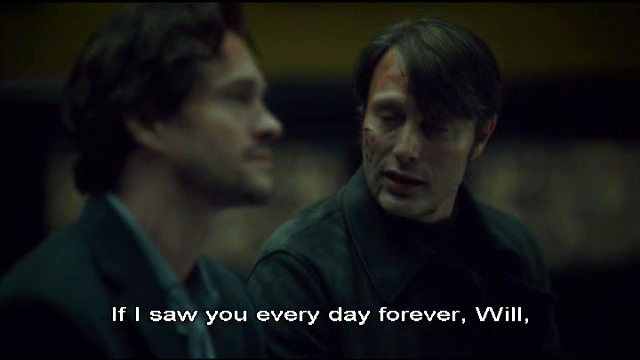
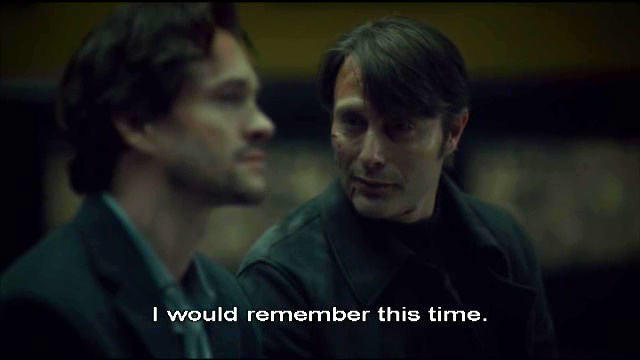
Hannibal, meanwhile, is in the Uffizi Gallery, sketching Botticelli’s Primavera, but substituting Will and Bedelia into the drawing. Will comes in from behind. It’s a touching reunion, almost a love scene, of two battered but unbowed warriors.
vlcsnap-00069.jpg

vlcsnap-00070.jpg

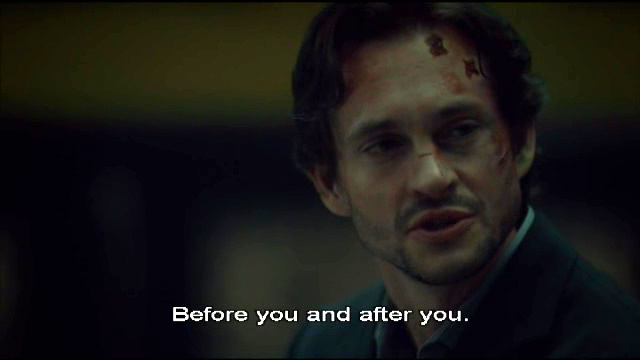
Hannibal asks Will where the dividing line is, for him, between past and future.
vlcsnap-00080.jpg

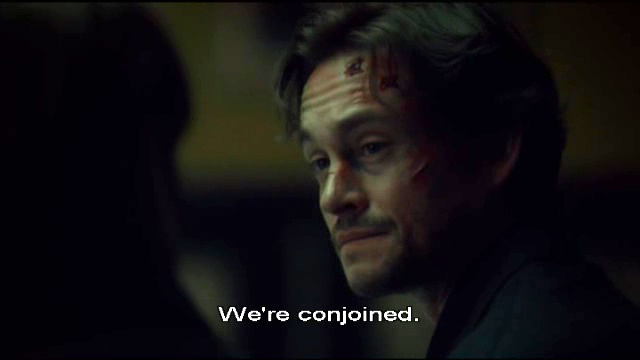
“Every crime of yours feels like one I am guilty of. We’re conjoined. I’m curious whether we can survive separation.”

It’s so tender! But it’s not totally a love scene. As they leave the gallery and cross the street, Will pulls a knife, prepares to kill Hannibal, but Chiyoh shoots him from the roof.

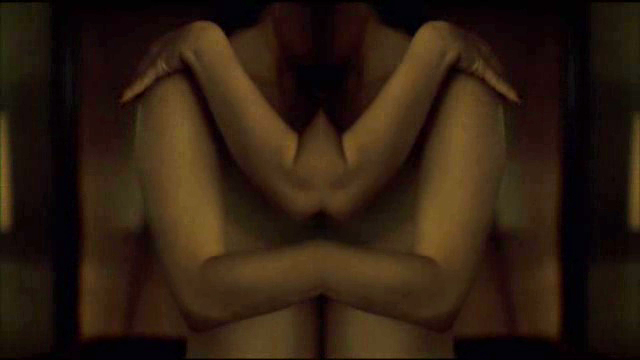
Margo and Alana are having a less complicated relationship, if somewhat more artistic.
vlcsnap-00099.jpg

vlcsnap-00100.jpg

vlcsnap-00104.jpg

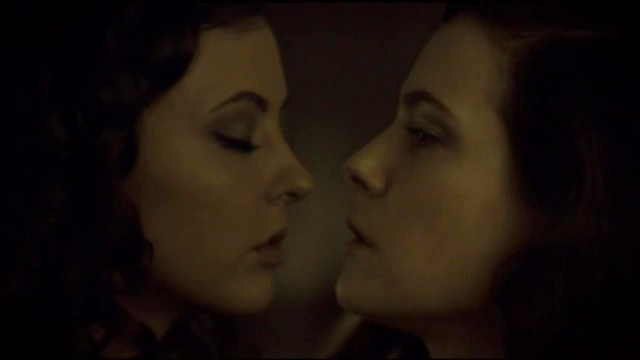
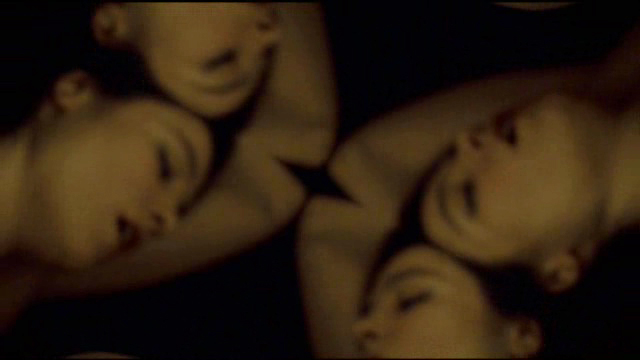
We are treated to a kaleidoscope of lesbian sex. But nothing is free. Margo wants to have a Verger baby, which will inherit the family fortune, but it’s tricky, since her brother had her uterus removed.
vlcsnap-00110.jpg

Hannibal removes the bullet from Will’s shoulder. The anaesthetic puts Will into a trance, during which we are treated to some more Nietzschean philosophy from both of them.

“Taste and smell are the oldest senses, and closest to the centre of the mind.”

“Parts that precede pity and morality.”

Will asks, “What’s for dinner?” Once again, we are treated to a kaleidoscope, but this time it’s Hannibal and Will.

vlcsnap-00130.jpg

Will wakes up strapped to his chair, at a long dining table. Hannibal is in a reflective, almost sentimental mood. He talks about all the things he is sorry to be missing by leaving Florence.

vlcsnap-00134.jpg

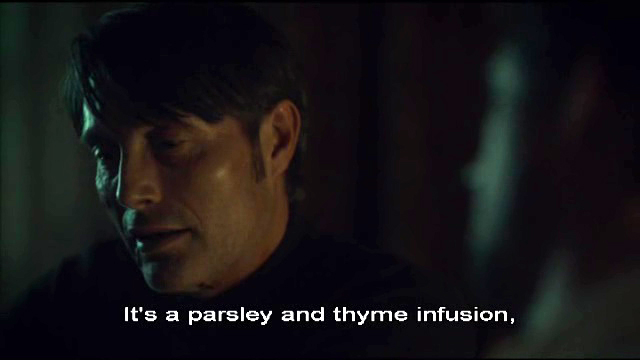
While they talk, he feeds Will from a soup tureen. Will is not impressed by the taste.
vlcsnap-00136.jpg

vlcsnap-00165.jpg

Yes, Will is getting ready for dinner – but as the main course.

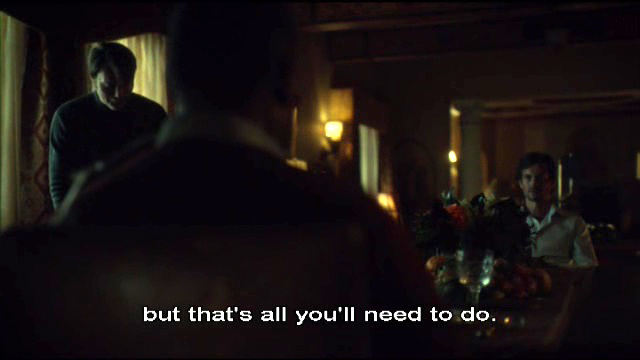
Jack appears with a gun, but Hannibal is under the table and cuts his Achilles tendons, disables him, drugs him and ties him to the chair to watch Bryan Fuller’s reimagining of the final scene of the book and movie Hannibal. You may remember Hannibal, in those days almost unimaginable as anyone but Anthony Hopkins, sawing off the cranium of Paul Krendler, a very rude person who had ruined Clarice Starling’s career, and cooking his frontal lobes. Well, this time, it’s Will. Jack is invited to dinner too. Hannibal tells him

“I’ve taken the liberty of giving you something to help you relax. You won’t be able to do much more than chew.”
vlcsnap-00144.jpg

Hannibal unpacks an electric surgical saw, telling Will,

“Jack was the first to suggest getting inside your head. Now we both have the opportunity to chew quite literally what we’ve only chewed figuratively.”

Hannibal starts sawing off the top of Will’s skull. Blood runs down, turning Will into a figure reminiscent of Jesus with the crown of thorns.

vlcsnap-00158.jpg

But even the best laid plans of mice and cannibals gang aft a-gley. We see pig carcasses hanging from hooks. We see Will and Hannibal, also hanging upside-down. Mason rolls in.

“Gentlemen. Welcome to Muskrat Farm.”

Yet another dinner is in preparation. This time, Hannibal is to be the main course.

Dexter is delicious: “What’s Eating Dexter Morgan?” DEXTER Season 8 Episode 3

00 title.jpg

Dexter is a television series that ran for 96 episodes from 2006-13. This episode is from the final season, and is the only one to feature a cannibal, which seems like a pretty shocking oversight really.

Dexter Morgan (Michael C. Hall, who played David Fisher in Six Feet Under) is a serial killer who also works as a blood spatter technician for the Miami metro police. There’s a lot of analysis of how he got that way (didn’t help that he saw his mother chopped up with a chainsaw when he was little) but, as he is not the cannibal in this tale, we don’t have to concern ourselves too much about that. Interesting to note, though, that although he is presented as a psychopath, he is often shown to have emotions and feelings that might not result in that diagnosis. In fact, Dexter only kills very bad people (just as Hannibal Lecter mostly only kills very rude ones) so he is really more a vigilante than a psychopath, and is motivated by a sense of justice that the Nietzschean Dr Lecter might find laughably absurd. We would have to conclude that both, however, are trying to improve the world by removing objectionable characters from its surface.

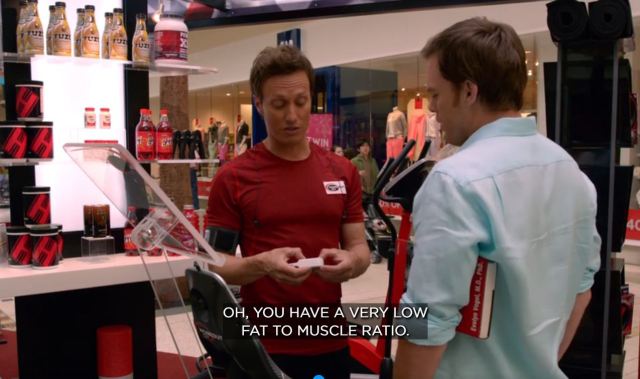
Dexter follows a suspect, Ron Galuzzo (Andrew Elvis Miller), to the mall where he sells exercise equipment. Galuzzo measures Dexter’s body/fat ratio, a wink to what we are about to find out about the dude and his culinary interests.

02 very low fat to muscle.JPG

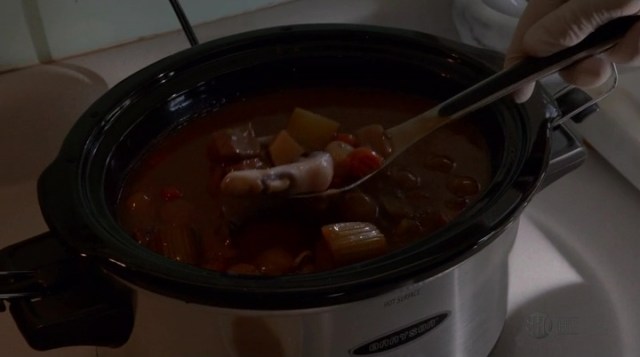
Dexter breaks into Galuzzo’s house and it’s a mess, except for the kitchen, which is clean and spotless. Dexter opens a crock pot and finds a finger in the stew. Dexter is horrified, because I guess serial killers are not used to seeing body parts. Or perhaps Dexter is secretly a vegan.

vlcsnap-00005.jpg

vlcsnap-00004.jpg

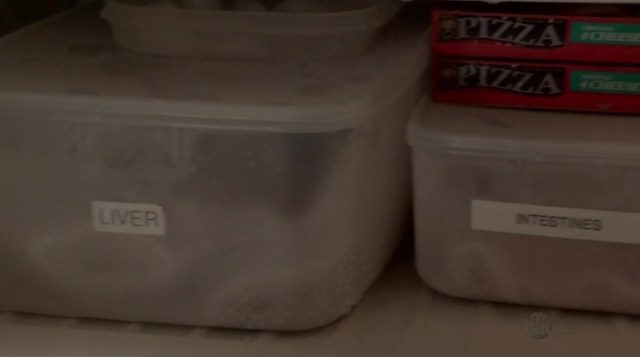
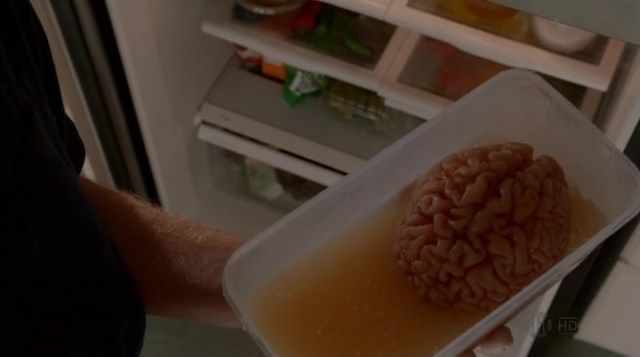
In the fridge, Dexter finds plastic containers containing various body parts. One of them holds a whole brain marinating in a garlic sauce.

vlcsnap-00007.jpg

vlcsnap-00009.jpg

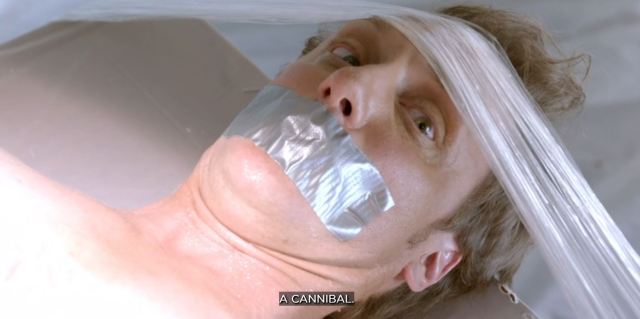
Dexter has a killing ritual, in which the victim is bound and gagged; in this case, it takes place in Galuzzo’s kitchen.

11 Disgusting.JPG

12 cannibal.JPG
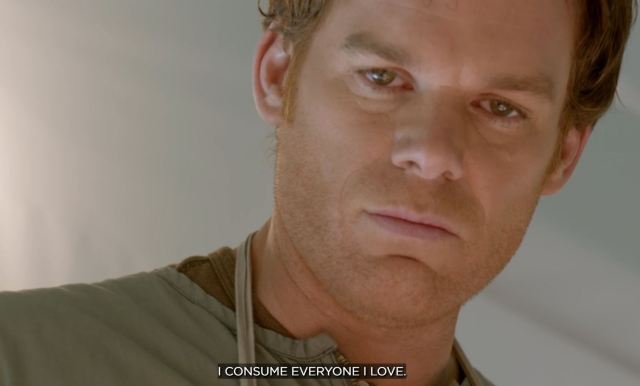
He first lectures Galuzzo on the evils of cannibalism (bit of a nerve from someone whose hobby is slicing people up) then admits that he thinks that he and Galuzzo are alike, because

15 consume everyone I love.JPG

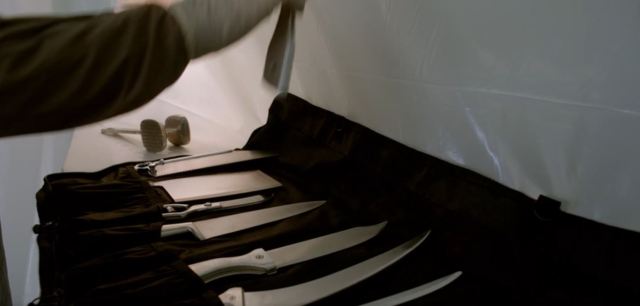
Of course, Dexter has a rather better set of knives than most cannibals.

16 knives.JPG

Galuzzo is the only cannibal featured in the TV series, which is all based around the first book of an entertaining and highly amusing series of eight novels by Jeff Lindsay. A quite different case of cannibalism is featured in the fifth novel, Dexter is Delicious (2010). In the book, Dexter faces a coven of cannibals who eat (sometimes willing) victims in a Dionysian romp.

Image result for dexter is delicious

The story revolves around Dexter and his sister, Deb, trying to save a young girl who doesn’t want to be saved; she wants to be eaten. I shall leave the cannibal unnamed in this extract, so as not to be accused of spoilers.

“Some of them do. They want to be eaten – just as much as I want to eat them…. Almost makes you believe in a benevolent God, doesn’t it?”

The book (IMHO) offers a much better cannibal story than the one in this episode, and we can only wish that the television gods had adapted it instead of this rather insipid character who presents no real challenge to Dexter, beyond offending his delicate sensibilities. Maybe Legal forbade it. Fine to tie a cannibal up, abuse him and slaughter him, but to eat someone who wants to be eaten? Now there’s an ethical dilemma for our times.

vlcsnap-00001.jpg